
Lecture IV
Phonology
November 6th, 2008

Structure of the talk
• Definition of phonology
• Levels of phonological analysis
• Phonological features
• Phonemes vs. allophones
• Complementary distribution and free
variation
• The structure of the syllable
• Phonotactics (SSP, OSDP)

Definition of phonology
• The component of a grammar
made up of the elements and
principles that determine how
sounds pattern in a language
• The study of how sounds structure
and function in various languages

Units of phonological
analysis
• The word – the smallest meaningful unit of
language
• The syllable – a unit of linguistic structure
that consists of a syllabic element and any
segments that are associated with them
• Speech segments – speech sounds (bundles of
features)
• Phonological features – the smallest units of
phonological analysis that can be thought of
as individual articulatory characteristics of a
segment, e.g. [+nasal] or [- voice]
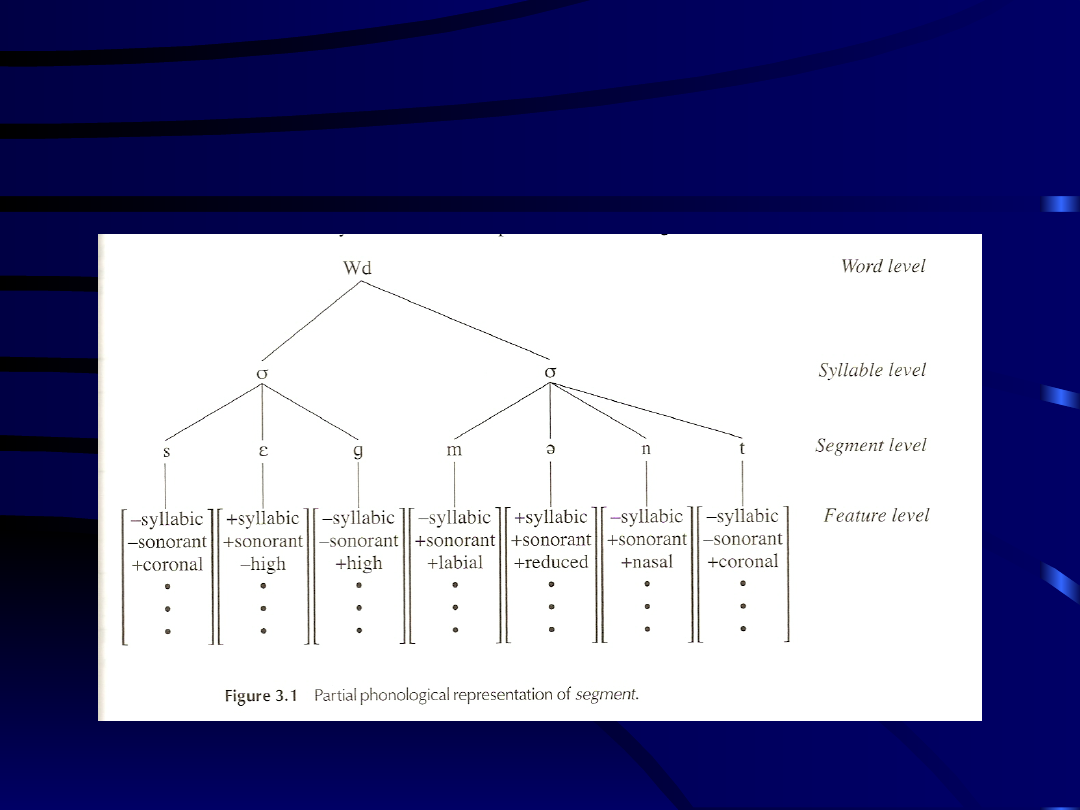
The hierarchy of phonological
analysis
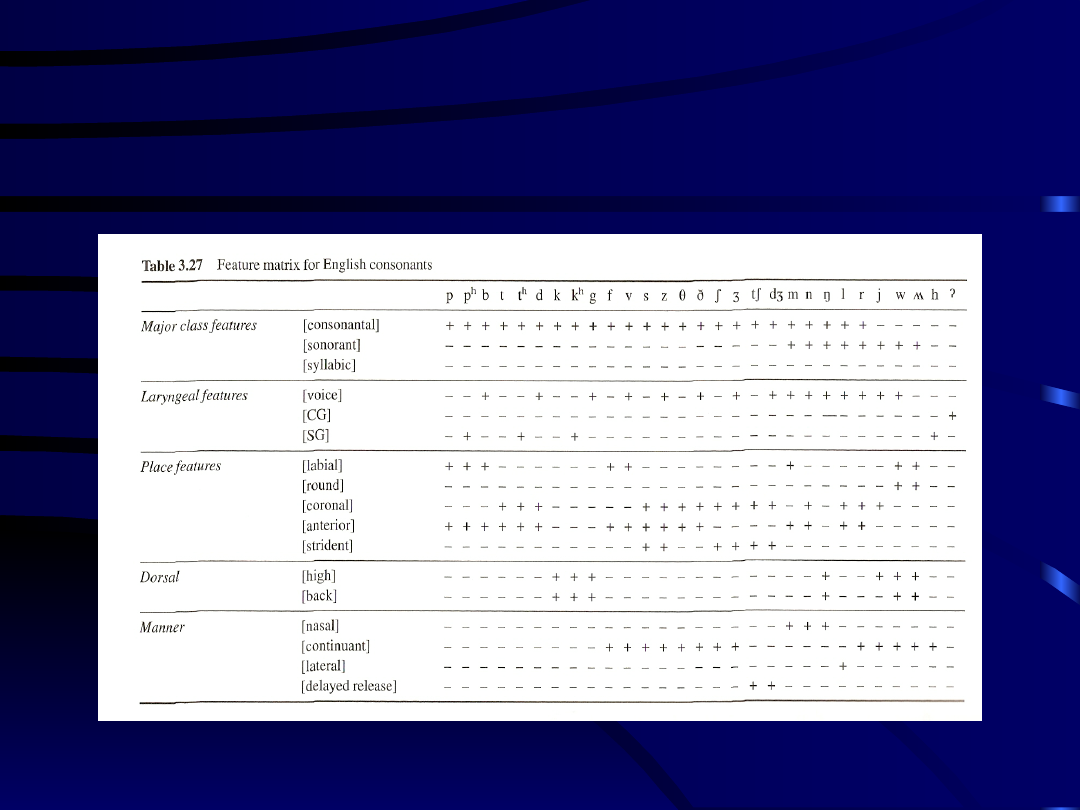
Feature matrix for English
consonants
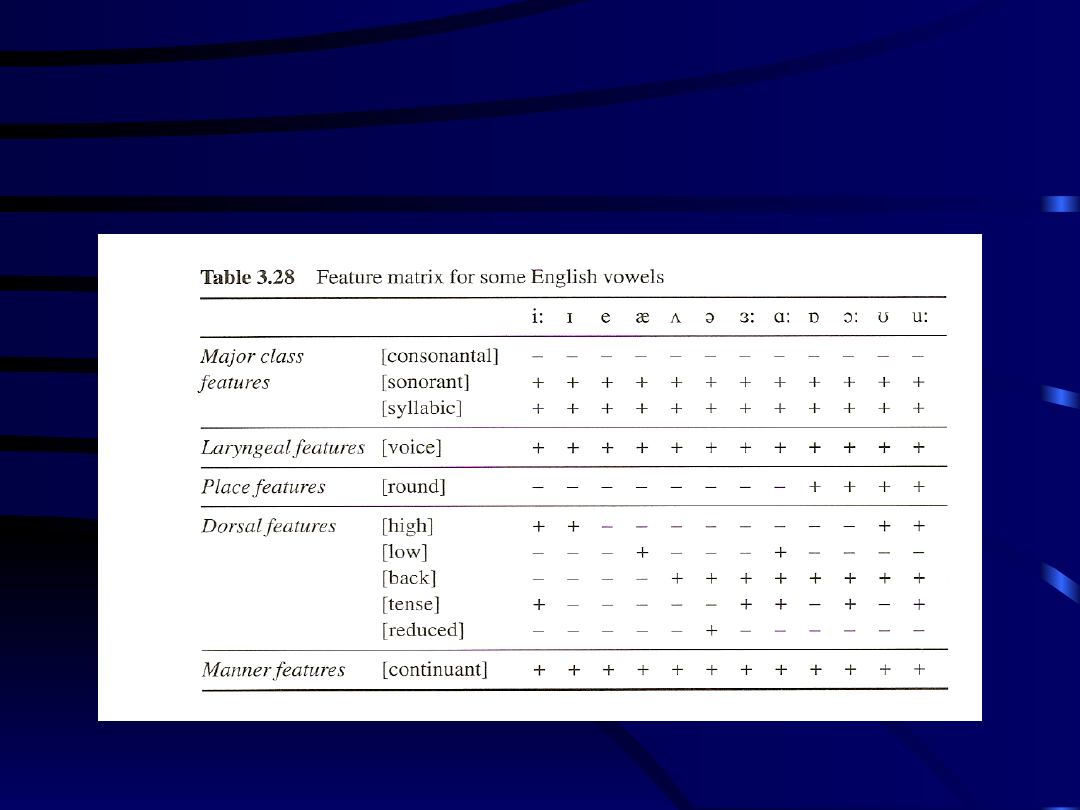
Feature matrix for English
vowels

Phonemes
• Phonemes – distinctive speech
units, that is, those which are
capable of distinguishing
words of different meanings.

Minimal pair test
• English
• bead – bid – bed –
bad
• pray – play
• take – cake
• back – bag
• Polish
baty – buty – bity
skradać – składać
kot – pot
żal - szal
luźne gadki – luźne
gatki

Allophones
• Allophones – actual realisation of a
given phoneme, particularly one
predictable from its phonological
context
• [] vs. []
• [] vs. []
• []

Aspiration
• Aspiration – voiced interval consisting
of strongly expelled breath between the
release of the plosive and the onset of
the following vowel.
• [], [], []
• Aspiration is the strongest in accented
syllables
• Aspiration doesn’t occur when the
plosive follows // as in spin, skin, stake

Nasal release
• When a plosive is followed by the
homorganic nasal, it is usually
released through the nose.
• [] – sudden
• [] – submerge
• [] - thicken

Lateral release
• bottle [
• kettle []
• shuttle []

Neutralisation
• When a sound may be assigned to
two different phonemes the contrast
between them is neutralised.
• Words beginning with /sb-, sd-, sg-/,
are not contrasted with words
beginning with /sp-, st-, sk-/
• The nasals /m/ and /n/ before the
bilabials /f, v/, e.g. symphony, infant

Complementary
distribution
• Two allophones are said to be in complementary
distribution when they are found in mutually
exclusive environments. In other words, they
are conditioned by the phonological context.
• Examples: // - //
// - //
// - //
// - //, //
// - //

Free variation
• When two different allophones appear
in the same phonological context
without changing the meaning of a
word, they are said to be in free
variation.
• Examples: // - / /
// - //
// - //
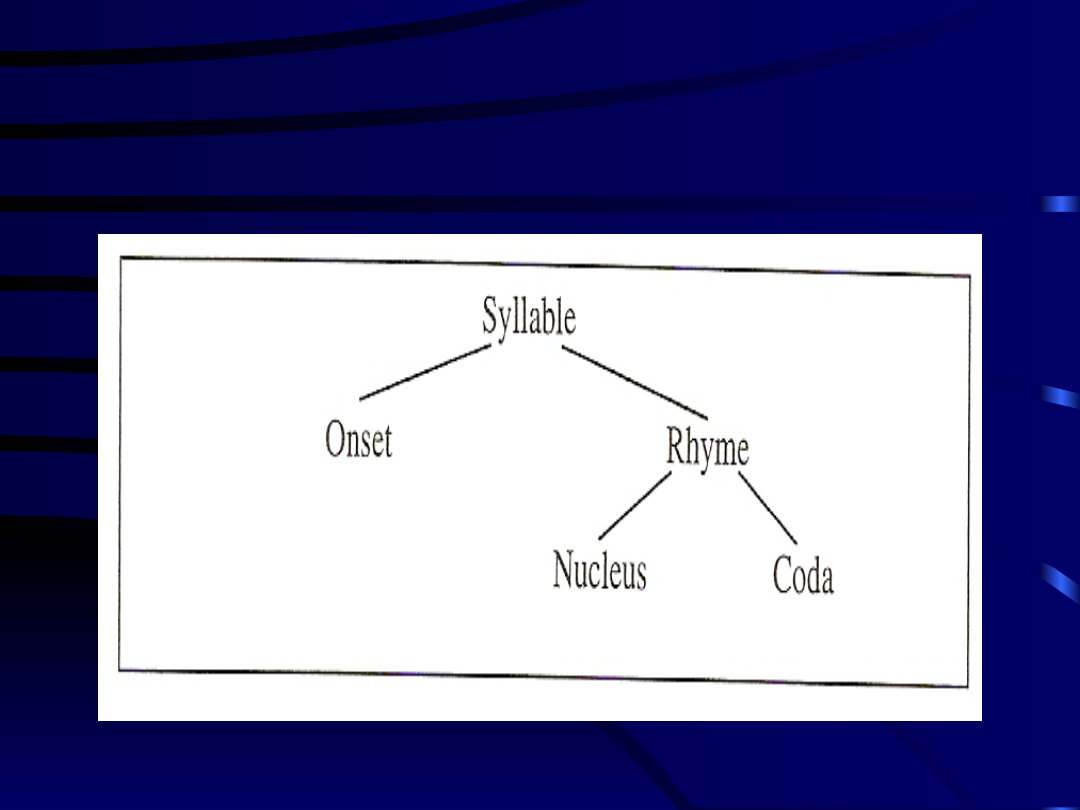
Syllable structure

Phonotactics
• The set of constraints on how sequences of
segments pattern (70% of the world’s
languages only allow CV syllables).
• A branch of phonology that investigates
permissible sequences of consonants in word-
initial, word-medial and word-final clusters.
• Accidental gaps – non-occurring but possible
forms of a language.
• Systematic gaps – gaps in the occurring
syllable structures of a language that result
from the exclusion of certain sequences

Language-specific
constraints
• English –
maximally
three segments
in the onset.
• //
• /,,/
• /, , , /
• Polish – up to
four segments
in the onset,
e.g. /-/,
/-/, and up to
five elements in
the coda, e.g.
/-/

The Sonority Scale(s)
• The organisation of segments in clusters is believed
to be driven by principles of sonority.
• Sonority – perceptual salience or the relative
loudness of a sound which correlates with the
degree of openness of the vocal tract involved in its
production.
• A sonority hierarchy is formed by assigning a
sonority value to each sound category.
vowels > glides > liquids > nasals > fricatives > (affricates) > stops
low vowels > mid vowels > high vowels > glides > nasals > obstruents
G > L > N > O

The Sonority Sequencing
Principle
• More sonorous segments tend to stand
closer to the syllable peak than less
sonorous ones (Sievers 1881, Jespersen
1904)
• Well-formed doubles: //, //, //, /
• Well-formed triples: //, //
• Ill-formed doubles: //, //, //
• Ill-formed triples: //, //, //

The Optimal Sonority
Distance Principle
• Clusters, in order to survive, must be
sustained by some force counteracting
the overwhelming tendency to reduce
towards CV
• The force is explained in terms of
sonority distances between
neighbourng segments.
• The distances are not expected to be
maximal or minimal, but to be optimal

Word-initial doubles
• C1C2V - |son(C1) – son(C2)| ≥ |
son(C2) – son(V)|, i.e. sondis (C1,C2) ≥
(C2,V)
• In word-initial doubles, the sonority
distance between the two consonants
should be greater than or equal to the
sonority distance between the vowel
and the consonant neighbouring on it.
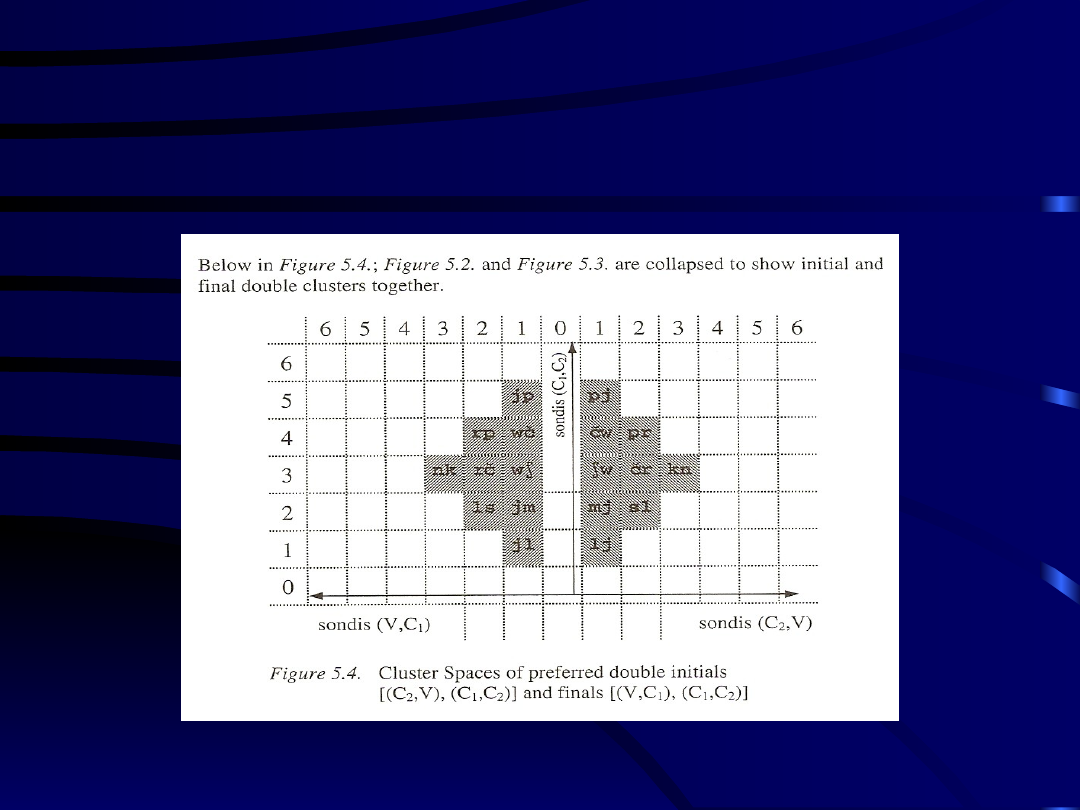
Word-initial doubles

Word-initial triples
•
C1C2C3V - |son(C1) – son(C2)| < |son(C2) –
son(C3)| ≥ |son(C3) – son(V)|,
i.e. sondis (C1,C2) < sondis(C2, C3) ≥ sondis
(C3,V)
For word-initial triples, the distance between
the third consonant and the second should
be greater than or equal to the distance
between this third consonant and the beat,
and greater than the distance between the
second and the first consonant.
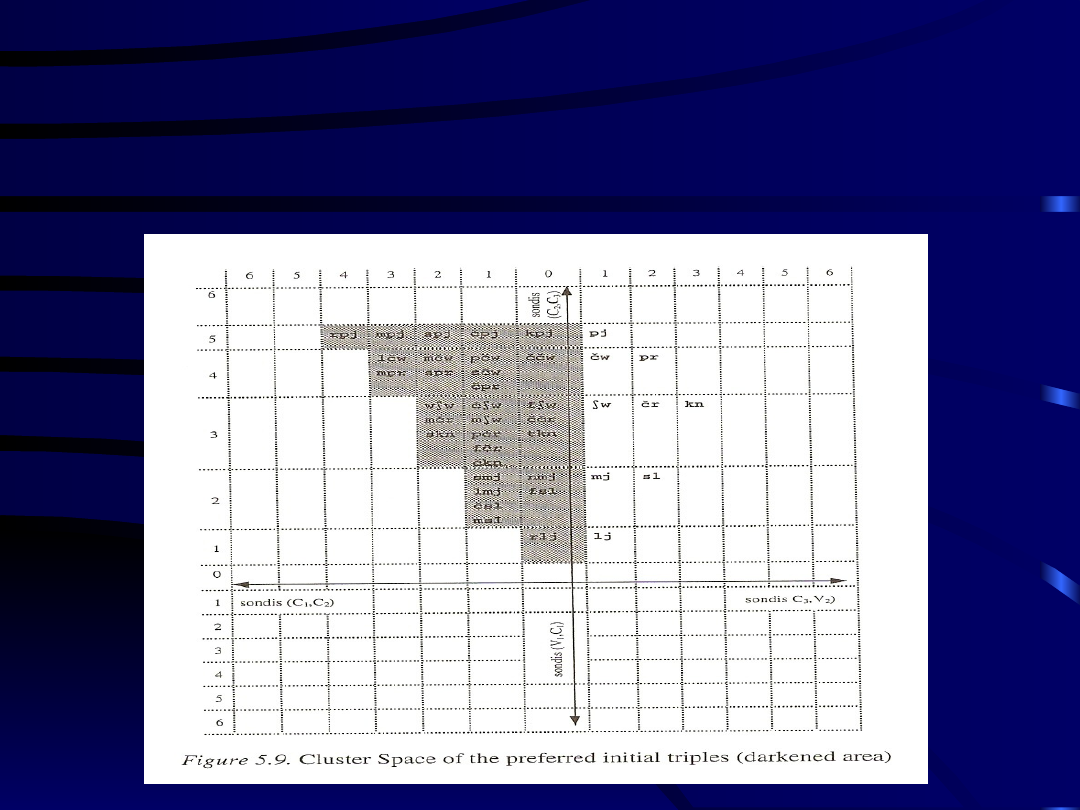
Word-initial triples

Bibliography
• Dziubalska-Kołaczyk, Katarzyna. 2002. Beats-and-
biding phonology. Frankfurt: Peter Lang.
• O’Grady, William – Dobrovolsky, Michael – Katamba,
Francis. (1996). Contemporary linguistics. London:
Pearson Education Limited.
• Hyman, Larry. 1975. Phonology: theory and analysis.
New York: Holt, Rinehart and Winston Inc.
• Sobkowiak, Włodzimierz. 2001. English phonetics for
Poles. Poznań: Wydawnictwa Poznańskie.
Document Outline
- Slide 1
- Slide 2
- Slide 3
- Slide 4
- Slide 5
- Slide 6
- Slide 7
- Slide 8
- Slide 9
- Slide 10
- Slide 11
- Slide 12
- Slide 13
- Slide 14
- Slide 15
- Slide 16
- Slide 17
- Slide 18
- Slide 19
- Slide 20
- Slide 21
- Slide 22
- Slide 23
- Slide 24
- Slide 25
- Slide 26
- Slide 27
Wyszukiwarka
Podobne podstrony:
Lecture IV
Lecture VI Phonological processes
3 Intro to lg phonol LECTURE201 Nieznany
Lecture V Phonological processes
Phonetics and phonology IV
IR Lecture1
wyklad IV
uml LECTURE
Mała chirurgia II Sem IV MOD
lecture3 complexity introduction
Temat IV 2 2
Pr UE Zródła prawa (IV 2013)
IV lek leczenie wspomagające w onkologii Żywienie
IV NIPiP Zmiany w podsystemie
IV 1 2 Atrybuty Osobow
więcej podobnych podstron