
Lecture V
Phonological processes
November 13th, 2008

Structure of the talk
•
Phonostylistics
•
Phonological processes vs.
phonological rules
•
The role of features in
phonological processes
•
Unordered and feeding rule
application

Phonostylistics
•
Phonostylistics – the phonological
processes that are conditioned by
speaking style i.e., style-sensitive or style-
dependent ones.
•
emphatic – formal – informal
•
Underlying form (intention) is a mental
representation of a word or phrase (style-
independent)
•
Surface form – the actual realisation of a
given word or phrase (style dependent).

Phonological processes
•
A phonological process is “a mental
operation that applies in speech to
substitute, for a class of sounds or
sound sequences presenting a specific
common difficulty to the speech
capacity of the individual, an
alternative class identical but lacking
the difficult property.”
(Stampe 1979:
1).

Features of phonological
processes
•
Phonological processes are inborn,
natural, universal and mental
•
The full repertoire of phonological
processes is available to the child at the
very beginning of the acquisition period.
•
The processes undergo supression,
limitation and ordering
•
Processes are believed to be
phonetically motivated

The functioning of phonological
processes
•
Underlying representation / / Adult form
b Denasalisation
p Devoicing of final consonant
Gliding
Frication
Processes Stopping
Labial assimilation
Neutralisation
Surface form / / Child’s form
Adapted from Shriberg – Kwiatkowski (1980: 11)

Phonological rules
•
Phonological rules are conventions that have
to be learned and observed by all speakers of a
language
•
Phonological rules are basically morphological
•
Phonological rules can
-
change features of segments
-
delete segments
-
insert segments
-
coalesce segments
-
permute or interchange segments (metathesis)

The processes/rules dichotomy
•
Processes:
•
possess synchronic
phonetic motivation
•
are inborn
•
apply subconsciously
only their absence is
noticeable
•
are exceptionless
•
apply to slips of the
tongue, loan word etc.
•
may be obligatory or
optional
•
Rules:
•
have no synchronic
motivation, but possess
a grammatical function
•
have to be learned
•
are formulated through
observation
•
tolerate exceptions
•
are not productive
•
are obligatory, style-
independent

Examples of processes and rules
•
Lenitions – context-
sensitive (weakening
processes):
-
assimilation
-
deletion
-
reduction
-
monophthongisation
•
Fortitions – contex-free
strengthening processes:
-
onset strengthening
-
dissimilation
-
insertion
-
diphthongisation
•
Rules:
•
velar softening:
// - //
/ - /
// - //
// - //
•
the // - // alternation in Polish
// - //
•
irregular verb forms
// - //

The form and notation of rules
•
A→B/X_Y
•
A becomes B between X and Y
•
Chomsky and Halle – The sound
patterns of English
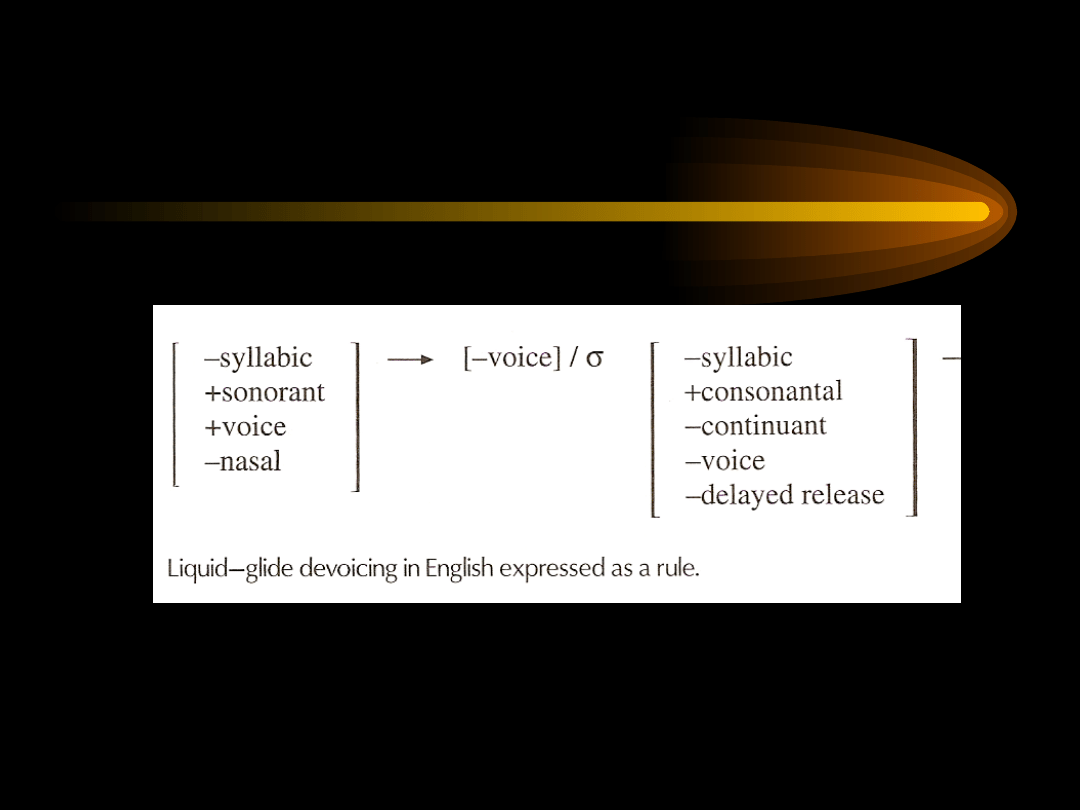
The role of features in phonological
processes

The feeding order of rule
application
•
The application of one process
creates an environment that
makes possible the application of
another process that could
otherwise not apply, eg. vowel
deletion and liquid devoicing in
parade, police, etc.

Unordered processes
•
Two rules are said to be
unordered when the order in
which they are applied makes no
difference to the outcome, i.e.
They do not interact or affect each
other in any way, e.g. vowel
lengthening and aspiration as in
the word //
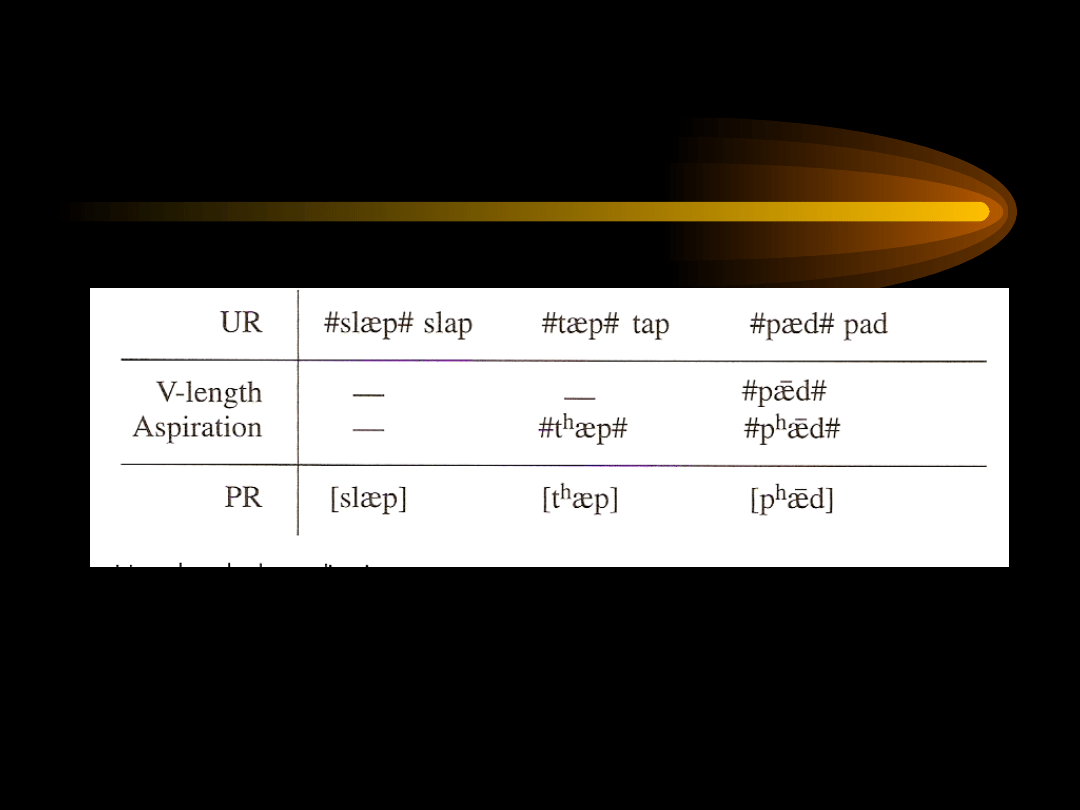
Unordered processes

Bibliography
•
Dziubalska-Kołaczyk, Katarzyna. 2002. Beats-and-
biding phonology. Frankfurt: Peter Lang.
•
O’Grady, William – Dobrovolsky, Michael – Katamba,
Francis. (1996). Contemporary linguistics. London:
Pearson Education Limited.
•
Hyman, Larry. 1975. Phonology: theory and analysis.
New York: Holt, Rinehart and Winston Inc.
•
Sobkowiak, Włodzimierz. 2001. English phonetics for
Poles. Poznań: Wydawnictwa Poznańskie.
•
Shriberg, Lawrence – Kwiatkowski, Joan. 1980. Natural
process analysis. New York: John Wiley & Sons.
•
Stampe, David. 1979. A Dissertation on Natural
Phonology. New York: Garland.
Document Outline
- Slide 1
- Slide 2
- Slide 3
- Slide 4
- Slide 5
- Slide 6
- Slide 7
- Slide 8
- Slide 9
- Slide 10
- Slide 11
- Slide 12
- Slide 13
- Slide 14
- Slide 15
Wyszukiwarka
Podobne podstrony:
Lecture VI Phonological processes
Phonological processes
types of phonological processes 2
3 Intro to lg phonol LECTURE201 Nieznany
Lecture IV Phonology
Lecture IV Phonology
W4 Proces wytwórczy oprogramowania
WEWNĘTRZNE PROCESY RZEŹBIĄCE ZIEMIE
IR Lecture1
Proces tworzenia oprogramowania
uml LECTURE
Proces pielęgnowania Dokumentacja procesu
19 Mikroinżynieria przestrzenna procesy technologiczne,
4 socjalizacja jako podstawowy proces spoeczny
więcej podobnych podstron