
ERRATA
February 2011 update in
blue
and
green
Page 14 Infantry and Cavalry Order
Close Order is the default order type for all infantry units, and all cavalry and camel riders whose
mounts are equipped with barding.
Page 19 Movement
Item 2 Rally Fleeing Troops (p30) Should read: “If any of your troops are fleeing you must attempt to
rally them now”.
Page 21 Encumbrance
The chart on page 21 is correct. The summary on page 96 should say “Infantry with an armour save of
3+”
Page 22 Adding/Deducting Ranks
When adding ranks, each rank gets narrower and the figures released move to the back. When
deducting ranks, the rear rank disappears and the figures released move onto the ends of the forward
ranks. The middle of the unit’s front rank remains stationary, and remains the front rank. The unit does
not get closer to or further from the enemy during this process. The diagrams on page 22 are incorrect.
Page 30 Rallying Fleeing Units
The first sentence should read “ A player must attempt to rally fleeing units in the allotted part of the
movement phase by taking and passing a Rally Test.”
Page 31 Charge Responses
Countercharge
Alter first sentence to read “If a cavalry or light chariot unit is charged to the front by an enemy cavalry
or chariot unit that it can see then it can respond by a countercharge.” Add at end of paragraph:
“Elephants, Cataphracts and heavy chariots cannot countercharge.”
Flee and Fire & Flee
If a unit’s flee move is insufficient to escape the chargers’ full movement allowance, move the fleeing
troops the distance thrown and then move the chargers into contact with them. The fleeing unit is
automatically destroyed in the melee phase, and panic tests are caused as usual.
Page 39 Countercharges
Alter first sentence to read “If a cavalry or light chariot unit is charged to the front by an enemy cavalry
or chariot unit that it can see then it can respond by a countercharge.”
Page 42 Who Can Shoot
Troops who march or fast march are unable to shoot that turn.
Page 60 Combat Results Bonus
+1 Rank Bonus
The bonus is based on the number of complete ranks at the start of the round of combat.
Page 62 How Far Does the Unit Flee?
Second paragraph should read “Before throwing dice to determine how far the unit flees, establish
whether the victorious enemy will pursue”.
Page 66 Giving Ground
Troops following up an enemy that Gives Ground do not change their formation and will contact any
other enemy that lie in the path of their advance. Such a contact will count as a charge, even though
their combat with their original opponents counts as ongoing.
A unit is not prevented from Giving Ground if the only enemy behind it is a character or characters, or
less than five skirmisher figures. In this case the “blocking” figures are moved back to remain at least
1” away.
Page 78 Skirmishers and Leadership Tests

Add new paragraph:
Skirmishers are also not affected by any special rules applying to a character that joins their unit, such
as Hatred or immunity to psychology.
Page 82 Characters
If a single character flees from hand to hand combat, or as a result of a panic test, it is allowed to
attempt to rally in the same way that a unit would.
A single character does not have to take a panic test due to proximity to breaking or fleeing
skirmishers.
If a character with the Warband ability joins a unit that is not Warband, the character does not take
Warband tests while he remains with the unit, in the same way that the unit psychology overrides that
of the character.
Page 98 Buckler
Models wearing heavy armour and carrying a buckler do not suffer any movement reduction.
Page 103 Stubborn
A unit depends on its own self-confidence for its Stubborn ability. Even if it has used its special Give
Ground ability under Stubborn rule 2, it still retains the benefit of Stubborn rule 1. It remains Stubborn
until it has fled from combat, at which point it no longer has sufficient self-belief to count as Stubborn
and irretrievably loses all the benefits of the rule.
Page 105 Combined Formation
Sometimes a Combined Formation will mix troops who are Stubborn with troops who are not, with the
Stubborn troops in a minority. When such a unit first needs to use a part of the Stubborn ability in a
game, throw a D6; on a result of 1-3 the restless and fearful mutterings from the back have sapped the
will of the better troops, and the unit does not count as Stubborn; on a result of 4-6 the sterling example
of the front ranks has stirred the souls of those behind, and the unit will count as Stubborn. This result
stands for the remainder of the game.
Page 107 Feigned Flight
Paragraph 5 now reads:
In situations where a unit with feigned flight is charged by an enemy it fears, the unit does not need to
take a fear test if it wishes to use feigned flight and its basic move distance is longer than that of the
enemy unit charging it. If this is not the case, or if the charging enemy terrifies it, then it can only make
a feigned flight if it passes its Fear or Terror test, and if it fails the test it can only flee.
Page 108 Ferocious Charge (First Charge)
Add at end:
Troops beaten by a ferocious charging unit in combat may use the Give Ground rule if they outnumber
the chargers by 2:1.
Page 109 Special Rules
Mixed Weapons
Troops armed with mixed weapons may re-roll any failed to hit rolls once in the first round of combat.
Mixed weapons are defined as being armed with a hand weapon, such as a sword, axe or short spear,
and javelins, so they may shoot with these in the Shooting phase.
Page 110 Phalanx Formation Rules
Rule 3: Enemy fighting against the front of a phalanx in hand-to-hand combat suffer a penalty to hit.
This is a –2 penalty if the enemy are cavalry or light chariots, and a –1 penalty if the enemy are foot
troops, heavy chariots or elephants.
Page 112 Shieldwall
A unit in Shieldwall, that follows up when its enemy Gives Ground in combat, retains the Shieldwall.
Page 113Warband
When a warband rolls a 1 for its test, it must charge the nearest visible enemy within charge reach. If
its charge cannot reach that enemy, or would fail for another reason, then the warband must charge the

next nearest visible enemy within charge reach, and so on. If there is no visible enemy within charge
reach, then it advances towards the nearest visible enemy.
A Warband loses its Leadership bonus for ranks in the same circumstances as it would lose its combat
resolution bonus for ranks.
Page 116 Impact Hits
The removal of a scythed chariot as a collision casualty does not cause a panic test for friendly troops-
it is only what they expected to happen!
Page 117 Chariots and Shooting
Troops armed with longbows can shoot once from a chariot each turn even if the chariot moves. The
longbow should not have been included with “other weapons that are disallowed from moving and
shooting”.
Page 120: Elephants
An elephant enjoys an armour saving throw of 4+ against shooting or combat wounds inflicted from
the front only. This can be improved to 3+ by the addition of barding, if available.
Page 121 Elephants and Shooting
Troops armed with longbows can shoot once from an elephant each turn even if the elephant moves.
The longbow should not have been included with “other weapons that are disallowed from moving and
shooting”.
Page 122 Stampede Test
If an elephant passes its Stampede test upon the death of its Mahout, it will continue fighting if in
combat, until it stampedes or its opponents break and flee. It will pursue fleeing opponents immediately
after the combat. Thereafter, or if not in combat when its mahout dies, it will remain stationary for the
rest of the game, unless stampeded by further shooting or engaged in another combat, in which case it
will act as above.
Page 122 Moving Stampeding elephants
If the scatter dice rolls a “HIT” then the elephant moves in the direction signified by the small arrow on
the face of the dice.
Page 145 Scenery Generator
Note that “Rough” terrain is Difficult Terrain, but does not block line of sight, so scrub, a ploughed
field, soft sand, and so on.
Page 175 Roman Army Selection
Barbarian allies count as Special Units.
Pages 176 & 177 Roman Characters
Should read “May have shield (+2 points), or, if on foot, a large shield (+3 points)”.
Page 181 Special Troops
Camelry and marines may have leaders, standards and musicians like legionaries and auxiliaries.
Page 184 Barbarian Characters
The Battle Standard Bearer has 2 wounds.
Page 187 Barbarian Noble Cavalry
These troops may exchange Mixed Weapons for thrusting or throwing spear at no cost. Ignore the “+4
points”.
Page 187 Barbarian Light Cavalry
These troops have a hand weapon and javelins, not the Mixed Weapon rule as stated.
Page 188 Supporting Infantry
Mountain tribesmen are affected by the rules for Warbands.

Skirmishers have a hand weapon and javelins, not the Mixed Weapon rule as stated.
Page 191 The Germans
German noble cavalry and warriors may be stubborn at an additional cost of +3 points per model.
Page 202 Charge Responses
2 Countercharge
Alter first sentence to read “If a cavalry or light chariot unit is charged to the front by an enemy cavalry
or chariot unit that it can see then it can respond by a countercharge.”
Page 202 Rallying (p30)
Point 1 should read “Fleeing troops must attempt to rally in the Rally part of the movement phase.”
The Wound chart on page 204 and the To Hit chart on page 205 are transposed.
ADDITIONAL SPECIAL RULES
DIFFERENT WEAPONS
Some units may have figures armed with a variety of weapons. The normal rules apply to each
weapon- so double handed axe men will hit after all other figures have struck, figures armed with
throwing weapons in the second rank may strike in the first round of combat, etc. As a result of the
different weapons some figures may have different armour saves than others. In close combat always
use the saving throw of the majority of the front rank, when resolving missile fire use the Saving roll of
the majority of the figures. Usually the owner of the unit decides which figures to remove as casualties,
but the other player may elect to make attacks against specific figures if he wishes.
STEALTH
This is a special ability available to some close order infantry and open order cavalry. Troops with
Stealth may move through difficult ground such as woods or rocky areas, and over obstacles, at a
normal pace even though formed. However, stealthy units do not retain combat rank bonuses if fighting
in difficult ground or across obstacles. Stealthy units must still be able to see their foe before charging,
may not march move while using the ability, and must pay normal movement costs and combat
penalties while charging in difficult ground or across obstacles.
WAR WAGONS
A war wagon is represented on the table by a single wagon, a team of 2-4 horses and six crewmen. The
crewmen are carrying a mix of melee and missile weapons. If included on the model, a drover can be
considered as one of the troops; no matter how many figures are depicted, only six as above are
counted. If your crew models are too big to fit inside the wagon, place them alongside and count them
as being inside it.
War wagons are deployed as single models counting as a 6 figure formed unit. Each war wagon may
have a standard for +10pts and a leader for +5pts. War wagons may never have musicians. Single
characters may join and leave single wagons. A maximum of two characters may join a single war
wagon.
WAGON MOVEMENT
War wagons may not march, fast march or charge. They do not wheel but may pivot on the spot once
prior to their movement. If they pivot before moving their movement distance is halved (i.e. their
movement is reduced to 3’’).
They cannot cross obstacles, nor can they enter difficult ground. If forced to move into difficult or very
difficult going, the wagon will instead stop at the edge without entering.
War wagons cannot flee or fire and flee as a charge reaction.
M
WS
BS
S
T
W
I
A
LD
Pt
War Wagon
6
-
-
-
6
4
-
-
-
120
Crew
4
3
3
3
3
1
4
1
8
-
Equipment: The six crewmen have a mix of melee and missile weapons (counted as halberd and war
wagon shooting weapons, see below).
Special Rules:
Weapons used from a war wagon are treated the same as if figures on foot used them. The missile
weapons carried by three of the crewmen in a medieval war wagon include a mix of crossbows and
handguns and share the following statline:
Range Strength Save Modifier
War Wagon shooting weapons 24’’
3
-2 at short range
-1 at long range
Each crewman may fire only once during the shooting phase.
If the war wagon is present in an army from a pre-medieval period then the missile weapons are
ordinary composite bows instead.
Armour saves for all crew are increased by +2 in the same way as chariot crews or figures with a large
shield or pavise.
One war wagon in every three fielded may include a tarasnices (a palisade gun) for +20 pts. This works
in exactly the same way as a carroballista (see page 180) and is assumed to be fired by one of the
existing crew as an extra duty. That crewman may not shoot with his personal weapon during the same
turn. The tarasnices may only fire from the position it is modelled on the war wagon, with a 90° angle
of fire. The crew may only shoot from one of the long sides of the war wagon model, and may choose
which one they will shoot from in each shooting phase.
MISSILE FIRE EFFECTS
War Wagons are Large Targets, and troops shooting at them benefit from the +1 to hit bonus as
indicated on the chart page 46.
Hits from normal shooting are randomised between the wagon and its crew by the throw of a D6, with
a score of 5 or 6 indicating a crewman is hit. A 6 indicates the hit is on a character, should one be
present. A score of 1-4 indicated a hit on the war wagon and is simply ignored.
Hits from war machines, including artillery and multi-barrelled artillery automatically hit the war
wagon itself, and are resolved normally. Note that most war machines can remove multiple wounds
with a single hit, even against war wagons. War wagons don’t have any saving throws against hits
inflicted by war machines.
HAND TO HAND EFFECTS
War wagon crews can attack or be attacked from every face of the model. Attacks on the wagon are
resolved using the WS of the crew, but any hits are randomised as above between the crew and the
wagon before rolling to wound. The wagon can be damaged by these, representing the attackers
attempting to pull down hoardings, topple or disable the wagon or destroy surrounding pavises.
Cavalry treat war wagons as defended obstacles (even after a war wagon has lost a round of combat)
and warhorses may never attack war wagons or their crew.
In a combat involving a war wagon, rank bonuses are never counted during the combat resolution.
Close Order combat bonus is counted, but the war wagon does not get it. War Wagons are always
considered to be 6 models strong units, even if they have lost crews.
The wagon does not have a flank or rear, is never subject to panic, and does not automatically break
when reduced to less than 5 crew. However if it fails a Break Test, it is automatically destroyed and
removed from play, and its loss will trigger panic tests for friendly units within 12”. Its victorious
opponent does not pursue.
Victorious war wagons which pursue their defeated opponents move only D6” and cannot contact a
fresh enemy while doing so (they stop 1” short) but destroy the fleeing enemy unit if they catch it.
War Wagons can Give Ground if they qualify, moving back D6”.
A wagon whose crew are all killed is immediately removed from play.
If a wagon that fears its opponents is beaten in combat and would flee according to the rules for Fear, it
is instead removed from play.
WAGON TABOR
Several armies used stationary wagons as defensive positions. These wagon fortresses, called Tabors,
were helpful in open areas to secure the flanks of the army.
Wagon deployment
The Wagon tabor is composed of any number of wagons, deployed on the table prior to the army
deployment. All wagons must form a line with one end touching the owning player table edge, and the
wagons forming wagon tabor may be up to 3’’ apart.
The whole tabor must be deployed within the boundaries of the owning player deployment zone.
Defender Deployment
The defenders for each wagon are a separate unit of up to 10 models that may not have a leader,
standard or musician. The profile and cost of the defenders is listed in the army list. If no profile or
entry for them or the wagons have been given in the army list, use the following generic entry:
M
WS
BS
S
T
A
I
W
Ld
Pts
Wagon
4
3
15
Defenders 4
2
3
3
3
1
2
1
7
6
Equipment: The defenders are armed with hand weapons, bows and light armour. The bows may be
replaced by thrusting spears or throwing spears.
The defenders are placed in contact with the wagon. They count as being inside the wagon they are
defending (models are placed outside for practical reasons only), and may not leave it voluntary, but
may leave as a result of fleeing or pursuing after a failed Leadership test to hold. Wagon defenders can
attack and be attacked from all facing.
When they have left their wagon, the defenders are considered to form a skirmishers unit. Unless their
wagon has been removed, they must move toward their wagon and occupy it again as soon as possible.
They may never declare a charge.
Movement
A Wagon Tabor may not move after deployment.
Wagon Tabors are obstacles to movement and mounted unit may not cross through them. Units on foot
may cross through unoccupied wagons, which count as very difficult terrain.
Shooting
Missile armed defenders fire once as if on foot. The wagon tabor is not a large target for shooting. It
may shoot all round like crew on an elephant or chariot.
When shooting at a Wagon (except with a war machine or artillery), the defenders count as being in
hard cover. Armour Save for Wagon Tabor defenders is increased by +2 in the same way as chariot
crews against shooting and melee attacks.
If shooting at a wagon with artillery or a war machine, resolve any hit against the toughness and
wounds of the wagon. If the wagon is reduced to zero wounds it is removed from play, and the
defending unit is deployed where their wagon was and must take an immediate Panic test.
Combat Effects
In close combat, the Wagon Tabor defenders always count as being behind a defended obstacle, even if
they have lost a previous round of combat. Wagon Tabor defenders do not have flanks or rear, and may
fight in hand to hand combat with a maximum of five figures for each engaged facing.
An enemy unit may attack an unoccupied wagon. All hits aimed at the wagon hit automatically. When
reduced to zero wounds, the wagon is removed from the table.
Victory
For army break points and victory points the whole wagon tabor counts as a single unit. If half the
defender models have been removed, the unit counts as being at half strength (and give half their value
of victory or army break points). You must eliminate all defenders of the wagon tabor to claim their
full value of victory or army break points.
Frequently Asked Questions
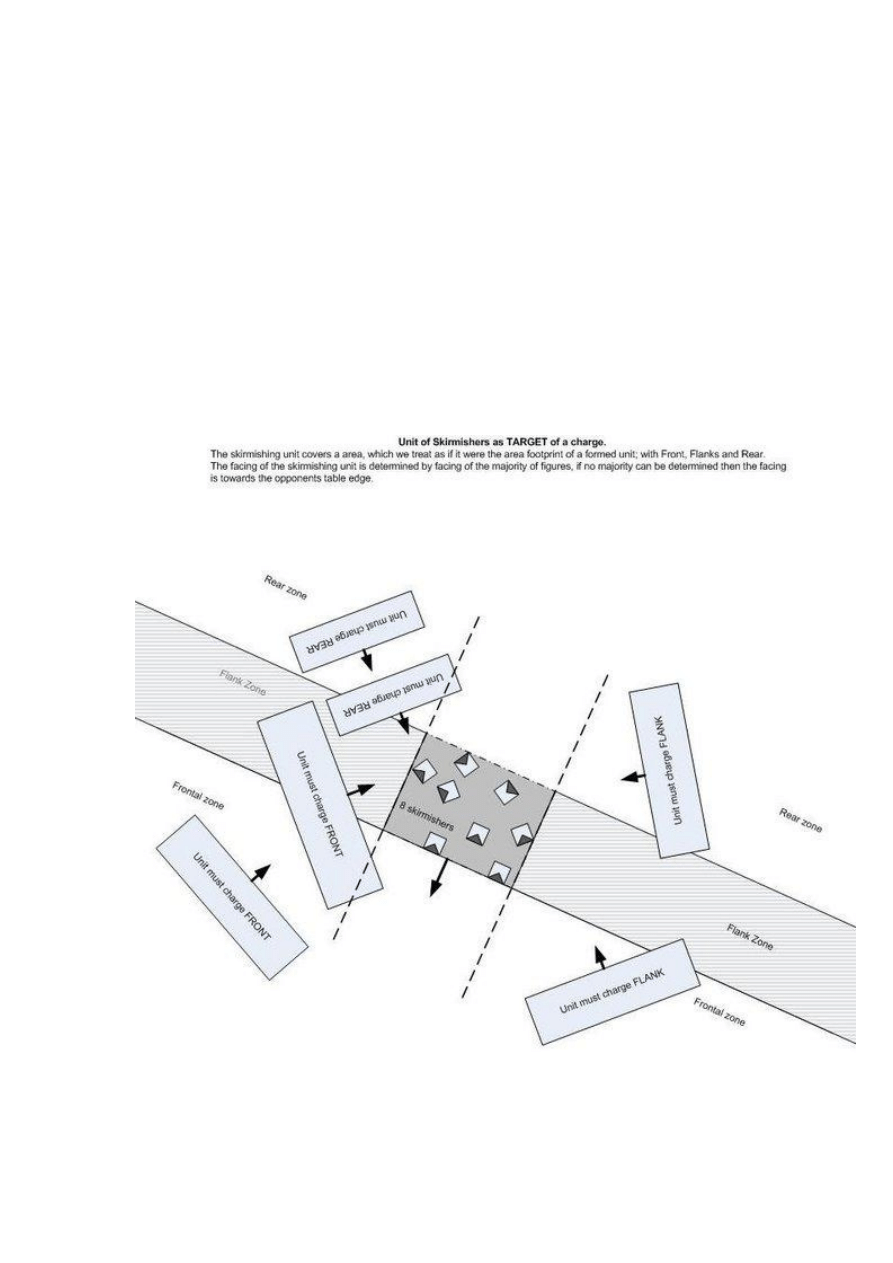
If a skirmish unit is formed in a “cloud”, how do I tell whether my troops are in its flank arc?
This is important because troops cannot use feigned flight if charged from the flank. When as skirmish
unit is in combat, it will be obvious where the flank arc lies, but a “cloud” presents more problems.
Remember the unit faces the direction that most of its models are facing, or the enemy baseline if this
cannot be easily established.
Once the direction of facing is established, imagine a rectangle imposed over the unit, with its long side
in the direction of facing. This gives a line through which the flank arc can be drawn.
Diagram by Andy Pickering
How do we handle charges and combats between skirmishers?
The rules for charging skirmishers are the same as for other troops, so the figures must charge in a
straight line after any initial wheel to allow them to reach an enemy figure not yet contacted. Measure
to check which figures can reach the enemy then move them so that each figure contacts one of the
enemy’s. If you have extra figures after all reachable enemy figures are in combat, you may use them
to create 2:1 match ups where you can. After this, surplus figures are placed behind those in contact
much as they would be if fighting a formed unit.
Does the destruction of a friendly unit in the shooting phase cause a panic test?
No, this is not a cause of panic.
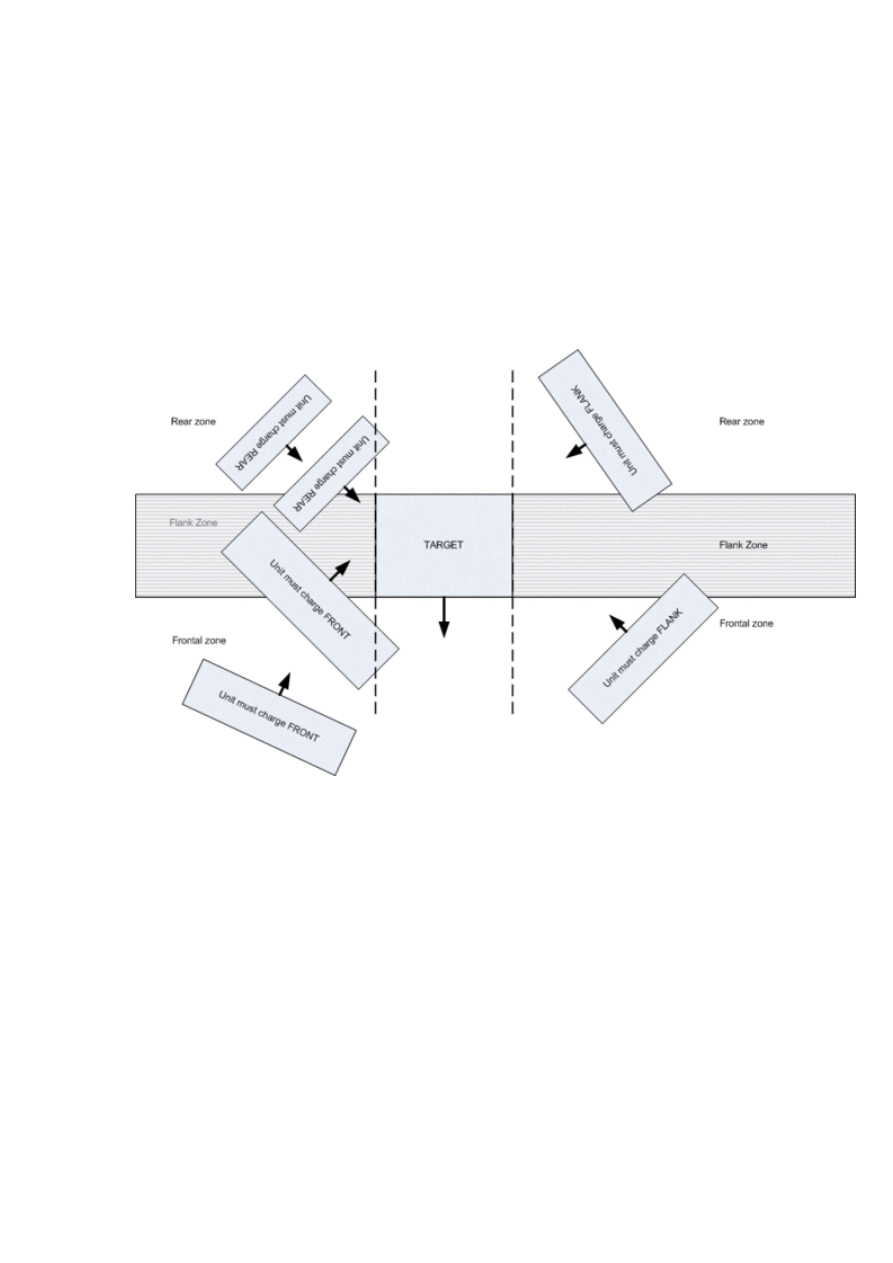
How do I tell whether a charge should be against the front or flank of the enemy?
A number of people have asked for additional clarification in this area. Here is a diagram that
summarises things nicely.
Diagram by Andy Pickering
Which units are moved first after combat?
After combats have been concluded and results determined, move any troops giving ground first, then
fleeing troops, then those pursuing or following up.
Must skirmishers charge in a straight line or can they follow a curved path?
The rules for charging apply equally to skirmishers as to units, each figure must move in a straight line
after any necessary initial wheel. This means that you may not get as many figures in contact as you
expected.
When can cavalry Give Ground?
Formed cavalry units that lose a melee but pass their break test may opt to Give Ground voluntarily,
even though they do not outnumber their enemy by 2:1. This is exactly the same as the rule for drilled
troops on page 106.
Can an open order unit use its “free” movements (e.g. turn, expand) in all circumstances?
Open order units cannot use their “free” movements when marching, charging or when subject to
compulsory movement.

How does Testudo work?
Rule on page 175. The use of Testudo formation must be declared at the start of every turn in which it
is used. Therefore a unit in Testudo can never charge or march. If a unit in testudo is charged, it
automatically drops the formation in order to fight, after any shooting by the chargers.
Are the base sizes on page 12 compulsory?
The base sizes are recommendations. Use them if possible, but if your figures are on slightly different
ones, don’t worry. The main thing is that it is possible to tell how many figures of each side should be
allowed to fight each other.
If your figures are on smaller bases, use sabot bases to bring them to the correct frontage.
Why have several unit types disappeared from the Roman Army List?
The list is now intended to represent a field army from the early imperial period. Units not appropriate
to this period, or only used in sieges, no longer appear.
How many figures are there in a Barbarian warhound unit?
There can only be one unit, which contains one packmaster and up to 6 dogs.
Are Wedges Open Order? How do they work in the new rules?
All formed cavalry are open order by default, unless barded or Massed Cavalry. So a wedge will
usually comprise of open order troops. However note that a wedge manoeuvres using a special pivot
move, and does not turn. The normal open order advantages of “free” turns and
expansions/contractions therefore do not apply to wedges.
When a character joins a unit, does he move at the same speed at the unit he joins, even if that unit
would normally move faster?
A mounted character is considered to have the best mount available, certainly superior to the rank and
file, and so moves at the speed of any unit he joins. He will also be able to keep up with the unit if it
performs any special manoeuvre, such as feigned flight.
This bonus is not available to a character on foot, so if he moves slower than the unit he joins, it will
have to move at his pace.
The rules say troops that flee as a charge reaction flee “directly away from the chargers”- but what
does that mean?
The best way to determine this is to carry out any necessary wheel that the charger would perform in
order to maximise contact, before moving the fleeing troops. Having done this, a line drawn from the
centre of the charging unit and at 90 degrees to its front will define the charge path; the target unit then
flees away along the charge path. Then carry out the chargers’ remaining move.
When a formed unit charges a light chariot unit in dispersed formation, how does it align to the target
unit?
Align the chargers as if the chariot unit was comprised of skirmishers.
What Leadership rank bonus do open order infantry warbands get?
The warband rank bonuses for combat resolution and leadership are separate. So all infantry warbands
can enjoy up to +3 leadership bonus for ranks, while there is a maximum combat resolution rank bonus
of +2 for close or open order infantry.
What happens when a scythed chariot passes through drilled infantry that open a lane for it?
The scythed chariot obeys the rules for Revealed Charges on page 38, except that it always travels its
full charge distance, even if this does not enable it to contact an enemy. If its charge distance is
insufficient to clear its original target, it is placed 1” behind it.
Can a character in a heavy chariot join a unit?
A character in a chariot may only join a chariot unit, which must be of the same type as the one he is
riding in. An elephant mounted character cannot join a unit at all.
What is a complete rank?
Each rank in a formed unit must be a minimum of four figures wide, unless the unit is in march
column. The final rank may be incomplete if there are insufficient figures available to complete it.

Some combat bonuses are lost by units that are fighting in difficult terrain. When does this apply?
These bonuses, such as rank bonuses, or momentum for cavalry, for example, are lost if any part of the
unit is actually in the difficult terrain. If the unit fights against enemy that are occupying the terrain, it
is only adversely affected if its own bases are within the area designated as difficult, but not if it is
merely in base contact with enemy figures that are partly within the terrain.
What is “Fearsome”?
Fearsome is a term used in some army lists to signify that a troop type causes Fear.
What armour save does a mounted character retain when he dismounts to join and infantry unit?
The character loses the +1 bonus for being mounted, so character with light armour and shield who
dismounts will move from a 4-plus to a 5-plus save.
A bolt shooter can pivot without penalty to face its target. Does this mean it can shoot a target outside
its arc of vision?
No, the target must still be a legitimate one within the arc of vision of the machine. The “pivot” to face
the target is there so players can clearly establish the line of the shot, so as to be able to tell how many
figures may be affected by it. The “pivot” does not change the machine’s arc of vision; if a machine
needs to change its arc of vision, it must do so in the movement phase, and will not then be able to
shoot that turn.
A unit of skirmishers stands in front of a line of units arrayed with gaps between them. An enemy unit
charges the skirmishers, whose flee dice roll is enough to get away. However they must try to run
through the gaps between the friendly units, and some will be caught by the chargers because they are
running sideways towards a gap. Is this right?
Fleeing troops must try to go through gaps between friendly units, but if they can’t, they go through
them. In this case once they have thrown high enough to get away, they should do so-if they would be
caught trying for a gap, then they cannot make it to the gap and so run through a friendly unit. If this
destroys unit coherence, they must reinstate it next turn.
When a unit rallies from fleeing, can it move further away from the enemy while doing so?
A unit rallies using a reform move, and should rally round its standard. When the unit flees, the figures
turn around rather than the unit doing so as a whole, so the command figures will be in the rank nearest
the pursuers. This means that when the unit rallies, it should not get either nearer to, or further from,
the enemy, except by an incidental distance when, for instance, it rallies facing a different direction to
that from which it came.
When using army lists to choose equipment for units, what is meant by “every second unit may have
x?”
This means that in order to equip a unit with the extra equipment “x” you must first take a unit without
it. So if there are an odd number of these units, there will be more without “x” than with “x”.

Wyszukiwarka
Podobne podstrony:
30 Concertino Davida Jay Friedman Feb 2011
PoznanPasek Feb May 2012 v3 0 i Nieznany
D&D 3 5 Monstel Manual v3 5 Errata
NFE 200411 World ice hockey championships 2011 V3
wniosek dotacja 2011 v3
2011 2 KOSZE
higiena dla studentów 2011 dr I Kosinska
Plan pracy na 2011 pps
W 8 Hormony 2010 2011
wm 2011 zad 2
Zawal serca 20 11 2011
PRK 23 10 2011 org
PIW 4z 2011
pmp wykład podmioty 2011 2012
więcej podobnych podstron