
STUDIA PSYCHOLOGICA, 55, 2013, 1
47
POSITIVE ORIENTATION AND
GENERALIZED SELF-EFFICACY
Piotr K. OLEŚ
1
, Guido ALESSANDRI
2
, Maria OLEŚ
1
, Wacław BAK
1
, Tomasz JANKOWSKI
1
,
Mariola LAGUNA
1
, Gian Vittorio CAPRARA
2
1
Institute of Psychology, The John Paul II Catholic University of Lublin
Al. Raclawickie 14, 20-950 Lublin, Poland
E-mail: oles@kul.lublin.pl
2
Department of Psychology, Sapienza, University of Rome
Abstract: The beliefs that people hold about themselves, their life and future are important and
mutually related constituents of psychological functioning and well-being. In this paper, we
investigated the r elationship between positive orientation and generalized self-efficacy. The
sample consisted of 672 participants aged 15-72 years (274 males). The results confirmed the
first hypothesis that positive orientation and generalized self-efficacy constitute two distinct but
correlated constructs. The results were confirmed across the three age groups and, contrary to the
second hypothesis, age was not confirmed as a moderator of the relationship between positive
orientation and self-efficacy.
Key words: positive orientation, self-esteem, life satisfaction, optimism, generalized self-effi-
ca cy
Interest in the positive beliefs and posi-
tive features of individual functioning has
been attracting an increasing amount of at-
tention over the last decade. The promotion
of health rests upon a broad appreciation of
the potentials and strengths that enable
people to recognize their talents, to act fruit-
fully, to cope effectively, and to pursue am-
bitious goals (Lyubomirsky, King, Diener,
2005; Sheldon, 2009).
Positive orientation is the name given to
what life satisfaction, self-esteem, and opti-
mism have in common. It is a pervasive mode
of facing reality, reflecting upon experience,
framing events, and processing experiences
(Caprara et al., 2009). This study addresses
the question of whether generalized self-ef-
ficacy beliefs (Schwarzer, 1992) can be in-
cluded in the aforementioned triad, as an in-
dicator of positive orientation. The aim of
this article is twofold. The first is to check
whether self-efficacy beliefs belong to the
broader construct of positive orientation; the
second is to check whether the relationships
between positive orientation and self-effi-
cacy are moderated by age.
Positive Orientation
as a Personality Dimension
Recently, a significant body of research
has focused on human strengths and opti-
mal functioning (Csikszentmihalyi, 2009;
Sheldon, 2009; Sollárová, Sollár, 2010). Self-
esteem (Kernis, 2003), life satisfaction
(Diener, 1984) and dispositional optimism
(Carver, Scheier, 2002) are treated as associ-
ated with well-being and success and con-

48
STUDIA PSYCHOLOGICA, 55, 2013, 1
stitute the core of positive attitudes towards
the world and the self (Caprara et al., 2010).
Life satisfaction refers to one’s overall
evaluation of various domains, as well as to
relationships that make one’s life meaning-
ful (Diener, 1984). It is associated with nu-
merous positive outcomes, including physi-
cal health and use of adaptive coping strate-
gies (Jones et al., 2003). Self-esteem ex-
presses the general evaluation of oneself
(Rosenberg, 1989) and many research find-
ings attest to the adaptive role of high self-
esteem (Baumeister et al., 2003). Dispositional
optimism refers to a belief about future events
according to which good things will be plen-
tiful and bad things will be scarce, which has
positive effects in various settings and life
circumstances (Carver, Scheier, 2002). Al-
though various studies document a relatively
high degree of correlation between the three
aforementioned constructs (Diener, Diener,
1995; Schimmack, Diener, 2003), most of the
literature focuses on their unique role in pro-
ducing specific outcomes (e.g., Laguna, in
press; Žitný, Halama, 2011; Sarmány-
Schuller, 1993).
A recent line of research investigates the
degree to which self-esteem, life satisfaction
and optimism can be subsumed under a com-
mon latent dimension. A relatively large body
of findings revealed the existence of posi-
tive orientation (POS) as a higher-order con-
struct that captures the core of self-esteem,
life satisfaction, and optimism across cultures
as well. (Caprara et al., in press). Genetic stud-
ies (Caprara et al., 2009) together with longi-
tudin al and cross-section al fin dings
(Alessandri, Caprara, Tisak, 2012; Caprara et
al., 2010) point out positive orientation as a
basic predisposition that accounts, to a con-
siderable extent, for individual adjustment
and achievement. Thus, a common factor
underlying mutual relationships among these
three variables and explaining the level of
self-esteem, life satisfaction, and optimism
can be introduced as the basis for positive
beliefs about the self – its value, future, and
current status.
The basic idea of Positive Orientation
theory is that an optimistic view of oneself,
life, and the future is a basic predisposition
allowing people to cope successfully with
life despite adversities, failures, and losses.
The empirical findings from different popu-
lations (i.e., Canada, Italy, Germany, and Ja-
pan), show that the positive judgments
people hold about the themselves, life, and
the future can be traced to a higher-order
dimension (Caprara et al., 2009). Yet, the mod-
els including other personal characteristics
that could be associated with self-esteem,
life satisfaction, and optimism – e.g., trust or
emotional stability – demonstrate worse
model fit indices than the proposed POS
model (Caprara, Alessandri, Barbaranelli,
2010). However, the question remains of what
variables constitute positive orientation.
Positive Orientation
and Generalized Self-Efficacy
In this study we examine the relationships
between generalized self-efficacy beliefs
(GSE) and POS. The concept of self-efficacy
applies to the judgments people hold about
their capacity to master specific tasks and to
cope with challenging situations. In contrast
to Bandura (1997) who advocates the spe-
cific character of self-efficacy, Schwarzer
(1992) claims that GSE, as a general confi-
dence in one’s own ability to take necessary
action in challenging situations, is par-
ticularly useful. As several studies list
GSE among the correlates of adjustment

STUDIA PSYCHOLOGICA, 55, 2013, 1
49
(Schwarzer, 1992; Akin, Kurbanoglu, 2011),
we wonder whether it should also be in-
cluded among the first-order indicators of
POS. Previous findings show significant cor-
relations between GSE and each of the three
components of POS when these are treated
separately (Luszczynska, Scholz, Schwarzer,
2005; Magaletta, Oliver, 1999). While self-
esteem, optimism, and life satisfaction are
general evaluations of oneself, life, and the
future, GSE concerns the impact people be-
lieve themselves to be able to exert on their
environment. That is why one may consider
three alternative hypotheses: 1) self-esteem,
life satisfaction, optimism, and GSE are sepa-
rate but correlated constructs; 2) POS is com-
posed of all four variables; 3) GSE and POS
represent two distinct but related personal-
ity dimensions. Our hypothesis is the fol-
lowing:
Hypothesis 1. Positive orientation and gen-
eralized self-efficacy represent two different
but personality dimensions.
Taking developmental processes into ac-
count, one can expect different relationships
between POS and self-efficacy across age
groups. Although general satisfaction with
life, hope, optimism, and self-esteem as well
as self-efficacy are interrelated in adoles-
cents (Frydenberg, 2008; Semmer, 2006;
Jombiková, Kováč, 2007), their mutual rela-
tions are rather vague. For example, self-es-
teem slightly increases during adolescence
and early adulthood (Baumeister et al., 2003),
whereas self-efficacy beliefs are related to
successes and failures in adolescents’ efforts
to gain control over the effects of their own
actions (Rew, 2005). Practicing self-efficacy
through an interaction with the environment
and coping with stress, adolescents learn
how to control their lives and how to master
desired changes, which in turn influences
their self-efficacy beliefs (Frydenberg, 2008).
Personality structure, incompletely inte-
grated in the period of identity formation,
becomes more integrated in young adults
(Heckhausen, 1999); thus, dimensions rela-
tively separate for adolescents may merge
into unified structures for adults. Assuming
the development of personal beliefs, we pos-
tulate that:
Hypothesis 2. Age is the moderator of the
relationships between positive orientation
and generalized self-efficacy.
THE PRESENT CONTRIBUTION
The aim of this study is to check whether
self-efficacy belongs to the broader con-
struct of positive orientation and whether
the relationships between positive orienta-
tion and self-efficacy are moderated by age.
This study outlines the relation between POS
and GSE using the Structural Equation Mod-
eling (SEM) approach. Following a sugges-
tion by Edwards (2001), we examine the fit of
three competing SEM models (Figure 1). The
first one, Model 1, posits a single latent di-
mension loaded by self-esteem, life satisfac-
tion, and optimism, which is correlated with
general self-efficacy. This model represents
a tau equivalent model (i.e., the first-order
indicators have equal loadings on the latent
factor), with POS and GSE as correlated but
distinct dimensions. Imposing the constraint
of equality on the factor loadings of self-
esteem, life satisfaction, and optimism is es-
sential in order to make the measurement
model for POS over-identified. Model 2, pos-
its a single latent dimension equally loaded
by self-esteem, life satisfaction, optimism,
and GSE. Finally, Model 3 is built and con-
sidered as a reference model in which four
variables are distinct but correlated con-
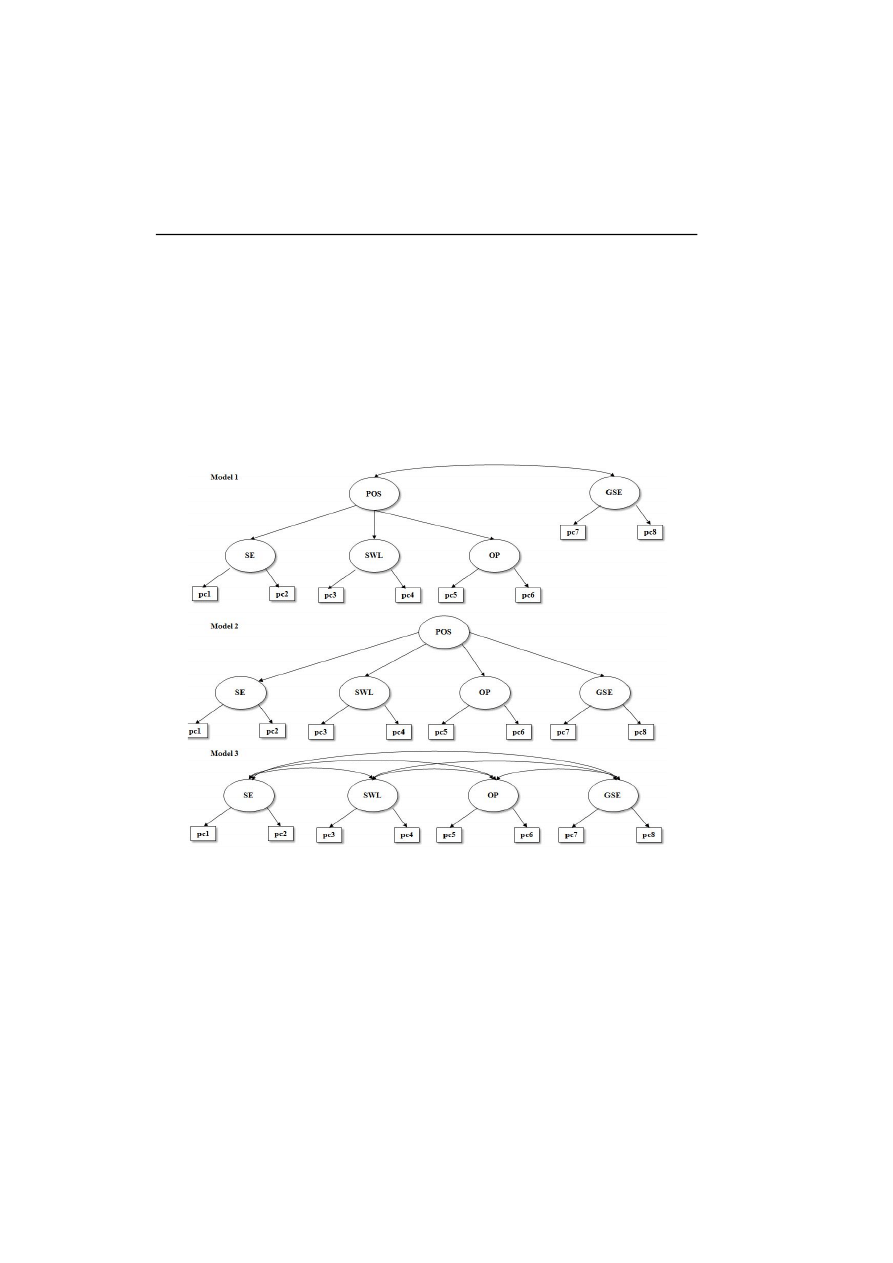
50
STUDIA PSYCHOLOGICA, 55, 2013, 1
structs. Following Edwards (2001), we select
the model that fits equally well or better than
Model 3 and better than the other competi-
tive model. We assume (H1) that Model 1,
positing POS correlated with GSE, produces
the best fit to the data.
To achieve the second aim of this study,
we repeated the complete analysis procedure
by dividing the total group into three age
subgroups: adolescents, students, and
adults. The same sequence of models was
retested and compared separately in each
sample. Having ascertained the best-fitting
model, we examined its measurement invari-
ance by estimating its parameters across the
three samples. Since positive orientation was
posited as a stable personality characteris-
tic (Caprara et al., 2009), we hypothesized
Figure 1. Three models tested: Model 1: POS correlated with GSE; Model 2: POS loaded
by GSE; Model 3: Correlated constructs model.
Note: SE = self-esteem; SWL = life satisfaction; OP = optimism; GSE = generalized self-
efficacy; Pc1-Pc2: parcels for self-esteem; Pc3-Pc4: parcels for life satisfaction; Pc5-Pc6:
parcels for optimism; Pc7-Pc8: parcels for GSE.

STUDIA PSYCHOLOGICA, 55, 2013, 1
51
that Model 1 should outperform the other
models in this case as well. Moreover, age
and gender differences in self-esteem, life
satisfaction, and GSE, were investigated in
an explorative manner.
METHOD
Participants and Procedure
The participants were 672 Polish people
(274 males, 41%), ranging in age from 15 to
72 years (M = 27.46; SD = 12.51). Education
ranged from 8 till 25 years (M = 14.5, SD =
3.00) – from primary school to academic de-
gree; 23% were married. All participants were
contacted personally by trained researchers
and filled out a set of questionnaires. All
measures were completed anonymously to
ensure confidentiality; the instruments were
given in the same order as described below.
For further analyses, the total sample was
divided into three subgroups: 1) adolescents
(n = 200; 80 males, 40%), with a mean age of
16.81 years (SD = 0.69); 2) students (n = 232;
111 males, 48%), with a mean age of 21.88
years (SD = 1.92), and 3) adults (n = 240;
83 males, 35%), with a mean age of 41.74
(SD = 10.28).
Instruments
Three scales measuring three components
of POS and a scale measuring GSE were used.
Rosenberg’s Self Esteem Scale (RSES) is
a 10-item scale (Rosenberg, 1989). Partici-
pants indicated the extent to which they felt
they possessed positive qualities using a
4-point scale (1 – strongly disagree, 4 –
strongly agree). Cronbach’s alpha coeffi-
cients were: .83, .83, and .82 for adolescent,
student, and adult samples, respectively.
Satisfaction with Life Scale (SWLS) con-
sists of 5 items (Diener et al., 1985). Partici-
pants rated the extent to which they felt gen-
erally satisfied with life on a 7-point scale
(1 – strongly disagree, to 7 – strongly agree).
The alphas were: .81, .80 and .80 for adoles-
cents, students, and adults, respectively.
Life Orientation Test (LOT-R) is a 10-item
scale with 6 items measuring optimism (Scheier,
Carver, Bridges, 1994). Participants provided
their ratings using a 5-point scale (1 – strongly
disagree, to 5 – strongly agree). The alphas
were: .73, .75, and .71, for adolescent, student,
and adult samples, respectively.
General Self-Efficacy Scale (GSES) is a
10-item scale to measure generalized self-ef-
ficacy beliefs (Schwarzer, Jerusalem, 1995).
Respondents rated to what extent each state-
ment was true for them across a 4-point Likert-
type scale (1 – not at all true, to 4 – exactly
true). The alphas were: .83, 84, and .82, re-
spectively, for adolescents, students, and
adults.
RESULTS
Table 1 presents the means, standard de-
viations, and significance of the ANOVA
main effects of age group membership and
gender, as well as of the interaction between
group and gender on self-esteem, life satis-
faction, optimism, and GSE. Only mean level
of self-esteem and optimism appeared to vary
across groups. In particular, according to
Tukey’s post hoc tests, adults appeared to
score higher than young adults and adoles-
cents on both self-esteem and optimism.
However, no differences were observed
among adolescents and young adults on
these variables. Finally, neither gender nor
interaction effects were detected for any of
the variables.

52
STUDIA PSYCHOLOGICA, 55, 2013, 1
We estimated all of the hypothesized mod-
els and handled missing data by using Mplus
4.01 (Muthén, Muthén, 2006) with maximum
likelihood estimation. According to a multi-
faceted approach to the assessment of model
fit (Kline, 1998) the following criteria were
employed to evaluate the goodness of fit:
chi-square (χ
2
) likelihood ratio statistic,
Tucker and Lewis Index (TLI), Comparative
Fit Index (CFI), the Root Mean Square Error
of Approximation (RMSEA) with associated
confidence intervals (CI with their p values),
and the Standardized Root Mean Square
Residual (SRMR). We accepted TLI and CFI
values higher than .90 (Bentler, 1990),
RMSEA values lower than .06 (Brown,
Cudeck, 1993), and values lower than .08 for
the SRMR. Chi-square difference tests were
used to compare nested models (Δχ²).
Given the moderate size of the three
samples used to compare the fit of Model 1
across age groups, and given the relatively
large number of indicators, the models were
analyzed via item parceling (Hoyle, 1995).
Item parcels are likely to increase the stabil-
ity of parameter estimates, improve the vari-
able to sample size ratio, and reduce the ef-
fects of non-normality (see Little et al., 2002).
Accordingly, items were randomly combined
for each scale into two parcels of two or five
items for each dimension, depending on the
construct (West, Finch, Curran, 1995). Thus,
the final model was composed by height
manifest indicators (parcels), represented by
Table 1. Means, standard deviations, and ANOVA results of self-esteem, life satisfac-
tion, optimism, and generalized self-efficacy for adolescents, students, adults and by sex
Self-Esteem
Males
Females
ANOVA results
M
SD
M
SD
Variables
F
p
η
2
Adolescents
3.54
.55
3.54
.60
group
6.39
<.01
.02
Students
3.67
.45
3.59
.58
sex
.60
.42
.01
Adults
3.77
.58
3.75
.47
group*sex
.42
.66
.01
Life
Satisfaction
Males
Females
ANOVA results
M
SD
M
SD
Variables
F
p
η
2
Adolescents
5.00
1.30
4.45
1.57
group
.88
.45
.01
Students
5.30
1.37
5.09
1.3
sex
.05
.82
.01
Adults
5.34
1.46
4.07
1.34
group*sex
.90
.41
.01
Optimism
Males
Females
ANOVA results
M
SD
M
SD
Variables
F
p
η
2
Adolescents
3.33
.76
3.30
.80
group
11.45
<.01
.05
Students
3.47
.73
3.43
.76
sex
.55
.46
.01
Adults
3.69
.70
3.63
.68
group*sex
.02
.98
.01
Generalized
Self-Efficacy
Males
Females
ANOVA results
M
SD
M
SD
Variables
F
p
η
2
Adolescents
2.91
.48
2.90
.43
group
1.55
.21
.01
Students
3.03
.41
2.88
.40
sex
.093
.18
.01
Adults
3.04
.48
2.92
.38
group*sex
.094
.18
.01

STUDIA PSYCHOLOGICA, 55, 2013, 1
53
the individuals’ mean scores on items be-
longing, respectively, to self-esteem, life sat-
isfaction, optimism, and GSE. Each manifest
indicator was allowed to load simultaneously
on only one latent variable and no cross-
loading or correlation among residuals was
allowed. To make the measurement model
just identified, we constrained the loading
of both parcels for each first-order factor to
equality.
Analyzing the total sample, Model 1
(χ
2
(22)
= 43.83, p < .01, TLI = .967, CFI = .959,
RMSEA = .061 (CI = .033-.089), SRMR = .079),
as well as Model 2 (χ
2
(23)
= 69.67, p < .01,
TLI = .968, CFI = .959, RMSEA = .057 (CI =
.042-.072), SRMR = .076), and Model 3
(χ
2
(18)
= 36.05, p < .01, TLI = .971, CFI = .955,
RMSEA = .065 (CI = .033-.095), SRMR = .076)
fitted the data well. However, the results of
model comparisons demonstrated that Model
2 fitted the data considerably worse than
Model 3 (the correlated construct model;
Δχ
2
(1)
= 25.84, p < .01), and Model 1 (the posi-
tive orientation model; Δχ
2
(1)
= 33.62, p < .01).
This model failed to show a competitive fit
compared to the other two models. On the
contrary, Model 1, hypothesizing a latent
factor of POS correlated with GSE, fitted bet-
ter than Model 2 and also Model 3 (Δχ
2
(1)
=
7.78, p = .09). Thus, as the positive orienta-
tion model (Model 1) was more parsimoni-
ous (i.e., had 4 more degrees of freedom than
the separated constructs model; Edwards,
2001) the results were preferable to those of
the correlated constructs model (Model 3).
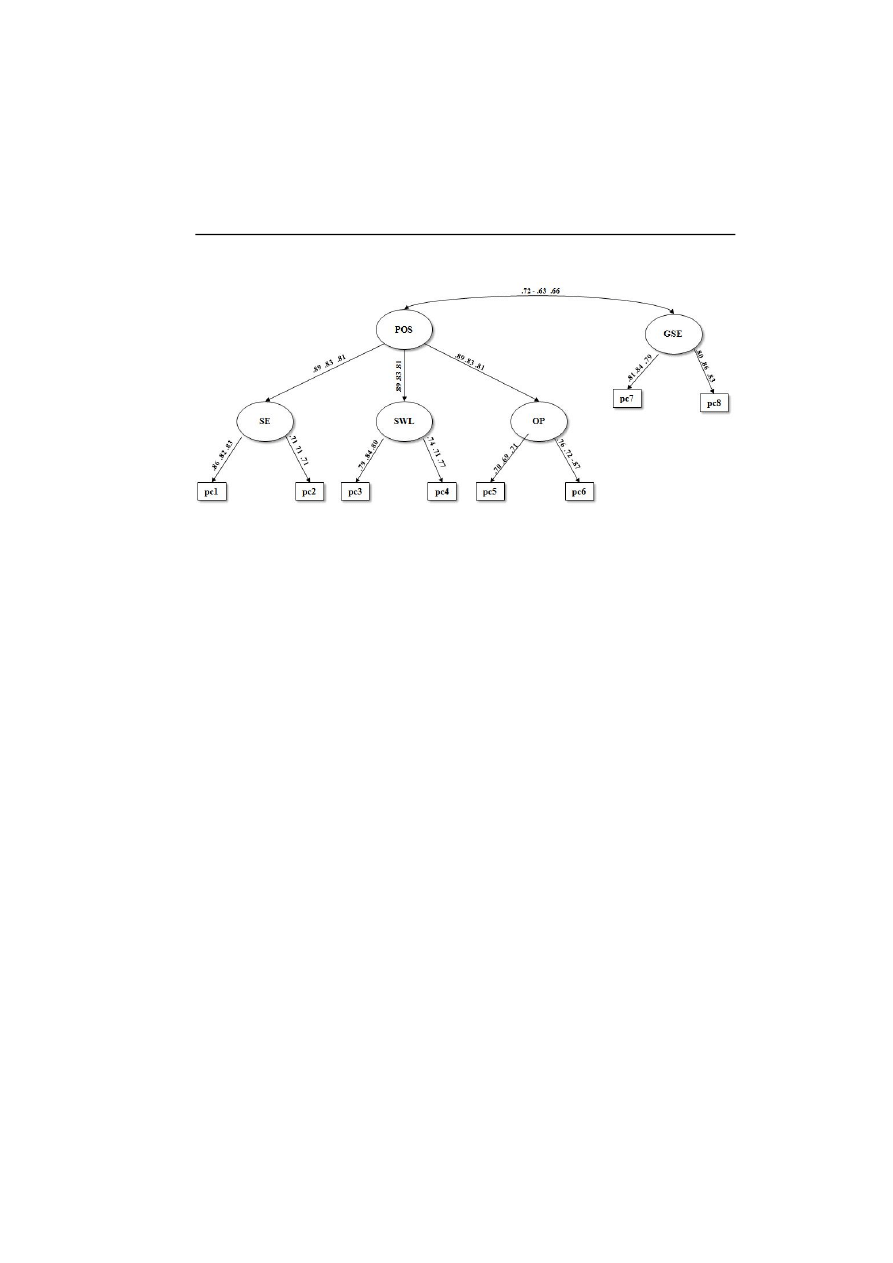
In this final model (Model 1), all first-order
loadings were significant and all above .60
(range: from .63 to .89). The correlation be-
tween POS and GSE was .65.
As for the total sample, results demon-
strated that the positive orientation model
(Model 1) was preferable to Model 2 and
Model 3 in each of the three considered
subsamples (Table 2). In all subsamples, all
first-order loadings were significant and all
above .60 (range: from .61 to .87). The corre-
lations between positive orientation and gen-
eralized self-efficacy were .71, .64, and .64 in
the samples of adolescents, students, and
adults, respectively.
After the best fitting model had been esti-
mated separately for each group, we used
multi-group Confirmatory Factor Analyses
(CFAs) to examine measurement invariance
(Little, 1997). A sequence of nested models
was tested (see: Vandenberg, Lance, 2000).
In the first (unconstrained) model, the factor
loadings, intercepts, and error variances were
allowed to differ across groups (configural
invariance). In the second model (metric in-
variance), the factor loadings were con-
strained to be equal (equal λ) across groups.
In the third model, we imposed an additional
constraint of equal first-order intercept in-
variance (scalar invariance: equal τ). The lat-
ter level of invariance was of special interest
because it was required for comparing latent
means across groups and referred to the
equality of scale’s origin between groups.
To test the differences between the base
model and the more restricted models, we
calculated restricted chi-square tests (Δχ²)
with an alpha level of .05 (Bollen, 1989).
Having selected Model 1 as the best-fit-
ting model, we proceeded with examining
measurement invariance and estimated that
model in all three groups simultaneously. The
configural model showed a good fit with the
data: χ
2
(d=66; N=687)
= 101.00, p < .01, CFI = .984,
TLI = .976, RMSEA = .045 (CI = .02-.066),
SRMR = .037. When we constrained the first-
order factor loadings in the measurement
model to be equal across the groups, the
change in overall chi-square was non-sig-

54
STUDIA PSYCHOLOGICA, 55, 2013, 1
nificant Δχ
2
(8)
= 25.88, p = .17. Similarly, con-
straining the loadings of self-esteem, life sat-
isfaction, and optimism on POS to equality
resulted in a non-significant decrease in fit
Δχ
2
(2)
= 4.02, p = .13. Furthermore, the require-
ments of metric invariance were satisfied.
Then, we also constrained the intercepts for
the measurement model. The chi-square dif-
ference test between that model and the less
constrained model was non-significant
Δχ
2
(8)
= 14.76, p = .06. Likewise, constraining
the intercepts of self-esteem, life satisfaction,
optimism, and GSE resulted in a non-signifi-
cant chi-square difference test Δχ
2
(4)
= 5.43,
p = .25. The results of the latter two tests
suggested that scalar invariance, also called
strong invariance, was reached
1
. Figure 2
presents the standardized parameter esti-
mates for this final model. In the light of these
findings, hypothesis 2 is not confirmed.
As the final step, we fixed latent means of
positive orientation to equality across the
three different groups. The test resulted in a
largely significant chi-square difference test,
suggesting that latent means should be con-
Table 2. Results from Model Fitting Analyses
1
We investigated plau sible differences in the
strength of corr elation between POS a nd GSE
across ages by constraining these coefficients to
equality, and found a significant chi-square dif-
ference Δχ
2
(2) = 6.81, p = .047; POS and GSE
were more strongly correlated among adolescents
(see Figure 2).
Adolescents
(n = 200)
χ
2
df
p
TLI
CFI
SRMR
RMSEA
CI
p
Model 1
45.97
22
<.01
.956
.972
.043
.067
.036-.098
.16
Model 2
58.19
23
<.01
.935
.956
.06
.081
.053-.110
.04
Model 3
36.76
18
.04
.969
.985
.026
.056
.01-.093
.35
Δχ
2
Δdf
p
Model: 3 vs. 1
9.21
4
.06
Model: 3 vs. 2
21.43
5
<.01
Model: 2 vs. 1
12.22
1
<.01
Students
(n = 232)
χ
2
df
p
TLI
CFI
SRMR
RMSEA
CI
p
Model 1
46.68
22
<.01
.955
.971
.037
.072
.038-.105
.13
Model 2
51.90
23
<.01
.956
.970
.040
.072
.038-.104
.13
Model 3
40.00
18
<.01
.948
.974
.029
.077
.040-.115
.10
Δχ
2
Δdf
p
Model: 3 vs. 1
6.68
4
.16
Model: 3 vs. 2
11.90
5
.04
Model: 2 vs. 1
5.22
1
.02
Adults (n = 240)
χ
2
df
p
TLI
CFI
SRMR
RMSEA
CI
p
Model 1
27.775
22
.47
1.01
1.00
.032
.00
.00-.057
.91
Model 2
35.728
23
.14
.984
.989
.044
.038
.00-.073
.067
Model 3
23.76
18
.47
1.01
1.00
.026
.00
.00-.062
.88
Δχ
2
Δdf
p
Model: 3 vs. 1
4.02
4
.40
Model: 3 vs. 2
11.97
5
.04
Model: 2 vs. 1
7.95
1
<.01
Note: Model 1: POS correlated with GSE; Model 2: POS loaded by GSE; Model 3: The correlated construct
model.
STUDIA PSYCHOLOGICA, 55, 2013, 1
55
sidered different: Δχ
2
(2)
= 20.01, p = < .01.
POS was lower for adolescents (M = 9.95)
and higher for young adults (M = 10.17) and
adults (M = 10.44), showing a slight increase
across ages. Similarly, fixing latent means of
GSE to equality resulted in a non-significant
chi-square test Δχ
2
(2)
= 2.81, p =.24. There-
fore, these means should be considered
equal.
Aiming to investigate gender differences,
we included gender as a covariate of both
latent POS and GSE in the previous model
(Model 1). The model showed again an ad-
equate fit: χ
2
(106)
= 246.29, p < .01, TLI = .927,
CFI = .938, RMSEA = .077 (CI = .064-.089),
SRMR = .078. No effect of gender was de-
tected on either POS or GSE in any of the
three age groups.
DISCUSSION
The present study considers the question
of whether GSE can be traced together with
self-esteem, life satisfaction, and optimism
to a common latent dimension, named POS.
The present findings corroborate the previ-
ous findings tracing self-esteem, life satis-
faction, and optimism to POS while leaving
GSE as a separate but correlated factor
(Caprara, Alessandri, Barbaranelli, 2010).
When GSE is added to the earlier triad, the
model’s fit decreases.
The findings suggest that the views that
people hold about themselves, life, and the
future reflect a pervasive mode of appraisal
while GSE mostly concerns a general sense
Figure 2. The model of POS with standardized parameter estimates resulting from
configural invariance. The first coefficient (from the left) is for adolescents, the second for
students, and the third for adults.
Note: SE = self-esteem; SWL = life satisfaction; OP = optimism; GSE = generalized self-
efficacy; Pc1-Pc2: parcels for self-esteem; Pc3-Pc4: parcels for life satisfaction; Pc5-Pc6:
parcels for optimism; Pc7-Pc8: parcels for GSE

56
STUDIA PSYCHOLOGICA, 55, 2013, 1
of mastery. This distinction has important
practical implications: although POS mostly
concerns how people construe themselves
within the world, GSE mostly concerns
people’s beliefs about the control they can
exercise over their own lives. Since the pre-
vious findings indicate a considerable ge-
netic component in POS, it can be viewed as
a basic predisposition to optimal function-
ing across life domains serving as protec-
tive factor against challenges and failures
(Caprara et al., 2009). On the other hand, as
the previous findings relate self-efficacy be-
liefs to mastery experiences (Bandura, 1997),
GSE can be regarded as a general sense of
confidence that may be properly inculcated
in a person and reinforced through learning
and self-reflection (Hoskovcová, 2006). Like-
wise, it is the way POS and GSE interplay
with one another. Even though inheritance
contributes to determining an individual’s
level of POS (Caprara et al., 2009), it is not
solely responsible for any of its manifesta-
tions at any particular time or for any associ-
ated behavior. The significant contribution
of experience should not be underestimated.
The present study demonstrates a slight in-
crease of POS from adolescence to adulthood
in accordance with the results illustrating that
happiness may increase during the mature
stages of life (Charles, Reynolds, Gatz, 2001;
Diener, Diener, 1995).
As part of the genetic endowment, POS
can be considered to be an individual poten-
tiality. The realization of potential in terms of
self-esteem, life satisfaction, and optimism
depends both on environmental opportuni-
ties and on an individual’s capacity to mas-
ter their experiences. Thus, interventions
designed to nurture and strengthen a posi-
tive view of oneself, one’s own life, and the
future, without boosting high but insecure
and fragile self-esteem (Kernis, 2003) or en-
hancing unrealistic optimism, represent a
major challenge for researchers, clinicians,
and health psychologists. Recent findings
attest to the malleability of POS and of its
components despite a high degree of her-
itability and stability as well as point to
self-efficacy beliefs as effective agents of
change. Ultimately, one may view POS as
predisposition to GSE and self-efficacy be-
liefs as the vessels enabling to promote POS.
Social cognitive theory (Bandura, 1997) pro-
vides an explanatory frame of how predispo-
sitions can accord with mastery experiences
at the service of optimal functioning. It also
offers a unique direction to identify the strat-
egies suitable to enable people to manage
their emotions and their interpersonal rela-
tionships in ways that strengthen their self-
esteem, bring life satisfaction, and allow them
to imagine a promising life.
In conclusion, one may view self-efficacy
as a close correlate of POS, though not its
specific component. Although longitudinal
studies are welcome in order to ascertain the
plausible directions of influence linking
these two constructs, the present results add
support to the opinion that individuals who
score high on POS feel a stronger confidence
in their potentialities and strengths, yet these
two sets of beliefs are distinct. Another prob-
lem for further study is the hypothetical rela-
tionship between POS and core self-evalua-
tions as a trait indicated by self-esteem, lo-
cus of control, GSE, and (low) neuroticism
(Judge, 2009).
As regards the limitations of this study,
almost a quarter of the respondents were
married and this issue was not of main inter-
est in this study; however, that fact might
have influenced the results. The question of
the relationships between POS and marital

STUDIA PSYCHOLOGICA, 55, 2013, 1
57
status seems to be an interesting one for fur-
ther studies. It should be also emphasized
that it is beneficial to assess self-esteem, life
satisfaction, and optimism using multiple
methods, for instance implicit measures and
informants, rather than rely on self-reports.
The second benefit of extending similar re-
search to specific populations prone to vari-
ous kinds of health problems is the chance
this would offer to further assess the gene-
ralizability of posited relations between the
constructs discussed in this paper. Also
cross-cultural investigations of the models
studied would be interesting, especially as
other cross-cultural analyses concentrate
solely on POS (e.g., Caprara et al., in press).
Received April 15, 2012
REFERENCES
AKIN, A., KURBANOGLU, I.N., 2011, Rela-
tionships between math anxiety, math attitudes,
and self-efficacy: A structural equation model. Studia
Psychologica, 53, 3, 263-273.
ALESSANDRI, G., CAPRARA, G.V., TISAK, J.,
2012, The unique contribution of positive orienta-
tion to optimal functioning: Further explorations,
European Psychologists, 17, 44-54.
BAGOZZI, R.P. (Ed.), 1994, Principles of mar-
keting research. Cambridge, MA: Blackwell.
BANDURA, A., 1997, Self-efficacy. The exercise
of control. New York: Freeman & Co.
BAUMEISTER, R.F., CAMPBELL, J.D.,
KRUEGER, J.I., VOHS, K.D., 2003, Does high
self-esteem cause better performance, interper-
sonal success, happiness, or healthier lifestyle?
Psychological Science in the Public Interest, 4, 1-
44 .
BENTLER, P.M., 1990, Comparative fit indexes
in structural equation modelling. Psychological
Bulletin, 107, 238-246.
BOLLEN, K.A., 1989, Structural equations with
latent variables. New York: Wiley.
BROWNE, M.W., CUDECK, R., 1993, Alterna-
tive ways of assessing model fit. In: K.A. Bollen,
J.S. Long (Eds.), Testing structural equation mod-
els. Newbury Park, CA: Sage.
CAPRARA,
G.V.,
ALESSANDRI,
G.,
BARBARANELLI, C., 2010, Optimal functioning:
The contribution of self-efficacy beliefs to posi-
tive orientation. Psychotherapy and Psychosomat-
ics, 79, 328-330.
CAPRARA,
G.V.,
ALESSANDRI,
G.,
TROMMSDORFF,
G.,
HEIKAMP,
T.,
YAMAGUCHI, S., SUZUKI, F., in press, Positive
orientation across countries. Journal of Cross-Cul-
tural Psychology.
CAPRARA, G.V., FAGNANI, C., ALESSANDRI,
G., STECA, P., GIGANTESCO, A., CAVALLI
SFORZA, L.L., 2009, Human optimal functioning:
The genetics of positive orientation towards self,
life, and the future. Behaviour Genetics, 39, 277-
28 4.
CAPRARA, G.V., STECA, P., ALESSANDRI, G.,
ABELA, J.R.Z., MCWHINNIE, C.M., 2010, Posi-
tive orientation: Explorations on what is common
to life satisfaction, self-esteem, and optimism.
Epidemiologia e Psichiatria Sociale,19, 63-71.
CARVER, C.S., SCHEIER, M.F., 2002, Optimism.
In: C.R. Snyder, J.L. Lopez (Eds.), Handbook of
positive psychology (pp. 231-243). New York:
Oxford University Press.
CHARLES, S.T., REYNOLDS, C.A., GATZ, M.,
2001, Age-related differences and change in posi-
tive and negative affect over 23 years. Journal of
Personality and Social Psychology, 80, 136-151.
CSIKSZENTMIHALYI, M., 2009, The promise
of positive psychology. Psychological Topics, 18,
203-211.
DIENER, E., 1984, Subjective well-being. Psy-
chological Bulletin, 95, 542-575.
DIENER, E., DIENER, M., 1995, Cross-cultural
correlates of life satisfaction and self-esteem. Jour-
nal of Personality and Social Psychology, 68, 653-
66 3.
DIENER, E., EMMONS, R.A., LARSEN, R.J.,
GRIFFIN, S., 1985, The Satisfaction With Life
Scale. Journal of Personality Assessment, 49, 71-
75 .
EDWARDS, J.R., 2001, Multidimensional con-
structs in organizational behavior research: An in-
tegrative analytical framework. Organizational
Research Methods, 4, 144-192.
FRYDENBERG, E., 2008, Adolescent coping.
Advances in theory, research and practice. Lon-
don: Routledge.
HECKHAUSEN, J., 1999, Developmental regu-
lation in adulthood. Age-normative and socio-
structural constrains as adaptive challenges. Cam-
bridge: Cambridge University Press.

58
STUDIA PSYCHOLOGICA, 55, 2013, 1
HOSKOVCOVÁ, S., 2006, Self-efficacy in pre-
school children. Studia Psychologica, 48, 175-182.
HOYLE, R.H. (Ed.), 1995, Structural equation
modeling. Thousand Oaks, CA: SAGE Publications,
Inc.
JONES, T.G., RAPPORT, L.J., HANKS, R.A.,
LICHTENBERG, P.A., TELMET, K., 2003, Cog-
nitive and psychosocial predictors of subjective well-
being in urban older adults. Clinical Neuropsycholo-
gist, 17, 3-18.
JOMBÍKOVÁ, E., KOVÁČ, D., 2007, Optimism
and quality of life in adolescents - Bratislava sec-
ondary schools students. Studia Psychologica, 49,
347-356.
JUDGE, T.A., 2009, Core self-evaluations and
work success. Current Directions in Psychological
Science, 18, 58-62.
KERNIS, M.H., 2003, Toward a conceptual-
ization of optimal self-esteem. Psychological In-
quiry, 14, 1-26.
KLINE, R.B., 1998, Principles and practices of
structural equation modeling. New York: Guilford.
LAGUNA, M., in press, Self-efficacy, self-esteem,
and entrepreneurship amongst the unemployed.
Journal of Applied Social Psychology.
LITTLE, T., 1997, Mean and covariance struc-
tures (MACS) analyses of cross-cultural data: Prac-
tical and theoretical issues. Multivariate Behavioral
Research, 32, 53-76.
LITTLE,
T.D.,
CUNNINGHAM,
W.A.,
SHAHAR, G., WIDAMAN, K.F., 2002, To parcel
or not to parcel: Exploring the question, weighing
the merits. Structural Equation Modeling, 9, 151-
17 3.
LUSZCZYNSKA,
A.,
SCHOLZ,
U.,
SCHWARZER, R., 2005, The General Self-Effi-
cacy Scale: Multicultural validation studies. The Jour-
nal of Psychology, 139, 439-457.
LYUBOMIRSKY, S., KING, L., DIENER, E.,
2005, The benefits of frequent positive affect: Does
happiness lead to success? Psychological Bulletin,
131, 803-855.
MAGALETTA, P.R., OLIVER, J.M., 1999, The
hope construct, will, and ways: The relations with
self-efficacy, optimism, and general well-being. Jour-
nal of Clinical Psychology, 55, 539-551.
MUTHÉN, L.K., MUTHÉN, B.O., 2006, Mplus
User’s Guide. Los Angeles: Muthen & Muthen.
REW, L., 2005, Adolescent health. A multidis-
ciplinary approach to theory, research, and inter-
vention. Thousand Oaks: SAGE Publications.
ROSENBERG, M., 1989, Society and the ado-
lescent self-image. Princeton, NJ: Princeton Univ.
Press.
SARMÁNY-SCHULLER, I., 1993, Different prob-
lem solving strategies (What role is played by opti-
mism-pessimism here?). Studia Psychologica, 35,
377-379.
SCHEIER, M.F., CARVER, C.S., BRIDGES, M.W.,
1994, Distinguishing optimism from neuroticism
(and trait anxiety, self-mastery, and self-esteem):
A reevaluation of the Life Orientation Test. Jour-
nal of Personality and Social Psychology, 67, 1063-
1078.
SCHIMMACK, U., DIENER, E., 2003, Predic-
tive validity of explicit and implicit self-esteem for
subjective well-being. Journal of Research in Per-
sonality, 37, 100-106.
SCHWARZER, R. (Ed.), 1992, Self–efficacy.
Thought control of action. Washington, DC: Hemi-
sphere.
SCHWARZER, R., JERUSALEM, M., 1995, Gen-
eralized Self-Efficacy Scale. In: J. Weinman, S.
Wright, M. Johnston (Eds.), Measures in health
psychology: A user’s portfolio. Causal and control
beliefs (pp. 35-37). Windsor: UK: Nfer-Nelson.
SEMMER, N.K., 2006, Personality, stress and
coping. In: M.E. Vollrath, Handbook of personal-
ity and health (pp. 73-113). Chichester: Wiley and
Sons.
SHELDON, K.M., 2009, Providing the scien-
tific backbone for positive psychology: A multi-
level conception of human thriving, Psychological
Topics, 18, 267-284.
SOLLÁROVÁ, E., SOLLÁR, T., 2010, The psy-
chologically integrated person and the parameters
of optimal functioning. Studia Psychologica, 5,
333-338.
VANDENBERG, R.J., LANCE, C.E., 2000, A
review and synthesis of the measurement invari-
ance literature: Suggestions, practices, and recom-
mendations for organizational research. Organiza-
tional Research Methods, 2, 4-69.
WEST, S.G., FINCH, J.F., CURRAN, P.J., 1995,
Structural equation models with non-normal vari-
ables: Problems and remedies. In: R. Hoyle (Ed.),
Structural equation modeling: Concepts, issues, and
applications (pp. 56-75). Thousand Oaks, CA: Sage.
ŽITNÝ, P., HALAMA, P., 2011, Self-esteem,
locus of control, and personality traits as predic-
tors of sensitivity to injustice. Studia Psychologica,
53, 1, 27-40.

STUDIA PSYCHOLOGICA, 55, 2013, 1
59
POZITÍVNA ORIENTÁCIA A GENERALIZOVANÁ SEBAÚČINNOSŤ
P. K. O l e ś, G. A l e s s a n d r i, M. O l e ś, W. B a k, T. J a n k o w s k i,
M. L a g u n a, G. V. C a p r a r a
Súhrn: Čo si ľudia myslia o sebe, o svojom živote a budúcnosti, sú dôležité a vzájomne prepojené
zložky psychologického fungovania a životnej pohody. V našom príspevku sme skúmali vzťah
medzi pozitívnou orientáciou a generalizovanou sebaúčinnosťou. Výskumu sa zúčastnilo 672
respondentov vo veku 15 -27 rok ov (27 4 mužov). Výsledky potvrdili prvú hypotézu, podľa
ktorej pozitívna orientácia a generalizovaná sebaúčinnosť tvoria dva rozdielne konštrukty, ktoré
však vzájomne súvisia. Výsledky sa potvrdili v troch vekových skupinách, v rozpore s druhou
hypotézou sa vek ako moderátor vzťahu medzi pozitívnou orientáciou a vlastnou účinnosťou
nepotvrdil.

Copyright of Studia Psychologica is the property of Institute of Experimental Psychology, Slovak Academy of
Science and its content may not be copied or emailed to multiple sites or posted to a listserv without the
copyright holder's express written permission. However, users may print, download, or email articles for
individual use.
Wyszukiwarka
Podobne podstrony:
Review Santer et al 2008
Arakawa et al 2011 Protein Science
Byrnes et al (eds) Educating for Advanced Foreign Language Capacities
Huang et al 2009 Journal of Polymer Science Part A Polymer Chemistry
Mantak Chia et al The Multi Orgasmic Couple (37 pages)
5 Biliszczuk et al
[Sveinbjarnardóttir et al 2008]
II D W Żelazo Kaczanowski et al 09 10
2 Bryja et al
Ghalichechian et al Nano day po Nieznany
4 Grotte et al
6 Biliszczuk et al
ET&AL&DC Neuropheno intro 2004
3 Pakos et al
7 Markowicz et al
Bhuiyan et al
Agamben, Giorgio Friendship [Derrida, et al , 6 pages]
Gao et al
Dannenberg et al 2015 European Journal of Organic Chemistry
więcej podobnych podstron