
2
Contretemps 5, December 2004
Giorgio Agamben
Friendship
Friendship, our topic in this seminar, is so closely linked to the very definition of
philosophy that one can say that without it, philosophy would not in fact be possible. The
intimacy of friendship and philosophy is so deep that philosophy includes the philos, the
friend, in its very name and, as is often the case with all excessive proximities, one risks
not being able to get to the bottom of it. In the classical world, this promiscuity—and,
almost, consubstantiality—of the friend and the philosopher was taken for granted, and it
was certainly not without a somewhat archaizing intent that a contemporary philosopher
—when posing the extreme question, ʻwhat is philosophy?ʼ—was able to write that it
was a question to be dealt with entre amis. Today the relation between friendship and
philosophy has actually fallen into discredit, and it is with a sort of embarrassment and
uneasy conscience that professional philosophers try to come to terms with such an
uncomfortable and, so to speak, clandestine partner of their thought.
Many years ago, my friend Jean-Luc Nancy and I decided to exchange letters on
the subject of friendship. We were convinced that this was the best way of approaching
and almost ʻstagingʼ a problem which seemed otherwise to elude analytical treatment.
I wrote the first letter and waited, not without trepidation, for the reply. This is not the
place to try to understand the reasons—or, perhaps, misunderstandings—that caused
the arrival of Jean-Lucʼs letter to signify the end of the project. But it is certain that our
friendship—which, according to our plans, should have given us privileged access to
the problem—was instead an obstacle for us and was consequently, in a way, at least
temporarily obscured.
Out of an analogous and probably conscious uneasiness, Jacques Derrida chose as the
Leitmotiv of his book on friendship a sibylline motto, traditionally attributed to Aristotle,
that negates friendship in the very gesture with which it seems to invoke it: o philoi,
oudeis philos, “o friends, there are no friends.” One of the concerns of the book is, in fact,
a critique of what the author defines as the phallocentric conception of friendship that
dominates our philosophical and political tradition. While Derrida was still working on
the seminar which gave birth to the book, we had discussed together a curious philological

3
Contretemps 5, December 2004
problem that concerned precisely the motto or witticism in question. One finds it cited
by, amongst others, Montaigne and Nietzsche, who would have derived it from Diogenes
Laertius. But if we open a modern edition of the Lives of the Philosophers, we do not find,
in the chapter dedicated to the biography of Aristotle (V, 21), the phrase in question, but
rather one almost identical in appearance, the meaning of which is nonetheless different
and far less enigmatic: oi (omega with subscript iota) philoi, oudeis philos, “he who has
(many) friends, has no friend.”
1
A library visit was enough to clarify the mystery. In 1616 the great Genevan philologist
Isaac Casaubon decided to publish a new edition of the Lives. Arriving at the passage in
question—which still read, in the edition procured by his father-in-law Henry Etienne,
o philoi (o friends)—he corrected the enigmatic version of the manuscripts without
hesitation. It became perfectly intelligible and for this reason was accepted by modern
editors.
Since I had immediately informed Derrida of the results of my research, I was
astonished, when his book was published under the title Politiques de lʼamitié, not to
find there any trace of the problem. If the motto—apocryphal according to modern
philologists —appeared there in its original form, it was certainly not out of forgetfulness:
it was essential to the bookʼs strategy that friendship be, at the same time, both affirmed
and distrustfully revoked.
In this, Derridaʼs gesture repeated that of Nietzsche. While still a student of philology,
Nietzsche had begun a work on the sources of Diogenes Laertius and the textual history of
the Lives (and therefore also Casaubonʼs amendment) must have been perfectly familiar
to him. But both the necessity of friendship and, at the same time, a certain distrust
towards friends were essential to Nietzscheʼs strategy. This accounts for his recourse to
the traditional reading, which was already, by Nietzscheʼs time, no longer current (the
Huebner edition of 1828 carries the modern version, with the note, “legebatur o philoi,
emendavit Casaubonus”).
It is possible that the peculiar semantic status of the term ʻfriendʼ has contributed to
the uneasiness of modern philosophers. It is well known that no-one has ever been able
to explain satisfactorily the meaning of the syntagm: ʻI love youʼ, so much so that one
might think that it has a performative character—that its meaning coincides, that is, with
the act of its utterance. Analogous considerations could be made for the expression ʻI am
your friendʼ, even if here a recourse to the performative category does not seem possible.
I believe that ʻfriendʼ belongs instead to that class of terms which linguists define as
non-predicative—terms, that is, on the basis of which it is not possible to construct a
class of objects in which one might group the things to which one applies the predicate
in question. ʻWhiteʼ, ʻhardʼ and ʻhotʼ are certainly predicative terms; but is it possible to
say that ʻfriendʼ defines, in this sense, a coherent class? Strange as it may seem, ʻfriendʼ
shares this characteristic with another species of non-predicative terms: insults. Linguists
have demonstrated that an insult does not offend the person who receives it because it
places him in a particular category (for example, that of excrement, or of male or female
sexual organs, depending on the language), which would simply be impossible or, in any
4
Contretemps 5, December 2004
case, false. The insult is effective precisely because it does not function as a constative
utterance but rather as a proper name, because it uses language to name in a way that
cannot be accepted by the person named, and from which he nevertheless cannot defend
himself (as if someone were to persist in calling me Gaston even though my name is
Giorgio). What offends in the insult is, to be precise, a pure experience of language, and
not a reference to the world.
If this is true, ʻfriendʼ would share this condition not only with insults, but with
philosophical terms: terms which, as is well known, do not have an objective denotation
and which, like those terms Medieval logicians labelled ʻtranscendentʼ, simply signify
existence.
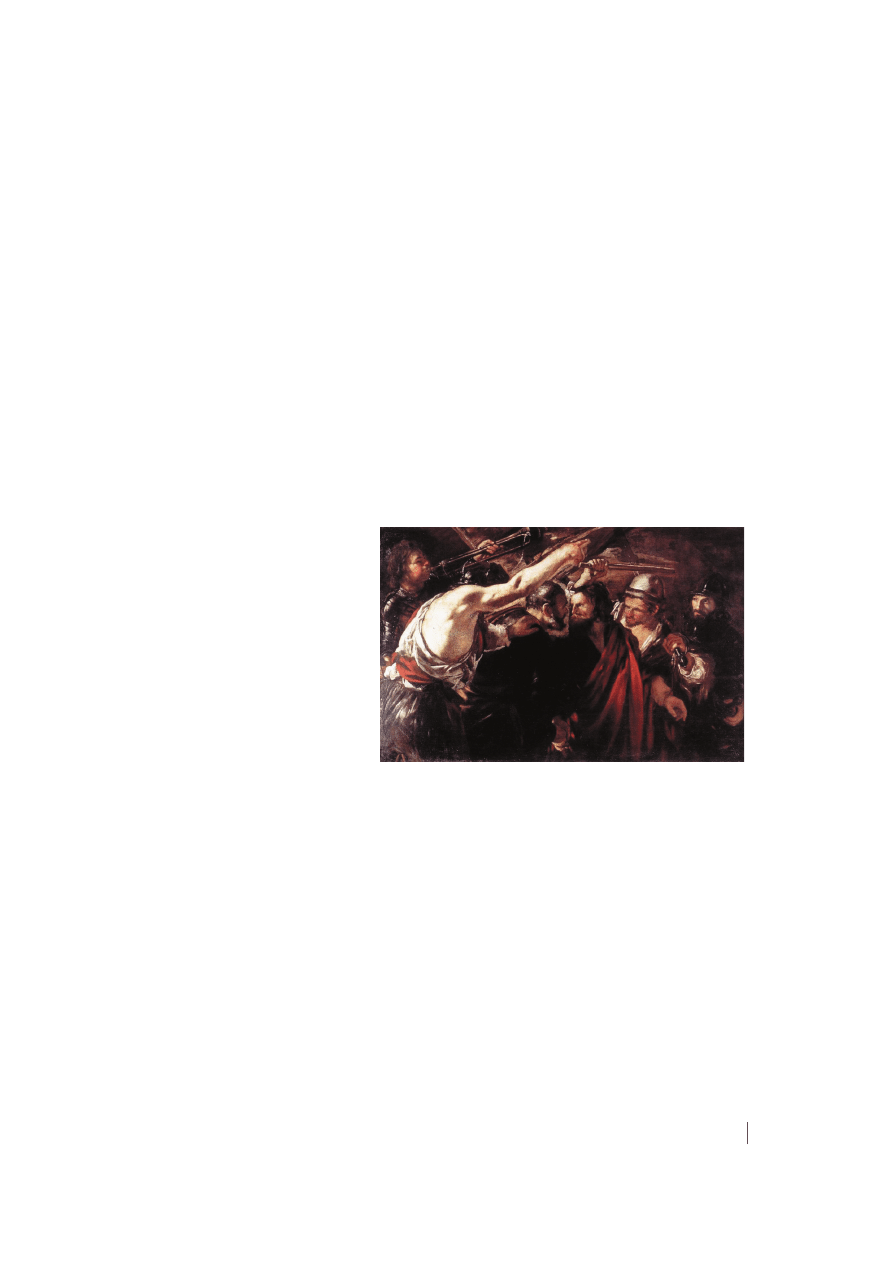
For this reason, before getting to the heart of our seminar, I would like you to observe
carefully the reproduction of the painting by Serodine which you see before you. The
painting, kept in the Galleria nazionale di arte antica in Rome, depicts the encounter of
the apostles Peter and Paul on the road to martyrdom. The two saints, motionless, occupy
the centre of the canvas, surrounded by the disorderly gesticulation of the soldiers and
executioners who are leading
them to their death. Critics
have often drawn attention
to the contrast between the
heroic rigour of the two
apostles and the commotion
of the crowd, lit up here
and there by flecks of light
sketched almost randomly
on the arms, the faces, the
trumpets. For my part, I
think that what makes this
painting truly incomparable
is that Serodine has portrayed the two apostles so close together—with their foreheads
almost glued one to the other—that they are absolutely unable to see each other. On the
road to martyrdom, they look at, without recognizing, each other. This impression of an
excessive proximity, as it were, is accentuated by the silent gesture of shaking hands at
the bottom of the picture, scarcely visible. It has always seemed to me that this painting
contains a perfect allegory of friendship. What is friendship, in effect, if not a proximity
such that it is impossible to make for oneself either a representation or a concept of it?
To recognize someone as a friend means not to be able to recognize him as ʻsomethingʼ.
One cannot say ʻfriendʼ as one says ʻwhiteʼ, ʻItalianʼ, ʻhotʼ,—friendship is not a property
or quality of a subject.
But it is time to begin a reading of the Aristotelian passage upon which I intended to
comment. The philosopher dedicates to friendship a veritable treatise, which occupies
the eighth and ninth books of the Nicomachean Ethics. Since we are dealing with one
of the most celebrated and discussed texts in the entire history of philosophy, I will take

5
Contretemps 5, December 2004
for granted a knowledge of its most well-established theses: that one cannot live without
friends, that it is necessary to distinguish between friendship founded on utility and on
the pleasure of virtuous friendship (in which the friend is loved as such), that it is not
possible to have many friends, that friendship at a distance tends to result in oblivion, etc.
All this is very well known. There is, however, a passage of the treatise which appears
to me not to have received sufficient attention, although it contains, so to speak, the
ontological basis of the theory. The passage is 1170a 28—171b35.
And if the one who sees perceives (aisthanetai) that he sees, the one who hears
perceives that he hears, the one who walks perceives that he walks, and similarly
in the other cases there is something that perceives that we are in activity (oti
energoumen), so that if we perceive, it perceives that we perceive, and if we think,
it perceives that we think; and if perceiving that we perceive or think is perceiving
that we exist (for as we said, existing [to einai] is perceiving or thinking); and if
perceiving that one is alive is pleasant (edeon) in itself (for being alive is something
naturally good, and perceiving what is good as being there in oneself is pleasant);
and if being alive is desirable, and especially so for the good, because for them
existing is good, and pleasant (for concurrent perception [synaisthanomenoi] of
what is in itself good, in themselves, gives them pleasure); and if, as the good person
is to himself, so he is to his friend (since the friend is another self [heteros autos])
then just as for each his own existence (to auton einai) is desirable, so his friendʼs
is too, or to a similar degree. But as we saw, the good manʼs existence is desirable
because of his perceiving himself, that self being good; and such perceiving is
pleasant in itself. In that case, he needs to be concurrently perceiving his friend
– that he exists, too—and this will come about in their living together, conversing
and sharing (koinonein) their talk and thoughts; for this is what would seem to be
meant by “living together” where human beings are concerned, not feeding in the
same location as with grazing animals.
… For friendship is community, and as we are in relation to ourselves, so we are
in relation to a friend. And, since the perception of our own existence (aisthesis
oti estin) is desirable, so too is that of the existence of a friend.
2
We are dealing with an extraordinarily dense passage, since Aristotle enunciates here
some theses of first philosophy that are not encountered in this form in any of his other
writings:
1) There is a pure perception of being, an aisthesis of existence. Aristotle repeats this
a number of times, mobilising the technical vocabulary of ontology: aisthanometha
oti esmen, aisthesis oti estin: the oti estin is existence, the quod est as opposed to the
essence (quid est, oti estin).

6
Contretemps 5, December 2004
2) This perception of existing is, in itself, pleasant (edys).
3) There is an equivalence between being and living, between awareness of oneʼs
existing and awareness of oneʼs living. This is decidedly an anticipation of the
Nietzschean thesis according to which: “Being: we have no other experience of it
than ʻto liveʼ.”
3
(An analogous affirmation, although a more generic one, can be read
in De Anima 415 b 13 —“In the case of living things, their being is to live.”
4
)
4) Inherent in this perception of existing is another perception, specifically human,
which takes the form of a concurrent perception (synaisthanesthai) of the friendʼs
existence. Friendship is the instance of this concurrent perception of the friendʼs
existence in the awareness of oneʼs own existence. But this means that friendship also
has an ontological and, at the same time, a political dimension. The perception of
existing is, in fact, always already divided up and shared or con-divided. Friendship
names this sharing or con-division. There is no trace here of any inter-subjectivity—that
chimera of the moderns—nor of any relation between subjects: rather, existing itself
is divided, it is non-identical to itself: the I and the friend are the two faces—or the
two poles—of this con-division.
5) The friend is, for this reason, another self, a heteros autos. In its Latin translation,
alter ego, this expression has a long history, which this is not the place to reconstruct.
But it is important to note that the Greek formulation is expressive of more than a
modern ear perceives in it. In the first place, Greek, like Latin, has two terms to
express otherness: allos (Lat. alius) is a generic otherness, while heteros (Lat. alter)
is otherness as an opposition between two, as heterogeneity. Furthermore, the Latin
ego does not exactly translate autos, which signifies ʻoneselfʼ. The friend is not
another I, but an otherness immanent in self-ness, a becoming other of the self. At the
point at which I perceive my existence as pleasant, my perception is traversed by a
concurrent perception that dislocates it and deports it towards the friend, towards the
other self. Friendship is this de-subjectivization at the very heart of the most intimate
perception of self.
At this point, the ontological dimension in Aristotle can be taken for granted. Friendship
belongs to the prote philosophia, because that which is in question in it concerns the
very experience, the very ʻperceptionʼ of existing. One understands then why ʻfriendʼ
cannot be a real predicate, one that is added to a concept to inscribe it in a certain class. In
modern terms, one might say that ʻfriendʼ is an existential and not a categorical. But this
existential—which, as such, is unable to be conceptualized—is nonetheless intersected
by an intensity that charges it with something like a political potency. This intensity is the
ʻsynʼ, the ʻcon-ʼ which divides, disseminates and renders con-divisible—in fact, already
always con-divided—the very perception, the very pleasantness of existing.

7
Contretemps 5, December 2004
That this con-division might have, for Aristotle, a political significance, is implicit in
the passage of the text we have just analysed and to which it is opportune to return.
In that case, he needs to be concurrently perceiving his friend – that he exists,
too – and this will come about in their living together, conversing and sharing
(koinonein) their talk and thoughts; for this is what would seem to be meant by
“living together” where human beings are concerned, not feeding in the same
location as with grazing animals.
The expression translated as “feeding in the same location” is en to auto nemesthai.
But the verb nemo—which as you know, is rich with political implications (it is enough
to think of the deverbative nomos)—in the middle voice also means ʻto partakeʼ, and
the Aristotelian expression could mean simply ʻto partake of the sameʼ. It is essential, in
any case, that human community should here be defined, in contrast to that of animals,
through a cohabitation (syzen here takes on a technical meaning) which is not defined
by participating in a common substance but by a purely existential con-division and, so
to speak, one without an object: friendship, as concurrent perception of the pure fact
of existence. How this original political synaesthesia could become, in the course of
time, the consensus to which democracies entrust their fates in this latest extreme and
exhausted phase of their evolution is, as they say, another story, and one upon which I
shall leave you to reflect.
Giorgio Agamben
University of Verona
Translated by Joseph Falsone
University of Sydney
Notes
1. Diogenes Laertius, The Lives of Eminent Philosophers, trans. R.D. Hicks, 2 vols. (London:
Heinemann, 1959) 464-465. [Note: In this parallel text Loeb edition, Hicks provides a somewhat
more elaborate translation of the Greek: “He who has (many) friends can have no true friend.”]
2. Aristotle, Nicomachean Ethics, trans. Christopher Rowe (Oxford: Oxford UP, 2002) 237-240
[Greek added.]
3. Friedrich Nietzsche, The Will to Power, trans. Walter Kaufmann and R.J. Hollingdale (Random
House: New York, 1968) 312 ¶582 “Das Sein—wir haben keine andere Vorstellung davon als
ʻlebenʼ.”
4. Aristotle, “De Anima,” The Complete Works of Aristotle, ed. Jonathan Barnes, 2 vols. (Princeton:
Princeton UP, 1984) vol.1, 661.
Copyright © 2004 Giorgio Agamben, Joseph Falsone, Contretemps. All rights reserved.
Wyszukiwarka
Podobne podstrony:
Mantak Chia et al The Multi Orgasmic Couple (37 pages)
Mantak Chia et al The Multi Orgasmic Couple (37 pages)
Agamben, Giorgio Le cinéma de Guy Debord
Review Santer et al 2008
Arakawa et al 2011 Protein Science
Byrnes et al (eds) Educating for Advanced Foreign Language Capacities
Huang et al 2009 Journal of Polymer Science Part A Polymer Chemistry
5 Biliszczuk et al
[Sveinbjarnardóttir et al 2008]
II D W Żelazo Kaczanowski et al 09 10
2 Bryja et al
Ghalichechian et al Nano day po Nieznany
4 Grotte et al
6 Biliszczuk et al
ET&AL&DC Neuropheno intro 2004
3 Pakos et al
7 Markowicz et al
Bhuiyan et al
Gao et al
więcej podobnych podstron