
Page 1
Radiation Protection Guidance
For
Hospital Staff
Prepared for Stanford Hospital and Clinics,
Lucile Packard Children's Hospital
And
Veterans Affairs Palo Alto Health Care System
December 2010
For additional information contact the Health Physics office at 723‐3201

Page 2
Preface
The privilege to use ionizing radiation at Stanford University, Stanford Hospital
and Clinics, Lucile Packard Children's Hospital and Veterans Affairs Palo Alto
Health Care System requires each individual user to strictly adhere to federal and
state regulations and local policy and procedures. All individuals who work with
radioactive materials or radiation devices are responsible for knowing and
adhering to applicable requirements. Failure of any individual to comply with
requirements can jeopardize the investigation, the laboratory, and the institution.
This guidance document provides an orientation on ionizing radiation, and
describes radiation safety procedures we have implemented to ensure a safe
environment for our patients and students, the public, and ourselves. Our goal is
to afford users as much flexibility as is safe and consistent with our policy of as
low as reasonably achievable (ALARA) below the limits provided in the
regulations.
The Radiation Safety Officer is responsible for managing the radiation safety
program subject to the approval of the Administrative Panel on Radiological
Safety, and is authorized to take whatever steps are necessary to control and
mitigate hazards in emergency situations.
Consult with the Radiation Safety Officer at 723-3201 for specific information.

Page 3
TABLE OF CONTENTS
Section 1 - Introduction ................................................................................................ 5
Section 2 - The Hazards of Radiation Exposure ........................................................ 6
X-rays.......................................................................................................................... 8
Gamma Radiation ....................................................................................................... 8
Background Radiation ................................................................................................ 9
Properties of Radioactivity And Units Of Measure.................................................. 10
Section 3 - Regulations for the Safe Use of Ionizing Radiation .............................. 12
Occupational Exposure Limits to Radiation............................................................. 12
Maximum Permissible Occupational Doses ............................................................. 12
Additional limits for pregnant workers..................................................................... 12
Posting Requirements ............................................................................................... 13
Labeling requirements .............................................................................................. 13
Radioactive Package Receipt Requirements............................................................. 13
Section 4 - Personnel monitoring............................................................................... 14
Declaration of Pregnancy.......................................................................................... 16
Section 5 - General workplace safety guidance........................................................ 17
Security ..................................................................................................................... 17
The Basic Principles of Radiation Protection ........................................................... 17
Protection against Radiation Exposure ..................................................................... 17
Recommended Shielding For Radionuclides............................................................ 18
Lead shielding for fluoroscopic units ....................................................................... 18
Lead Apron Policy:................................................................................................... 18
Lead Apron Inspection and Inventory Policy ........................................................... 19
Section 6 - Radiation-Producing Machines (X-Ray) in the Healing Arts ............. 21
Machine Acquisition................................................................................................. 21
Shielding For Machines ............................................................................................ 21
Machine Purchase and Registration with the State of California ............................. 21
X-RAY Machine compliance Tests and Calibrations............................................... 22
State Approval Process for New Therapy Machines ................................................ 23
Certificates and Permits ............................................................................................ 23
Certificates/Permits for Radiologic Technologists and Limited Permit x-ray
Technicians ............................................................................................................... 24
Section 8 - Radioactive Materials in Medicine and Human Research................... 26
Clinical Radiation Safety Committee (CRSCo) ....................................................... 26
Approval of Human Research with Ionizing Radiation............................................ 26
Radioactive Drug Research Committee (RDRC) ..................................................... 27
RDRC Organization and Operation.......................................................................... 27
Selection of Physicians to Use Radioactive Material for Human Treatment and
Diagnosis................................................................................................................... 27
Direct Supervision .................................................................................................... 28
Radiopharmaceuticals and Radionuclides for Human Use - Authorized User......... 28
Section 9 - Individuals or Groups Requiring Training ........................................... 29
Radiation Workers .................................................................................................... 29
Ancillary Worker ...................................................................................................... 29

Page 4
Non-Radiation Workers ............................................................................................ 29
Training Frequency for Those Working With or Near Radioactive Material or
Radiation Producing Machines ................................................................................. 29
Section 10 - Emergency Actions................................................................................. 30
Lifesaving emergency Actions for Patients Administered with Radiopharmaceuticals
or for Patients Contaminated with Radioactive Material.......................................... 30
In The Event Of an Injured Contaminated Stanford Researcher .............................. 30
In The Event of A Large Scale Major Radiological Event....................................... 30
Ionizing Radiation and Terrorist Incidents: Important Points for the Patient and You
................................................................................................................................... 31
Additional resources: ................................................................................................ 32
Section 11 – Patient’s Receiving Radioisotope Administrations ............................ 33
General Radiation Precautions Regarding Patients Receiving Radioiodine Therapies
................................................................................................................................... 33
Nursing Care Specific Instructions for Therapy Patients Treated with
Radiopharmaceuticals ............................................................................................... 34
General Radiation Precautions Regarding Patients with Implants of Sealed
Radioactive Sources.................................................................................................. 34
Nursing Care Specific Instructions for Patients with Implants of Sealed Radioactive
Sources:..................................................................................................................... 35
General Radiation Precautions Regarding Patients Receiving Doses of Radioactive
Material For Diagnostic Studies Or Minor Therapies .............................................. 35
General Radiation Precautions Regarding Patients Treated With Yttrium-90 (
90
Y)
Glass Microspheres................................................................................................... 35
Nursing Care Specific Instructions for Patients Treated With Yttrium-90 (
90
Y) Glass
Microspheres............................................................................................................. 36
Release of individuals containing unsealed byproduct material or implants
containing byproduct material .................................................................................. 36
Transportation Service - General Radiation Precautions.......................................... 36
Actions In Case of Death for Patients Administered With Therapeutic Radioactive
Sources...................................................................................................................... 36
Appendix I - Frequently Asked Questions: .............................................................. 38
Appendix II - Receiving Radioactive Material Packages........................................ 40
Appendix III - Use of Inert Gases in Nuclear Medicine .......................................... 41
Appendix IV - Proper Operating Procedures for Fluoroscopic Units ................... 42
Appendix V - Guidance for Preparing Research Proposals ................................... 43
Appendix VI - Definitions .......................................................................................... 45

Page 5
Section 1 - Introduction
The purpose of this guidance document is to describe the policies and procedures of the
Stanford Hospital and Clinics, Lucile Packard Children's Hospital and Veterans Affairs
Palo Alto Health Care System.
The regulatory basis of the Stanford University Radiation Protection Program includes
Title 17, California Code of Regulations, Division 1, Chapter 5, 10 CFR 20 (Title 10
Code of Federal Regulations, Part 20) and 10 CFR 35 (Title 10 Code of Federal
Regulations, Part 35). In addition, stipulations of the Food and Drug Administration, the
United States Department of Transportation, the Occupational Safety and Health
Administration (in the case of VAPAHCS), and the Joint Commission contribute to the
regulatory environment.
Due to frequent changes in the regulatory climate, and changes in the needs of the users
of radioactive material at Stanford University, all policies and procedures outlined in this
guidance document shall be considered to be subject to change.
The safe use of lasers and other forms of non-ionizing radiation such as ultra sound or
magnetic fields will not be covered in this document.
Page 6
Section 2 - The Hazards of Radiation Exposure
Since the end of the 19
th
Century, man has learned to use radiation for many beneficial purposes.
Today, many sources of radiation, such as x-ray machines, linear accelerators and radionuclides
are used in clinical and research applications. Such beneficial uses may at times create
potentially hazardous situations for personnel who work within the hospital.
All uses of ionizing radiation at the Stanford Hospital & Clinics (SHC), the Lucile Packard
Children's (LPCH) Hospital and the VA Palo Alto Health Care System (VAPAHCS) are subject
to review and approval by the Administrative Panel on Radiological Safety (APRS). The review
assures that projects can be conducted safely. The Radiation Safety Officer (RSO) manages the
health physics program.
Ionizing versus Non-
ionizing
Not all radiation interacts with matter in the same way. Radiation that has
enough energy to move atoms in a molecule around or cause them to vibrate,
but not enough to remove electrons, is referred to as "non-ionizing
radiation." Examples of this kind of radiation are sound waves, visible light,
and microwaves.
Radiation that falls within the ionizing radiation" range has enough energy to
remove tightly bound electrons from atoms, thus creating ions. This is the
type of radiation that people usually think of as 'radiation.' We take
advantage of its properties in diagnostic imaging, to kill cancer cells, and in
many manufacturing processes.

Page 7
Examples of non-ionizing radiation exposures in the clinical setting include,
Magnetic resonance imaging (MRI), ultrasound and LASERS.
Natural sources
We live in a radioactive world. There are many natural sources of radiation
which have been present since the earth was formed
The three major sources of naturally occurring radiation are:
Cosmic radiation
Sources in the earth's crust, also referred to as terrestrial radiation
Sources in the human body, also referred to as internal sources.
Cosmic radiation
Cosmic radiation comes from the sun and outer space and consists of
positively charged particles, as well as gamma radiation. At sea level, the
average cosmic radiation dose is about 26 mrem per year. At higher
elevations the amount of atmosphere shielding cosmic rays decreases and
thus the dose increases. The average dose in the United States is
approximately 28 mrem/year.
Terrestrial
There are natural sources of radiation in the ground, rocks, building
materials and drinking water supplies. This is called terrestrial radiation.
Some of the contributors to terrestrial sources are natural radium, uranium
and thorium. Radon gas, which emits alpha radiation, is from the decay of
natural uranium in soil and is ubiquitous in the earth's crust and is present in
almost all rocks, soil and water. In the USA, the average effective whole
body dose from radon is about 200 mrem per year while the lungs receive
approximately 2000 mrem per year.
Internal
Our bodies also contain natural radionuclides. Potassium 40 is one example.
The total average dose is approximately 40 mrem/year.
Human sources of
radiation
The difference between man-made sources of radiation and naturally
occurring sources is the place from which the radiation originates. The
following information briefly describes some examples of human-made
radiation sources.
Consumer products Examples include TV's, older luminous dial watches, some smoke detectors,
and lantern mantles. This dose is relatively small as compared to other
naturally occurring sources of radiation and averages 10 mrem in a year.
Atmospheric testing
of nuclear weapons
Another man-made source of radiation includes residual fallout from
atmospheric nuclear weapons testing in the 1950's and early 1960's.
Atmospheric testing is now banned by most nations. The average dose from
residual fallout is about 2 mrem in a year.
Medical radiation
sources
X rays are identical to gamma rays; however, they are produced by a
different mechanism. X rays are an ionizing radiation hazard. A typical
radiation dose from a chest x ray is about 10 mrem. A typical radiation dose
from a whole body CT is about 1500 mrem. In addition to x rays, radioactive

Page 8
isotopes are used in medicine for diagnosis and therapy.
X-ray machines
Any electronic device that has fast-moving electrons is a potential source of
ionizing radiation. One is the diagnostic x-ray machine. First used in 1896,
it permitted non-invasive imaging of internal human structures. Today, in
the US alone, medical procedures from ionizing radiation accounts for fifty-
one percent of our annual dose from radiation (the other 50% is from
naturally occurring sources such as cosmic rays, radon, and soils).
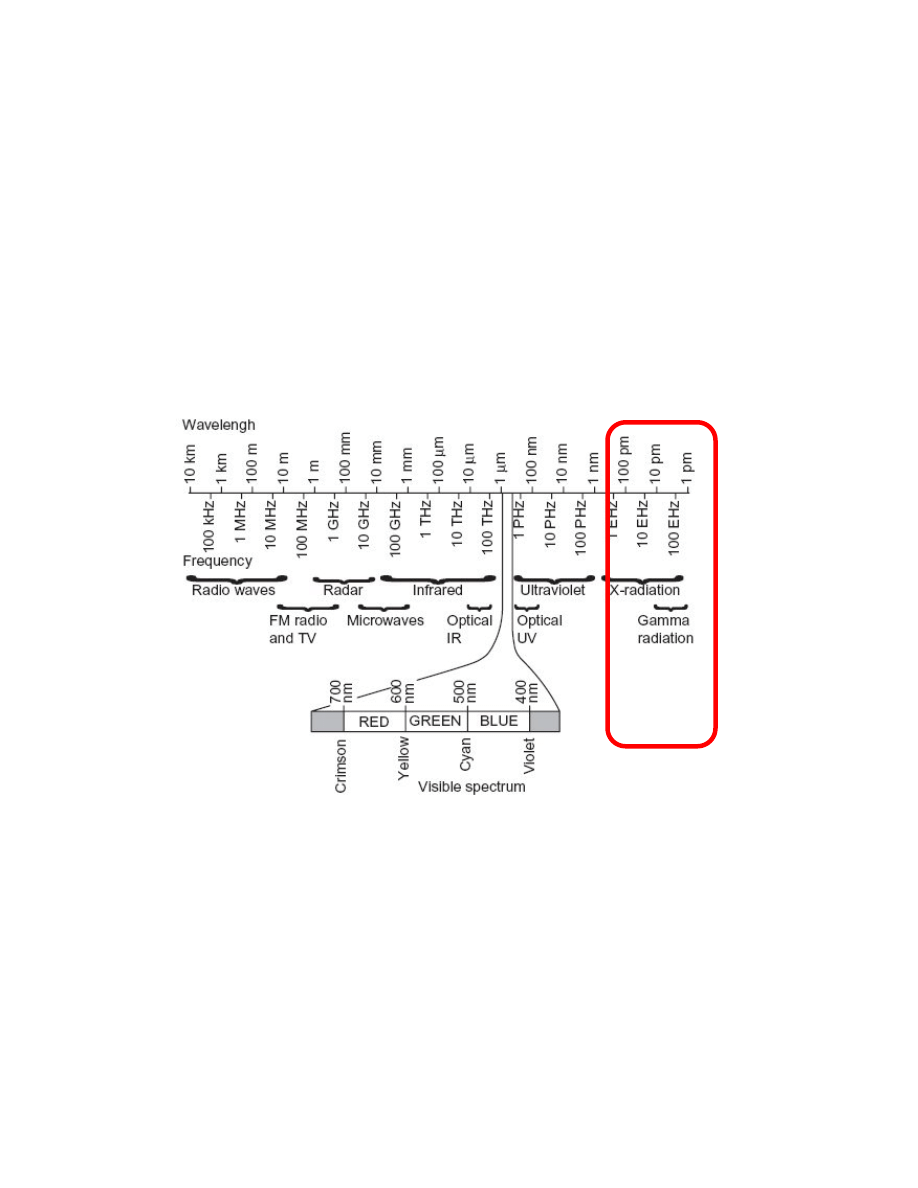
X-rays
X-rays are a type of radiation commonly found in the hospital. These
radiations are produced mainly by machines when high voltage electrons
interact with matter. X-rays are a type of energy similar to light and like
gamma rays; pass easily through fairly thick materials. X-ray machines and
the rooms they are used in have built-in shielding. The useful beam is
restricted by a cone or an adjustable collimator.
High energy x-ray
machines and/or
accelerators
High energy x-ray machines, also called accelerators, operating in the 4 MV
to 25 MV energy range, are therapy machines used to treat many illnesses.
Sealed sources
Many devices use sealed radioactive sources because they provide a
convenient, inexpensive source of ionizing radiation. Sealed radioactive
sources are often made by encapsulating the salt or metal of a radionuclide
in a welded metal container whose size typically ranges from smaller than a
pencil lead to the size of a golf ball. The encapsulation ensures that there
will be no radioactive contamination of the laboratory. Applications range
from low activity alpha sources that are used in home smoke detectors to
Brachytherapy which is a form of radiotherapy where a radioactive source
is placed inside or next to the area requiring treatment.
Gamma Radiation
Gamma Radiation is similar to light and x-rays. It may penetrate through
many inches of iron, concrete, wood, plastic, water, etc. Patients who have
received large doses of radioactive materials that emit gamma rays (for
example, in undergoing some therapy procedures such as Iodine-131 MIBG
used to treat neuroendocrine tumours) may be a source of exposure to nurses
and other personnel.
Beta Radiation
Beta radiations are electrons with a range of energies. They are less
penetrating than gamma particles, but generally will be stopped by about
one-half inch thick wood, plastic, water, tissue…etc, depending on the
energy. A patient who has received a radioactive material that gives off only
beta radiations does not become an external radiation hazard to nurses or
others. Problems may arise, however, due to contamination of bedding,
dressings, when such materials are excreted in urine or perspiration.
Applications include Yttrium 90 (
90
Y) for cases where it is not possible to
surgically remove hepatic tumors. The
90
Y can be used to deliver targeted,
internal radiation therapy directly to the tumor. The
90
Y is delivered by
loading the yttrium into tiny resin microspheres. The spheres
are very small
and are injected via microcatheter into the common hepatic artery.

Page 9
Positron Radiation
Isotopes used in positron emission tomography (PET) scans, such as
18
F,
11
C, or
13
N, decay by positron emission. A positron, the anti-particle of a
beta particle, is emitted by a proton-rich nucleus. It has the same mass as an
electron, but carries a positive charge. Positrons yield two 0.511 MeV
photons. Positron photon radiation is similar to gamma radiation in that it
can penetrate through inches of iron, concrete, wood, plastic, water, etc.
Patients who have received positron emitters (for example the
radiopharmaceutical fluorodeoxyglucose, commonly abbreviated
18
F-FDG,
is used in PET) are a source of exposure to nurses and other personnel.
Radioactive Decay
If one starts with a sample of radioactive material, i.e., a specific number of
atoms, as that sample undergoes radioactive transformation, over time one
will have progressively smaller numbers of the original radioactive atoms
present. When half of the original atoms have decayed, the material is said
to have gone through a half-life. During the next half-life, half of the
remaining atoms will decay; leaving one-fourth of the original and so on.
The number of atoms which decay each second is the measure of
radioactivity.
Some elements, such as Cesium-137 (
137
Cs) have a very long half-life (30
years), so they essentially maintain a significant level of radioactivity over a
human life span. Others, such as Flourine-18 (
18
F) and Iodine-131 (
131
I),
have fairly short half-lives, approximately 2 hours and eight days
respectively, and therefore, the level of radioactivity diminishes relatively
rapidly. Nuclides which are used for diagnostic purposes, scans, or images
have short half-lives. For example, a commonly used nuclide, Technetium-
99m (
99m
Tc) has a half-life of six hours. In 42 hours, 99.3% of
99m
Tc’s initial
activity decays.
Background Radiation
Background radiation dose consists of the radiation doses received from natural and man-made
background. For someone residing in the US, the annual background dose is approximately 633
millirem (mrem), but in some locations can be much higher. The highest known level of
background radiation affecting a substantial population is in Kerala and Madras States in India
where some 140,000 people receive an annual dose rate which averages over 1500 mrem per year
from gamma, plus a similar amount from radon, for a total of 3000 mrem.
US Average 633 millirem
Medical
51%
Cosmic
6%
Radon
30%
Internal
6%
Consumer
products
2%
Other
1%
Terrestial
4%

Page 10
Properties of Radioactivity And Units Of Measure
How is Radiation Measured?
In the United States, radiation absorbed dose, dose equivalent, and exposure are often measured
and stated in the units called rad, rem, or roentgen (R). This exposure can be from an external
source irradiating the whole body, an extremity, or organ resulting in an external radiation dose.
Alternately, internally deposited radioactive material may cause an internal radiation dose to the
whole body or other organ or tissue.
Smaller fractions of these measured quantities often have a prefix, e.g., milli (m) means 1/1,000.
For example, 1 rad = 1,000 mrad.
The International System of Units (SI) for radiation measurement is now the official system of
measurement and uses the "gray" (Gy) and "sievert" (Sv) for absorbed dose and equivalent dose
respectively. Conversions are as follows:
1 Gy = 100 rad
1 mGy = 100 mrad
1 Sv = 100 rem
1 mSv = 100 mrem
With radiation counting systems, radioactive transformation events can be measured in units of
"disintegrations per minute" (dpm) or, "counts per minute" (cpm). Background radiation levels
are typically less than 0.02 mrem per hour, but due to differences in detector size and efficiency,
the cpm reading on various survey meters will vary considerably.
Half-life
Probably the best known property of radioactivity is the half-life T. After one-half life has
elapsed, the number of radioactive decay events in a sample per unit time will be observed to
have reduced by one-half. The decay rate or activity at any time t can be described
mathematically:
A
t
= A
0
e
-[0.693 t/(T)]
Where:
A
0
= initial activity
A
t
= final activity at time t
t = lapsed time
T = isotope half-life
Alternatively, if n is the number of elapsed half-lives, then:
A
t
= A
0
(1/2)
n
Half-lives range from billionths of a second to billions of years. The half-life is characteristic of
the radioisotope at hand, and cannot be inferred. The half-life is included with the description of
the decay scheme.
Measures of Activity
The size or weight of a quantity of material does not indicate how much radioactivity is present.
A large quantity of material can contain a very small amount of radioactivity, or a very small
amount of material can have a lot of radioactivity.

Page 11
For example, uranium-238, with a 4.5-billion-year half-life, has only 0.00015 curies of activity
per pound, while cobalt-60, with a 5.3-year half-life, has nearly 513,000 curies of activity per
pound. This "specific activity," or curies per unit mass, of a radioisotope depends on the unique
radioactive half-life and dictates the time it takes for half the radioactive atoms to decay.
In the United States, the amount of radioactivity present is traditionally determined by estimating
the number of curies (Ci) present. The more curies present, the greater amount of radioactivity
and emitted radiation.
Common fractions of the curie are the millicurie (1 mCi = 1/1,000 Ci) and the microcurie (1 μCi
= 1/1,000,000 Ci). In terms of transformations per unit time, 1 μCi = 2,220,000 dpm.
The SI system uses the unit of becquerel (Bq) as its unit of radioactivity. One curie is 37 billion
Bq. Since the Bq represents such a small amount, one is likely to see a prefix noting a large
multiplier used with the Bq as follows:
37 GBq = 37 billion Bq = 1 curie
1 MBq = 1 million Bq = ~ 27 microcuries
1 GBq = 1 billion Bq = ~ 27 millicuries
1TBq = 1 trillion Bq = ~ 27 curies

Page 12
Section 3 - Regulations for the Safe Use of Ionizing Radiation
Occupational Exposure Limits to Radiation
The NRC radiation dose limits in 10 CFR Part 20 and adopted by Title 17, California Code of
Regulations, Division 1, Chapter 5 were established by the NRC based on the recommendations
of the International Commission on Radiological Protection, (ICRP) and the National Council on
Radiation Protection and Measurements (NCRP). The limits were recommended by the ICRP and
NCRP with the objective of ensuring that working in a radiation-related industry was as safe as
working in other comparable industries. The dose limits and the principle of as low as reasonably
achievable (ALARA) should ensure that risks to work, are maintained indistinguishable from
risks from background radiation.
No level of radiation exposure is free of some associated risk. Thus the principle of radiation
safety is to keep the level of exposure ALARA.
Maximum Permissible Occupational Doses
Organ, tissue
Occupational Doses
Non-occupational
rem/year
mSv/year
rem/year
mSv/year
Whole body
5 50 0.1 1
Lense of the eye
15 150 NA NA
Shallow dose (skin
and extremities)
50 500 NA NA
The deep-dose equivalent is the whole-body dose from an external source of ionizing radiation.
This value is the dose equivalent at a tissue depth of 1 cm.
The lens dose equivalent is the dose equivalent to the lens of the eye from an external source of
ionizing radiation. This value is the dose equivalent at a tissue depth of 0.3 cm.
The shallow-dose equivalent is the external dose to the skin of the whole-body or extremities
from an external source of ionizing radiation. This value is the dose equivalent at a tissue depth of
0.007 cm averaged over and area of 10 cm
2
.
The dose limit to non-occupational workers and members of the public are two percent of the
annual occupational dose limit. Therefore, a non-radiation worker can receive a whole body dose
of no more that 0.1 rem/year from industrial ionizing radiation. This exposure would be in
addition to the 0.3 rem/year from natural background radiation and the 0.33 rem/year from man-
made sources such as medical x-rays.
Additional limits for pregnant workers
Because of the increased health risks to the rapidly developing embryo and fetus, pregnant
women can receive no more than 0.5 rem during the entire gestation period and no more than
0.05 rem each month. This is 10% of the dose limit that normally applies to radiation workers.
Page 13
Posting Requirements
The use of warning or caution signs is necessary to warn unauthorized or unsuspecting personnel
of a hazard and to remind authorized personnel as well.
Radioactive Materials, Radiation Areas, High Radiation Areas, Very High Radiation Areas,
Airborne Radioactivity Areas, shipping containers and vehicles shall be marked or posted as
required by various regulations. Health Physics will assist in providing the necessary information,
signs, and/or labels.
All signs, labels, and signals will be posted in a conspicuous place.
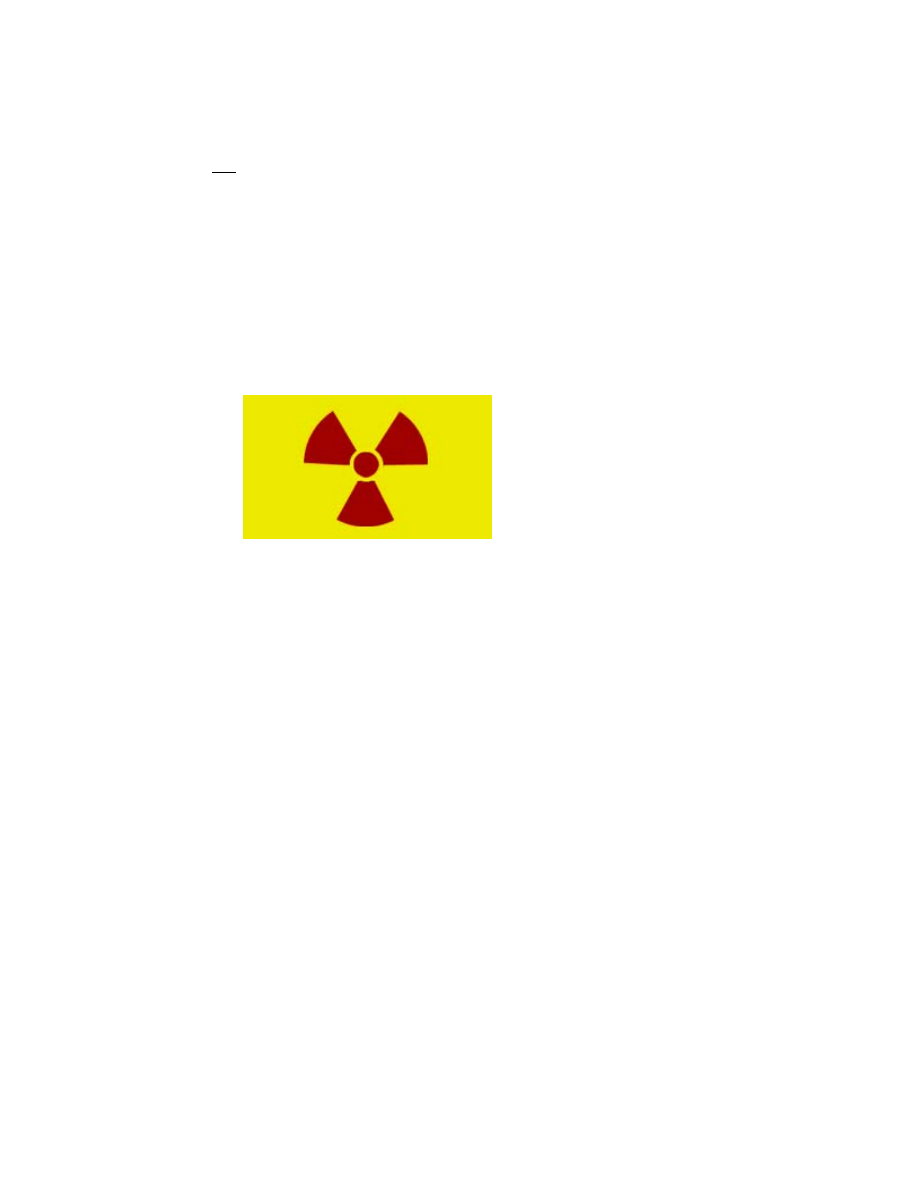
The standard radiation symbol appears with the required trefoil symbol as shown below. The
symbol is magenta, purple, or black on a yellow background.
Labeling requirements
Containers with greater than 10 CFR 20 Appendix C quantities must be labeled with the radiation
symbol, the words "Caution, Radioactive Material," and appropriate precautionary information
such as radionuclide, activity, date, dose rate at a specified distance, and chemical form.
Radioactive Package Receipt Requirements
Most radioactive materials packages found at the SHC, LPCH or
VAPAHCS
contain radioactive
drugs. The radioactive drugs are given to patients for the detection and treatment of disease.
Packages of radioactive materials are safe to handle under normal conditions. Studies show that
cargo handlers get very little radiation exposure from handling them.
If a package is labeled as
containing radioactive material, or appears damaged, it must be promptly monitored for dose rate
and contamination. If certain thresholds are exceeded, Health Physics must notify the carrier, the
Department of Health Services and the Nuclear Regulatory Commission.
Contact Health Physics if any package labeled as containing radioactive material is left
unattended in public areas.

Page 14
Section 4 - Personnel monitoring
The purpose of personnel monitoring is to provide early notice if your exposure is not below the
limits and ALARA. The monitoring program also provides a permanent record of your exposure.
Types of
dosimeters
Film badges are used to measure the radiation dose that you receive while attending
patients undergoing therapeutic or diagnostic procedures with radionuclides or while
working with radiation generation devices (e.g., linear accelerator, fluoroscope unit). If the
film is exposed to radiation it will darken; the amount of darkening increases with
exposure. Most finger rings use a LiF TLD to measure radiation exposure. The crystal
stores some of the radiation energy. When it is heated the energy is released as visible
light. LiF TLDs are also used as whole body dosimeters in areas which have both
radionuclides and x-rays (e.g., nuclear medicine). Both film badges and TLDs are
processed by a contractor. They are collected the first of each month. Most monitors can
read as low as 10 millirem.
Required
Monitoring
The regulations state monitoring is required for any worker who might exceed 10 percent
of the occupational limit (500 mrem), and any worker in a high or very high radiation
areas. Years of monitoring history demonstrate that most SHC, LPCH and VAPAHCS
exposures are nondetectable. Areas where exposures are observed include nuclear
medicine and interventional radiology. Each location bears the cost of its dosimetry
service and nonreturned dosimeter fees.
Use
Body badges are to be worn at the collar. If lead aprons are used wear the badge outside of
the apron at the collar. Finger rings are worn on the hand where the highest exposure is
expected underneath gloves to avoid contamination. If you are supplied both types, wear
both whenever you are working with radiation. These devices provide legal records of
radiation exposure; therefore, it is imperative that they only be used as prescribed.
Precautions
Do not remove the badges from your immediate work area. Do not take badges home, or
wear them for non-work exposures such as a dentist’s office.
Store badges in a safe location when not in use, away from sun, heat, sources of radiation
or potential damage. Protect badges from impact, puncture, or compression.
Do not store Extremity (finger) rings in lab coat pockets. Storing rings in the lab coat
pocket may expose the rings to radiation measured by the whole body badge. Rings are to
measure hand exposures only.
Dosimetry
Requests
Dosimetry requests can be made through the following web link:
https://ehsappprd1.stanford.edu/dosimetry/dosimetryhome.jsp
Records of
Prior
Exposure
Each individual having a previous or on-going radiation exposure history with
another institution is required to submit an “Authorization to Obtain Radiation
Exposure History” form. The form can be found at the following web link:
http://www.stanford.edu/dept/EHS/prod/researchlab/radlaser/manual/appendices/fo
rms/forms.htm
Lost
Dosimetry
A missing or invalid dosimeter reading creates a gap in your radiation dose record and
gives the impression of a lackadaisical monitoring program. A lost monitor report is
required.
The form can be found at the following web link:
http://www.stanford.edu/dept/EHS/prod/researchlab/radlaser/manual/appendices/fo

Page 15
rms/forms.htm
Late
Dosimetry
Dosimeters are considered “late” when they have not been returned to the dosimetry
location’s contact within one week after the end of the wear period (e.g., if issued a
monthly dosimeter on the 1
st
of October, return the worn dosimeter to the contact by the 7
th
of November). Dosimetry accounts will be charged a late fee in addition to the usual
dosimeter costs for dosimeters not returned within 90 days.
Late dosimeters may not be read as accurately as dosimeters returned on time. A control
badge accompanies the badges while in transit to and from the dosimetry vendor. Its
purpose is to record background radiation during the use period and to record any radiation
received by the badges during shipment. The exposure recorded by the control badge is
subtracted from the exposure on the badges worn by the workers. The net exposure is the
value found on the exposure reports. When a badge is returned late it cannot be processed
with the control badge and a correct exposure may not be reported.
Late dosimeters may also affect the whole location for the dosimeter because the location
contact may delay return of the entire group of badges while waiting for individuals who
turn badges in late. This delays the processing and reporting of results to other users.
If a significant exposure occurs, an early report is very desirable. If a badge is returned late,
higher work exposures can not be investigated in a timely manner. Returning a dosimeter
late is the same as not wearing one.
Bioassays
Bioassays determine the quantities, and in some cases, the locations of radioactive material
in the human body, whether by direct measurement, called in vivo counting, or by analysis
and evaluation of materials excreted from the human body. Individuals who handle large
amounts of easily ingested radionuclides may be required to participate in a bioassay
monitoring program. Bioassays may also be ordered by the RSO after a spill, an unusual
event, or a procedure that might result in an uptake.
Note: Dosimeters cannot detect very low levels of beta particle radiation (average
energies below 70 KeV).
Frequently Asked Question
Are dosimeters needed if exposed to ultrasound or MRI radiation?
Answer:
Dosimeters measure ionizing radiation only therefore dosimeters are
not responsive to radiation emitted from ultrasound or magnetic
resonance imaging equipment.
If there are any questions regarding the wearing of these badges or any questions regarding
radiation, please contact the Stanford University Health Physics Department at 723-3203.
Note: Failure of an employee to use required safety apparatus, such as film badges, may result in
appropriate disciplinary action. When badges are required, it is both the individual and the
supervisor’s responsibility to ensure that they are worn.

Page 16
Declaration of Pregnancy
The National Council on Radiation Protection and Measurements (NCRP) has recommended that,
because the unborn are more sensitive to radiation than adults, radiation dose to the fetus that
results from occupational exposure of the mother should not exceed 500 millirem during the
period of gestation. California and the NRC have incorporated this recommendation in their
worker dose limit regulations.
Employees who become pregnant and must work with radioactive material or radiation sources
during their pregnancy, may choose to contact Health Physics and complete a confidential
Declaration of Pregnancy form. Formal Declaration of Pregnancy is voluntary. After declaring
her pregnancy, the employee will then receive:
1. An evaluation of the radiation hazard from external and internal sources.
2. Counseling from the staff of the Radiation Safety Division regarding modifications of
technique that will help minimize exposure to the fetus.
3. A fetal monitoring badge, if appropriate.
Note: It is the employee’s responsibility to decide whether the exposure she is receiving from
penetrating radiation and intake is sufficiently low. Contact Health Physics to determine whether
radiation levels in your working areas could cause a fetus to receive 0.5 rem or more before birth.
Health Physics makes this determination based on personnel exposure monitor reports, surveys,
and the likelihood of an accident in your work setting. Very few work positions would require
reassignment during pregnancy.

Page 17
Section 5 - General workplace safety guidance
Safe use of hazardous materials in the workplace depends on the cooperation of individuals who
have been educated in the science and technology of the materials, who have technical training
specific to their application, and who follow administrative and technical procedures established
to ensure a safe and orderly workplace.
Security
No matter what source of radiation you work with, one way to enhance safety is to allow access
only to those with business in the area. If you see unfamiliar individuals in the area, it is
important to question them or call security. Regulatory agencies consider a high degree of
security to be an important compliance matter.
The Basic Principles of Radiation Protection
External contamination occurs when radioactive material, in the form of dust, powder, or liquid,
comes into contact with a person's skin, hair, or clothing. In other words, the contact is external to
a person's body. People who are externally contaminated can become internally contaminated if
radioactive material gets into their bodies.
Internal contamination occurs when people swallow or breathe in radioactive materials, or when
radioactive materials enter the body through an open wound or are absorbed through the skin.
Some types of radioactive materials stay in the body and are deposited in different body organs.
Other types are eliminated from the body in blood, sweat, urine, and feces.
A person exposed to radiation is not necessarily contaminated with radioactive material. A person
who has been exposed to radiation has had radioactive waves or particles penetrate the body, like
having an x-ray. For a person to be contaminated, radioactive material must be on or inside of his
or her body. A contaminated person is exposed to radiation released by the radioactive material
on or inside the body. An uncontaminated person can be exposed by being too close to
radioactive material or a contaminated person, place, or thing.
The use of universal precautions when handling human blood, human tissue and body
fluids equally protects occupational workers from radioactive material contamination.
In general the basic means of reducing your exposure to radiation and keeping your exposure
ALARA regardless of the specific source of radiation are as follows:
Keep the time of exposure to a minimum
Maintain distance from source
Where appropriate, place shielding between yourself and the source
Protect yourself against radioactive contamination
Protection against Radiation Exposure
The radiation worker can control and limit his/her exposure to penetrating radiation by taking
advantage of time, distance, and shielding.

Page 18
By reducing the time of exposure to a radiation source, the dose to the worker is reduced in direct
proportion with that time. Time directly influences the dose received: if you minimize the time
spent near the source, the dose received is minimized.
The exposure rate from a radiation source drops off by the inverse of the distance squared. If a
problem arises during a procedure, don't stand next to the source and discuss your options with
others present. Move away from the source or return it to storage, if possible.
The third exposure control is based on radiation shields, automatic interlock devices, and in-place
radiation monitoring instruments. Except temporary or portable shields, this type of control is
usually built into the particular facility.
Recommended Shielding For Radionuclides
Type of Radiation
Permanent
Temporary
beta radiation (e.g., Y90,
Sm153)
Aluminum, plastics
Aluminum, plastics, wood,
rubber, plastic, cloth
Gamma, Xrays, positrons
(e.g., I131, F18)
Lead, iron, lead glass, heavy
aggregate concrete, ordinary
concrete, water
Lead, iron, lead glass, concrete
blocks, water, lead equivalent
fabrics such as gloves (for
diagnostic xray machines
only)
Lead shielding for fluoroscopic units
Leaded eyewear and thyroid shields are recommended if monthly collar badges readings exceed
400 mrem.
Transparent upper body shields are usually suspended from the ceiling and protect the upper
torso, face and neck. The shield is contoured so that it can be positioned between the irradiated
patient anatomy and the operator.
Flat panel mobile shields and when used must be placed between personnel and the sources of
radiation (i.e., the irradiated area of the patient and the x-ray tube). Mobile shields are
recommended for the operator and for ancillary personnel who must be in the room but who are
not performing patient-side-work.
X-ray attenuating surgical gloves help to reduce the risk of radiation dermatitis in physician’s
hands from exposure to scattered radiation. These gloves do NOT adequately shield hands in the
primary x-ray field.
Lead Apron Policy:
Lead aprons are used in medical facilities to protect workers and patients from unnecessary x-ray
radiation exposure from diagnostic radiology procedures. A lead apron is a protective garment
which is designed to shield the body from harmful radiation, usually in the context of medical

Page 19
imaging. Both patients and medical personnel utilize lead aprons, which are customized for a
wide range of usages. As is the case with many protective garments, it is important to remember
that a lead apron is only effective when it is worn properly, matched with the appropriate
radiation energy and is used in a safe and regularly inspected environment. For example, per
California Title 17 (30307 Fluoroscopic Installations) “Protective aprons of at least 0.25 mm lead
equivalent shall be worn in the fluoroscopy room by each person, except the patient, whose body
is likely to be exposed to 5 mR/hr or more.”
Personnel who are required to wear lead aprons or other similar radiation protection devices
should visually inspect these devices prior to each use for obvious signs of damage such as tears
or sagging of lead.
Examples of when a lead apron is effective and appropriate:
A lead apron is inadequate for shielding
111
In or
131
I but is appropriate for an 80 kVp x-
ray beam (about 95 percent of the x-rays will be shielded). The lead apron can cause
stress and pain in the back muscles; to protect back strain often a skirt style apron
covering the lower abdomen is adequate.
For fluoroscopic procedures a lead apron of at least 0.25 mm lead equivalence (0.5 mm is
recommended) will reduce scattered x-rays by 95%. Additionally a thyroid collar is
recommended. A lead apron is not necessary if only imaging patients (e.g., chest
radiograph).
All occupation workers exposed to greater than 5 mrem/hr from fluoroscopic units must
wear lead. Dose rates of greater than 5 mrem/hr can be measured within 6 feet of the
table and includes where the fluoroscopist stands.
Examples of when a lead apron is NOT appropriate:
A lead apron does not provide much shielding for
137
Cs or
131
I therapy patients. In the
case of therapy patients, heavy portable shields are provided. Radiation Oncology
provides shields for brachytherapy patients and Health Physics provides shields for the
radioactive iodine therapy patients.
Lead Apron Inspection and Inventory Policy
Due to standards set forth by the Joint Commission, health care organizations must perform
annual inspections on medical equipment, including lead aprons.
SHC
, LPCH and VAPAHCS are
responsible for lead apron inspection and inventory.
The recommended apron inspection policy is as follows:
Annually perform a visual and tactile inspection
Look for visible damage (wear and tear) and feel for sagging and deformities.
In cases of questionable condition, one can choose to use fluoroscopy or radiography to
look for holes and cracks.
During fluoroscopic examination, use manual settings and low technique factors (e.g. 80
KVp). Do not use the automatic brightness control, as this will drive the tube current and
high voltage up, resulting in unnecessary radiation exposure to personnel and wear on the
tube. Lead aprons can also be examined radiographically.
Fluoroscopic lead apron are to be discarded if inspections determine there is:

Page 20
A defect greater than 15 square mm found on parts of the apron shielding a critical organ
(e.g., chest, pelvic area).
A defect greater than 670 square mm along the seam, in overlapped areas, or on the back
of the lead apron.
Thyroid shields with defects greater than 11 square mm.

Page 21
Section 6 - Radiation-Producing Machines (X-Ray) in the Healing Arts
Note: PRIOR to installation and during the architectural planning phase:
A review of shielding plans or the adequacy of shielding for each room where ionizing
radiation-generating equipment is used shall be conducted by Health Physics.
California Code of Regulations (CCR), Title 17, section 30108 states:
Every registrant having physical possession or control of a
radiation machine capable of producing radiation in the State of
California shall complete a separate registration form for each
installation within 30 calendar days of acquisition of each radiation
machine. A radiation machine is any device capable of producing x-
rays when its associated control devices are operated.
Additionally, CCR, Title 17, section 30115 states:
The registrant shall report in writing to the Department, within 30
days, any change in: registrant’s name, address, location of the
installation or receipt, sale, transfer, disposal or discontinuance of
use of any reportable source of radiation.
Machine Acquisition
All machines that generate ionizing radiation, including those for either medical diagnostic or
therapeutic purposes, must be registered with the State of California. Their installation and
operation must be registered with Health Physics. Departments preparing to purchase or acquire
radiation-producing machine(s) must provide Health Physics the following information:
Name of the primary supervisor/operator.
Description of the machine and its proposed use.
Health and safety provisions may require such items as shielding and monitoring devices.
Shielding For Machines
To ensure that shielding calculations and other recommendations are adequate and the radiation
dose to the public is below regulatory limits, the proposed floor plans and shielding shall be
submitted to Health Physics for review and approval as early in the design process as possible to
reduce the possible necessity of required design changes.
During construction and/or renovations, a shielding evaluation review shall be performed by
Health Physics for the area covered in the shielding calculation report.
Machine Purchase and Registration with the State of California
All purchases of radiation-producing machines shall be made through the normal Purchasing
Department procedures.
In most cases Health Physics performs all required machine registration functions with
mammography machines and Lucile Packard Children's Hospital being notable exceptions. After

Page 22
the machine is purchased and becomes operable, biennial inspection fees are paid by Health
Physics to the State of California. Machine registration fees are recharged to departments that
operate x-ray machines.
Survey of Machine Installation
Unless otherwise specified, Health Physics must survey the installation of radiation-producing
machine(s), whether newly acquired, relocated, modified, or repaired to determine the
effectiveness of health and safety hazard controls.
Warning Signs
All devices and equipment capable of producing radiation when operated shall be appropriately
labeled to caution individuals that such devices or equipment produce radiation. Rooms or areas
that contain permanently installed x-ray machines as the only source of radiation shall be posted
with a sign or signs that bear the words, “CAUTION X-RAY.”
Operation Signals
Any radiation-producing machine that is located in an area accessible to occupational workers
and is capable of producing a dose equivalent of 0.1 rem (1 mSv) in 1 hour at 30 centimeters from
the radiation source, shall be provided with conspicuous visible or audible alarm signal so that
any individual near or approaching the tube head or radiation port is aware that the machine is
producing radiation.
Changes in Machine Location and Disposition
Health Physics shall be notified of changes in the location or disposition of radiation-
producing machines.
Health Physics shall be given notice of intent to dispose or transfer the radiation-producing
machine to another user in order to notify the State of the transfer or disposal of the
radiation-producing machine.
If the radiation-producing machine is to be disposed of, all radiation-producing parts (e.g.,
x-ray tube) must be destroyed.
X-RAY Machine compliance Tests and Calibrations
The following information is provided as guidance:
Medical Diagnostic Machines
Health Physics annually performs x-ray machine compliance tests on medical diagnostic
machines to assure compliance with applicable rules and regulations. Records of these
compliance tests and any findings are kept at Health Physics. Compliance test copies are
also forwarded to Radiology.

Page 23
Weekly fluoroscopy phantom checks to confirm tube current and potential shall be
performed by the department responsible for the unit as required by CCR Title 17.
Note: Mammography machine annual tests are performed by an outside contractor.
Health Physics acts as a point of contact for this contractor. Records of these compliance
tests are provided to the mammography supervisor/department.
Medical Therapy Machines
Beam calibrations are performed by a Radiation Oncology Medical Physicist before
initial operation and at intervals not to exceed twenty-four months. A radiation protection
survey must be performed on all new and existing installations not previously surveyed,
and spot checks must be performed at least once each week for therapy systems. Annual
safety compliance tests are performed by Health Physics. Records of these calibrations,
spot checks, and surveys are maintained by Radiation Oncology - Radiation Physics and
audited annually by Health Physics.
State Approval Process for New Therapy Machines
The typical flow of information to the State of California Radiological Health Branch (RHB) and
ultimate RHB approval for the use of therapy machines is as follows:
Radiation Oncology Medical Physics and Health Physics will jointly prepare
information for submittal and review by RHB (submit to RHB >60 days prior to
installation or upgrade) including:
o
Shielding calculations or supported reasoning for why shielding is not required
o
Safety feature description such as interlocks, audible/visual beam-on indicators
RHB returns their comments and concerns or approves shielding
Machine is installed and registered
RHB approves energization of the beam for the purposes of obtaining applicable TG
report/calibration and the environmental survey
Submit Physicist’s Report of Safety Inspection and Comprehensive Environmental
Survey
RHB gives final approval (approval may take up to 60 days)
Patients treatments can begin
Certificates and Permits
Under the Radiologic Technology Act, the Radiologic Health Branch (RHB):
Certifies physicians, technologists, and permits technicians who use x-ray machines
and radioactive materials on human beings, approves radiologic technology schools,
and annually administers exams to physicians, technologists, and technicians for x-ray
certification.
Certifies individuals to use and administer radiopharmaceuticals for medical and
therapeutic purposes.
The following certificates and permits are applicable for licentiates:
Licentiate Certificate:
Radiology Supervisor and Operator (Radiologists only)

Page 24
Licentiate Permits:
Fluoroscopy Supervisor and Operator
Radiography Supervisor and Operator
Dermatology Supervisor and Operator
A Fluoroscopy Supervisor and Operator permit allows the individual to do any of the following:
(1) Actuate or energize fluoroscopy equipment. (2) Directly control radiation exposure to the
patient during fluoroscopy procedures. (3) Supervise one or more persons who hold a Radiologic
Technologist Fluoroscopy Permit.
Note: Only persons authorized by the individual in charge of the installation shall
operate fluoroscopic equipment. All physicians using or supervising use of
fluoroscopic equipment are required to be certified by the state of California.
Additionally, the Clinical Radiation Safety Committee requires that Veterans Affairs
Palo Alto Health Care System comply with the State of California certificate
requirements or its equivalent
A Radiography Supervisor and Operator permits allows the individual to do any of the following:
(1) Actuate or energize radiography x-ray equipment. (2) Supervise one or more persons who
hold a Radiologic Technologist Certificate. (3) Supervise one or more persons who hold a limited
permit. (4) Certificates/Permits for Diagnostic Machines
Frequently Asked Questions
Does a resident or fellow need a fluoroscopy permit?
Answer:
No. A resident or fellow working under the supervision of a Certified Fluoroscopy Supervisor
physician does not need to be themselves certified.
When is a fluoroscopy certificate NOT required by the State of California?
Answer:
A physician is not required to obtain a certificate or permit from the State if that physician:
a. Requests an x-ray examination through a certified supervisor and operator.
b. Performs radiology only in the course of employment by an agency of the Federal
Government and only at a Federal facility (Note: As a best management practice the
Clinical Radiation Safety Committee requires that Veterans Affairs Palo Alto Health
Care System comply with the State of California certificate requirements or its
equivalent).
Certificates/Permits for Radiologic Technologists and Limited Permit x-ray Technicians
Diagnostic Radiologic Technology Certificate
Mammographic Radiologic Technology Certificate
Radiologic Technologist Fluoroscopy Permit (Additionally, this individual must be
supervised by a licentiate who possesses a valid Fluoroscopy Supervisor and Operator
Permit.)
Therapeutic Radiologic Technology Certificate

Page 25
Permits for Limited Permit x-ray Technicians
Restraint/Manipulation of Patients during Examinations
No occupational worker shall regularly/routinely be assigned to hold or support humans during
radiation exposures. Personnel shall not perform this service except infrequently and then only in
cases where no other method is available. A non-occupational worker, such as a mother or father,
can hold the patient. Any individual holding or supporting a person during radiation exposure
should wear protective gloves and apron with a lead equivalent of not less than 0.25 millimeters.
Under no circumstances shall individuals holding or supporting a person place part of their body
directly in the primary beam.
Sources of Incidental X-Rays
Some electrical equipment operating at potentials of 20 kVp and above is capable of producing x-
rays. Generally, only equipment operating at potentials of 30 kVp and above is capable of
producing x-rays of biological significance. Anyone acquiring or constructing equipment
operating at or above 30 kVp, or employing cathode-ray tubes, rectifier tubes, klystrons or
magnetrons must contact Health Physics so that the machine may be checked under operating
conditions to insure that no significant exposures will occur to operating personnel.

Page 26
Section 8 - Radioactive Materials in Medicine and Human Research
Clinical Radiation Safety Committee (CRSCo)
At Stanford the oversight of human subject research involving radiology devices and radioactive
materials is a function of the Clinical Radiation Safety Committee (CRSCo) which is chartered by
the Food and Drug Administration. At SHS, LPCH and VAPAHCS, all uses of radionuclides in
humans regardless of quantity or purpose must be approved by CRSCo. Research protocols
involving human subjects must also be approved by Stanford’s Institutional Review Board (IRB).
Reviews may be conducted concurrently. In most cases, according to IRB procedures, only
medical faculty and VA staff physicians may apply.
Safety policies and instructions for clinical use of radiation sources at SHS, LPCH and
VAPAHCS are available from Health Physics. Additionally, Guidance for Preparing Research
Proposals Involving Ionizing Radiation in Human Use Research (see Appendix V) provides
information on administrative procedures and informed consent language. Health Physics is
available to assist protocol directors designing studies with radiation. Early consultation will help
assure that the proposal will be approved on the first review.
The Committee meets at least once during each calendar quarter, or more frequently, at the
discretion of the Chair. A quorum consists of more than fifty percent of its then current
membership, and must include the Chair, the RSO, and the Management representative.
Approval of Human Research with Ionizing Radiation
Application Process
All protocols involving both "research" or "clinical investigations" and "human subjects" must be
submitted by the electronic Human Subjects "eProtocol" system and are reviewed and approved
by the IRB before recruitment and data collection may start. Applications for Human Subjects
which include the use of radiation are forwarded to Health Physics for review. Human subject
protocols are then approved by the Stanford Clinical Radiation Safety Committee (CRSCo). If the
research requires Radioactive Drug Research Committee (RDRC) review as specified by FDA
RDRC regulations 21 CFR 361.1 an additional application from Health Physics must be
completed.
Application Review and Approval
Your application must be reviewed by Health Physics and may need to be circulated to individual
members of the CRSCO/RDRC committee for evaluation. Consult with Health Physics if you
have a time-sensitive need.
Human use research approvals are contingent on contemporaneous approval by the Stanford
University Research Compliance Office on Human Subject Research.

Page 27
Radioactive Drug Research Committee (RDRC)
The purpose of the Radioactive Drug Research Committee (RDRC) is to guarantee patients who
take part in either research protocols or clinical trials the highest degree of both radiation and
pharmacological safety. It is also the RDRC’s responsibility to determine the intrinsic value of
the research and weigh risk versus benefit considerations before approving such studies. Federal
law defines this committee, and the FDA must individually approve its members. The FDA also
specifies its composition.
RDRC Organization and Operation
By law the committee must be composed of:
A person qualified by both training and experience to formulate radioactive drugs
A person with special competence in radiation safety and radiation dosimetry
The remaining members of the committee shall be selected from the pertinent disciplines
that may be required to carry out the provisions of the law
The chairman of this committee shall sign all applications, minutes, and reports of the committee.
The committee must meet at least four times per year with a quorum (Section 361.1(c)(2))
consisting of more than 50 percent of the RDRC members present at each quarterly meeting, with
appropriate representation of the required fields of specialization. Its minutes and records shall
include the numerical results of the votes on protocols involving using radioactive drugs in
human subjects. No member of this committee may vote on a protocol with which he is
associated as an investigator.
The committee must submit an annual report to the FDA on or before January 31 of each year.
This report shall include the names and qualifications of the committee members and of any
consultants used by the committee. This report shall also incorporate the reports from the
individual institutional users and supply statistical information showing the number of
applications, the number of investigators, and pertinent information on any applications not
approved for investigational study.
The committee is also obligated to report immediately the approval of any study that will involve
the exposure of more than 30 research subjects or if any subjects were expected to be under the
age of 18. The FDA will conduct periodic reviews of the approved committee by reviewing the
annual reports, reviewing the minutes, and by examination of the full protocols for pertinent
studies that have been approved by the committee. They may also institute on-site inspections.
Selection of Physicians to Use Radioactive Material for Human Treatment and Diagnosis
Physicians named as Authorized Users to a Controlled Radiation Authorization (CRA) approved
for human treatment and/or diagnosis with radioactive materials should be board certified in their
area of specialty practice and must be approved as an Authorized User by the Clinical Radiation
Safety Committee prior to radiopharmaceuticals administrations or medical use of byproduct
material.. Board certification with the American Board of Nuclear Medicine, American Board of
Radiology, American Board of Osteopathic Radiology, British "Fellow of the Faculty of
Radiology" or "Fellow of the Royal College of Radiology", or Canadian Royal College of

Page 28
Physicians and Surgeons are considered acceptable certification organizations. The physician
must also be authorized to practice medicine in the state of California.
Physicians without the above board certifications may be named as users for human treatment and
diagnosis with radioactive materials on Radiation Use Authorizations provided that they meet the
appropriate training and experience requirements described in 10 CFR 35.
Physicians who are in specialty training (i.e., residents and fellows) may work on Controlled
Radiation Authorization (CRA) for human treatment and diagnosis provided that they are under
the general supervision of a physician who is board certified in the specialty area that the resident
physician is being trained in. Residents and fellows performing therapy must be under the direct
supervision of a board certified physician.
Direct Supervision
Residents and fellows performing therapy must be under the direct supervision of a board
certified physician. Direct supervision means that the supervisor must be able to assure that the
individual being supervised is following directions and performing the task correctly. The
supervisor must be able to immediately apply proper instruction and corrective actions.
Radiopharmaceuticals and Radionuclides for Human Use - Authorized User
Physicians who are authorized users may select radiopharmaceuticals in accordance with their
professional judgment for the treatment and diagnosis of human beings provided that the
radiopharmaceutical is approved for human use by the FDA.
Authorized Users must be approved by the Clinical Radiation Safety Committee prior to
radiopharmaceuticals administrations.
Physicians who are authorized users meet the requirements in NRC regulations 10 CFR PART
35--Medical Use of Byproduct Material.

Page 29
Section 9 - Individuals or Groups Requiring Training
Individuals employed by SHC, LPCH, and VAPAHCS fall into three general categories with
respect to their exposure to radiation:
Radiation Workers
Workers whose major responsibilities involve working with sources of ionizing radiation or
radioactive material. Examples could include:
Radiologists
Nuclear medicine physicians and technologists
Radiation therapy technologists
Cardiology technologists working with fluoroscopy equipment
Authorized Users
Nurses regularly caring for radionuclide therapy patients
Ancillary Worker
All personnel who may come in contact with or enter an area that contains radioactive material or
sources of ionizing radiation. Ancillary Worker examples include:
Housekeeping
Waste processors
Nursing staff occasionally caring for radionuclide therapy patients
Non-Radiation Workers
Personnel who would not normally be expected to encounter radioactive material or radiation
sources in the course of their employment. Non-Radiation Workers examples include:
Administrators and administrative assistants
Food service employees
Clerical staff.
Training Frequency for Those Working With or Near Radioactive Material or Radiation
Producing Machines
1. Radiation workers (including all new nuclear medicine technicians or residents): initial
“hands on” orientation is provided by Health Physics including instruction in the proper
use and handling of radioactive material and other sources of ionizing radiation. The
content of the initial training may be modified for the specific job responsibilities.
2. Radiation workers and ancillary workers whose exposure is frequent (waste processors):
periodic refresher training.
3. Ancillary workers whose exposure to radioactive material and other sources is infrequent
(e.g., nursing staff) or who request additional radiation safety training: training occurs on
an as needed basis (e.g., for infrequent in-house iodine therapy patient, portable CT
machine)
4. Non-Radiation workers: General information is available on demand through the web-
based course “Working Safely Near Radioactive Materials EHS-5275-WEB.”

Page 30
Section 10 - Emergency Actions
Lifesaving emergency Actions for Patients Administered with Radiopharmaceuticals or for
Patients Contaminated with Radioactive Material
If a SHC, LPCH or VAPAHCS patient is in a condition that requires immediate medical
treatment, which if not given will result in death or serious medical harm to the patient, that
treatment shall take precedence over radiation safety measures designed to prevent infractions of
State or Federal law.
Health Physics shall provide medical personnel support as necessary (call 723-3201). Support
will be provided in the area of contamination control, advice on radiation safety, and related
matters.
If an emergency procedure must be performed that requires transporting the patient to another
area (e.g., from the Emergency Department to Surgery), then the patient shall immediately be
transported to the necessary location. Health Physics shall be notified immediately. Health
Physics shall then assure that appropriate health physics support is provided.
In The Event Of an Injured Contaminated Stanford Researcher
Most radioactive materials used for research at Stanford and VA Palo Alto are low energy beta
emitters, low energy photon emitters, or radionuclides that are used in nuclear medicine. These
radionuclides on a contaminated patient will cause minimal to zero harm or cancer risk to medical
responders. Keep the following in mind:
Perform lifesaving measures.
Protect yourself from radioactive contamination by observing standard universal
precautions, including protective clothing, gloves, and a mask.
Call Health Physics 723-3201.
In The Event of A Large Scale Major Radiological Event
If a large local event such as a terrorist act has occurred involving radioactive materials medical
providers must be prepared to adequately treat injuries complicated by ionizing radiation
exposure and radioactive contamination. Nuclear detonation and other high-dose radiation
situations are the most critical (but less likely) events as they result in acute high-dose radiation.
If you are informed that radiation accident victims will be sent to the hospital, immediately notify
the nuclear medicine department, health physicist, radiation safety officer and others who have
expertise in radiation emergencies.
The following scenarios are adapted from Medical Management of Radiological Casualties
Handbook (Jarrett, 1999). Acute high-dose radiation occurs in three principal situations:
A nuclear detonation which produces extremely high dose rates from radiation during the
initial 60 seconds and then from fission fallout products in the area near ground zero.

Page 31
A nuclear reaction which results if high-grade nuclear material were allowed to form a
critical mass (“criticality”) and release large amounts of gamma and neutron radiation
without a nuclear explosion.
A radioactive release from a radiation dispersal device (RDD)* made from highly
radioactive material such as cobalt-60.
Ionizing Radiation and Terrorist Incidents: Important Points for the Patient and You
(Reprinted from Department of Homeland Security Working Group on Radiological Dispersal
Device (RDD) Preparedness: Medical Preparedness and Response Sub-Group (5/1/03 Version))
1. All patients should be medically stabilized from their traumatic injuries before radiation
injuries are considered. Patients are then evaluated for either external radiation exposure or
radioactive contamination.
2. An external radiation source with enough intensity and energy can cause tissue damage (eg,
skin burns or marrow depression). This exposure from a source outside the person does not make
the person radioactive. Even such lethally exposed patients are no hazard to medical staff.
3. Nausea, vomiting, diarrhea, and skin erythema within four hours may indicate very high (but
treatable) external radiation exposures. Such patients will show obvious lymphopenia within 8-24
hours. Evaluate with serial CBCs. Primary systems involved will be skin, intestinal tract, and
bone marrow. Treatment is supportive with fluids, antibiotics, and transfusions stimulating
factors. If there are early CNS findings of unexplained hypotension, survival is unlikely.
4. Radioactive material may have been deposited on or in the person (contamination). More than
90% of surface radioactive contamination is removed by removal of the clothing. Most remaining
contamination will be on exposed skin and is effectively removed with soap, warm water, and a
washcloth. Do not damage skin by scrubbing.
5. Protect yourself from radioactive contamination by observing standard universal precautions,
including protective clothing, gloves, and a mask.
6. Radioactive contamination in wound or burns should be handled as if it were simple dirt. If an
unknown metallic object is encountered, it should only be handled with instruments such as
forceps and should be placed in a protected or shielded area.
7. In a terrorist incident, there may be continuing exposure of the public that is essential to
evaluate. Evacuation may be necessary. Administration of potassium iodine (KI) is only indicated
when there has been release of radioiodine.
8. When there is any type of radiation incident many persons will want to know whether they
have been exposed or are contaminated. Provisions need to be made to potentially deal with
thousands of such persons.
9. The principle of time/distance/shielding is key. Even in treatment of Chernobyl workers, doses
to the medical staff were about 10 milligray or 10 millisievert [20% annual occupational limit].
Doses to first responders at the scene, however, can be much higher and appropriate dose rate
meters must be available for evaluation. Radiation dose is reduced by reducing time spent in the

Page 32
radiation area (moderately effective), increasing distance from a radiation source (very effective),
or using metal or concrete shielding (less practical).
Additional resources:
The Radiation Emergency Assistance Center/Training Site
REAC/TS maintains a 24/7 national and international radiation emergency response
capability that includes a staff of physicians, nurses, and health physicists experienced in
treatment of radiation injuries/illnesses, radiation dose evaluations, and decontamination.
Call (865) 576-3131
Radiation Emergency Medical Management
Provides evidence-based data for healthcare professionals about radiation emergencies.
http://www.remm.nlm.gov/index.html
Acute Radiation Syndrome: A Fact Sheet for Physicians
http://www.bt.cdc.gov/radiation/arsphysicianfactsheet.asp

Page 33
Section 11 – Patient’s Receiving Radioisotope Administrations
General Radiation Precautions Regarding Patients Receiving Radioiodine Therapies
Prior to any administration of radioiodine, an Authorized User physician shall date and sign a
written directive and a treatment plan for the procedure. The written directive shall include the
patient's name, treatment site, radiopharmaceutical, and prescribed dose.
1. Patients requiring hospitalization for treatment with radiopharmaceuticals who cannot be
released under the conditions of 10 CFR 35.75 shall be provided with a private room with
private bathroom facilities.
2. Radioactive iodine (
131
I) is usually administered orally to the patient. The iodine concentrates
in the patient's thyroid. However, iodine will also be eliminated from the patient via the urine,
perspiration and other body excreta within the first 48 hours. Radioactivity remaining in the
body after 48 hours is located primarily in the patient's thyroid.
Fluids from the patient's body will contaminate linen, bed clothes, and much of what the
patient touches. The major routes of potential intake are passage through skin and ingestion.
For example, if you were to touch a surface contaminated with radioactivity, your fingers
could transfer radioactivity to your mouth. Because of the potential for contamination
universal precautions are required and effective for attending personnel (for example, a gown,
shoe covers, and gloves must be worn).
3. Patients receiving the
131
I therapy must be assigned to a room designed with shielding in the
walls and a private toilet (e.g., F040, C319). The floor and any objects the patient is likely to
touch must be covered with plastic or other protective material to prevent contamination. The
Environmental Health and Safety hazardous waste technician will prepare the room prior to
the administration of the radioiodine.
4. The patients will receive the following instructions:
a) You are restricted to your room.
b) You must use disposable eating utensils. These utensils should be placed in the special
waste container after use.
c) You should flush the toilet two or three times after each use. This will insure that all
radioactive urine is washed from the toilet bowl.
d) Both male and female patients must sit down on the toilet to prevent urine splatter.
e) Adult family visitors are encouraged but avoid physical contact with visitors.
5. Before the patient's room can be reassigned to another patient, the hazardous waste technician
shall survey the room for contamination and remove all radioactive waste. The room will be
decontaminated if necessary.

Page 34
Nursing Care Specific Instructions for Therapy Patients Treated with
Radiopharmaceuticals
1. Nursing and other hospital staff should minimize time spent in the room and near the
patient, consistent with the provision of all necessary care. Specific “stay times” will be
provided on the patient’s door.
2. Attending personnel must wear disposable gloves when handling or touching items in
the room. Remove gloves and place in designated waste container before leaving the
room.
3. Gowns should be worn if significant time will be spent in the room or whenever
necessary to protect clothes from contact with the patient or items in the room.
4. Shoe covers should be worn when in the patient's room. They must be removed when
leaving the room to avoid tracking contamination from the room.
5. Disposal items such as plates and eating utensils should be used whenever possible.
These items must be placed in the designated waste container.
6. Bedclothes, towels, and bed linen used by the patient should be placed in the laundry
bag provided and left in the patient's room until monitored by the hazardous waste
technician. If contaminated, they will be collected by the hazardous waste technician.
7. All items within the room should be checked for contamination by the hazardous waste
technician before being removed.
8. Excess food may be flushed down the toilet.
9. The patient is to be encouraged to take responsibility for his/her own urine collection, if
possible. Urine and stool may be disposed of via the sanitary sewer.
10. Nursing staff should not provide assistance in bathing the patient for the first 48 hours
unless specifically approved by the physician. However, the patient should be
encouraged to bathe/shower daily.
11. Items such as bedpans, urinals, and basins, if disposable, may be disposed of as
radioactive waste. If these items are not disposable, they shall be thoroughly washed
with soap and running water. The same items should be used for the individual patient
until his/her treatment is terminated and shall be monitored before being returned to
general stock. Protective gloves shall be worn while cleaning possibly contaminated
equipment.
12. Any vomitus, gastric contents collected during the first 24 hours by nasogastric
aspiration, or excessive sputum should be collected in a waterproof container and held
for disposal by the hazardous waste technician if disposal down the sanitary sewer is
not possible. If there has been a large spill of urine, Health Physics (723-3201) or
Nuclear Medicine Laboratory personnel shall be notified immediately.
13. Before the patient's room can be reassigned to another patient, the hazardous waste
technician must survey the room for contamination and remove all radioactive waste.
The room will be decontaminated if necessary.
General Radiation Precautions Regarding Patients with Implants of Sealed Radioactive
Sources
Prior to any administration of radiation from sealed sources, an Authorized User physician will
date and sign a written directive and a treatment plan for the procedure. The written directive
shall include the patient's name, treatment site, radionuclide, number and sequence of sources,
source strength, and total radiation dose to be delivered to the target area.

Page 35
Nursing Care Specific Instructions for Patients with Implants of Sealed Radioactive
Sources:
1. Do not spend any more time in patient’s room than is necessary to care for patient. In
particular, time at patient’s bedside should be kept to a minimum. Specific “stay times”
will be provided on the patient’s door.
2. Place laundry in linen bag and save until surveyed and released by Radiation Oncology
or Health Physics.
3. Housekeeping staff may not enter the room unless escorted by a nurse. Only essential
cleaning should be done.
4. Visitors shall be 18 years or older.
5. Patient shall not have pregnant visitors.
6. Visitors should remain at least 6 feet from the patients and should not stay more than 2
hours per day (unless other information is provided).
7. A radiation survey must be performed before patient is discharged and the room is
cleaned
General Radiation Precautions Regarding Patients Receiving Doses of Radioactive Material
For Diagnostic Studies Or Minor Therapies
The most commonly used radioactive material in Nuclear Medicine studies is technetium-99m
(
99m
Tc), a gamma emitter with a half-life of 6 hours. In many of the studies, especially bone and
renal studies, the radioactive compounds are removed from the body in the urine and occasionally
in the stool. Most of the radioactivity is gone after 24 hours.
The objective in diagnostic procedures involving radionuclides is to determine something about
an organ's shape or function. The administered dose must be small so as not to produce any
radiation effect, which might result in a change in the status quo of the patient.
With minor therapies, such as radioiodine for treatment of hyperthyroidism, the amount of
radioactivity administered is sufficiently small to permit outpatient treatment of these patients.
Relatively little radiation exposure or contamination hazard to hospital is associated with patients
receiving radionuclides for minor therapies or diagnostic studies. Radiation warning signs are not
posted for these patients.
General Radiation Precautions Regarding Patients Treated With Yttrium-90 (
90
Y) Glass
Microspheres
Yttrium-90 microspheres are tiny spheres loaded with
90
Y, a radioisotope that emits pure beta
radiation.
90
Y has a "half life" of about 64 hours. The radiation from
90
Y is largely confined to a
tissue depth of 2 - 3 mm. After injection into the artery supplying blood to the tumors, the spheres
are trapped in the tumor's vascular bed, where they destroy the tumor cells by delivering the beta
radiation. The radiation emissions from the tumor are contained within the patient's body and
after 14 days the majority of the radiation effect has occurred.
Because the spheres may have trace amounts of free
90
Y on their surface, very small amounts of
90
Y can be excreted in the urine. No special precautions are required except universal precautions.

Page 36
Nursing Care Specific Instructions for Patients Treated With Yttrium-90 (
90
Y) Glass
Microspheres
No special precautions are required when working with patients treated with
90
Y except using
universal precautions. Nursing personnel are not required to wear radiation monitoring badges.
No special precautions are needed for dishes, instruments, or linen. The radiation emissions from
the tumor are contained within the patient’s body.
Release of individuals containing unsealed byproduct material or implants containing
byproduct material
10 CFR 35.75 requires that the released individual is provided with instructions, including written
instructions, on actions recommended to maintain doses to other individuals ALARA if the total
effective dose equivalent to any other individual from exposure to the released individual is not
likely to exceed 5 mSv (0.5 rem).
If the dose to a breast-feeding infant or a child could exceed 1
mSv (0.1 rem), assuming there was no interruption of breast-feeding, the instructions shall also
include:
Guidance on the interruption or discontinuation of breast-feeding; and
Information on the potential consequences of failure to follow the guidance. This implies
that the licensee will confirm whether a patient is breast-feeding prior to release of the
patient.
The record is required to be maintained for 3 years after the date of release if the
radiation dose to the infant or child from continued breast-feeding could result in a TEDE
exceeding 5 mSv (0.5 rem).
In addition, 10 CFR 35.75 (c) requires that the licensee maintain a record of the basis for
authorizing the release of an individual, for 3 years after the date of release, if the TEDE is
calculated by:
Using the retained activity rather than the activity administered;
Using an occupancy factor less than 0.25 at 1 meter;
Using the biological or effective half-life; or
Considering the shielding by tissue.
Transportation Service - General Radiation Precautions
Occasionally patients who have received therapeutic levels of radioactivity must be transported
within the Stanford Medical Center. The risks associated with transportation of such patients are
small, and results in a very insignificant exposure if the following procedures are followed:
a. Transport the patient by the most direct route.
b. The patient shall not be left in public waiting areas or corridors. If necessary the
transporter shall remain in the area to keep other people at least 6 feet from the patient.
c. When transporting the patient, do not share elevators with other staff or patients.
Actions In Case of Death for Patients Administered With Therapeutic Radioactive Sources
If a patient dies with internally deposited radioactive material from a therapeutic treatment:

Page 37
a. If the radioactivity in the patient is a temporary sealed source implant, the sources shall
be removed prior to the decedent being transported to the hospital morgue. A survey by
the medical physicist or Health physicist shall be done to assure that no sources remain in
the body or in the room.
b. If the radioactive material is in an unsealed form or a permanent sealed source implant,
the attending physician shall tag the body with a radioactive materials tag stating the
estimated amount and type of radionuclide in the body. Health Physics shall provide the
necessary radiation safety consultation.
c. An autopsy or other invasive procedure shall not be performed until the Health Physics
Radiation Safety Officer or designated representative has met with the appropriate
physician(s) and determined the best radiation safety procedures and contamination
control measures.

Page 38
Appendix I - Frequently Asked Questions:
What is the policy on holding patients during diagnostic imaging procedures?
The regulations (California Code of Regulations Title 17) state:
“No individual occupationally exposed to radiation shall be permitted to hold patients during
exposures except during emergencies, nor shall any individual be regularly used for this service. If
the patient must be held by an individual, that individual shall be protected with appropriate shielding
devices such as protective gloves and apron and he shall be so positioned that no part of his body will
be struck by the useful beam.”
The interpretation of this regulation is that occupational workers shall not routinely hold a patient,
but can, in unusual cases, provided that they are protected with appropriate shielding. A non-
occupational worker, such as a mother or father, can hold the patient. There is some flexibility in
the regulations on how an emergency would be defined.
What are the lead apron requirements when using and fluoroscopes?
Persons closest to the unit (generally those with “hands on” the patient) should wear a
lead equivalent apron when operating the unit.
Because radiation exposure drops off very quickly, other personnel in the room do not
need to wear lead aprons but should also maintain as much distance from an operating
unit as feasible. Radiation exposures 6 feet away are near natural background radiation
levels.
Only necessary personnel should be in the room when the unit is operating. However, for
ALARA purposes (i.e., to keep exposures As Low As Reasonably Achievable) keep a
portable lead shield between the unit and other personnel in that room performing
procedures unrelated to the fluoroscopes unit.
What are the criteria for patient gonadal shielding for radiation protection purposes?
For patients, the gonads may or may not need to be in the primary x-ray field. If the gonads are
not in the primary field, the radiation exposure drops off rapidly. In practice, the patient may be
provided with a leaded apron anyway, because the staff has been trained to do that or it provides
reassurance to the patient.
For situations where the gonads are in the primary radiation field, shielding should be employed
as long as the areas of interest are not blocked by the shielding. An example might be to image
the pelvis to evaluate the heads of the femur bones. For males, the testes are easily shielded by
special shields that are in contact with the body. Alternately, shadow shields can be used. These
are typically triangular pieces of lead that are suspended by flexible arms (like those for desk
lamps) from the x-ray tube housing. Since the collimator light field is aligned to the x-ray field,
the shadow cast by the suspended piece of lead will show what area is being shielded from the x
rays produced. For females, the gonads are not visible or generally localized in the abdomen. As
such, shielding is seldom employed for females, but the x-ray field collimators may be used to
shield the center of the abdomen.

Page 39
How effective are thyroid shields in protecting the radiation worker from unnecessary
exposure? At what dose level do you recommend using a thyroid shield?
Typically, when a lead apron is worn during a fluoroscopy procedure, where close-in work is
needed, thyroid shields are also used by physicians, and perhaps other support staff, to keep the
thyroid dose as low as reasonably achievable (ALARA). Often lead glasses are used too during
fluoroscopy x-ray procedures to reduce the dose to the lens of the eye. A typical 0.5-mm lead-
equivalent apron or thyroid shield will provide 85% to 95% attenuation of scattered fluoroscopy
x-rays. Thyroid shields are designed for fluoroscopy x-rays and can not shield radioisotopes such
as
131
I or
18
F.
A patient treated with radioiodine (
131
I) has renal failure and is on dialysis. What radiation
safety points should I be aware of?
There is some potential for contamination with these procedures, although it is not excessive and
it depends on the administered activity and the length of time from the administration to the
dialysis procedure. Administering the radioiodine immediately after dialysis will maximize the
time for elimination of the excess radioiodine from the body prior to the next dialysis. The
dialysis staff will already be using universal precautions to protect themselves from the patient's
blood and other body fluids. These are the same precautions that are used to protect against
contamination from radioactivity. Flushing of the waste from the dialysis tubing directly to the
sanitary sewer line and collecting the dialysis tubing as radioactive waste is appropriate.
What are hospital attending staff radiation safety precautions for patients receiving
Samarium (
153
Sm) palliative therapy?
Because
153
Sm is mostly a beta particle-emitting radionuclide and beta particles are effectively
shielded by the human body
153
Sm does not present an external radiation hazard. However,
153
Sm
is excreted through the urine for up to three days. Use universal precautions when handling
collected urine or urine soiled linens. Urine can be disposed of in the sewer.
When are dosimeters not needed?
Dosimeters measure ionizing radiation only; therefore, dosimeters are not responsive to radiation
emitted from ultrasound or magnetic resonance imaging equipment.
Does a resident or fellow need a fluoroscopy permit?
No. A resident or fellow working under the supervision of a Certified Fluoroscopy Supervisor
physician does not need to be themselves certified.
When is a Fluoroscopy Supervisor certificate/permit not required?
A physician is not required to obtain a certificate or permit from the State if that physician:
a. Requests an x-ray examination through a certified supervisor and operator.
b. Performs radiology only in the course of employment by an agency of the
Federal Government and only at a Federal facility (Note: As a best management
practice the Veterans Affairs Palo Alto Health Care System complies with the
State of California certificate requirements).

Page 40
Appendix II - Receiving Radioactive Material Packages
Radioactive material packages delivered directly to Nuclear Medicine contain radionuclides that will
be administered to patients for diagnostic and therapeutic procedures. Direct deliveries may arrive on
any day and at any time of the day.
Nuclear Medicine may receive packages that are specific to the Nuclear Medicine CRA,
including
99m
Tc,
18
F from the cyclotron, exempt quantity sources for calibration, and other
special calibration sources.
All packages that are received with a White I, Yellow II, or Yellow III label shall be
monitored for surface contamination and external radiation levels within 3 hours after receipt
if received during working hours, or within 3 hours of the start of the next business day if
received after working hours.
All packages shall be visually inspected for any sign of external damage (e.g., wet or
crushed). If damage is noted, processing of the package shall be halted and Health Physics
shall be notified immediately.
Processing Nuclear Medicine Radioactive Packages
Upon receipt, all radioactive material packages will be entered into the Pinestar database or other
Nuclear Medicine database.
Nuclear Medicine Package Radiological Receipt Swipe Surveys
The exterior surface of the package shall be surveyed (swiped over an average of 300 cm
2
) for
removable contamination.
If wipe test results indicate no radioactive contamination is present on the exterior of the
package (e.g., less than 22 dpm/cm
2
), process the package as usual.
If wipe test results indicate that removable contamination levels are > 22 dpm/cm
2
and <
220 dpm/cm
2
, the package should be decontaminated prior to further handling (inform
Health Physics of this occurrence).
If wipe test results indicate that removable contamination levels exceed 220 dpm/cm
2
,
Health Physics shall be notified immediately.
Nuclear Medicine Package Radiation Surveys
The dose rate from the package at 1 meter from each of the package surfaces shall be measured.
The Transportation Index (TI) noted on the packages with “Yellow II” or “Yellow III”
labels is the dose rate, in mrem/hour, at 1 meter from the package surface. The surface
dose rate for such packages shall not exceed 200 mrem/hour.
The dose rate from packages with “White I” labels shall be less than 0.5 mrem/hour on the
package surface. (See 49 CFR 172.403) If dose rates exceed any of the dose rates
discussed above, stop and notify the RSO or his/her designee immediately.
Procedure for Empty Packages (i.e., packages that will be returned to the vendor)
Prior to returning the empty package (usually an ammo box), swipe and monitor the
package for contamination.
If contamination is present, decontaminate.
If the package is not contaminated remove or switch the radiation label to the “empty”
notice.
Receipt and return of all radioactive packages is documented by entering the required data
in to the Pinestar Database or other Nuclear Medicine Database.

Page 41
Appendix III - Use of Inert Gases in Nuclear Medicine
Inert gases (
133
Xe) in nuclear medicine should be used in such a manner that no individual, other
than the patient, is likely to receive a submersion dose greater than 2500 mrem over the course of
one year. Inert gases shall be used in such a manner that the instantaneous levels of airborne
radioactivity shall not exceed 5 times the inhalation derived air concentration (DAC) listed in 10
CFR 20, appendix B (1E-4 uCi/ml for
133
Xe).
Health Physics will assure that appropriate technical assistance and guidance is provided for
achieving compliance with the above.
The room where the inert radioactive gas is used must be under negative pressure. The exhaust
from the room where the inert gas is used shall be directly vented to the environment. Fresh air
may be mixed with the exhaust stream so as to reduce the concentration of radioactive inert gas.
Health Physics shall approve machines used for the administration of radioactive inert gases to
patients. The machines must feature:
a. A rebreathing system.
b. A charcoal filtered exhaust trap which will trap or hold most of the radioactive gases such
that airborne radioactivity levels are not likely to exceed one DAC fraction at 1 meter
from the machine's exhaust.
c. A radiation monitor or other alarm system which indicates that the trap has failed or
reached its maximum loading.
In the event the patient experiences breathing difficulties or other medical problems, the patient
will be immediately disconnected from the machine. Appropriate first aid measures shall be
conducted. As soon as practicable, the machine shall be shut off with the priority directed towards
the well-being of the patient.

Page 42
Appendix IV - Proper Operating Procedures for Fluoroscopic Units
1. As in a radiographic procedure, use the smallest possible beam area to reduce patient exposure
and scatter radiation.
2. Perform visual observation of the alignment of the image intensifier, x-ray tube, and the patient
prior to the initiation of a fluoroscopy procedure.
3. Minimize fluoroscopic doses by reducing the fluoroscopic time used. Fluoroscopic time, of
course, varies with different patients, the type of the examination, and the complexity of the
clinical study. Perform quarterly outputs for Entrance Skin Exposure (ESE) rates for all
fluoroscopes. Post the ESE rates in the fluoroscopy room for reference by physician/radiologist.
4. Operators should use the timing device to indicate a preset time, which will serve as a reminder
to keep it as short as possible.
5. Use the shortest possible distance from the image intensifier to the patient. For fluoroscopes
that are equipped with AEC; AEC operations provide for automatic compensation so that when
longer distances are used, a higher radiation dose is given to the patient.
6. The fluoroscopist should wear a thyroid shield, leaded gloves, and glasses to reduce exposure
to the thyroid, extremities, and eyes.

Page 43
Appendix V - Guidance for Preparing Research Proposals
Guidance for Preparing Research Proposals Involving Diagnostic Use of Ionizing Radiation in
Human Use Research
Introduction
This guidance has been prepared by the Clinical Radiation Safety Committee (CRSCo) to help
ensure a careful, complete, and timely review of research projects that include human use of
ionizing radiation. CRSCo serves under California Department of Health Services regulations and
Nuclear Regulatory Commission regulations as the Radiation Safety Committee for Stanford and
Veterans Affairs Palo Alto Health Care System, and is also chartered by the Food and Drug
Administration as a Radioactive Drug Research Committee. It meets quarterly.
Review and Approval
Health Physics reviews the application for completeness and accuracy. If the effective dose is less
than or equal to 5000 millirem and the organ equivalent dose is less than or equal to the value
derived by dividing 5 rad by the associated weighting factor (see table below), Health Physics can
approve the application. If the effective dose is greater than 5000 millirem or the organ
equivalent dose is greater than the value derived by dividing 5 rad by the associated weighting
factor (see table below), it may be approved before the next CRSCo meeting by the Chairman or
his designee, the Radiation Safety Officer (RSO) or his designee, and one physician faculty
member, or be approved at the next CRSCo meeting. The approval levels listed are for adults. For
minors, approval levels are 10% of those listed above and in the table.
All of these approvals are reported to CRSCo at its next meeting; it can re-open and revise the
approvals. If the proposal requires the approval of the Radioactive Drug Research Committee,
CRSCo must review and approve the application at the next meeting. There are also organ dose
limits associated with each category.
Category Effective Dose in
millirem
Organ Equivalent
Dose in rad
1
Approval Authority
2
I
H ≤ 5000 and
H
T
≤ 5/W
T
HSkin ≤ 500
RSO or designee
II
H > 5000 or
H
T
> 5/W
T
HSkin > 500
RSO, + Chairman + one
physician faculty or CRSCo
1
W
T
values are from ICRP Report 60, Table 2: gonads 0.20; red bone marrow 0.12; colon 0.12; lung 0.12;
stomach 0.12; bladder 0.05; breast 0.05; liver 0.05; esophagus 0.05; thyroid 0.05; skin 0.01, bone surface
0.01; remainder 0.05.
2
Radioactive Drug Research Committee proposals require full CRSCo approval. Dose limits: whole body,
active blood-forming organs, lens and gonads 3 rem per study and 5 rem total; other organs 5 rem per study
and 15 rem total. See 29 CFR 361.1.

Page 44
Draft "Informed Consent Form" Language
To estimate risk associated with a specific procedure, CRSCo uses the dose calculation
methodology established by the International Commission on Radiological Protection in Report
60, "1990 Recommendations of the International Commission on Radiological Protection." Based
on the whole body effective dose H and organ equivalent dose H
T
, CRSCo has prepared different
statements you may want to consider when developing your "Informed Consent Form."
Suggested language for Category I effective dose proposals. You will be exposed to radiation
during this research. Your total effective dose will be about X millirems. If there is any risk from
this exposure, it is too small to be measured. The risk is low compared to other everyday risks.
You receive about 300 millirems each year from natural sources. Radiation workers can receive
5000 millirems each year.
Suggested language for Category II effective dose proposals. You will be exposed to radiation
during this research. Your total effective dose will be about X rems. This dose has an estimated
risk of fatal cancer of about X percent (assume 5 E-2/Sv)
1
. This is in addition to the natural fatal
cancer risk of about 25 percent.
If individual organ doses are in the Category II levels then a statement regarding the acute risks
should be added to the draft language for the effective dose proposals listed above as appropriate.
1- ICRP, 1991:7 0.05 fatal cancers per person-sievert for the entire population
Suggested language for Category II organ equivalent dose proposals. You will be exposed to
radiation during this research. The dose to your skin will be about X rads. This dose may result in
temporary or permanent hair loss and possible skin changes or damage.
For more information
If you would like a copy of the documents that form the foundation for this guidance, or if you
have questions specific to your project, please contact Health Physics at 723-3201.

Draft 1/3/2011
Radiation Protection Guidance for Hospital Staff page 45 out of 51
Appendix VI - Definitions
Absorbed Dose
The energy imparted by ionizing radiation per unit mass
of irradiated material. The units of absorbed dose are the
international unit, gray (Gy) or the rad.
Activation
The process of making a material radioactive by
bombardment with neutrons, protons, or other nuclear
radiation
Activity
The rate of disintegration per (second = dps, minute =
dpm) or decay of radioactive material. The original unit
for measuring the amount of radioactivity was the Curie
(Ci). In the International System of Units (SI) the curie
has been replaced by the becquerel (Bq).
Administrative Panel on Radiological Safety
(APRS)
The Administrative Panel on Radiological Safety (APRS)
oversees the entire institutional radiation safety program
for both Stanford, LPCH and VAPAHCS. It also reviews
applications that are outside the jurisdiction of the local
control committees (NHRSC, CRSCO, RDRC see below).
ALARA
(acronym for As Low As Reasonably Achievable) Make
every reasonable effort to maintain exposures to radiation
as far below the dose limits as practical and consistent
with the purpose for which the licensed activity is
undertaken. ALARA also adheres to the principle of
keeping radiation doses of patients As Low As
Reasonably Achievable.
Authorized User
Authorized user has two definitions: 1) Authorized user is
a person who has fulfilled the training requirements and
has been added to a Controlled Radiation Authorization
2) Authorized User means a physician who meets the
requirements in 10 CFR 35.57. Authorized Users must be
approved by the Clinical Radiation Safety Committee
prior to radiopharmaceuticals administrations or medical
use of byproduct material.
Bioassay
The determination of kinds, quantities, or concentrations,
and in some cases, the locations of radioactive material in
the human body, whether by direct measurement (in vivo
counting) or by analysis and evaluation of materials
excreted or removed from the human body.
Brachytherapy
A method of radiation therapy that uses sealed sources to
deliver a therapeutic dose at a distance up to a few
centimeters from the source.

Draft 1/3/2011
Radiation Protection Guidance for Hospital Staff page 46 out of 51
California Code of Regulations (CCR),
Title 17
California State Code of Regulations, also known as Title
17, govern the use of ionizing radiation and radioactive
materials at locations where the State of California has
jurisdiction.
CFR
Code of Federal Regulations
Clinical Radiation Safety Committee
(CRSCo)
At Stanford the oversight of human subject research and
standard of care procedures involving radiology devices
and radioactive materials is a function of the Clinical
Radiation Safety Committee (CRSCo) which is chartered
by the Food and Drug Administration. At SH&C and
VAPAHCS, all uses of radiation in humans regardless of
quantity or purpose must be approved by CRSCo.
Research protocols involving human subjects must also be
approved by Stanford’s Institutional Review Board (IRB).
Reviews may be conducted concurrently. In most cases,
according to IRB procedures, only medical faculty and
VA staff physicians may apply. (For additional
information review Radioactive Drug Research
Committee below).
Contamination
Deposition of radioactive material such as a liquid or
powder in any place where it is not desired.
Controlled Radiation Authorization (CRA)
Controlled Radiation Authorization. The permit issued by
the APRS or RSO that allows the use of ionizing
radiation.
Curie
See "Activity."
Declared Pregnant Worker
A woman who is occupationally exposed to ionizing
radiation and who has voluntarily contacted Health
Physics, in writing, of her pregnancy and the estimated
date of conception for the purpose of monitoring the
radiation dose to the fetus.
Deep dose
The dose from external whole body exposure at a tissue
depth of 1 cm.
Deep Dose Equivalent
External whole body exposure that is the dose equivalent
at a tissue depth of 1 centimeter (1,000 mg/cm2).
Deterministic Effect
A deterministic effect, also known as Nonstochastic
effect, is a health effect who’s severity varies with the
dose and for which a threshold is believed to exist.
Radiation-induced skin burns from fluoroscopic
procedures (for skin exposures greater than 1 Gy) and
cataract formation (for eye exposures greater than 2 Gy)
are examples.

Draft 1/3/2011
Radiation Protection Guidance for Hospital Staff page 47 out of 51
Diagnostic x-ray System
An x-ray system designed for irradiation of any part of the
human or animal body for diagnostic purposes.
Dose Equivalent
The product of the absorbed dose in tissue, quality factor
(i.e., rad x Q = rem) or organ dose weighting factors (i.e.,
Gy x w
T
= Sv), and all the necessary modifying factors at
the location of interest. The units of dose equivalent are
the international unit, Sievert (Sv) or the rem.
Dosimetry
Devices that measure the cumulative occupational dose of
radiation to an individual or area. Types of dosimetry
include film badges, thermoluminescence dosimeters
(TLDs), finger rings, and albedo type dosimetry (CR39)
for neutron measurements.
Exposure
A measure of the ionization produced in air by x- or
gamma radiation. The sum of electric charges on all ions
of one sign produced in air when all electrons liberated by
photons in a volume of air are completely stopped in air,
divided by the mass of the air in the volume. The units of
exposure in air are the international unit, coulomb per
kilogram or the Roentgen.
Extremity
Hand, elbow, arm below the elbow, foot, knee, or leg
below the knee.
Eye Dose Equivalent
External exposure of the lens of the eye that is the dose
equivalent at a tissue depth of 0.3 centimeters (300
mg/cm2).
Health Physics
Under contract to the SHC, LPCH and VAPAHCS, Health
Physics manages the radiation safety program in the
hospital environment. All Health Physics staff report to
the Radiation Safety Officer.
High Radiation Area
High radiation area means any area accessible to
individuals, in which radiation exists at such levels that an
individual could receive in any one hour, a dose
equivalent in excess of 100 millirem (1.0 millisievert) at
30 centimeters from the radiation source or from any
surface that the radiation penetrates.
Ionizing Radiation
Any electromagnetic or particulate radiation capable of
producing ions directly or indirectly in its passage through
matter. In general, it will refer to gamma rays and x-rays,
alpha and beta particles, neutrons, protons, high speed
electrons, and other nuclear particles. Ionizing radiation
does not include radio waves, visible, infrared, or
ultraviolet light (i.e., non-ionizing radiation).

Draft 1/3/2011
Radiation Protection Guidance for Hospital Staff page 48 out of 51
IRB
Institutional Review Board (National Institutes of Health).
A committee that reviews and approves research projects
that involve human subjects. The Stanford University
Administrative Panel on Human Subjects performs this
function.
LPCH
Lucile Packard Children's Hospital
Monitoring
The measurement of radiation levels, concentrations,
surface area concentrations or quantities of radioactive
material and the use of the results of these measurements
to evaluate potential exposures and doses.
Non-Human Use Radiation Safety
Committee (NHRSC)
The Non-Human Use Radiation Safety Committee is
responsible for reviewing applications under its
jurisdiction to provide assurance that the work can be
done safely and in accordance with the requirements in the
Radiation Safety Manual and the Hazards Evaluation.
Nonstochastic effect
Nonstochastic effect means health effects, the severity of
which varies with the dose and for which a threshold is
believed to exist. Radiation-induced cataract formation is
an example of a nonstochastic effect (also called a
deterministic effect).
Nuclear Regulatory Commission (NRC)
The Nuclear Regulatory Commission (NRC) is the
primary federal agency charged with regulating the use of
byproduct radioactive and special nuclear materials. The
NRC replaced regulatory functions of the Atomic Energy
Commission (AEC). The NRC was established by the
Energy Reorganization Act of 1974. This act abolished the
Atomic Energy Commission and transferred to the NRC
all the licensing and related regulatory functions
Occupational Dose
The dose received by an individual in a restricted area or
in the course of employment in which the individual’s
assigned duties involve exposure to radiation and to
radioactive material from licensed and unlicensed sources
of radiation, whether in the possession of the licensee or
other person. Occupational dose does not include dose
received from background radiation, as a patient from
medical practices, from voluntary participation in medical
research programs, or as a member of the general public.
Public dose
Dose received by a member of the public from exposure to
radiation and to radioactive material released by a
licensee. It does not include occupational dose or doses
received from background radiation, as a patient from
medical practices, or from voluntary participation in
medical research programs.

Draft 1/3/2011
Radiation Protection Guidance for Hospital Staff page 49 out of 51
Rad
Special unit of absorbed dose. One rad is equal to an
absorbed dose of 100 ergs/gram or 0.01 joule/kilogram.
100 rads equal 1 gray.
Radiation Area
An area accessible to individuals, in which radiation exists
at such levels that an individual could receive, in any one
hour, a dose equivalent to the whole body in excess of 5
mrem (.05 millisievert), at 30 centimeters from the
radiation source or from any surface that the radiation
penetrates.
Radiation Safety Officer (RSO)
The Radiation Safety Officer (RSO), who is identified on
the radioactive materials licenses, is the manager of
Health Physics, which manages the institutional radiation
safety program.
Radiation-producing machine
Any device capable of producing ionizing radiation when
the associated control devices are operated, excluding
devices that produce radiation only by the use of
radioactive materials (e.g., high dose rate (HDR)
temporary brachytherapy).
Radioactive Drug Research Committee
(RDRC)
The Radioactive Drug Research Committee (RDRC) is
chartered by the Food and Drug Administration to review
and approve basic research involving the administration of
radioactive drugs to human subjects generally recognized
as safe and effective when administered under the
conditions specified in the RDRC regulations (21 CFR
361.1). The RDRC is a subset of CRSCo.
Radioactive Drug Research Committee
(RDRC)
Radioactive Drug Research Committee (RDRC). The
RDRC is chartered by the Food and Drug Administration
to review and approve basic research projects involving
the administration of radioactive drugs to human subjects.
CRSCo provides this service.
Radioactive Materials
Any material, solid, liquid, or gas that emits ionizing
radiation.
rem
The special unit of any of the quantities expressed as dose
equivalent. The dose equivalent in rems is equal to the
absorbed dose in rads multiplied by the quality factor. For
most forms of radiation, one rem is numerically equal to
one roentgen or one rad. One sievert equals 100 rems.
Restricted Area
An area, access to which is limited by the licensee for
purpose of protecting individuals against undue risk from
exposure to radiation and radioactive material.

Draft 1/3/2011
Radiation Protection Guidance for Hospital Staff page 50 out of 51
Roentgen (R)
The special unit of radiation exposure. The amount of
exposure that liberates one esu of charge per cc of air. For
most forms of radiation, one roentgen is numerically equal
to one rem or one rad. Although considered obsolete, this
term and its abbreviation are still commonly used.
Shall
Used in laws, regulations, or directives to express what is
mandatory.
Shallow Dose Equivalent
External exposure of the skin or an extremity that is the
dose equivalent at a tissue depth of 0.007 centimeters (7
mg/cm2) averaged over an area of 1 square centimeter.
Should
Used in laws, regulations, or directives to express what is
best practice.
sievert (Sv)
SI unit of any of the quantities expressed as dose
equivalent. The dose equivalent in sieverts is equal to the
absorbed dose in greys multiplied by the quality factor. 1
sievert equals 100 rems.
Stanford Medical Machine Use
Authorization (SMM)
An authorization issued by Health Physics to operate an
ionizing radiation-producing machines.
Stochastic Effect
A stochastic effect is a health effect where the probability
of occurrence increases with increasing dose (e.g. cancer)
Survey Meter
Any portable radiation detection instrument designed to
determine the presence of radioactive materials and/or
ionizing radiation fields. Commonly used survey meters
are of the types: a. Count rate meters (GM counters) that
detect only the presence of radioactive material. Under
certain conditions the survey meter's reading may be used
to determine the exposure rate from a source of
radioactive material. b. Dose rate meters (ion chambers)
that are used to evaluate the intensity of radiation fields in
units such as rem per hour, millirem per hour or Sievert
per hour.
University License
A broad scope license issued to Stanford University and
specific off-site locations such as SHC for the use of
radioactive materials.
Unrestricted Area
Any area for which access is not limited by Health Physics
for the purpose of protecting individuals from exposure to
radiation and radioactive materials.

Draft 1/3/2011
Radiation Protection Guidance for Hospital Staff page 51 out of 51
Wipe Test (Sample)
A test (sample) made for the purpose of determining the
presence of removable radioactive contamination on a
surface. A piece of soft filter paper is wiped over 100
square centimeters of the area to be surveyed and counted
for radioactivity with an appropriate instrument.
Wyszukiwarka
Podobne podstrony:
a5 Hospital Nieznany (2)
document 10 id 138593 Nieznany
Document (21) id 138605 Nieznany
document 7 id 138599 Nieznany
hospital i asymptoty id 206201 Nieznany
Business documents Unit 8 Forma Nieznany
Guidance for ambulance personnel on decisions and situations related to out of hospital CPR
Document 2 id 138594 Nieznany
Guidance for ambulance personnel on decisions and situations related to out-of-hospital CPR, MEDYCYN
GUIDANCE ON DISTRESS ALERTS id Nieznany
Healthcare Karolinska Hospital Nieznany
document 9 id 138601 Nieznany
AMI 22 Regula De L'Hospitala i Nieznany (2)
a5 Hospital Nieznany (2)
CSE Guidance Core Document 13 02 2017
populacja hospitacja ppt
Gor±czka o nieznanej etiologii
więcej podobnych podstron