European Journal of Chemistry 5 (3) (2014) 457‐462
European Journal of Chemistry
ISSN 2153‐2249 (Print) / ISSN 2153‐2257 (Online) 2014 Eurjchem Publishing ‐ Printed in the USA
http://dx.doi.org/10.5155/eurjchem.5.3.457‐462.1040
European Journal of Chemistry
Journal homepage:
www.eurjchem.com
Synthesis of new 3,4‐dihydropyrano[c]chromene derivatives and
their evaluation as acetyl cholinesterase inhibitors
Younes Bouazizi
a,b,
*, Anis Romdhane
b
, and Hichem Ben Jannet
b
a
Chemistry Department, Faculty of Science, Jazan University, 2097, Saudi Arabia
b
Laboratory of Heterocyclic Chemistry, Natural Products and Reactivity, Bioorganic Chemistry and Natural Products, Faculty of Sciences, University of Monastir,
Monastir, 5000, Tunisia
*Corresponding author at: Chemistry Department, Faculty of Science, Jazan University, 2097, Saudi Arabia.
Tel.: +96.653.7135063. Fax: +96.653.7135065. E‐mail address:
bouazizi_younes@yahoo.fr
(Y. Bouazizi).
ARTICLE INFORMATION
ABSTRACT
DOI: 10.5155/eurjchem.5.3.457‐462.1040
Received: 02 March 2014
Received in revised form: 26 April 2014
Accepted: 27 April 2014
Online: 30 September 2014
KEYWORDS
2‐Amino‐4‐phenyl‐4,5‐dihydro‐5‐oxopyrano[2,3‐c]chromen‐3‐carbonitrile derivatives (8a‐d)
have been isolated in good yields by the reaction of corresponding 4‐hydroxycoumarin (1)
with substituted aldehydes (2a‐d) and malononitrile (3) under reflux conditions. The
reactivity of α‐functionalized iminoethers (9a‐d) with hydrazine, hydroxylamine and
piperidine was studied. The synthesized compounds were characterized by various
techniques including spectroscopy. Compounds 8‐11 were also evaluated as potential
acetylcholinesterase inhibitors.
Chromene
Iminoethers
Pyrrolochromene
Pyridinochromene
Dihydropyrano[c]chromene
Anti‐acetylcholinesterase activity
1. Introduction
4‐Hydroxycoumarins
(2H‐1‐benzopyran‐2‐ones)
have
evoked a great deal of interest due to their biological properties
and characteristic conjugated molecular architecture. Many of
them display important pharmacological effects, including
analgesic [
1
], anti‐arthritis [
2
], anti‐inflammatory [
3
], anti‐
pyretic [
4
], anti‐bacterial [
5
], anti‐viral [
6
], and anti‐cancer [
7
]
properties. 4‐Hydroxycoumarin and its derivatives have been
effectively used as anticoagulants for the treatment of
disorders in which there is excessive or undesirable clotting,
such as thrombophlebitis [
8
], pulmonary embolism [
9
], and
certain cardiac conditions [
10
]. A number of comparative
pharmacological investigations of the 4‐hydroxycoumarin
derivatives have shown good anticoagulant activity combined
with low side effects and little toxicity [
11
].
Our research has been devoted to the development of
several heterocyclic systems derived from 4H‐pyrans
(chromenes) as starting material a new class of heterocyclic
systems with the hope that they may be biologically active. We
report here, facile syntheses approaches to several heterocyclic
systems derived from 4H‐pyrans (chromenes) as starting
material, for which we have evaluated their anti‐acetylcholin‐
esterase activity.
2. Experimental
2.1. Instrumentation
1
H NMR (300 MHz) and
13
C NMR (75 MHz) spectra were
recorded in deuterated CDCl
3
and DMSO‐d
6
on a Bruker AC‐300
using non‐deuterated solvents as internal reference. All
chemical shifts were reported as δ values (ppm) and coupling
constants (J) were expressed in Hz. All reactions were
monitored by TLC using aluminium sheets of SDS silica gel 60
F
254
, 0.2 mm.
2.2. Biological properties
Acetylcholinesterase enzymatic activity was measured by
the Ellman test [
12
], 98 μL (50 mM) Tris‐HCl buffer pH = 8. 30
μL sample and 7.5 μL acetylcholinesterase solutions containing
0.26 U/mL were mixed in an ELISA plate well and left to
incubate for 15 min. Subsequently, 22.5 μL of AtchI (Acetyl
thiocholine iodide, substrate concentration = 0.023 mg/mL)
and 142 μL of DTNB (5,5‐Dithio‐bis(2‐nitrobenzoic acid),
chromogen concentration = 3 mM) were added.
458
Bouazizi et al. / European Journal of Chemistry 5 (3) (2014) 457‐462
Scheme 1
The absorbance at 405 nm was read when there action
reached the equilibrium. A control action was carried out using
water instead of compound.
The absorbance value obtained was considered 100%
activity. Inhibition (%) was calculated with Equation (1).
I % = 100‐(A
sample
/A
control
) × 100
(1)
where, A
sample
is the absorbance of the reaction containing the
extract and A
control
the absorbance of the reaction control. Tests
were carried out in triplicate and a blank with Tris‐HCl buffer
instead of enzyme solution was done. Sample concentration
providing 50% inhibition (IC
50
) was obtained plotting the
inhibition percentage against compound solution concentra‐
tions.
2.3. Synthesis
Starting materials were prepared using standard methods
[
13
,
14
].
2.3.1. Reaction of 4‐hydroxycoumarin (1) with compounds
2a‐d
General procedure: To a stirred mixture of 4‐hydroxy
coumarin (1) (3 mmol) and benzaldyde (2a‐d) (3 mmol) and
malononitrile (3) (3 mmol) in absolute ethanol (30 mL) was
added anhydrous sodium carbonate (32.68 mg, 0.308 mmol)
and the mixture was heated under reflux. A TLC control
showed that the reaction was completed after an hour. After
cooling, the mixture diluted with cold ethanol when a solid
formed which collected by filtration, washed several times with
cold ethanol and dried and recrystallized from ethanol to afford
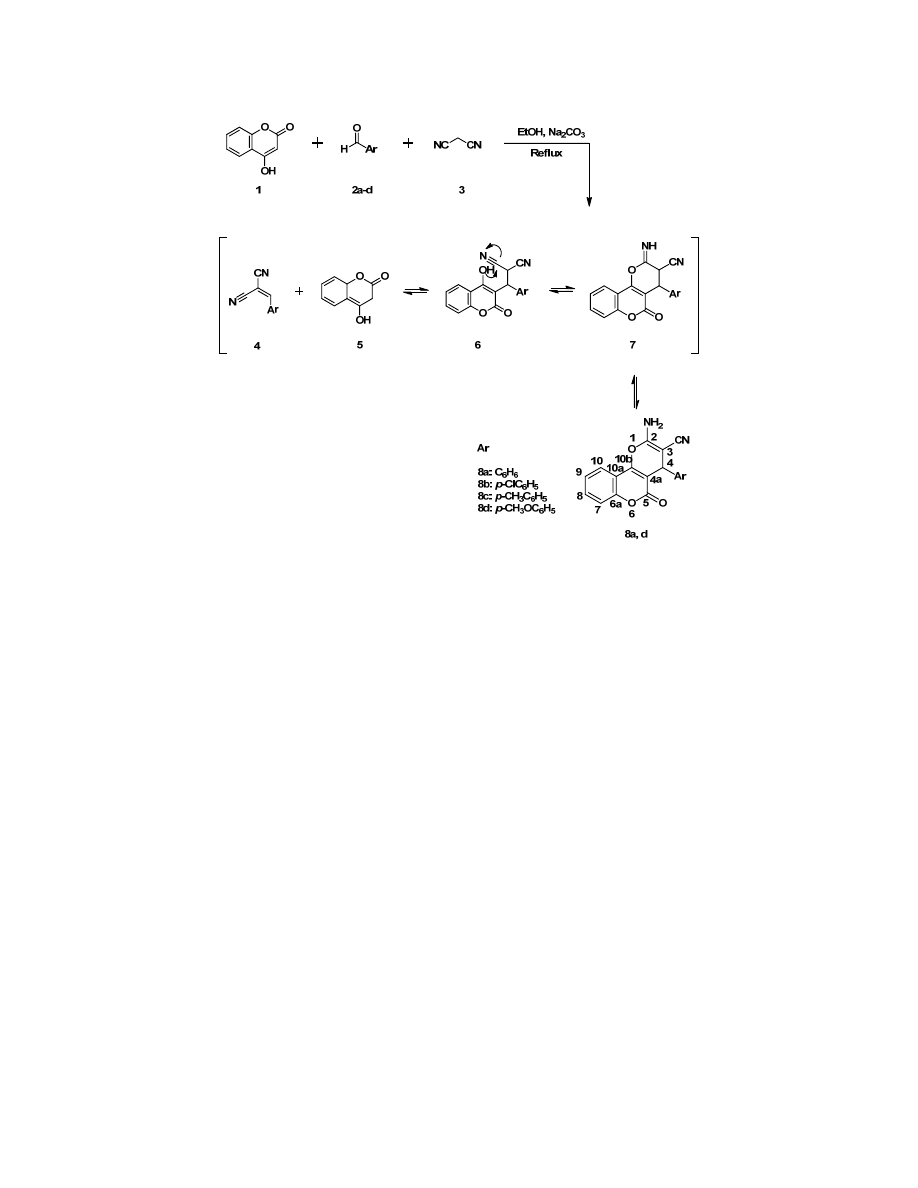
the chromenes 8a‐d (
Scheme 1
).
2‐Amino‐5‐oxo‐4‐phenyl‐4,5‐dihydropyrano[3,2‐c]chromene‐
3‐carbonitrile (8a): Color: White. Yield: 80%.
1
H NMR (300
MHz, DMSO‐d
6
, δ, ppm): 4.45 (s, 1H, CH‐Ph), 7.28‐7.38 (m, 5H,
NH
2
, Ar‐H), 7.47‐7.53 (m, 4H, Ar‐H), 7.79 (t, 1H, J = 8.1 Hz, Ar‐
H), 7.90 (d, 1H, J = 7.8 Hz, Ar‐H).
13
C NMR (75 MHz, DMSO‐d
6
, δ,
ppm): 159.9 (1C, CO), 158.3 (1C, Ar‐C), 153.7 (1C, Ar‐C), 152.5
(1C, Ar‐C), 143.7 (1C, Ar‐C), 133.3 (1C, Ar‐C), 128.8 (2C, Ar‐C),
127.9 (2C, Ar‐C), 127.4 (1C, Ar‐C), 125.0 (1C, Ar‐C), 122.8 (1C,
Ar‐C), 119.6 (1C, Ar‐C), 116.9 (1C, Ar‐C), 113.3 (1C, CN), 104.3
(1C, Ar‐C), 58.2 (1C, Ar‐C), 37.3 (1C, CH‐Ph). Anal. calcd. for
C
19
H
12
N
2
O
3
: C, 72.15; H, 3.82; N, 8.86. Found: C, 72.20; H, 3.85;
N, 8.90%.
2‐Amino‐4‐(4‐chlorophenyl)‐5‐oxo‐4,5‐dihydropyrano[3,2‐c]
chromene‐3‐carbonitrile (8b): Color: White. Yield: 75%.
1
H NMR
(300 MHz, DMSO‐d
6
, δ, ppm): 4.72 (s, 1H, CH‐Ph), 7.40‐8.13 (m,
10H, NH
2
, Ar‐H).
13
C NMR (75 MHz, DMSO‐d
6
, δ, ppm): 160.4
(1C, CO), 158.9 (1C, Ar‐C), 154.4 (1C, C‐NH
2
), 153.2 (1C, Ar‐C),
143.1 (1C, Ar‐C), 133.8 (1C, C‐Cl), 130.6 (2C, Ar‐C), 128.8 (2C,
Ar‐C), 127.9 (1C, Ar‐C), 127.4 (1C, Ar‐C), 125.0 (1C, Ar‐C), 122.8
(1C, Ar‐C), 119.6 (1C, Ar‐C), 113.3 (1C, CN), 104.4 (1C, Ar‐C),
58.6 (1C, Ar‐C), 38.3 (1C, CH‐Ph).
2‐Amino‐5‐oxo‐4‐(p‐tolyl)‐4,5‐dihydropyrano[3,2‐c]chrome
ne‐3‐carbonitrile (8c): Color: White. Yield: 80%.
1
H NMR (300
MHz, DMSO‐d
6
, δ, ppm): 2.25 (s, 3H, CH
3
), 4.40 (s 1H, CH‐Ph‐
CH
3
), 7.12‐7.93 (m, 10H, NH
2
, Ar‐H).
13
C NMR (75 MHz, DMSO‐
d
6
, δ, ppm): 159.8 (1C, CO), 158.4 (1C, Ar‐C), 153.7 (1C, C‐NH
2
),
152.5 (1C, Ar‐C), 140.8 (1C, Ar‐C), 136.7 (1C, Ar‐C), 133.2 (1C,
Ar‐C), 129.5 (2C, Ar‐C), 128.9 (2C. Ar‐C), 127.9 (1C, Ar‐C), 122.8
(1C, Ar‐C), 119.7 (1C, Ar‐C), 116.9 (1C, Ar‐C), 113.4 (1C, CN),
104.6 (1C, Ar‐C), 58.6 (1C, Ar‐C), 37.0 (1C, CH‐Ph‐Me), 21.0 (1C,
CH
3
). Anal. calcd. for C
20
H
14
N
2
O
3
: C, 72.12; H, 4.27; N, 8.48.
Found: C, 72.16; H, 4.30; N, 8.50%.
2‐Amino‐5‐oxo‐4‐(4‐methoxyphenyl)‐4,5‐dihydropyrano[3,2‐
c]chromene‐3‐carbonitrile (8d): Color: White. Yield: 85%.
1
H
NMR (300 MHz, DMSO‐d
6
, δ, ppm): 3.71 (s, 3H, CH
3
O), 4.39 (s,
1H, CH), 6.80‐7.85 (m, 10H, NH
2
, Ar‐H).
Bouazizi et al. / European Journal of Chemistry 5 (3) (2014) 457‐462
459
Scheme 2
13
C NMR (75 MHz, DMSO‐d
6
, δ, ppm): 161.2 (1C, CO), 158.8
(1C, Ar‐C), 158.5 (1C, C‐NH
2
), 154.5 (1C, C‐O‐Me), 151.7 (1C, Ar‐
C), 135.9 (1C, Ar‐C), 133.1 (2C, Ar‐C), 129.0 (1C, Ar‐C), 125.1
(1C, Ar‐C), 121.4 (1C, Ar‐C), 119.8 (1C, Ar‐C), 117.2 (1C, Ar‐C),
115.0 (2C, Ar‐C), 111.7 (1C, CN), 106.4 (1C, Ar‐C), 59.1 (1C, Ar‐
C), 56.1 (1C, CH
3
‐O), 36.7 (1C, CH‐Ph‐Me).
2.3.2. Reaction of compounds 8a‐d with triethylortho
formate
General procedure: A mixture of compounds 8a‐d (0.01
mmol), triethylorthoformate (0.01 mmol) and Ac
2
O (30 mL)
was refluxed for 6 h. The solid product that precipitated during
the reflux was filtered off, dried and recrystallized from ethanol
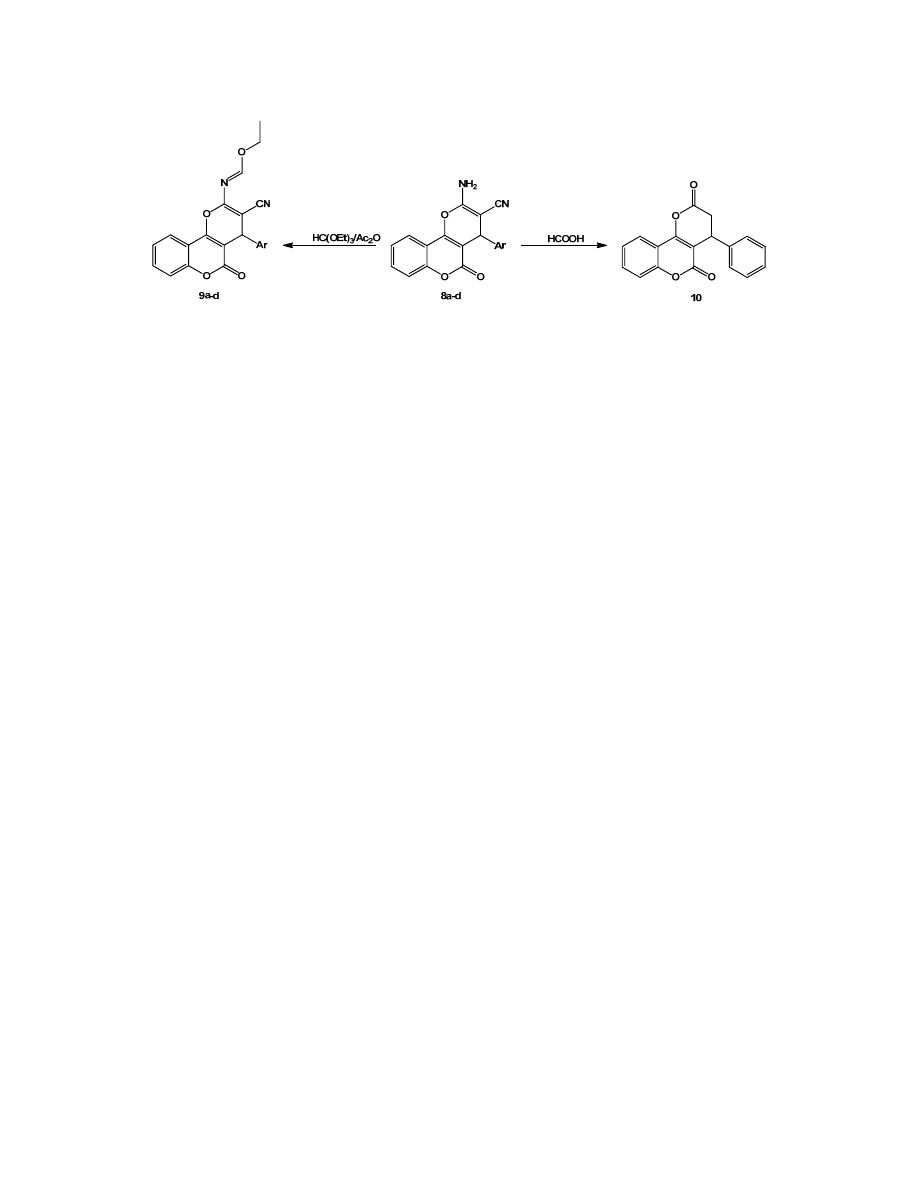
to give compounds 9a‐d (
Scheme 2
).
Ethyl‐N‐(3‐cyano‐5‐oxo‐4‐phenyl‐4,5‐dihydropyrano[3,2‐c]
chromen‐2‐yl)formimidate (9a): Color: White solid. Yield: 80%.
1
H NMR (300 MHz, DMSO‐d
6
, δ, ppm): 1.34 (t, 3H, J = 9 Hz, CH
3
‐
CH
2
‐O), 4.38 (q, 2H, J = 9 Hz, CH
3
‐CH
2
‐O), 4.76 (s, 1H, CH‐Ph),
7.27‐8.22 (m, 9H, Ar‐H), 8.92 (s, 1H, N=CH).
13
C NMR (75 MHz,
DMSO‐d
6
, δ, ppm): 162.4 (1C, C‐N=CH), 159.4 (1C, CO), 158.6
(1C, Ar‐C), 155.0 (1C, ‐N=CH‐O), 153.4 (1C, Ar‐C), 152.1 (1C, Ar‐
C), 133.5 (2C, Ar‐C), 133.0 (1C, Ar‐C), 132.0 (1C, Ar‐C), 129.3
(2C, Ar‐C), 124.6 (1C, Ar‐C), 123.4 (1C, Ar‐C), 116.8 (1C, Ar‐C),
116.3 (1C, Ar‐C), 113.9 (1C, CN), 103.1 (1C, Ar‐C), 82.9 (1C, Ar‐
C), 64.1 (1C, ‐O‐CH
2
‐CH
3
), 37.5 (1C, CH‐Ph), 13.8 (1C, CH
3
‐CH
2
‐
O).
Ethyl‐N‐(4‐(4‐chlorophenyl)‐3‐cyano‐5‐oxo‐4,5‐dihydropyra
no[3,2‐c]chromen‐2‐yl)formimidate (9b): Color: White. Yield:
75%.
1
H NMR (300 MHz, DMSO‐d
6
, δ, ppm): 1.35 (t, 3H, J = 9 Hz,
CH
3
‐CH
2
‐O), 4.39 (q, 2H, J = 9 Hz, CH
3
‐CH
2
‐O), 4.76 (s, 1H, CH‐
Ph), 7.42‐8.22 (m, 8H, Ar‐H), 8.93 (s, 1H, N=CH).
13
C NMR (75
MHz, DMSO‐d
6
, δ, ppm): 162.7 (1C, Ar‐C), 159.4 (1C, CO), 155.0
(1C, O‐CH=N), 153.9 (1C, Ar‐C), 152.2 (1C, Ar‐C), 140.5 (1C, Ar‐
C), 133.2 (1C, Ar‐C), 132.3 (1C, Ar‐C), 130.2 (2C, Ar‐C), 128.6
(2C, Ar‐C), 124.7 (1c, Ar‐C), 123.6 (1C, Ar‐C), 116.6 (1C, Ar‐C),
116.4 (1C, Ar‐C), 112.8 (1C, CN), 102.5 (1C, Ar‐C), 82.2 (1C, Ar‐
C), 64.2 (1C, O‐CH
2
‐CH
3
), 37.7 (1C, CH‐Ph), 13.8 (1C, CH
3
‐CH
2
‐
O).
Ethyl‐N‐(3‐cyano‐5‐oxo‐4‐(p‐tolyl)‐4, 5‐dihydropyrano [3,2‐
c]chromen‐2‐yl)formimidate (9c): Color: White. Yield: 70%.
1
H
NMR (300 MHz, DMSO‐d
6
, δ, ppm): 1.35 (t, 3H, J = 9 Hz, CH
3
‐
CH
2
‐O), 3.32 (s, 3H, CH
3
), 4.38 (q, 2H, J = 9 Hz, O‐CH
2
‐CH
3
), 4.65
(s, 1H, CH‐Ph), 7.18‐8.20 (m, 8H, Ar‐H), 8.92 (s, 1H, N=CH‐O).
13
C NMR (75 MHz, DMSO‐d
6
, δ, ppm): 162.4 (1C, Ar‐C), 159.4
(1C, CO), 155.2 (1C, O‐CH=N), 153.6 (1C, Ar‐C), 152.1 (1C, Ar‐C),
138.6 (1C, Ar‐C), 136.9 (1C, Ar‐C), 133.0 (1C, Ar‐C), 129.2 (2C,
Ar‐C), 128.0 (2C, Ar‐C), 124.7 (1c, Ar‐C), 123.5 (1C, Ar‐C), 116.7
(1C, Ar‐C), 116.4 (1C, Ar‐C), 112.9 (1C, CN), 103.0 (1C, Ar‐C),
82.8 (1C, Ar‐C), 64.2 (1C, O‐CH
2
‐CH
3
), 37.9 (1C, CH‐Ph), 20.6
(1C, CH3), 13.8 (1C, CH
3
‐CH
2
‐O).
Ethyl‐N‐(3‐cyano‐4‐(4‐methoxyphenyl)‐5‐oxo‐4,5‐dihydro
pyrano[3,2‐c]chromen‐2‐yl)formimidate (9d): Color: White.
Yield: 78 %.
1
H NMR (300 MHz, DMSO‐d
6
, δ, ppm): 1.35 (t, 3H, J
= 9 Hz, CH
3
‐CH
2
‐O), 3.33 (s, 3H, OCH
3
), 4.38 (q, 2H, J = 9 Hz, O‐
CH
2
‐CH
3
), 4.63 (s, 1H, CH‐Ph), 6.83‐8.21 (m, 8H, Ar‐H), 8.91 (s,
1H, N=CH‐O).
13
C NMR (75 MHz, DMSO‐d
6
, δ, ppm): 162.4 (1C,
Ar‐C), 159.4 (1C, CO), 158.7 (1C, O‐CH=N), 155.1 (1C, Ar‐C),
153.4 (1C, Ar‐C), 152.1 (1C, Ar‐C), 133.6 (1C, Ar‐C), 133.0 (1C,
Ar‐C), 129.4 (2C, Ar‐C), 124.7 (1C, Ar‐C), 123.5 (1c, Ar‐C), 116.8
(1C, Ar‐C), 116.4 (1C, Ar‐C), 113.9 (2C, Ar‐C), 112.9 (1C, CN),
103.2 (1C, Ar‐C), 82.9 (1C, Ar‐C), 64.2 (1C, O‐CH
2
‐CH
3
), 55.1
(1C, O‐CH
3
), 37.5 (1C, CH
3
), 13.8 (1C, CH
3
‐CH
2
‐O).
2.3.3. Reaction of compound 8a with formic acid
A mixture of the chromene 8a (0.01 mmol) and formic acid
(20 mL) was refluxed for 5 h. The mixture cooled it as a solid
started to form and the precipitate filtered off, then washed
with water and diethyl ether. The solid recrystallized from
ethanol and afforded the 4‐phenyl‐3,4‐dihydropyrano[3,2‐c]
chromene‐2,5‐dione, 10 (
Scheme 2
).
4‐Phenyl‐3,4‐dihydropyrano[3,2‐c]chromene‐2,5‐dione (10):
Color: White. Yield: 80%.
1
H NMR (300 MHz, DMSO‐d
6
, δ, ppm):
2.99 (dd, 1H, J = 1.2 Hz, CH
2
), 3.57 (dd, 1H, J = 7.8 Hz, CH
2
), 4.45
(d, 1H, J = 7.8 Hz, CH‐Ph), 7.22‐7.87 (m, 9H, Ar‐H).
13
C NMR (75
MHz, DMSO‐d
6
, δ, ppm): 165.6 (1C, O‐CO‐CH
2
), 160.7 (1C, O‐CO‐
C), 157.7 (1C, Ar‐C), 153.1 (1C, Ar‐C), 140.5 (1C, Ar‐C), 133.6
(1C, Ar‐C), 129.6 (1C, Ar‐C), 128.0 (2C, Ar‐C), 127.1 (2C, Ar‐C),
125.4 (1C, Ar‐C), 123.0 (1C, Ar‐C), 117.2 (1C, Ar‐C), 113.8 (1C,
Ar‐C), 106.6 (1C, Ar‐C), 36.7 (1C, CH‐Ph), 35.8 (1C, CH
2
).
2.3.4. Reaction of compounds 9a‐d with hydrazine hydrate
General procedure: A solution of compounds 9a‐d (0.01
mmol) and hydrazine hydrate (5 mL) in EtOH (50 mL) was
sttired at room temperature for 1 h. The solid product was
collected by filtration and recrystallized from ethanol to give
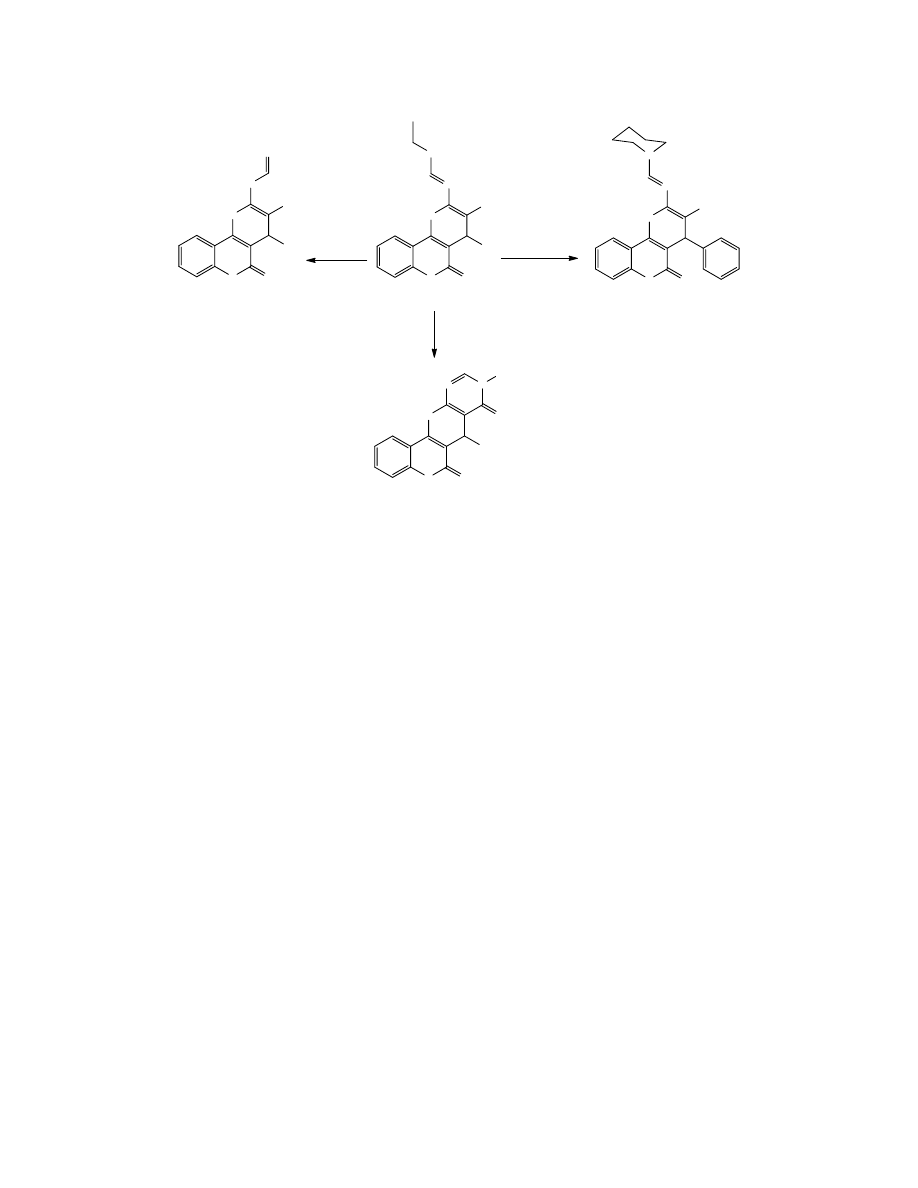
compounds 11a‐d (
Scheme 3
).
9‐Amino‐8‐imino‐7‐phenyl‐8,9‐dihydrochromeno[3’,4’,5,6]
pyrano[2,3‐d]pyrimidin‐6(7H)‐one (11a): Color: White. Yield:
72%.
1
H NMR (300 MHz, DMSO‐d
6
, δ, ppm): 4.99 (s, 1H, CH‐Ph),
5.73 (s, 2H, NH
2
), 7.14‐7.94 (m, 10H, NH, Ar‐H), 8.17 (s, 1H,
CH=N).
13
C NMR (75 MHz, DMSO‐d
6
, δ, ppm): 163.1 (1C, CO),
161.0 (1C, Ar‐C), 160.3 (1C, Ar‐C), 157.2 (1C, C=NH), 155.0 (1C,
Ar‐C), 152.5 (1C, Ar‐C), 142.1 (1C, N=C‐N‐NH
2
), 133.3 (1C, Ar‐
C), 128.9 (2C, Ar‐C), 128.7 (1C, Ar‐C), 127.7 (2C, Ar‐C), 125.3
(1C, Ar‐C), 123.1 (1C,Ar‐C), 117.0 (1C, Ar‐C), 113.9 (1C, Ar‐C),
106.2 (1C, Ar‐C), 96.6 (1C, Ar‐C), 34.0 (1C, CH).
9‐Amino‐7‐(4‐chlorophenyl)‐8‐imino‐8,9‐dihydrochromeno
[3’,4’,5,6]pyrano[2,3‐d]pyrimidin‐6(7H)‐one (11b): Color: White.
Yield: 70%.
1
H NMR (300 MHz, DMSO‐d
6
, δ, ppm): 4.99 (s, 1H,
CH‐Ph), 5.76 (s, 2H, NH
2
), 7.12‐7.93 (m, 9H, NH, Ar‐H), 8.17 (s,
1H, CH=N).
13
C NMR (75 MHz, DMSO‐d
6
, δ, ppm): 164.0 (1C,
C=NH), 163.1 (1C, CH=N), 159.8 (1C, CO), 154.2 (1C, Ar‐C),
460
Bouazizi et al. / European Journal of Chemistry 5 (3) (2014) 457‐462
O
O
O
CN
HN
Ar
O
O
O
CN
Ar
N
O
NH
Piperidine
NH
4
OH
NH
2
NH
2.
H
2
O
9a-d
O
O
N
N
O
NH
NH
2
Ar
13a
12a-d
11a-d
1
2
3
4
7a
5
4a
5a
6
7
8
9
10
11
11a
11b
12
12a
O
O
CN
N
N
O
Scheme 3
152.0 (1C, Ar‐C), 151.3 (1C, Ar‐C), 140.8 (1C, Ar‐C), 132.8 (1C,
Ar‐C), 131.6 (1C, Ar‐C), 130.7 (2C, Ar‐C), 127.9 (2C, Ar‐C), 124.8
(1C, Ar‐C), 122.5 (1C, Ar‐C), 116.5 (1C, Ar‐C), 113.2 (1C, Ar‐C),
104.3 (1C, Ar‐C), 99.6 (1C, Ar‐C), 34.8 (1C, CH).
9‐Amino‐8‐imino‐7(p‐tolyl)‐8,9‐dihydrochromeno[3’,4’,5,6]
pyrano[2,3‐d]pyrimidin‐6(7H)‐one (11c): Color: White. Yield:
78%.
1
H NMR (300 MHz, DMSO‐d
6
, δ, ppm): 2.50 (s, 3H, CH
3
),
4.97 (s, 1H, CH‐Ph), 5.77 (s, 2H, NH
2
), 7.15‐7.91 (m, 9H, NH, Ar‐
H), 8.16 (s, 1H, CH=N).
13
C NMR (75 MHz, DMSO‐d
6
, δ, ppm):
159.8 (1C, CO), 154.2 (1C, Ar‐C), 152.0 (1C, Ar‐C), 151.3 (1C,
C=NH), 148.4 (1C, Ar‐C), 147.2 (1C, Ar‐C), 140.9 (1C, CH=N),
132.8 (1C, Ar‐C), 131.6 (1C, Ar‐C), 130.7 (2C, Ar‐C), 127.9 (2C,
Ar‐C), 124.7 (1C, Ar‐C), 122.5 (1C, Ar‐C), 116.5 (1C, Ar‐C), 113.1
(1C, Ar‐C), 104.3 (1C, Ar‐C), 99.8 (1C, Ar‐C), 54.9 (1C, CH), 34.8
(1C, CH
3
).
9‐Amino‐8‐imino‐7(4‐methoxyphenyl)‐8,9‐dihydrochromeno
[3’,4’,5,6]pyrano[2,3‐d]pyrimidin‐6(7H)‐one (11d): Color: White.
Yield: 78%.
1
H NMR (300 MHz, DMSO‐d
6
, δ, ppm): 2.50 (s, 3H,
OCH
3
), 4.90 (s, 1H, CH‐Ph), 5.76 (s, 2H, NH
2
), 6.79‐7.92 (m, 9H,
NH, Ar‐H), 8.15 (s, 1H, CH=N).
13
C NMR (75 MHz, DMSO‐d
6
, δ,
ppm): 159.8 (1C, CO), 158.2 (1C, Ar‐C), 154.0 (1C, Ar‐C), 153.8
(1C, C=NH), 151.9 (1C, C‐OCH
3
), 150.8 (1C, Ar‐C), 148.0 (1C, Ar‐
C), 146.8 (1C, Ar‐C), 133.9 (1C, Ar‐C), 132.6 (1C, Ar‐C), 129.8
(2C, Ar‐C), 124.7 (1C, Ar‐C), 122.4 (1C, Ar‐C), 116.5 (1C, Ar‐C),
113.5 (2C, Ar‐C), 113.2 (1C, Ar‐C), 104.9 (1C, Ar‐C), 54.9 (1C,
OCH
3
), 34.8 (1C, CH).
2.3.5. Reaction of compounds 9a‐d with hydroxylamine
General procedure: A mixture of compounds 9a‐d (0.01
mmol) and hydroxylamine (10 mL) in methanol:THF (v:v, 14:6)
(20 mL) was stirred at room temperature for 1 h. The solid
product was collected and recrystallized from ethanol to give
compounds 12a‐d (
Scheme 3
).
N‐(3‐Cyano‐5‐oxo‐4‐phenyl‐4,5‐dihydropyrano[3,2‐c]chro
men‐2‐yl)formimidamide (12a): Color: White. Yield: 85%.
1
H
NMR (300 MHz, DMSO‐d
6
, δ, ppm): 4.55 (s, 1H, CH‐Ph), 7.26‐
8.06 (m, 10H, NH, Ar‐H), 8.44 (d, 1H, J = 13.8 Hz, ‐NH), 8.56 (dd,
1H, J = 9.6 Hz, CH=NH).
13
C NMR (75 MHz, DMSO‐d
6
, δ, ppm):
160.0 (1C, CO), 158.4 (1C, Ar‐C), 156.0 (1C, Ar‐C), 154.2 (1C,
C=NH), 152.5 (1C, C‐OCH
3
), 143.0 (1C, Ar‐C), 133.2 (1C, Ar‐C),
128.9 (2C, Ar‐C), 128.3 (1C, Ar‐C), 127.6 (2C, Ar‐C), 125.0(1C,
Ar‐C), 123.3 (1C, Ar‐C), 119.3 (1C, Ar‐C), 116.8 (1C, Ar‐C), 113.6
(1C, CN), 103.7 (1C, Ar‐C), 74.4 (1C, Ar‐C), 34.8 (1C, CH).
N‐(4‐(4‐Chlorophenyl)‐3‐cyano‐5‐oxo‐4,5‐dihydropyrano [3,
2‐c]chromen‐2‐yl)formimidamide (12b): Color: White. Yield:
85%.
1
H NMR (300 MHz, DMSO‐d
6
, δ, ppm): 4.55 (s, 1H, CH‐Ph),
7.25‐8.04 (m, 9H, NH, Ar‐H), 8.44 (d, 1H, J = 13.8 Hz, ‐NH), 8.56
(dd, 1H, J = 9.6 Hz, CH=NH).
13
C NMR (75 MHz, DMSO‐d
6
, δ,
ppm): 162.6 (1C, CO), 160.5 (1C, Ar‐C), 159.8 (1C, Ar‐C), 156.8
(1C, C=NH), 154.6 (1C, C‐OCH
3
), 152.1 (1C, Ar‐C), 140.5 (1C, Ar‐
C), 132.9 (1C, Ar‐C), 131.8 (1C, C‐Cl), 130.3 (2C, Ar‐C), 128.1
(2C, Ar‐C), 124.8 (1C, Ar‐C), 122.6 (1C, Ar‐C), 116.5 (1C, Ar‐C),
113.3 (1C, CN), 105.2 (1C, Ar‐C), 95.6 (1C, Ar‐C), 33.0 (1C, CH).
N‐(3‐Cyano‐5‐oxo‐4‐(p‐totyl)‐4,5‐dihydropyrano[3,2‐c]chro
men‐2‐yl)formimidamide (12c): Color: White. Yield: 80%.
1
H
NMR (300 MHz, DMSO‐d
6
, δ, ppm): 2.50 (s, 3H, CH
3
), 5.1 (s, 1H,
CH‐Ph), 7.25‐8.04 (m, 9H, NH, Ar‐H), 8.44 (d, 1H, J = 13.8 Hz, ‐
NH), 8.56 (dd, 1H, J = 9.6 Hz, CH=NH).
13
C NMR (75 MHz, DMSO‐
d
6
, δ, ppm): 162.5 (1C, CO), 160.4 (1C, Ar‐C), 159.7 (1C, Ar‐C),
156.6 (1C, C=NH), 154.3 (1C, C‐OCH
3
), 152.0 (1C, Ar‐C), 138.6
(1C, Ar‐C), 136.3 (1C, Ar‐C), 132.7 (1C, Ar‐C), 128.8 (2C, Ar‐C),
128.2 (2C, Ar‐C), 124.8 (1C, Ar‐C), 122.5 (1C, Ar‐C), 116.5 (1C,
Ar‐C), 113.3 (1C, CN), 105.7 (1C, Ar‐C), 96.1 (1C, Ar‐C), 33.1
(1C, CH), 20.5(1C, CH
3
).
N‐(3‐Cyano‐4‐(4‐methoxyphenyl)‐5‐oxo‐4,5‐dihydropyrano
[3,2‐c]chromen‐2‐yl)formimidamide (12d): Color: White. Yield:
85%.
1
H NMR (300 MHz, DMSO‐d
6
, δ, ppm): 3.80 (s, 3H, OCH
3
),
4.80 (s, 1H, CH‐Ph), 7.34‐8.02 (m, 9H, NH, Ar‐H), 8.40 (d, 1H, J =
13.8 Hz, ‐NH), 8.50 (dd, 1H, J = 9.6 Hz, CH=NH).
13
C NMR (75
MHz, DMSO‐d
6
, δ, ppm): 160.5 (1C, CO), 159.4 (1C, Ar‐C), 158.7
(1C, Ar‐C), 155.6 (1C, C=NH), 153.2 (1C, C‐OCH
3
), 151.5 (1C, Ar‐
C), 138.5 (1C, Ar‐C), 136.6 (1C, Ar‐C), 130.7 (2C, Ar‐C), 128.3
(1C, Ar‐C), 125.0 (1C, Ar‐C), 123.7 (1C, Ar‐C), 115.1 (1C, Ar‐C),
116.0 (1C, Ar‐C), 113.9 (2C, Ar‐C), 113.2 (1C, CN), 104.7 (1C, Ar‐
C), 96.1 (1C, Ar‐C), 38.7(1C, CH).

Bouazizi et al. / European Journal of Chemistry 5 (3) (2014) 457‐462
461
2.3.6. Reaction of compound 9a with piperidine
Compound 9a (1 mmol), piperidine (3 mL) and toluene (20
mL) was refluxed for 3 h. The solvent was removed under
reduced pressure and the resulting solid was recrystallized
from ethanol:petrol ether (v:v, 14:6) (20 mL) to give compound
13a (
Scheme 3
).
5‐Oxo‐4‐phenyl‐2‐((piperidin‐1‐ylmethylene)amino)‐4,5‐di
hydropyrano[3,2‐c]chromene‐3‐carbonitrile (13a): Color: White.
Yield: 80%.
1
H NMR (300 MHz, DMSO‐d
6
, δ, ppm): 1.56‐1.64 (m,
6H, CH
2
‐CH
2
‐CH
2
), 3.65‐3.71 (m, 4H, CH
2
‐N‐CH
2
), 4.55 (s, 1H,
CH‐Ph), 7.22‐8.32 (m, 9H, Ar‐H), 8.57 (s, 1H, N=CH‐N).
13
C NMR
(75 MHz, DMSO‐d
6
, δ, ppm): 160.1 (1C, Ar‐C), 157.7 (1C, CO),
154.3 (1C, Ar‐C), 153.2 (1C, Ar‐C), 152.5 (1C, Ar‐C), 143.1 (1C,
Ar‐C), 133.2 (1C, Ar‐C), 128.9 (2C, Ar‐C), 128.2 (1C, Ar‐C), 127.6
(2C, Ar‐C), 124.9 (1C, Ar‐C), 123.9 (1C, Ar‐C), 119.5 (1C, Ar‐C),
116,7 (1C, Ar‐C), 113,6 (1C, Ar‐C), 103,7 (1C, Ar‐C), 74,1 (1C,
Ar‐C), 50.8 (1C, CH
2
), 43.3 (1C, CH
2
), 38.7 (1C, Ar‐C), 26.5 (1C,
CH
2
), 25.1 (1C, CH
2
), 24.0 (1C, CH
2
).
3. Results and discussion
3.1. Synthesis
Treatment of 4‐hydroxycoumarin (1) with aryl aldehydes
(2a‐d) and malononitrile (3) in the boiling ethanol during
several hours in the presence of anhydrous sodium bicarbonate
as
a
catalyst
gave
2‐amino‐5‐oxo‐4‐phenyl‐4,5‐
dihydropyrano[3,2‐c]chromene‐3‐carbonitrile derivatives (8a‐
d) in high yields (75‐85%) (
Scheme 1
).
The
1
H NMR spectra of compound 8a displays a signal at δ
4.45 ppm that ascribable to the proton H
4
. In addition, the
aromatic protons are observed between δ 7.28 and 7.90 ppm
(see experimental), and the expected singlet for the proton H
8
is observed at δ 7.79 ppm (
Scheme 1
).
The observed high regioselectivity is most probably
associated with the reaction sequence outlined in Scheme 1.
Initial Knoevenagal reaction between aldehydes substitutes 2a‐
d and malonitrile (3) produces the unsaturated nitrile 4, which,
undergoes a Michael reaction with the base derived coumarin
anion, 5. The resulting Michael adduct 6 then undergoes intra
molecular cyclization producing the annelatediminopyran 7.
Subsequent tautomeric[1,3] sigmatropic shift gives compounds
8a‐d.
Under these conditions, the reaction proceeds sufficiently
rapidly and smoothly to afford the target chromenes 8a‐d in
high yields without Michael adducts 6 being detected. However,
the proposed mechanism is supported to some degree by
isolation of analogous Michael adducts in the previously
studied reaction of 4‐hydroxycoumarin with arylidenecyano
acetamides [
3
].
Refluxing compounds 8a‐d with triethylorthoformate in
acetic anhydride at reflux afforded the corresponding ethyl‐N‐
(3‐cyano‐5‐oxo‐phenyl‐4,5‐dihydropyrano[3,2‐c]chromen‐
2‐yl)formimidate (9a‐d) while with formic acid, chromene‐2,5‐
one‐2,5‐dione (10) were formed,
Scheme 2
.
Hydrazinolysis of compound 9a‐d in ethanol at room
temperature afforded the 9‐amino‐8‐imino‐7‐phenyl‐8,9‐di
hydrochromeno [3’,4’,5,6]pyrano[2,3‐d]pyrimidin‐6(7H)‐one
derivatives, 11a‐d.
Reaction of compounds 9a‐d with hydroxylamine in MeOH‐
THF at room temperature yielded the N‐(3‐cyano‐5‐oxo‐4‐
phenyl‐4,5‐dihydropyrano[3,2‐c]chromen‐2‐
yl)formimidamide deriva‐tives, 12a‐d. Interaction of
compounds 9a‐d with piperidine in toluene afforded the
chromen
5‐oxo‐4‐phenyl‐2‐((piperidin‐1‐ylmethylene)
amino)‐4,5‐dihydropyrano[3,2‐c]chromene‐3‐carbonitrile,
13a,
Scheme 3
.
The structures of products are characterized by
1
H NMR
along with
13
C NMR are in agreement with the proposed
structures.
3.2. Biological properties (Acetylcholinesterase inhibition)
Inhibition of acetylcholinesterase (AChE), the key enzyme
in the breakdown of acetylcholine, is considered one of the
treatment strategies against several neurological disorders
such as Alzheimer’s disease, senile dementia, ataxia, and
myasthenia gravis [
15
,
16
]. The acetylcholinesterase (AChE)
inhibition was determined using an adaptation of the method
described in the literature [
17
]. All compounds were analyzed
on what concerns their acetylcholinesterase inhibition activity
(
Table 1
). Values oscillating between 0.010 and 0.130 mg/mL
were obtained. Compared to those given in the literature for
crude pure products [
17
], we can say that the synthesized
compounds 8, 9, 10 and 11 are considered good inhibitors of
acetylcholinesterase. The greatest inhibitory activity was
exhibited by compound 11a (Ar = Ph) (IC
50
= 0.110 μg/mL). It
has been shown that the activity of these derivatives depends
in general on the nature of Ar. In compound 10, the
acetylcholinesterase inhibition decreases from Ar = Ph (9a) to
Ar = p‐MeOPh (9d).
The same phenomena have been observed with compounds
9a‐d and 8a‐d. It has been also shown that the activity
decreases considerably when Ar varied in the order Ph, p‐ClPh,
p‐MePh and p‐MeOPh. The substitution of both the phenyl
seems to affect the activity of the chromene skeleton.
Table 1. Acetylcholinesterase inhibition capacity represented by IC
50
(mg/mL) of compounds 8, 9, 10 and 11.
Compound
Acetylcholiinesterase inhibition
capacity represented by IC
50
(mg/mL)
8a
0.091
8b
0.065
8c
0.064
8d
0.035
9a
0.130
9b
0.048
9c
0.030
9d
0.021
10
0.077
11a
0.110
11b
0.033
11c
0.025
11d
0.010
4. Conclusion
In conclusion, this work reports the synthesis of 3,4‐
dihydropyrano[c]chromene derivatives and their evaluation as
acetyl cholinesterase inhibitors, via the simple and useful
4‐hydroxycoumarin (1) with substituted aldehydes 2a‐d and
malonitrile (3) under reflux reaction conditions.
Reference
[1].
Adami, E.; Marazzi‐Uberti, E.; Turba, C. Arch. Ital. Sci. Farmacol. 1959,
9, 61‐69.
[2].
Arvind, B. T.; Venkat, S. S.; Narayan, D. S.; Devanand, B. S. Bull. Environ.
Pharmacol. Life Sci. 2012, 7, 30‐33.
[3].
Luchini, A. C.; Rodrigues‐Orsi, P.; Cestari, S. H.; Seito, L. N.; Witaicenis,
A.; Pellizzon, C. H. Biol. Pharm. Bull. 2008, 31, 1343‐1350.
[4].
Jae‐Chul, J; Qee‐Sook, P. Molecules 2009, 14, 4790‐4803.
[5].
Chohan, Z. H.; Shaikh, A. U.; Rauf, A.; Supuran, C. T. J. Enz. Inhib. Med.
Chem. 2006, 21, 741‐748.
[6].
Kirkiacharian, B. S.; Clercq, E.; Kurkjian, R.; Pannecouque, C. J. Pharm.
Chem. 2008, 42, 265‐270.
[7].
Velasco‐Velazquez, M. A.; Agramonte‐Hevia, J.; Barrera, D.; Jimenez‐
Orozco, A.; Garcia‐Mondragon, M. J.; Mendoza‐Patino, N.; Landa, A.;
Mandoki, J. Cancer. Lett. 2003, 198, 179‐186.
[8].
Shapiro, S.; Sherwin, B. N. Y. State J. Med. 1943, 43, 45‐52.
[9].
Butsch, W. L.; Stewart, J. D. Arch. Surg. 1942, 45, 551‐553.
[10]. Hintz, K. K.; Ren, J. Vascul. Pharmacol. 2003, 40, 213‐217.
[11]. Manolov, I.; Maichle‐Moessmer, C.; Danchev, N. Eur. J. Med. Chem.
2006, 41, 882‐890.
[12]. Howes, M. R.; Houghton, P. J. Pharmacol. Biochem. Behav. 2003, 75,
513‐527.
[13]. Saudi, M. N. S.; Gaafar, M. R.; El‐Azzouni, M. Z.; Ibrahim, M. A.; Eissa, M.
M. Chem. Res. 2008, 17, 541‐563.

462
Bouazizi et al. / European Journal of Chemistry 5 (3) (2014) 457‐462
[14]. Sunduru, N.; Agawal, A.; Katiyar, S.; Nishi, B.; Goyal, N.; Gupta, S.;
Chauhan, P. M. S. Bioorg. Med. Chem. 2006, 14, 7706‐7715.
[15]. Huisgen, R. J. Org. Chem 1976, 41, 403‐419.
[16]. Pinner, A.; Klein, F. Ber. Dtsch. Chem. Ges 1877, 10, 1889‐1897
[17]. Orhan, G.; Orhan, I.; Sener, B. Lett. Drug. Desig. Discov. 2006, 3, 268‐
274.

Copyright of European Journal of Chemistry is the property of European Journal of
Chemistry and its content may not be copied or emailed to multiple sites or posted to a
listserv without the copyright holder's express written permission. However, users may print,
download, or email articles for individual use.
Wyszukiwarka
Podobne podstrony:
document 7 id 138599 Nieznany
Document 2 id 138594 Nieznany
document 10 id 138593 Nieznany
Document (21) id 138605 Nieznany
Abolicja podatkowa id 50334 Nieznany (2)
4 LIDER MENEDZER id 37733 Nieznany (2)
katechezy MB id 233498 Nieznany
metro sciaga id 296943 Nieznany
perf id 354744 Nieznany
interbase id 92028 Nieznany
Mbaku id 289860 Nieznany
Probiotyki antybiotyki id 66316 Nieznany
miedziowanie cz 2 id 113259 Nieznany
LTC1729 id 273494 Nieznany
D11B7AOver0400 id 130434 Nieznany
analiza ryzyka bio id 61320 Nieznany
pedagogika ogolna id 353595 Nieznany
więcej podobnych podstron