Connections 3
Photocopiable
© Oxford University Press
1
Mini mock exam
Units 5–9 Test B
3
Uzupełnij poniższy dialog, wpisując w każdą lukę 1–4
literę A, B lub C. Za każdą poprawną odpowiedź otrzymasz
1 punkt.
Lisa
Hi Jamie! What’s up? You look upset.
Jamie It’s Sally. She broke up with me after two years
of going 1
together.
Lisa
Oh no! What happened?
Jamie I don’t really know. She didn’t want to tell me.
Lisa
Did you ring her?
Jamie I
2
, but she didn’t pick the phone.
Lisa
If I were you, 3
try again.
Jamie But she said she didn’t want to talk to me.
Lisa
Maybe, she was just upset. She probably didn’t
mean it. You shouldn’t give up so easily.
Jamie OK, I’ll try.
Lisa You’d
4
do it soon. Don’t let her go.
Jamie You’re right. I must talk to her again.
1 A
away B out
C
by
2 A
were
B
did
C
does
3 A
I’d
B
I’ll
C
I’ve
4 A
best
B
well
C
better
Mark
/4
4
Do każdej sytuacji dobierz odpowiednią reakcję, wpisując
literę A–E w luki 1−3. Dwie reakcje podane zostały
dodatkowo i nie pasują do żadnej sytuacji. Za każdą
poprawną odpowiedź otrzymasz 1 punkt.
1 Wyrażasz podziw dla nowej fryzury koleżanki.
2 Zdecydowanie nie zgadzasz się z opinią kolegi.
3 Odmawiasz przeczytania swojego wiersza.
A
Rubbish!
B
Absolutely!
C
No way!
D
Wow!
E
Lucky you!
Mark
/3
Odbiór tekstu słuchanego
1
Usłyszysz dwukrotnie pięć wypowiedzi. Przyporządkuj
każdej rozmowie 1–5 sytuację, której dotyczy (A–F). Wstaw
znak X w odpowiednie rubryki tabeli. Jedna sytuacja podana
została dodatkowo i nie pasuje do żadnej rozmowy. Za każdą
poprawną odpowiedź otrzymasz 1 punkt.
One person in each dialogue is worried about
Dialogue 1
Dialogue 2
Dialogue 3
Dialogue 4
Dialogue 5
A having too many unnecessary
things
B not having money for holidays
C some conflicts with the family
members
D buying gifts for the family
E loosing contact with friends
F not having right clothes to wear
Mark
/5
Reagowanie językowe
2
Przeczytaj dwukrotnie trzy wypowiedzi (1−3). Do każdej
z nich dobierz właściwą reakcję, zakreślając literę A, B lub C.
Za każdą poprawną odpowiedź otrzymasz 1 punkt.
1
Why don’t you take her to the cinema?
A
I don’t think so.
B
Don’t worry about it.
C
I don’t think it’s a good idea.
2
What’s the matter with you?
A
I hope so
B
I feel bad.
C
I’m so sorry.
3
Could you lend me you book?
A
Yes, of course.
B
Not at all.
C
Thanks a lot.
Mark
/3
Connections 3
Photocopiable
© Oxford University Press
A
B
C
D
Mark
/3
2
Units 5–9 Test B
6
Przeczytaj tekst, a następnie do akapitów 1–3 przyporządkuj
pytania A–D. Wpisz odpowiednią literę w każdą kratkę.
Jedno pytanie zostało podane dodatkowo i nie pasuje do
żadnego akapitu. Za każdą poprawną odpowiedź otrzymasz
1 punkt.
Odbiór tekstu czytanego
5
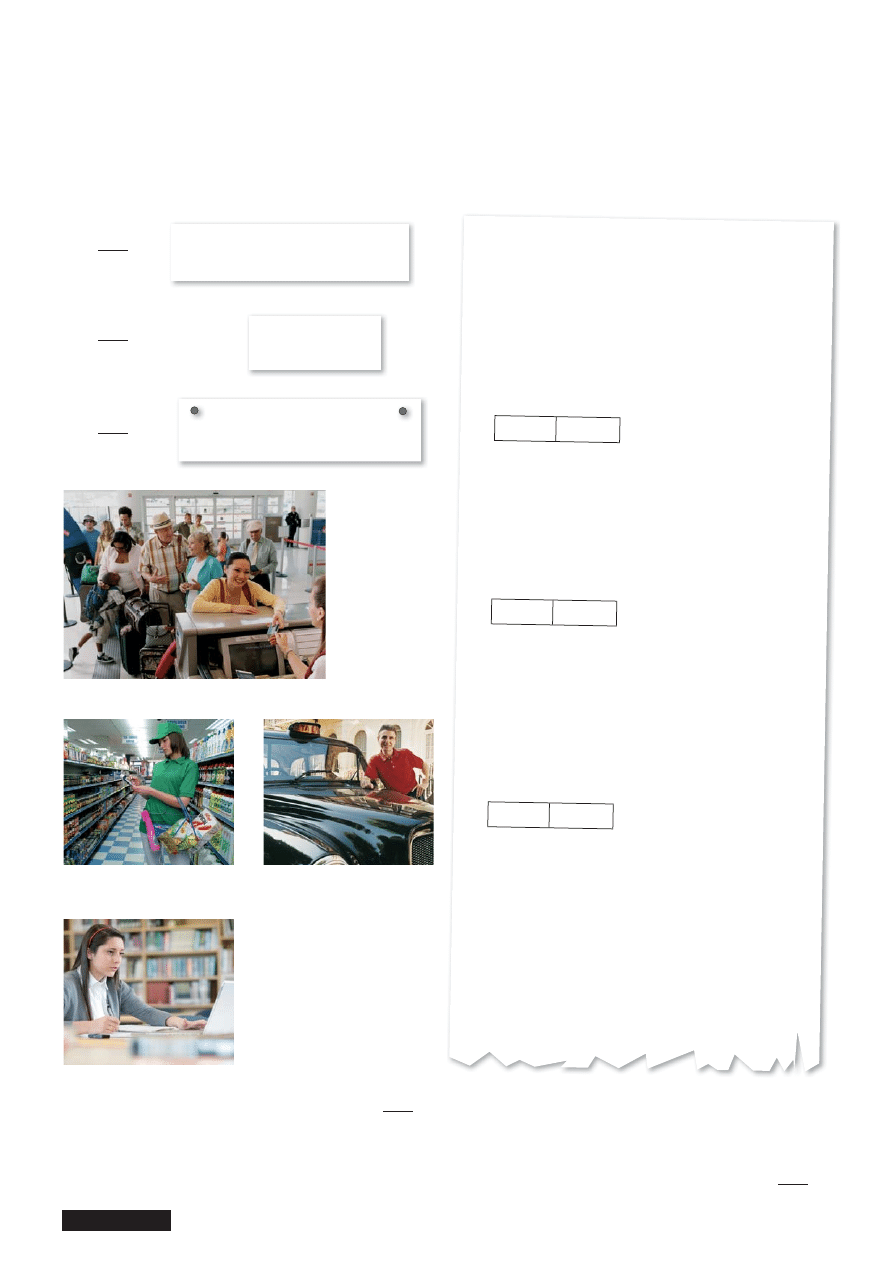
Przyporządkuj każdej tablicy informacyjnej odpowiednie
miejsce, wpisując w każdą lukę 1–3 literę A–D. Jedno miejsce
podane zostało dodatkowo i nie pasuje do żadnej tabliczki.
Za każdą poprawną odpowiedź otrzymasz 1 punkt.
Nothing
to declare
BE QUIET!
Consider other people working
All passengers are required by
law to fasten their seatbelts.
1
2
3
Who invented the spoon?
Our great-great-grandfathers in
prehistoric times cleaned up shells
and used them to put liquid food in
their mouths. They discovered that it
was much quicker and more elegant
than putting their mouths into water
or their prehistoric soup.
1
Spoons first appeared in Poland in
the 16th century and they were often
made of silver. No wonder they were
very expensive! They were big and
flat, so they were good for eating
potatoes or cabbage but not so good
for soups.
2
In the 19th century, only spoons were
put on tables next to plates. Guests
had to bring their own knives and
forks and use them during the meal.
The interesting thing was that the
spoons were decorated with patriotic
sentences about God, honour and the
country.
3
After a party, it was very important
that nobody took the spoons home
with them. That is why many of them
had slogans which said something like,
“You can use me, but don’t put me in
your pocket!” Strangely enough, when
modern hotel or restaurant owners
put their logos on knives, forks and
spoons, they have the same thing on
their minds.
A
What was unusual about old Polish spoons?
B
Where did they keep spoons in the old days?
C
What did old Polish spoons look like?
D
How to stop thieves from stealing spoons
Mark
/3
Connections 3
Photocopiable
© Oxford University Press
3
Units 5–9 Test B
3
Special Scotch Express in another name for
4
The kings’ and queens’ trains are in the
Mark
/4
Total
/25
7
Przeczytaj reklamę muzeum, a następnie uzupełnij zdania
1–4, wpisując w każdą lukę krótkie wyrażenie. Za każdą
poprawną odpowiedź otrzymasz 1 punkt.
National Railway Museum
York
Over 300 years of history to discover and over a million wonderful objects to see!
Opening Times
Daily 10.00–18.00
Closed 24–26 December
Free Admission
General admission to the museum is free. (Please note that for certain special events or exhibitions there may be
charges.)
Station Hall
Find out more about the luxury of rail travel by visiting the Royal Trains – there’s even a carriage used by Queen
Victoria herself.
Outdoor Play Area
For younger visitors we offer a fun railway-themed outdoor area. You can also take a ride on a miniature railway
to enjoy the views. Rides cost 50p.
Flying Scotsman
The museum is home to the nation’s favourite locomotive – the Flying Scotsman. This train went into service in
1862, and was named in the timetable as the Special Scotch Express. The journey time between London and
Edinburgh was 10½ hours, inclusive of a 30-minute lunch stop at York.
WELCOME TO OUR MUSEUM!
1
Visitors to the National Railway Museum must
when
there is a special event.
2
Children can
in a small
train for 50p.
National Railway Museum
York
Over 300 years of history to discover and over a million wonderful objects to see!
Opening Times
Daily 10.00–18.00
Closed 24–26 December
Free Admission
General admission to the museum is free. (Please note that for certain special events or exhibitions there may be
charges.)
Station Hall
Find out more about the luxury of rail travel by visiting the Royal Trains – there’s even a carriage used by Queen
Victoria herself.
Outdoor Play Area
For younger visitors we offer a fun railway-themed outdoor area. You can also take a ride on a miniature railway
to enjoy the views. Rides cost 50p.
Flying Scotsman
The museum is home to the nation’s favourite locomotive – the Flying Scotsman. This train went into service in
1862, and was named in the timetable as the Special Scotch Express. The journey time between London and
Edinburgh was 10½ hours, inclusive of a 30-minute lunch stop at York.
WELCOME TO OUR MUSEUM!
Wyszukiwarka
Podobne podstrony:
connections pre intermediate minimock test 0 4 b
connections pre intermediate minimock test 5 9 klucz
connections pre intermediate minimock test 5 9 a
connections pre intermediate minimock test 0 4 a
connections pre intermediate minimock test 0 4 klucz
connections pre intermediate minimock test 0 4 b
Matura Solution 1, Solutions Pre Intermediate Cumulative Test A
Market Leader 2 Pre Intermediate progress test 03
Test 5 B PRE INTERMEDIATE (2)
Test 7 B PRE INTERMEDIATE
Test 3 A PRE INTERMEDIATE
Test 2 A PRE INTERMEDIATE
więcej podobnych podstron