
C
ome
, o H
oly
S
pirit
!
By Don Dolindo Ruotolo
Translated by Fr. Peter Damian M. Fehlner, FI
academy of the immaculate
new bedford, ma
2007

Come, o Holy Spirit!
is a book prepared for publication by the
Franciscans of the Immaculate [marymediatrix.com], POB 3003,
New Bedford, MA, 02741-3003.
First published: Naples, 1949, reprinted 1985.
English translation: New Bedford, MA, Academy of the
Immaculate, 2006
Imprimatur: Joseph Ma. De Nicola,
Tit. Bishop of Pergamen, Vicar General of Naples
Naples, 21 April, 1949
© 2007 Franciscans of the Immaculate
All rights reserved
Cum permissu superiorum
Fr. Stephanus M. Manelli, FI
Minister Generalis
Pentecost, 2007
The permission of the superiors is a declaration of the Roman
Catholic Church that a work is free from error in matters of
faith and morals, but in no way does it imply that she endorses
the contents of the book.
ISBN: 978-1-60114-041-8
Front Cover:
The Holy Spirit depicted as a dove in the stained glass window
behind the Cathedra Petri in St. Peter’s Basilica, Rome.
ii

C
ome
, o H
oly
S
pirit
!
By Don Dolindo Ruotolo


Table of Contents
Foreword to the Second Edition ������������������������������������������������� ix
Translator’s Note ������������������������������������������������������������������������ xi
A Word of Presentation ������������������������������������������������������������� xii
INTroduCTIoN ��������������������������������������������������������������������1
I. A Common Complaint .............................................................3
II. Key Concepts ..........................................................................5
III. General Notions of the Sacraments ........................................7
IV. General Notions on Confirmation ........................................11
V. Nature of Christian Life .........................................................13
VI. Christian Life: Its Organism and General Concept of Gifts of
the Holy Spirit .....................................................................15
VII. Action of the Holy Spirit in the Soul: Synthesis .................18
ThE GIFTS oF ThE holy SPIrIT �������������������������������������25
I. Necessity and Manner of Cultivating the Gifts of the Holy Spirit
in Us ....................................................................................27
– Their Classification ...........................................................31
– Cultivation ........................................................................47
VIII. Gift of Fortitude: Its Activity and Object – Necessity
– Cultivation ........................................................................54
IX. Gift of Knowledge: True Knowledge and the Science of
X. Gift of Godliness: Its Nature – Effects – Necessity For All and
Especially for Priests and Religious – Cultivation .................71
XI. Gift of the Fear of the Lord: Its Nature – Grandeur Within

the Harmony of the Seven Gifts – Necessity – Cultivation ...78
XII. Synthesis of the Gifts of the Holy Spirit From an Admirable
Meaning and of Their Value – Order of Listing ....................97
Flesh ..................................................................................112
II. Heroism to Which the Beatitudes Elevate by Means of the Gifts
of the Holy Spirit from Which They Flow .........................122
II. Charisms of the Holy Spirit in Particular .............................142
Appendix One
rITE oF CoNFIrmATIoN ouTSIdE oF ThE mASS ����155
Appendix Two
dEVoTIoN To ThE holy SPIrIT ����������������������������������163
list of Illustrations ������������������������������������������������������������������171
About the Author ��������������������������������������������������������������������173
vi



Foreword to the Second Edition
When the first edition of this small, but very popular
book, was sold out, demand for it was such as to necessitate
a new edition, unchanged except where account has been
taken of the revised rite for administration of the Sacrament
of Confirmation and current devotional prayers to the Holy
Spirit.
Typographically, the lay-out of the new edition sets the
various sections of the book and the respective chapters of
each section in greater relief. Rather than a second edition,
this volume should, strictly speaking, be classed as a reprint,
insofar as the text composed by Father Dolindo has remained
unaltered.
The author, who has always focused his innumerable
writings on the majesty of God, on the Eucharistic and
crucified Jesus, and on Our Lady, also finds in the Holy Spirit
a key axis for his extraordinarily profound spirituality.
We need only recall his Veni, Sancte Spiritus, a work of 348
pages (33 meditations or elevations of the soul of the priest to
the Holy Spirit: elevatio mentis sacerdotalis seu ‘sursum cordis’
sacerdotis in Deum),
1
originally part of a book written for
priests,
2
substantially dogmatic in content, yet in the delicately
balanced style of a lofty, contemplative teaching.
In this work, Come, O Holy Spirit, an indisputably orthodox
theology is simply and clearly presented, uplifting the soul in
authentically ascetical and mystical meditations. It is a work
addressed to and particularly useful for those preparing for
Confirmation, for catechists, and for all who wish to deepen
the vivifying presence of the Holy Spirit in their souls and
make him the very light of their existence.
3rd edition, Naples 998
Nei raggi della grandezza e della vita Sacerdotale, Meditations for
priests, Naples, 938, pp. 47–637 (imprimatur dated 938), reprinted
940, now in its third edition.
ix

When the first edition of this book appeared in 1950, the
Rev. Father Philip da Boriello, at the time Provincial of the
Capuchins, wrote as follows: “I exhort Fr. Ruotolo to print
thirty million copies of this book, Come, O Holy Spirit, so
that a copy might be given to every Italian: it would mean the
Christian renewal of Italy…”
Naples, November 19, 1985
Fifteenth anniversary of the death of Don Dolindo
x

Translator’s Note
Although written nearly sixty years ago, well in advance of
Vatican II, this little work of Don Dolindo Ruotolo anticipates
the very best, theoretically and practically, in what theologians
call a renewed interest and stress on “pneumatology” or the
person of the Holy Spirit in the economy of salvation, a
presence and operation intimately and uniquely bound up
with that of the Immaculate Virgin as Mother of God and
Mother of the Church. From a purely practical standpoint,
one need only glance at the chapter on the charisms of the
Holy Spirit to appreciate the soundness and foresight of
the author, whose cause for canonization is being actively
promoted by the Archdiocese of Naples and the Franciscans
of the Immaculate. Those seeking an authentic participation
in the spirituality of Pentecost, of living their anointing by
the Spirit of Christ in Baptism/Confirmation, will not be
disappointed in this book.
In content and layout, the English translation conforms
to the most recent Italian edition. Here and there, brief
explanatory footnotes have been added by the translator,
indicated by a [Tr. note] at the end of the note. Within the
text, scriptural references and/or allusions have been supplied,
without comment, where absent in the Italian editions.
Marian Friary, New Bedford, MA, November 21, 2006
xi

A Word of Presentation
Whoever reads the few instructions of the Catechism on
Confirmation will immediately grasp that this Sacrament
serves to form perfect Christians and soldiers – knights of Jesus
Christ. But if one observes the mass of Christians today,
one must admit that a large number reveal themselves to be
anything but perfect Christians and soldiers of Jesus Christ,
in spite of having received the Sacrament of Confirmation.
Their life is simply pagan, and out of human respect they have
abased themselves to the point of fighting among the enemies
of God. How did this come about? From abysmal ignorance
and from the almost total absence of any preparation for the
reception of this Sacrament; and it is necessary to add, from
the lack of any care taken to cultivate and render it fruitful after
having received it.
As a help to eliminating these problems, we offer this
small volume, both for preparing souls more efficaciously
for Confirmation and even more, we can say, to remind
those already confirmed of their obligation to cultivate this
Sacrament and restore it to life in them, so to bear fruit.
Those who receive Holy Communion feel the duty
of making a fitting thanksgiving, and only in so doing, do
they in fact, enjoy the fruits of the Eucharist. On the other
hand, those who receive the Holy Spirit omit the obligatory
thanksgiving more often than not, and immediately proceed
to engage in excessive celebration; and thereafter, cease to give
Confirmation even a passing thought for the remainder of
life. Yet, our entire life ought to be a daily thanks to the Holy
Spirit come to dwell in us; and every day, we should cultivate
and make fruitful his gifts so as not to render his visit vain in
practice.
Hence, we are not offering a theological treatise on the Holy
Spirit, although what we say is taken from Sacred Theology.
Rather, in an easy form within the grasp of all, we propose to
xii

explain, by analogies and parallels, the teaching of the Church
on the action of the Holy Spirit in us, on his gifts and on his
fruits. Ours is a wide-ranging instruction on Confirmation,
aiming at providing souls with their first notions of the quest,
for perfection in their lives and for becoming Christians, and
soldiers of Jesus Christ in their profession of faith. Ours is
a wide-ranging and detailed instruction on the action of the
Holy Spirit in us, because correspondence with this action
in us is the secret for living in a Christ-like manner as true
children of the Church. We implore the One and Triune God
through the intercession of the All Holy Virgin Mary that these
humble pages will penetrate the reader’s heart and accomplish
a bit of good therein.
Naples, March 25, 1949, Solemnity of the Annunciation
Don Dolindo Ruotolo
xiii


Introduction

I. A Common Complaint
Any right-living soul, that is, one living to glorify God and
to do good, will notice the decline of Christian life and strongly
feel its effects. Today, Christians are, indeed, an absolute
majority in Italy and many take pride in this. It is, however,
an undeniable fact that some are perverse, and as such, are
actively aggressive within the Church, and in consequence,
very dangerous to the Faith. The Christian majority does not
succeed in overcoming or eliminating this hostility, despite the
fact that a considerable number work zealously to accomplish
that very goal. Why is this so? When an organism does not
succeed in rejecting a sickness or infection that might afflict it,
it is considered to be a weak and torpid organism. Antibiotics
are vigorously administered and all forms of advanced medical
technology are employed to overcome the infection, yet in
spite of this, well-being is not restored because the organism
is in such an advanced, weakened condition, life itself is
wanting. As a result, the illness is virulent, invasive, and life-
threatening.
This describes exactly what is happening to the modern
world: life-threatening infections spread rapidly, but the healthy
part which should react, either does not, or reacts insufficiently.
The evil spreads; the people are corrupted; patterns of living
decay and turn barbaric; immorality, impurity, anger, thievery,
oppression, and murder team violently, like malignant tumors.
All this virulence ends either in social upheaval or wars.
3

When physicians become aware of a progressive
malignancy, they seek out the cause in order to overcome
or eliminate it altogether, using every modern method of
diagnoses available, no matter the cost: analyses, chemical
tests, cat-scans, x-rays, lumbar punctures, surgeries, etc. What
is the cause of Christian decay and of its virulence? It is the
lack of Christian spirit, and consequently, of Christian life.
From where does this originate? A sickness is always the result
of a malfunctioning, perhaps of the liver, of the heart, of the
lungs, of the circulation, or of the brain. If this disorder is
not remedied, the illness will advance. In Christian life, there
exists a grievous malfunction which brings about this decay
and which, seemingly, no one notices: the supernatural life of
Christians is impoverished, and absolutely wanting of the Holy
Spirit. Christians don’t have a clue as to what Christian life is
about, and are neither animated by grace nor by the gifts of
the Holy Spirit. This is an undeniable fact, perfectly evident
from the manner in which the majority receives the Sacrament
of Confirmation. This vivifying Sacrament is approached in
the greatest ignorance, and a clear symptom of this ignorance
is the absence in bookstores of even a small work shedding full
light on this Sacrament.
3
Confirmation is received in haste without proper
dispositions of any kind, merely to obtain the required
certificate for the marriage contract in the future. Prospective
recipients distractedly approach this sacrament in a state of
dissipation, chatting and laughing, with more concern for the
3
The comment of Don Dolindo is in reference to the situation in Italy in the
late 40’s of the last century, in reference to solid and practical Catholic
commentary on the gifts of the Holy Spirit and Christian life in the Spirit
as fruit of the Sacrament of Confirmation. Curiously, the situation is not
much different today as regards practical manuals on Confirmation as
a basis for the cultivation of the interior life of the Christian, despite
the increased number of works on the Holy Spirit in general and his
charisms in particular. On the broader subject of the Holy Spirit and
the cultivation of the interior life, there are a number of classic works
available in English: the two volumes of Cardinal Manning on the interior
and exterior mission of the Holy Spirit (9th century works) and the 0th
century works: The Spirit and the Bride by Abbot Vonier (London 937)
and The Holy Ghost by E. Leen (New York 939). [Tr. note.]
4
Come, O Holy Spirit!

celebration to follow and the gift of their sponsor, than for the
ineffable life conferred by the Holy Spirit, with his gifts and
fruits, to activate and perfect that Christian life.
II. Key Concepts
It is not possible to form a clear idea of the action of the
Holy Spirit in us without certain basic concepts which make it
easy to understand this action. Anyone, for example, who seeks
to activate a machine, must have some grasp of its component
parts, their movements and the way to make them function.
Now if this is necessary for work involving machines, it is even
more so for the work of grace in us that we know the remote
and proximate principles governing the action of God in the
soul, and the nature of Christian life which is the objective for
the sake of which the Holy Spirit comes into us and vivifies
us with his grace and with his gifts. Let us begin with a glance
at ourselves who are the subjects in whom the Holy Spirit
works.
We are formed of soul and body. The body lives via its
natural development and via the activity of its organs. The
soul has a natural life in the activity of all its faculties, and also
enjoys a supernatural life communicated to it by the goodness
of God: the life of grace, or a sharing in the very life of God.
This life does not deprive us of our free will. On earth, this
life can grow in us and be perfected, just as in a field plants
and trees grow from living shoots and bear fruit. Hence, we
must perfect ourselves throughout the course of our mortal life,
according to the state in which God has placed us and the
mission we are to fulfill on earth, so as to enrich ourselves with
merit and gain eternal life.
The process of becoming perfect entails an inner struggle,
because composed of body and soul, united so as to form a
single nature and person, our lower powers ardently tend to
pleasure, whereas the higher to the good; and so, these powers
often find themselves in conflict: flesh against spirit and spirit
5
I
ntroductIon

against flesh; will against passion and passion against will. For
this reason, the Holy Spirit calls this life a warfare.
The drives of the flesh and of the passions toward sensible
pleasures, however, are not irresistible. The will, supported by
the intellect, possesses a fourfold power of control over such
passionate drives. First – the power of foresight, in anticipating
dangerous emotions with prudent watchfulness; second – the
powers of inhibition and of moderation, whereby one may
forbid the eyes, for example, to look at dangerous images, and
may control violent emotion suddenly aroused in the soul, for
example, violent rage; third – the power of stimulus, to spur on
resistance to evil; fourth – the power of direction, to guide the
activity and drive of the passions toward good.
But a man does not fight this battle with these powers
alone. By the goodness of God, he has been raised to a higher
state and endowed with preternatural and supernatural gifts,
which facilitate victorious combat. These gifts come to us from
the Holy Spirit through the Redemption and merits of Jesus
Christ, unite us with God, enable us to share his divine life,
and make us capable of resisting evil and doing good.
An airplane is naturally heavy, indeed very heavy. Its
weight forces it violently to the ground. But its wings and
motor, with rudder, propellers, and flight instruments enable
it to take off, overcoming gravity and launching it into the
wide, blue heavens. Something similar happens in us: the
flesh weighs us down; the spirit is poised for the soar on high,
like the extended wings of the airplane. Without the motor,
however, the airplane does not move; and without grace our
soul does not ascend on high nor does it overcome the weight
of matter and of the flesh. Grace is bestowed on us with the
sacraments, and so it is necessary to have some notion of these
great treasures, given to us by Jesus Christ our Redeemer.
6
Come, O Holy Spirit!

III. General Notions of the Sacraments
The Lord, then, in his great mercy confers on us and
increases grace in us by means of the sacraments. A sacrament
is a sensible sign, definitively instituted by Jesus Christ to signify
and confer sanctifying grace. The sacraments are seven: Baptism,
Confirmation, the Eucharist, Penance (Reconciliation),
Anointing of the Sick (Extreme Unction), Holy Orders, and
Matrimony.
Constitutive elements of the sacraments are the matter
and form. The matter is the element or sacramental sign. The
form, or words, pronounced by the minister of the sacrament
in applying the matter, determines the meaning of the sign
precisely as sacrament, and confers on it the power to sanctify.
For example, in Baptism the matter is water, and the form are
the words: I baptize you in the name of the Father and of the Son
and of the Holy Spirit. These words realize the sacrament here
and now, and constituted as such, bestow the grace of rebirth
and other graces annexed to this.
The sacraments are an immense gift from God, because
from birth to death, they sanctify the entire course of life in
its every aspect and provide us with the possibility of gaining
eternal glory. All of them confer sanctifying or common grace,
and sacramental grace, the grace distinctive of each sacrament.
They can confer the first grace when the soul lacks this, as
in the case of Baptism, or when the soul has lost grace, as is
the case with Penance. They confer an increase of grace when
the soul already possesses it, as in the case of the other five
sacraments, or in the sacrament of Penance, when the person
receiving it is already in the state of grace, because he does not
have mortal sins on his soul. If a person in good faith believes
he is in the state of grace while approaching the sacraments
which require such a state as prerequisite, these sacraments
would confer on such a person the first grace, provided the
7
I
ntroductIon

person has in his soul at least attrition for his sins.
4
Anointing
of the Sick also confers the remission of mortal sins, when the
person receiving this Sacrament is unable to confess his sins.
The sacramental grace proper to each sacrament, over
and above sanctifying grace and the increase of sanctifying
grace, is that grace corresponding to the special significance
of each sacrament, insofar as it has been instituted for a
specific purpose. Thus, we are reborn by means of Baptism;
by means of Confirmation grace is increased in us and we
are strengthened in the faith; through the Eucharist we are
nourished supernaturally with the divine food of the Body
and Blood of Jesus Christ; with Penance we are reborn to a
lost grace; through Anointing of the Sick we are purified and
strengthened in the face of death, and also supported in the
trials consequent on misfortune and in bodily health, if such
should be God’s pleasure. Five sacraments are directed toward
the spiritual perfection of the soul, while the other two, Holy
Orders and Matrimony, are directed toward government
and multiplication of the Church. The nature, then, of
sacramental grace is identical with habitual grace, with the right
to special, actual graces corresponding to the distinctive goal of
each sacrament.
Three sacraments imprint a character and cannot be repeated:
Baptism, Confirmation, and Sacred Orders. Character is a
spiritual sign and indelible mark on the soul, by which men are
oriented toward the things of God and are differentiated among
themselves.
In order to be administered, every sacrament needs a
minister, or someone who has the power and authority to
administer it. The principal minister is always Jesus Christ who
instituted the sacraments, and in whose name and authority
4
Attrition is sorrow for one’s own sins, motivated supernaturally, for
example, by the ugliness of sin or fear of hell, etc., but not directly by
the sorrow for having offended God. It is a sorrow less noble and less
perfect, because not motivated by the love of benevolence and friendship
for God, but by fear; but united with the Sacrament it is sufficient for
remitting the sins of the soul.
8
Come, O Holy Spirit!

they are conferred by secondary ministers. The minister may
be ordinary, when consecrated or deputized by virtue of his
office to confer a sacrament; extraordinary, when he may
confer it only in cases of necessity or by special privilege. Thus,
in case of necessity, any man or woman, in possession of their
senses, may legitimately, but not solemnly, baptize. In case
of necessity also, and under special conditions, a pastor may
confirm in virtue of a privilege granted by the Holy See.
It is necessary to consider and deepen, by way of example
and analogy, one’s understanding of the nature and greatness
of the sacraments, ineffable gifts of the Redemption, and sure
means for harvesting its fruits. Jesus Christ, in fact, has not
simply redeemed us, paying by His passion, the debt incurred
by our sins, but has enriched us with extraordinary graces to
support and to elevate our life throughout its entire course,
from birth to death, as already mentioned. He is the Head and
we are the members of the Church, His Mystical Body. By
means of the sacraments, we directly participate in His life via
seven distinct channels irrigating our souls, His mystical field,
and rendering them lovely and fruitful in their every power and
activity. The graces which He has given us in the sacraments
are not a momentary, but a permanent benefaction.
A generous benefactor, desirous of assisting a poor person
in such wise as to guarantee him a secure living, takes a sheet
of paper from the house of the poor man, addresses it to the
bank where he deposits his own wealth, affixes his seal and
signature, and offers it to the poor man, so that he might,
himself, visit the bank and request a sum of money. The poor
person need do no more than present the note to the banker,
countersign the note and receive what he needs. When all
has been done in accord with the law, even by the poor man,
the withdrawal is no longer an alms, but a right, based on
the wealth, which from his labor and sacrifice, the generous
benefactor had deposited in the bank.
9
I
ntroductIon

If I wish to light a candle, I must touch the flame to the
wick; if there is no obstacle, e.g., if the wick is not damp and
the flame is near enough, surely the intended result will occur
and the candle will be lit. Jesus Christ bestows on us the graces
necessary for life and for the salvation of the soul with a gift
that cannot fail: it is enough to supply the elements ordained
by Him to participate in these gifts, and enough not to place
any obstacle in order to receive them infallibly.
What is the paper money of a state or an annuity? It is
a sensible sign, instituted by the state to indicate its wealth
and to make it circulate in relation to the securities held in
its vault. Whoever possesses such paper may not disdain it or
tear it simply because it is paper, but must carefully guard it,
because it is valuable. Anyone who would presume to print
paper money on his own authority is a counterfeiter, and his
paper money is rendered worthless, because it has no relevance
to any securities of the state. If genuine paper money is hidden
in a strong-box, for all practical purposes, it loses its value in
not circulating. It is not gold; it is not a gem; it is a piece of
paper. But if it is put into circulation, its value is restored, and
the paper causes the wealth it represents to circulate, otherwise
remaining defunct for lack of circulation.
If the paper is torn so as to no longer be recognizable, or
if in its printing the ink gave out, or if it was not properly
printed, even though printed in view of possessing a certain
value, in reality, it is worthless. The wealth exists in the vaults
of the state, but the title, for want of form, is worthless and
incapable of circulation. Something similar happens in the
case of the sacraments, sensible signs of that immense wealth,
or a title to an annuity to be cashed when one has encountered
or endured some misfortune.
To enjoy such an annuity, a deposit of funds must have
taken place, the paper being but a sensible sign of this; the
words printed on the paper a statement of its value; and
last of all the signature and seal of the representative of the
10
Come, O Holy Spirit!

state who is, as it were, the minister of that title. To have a
sacrament, the prerequisites are the rich merits of Jesus, and
hence, its divine institution: the sensible sign which expresses
the communication of His wealth; the formulary which
determines its value; and the minister who acts in the place
of Jesus Christ and in His name, distributes the riches of His
merits. An alteration or absence of one of these constitutive
elements nullifies the sacrament, just as no current is produced
in charging an electric battery if water is substituted for acid.
From these elementary and facile examples, the soul can, in
some way, grasp the real grandeur and riches of the sacraments.
Contemplating means of grace so great, expressed with such
simple, sensible signs and with words still more simple, the
soul can shake from itself that apathy and indifference which
so often might smother it. On throwing a switch, or at the
touch of a button, one can light thousands of lamps at a great
distance and release formidable power. The touch is an act
which, of itself, does not reveal such power; it is first necessary
to believe this to assess its value. In such wise, he who receives
a sacrament does not grasp what light is enkindled in the soul
and what power of grace moves it, if he does not believe in the
wonderful efficacy of the gift of God.
Among the sacraments, we shall specifically focus our
attention here on Confirmation and, above all, on its wonderful
effects.
IV. General Notions on Confirmation
Confirmation is a sacrament of the New Law whereby, through
the anointing with oil and the imposition of hands by the bishop,
the baptized is strengthened in grace and signed as a soldier of
Jesus Christ. It is known as Chrism from the matter used in
its conferral, or Sacred Chrism – a mixture of oil and balsam,
especially blessed by the Bishop on Holy Thursday – and is
called Confirmation because of the effects it produces in one
11
I
ntroductIon

who receives it, in being confirmed and strengthened in the
Faith by a particular grace of the Holy Spirit.
The matter of this Sacrament is the Sacred Chrism, the
imposition of the hands of the bishop on those to be anointed
and the actual anointing which he makes on their foreheads.
The Sacred Chrism, before the actual anointing of the
confirmands, is called remote matter, namely still at a distance
and not yet applied. In this matter, the oil denotes the grace
which is poured into the Christian to confirm him in the Faith;
the balsam mixed with it is sweet-smelling and preserves from
corruption, and so signifies that the life of a Christian must
give off the pleasing scent of virtue and be preserved from the
corruption of vice.
The imposition of the hands and the anointing are the
proximate matter, or sensible sign of the Sacrament. With the
action whereby the soul is anointed, it receives the Holy Spirit
with his seven gifts, of which we shall speak at great length.
The soul, as it were, is enlisted in the army of Jesus Christ,
and precisely when its life develops and meets with the perils
of temptation, the soul is strengthened and receives the grace
to combat these perils and remain faithful in the state and
mission to which God has called it. Even babies in danger of
death, who receive this sacrament before attaining the use of
reason, obtain the grace of the Holy Spirit, so that, at least
with the suffering they endure in dying, they might be active
for the glory of God and adorn themselves with a greater claim
on glory.
Confirmation must be received by every Christian on
reaching the age of reason. It is not a sacrament absolutely
necessary for salvation, or as the theologians say, it is not
necessary by a necessity of means for salvation. But it is necessary
by a necessity of precept, because this is required by the laws of
the Church. For the rest, it is in the best interest of the soul
to receive this Sacrament, because without it, the Christian
resembles an unarmed soldier lacking any kind of support,
12
Come, O Holy Spirit!

exactly when life is at its most perilous. If Jesus Christ has
given us this treasury of grace to sanctify and save us, who can
overlook, or minimize its importance, without being guilty of
sin?
To receive the sacrament of Confirmation, it is necessary
to be baptized and to be instructed in the principal truths
of the Catholic Faith, because one cannot defend a faith of
which one is ignorant. It is also necessary to know, by heart,
all the principal prayers: Our Father, Hail Mary, Creed, Acts of
Faith, Hope, Charity, and Contrition, etc., because a Christian,
fighting for Jesus Christ and for the Faith, without the weapons
of combat, which are prayers, is inconceivable! Whoever is
confirmed, must be in the state of grace, and so must confess
and receive Communion. He must also have the intention,
at least implicit, of receiving the Sacrament. If he receives
Confirmation in the state of sin, he is validly confirmed, but
commits a sacrilege, and is deprived of the graces and gifts of the
Holy Spirit. These effects of sanctification remain suspended
in him so long as he does not confess his sacrilegious act, and
thus, make reparation for having committed that sin.
V. Nature of Christian Life
By receiving the sacrament of Confirmation, one becomes
fully Christian and a soldier of Jesus Christ, not in act however,
because Christian perfection is acquired little by little with the
exercise of virtue, and one is a soldier of Christ when, in fact,
one joins the combat in defense of the Faith.
In all truth, one should never believe that Christian life
consists in having some sacred image in one’s home or wallet;
or in reciting some prayer more or less distractedly; or perhaps
in attending the Holy Sacrifice negligently, engaging in curious
and flighty chatter to compensate for having to be present;
or at other times, receiving Communion reluctantly. These
things are superficial acts and manifestations of Christian life,
minimal at best, but are not the life itself.
13
I
ntroductIon

Christian life is thus defined by theologians, the teachers
of supernatural truth: a participation in divine life, conferred
by the Holy Spirit who dwells in us in virtue of the merits of
Jesus Christ, and which we must cultivate in the face of tendencies
opposing it. Being a participant in divine life, is supernatural
life; and, therefore, is a life in which it is necessary to utilize
the gifts of God to live in God and for God, to live in intimate
union with Jesus Christ, and to imitate Him.
Because we do not immediately cease to be miserable
and feel inclined toward evil due to a triple concupiscence
in us, we cannot participate in divine life without combating
this evil within ourselves and overcoming it. This combat
is the exercise of virtue. It makes us grow in God through
meritorious acts, and makes us feel the need of prayer and
of the sacraments, which unite us to God and prepare us for
the attainment of eternal life. Summarizing Christian life as
follows, we will have a clearer concept of it: God works in us by
dwelling in us, himself, through the Word Incarnate, through
Mary Most Holy who is our Mother, and through the Angels
and Saints who are our advocates. We live and work through
God – fighting against concupiscence, the world, and the devil
– sanctifying our actions, praying, and worthily receiving the
Holy Sacraments.
God, as St. Thomas says [Summa, I, q. 8, a. 3], dwells
naturally in his creatures: by his power, because all are subject
to him; by his presence, because he sees all; by his essence, because
he works everywhere, and because he is the fullness of being
and the first cause of all that is real in creatures, continually
communicating to them their being, life, and movement.
5
In us Christians, God dwells more particularly by means of
grace, which is a presence of a much higher and more intimate
order. He is not only in us, but he gives himself to us so that we
can enjoy him; he gives himself to us as Father, as friend, as
collaborator and as sanctifier. He gives himself to us as Father,
The allusion is to a line from the discourse of St. Paul, recorded in Acts
7: 8. [Tr. note]
14
Come, O Holy Spirit!

and we are his adopted children, the wonderful privilege that
is the basis of our supernatural life. He gives himself to us as
friend, speaking to us through the Church, and from within,
through the Holy Spirit. He gives himself to us as collaborator,
supplying for our impotence in the supernatural life, with his
actual grace, enlightening us, strengthening us, and supporting
us. Finally, he gives himself to us as sanctifier, bestowing upon
us the Holy Spirit with his gifts.
6
The Christian, then, who remains in the grace of God, and
who, by corresponding with that grace, makes the gifts he has
received bear fruit, is the temple of the One and Triune God;
he is a kind of sacred enclosure reserved to God,
7
a throne of
mercy adorned by God with all the virtues. From this throne
God is pleased to distribute all his heavenly favors.
VI. Christian Life: Its Organism and General Concept of
Gifts of the Holy Spirit
In every life, a threefold element is found: a vital principle
which is the source of life; faculties or powers which stimulate
vital activities, and finally actions which are its extension and
which contribute to its growth. In the supernatural order, God,
who lives in us, produces these three elements in our souls: 1)
he communicates to us habitual grace which serves in us as
vital supernatural principle, and which divinizes, as it were, the
very substance of our soul, making it fit, even if only remotely,
for the beatific vision and for those acts which prepare for this
vision. 2) From this grace flow the infused virtues and gifts of
the Holy Spirit, which perfect our faculties, and which give
us the power to perform actions godlike, supernatural, and
meritorious. 3) To set these actions in motion God bestows on
6
The summary reflects the synthesis of St. Paul, Gal 4: 4–7, where
the entire order of grace is brought into being through the maternal
mediation of the “Woman,” viz., Mary Immaculate. [Tr. note]
7
The allusion is to the bride of the Canticle of Canticles, 4:, :, as an
enclosed garden reserved to the bridegroom, a figure used to explain the
relation of Mary Immaculate, the Church and every holy soul to Christ.
[Tr. note]
15
I
ntroductIon

us actual graces which enlighten our intelligence, strengthen
our will, help us to work supernaturally, and thus increase the
capital share of habitual grace imparted to us by God.
This is the life of grace which the Three Divine Persons,
dwelling in us, are pleased to communicate to us, enriching
us with supernatural gifts. This life, although distinct from
natural life, penetrates the soul in its entirety, transforming
and divinizing it, alikening itself to all that is good in nature,
in education, and in habits acquired by the soul. The life of
grace perfects and so makes all these elements supernatural,
orientating them toward their final end which is the possession
of God, by means of the beatific vision, and of the love which
accompanies it. This is how supernatural life must guide
natural life, for the same reason that less perfect beings are
subordinated to those who are superior. Supernatural life can
neither endure nor unfold, unless it can, in fact, dominate and
retain under its influence, the activity of the intellect, of the
will, and of the other faculties. For all this, nature is neither
destroyed nor minimized, but exalted and perfected.
It is not possible to live in a Christian way and grow in
perfection, without understanding well this organism of the
supernatural life, just as it is not possible to start motors or
initiate the takeoff of an airplane, lifting it above the earth and
releasing it for flight, without knowing well how these machines
function. In so many Christians, including souls consecrated
to perfection, ignorance of supernatural life is the true cause of
that naturalism and of that selfish and materialistic concept of
life, which keeps us far from Christian life and perfection, and
which accounts for that meager correspondence with the work
of the Eternal Love of God in us. The saints are precisely those
who have corresponded with grace; have been transformed by
grace into new creatures; have been enriched by the generosity
and mercy of God; and have been stimulated by his charity to
act through a series of uninterrupted, actual graces.
16
Come, O Holy Spirit!

Supernatural life, inserted into our soul by means of habitual
grace, requires for its operation and development, powers of a
supernatural kind which divine goodness grants us under the
names of infused virtues and gifts of the Holy Spirit. Our natural
powers, which of themselves can produce only natural acts,
must be perfected and divinized by infused habits elevating
and assisting them to operate supernaturally. These habits are:
the virtues which, concurrent with actual grace, enable us to
operate supernaturally; and the gifts which render us so docile
to the action of the Holy Spirit, that guided by a kind of divine
instinct we are moved and directed by this Divine Spirit.
Inveterate practice of the virtues, of mortification, and
of prayer facilitate in our soul the acquisition of docility to
the inspirations of the Holy Spirit, and give rise in us to a
frequency and intensity in the exercise of the gifts of the Holy
Spirit. In the practice of the virtues, grace leaves us active
under the influence of prudence, while in the use of the
gifts, grace primarily requires docility rather than activity, so
that we might be guided and sustained by the Holy Spirit. A
mother can avoid the fall of a tender child in two ways: she
may teach him to walk, holding his arms so as to guide and
support him; or she can pick him up in her arms, thwarting a
danger, or she may carry him, because he is tired. So, too, does
God deal with our soul. In the exercise of the virtues, leaving
the initiative to us, he helps us to work according to the rules
of prudence or reason illumined by Faith; with the gifts, it is
he who commences the work in us, sending us illustrations
and inspirations which work in us without our deliberation,
requiring, however, our full and willing consent.
Using the examples of the Fathers of the Church, we can
say that one who practices virtue, navigates by rowing on his
own power. One who is activated by the gifts of the Holy
Spirit navigates by sailing, moves more rapidly and relatively
without effort, other than docilely following the direction of
the wind. One who plays the harp, plucks the strings, and thus
is alikened to one who, with order and prudence, practices
17
I
ntroductIon

virtue supernaturally. One who offers the harp to an artist of
great renown allows him the freedom to play it magnificently
as he pleases, and thus is a likeness to one who, precisely in
being docile to the gifts of the Holy Spirit, gives himself to
God to be used according to God’s good pleasure.
From these concepts, one clearly perceives and better
understands what the gifts of the Holy Spirit actually are.
Theology defines them thus: The gifts of the Holy Spirit are
supernatural habits which confer on the faculties such docility as to
obey promptly the inspirations of grace. One and the same word
– gift – expresses two things: the soul passes under the action
of God and receives that action from God’s generous liberality
as gift. The soul, however, is active because it cultivates the gift
and desires to do the Divine Will; it is compliant with God
and energetic in working, docile to the Love which moves it,
and strong in overcoming self, so as to follow him without
setting up roadblocks.
VII. Action of the Holy Spirit in the Soul: Synthesis
In a materialistic age, and it is necessary to say, in a time
of unrestrained sexual license such as that in which we live, it
is very difficult to penetrate the soul with some idea of how
divine grace and the action of the Holy Spirit work in us.
Nonetheless, these concepts and knowledge are very essential
for Christian life, for its perfection, and for sanctity. If the soul
were to think just this: that the Holy Spirit truly dwells in it,
how could the soul possibly yearn for the pleasures of the flesh
and commit a sin of impurity? If the soul were to realize that
the Holy Spirit is guiding it, how could the soul not hold his
hands and allow itself to be directed? For this reason, even at
the risk of being redundant, we want to give here a synthesis
of all the actions of the Holy Spirit in us, so that the very
repetition of concepts makes the truth more evident.
1)
The Holy Spirit gives himself to the soul as Author of the
supernatural state, without whom, and outside of whom, it is
18
Come, O Holy Spirit!

not possible to please God or to work out one’s salvation. This
self-communication is necessary, because no man can perform
supernatural actions if God does not lift him above all the
powers of nature, and by means of that elevation, render him
active in living and working in a supernatural way.
To illustrate this by way of analogy, here is what also happens
within a purely natural context: A man cannot attain a state
beyond that of merely animalistic life without the elevation
made possible by education and study. An academic degree
raises him above the level of merely material life to that of art
and science. He then is no longer a vulgar man who lives solely
to eat, drink, and engage in demeaning activities; but he is a
scientist who has raised himself to the knowledge of natural
truths, and is an artist who discovers his home among the
beauty and harmonies of art. The sum total of the knowledge
and dispositions which uplifts him, imprints within him a
certain permanent character, enabling him to reflect deeply
and work nobly.
This character, lifting him to a superior state, gives us
some idea of what, in us, is an elevation from the natural to
the supernatural state, and of what, in us, is actual grace. The
animalistic or carnal man becomes, via this grace, a spiritual
man, and he who could not lift himself beyond simple, natural
knowledge or the harmonies of created beauty, is now elevated
to the plane of supernatural knowledge and the harmonies of
eternal beauty. Educational institutions and university study
lift a man to a higher state of culture and art. And the Church,
through which and in which man lives the life of grace is,
as it were, a wonderful institute in which God raises souls to
supernatural life.
Such an elevation is the first operation for which the
Holy Spirit gives himself to men; and it is realized by means
of Baptism or the sacrament of Penance, since by means of
these sacraments, the Spirit takes man out of the state of sin,
transmits to him sanctifying grace, the supernatural virtues
19
I
ntroductIon

and his gifts; constitutes him a child of God and gives him
the strength and power to live in a supernatural way. This
communication occurs in all the just: in babies at Baptism, and
in penitents with Confession, as soon as, via a true conversion,
they abandon sin.
2)
The Holy Spirit gives himself to the soul as the Author
of supernatural actions. Although man, in fact, acquires
supernatural life with this first communication of which we
have just spoken, he is not yet capable of performing even one
supernatural action by himself without a new influence of the
Holy Spirit. Man is like a ship, says St. Basil, which even if
perfectly constructed and equipped with all that is necessary
for navigation, cannot move without a favorable wind. The
influence of the Holy Spirit is so necessary and universal, that
no one can do any good without it. St. Cyril of Jerusalem says:
This Consoler sent by God is the director, the teacher, the sanctifier
of all. All have need of him: Elijah and Isaiah among men, Gabriel
and Michael among the Archangels [Catecheses, 16].
Machinery is perfect when it is completely mounted and all
its parts connected. It represents a wonder of technology and
is the complete transformation of prime matter from which
it is made. He who sees prime matter in its raw state, finds
himself in the presence of unworked mass, jumbled rusting
heaps, heavy greenish blocks lying about the earth. This is
the natural state of matter. From an unformed and practically
useless condition, matter passes to a higher state in the forges,
in the electric ovens, under tooling or the power hammer,
and while remaining substantially what it was, acquires in its
transformation a new entity: it has been worked according to a
design precise in each of its parts; it has been structured in view
of an end which it must achieve, to be beheld all beautiful in
its ordered and harmonious construction. Although complete,
it still cannot move itself, nor produce without electric current,
nor without some kind of motor, even if only operated by
hand.
20
Come, O Holy Spirit!

In an immensely higher sense, the soul in its elevation to the
supernatural order by means of habitual grace, is that which
is the prime matter of this noble transformation. That which
is the current or motor for the already completed machine, is
the action of the Holy Spirit, an action which actually brings
to pass, supernatural actions in the soul. This action is known
as the actual grace of the Holy Spirit. Actual, as the word itself
declares, for each act, for every good action which must be
accomplished, if only to pronounce with devotion the name of
Jesus, as St. Paul expressly notes [I Cor 12: 3]. The Holy Spirit
enlightens the intellect and forcefully touches the will; the soul
is fascinated, feels persuaded, convinced, affected, softened,
and passes from capacity to act to acting in fact, pronouncing
in loving adoration the name of Jesus.
This influence of the Holy Spirit is so necessary, that no
one can do any good without it. It is the wondrous power,
the breath, the spirit, the energy which makes possible the
harmonies of adoration and of love. Like an immense organ,
it intones the praises of God on earth and in eternity, and
fills the created spirits and souls with an ineffable joy and an
unlimited happiness.
8
3)
The Holy Spirit gives himself to the soul as Author and
Teacher in the way of faith. His only aim is to lead the soul
to holiness. Hence, he begins by prompting it with his holy
inspirations to despise the goods of earth, to self-denial, to
love of God and of neighbor, and to the exercise of other
demanding virtues. The soul exercises itself in these virtues out
of love for God and on the principles of Faith. Faith increases
by means of the seven gifts of the Holy Spirit. This Eternal
Love communicates to the soul a clear, infused light which
illuminates the truths of the Faith to it. The soul believes
with the simplicity and evidence of one who indeed sees,
8
From this simple illustration one can see how much harm is caused by
the accursed spirit of naturalism and rationalism, of criticism and foolish
scientism which seeps into souls today. The fruit of this spirit is a kind of
abhorrence of the supernatural and the tendency to explain everything
in terms of reason and natural powers.
21
I
ntroductIon

considerably more than one who sees, because the soul lives by
faith, savors it and tastes its harmonies, studies its grandeurs in
depth, beholds in its light the vanity of earthly things and all
the meanness of human reasoning. The soul still remains in the
dark; yet the dark is not darkness to it, but rather, the shadows
of restful abandonment in God; just as shade, emerging during
a day of burning and brilliant sunshine, provides respite.
In the noonday light and in the soft shade of this Faith, the
Holy Spirit prompts the soul to good, touching and penetrating
the heart, making pleasing that which is bitter in the exercise
of virtue, and overcoming the pain and resistance of nature.
With generous and magnanimous feelings, the Spirit arouses
the soul to heroic actions, and responds with miracles to acts
of confidence on its part. The soul hopes from God all good,
loves him with its whole heart, becomes ever more attentive
and docile to the operations of grace, grows in holiness, and
can be drawn to the highest forms of contemplation.
With a few analogies, let us try to deepen these basic
concepts, touching the operation of the Holy Spirit in us. A
father prepares his son for life in society and in matters of the
intellect. By educating him, he corrects and modifies the bad
inclinations and disorderly habits of his son, and induces in
him inclinations to courtesy, kindness, and generosity which
he previously lacked. The son appears a changed person, and
even though remaining physically as he was, in reality, he is
different. He possesses virtuous habits and inclinations, but
based on natural principles: fittingness, modesty, self-esteem,
emulation, so as not to be the disgrace of the family, of the
name he bears, of the office he occupies.
The infused virtues – those conferred by God on the faculties
of the soul as supernatural habits, capable of enabling us to
gain eternal life – are as it were, the supernatural education
which the Lord himself gives us; are principles of action, as
theology defines them, which God inserts in us to serve the soul
22
Come, O Holy Spirit!

as supernatural powers, making it easy for the soul to perform
meritorious acts.
Natural virtues are acquired with the repetition of the
same acts, under the spur and vigilance of the educator;
the supernatural virtues come from God who infuses them
into the soul together with habitual grace. It is logical that
God, in elevating us to the supernatural order with habitual
grace, should give us those habits and those powers which are
proportioned to that order, we might say, precisely so that we
might not be a disgrace in the higher order. He who confers
on a plebian a title of nobility takes care that the recipient
learn how to speak well and act courteously, so as not to cut a
shameful figure. The infused virtues give us a facility to perform
acts of virtue promptly and joyfully; they give us the power to
perform meritorious acts, and a certain inclination to perform
them. By repeating acts of these virtues, they become ever
more easy, not merely tending to the greater good as in the
natural virtues, but to the friendship and glory of One and
Triune God.
The virtues increase in the measure in which habitual
grace increases in us. God produces this increase, when we
receive the Sacraments, perform good works, and pray. Thus
one comes, as St. Thomas says, to a more perfect and more
active possession of the virtues, and these sink their roots in
us more deeply, becoming more stable and fruitful. Venial sins
block the exercise of the virtues; mortal sins undermine the
foundations of those linked to charity. Faith and hope remain
in the sinner, but in a state of inactivity, as a kind of anchor
of salvation, provided one not sin directly against these two
virtues.
From these concepts and those given previously, one sees
clearly how the virtues differ from the gifts of the Holy Spirit.
The virtues are powers directly active, inclining us to act
according to the nature of our faculties, such that with the
help of the graces conferred on us, we probe, reason, and work
23
I
ntroductIon

in the same way as in the case of activity in the purely natural
order, even if acting supernaturally.
One who paints with brushes that serve to produce
masterpieces of art, holds and moves them in the same way as
one who traces simple colored lines with them at the base of
a gate. The portrait painter is an artist who lives in the higher
order of art; the house painter is a manual laborer who applies
a simple color with a certain symmetry.
The gifts of the Holy Spirit give the soul the docility to
follow the promptings of actual grace, a grace which sets
our faculties in motion without, however, depriving them of
their freedom. In the virtues, we direct ourselves according to
principles and rules of supernatural prudence, in such wise that
we might reflect, consult, deliberate, choose, etc. Under the
influence of the gifts, we let ourselves be guided instead by a
divine motion which immediately, and without our reflection,
makes us hasten to do this or that thing.
24
Come, O Holy Spirit!

The Gifts of the Holy Spirit
9
The theological explanation of the gifts by St. Thomas (cf. Summa
Theologica, IIa IIae) is found in the context of an exposition of the
virtues. One may usefully compare this with a complementary exposition
of virtues, gifts and beatitudes by St. Bonaventure, in summary form in
his Breviloquium, part , ch. 4–6. In both Saints the discussion follows
upon a discussion of grace, with particular stress on the gift of the Holy
Spirit in St. Bonaventure consequent on the redemptive sacrifice of
Jesus. [Tr. note]

the heart. We, therefore, O Eternal Love, because of our
pressing need for thy help, have recourse to thy omnipotent
goodness, and we implore thee to come as soon as possible to
renew the face of this earth in misery.
Come, then, O Holy Spirit, and with thy divine splendors
illumine the many souls blinded by the false maxims of the
world. Come, and with the fire of thy love, enkindle, and
with fervor, fill so many frozen souls. Come, and with the
outpouring of thy sevenfold gift, sanctify the redeemed. Come,
come, demolish and scatter the kingdom of Satan; bring to be
a new era of faith and grace, and make the holy kingdom of
God triumph across the earth. Amen.
170
Come, O Holy Spirit!

List of Illustrations
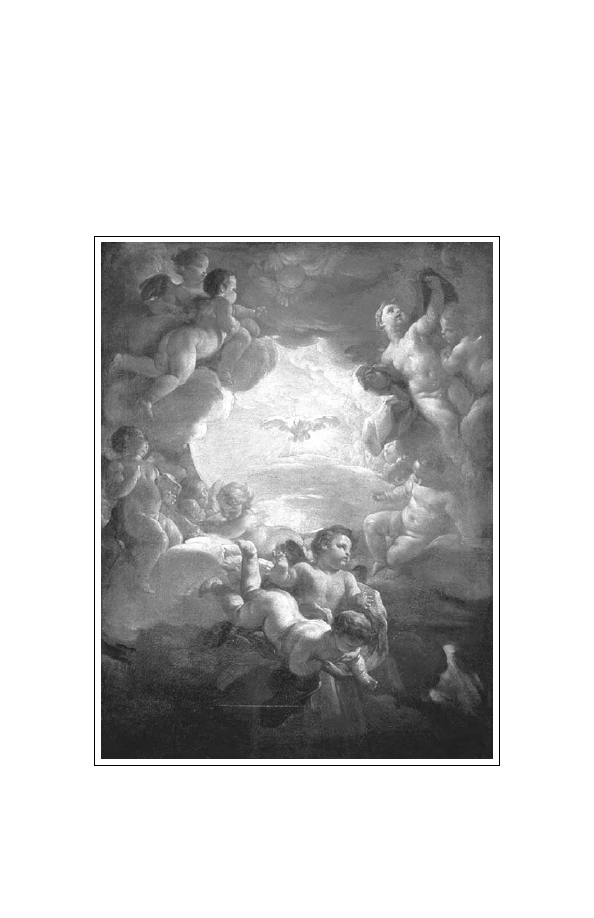
Page 2
The Holy Spirit (1750s)
Oil on canvas, 64 x 48 cm
Private collection
Giaquinto, Corrado
A bozzetto for a ceiling for a church or noble house in
Madrid
Page 26
The Annunciation (1490-95)
Oil on wood
Art Institute of Chicago, Chicago
Master of Moulins (Jean Hey)
Page 92
Baptism of Christ (1500-02)
Oil on canvas, 400 x 263 cm
Santa Corona, Vicenza
Bellini, Giovanni
Page 116
Visitation (c. 1445)
Oil on oak panel, 57 x 36 cm
Museum der Bildenden Künste, Leipzig
Weyden, Rogier van der
Page 138
Pentecost
Panel, 110 x 84 cm
Museo del Prado, Madrid
Juan De Flandes
The panel is from the church of St Lazarus in Palencia.

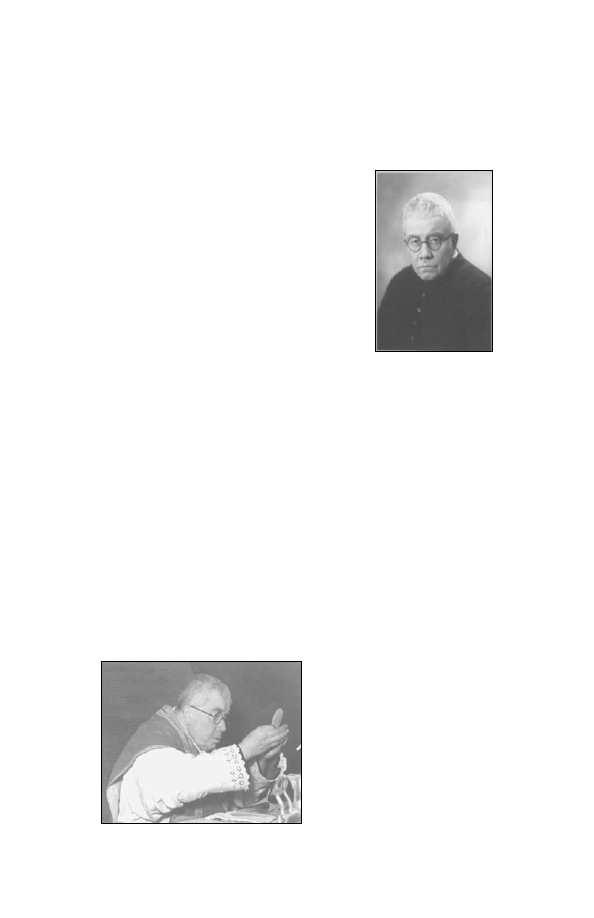
The author, Don Dolindo Ruotolo,
Franciscan Tertiary, was born in Naples,
October 6, 1882.
Ordained priest at a very early age, he
lived his priesthood in an uninterrupted,
intense, sacrificial testimony to God: in
the Church which he loved heroically,
and among souls for whom he expended
the last energies of his poor health.
He wrote colossal commentaries and meditations on Sacred
Scripture which have enjoyed enthusiastic praise, but also
met strong criticism… But his masterpiece was an anthology
of thoughts and reflections. Composed extemporaneously
during contemplative moments of prayer and recollection,
these analogies and reflections, like silent seeds so productive
of incalculable good, have brought immense comfort to
thousands and thousands of souls.
Until the very last days of a long life, he lived more than
ever at the service of souls and of the world, surviving on
next to nothing materially. He led a life consisting solely in a
continuous and heroic sacrifice of intense pain, which up to the
very end, did not prevent him from leaving his home in order
to comfort the sick. A paralytic himself, and literally doubled
over in pain, his legs were so
bent and arthritic that his
every step could not have
been other than agony….
He died a holy death,
November 19, 1970. The
cause of his beatification has
been opened.
About the Author

A Selection of Books from the
Academy of the Immaculate
A Month with Mary
Daily Meditations for a Profound Reform
of the Heart in the School of Mary
by Don Dolindo Ruotolo
This
little book was written by a holy Italian priest Father Dolondo
Ruotolo (1882-1970). Originally written as spiritual thoughts to his
spiritual daughter, the work is comprised of thirty-one meditations
for the month of May. The month of Mary is the month of a profound
reform of heart: we must leave ourselves and adorn ourselves with
every virtue and every spiritual good.
Jesus Our Eucharistic Love
by Fr.
Stefano Manelli, FI
A treasure of Eucharistic devotional writings and examples from
the saints showing their stirring Eucharistic love and devotion. A
valuable aid for reading meditatively before the Blessed Sacrament.
Who is Mary?
Fr.
Gabriele M.
Pellettieri, FI
This book is a
concise marian catechism presented in a question/answer format. In
this little work of love and scholarship the sweet mystery of Mary is
unveiled in all its beauty and simplicity. It is a very helpful resource
both for those who want to know the truth about Mary and those
who want to instruct others.
Padre Pio of Pietrelcina
by Fr.
Stefano Manelli, FI
This
144 page popular life of Padre Pio is packed with details about his life,
spirituality, and charisms, by one who knew the Padre intimately. The
author turned to Padre Pio for guidance in establishing a new
Community, the Franciscans of the Immaculate.
Devotion to Our Lady
by Fr.
Stefano M.
Manelli, FI
This
book is a must for all those who desire to know the beauty and value
of marian devotion and want to increase their fervent love towards
their heavenly Mother. Since it draws abundantly from the examples
and writings of the saints, it offers the devotee a very concrete and
practical aid for living out a truly marian life.

Do You Know Our Lady
by Rev.
Mother Francesca Perillo,
FI
This handy treatise (125 pages) covers the many rich references
to Mary, as prefigured in the Old Testament women and prophecies
and as found in the New Testament from the Annunciation to
Pentecost. Mary’s role is seen ever beside her Divine Son, and the
author shows how scripture supports Mary’s role as Mediatrix of all
Graces. Though scripture scholars can read it with profit, it is an
easy read for everyone. Every marian devotee should have a copy for
quick reference.
Come Follow Me
by Fr.
Stefano Manelli, FI
A book directed
to any young person contemplating a religious vocation. Informative,
with many inspiring illustrations and words from the lives and
writings of the saints on the challenging vocation of total dedication
in the following of Christ and His Immaculate Mother through the
three vows of religion.
St. Maximilian Kolbe Martyr of Charity – Pneumatolgist
by Fr.
Peter Damian Fehlner, FI
A scholarly study of St.
Maximilian’s teaching on the Holy Spirit and Our Lady; focus of
contemporary criticism of the Saint and of his marian program of life
and thought, both by conservatives as well as by liberals. The author,
being a prominent Kolbe scholar, shows how Kolbe’s perspectives are
in full continuity with those of St. Francis and the great Franciscan
doctors of the Church. Thoroughly documented with extensive
bibliography.
Saints And Marian Shrine Series
Edited by Bro. Francis Mary, FI
Padre Pio - The Wonder Worker
The latest on this popular
saint of our times including the two inspirational homilies given by
Pope John Paul II during the beatification celebration in Rome. The
first part of the book is a short biography. The second is on his
spirituality, charisms, apostolate of the confessional, and his great
works of charity.

A Handbook on Guadalupe
This well researched book on
Guadalupe contains 40 topical chapters by leading experts on
Guadalupe with new insights and the latest scientific findings. A
number of chapters deal with Our Lady’s role as the patroness of the
pro-life movement. Well illustrated.
Kolbe Saint of the Immaculata
Of all the books in the Marian
Saints and Shrines series, this one is the most controversial and thus
the most needed in order to do justice to the Saint, whom Pope John
Paul II spoke of as “the Saint of our difficult century [twentieth].” Is
it true, as reported in a PBS documentary, that the Saint was anti-
Semitic? What is the reason behind misrepresenting this great modern
day Saint? Is a famous mariologist right in accusing the Saint of being
in error by holding that Mary is the Mediatrix of all Graces? The
book has over 35 chapters by over ten authors, giving an in-depth
view of one of the greatest marian saints of all times.
For a complete listing of books, tapes and CD’s from
the Academy of the immaculate please refer to our catalog.
request a free catalog by email, letter, or phone via the contact
information given below for the Academy of the immaculate.
Special rates are available with 25% to 50% discount
depending on the number of books, plus postage. For ordering
books and further information on rates to book stores, schools
and parishes:
Academy of the immaculate, 124 North Forke
Dr., Advance, NC 27006, Phone/FAX (336)751-2990, E-
mail mimike@pipeline.com. Quotations on bulk rates shipped
directly by the box from the printery, contact: Franciscans of the
Immaculate, P.O. Box 3003, New Bedford, MA 02741, (508)996-
8274, FAX (508)996-8296, E-mail: ffi@marymediatrix.com.
Website: www.marymediatrix.com.
The Academy of the Immaculate
The Academy of the Immaculate, founded in 1992, is inspired by
and based on a project of St. Maximilian M. Kolbe (never realized by
the Saint because of his death by martyrdom at the age of 47, August
14, 1941). Among its goals the Academy seeks to promote at every
level the study of the Mystery of the Immaculate Conception and the
universal maternal mediation of the Virgin Mother of God, and to
sponsor publication and dissemination of the fruits of this research
in every way possible.
The Academy of the Immaculate is a non-profit religious-
charitable organization of the Roman Catholic Church, incorporated
under the laws of the Commonwealth of Massachusetts, with its
central office at Our Lady’s Chapel, POB 3003, New Bedford, MA
02741-3003.

Wyszukiwarka
Podobne podstrony:
Dolindo Ruotolo MEDITATION ON THE HOLY ROSARY
JW Who Sent Holy Spirit
Don Dolindo Ruotolo JEZU, TY SIĘ TYM ZAJMIJ (Wszystko możecie przez ten akt otrzymać)
20 The Holy Spirit Eternal, Omniscient, Omnipresent
apocalipsse commentata da don dolindo ruotolopdf
35 Letting the Holy Spirit Lead
23 The Gifts of the Holy Spirit
Michael Tsarion Shiva, The Holy Spirit And The Age Of Aquarius
Invokation of the Holy Spirit ISIS
Jezus do serca kapłana Dolindo Ruotolo
Jezu, Ty się tym zajmij! o Dolindo Ruotolo Życie i cuda Bątkiewicz Brożek Joanna
troszcz si ty akt oddania si p jezusowi przeciw niepokojom i zmartwieniom don dolindo ruotolo
Dolindo Ruotolo czysciec
19 Who Is the Holy Spirit
24 The Fruit of the Holy Spirit
Jezus do serca kapłana Dolindo Ruotolo
The word to Brothers and Sisters, Protestants filled with the Holy Spirit
Akt oddania przeciw niepokojom i zmartwieniom wg ks Dolindo Ruotolo
więcej podobnych podstron