
The Age of Einstein
Frank W. K. Firk
Professor Emeritus of Physics
Yale University
2003

ii

iii
CONTENTS
Preface v
1. Introduction 1
2. Understanding the Physical Universe 2
3. Describing Everyday Motion 4
4. Einstein’s Theory of Special Relativity 13
5. Newton’s Dynamics 29
6. Equivalence of Mass and Energy: E = mc
2
38
7. An Introduction to Einstein’s General Relativity 43
8. Appendix: a Mathematical Approach to Special Relativity 54
9. Bibliography 73

iv

v
PREFACE
This book had its origin in a one-year course that I taught at Yale
throughout the decade of the 1970’s. The course was for non-science majors
who were interested in learning about the major branches of Physics. In the
first semester, emphasis was placed on Newtonian and Einsteinian Relativity.
The recent popularity of the Einstein exhibit at the American Museum of
Natural History in New York City, prompted me to look again at my fading
lecture notes. I found that they contained material that might be of interest to
today’s readers. I have therefore reproduced them with some additions,
mostly of a graphical nature. I recall the books that were most influential in
my approach to the subject at that time; they were Max Born’s The Special
Theory of Relativity, Robert Adair’s Concepts of Physics, and Casper and
Noer’s Revolutions in Physics. These three books were written with the
non-scientist in mind, and they showed what could be achieved in this
important area of teaching and learning; I am greatly indebted to these
authors.

vi

1
1. INTRODUCTION
This brief book is for the inquisitive reader who wishes to gain an
understanding of the immortal work of Einstein, the greatest scientist since
Newton. The concepts that form the basis of Einstein’s Theory of Special
Relativity are discussed at a level suitable for Seniors in High School. Special
Relativity deals with measurements of space, time and motion in inertial
frames of reference (see chapter 4). An introduction to Einstein’s Theory of
General Relativity, a theory of space, time, and motion in the presence of
gravity, is given at a popular level. A more formal account of Special
Relativity, that requires a higher level of understanding of Mathematics, is
given in an Appendix.
Historians in the future will, no doubt, choose a phrase that best
characterizes the 20th-century. Several possible phrases, such as “the Atomic
Age”, “the Space Age” and “the Information Age”, come to mind. I
believe that a strong case will be made for the phrase “the Age of Einstein”;
no other person in the 20th-century advanced our understanding of the
physical universe in such a dramatic way. He introduced many original
concepts, each one of a profound nature. His discovery of the universal
equivalence of energy and mass has had, and continues to have, far-reaching
consequences not only in Science and Technology but also in fields as diverse
as World Politics, Economics, and Philosophy.

2
The topics covered include:
a) understanding the physical universe;
b) describing everyday motion;
relative motion,
Newton’s Principle of Relativity,
problems with light,
c) Einstein’s Theory of Special Relativity;
simultaneity and synchronizing clocks,
length contraction and time dilation,
examples of Einstein’s world,
d) Newtonian and Einsteinian mass;
e) equivalence of energy and mass, E = mc
2
;
f) Principle of Equivalence;
g) Einsteinian gravity;
gravity and the bending of light,
gravity and the flow of time, and
red shifts, blue shifts, and black holes.
2. UNDERSTANDING THE PHYSICAL UNIVERSE
We would be justified in thinking that any attempts to derive a small set
of fundamental laws of Nature from a limited sample of all possible processes
in the physical universe, would lead to a large set of unrelated facts.
Remarkably, however, very few fundamental laws of Nature have been found
to be necessary to account for all observations of basic physical phenomena.

3
These phenomena range in scale from the motions of minute subatomic
systems to the motions of the galaxies. The methods used, over the past five
hundred years, to find the set of fundamental laws of Nature are clearly
important; a random approach to the problem would have been of no use
whatsoever. In the first place, it is necessary for the scientist to have a
conviction that Nature can be understood in terms of a small set of
fundamental laws, and that these laws should provide a quantitative account
of all basic physical processes. It is axiomatic that the laws hold throughout
the universe. In this respect, the methods of Physics belong to Philosophy.
(In earlier times, Physics was referred to by the appropriate title, “Natural
Philosophy”).
2.1 Reality and Pure Thought
In one of his writings entitled “On the Method of Theoretical Physics”,
Einstein stated: “If, then, experience is the alpha and the omega of all our
knowledge of reality, what then is the function of pure reason in science?”
He continued, “Newton, the first creator of a comprehensive, workable
system of theoretical physics, still believed that the basic concepts and laws of
his system could be derived from experience.” Einstein then wrote “But the
tremendous practical success of his (Newton’s) doctrines may well have
prevented him, and the physicists of the eighteenth and nineteenth centuries,
from recognizing the fictitious character of the foundations of his system”. It
was Einstein’s view that “..the concepts and fundamental principles which
underlie a theoretical system of physics are free inventions of the human
4
intellect, which cannot be justified either by the nature of that intellect or in
any other fashion a priori.” He continued, “If, then, it is true that the
axiomatic basis of theoretical physics cannot be extracted from experience but
must be freely invented, can we ever hope to find the right way? ... Can we
hope to be guided safely by experience at all when there exist theories (such
as Classical (Newtonian) Mechanics) which to a large extent do justice to
experience, without getting to the root of the matter? I answer without
hesitation that there is, in my opinion, a right way, and that we are capable of
finding it.” Einstein then stated “Experience remains, of course, the sole
criterion of the physical utility of a mathematical construction. But the
creative principle resides in Mathematics. ... I hold it true that pure thought
can grasp reality, as the ancients dreamed.”
3. DESCRIBING EVERYDAY MOTION
3.1 Motion in a straight line (the absence of forces)
The simplest motion is that of a point, P, moving in a straight line. Let
the line be labeled the “x-axis”, and let the position of P be measured from a
fixed point on the line, the origin, O. Let the motion begin (time t = 0) when
P is at the origin (x = 0). At an arbitrary time, t, P is at the distance x:
P [x, t]
-x O position, x +x
at time t

5
If successive positions of P are plotted, together with their corresponding
times, we can generate what is called the “world line” of P.
Let us observe a race car, moving at high speed along the straight part
of a race track (the x
−
axis), and let us signal the instant that it passes our
position, x = 0, by lowering a flag:
An observer, standing at a measured distance D, from x = 0, starts his clock
at the instant, t = 0, when he sees the flag lowered, and stops the clock at the
instant t = T, as the car passes by.
We can obtain the average speed of the car, v, during the interval T, in the
standard way; it is
v = D/T (in units of velocity).
If, for example, D = 1 mile, and T = 20 seconds (1/180 hour), then
v = 1 (mile)/(1/180) (hour) = 180 miles per hour.
This is such a standard procedure that we have no doubt concerning the
validity of the result.
3.2 The relativity of everyday events
Events, the description of when and where happenings occur, are part
of the physical world; they involve finite extensions in both time and space.
From the point of view of a theory of motion, it is useful to consider “point-
like” events that have vanishingly small extensions in time and space. They
then can be represented as “points” in a space-time geometry. We shall label
events by giving the time and space coordinates: event E
→
E[t, x], or in
three space dimensions, E[t, x, y, z], where x, y, z are the Cartesian
6
components of the position of the event. There is nothing special about a
Cartesian coordinate system, it is a mathematical construct; any suitable
coordinate mesh with a metrical property (measured distances defined in
terms of coordinates) can be used to describe the spatial locations of events.
A familiar non-Cartesian system is the spherical polar coordinate system of
the lines of latitude and longitude on the surface of the earth. The time t can
be given by any device that is capable of producing a stable, repetitive motion
such as a pendulum, or a quartz-controlled crystal oscillator, or for high
precision, a clock that depends on the very stable frequency of an atomic
system.
Suppose we have an observer, O, at rest at the origin of an x
−
axis, in
the F-frame. O has assistants with measuring rods and clocks to record
events occurring on the x-axis:
F
-x
O
+x
We introduce a second observer, O
′
, at rest at the origin of his frame of
reference, F
′
. O
′
has his assistants with their measuring rods (to measure
distances, x
′
) and clocks (to measure times, t
′
) to record events on the x
′
-axis.
(The F
′
-clocks are identical in construction and performance to the clocks in
the F-frame). Let O
′
coincide with O at a common origin O = O
′
(x = x
′
=
0), at the synchronized time zero t = t
′
= 0. At t = t
′
= 0, we have
7
F
′
-x
′
O
′
+x
′
Suppose that the observer O
′
, and his assistants with rods and clocks, move
to the right with constant speed V along the common x, x
′−
axis. At some
later time t, the two sets of observers, represented by O and O
′
, record a
common event that they write as E[t, x] and E
′
[t
′
, x
′
], respectively. The
relative positions of the two observers at time t is:
F
E[t. x]
-x
O
x
+x
D
F
′⇒
E
′
[t
′
, x
′
]
-x
′
O
′
x
′
+x
′
where D = Vt is the distance that O
′
moves at constant speed V, in the time t.
We therefore write the relationship between the two measurements by the
plausible equations (based on everyday experience):
t
′
= t (everyday identical clocks tick at the same rate)
and
x
′
= x
−
D = x
−
Vt.
These are the basic equations of relative motion according to the concepts
first put forward by Galileo and Newton. They are fully consistent with
measurements made in our real world (the world of experience). They are

8
not, however, internally consistent. In the equation that relates the
measurement of distance x
′
in the F
′
-frame to the measurements in the F-
frame, we see that the space part, x
′
, in the F
′
-frame, is related to the space
part, x, and the time part, t, in the F-frame: space-time in one frame is not
related to space-time in the other frame! Furthermore, the time equation
makes no mention of space in either frame. We see that there is a
fundamental lack of symmetry in the equations of relative motion, based on
everyday experience. The question of the “symmetry of space-time” will
lead us to Einstein’s philosophy of the “free invention of the intellect”.
3.3 Relative velocities
We have seen that the position of an event, E[t, x], measured by an
observer O, is related to the position of the same event, E
′
[t
′
, x
′
], measured
by an observer O
′
, moving with constant speed V along the common x, x
′−
axis of the two frames, by the equation
x
′
= x
−
Vt .
The speed v of a point P[t, x], moving along the x
−
axis, is given by the
ratio of the finite distance the point moves,
∆
x, in a given finite time interval,
∆
t:
v =
∆
x/
∆
t .
We can obtain the speeds v, and v
′
of the same moving point, as measured in
the two frames, by calculating v =
∆
x/
∆
t and v
′
=
∆
x
′
/
∆
t
′
, as follows:
∆
x
′
/
∆
t
′
= v
′
=
∆
x/
∆
t
−
V
∆
t/
∆
t (where we have used
∆
t
′
=
∆
t because
t = t
′
in everyday experience).
9
We therefore find
v
′
= v
−
V,
the speeds differ by the relative speed of the two frames. This is consistent
with experience: if a car moves along a straight road at a constant speed of v
= 60 mph, relative to a stationary observer O, and an observer O
′
follows in a
car at a constant speed of V = 40 mph relative to O, then the speed of the
first car relative to the occupant of the second car is v
′
= 20 mph.
3.4 The Newtonian Principle of Relativity
The Newtonian Principle of Relativity asserts that, in the inertial
frames F, F
′
, the following two situations
x = x
′
= 0 at t = t
′
= 0
F
−
x
O
+x
D = Vt
⇒
+V
F
′
(moves to right
at speed V)
O
′
+x
′
D
′
= Vt
′
F
′
O
′
+x
′
−
V
⇐
F
(moves to left at speed V)
O
+x
cannot be distinguished by experiments that involve mechanical systems
(classical systems that obey Newton’s Laws of Motion).

10
The speed V has been written in bold face to remind us that here we
are dealing with a vector quantity that has both magnitude (the speed in
mph) and a sense of direction: +V in the +x-direction and
−
V in the
−
x-
direction.
3.5 Problems with light
We are accustomed to the notion that waves propagate through a
medium, required to support the waves. For example, sound waves propagate
as pressure variations in air, and water waves propagate as coupled
displacements of the water molecules, perpendicular to the direction of the
wave motion. In the 19th-century, Maxwell discovered that light waves are
electromagnetic phenomena. This great work was based on theoretical
arguments, motivated by the experimental results of Faraday and Henry.
One of the most pressing questions facing scientists of the day was:
“what is waving when a beam of light propagates through empty
space?”
It was proposed that the universe is filled with a medium called the aether
with the property of supporting light waves, and having no other physical
attributes. (For example, it would have no effect on the motion of celestial
bodies). In the latter part of the 19th-century, Michelson and Morley carried
out a famous experiment at the Case Institute in Cleveland that showed there
is no experimental evidence for the aether. Light travels through the void,
and that is that. Implicit in their work was the counter-intuitive notion that
the speed of light does not depend on the speed of the source of the light.

11
The Aether Theory was popular for many years. Non-traditional
theories were proposed to account for the null-result of the Michelson-Morley
experiment. Fitzgerald (Trinity College, Dublin) proposed that the Michelson-
Morley result could be explained, and the Aether Hypothesis retained, if the
lengths of components in their apparatus were “velocity-dependent”
−
lengths contract in the direction of motion, and lengths remain unchanged
when perpendicular to the direction of motion. He obtained the result
L
0
= [1/
√
(1
−
(v/c)
2
)]L
≡
γ
L
⇑
⇑
(length of rod at rest) (length of rod moving at speed v)
Here, c is the constant speed of light (2.99...
×
10
8
meters/second).
All experiments are consistent with the statement that the ratio v/c is always
less than 1, and therefore
γ
is always greater than 1. This means that the
measured length of the rod L
0
, in its rest frame, is always greater than its
measured length when moving.
At the end of the 19th-century, Larmor introduced yet another radical
idea: a moving clock is observed to tick more slowly than an identical clock
at rest. Furthermore, the relationship between the clock rates in the moving
and rest frames is given by the same factor,
γ
, introduced previously by
Fitzgerald. Specifically,

12
∆
t =
γ∆
t
0
⇑
⇑
(an interval on a moving clock) (an interval on a clock at rest)
Since the velocity-dependent term
γ
is greater than 1, the intervals of time
∆
t
(moving), are greater than the intervals
∆
t
0
(at rest).
Fitzgerald, Larmor, and other physicists at that time considered length
contraction and time dilation to be “real” effects, associated with minute
physical changes in the structure of rods and clocks when in motion. It was
left to the young Einstein, working as a junior Patent Officer in Bern, and
thinking about space, time, and motion in his spare time, to introduce a new
Theory of Relativity, uninfluenced by the current ideas. Although, in later
life, Einstein acknowledged that he was aware of the Michelson-Morley result,
and of the earlier work on length contraction and time dilation, he neither
used, nor referred to, the earlier results in his first paper on Relativity.

13
4. EINSTEIN’S THEORY OF SPECIAL RELATIVITY
In 1905, Einstein published three great papers in unrelated areas of
Physics. In this chapter, we shall discuss his new ideas concerning the relative
motion of beams of light, and of objects that move at speeds close to that of
light. His independent investigations were based upon just two postulates:
1. The generalized Principle of Relativity: no mechanical or optical
experiments can be carried out that distinguish one inertial frame of reference
from another. (This is a development of Newton’s Principle of Relativity that
is limited to mechanical experiments, involving speeds much less than the
speed of light; it applies to experiments in the everyday world).
Inertial frames of reference are non-rotating, and move in straight lines
at constant speed. They are non-accelerating.
2. The speed of light in a vacuum is a constant of Nature, and is
independent of the velocity of the source of the light.
Einstein was not concerned with questions having to do with the Aether; for
him, a true theory of the physical properties of the universe could not rest
upon the mysterious qualities of such an unobservable. As we shall see,
Einstein was concerned with the precise meaning of measurements of lengths
and time intervals. In his later years, he recalled an interesting thought that
he had while in school. It had to do with the meaning of time. Our lives are
dominated by “psychological time”; for example, time seems to go by more
quickly as we grow older. For the young Einstein, time in the physical world
was simply the reading on a clock. He therefore imagined the following: if

14
the schoolroom clock is reading 3PM, and I rush away from the clock at the
speed of light, then the information (that travels at the speed of light) showing
successive ticks on the clock, and therefore the passage of time, will never
reach me, and therefore, in my frame of reference, it is forever 3PM
−
time
stands still. He therefore concluded that the measurement of time must
depend, in some way, on the relative motion of the clock and the observer; he
was, by any standards, a precocious lad.
If we apply the Galilean-Newtonian expression for the relative velocities
v, v
′
, measured in the inertial frames F, F
′
, (moving with relative speed V), to
the measurements of flashes of light, v = c, the speed of light in F, and v
′
= c
′
,
the speed of light in F
′
, we expect
c
′
= c
−
V (corresponding to v
′
= v
−
V for everyday objects).
Modern experiments in Atomic, Nuclear, and Particle Physics are consistent
with the fact that c = c, no matter what the value of the relative speed V
happens to be.
At the end of the 19th-century, a key question that required an answer
was therefore: - why does the Galilean-Newtonian equation, that correctly
describes the relative motion of everyday objects, fail to describe the relative
motion of beams of light? Einstein solved the problem in a unique way that
involved a fundamental change in our understanding of the nature of space
and time, a change that resulted in far-reaching consequences; these
consequences are discussed in the following chapters.

15
4.1 The relativity of simultaneity: the synchronization of clocks.
It is important to understand the meaning of the word “observer” in
Relativity. To record the time and place of a sequence of events in a
particular inertial reference frame, it is necessary to introduce an infinite set
of adjacent “observers”, located throughout the entire space. Each observer,
at a known, fixed position in the reference frame, carries a clock to record the
time, and the characteristic property, of every event in his immediate
neighborhood. The observers are not concerned with non-local events. The
clocks carried by the observers are synchronized: they all read the same time
throughout the reference frame. It is the job of the chief observer to collect
the information concerning the time, place, and characteristic feature of the
events recorded by all observers, and to construct the world line (a path in
space-time), associated with a particular characteristic feature (the type of
particle, for example). “Observer” is therefore seen to be a collective noun,
representing the infinite set of synchronized observers in a frame of reference.
The clocks of all observers in a reference frame are synchronized by
correcting them for the speed of light (the speed of information) as follows:
Consider a set of clocks located at x
0
, x
1
, x
2
, x
3
, along the x-axis of a
reference frame. Let x
0
be the position of the chief observer, and let a flash
of light be sent from the clock at x
0
when it reads t
0
(12 noon, say). At the
instant that the light signal reaches the clock at x
1
, it is set to read t
0
+ (x
1
/c),
at the instant that the light signal reaches the clock at x
2
, it is set to read t
0
+
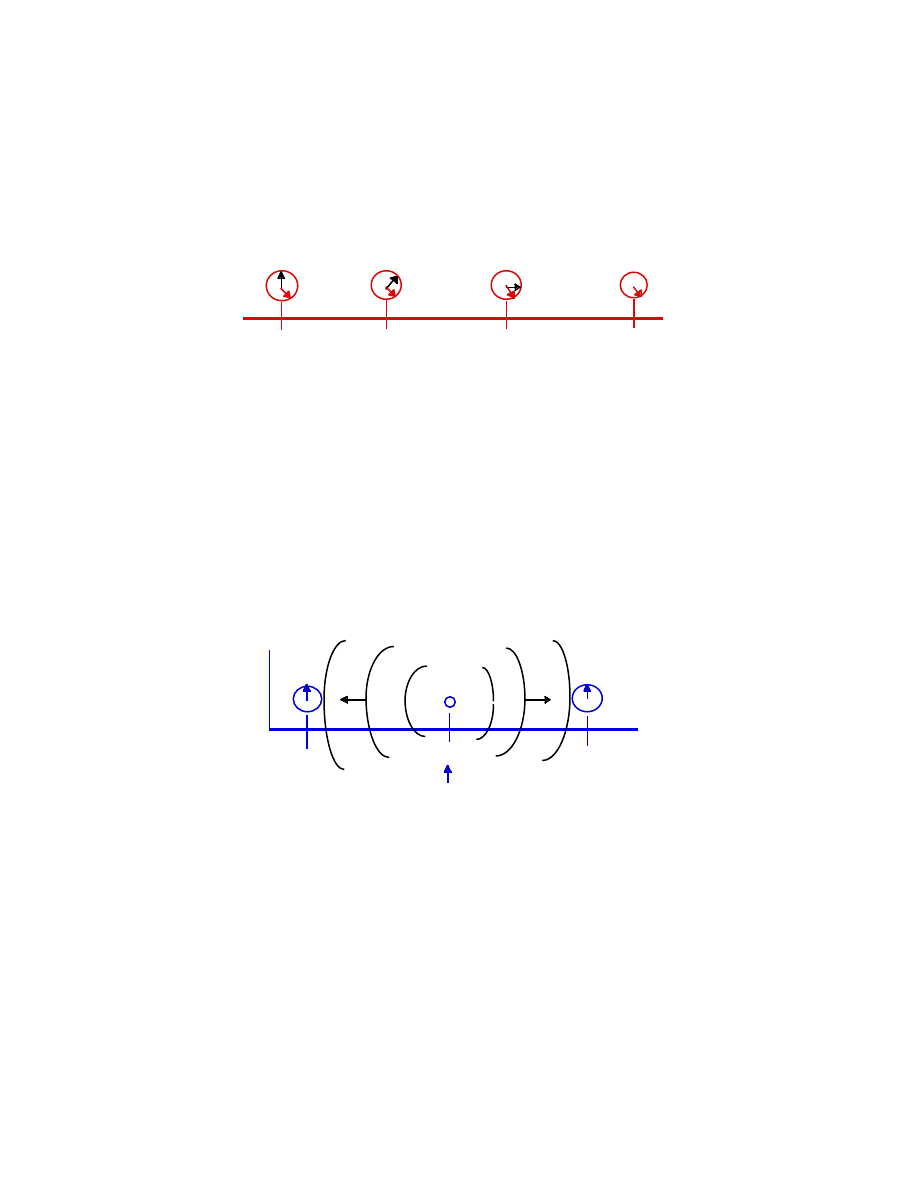
16
(x
2
/c) , and so on for every clock along the x-axis. All clocks along the x -
axis then “read the same time”
−
they are synchronized:
These 4 clocks read the same time “noon + x
3
/c in their rest frame
~~~> ~~~> ~~~> ~~~>
x
0
x
1
x
2
x
3
noon at x
0
noon
+ x
1
/c noon + x
2
/c noon + x
3
/c
To all other inertial observers, the clocks appear to be unsynchronized.
The relativity of simultaneity is clearly seen using the following method
to synchronize two clocks: a flash of light is sent out from a source, M
′
situated midway between identical clocks, A
′
and B
′
, at rest in the frame, F
′
F
′
c c
A
′
M
′
B
′
Flash of light from M
′
, the mid-point between A
′
and B
′
The two clocks are synchronized by the (simultaneous) arrival of the flash of
light (traveling at c) from M
′
. We now consider this process from the
viewpoint of observers in an inertial frame, F, who observe the F
′
-frame to be
moving to the right with constant speed V. From their frame, the
synchronizing flash reaches A
′
before it reaches B
′
:
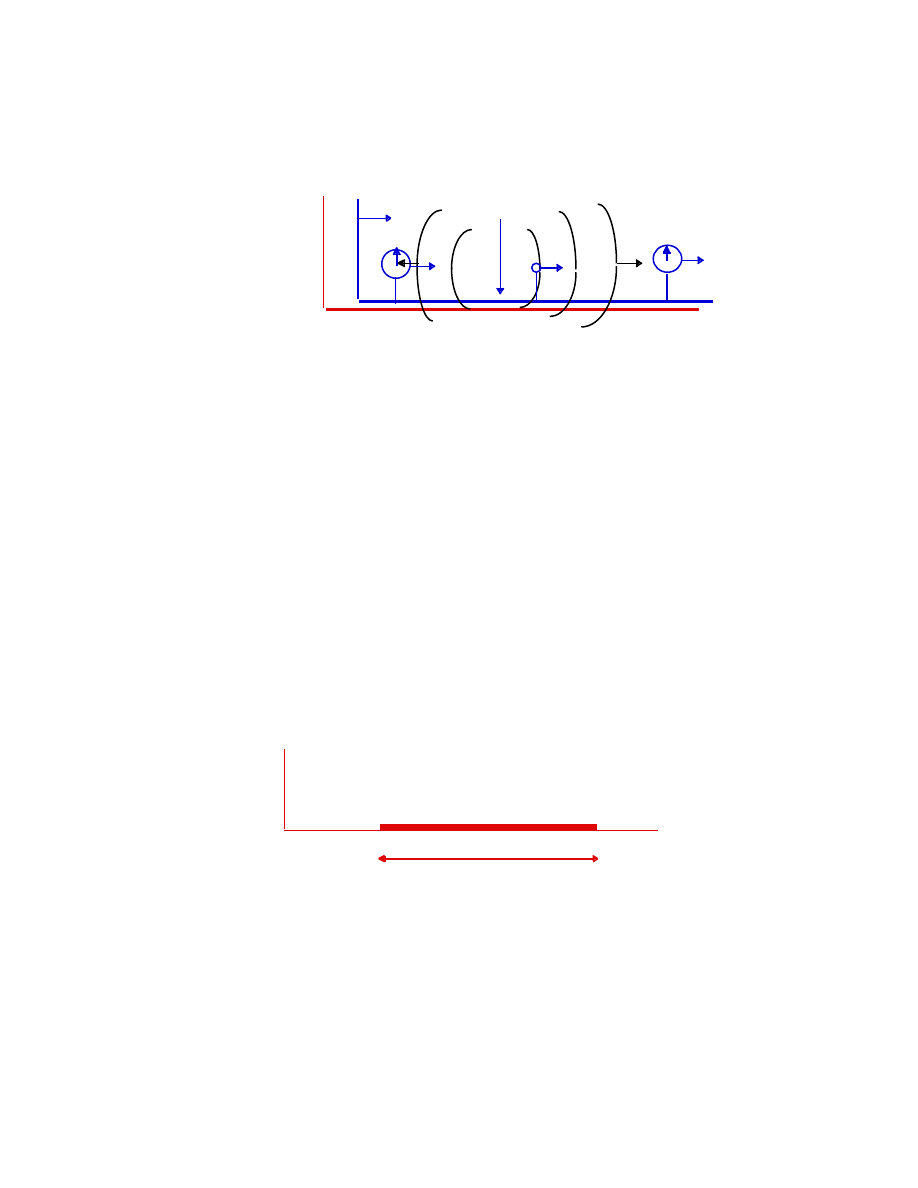
17
F
F
′
V
original position of M’
A
′
c
V
V
c
B
′
V
M
′
They conclude, therefore, that the A
′
-clock starts before the B
′
-clock; the
clocks are no longer synchronized. This analysis rests on the fact that the
speed of light does not depend on the speed of the source of light.
The relativity of simultaneity leads to two important non-intuitive
results namely, length contraction and time dilation.
4.2 Length contraction
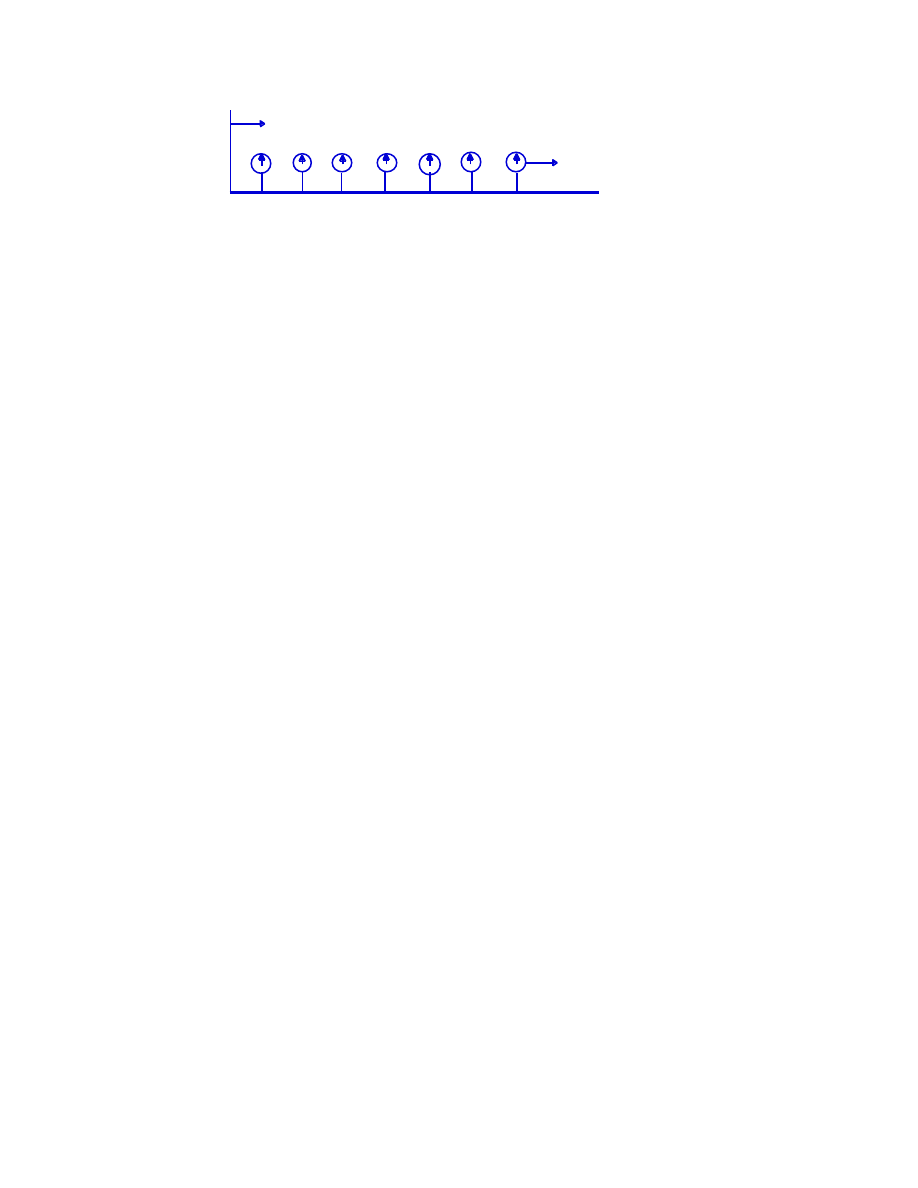
Let a rod be at rest in the F-frame, and let its proper (rest) length be L
0
.
F
x
L
o
Consider an F
′
-frame, moving at constant speed V in the +x direction. The
set of observers, at rest in F
′
, have synchronized clocks in F
′
, as shown
18
F
′
V All clocks “read the same time” in F
′
V
x
′
The observers in F
′
wish to determine the length of the rod, L
′
, relative to the
F
′
frame. From their perspective, the rod is moving to the left (the
−
x
′
direction) with constant speed, V. We define the length of a rod, measured in
any inertial frame, in terms of the positions of the two ends of the rod
measured at the same time. If the rod is at rest, it does not matter when the
two end positions are determined; this is clearly not the case when the rod is
in motion. The observers in F
′
are distributed along the x
′−
axis, as shown.
They are told to measure the length of the rod at 12 noon. This means that,
as the rod passes by, each observer looks to see if either end of the rod is in
his (immediate) vicinity. If it is, the two critical observers A
′
and B
′
(say) raise
their hands. At any time later, the observers in F
′
measure the distance
between the observers A
′
and B
′
, and the chief observer states that this is the
length of the rod, in their frame. This procedure can be carried out only if
the clocks in F
′
are synchronized. We have seen, however, that the
synchronized clocks in F
′
are not seen to be synchronized in a different
frame, F, such that F
′
moves at speed V, relative to F. The question is: how
does the length L
′
of the moving rod, determined by the observers in F
′
,
appear to the observers at rest in the F frame? We have seen that the clock
A
′
starts before clock B
′
, according to the F observers. Therefore “left end
of the rod coincides with the A
′
clock, reading noon” occurs before “right
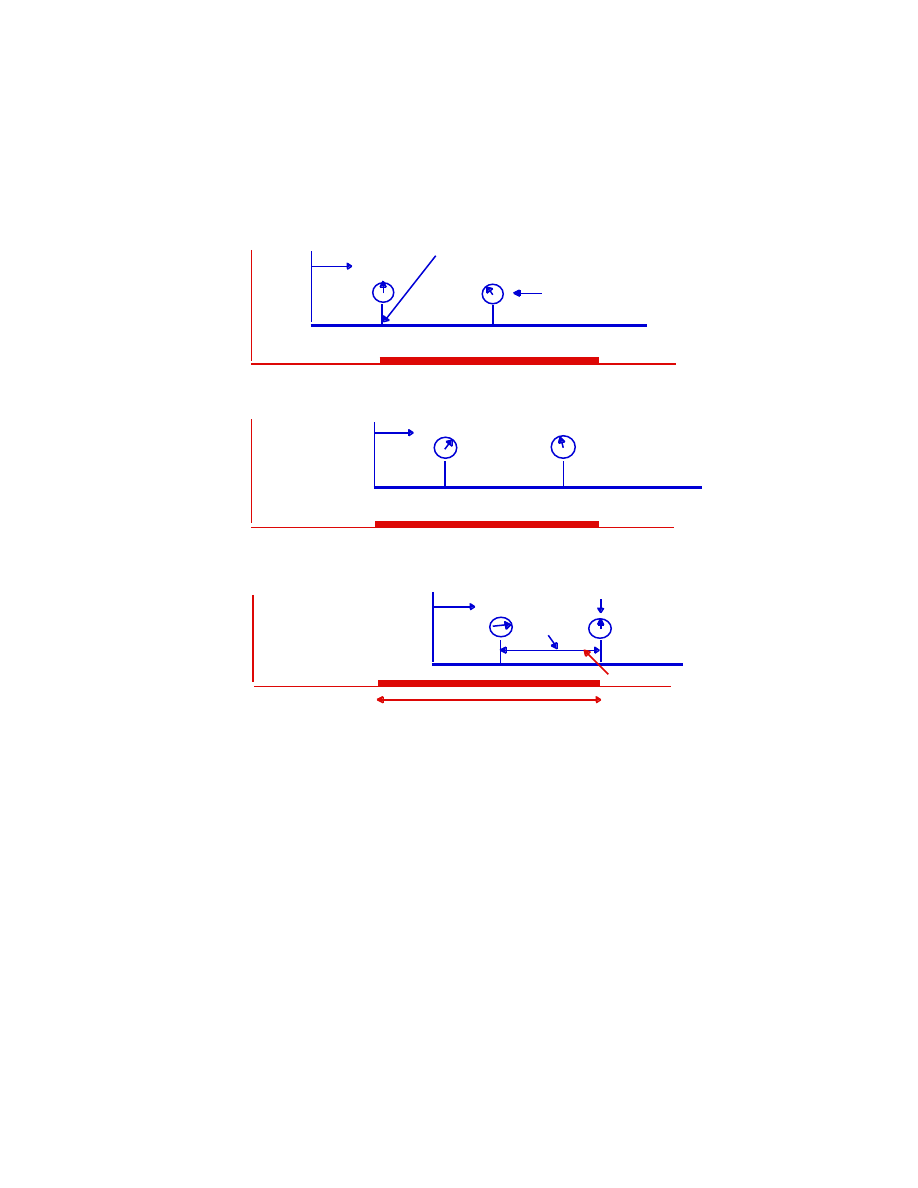
19
end of rod coincides with B
′
clock, reading noon”, according to the F
observers:
F
F
′
V
position of left end at t
′
= noon
A
′
B
′
not yet t
′
= noon
F
F
′
V
A
′
B
′
an intermediate position
F
F
′
V
position of right end at t
′
= noon
A
′
L
′
B
′
according to observers in F
L
0
, in F
The length of the rod, L
′
, as determined by observers at rest in F
′
, shown
from the viewpoint of observers in the F frame, is less than its proper length,
L
0
.
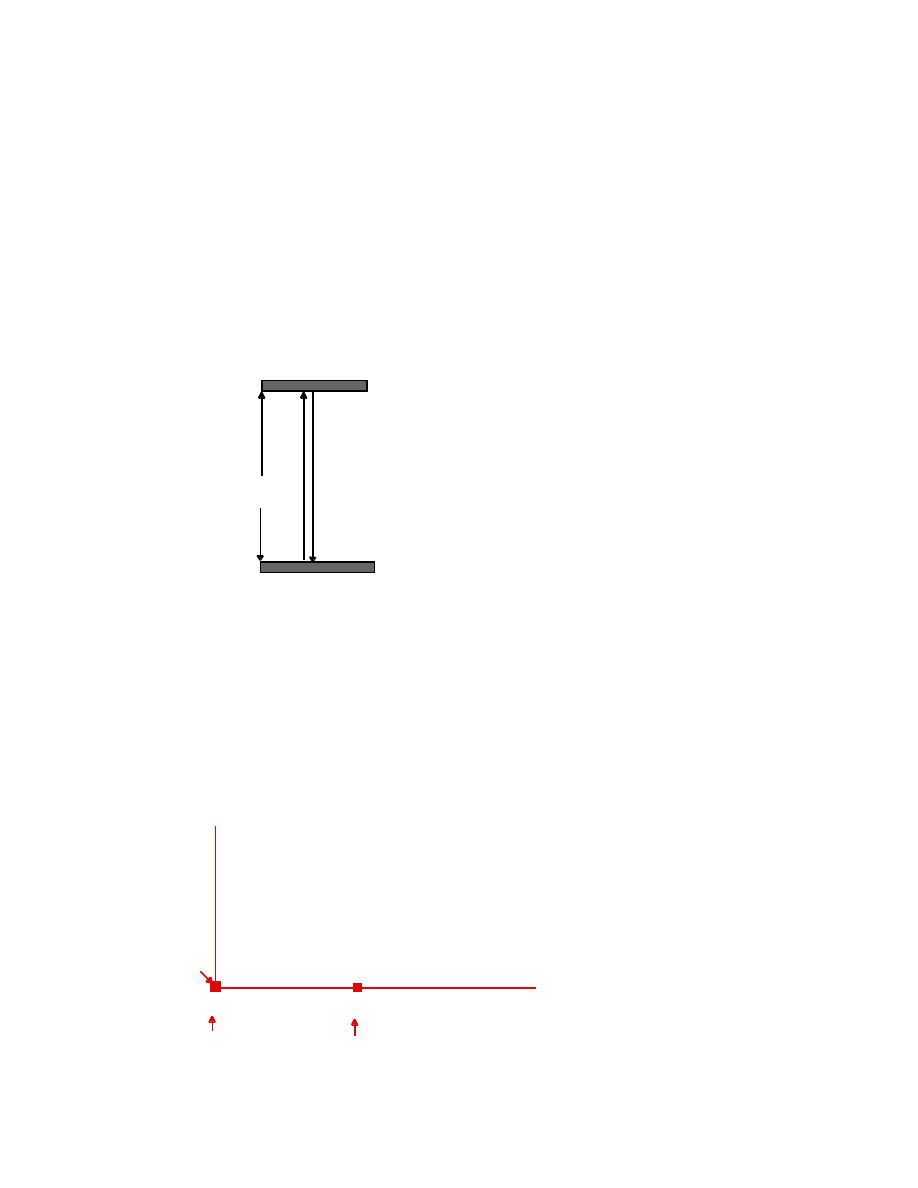
We see that the measurement of length contraction does not involve
physical changes in a moving rod; it is simply a consequence of the
synchronization of clocks in inertial frames, and the relativity of simultaneity.
20
4.3 Time dilation
The proper time interval between two events is the interval measured
in the frame of reference in which they occur at the same position. Intervals
that take place at different positions are said to be improper.
Consider a pulse of light that reflects between two plane mirrors, M
1
and M
2
, separated by a distance D:
D Pulse of light traveling between M
1
and M
2
,
at the invariant speed of light, c
The time interval,
∆
t, for the light to make the round-trip is
∆
t = 2D/c.
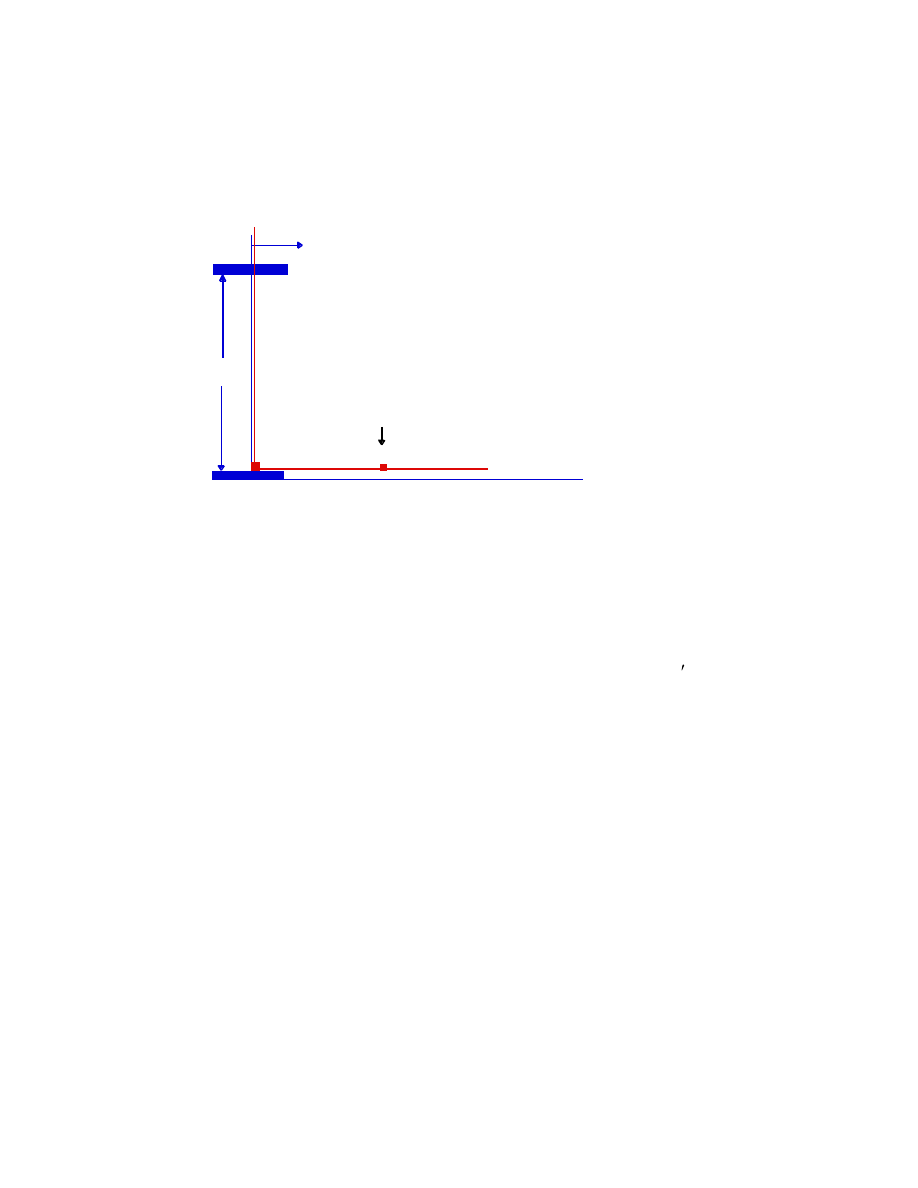
Consider a reference frame, F, (the laboratory frame, say), and let the origin
of F coincide with the location of an event E
1
. A second event E
2
, occurs at a
different time and location in F, thus
F
O
E
1
E
2
1st event at x=t=0 in F 2nd event; different place, different time in F
21
Let us introduce a second inertial frame, F
′
, moving with speed V relative to
F, in the +x direction:
F
′
F
V
M
2
D
2nd event, at the “same place”, O
′
, in F
′
M
1
E
1
E
2
x
O
′
O
x
′
Let F
′
be chosen in such a way that its origin, O
′
, coincides with the first
event E
1
(in both space and time), and let its speed V be chosen so that O
′
coincides with the location of the second event, E
2
. We then have the
situation in which both events occur at the same place in F (at the origin,
O
′
). The interval between E
1
and E
2
in F
′
is therefore a proper interval.
The mirrors, M
1
and M
2
, are at rest in F
′
, with M
1
at the origin, O
′
. These
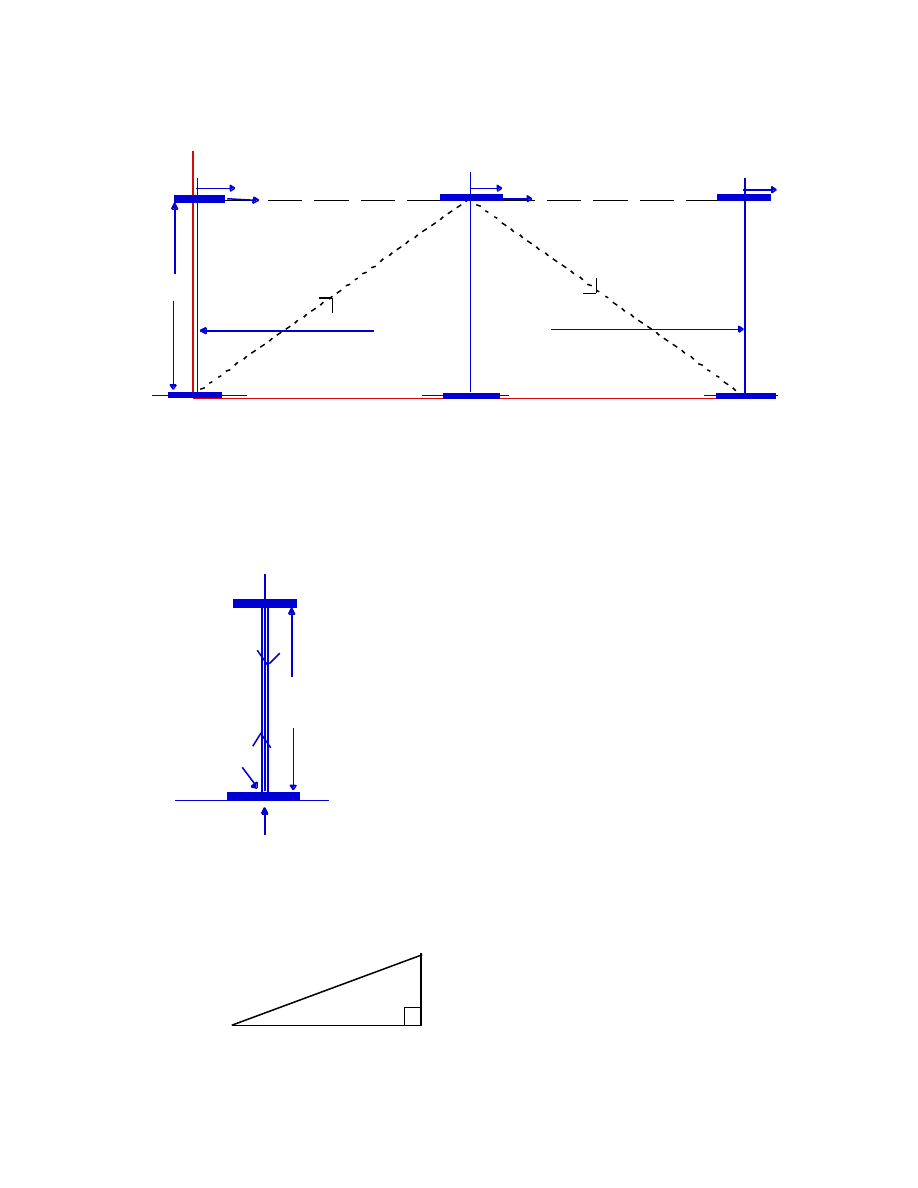
mirrors move to the right with speed V. Let a pulse of light be sent from the
lower mirror when O and O
′
coincide (at the instant that E
1
occurs).
Furthermore, let the distance D between the mirrors be adjusted so that the
pulse returns to the lower mirror at the exact time and place of the event, E
2
.
This sequence of events, as observed in F, is as shown:
22
F
V
V
V
M
2
F
′
F
′
F
′
D
Distance = V.
∆
t
M
1
Event E
1
, At time
∆
t/2, later, Event E
2
light leaves M
1
light reflects from M
2
light arrives at M
1
at time
∆
t
The sequence, observed in F
′
is
F
′
D The mirrors are at rest in F
′
, and the events
O
′
E
1
and E
2
occur at the same place, therefore
the time interval
∆
t
′
= 2D/c is a proper interval.
E
1
and E
2
, both take place at the origin, O
′
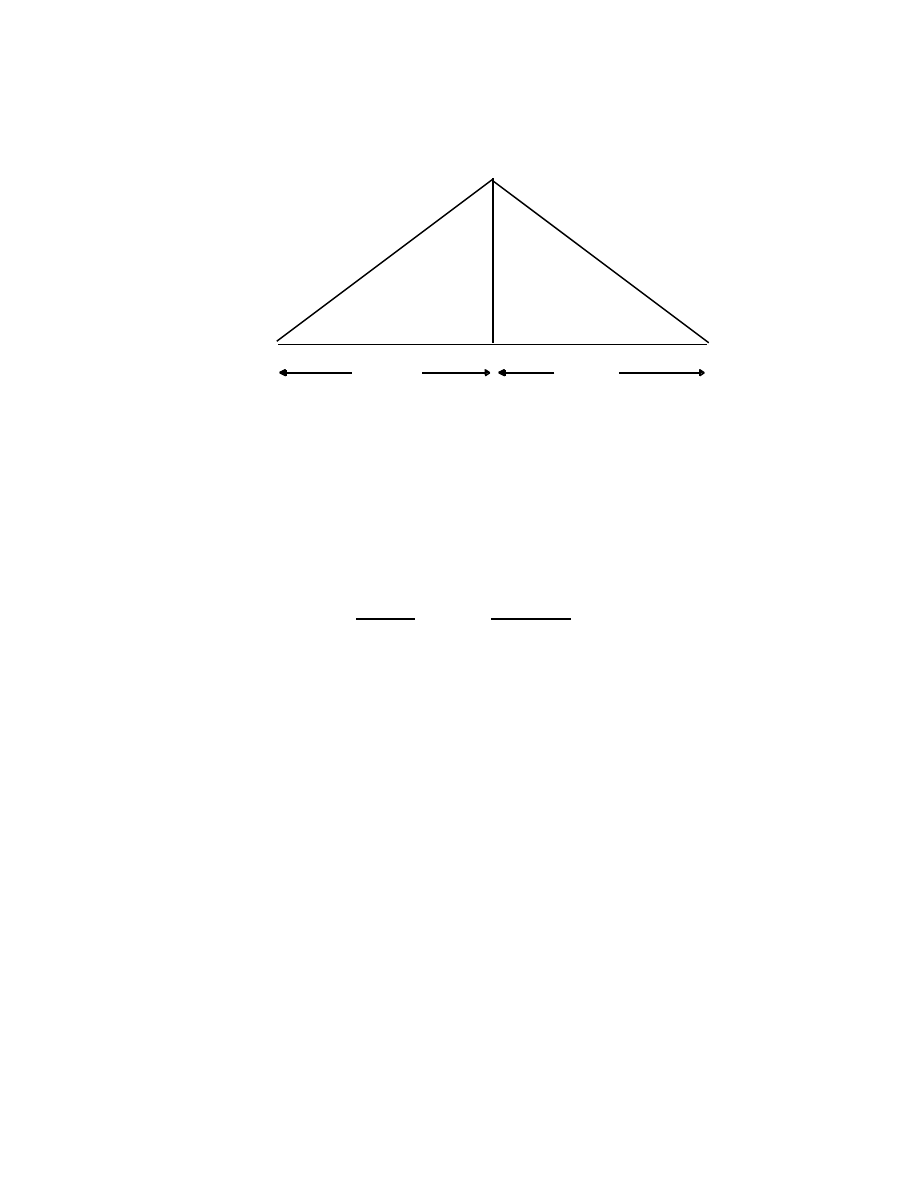
The geometry of the sequence of events in the F frame is Pythagorean.
Recall, that in a right-angled triangle, we have
c b
a a
2
+ b
2
= c
2
.
23
In F, the relevant distances are:
c
∆
t/2 c
∆
t/2
D
V
∆
t/2 V
∆
t/2
where
∆
t is the round-trip travel time. We therefore have
(V
∆
t/2)
2
+ D
2
= (c
∆
t/2)
2
,
or,
(
∆
t)
2
[c
2
−
V
2
] = 4D
2
,
so that, on taking the square root,
∆
t = 2D/
√
(c
2
−
V
2
) = {1/
√
[1
−
(V/c)
2
]}(2D/c) =
γ
(2D/c),
where
γ
is the factor first introduced, on empirical grounds, by Fitzgerald. In
this discussion, we see that it emerges in a natural way from the two
postulates of Einstein.
We can now compare the interval,
∆
t, between E
1
and E
2
in F with the
interval,
∆
t
′
, between the same events as determined in F
′
. If we look at the
sequence of events in F
′
, in which the mirrors are at rest, we have
2D = c
∆
t
′
,
and therefore
∆
t
′
= 2D/c.

24
Substituting this value in the value for
∆
t in F, we obtain
∆
t = {1/
√
[1
−
(V/c)
2
]}
∆
t
′
or
∆
t =
γ∆
t
′
,
γ
> 1,
which means that
∆
t (moving) >
∆
t
′
(at rest).
A moving clock runs more slowly than an equivalent clock at rest.
Notice that at everyday speeds, in which V/c is typically less than 10
-6
, (and
therefore (V/c)
2
is less than 10
-12
, an unimaginably small number),
∆
t and
∆
t
′
are essentially the same. Einstein’s result then reduces to the classical result
of Newton. However, in Modern Physics, involving microscopic particles
that have measured speeds approaching that of light, values of
γ
> 1000 are
often encountered. The equations of Newtonian Physics, and the
philosophical basis of the equations, are then fundamentally wrong.
Although we have used an “optical clock” in the present discussion, the
result applies to clocks in general, and, of course, to all inertial frames (they
are equivalent).
A formal discussion of Einstein’s Theory of Special Relativity is given
in the Appendix.; it is intended for those with a flair for Mathematics.
4.4 Experimental evidence for time dilation and length contraction
At the top of the Earth’s atmosphere, typically 30,000m above sea-
level, various gasses are found, including oxygen. When oxygen nuclei are
bombarded with very high energy protons from the Sun, and from more
distant objects, entities called muons are sometimes produced. These muons

25
are found to have speeds very close to that of light (> 0.999c). Experiments
show that the life-time of the muon, in its rest frame, is very short, a mere 2
×
10
−
6
seconds. After that brief existence, the muon transforms into other
elementary particles. In Newtonian Physics, we would therefore expect the
muon to travel a distance d = V
∆
t, where V
≈
c
≈
3 x 10
8
m/s, and
∆
t = 2
×
10
−
6
s, so that d
≈
600 m. We should therefore never expect to observe
muons on the surface of the Earth, 30,000 m below. They are, however,
frequently observed here on Earth, passing through us as part of the general
cosmic background. Although the lifetime of the muon is 2
µ
s in its rest
frame, in the rest frame of the Earth, it is moving very rapidly, and therefore
the interval between its creation and decay is no longer
∆
t but rather
∆
t
E
=
γ∆
t
µ
= 2 x 10
−
6
sec /
√
[1
−
(V/c)
2
]
where V is the speed of the muon relative to Earth, and
∆
t
µ
is the lifetime of
the muon in its rest frame.
∆
t
E
is its lifetime in the Earth’s frame.
We see that if
γ
≥
50, the muon will reach the Earth. (For then,
∆
t
E
≥
10
−
4
s , and therefore H
E
≥
30,000m). A value of
γ
= 50 corresponds
to a muon speed V = 0.9995c, and this is consistent with observations.
The detection of muons on the surface of the Earth is direct evidence for
time dilation.
Alternatively, we may consider the observation of muons at the Earth’s
surface in terms of length contraction, as follows:
If we view the Earth from the rest frame of the muon, 30,000m above the
Earth, it is moving toward the muon with very high speed, V corresponding
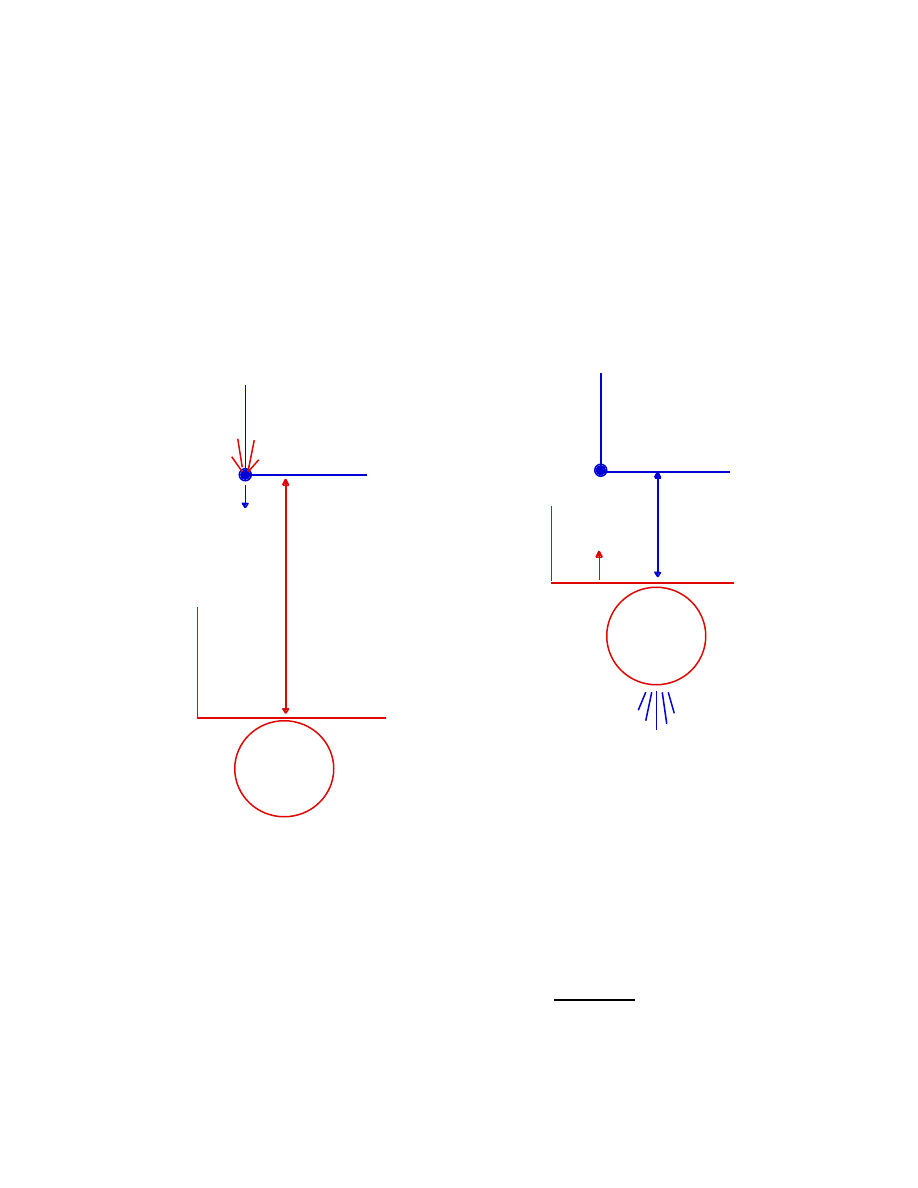
26
to a value
γ
≥
50. According to Einstein, the distance to the Earth is
contracted by a factor of
γ
≥
50, so that the muon-Earth distance from the
perspective of the muon is H
µ
= 30000/
γ
≤
30000/50
≤
600m. The Earth
therefore reaches the muon before it decays.
This is direct evidence for length contraction.
Schematically, we have:
F
µ
F
µ
muon at rest in F
µ
, seen to muon at rest in F
µ
,
be rushing toward Earth Earth rushing up
V
F
E
H
E
= 30km V
H
µ
≤
600m
F
E
Earth at rest in F
E
Earth
Earth
In F
E
, fixed to the Earth, a muon In F
µ
, fixed to the muon,
moving at high speed V toward the Earth is seen to be moving
the Earth, is seen to be created upwards at very high speed, V,
at H
E
= 30km. at a contracted distance
H
µ
=
√
(1
−
(V/c)
2
) H
E
.

27
4.5 Space travel
The distance between any two stars is so great that it is measured in
“light-years”, the distance light travels in one year. In more familiar units:
1 light-year = 9
.
45
×
10
15
meters
≈
6 trillion miles!
Alpha Centauri, our nearest star, is 4.3 light-years away; this means
that, even if a spaceship could travel at a speed close to c, it would take more
than 4.3 years to reach the star.
Imagine that it were technically possible to build such a near-light-speed
craft; we ask how long the journey would take to a star, 80 light-years away,
as measured by observers on the Earth. Let E
LV
be the event “craft leaves
Earth” and E
ARR
the event “craft arrives at star”. To observers in the rest
frame of the Earth, it travels a distance 756
×
10
15
meters at a speed of
0.995c, (say), in a time
∆
t
E
= 756
×
10
15
(meters) / 0.995
×
9.45
×
10
15
(meters per light-year)
= 80.4 years.
Very few passengers would be alive when the craft reached the star. If the
survivors sent a radio signal back to the Earth, saying that they had arrived, it
would take another 80 years for the signal to reach the Earth. (Radio waves
travel at the invariant speed of light).
Let us calculate the time of the trip from the perspective of the
travelers. The spacecraft-fixed frame is labeled F
SC
In this frame, the two
events, E
LV
and E
ARR
occur at the same place, namely the origin of F
SC
. The
trip-time,
∆
t
SC
, according to the travelers is a “proper” time interval, and is

28
less than the trip-time according to Earth-fixed observers by a factor
√
(1
−
(V/c)
2
), where V = 0.995c. We then find
∆
t
SC
=
∆
t
E
√
(1
−
(0.995)
2
) =
∆
t
E
×
√
(0.01)
= 80.4
×
0.1
= 8.04 years.
To the travelers on board, the trip takes a little more than 8 years.
The passengers and crew of the spacecraft would have plenty of time to
explore their new environment. Their return trip would take another 8.04
years, and therefore, on arrival back on the Earth, they would have aged
16.08 years, whereas their generation of Earth-bound persons would have
long-since died. (The society would have aged 160 years).
This discussion assumes that the biological processes of the travelers
take place according to time on the spacecraft clocks. This is certainly
reasonable because heart-beats represent crude clocks, and metabolic rates of
life processes are clock-like. According to Einstein, all “clocks” are affected
by the motion of one inertial frame relative to another.
The twin paradox is not a paradox at all. Consider a twin, A, in the
rest frame of the Earth, and let A observe the round-trip of his twin, B, to a
distant star at near-c speed. A concludes that when B returns to Earth, they
are no longer the same age; B is younger than A. According to the Principle
of Relativity, B can be considered at rest, and the Earth, and twin A, travel
away and return, later. In this case, B concludes that A has been on the trip,
and therefore comes back younger. This cannot be! The paradox stems

29
from the fact that the twin, B, who leaves the Earth, must accelerate from
the Earth, must slow down at the star, turn around, accelerate away from the
star, and slow down on reaching Earth. In so doing, the B-twin has shifted
out of inertial frames and into accelerating frames. Special Relativity does not
hold throughout the entire journey of the twin in the spacecraft The A-twin
is always at rest in the inertial frame of the Earth. There is a permanent
asymmetry in the space-time behavior of the twins.
The time in which a space traveler is in non-inertial frames can be
made very short compared with the total travel time. The principles of Special
Relativity are then valid, and the discussion given above, in which a spacecraft
travels to a distant star, 80 light-years away, is essentially correct.
5. NEWTONIAN DYNAMICS
. . . for the whole burden of (natural) philosophy seems to consist of this
—from the phenomena of motions to investigate the forces of nature, and
then from these forces to demonstrate the other phenomena.
NEWTON, the PRINCIPIA
Although our discussion of the geometry of motion has led to major
advances in our understanding of measurements of space and time in different
inertial systems, we have yet to come to the real crux of the matter, namely, a
discussion of the effects of forces on the motion of two or more interacting
particles. This key branch of Physics is called Dynamics. It was founded by
Galileo and Newton and perfected by their followers, notably Lagrange and
Hamilton. The Newtonian concepts of mass, momentum and kinetic energy

30
require fundamental revisions in the light of the Theory of Special Relativity.
In spite of the conceptual difficulties inherent in the classical theory, its success
in accounting for the dynamical behavior of systems, ranging from collisions
of gas molecules to the motions of planets has been, and remains, spectacular.
5.1 The law of inertia
Galileo (1564-1642) was the first to develop a quantitative approach to
the study of motion of everyday objects. In addition to this fundamental
work, he constructed one of the first telescopes and used it to study our
planetary system. His observation of the moons of Jupiter gave man his first
glimpse of a miniature world system that confirmed the concepts put forward
previously by Copernicus (1473 -1543).
Galileo set out to answer the question: what property
of motion is related to force? Is it the position of the moving object or its
velocity or its rate of change of velocity, or what? The answer to this
question can only be obtained from observations, this is a basic feature of
Physics that sets it apart from Philosophy proper. Galileo observed that force
Influences changes in velocity (accelerations) of an object and that, in the
absence of external forces (e.g. friction), no force is needed to keep an object
in motion that is traveling in a straight line with constant speed. This
observationally based law is called the Law of Inertia. It is, perhaps, difficult
for us to appreciate the impact of Galileo's new ideas concerning motion. The
fact that an object resting on a horizontal surface remains at rest unless
something we call force is applied to change its state of rest was, of course,

31
well-known before Galileo’s time. However, the fact that the object continues
to move after the force ceases to be applied caused considerable conceptual
difficulties to the early Philosophers. The observation that, in
practice, an object comes to rest due to frictional forces and air resistance was
recognized by Galileo to be a side effect and not germane to the fundamental
question of motion. Aristotle, for example, believed that the true or natural
state of motion is one of rest. It is instructive to consider Aristotle's
conjecture from the viewpoint of the Principle of Relativity: is a natural state
of rest consistent with this general Principle? First, we must consider what is
meant by a natural state of rest; it means that in a particular frame of
reference, the object in question is stationary. Now, according to the general
Principle of Relativity, the laws of motion have the same form in all frames of
reference that move with constant speed in straight lines with respect to each
other. An observer in a reference frame moving with constant speed in a
straight line with respect to the reference frame in which the object is at rest,
would conclude that the natural state of motion of the object is one of
constant speed in a straight line and not one of rest. All inertial observers, in
an infinite number of frames of reference, would come to the same
conclusion. We see, therefore, that Aristotle's conjecture is not consistent
with this fundamental Principle.
5.2 Newton’s laws of motion
During his early twenties, Newton postulated three laws of motion that
form the basis of Classical Dynamics. He used them to solve a wide variety

32
of problems, including the motion of the planets. They play a fundamental
part in his famous Theory of Gravitation. The laws of motion were first
published in the Prlncipia in l687; they are:
1. In the absence of an applied force, an object will
remain at rest or in its present state of constant
speed in a straight line (Galileo's Law of Inertia)
2. In the presence of an applied force, an object will
be accelerated in the direction of the applied force
and the product of its mass by its acceleration is
equal to the force.
and,
3. If a body A exerts a force of magnitude |F
AB
| on a body
B, then B exerts an equal force of magnitude |F
BA
| on
A. The forces act in opposite directions so that:
F
AB
= F
BA
.
The 3rd. Law applies to “contact interactions”. For non-contact interactions,
it is necessary to introduce the concept of a “field-of-force” that “carries the
interaction”.
We note that in the 2nd. law, the acceleration lasts only while the
applied force lasts. The applied force need not, however, be constant in time;
the law is true at all instants during the motion. We can show this explicitly by
writing:

33
F(t) = ma(t)
where the time-dependence of the force, and the resulting acceleration, is
emphasized.
The "mass" appearing in Newton's 2nd law is the so-called inertial
mass. It is that property of matter that resists changes in the state of motion
of the matter. Later, in discussions of Gravitation, we shall meet another
property of matter that also has the name "mass"; it is that property of matter
that responds to the gravitational force due to the presence of other "masses";
this "mass" is the so-called "gravitational mass". The equivalence of inertial
and gravitational mass was known to Newton. Einstein considered the
equivalence to be of such fundamental importance that he used it as a starting
point for his General Theory of Relativity, one of the greatest creations of the
human mind.
In 1665 - 66, Sir Isaac Newton, the supreme analytical mind to emerge
from England, deduced the basic law governing the interaction between two
masses, M
1
and M
2
. The force depends on the product of the two masses,
and the square of the distance between them, thus
Mass, M
1
Mass, M
2
Distance between centers, R
The gravitational force between the masses is given by:
M
1
×
M
2
F
grav
∝
R
2

34
If the masses are initially 1 meter apart, and we increase the separation to 2
meters, the force decreases by 1/(2)
2
= 1/4.
(It took Newton many years to prove that the distributed mass of a sphere
can be treated as a “point” mass at its center. The problem involves a three-
dimensional integral using his newly-invented Calculus).
5.3 General features of inverse square-law forces
In the early 1700’s, Coulomb deduced the law of force that governs
the interaction between two objects that possess the attribute of “electric
charge”. He found the following: the force between two charges Q
1
(at rest)
and Q
2
depends on the product of the two charges, Q
1
and Q
2
, and on the
square of the distance between them:
Charge Q
1
Charge Q
2
Distance between centers, R
Q
1
×
Q
2
F
elect
∝
R
2
In the 19th-century, experiments showed that charges in motion, relative to
an observer, generate an additional component of the force called the
Magnetic Force. The complete force between moving charges is therefore
known as the Electromagnetic Force.
We see that there is a remarkable similarity between the forms of the
Gravitational and the Electromagnetic forces. They both depend on the
35
symmetries M
1
×
M
2
and Q
1
×
Q
2
, and they both vary as the inverse square
of the distance between the objects. This latter feature is not by chance.
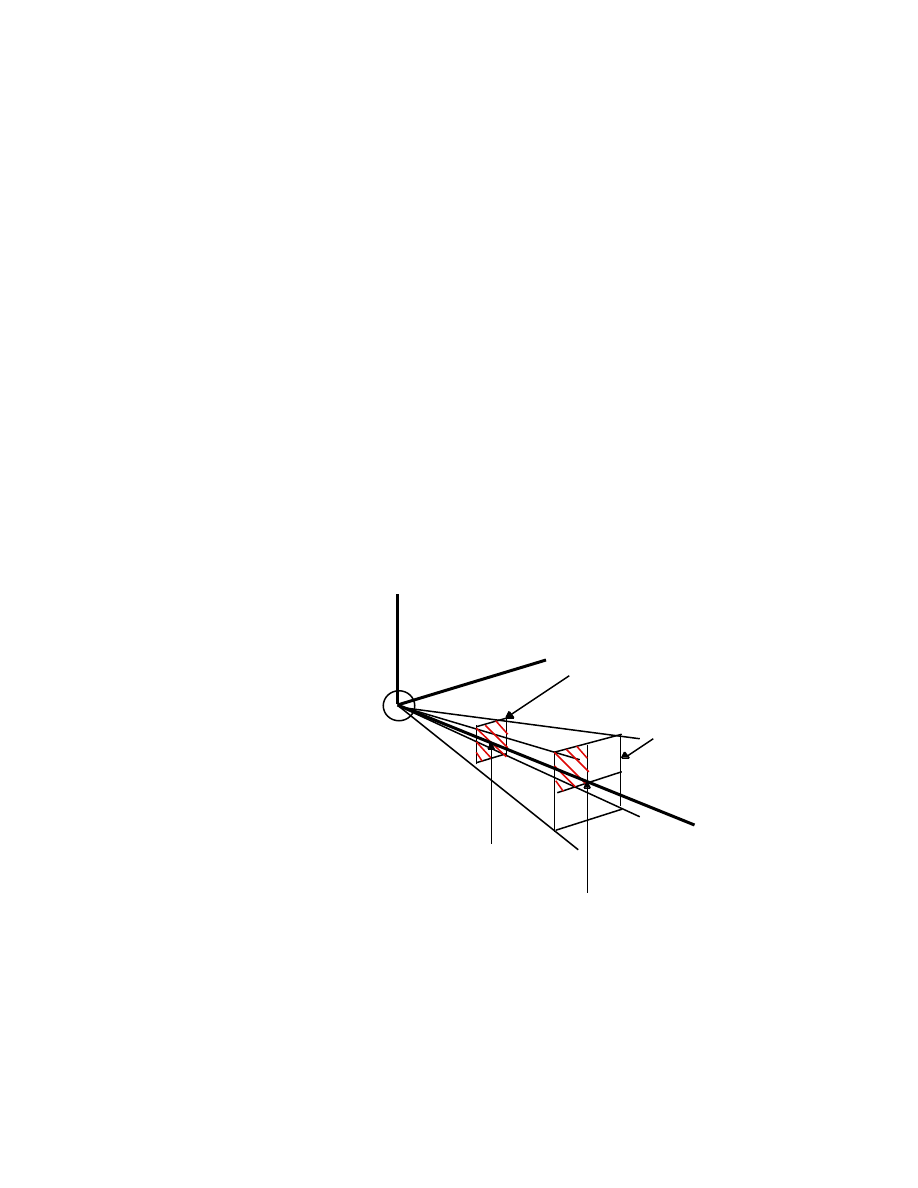
Let us introduce a model of these interactions in which we postulate that the
force between one object and another is “carried”, or mediated, by entities,
generated by their sources; let them travel in straight lines between the
objects. The mediators are capable of transferring momentum between the
interacting objects. Consider the case in which a stationary charge Q is the
source of mediators that travel, isotropically, from the charge at a uniform
rate:
Area. A at 1m.
Charge Q
Area. 4A at 2m.
1m
2m
It is a property of the space in which we live that the shaded area, A, situated
1 meter from the charge Q, projects onto an area 4A at a distance 2 meters
from Q. Therefore, the number of mediators passing through the area A at 1
meter from Q passes through an area 4A at a distance 2 meters from Q. If

36
the force on a second charge Q
′
, 1 meter from Q, is due to the momentum
per second transferred to the area A as a result of the mediators striking that
area, then a charge Q
′
, 2 meters from the source, will experience a force that
is 1/4 the force at 1 meter because the number of mediators per second
passing through A now passes through an area four times as great. We see
that the famous “inverse square law” is basically geometric in origin.
Not surprisingly, the real cases are more subtle than implied by this
model. We must recognize a fundamental difference between the
gravitational and the electromagnetic forces, namely:
the gravitational force is always attractive, whereas the electromagnetic
force can be either attractive or repulsive. This difference comes about
because there is only “one kind” of mass, whereas there are “two kinds” of
charge, which we label positive and negative. (These terms were introduced
by the versatile Ben Franklin). The interaction between like charges is
repulsive and that between unlike charges is attractive.
We can develop our model of forces transmitted by the exchange of
entities between objects that repel each other in the following way:
Consider two boxes situated on a sheet of ice. Let each box contain a person
and a supply of basketballs. If the two occupants throw the balls at each
other in such a way that they can be caught, then a stationary observer,
watching the exchange, would see the two boxes moving apart. (This is a
consequence of a law of motion that states that the linear momentum of a
system is conserved in the absence of external forces):
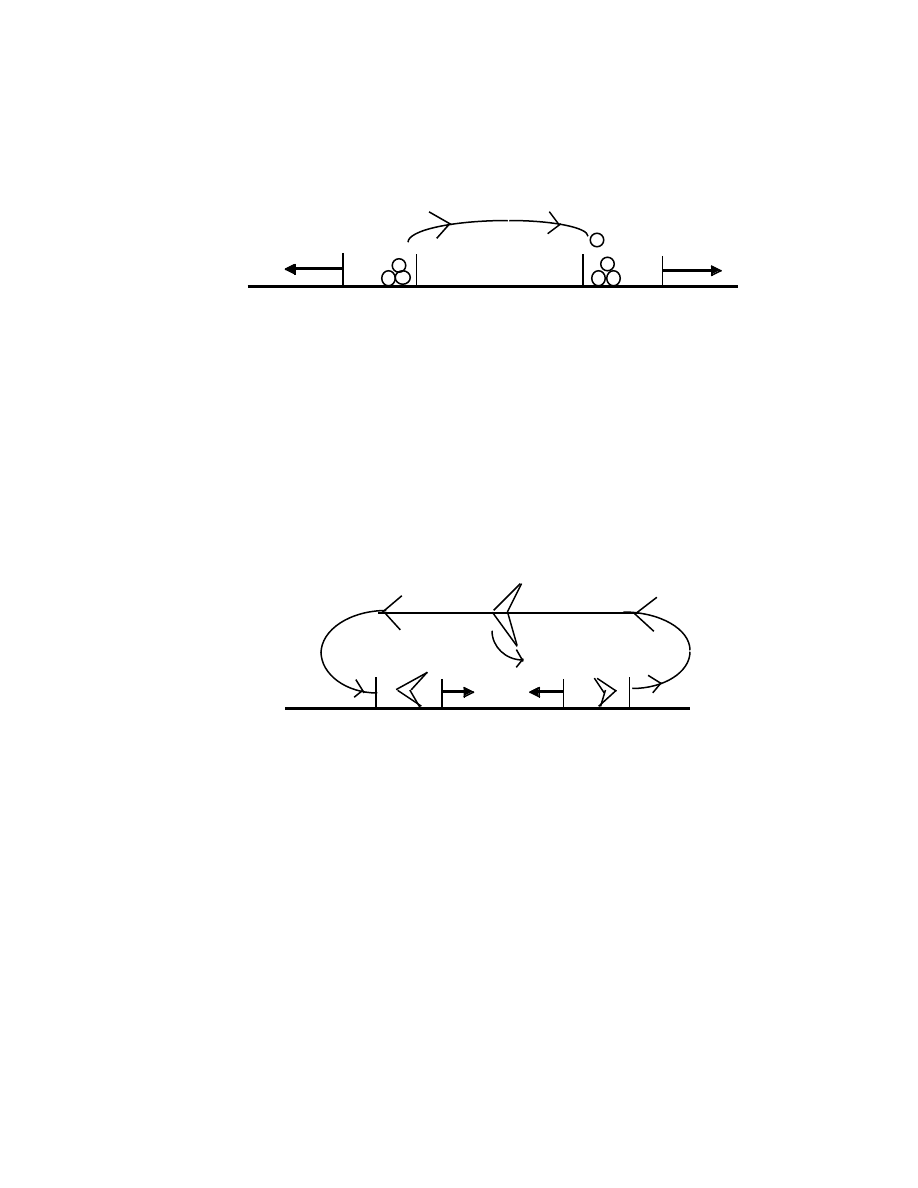
37
If the observer were so far away that he could see the boxes, but not the balls
being exchanged, he would conclude that an unexplained repulsive force
acted between the boxes.
The exchange model of an attractive force requires more imagination; we
must invoke the exchange of boomerangs between the occupants of the
boxes, as shown
Boxes move together
These models are highly schematic. Nonetheless, they do indicate that
models based on the exchange of entities that carry momentum, can be
constructed. Contemporary theories of the Nuclear Force, and the Quark-
Quark Force of Particle Physics, involve the exchange of exotic entities
(mesons and gluons, respectively).
Newton deduced the inverse square law of gravitation by combining
the results of painstaking observations of the motions of the planets (Brahe

38
and Kepler), with an analysis of the elliptical motion of a (terrestrial) object,
based on his laws of motion. This was the first time that the laws of motion,
discovered locally, were applied on a universal scale.
6. EQUIVALENCE OF MASS AND ENERGY: E=mc
2
6.1 Relativistic mass
In Newtonian Physics, the inertial mass of an object is defined,
operationally, by the second law:
m = F/a,
where a is the acceleration of the mass m, caused by the force F. For a given
particle, the mass is constant; it has the same value in all inertial frames.
In Einsteinian Physics, the inertial mass, m, of an object depends on the
speed of the frame in which it is measured. If its mass is m
0
in its rest frame
then its mass m in an inertial frame moving at constant speed V is
m (the relativistic mass) =
γ
m
0
(the rest mass),
where
γ
is the same factor found in discussions of length contraction, and
time dilation. The validity of this equation has been demonstrated in
numerous modern experiments.
The structure of atoms has been understood since the early 1930’s.
An atom consists of a very small, positively charged nucleus, surrounded by
electrons (negatively charged). The nucleus contains protons (positively
charged) and neutrons (electrically neutral) bound together by the nuclear
force. The diameter of a typical nucleus is less than 10
-12
centimeters. The
electrons orbit the nucleus at distances that can be one hundred thousand

39
times greater than the size of the nucleus. The electrons are held in orbit by
the electromagnetic force. The total positive charge of the nucleus is exactly
balanced by the total negative charge of the planetary electrons, so that the
atom is electrically neutral. An electron can be removed from an atom in
different ways, including ionization in an electric field and photo-ionization
with light. A free electron has the following accurately measured properties:
mass of the electron = 9.1083 x 10
-31
kilograms (kg),
and
electric charge of the electron = 1.60206 x 10
-19
Coulomb. (C).
Here, “mass” refers to the mass measured in a frame of reference in which
the electron is at rest; it is the “rest mass”.
In 1932, a particle was observed with the same mass as the electron and with
a charge equal in magnitude, but opposite in sign, to that of the electron. The
particle was given the name “positron”; it is the “anti-particle” of the
electron. The concept of anti-particles was introduced by Dirac, using purely
theoretical arguments, a few years before the experimental observation of the
positron.
In the 1940’s, it was found that an electron and a positron, when relatively at
rest, can form a “positronium atom” that consists of a bound state of an
electron and a positron, orbiting about their center-of-mass. Such an “atom”
exists for a very short interval of time, namely 10
-10
seconds. It then
spontaneously decays into two gamma-rays (high energy electromagnetic

40
radiation). The two gamma-rays are observed to travel back-to-back. (This
observation is consistent with the law of conservation of linear momentum;
the momentum is zero before the decay (the particles are initially at rest), and
therefore it must be zero after the decay). Each gamma-ray has a measured
energy of 0.511 MeV (Million electron-volts).
In Modern Physics, it is the custom to use the electron-volt (eV) as the unit of
energy. An electron-volt is the energy acquired by an electron when
accelerated by a potential difference of one volt. Pictorially, we have:
(back-to-back)
+
−
0.511 MeV 0.511 MeV
-
∗
<∼∼ ∼∼>
Matter
⇒
Annihilation
⇒
Radiation
Electron-positron annihilation is a prime example of the conversion of matter
into electromagnetic radiation. (This is the basic process in PET scanning in
Nuclear Medicine [Positron Emission Tomography]).
From the measured electron and positron masses, and the measured energies
of the two gamma-rays, we can obtain one of the most important results in
our on-going quest for an understanding of the laws of Nature, and the
associated workings of the physical universe. We begin by noting one of the

41
standard results of Classical (Newtonian) Physics, namely, the expression for
the kinetic energy (energy of motion), E, of an object of mass m, moving
with a velocity v:
E = (1/2)mv
2
. (A result derived in standard texts on Mechanics).
We note that the ratio, energy/mass is
E/m =(1/2)v
2
, (the ratio is proportional to (velocity)
2
).
We are therefore led to study the ratio:
gamma-ray energy/electron mass,
to obtain the resulting velocity-squared.
The gamma-ray energy is:
energy, E = 0.511 x 10
6
(eV) x 1.602 x 10
-19
(Joule/eV)
= 0.8186 x 10
-13
Joule.
(A note on “units”: in the Physical Sciences, units of measured quantities are
often given in the MKS system, in which lengths are given in meters, masses
are given in kilograms, and time is given in seconds. In this system, the unit
of energy is the Joule (named after James Prescott Joule, a Manchester
brewer and distinguished scientist of the 19th-century)).
Our required conversion factor is: 1 electron-volt = 1.602 x 10
-19
Joule.
In the MKS system, the ratio gamma-ray energy/ electron mass is therefore
E/m = 0.8186 x 10
-13
Joule / 9.1083 x 10
-31
kilogram,
= 0.89874 x 10
17
(meters/second)
2
,
a velocity, squared.
We can find the velocity by taking the square root of the value of E/m, thus:

42
√
(8.9874 x 10
16
) = 2.9974
×
10
8
meters/second.
This is a truly remarkable result; it is the exact value of the measured velocity
of light, always written, c.
We therefore find that the ratio
E (gamma-ray)/m (electron) = c
2
or,
E = mc
2
.
This is Einstein’s great equation that shows the equivalence of energy and
mass. (Here, m is the “relativistic mass” equal to
γ
m
0
). It is important to
note that Einstein derived this fundamental relation using purely theoretical
arguments, long before experiments were carried out to verify its universal
validity. The heat that we receive from the Sun originates in the conversion
of its mass into radiant energy. A stretched spring has more mass than an
unstretched spring, and a charged car battery has more mass than an
uncharged battery! In both cases, the potential energy stored in the systems
has an equivalent mass. We do not experience these effects because the mass
changes are immeasurably small, due to the 1/c
2
factor. However, in nuclear
reactions that take place in nuclear reactors, or in nuclear bombs, the mass
(energy) differences are enormous, and certainly have observable effects.
7. AN INTRODUCTION TO EINSTEINIAN GRAVITATION
7.1 The principle of equivalence
The term “mass” that appears in Newton’s equation for the
gravitational force between two interacting masses refers to

43
“gravitational mass”; Newton’s law should indicate this property of matter
F
G
= GM
G
m
G
/r
2
, where M
G
and m
G
are the gravitational
masses of the interacting objects, separated by a distance r.
The term “mass” that appears in Newton’s equation of motion,
F = ma, refers to the “inertial mass”; Newton’s equation of motion should
indicate this property of matter:
F = m
I
a, where m
I
is the inertial mass of the particle moving
with an acceleration a(r) in the gravitational field of the mass M
G
.
Newton showed by experiment that the inertial mass of an object is
equal to its gravitational mass, m
I
= m
G
to an accuracy of 1 part in 10
3
.
Recent experiments have shown this equality to be true to an accuracy of 1
part in 10
12
. Newton therefore took the equations
F = GM
G
m
G
/r
2
= m
I
a
and used the condition m
G
= m
I
to obtain
a = GM
G
/r
2
.
Galileo had previously shown that objects made from different
materials fall with the same acceleration in the gravitational field at the surface
of the Earth, a result that implies m
G
∝
m
I
. This is the Newtonian Principle of
Equivalence.
Einstein used this Principle as a basis for a new Theory of Gravitation.
He extended the axioms of Special Relativity, that apply to field-free frames,
to frames of reference in “free fall”. A freely falling frame must be in a state
of unpowered motion in a uniform gravitational field . The field region

44
must be sufficiently small for there to be no measurable gradient in the field
throughout the region. The results of all experiments carried out in ideal
freely falling frames are therefore fully consistent with Special Relativity. All
freely-falling observers measure the speed of light to be c, its constant free-
space value. It is not possible to carry out experiments in ideal freely-falling
frames that permit a distinction to be made between the acceleration of
local, freely-falling objects, and their motion in an equivalent external
gravitational field. As an immediate consequence of the extended Principle
of Equivalence, Einstein showed that a beam of light would be observed to be
deflected from its straight path in a close encounter with a sufficiently massive
object. The observers would, themselves, be far removed from the
gravitational field of the massive object causing the deflection.
Einstein’s original calculation of the deflection of light from a distant
star, grazing the Sun, as observed here on the Earth, included only those
changes in time intervals that he had predicted would occur in the near field
of the Sun. His result turned out to be in error by exactly a factor of two.
He later obtained the “correct” value for the deflection by including in the
calculation the changes in spatial intervals caused by the gravitational field.
7.2 Rates of clocks in a gravitational field
Let a rocket be moving with constant acceleration a, in a frame of reference,
F, far removed from the Earth’s gravitational field, and let the rocket be
instantaneously at rest in F at time t = 0. Suppose that two similar clocks, 1
and 2, are attached to the rocket with 1 at the rear end and 2 at the nose of
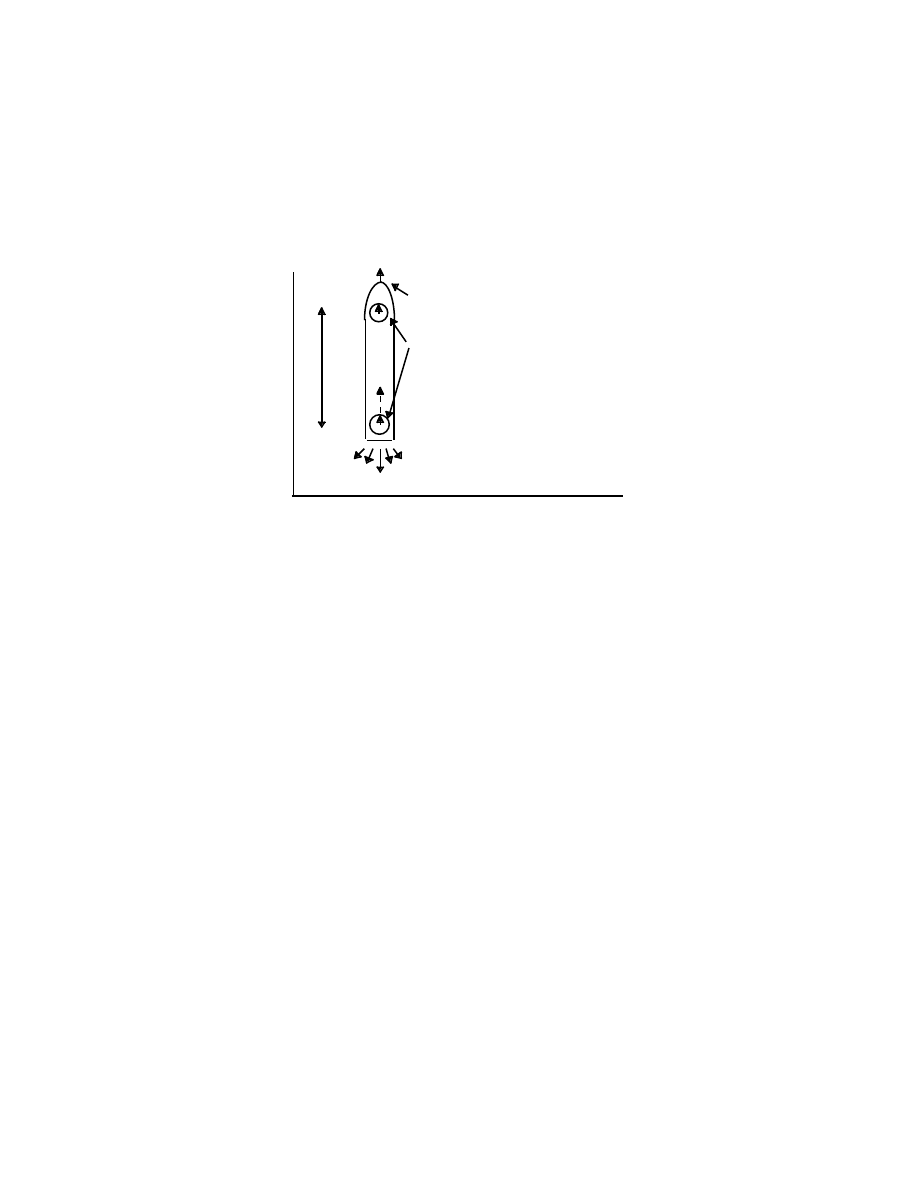
45
the rocket. The clocks are separated by a distance
l. We can choose two
light sources, each with well-defined frequency, f
0
, as suitable clocks. f
0
is the
frequency when the rocket is at rest in an inertial frame in free space.
F (an inertial frame, no gravitational field)
y 2 constant acceleration, a, relative to F
Clocks at rest in rocket
l
1 Pulse of light emitted from 1 at t = 0
acceleration begins at t
≥
0
x
Let a pulse of light be emitted from the lower clock, 1, at time t = 0, when
the rocket is instantaneously at rest in F. This pulse reaches clock 2 after an
interval of time t, (measured in F) given by the standard equation for the
distance traveled in time t:
ct = (
l + (1/2)at
2
),
where (1/2)at
2
is the extra distance that clock 2 moves in the interval t.
Therefore,
t = (
l/c) + (a/2c)t
2
,
≈
(
l/c) if (at/2) << c
At time t, clock 2 moves with velocity equal to v = at
≈
a
l/c, in F.
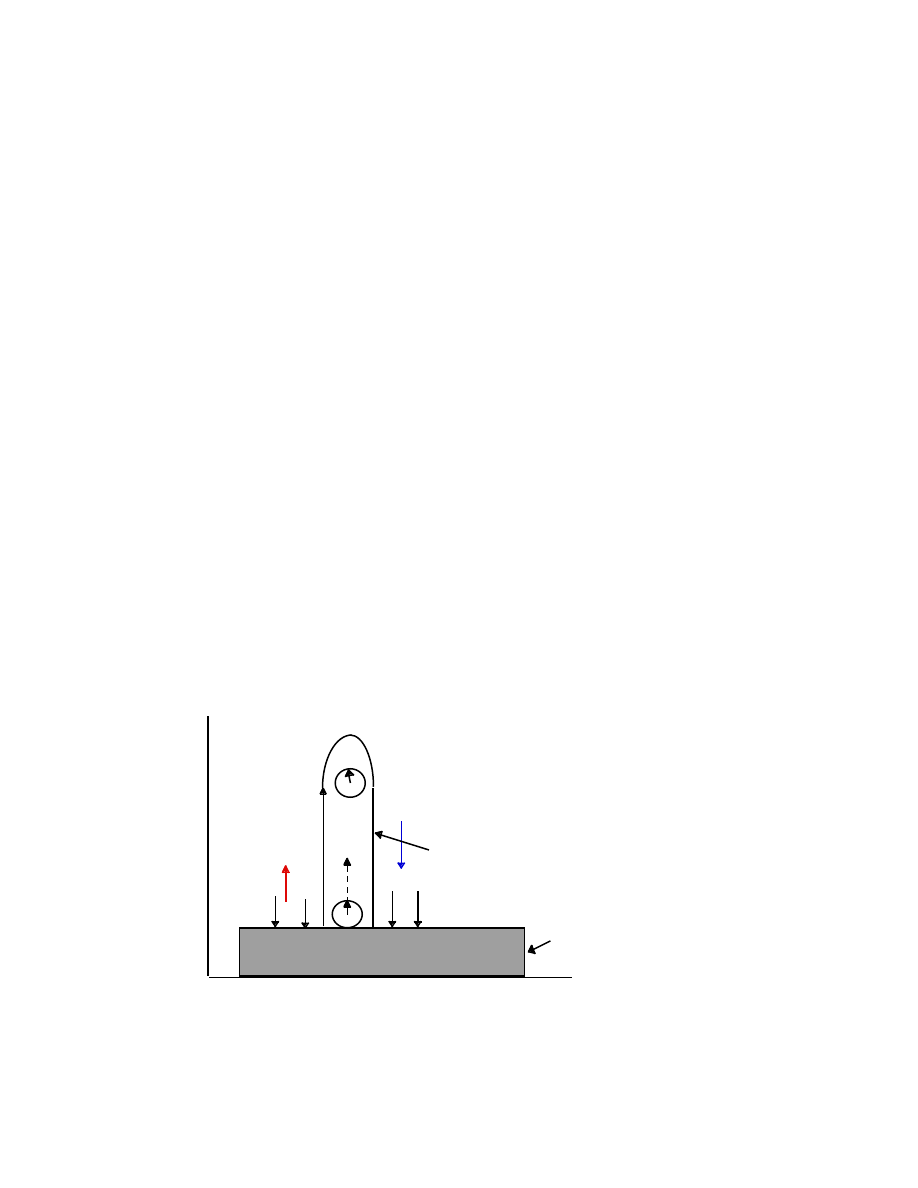
46
An observer at the position of clock 2 will conclude that the pulse of light
coming from clock 1 had been emitted by a source moving downward with
velocity v. The light is therefore “Doppler-shifted”, the frequency is given by
the standard expression for the Doppler shift at low speeds (v << c):
f
′
≈
f
0
[1
−
(v/c)]
= f
0
[1
−
(a
l/c
2
].
The frequency f
′
is therefore less than the frequency f
0
. The light from clock
1 (below) is “red-shifted”. Conversely, light from the upper clock traveling
down to the lower clock is measured to have a higher frequency than the
local clock 1; it is “blue-shifted”.
The principle of equivalence states that the above situation, in a closed
system, cannot be distinguished by physical measurements, from that in
which the rocket is at rest in a uniform gravitational field. The field must
produce an acceleration of magnitude |a|, on all masses placed in it.
y
′
G is a non-accelerating frame with a uniform
G 2 gravitational field present.
Blue shift
Red shift
Rocket at rest in G
1
Gravitational field
Massive body
x
′
The light from the lower clock, reaching the upper clock will have a
frequency lower than the local clock, 2, by f
0
g
l/c
2
, (replacing |a| by |g|), where

47
g
≈
10 m/s
2
, the acceleration due to gravity near the Earth. The light sources
are at rest in G, and no oscillations of the pulses of light are lost during
transmission; we therefore conclude that, in a uniform gravitational field, the
actual frequencies of the stationary clocks differ by f
0
g
l/c
2
. Now, g
l is the
difference in the “gravitational potential” between the two clocks. It is the
convention to say that the upper clock, 2, is at the higher potential in G.
(Work must be done to lift the mass of clock 1 to clock 2 against the field).
Consider the case in which a light source of frequency f
S
(corresponding to clock 1) is situated on the surface of a star, and consider a
similar light source on the Earth with a frequency f
E
(corresponding to clock
2). Generalizing the above discussion to the case when the two clocks are in
varying gravitational fields, such that the difference in their potentials is
∆φ
,
we find
f
E
= f
S
(1 +
∆φ
/c
2
)
(g
l =
∆φ
, is the difference in gravitational potential of the clocks in
a constant field, g, when separated by
l).
For a star that is much more massive than the Earth,
∆φ
is positive, therefore,
f
E
> f
S
, or in terms of wavelengths,
λ
E
and
λ
S
,
λ
S
>
λ
E
. This means that the
light coming from the distant star is red-shifted compared with the light from
a similar light source, at rest on the surface of the Earth.
As another example, radioactive atoms with a well-defined “half-life”
should decay faster near clock 2 ( the upper clock) than near clock 1. At the

48
higher altitude (higher potential), all physical processes go faster, and the
frequency of light from above is higher than the frequency of light from an
identical clock below. Einstein’s prediction was verified in a series of accurate
experiments, carried out in the late 1950’s, using radioactive sources that
were placed at different heights near the surface of the Earth.
7.3 Gravity and photons
Throughout the 19th-century, the study of optical phenomena, such as
the diffraction of light by an object, demonstrated conclusively that light
(electromagnetic in origin) behaves as a wave. In 1900, Max Planck,
analyzed the results of experimental studies of the characteristic spectrum of
electromagnetic radiation emerging from a hole in a heated cavity (so-called
“black-body radiation”). He found that current theory, that involved
continuous frequencies in the spectrum, could not explain the results. He did
find that the main features of all black-body spectra could be explained by
making the radical assumption that the radiation consists of discrete pulses of
energy E proportional to the frequency, f. By fitting the data, he determined
the constant of proportionality, now called Planck’s constant; it is always
written h. The present value is:
h = 6.626
×
10
−
34
Joule-second in MKS units.
Planck’s great discovery was the beginning of Quantum Physics.
In 1905, Einstein was the first to apply Planck’s new idea to another
branch of Physics, namely, the Photoelectric Effect. Again, current theories
could not explain the results. Einstein argued that discrete pulses of

49
electromagnetic energy behave like localized particles, carrying energy E =
hf and momentum p = E/c. These particles interact with tiny electrons in the
surface of metals, and eject electrons in a Newtonian-like way. He wrote
E
PH
= hf
PH
and E
PH
= p
PH
c
The rest mass of the photon is zero. (Its energy is all kinetic).
If, under certain circumstances, photons behave like particles, we are
led to ask: are photons affected by gravity? We have
E
PH
= m
PH
I
c
2
= hf
PH
,
or
m
PH
I
= E
PH
/c
2
= hf
PH
/c
2
.
By the Principle of Equivalence, inertial mass is equivalent to gravitational
mass, therefore Einstein proposed that a beam of light (photons) should be
deflected in a gravitational field, just as if it were a beam of particles. (It is
worth noting that Newton considered light to consist of particles; he did not
discuss the properties of his particles. In the early 1800’s, Soldner actually
calculated the deflection of a beam of “light-particles” in the presence of a
massive object! Einstein was not aware of this earlier work).
Let us consider a photon of initial frequency f
S
, emitted by a massive
star of mass M
S
, and radius R. The gravitational potential energy, V, of a
mass m at the surface of the star, is given by a standard result of Newton’s
Theory of Gravitation; it is
V(surface) =
−
GM
S
m/R.

50
It is inversely proportional to the radius of the star. The negative sign
signifies that the gravitational interaction between M
S
and m is always
attractive.
Following Einstein, we can write the potential energy of the photon of
“mass” hf
PH
/c
2
at the surface as
V (surface) =
−
(GM
S
/R)(hf
PH
/c
2
).
The total energy of the photon, E
TOTAL
is the sum of its kinetic and potential
energy:
E
TOTAL
= hf
PH
STAR
+ (
−
) GM
S
hf
PH
STAR
/Rc
2
,
= hf
PH
STAR
(1
−
GM
S
/Rc
2
).
At very large distances from the star, at the Earth, for example, the photon is
essentially beyond the gravitational pull of the star. Its total energy remains
unchanged (conservation of energy). At the surface of the Earth the photon
has an energy that is entirely electromagnetic (since its potential energy in the
“weak” field of the Earth is negligible compared with that in the gravitational
field of the star), therefore
hf
PH
EARTH
= hf
PH
STAR
(1
−
GM
S
/Rc
2
)
so that
f
PH
EARTH
/f
PH
STAR
= 1
−
GM
S
/Rc
2
,
and
∆
f/f
≡
(f
PH
STAR
−
f
PH
EARTH
)
/f
PH
STAR
= GM
S
/Rc
2
.
We see that the photon on reaching the Earth has less total energy than
it had on leaving the star. It therefore has a lower frequency at the Earth. If
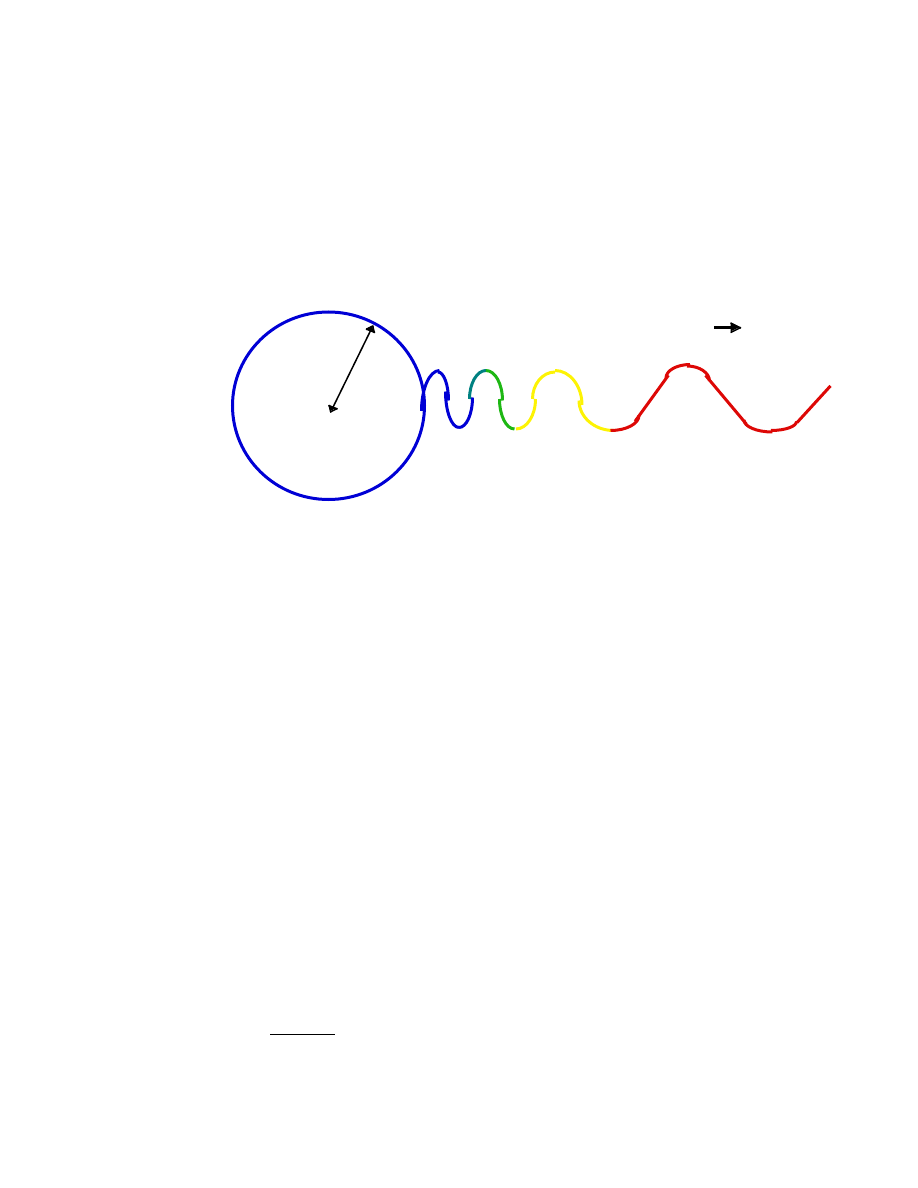
51
the photon is in the optical region, it is shifted towards the red-end of the
spectrum. This is the gravitational red-shift. (It is quite different from the
red-shift associated with Special Relativity)
Schematically, we have:
f
PH
STAR
To Earth f
PH
EARTH
Radius R
Mass M
S
Blue light emitted Light red-shifted
far from field of star
Massive Star
7.4 Black holes
In 1784, a remarkable paper was published in the Philosophical
Transactions of the Royal Society of London, written by the Rev. J. Michell.
It contained the following discussion:
To escape to an infinite distance from the surface of a star of mass M
and radius R, an object of mass m must have an initial velocity v
0
given by
the energy condition:
initial kinetic energy of mass
≥
potential energy at surface of star,
or
(1/2)mv
0
2
≥
GMm/R (A Newtonian expression).
This means that
v
0
≥
√
(2GM/R).

52
Escape is possible only when the initial velocity is greater than (2GM/R)
1/2
.
On the Earth, v
0
≥
25,000 miles/hour.
For a star of given mass M, the escape velocity increases as its radius
decreases. Michell considered the case in which the escape velocity v
0
reaches a value c, the speed of light. In this limit, the radius becomes
R
LIMIT
= 2GM/c
2
He argued that light would not be able to escape from a compact star of mass
M with a radius less than R
LIMIT
; the star would become invisible. In modern
terminology, it is a black hole.
Using the language of Einstein, we would say that the curvature of
space-time in the immediate vicinity of the compact star is so severe that the
time taken for light to emerge from the star becomes infinite. The radius
2GM/c
2
is known as the Schwarzschild radius; he was the first to obtain a
particular solution of the Einstein equations of General Relativity. The
analysis given by Michell, centuries ago, was necessarily limited by the
theoretical knowledge of his day. For example, his use of a non-relativistic
expression for the kinetic energy (mv
2
/2) is now known to require
modification when dealing with objects that move at speeds close to c.
Nonetheless, he obtained an answer that turned out to be essentially correct.
His use of a theoretical argument based on the conservation of energy was
not a standard procedure in Physics until much later.
A star that is 1.4 times more massive than our Sun, has a
Schwarzschild radius of only 2km and a density of 10
20
kg/m
3
. This is far

53
greater than the density of an atomic nucleus. For more compact stars
(R
LIMIT
< 1.4 M
SUN
), the gravitational self-attraction leads inevitably to its
collapse to a “point”.
Studies of the X-ray source Cygnus X-1 indicate that it is a member of
a binary system, the other member being a massive “blue supergiant” There
is evidence for the flow of matter from the massive optical star to the X-ray
source, with an accretion disc around the center of the X-ray source. The X-
rays could not be coming from the blue supergiant because it is too cold.
Models of this system, coupled with on-going observations, are consistent
with the conjecture that a black hole is at the center of Cygnus X-1. Several
other good candidates for black holes have been observed in recent studies of
binary systems. The detection of X-rays from distant objects has become
possible only with the advent of satellite-borne equipment.
I have discussed some of the great contributions made by Einstein to
our understanding of the fundamental processes that govern the workings of
our world, and the universe, beyond. He was a true genius, he was a
visionary, and he was a man of peace.
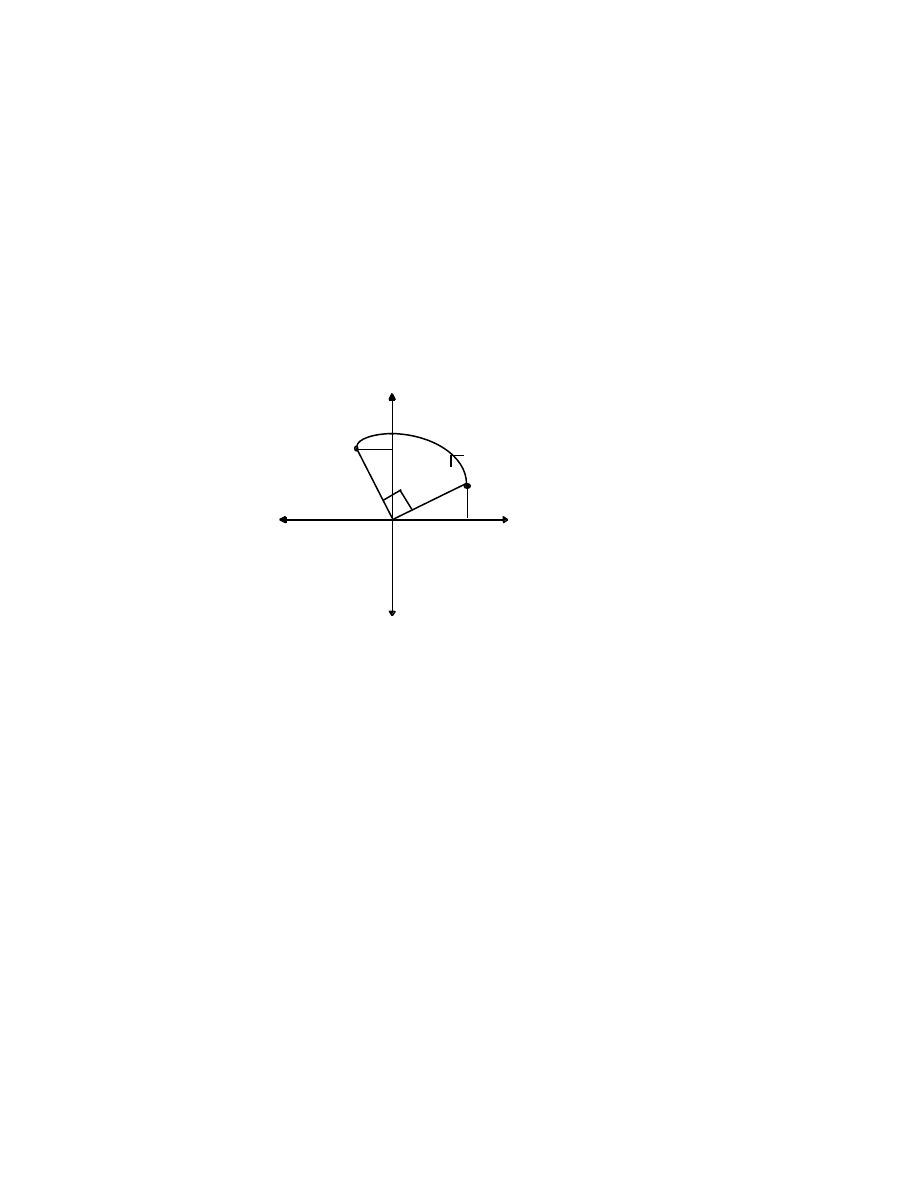
54
Appendix
The following material presents the main ideas of Einstein’s Special Relativity
in a mathematical form. It is written for those with a flair for Mathematics.
A1. Some useful mathematics: transformations and matrices
Let a point P[x, y] in a Cartesian frame be rotated about the origin
through an angle of 90
°
; let the new position be labeled P
′
[x
′
, y
′
]
+y
P
′
[x
′
, y
′
]
P[x, y]
-x +x
-y
We see that the new coordinates are related to the old coordinates as follows:
x
′
(new) =
−
y (old)
and
y
′
(new) = +x (old)
where we have written the x’s and y’s in different columns for reasons that
will become clear, later.
Consider a stretching of the material of the plane such that all x-values are
doubled and all y-values are tripled:
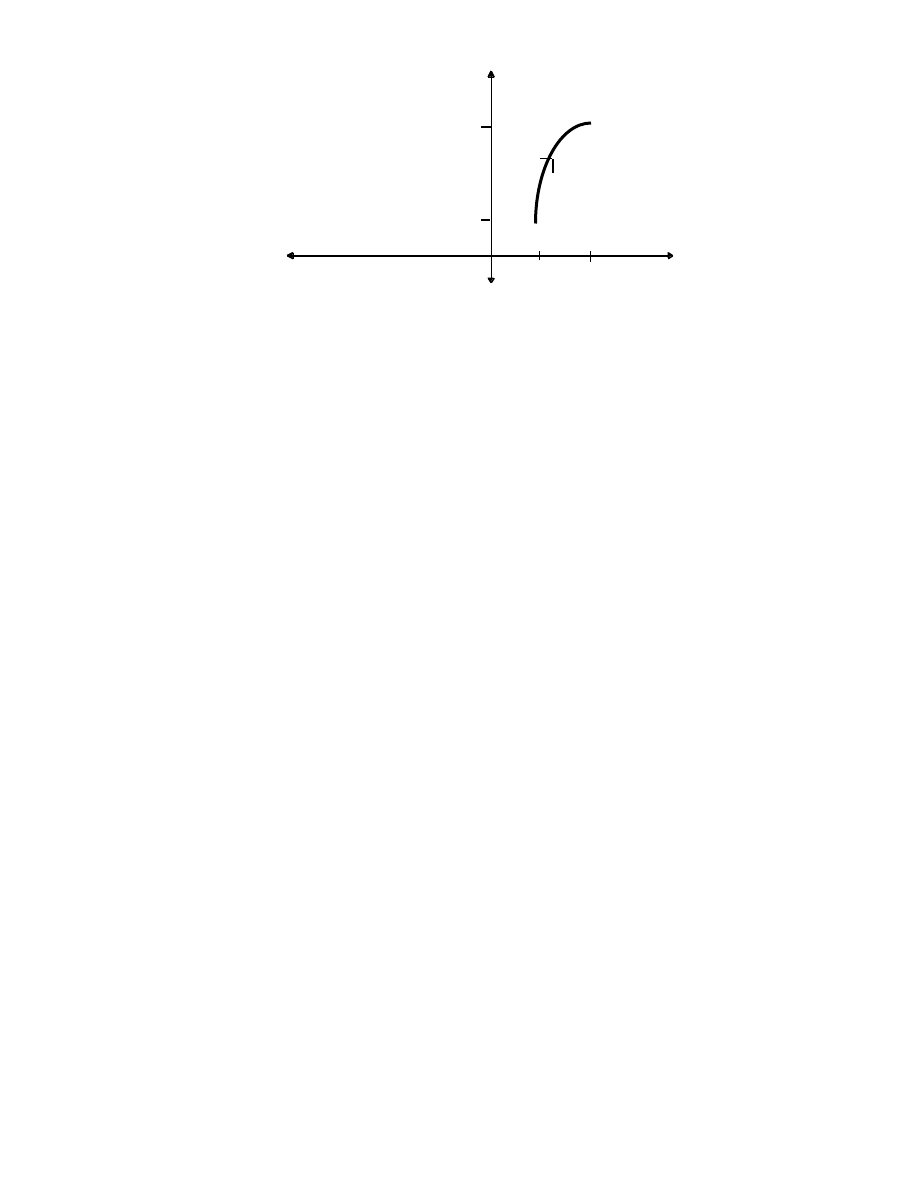
55
3y P
′
[x
′
, y
′
] = P
′
[2x, 3y]
y P[x, y]
x 2x
The old coordinates are related to the new coordinates by the equations
y
′
= 3y
and
x
′
= 2x
Consider a more complicated transformation in which the new values are
combinations of the old values, for example, let
x
′
= 1x + 3y
and
y
′
= 3x + 1y
We can see what this transformation does by putting in a few definite values
for the coordinates:
[0, 0]
→
[0, 0]
[1, 0]
→
[1.1 + 3.0, 3.1 + 1.0] = [1, 3]
[2, 0]
→
[1.2 + 3.0, 3.2 + 1.0] = [2, 6]
[0, 1]
→
[1.0 + 3.1, 3.0 + 1.1] = [3, 1]
[0, 2]
→
[1.0 + 3.2, 3.0 + 1.2] = [6, 2]
[1, 1]
→
[1.1 + 3.1, 3.1 + 1.1] = [4, 4}
[1, 2]
→
[1.1 + 3.2, 3.1 + 1.2] = [7, 5]
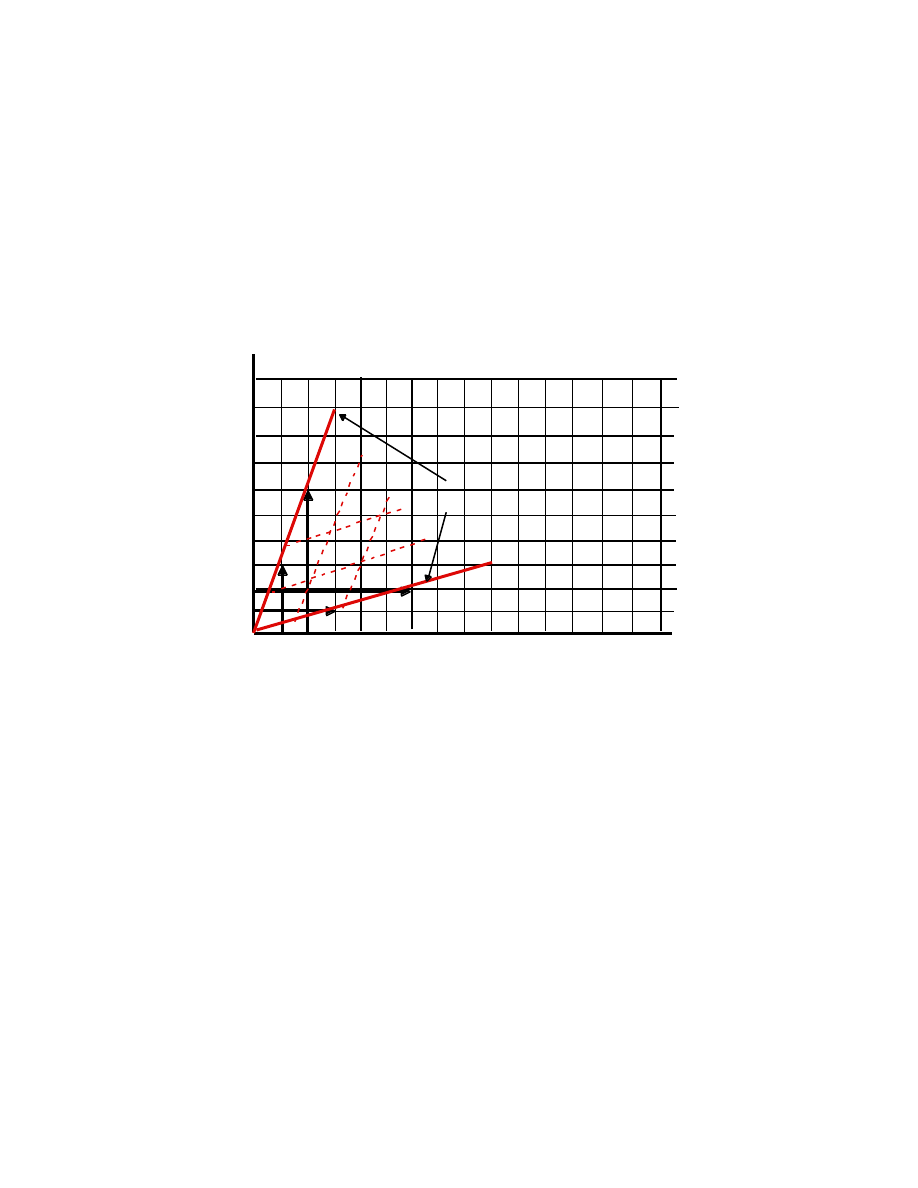
56
[2, 2]
→
[1.2 + 3.2, 3.2 + 1.2] = [8, 8]
[2, 1]
→
[1.2 + 3.1, 3.2 + 1.1] = [5, 7]
and so on.
Some of these changes are shown below
y
y
′
New axes and grid-lines are oblique
x
′
x
This is a particular example of the more general transformation
x
′
= ax + by
and
y
′
= cx + dy
where a, b, c, and d are real numbers.
In the above examples, we see that each transformation is characterized by
the values of the coefficients, a, b, c, and d:
For the rotation through 90
°
:
a = 0, b =
−
1, c = 1, and d = 0;

57
for the 2x3 stretch:
a = 2, b = 0, c = 0, and d = 3;
and for the more general transformation:
a = 1, b = 3, c = 3, and d = 1.
In the 1840’s, Cayley recognized the key role of the coefficients in
characterizing the transformation of a coordinate pair [x, y] into the pair
[x
′
, y
′
]. He therefore “separated them out”, writing the pair of equations in
column-form, thus:
x
′
a b x
=
y
′
c d y
This is a single equation that represents the original two equations. We can
write it in the symbolic form:
P
′
= MP ,
which means that the point P with coordinates x, y (written as a column) is
changed into the point P
′
with coordinates x
′
, y
′
by the operation of the
2 x 2 matrix operator M.
The matrix M is
a b
M = .
c d
The algebraic rule for carrying out the “matrix multiplication” is obtained
directly by noting that the single symbolic equation is the equivalent of the
two original equations. We must therefore have

58
x
′
= a times x + b times y
and
y
′
= c times x + d times y.
We multiply rows of the matrix by columns of the coordinates, in the correct
order.
2 x 2 matrix operators will be seen to play a crucial role in Einstein’s
Special Theory of Relativity.
A2. Galilean-Newtonian relativity revisited
The idea of matrix operators provides us with a useful way of looking
at the equations of classical relativity, discussed previously. Recall the two
basic equations:
t
′
= t
and
x
′
= x
−
Vt .
where, the event E[t, x] in the F-frame has been transformed into the event
E
′
[t
′
, x
′
] in the F
′
-frame. We can write these two equations as a single matrix
operator equation as follows
t
′
1 0 t
= ,
x
′
−
V 1 x
or, symbolically
E
′
= GE,
where
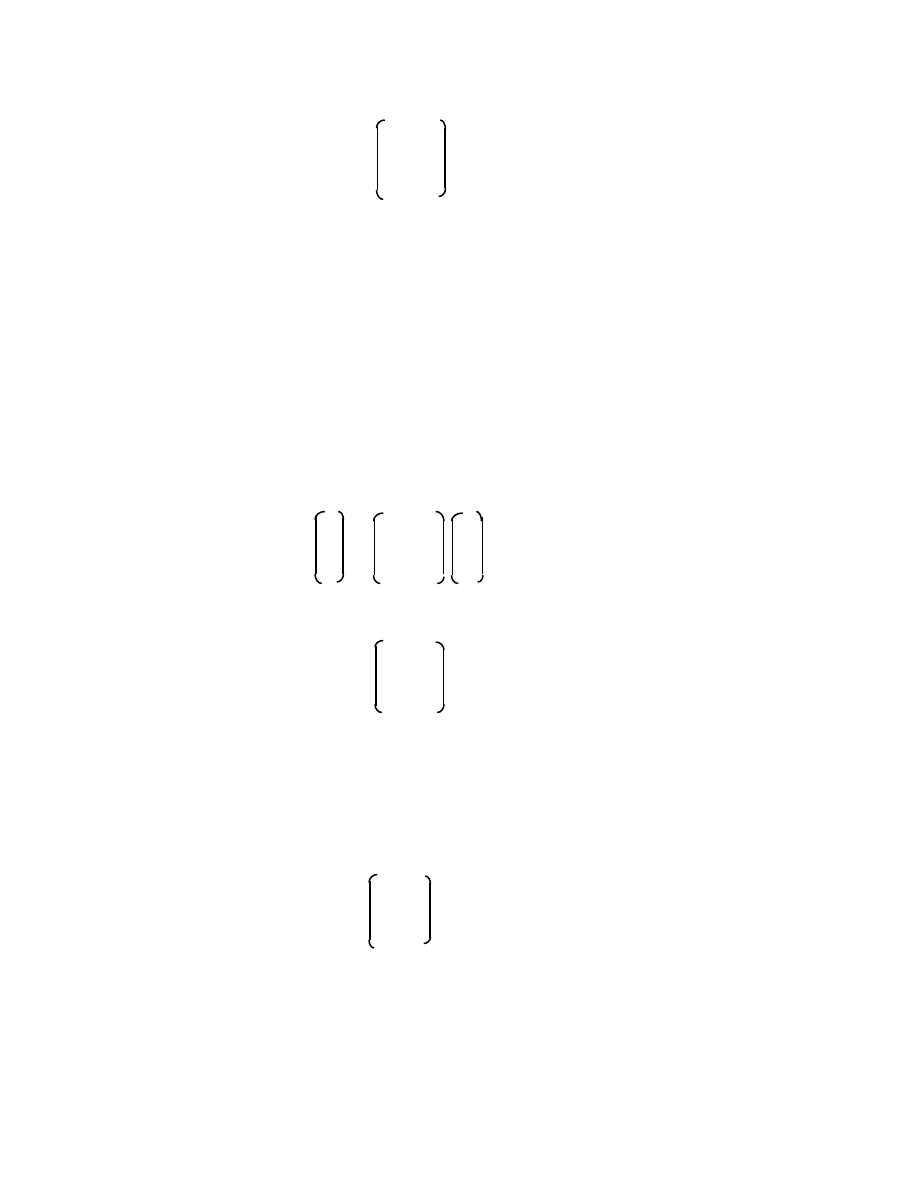
59
1 0
G = , the matrix of the Galilean transformation.
−
V 1
If we transform E
→
E
′
under the operation G, we can undo the
transformation by carrying out the inverse operation, written G
−
1
, that
transforms E
′
→
E, by reversing the direction of the relative velocity:
t = t
′
and
x = x
′
+ Vt
′
or, written as a matrix equation:
t 1 0 t
′
=
x +V 1 x
′
where
1 0
G
−
1
=
+V 1
is the inverse operator of the Galilean transformation. Because G
−
1
undoes
the effect of G, we have
G
−1
G = “do nothing” = I , the identity operator,
where
1 0
I = .
0 1
We can illustrate the space-time path of a point moving with respect to
the F- and F
′
-frames on the same graph, as follows
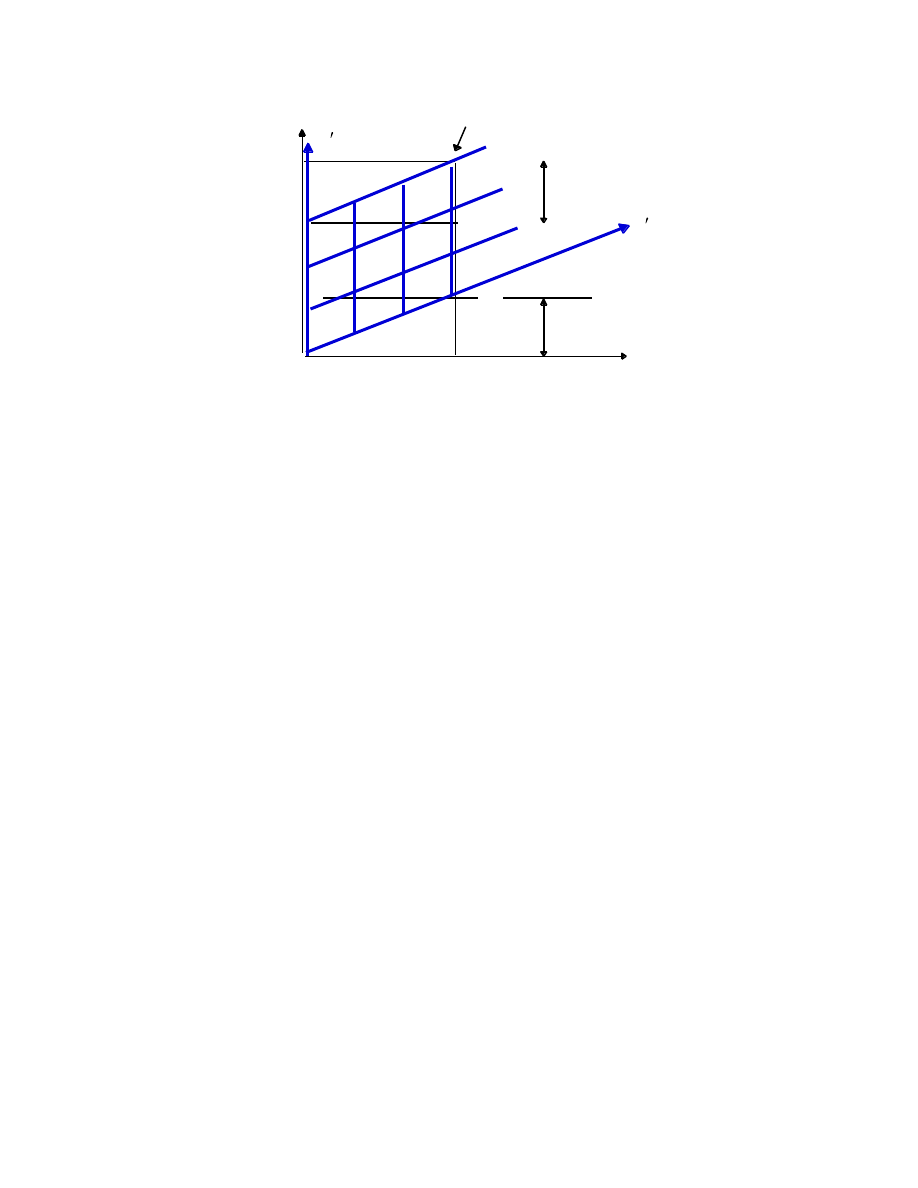
60
x - axis E[t, x] and E
′
[t
′
, x
′
]
x - axis
x
D = Vt
x
′
t - axis
(the world line
of O
′
relative to O)
t
′
D = Vt
O, O’ t - axis
t
The origins of F and F
′
are chosen to be coincident at t = t
′
= 0. O
′
moves to the right with constant speed V, and therefore travels a distance
D = Vt in time t. The t
′
- axis is the world line of O
′
in the F-frame. Every
point in this space-time geometry obeys the relation x
′
= x
−
Vt; the F
′
-frame
is therefore represented by a semi-oblique coordinate system. The
characteristic feature of Galilean-Newtonian space-time is the coincidence of
the x-x
′
- axes. Note that the time intervals, t, t
′
in F and F
′
are numerically
the same (Newton’s “absolute time”), and therefore a new time scale must be
chosen for the oblique axis, because the lengths along the time-axis,
corresponding to the times t, t
′
of the event E, E
′
are different.
A3. Is the geometry of space-time Pythagorean?
Pythagoras’ Theorem is of primary importance in the geometry of
space. The theorem is a consequence of the invariance properties of lengths
and angles under the operations of translations and rotations. We are
therefore led to ask the question
−
do invariants of space-time geometry exist
under the operation of the Galilean transformation and, if they do, what are

61
they? We can address this question by making a simple, direct calculation, as
follows. The basic equations that relate space-time measurements in two
inertial frames moving with relative speed V are
x
′
= x
−
Vt and t
′
= t.
We are interested in quantities of the form x
2
+ t
2
and x
′
2
+ t
′
2
. These forms
are inconsistent, however, because the “dimensions” of the terms are not the
same; x, x
′
have dimensions of “length” and t, t
′
have dimensions of “time”.
This inconsistency can be dealt with by introducing two quantities k, k
′
that
have dimensions “length/time” (speed), so that the equations become
x
′
= x
−
Vt (all lengths) and k
′
t
′
= kt (all lengths).
(Note that kt is the distance traveled in a time t at a constant speed k). We
now find
x
′
2
= (x
−
Vt)
2
= x
2
−
2xVt + V
2
t
2
, and k
′
2
t
′
2
= k
2
t
2
,
so that
x
′
2
+ k
′
2
t
′
2
= x
2
−
2xVt + V
2
t
2
+ k
2
t
2
.
≠
x
2
+ k
2
t
2
unless V = 0 (no motion!).
Relative events in an semi-oblique space-time geometry therefore transform
under the Galilean operator in a non-Pythagorean way.
A4. Einstein’s space-time symmetry: the Lorentz transformation
We have seen that the classical equations relating the events E and E´
are
E´ = GE, and the inverse E = G
–1
E´ where
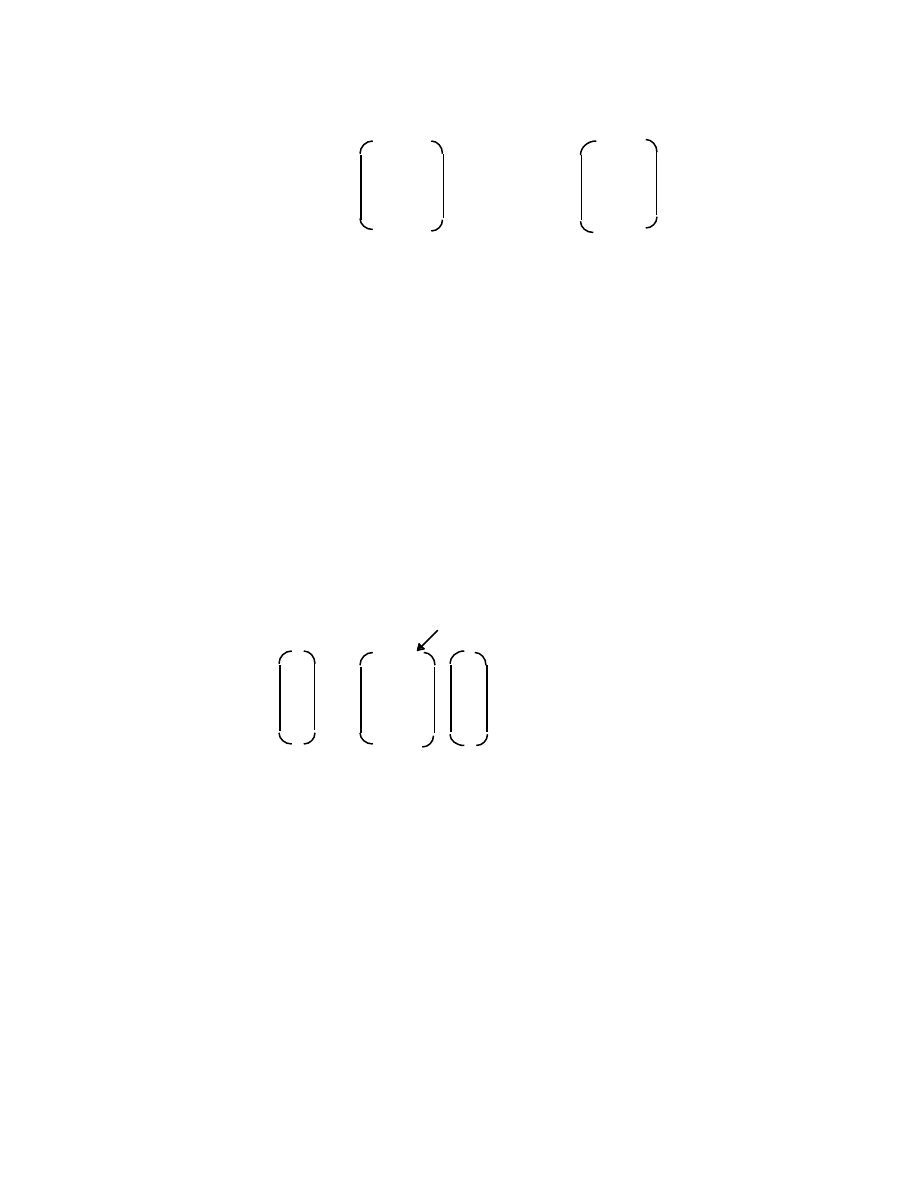
62
1 0 1 0
G = and G
–1
= .
–V 1 V 1
These equations are connected by the substitution V
↔
–V; this is an
algebraic statement of the Newtonian Principle of Relativity. Einstein
incorporated this principle in his theory (his first postulate), broadening its
scope to include all physical phenomena, and not simply the motion of
mechanical objects. He also retained the linearity of the classical equations in
the absence of any evidence to the contrary. (Equispaced intervals of time
and distance in one inertial frame remain equispaced in any other inertial
frame). He therefore symmetrized the space-time equations (by putting space
and time on equal footings) as follows:
−
V replaces 0, to symmetrize the matrix
t´ 1 –V t
= .
x´ –V 1 x
Note, however, the inconsistency in the dimensions of the time-equation that
has now been introduced:
t´ = t – Vx.
The term Vx has dimensions of [L]
2
/[T], and not [T]. This can be corrected
by introducing the invariant speed of light, c (Einstein's second postulate,
consistent with the result of the Michelson-Morley experiment):
ct´ = ct – Vx/c (c
′
= c, in all inertial frames)

63
so that all terms now have dimensions of length. (ct is the distance that light
travels in a time t)
Einstein went further, and introduced a dimensionless quantity
γ
instead of the scaling factor of unity that appears in the Galilean equations of
space-time. (What is the number “1” doing in a theory of space-time?). This
factor must be consistent with all observations. The equations then become
ct´ =
γ
ct –
βγ
x
x´ = –
βγ
ct +
γ
x , where
β
=V/c.
These can be written
E´ = LE,
where
γ
–
βγ
L = ,
–
βγ
γ
and E = [ct, x] .
L is the operator of the Lorentz transformation. (First obtained by Lorentz, it
is the transformation that leaves Maxwell’s equations of electromagnetism
unchanged in form between inertial frames).
The inverse equation is E = L
−
1
E
′
, where
γ
βγ
L
–1
= .
βγ
γ
This is the inverse Lorentz transformation, obtained from L by changing
β
→
–
β
(V
→
–V); it has the effect of undoing the transformation L. We can
therefore write

64
LL
–1
= I.
Carrying out the matrix multiplication, and equating elements gives
γ
2
–
β
2
γ
2
= 1
therefore,
γ
= 1/
√
(1 –
β
2
) (taking the positive root).
As V
→
0,
β
→
0 and therefore
γ
→
1; this represents the classical limit in
which the Galilean transformation is, for all practical purposes, valid. In
particular, time intervals have the same measured values in all Galilean frames
of reference, and acceleration is the single Galilean invariant.
A5. The invariant interval
Previously, it was shown that the space-time of Galileo and Newton is
not Pythagorean under G. We now ask the question: is Einsteinian space-
time Pythagorean under L ? Direct calculation leads to
(ct)
2
+ x
2
=
γ
2
(1 +
β
2
)(ct´)
2
+ 4
βγ
2
x´ct´
+
γ
2
(1 +
β
2
)x´
2
≠
(ct´)
2
+ x´
2
if
β
> 0.
Note, however, that the difference of squares is an invariant:
(ct)
2
– x
2
= (ct´)
2
– x´
2
because
γ
2
(1 –
β
2
) = 1.
Space-time is said to be pseudo-Euclidean. The “difference of squares” is
the characteristic feature of Nature’s space-time. The “minus” sign makes
no sense when we try and relate it to our everyday experience of geometry.
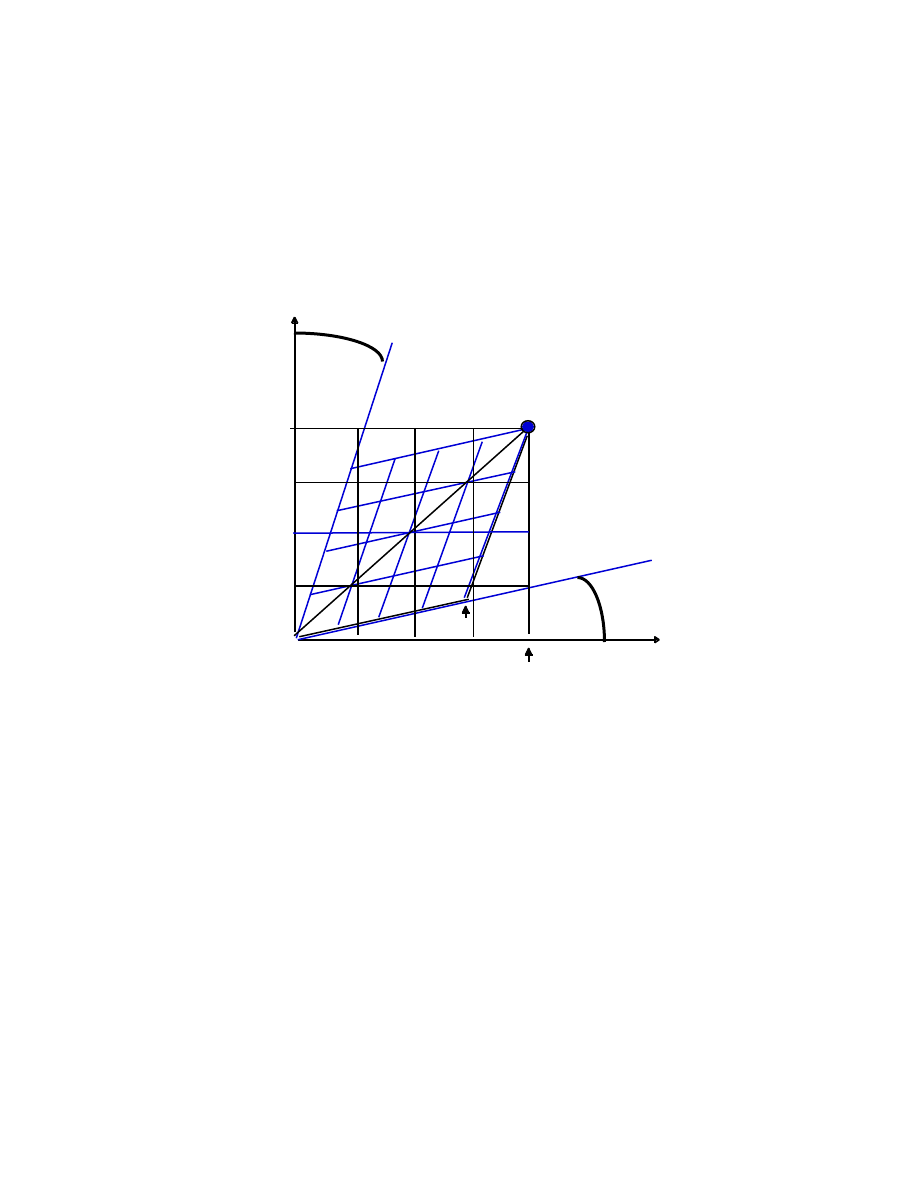
65
The importance of Einstein’s “free invention of the human mind” is clearly
evident in this discussion.
The geometry of the Lorentz transformation, L, between two inertial
frames involves oblique coordinates, as follows:
x -axis tan
−
1
β
x
′
- axis
X E[cT, X] and E
′
[cT
′
, X
′
]
X
′
(cT)
2
−
X
2
= (cT
′
)
2
−
X
′
2
ct
′
- axis
Common O, O
′
cT
′
angle = tan
−
1
β
cT ct - axis
The symmetry of space-time means that the ct - axis and the x - axis fold
through equal angles. Note that when the relative velocity of the frames is
equal to the speed of light, c, the folding angle is 45
0
, and the space-time axes
coalesce.
A6. The relativity of simultaneity: the significance of oblique axes
Consider two sources of light, 1 and 2, and a point M midway between
them. Let E
1
denote the event “flash of light leaves 1”, and E
2
denote the
66
event “flash of light leaves 2”. The events E
1
and E
2
are simultaneous if the
flashes of light from 1 and 2 reach M at the same time. The oblique
coordinate system that relates events in one inertial frame to the same events
in a second (moving) inertial frame shows, in a most direct way, that two
events observed to be coincident in one inertial frame are not observed to be
coincident in a second inertial frame (moving with a constant relative velocity,
V, in standard geometry). Two events E
1
[ct
1
, x
1
] and E
2
[ct
2
, x
2
], are
observed in a frame, F. Let them be coincident in F, so that t
1
= t
2
= t, (say).
The two events are shown in the following diagram:
x - axis
x
1
E
1
Coincident events in F
x
2
E
2
O F - frame
ct
1
= ct
2
= ct ct - axis
Consider the same two events as measured in another inertial frame, F
′
,
moving at constant velocity V along the common positive x - x
′
axis. In F
′
,
the two events are labeled E
1
′
[ct
1
′
, x
1
′
] and E
2
′
[ct
2
′
, x
2
′
]. Because F
′
is
moving at constant velocity +V relative to F, the space-time axes of F
′
are
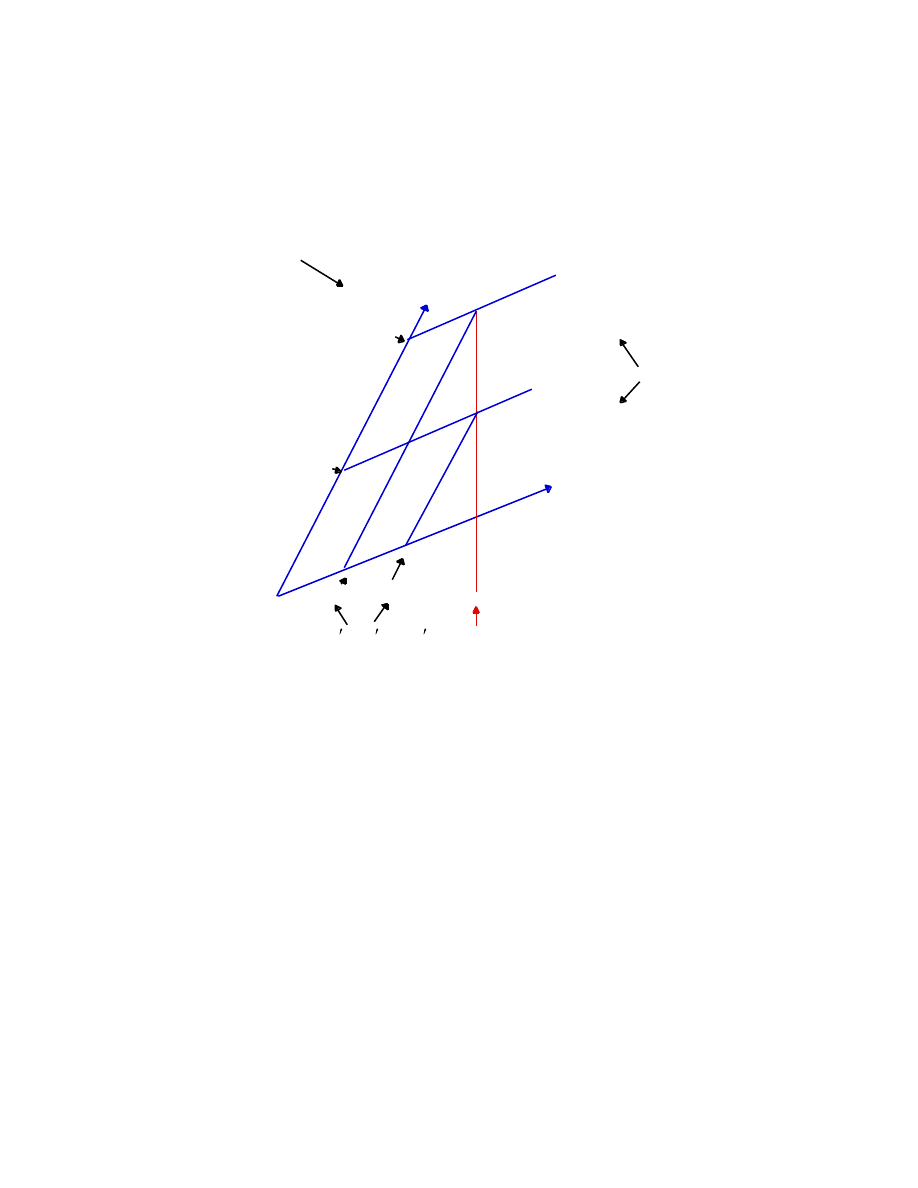
67
folded inwards through angles tan
−
1
(V/c) relative to the F axes, as shown. The
events E
1
′
and E
2
′
can be displayed in the F
′
- frame:
inclined at tan
−
1
(V/c) relative to the x - axis of F
x
′
- axis
x
1
′
E
1
′
[ct
1
′
, x
1
′
] in F
′
Not coincident in F
′
E
2
′
[ct
2
′
, x
2
′
] in F
′
x
2
′
ct
′
- axis inclined at tan
−
1
(V/c)
relative to the ct - axis of F
O’ ct
1
′
ct
2
′
t
1
< t
2
in F
ct
1
= ct
2
(E
1
and E
2
are coincident in F)
We therefore see that, for all values of the relative velocity V > 0, the events
E
1
′
and E
2
′
as measured in F
′
are not coincident; E
1
′
occurs before E
2
′
.
(If the sign of the relative velocity is reversed, the axes fold outwards through
equal angles).
A7. Length contraction: the Lorentz transformation in action
The measurement of the length of a rod involves comparing the two
ends of the rod with marks on a standard ruler, or some equivalent device. If
the object to be measured, and the ruler, are at rest in our frame of reference
then it does not matter when the two end-positions are determined - the

68
“length” is clearly-defined. If, however, the rod is in motion, the meaning of
its length must be reconsidered. The positions of the ends of the rod relative
to the standard ruler must be “measured at the same time” in its frame of
reference.
Consider a rigid rod at rest on the x
′
-axis of an inertial reference frame
F´. Because it is at rest, it does not matter when its end-points x
1
´ and x
2
´ are
measured to give the rest-, or proper-length of the rod, L
0
´ = x
2
´ – x
1
´.
Consider the same rod observed in an inertial reference frame F that is
moving with constant velocity –V with its x-axis parallel to the x´-axis. We
wish to determine the length of the moving rod; We require the length
L = x
2
– x
1
according to the observers in F. This means that the observers in
F must measure x
1
and x
2
at the same time in their reference frame. The
events in the two reference frames F, and F´ are related by the spatial part of
the Lorentz transformation:
x´ = –
βγ
ct +
γ
x
and therefore
x
2
´ – x
1
´ = –
βγ
c(t
2
– t
1
) +
γ
(x
2
– x
1
).
where
β
= V/c and
γ
= 1/
√
(1 –
β
2
).
Since we require the length (x
2
– x
1
) in F to be measured at the same time in
F, we must have t
2
– t
1
= 0, and therefore
L
0
´ = x
2
´ – x
1
´ =
γ
(x
2
– x
1
) ,

69
or
L
0
´(at rest) =
γ
L (moving).
The length of a moving rod, L, is therefore less than the length of the same
rod measured at rest, L
0
,
because
γ
> 1.
A8. Time dilation: a formal approach
Consider a single clock at rest at the origin of an inertial frame F´, and
a set of synchronized clocks at x
0
, x
1
, x
2
, ... on the x-axis of another inertial
frame F. Let F´ move at constant velocity +V relative to F, along the
common x -, x´- axis. Let the clocks at x
o
, and x
o
´ be synchronized to read t
0
and t
0
´ at the instant that they coincide in space. A proper time interval is
defined to be the time between two events measured in an inertial frame in
which they occur at the same place. The time part of the Lorentz
transformation can be used to relate an interval of time measured on the
single clock in the F´ frame, and the same interval of time measured on the
set of synchronized clocks at rest in the F frame. We have
ct =
γ
ct´ +
βγ
x´
or
c(t
2
– t
1
) =
γ
c(t
2
´ – t
1
´) +
βγ
(x
2
´ – x
1
´).
There is no separation between a single clock and itself, therefore x
2
´ – x
1
´ =
0, so that
c(t
2
– t
1
)(moving) =
γ
c(t
2
´ – t
1
´)(at rest) ,
or

70
c
∆
t (moving) =
γ
c
∆
t
′
(at rest).
Therefore, because
γ
> 1, a moving clock runs more slowly than a clock at
rest.
A9. Relativistic mass, momentum, and energy
The scalar product of a vector A with components [a
1
, a
2
] and a vector
B with components [b
1
, b
2
] is
A
⋅
B = a
1
b
1
+ a
2
b
2
.
In geometry, A
⋅
B is an invariant under rotations and translations of the
coordinate system.
In space-time, Nature prescribes the differences-of-squares as the
invariant under the Lorentz transformation that relates measurements in one
inertial frame to measurements in another. For two events, E
1
[ct, x] and
E
2
[ct,
−
x], the scalar product is
E
1
⋅
E
2
= [ct, x].[ct,
−
x]
= (ct)
2
−
x
2
= invariant in a space-time geometry,
where we have chosen the direction of E
2
to be opposite to that of E
1
,thereby
providing the necessary negative sign in the invariant.
In terms of finite differences of time and distance, we obtain
(c
∆
t)
2
−
(
∆
x)
2
≡
(c
∆τ
)
2
= invariant,
where
∆τ
is the proper time interval. It is related to
∆
t by the equation
∆
t =
γ∆τ
.
In Newtonian Mechanics, the quantity momentum, the product of the
mass of an object and its velocity, plays a key role. In Einsteinian Mechanics,

71
velocity, mass, momentum and kinetic energy are redefined. These basic
changes are a direct consequence of the replacement of Newton’s absolute
time interval,
∆
t
N
, by the Einstein’s velocity-dependent interval
∆
t
E
=
γ∆τ
.
The Newtonian momentum p
N
= m
N
v
N
= m
N
∆
x/
∆
t
N
is replaced by the
Einsteinian momentum
p
E
+
≡
m
0
v
E
= m
0
∆
[ct, x]/
∆τ
= m
0
[c
∆
t/
∆τ
,
∆
x/
∆τ
]
= m
0
[
γ
c, (
∆
x/
∆
t)(
∆
t/
∆τ
]
= m
0
[
γ
c,
γ
v
N
].
We now introduce the vector in which the direction of the x-component is
reversed, giving
p
E
−
= m
0
[
γ
c,
−γ
v
N
].
Forming the scalar product, we obtain
p
E
+
⋅
p
Ε
−
= m
0
2
(
γ
2
c
2
−
γ
2
v
N
2
)
= m
0
2
c
2
,
because v
E
+
⋅
v
E
−
= c
2
.
Multiplying throughout by c
2
, and rearranging, we find
m
0
2
c
4
=
γ
2
m
0
2
c
4
−
γ
2
m
0
2
c
2
v
N
2
.
We see that
γ
is a number and therefore
γ
multiplied by the rest mass m
0
is a
mass; let us therefore denote it by m:
m =
γ
m
0
, the relativistic mass.

72
We can then write
(m
0
c
2
)
2
= (mc
2
)
2
−
(cp
E
)
2
.
The quantity mc
2
has dimensions of energy; let us therefore denote it by the
symbol E, so that
E = mc
2
, Einstein’s great equation.
The equivalence of mass and energy appears in a natural way in our search
for the invariants of Nature.
The term involving m
0
is the rest energy, E
0
,
E
0
= m
0
c
2
.
We therefore obtain
E
0
2
= E
2
−
(p
E
c)
2
= E
′
2
−
(p
E
′
c)
2
, in any other inertial frame.
It is the fundamental invariant of relativistic particle dynamics.
This invariant includes those particles with zero rest mass. For a
photon of total energy E
PH
and momentum p
PH
, we have
0 = E
PH
2
−
(p
PH
c)
2
,
and therefore
E
PH
= p
PH
c.
No violations of Einstein’s Theory of Special Relativity have been
found in any tests of the theory that have been carried to this day.

73
Bibliography
The following books are written in a style that requires little or no
Mathematics:
Calder, N., Einstein’s Universe, The Viking Press, New York (1979).
Davies, P. C. W., Space and Time in the Modern Universe,
Cambridge University Press, Cambridge (1977).
The following books are mathematical in style; they are listed in increasing
level of mathematical sophistication:
Casper, Barry M., and Noer, Richard J., Revolutions in Physics,
W. W. Norton & Company Inc., New York (1972).
Born, M., The Special Theory of Relativity, Dover, New York (1962).
French, A. P., Special Relativity, W. W. Norton & Company, Inc.
New York (1968).
Rosser, W. G. V., Introduction to Special Relativity, Butterworth & Co. Ltd.
London (1967).
Feynman, R. P., Leighton, R. B., and Sands, M., The Feynman Lectures on
Physics, Addison-Wesley Publishing Company, Reading, MA (1964).
Rindler, W., Introduction to Special Relativity, Oxford University Press,
Oxford, 2nd ed. (1991).
Document Outline
- CONTENTS
- PREFACE
- 1. INTRODUCTION
- 2. UNDERSTANDING THE PHYSICAL UNIVERSE
- 3. DESCRIBING EVERYDAY MOTION
- 4. EINSTEIN’S THEORY OF SPECIAL RELATIVITY
- 5. NEWTONIAN DYNAMICS
- 6. EQUIVALENCE OF MASS AND ENERGY: E=mc 2
- 7. AN INTRODUCTION TO EINSTEINIAN GRAVITATION
- Appendix
- Bibliography
Wyszukiwarka
Podobne podstrony:
Einstein A Relativity the special and general theory (free web version, Methuen, 1920) (115s)
Firk F W K Essential physics 1 (free web version, 2004) (210s) PG
Huba J D (ed ) The Natl Plasma physics formulary (free web version, NRL, 2004)(70s) PRef
12 Intro to origins of lg LECTURE2014
HANDOUT 2 Intro to Fall Rises Meanings of definite falls
The Rise of Einsteinian Special Relativity
12 Intro to origins of lg LECTURE2014
British Patent 6,481 Improvements relating to the Electrical Transmission of Power and to Apparatus
The Relation of Prophylactic Inoculations to the Onset of Poliomyelitis Lancet 1950 pp 659 63
Intro to EU law Sources of law (2014)
Intro to EU law legal basis and scope of EU competence (2015)
The Gospel of St John in Relation to the Other Gospels esp that of St Luke A Course of Fourteen Lec
The relationship of Lumbar Flexion to disability in patients with low back pain
więcej podobnych podstron