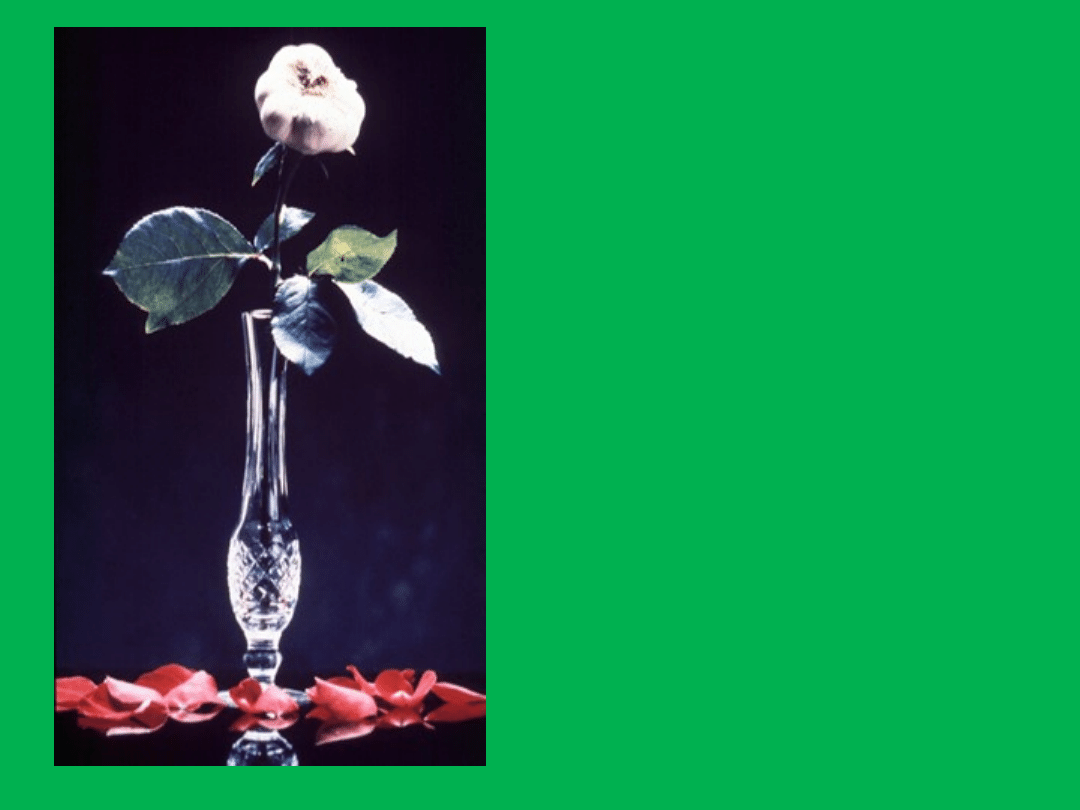
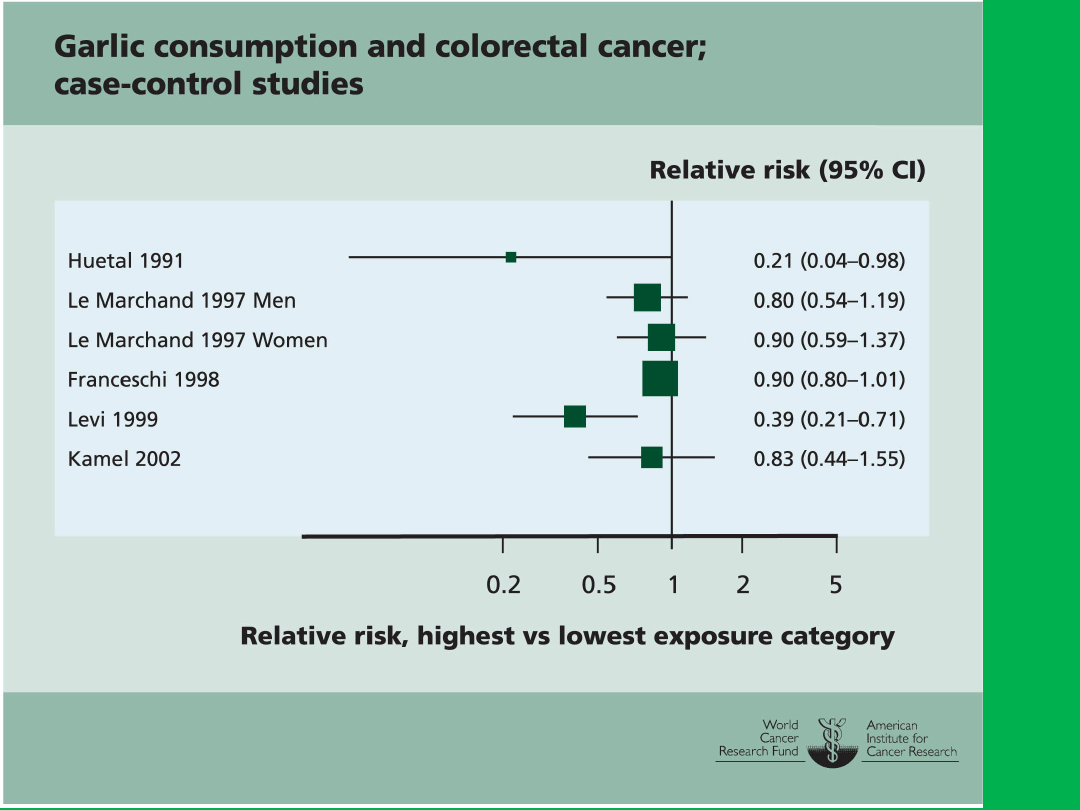
Recent meta-analysis of
Data from 11 trials
concluded
The random-
effects relative risk (RR)
estimate for raw and
cooked garlic and
colorectal cancer
was 0.69
and for stomach was 0.53.
Fleischauer, et al. Amer
JClin Nutr 72, 1047, 2000.
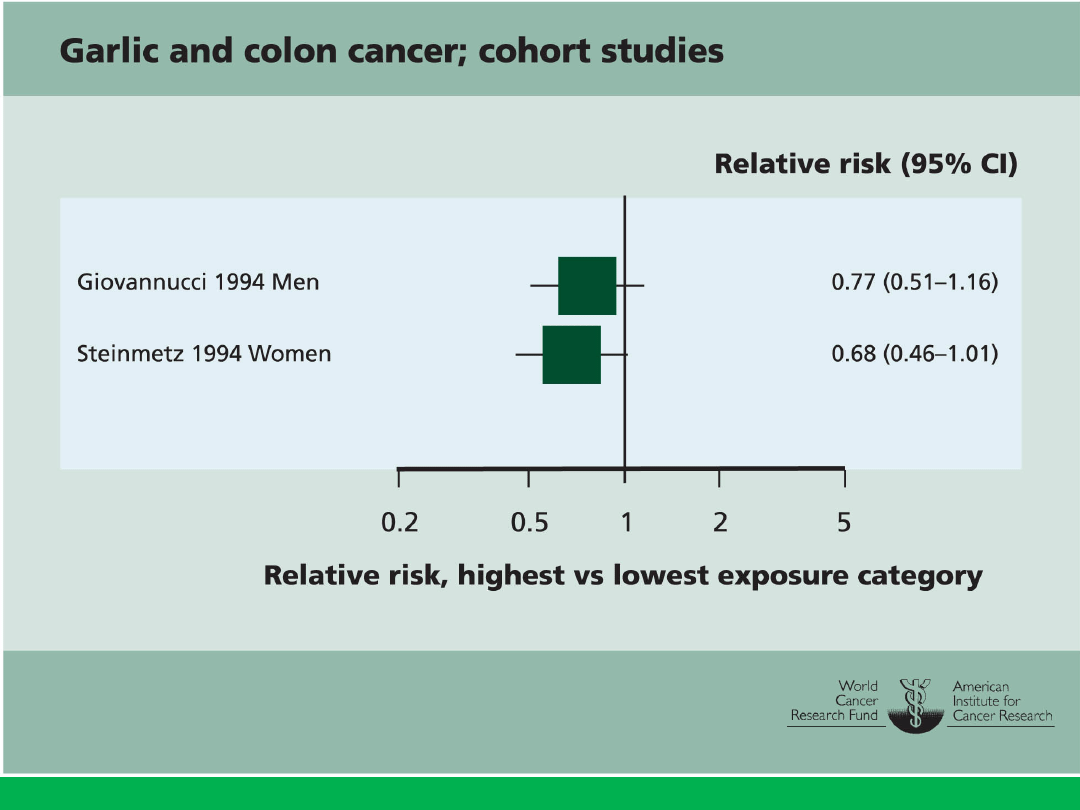
Prospective cohort study
with 41,837 women age 55
to 69, examined 127 food
items. “The strongest
association in the present
study was that for garlic
consumption, with an
approximate 50% lesser risk
of colon cancer associated
with high consumption of
garlic.”
Steinmetz et al.
Steinmetz et al.
Amer. J. Epidemiology
Amer. J. Epidemiology
139:1, 1994
139:1, 1994

Historia czosnku
Historia czosnku
W starożytnym Egipcie
W starożytnym Egipcie
Codex Ebers,
Codex Ebers,
Egipski
Egipski
tekst medyczny
tekst medyczny
wymienia czosnek jako lek na dolegliwości
wymienia czosnek jako lek na dolegliwości
takie jak:
takie jak:
Zaburzenia krążenia
Zaburzenia krążenia
Złe samopoczucie
Złe samopoczucie
Infekcje pasożytnicze
Infekcje pasożytnicze
Nienormalny wzrost tkanek
Nienormalny wzrost tkanek
Główki czosnku znaleziono w grobie
Główki czosnku znaleziono w grobie
faraona
faraona
Tutenhamon
Tutenhamon
a
a
(
(
około
około
1500
1500
p.n.e.
p.n.e.
)
)

Historia czosnku
• Budowniczowie piramid dostawali dzienną rację
czosnku, a ograniczenie tej racji znacznie obniżało
wydajność pracy robotników.
• Babilończycy (4000 p.n.e.) używali czosnek
przeciwko trądowi i cholerze

Historia czosnku
• W starożytnej Grecji
– Żołnierze dostawali dzienną rację
czosnku,
– Sportowcy startujący w starożytnych IO
jedli czosnek przed zawodami,
– Hipokrates, Ojciec Medycyny, zalecał
stosowanie czosnku na dolegliwości
płucne

Historia czosnku
• Sanskrit records the usage of garlic 5,000
years ago
• Chinese have used garlic for at least 3,000
years

Tradycyjne zastosowanie
czosnku
• Antiviral & antibacterial for the lungs: coughs,
bronchitis, pneumonia
• Garlic was and is still used in Chinese, Ayurvedic,
and naturopathic medicine as an
antibacterial/antiviral agent, an expectorant, & a
wound dressing
• Used to treat high blood pressure, colds, gastric
ulcers, bacterial diarrhea, sinus infections, vaginal
yeast infections, & otitis media
• The antibacterial activity of garlic was confirmed by
Louis Pasteur in 1858
• Used a topical cream to relieve wasp and bee stings

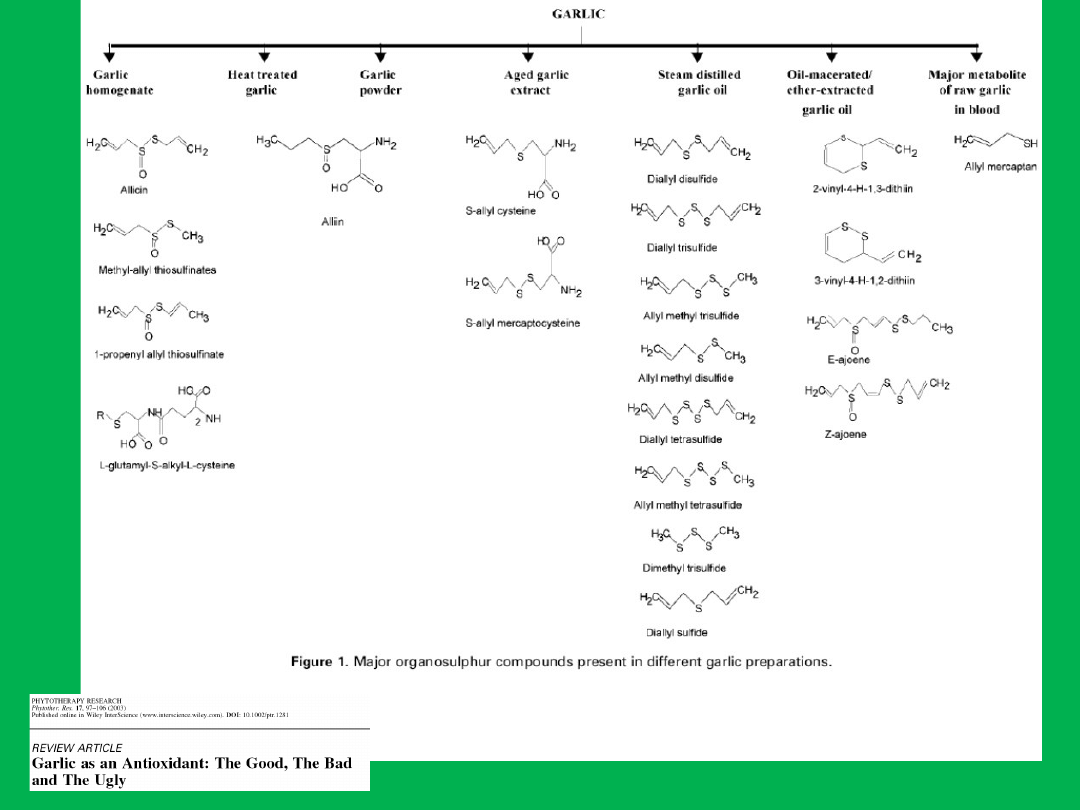
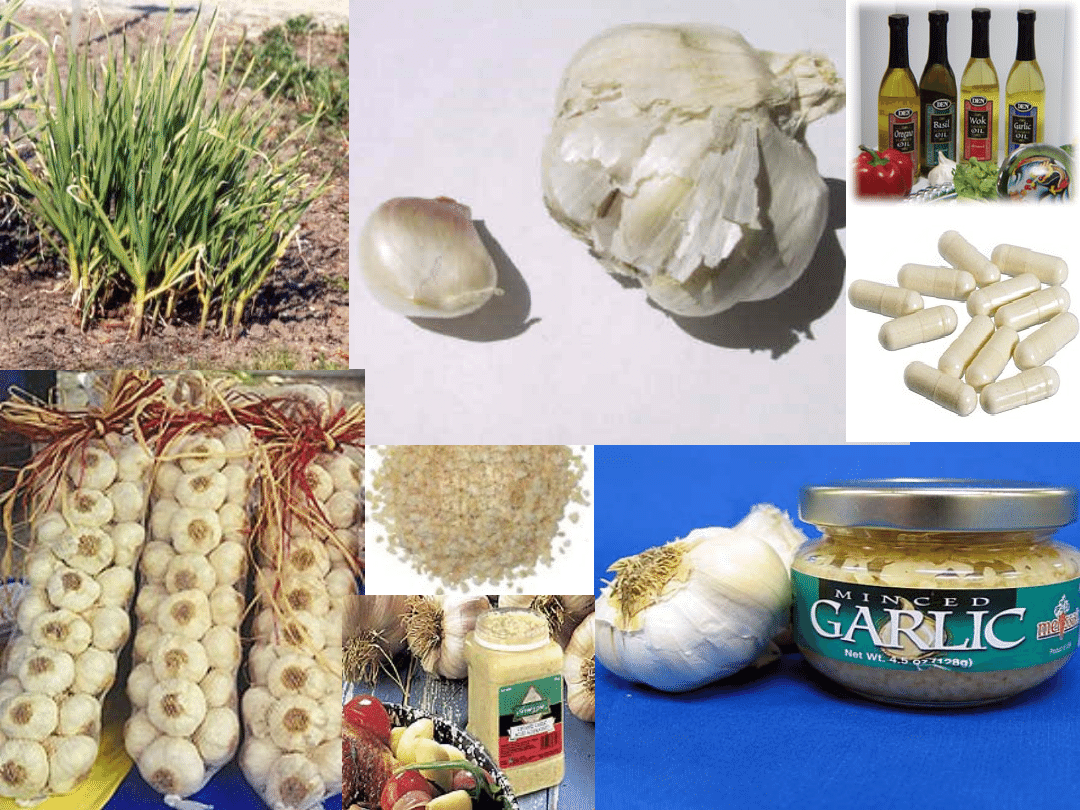
Garlic supplements can be classified into four groups: Garlic essential oil,
garlic oil macerate, garlic powder, and garlic
Garlic essential oil is obtained by passing steam through garlic. Commercially
available garlic oil capsules generally contain vegetable oil, but only have a
small amount of garlic essential oil because of its strong odor.
Garlic oil macerate products are made from encapsulated mixtures of whole
garlic cloves ground into vegetable oil.
Garlic powder is produced by slicing or crushing garlic cloves, then drying
and grinding them into powder. Garlic powder is used as a flavoring agent for
condiments and food and is thought to retain the same ingredients as raw
garlic.
Garlic extract is made from whole or sliced garlic cloves that are soaked in an
alcohol solution (an extracting solution) for varying amounts of time.
Powdered forms of the extract also are available (
,
).
Preparaty z czosnku

Jak czosnek chroni przed chorobą
nowotworową
?
•Działa przeciwbakteryjnie
•Zapobiega tworzeniu się
kancerogenów
•Zapobiega aktywacji kancerogenów
•Wzmaga naprawę DNA
•Działa antyoksydacyjnie
•Hamuje proliferacje komórek
nowotworowych i indukuje ich
apoptozę

Inne działania czosnku
• Zwiększa aktywność syntazy tlenku
azotu i tym samym poprawia funkcje
naczyń
• Zwiększa elastyczność naczyń, zmniejsza
ciśnienie krwi i działa przeciw
miażdżycowo
• Hamuje powstawanie prostaglandyn
działających prozapalnie
• Zwiększa ekspresję genów GST i
reduktazy chinonowej
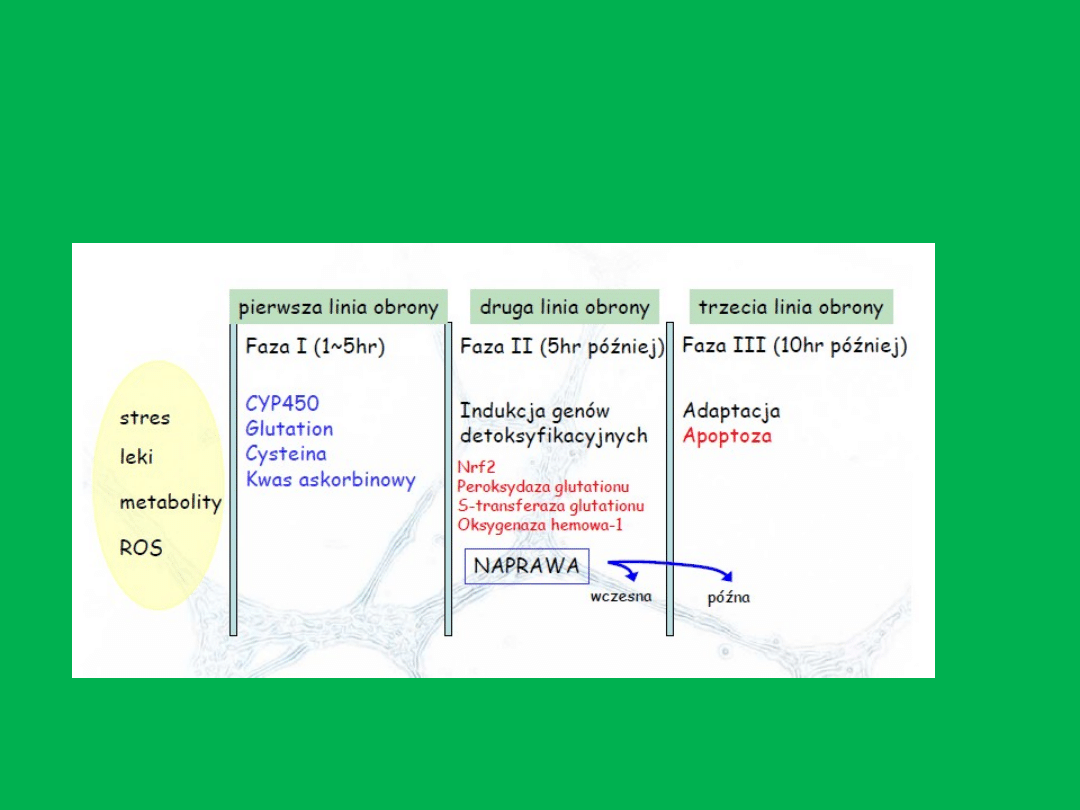
Mechanizm działania czosnku i
innych chemoprewencyjnych składników
diety
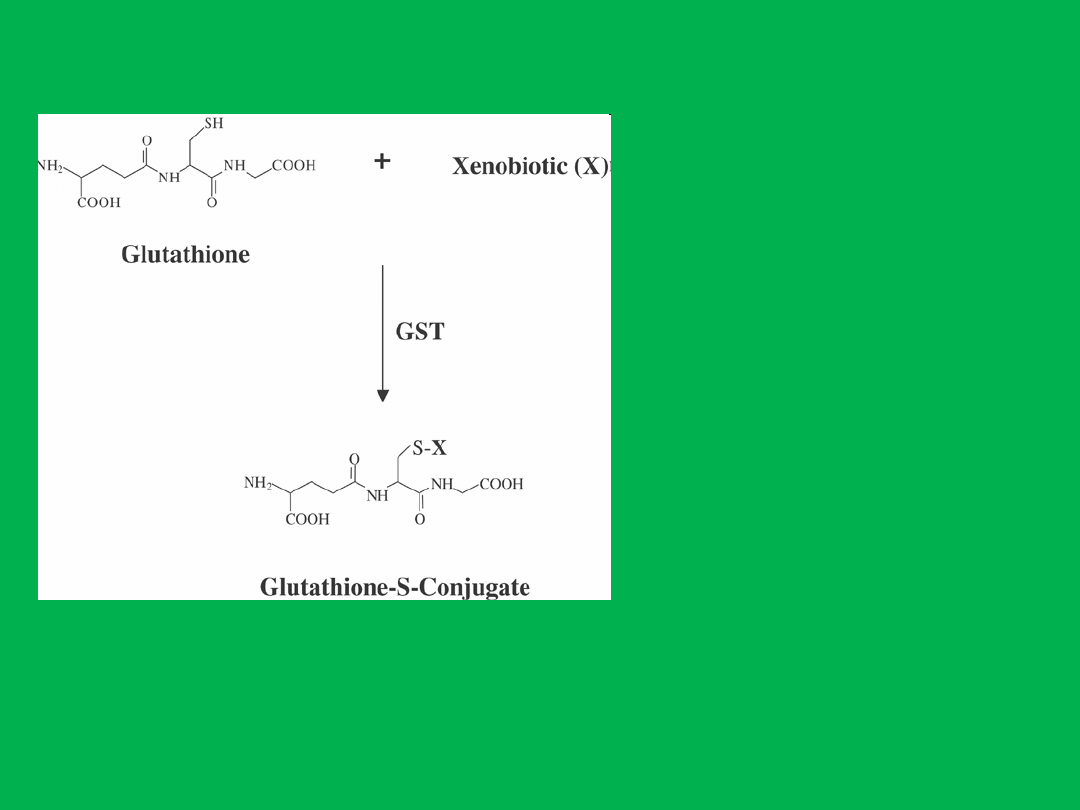
S-transferazy glutationowe
katalityczna aktywność
GST odpowiada za
detoksykację
reaktywnych produktów,
powstałych w czasie
stresu oksydacyjnego,
oraz jest związana z
detoksykacją
kancerogenów, leków
przeciwnowotworowych,
pestycydów i herbicydów
wyróżnia się trzy główne grupy GST: cytosolowe, mitochondrialne i
mikrosomalne
katalizują one reakcje sprzęgania między nukleofilowym
zredukowanym glutationem i związkami elektrofilowymi (katalizują
tworzenie wiązań tioeterowych między ksenobiotykami (lub związkami
endogennymi takimi jak prostaglandyny czy steroidy) a GSH
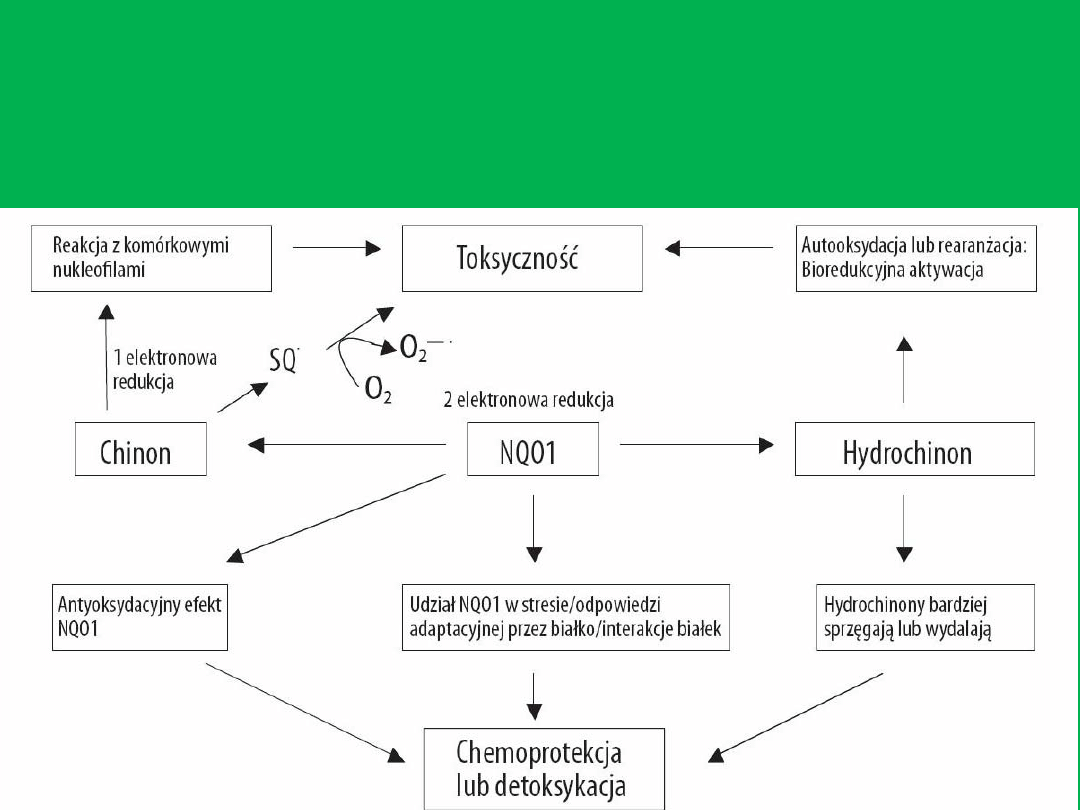
enzym ten występuje u zwierząt, roślin i bakterii
u ludzi największą jego aktywność wykazano w wątrobie, znacznie mniejszą
w nerkach, płucach i mózgu
Reduktaza NAD(P)H:chinon 1 (NQO1)

In a third study, greater intake of allium vegetables (more than 10 g per day
vs. less than 2.2 g per day), particularly garlic and scallions, was associated
with an approximately 50 percent reduction in prostate cancer risk (10).
In addition, a study in France found that increased garlic consumption was
associated with a statistically significant reduction in breast cancer risk.
After considering total calorie intake and other established risk factors,
breast cancer risk was reduced in those consuming greater amounts of
fiber, garlic, and onions (12).
Rak prostaty
Rak piersi
Evidence also suggests that increased garlic consumption may reduce
pancreatic cancer risk. A study conducted in the San Francisco Bay area
found that pancreatic cancer risk was 54 percent lower in people who ate
larger amounts of garlic compared with those who ate lower amounts (11).
Rak trzustki
Badania populacyjne

Three randomized clinical trials have evaluated the effect of garlic
intake on gastric cancer risk. In one study, which involved over 5,000
Chinese men and women at high risk for stomach cancer, researchers
compared the effects of taking a combination of 200 mg synthetic
allitridum (an extract of garlic used as a medicine in China for over
3,000 years) daily and 100 micrograms selenium every other day with
taking a placebo (an inactive substance or treatment that looks the
same as, and is given the same way as, an active drug or treatment
being tested) for 5 years. In the group that received allitridum and
selenium, the risk for all tumors combined was reduced by 33 percent
and the risk for stomach cancer was reduced by 52 percent in
comparison with the group that received only the placebo (13).
Badania Kliniczne
Li H, Li HQ, Wang Y, et al. An intervention study to prevent gastric cancer
by micro-selenium and large dose of allitridum. Chinese Medical Journal
(English) 2004; 117(8):1155–1160.
A third randomized study in Japan compared the effects of daily high-dose
(2.4 mL) and low-dose (0.16 mL) intake of aged-garlic extract after 6 and 12
months of use on individuals with colorectal adenomas (noncancerous
tumors). At the end of 12 months, 67 percent of the low-intake group
developed new adenomas compared with 47 percent in the high-intake
group (15).
Tanaka S, Haruma K, Kunihiro M, et al. Effects of aged garlic extract
(AGE) on colorectal adenomas: A double-blinded study. Hiroshima
Journal of Medical Sciences 2004; 53(3–4):39–45.
Garlic
Garlic
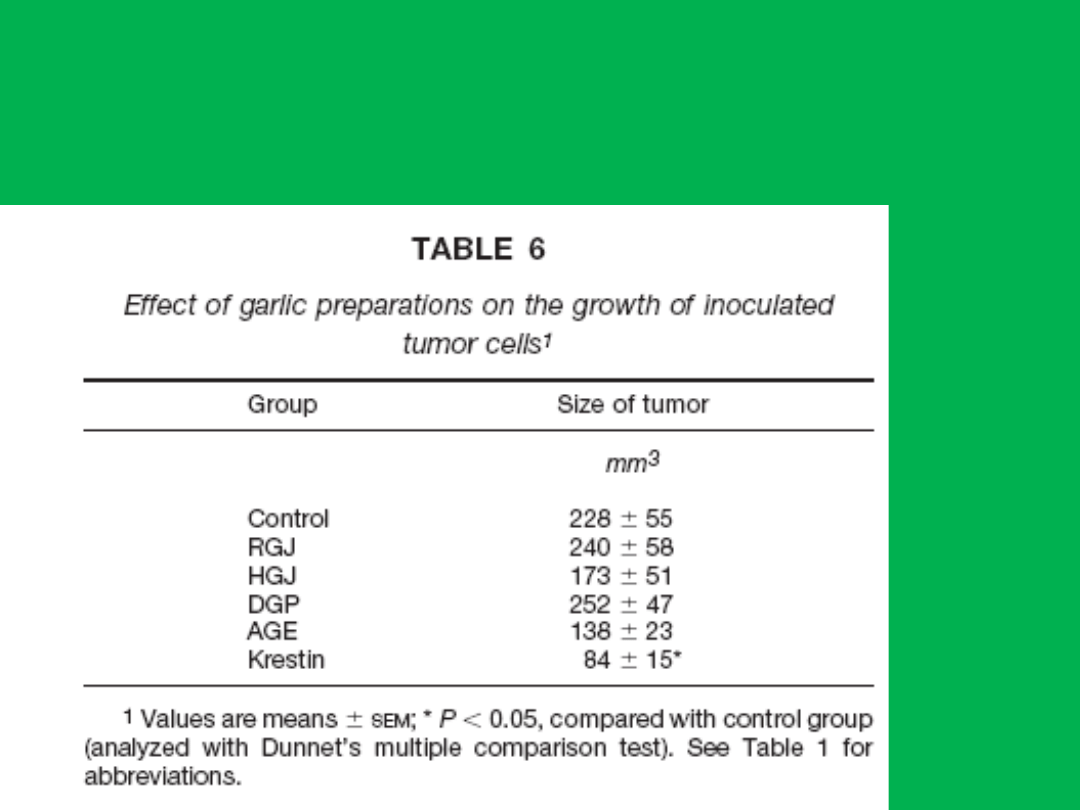
Badania na zwierzętach
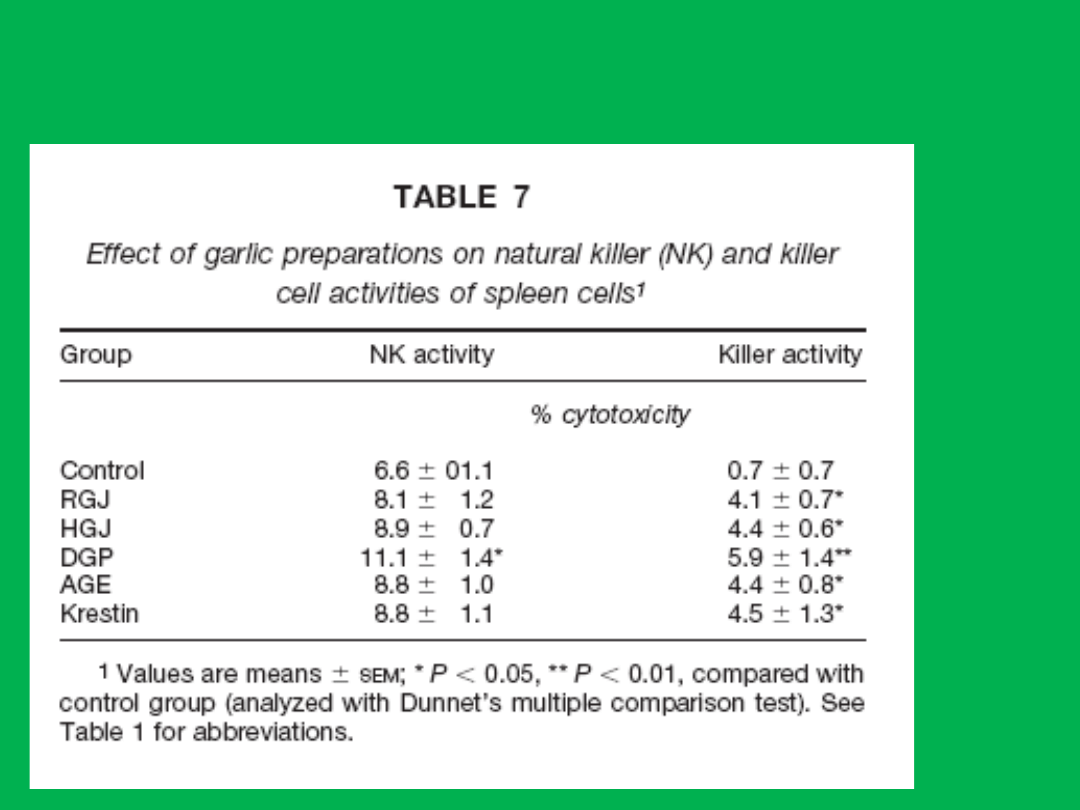
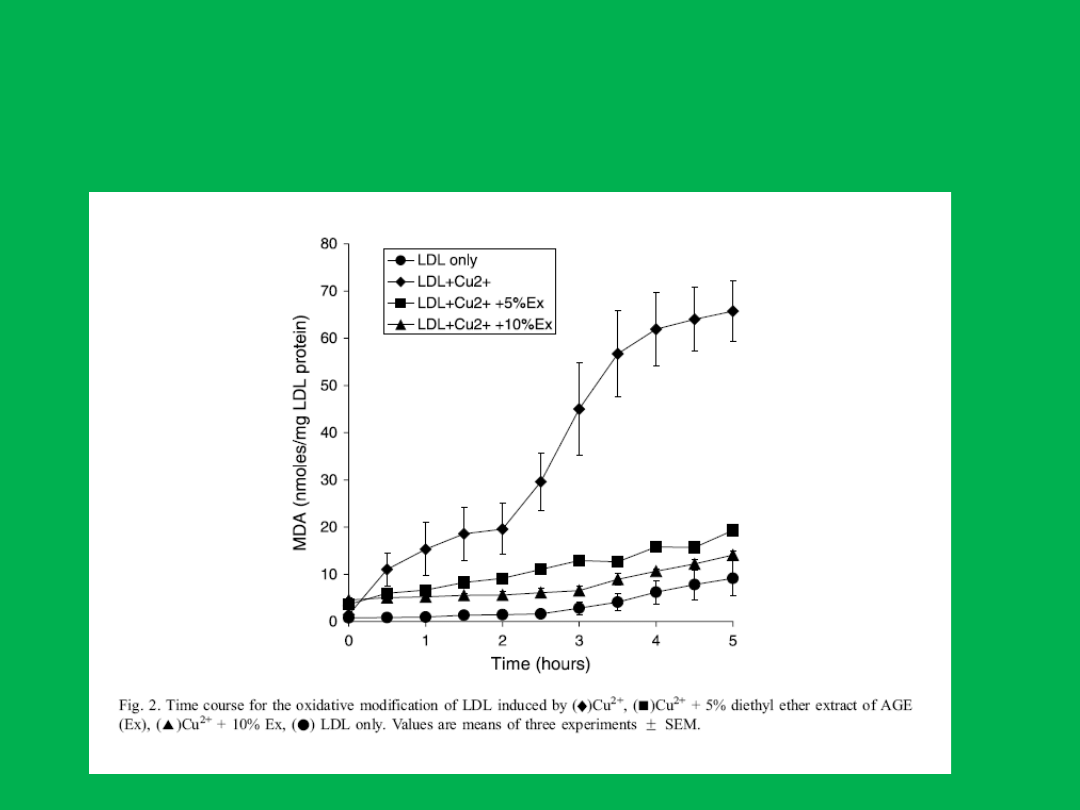
Działanie antyoksydacyjne
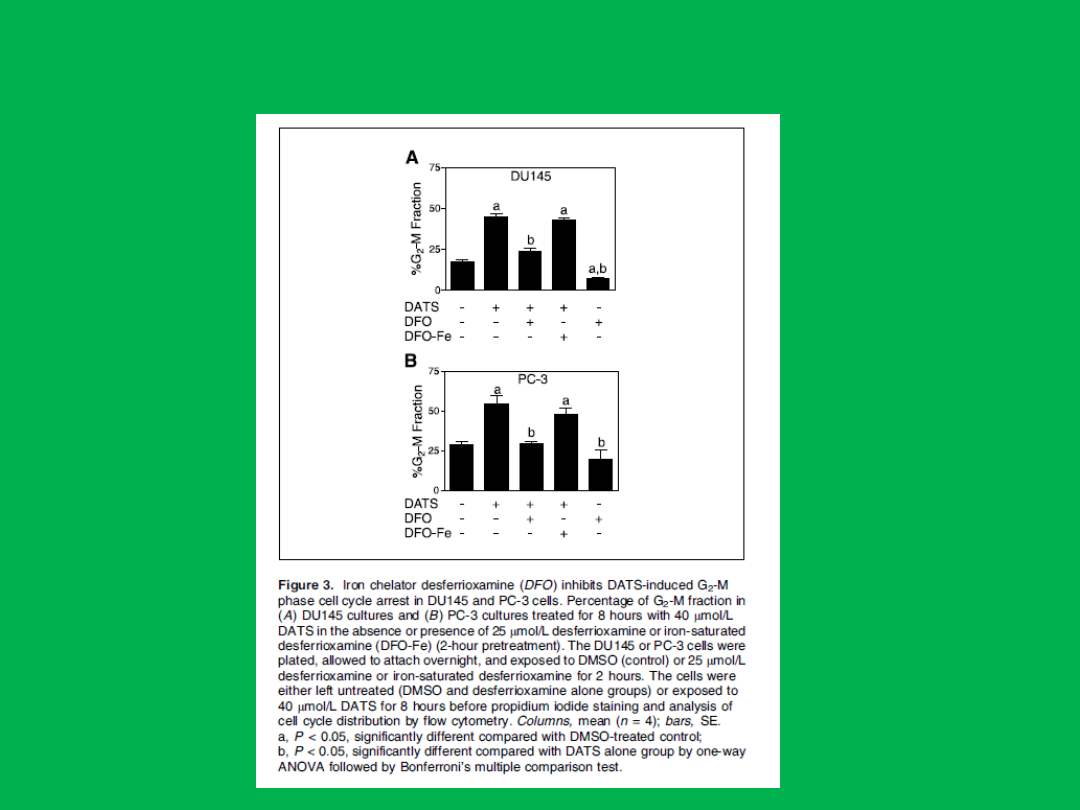
Badania na hodowlach komórkowych
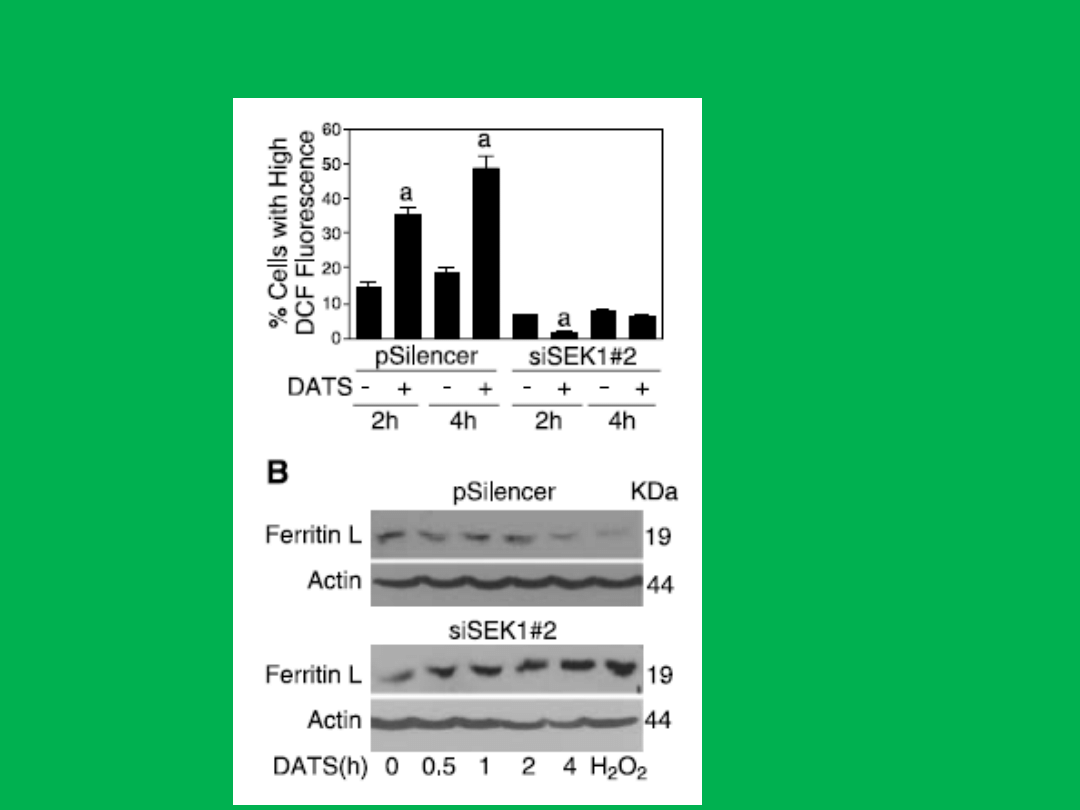
Badania na hodowlach komórkowych
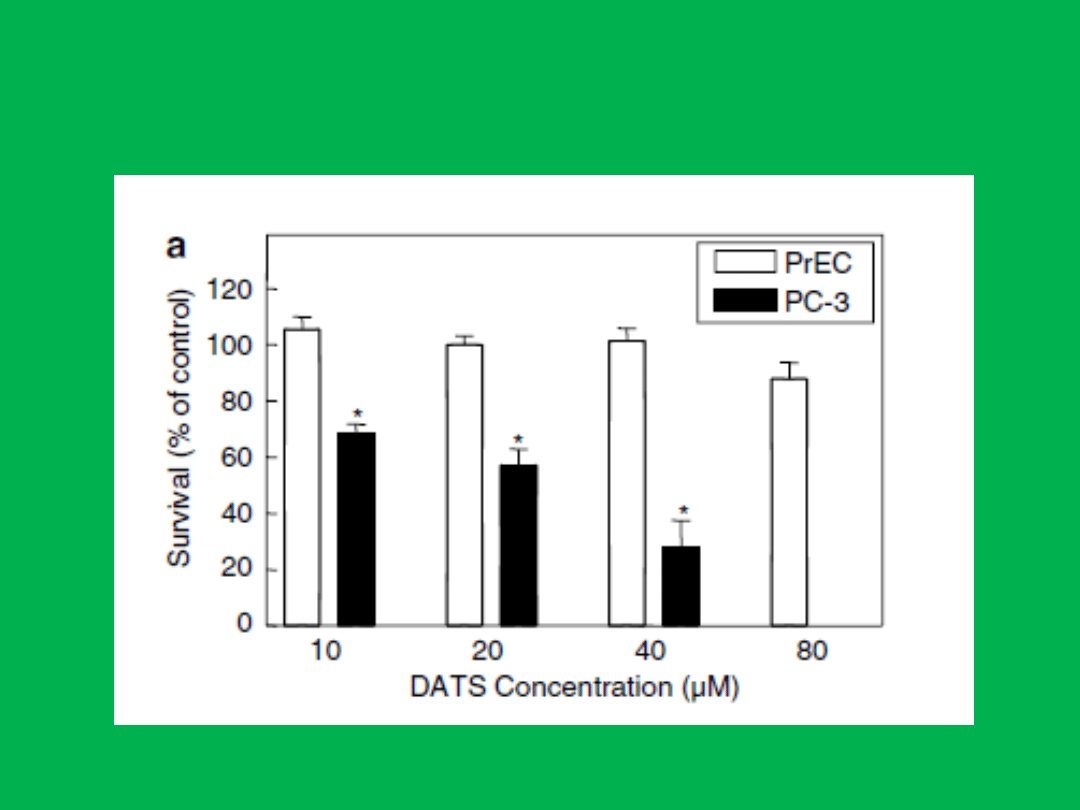
Badania na hodowlach komórkowych
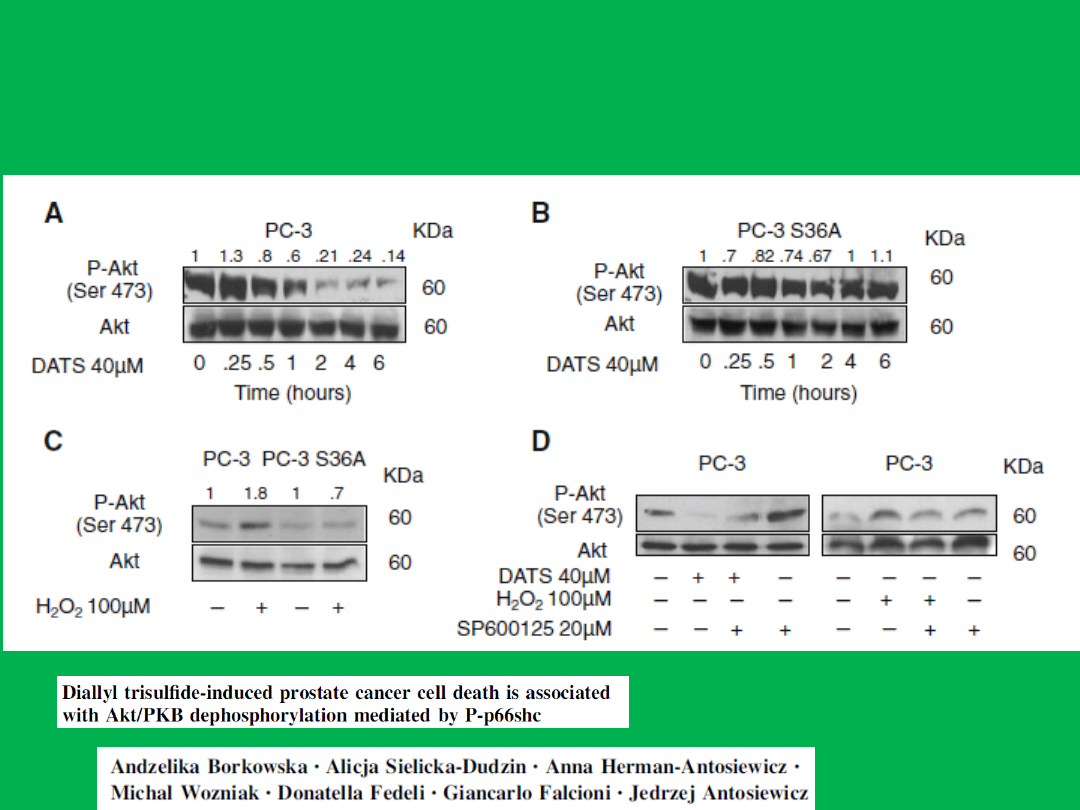
Badania na hodowlach komórkowych
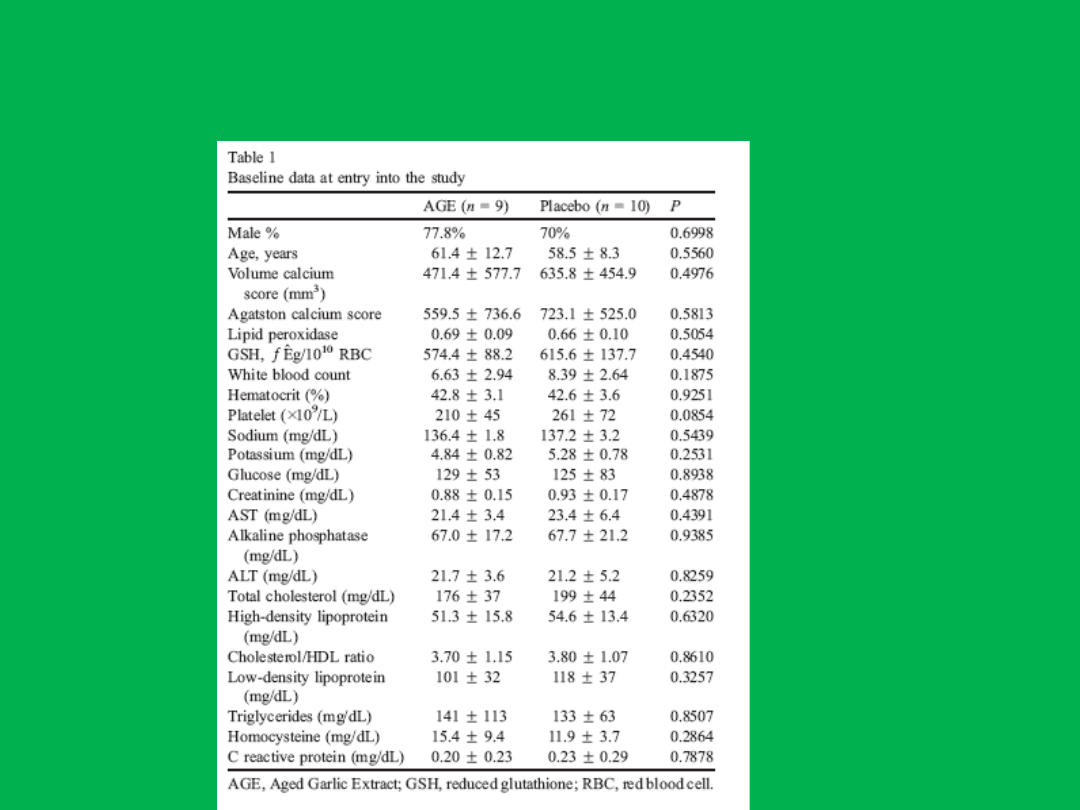
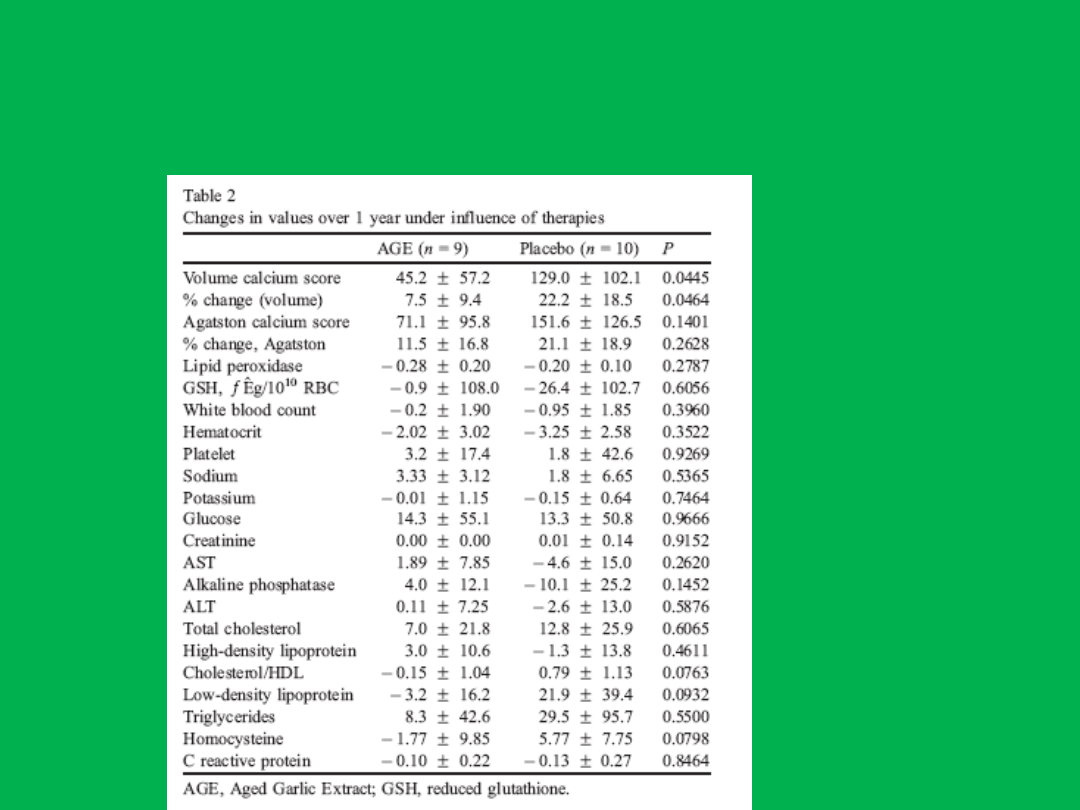
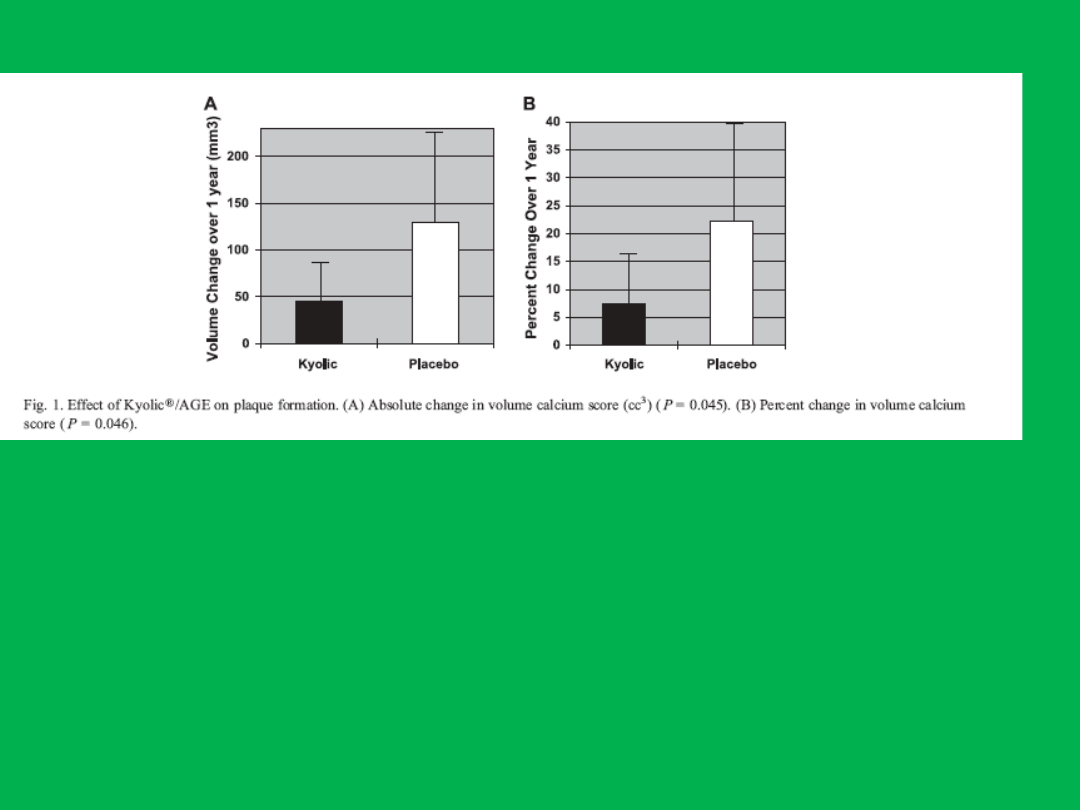
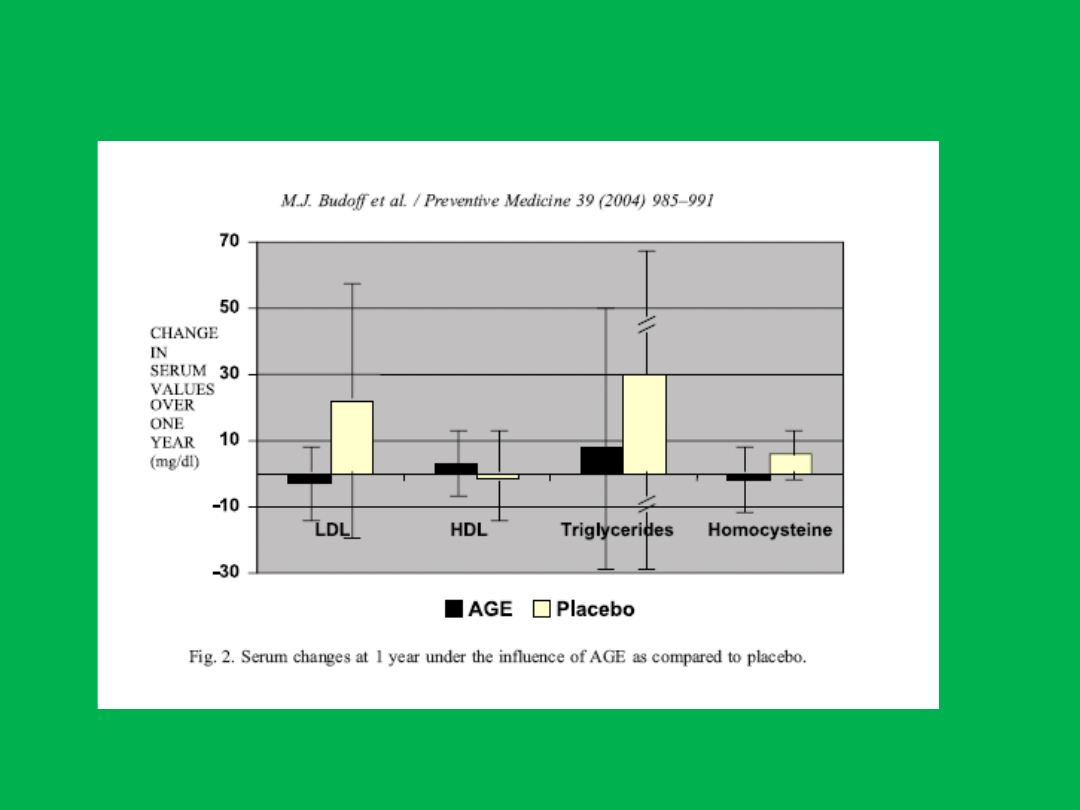
Inhibiting progression of coronary calcification using Aged Garlic
Extract
in patients receiving statin therapy: a preliminary study$
Matthew J. Budoff, M.D.,aPreventive Medicine 39 (2004) 985–991
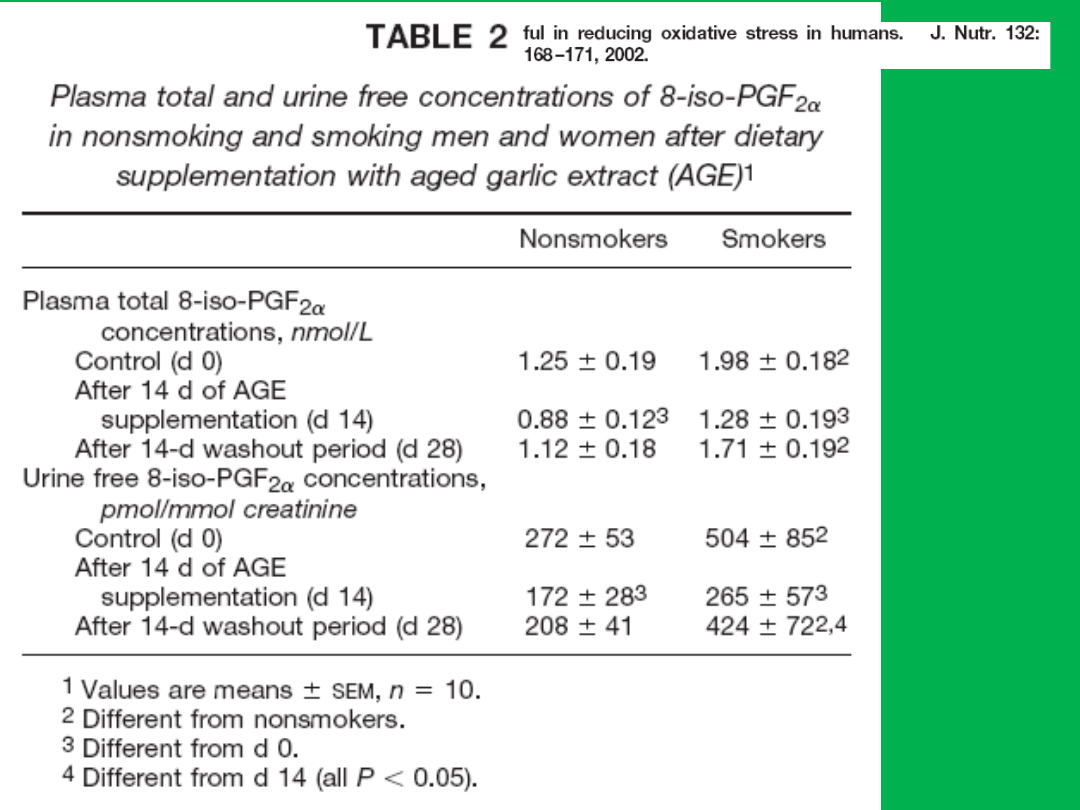
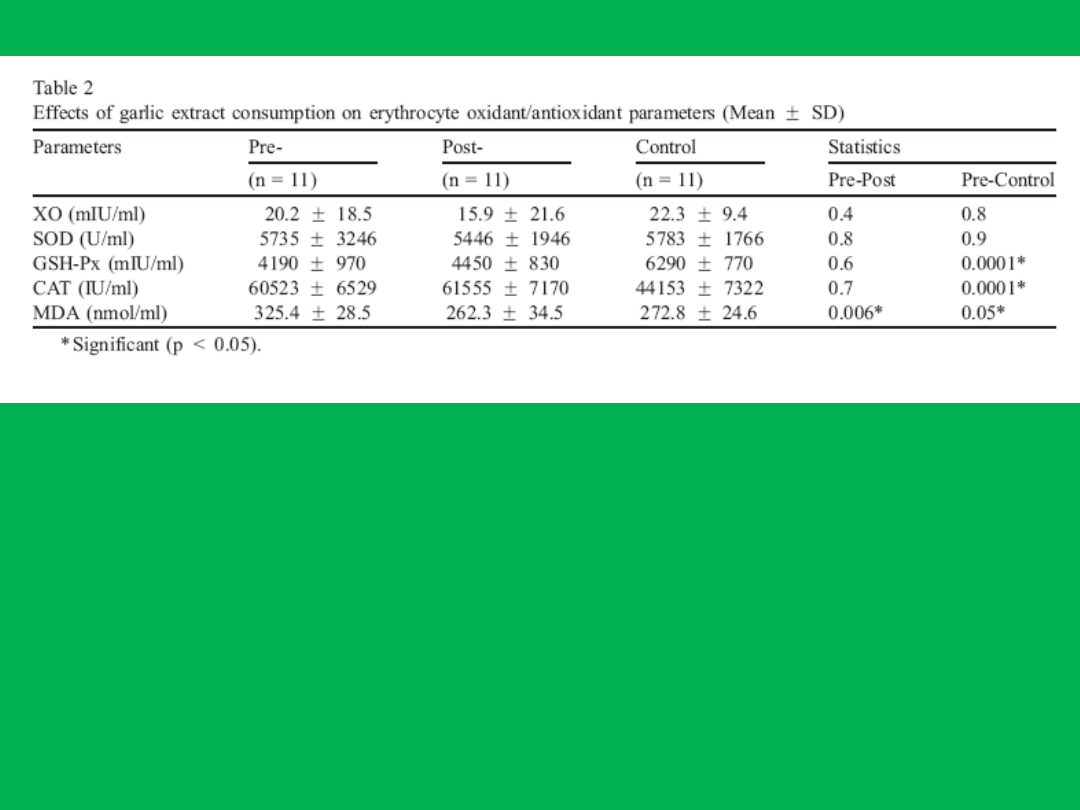
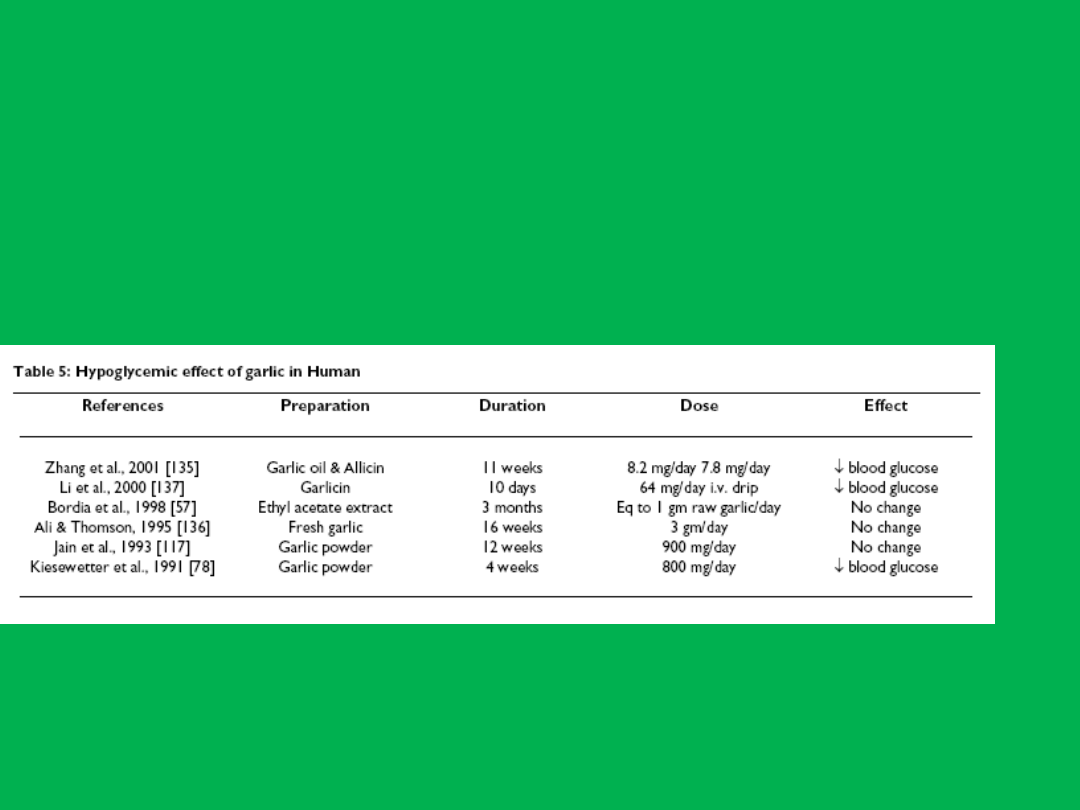
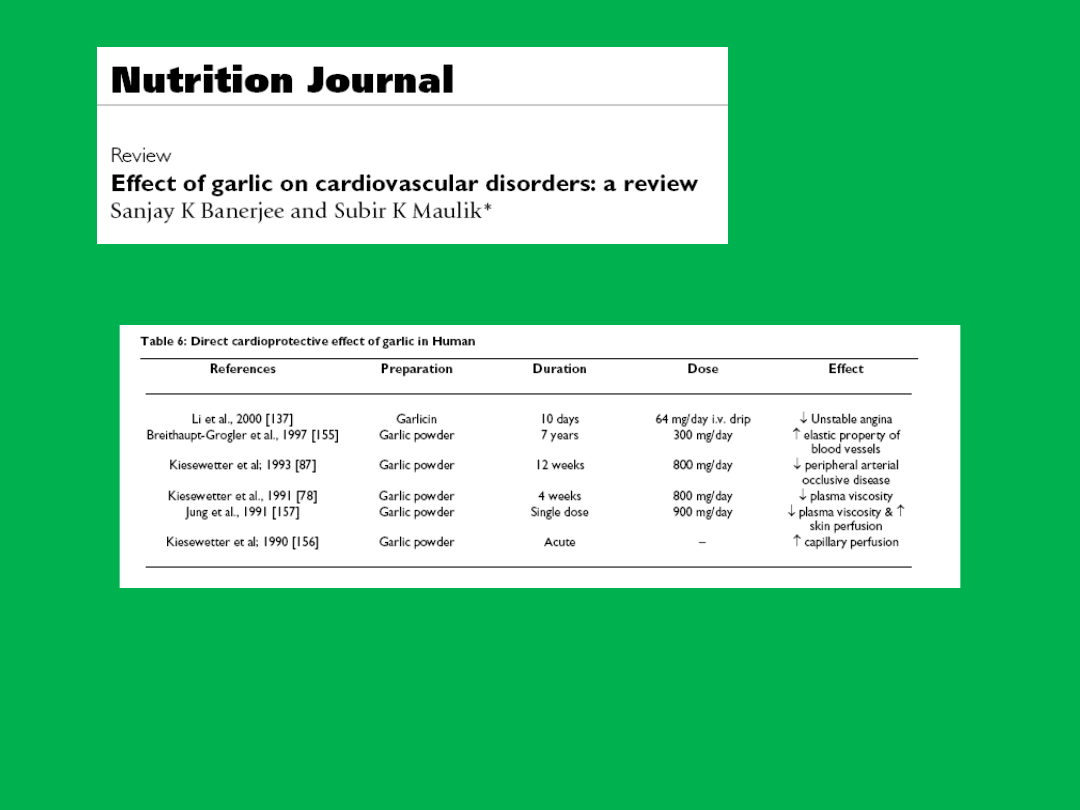
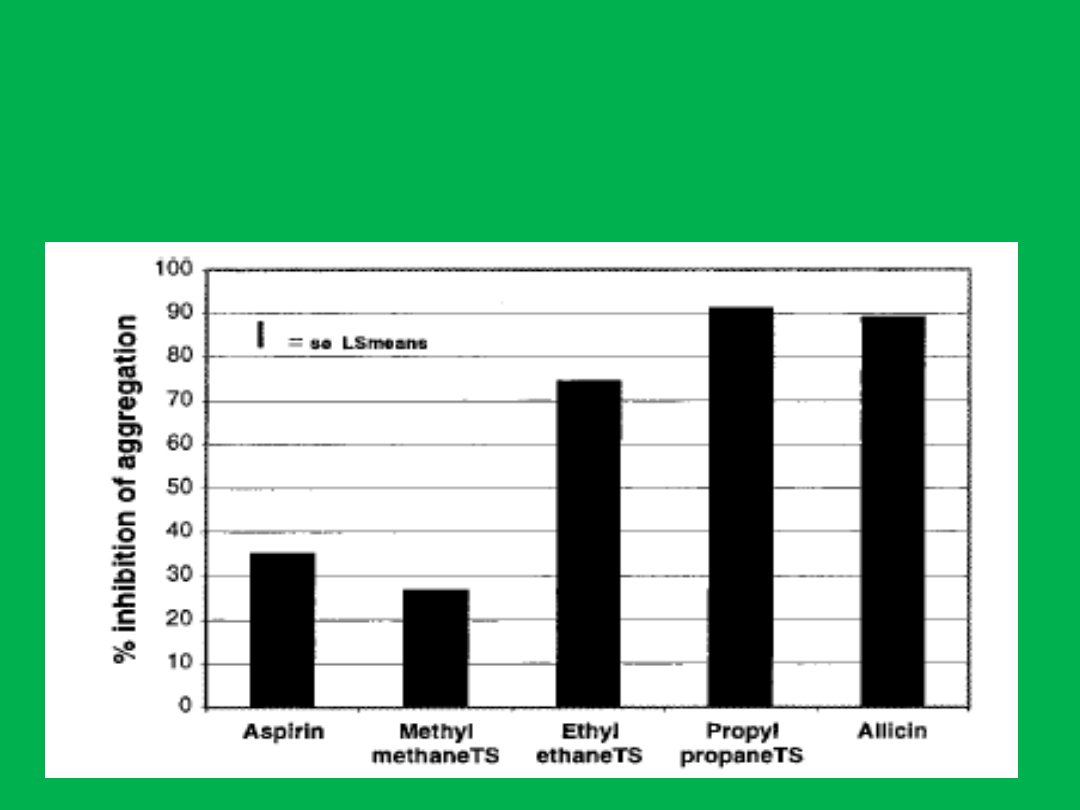
Can a clove (of garlic) a day keep
the doctor away?
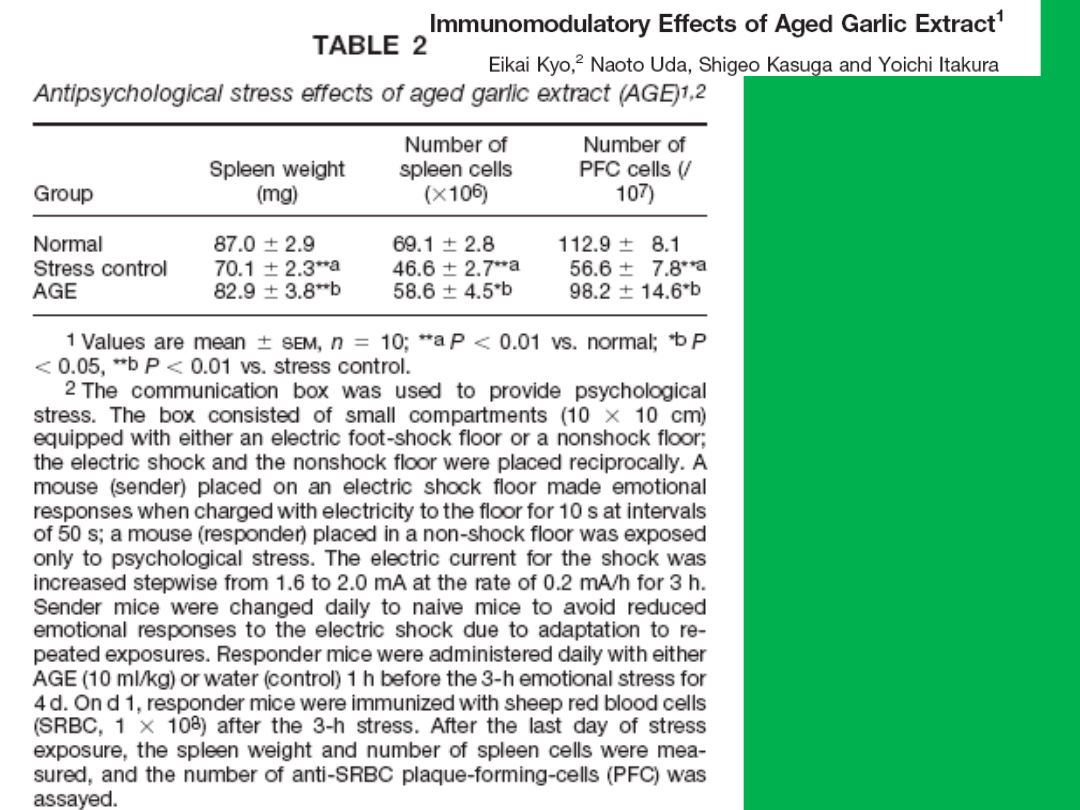
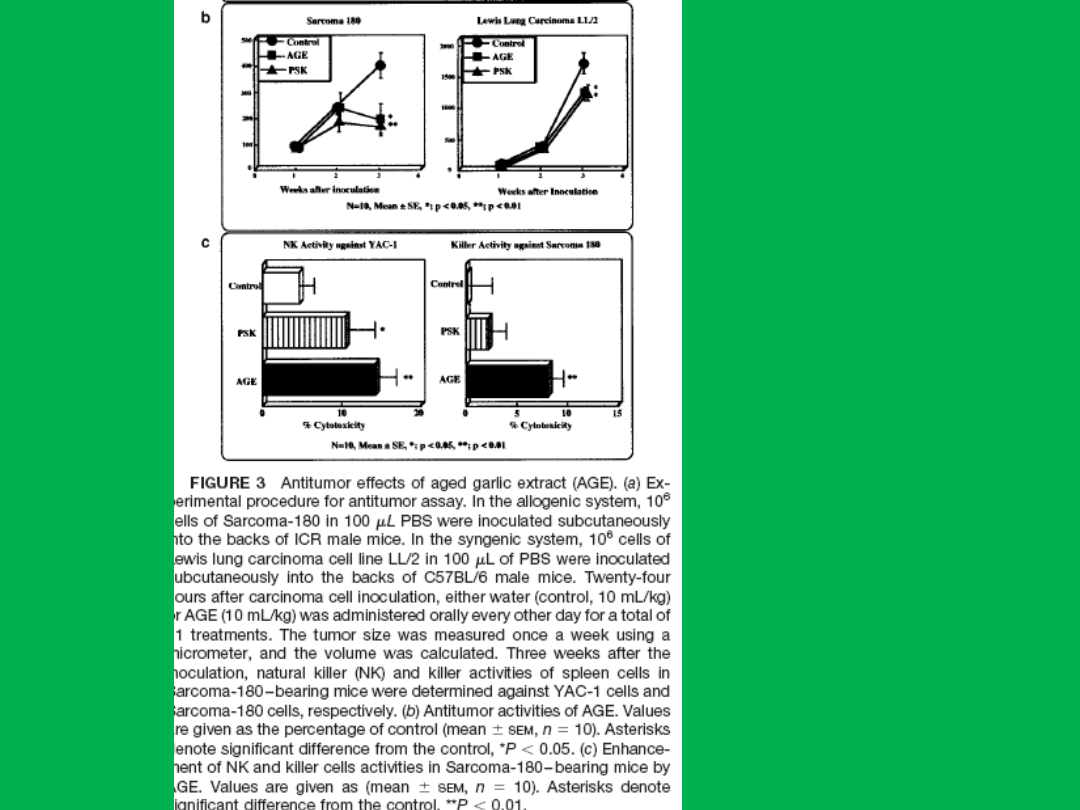
J. Nutr. 131: 1093S–1095S, 2001
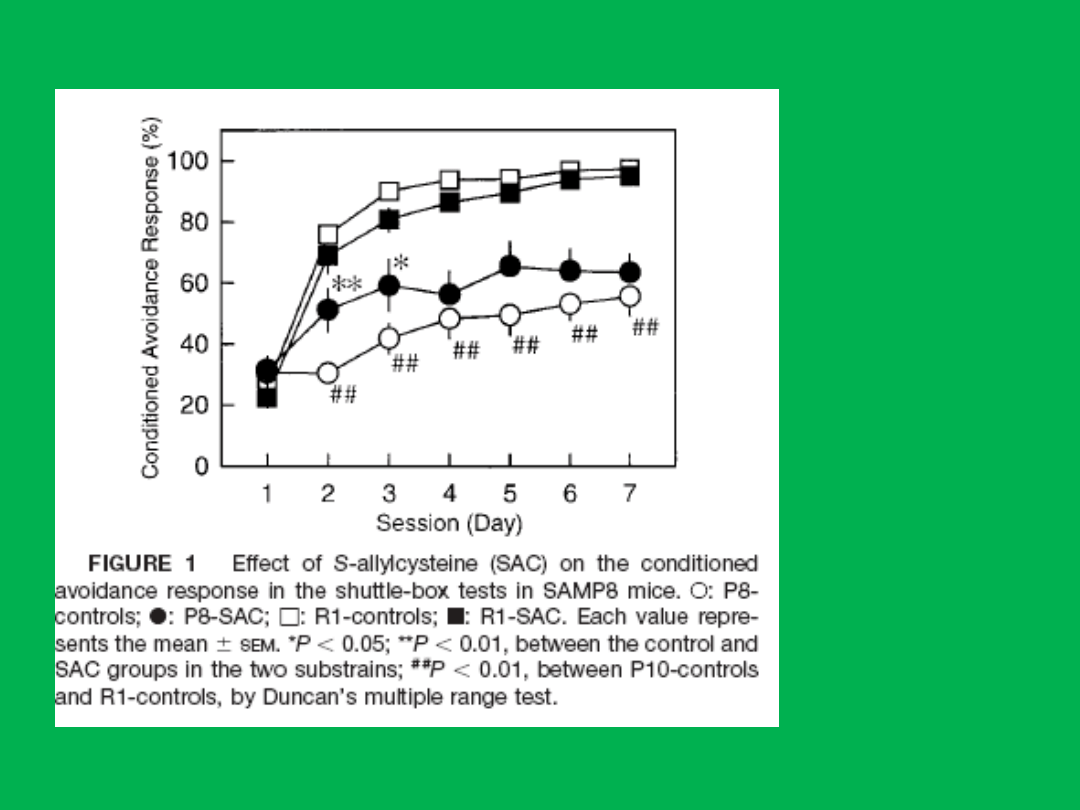
S-allylcysteine (SAC),Senescenceaccelerated prone P8
mice
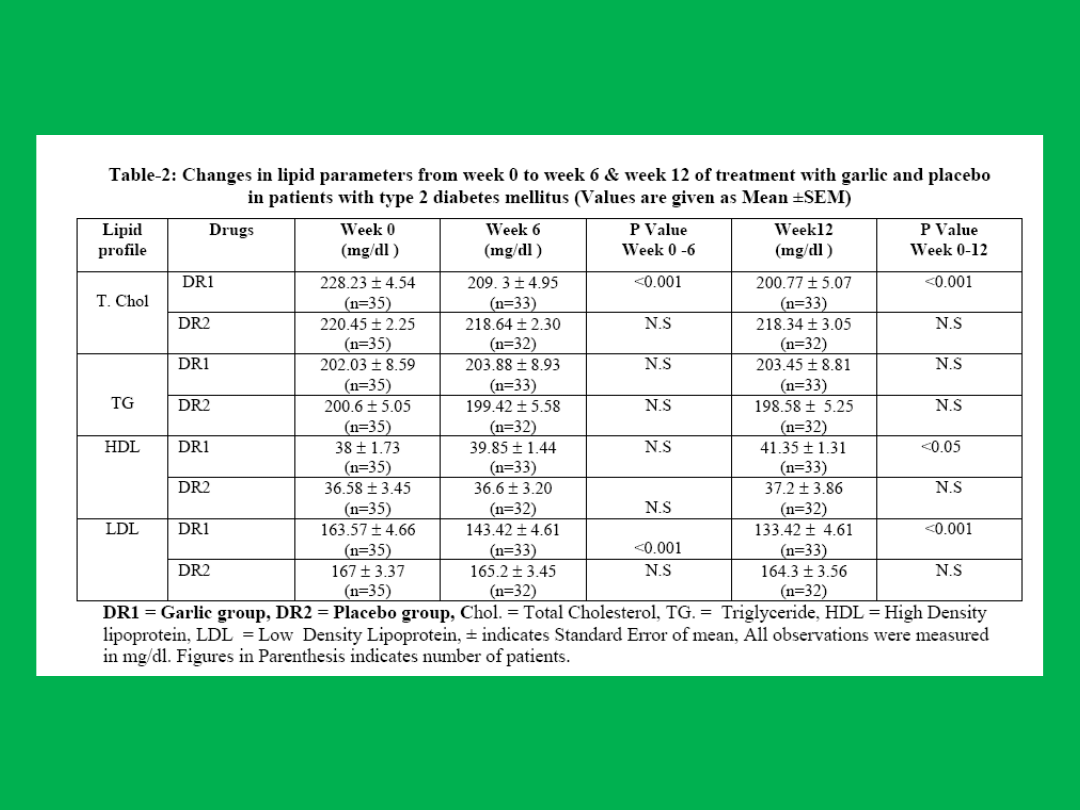
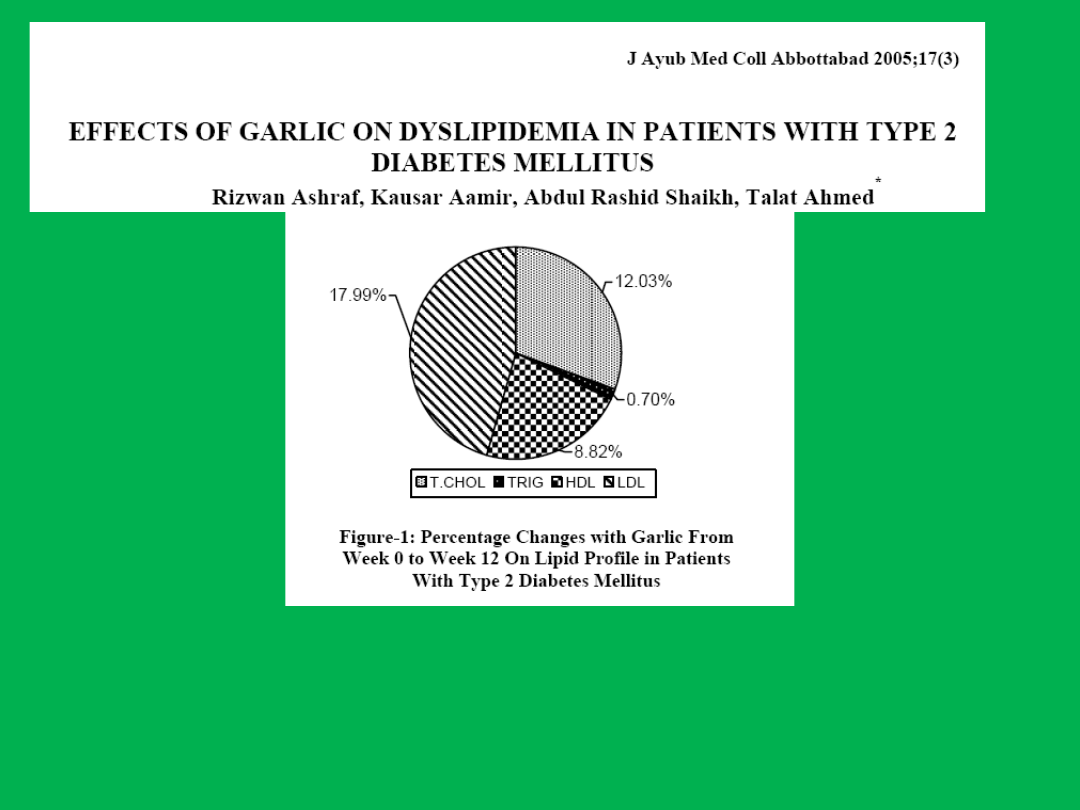
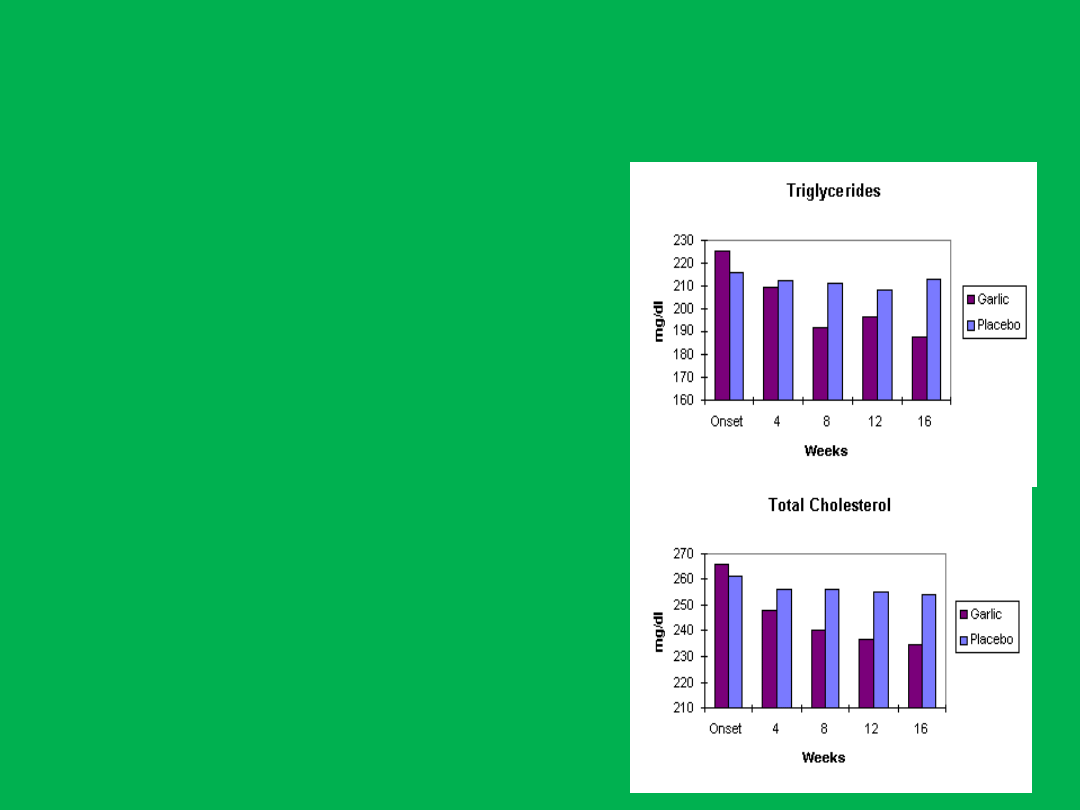
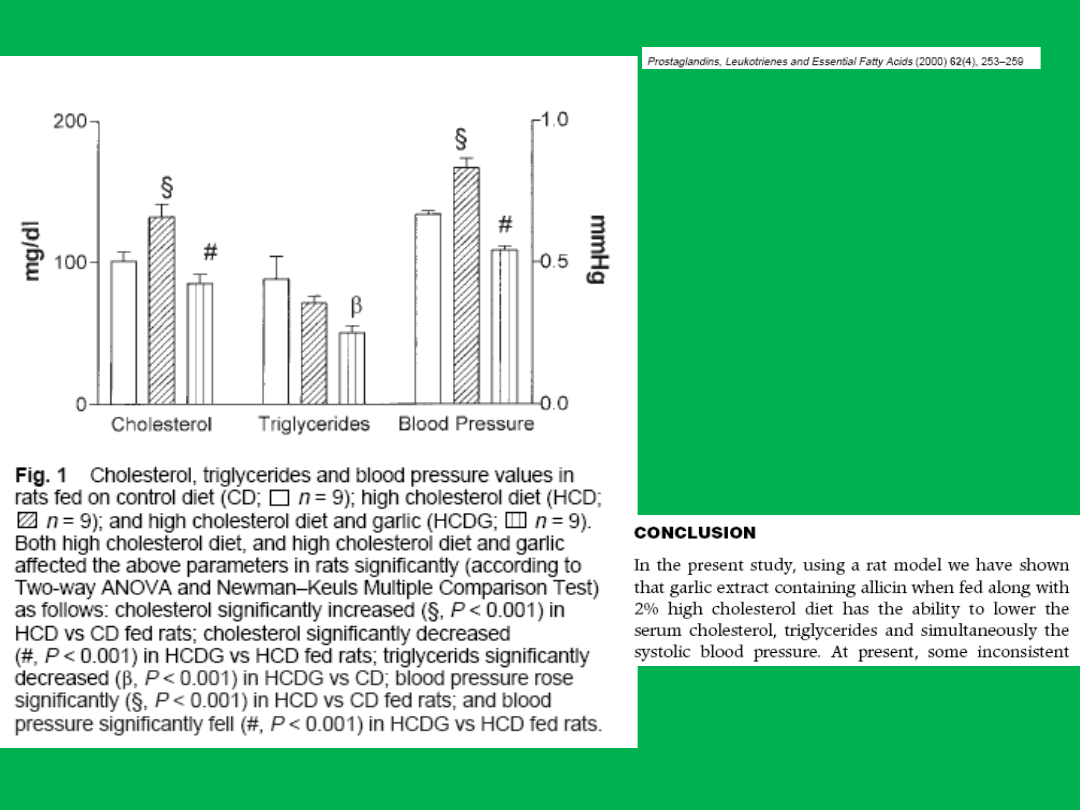
Garlic and Cholesterol
• Overall a 12% reduction in
total cholesterol was
shown over a placebo after
only 4 weeks treatment
• The largest study so far
was conducted in Germany
where 261 patients were
given either garlic powder
tablets or a placebo. After
12 weeks, mean serum
cholesterol level dropped
by 12% and triglycerides
dropped by 17% compared
to the placebo group.
0,1
1
10
100
1000
10
4
Concentration (
M)
0
20
40
60
80
100
120
C
h
o
le
st
e
ro
l
B
io
s
y
n
th
e
s
is
(
%
)
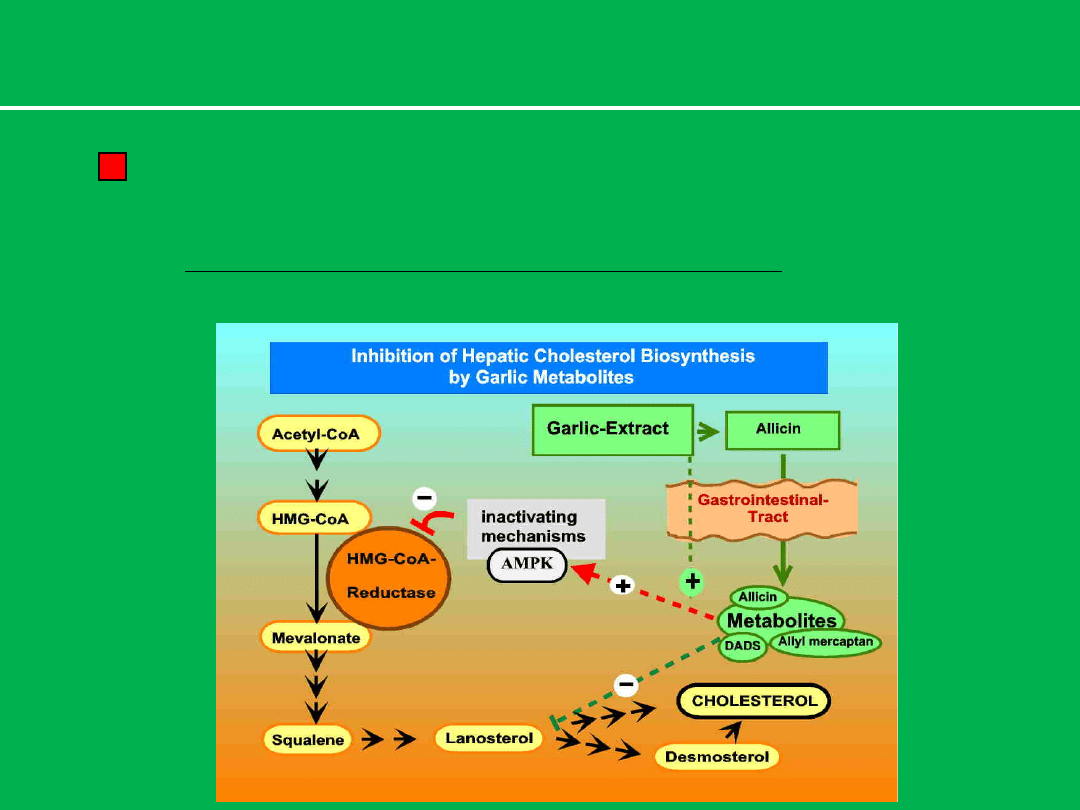
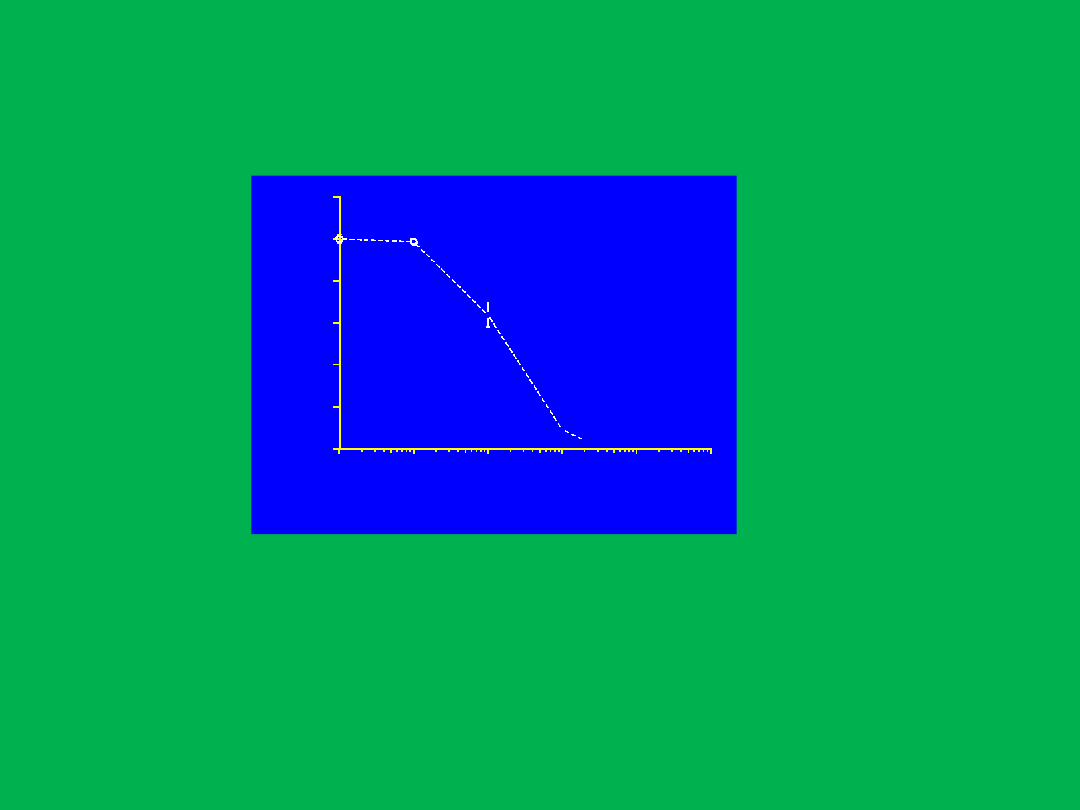
Organiczne związki siarki
Mechanizm hamowania biosyntezy Ch:

Document Outline
- Slide 1
- Slide 2
- Slide 3
- Slide 4
- Slide 5
- Slide 6
- Slide 7
- Slide 8
- Slide 9
- Slide 10
- Slide 11
- Slide 12
- Slide 13
- Slide 14
- Slide 15
- Slide 16
- Slide 17
- Slide 18
- Slide 19
- Slide 20
- Slide 21
- Slide 22
- Slide 23
- Slide 24
- Slide 25
- Slide 26
- Slide 27
- Slide 28
- Slide 29
- Slide 30
- Slide 31
- Slide 32
- Slide 33
- Slide 34
- Slide 35
- Slide 36
- Slide 37
- Slide 38
- Slide 39
- Slide 40
- Slide 41
- Slide 42
- Slide 43
- Slide 44
- Slide 45
- Slide 46
- Slide 47
- Slide 48
Wyszukiwarka
Podobne podstrony:
Wykład AGE 222
Wykład AGE 222
Napęd Elektryczny wykład
wykład5
Psychologia wykład 1 Stres i radzenie sobie z nim zjazd B
Wykład 04
geriatria p pokarmowy wyklad materialy
ostre stany w alergologii wyklad 2003
WYKŁAD VII
Wykład 1, WPŁYW ŻYWIENIA NA ZDROWIE W RÓŻNYCH ETAPACH ŻYCIA CZŁOWIEKA
Zaburzenia nerwicowe wyklad
Szkol Wykład do Or
Strategie marketingowe prezentacje wykład
Wykład 6 2009 Użytkowanie obiektu
wyklad2
wykład 3
więcej podobnych podstron