APOCALYPTIC LITERATURE
APOCALYPTIC LITERATURE
CONTENTS
Ascension of Isaiah
($0
Jubilees
48-58).
Assumption of Moses
59-67).
Introductory
Apocalypse of Baruch
Enoch; Ethiopic
18-32),
Slavonic
Testaments of
Patriarchs
68-76).
Psalms of Solomon
77-85).
Sibylline Oracles
86-98).
See
for references to the following. less
Abraham
(A
POCRYPHA
,
I
).
Esdras
Bartholomew
IO
(
I
)
E
).
Moses
: The objects and nature of apocalyptic
I. A
POCALYPSE
BARUCH
1.-
A composite work derived
from at least five authors, written mainly in
Palestine, if not in Jerusalem, by Pharisees
A.D.
Preserved only in Syriac
11.
Ethiopic
originally in Hebrew
or Aramaic by at least five
authors
B
.c.)
in
Palestine. Part I.
1-36
earlier
B.C.
Part
11.
literature
chaps. 83-00,
Part 111. chaps. 61-104,
B.C.
Part
(the Similitudes) chaps
94-64
B
.
C.
Part V. (the
Book
of
Celestial Physics) chaps.
79.
Part VI.
(Fragments of a lost Apocalypse of Noah)
Slavonic B
OO
K
OF
bv
an Alexandrian
from
existing materials,
A.D.
preserved only in Slavonic
;
IV.
O
F
I
SAIAH
.
-
A
composite work, written
originally in Greek, partly by Jewish, partly by Christian
authors.
A
.
D
.
Preserved in
and
in
-
-
Latin
B
OO
K
originally in Hebrew by a
Palestinian Jew a Pharisee of the Pharisees, probably
B
.C.
Preserved in Ethiopic and partially in Hebrew, Syriac, Greek,
Latin, and Slavonic
48-58).
VI.
A
SSUMPTION
OF
Palestine,
A
.D.,
by a Pharisee.
VII.
T
ESTAMENTS
OF
THE
Preserved only in Latin
59-67).
work written originally in Hebrew by two Jewish
representing respectively the legalistic and the apocalyptic sides
of
Pharisaism 130
and interpolated by a succession
of
Christian
from the close of the
century down to
the 4th century
A
.
D
.
Preserved in Greek, Armenian, and
Slavonic versions
68-76).
VIII. P
SALMS
originally in Hebrew,
possibly in Jerusalem, by two
more Pharisees,
B.C.
IX.
S
IBYLLINE
in Greek hexameters
and Christian authors mainly by the latter-the
portions belonging to the znd'century
the latest not
than the 3rd century
A
.D.
86-98).
INTRODUCTORY.-The object of apocalyptic literature
in general was to solve the difficulties connected
a
belief in God's righteousness and
suffering condition of his servants or
earth.
The righteousness of God postulated
temporal prosperity of the righteous, and this postulatt
was accepted and enforced by the Law.
But while
continuous exposition of the Law in the post-exilic
period
the people in their monotheistic
and intensified their hostility to heathenism,
expectations of material well-being, which likewise tht
Law had fostered, were repeatedly falsified, and
grave contradiction thus emerged between the
prophetic ideals and the actual experience of the nation
between the promises of God and the bondage and per.
secution which the people had daily to endure at
hands of their pagan oppressors. T h e difficulties arising
from this conflict between promise and experience migh
be shortly resolved into two, which deal
with the position
(
I
)
of the righteous as a community
and
of the righteous man as an individual.
The
O T
prophets had concerned themselves
with the former,
pointed
the main to the restora
(or 'resurrection') of Israel as a nation, and
Israel's ultimate possessisn of the earth as
a
reward o
righteousness. Later, with the growing claims of
individual, and the acknowledgment of these
in
On other Apocalypses of Baruch.
see
below,
20.
On chaps.
see
HA
no.
,
nos.
I
no.
and
no.
also below,
and intellectual life, the second problem pressed
tself irresistibly on the notice of religious thinkers, and
nade it impossible for any conception of the divine rule
righteousness which did not render adequate
action to the claims of the righteous individual to gain
Thus, in order to justify the righteousness
if
God, there was postulated not only the resurrection
if the righteous nation but also the resurrection of the
individual. Apocalyptic literature, therefore,
;trove to show that, in respect alike of the nation and
the individual, the righteousness of God would be
vindicated and, in order to justify its contention,
t sketched in outline the history of the world and of
the origin of evil and its course, and the
inal consummation of all things; and thus,
fact,
t presented
a
Semitic philosophy of religion (cp
O
F
OT,
I
).
The righteous as
a
should yet possess the earth either
an eternal
in a temporary Messianic kingdom, and the destiny
the righteous individual should finally be determined
according to his works.
For, though he might perish
untimely amid the world's disorders, he would not fail
to
attain through the resurrection the recompense that
was his due in the Messianic kingdom, or
heaven
itself. The conceptions as to the duration and character
of the risen life vary with each writer.
The writings that are treated of in the rest of this article,
however, deal not only with the Messianic expectations
but also with the exposition and application of the Law
to the numberless circumstances of life.
As
Schiirer
has rightly observed, the two subjects with which Jewish
thought and enthusiasm were concerned were the Law
and the Messianic kingdom. These were, in fact, parallel
developments of Pharisaism.
As
we have the
its legalistic side-represented in the Book of
so
we have the latter-its apocalyptic
mystical side
-set forth in the
Book
Enoch.
The
Testaments
the
Patriarchs
give expression to both sides of
Pharisaism
but this book, as we shall see in the
sequel, is really a composite work and springs from
authors of different schools. The rest of the books here
discussed belong mainly to the apocalyptic side of
Pharisaism.
It
is
a
characteristic of apocalyptic as distinguished
from prophecy that the former trusts to the written, the
This is due
largely to the fact that the prophet
addresses himself chiefly to the present and its concerns,
and that, when he fixes his gaze
the future, his
prophecy springs naturally from the circumstances of
the present.
The apocalyptic writer, on the other
hand, almost wholly despairs of the present his main
interests are supramundane.
He entertains no hope
of
arousing his contemporaries to faith and duty by direct
and personal appeals.
His pessimism and want of faith
in the present thus naturally lead him to pseudonymous
authorship, and
so
he approaches his countrymen with
a
writing which purports to be the work of some
great figure in their history, such as Enoch, Moses,
Daniel, or Baruch. The standpoint thus assumed is as
skilfully preserved as the historical knowledge and
conditions of the pseudonymous author admit, and the
future of Israel is foretold in a
enigmatical indeed
Paul
13).
Zephaniah
no.
latter to the spoken, word.
APOCALYPTIC LITERATURE
but generally intelligible. All precision ceases, however,
when we come to the real author’s own time: his
predictions, thenceforward, are mere products of the
religious imagination, and vary with each writer.
In
nearly every case, we should add, these books claim to
,
be supernatural revelations given to the men by whose
names they are designated.
It will not be amiss here to notice the gross mis-
apprehension under which
and other
Jewish writers laboured when they pro-
nounced this literature to be destitute
of value for the history of Jewish
religion. T o such statements it
sufficient answer
that from
zoo
B
.
c.
to
70
A. D.
the religious and political
ideals that really shaped the history of Judaism found
their expression in this literature.
It is not in the
discussions and logomachies of the Rabbinical schools
that we are to look for the influences and aims that
called forth some of the noblest patriotism and self-
sacrifice the world has ever witnessed, and educated the
nation for the destinies that waited it in the first century
of our era, but in the apocalyptic and pseudepigraphic
which, beginning with Daniel, had a large share
in preparing the most religious
ardent
of
Galilee and
either to pass over
Christianity,
or else to hurl themselves
fruitless efforts against the
invincible might of Rome, and thereby all but annihilate
their country and name.
Still it is true that the work
of
the scribes and the exposition of the schools had opened
the way for this new religious and literary development.
The eschatological element, moreover, which later
attained its full growth in such
writings as Daniel, Enoch, Noah, etc., had already
strongly asserted itself in later prophets such
as
Is.
24-27, Joel, Zech. 12-14. Not only the
therefore, but also a well-defined and developed type of
this literature had already established itself in the OT.
Its further developments were moulded, as we have
pointed out above, by the necessities of the thought and
by the historical exigencies of the time.
Cp Smend‘s introductory essay on Jewish apocalyptic,
Z A
5
Schiirer,
5 44
Hilgenfeld, Die
I.
T
HE
A
POCALYPSE O F
Apocalypse
of Baruch
was
for the first time made known to the
modern world through a Latin version
of Ceriani in
1866
This version
was
made from
a
Syriac
MS
of the sixth century, the text of which was
also in due course published by the
scholar, in
ordinary type in
1871,
and in a photo-lithographic
facsimile in 1883. An examination of the Syriac version
makes it clear that this version is a
translation from the Greek. It occasion-
ally transliterates Greek words, and
the text is at times explicable only
on
the supposition that the wrong alternatives of two
possible meanings of certain Greek words have been
followed by the translator.
Even before Ceriani’s
publication, however, we had some knowledge of the
Apocalypse of Baruch for chaps. 78-86, which contain
Baruch’s Epistle to the nine tribes and
a
half that were
captivity. had already appeared in Syriac
Latin,
in the London and the Paris Polyglots, in Syriac alone in
Lagarde’s
Vet.
Test. Apoc.
1861,
in Latin
in Fabricius’s
Cod.
T e s t . ,
and in
in
Authentic
Records.
Ceriani’s Latin
version was republished in Fritzsche’s
Lib. Apoc.
Vet.
Test.
(’71)
in a slightly emended form;
as
the
Syriac text was still inaccessible. Fritzsche’s emendations
are only guesses more or less fortunate-generally less.
W e have just remarked that the Syriac version is
a
translation from the Greek. We shall
now enumerate the reasons from which
it appears that the Greek was in turn
translated from a Hebrew original.
T h e quotations from, or unconscious reproductions of, the
DT
agree in all cases but one with the Massoretic text against
Hehrew idioms survive in the Syriac text.
’l’hus
arc many
of the familiar Hehrew idiom of the
infinitive absolute combined with the finite verb, and many
breaches of Syriac grammar in the Syriac
text
are probably to
as
survivals of Hebrew order and Hehrew syntax.
Unintelligible expressions in the Syriac can he explained
the
restored bv retranslation into Hebrew.
Thus.
among many others the passages 2 1 9
24
and
7
can be
retranslation
thence
into Hebrew. The Syriac in these verses is the stock rendering
of
and this in turn of
and this’ is the meaning required in
above passages,
where the Greek translator erroneously adopted the commoner
rendering.
(iv.) Many
discover themselves on
retranslation into Hebrew.
The final editor
of
this work assumes for literary
the
of Baruch. the
son
of
See
Charles,
Apoc.
44’53.
The scene is laid in the neighbourhood
of Jerusalem; the supposed time is the
period immediately preceding and subsequent to the
capture of the city by the
Baruch, who
begins by declaring that the word of the Lord came
to him in
twenty-fifth
of
speaks
throughout in the first person. If we
the letter
to the tribes in the captivity (chaps. 78-87), the work
naturally divides itself into seven sections, separated from
one another in all but one instance
after 35) by
fasts which are, save at the end of the first section, of
seven days’ duration. The omission of a fast after chap.
35
may
been due either to an original oversight of
the final editor or to the carelessness of
a
copyist.
That the text requires the insertion
o f
such a fast is to
con-
cluded on the following grounds
to
scheme of
the final editor events proceed in each section in a certain
order (see Charles,
9,
36,
61).
Thus first we
find a fast, then generally a prayer, then a divine message or
disclosure, and
an
of
this to an individual
or to the people. Thus in the fifth section 21-34 we have a
seven-days’ fast (21
a
prayer (21 4-26),
and an address to the people (21 24). Then another seven-days’
should ensue
at
the beginning of the sixth section
With theexception of this omission events follow in this section
as
in the others.
These sections are very unequal in length-1-56
57-8
21-35 36-46 47-77-a fact that,
though it does not in itself make against unity of
authorship, confirms the grounds afterwards to be
adduced for regarding the work as composite.
I
.
The first section
opens with God’s revelation to
Baruch regarding the coming destruction of Jerusalem.
a
time of prosperity should return.
According to the next section (5
I
)
,
Baruch fasts until
the evening, and the
encompass Jerusalem next day.
I n a vision Baruch
sees the sacred vessels removed
the
temple by angels and hidden in the earth till the last times.
T h e angels next overthrow the walls, the enemy are admitted
and the people carried away captive to Babylon.
In the third section (9
Baruch fasts seven days, and
receives a
divine command to tell Jeremiah t o go to Babylon;
but Baruch himself is to remain a t Jerusalem to receive God‘s
revelations regarding the future.
Baruch bewails Jerusnlem
and the lot of the survivors.
Would that thou hadst ears,
0
earth, and that thou hadst a heart,
0 dust, that ye might go and
announce in Sheol and say to the dead
:
“Blessed are ye more
than we who live.”’
4.
the fourth section (12 5-20), Baruch fasts for seven days
and
told hv God that he will be oreserved till the end of
in order to
testimony against‘ the nations that oppressed
Zion. When
of the prosperity of the wicked
and the calamities of the righteous God answers that the future
world is made on account of t h e
the blessings of
life are to he reckoned not by its length but by its quality and
its end. Baruch is hidden not to publish this revelation (20
3).
5.
In the fifth section
1-35),
Baruch fasts
as
usual seven
days.
He
deplores the bitterness of life, nnd supplicates
to
bring about the promised end. God reminds him of his ignor-
ance, and declares that the end, though close at hand, cannot
arrive till the predestined number
men be fulfilled, and again,
in answer to Baruch’s question respecting the nature and the
of the judgment of the ungodly, describes the coming
time of tribulation, which will be divided into twelve parts. At
its
close
the Messiah will he revealed. Baruch summons a
meeting of the elders in the valley of Kedron, and announces to
them t h e future glory of Zion.
6. The sixth section
with the missing fast
of
seven
davs.
Shortlv after. he has a vision of a cedar and a vine
W e
may observe here that
reigned only three
months, and was carried captive to Babylon eleven years before
the
fall
of Jerusalem.
APOCALYPTIC LITERATURE
whichsymholise the
the triumphofthe Messiah.
askswho shall share
the future blessedness, God
answers :
‘ T o
have
there will be the
ness that
spoken of
Baruch
calls
together his first-born son and seven of the elders, tells them of
his approaching end, and exhorts them to keep the law, for ‘ a
wise man will not he wanting to Israel, nor a son of the law to
the race of Jacob.’
7. After a fast of seven days Baruch in the seventh section
prays for Israel. The
that ensue tell of the
coming tribulation.
the evil effects of Adam’s
fall.
I n answer to his request, he is instructed as to the nature
of the resurrection bodies. Then, in a new vision
he sees
a
cloud ascending from the sea
covering the whole earth.
There was lightning about its summit, and soon it began
to discharge first black waters and then clear, and again hlack
waters and then clear, and so on till there
been six black
waters and six clear.
At last
it
rained black waters, darker
than had been all that were before. Thereupon, the lightning
on the summit of the cloud flashed forth and healed the earth
where the last waters had fallen, and twelve streams
up
from the sea and
subject to that lightning.
I n
the
chapters the vision
is
interpreted.
cloud is
the world, and the twelve successive discharges of black waters
and clear waters symbolise six evil periods and six good periods
of the world’s history. T h e eleventh period
by the
hlack waters, pointed to the supposed
of Jeru-
salem. The rest of the interpretation follows in the future tense.
The twelfth clear waters point to the renewed prosperity of Israel
the rebuilding of Jerusalem.
T h e last hlack waters that
were to flow pointed to troubles, earthquakes, and wars over
the whole earth. Such as survived these were to fall by the
hands of the Messiah. These blackest
of
all the waters were
to be followed by clear waters, which
the blessedness
of the Messianic times. This Messianic period should form the
boundary line between corruption and incorruption.
That time
is the consummation of that which is corruptible, and the begin-
ning of that which
is incorruptible.’
Baruch thanks God for
the revelation vouchsafed. H e
is then informed of his coming de-
parture from the earth, hut is hidden first to go and instruct the
neonle. He admonishes them to
faithful
and at
request sends two epistles
o n e
to their
(‘the two and a half tribes’)
the other
to
the tribes (‘nine
and a half’) beyond the Euphrates.
T h e latter is given
chaps.
I t is probable that the lost letter to the two tribes
and a half is identical with, or is the source of, the Greek Baruch
3
the discoverv of the
of Baruch
See Charles, Apoc.
Bar. 65-67.
1866 till
it was regarded by
scholars
In the latter
year,
in an article entitled Die
der Apocalypse
sources.
as the work of one author.
1891,
66- IO^),
showed beyond the possibility of
question that the work was composite and derived from
at least three or four authors.
Thus be distinguishes 1-24
I
,
30 2-34, 41-52,
and 75-67 as
groundwork written after 70
A.D.,
since these chapters imply
destruction of the temple.
H e further observes that these
parts are marked by a despair which no longer looked for peace
and happiness in this world, but fixed its regards on the world
of incorruption. In the other pieces of the book there is a
strong faith in Israel‘s ultimate triumph
and a n
which looks for the consummation of Messianic
in this
life and, as Kahiscb rightly remarks, the temple is still standing.
These other sections, however, are the work not of one writer
but of three, being constituted a s follows : a short Apoc. 24
29,
the Vine and Cedar Vision 3G-40, and the Cloud
53-74
:
30
I
35
are due to the final editor.
It
is
open, however, to unanswerable objections. There is
no unity in the so-called groundwork.
When submitted to a detailed criticism, it
exhibits a mass of conflicting conceptions
and statements. The results of such a
criticism may be stated briefly as follows (for the details
see Charles,
Bur.
53-67).
1-26
31-35 41-52
87
were written after the fall of Jerusalem, and were
derived from three or possibly four authors,
B,, B,,
B,,
and possibly
S.
84
written b y a Pharisee
who expected
to he rebuilt and the dispersion to he
This theory
is
certainly in the right direction.
hack from exile.
13-25
47-52
63,
also
a
Pharisee who looked for no national restoration, hut only
the recompense of the righteous in heaven.
written by a Jew in exile.
possibly
a
Sadducee, hut perhaps to be
signed to
for
of the book was written before the fall of
It consists of
Apocalypse
(=A,)
Jerusalem.
and the two Visions
36-40 (
and
already mentioned. All these different elements were
combined by the final editor, to whom we owe also
42-6
26
and possibly some other additions.
Jewish religious thought busied itself, as already
observed,
with two subjects, the Messianic hope
and the Law and in proportion as the
one became more prominent the other
fell into the background.
Now, the
chapters written before 70
A.
D
.
arc mainly Messianic.
27-30
I
take account of the Lam
only indirectly, whereas in those written after that date the whole
thought and hopes of the writers centre in the Law as their present
mainstay and their source of future bliss. I n chaps. 53-74
again, the Messianic hope and the Law are equally emphasized:
This writing marks the
of early Rabbinism and
popular Messianic expectation.
In the sections B, and
B,,
on
the other hand, written
the fall of Jerusalem, we have two distinct outlooks
as
to the future.
In
B,
the writer is still hopeful as to
the future of Jerusalem.
It
is delivered into the hands of its enemies indeed, but only
for a time (4
I
The consolation of Zion should yet be
accomplished (44 7
I
and the ten tribes brought hack from
their captivity (78 7 84
Moreover the retribution of the
Gentiles was close a t hand (82
and’in due time would arrive
the judgment, in which God’s justice and truth should exact
their mighty due (859).
In
B,,
on the other hand (and if possible still more in
the writer is full of irremediable despair
as to the earthly fortunes
of
Zion and its people in this
world
The
righteous have nought to look for save the new world (44
the
world that dies not (51
the world of incorruption (85 5). Only
in the world to come will every man he recompensed in the
resurrection according to his works
when the wicked
shall go into torment and the righteous
made like unto
the angels.
In the sections written before the fall of Jerusalem,
the Messianic element, which was wanting in
B,, B,,
and B,, is predominant.
The three Apocalypses
27-30
(A,)
36-40
(A,)
53-74
(A,)
have many features in
common-such as an optimistic outlook as to Israel’s
earthly prosperity, the earthly rule of the Messiah till the
close of this world, and the material blessings
of
his
kingdom. There are, however, good grounds for regard-
ing them as of different authorship. The Messianic reign
is to close with the final judgment.
On
the Escha-
tology of the book see, further, E
SCHATOLOGY
,
78.
All the elements of this book are distinctly Jewish.
Its authors, as already observed, were Pharisees, full of
confidence
the future glories of their
nation, either in this world or in the nest,
notwithstanding their present humilia-
tions.
They entertain the most lofty conceptions as to
the divine election and the absolute pre-eminence of
their race.
I t was on Israel’s account that not only the present world
(14
but also the coming world
7)
was created.
Israel is
God’s chosen people whose like is not on earth
the
perpetual felicity of Israel lay in the fact that they had not
mingled with the nations (4623).
The one law which they had
received from the one God (48
24)
could help and justify them
(51 3);
for so far as they kept its ordinances they could not fall
(48
: their works would save them (14
51
I n due
time also all nations should serve Israel; but such of
had
injured Israel should be given to
sword
The carnal
nature of the Messiah and his kingdom
--40
72-74)
is essentially Pharisaic.
There was to he a
resurrection (42
8
I
;
hut apparently only Israel should De
saved (51 4).
( S e e Charles,
Destruction awaits this world of corruption (21
31
5).
I t is possible to determine approximately
earlier limit
of the composition of
by means of
we might call
Enochic canon. This is
:
No
book which
Enoch
written
after
5 0
a n d
words a n d achievements
a
other
O T
heroes is a sign that
it
w a s
written after the
Christianity. This hostility to
from
E
O
A
.D.
onwards (cp Enoch) is to he traced to
among the Christians as a Messianic prophet. For the grounds
and illustrations of this
see Charles,
Now, in 59
of this Apocalypse many of Inoch‘s
functions and revelations are assigned to Moses. Hence
was written after 53
218
APOCALYPTIC LITERATURE
The affinities of Apoc. Bar. with 4 Esdras are
so
strik-
ing and
so
many that Ewald ascribed the two books
to
the
same author. Though this view has not
been accepted in later criticism, it will
not be amiss to draw attention to these
affinities.
(
I
)
The main features of the two books are
similar. They have one and the same object-to de-
plore Israel‘s present calamities and awaken hope in the
coming glories, temporal or spiritual, of their race.
I n
both the speaker is a notable figure of the time of the
Babylonian captivity.
I n both there is a sevenfold division of
the work,. and
an
interval (as a rule, of seven days) between each
two divisions ; and, whereas in the one Ezra devotes forty days
to the restoration of the scriptures, in the other Baruch is
to
forty days in admonishing Israel before his de-
parture from the earth.
They have many doctrinal peculiarities in common.
According to both, man is saved
works (4 Esd.
7
77 8 33
9 7
2
1 4
etc.)
;
the world was created
behalf of
Esd. 6 55
7
9
Bar.
1 4
19
15 7
man came
not into the world of his own will (4 Esd. 8 5,
Bar.
1 4
48
15);
a predetermined number of men must be attained before
the
(4
Esd.
Bar.
2 3 4 5 ) ’
God will visit his
creation (4 Esd. 5 56
9
Bar.
20
4)
Adam’s sin was
the cause of physical death (4 Esd. 3 7
Bar.
23
the souls
of the good are kept safe in treasuries
the
(4
Esd.
4 35-37 7 32
8 0 95,
Bar.
30
This list
have been indefinitely added to.
On the other hand, there are clear
of
divergence.
Esdras the Messianic reign is limited
to
400
years
(7
),
whereas in Baruch
this oeriod is
indeterminate.
Again, in the former
the Messiah is to die, and
the Messianic reign is to close with the death of all
living things whereas in the latter, according to
30,
the
Messiah is to return in glory to heaven ,at the
of
his reign, and, according to
73
this reign is to be
eternal, though it is to belong partly to this world and
partly to the next.
Again, in Esdras the writer urges that God’s people should be
punished
God’s own hands and not
the hands of their
enemies (5 29
for these have overthrown the altar and
destroyed the
and made the holy place a desolation (10
I n
Earnch
described at length how the holy vessels
were removed
angels and the walls of Jerusalem demolished
the same agency before the enemy drew nigh
On
the question of original sin likewise these two hooks are
a t variance. Whilst in Esdras the entire stream of physical and
ethical death is traced to Adam (3.7
4 3 0 7 48)
and the guilt
of his descendants
a t the cost of
first
parent
(yet see
Baruch derives physical death indeed from
Adam’s transgression
(17 3 23 4 54
hut as t o ethical death de-
clares that “each man is the Adam of his own soul” (54
;
yet
see 48 42).
i t will be clear from the facts set forth above that
the relations of these two apocalypses constitute
a
com-
plex problem.
If we attempt to deal with
this problem on the supposition that each
book is derived from
a
single author, no
solution is possible; and the barrenness of criticism
hitherto in this direction is due to this supposition of their
unity. When, however, we come perforce to recognise
their composite nature, we enter at the same time on
the road that leads to the desired goal. For a pro-
visional study of the relations between the various con-
stituents of this apocalypse and 4 Esdras, the reader
can consult Charles,
Apoc.
Bar.
67-76. T h e results of
this study tend to show that, whilst some of the con-
stituents of
4
Esdras are older than the latest of Baruch,
other
of Baruch are decidedly older than
the remaining ones of
4
Esdras.
The points of contact between this apocalypse and
the
are many; but they are for the most part
insufficient to establish a relation of de-
pendence on either side.
The thoughts
and expressions in questions are explicable
from pre-existing literature or
as
commonplaces of the
time.
Such, among many others, are
Mt.
3 16,
Bar.
22
I
,
24,
Bar.
106, Lk. 2128,
Bar.
237,
Rom.
Bar.
8.
The following passages are of a different nature
and postulate the dependence of
our
apocalypse on the
or possibly, in one or two
of
the instances, of both
a
common source.
With
Mt.
1 6 2 6
‘ F o r what shall a man he profited if he
gain the
world and forfeit his
soul? or what
a
nan give in exchange for his soul?’ ‘cp
Bar.
51
‘ F o r
what then have men lost their life, or for ,what have those who
were on the earth exchanged their soul? Also with
I
Cor. 1 5
If
only we have hoped in Christ, we are of all
men
most miserable cp
Bar.
21
For if
were
this life only.
. .
could he more
than this.
Also
with
I
Cor. 1635, ‘How are the dead raised and with what
manner of body do they
492
‘ I n what shape will
those live who live in that day
Cp
Lk
1 4 2
with
Bar.
54
Jas. 1
with 52
6,
and Rev. 4 6 with 51
As the Apocalypse of Baruch was written between
50
and
it furnishes
us
with the historical setting
and background
of
many of the N T
lems, and thereby enables
us
to estimate
the contributions made in this respect by Christian
thought.
Thus, whereas, from
we see that the
Pauline doctrine of the resurrection
was
not an innovation but
a
developed and more spiritual
exposition of ideas already current in Judaism, it is clear,
on the other hand, from the teaching of this book on
Works and Justification, Forgiveness and Original Sin
and Freewill
(see
Charles,
op.
pp.
what a
crying need there was for the Pauline dialectic, and
what an immense gulf lay herein between Christian and
Rabbinic teaching.
No
ancient book is
so
valuable in
attesting the Jewish doctrine of that period.
addition to the works already mentioned,
the reader may consult Langen,
De
Bar.
(‘67)
E w . GGA (’67)
Hist.
of
Israel,
Drummond,
Jewish
Kneucker
Buch Bar.
Di.
in
1 2
;
Deane,
T
H
E
B
OOK
OF
the exegesis of later
times, the
that Enoch walked with God (Gen.
18.
Jewish
view of
Enoch.
see
was taken to
that he enjoyed superhuman privileges of
intercourse with God, and in this inter-
course received revelations
as
to the nature
of the heavens and the earth, the present lot and the
destinies of men and angels.
It was natural, there-
fore, that an apocalyptic literature should seek the
shelter and authority of his name in ages when such
literature became current.
In the Book
of
Enoch
pre-
served in Ethiopic we have large fragments of this
literature proceeding from
a
variety of Jewish writers
in Palestine; and in the
Book
the
Secrets
of
Enoch
preserved in Slavonic we have further portions of it,
written originally by Hellenistic Jews in Egypt.
To
the latter book we shall return.
The Book of Enoch as translated into Ethiopic
belongs to the last two centuries
B.C.
All the writers
of
the N T were familiar with it and were
influenced by it in thought
It is quoted
as
a
genuine
production in the Epistle of Jude
) and
as
in that of
4 3
‘ T h e
authors of the Secrets
Test.
Patr.,
Bar.
and 4 Esd. laid it under contribution. With
the earlier Fathers and Apologists it had all the weight of
a
canonical book but towards the close of the third and
the beginning of the fourth centuries it began to be dis-
credited, and finally it fell under the ban
of
the Church.
The latest references to it are to be found in Syncellus
and Cedrenus, who have preserved large fragments of
the Greek version.
The book was then lost sight
of till
when two
MSS of
the Ethiopic version
were discovered by Bruce.
From one of these MSS
Lawrence made the first modern translation of Enoch
in
1821.
Enoch,. was originally written in Heb.
or
Aram..
not in Greek. On this question the
chief Apocalyptic scholars are practi-
cally agreed.
I n the case
of
chaps. 1-32 this view is established beyond the
reach of controversy’ for in
19 1 8 8
28
I
29
I
31
I
of the
Greek version we
find that the translator transliterated Heb. or
APOCALYPTIC LITERATURE
Aram. words that were unintelligible to him. T h e same view
a s to
remaining chapters has been amply proved in the
As. ('67)
by
who regards the entire
work a s derived from a Hebrew
See also Charles
Book
325.
Recently some Dutch and
scholars have argued for an Aram. original on the ground that
three Aram. forms have been preserved in the Gizeh Greek frag-
ment-viz.
in
in
I
,
and
29
I
.
The first is, it is true, an Aram. form of
and the two latter
of
This argument, however, is inconclusive.
find
in K. 14
as a transliteration of
and
in Neh.
2
as a
transliteration of
and thereareother instances
of the same peculiarity in
Hence the presence of such
in a text is not sufficient in itself to establish
an
Aram. original.
The Heb. original was translated into Greek, and
from Greek into
and Latin.
Of the Greek
version chaps.
6 - 9 4
have come down to us through
800
A.D.),
through
a
Vatican
but the most important fragment of
this version-the Gizeh Greek fragment-was discovered
only
few years ago by the Mission
at Cairo, and published in 1892.
M. Lod's critical edition of this fragment, accompanied by a
translation, appeared almost simultaneously, and next year it was
edited by t h e present writer with a n exhaustive comparison of
the Greek and Ethiopic
of
1-32, as an Appendix to his
work on
Enoch. T h e other Greek fragments will be found
the same work. T h e Gizeh fragment was edited
Dill-
mann
1079.1092).
T h e
meuts of the Greek Enoch with a critical apparatus are to be
published in the
edition of vol.
of
Swete's Cambridge
The Latin version is wholly lost-with the exception
of
19,
which is found in a treatise of the Pseudo-Cyprian
entitled A d
(see
Gesch.
2
and
which owes its discovery to Mr. James, in
an eighth-century MS in the British Museum.
This
fragment is critically edited in Charles's Book
Enoch,
372-37
James,
The Ethiopic version alone preserves the entire text,
and that in a more ancient and trustworthy form than
the other versions.
It has fewer
additions, fewer omissions, and fewer
and less serious corruptions.
I. The
Ethiopic MSS are compara-
tively many.
are about twenty scattered throughout the
libraries of Europe' half of them are found in the British
Museum. The best
all the known
MSS
is undoubtedly that
designated
in the British Museum.
Editions of
Text.-Only two editions have
appeared-that of Lawrence in
from one
and that of
Dillmann
from five
Unhappily,' these. MSS
were late and corrupt. The present writer hopes to issue a
text
on the
MSS now accessible to
scholars. Such a text is actuallypresupposed in his Translation
and Commentary of 1893.
I.
an%
accom-
panied
Commentaries have been issued by Lawrence
Hoffmann
Dillmann
Schodde
and
('93).
Of Dillmann's and Scbodde's Translations the reader
will find a short review in Charles
IV.
account of
will be found
in Schiirer,
Hist.
and in Charles's Book
Bnoch, 9-21
Of the many works on this book the following deserve
special mention here.
in
des
E
w.
wh.
d.
Kostlin
Ueh. die
d. B. Henoch'
1856,
Hilgenfeld,
Die
Geb;
ardt, 'Die
Hirten des Buches Henoch nnd ihre Deutungen
'(Merx's
des A T , 1872
Heft 2
Drummond,
The
Jewish Messiah
Lipsius in Smith and Wace's
of
('So),
2
Schiirer,
5 54-73
;
vol.
xxv.
pp.
The Book of Enoch is
a
fragmentary survival
of
an
entire literature that once circulated under his name.
To'this fact the plurality of books
as-
signed to Enoch from the first may in
sense
: as. for instance. the
expression books' in
Test.
Putr. Jud.
18
Origen,
554,
and elsewhere. Of this literature
five distinct fragments have been preserved in the five
books into which the Book
of
Enoch is divided
(1-36
22
17-71
72-82 83-90
91-108).
These bookswereoriginally
treatises ; in later tiines they were collected
edited, but were much mutilated in the course
of
and incorporation into a single work.
In
to this Enoch literature, the final editor of the
made use of a lost apocalypse, the Book of Noah
mentioned in Jubilees
21
IO
),
from which he drew
106
Another fragment of the
Book
of Noah
been embodied in the Book of Jubilees (see below,
i
We have already remarked that in the five books into
the whole work is divided we have the writings
of five different authors.
Before we
proceed to give some of the grounds
or this statement, we shall give in merest outline the
constituents found in the work by the chief
who have studied the subject.
Liicke
his
(see above,
23)
regards the book a s
of two parts.
T h e first part embraces 1-3G
written a t the beginning of the Maccabean revolt, or, according
o his later view, in the reign of John Hyrcanus: the second
of
the Similitudes (36-71) and
written in the early
of Herod the Great.
In
latter, however, there are
interpolations.
Hofmann
(J. Chr. K.) ascribes the entire
work to a Christian author of the second century. I n this view
was followed later
Weisse and
Hofinann
mention in this connection on the ground of his having
the first to give the correct interpretation of the seventy
shepherds in
Ew. in his
(see above
23)
gives
the following scheme :--Rook I.
circa 144
Book
84
91-105) circa 135
Book
72-90
circa
B.C.
.
108
later.
Book
IV.
the Book of
Noah
6
9 7 10
17-19
7-55
24
64-69
omewhat later than the preceding.
in his essay (see
ibove,
a contribution of great worth, arrives a t the
analysis
:
the gronndwork
circa
B
.C.
:
the Similitudes
and 17-19) before 64
B.C.
Noachic
Fragments
60
25,
possibly also 20
108
is an Essene addition.
Hilgenfeld
regards the
groundwork, consisting of 1-10
a s written before
.
and the remaining chapters as coming from the hand
of
a
Gnostic after the time of Saturninus.
T h e
interesting
of
and the
works of Lipsius Schiirer, Drummond, enumerated above
and Schodde
Book
Bnoch, 1882)
only be mentioned
here. As Dillmann changed his mind three times, and in each
instance for the better, it will be
to
give his final
analysis. The gronndwork (1-3G
in the time of John
the Similitudes and 17-19, 'before 64
B.C.
the
Noachic fragments (6
3-8
9
7
10
I
20 39
I
54
7-55
GO
25
from a later hand.
W e shall now proceed to discuss this question
(?)
17-19
43J
5 4 7
and endeavour to carry the
criticism of the book one further stage
towards finality.
Disregarding the interpolations from the Book of Noah
already mentioned
as
well as the closing chapter, we find
that all critics are agreed in ascribing the Similitudes
(37-70)
to
an
authorship different from the rest.
The
remaining chapters
(1-36
have been regarded by
all critics except Ewald and Lipsius
as
proceeding from
one and the same author but these scholars, while differ-
ing from each other, have not persuaded any one but
themselves
as
to the justness of their respective analyses.
In their contention, however,
as
to the conipositeness of
these chapters they were undoubtedly right.
This
question has been gone into at length in Charles's
Book
55
220
where
grounds are given for believing that sections 1-36, 72-82,
83-90, and
are writings distinct
as
to author-
ship, system of thought, and date.
We must now
proceed to sketch briefly the various independent writings
contained in the entire work, assigning to each its most
probable date.
Part I., consisting of chaps.
1-36
(for the Noachic
interpolations, see
was
written at latest befoi-e
170
and mainly from the prophetic
standpoint of such chapters as
Is.
65.
This is, undoubtedly, the oldest part of
the book, being anterior to
72-82, 83-90,
91-104,
as
it is
used by the writers of these sections.
As S3-90 was written not later than
must be
some years earlier, and, as there is no allusion to the massacres
222
APOCALYPTIC
LITERATURE
of Antiochus Epiphanes, the above date, 170, is the latest
reasonable limit for
composition.
T h i s
1-36- is t h e oldest piece of Jewish
literature that teaches t h e general resurrection of Israel,
describes Sheol according
to
t h e conception t h a t prevails
i n t h e
N T
a s opposed
to that
of t h e
OT,
o r represents
as
a
final place of punishment (cp
E
SCHATO
-
LOGY
,
63).
problem of
the
a u t h o r is t o justify
t h e ways of G o d t o men.
The righteous will not suffer always
Sin is the cause of
this suffering and the sin of man is due to the lust of the angels
- the
(969
Hence the Watchers, their
companions and their children will he destroyed
Their
will form
to the first world-judgment,
of which the Deluge will form the completion
still
prevailed after the Deluge: however, through the influence of the
evil spirits that went forth from the slaughtered
of the
Watchers and the daughters of
These act with
impunity till the final judgment.
I n the meantime character
finds its recompense in some
immediately after death
I n the last judgment the Watchers, the demons,
all
classes of Israelites with one exception, will receive their final
award
This judgment is preceded
a
general
resurrection of Israel
The wicked are cast into Gehenna
(27
; the earth is cleansed from sin (10
the Messianic
kingdom is established, with Jerusalem as a centre (25 5) and
God abides with men
Gentiles are converted
The righteous eat of the tree of life
and thereby enjoy
patriarchal lives
As to what befalls the righteous after the
second death there is no hint in this fragmentary section.
P a r t
II.,
consisting
of
83-90,
was written between
166
a n d
B
.c.,
mainly from
the
s a m e
standpoint
as
Daniel.
On
a
variety of
grounds, w e
are
obliged
to
discriminate
this section from t h e preceding.
I t will be enough to mention that, whereas in this there
is a Messiah in the preceding there was none' in this the
life of the
is
apparently unending,
the other it
was finite; in this the scene of the kingdom is the New
Jerusalem set up
God himself, in the other it was Jerusalem
and the entire earth unchanged
purified. Finally, the
picture in 83-90 is developed and spiritual, whilst that in 1-30 was
primitive, and sensuous.
T h e d a t e assigned above is n o t difficult t o
fix.
The Hasidim (see
symholised hy
that
are
to the white sheep
are already an
party
in the Maccahean revolt. The
that become homed are
the Maccahean
and the great horn who in still warring
while the author of the section is writing is Judas the Maccahee
who died in
Chapters 83-90 recount t w o visions
:
dealing with
t h e first world-judgment
85-90, dealing with
the
entire
history of t h e world till t h e final judgment.
I n t h e
second vision t h e a u t h o r considers t h e question of Israel's
unmerited suffering.
Israel has indeed sinned
;
but the punishment immeasurably
transcends its guilt.
have not come from the hand of God they are the
the seventy shepherds into whose care Gcd committed Israel
These shepherds or angels have proved faithless to
their trust but not with impunity. An account has been taken
of
all their deeds
and for them and for their victims
there is laid up
a
due recompense (9033). Moreover, when the
outlook is darkest, a league of the righteous is organised
in Israel (906).
In
there will arise a family from which
will come forth the deliverer of Israel, Judas the Maccahee
Every effort of the
to destroy him will prove
vain, and God's
in person to judge will he the signal
for their destruction. The apostates will he cast into Gehenna,
and the wicked angels into an
of fire
God
himself will set up the New
29)
; the surviving
will be converted and serve
(9030);
the righteous
dead will he raised to take part in the kingdom; and
the Messiah will appear among them
The Messianic
lasts on earth for ever,
its members enjoy ever-
lasting blessedness.
It
will
be
observed t h a t this is
the
earliest a p p e a r a n c e
of
the
Messiah i n non- canonical literature (see M
ESSIAH
,
E
SCHATOLOGY
,
6 0 ) .
He has,
however, n o
t o play : h e
has
n o t
as
yet vindicated for himself
a
place
in
the
apocalyptic doctrine of
the
last things.
P a r t
consisting of
91-104,
was written between
a n d
95
well-defined opposition of
the
Pharisees a n d t h e Sadducees depicted in
this section c a n n o t have been earlier
than
t h e breach between John H y r c a n u s a n d
18)
hence
O n t h e other h a n d ,
c a n n o t
These undue severities, the author shows
t h e Pharisees (see
I
S
R
A
EL
,
S
CRIBES
,
not
earlier t h a n
B.C.
have
been
later
t h a n
as the merely
reference
to
persecution
in
could hardly
be
inter-
preted
of
after his savage massacres of t h e
Pharisees i n
which w o n for him t h e title,
t h e
slayer of t h e pious.'
This section was originally, like 83-90, an independent writing.
I n adapting it to its present environment, the redactor of the
entire work
up its original arrangement. In order
to
recover this we must read it in the following order :-92
93
91
On a variety of grounds (see Charles
Book
we must attribute this work to quit:
another author than that of either of the preceding sections.
In
passing from 8 3 - 9 0 t o
91-104 we
enter o n
a
world
of new conceptions ( c p ESCHATOLOGY,
I n
previous apocalyptic writings t h e resurrection a n d
t h e
final
j u d g m e n t h a v e been
the
prelude
to
an
ever-
lasting Messianic kingdom
;
whereas i n t h e present
writing these great events
are
relegated t o t h e close
of t h e Messianic kingdom, a n d n o t till then d o t h e
righteous enter
on
their
reward.-
T h i s kingdom is
temporary
(91
there is
no
Messiah
the
right-
eous with
God's
h e l p vindicate their j u s t cause a n d
destroy their oppressors.
O n t h e close of t h e
follow t h e
final
j u d g m e n t
(91
a n d t h e risen spiritual
life of blessedness i n
a
new heaven
In
this view of t h e future t h e centre
of
interest h a s
obviously passed from t h e material world t o t h e
spiritual,
and
t h e Messianic kingdom is n o longer
t h e goal of t h e hopes of
righteous.
T h e i r faith finds
its satisfaction only in
a
blessed immortality i n heaven
itself.
T h i s immortality is
immortality of
the
soul
only
03
As
for t h e wicked, they will descend
into t h e p a i n of S h e d a n d a b i d e t h e r e everlastingly
Here
a p p e a r s
as Hell
for possibly
the
first time.
P a r t I V . T h e Similitudes, consisting of
were
written between
94
a n d 7 9
B.
or
between
a n d
64
B.
c.
'The kings and the mighty,' so often denounced, are the
later Maccabean princes and their Sadducean supporters : the
later Maccabean princes, for the blood of the righteous was
not shed (as the writer complains,
before 95
.
not the Herods, for the Sadducees were not allies of the Herods'
and Rome was not as yet known to the writer
as
one of
great world-powers. This
fact necessitates
earlier-date
than 64
B
.c.,
when Rome interposed authoritatively in the affairs
of
I n his a t t e m p t t o solve
the
problem of
the
suffering of
t h e righteous, t h e a u t h o r
of
t h e Similitudes h a s n o
interest save for t h e m o r a l a n d spiritual world.
H i s
view, t o o , i s strongly apocalyptic, a n d follows closely
i n t h e w a k e of Daniel.
The origin of sin is traced one stage farther hack than in 1-38.
.The first authors of sin were the
(407).
T h e Watchers
fell through becoming subject to these and leading mankind
astray (546).
the Watchers were forthwith confined in
a deep abyss, sin still flourishes in the world and sinners deny
the name of the Lord of Spirits
of his Anointed (48
IO
),
and the kings and the mightyoppress the
God (8211).
Suddenly there will appear the Head of Days, and with him
the Son of Man (462 3 4
to
execute judgment upon all alike.
To
this end there will be a resurrection of all Israel (511
and all judgment will he committed to the Son of Man
who will judge all according to their deeds (41
I
).
and
will he banished from the earth
and
heaven and earth be transformed (454
and the righteous
will have their mansions in Paradise (39
6
41
The Elect One
will dwell among them (454); they will be clad in garments of
become angels in heaven
and continue to
grow in knowledge and righteousness
It
will
be
observed t h a t t h e Messianic doctrine in this
section is unique, n o t only
as
regards t h e other sections
of E n o c h
but also
i n Jewish literature a s
a
whole (see,
further,
E
SCHATOLOGY
,
6 6 ) .
The Messiah exists from the beginning
( 4 6 2 ) ;
he sits on
the throne of
(453
possesses
dominion
(626);
and all judgment is committed unto him
If we
turn to the other sections we find that in 1-36 and
there
is
no Messiah
at
all; whilst
the Messiah is evidently
human, and has no real
to
play in the doctrine of the last
things.
I f t h e reader will
to
t h e list of Noachic interpola-
tions (see above,
2 4 )
h e will find t h a t m a n y of t h e m
are to
be
found i n this section.
APOCALYPTIC LITERATURE
They have as a rule been drawn from a n already existing
Apocalypse of Noah, and adapted by an editor to their present
contexts in Enoch. This he does by borrowing from the Simili-
tudes characteristic terms such a s Lord of Spirits,’ Head of
Days,’ Sou of Man,’
however, either through ignor-
ance or of set intention, he generally gives a new connotation.
Chapter 71
does
not
Similitudes. I t shows
the same misuse of characteristic phrases as the interpola-
tions just referred to
(see
Charles,
Enoch,
Part
V.,
the Book
of
Celestial Physics, consists of
72-78 8 2
This, like the preceding
is a work of independent
authorship.
There are
no
means
of
It
has suffered from both disarrangements and interpolations
a t the hands of the editor of the whole work.
is a manifest intrusion written from a standpoint
different from that of the rest. I n the next place 82 does not
stand
in its original position. T h e opening word; of
in fact
82
as already read. We have found a similar disloca-
tion of the text in Part
Part
VI.,
the Noachian and other interpolations.
These have been enumerated above
24).
influence of Enoch on Jewish literature (to exclude
for the moment the N T ) is seen in
(written about the beginning
of
the Christian era), in the Slavonic
Enoch
A.
Test.
Putr.,
Bur.,
and in 4 Esdras.
In Jewish apocalyptic before
40
A.
D
.
Enoch was
the chief figure next to Daniel ; but his acceptance by
the Christians as
a
Messianic prophet led to
tion by the Jews.
See note on
IO
.
I n
patristic literature, Enoch is twice cited as Scripture
in Ep. Barn.
( 4 3 165).
It is also quoted with approval,
though not always by name, by Justin Martyr, Iren. and
Athenag., Tert., Clem. Alex., Orig., Anatolius. Thence-
forward it is mentioned with disapproval by Hilary,
Chrys.,
August., and finally condemned in explicit
terms in the
6
16.
Far more important than its influence on Jewish litera-
ture, was its influence on
N T
diction
and doctrine
( b ) .
(a)
We shall here draw attention
to the indubitable
instances.
is quoted directly in Jude
Phrases,
clauses, or thoughts derived from it, or of closest kin with it,
are
Rev.27
9 5 ;
Lk. 9 35 1 6 9 23 35 ; Mt. 19
25
41
26
24.
The doctrines in Enoch that had a share in mould-
ing the analogous N T doctrines, or formed a neces-
sary link in the development of doctrine from the
OT
to
the NT, are those concerning the Messianic kingdom and
the Messiah, Shed and the resurrection, and demonology,
on
which reference must be made to the separate articles
on these heads and to
E
SCHATOLOGY
.
W e here content
ourselves with remwking, as regards the doctrine of the
Messiah, that four titles, afterwards reproduced in the
New Testament, are first applied to the personal Messiah
in the Similitudes.
These titles are ‘Christ’ or ‘the
Anointed One,’ the Righteous One,’ the Elect One,’
and the Son of Man.’
first title, found repeatedly
in earlier writings but always in reference to actual con-
,
temporary kings or priests, is now for the first time
(48
IO
52
4)
applied to the ideal Messianic king that is to come.
It is here associated with supernatural attributes. The
second and the third of these titles, found first in Enoch,
have passed over into the NT-the former occurring in
Acts
the latter in Lk.
935
The last
title, that of the Son of Man,’ is historically the source
of the
Testament designation.
the latter it
contributes some of its most characteristic contents (see
Book
Enoch,
T
HE
OF THE
SECRETS
OF
book has, as far
as
is yet
been preserved only in
Slavonic. For the sake of convenience
we shall call it the Slavonic Enoch,’
in contradistinction to the older book,
which for the same reason we shall
determining its date.
In the first place
designate the Ethiopic Enoch.
16
225
This new fragment of the Enochic literature has only
recently come to light through certain
MSS,
some
of
which were found in Russia and some in Servia.
Although the very knowledge of such a book was lost for
probably twelve hundred years, the book was much used
by both Christians and heretics in the early centuries.
Citations appear from it though without acknowledg-
ment, in the
Book
Adam
Eve, Apoc. Moses and Pan2
A
.
D
.),
Asc.
Zsa.
and
Bar.
A
.D.).
I t is quoted hy name in the apocalyptic portions
of the Test.
Patr.
(circa
I
A
.
D
.).
I t was referred to
by
Orig. and probably by Clem. Alex and was used by Iren.
Some phrases of the N T may be derive2 from it.
There are five Slavonic
:
in
two of them the complete
text is found, while
remaining three supply ouiy a shortened
The
the present writer the two best
above MSS (A and
were translated and put a t
the service of the editor by Mr.
T h e
editor had a t
disposalalso Mr.
transla-
tion of Prof. Sokolov’s text, which is founded on these and other
MSS.
In 1896 Prof. Bonwetsch published his
in which he
a
German translation of the MSS
A
and
B
bv side,
bv
a
short introduction.
and incomplete redaction.
For the edition
( a )
The main part of the Slavonic
Enoch’ was written in Greek.
This is clear from such statements as (
I
) 30
‘And
I
gave
him a name
Adam) from the four substances : the East, the
West,
and the South.’ Adam’s name is thus derived
from the initial letters of the Greek
of the four
This derivation was first
elaborated in Greek : it
the Semitic languages.
The writer follows the chronology of
(3)
I n 504 he
reproduces the
text of Dt. 32 35 against the Hebrew. (4) H e
constantly uses Ecclesiasticus,
was current chiefly in
Certain portions were based on Hebrew originals.
Such
a
hypothesis is necessary to account for the quota-
tions from it or references to it which appear in the
Test.
Putr.
The fact that the latter work was
written in Hebrew obliges us to conclude that its author
drew upon Hebrew originals in quotations and references.
36.
Place.
This is deducible from the following facts
The variety of
speculations which it holds in common with Philo and other
Hellenistic writers :
thus
were created before the foundation
of the world, 23 5 (cp Philo, De
; Wisd. 8
Again, man bad seven natures, 30 (cp Philo,
De
Op.
The whole Messianic teaching of the O T does not find a
single echo in the work of this
Israelite of
E
ypt
although he shows familiarity with most of its books.
monstrous creatures a s appear in chap. 12 are natural products of
the Egyptian imagination.
(4) T h e syncretistic character of
the creation narrative in
betrays Egyptian elements.
Materials originally derived from this hook are discoverable in
Joel and Cedrenus
though
these authors the
materials are assigned to other names. Two
passages of the
Book
A d a m
and
(see
IO
) in
1 6
and
8
are all but
quotations from
and
of our hook.
Again in the Apoc. Moses,
(ed. Tisch.
we have a further development of
of our text, just
as in
64
. .
.
.
is a Christian
adaptation of 8
‘And in the midst (of Paradise is) the
of
life-on which
rests when he comes into Paradise.
T h e
section on the derivation of Adam’s name in the
De
et
4, is to be traced ultimately to 30 13, and
Augustine’s speculation, De
30 5,
on the eighth eternal
day to 33
Still earlier we find almost a verbal reproduction of 50
I
in
the Sibylline Oracles 2 75.
I n
Contra
v.
the Jewish speculatioh of 33
is reproduced, and possibly
Origen (see Lommatzsch ed.
xxi. 55). However this may
be, there is no donbt as to
direct reference to 24-30 33
8
in the
De
3 :
‘
Nam e t in eo
. . .
quem Hermas
ita
refertnr : Primo omnium crede, ,quia
est
Deus, qui
fecit omnia
. .
.
sed et in Enoch
his
describuntur.
There are good grounds for believing that in a
still earlier period
A.u.)
the writers of
816
and of
4
3 were acquainted with 19 and 31 of this
book respectively.
Barn.
15
and probably in
I
the thought and diction are dependent on 32
and 30 15.
In the N T the similarity
of
matter and language is
sufficiently great to establish a close connection if not a
literary dependence.
With Mt. 55,
11
‘Blessed
is
he who establishes peace
.
with Mt. 5 34 35 37,
not
a t
all
etc. cp 49
I
I
will
by a single oath, neither by
by’earth, nor by any other creature which God
made.
.
. .
If there is
no truth in men, let them swear by a word,
The book was written in Egypt.
other
226
APOCALYPTIC LITERATURE
yea, yea, or nay nay.’ Again, with Mt.
and 25 34 cp 42
and 9
I
with
cp
with Eph. 4
25
cp
; with
Rev.
9
I
and 10
42
I
and 05
7.
Still earlier we find this
hook
not
quoted by name in the
Test.
Dun
5
where the statement
is
from 1 8 3 , ‘These are the
who
with their prince Satanail
the holy Lord.
the
references
to
Enoch in Test.
4,
Test.
Test.
are adaptations of 34
The question
as
to the date has,
to
a large extent, been
The portions which
have a Hebrew background are a t latest
pre-Christian.
This follows from the fact of their quotation in the Test.
Putr. Turning to the rest of the book, we find that the
quo
is determined by the .fact that it frequently uses
(cp 43
47
5 52
8
61 4, etc.
see the writer’s edition
of
the Slavonic Enoch). T h e Ethiopic Enoch, further, is con-
tinually presupposed to
in the background. Its phraseology
and conceptions are
(7
4f: 33 4
35
etc.). At
its views are put forward in a developed form (8
I
4 0
13
64
5 )
and occasionally divergent conceptions are enunciated
(16
4).
.
explanations are claimed to have been given
by this writer which, as a matter of fact, are to
found not in
his writings but in the
En. (see
40
It
is possible
that the Book of Wisdom also was used by our author see
4.
Since, therefore, Ecclus., the
Enoch, and Wisdom
(7)
were used by this author, his work cannot have been
earlier than 30
B.C.
The terminus
ad
must be set down
as
earlier
than 70
A.D.
(2)
This book was known and used by the writers of
and
and probably by some of the
writers of the
NT.
We
with reasonable certainty,
therefore, assign the composition of the book
in Creek
to
the period
A.
D
.
The author is thus
a
contemporary
of
Philo, with whom, accordingly, we find that he holds
many speculations in common,
of the book, how-
ever, goes back
to
a
Hebrew background of an earlier
date.
The author was thus
an
orthodox Hellenistic Jew who
lived in Egypt.
He believed in the
of sacrifices
determined already.
For
(
I
)
the temple
is
still standing.
591
he is careful
to enforce enlightened views with
regard to them
law
and
in a blessed immortality
the
righteous will wear the raiment of
Gods
glory’
( 2 2 8 ) .
In questions affecting the origin of the earth, of sin, and
of death, he allows himself the most unrestricted freedom
and borrows from every quarter. Thus Platonic
(30
Egyptian
and Zend
elements are in-
corporated in his system.
The result is highly
syncretistic.
T h e
book opens with a short account of Enoch as ‘ a very
wise
man’ whom
‘
God loved and received so that he should see
the heavenly abodes, the kingdoms of the
40.
wise, great, and never-changing God.’
I n
chap. 1 two angels appear to Enoch and bid
him make ready to ascend with them
into
heaven. I n chap. 2
he
admonishes his
and directs them not to seek for him
till he
is
brought hack to them. Thereupon
(3-G)
he is carried u p
through
air into the first heaven, where he beholds a great
sea and the elders the rulers of the orders of the stars and the
of the show and ice and clouds and dew ’and the
angels who guard them. Thence the angels
to
the
second heaven
where he sees the angels who had rebelled
against God, imprisoned and suffering torments. These angels
ask Enoch to intercede for them. Next, he ascends to the
third heaven
where is Paradise, with all manner of beautiful
fruits and the tree of life
on which God rests when he
into the garden,’ and the four streams of honey milk oil and
wine, that water the garden, and go down to h e
of
Eden between corruptibility and incorruptibility.
The angels
Enoch that ‘this place is prepared as an eternal inherit-
ance
’
for those
‘
who turn their eyes from unrighteousness and
a
righteous judgment, and give bread to the huhpry
and clothe the naked, and raise the fallen
.
.
.
and walk with:
blame before the face of the Lord.’ Enoch is then taken to
the northern region of this heaven
and shown
very
terrible place of savage darkness and impenetrable gloom
with ‘fire on all sides cold and ice.’ H e is told that
place is prepared a s
inheritance’ for those ‘who
commit evil deeds on earth, sodomy, witchcraft’
.
. .
who
oppress the poor who are guilty of ‘stealing, lying, envy
thoughts,
murder,’ who ‘worship gods without
Thence Enoch is conducted to the fourth heaven, where he is
shown the courses of the
and
moon
and the
the
?
cp
C
O
C
K
ATR
I
C
E
)
and the eastern and
western gates of the sun
and an aimed host serving the
Lord with
and organs’ (17).
I n 18
he
taken up to the fifth heaven, where he sees the
Watchers
had rebelled
their brethren were already
in torment in the second heaven. Then he passes to
the sixth heaven
where are the angels who regulate all the
powers of nature and the courses of the stars, and write down
the deeds
o f
men. Finally, he is raised to the seventh heaven
‘20
where h e sees God sitting on his throne,
the
heavenly hosts
their ten orders on the steps of
throne,
and the Seraphim singing the
H e falls down and
worships (22).
At God’s command, Michael takes from him his
earthly robe, anoints him with the holy oil, and clothes him
with the raiment of God’s glory. Thus Enoch becomes like one
of the glorious ones. Under the instruction of
he
writes 366 books, in thirty days and thirty nights, about things
in heaven and earth, and about the souls of men created from
eternity, and their future dwelling-places.
In
24-26
God makes known t o Enoch how h e created the
invisible out of the visible how h e commanded
(possibly
a corruption of
regarded
of God), and
(possibly from
or
to come forth and
burst asunder and so the light on high and the world below
were produced. And God divided the light and the darkness
and made the
heavens, and caused the waters
under the heaven to be gathered into one place, and made the
earth from the waters (28).
were the creations of the first
day. And on the second day God created the heavenly hosts
And one of the archangels (Satanail) rebelled, and
God cast him down
from the heights.
On
the third
day (30
I
God caused the earth
produce trees and
and planted Paradise.
the fourth
he ordered
lights to be in the various circles of the heavens-Saturn,
Venus Mars the
Sun
Jupiter Mercury the Moon.
On
the
fifth
he
the hsh of the’sea, and the fowl of
heaven and every thing that moveth
the earth and on
the
he made
from seven substances, and
him
Adam, and showed him the two ways. While Adam was in
Paradise he could see the angels in heaven (31); but Satan
envied him and deceived Eve.
And
established the
eighth day (33
at
the beginning of which time should be
more. T h e corruption of the earth and the deluge are then
foretold and the preservation of Noah (35). God bids Enoch
return
the earth for thirty days and teach his sons during
that time
Enoch admonishes and instructs his sons,
tells them what h e has seen, and gives utterance to nine
beatitudes
H e ‘impresses on them the
dignity of goodness-‘none is greater than he who fears God
They are not to revile the person of man,
to
present
their offerings ;
yet they must not value these unduly, but con-
sider the heart from which they spring
Enoch gives his
hooks to his sons (47) ; instructs them not
to
swear (49) and bids
them in meekness accomplish the number of their days and
be open-handed to those in need
Again he
seven beatitudes and the woes with which they are contrasted
(52).
The departed saints, he says, do not intercede for the
living (53).
At the close of the appointed time
Enoch
again addresses his
sons.
H e declares that n o soul shall
perish
till the final judgment, and that the souls of beasts will
then bring charges against the men who ill-treated them.
Further instruction follows, as to sacrifice and man’s duty to
the needy, and warning against contempt and lying
T h e people assemble
in
to take leave of Enoch, who
addresses them on various topics and exhorts them to faithful-
ness.
sons
build an altar in Achuzan and hold high festival, rejoicing and
praising God
The value of the book, in elucidating contemporary
and subsequent religious thought, may
be exemplified by the fresh evidence it
contributes on the following beliefs :-
I.
The
Jewish conception is first
found in
From this its origin is clear. The
account in Genesis of the first week of creation came in
pre-Christian times to be regarded not only as a history
of the past, but also as a sketch of the future of the
world. Thus,
as
the world was created in six days, its
history was to last 6000 years for
years with God
are as one day
(Ps.
904 Jub.
Pet.
3 8 )
and
as
God rested on the seventh day,
so
at the close
of
6000
years there should be
a
rest of
years-Le., the
millennium.
The
sewn
detailed account of the
seven heavens in this book has served to explain
in the
NT
conceptions of the heavens, and
has shown beyond the reach of controversy that the
sevenfold division of the heavens was believed by
by the author of Hebrews, and probably by the author
of Revelation.
On the Secrets of Enoch see also
E
S
CHATO
L
OGY
,
228
H e is then carried up to the highest heaven.
APOCALYPTIC LITERATURE
T
HE
A
SCENSION
OF
ISAIAH.-This apocryph
has come down to us in its
onlv in the Ethiopic
version. It is a composite work,
as
we
shall see and two, if not three, of
its constituents existed
before their incorporation
the present work. Of
these the oldest is undoubtedly
21
and
6-14,
which contains
an
account of the martyrdom of Isaiah
(cp I
SAIAH
,
I
,
end). From this section, which is of
Jewish authorship, seem to have been derived such state-
ments as :
‘
they were sawn asunder, they were tempted,
..
. .
they went about in sheepskins
.
. .
being des-
titute
.
. .
wandering in deserts and mountains
’
(Heb.
; Cp
I
6).
The next probable reference is in Justin Martyr
(c.
he says
:
‘ye sawed (Isaiah) in twain with a wooden
saw.
So
we find it in
5
I
.
In
(De
14)
the
reference is unmistakable, while in Origen the book or its
matter is discussed : it is there called
or
simply
ad
9 ’
A d
Matt.
2337’
The
reference to the
part
is in Epiph.
and
3)
where we
are told that certain heretics made use of this
which he
calls
to
support their opinions. Jerome
speaks of an
and in the list of the
edited by
and others it is called
The various constituents of the book were written
in Greek.
Thus. in
4
6 8
is
followed where it differs from- the
Of the Greek the
Hebrew.
part has come down to us
a
MS
found in the National
Library in
and edited by Gebhardt in Hilgenfeld‘s
(1878)-though it is not the original work,
but a free recast and rearrangement of it (see below).
Translations from the Greek were made into Latin,
Ethiopic, and Slavonic. Of the
Latin
version, 6-11
were extant in the sixteenth century
and were printed at Venice in
but had long been lost to view when Gieseler re-edited
them in 1832.
Two other fragments,
and
71-19,
were discovered and published in
by
though that editor was not aware that they belonged
to this apocryph.
Happily, as remarked above, the
entire work has been preserved in
Ethiopic,
and
on
the
whole faithfully, as we can infer from the Greek and
the Latin
in
of both is
as we find in the Greek; hut the Ethiopic
translator has followed an inappropriate meaning. That followed
by the Latin translator is admissible
;
but the context requires
the ordinary sense of
‘permitting.’
The Ethiopic version was first edited by Laurence in
1819 from one
MS,
and afterwards in 1877 by Dillmann
from three
MSS.
T o the latter edition are appended
the Latin fragments.
Next year,
as
we have already
noticed,’ Gebhardt edited the Greek text. Although
a
free recast of
our
apocryph, it
is
very valuable for
critical purposes, and in many
confirms the
critical
of Dillmann. Still there is need
of
a
work which will give a text emended and corrected
with the help of this Greek
MS
as
well as of ’the
Slavonic version and will deal more exhaustively with the
different elements from which the apocryph is composed.
This need Charles has tried to meet in his forthcoming
work,
The Ascension
Ewald was the first to recognise the composite
structure of this book, finding in it the works of three
distinct authors. Subsequent criticisms,
however, have only in part confirmed
his analysis, and the best work as yet
done in this direction is that of Dillmann.
Dillmann’s
hypothesis is as follows :-There were originally two
independent works
:
one, an account of the martyrdom
of
of Jewish origin; the other,
the vision of Isaiah
(6-11
I
of Christian author-
ship. These two works were next combined into one
volume by a Christian, who supplied them with
a
prologue and an epilogue
(1
46-13
11
Finally,
the book had assumed this shape, another editor
nserted
I
11
2-22
41.
This will do as
a
hypothesis, but it is not final; and Gebhardt,
and Deane are wrong in saying that it is
out by external testimony, averring that in the
work there is
no
trace
of
the sections
11
By a minute examination of the Greek certain
phrases which imply the author’s acquaintance with
13 17
4
8
11
are discoverable (see Charles,
).
Thus the final editing was completed before the
of the Greek legend. Further, since
313
is found in one of the Latin fragments published by
Mai, this section
was already present
before the Latin version was made.
Too much stress
must not be laid on the fact that
11
2-22
is represented
in the Latin version by only
a
few lines; for it is
characteristic of this version to abridge the text it is
rendering.
The following is an outline of the contents of the
book.
In the twenty-sixth year of his reign Hezekiah
Manasseh in order to entrust to him certain writings touching
the future
Isaiah foretells to
kiah his martyrdom a t the hands of
(1 7-73).
On the death of Hezekiah,
abandons the service of God for that of Satan and thus, owing
to
the evils perpetrated in Jerusalem, Isaiah and other prophets
withdraw into the wilderness (2).
Thereupon
a
Samaritan, accuses Isaiah and the prophets of prophesying
evil things against the king and the people.
As
has
gained possession of the king’s heart, the king sends and seizes
Isaiah (3
There is a sudden
in the narrative
here (the conclusion of the martyrdom of Isaiah follows in
5
to explain the reason of
Isaiah‘s
vision
the revelation
which he laid hare the
rule
and destruction of Sammael, as well as the corning redemption
Christ. In fact, we have the history of the Christian Church
summarised briefly from the coming of Christ to the Neronic
persecution and the last judgment
In this short
apocalypse we have the account of an eye-witness of the condition
of the early Church,
A
.D.
Church organisation is still
in its infancy; the rulers are called presbyters and pastors;
bishops are nowhere mentioned. There are disputes about the
second advent prophecy has not yet disappeared ; the vice and
greed of the Christian teachers are uns
dealt with.
The writer feels that the end is at hand.
5
2-14
see above.
With 6 begins the vision which Isaiah
in the
twentieth year of the reign of Hezekiah
.
he discloses it to the
king and to Josah his son.
this
Isaiah
is
conducted
an angel through the firmament and the six lower heavens
and is shown the chief wonders in each
Next he is raised
to
the seventh heaven, where he sees all the righteous from
Adam downwards. H e is then told of the coming advent of
the Beloved into the world, and of his crucifixion and resurrection.
Finally, he sees the Beloved in the form of an angel,
and
likewise the Holy Spirit in the same form, and ‘the Great
Glory
God-worshipped by the Beloved and the Spirit
I n
10,
hears God commissioning
Son to descend
into
the world, and thereupon follows an account of this descent.
I n the concluding chapter are revealed the birth of Jesus and
the history of his life on earth down
to his crucifixion and
resurrection and ascension through the seven heavens to his
seat at the right hand of God.
The Martyrdom of Isaiah proper
(2
5
2-14),
which
is of Jewish authorship, was written some time in the
first century of
era ; the Vision (6-11)
probably about its close ; and the apocalyptic
section
circa
A
.D.
For additional bibliography on this book see Schiirer,
5
Charles, The Ascension of
V.
OF
Book of Jubilees,
which is really a haggadic commentary
on
Genesis, is.
important
as
being the chief monument
(practically the sole monument) of legal
Pharisaism belonging to the century
immediately preceding the Christian era.
Just
as
we have the other side of Pharisaism, its
apocalyptic and mystical side, represented in the Book
so
here we have its natural complement in
the hard and inexorable legalism to whose yoke, accord-
ing to the author, creation was subject from the beginning
and must be subject for evermore.
Jubilees is not only indispensable to students of the
N T and of the history of the Pharisaic movement
:
it
is likewise of first-class importance
as
a witness to the
readings of the Hebrew text of Genesis about the
APOCALYPTIC, LITERATURE
beginning of the Christian era.
In this respect it
comes next in worth to
and the Samaritan text, and
presents
with much earlier readings than are to be
found in the Syr. or Lat. versions, or in Targ. Onk.
In the matter of determining the respective values of
the Samaritan,
and Massoretic chronologies its
evidence will be practically of decisive weight.
This hook has been variously named at different
stages of its career. Its original name seems to have
been 'Jubilees,' and not the
'Book
of
Jubilees.'
So
we find it in the Syriac
fragment, and likewise in Epiphanius, where it is desig-
nated
or
I t is also called
in Epiphanius,
and others-a title pointing back to
name
was given to it not because of its smaller bulk-for it is greater
than that
on the groundofitsinferior
authority. Other variations of this title are
and
In the Abyssinian Church it is named
the Book of the Division,' from the first words of the inscription
a t the beginning. and we
still other designations. Thus,
in the decree of
according to
we find
'
Liber de filiabus
hoc est Leptogenesis.
name as Ceriani observed,
given to the book because it
the names of all the Patriarchs' wives and assigns
them a prominent
the course of events-a view that is
confirmed by the Syriac fragment.
Again, it seems to be
identified by Syncellus with 'the so-called Life of Adam'-
;-for he cites as from that book three
passages that occur
Jubilees. This
of
Adam may have
been identical with a part of Jubilees, or a later enlargement of
a portion of it. Jubilees is once described as the 'Testament
of Moses,' and once as the Apocalypse of Moses,' but only by
very late writers.
being the origin of Jubilees and the conditions
under which it
was
produced, it was naturally written
in the sacred language
of
Palestine.
Of this we have direct testimony in
Ep.
78,
ad
18,
where he
a Hebrew word for which he could cite
no
authority
save that of this hook. The entire cast and the idiom
of the book confirm the statement of Jerome.
We have further testimony to the same effect in the title of
the Syriac fragment, in which the present hook is designated
'The Hebrew Book called Jubilees.'
I t
is
impossible
t o deal with the textual corruptions
deal
them on
this presupposition. In the case of many of these it is only
necessary
retranslate them into Hebrew in order to discover
the original misconception or misreading of the Greek translator.
Some interesting transliterations of Hebrew words, moreover,
still survive in the text.
Finally, fragments of the Hebrew original have come down
to
us embedded in the
I n these at times an entire
sentence survives, preserving not only the words, hut even
their original order, as we can infer
the evidence of the
versions.
There were probably four versions
of
Jubilees-
Greek, Syriac, Ethiopic, and Latin. The first two were
made from the original Hebrew.
Of
the
Greek
only some fragments have
come down to
us
in Epiphanius and through such
annalists
as
Syncellus and Cedrenns. Of the
only a small fragment, containing the names of the
Patriarchs' wives and a few other facts, survives.
The Ethiopic and the Latin versions were made from
the Greek version, not from the original text.
The
former survives almost in its entirety,
and from an exhaustive comparison of
the best attainable text with all existing materials we
find that it is most accurate and trustworthy.
It is,
indeed, as a rule, servilely literal.
I t has, of course suffered from the corruptions naturally
incidental to transmission through
MSS
but
it is singularly free
from the glosses and corrections of unscrupulous scribes, though
the temptation to bring it into accord with the Ethiopic ver-
sion of Genesis must have been great. Only in about a dozen
instances did the temptation prove too great, with the result
that changes were introduced into
text in subservience to
that version.
Of the Latin version (made, as we have seen, from
the Greek) more than a fourth has been
First published
1861
by Ceriani
et
tom.
I
fasc.
I
,
pp.
it was next edited with great
learning' by Ronsch in
Buch
unt.
deer
. .
.
preserved.
the text in many passages; but as he was not aware
hat it
been corrected in conformity both with
and
with the Vg and as further he had only a late representative'
the
version
him, his work is defective and
ar from final. A critically revised text of these fragments is
in Charles's edition of
Ethiopic text.
The Ethiopic
MSS
of which there are four, belong
to the National Library in Paris (A), the British Museum
University Library in
(C),
64.
Text
Of
to M.
(D).
B
is
by far the
most valuable next
value comes A C and
D
are late and very corrupt.
I n addition to
these MSS, however, there is a vast wealth of materials for
the criticism and reconstruction of the text in the Mas. and
Sam. Texts and in the Gr., Syr., Aram and Lat. ,versions of
Genesis;
the fragments of the
Syriac,
versions of Jubilees mentioned above
in abundant other
documents of a less directly serviceable nature.
(a)
The
has been edited twice-first
Di.
in 1859 from
two
MSS
(C, D), and next, by the present writer from A,
C,
D.l
Though Di. made no
of the critical materials just
enumerated in the formation of his text, and it was, accord-
ingly, in no sense a critical edition, it was a great boon to
scholars at
time.
Three
have
the first
Di. in 1850 from one
MS
the
second
Schodde
Sacra,
from
of
the text' and the third by
present writer
1894,
the text published in
referred to above.
Jubilees cannot have been written later than 70
for the temple is throughout supposed to he standing.
As
the hook repeatedly uses Enoch
it cannot have been written much
before 60
B.C.
Though there is some evidence that
would place it nearer the earlier than the later date,
we shall leave the date undefined for the present.
The author was
a
Palestinian Jew and
a
Pharisee.
Frankel's view
1856,
pp.
it was
written by a Hellenistic Jew belonging to
is rendered un-
tenable by the fact that it was written originally in Hebrew. Nor
can the writer have
a Samaritan as Beer supposes
Buch
Wort
Buch
for,
whereas the text
in turn with
M T
Syr. Vg., with
and even with the Ar. against all
never, strange
t o say, agrees thus with the Samaritan. This evidence is con-
clusive in itself; but we might further observe that, in speaking
of the four places most favoured of God in all the earth, the
author
Eden, Sinai, Zion and the mountain in the
East, but not
Again, that he not a Sadducee is proved
by the fact that be believes
angels and
the immortality
of the soul. Nor, finally, was he
Essene for, though some
characteristics (a highly-developed angelology, the doctrine of
the immortality of the soul without the resurrection of the body,
the exaggerated reverence for the Sabbath and the number
seven) would seem to argue an Essene origin, such an origin
is absolutely precluded by the enforcement of animal sacrifice
and the
silence as to the washings and purifications
that were of such importance among the Essenes. Thus, though
in some legal questions of less moment (Beer,
the author's views are at variance with traditional
ism,
in all essentials he is emphatically
of the Pharisees.
That Palestine was the home of the author is deducible
in the first instance from the language in which he
wrote.
A
Hellenistic Jew would not have written in
Hebrew. Again (not to press other details), the duty
of absolute separation from the heathen, which is re-
peatedly enforced, would have been impossible of fulfil-
ment for any Jew outside Palestine.
There are several lacunae in the hook but as far
as
evidence is forthcoming, these
to
be slight. It appears, on the other
hand, to be free from interpolations.
A curious phenomenon, however, presents itself in chap.
7.
Verses
seem to be an extract from the Book or Apocalypse of
Noah, beginning in an indirect form with
and changing
into the direct with
v.
whence to the end Noah admonishes
his sons in
first person. These verses are similar to the
Noachic interpolations in the Book of Enoch (see above,
The contents of Jubilees may he briefly described
as
a
commentarv
on
the biblical text, from the
of the world to the 'institution
of the Passover, in the spirit, and from
Its
the
of view. of later
aim is to prove the everlasting validity of
law.
work assumes the form of
a
revelation to Moses, made on
Mt. Sinai by the angel of the presence in the first year
MSS.
R.
H.
Charles,
M.A.,
Clar.
The
o
f
Book
of
Jubilees ed. from four
APOCALYPTIC LITERATURE
of the Exodus. The author thereby seeks to secure
a
divine sanction for the additions he makes to the biblical
narrative. Among these the most important novelty
is his chronological system.
I n this
of reckoning is the jubilee period of
This jubilee period is subdivided into seven
Hence, in order to date any
forty-nine years.
year-weeks of seven years each.
event exactly, the author determines it as occurring on a certain
day of a certain month of a certain year in a certain year-week
of a certain jubilee period. Fifty of these jubilee periods are
assumed as the interval between the creation and the entrance
of
the Israelites into Canaan. His year strangely consists of
364
days), and, inopposition
of his time he
that the year should be regulated by the
movement; of the
without reference to those of the moon.
The dates assigned to the various events, though presenting
many difficulties, favour in the main the Samaritan chronology.
Another object of the author is
to
carry the Jewish
cultns back into the patriarchal or even pre-Adamite
period.
Thus we are given to understand
the angels observed the
rite of circumcision while, as regards the great annual festivals,
the Feast of Weeks was observed
Noah and Abram, the Feast
of Tabernacles was first celebrated
about the time of
the
of Isaac, and the Day of Atonement was established
Jacob in memory
of the loss of Joseph. Again, the law
regarding the purification of women after childbirth (Lev. 12) is
traced to the fact that Adam was created in the first week and
Eve in the second
;
to this is due the command Seven days for
a man-child and two weeks for a maid-child.
Certain variations from the prescribed
are observable in
to the festivals. Thus, the injunction of fasting on the
Day of Atonement and the exclusion of the uncircumcised from
the Passover are omitted; while in the case of the Feast of
Tabernacles there is no reference to the custom of drawing water
from the pool of
and pouring it
upon the ,altar.
in the last instance the author agrees with the Sadducees,
must he admitted that the practice was a Pharisaic innovation
and that
the
Sadducees had the law on their side.
Another notable characteristic of the work is the in-
creased rigonr of many of the Levitical ordinances.
Thus, the man who eats blood is to be utterly destroyed, and
the father who gives his daughter, or the brother who gives his
sister, in marriage to a heathen is to he stoned t o death and the
woman to he burned.
Death is to he the
penalty
for breaking the
and the Sabbath is broken
buying
or selling, by lighting a
drawing water, by talking of an
intended journey, or by
with one's wife.
Another no less interesting characteristic is the care
either to leave unrecorded or to palliate the faults of the
Patriarchs
as
well
as
to multiply their virtues.
Thus, from the first they were scrupulous observers of the ritual
and ceremonial law before its authoritative promulgation on
Sinai. There is no mention made of
deceit at the court
of Pharaoh; Jacob's answer to Isaac's question 'Art
my
very son Esau? is cleared from verbal falsehood by representing
him as answering
I
am thy son.
This quibble is found likewise
in the Talmud, and may therefore have been a stock interpretation
of Jewish exegesis. Again whereas in Genesis Levi
cursed
for his share in the
of Shechem, in Jubilees he is
highly honoured for the same action and his posterity elected to
an everlasting priesthood.
W e find the same view taken
by
Philo (De
23).
Akin to the aim just described is the attempt to
justify from the standpoint of a later age the severities
practised by Israel in their conquest of
Thus
it is represented that in the presence of an angel Noah divided
the earth by lot ambngst his three sons, and
and
their successors by the most sacred oaths to observe the arrange-
ment. Destruction was invoked on the head of
who trans-
gressed it. According
to
the sequel,
seized upon Shem's
inheritance and thus our author justifies the extermination of
his descendants by Israel.
As has alreadybeenpointedout, though the immortality
of
the
soul
is taught, there
is
no resurrection of the body.
In the restored theocracy that is foreshadowed there may
be a Messiah. See, further,
E
S
C
HAT
OLOGY
,
72.
Schurer in
;
Charles, The
Book
VI. T
HE
A
SSUMPTION
OF
this book,
which from the twelfth century was regarded
as
lost,
a
It
is a Jewish prototype of Ronsseau's Social Contract.
For
the literature of this hook see
large fragment was rediscovered by
Ceriani
the
Library in
Milan and published by him in 1861
tom.
fasc.
55-64).
This
fragment was part of an old Latin version;' and is
written on a palimpsest of the sixth century-the same
that contains the Latin version of Jubilees-
originally belonged to the monastery of Bobbio.
this discovery, however, we were, from various
in some degree acquainted with the contents of
.he book.
Thus, the account of the strife between the archangel Michael
Satan about the body of Moses was
as we know
Origen,
De
3
I
),
from the apocryphal 'hook entitled
:he A
Many other writers
to the existence of this apocryph. Besides the reference
noticed in Origen
there are other references or
in Clem. Alex.
123
6
132);
in Origen
2
I
)
Alex.
(Zn
G
in Evodius,
the
and in the
Acta
2
This last
reference must he given in full as the passage quoted is found in
Ceriani's
The words quoted are
rendered in the Latin
fragment (1
: Itaque excogitavit et invenit me,
ah initio
sum,
ut
sim arbiter testamenti
The rest of the quotations are in the main from the part of this
book which is lost.
Of the derivation of our Latin text from the Greek
there can be no question. Thus Greek words are
literated ;
as
from
3 7 ,
and
from
8 3 .
Again, we are not infrequently obliged to
adopt not the Latin text but the Greek it presupposes,
which has been misrendered by the translator.
Thus
a b oriente usque ad occidentem,' which means from
the east to the west,' is derived from
which means also from sunrise
to sunset '-the meaning required by our context.
For
similar instances see
11
18.'
Finally, retranslation into
Greek makes it evident that in the case of some cor-
ruptions in the Latin the error arose through the con-
fusion of different though similar forms of words
:
cp
3
5
6
11
In
4
I
we have the Greek article rendered
by
,
The derivation of our text from
a
Semitic original was
stoutly denied by Volkmar, Hilgenfeld, and others.
This position,
can no longer be
persevered in. A Semitic original must
now be conceded. It remains a matter
of debate whether the balance of evidence is in favour
of
an
Aramaic or of
a
Hebrew source. Rosenthal
decides for the latter ; Schmidt Merx, Colani, and
Carrihe for the former. Notwithstanding all that has
been advanced by these three scholars, however, in
support of their contention, the evidence points decidedly
in the direction of a Hebrew original.
Rosenthal restores three or four passages
means of
into Hebrew.
In
Charles's
(1897)
the necessity of such an hypothesis is shown alike in the Hebrew
character of the Latin version and in the possibility of removing
most of its corruptions
means of retranslation into Hebrew.
Thus in
we must follow the Hebrew presupposed by the
Latin
.
next in G
4
there
play upon words possible only
the
.
there are Hebrew phrases and constructions
reproduced i n
7 3 3 G
I
Finally, it is only through
retranslation into Hebrew that we can understand the text or
get rid of its corruptions in
7.
Schurer has already pointed out ( H i s t .
3
8 2 )
that the
Latin version we possess is in reality a Testament
of
Moses,' although quoted in the Acts of
the Council of
as the
and has conjectured that
'these designations were the titles of two separate
divisions of one and the same work, the first of which
has been preserved, whereas the quotations in the Fathers
almost all belong to the second.'
The
writer's
studies tend in some degree to support this conjecture.
Thus in the Latin version (1
and 10 14) Moses speaks of his
death as an ordinary one and the same fact undoubtedly was
stated in 10 before it
interpolated
the editor who joined
the 'Testament' and the
of Moses' into
look.
Thus in 10
the text is : ernnt enim a
usque ad
tempora CCL.' Schmidt-Merx
omit
'
morte,' and Hilgenfeld omits receptione,' these critics
failing to see that 'receptione' was introduced
the final
234
APOCALYPTIC LITERATURE
editor into the text of the 'Testament' which recounted nothing
of
Assumption, in order to prepare, the reader for
the
subject of the added work, the
Assumption
of
Moses.
apparently assumes that both the Testament'
and the 'Assumption' were from one and the same
author but the facts stated above are against this sup-
position. The Latin fragment is the
mentioned in the Stichometry of Nicephorus. It is
there said to consist of
lines. Of these about half
have survived. Some writers have sought to identify
this Testament' with the Book of Jubilees. This is
impossible. Since
lines are assigned to Genesis
in Nicephorus' Stichometry, this Testament of Moses
would have above 5000 or 6000 if it were the
Book of Jubilees, for the latter is much longer than
Genesis.
About one-half of the original Testament has been
preserved by our Latin
It is possible that the
latter half dealt with certain revelations about
creation made by Moses, and that it closed
with his disappearance in a cloud,
so
that his
death was hid from human sight.
We make this conjecture on the ground of the following
statement in
old Catena on the Pentateuch (Fabric. Cod.
in
de
quo tempore mortuus est Moses, locum sepulchri
plexam oculos circumstantium perstrinxisse ita, ut
neque
morientem legislatorem neque locum
potuerit,
cadaver
conderetur.'
On the 'bright cloud' see also Jos.
Ant.
49.
On the question of the date of the Assumption of
Moses the opinions of critics oscillate between the
death of Herod the Great and the death of
later date is impossible.
Ewald, Wieseler, Drummond, Dillmann, and Schiirer
assign it to the first decade after
death;
Hilgenfeld assigns it to 44-45
A . D .
;
Merx to 54-64
and
so
also Fritzsche
Baldensperger to
A . D .
On
various grounds all these determinations are
unsatisfactory. The real date appears to lie between
4
B.C.
and 30
A.D.
It cannot be later than
30
A . D .
'Towards the close of chap.
6
it is stated that the sons of
Herod should reign for a shorterperiod
than their father-a statement that could have been
made only while they were still living, since it is true of
Archelaus alone for Antipas reigned forty-three years,
Philip thirty-seven, and Herod himself only thirty-four.
The book must, therefore, have been written at the
latest less than thirty-four years after Herods death
( 4
c.
earlier, at all events, than 30
A.
D
.
T h e
limits may, however, be defined more closely for the pre-
diction that Herods
sons
should rule for shorter periods
than their father, may owe its origin to the general
expectation that the sons of such
a
wicked king could
not long preserve their authority, but still more to the
actual deposition of Archelaus in 6 A. -an event that
would naturally be construed by
author in the
light of a divine judgment and suggest
him the
prediction that appears in the text
as
to the impending
fate of Philip
Antipas.
Hence the earliest limit
'of
composition is 7
A
.
D
.
As for the author, he was not a Sadducee; for
according to chap.
10
he looks forward to the
of the Messianic kingdom by God in
Nor
is it possible, with Wieseler
and Schurer, to regard him as a Zealot
for
(
I )
there
is not
a
single incentive held forth to encourage men
to take arms in behalf of the theocracy;
(2)
the
actual advent of the kingdom is brought about,
not by any action of the righteous in Israel, but
Bar-Cochba.
person.
I t
is to be remarked that we have
this Latin Fragment
a
clear instance of dislocation of the text. The perception of
fact removes some of the main difficulties in the way of inter.
pretation.
In order
to
recover the original order, we have
to
restore
to their original position, before 6.
For the
grounds of this restoration of the text, see the present
edition of the hook.
the archangel Michael
and God himself
(3)
the author's ideal of duty as regards
for the Messianic kingdom is that depicted in
,
absolute obedience to the law andnon-resistance.
The faithful Israelite was quietly to do his duty and
God's will.
The writer, accordingly, glorifies the
ideals cherished and pursued by the
and
Early Pharisaic party, which the Pharisaism of the
first century
had begun to disown in favour of a
more active
the life of the nation.
See
81.
God
would in his own good time interpose in person
10)
at all events, he would avenge the death of
his servants
( 9 7 ) .
Our author pours the most scathing
invective on his religious and political opponents, the
Sadducees, whom
in
he describes in terms that
frequently recall the anti-Sadducean Pss. of Solomon.
(Through some inexplicable misapprehension, Schurer
others have regarded this chapter
as
a
description
of the Pharisees.)
The author, therefore, was a
Pharisee, and
a
Pharisee who was the antithesis of the
Zealot exactly in those respects in which Pharisaism
differed from
His book was designed as a
protection against the growing secularisation of the
Pharisaic party through its adoption of political ideals
and popular Messianic beliefs. To guard against the
possible suggestion of
Essene author, we may
that such
a
derivation is absolutely precluded by the
recognition of animal sacrifices,
by
the declaration of
the speedy coming of the Messianic
or
Theocratic
kingdom, and by the strong sense of national life,
and triumph.
See Charles's
Assumption
Moses,
pp.
and cp
E
SC
HATOLOGY
,
73.
The following is ah outline of the contents of
Ass. Moses
Introduction.
Moses tells Joshua that he is
about to die, and commits certain books of prophecies to his
safe keeping. I n
the subsequent history
66.
Contents.
of Israel down to the captivity is briefly but
clearly outlined.
I n their captivity the
tribes remember that all that had befallen them had already been
foretold
Moses. In 4 owing to the prayers of one who is
over them (Daniel) God
take pity on them and raise up a
king (Cyrus) who
restore
fragments of their tribes to
their own land. These will mourn
of their inability
to sacrifice to the God of their fathers. Judgment (5
I
)
will
overtake their oppressors (the Seleucid kings). Yet they them-
selves (the Sadducees
the Hasids) will he divided as to
what is true and the altar and temple will he defiled by men
who are
(as Menelaus, who was a
but
slaves born
of
slaves (5 2-4) (the paganising high-priests
who
were nominees of
and many of them (the Sad-
ducean priesthood and aristocracy), moreover will be respecters
of persons and
and their country
he filled with
unrighteousness (5
Then (8
a
fresh vengeance will
alight upon them, in which the king of kings (Antiochus) will
crucify those who confess to their circumcision, and force them
to bear on their slioulders impure idols, and to blaspheme
the word.
A
man of the tribe of
whose name
is
Mac.
for, as
has dis-
covered,
is a mistake for
uhich by
will say to his seven sons : 'Let us fast three
days, and on
fourth let us go into a cave which is in the
field and die, rather than transgress the commands of the God
of our fathers.
In
we are told of the assumption of royal
power
Maccabees, and of Herod as their successor who
to
for thirty-four years. He will
sons who will
reign
successors, but for shorter periods. Tden follows
the capture of Jerusalem
a king
the west (Varus).
Soon after,
becomes a Roman province. The author
next launches out into a scathing denunciation
the Sadducees,
of whose injustice, greed, and gluttony we have an account in
7.
Thereupon (10
the times are fulfilled, and God appears to
judge the enemies
of Israel
Moses is then represented
exhorting Joshua to guard these words and this book (10
When
deplores
inability
Israel
Moses
him not to
himself and not to
of the future of
his people
Ceriani,
i. fasc.
I
(1861); Hilgenfeld,
cp
and
Clem.
67.
Biblio-
;
and Merx
des
I.
1868); Fritzsche,
cp
32-36
Drummond, The
74-84
;
Baldensperger,
; Deane,
Schiirer, Hist.
Charles, The Ass.
For complete bibliography, see the two works
last
Here the fragment ends.
mentioned.
APOCALYPTIC LITERATURE
T
HE
T
ESTAMENTS O F
THE
XII.
The earliest
to this book by name is in
Origen in
1 5 6
(Ed.
Lommatzsch
11
: in
lihello qui appellatur testamentum
decim patriarcharnm, quamvis
non
tur in
talem
quendam sensum
quod per singulos peccantes
intelligi
debeant (cp Reuben
3).
It is possible, indeed, that in
the preceding century the ideas of
17
in
Stieren’s edition of
(1
836-837)
are derived
from this
6
T
O
O
. .
.
This con-
junction of Simeon and Levi is found in Sim. ; Lev.
2 8
Dan
5
Gad
8
Jos.
19
Benj.
11.
Since, how-
ever, it is now demonstrable that the Christian elements
in the Testaments are due to interpolation, it
is
not
possible at the present stage of criticism to determine
the relative chronology of these elements and the
writings of
The passages in
Adv.
Marc.
13
which most critics from Grabe onwards have regarded as based
on Benj. 11 are due, as Schiirer has already
simply
t o
the
interpretation of Gen. 4927. This eleventh chap.
of
Benj., which contains the striking account of Paul is not
found in the Armenian version and is for the most part
in the Greek MS R. On
and on other grounds we may
safely regard it as one of the latest of the Christian interpola-
tions.
There is possibly
an
allusion to this book in the con-
temptuous words of Jerome,
6.
The
Testaments are next mentioned in the Stichometry of
Nicephorus, in the
as well as in the
anonymous list of books edited by Montfaucon, Petra,
and others.
In
these lists the book is simply called
After this date the Testaments are lost to
knowledge till their reappearance in the thirteenth
century, when Robert Grosseteste, Bishop of Lincoln,
translated them from Greek into Latin.
The
MS
from which the translation was made is the tenth
century Cambridge MS of this book (Sinker).
This
Latin version was the parent of almost all the European
versions.
The work consists,
as
its present
indicates, of
the dying commands
of
the twelve sons of Jacob to their
children. Each Testament deals with a fresh
and special side of the ethical life, with some
virtue or vice which finds apt illustration in
life
of
the particular patriarch.
Thus, according to the titles
in Sinker’s text, Simeon deals with the
of envy,
Zebulun with compassion and mercy, Dan with anger
and lying, Gad with hatred, Joseph with chastity, and
Benjamin with
a
pure mind. These titles are appro-
priate; but in manuscripts
0
and R
mention of
the virtues and vices is omitted; in
P
they are
generally wanting, and when they are given they differ
in
all but two instances from Sinker’s text, while in the
Armenian version they are wanting in Simeon, Issachar,
Zebulun, and Benjamin
for concerning chastity in
the title of the Test. Joseph we have concerning envy’
they differ in the case of Levi, Gad, and
only
in the case of Judah do they give a divided support
to the Cambridge
MS,
which Sinker follows. We may,
therefore, regard the title of each Testament as origin-
ally consisting of the word
followed by the
name of the patriarch to whom it was attributed.
It
is
possible, moreover, that the title was originally still
as we find it in the Oxford
MS,
merely the
name of the patriarch. The fact that in the
of Nicephorus and in the
Synopsis
Athanasii,
as
well as in the anonymous list of books edited by
Montfaucon, Petra, and others, this book
as
a
whole
is designated simply
points in the same
direction and this evidence is the more‘ weighty since
237
the adjoining books in these lists have their full titles
given. This supposition receives further support from
the initial words of the Testaments themselves. In the
case of seven of the Testaments the contents are simply
described as the
of the Patriarchs, which they
or ordained
(
or
before
they died. I t is only in the case of the remaining five
that each is described as a
which the patriarch
spake, enjoined, or ordained
It is probable, therefore, that the original
title of the entire book was The Twelve Patriarchs.’
In
the next place, it is noteworthy that in each of the
Testaments three elements are distinguishable.
(I)
In
each instance the patriarch gives a brief
or detailed account of his life, in which
particular virtues or vices are vigorously emphnsised.
The biblical notices of his life are expanded and en-
riched after the manner of haggadic
In
a
few instances their place is taken by materials that
conflict directly with the biblical narrative.
The
patriarch next proceeds to press upon his children a
series of exhortations based upon and naturally sug-
gested by the virtues or the vices conspicuous in his
own career
they are to imitate the one and to shun
the other.
( 3 )
Finally, the patriarch gives utterance to
certain predictions which bear upon the future
of
his
descendants, and the evils of overthrow and captivity
which they will entail upon themselves by their sins and
apostasies, and their breach with the tribes of Levi and
Judah.
These predictions are generally
( a )
of purely
Jewish authorship
but
many are ( b ) distinctively
Christian.
T o account for the difficulties which confront
in
this work, Grabe
,was the first to suggest that the
book was written b y a Jew and subse-
quently interpolated by a Christian. This
hypothesis was for the
so
successfully combated
by Corrodi
des
that
most subsequent writers, such
as
Nitzsch, Liicke, Ritschl,
Vorstman, Hilgenfeld, Dillmann, and Sinker, have
practically ignored the question of the integrity of the
book and confined themselves mainly to the discussion
of the religious and national affinities of the author.
Nitzsch
(De
Test.
Patriarch.
berg,
describes the author as a Jewish Christian of Alex-
andria who had imbibed many of the Essene doctrines that were
then current. Ritschl
d e r
1.
Aufl.
322
assigns the
to a Gentile Christian appealing
principally to Benj. 11 (a chapter really due to
inter-
polation : see 68). Ritschl’s view was vigorously assailed
(‘Die Test. d.
in
and
who
on several
grounds derives the hook from
reviving on a
large scale Grabe’s theory of interpolation in order to arrive
at
this
result. Kayser’s treatise was in turn examined by Vorstman
(De Test.
et
who,
after a detailed
of
Kayser’s arguments, concluded that
the Testaments present no trace of Ehionism, but were the work
of a Gentile Christian. Hardly had
thus vindicated
the view of Ritschl when a second edition of this scholar‘s
work
above) appeared, in which his former contention
(pp.
was
abandoned as impossible, and the theory of a
Nazarene authorship was advocated. Ritschl’s first view: how-
ever, has received the continued support of Hilgenfeld
whilst
in
and Sinker
(The
Test.
art. ‘Test.
Patr.’ in Smith‘s
Dictionary
of
hold fast
t o
the theory of a
Jewish Christian authorship.
If there were no other methods of determining the
questions of authorship and date than those pursued
by
Nitzsch and his successors, finality
or
even progress
in such matters would be a sheer impossibility.
To
Schnapp (Die Test. der
Halle,
however, is due the credit of lifting the criticism
of this book out of the arena of fruitless Iogomachies by
returning to Grabe’s hypothesis of Christian interpolation
of an originally Jewish work. Schnapp’s theory is that
in its original form the book consisted
,of
biographical
details respecting each of the patriarchs and of exhorta-
tions suggested by these details. Thus
work
APOCALYPTIC LITERATURE
prised only two
of
the three elements mentioned in the
preceding section
70).
Subsequently, however, the
book was worked over by
a
Jewish writer, who inserted,
generally towards the end of each Testament, sections
dealing with the future fortunes of the tribes and other
matter of
apocalyptic nature.
Finally, at a later
period still, the book thus enlarged was revised by a
Christian, who in some passages merely modified the
text by slight changes, but in others made large inter-
polations.
Thus we have three writers. concerned in
the Testaments : the original Jewish author, the Jewish
interpolator, and the Christian interpolator.
It
is not
difficult to prove that in the main this theory is true.
Thus in the Testament of Joseph we have two partially
conflicting accounts derived from different
and 106-18. As early as 1869 indeed Sinker suggested a com-
posite authorship as the
of ’certain difficulties in the
narrative. but he made no attempt to verify this hypothesis
so
it was
for Schnapp to establish beyond
the
dual origin of this Testament and the
Testaments. T h e
same compositeness is observable on a
scale in Benj. 2,
where
conflicts with 2n and with every other reference to
the same
in the rest of the Testaments. Again, in
Levi 2
. . .
we have a
large addition which conflicts with the words before and after.
Levi
is open to the same criticism. Again,
in Dan 5, in adjoining sentences, Levi is commended as the
guide and stay of Israel and denounced as the leader in Israel’s
apostasy.
I t is needless to multiply such instances further.
T h e presence of additions to the list from a Jewish interpolator
is
It is, however,
no
less certain that
all
the Christian
passages have been inserted in the text not, as Schnapp
supposed, by
a
single Christian interpolator, but by
a
succession of such interpolators.
T h e grounds
this conclusion will he found in Conyheare’s
valuahle article On the Jewish authorship of the Twelve
’
By collating the Armenian
version with the Greek text of Sinker, this scholar has shown
that most of the Christian passages in the latter are not to he
found in the former.
Thus when the Greek MS used in
making the Armenian version was written, the process of
Christian interpolation had advanced only a short way in the
which later it pro
so
far. In the Armenian
version we have thus a
confirmation of the critical
sagacity of the scholars who saw in the Testaments a Jewish
work interpolated later from Christian sources. With the fresh
materials a t our disposal, there is a splendid opportunity for
a
critical edition of the text, and a scientific edition of the
work in which the various elements will he duly discriminated
their dates a s far a s possible determined, and their hearing
history elucidated.
We have now arrived at
a
stage when we are in
a
position to consider the question of the original language
of the Testaments. Apart from
no notable critic has advocated
a
Hebrew or Aramaic original. This is only what might
be expected, since nearly all the students of this book
believed in its integrity and Christian authorship.
However, now that by means of external and internal
evidence we have come to see that the book was origin-
ally Jewish, the question
as
to its original language
can no longer be evaded.
On two grounds the present
writer is inclined to advocate
original.
Space
does not suffice for dealing with the first here.
Let it
merely be observed that fragments have been found in
Testaments which are not explicable on the assump-
tion of a date later than
B.C.
This and other
kindred questions will be dealt with at length
the
present writer’s forthcoming edition of the Testaments,
The second reason for supposing a Semitic origin is to
be found in the language.
Dr. Gaster
The Hebrew
text of one of the ’Test.
Patr.’
1893,
Feb. 1894) gives
s o m e
evidence which points in this
direction.
In the article just referred t o indeed he publishes what he
claims to he the ‘actual
of the Testament
entitled
In this text,’ he writes, we
have undoubtedly the
version of the Testament, free
from any interpolation.
H e adds
:
‘The Greek counterpart
the Hebrew
no sense and has no meaning a t all : while
the Hebrew is rounded off and complete, and perfectly clear.
I t is not necessary to traverse these statements at any length
Most of Schnapp’s conclusions have been accepted
Schiirer (Hist. 5
of all the style of the Hebrew is not earlier, as Dr.
us, than the 7th or the 8th century
A.D.
In
he next place, even if it were
it, can lay no claim to
he original of the Greek ‘Testament.
All that could he urged
that the two texts possess some material in common. Their
and their spirit are as antagonistic aspossible. This Hebrew
in fact is a strong polemic against Joseph whereas in
he Greek Test.’
Patr. as well as in
Joseph is
iniversally extolled for his goodness and virtue, and the various
are punished in proportion as they are hostile to
By the name of Joseph in this polemical treatise we
r e probably to understand the ten tribes and their successors
he Samaritans.
Though this treatise was probably
long after the Christian era, it is based on old materials,
of which are common to it and the Greek Test. Naph. ; and
hus Gaster is probably right in observing that in chap.
the
ext must he corrupt where the ship that comes sailing
is said
o
he
The
of salt fish’-cannot he correct.
probably
iue
to
a
corrupt dittography
of
as
for in
he
Hehrew ‘Testament’
the
text
Subjoined are some of the arguments for
a
Hebrew
(I)
Hebrew constructions and expressions are frequent. Thus,
(Reub. 3)=
transliteration of
:
etc.
which are
lost in the Greek hut
be restored by retranslation into
Hebrew, are frequent. Thus in Sim. 2
In
;
.
.
.
Zah.
In Naph. 1
. . .
. . .
closing words of this
chapter we have two
on
the name
ydp
.
In Issach.
T h e Hebraisms given in
no.
might occur it is true, in an Hellenistic Greek original ;
hut it is otherwisd with regard to the ‘linguistic’ phenomena
just dealt with.
These undoubtedly postulate a
original.
A third and final argument enforces the same
postulate. There
certain
or unintelligible
in the Greek, which become
on
into Hebrew.
Thus in Zab. 4
unintelligible Greek. This is
the text of C and
0.
R and
P
correct the text, the former
giving
and the latter
both of
which yield an excellent sense. They are, however, merely
late emendations, and we must therefore start from the
attested text
=
‘they served u p
food.’ I t is possible, indeed, that the
of
R
is right,
that
is
t
for
Hence ‘they sat down to eat.
In Gad 4 it is
from the contrast instituted between
and
that we must take the former
in its natural meaning as ‘faintheartedness
as
‘
impatience.
Hence we have here a mistranslation of
Exactly the
same contrast appears in
25
and the
false render-
ing in
@.
Again, in Gad
&
‘ H e taketh them
riches) away from the wicked,
or ‘when
are wicked.
Thus
seems
to
confusing
and
and should be
Before leaving the question
of
a
Hebrew original it
will be well to notice some of the arguments advanced
by Mr. Sinker in favour of the original being Greek.
(I)
H e urges that the very title ai
is against the
hypothesis o f a Hebrew original. But it is probable that the title
was merely
sees 69, end.
H e
that
such
as
(Benj.
4)
;
23)
;
and
(Nap. 2 3) imply a Greek original.
As
regards the first pair,
they are late interpolations since the passage in which they
occur is wanting in the
version and in
0
R. As
regards the second pair,
reads
both cases,
R
omits
and the Armenian version omits
is probable, therefore, that there was no paronomasia in the
early Greek version. There is no weight attaching to the other
paronomasiae cited. (3) Again,
Mr.
Sinker speaks of the use
of certain philosophical .terms as favouring a Greek original.
these are found also in
(4)
Again, the
of
in
Judah 24 which he presses in favour of a Greek original is
no
a valid argument, since we find from the
version that the passage in which it occurs is a Christian
interpolation.
W e may, therefore, reasonably conclude that the
groundwork of the Testaments was originally written
It
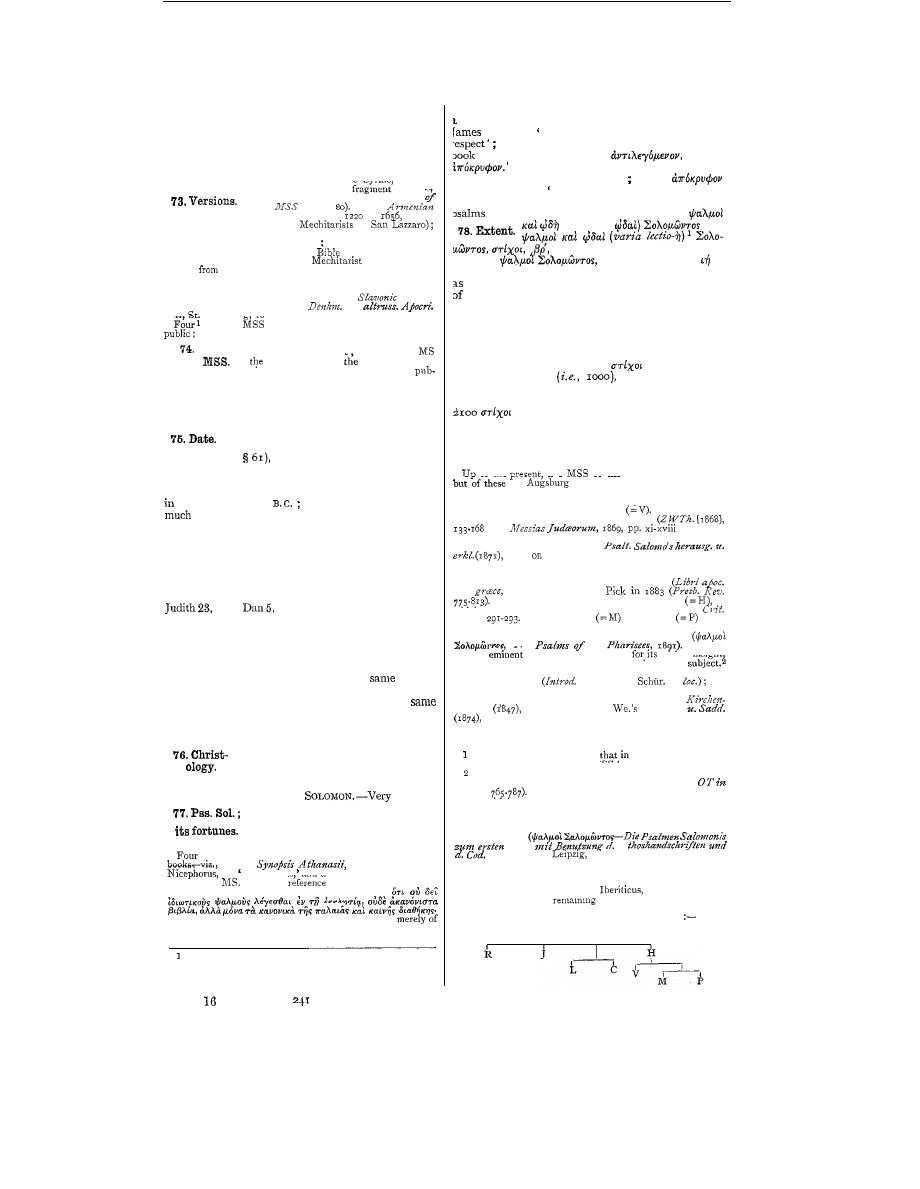
APOCALYPTIC LITERATURE
in Hebrew.
The additions of the Jewish interpola-
tor were, as far as I have examined them, in the
same language. Christian interpolations were intro-
duced at the close of the first century of the Christian
era, and some probably as late as the third or
t h e
fourth.
The earliest versions were the Greek, the Syriac and the
Armenian.
Of
the
Syriac
version only a
survives
preserved in the British Museum
(Cat.
Syriac
Cod. 861
Of the
version six MSS, varying in date from
to
are in
Venice (in the Library of the
of
one,
of
1388, in Vienna; another, of the fourteenth century:
in the library of Lord de la Zouche
and a ninth, in the pos-
session of the British and Foreign
Society. An edition
of
the Armenian version by the
Fathers is soon
to issue
the press.
No trace has a s yet been discovered of
a
L a t i n version anterior to that
of
Grosseteste in the thirteenth
century. This version and the later European versions are of
no critical worth. There is also a n old
version
published by Tichonrawow in the
der
Lit
Petersburg 1863.
of these
have already been made known to the
the Cambridge
MS
of the tenth century, and the
Oxford
MS
of the fourteenth, through Sinker's
The
edition of the Greek text. the Vatican
Greek
of
thirteenth and
Patmps
MS
of
the sixteenth through the Appendix he
lished in 1879. These four M S S are designated by their editor
respectively as C
0
R P,
and this notation has been followed
in the present article.
It has already been observed that the process of
Christian interpolation probably extended from the
close of the first century
A.D.
to the fourth.
As
regards the apocalyptic sections (see
E
SCHATOLOGY
,
which are due to
a
Jewish inter-
polator, we have no means at present of determining
their date with any exactness. Some of them are the
oldest portions in the book, and were probably written
the second century
but some of them are very
later, since they contain citations from the Ethiopic
and the Slavonic Enoch.
As
far as the present writer
has examined them, he is inclined to regard them
as
all
springing from a Hebrew original. The date, therefore,
of these interpolations may possibly extend from the
second century
B.C.
to 30
A.D.
I t may be added,
partly on the evidence of the Armenian version and
partly from the context, that it is clear that in Levi
15,
and
there are no references to the
Roman destruction of the temple in 70
A.D.
The
groundwork may have been written about the beginning
of the Christian era.
W e
can hardly suppose it
to be based upon Jubilees, for it never mentions
i t ; yet, since it possesses in common with it a vast
mass of biographical details as well as the
chrono-
logical system, it is natural to regard both works as
almost contemporary and
as
emanating from the
school of thought.
No
attempt has been made to give a systematic
statement of the Christology, since the passages relating
to this subject are derived-not from one
writer or period, but from a variety of
scribes and times. The value, therefore,
VIII.
T
HE
P
SALMS
O
F
little is
of the Christological portions in this book is slight.
known of the early history of these
psalms.
Only six direct and undoubted
references to them are found in early
literature.
of these occur in catalogues of canonical and uncanonical
in the
the Stichometry of
the Sixty Books and the table of contents in the
Alexandrian
The fifth
is found in the fifty-ninth
canon of the Council of Laodicea, which ordains
The sixth belongs to the twelfth century, and consists
a
note on this canon. With doubtful references we have here
no concern.
Mr. Sinker has since discovered two other Greek MSS;
and these six
MSS,
with the other versions, he is using as the
foundation of a new Greek Text which, we hope, will see the
light soon.
It is obvious, therefore, that the book never attained
large circulation. On the other hand, as Ryle and
point out, where it was read' it was 'read with
for ' i t is the solitary instance
of
an O T
which, from being merely
became
As
belonging
to
the former it appears in
.he first two lists above mentioned
as an
t is enrolled in the Sixty Books.'
It is notable in the next place that, whereas these
are designated in the first two lists as
(Fabricius
and
in the next two they are described
simply
as
with the addition of
in
the case of
A.
The book, therefore, circulated as early
the fifth century in two forms : one consisting simply
the eighteen 'Psalms of Solomon,' the other of
these together with certain Odes. The first form is the
older. The second probably originated in an attempt
to
supplement a defective edition of the first by certain
odes or songs, partly of Jewish, partly
of
Christian,
authorship, that were current under Solomon's name.
For if we accept the number of
assigned to the
psalms in the
MSS
we must regard the
present psalms
as
deficient to the extent of 300. On
the other hand, as the Stichometry of Nicephorus assigns
to the psalms and the odes combined, the
odes themselves must have been about the same length
as the psalms.
Of the odes only five have been
preserved. These are edited in an appendix to the
edition of Ryle and James.
to
the
five
of this book have been found
:
the
MS has long been lost, though we
possess a record of its readings in de la Cerda's
79.
Text.
edition, which was based upon it. T h e second
codex is that of Vienna
This MS was
collated by Haupt for Hilgenfeld's two editions
and
1-33);
but
the collation has been recently shown to be most inaccurate. T h e
next edition is that of Geiger,
Der
based
the same critical materials as Hilgenfeld's.
Though agreeing with Hilgenfeld as to the date and situation,
Geiger maintains, in opposition to him, the Hebrew original.
Fritzsche's edition was published in the same year
V T
569-89); and that of
T h e third codex is the Copenhagen one
to
which attention was first called hy Graux in the
Rev.
(1877)
The Moscow
and Paris
MSS
were discovered and collated hy Gebhardt. All these authorities
have been used in the edition of Ryle and James
The
the
I n this
edition,
alike for its learning and
critical insight
the reader will find everything worth knowing on the
For the remaining literature on these psalms we mnst refer the
student to this
work
13-21),
and to
(in
but
we must not forget two of the most fruitful studies that have yet
been made-namely, an article by Movers in Herder's
Lexicon
and an Appendix to
Die Phar.
which contains the translation with notes.
The date must be determined by the references to
Ryle and James make it clear
both cases 'we should
read the plural, against the best
MSS.
Since the above account was written two new editions of
the text have appeared.
The first is that of Swete (The
Greek, 3
This editor has made a valuable contribution
to the criticism of the text by means of a hitherto uncollated
M S (which Gehhardt designates R) belonging to the Vatican.
According to Gehhardt, however, his collation of this MS is
deficient in point of accuracy. The second edition is that of
0.
von Gehhardt
Male
A
Casanatensis,
1895). In the formation of his
text Gebhardt has used the MSS
C H
J L R.
Of these only
H
(the Copenhagen
MS)
was used by Ryle and James, and
H R
by Swete. Hence C J
I,
are here used for the first time.
These are respectively the Codd.
Laura-Klostu, and
Casanatensis.
T h e
MSS,
M
P V,
Gebhardt
regards as not deserving consideration.
H e gives the following
genealogyofall the
MSS. Z
represents the archetype
z
242
APOCALYPTIC LITERATURE
contemporary events; and,
as
these are many and
there will be little difficulty in assign-
ing
a
definite period to the activities of the
authors.
T h e book opens with the alarms of
8
I
)
in the midst
of a period of great material prosperity (1
8
7);
but the
prosperity is only seeming : from their ruler to the vilest of the
people they are altogether sinful (17
T h e king, too, be-
longs to the family that has usurped the throne of David (17
A
righteous judgment however, speedily comes upon them.
A hostile army
them, led by a ‘mighty striker,’
who came from the ends of the earth (8
The princes of the
land go forth to meet him with joy, and greet him with the
words Blessed is thy path come ye,
in with peace
18).
When) he has established himself within the city he seizes its
strongholds
he casts down its fenced walls with the
battering ram
Then the Gentiles tread Jerusalem under
foot
(‘2
;
yea, they pollute even the altar with their presence
and the blood of its inhabitants flows like water (8 23) its
and daughters are
away captive to the West (8 24
17
14)
to serve in bondage
and its princes to grace the triumph of
their conqueror
But the dragon who has conquered
Jerusalem
aimed at lordship of land and sea, and thought
himself to be more than man, a t last meets with shameful death
on the shores of Egypt, and there is none to bury him
There can be little doubt now
as
to the interpretation
of these facts. The family that had usurped the
throne of David are the
who, since
105
had assumed the regal name.
The ‘mighty
striker’ who comes ‘from the ends
of
the earth’ is
Pompey.
The princes who welcomed his approach
are
11.
and Hyrcanus,
When the
followers of the latter opened the gates to Pompey, the
party of
shut themselves up within the
temple, where they were besieged by Pompey and their
defences battered down with battering-rams.
The
massacre that follows, and the carrying away captive
to
West
of princes and people, agree only with the
capture of Jerusalem by Pompey.
Finally, the cir-
cumstances attending the death of the conqueror
on
the shores of Egypt recall the death of Pompey in a
mahner that cannot be misconceived.
W e conclude, therefore, that the second psalm was
written very,
soon
after the death of Pompey in 48
B.
c.
and that
I
,
8, 17 were composed between 63 and 48,
as
they presuppose Pompey’s capture of Jerusalem but
show no knowledge of his death.
Psalms
7,
and
15
allude to the same sequence of
as
I
,
8, and
and therefore
to
belong to the same period.
In 4 and
on the other hand, ‘ t h e sinners’ are
denounced
but as yet
no
visitation by the Gentiles is
spoken of, nor any interposition of the Gentiles in Jewish
affairs foretold.
Hence these psalms are probably
anterior to 64
B
.C.
Psalms
3,
4,
14, and 16 betray
no distinctly historical
but there is nothing
in them which requires us to assume different authorship
and date
those of the other psalms. W e may,
therefore, with Ryle and James, safely assign
as the limits within which the psalms were written.
It may he added that Movers, Del. and Keim have identified
the invader of Palestine with Herod ; but this is impossible on
many grounds
;
and just as many difficulties are against
identification of this personage with Antiochus Epiphanes. I n
fact, all modern critics support the view advocated above.
Thus they divide
their countrymen into ‘righteous’
33-5
14
49 etc.
)
and
sinners
238
49
‘saints’
3
47
8 4 0
etc.) and
transgressors’
132127
theformer
were the Pharisees and the latter the Sadducees. They
assail the ‘sinners’ for having usurped the throne of David
and laid violent hands on the high-priesthood
(176).
This assault on the
house evidently
emanates from
a
Pharisee.
T h e authors further denounce the priests for polluting the
things by their uncleanness and their neglect of the true
observances
3
5
8 13
26)
and likewise for outdoing the heathen
in their abominations (1
Their attitude, moreover, to the
law, their conception of the theocracy, their ideal of the bearing
of a righteous man in the case of Gentile oppression, all alike
mark them out as belonging to the Pharisaic school.
T o the
243
Its princes and wise counsellors are put to the sword
The authors were clearly Pharisees.
same school appertains
the doctrine taught regarding future
retribution and the Messiah. I n regard to the last, Ryle and
James observe with justice that the Messianic conception
in
these
‘marks the revolution
had passed over
Pharisaic thought since the time, not a century before, when
Israel’s mission in the world was identified only with the fulfil-
ment and dissemination of the law.
.
.
.
The heroic deeds of
Judas
and his brothers had rekindled the ardour
of the people for a Jewish dynasty and a Jewish kingdom ; and
the Pharisaic supporters of a theocracy were powerless so long
a s their teaching showed no sympathy with this patriotic
enthusiasm.’
But as it was hopeless to look for Israel’s re-
demption to the helpless and
later Asmonaeans, so it is
a t this crisis that the author of these psalms ‘combines
the recognition of the failure of the
house with the
popular enthusiasm for a Jewish monarchy’ (p. 57). Thus the
Pharisees ‘appealed to the patriotic feelings of those who had
no power to appreciate the abstract
of the old legalism.
By its hope for a “son of David it proclaimed the downfall of
the Levitical Asmonaan house.
its ideal reign of
wisdom
and righteousness,” it asserted the fundamental Pharisaic position
that the law was supreme. Thus ‘the Messianic representation
of our seventeenth psalm marks the stage a t which Pharisaic
thought passed beyond the narrow limits of its earlier teaching,
and availed itself of the popular aspiration for a n earthly
kingdom.’ This step, however, ‘entailed upon the theocratic
party no policy beyond the exercise of patience till God should
raise up the king, and until then the
observance of this
law’ (p. 58). Against the
adopted by the writers of
this book the
of
Moses is a protest from beginning
to
end (see above, 65).
We give below
85) some grounds for assuming
that pss.
1-16
and
17-18
are due to different writers.
As
the main interests of the psalms centre
Jerusalem, the writer probably lived in that
ritv
I t
is
City of the Sanctuary’ (84); in it shall the song
of triumph be sung when God brings hack its children from the
east and from the west (11
Though Jerusalem has now
been trodden under foot
the Gentiles
the Messiah will
cleanse it from all such pollution (17 25
and thither all the
nations of the earth will go up to see the Messiah‘s glory
(17 34).
T h e psalmist’s indictment of the Sadducean members of the
Sanhedrim
(4
I
),
and his account of their vices and ahominations
are best understood as coming from a contemporary
of Jerusalem.
T o the writer of psalms
8,
and
that city
is the centre of all the world, and the history of other nations
or world-empires is of moment only in as far as it connects itself
with ‘the Holy City.’
The circumstances connected with these psalms point
undoubtedly to a Hebrew
e . , their composi-
tion, circa
by a Pharisee
in
:-and.
standing Hilgenfeld‘s strong advocacy of ’ a Greek
original, all modern scholars admit that the psalms
were composed in Hebrew.
This fact was first established by Geiger in opposition to
Hilgenfeld‘s view. I t
has further been substantiated by Ryle
and James with a fulness and insight that cannot fail
to
win
conviction
pp. 77-87).
As
for the Greek
84.
Greek
translation, we may provisionally accept the date
version.
assigned by the editors just named, who,
a
hypothetical train of reasoning, show that it
not later than the middle of the first century
A.D.’
W e will now sketch in a few words some of the teaching
of these psalms regarding the Messiah and the resurrec-
tion. First, in regard
to
the Messiah,
the writer of
17
returns to
the conception of the prophets and describes him as
the son of David
He calls him also the
Anointed One’
(v.36,
cp
title that had been
applied a few years before to the ideal Messianic king
in association with supernatural attributes (Enoch 48
IO
52
4).
Here, however, the Messiah is a man and nothing
more,
H e is to be raised up by God himself (17
cp 18
6). H e is
to destroy the supremacy of the Gentiles (the Romans) and
drive them forth from the borders of Israel (17 25 27
The
sinners’ (the Sadducees) will be expelled from the
heritage of God which they had unlawfully seized
51).
The Messiah will purge Jerusalem from all impurity and
make it his capital
33.35)
he will bring hack t o Palestine
the dispersed tribes
28 34
the Gentiles will become
tributary and he converted to
of Israel
34).
H e shall himself be free from sin
and all his people will
he holy (u. 36). Further, he will not
by force of arms
(v.
will smite the earth with the word of
mouth
(v.
39).
Finally,
is temporary
42):
H e shall
not faint all his days.
Only the surviving righteous share in
his kingdom
the departed righteous are not raised
t o
participate in it.
APOCALYPTIC LITERATURE
As these hopes of the Messiah are confined to
pss. 17
and as not even the remotest hint of such
hopes can be discovered in the preceeding sixteen
psalms, it appears necessary to assume for them
a
difference of authorship.
In these, we should observe, there is not a hint that redress
for present evils is to be looked for from
Messiah. In eyery
instance the Psalmist expresses his faith that wrong will be set
right either by God's present judgments, by which his righteous-
ness 'is or shall be justified (2 36
8
7
9 3),
or hy his final
judgment of the world, when the righteous shall rise to eternal
life (3
14
.and hell and destruction and darkness shall he
the heritage of transgressors
(146
15 14).
This final judgment
is spoken of as a 'visitation' of God upon the righteous and
the wicked (3
15
it is likewise called in respect of
the righteous 'the day of mercy for the righteous' (146
whereas in respect of the wicked it is named ' t h e day of
judgment of the Lord'
Since there is in pss.
1-16
only
a
resurrection of the
righteous, Shed was conceived as the perpetual abode
of the wicked,
16
Into Shed, thus conceived as hell,
the wicked enter immediately on death
(16
compared
with
1 4 6
15
The intermediate abode of the
righteous is probably to be regarded
as
the treasuries
to which we find the first reference in Eth.
En.
100
5.
See also E
SCHATOLOGY
, 67.
IX.
T
HE
S
IBYLLINE
O
RACLES
. - The Sibylline
literature belongs to a class of productions highly
characteristic of Hellenistic Judaism.
These,'
as
Schiirer aptly remarks, were
Jewish works under a heathen mask.'
However divergent the outward form
assumed, they all exhibited one characteristic in common :
they addressed themselves to heathen readers, under
cloak of some name that was influential in the heathen
world, and in the form most naturalto their alleged origin.
Indirectly or directly, their aim was the propagation of
Judaism among the Gentiles. Whilst the works ascribed
to
and Aristeas belong to the former category
(indirect propaganda), the Sibyllines are distinctly of
the latter.
The
was regarded in the ancient world as an
inspired prophetess.
She belonged to no prophetic
order or priestly caste, but held a position
and uncontrolled as a superhumanly
gifted organ of the will and counsels of the gods.
The number of such Sibyls is variously stated a t different
times.
Heraclitus in Plutarch
(De
G),
phanes ( P a x
and Plato
speak of only one.
is doubtful whether there were more than
one. Pausanias
10
mentions four, while Varro
(in Lactantius
Div.
16)
specifies ten.
For further in-
formation on this subject
reader should consult Alexandre
Orac.
ed.) 1856
2
.
de
and
on the
in Smith's
G
Y
. and
Rom.
and the
Brit.
Written accounts of the oracles delivered by the
Sibyls obtained in Greece and Asia Minor only a
private circulation. Still though
were not preserved hy tlie State or
consulted, we must not under-
=
<
rate their importance in the life and thought
Eastern
classical world.
In Rome, however, they acquired
quite a unique position.
It is not necessary to treat
here of the very ancient collection of these oracles, said
to have been purchased by
or to record
the frequent occasions on which they were consulted by
before their destruction in the fire that con-
sumed the Capitol in
83.
has
traced sixty such occasions.) Their place was soon
afterwards taken (75 B
.c.)
by
a
collection, amounting
in all to about
verses, made in Greece, Asia
Minor, Africa, and Italy, by order of the Senate.
(After being revised under Augustus, it seems finally to
have been
by the order of Stilicho in
A.
)
Inasmuch as such oracles enjoyed high authority and
a
wide circulation in the East,-inasmuch, likewise,
as
they were anonymous in origin, free from authoritative
revision, and capable of modification or enlargement at
pleasure
those in whose hands they were for the
time being,-they offered to the missionary spirit
of
Hellenistic Judaism
a
form of literature which would
readily admit the disguised expression of its highest
beliefs, and at the same time procure for them a
hearing in Gentile circles, It is not unlikely, too, that
the prolonged search of Roman officials for Sibylline
oracles in the East may have further stimulated the
inventive faculties of the Alexandrian Jews, and led to
the composition of many of the verses in our present
collection. In this method of propaganda the Christians
proved themselves later to be apt pupils of the Jews.
So
common, indeed, had become in early Christian
times the invention of such oracles that Celsus
(Orig.
terms Christians
believers in sibyls, or sibyl-mongers.
This charge of Celsns was not unmerited; for with
the exception of a citation about the tower of Babel
made by Alexander Polyhistor,
B.C.
(see
Eus.
and found likewise in Josephus
( A n t .
it is to Christian writers that we are indebted, not only
for all other references, but also for the preservation of
the entire collection that has come down to
us.
Hermas (Vis. 2 4) mentions the Sibyl hut not her verses but
quotations are frequent in Clement
and Lactantius.
A
collection of the Patristic quotations from the Sibyllines will he
found in
in Vervorst
(De
Paris,
(De
de
des
oracles
Montauban,
and in Alexandre
(2
.The Sibylline Oracles, as we now have them, are
a
Thev consist of twelve books-there
chaotic medlev.
were originally fourteen-of various
authorship, date, and religions
This
which is
due to a n
editor of
sixth century
(Alexandre), does not in itself determine identity of
authorship, or of
of religious belief
for many of
the books are merely arbitrary groupings of unrelated
fragments. As the editor, moreover, was guided by
caprice as often
as
by any discernible principle of
editing, it is not strange that the same passage fre-
quently recurs in different contexts.
The first printed edition of these Oracles was published a t
from an Augshurg (now a Munich) MS, and
consisted of eight books. A metrical Latin
90.
Editions.
translation of these books by
appeared
the
year,
and a n emended Greek text from the same scholar in
The most valuable of the early editions is that of
Koch), Paris, 1599, in which fresh
M S
evidence is brought
to hear upon the text.
These were followed by that of
Amsterdam, 1689; hut his work is of no critical worth.
These eight Sibylline books were likewise reprinted in
(Venice 1788). Book 14 was first
edited by
in 1817 from a Milan
and Books 11-14
from two Vatican MSS in 1828 by the same scholar. Books
and
10 have not been recovered.
All these editions have been
superseded by the first edition of Alexandre's
vols. Paris,
and his second edition of 1869, in
which the valuahle excursuses of the first are omitted ; and by
the edition of Friedlieb (Leipzig, 1852). T h e latter has a useful
introduction, and is accompanied by a translation into German
hexameters ; hut the text is untrustworthy.
By far the best text that has yet appeared is that of
(Vienna,
For the
formation of this text fourteen
MSS
have been used;
the text has been further emended by
an
exhaustive
collation of quotations in the Fathers.
citations
will be made from this text.
For further literature on the subject see Alexandre's
ed. 2
ed.
(Hist.
5
English
find the
well treated in
work
of Schurer
mentioned;
(July
pp. 31-67);
and Deane
pp. 276-344).
The relation of the Jewish and the Christian Sibyllines
to the ancient heathen ones it is practically impossible
to determine.
I
.
They assumed, of
course, the outward form of the older
Oracles, being written
in
Homeric
hexameter verse but they transgress every rule of pro-
sody.
Short syllables are lengthened through the
APOCALYPTIC
LITERATURE
fluence
of
the accent, or even without it, owing to the
exigencies of the verse and long syllables are likewise
shortened.
For peculiarities of metre and syntax, see Alexandre,
7.
I t must be acknowledged, however, that many
of these disappear in the better text of
Of acrostic
verses, which, according to Dionys. Hal. (462) and Cicero
(De
2
was the form of the most ancient Sihyllines, only one
specimen is still preserved-viz., in 8
the initials of which
are IHZOYZ XPEIZTOZ
YIOZ
ZTAYPOZ.
It
should be observed, further, that without the last
the
initials of the title compose the word
a
fish '-
a frequent
symbol of the Christian faith on early monuments.
As
regards the matter, it is more than probable
that the later Sibyls used much of the older material
lying ready to hand.
Thus, in 3
(the passage
Helen) 'the Erinnys from
Sparta,' is from a heathen source; so
the punning
cou plet in 4
which frequently recurs
:
Another
instance is 8 361 where a line from an ancient
Delphic oracle is given verbatim. See Herod. 147.
W e must turn from such questions to discuss the
various elements of which the work is composed.
as we have already observed,
Jewish and Christian, and the
latter largely preponderate.
however, to the character of
work, it is not always
possible to distinguish between the two.
It is therefore
only on some of the smaller portions that we can arrive at
anycertainty. Much is of a neutral character, and,
as
far
therefore as internal evidence goes, may equally well
have proceeded from either class of writers. There
a
great lack of external evidence. W e shall now deal
with the various elements of the work in their chrono-
logical order as far as that is possible. Our space does
not admit of an analysis of all the books
we shall,
however, give a short survey of the more important.
The first and oldest part is
397-829
and probably the
The latter is not found in our
MSS;
it
Ad
It consists of two fragments,
of thirty-five and forty-nine lines respec-
tively. Rzach (pp.
and Alexandre link them
together by another short fragment of three lines.
On
very inadequate grounds the latter editor assigns them
to Christian authorship
but they contain nothing of
an essentially Christian cast (on their
contents, see
E
SCHATOLOGY
,
With regard to
opinions are conflicting.
Bleek regards verses
the exception of
380,
a later Christian interpolation-as the work of
an Alexandrian Jew,
Hilgenfeld thinks
that the whole of
was written about
140
B
.
C
.
;
brings down the date to
124
B.c.
Alexandre
of
the
The strongest evidence in favour of
Alesandre's view is to be found in the difficulty of inter-
preting adequately such passages as
as applying
to
the civil war and the dissensions of
and
(Friedlieb,
p.
33).
falls naturally into three groups: (a)
;
(c)
The first (a)
opens abruptly with the
building and the destruction of
Then the earth
is peopled and its
is divided between Cronos Titan and
Japetos
In the strife that
the Cronides and the Titans these races were destroyed and
there arose in succession the great kingdoms of the
of Egypt, Persia, Media, Ethiopia, Assyria, Macedonia, again
of Egypt, and of Rome
This closes the retrospect of
the Sibyl; now begins her prophecy
First she
predicts the rise of the Jewish (under Solomon) the
and the Roman kingdoms
;
during the reign
the seventh
of Egypt, of Hellenic race, the people of God will again become
powerful
Then are recounted the judgments of God
A
Latin rendering with the last seven verses omitted is
given in Augustine's
De
I 8 23.
Where Friedlieb and Alexandre give 828, Rzach gives 829
verses.
3
I n the detailed analysis that follows, certain verses un-
important for the present purpose, are (for the sake of
left unaccounted for.
assigns
168,
but
295-488
the age
the kingdoms of the world and on the Jews
Next
he Sibyl takes as her theme the praise of the Jewish nation:
heir virtues, and the salient points in their history from their
leparture from Egypt down to Cyrns
T h e
econd group
is mainly concerned with judgments against
Egypt,
and Magog, Libya
and likewise
rgainst individual
Then follows the promise of
Messianic prosperity and peace
and this
closes
with oracles regarding Antiochns Epiphanes and his successors,
various countries, towns, and islands
In
we have the celebrated diatribe against Homer.
T h e third
openswith oracles against Phcenicia, Crete,
Gog
and Magog and the Hellenes
Then Israel is
its worship of the true God
Thereupou ensues a
prophecy of judgment and a call to conversion, and an
account of the evils that were to
the ungodly
the Sibyl foretells the coming of the Messianic king who
would take vengeance on his adversaries next comes a
of
the period of Messianic prosperity
and,
the signs that are to herald the end of all things
declares that she is neither the Erythrxan Sibyl nor
yet the Cumxan
3.
Though it is obvious from the above epitome that
is not a single and homogeneous composition but
rather an aggregate of
oracles, we are safe
[with Schiirer) in regarding the three groups as derived
in the main from one author, and as dating from the
period, the reign of the seventh Ptolemy, which is
referred to
all three groups
Ptolemy VII. Physcon reigned first in conjunction with
his brother Ptolemy VI. Philometor
B
.c.).
H e was
then banished,.
recovered the throne
reigned as
king till 117
That the composition dates from the
latter period is clear
from the prophecy of the com-
plete subjugation of
all
As Hilgenfeld, Schurer, and
Drnmmond point
this cannot have
written before the
fall of Corinth
T h e doom of Corinth is actually
referred to (487) and possibly that of
Verses
deal with the Seleucid kings, were
written (according to Hilgenfeld's interpretation) about 140
B.C.
Therefore, since the author represents the Messianic kingdom as
beginning during the reign of Ptolemy Physcon, we may safely
take
to
have been written in the second half of the second
centu
B C .
The Procemium with which we have already
dealt
most
formed the introduction
to these verses, and Schiirer adduces external evidence from
Lactantins
6 5)
to that effect.
Before proceeding to discuss 31-96, we should add that
Friedlieb and others reject
as
a
later addition, as these
verses are a t
with
With regard, however, to
all previous critics
seem to have gone wrong in connecting
63-92
with the
preceding verses.
In
63-92
the end of all
things is to come during the sway of Rome
over the world
In
1-62,
on the other hand,
only the partial judgments that are
to
take effect on
the coming of the Messianic king in
are re-
connted.
The Sibyl then promises in
to
enumerate
the cities that are to suffer
;
but here the account breaks
off, and not a word more is said
63-92
fulfilment
of
her promise.
Hence these
two
sections are of
different authorship.
63
is
certainly late and
Christian.
In
63-74
we have a reproduction of the
concerning
Nero, according to which
was to return in the form
of that emperor and work many mighty signs. This
idea recurs in
2
(a
distinctly Christian product),
and in the Asc. Isa.
3
I
(cp
A
NTICHRIST
,
As regards
3
it may be derived from one author,
and
52
may refer to
triumvirate of Antony,
and Lepidus.
In that case this section was
written before 31
C
.
Book 4 is, with Friedlieb, Ewald, Hilgenfeld, Alexandre, and
Schiirer, to he regarded as of Jewish authorship, and was
written about 80
A
.D.
or somewhat later. This
96.
Book
4. date is determined by two allusions : the de-
struction of Jerusalem (70
A.
D
.)
in
and
the eruption of Vesuvins (79
A
.D.)
in
The latter was
to be the immediate precursor of the vengeance that was to be
wreaked on
by Nero, returning with many myriads from
the East
There are no qrounds for assigning this
hook, with Ew. and Hilgenfeld, to
authorship ; for, with
the exception of the reference to ablutions in
there is
no mention of anything
of the Essenes, and the
words in
are
most
taken as
to
On
3
1-62,
see also
E
SCHATOLOGY
,
68.
15).
proselyte
(Schiirer). T h e
enforced in
shows that the author cannot have been a Jew of Alexandria,
hut probably belonged to Palestine; for the eschatology is
very
naive. From the bones and ashes of men's bodies God
proselyte
(Schiirer). T h e
enforced in
shows that the author cannot have been a Jew of Alexandria,
hut probably belonged to Palestine; for the eschatology is
From the bones and ashes of men's bodies God
Document Outline
- Title
- Preface
- Abbreviations, symbols, and Biblioraphical Notes
- Practical Hints to the Reader
- Aalar - Achsah
- Acts of the Apostles
- Acua - Ain
- Airus - Amphipolis
- Amplias - Apocalypse
- Apocalyptic Literature
- Apocrypha - Ariel
- Arimathaea - Asshurim
- Assideans - Azzur
- Baal - Baca
- Bacchides - Bastard
- Bat - Beth-Basi
- Beth-Birie -Box Tree
- Bozez - Bush
- Bushel - Canon
- Canopy - Chariot
- Charity, Feasts of - Chronology
- Chronology - Circumcision
- Cis - Conduits
- Coney - Covenant
- Coverlet - Cyrus
- Dabarah - David
- David, City of - Dial and Sun-Dial
- Diamond - Dysentary
Wyszukiwarka
Podobne podstrony:
Encyclopedia Biblica Vol 1 Amplias Apocalypse
Encyclopedia Biblica Vol 2 Jerusalem Job (book)
Encyclopedia Biblica Vol 2 En Rimmon Esau
Encyclopedia Biblica Vol 1 Bat Beth Basi
Encyclopedia Biblica Vol 2 Inscriptions Isle
Encyclopedia Biblica Vol 2 04 Maps In volume II
Encyclopedia Biblica Vol 2 Joiada Jotham
Encyclopedia Biblica Vol 2 Hirah Horonaim
Encyclopedia Biblica Vol 2 Issachar Javan
Encyclopedia Biblica Vol 1 Gavidcity Dial; Sun Dial
Encyclopedia Biblica Vol 2 Gospels part 03
Encyclopedia Biblica Vol 1 Bozez Bush
Encyclopedia Biblica Vol 1 Acts Of Apostles
Encyclopedia Biblica Vol 2 Eagle pg 1145 Eglath Shelishiyah pg 1202
Encyclopedia Biblica Vol 1 01 Title A to D
Encyclopedia Biblica Vol 2 Kedeshah Kushaiah
Encyclopedia Biblica Vol 1 Beth Birei Boxtree
Encyclopedia Biblica Vol 1 Charity Chronology
Encyclopedia Biblica Vol 2 Heathen Hermon
więcej podobnych podstron