
Sample Questions
2012 Advanced Level Syllabus
Test Analyst
Version 1.01
International Software Testing Qualifications Board
Copyright Notice
This document may be copied in its entirety, or extracts made, if the source is acknowledged.
Certified Tester
Advanced Level Syllabus – Test Analyst
International
Software Testing
Qualifications Board
Sample Questions – ATA
Page 2 of 47
23 November, 2012
© International Software Testing Qualifications Board
Table of Contents
Table of Contents .................................................................................................................................... 2
Acknowledgements ................................................................................................................................. 3
0.
Introduction....................................................................................................................................... 4
0.1
Purpose of this document .......................................................................................................... 4
0.2
Instructions ................................................................................................................................. 4
1.
ATA Sample Questions .................................................................................................................... 5
CTAL-ATA _LO-1.2.1 .......................................................................................................................... 5
CTAL-ATA _LO-1.3.1 .......................................................................................................................... 6
CTAL-ATA _LO-1.4.1 .......................................................................................................................... 7
CTAL-ATA _LO-1.5.1 .......................................................................................................................... 8
CTAL-ATA _LO-1.5.2 .......................................................................................................................... 8
CTAL-ATA _LO-1.6.1 ........................................................................................................................ 10
CTAL-ATA _LO-1.7.1 ........................................................................................................................ 11
CTAL-ATA _LO-1.8.1 ........................................................................................................................ 12
CTAL-ATA _LO-1.9.1 ........................................................................................................................ 12
CTAL-ATA _LO-2.2.1 ........................................................................................................................ 13
CTAL-ATA _LO-2.3.1 ........................................................................................................................ 14
CTAL-ATA _LO-2.4.1 ........................................................................................................................ 15
CTAL-ATA _LO-3.2.1 ........................................................................................................................ 16
CTAL-ATA _LO-3.2.2 ........................................................................................................................ 17
CTAL-ATA _LO-3.2.3 ........................................................................................................................ 18
CTAL-ATA _LO-3.2.4 ........................................................................................................................ 19
CTAL-ATA _LO-3.2.5 ........................................................................................................................ 20
CTAL-ATA _LO-3.2.6 ........................................................................................................................ 23
CTAL-ATA _LO-3.2.7 ........................................................................................................................ 24
CTAL-ATA _LO-3.2.8 ........................................................................................................................ 25
CTAL-ATA _LO-3.2.9 ........................................................................................................................ 27
CTAL-ATA _LO-3.2.10 ...................................................................................................................... 28
CTAL-ATA _LO-3.2.11 ...................................................................................................................... 29
CTAL-ATA _LO-3.3.1 ........................................................................................................................ 30
CTAL-ATA _LO-3.3.2 ........................................................................................................................ 30
CTAL-ATA _LO-3.4.1 ........................................................................................................................ 31
CTAL-ATA _LO-3.4.2 ........................................................................................................................ 32
CTAL-ATA _LO-3.4.3 ........................................................................................................................ 33
CTAL-ATA _LO-4.2.1 ........................................................................................................................ 35
CTAL-ATA _LO-4.2.2 ........................................................................................................................ 36
CTAL-ATA _LO-4.2.3 ........................................................................................................................ 37
CTAL-ATA _LO-4.2.4 ........................................................................................................................ 38
CTAL-ATA _LO-5.1.1 ........................................................................................................................ 39
CTAL-ATA _LO-5.2.1 ........................................................................................................................ 40
CTAL-ATA _LO-5.2.2 ........................................................................................................................ 42
CTAL-ATA _LO-6.2.1 ........................................................................................................................ 43
CTAL-ATA _LO-6.3.1 ........................................................................................................................ 44
CTAL-ATA _LO-6.4.1 ........................................................................................................................ 44
CTAL-ATA _LO-6.5.1 ........................................................................................................................ 45
CTAL-ATA _LO-7.2.1 ........................................................................................................................ 46
CTAL-ATA _LO-7.2.2 ........................................................................................................................ 46
CTAL-ATA _LO-7.2.3 ........................................................................................................................ 47
Certified Tester
Advanced Level Syllabus – Test Analyst
International
Software Testing
Qualifications Board
Sample Questions – ATA
Page 3 of 47
23 November, 2012
© International Software Testing Qualifications Board
Acknowledgements
This document was produced by a core team from the International Software Testing Qualifications
Board Examination Working Group: Minna Aalto, Rex Black, Mette Bruhn-Pedersen, Debra
Friedenberg, Brian Hambling, Inga Hansen, Kari Kakkonen, Judy McKay, Stuart Reid, and Mario
Winter.
The core team thanks the Examination Working Party review team, the Advanced Syllabus Working
Group and the National Boards for their suggestions and input.
This document was formally released by the General Assembly of the ISTQB® on 19 October, 2012.
Certified Tester
Advanced Level Syllabus – Test Analyst
International
Software Testing
Qualifications Board
Sample Questions – ATA
Page 4 of 47
23 November, 2012
© International Software Testing Qualifications Board
0. Introduction
0.1 Purpose of this document
The sample questions, answer sets and associated justifications in this document have been created
by a team of Subject Matter Experts and experienced question writers with the aim of assisting
ISTQB® Member Boards and Exam Boards in their question writing activities.
These questions cannot be used as-is in any official examination, but they should serve as guidance
for question writers. Given the wide variety of formats and subjects, these sample questions should
offer many ideas for the individual Member Boards on how to create good questions and appropriate
answer sets for their examinations.
0.2 Instructions
The question and answer sets are organized in the following way:
• Learning Objective and K-level
• Question - including any scenario followed by the question stem.
• Answer Set - correct answer(s) are indicated in bold face.
• Justification of the answers.
• Suggested point value for the question.
Certified Tester
Advanced Level Syllabus – Test Analyst
International
Software Testing
Qualifications Board
Sample Questions – ATA
Page 5 of 47
23 November, 2012
© International Software Testing Qualifications Board
1. ATA Sample Questions
CTAL-ATA _LO-1.2.1
TA-1.2.1 (K2) Explain how and why the timing and level of involvement for the Test Analyst varies
when working with different lifecycle models
Question:
Which of the following statements is TRUE with respect to when the test analyst should become
involved during different lifecycle models?
Answer Set:
A. In sequential V-model projects the test analyst should start test analysis concurrently
with requirement specification
B. In Agile projects the test analyst should start test analysis and design concurrently with coding
C. In sequential V-model projects the test analyst should start test analysis concurrently with
coding
D. There are no differences in the moment of involvement for test analysts for the various
software lifecycles
Justification:
A. Correct: This is the correct option of how testing activities should be aligned to the sequential
lifecycle model phases
B. Incorrect: As stated in the syllabus the analyst should be involved from the beginning of an
agile project.
C. Incorrect: test analysis must start earlier, already during requirement specification in
sequential lifecycle models.
D. Incorrect: as stated in the syllabus, there may be many differences in how the testing activities
are aligned
Point Value: 1
Certified Tester
Advanced Level Syllabus – Test Analyst
International
Software Testing
Qualifications Board
Sample Questions – ATA
Page 6 of 47
23 November, 2012
© International Software Testing Qualifications Board
CTAL-ATA _LO-1.3.1
TA-1.3.1 (K2) Summarize the activities performed by the Test Analyst in support of planning and
controlling the testing
Question:
Which of the following is a type of testing that someone in the role of a Test Analyst, working with the
Test Manager, should typically consider and plan for?
Answer Set:
A. Usability
B. Security
C. Performance
D. Maintainability
Justification:
A. Correct per the syllabus.
B. Incorrect: This is the responsibility of the TTA.
C. Incorrect: This is the responsibility of the TTA.
D. Incorrect: This is the responsibility of the TTA.
Point Value: 1
Certified Tester
Advanced Level Syllabus – Test Analyst
International
Software Testing
Qualifications Board
Sample Questions – ATA
Page 7 of 47
23 November, 2012
© International Software Testing Qualifications Board
CTAL-ATA _LO-1.4.1
TA-1.4.1 (K4) Analyze a given scenario, including a project description and lifecycle model, to
determine the appropriate tasks for the Test Analyst during the analysis and design phases.
Question:
A project has been initiated to collect and analyze usage of a web-based search tool in order to
optimize search results for particular groups of users. The project will build on initial analysis of user
data collected over a period of time
and will aim to refine the collection and analysis ‘engines’ so that
relevant data can be collected and analyzed in real time, enabling users to focus their search more
effectively.
The project will use agile techniques in an iterative/incremental life cycle. Requirements are based on
user stories and these will be explored during short ‘sprints’. The sprints will be grouped to focus on
data collection for the first part of the project and analysis for the second part.
Risks include the inability to analyze the volume of data collected, inability to collect data for the
desired analysis, inadequate speed and response times, and poor user interface.
The testing for the first part has been scoped and requirements have been documented and reviewed
with no major concerns arising.
Which one of the following answers describes the most appropriate and complete sequence of
activities for the TA to focus on during test analysis and design?
Answer Set:
A. Analyze user stories, identify test conditions at appropriate levels to address user
stories, add test conditions for risk mitigation, select test case design techniques to
achieve desired coverage, create test cases
B. Analyze user stories, select test case design techniques, create high level test conditions for
risk mitigation, create test cases to achieve desired coverage for user stories, create risk
mitigation test cases
C. Select test case design techniques, create high level test cases to meet test conditions,
create high level test cases to mitigate risks, create low level tests cases to achieve desired
coverage.
D. Analyze risks, create test conditions to address risks, create high level test cases to meet test
conditions for risk mitigation and user stories, create all low level test cases.
Justification:
A. Correct: with risk mitigation added on to user story test conditions.
B. Incorrect: This option ignores test conditions for risk mitigation and goes straight to test cases,
and it is not specific about the objectives of test conditions.
C. Incorrect: This option ignores test conditions altogether and goes straight to test cases.
D. Incorrect: This option ignores analysis of user stories and omits mention of desired coverage.
Point Value: 2
Certified Tester
Advanced Level Syllabus – Test Analyst
International
Software Testing
Qualifications Board
Sample Questions – ATA
Page 8 of 47
23 November, 2012
© International Software Testing Qualifications Board
CTAL-ATA _LO-1.5.1
TA-1.5.1 (K2) Explain why test cases should be understood by the stakeholders
Question:
Which one of the following statements does NOT give a good reason why test cases should be
reviewed and understood by stakeholders?
Answer Set:
A. The test manager reviews the test cases in order to control the work of the test analyst
and to create the organization’s test strategy
B. Customer and users review the test cases in order to verify them against requirements,
business processes and business rules
C. Testers review test cases written by other testers in order to ensure that the test cases are
consistent, understandable and executable by testers other than the author
D. Developers review test cases written by testers in order to align their understanding of
requirements with the testers’ and to align component testing with system testing
Justification:
A. Correct: test cases should be created to comply with the test policy, not the other way around.
B. Incorrect: Yes this is one of the good reasons, that is to verify that the test cases match the
business processes and rules.
C. Incorrect: Yes this is another good reason, namely that other testers should be able to
understand and execute test cases.
D. Incorrect: Yes, developers need to be sure that they have the same understanding of the
requirements as the testers in order to catch misunderstandings and also to participate in the
optimization of tests.
Point Value: 1
CTAL-ATA _LO-1.5.2
TA-1.5.2 (K4) Analyze a project scenario to determine the most appropriate use for low level
(concrete) and high level (logical) test cases
Question:
Scenario: Health Insurance
The IT department of insurance company SecureLife has started a project IQ (Improved Quality) to
implement a new health insurance application to make it possible to create online transactions for
health insurance claims raised by employees and members of companies or associations having
health insurance agreements. In the new application it will be possible to make registration of all the
information about the employees, their age, health conditions, etc. The project also has to fulfill the
demands of the people doing insurance calculation, actuaries and the demands from public legislation.
The project team for IQ have testers who are business users with lots of domain knowledge but
without much formal test training.
At the same time another project, HIPPOS (Health Insurance Product Public Order Sales), has been
started by the marketing department of SecureLife with the purpose of launching a new Internet
application that will allow potential buyers of health insurance to use a small calculator to calculate

Certified Tester
Advanced Level Syllabus – Test Analyst
International
Software Testing
Qualifications Board
Sample Questions – ATA
Page 9 of 47
23 November, 2012
© International Software Testing Qualifications Board
insurance premiums and possible bonus deductions based on age and different health parameters.
This application will also allow individual customers to order Health Insurance Products online.
The marketing tool and web page of project HIPPO will be developed and tested by SecureLife’s Agile
development team, which has worked together for the last three years with the marketing department,
developing marketing web applications. The Agile team consists of well trained testers and
developers. They have implemented test automation for configuration and regression testing and they
have as part of their retrospectives built check lists of common defects and common security
problems.
As senior test analyst in SecureLife you have been asked to give input to the test strategy for the two
projects, IQ and HIPPOS, regarding the level of detail and documentation required for test cases in
the two projects.
Which TWO of the following are the BEST options for this strategy?
Answer Set:
A. In project IQ the test cases should be written at a logical level. The testers are business users
and they know their business rules and calculations so no need for detailed documentation.
B. In project IQ the test cases should be written at a concrete level with documented
procedures and traceability to requirements.
C. In project HIPPOS the test cases should be written at a concrete level with documented
procedures and audit trails.
D. In project HIPPOS the test cases should be written at a logical level allowing the testers
flexibility in varying the details to achieve higher coverage.
E. In both project IQ and HIPPOS the test cases must be written as concrete test cases, with
thorough documentation and detailed procedures.
F.
In both project IQ and HIPPOS the test cases should be written as logical test cases, since
we want to be as agile as possible and not spend time on documentation
Justification:
A. Incorrect: The scenario states that there are demands for traceability for project IQ, so this is
not a good recommendation. Also, testers do not have much testing experience, so logical
level is not good.
B. Correct: This is a good recommendation because there are demands for traceability, and the
testers do not have much test experience.
C. Incorrect: There are no arguments that support the same detailed level of documentation for
project HIPPOS; it is a marketing application they are building.
D. Correct: this is the best recommendation for project HIPPOS, the team has experience in
testing and in Agile development and the application is an online marketing application where
experience-based testing at a logical level makes a lot of sense.
E. Incorrect: Not a good recommendation, see argument for C.
F. Incorrect: Not a good recommendation, Agile or not it is always best practice to analyze the
concrete situation and the concrete requirements, project IQ still needs traceability.
Point Value: 2
Certified Tester
Advanced Level Syllabus – Test Analyst
International
Software Testing
Qualifications Board
Sample Questions – ATA
Page 10 of 47
23 November, 2012
© International Software Testing Qualifications Board
CTAL-ATA _LO-1.6.1
TA-1.6.1 (K2) Describe the typical exit criteria for test analysis and test design and explain how
meeting those criteria affect the test implementation effort..
Question:
Consider the following exit criterion: “All test cases must be reviewed and approved by
representatives from the development and test team.”
The project team has determined that this exit criterion is critical for keeping the project on schedule.
This exit criterion is from which test activity? How will meeting this criterion help keep the project on
schedule?
Answer Set:
A. Test Design; by ensuring that the test team is creating the test cases that will target the
correct areas with valid tests
B. Test Design; by ensuring the test team is executing the right tests in the right order
C. Test Implementation; by ensuring the test team is creating the test cases that will target the
correct areas with valid tests
D. Test Implementation; by ensuring the test team is executing the right tests in the right order
Justification:
A. Correct: per the syllabus as an example of a task that should be completed during this activity
and will accomplish the stated purpose.
B. Incorrect: Test cases should be reviewed and approved prior to execution or the process is
not likely to help the schedule.
C. Incorrect: Creating test cases is part of Test Design.
D. Incorrect: Executing tests is part of Test Execution.
Point Value: 1
Certified Tester
Advanced Level Syllabus – Test Analyst
International
Software Testing
Qualifications Board
Sample Questions – ATA
Page 11 of 47
23 November, 2012
© International Software Testing Qualifications Board
CTAL-ATA _LO-1.7.1
TA-1.7.1 (K3) For a given scenario, determine the steps and considerations that should be taken when
executing tests
Question:
You are analyzing the test log below to determine what actions, if any, are required:
Test Step
Expected Result Actual Result
Outcome
1 Customer
name
‘Briggs’
Customer name
‘Briggs’
Pass
2
Error 202
Error 203
Fail
3 Customer
name
changed to
‘Jones’
Customer name
changed to
‘Jones’
Pass
4
Error OP12
Error OP21
Pass
5 Switch
to
Delivery screen
Remains on
Customer
screen
Fail
On further investigation test step 2 was resolved as a typographical error in the log; the actual result
was ‘Error 202’ as expected.
Which option represents the appropriate action to take next?
Answer Set:
A. Amend the outcome for step 2. Repeat test step 4 to resolve an apparent ‘false
positive’. Check the test documentation for step 4 if the outcome is a ‘fail’. Check the
test documentation for step 5. Raise incident reports for steps 4 and 5 if test
documentation shows tests were correct.
B. Repeat test step 4 to resolve an apparent ‘false positive’. Amend the outcome for step 2.
Raise incident reports for steps 4 and 5.
C. Repeat test step 4 to resolve an apparent ‘false positive’. Raise incident reports for steps 2, 4
and 5.
D. Amend step 2 outcome to ‘Pass’. Recheck the test documentation for step 4 and raise an
incident report of it is correct. Raise an incident report for step 5.
Justification:
A. Correct: checking that tests were correct in every case before raising an incident report.
B. Incorrect: This raises incident reports for steps 4 and 5 without checking test documentation or
waiting for the outcome of the repeat step 4 test.
C. Incorrect: This adds an incident report for the ‘false positive’ step as well as steps 4 and 5 and
does not check test documentation.
D. Incorrect; This option rechecks steps 2 and 4 but raise an incident report for step 5 without
checking that the test was correct.
Point Value: 2
Certified Tester
Advanced Level Syllabus – Test Analyst
International
Software Testing
Qualifications Board
Sample Questions – ATA
Page 12 of 47
23 November, 2012
© International Software Testing Qualifications Board
CTAL-ATA _LO-1.8.1
TA-1.8.1 (K2) Explain why accurate test case execution status information is important
Question:
Which one of the following statements best expresses why accurate test case execution status
information is important?
Answer Set:
A. Accurate test case execution status information helps stakeholders gain knowledge
about the status of the project.
B. Accurate test case execution status information helps the developer decide what defects to fix
first.
C. Accurate test case execution status information allows the test manager to evaluate the
efficiency of individual test team members.
D. Accurate test case execution status information allows the test team to validate their
coverage.
Justification:
A. Correct. From the syllabus: “From the point of view of the test process, test progress
monitoring entails ensuring the collection of proper information to support the reporting
requirements. This includes measuring progress towards completion.“.
B. Incorrect. Test case execution status could have a bearing on the ordering of which defects to
fix, but there are other items, such as defect severity, which are more important..
C. Incorrect. Test case execution status information should not be used to evaluate efficiency of
individuals. It can give an idea of how quickly team members are working through test cases,
but status alone does not allow a manager to decide whether or not a team member is
efficiently using their time..
D. Incorrect. Test case status information just has to do with status. The validation of test case
coverage should be done earlier.
Point Value: 1
CTAL-ATA _LO-1.9.1
TA-1.9.1 (K2) Provide examples of work products that should be delivered by the Test Analyst during
test closure activities
Question:
Which of the following is a typical work product that the Test Analyst would deliver as part of the test
closure activities?
Answer Set:
A. A list of all deferred defects
B. A list of all rejected defect reports
C. A list of all defects found in production and fixed in this release
D. A list of all resolved defects
Certified Tester
Advanced Level Syllabus – Test Analyst
International
Software Testing
Qualifications Board
Sample Questions – ATA
Page 13 of 47
23 November, 2012
© International Software Testing Qualifications Board
Justification:
A. Correct: Only the deferred defects are of interest to the people who will be maintaining and
supporting the software, so this is the list that should be supplied at closure. The other items are part
of the test summary report.
B, C & D: Incorrect. See explanation for A.
Point Value: 1
CTAL-ATA _LO-2.2.1
TA-2.2.1 (K2) Explain the types of information that must be tracked during testing to enable adequate
monitoring and controlling of the project
Question:
Which of the following statements best expresses the types of information that must be tracked during
testing to enable adequate monitoring and controlling of the testing project
Answer Set:
A. The tracking and measurement of defects, tests, coverage as well as product risks
B. How many defects were introduced by each developer so adequate steps may be taken
C. The percentage of passed and failed test cases at given points in time whereas the number of
executed versus not-executed test cases is less relevant
D. How many test cases were passed by each tester so it can be used to motivate to be more
effective
Justification:
A. Correct: these are 4 of the 5 dimensions mentioned in the syllabus.
B. Correct: seen from a test monitoring and control perspective the performance of individual
developers is not in scope.
C. Incorrect: to get the right picture of progress both dimensions passed/failed executed/non-
executed is important.
D. Incorrect: it is one-sided, beyond the control of the testers and influenced by other factors,
how many test cases pass and how many fail.
Point Value: 1
Certified Tester
Advanced Level Syllabus – Test Analyst
International
Software Testing
Qualifications Board
Sample Questions – ATA
Page 14 of 47
23 November, 2012
© International Software Testing Qualifications Board
CTAL-ATA _LO-2.3.1
TA-2.3.1 (K2) Provide examples of good communication practices when working in a 24-hour testing
environment
Question:
According to the syllabus, which of the following would be the MOST effective method of
communication between test team members who are distributed across several time zones?
Answer Set:
A. Accurate recording of defect information in the defect tracking system
B. Accepting frequent builds from the developers to keep all testers working on the same version
at the same time
C. Skype meetings for personal interaction
D. Weekly, mandatory, all personnel meetings
Justification:
A. Correct: Accurate information in the defect tracking system enables everyone to work
efficiently with less follow up needed. Any of the meeting options might work, but it depends
on the time zones and availability. The defect tracking system will always work.
B. Incorrect: If anything, this would make it worse as the frequent loading of new software would
make it more difficult to keep everyone on the same versions and unblocked.
C& D. Incorrect: See A
Point Value: 1
Certified Tester
Advanced Level Syllabus – Test Analyst
International
Software Testing
Qualifications Board
Sample Questions – ATA
Page 15 of 47
23 November, 2012
© International Software Testing Qualifications Board
CTAL-ATA _LO-2.4.1
TA-2.4.1 (K3) For a given project situation, participate in risk identification, perform risk assessment
and propose appropriate risk mitigation
Question:
A project to develop a foreign exchange Automated Telling Machine for an airport has been planned
and a risk assessment has shown that there are 3 key risks:
1. There is a risk that usability will be a problem for visually impaired users because the
operation requires viewing several screens in sequence with relatively small text. This has
been assessed as medium likelihood with high impact.
2. There is a risk that response will be relatively slow because the foreign exchange rates will be
checked before each transaction; this has been assessed as medium likelihood with medium
impact.
3. There is a risk that accuracy of calculations could lead to cumulative errors. This has been
assessed as low likelihood with high impact.
The test strategy currently requires performance testing during system test, usability testing during
User Acceptance Test and accuracy tests at every test level. The project schedule is under time
pressure.
Which of the following possible risk mitigation actions should be prioritized highest?
Answer Set:
A. Allow access to the system for usability testing during integration
B. Review the calculation algorithms and work with specialists to define a data set for calculation
tests
C. Spend time with developers to Identify operational scenarios to test performance
D. Defer usability testing until UAT and recruit visually impaired testers to join the UAT team
Justification:
A. is the correct answer.
B. Incorrect: is a good suggestion but is a lower priority because the risk is lower.
C. Incorrect: is a good suggestion but is a lower priority.
D. Incorrect: is a good suggestion but will not mitigate risk as well as A. It could be done as well
as A but this should not override A as the highest priority.
Point Value: 1
Certified Tester
Advanced Level Syllabus – Test Analyst
International
Software Testing
Qualifications Board
Sample Questions – ATA
Page 16 of 47
23 November, 2012
© International Software Testing Qualifications Board
CTAL-ATA _LO-3.2.1
TA-3.2.1 (K2) Explain the use of cause-effects graphs
Question:
Which of the following statements about cause-effect graphing is NOT true?
Answer Set:
A. Cause-effect graphs can show only one type of relationship (and, or, is, is not) in the
diagram at a time.
B. Cause-effect graphs are used to show the functional logic of the test object visually.
C. Cause-effect graphing can be more time-consuming and challenging to learn than other
techniques, since they require the use of notation that has been agreed upon with all the
parties involved.
D. Cause-effect graphs are often created to support the creation of decision tables, but they can
easily become too large to be practical.
Justification:
A. Correct: Cause-effect graphs show condition combinations that cause results, exclude results,
multiple conditions that must be true to cause a result and alternative conditions that can be true
to cause a particular result. Therefore this option is NOT true.
B, C, and D: Incorrect: they are true.
Point Value: 1
Certified Tester
Advanced Level Syllabus – Test Analyst
International
Software Testing
Qualifications Board
Sample Questions – ATA
Page 17 of 47
23 November, 2012
© International Software Testing Qualifications Board
CTAL-ATA _LO-3.2.2
TA-3.2.2 (K3) Write test cases from a given specification item by applying the equivalence partitioning
test design technique to achieve a defined level of coverage
Question:
A company has set up an employee wellness program and combined it with the premium for health
insurance:
The full standard premium for a health insurance policy is $400.
The program have the following rules:
1) Employees who make a pledge — on the honor system — that they don't smoke, or that they
take a stop-smoking class, and have a BMI below 30, get 10% off their contribution toward the
full standard insurance premium.
2) Employees who fill in a "health risk assessment" with more health details will be rewarded with
a $25 reduction in premium.
3) Employees who participate in a yearly health control at the company a) receive a $50
reduction in their premium for having a BMI of 27.5 or less, and a $25 reduction for having a
BMI below 30. And b) if they are non-smokers, they receive an additional $50 reduction in
their premium, and those that have joined a stop-smoking class receive a $25 reduction.
Smokers pay an additional premium of $75.
How many test cases are needed to achieve 100% test coverage of equivalence partitions of the input
parameters, when testing this specification by applying the equivalence partitioning test design
technique and what will be the maximum and minimum resulting premium?
Answer Set:
A. 3 test cases and a maximum premium of $475 and minimum premium of $235
B. 6 test cases and a maximum premium of $475 and minimum premium of $235
C. 3 test cases and a maximum premium of $400 and minimum premium of $275
D. 4 test cases and a maximum premium of $400 and minimum premium of $275
Justification:
A. Correct: Parameter 1) and 2): Getting the 10 % reduction for signing pledge of honor and filling
out a detailed assessment an both have 2 partitions either the do it or they don’t.
Parameters 3)The smoking and the BMI parameter each have 3 partitions, so 3 test cases will be
sufficient to hit all of the partitions. As for the maximum premium: An employee not signing the
pledge of honor, and not filling out the detailed assessment being a smoker and having a BMI of
30 or more will have to pay the full standard premium + extra $75. On the other hand an
employee, signing the pledge of honor filling out the detailed assessment, being a non smoker and
having a low BMI of less that 27,5 will get deductions of: 40+25 + 50 + 50 = 165 leaving $235 in
premium.
B, C & D. Incorrect: See justification for A.
Point Value: 2
Certified Tester
Advanced Level Syllabus – Test Analyst
International
Software Testing
Qualifications Board
Sample Questions – ATA
Page 18 of 47
23 November, 2012
© International Software Testing Qualifications Board
CTAL-ATA _LO-3.2.3
TA-3.2.3 (K3) Write test cases from a given specification item by applying the boundary value analysis
test design technique to achieve a defined level of coverage
Question:
The participants in a yearly health check for employees are required to answer questions about
smoking: Whether they are non-smokers, have started a stop-smoking class, or are smokers. This is a
distractor that is probably too strong, suggest delete.
Their BMI (Body mass index) is measured in the following categories: 18.9 or less is underweight, 19
to 24.9 (inclusive) is normal, from 25 to 29.9 (inclusive) is overweight, and 30 or more is heavy
overweight
Their blood pressure is measured in categories from optimal to severely high. For simplicity in this
example, only the high blood pressure (systolic) will be considered: Everything under 120 is optimal,
up till 129 (inclusive) is normal, from 130 to 159 (inclusive) is medium high, and from 160 up till 179
(inclusive) is high and everything over that is severely high..
How many test cases are need to achieve 75% test coverage when testing this specification by
applying the boundary value analysis test design technique using 2 values per boundary and testing
BMI and blood pressure only with positive integer values. Each test case has both BMI and blood
measures as data values.
Also what about extreme boundaries (this are not taken into account), if not say so explicitly.
Answer Set:
A. 3
B. 4
C. 6
D. 8
Justification:
A. Incorrect, this is wrong see explanation under C.
B. Incorrect:, this is only 50%.
C. Correct: this is correct 6 out of 8 are 75%. 8 is the maximum number of test cases needed for
Blood Pressure which has 4 boundaries with 2 values each: 119, 120, 129, 130, 159, 160,
179, 180 For BMI there are 3 boundaries and thus 6 values: 18.9, 19, 24.9, 25, 29.9 and 30
these are covered by the same test cases as is the BP parameter.
D. Incorrect: this is the number for 100 % coverage.
Point Value: 2
Certified Tester
Advanced Level Syllabus – Test Analyst
International
Software Testing
Qualifications Board
Sample Questions – ATA
Page 19 of 47
23 November, 2012
© International Software Testing Qualifications Board
CTAL-ATA _LO-3.2.4
TA-3.2.4 (K3) Write test cases from a given specification item by applying the decision table test
design technique to achieve a defined level of coverage
Question:
The insurance company GoodHealth has launched a new health insurance product - for all customers
both new and existing - with the following specification:
Standard premium fee is 500€.
A bonus program offers customers buying the health insurance product with a 25€ discount to the
standard premium fee to accept participating in the medical tests even if they are not participating.
The customers get a 25€ discount to the standard premium for everyone of four medical tests (BMI,
blood pressure, glucose and cholesterol) that they take as part of the yearly medical test plus an extra
75€ if they take all the tests.
How many test cases are needed when using a collapsed decision table? How many test cases are
needed when using a non-collapsed decision table but with the limitation to test customers who do not
accept to participate in any medical tests, only with one test case?
Choose TWO options
Answer Set:
A. 4 tests are needed for a collapsed decision table
B. 5 tests are needed for a collapsed decision table
C. 6 tests are needed for a collapsed decision table
D. 16 are needed for the not-collapsed decision table
E. 17 are needed for the not-collapsed decision table
F. 18 are needed for the not-collapsed decision table
Justification:
A. Incorrect: see explanation for C.
B. Incorrect: see explanation for C.
C. Correct: Not accepting to participate = 500 in premium, accepting to participate but failing to
show up for some reason = (500 – 25) = 475. Participating with any combination of 1, 2, 3, or
4 tests will add 4 more test cases with different outcomes. See attached decision table.
D. Incorrect: see explanation for E.
E. Correct: 1 test case for not accepting to participate at all + 2*2*2*2 to cover the possibilities of
yes and no in participating in the 4 tests, See decision table also in spreadsheet.
(it makes no sense to do 15 more tests for people not accepting to participate since they will
all result in the same negative result of not participating in any test so they are not done due to
the restriction. If this restriction had not been introduced then the result would be 32 test
cases).
F. Incorrect: see explanation for E.
Point Value: 3
Certified Tester
Advanced Level Syllabus – Test Analyst
International
Software Testing
Qualifications Board
Sample Questions – ATA
Page 20 of 47
23 November, 2012
© International Software Testing Qualifications Board
CTAL-ATA _LO-3.2.5
TA-3.2.5 (K3) Write test cases from a given specification item by applying the state transition test
design technique to achieve a defined level of coverage
Question:
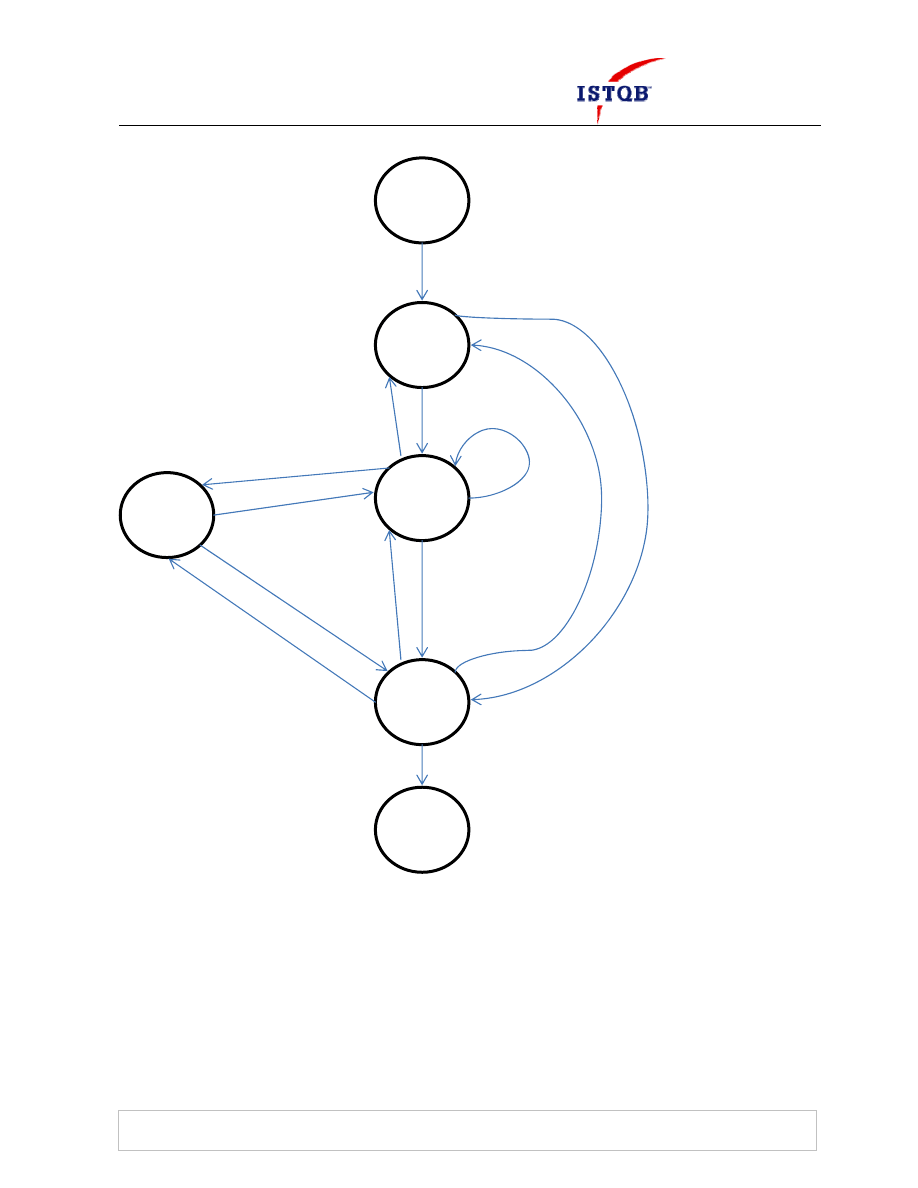
When an employee requests payment of a claim from his/her health insurance, this request follows the
sequences of states shown in the diagram from being requested until it is closed and removed.
If information is missing or changed, the claim may be moved back to an earlier state to prevent
payment. There are the following restrictions: If a claim in state Accepted has been Closed it can only
be restored to the same state Accepted. If a claim in state Activated has been Closed it can only be
restored to state Activated.
Certified Tester
Advanced Level Syllabus – Test Analyst
International
Software Testing
Qualifications Board
Sample Questions – ATA
Page 21 of 47
23 November, 2012
© International Software Testing Qualifications Board
Starting from Activated: what is the number of 0-switch transitions and what is the number of allowed
1-switch?
Choose TWO options
Answer Set:
A. 3 0-switch transitions
B. 4 0-switch transitions
C. 5 0-switch transitions
D. 8 1-switch transitions
E. 11 1-switch transitions
F. 12 1-switch transitions
Requested
Accepted
Activated
Closed
Disputed
Removed

Certified Tester
Advanced Level Syllabus – Test Analyst
International
Software Testing
Qualifications Board
Sample Questions – ATA
Page 22 of 47
23 November, 2012
© International Software Testing Qualifications Board
Justification:
A. Incorrect: 4 transitions for Switch 0, see justification under B.
B. Correct: , 4 transitions for Switch 0, Switch 0 from Activated there are 4 transitions: To
Activated itself, to Accepted, to Closed and to Disputed.
C. Incorrect:, 4 transitions for Switch 0. see justification under B.
D. Incorrect: 11 valid for Switch 1 see justification under E.
E. Correct
Switch 1 from Activated there are 11 valid transitions
1. Activated via Activated to Activated,
2. Activated via Activated to Closed
3. Activated via Activated to Disputed
4. Activated via Activated to Accepted
5. Activated via Closed to Activated
6. Activated via Closed to Disputed
7. Activated via Closed to Removed
8. Activated via Disputed to Activated
9. Activated via Disputed to Closed
10. Activated via Accepted to Activated
11. Activated via Accepted to Closed
Note Activated via Closed to Accepted is not an allowed transition.
F. Incorrect: , 11 valid for Switch 1 see justification under E.
G. Incorrect: 11 valid for Switch 1 see justification under E.
Point Value: 2
Certified Tester
Advanced Level Syllabus – Test Analyst
International
Software Testing
Qualifications Board
Sample Questions – ATA
Page 23 of 47
23 November, 2012
© International Software Testing Qualifications Board
CTAL-ATA _LO-3.2.6
TA-3.2.6 (K3) Write test cases from a given specification item by applying the pairwise test design
technique to achieve a defined level of coverage
Question:
A company offering house insurance policies has several policy options. They depend on the following
factors:
-
Building type: house, semi-detached, apartment building, cottage
-
Material: wood, concrete, brick, mixed
-
Location: city, suburb, countryside, wilderness
You are testing the system and using the pairwise technique for creating test cases.
Using the pairwise technique, how many test cases are required to achieve 2-wise coverage?
Answer Set:
A. 16
B. 12
C. 256
D. 4
Justification:
A. Correct: This can be seen from the following table:
case #
Value 1
Value 2
Value 3
1 house
wood
city
2 house
concrete
suburb
3 house
brick
countryside
4 house
mixed
wilderness
5 semi-det
wood
suburb
6 semi-det
concrete
countryside
7 semi-det
brick
wilderness
8 semi-det
mixed
city
9 apt wood
countryside
10 apt concrete
wilderness
11 apt brick
city
12 apt mixed
suburb
13 cottage
wood
wilderness
14 cottage
concrete
city
15 cottage
brick
suburb
16 cottage
mixed
countryside
B. Incorrect: this is the result of the number of parameters multiplied by the choices (3 * 4).
C. Incorrect: this is the result of 4 to the power of 4.
D. Incorrect: this is 1-wise coverage.
Point Value: 2
Certified Tester
Advanced Level Syllabus – Test Analyst
International
Software Testing
Qualifications Board
Sample Questions – ATA
Page 24 of 47
23 November, 2012
© International Software Testing Qualifications Board
CTAL-ATA _LO-3.2.7
TA-3.2.7 (K3) Write test cases from a given specification item by applying the classification tree test
design technique to achieve a defined level of coverage.
Question:
Easytravel is a card which is used for paying journeys on buses and undergrounds. The user can
store credit to the card at the Easytravel Loading Machines and the system automatically deducts the
fee of the journey while the user shows the card to the card reader on a bus or at the underground
station
The system allows the user to load 10, 20, 30, 40, 50 Euros or another, user-defined amount to the
card. There are four payment methods available: cash, credit card, debit card or pay-by-phone. After
the transaction, the system allows the user to view or print the balance on a receipt
Using the Classification Tree method, what is the minimum number of test cases for 100 % 1-wise
coverage?
Answer Set:
A. 6 test cases
B. 2 test cases
C. 12 test cases
D. 3 test cases
Justification:
A. Correct: In 1-wise coverage, each value of every parameter must be at least once included.
The maximum number of values is in the parameter “amount”, 6.
B. Incorrect: This is the minimum number of options in a branch (show balance - either on screen
or on paper).
C. Incorrect: This is the figure you get when you count all the options together (6 + 4 + 2).
D. Incorrect: This is the number of branches (amount, payment method, show balance).
Point Value: 2
Certified Tester
Advanced Level Syllabus – Test Analyst
International
Software Testing
Qualifications Board
Sample Questions – ATA
Page 25 of 47
23 November, 2012
© International Software Testing Qualifications Board
CTAL-ATA _LO-3.2.8
TA-3.2.8 (K3) Write test cases from a given specification item by applying the use case test design
technique to achieve a defined level of coverage
Question:
Easytravel is a card which is used for paying journeys on buses and undergrounds. The user can
store credit to the card at the Easytravel Loading Machines and the system automatically deducts the
fee of the journey while the user shows the card to the card reader on a bus or at the underground
station.
You are working on an Easytravel system maintenance project and the following use case has been
given to you for reviewing.
USE CASE: ADD TO EASYTRAVEL BALANCE FROM CREDIT CARD
Use case ID: UC-201201
Purpose: User is increasing the balance on their Easytravel card.
Actors: user, system
Pre-conditions: User has a valid Easytravel card and a credit card.
Main scenario:
User System
1. User sets the Easytravel
card on the reading plate of
the Easytravel Loading
Machine.
2. The system asks what the user wishes to do:
(E1)
a) query card balance (
Æseparate use case)
b) add to balance of the card
c) check latest card transactions (
Æseparate use
case)
3. User chooses “Add
balance”
4. System asks the amount. (E1)
5. User selects the amount. 6. System asks for the payment method: (E1)
a) cash (
Æseparate use case)
b) credit card
7. User selects credit card.
8. System asks the user to insert credit card into
the credit card reader. (E1)
9. User inserts the credit
card.
10. System shows the amount to be charged from
the credit card and asks for confirmation. (E2)
11. User confirms the
amount.
12. System makes the credit card transaction and
adds the amount to the Easytravel card balance.
13. User removes the
credit card and the
Easytravel card.
14. System prints out a receipt of the transaction.
15. System returns to the main screen.
Certified Tester
Advanced Level Syllabus – Test Analyst
International
Software Testing
Qualifications Board
Sample Questions – ATA
Page 26 of 47
23 November, 2012
© International Software Testing Qualifications Board
Exceptions:
Exception Action
E1
User can stop the process by removing the Easytravel card from
the reading plate.
E2
If the user does not accept the amount to be charged, they can
cancel the operation by pressing the Cancel-button on the credit
card reader.
End result: User’s Easytravel card balance has been increased with the selected amount and the
equal amount has been charged to the credit card.
How many test cases are required to achieve the minimum coverage for this use case?
Answer Set:
A. 6
B. 1
C. 9
D. 2
Justification:
A. Correct: The correct number has one test case for the main stream plus all the exception
paths of which there are 4 E1’s and 1 E2.
B. Incorrect; 1 is the minimum for main stream, but does not take into account the alternatives
nor the exceptions.
C. Incorrect: The figure is calculated by adding test cases for the options with separate use cases
to the correct number.
D. Incorrect: This is a situation with a test case for main stream and one test case for the
exceptions.
Point Value: 2
Certified Tester
Advanced Level Syllabus – Test Analyst
International
Software Testing
Qualifications Board
Sample Questions – ATA
Page 27 of 47
23 November, 2012
© International Software Testing Qualifications Board
CTAL-ATA _LO-3.2.9
TA-3.2.9 (K2) Explain how user stories are used to guide testing in an Agile project
Question:
Which of the following is true regarding user stories?
Answer Set:
A. User stories describe functional and non-functional characteristics of a specific small
part of a system that must be tested and demonstrated by the team.
B. User stories are stories told by users regarding their experiences in using the system after it
has been implemented.
C. User stories describe all the activities required from a user in order for them to perform a
certain functionality.
D. User stories are an extension to use cases and used in a similar way as a basis for test cases
in acceptance testing.
Justification:
A. True, as per definition of a user story in section 3.2.8 in Syllabus.
B. False. User stories are part or requirements documentation and created before or at the same
time as the system is developed.
C. False. User story describes the requirements and what is expected from a system, not specific
activities related to those expectations.
D. False. User stories are not related to use cases; nor are they used only in acceptance testing
but they can be used at all test levels.
Point Value: 1
Certified Tester
Advanced Level Syllabus – Test Analyst
International
Software Testing
Qualifications Board
Sample Questions – ATA
Page 28 of 47
23 November, 2012
© International Software Testing Qualifications Board
CTAL-ATA _LO-3.2.10
TA-3.2.10 (K3) Write test cases from a given specification item by applying the domain analysis test
design technique to achieve a defined level of coverage
Question:
Airliners are classified according to a number of factors affecting the air traffic control procedures and
airport handling procedures. A recent change to the classification scheme has been introduced to
reflect the increasing size of airliners. An air traffic control system has been modified to recognize a
change in two factors: weight and passenger capacity as a number of passengers.
The new class includes all airliners with unladen weight between 4700kg and 9500kg, and with
passenger capacity between 350 and 550.
Which option below correctly provides an adequate test for this new class of airliners using domain
analysis?
Answer Set:
Test 1
Test 2
Test 3
Test 4
Wt Cap Wt Cap Wt Cap Wt Cap
A
5500 450 4700 450 8500 350 4000 600
B
5500 475 4500 575 4800 545 9500 550
C
7500 375 4700 550 4600 560 9600 600
D
4700 350 9500 550 4500 600 9600 600
Justification:
A. Correct: Test 1 inside the domain, Test 2 on the weight boundary, Test 3 on the capacity
boundary and Test 4 outside both boundaries
B. Incorrect: Test 1 is inside both boundaries, Test 2 is outside both boundaries, Test 3 is inside
both boundaries and Test 4 is on the upper weight boundary. The set is missing a test at the
capacity boundary
C. Incorrect: Test 1 is inside both boundaries, Test 2 is on the lower boundary of weight and the
upper boundary of capacity Test 3 is inside both boundaries Test 4 is outside both boundaries.
There is duplication of the inside test
D. Incorrect: Test 1 is on the lower boundary for weight and for capacity Test 2 is on both upper
boundaries Test 3 is outside both boundaries and test 4 is outside both boundaries. There is
duplication of the outside test.
Point Value: 1
Certified Tester
Advanced Level Syllabus – Test Analyst
International
Software Testing
Qualifications Board
Sample Questions – ATA
Page 29 of 47
23 November, 2012
© International Software Testing Qualifications Board
CTAL-ATA _LO-3.2.11
TA-3.2.11 (K4) Analyze a system, or its requirement specification, in order to determine likely types of
defects to be found and select the appropriate specification-based technique(s)
Question:
A system is being specified for use by automotive dealers. The system will provide the ability to
configure a vehicle’s optional characteristics (e.g. engine size, external trim, color), visualize the
configured vehicle and generate the retail price of the vehicle. An existing system can provide a visual
model of any single configuration but it does not enable the user to modify the configuration in the
same session. This system is being used as a development prototype from which it is expected that
the required functionality can be generated more quickly than working from scratch, and time scales
have been adjusted for a rapid delivery.
Which TWO of the following test case design techniques would together give the best chance of
achieving acceptable test coverage in the available time frame?
Answer Set:
A. State Transition Testing
B. Classification
Tree
C. Boundary Value Analysis
D. Use Story Testing
E. Equivalence
Partitioning
Justification:
A. Incorrect: Although the system may be state-based there is no information about this in the
scenario and the approach of building from an existing system suggests there may be minimal
definition of state changes.
B. Correct: Classification trees offer the opportunity to manage combinations of inputs effectively.
C. Incorrect: Some of the inputs are likely to be in partitions (e.g. colors) but these are unlikely to
be ordered partitions because they identify alternatives, so boundary value analysis is not
appropriate.
D. Incorrect: User story testing is appropriate to the likely development approach but would be
based more on overall functional flow than on detailed combinations of inputs.
E. Correct: The inputs exist in partitions (options) that are combined, so the combination of
Classification Tree with Equivalence Partitioning would be an ideal choice.
Point Value: 2
Certified Tester
Advanced Level Syllabus – Test Analyst
International
Software Testing
Qualifications Board
Sample Questions – ATA
Page 30 of 47
23 November, 2012
© International Software Testing Qualifications Board
CTAL-ATA _LO-3.3.1
TA-3.3.1 (K2) Describe the application of defect-based testing techniques and differentiate their use
from specification-based techniques
Question:
Which of the following describes typical characteristics of defect-based testing techniques?
Answer Set:
A. Defect-based techniques are based on the analysis and classification of previously found
defects.
B. Defect-based techniques are mainly used at the component test level.
C. Defect-based techniques concentrate on defects found during the analysis of the
documentation of a system.
D. Defect-based techniques are a sub-category of specification-based techniques.
Justification:
A. Correct: Defect-based technique uses the typical defects identified for different types of
software and programs as the source of test cases in order to find those specific type defects
in the software under test.
B. Incorrect: Defect-based techniques are mainly used in system testing, not in component
testing.
A. C Incorrect: Test cases are created by analyzing the defects typical for the system under test,
not by analyzing the documentation of the system.
C. Incorrect: Defect-based testing is not a sub-category of specification-based testing, since the
specifications are not the basis of the test cases.
Point Value: 1
CTAL-ATA _LO-3.3.2
TA-3.3.2 (K4) Analyze a given defect taxonomy for applicability in a given situation using criteria for a
good taxonomy
Question:
You have just joined a new software organization. They have a product that is in production but it has
a large number of usability issues that have been recorded against it. This particular product is a data
entry product that records information about new insurance customers. The primary users of the
product are data entry operators who input up to 1,000 new entries each day. You have been asked
to select a good user interface checklist that can be used to test this product.
Which TWO of the following are items that should be included in this checklist?
Answer Set:
A. Verify the tab order of the input fields
B. Verify proper rule checking for validity for date fields
C. Verify that access is limited to those with the right permissions
D. Verify that data is saved accurately to the database
E. Load test with virtual users entering the equivalent of 1000 transactions in an eight hour period
Certified Tester
Advanced Level Syllabus – Test Analyst
International
Software Testing
Qualifications Board
Sample Questions – ATA
Page 31 of 47
23 November, 2012
© International Software Testing Qualifications Board
Justification:
A. Correct: Tab order is an item you should expect to see on a user interface. checklist.
B. Correct: Rules checking for valid date fields should be on a user interface checklist.
C. Incorrect: This is a security item and should not be on a user interface checklist.
D. Incorrect: This is a functional item and should not be on a user interface checklist.
E. Incorrect: Load testing is not part of usability testing.
Point Value: 3
CTAL-ATA _LO-3.4.1
TA-3.4.1 (K2) Explain the principles of experience-based techniques, and the benefits and drawbacks
compared to specification-based and defect-based techniques
Question:
Which of the following statements BEST explains experience-based testing?
Answer Set:
A. If the testers are experienced and have good knowledge of the system under test,
experience-based techniques are a viable alternative to more formal techniques if there
are problems with the quality of the documentation or if the project is under a tight
schedule.
B. Experience-based techniques should generally be used if there are no suitable formal
techniques or if it takes too much time and effort to use them.
C. Experience-based techniques rely on the tester’s knowledge and experience and can
therefore be used to increase the test coverage as the tester knows which areas need more
testing.
D. If checklists are used, experience-based testing can be more systematic and efficient and can
replace specification-based techniques.
Justification:
A. Correct: Experience-based techniques can be used as an option of more formal techniques, if
the testers have enough experience and information about the system under test. Typically
this can happen in situations when there is time pressure or the quality of documentation is
poor or there is no documentation available.
B. Incorrect: Experience-based techniques can be used if no formal techniques can be used, but
it is not the only situation – they should be used to complement formal testing whenever it’s
possible.
C. Incorrect: Experience helps the tester to decide where to test more, but experience-based
techniques do not necessarily improve the test coverage since they are informal and coverage
measurement is not always possible while using these techniques.
D. Incorrect: With the use of checklists, experience-based testing can be made more systematic
and efficient, but if there is a requirement for the use of specification-based techniques,
experience-based techniques can’t replace them. Even though this is partially correct, the
question asks for the BEST option and thus this is not the correct answer.
Point Value: 1
Certified Tester
Advanced Level Syllabus – Test Analyst
International
Software Testing
Qualifications Board
Sample Questions – ATA
Page 32 of 47
23 November, 2012
© International Software Testing Qualifications Board
CTAL-ATA _LO-3.4.2
TA-3.4.2 (K3) For a given scenario, specify exploratory tests and explain how the results can be
reported
Question:
You are a Test Analyst on a new project. The requirements documents are on a very high level,
containing little detail about the problem the software should address. As a result, your manager has
decided that exploratory testing will be a primary test technique used for this project. You have been
given the task of specifying, executing and recording the test sessions.
Select THREE of the options below to define what you will need or will use for specifying, executing
and recording the sessions.
Answer Set:
A. Use debriefing sessions with the test manager or a test lead to record the results of the
test sessions
B. Procure domain knowledge to be applied during the exploratory session
C. Create test charters and assign time boxes for each planned exploratory session
D. Log defects into the defect management system but do not record a pass/fail for the
exploratory session because duplicating the results could be difficult
E. Use the less experienced testers on the team to provide a new approach and fresh view to the
testing effort
F. Record the results in email and send the email to the test manager and test lead
G. Define the test cases to be executed and enter them into the test management tool for
tracking
Justification:
A. Correct per the syllabus as a way to record results.
B. Correct per the syllabus as you will need this knowledge to figure out what to test since the
problem is not defined.
C. Correct since specifying exploratory sessions should include charters and time boxes of some
type.
D. Incorrect; The pass/fail status of the session per the charter should also be recorded.
E. Incorrect: Exploratory testing will require experienced people - probably domain experienced
in this example although an experienced tester could probably do the work as well.
F. Incorrect: This is likely to lead to lost results and no overall tracking.
G. Incorrect: Test cases are not normally defined for exploratory sessions.
Point Value: 2
Certified Tester
Advanced Level Syllabus – Test Analyst
International
Software Testing
Qualifications Board
Sample Questions – ATA
Page 33 of 47
23 November, 2012
© International Software Testing Qualifications Board
CTAL-ATA _LO-3.4.3
TA-3.4.3 (K4) For a given project situation, determine which specification-based, defect-based or
experience-based techniques should be applied to achieve specific goals
Question:
The marketing department of insurance company, SecureLife, has started a project called HIPPOS
(Health Insurance Product Public Order Sales). The purpose of the project is to create a new Internet
application where potential customers can calculate insurance premiums and bonuses based on age
and different health factors.
The new application will also make it possible for individual customers to order health insurance
products online.
The tool and web page created by project HIPPOS will be developed and tested by SecureLife’s Agile
development team. The Agile development team has worked together for the last three years with the
marketing department, developing web applications. The Agile team consists of well-trained testers
and developers. They have implemented test automation for configuration and regression testing and
they have built taxonomies of common defects and common security problems.
In Project HIPPOS the Product Owner from Marketing has presented the following requirements to the
Agile team before the first release planning meeting
1. The Web health insurance calculator shall calculate according to the rules of calculation
described by the actuary and insurance calculation business section
2. The user interface of the Web Health Insurance Order application shall follow the same
standards as the other marketing web applications and use a predefined setup of page
frames and dialogs having been used during the last two years
3. The Web applications shall support the latest 3 versions of each of Internet Explorer, Google
Chrome, Firefox and Safari
4. Security must be at the same level as for other marketing web applications
The Agile team has been asked to prepare a testing strategy. The Product Owner asks the team to
present their proposal for the use of testing techniques at the release planning meeting.
Which one of the following proposals best supports the given scenario?
Answer Set:
A. The Agile team will use Exploratory testing and defect-based testing as the primary
testing techniques for stories 1-4. For story 1 decision table testing will also be used,
automated configuration testing for story 3 and attack-based testing using a checklist
will be used extra for story 4
B. The Agile team will use Exploratory testing for story 1-4. For story 1 the specification based
techniques: decision and branch testing will also be used, automated configuration testing for
story 3 and attack-based testing will be used extra for story 4
C. The Agile team will use specification based testing as the primary testing technique for story
1-4. For story 1 state transition and boundary value analysis (BVA) will also be used and
exploratory testing will be used extra for story 4
D. The Agile team will use defect based testing as the primary testing technique for story 1-4. For
story 1 EP and BVA will also be used and specification based testing will be used as extra
technique for story 4
Justification:
A. Yes this is the most likely proposal blending a number of techniques: It mentions both
exploratory and defect-based testing, the latter of which is directly supported by the scenario,
that states “the team …has as part of their retrospectives built check lists of common
defects…” and because the organization should have experience with the types of defects this
type of application will exhibit. Further decision table testing is proposed which matches what

Certified Tester
Advanced Level Syllabus – Test Analyst
International
Software Testing
Qualifications Board
Sample Questions – ATA
Page 34 of 47
23 November, 2012
© International Software Testing Qualifications Board
is written in the scenario for no 1. Automated configuration testing is supported by the
scenario for no 3 and so is checklist based attacks for security testing in no 4.
B. No: It is primarily wrong because decision and branch testing are not specification based
techniques, but it could also have mentioned defect based testing, since the scenario
explicitly mentioned that the team has build a list of common defects.
C. No: It is not likely that specification based testing is applicable for no 1-4 in the scenario
further there is nothing in no 1 that supports the use of state transition testing, instead decision
table testing ought to have been mentioned.
D. No: Exploratory testing is not mentioned at all. It ought to be part of the techniques used by
this Agile team. For no 1 EP and BVA are mentioned while decision table would be more
likely. Further specification based techniques are proposed for security testing in no 4 where
attack based or error based techniques would be more suitable based on the scenario.
Point Value: 2
Certified Tester
Advanced Level Syllabus – Test Analyst
International
Software Testing
Qualifications Board
Sample Questions – ATA
Page 35 of 47
23 November, 2012
© International Software Testing Qualifications Board
CTAL-ATA _LO-4.2.1
TA-4.2.1 (K2) Explain by example what testing techniques are appropriate to test accuracy, suitability,
interoperability and compliance characteristics.
Question:
You are testing an application that handles credit card transactions. Because of the nature of the
application, the demands for the quality of the system are high: the system shall work accurately and
in compliance with the regulations regarding the applications dealing with credit cards. In addition, as
there are many systems to which this application is connected to, the interaction between them is
critical and shall be flawless.
Which of the following techniques would be MOST appropriate when testing this application?
Select THREE.
Answer Set:
A. Error guessing
B. Decision
table
testing
C. Usability testing
D. Use case testing
E. State
transition
testing
F. Volume testing
G. Exploratory testing
H. Reliability testing
Justification:
B, D, E : Correct
A, C, F, G, H: Incorrect
Accuracy, interoperability and compliance are areas which should be detected from the scenario
for special attention. The MOST suitable techniques of this group for testing these are decision
table, use cases and state transition testing.
Point Value: 1
Certified Tester
Advanced Level Syllabus – Test Analyst
International
Software Testing
Qualifications Board
Sample Questions – ATA
Page 36 of 47
23 November, 2012
© International Software Testing Qualifications Board
CTAL-ATA _LO-4.2.2
TA-4.2.2 (K2) For the accuracy, suitability and interoperability characteristics, define the typical defects
to be targeted.
Question:
Assume you work for a company that has developed a software component to help users securely and
easily manage all the passwords they have defined for different websites.
This component is integrated into hundreds of websites, used by millions of people world-wide.
A new software version of the component is being developed. The main feature of this version is the
integration with a specific operating system that does not currently support this component.
You are the test analyst responsible for creating the interoperability tests.
Which of the following defects would be considered OUT OF SCOPE for interoperability testing to
detect?
Answer Set:
A. Saving the passwords becomes too complicated for some users
B. Passwords are not saved for all websites which integrate with the component
C. Passwords are truncated on some browsers
D. 5% of the websites do not run on a specific operating system
Justification:
A. Correct: this is a usability defect, not an interoperability defect.
B. Incorrect: This is an interoperability issue with some websites.
C. Incorrect; This is an interoperability issue with some browsers.
D. Incorrect: This is an interoperability issue with a specific OS.
Point Value: 1
Certified Tester
Advanced Level Syllabus – Test Analyst
International
Software Testing
Qualifications Board
Sample Questions – ATA
Page 37 of 47
23 November, 2012
© International Software Testing Qualifications Board
CTAL-ATA _LO-4.2.3
TA-4.2.3 (K2) For the accuracy, suitability and interoperability characteristics, define when the
characteristic should be tested in the lifecycle
Question:
Assume you work for a company that has developed a software component to help users securely and
easily manage all the passwords they have defined for different websites.
This component is integrated into hundreds of websites, used by millions of people world-wide.
A new software version of the component is being developed. The main feature of this version is the
integration with a specific operating system that does not currently support this component.
You are the test analyst responsible for creating the interoperability tests.
Which of the following statements correctly defines the level in the testing lifecycle in which the
relevant test should first be performed?
Choose TWO options.
Answer Set:
A. Testing that the passwords are saved securely on the newly integrated operating
system should be performed during component testing.
B. Testing that the passwords are saved accurately should be performed during
component testing
C. Testing that the passwords are saved easily should be performed during acceptance testing
D. Testing that the passwords are saved accurately for all browsers should be performed during
system test
E. Testing that passwords are saved for all websites that integrate the component should be
performed during component testing.
Justification:
A. Correct: The new functionality must be tested first during component testing
B. Correct: Testing that the main functionality still works should be tested at a component test
level.
C. Incorrect: since the ease of use of the component should be tested before acceptance testing.
D. Incorrect: it would be better to test the component on all browsers during component testing.
E. Incorrect: this can first be testing during integration testing.
Point Value: 1
Certified Tester
Advanced Level Syllabus – Test Analyst
International
Software Testing
Qualifications Board
Sample Questions – ATA
Page 38 of 47
23 November, 2012
© International Software Testing Qualifications Board
CTAL-ATA _LO-4.2.4
TA-4.2.4 (K4) For a given project context, outline the approaches that would be suitable to verify and
validate both the implementation of the usability requirements and the fulfillment of the user's
expectations
Question:
Your company has already released a video game product to the market, but it received many
complaints from the users regarding performance, usability, security and portability. You have been
chartered with overseeing the usability testing for the next release of the game. So far, the user
interface looks much better and the response time is greatly improved. The product is stable and all
the new features have been completed and summative testing has been completed.
Which of the following would be a reasonable next step?
Answer Set:
A. Verify that all stated usability requirements have been met and validate the usability by
conducting usability testing in a usability lab with a sample of real users
B. Verify the usability by conducting usability testing in a usability lab with a sample of real users
and validate the usability by releasing the product because it is a time-critical product that
must be released within the market window
C. Verify the usability by conducting formative usability testing and validate the usability by
simulating a realistic load in the lab environment and verifying the user experience with the
response time
D. Verify the usability by running a side-by-side feature comparison with the existing production
version and validate the usability by developing a prototype that can used for review with the
sales people
Justification:
A. Correct. The usability should be verified against the requirements and validated by the real
users.
B. Incorrect: Validation should be done before release and by real users.
C. Incorrect: Formative should have been done before summative and the second test described
is a load test, not a usability test.
D. Incorrect: Usability can’t be verified by running a comparison with the existing unacceptable
product. Also, there’s no reason to develop a prototype - you have the real product.
Point Value: 3
Certified Tester
Advanced Level Syllabus – Test Analyst
International
Software Testing
Qualifications Board
Sample Questions – ATA
Page 39 of 47
23 November, 2012
© International Software Testing Qualifications Board
CTAL-ATA _LO-5.1.1
TA-5.1.1 (K2) Explain why review preparation is important for the Test Analyst
Question:
You are an experienced test analyst who has been assigned to a new project that is very important to
your company.
Management has decided that the development model to be used will be the V-model. You have been
given the task of participating in the review process for the project from beginning to end.
Which of the following statements describes how you prepare for each review in the project, and why it
is important?
Choose TWO options.
Answer Set:
A. Prior to the requirements review, you read the requirements document, checking that
the requirements are unambiguous, complete and testable. The more defects found and
fixed at this stage, the less found later on.
B. In preparation for the integration test plan review, you read the architecture
specification in order to consider dependencies between the components that are
being integrated, so that the integration is performed efficiently.
C. During a system test plan review, you review the defects found during component test, to
determine which components need more testing, and which test techniques would be most
useful.
D. For the system test plan review, you create user stories which will be used to see whether the
system will be tested in the same way it will be used.
E. In preparation for component test design review, you read the design document and the code
of the component being developed and tested, in order to ensure that testing covers
everything.
Justification:
A. Correct: see syllabus (5.1)
B. Correct: see syllabus (5.1)
C. Incorrect: at the stage the system test plan is being created, no component defects have yet
been found.
D. Incorrect: user stories represent small units of demonstrable functionality (in the Agile
methodology). They are not relevant for the system test review phase, and wouldn’t be
created in a V-model project.
E. Incorrect: The design document is read, but there probably isn’t much code to be reviewed at
the stage of component test design review. Even if there were, the TA would probably not
read it (this would more correctly be the job of the TTA).
Point Value: 1
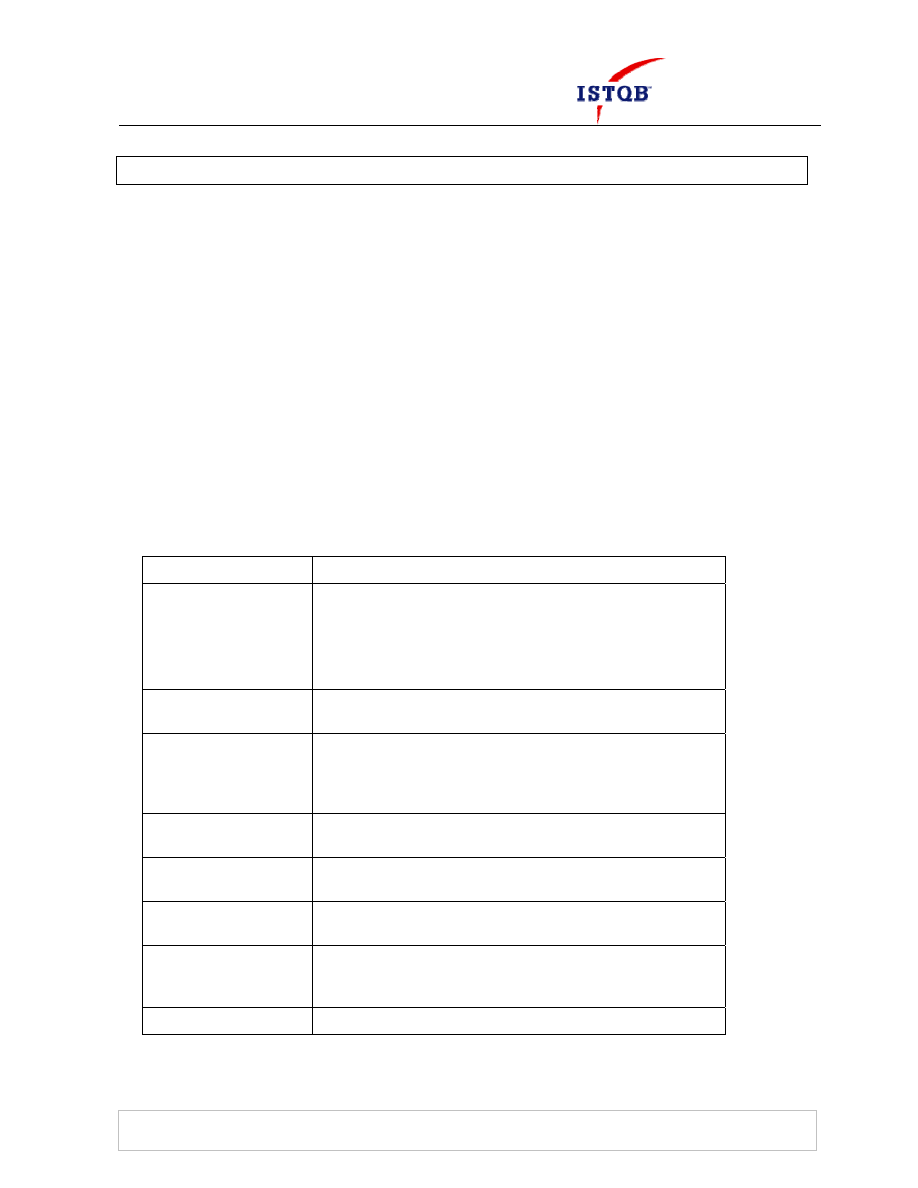
Certified Tester
Advanced Level Syllabus – Test Analyst
International
Software Testing
Qualifications Board
Sample Questions – ATA
Page 40 of 47
23 November, 2012
© International Software Testing Qualifications Board
CTAL-ATA _LO-5.2.1
TA-5.2.1 (K4) Analyze a use case or user interface and identify problems according to checklist
information provided in the syllabus
Question:
Easytravel is a card which is used for paying journeys on buses and undergrounds. User can store
credit to the card at Easytravel Loading Machines and the system automatically deducts the fee of the
journey while the user shows the card to the card reader at a bus or at the underground station.
You are working on an Easytravel system maintenance team and the following use case has been
given to you for reviewing.
USE CASE: ADD TO EASYTRAVEL BALANCE FROM CREDIT CARD
Use case ID: UC-201201
Purpose: User is increasing the balance on their Easytravel card.
Actors: user
Pre-conditions: User has a valid Easytravel card and a credit card.
Main scenario:
User System
1. User sets the
Easytravel card on the
reading plate of the
Easytravel Loading
Machine.
2. The system asks what the user wishes to do: (E1)
a) query card balance (
Æseparate use case)
b) add to balance of the card
c) check latest card transactions (
Æseparate use case)
3. User chooses “Add
balance”
4. System asks the amount. (E1)
5. User selects the
amount.
6. System asks for the payment method: (E1)
a) cash (
Æseparate use case)
b) credit card
7. User selects credit
card.
8. System asks the user to insert credit card into the credit
card reader. (E1)
9. User inserts the
credit card.
10. System shows the amount to be charged from the
credit card and asks for confirmation. (E2)
11. User confirms the
amount.
12. System makes the credit card transaction and adds the
amount to the Easytravel balance.
13. User removes the
credit card and the
Easytravel card.
14. System prints out a receipt of the transaction.
15. System returns to the main screen.
Certified Tester
Advanced Level Syllabus – Test Analyst
International
Software Testing
Qualifications Board
Sample Questions – ATA
Page 41 of 47
23 November, 2012
© International Software Testing Qualifications Board
Exceptions:
Exception Action
E1
User can stop the process by removing the Easytravel card from the
reading plate.
E2
If the user does not accept the amount to be charged, they can cancel
the operation by pressing the Cancel-button on the credit card reader.
End result: User’s Easytravel balance has been increased with the selected amount and the equal
amount has been charged to the credit card.
Consider the following criteria for a good use case:
Which of these are true regarding this use case? Pick TWO.
Answer Set:
A. The main path in the use case is clearly defined.
B. All alternative paths are clearly identified.
C. User interface messages are defined.
D. There is only one main path in the use case
E. Each path (main and alternatives) is testable.
Justification:
A. Correct: The main path can be defined from the use case.
B. Incorrect: There are apparent alternative options which are not defined in the use case.
C. Incorrect: There are no descriptions of user messages in the use case.
D. Correct: Only one main path exists in the use case.
E. Incorrect: There are parts in the use case where the outcome is not clear and thus it is not
testable.
Point Value: 2
Certified Tester
Advanced Level Syllabus – Test Analyst
International
Software Testing
Qualifications Board
Sample Questions – ATA
Page 42 of 47
23 November, 2012
© International Software Testing Qualifications Board
CTAL-ATA _LO-5.2.2
TA-5.2.2 (K4) Analyze a requirements specification or user story and identify problems according to
checklist information provided in the syllabus
Question:
You are reviewing the following requirements specification document:
Document: Req spec 101-A
Object: Transaction screen
Author: Susie Specifier
Date written: 2012-03-15
Version: 0.23
System: Bookkeeping TA-AB1
Subsystem: 2a15
Description:
• User must be able to browse customer’s transactions on the customer’s account. It must be
possible to view the transactions either chronologically from the oldest to the newest or the
opposite way, or by their transaction ID.
• There should be 20 transactions, at the minimum, visible on the screen at one time and the
user must be able to scroll forward and backward.
• The field containing the detailed transaction information must be long enough to contain the
name of the transaction counterparty (max 20 char), their ID number (6 digits) and the
transaction identifier (8 digits).
• It must be possible to change between the Transaction screen and User information screen
with the “Swap screen” –button.
• The layout of the screen is described in more detail in a separate document.
• The retrieval time of new data must be less than 3 seconds per screen. The number of
simultaneous users will vary between 20 and 40 and is expected to increase to 60 within a
year.
• More details about the performance requirements can be found in a separate performance
requirements specification document.
The following is the checklist you are using for this review:
1. Is each requirement testable?
2. Does each requirement have acceptance criteria listed?
3. Is a use case calling structure available (if applicable)?
4. Are the requirements uniquely identified?
5. Is the specification versioned?
6. Is there traceability visible from each requirement to the business/marketing requirements?
7. Is there traceability between the requirements and the use cases?
You are reviewing the specification above with the provided checklist. Assume you have access to
the document that provides more information about the screen layout. Which of the items on the
checklist are NOT met by the specification?
Certified Tester
Advanced Level Syllabus – Test Analyst
International
Software Testing
Qualifications Board
Sample Questions – ATA
Page 43 of 47
23 November, 2012
© International Software Testing Qualifications Board
Answer Set:
A. 4, 6, 7
B. 1, 2, 3
C. 2, 4, 5
D. 3, 5, 7
Justification:
A. Correct: There are multiple requirements in this specification and they are not individually
numbered or versioned, there is no traceability back to the business requirements and there
are no use cases provided.
B. Incorrect: There are no acceptance criteria.
C. Incorrect: Same as C plus the multiple requirements issue as in A.
D. Incorrect: Traceability is missing.
Option A is the only one where all three choices are correct.
Point Value: 2
CTAL-ATA _LO-6.2.1
TA-6.2.1 (K2) Explain how phase containment can reduce costs
Question:
How does phase containment contribute to reducing the cost of development?
Answer Set:
A. By eliminating defects as early as possible to minimize defect propagation
B. By ensuring that the deliverables from any life cycle phase are tested only in that phase
C. By using specific test techniques at each level and only at that level
D. By concentrating the testing effort on the phases where failures occur.
Justification:
A. Correct: Defect tracking can identify where a defect was introduced and where it was
eliminated. Defects not eliminated may give rise to failures and also generate further defects.
B. Incorrect: This response sounds like a form of containment but actually restricts testing
arbitrarily.
C. Incorrect: This response also sounds like a form of phase-centric testing, making the
erroneous assumption that certain techniques will be best in certain phases.
D. Incorrect: This response is the reverse of the correct one in that it defers testing until defects
have become as expensive as they can get (almost).
Point Value: 1
Certified Tester
Advanced Level Syllabus – Test Analyst
International
Software Testing
Qualifications Board
Sample Questions – ATA
Page 44 of 47
23 November, 2012
© International Software Testing Qualifications Board
CTAL-ATA _LO-6.3.1
TA-6.3.1 (K2) Explain the information that may be needed when documenting a non-functional defect
Question:
Which TWO of the following may more frequently need to be explained in greater detail for non-
functional defect reports than for a functional defect report?
Answer Set:
A. Expected
results
B. Steps to reproduce the defect
C. Test data used to identify the fault
D. Level of load on the system at the time of failure
E. Actual results
Justification:
A and D are the correct answers
B, C and E will be required for all defect reports
Point Value: 1
CTAL-ATA _LO-6.4.1
TA-6.4.1 (K4) Identify, gather and record classification information for a given defect
Question:
A project to build a control system for a national fire service is being conducted on a government
contract which has strict deadlines and penalties will be incurred for late delivery. Acceptance criteria
include limits on the number of outstanding defects of different levels of severity at the end of user
acceptance. The system embodies a sophisticated user interface based on an innovative design that
has not yet been deployed in any other system and which is critical to the effectiveness of the system.
The project is using a waterfall life cycle but with incremental deliveries based on priorities of individual
requirements. The project will make use of a defect classification system during development and the
tool in use will allow up to 3 separate classifications to be used.
Which of the following defect classifications will BEST meet the project’s needs?
Answer Set:
A. Defects outstanding by severity, project phase in which the defect was introduced (e.g.
requirements, design), symptom (i.e. what aspect of the system is affected)
B. Defects outstanding by priority, project phase in which the defect was detected, suspected
cause of defect (e.g. requirements, design)
C. Project activity that resulted in the defect being detected (e.g. review, inspection), total defects
by severity, work product in which the mistake was made
D. Symptom (i.e. what aspect of the system is affected, outstanding defects by priority,
suspected cause of defect (e.g. requirements, design)
Justification:
A. Correct: because it counts outstanding defects by severity (which relates directly to the
acceptance criteria), phase in which the defect was introduced (which is the basis of phase
Certified Tester
Advanced Level Syllabus – Test Analyst
International
Software Testing
Qualifications Board
Sample Questions – ATA
Page 45 of 47
23 November, 2012
© International Software Testing Qualifications Board
containment to save cost and time in the project), symptom (because user interface defects
are of particular concern).
B. Incorrect: tracks defects by priority (not directly related to the acceptance criteria), phase in
which the defect was detected (less useful than phase in which it was introduced in terms of
phase containment), and suspected cause (which would be useful for process improvement
but less useful for driving the project).
C. Incorrect: tracks how the defect was discovered (useful for process improvement but not
directly relevant for this project), total defects (rather than those outstanding at any time), and
the work product in which the mistake was made (useful for process improvement).
D. Incorrect: tracks symptoms (useful for identifying user interface defects), outstanding defects
by priority (not severity), and suspected cause (useful for process improvement).
Point Value: 1
CTAL-ATA _LO-6.5.1
TA-6.5.1 (K2) Explain the purpose of root cause analysis
Question:
Why is root cause analysis important?
Answer Set:
A. It helps identify root causes that are responsible for a significant amount of defects
B. It applies an industry standard taxonomy of the known root causes that result in the creation of
defects
C. Often, a large number of defects are caused by unclear requirements
D. It promotes discussion between the tester and the developer
Justification:
A. Correct: per syllabus (6.5.1).
B. Incorrect: this is part of how root cause analysis is done.
C. Incorrect: this is just one example of what root cause analysis may discover.
D. Incorrect: this may be a positive by-product of root cause analysis, but is not why it is
important.
Point Value: 1
Certified Tester
Advanced Level Syllabus – Test Analyst
International
Software Testing
Qualifications Board
Sample Questions – ATA
Page 46 of 47
23 November, 2012
© International Software Testing Qualifications Board
CTAL-ATA _LO-7.2.1
TA-7.2.1 (K2) Explain the benefits of using test data preparation tools, test design tools and test
execution tools
Question:
Which of the following is a benefit of using a classification tree tool for test design?
Answer Set:
A. The tool will generate the combinations of the specified options that the Test Analyst
should test
B. The tool will create the list of the inputs to be tested and the expected results
C. The tool will create test scenarios that will achieve 100% coverage of the specified
combinations
D. The tool will generate automated test code that can then be executed by the Test Analyst
Justification:
A. Correct: This is what classification tree tools do.
B. Incorrect: This is a loose description of a decision table. Definitely not a classification tree.
C. Incorrect: Classification trees do not generate tables that will guarantee 100% coverage.
D. Incorrect: This is a record/playback tool or some other type of test generation tool.
Point Value: 1
CTAL-ATA _LO-7.2.2
TA-7.2.2 (K2) Explain the Test Analyst’s role in keyword-driven automation
Question:
In an organization using keyword-driven automation, which of the following activities typically is the
responsibility of the Test Analyst?
Answer Set:
A. Identify the key business processes that must be tested
B. Write the code to automate the key processes
C. Work with the users to define the key usability aspects of the software
D. Write manual tests for the key business processes that can then be automated
Justification:
A. Correct per the syllabus.
B. Incorrect: This is the TTA ‘s job.
C. Incorrect: This is usability testing.
D. Incorrect: Manual tests are not written for the business processes - code is written by the TTA
for the processes identified by the TA.
Point Value: 1
Certified Tester
Advanced Level Syllabus – Test Analyst
International
Software Testing
Qualifications Board
Sample Questions – ATA
Page 47 of 47
23 November, 2012
© International Software Testing Qualifications Board
CTAL-ATA _LO-7.2.3
TA-7.2.3 (K2) ) Explain the steps for troubleshooting an automated test execution failure
Question:
You are a Test Analyst on a project. You are running an automated test case and it has just failed.
What should be your first step?
Answer Set:
A. Run the same test case manually to see if it fails
B. Alter the data and run the test again
C. Call the Technical Test Analyst to troubleshoot it
D. Write a defect report
Justification:
A. Correct.
B. Incorrect: The TA probably can’t alter the data of an automated test. It would be better to run
the same test manually to determine if the issue is with the automation or the code being
tested.
C. Incorrect: Troubleshooting should be done before calling the TTA.
D. Incorrect: The problem might not be due to a defect, so writing a defect report would be
premature at this point.
Point Value: 1
Wyszukiwarka
Podobne podstrony:
advanced level 2012 sample ques Nieznany (2)
advanced syllabus 2012 test man Nieznany
Cheltenham Word 2003 Manual Advanced Level USA sample
advanced syllabus 2012 technica Nieznany
al 2012 sample questions atm v1 Nieznany
Cheltenham Excel 2000 Manual Advanced Level sample
Cheltenham Word 2003 Manual Advanced Level sample
2 PE 2012 2id 21154 Nieznany (2)
First 2015 Writing sample paper Nieznany
biol prob styczen 2012 id 87360 Nieznany
chemia 3 etap gim 2012 id 11187 Nieznany
EiZI Projekt GiG4 2012 id 15450 Nieznany
Analiza kosztow 2012 id 60726 Nieznany (2)
2012 W2id 28118 Nieznany
pp A1 2012 id 381123 Nieznany
9 10 pierwotne kzn 2012 13 net Nieznany (2)
czerwiec 2012 2 id 128513 Nieznany
więcej podobnych podstron