
Dynamic Hydropower
The "suction turbine" or "jet turbine" of Viktor Schauberger
Hydropower engineering, up to this day, is almost esclusively concerned with two variables, one
being the altitude differential between head water and turbine and the other the quantity of water that
can be brought to flow through the turbines.
A third important variable, the velocity of flow of water, is generally not thought to be important. It is
taken into consideration only as the velocity resulting from the release of water pressure connected to
and dependent on altitude differential but not as an important factor in its own right. In fact, current
design of hydropower facilities normally excludes utilization of the dynamic energy potential inherent
in the free flow of water. A dam destroys this natural energy potential by bringing the water from its
dynamic state of flow to a static state, a complete absence of motion.
If we study the writings of Viktor Schauberger and Ludwig Herbrand, we find that the energy inherent
in the free and unhindered flow of water may be potentially much greater than that obtainable from
the exclusive use of pressure resulting from altitude differential.
A normal flow of water rather than an altitude-induced pressure, has been used in mills and old
blacksmith hammerworks of the pre-industrial era.
Schauberger
In recent times, it was Viktor Schauberger, the Austrian inventor and genial observer of nature's ways
who first advocated the use of increased water velocity rather than water pressure for the production
of hydroelectric power. He obtained a patent for what he termed a jet turbine (Strahlturbine) as early
as the year 1930. (1)
The principles used by Schauberger in order to increase water velocity were the jet configuration of
the water inlet pipe and the promotion, by spiral ribbings on the inside of the jet, of a vortex motion of
the water.
Schauberger's patent actually gives us two very important clues to innovative changes in hydropower
technology.
The first one is, that a pipe configured as a funnel or jet will increase the velocity of the water's flow
by restricting the space available in which the water may flow. This increase in velocity is especially
great if the funnel or jet allows or even encourages the water to form a characteristic flow pattern
known as a vortex. This vortex pattern itself has a tendency, quite separate from the jet-effect, to
increase the velocity of the water, to decrease its temperature and to augment the water's density.
The second innovation proposed by Schauberger is a revolutionary design of the turbine, obtaining
rotation at very high speeds and at the same time avoiding the usual difficulties of cavitation found in
normal high speed turbine designs. In fact Schauberger's turbine wheel is of conical shape, with 'ribs'
spiralling down the surface of the cone in a corkscrew pattern, and it is located in the center of the jet
of water. The corkscrew turbine wheel parts the flow of water, takes up the water's dynamic energy
and lets the flow continue without major disruption. Turbines of current design "hack" the water into
thousands of destructive counter flows and cross vortices, thus wasting much of the available energy
and causing the common problem of cavitation, a super fast corrosion and destruction of turbine
blade material.
Here is the description of this new type of turbine as given in Schauberger's patent number 117 749:
"The subject of the invention is a hydropower machine, which utilizes the living energy of a jet of
water for the purpose of power generation.
<page>
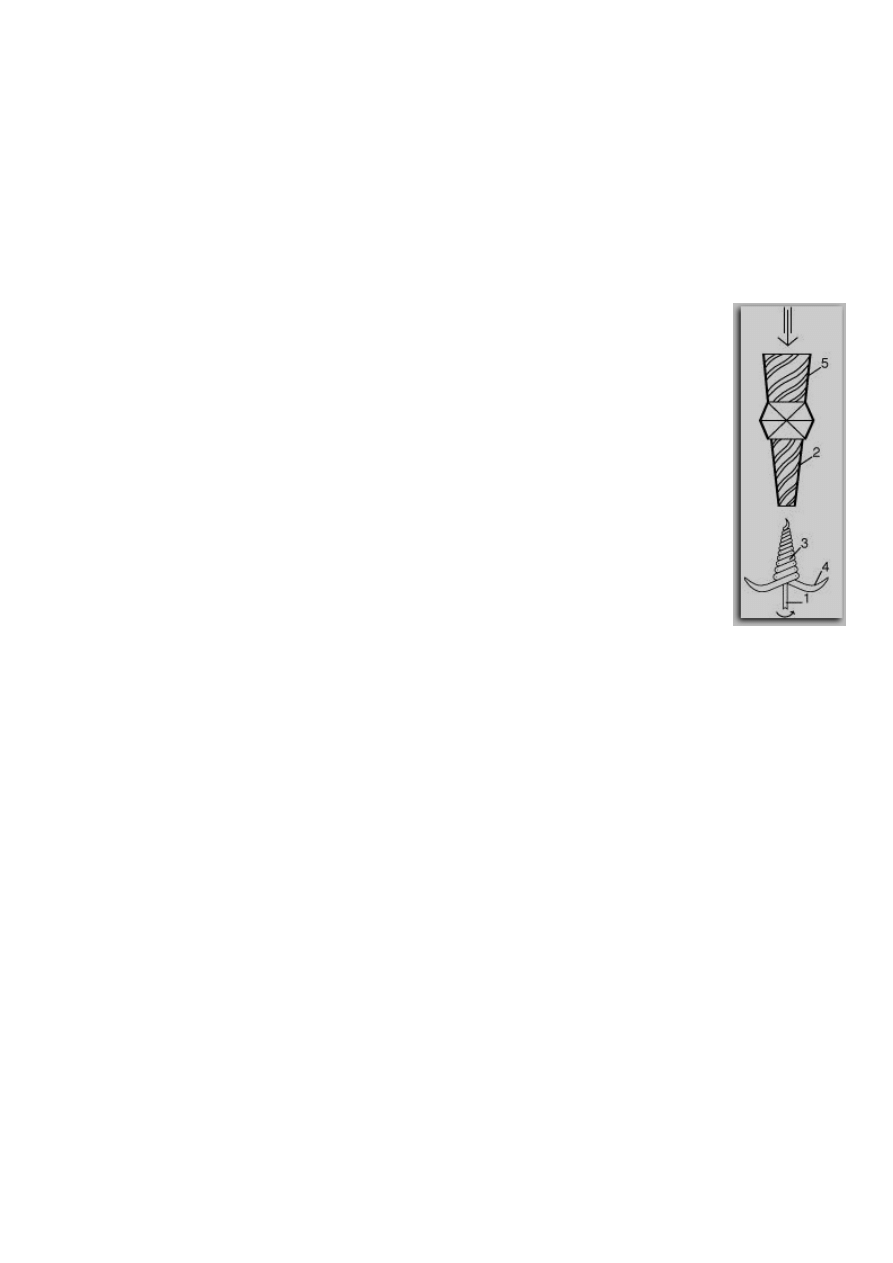
According to the invention, the turbine wheel is a cone with corkscrew-like blades. The cone is
aligned with its axis in the direction of the axis of the jet. In this way the jet of water is split and
diverted out of its course and thus gives its whole living energy to the spinning cone in a way that,
providing the lenght of the cone and the width of its base are in a correct relation to each other and
provided the blades are set at the correct angle, these parameters depending on the speed of the
water jet, the water will flow out of the machine without agitation.
The illustration is an approximate schematic representation of the invention.
The spinning cone, which is aligned with its axis (1) in the direction of the water jet leaving the jet
pipe (2), is made up of blades (3) in the form of a corkscrew.
The ends (4) of these blades (3) are bent somewhat upwards against the direction of
the arriving water jet in order to cause a diversion of the jet and to transfer as much as
possible of the living energy of the jet to the spinning cone.
On the inside of the jet pipe (2) there are screw-like ribs (5) promoting a spin, which
according to actual observations increase the speed of the water jet and the efficiency
of the machine.
PATENT CLAIMS:
z
A jet turbine, distinguished by the fact that in the path of the water jet and
aligned with its axis so as to split the jet, there is a turbine wheel in the form of a
cone, the surface of which is formed of corkscrew-like blades.
z
A jet turbine according to claim 1, distinguished by a jet pipe (2) with ribs (5)
slanted in the direction of spin of the turbine wheel."
This patent was applied for in 1926 and granted in 1930. It seems that Schauberger actually used a
small turbine of this design in a stream of water near the forest wardens' building during those years,
to generate electricity, but no reliable records are available. (2)
Herbrand
Another instance of the use of the dynamic powers of flowing water has been documented by Ludwig
Herbrand, a German engineer who as a student in the mid 1930's was called to evaluate and
calculate the parameters of some generators and exciter units that had recently been installed in the
Rheinfelden power station, as well as to design electrical overload protection and relevant switching
mechanisms for these generators. He was also required to compare the generators with those of
another power station that had been described in an article of a specialized magazine.
Much to the dismay of the then young and inquisitive engineering student, it seemed that the
generators under examination were supplying more electrical energy than they should have,
according to accepted theory. One of the generators of the Rheinfelden power plant, with 50 cubic
meters of water per second and an altitude differential of only one meter supplied just as much power
as a generator in near Ryburg-Schwörstadt, which had a capacity of 250 cubic meters of water per
second and an altitude differential from head waters to turbine of 12 meters! (3)
That fact was confirmed by prof. Finzi, the designer of the turbines and generators, saying to young
Herbrand:
"Do not worry about this. It is correct. The generator has been working without problems for some
time now. Make the calculations backwards and you will see for yourself. We are electrical engineers.
Why, those other problems are not ours to solve, we leave them to the water people. We have
repeated our measurements and the generator's yield of power is exactly as specified. The only thing
<page>
is - no one knows about this." (4)
Herbrand was soon drafted into the army and World War II did not allow him to pursue the matter
further. Only much later, in the 1970s and 1980s, Herbrand came back to the calculations made for
his engineering exams and tried - so far without success - to interest industry and government in this
different and more efficient use of hydropower.
Technical facts
I shall attempt to delineate here the technical facts, using calculations that are based on accepted
formulas and physical considerations confirmed by actual experiment, to show that with a different
approach to hydropower engineering, we could obtain significantly more electrical power than is
being extracted from hydro resources today, with simpler machinery and less expenditure, as well as
less disturbance to the environment.
As mentioned above, current hydropower engineering works with water pressure, obtained as a
result of the altitude differential between head waters and location of the turbine. This pressure, when
released through the turbine, results in a momentary acceleration of the water and thus in a certain
velocity of the water jet. This velocity is calculated with the formula
v = Sqrt 2
.
g
.
h
v being the velocity, g the gravitational acceleration of the earth (9.81 m/sec
2
) and h the altitude
differential measured in meters.
Example: An altitude of 12 m results in a velocity of Sqrt 2
.
9.81
.
12 = 15.3 m/sec.
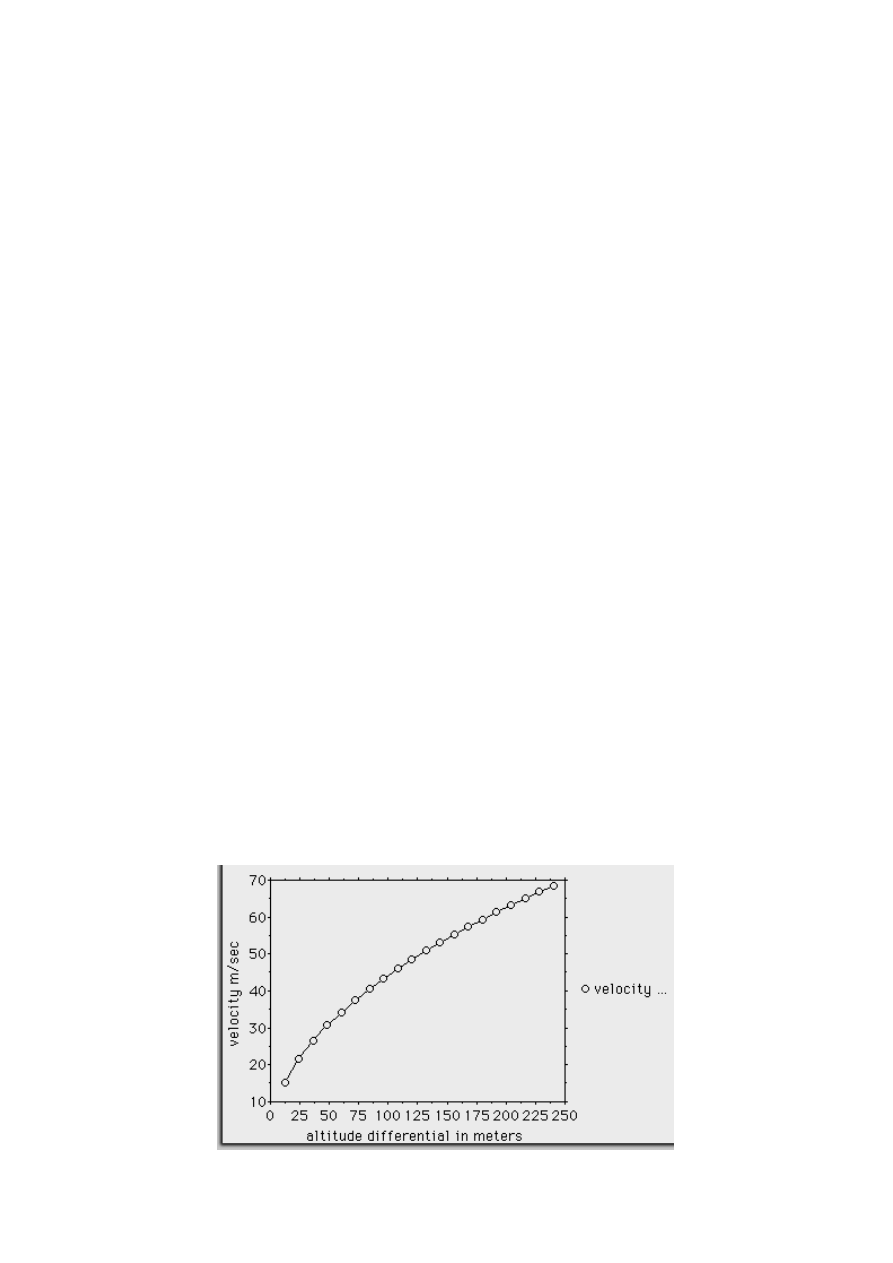
The progression of velocity in relation to altitude differential is shown in the following table.
These values are rendered graphically below.
We see that the curve of velocity at first increases more steeply and then tends to flatten with higher
altitude differentials.
head in meters
12
24
36
48
60
72
84
96
108
120
velocity
in
m/sec
15.3 21.7 26.6 30.7 34.3 37.6 40.6 43.4 46 48.5
head in meters
132
144
156
168
180
192
204
216
228
240
velocity
in
m/sec
50.9 53.1 55.3 57.4 59.4 61.4 63.3 65.1 66.9 68.6
<page>
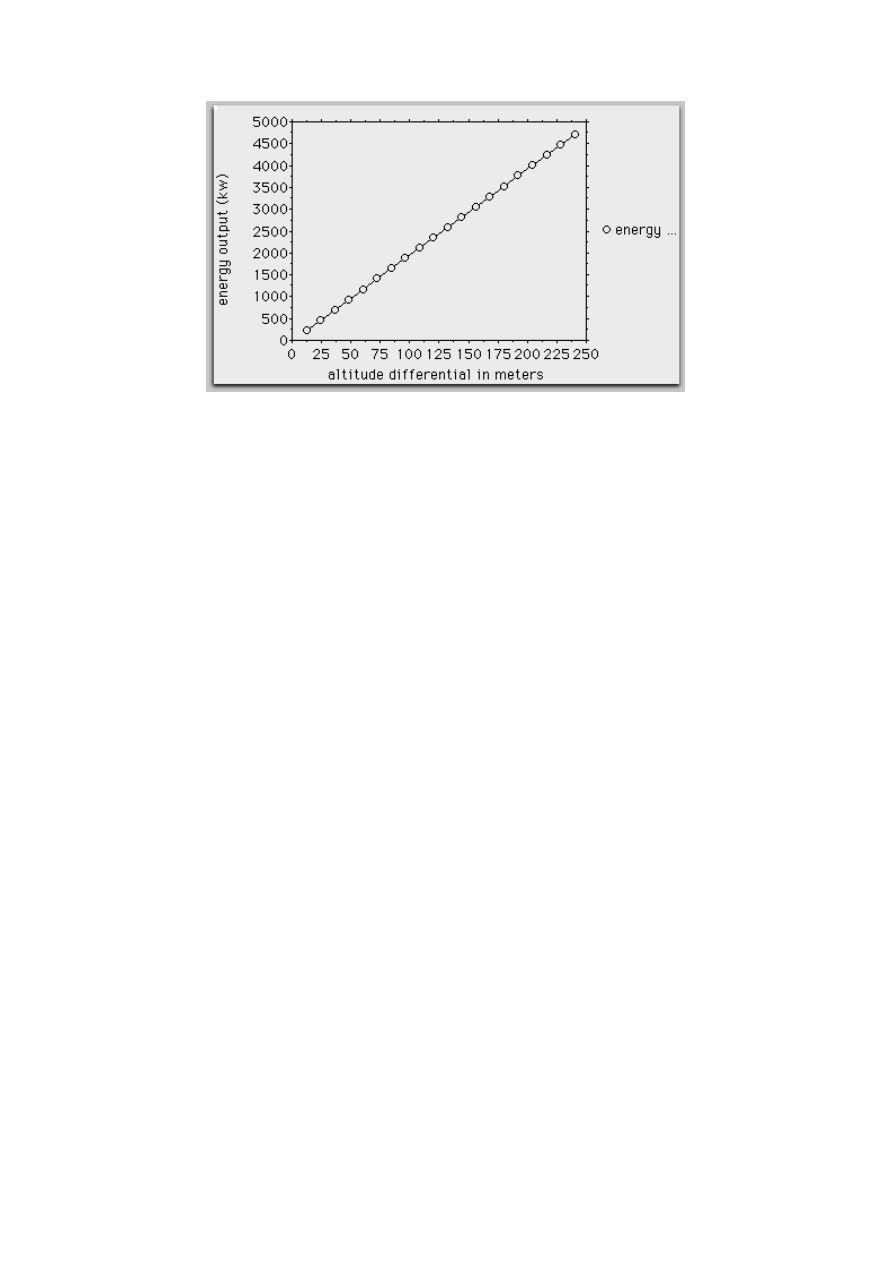
Let us now examine the energy output in kilowatt with increasing altitude differential.
The increase of energy output is linear, as shown in the graphic above.
Calculation
The electrical energy that can be obtained from water is calculated on the basis of the velocity of flow
and the mass of the water, i.e. magnitude of flow measured in cubic meters per second, according to
the formula
E kin = m/2
.
v
2
(kw)
An example, assuming a velocity of 25 m/sec and a mass of 5 cubic meters per second:
5 / 2 = 2.5
.
25
.
25 = 1562.5 kw
For the purpose of comparison, here are some further examples (assuming a small constant flow of
water, only 2 cubic meters per second):
These figures show, that a doubling of velocity quadruples the power output, a threefold increase of
velocity leads to a ninefold increase of power output. In other words, we have an exponential
increase. The curve of energy increase plotted against water velocity is shown in this third graphic.
velocity in m/sec
15
20
25
30
35
40
45
50
55
60
electrical output in kw
225
400
625
900
1225 1600 2025 2500
3025
3600
velocity in m/sec
65
70
75
80
85
90
95
100
105
110
electrical output in kw
4225 4900 5625 6400 7225 8100 9025 10,000 11,025 12,100
<page>
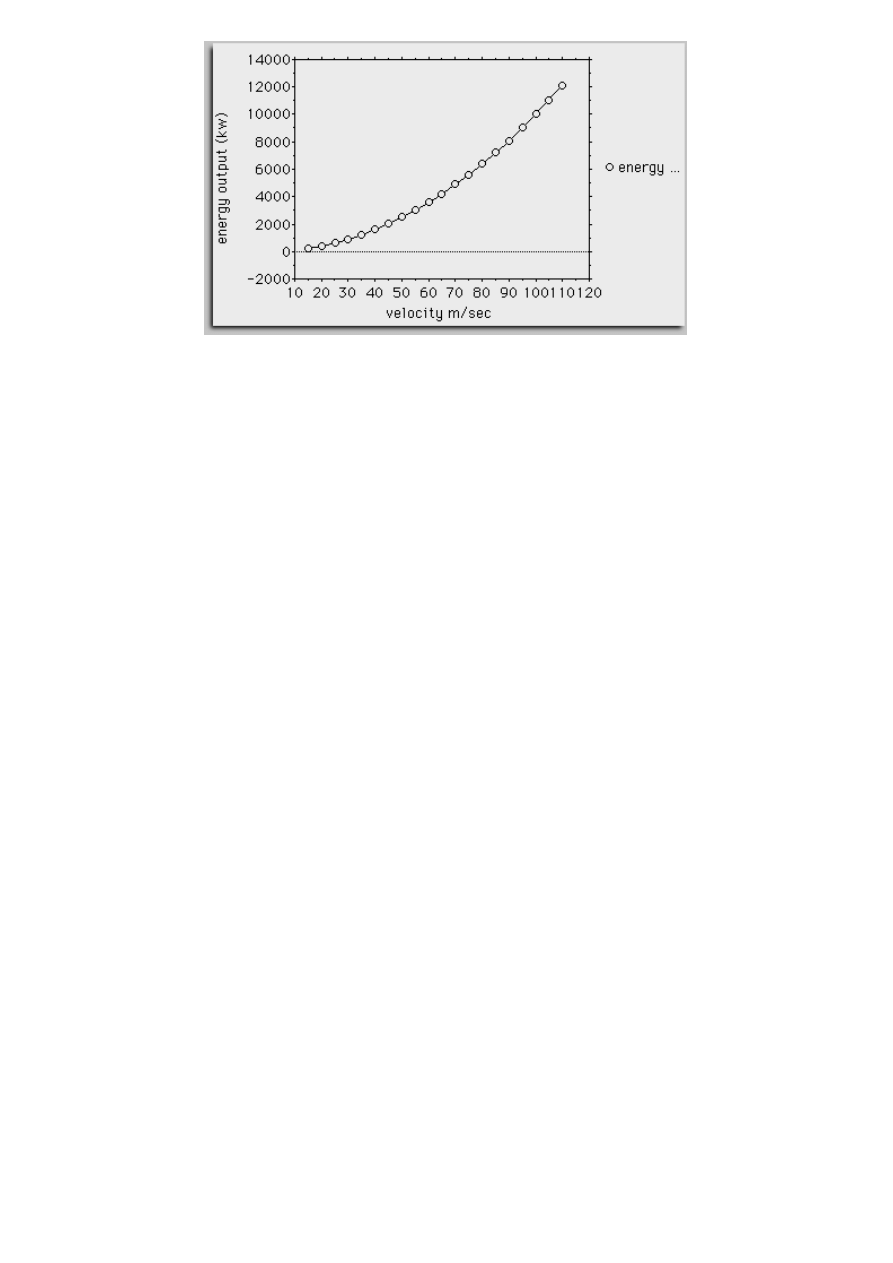
The graphic representation makes it clear, that a velocity increase brings progressively larger
increases of energy. Therefore, the higher the velocity of the water, the greater the overall efficiency
of the power plant!
For the purpose of utilizing hydropower for generating electrical energy, it is however quite irrelevant
whether the velocity of the water is the result of pressure obtained through altitude differential or
whether it is obtained in some other way, such as encouraging the natural tendency of water to flow.
And it seems that we can increase the velocity of flow of water almost at will.
How to increase electrical output
There are two basic variables in hydropower engineering that determine electrical output. They are
the amount of water available and the velocity of flow. The first variable, the amount of water
available, depends very much on location and is generally not subject to increase by human
intervention.
It is the second variable, the velocity of the water's flow, which can be manipulated in many ways.
Apart from increasing water pressure, which is a comparatively inefficient way to increase flow
velocity, this parameter can be influenced by other, more simple and more cost effective engineering
solutions.
It is a common principle in rocketry to increase the velocity of flow of the hot exhaust gases by a
restriction of the path of flow of these gases. This is called the jet principle and has been used
successfully for decades.
The same principle can be used to increase the velocity of a flow of water, such as a river. In fact,
where a river is forced, by the natural configuration of terrain, to flow through a narrow gorge, the
velocity at the narrowest point is much higher than it is before and after the river's passage through
the gorge. This effect can be utilized by finding a natural gorge or by artificially narrowing a river's
bed so as to bring about an increase in water velocity.
Another way to increase velocity of flow in water is to promote the formation of a longitudinal vortex.
This is a rolling or spinning motion, the axis of which coincides with the direction of flow of the water.
Such vortices have the property of causing an increase of the velocity of flow, and a contraction of
the diameter of the space needed by the body of water. They also cause a lowering of the water's
temperature and thus an increase in its density. (The highest specific density of water is reached at a
temperature of + 4† C.)
Water has a natural tendency to form vortices, especially if its flow is accelerated by some external
influence such as gravity. We can observe this by noting the swirl with which a full bathtub or sink or
any other container full of water empties, if the water is forced to flow through a pipe connected to a
hole in the bottom of the container. But even a simple water faucet, releasing a flow of water, will
<page>
show this same phenomenon if the water flows relatively undisturbed, without bubbles or agitation.
As the water picks up speed, it forms a distinctly funnel-shaped vortex right before our eyes.
A confirmation of this tendency of vortices to increase water velocity (or in other words to decrease
resistance to the water's flow) comes from experiments performed in 1952 at the Technical College in
Stuttgart by Prof. Franz Pöpel and Viktor Schauberger.
The experiments were performed with pipes of different materials and different shapes, to determine
if either materials or shapes had an influence on the resistance of the flow of water in pipes.
It seems that best results were achieved with copper pipes, and that this material caused less
resistance to the water's flow than even the smooth glass pipes used as comparison. But the most
important datum emerging from these experiments is, that by using a certain spiral configured pipe,
based on the form of the kudu antelope's horn, the friction in this pipe decreased with an increase in
velocity and at a certain point, the water flowed with a negative resistance. (5)
Theory and practice
The best theory is not worth the paper it is written on, if it cannot be put into practice. We shall
therefore examine the practical utilization of these principles in hydropower engineering.
The object is to increase the velocity of the flow of water to such a degree that the resulting jet will
release more kinetic energy than conventional utilization of water pressure achieved with comparable
means.
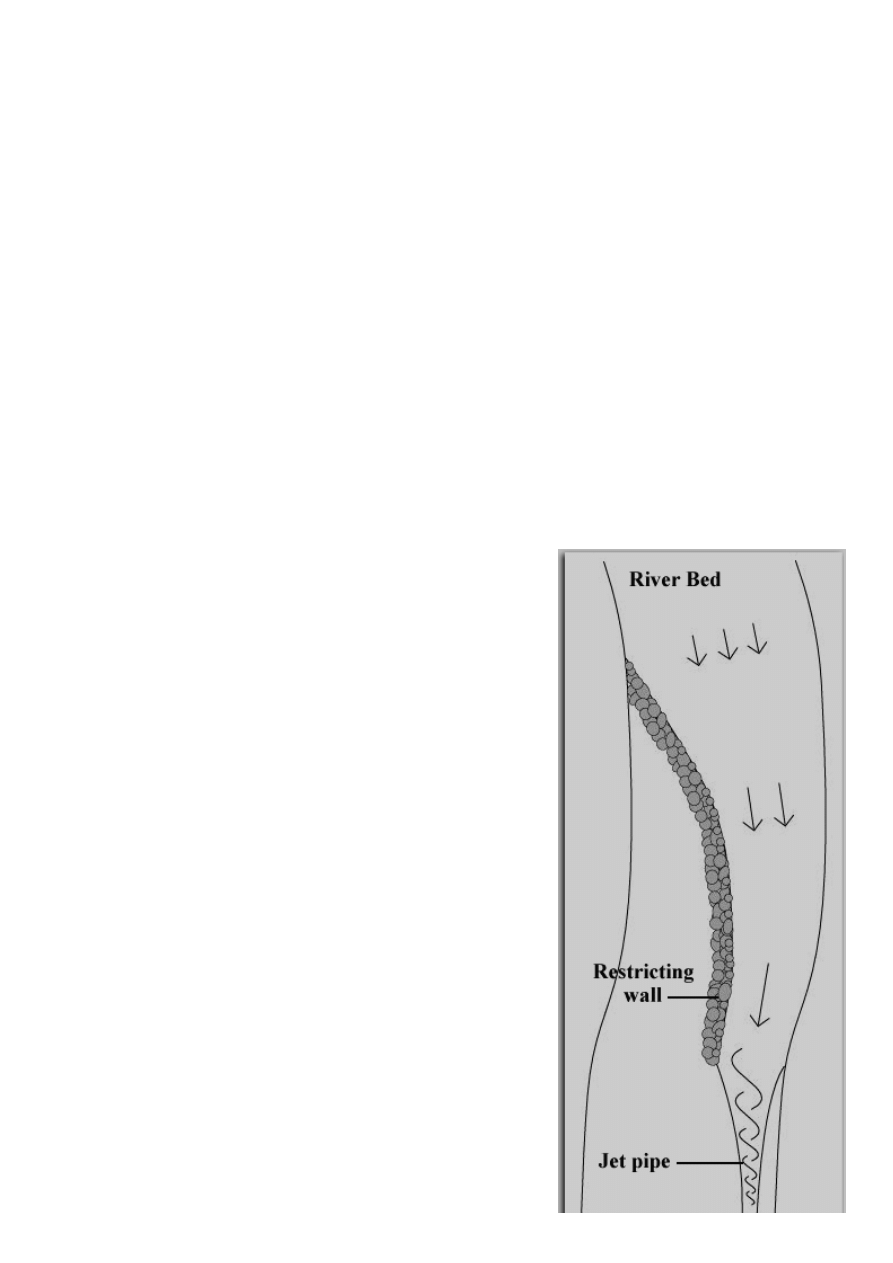
Step 1:
As a first step, a river's normal flow is brought to higher velocity
by the expedient of a wall that gradually restricts the river's bed.
This will increase the normal velocity of flow of 2 - 5 m/sec to a
sizeable 10 - 15 m/sec.
Step 2:
At this point, in order to further increase velocity, we must
provide a channel of flow that more closely resembles the shape
of a natural vortex.We do this by channelling the already swiftly
flowing water at the narrowest point of the river bed into an
approximately round "funnel" or "jet-pipe" which gradually
further restricts the diameter of the water's channel of flow and
thereby causes a further increase in velocity.
In order to aid this process, we can promote the formation of a
vortex in the funnel or jet-pipe which will ensure that the water
exits the jet at a considerable velocity. This is done either by
spiral ribs on the inside of the jet-pipe as proposd by
Schauberger, or by forming the whole pipe in a slightly
"corkscrew" configuration.
Installing a turbine and generator at the release point of the
water jet, preferably of the design proposed by Schauberger,
will now provide an output of electrical power much higher than
that achieved by comparable means in the conventional way.
Where step 1 is not practicable because of the river being too
small, or where we simply want to adapt existing power plants to
utilize the dyna;ic energy of water flow, step 2 can still be
profitably combined with current small hydropower plant design,
by altering the shape of the penstock to a funnel or jet-pipe
<page>

configuration, thus obtaining part of the velocity increase from
normal use of gravity and another part through the specific action of the jet effect and the vortex flow.
No theoretical limit
Are there limits to how fast a water-jet can be made to flow? This is a question we should obviously
ask ourselves before embarking on this kind of project.
It seems that theoretically there are no limitations, as long as the vortex mode of flow is used. If water
is forced to flow in straight pipes, resistance increases with the increase of velocity. Not so when we
allow the water to flow at its natural mode, accomodating the resulting vortex in our pipe design. In
this case, resistance can be very low and even negative, as shown by the experiments performed in
Stuttgart.
For purposes of estimating the potential benefits of using the dynamic powers inherent in the flow of
water, we can conservatively assume that we should be able to obtain, without particular difficulties,
velocities between 40 and 50 m/sec. This is an estimation based on the observation of Herbrand that
at the Rheinfelden power plant a velocity of 35 m/sec was achieved.
We can see from the above statistical tables that 45 m/sec of velocity are equivalent to an altitude
differential of more than 100 meters. And assuming that we have a flow of water of 10 cbm/sec, we
can predict (at v = 45 m/sec) an energy output of 10 megawatt. This is a considerable amount of
power and it can be obtained almost anywhere along the normal course of a river, without the costly
and environmentally questionable practice of constructing a dam and a man made lake to obtain 100
meters of altitude differential.
If it is true that the water's velocity of flow can be increased almost at will and with comparatively
simple means at a fraction of the cost of current hydropower designs, someone might ask: Why are
we not using this obviously superior method?
Fixed ideas and the "law of conservation of energy"
It is very hard to un-learn something one studied and especially if what was learned was then needed
to pass an examination. The weight of socalled "natural laws" brought to bear to support these
doctrines makes it even more difficult for any one person to stand up and say "hey, we have
overlooked something here!"
Of course "everybody knows" that water has to be pressurized if we are to use it for hydroelectric
power generation. And everybody knows as well, that the technology of hydropower engineering has
been well in hand since the turn of the century. So why bother to look any further?
Not so Ludwig Herbrand. He has fought an unceasing battle for more than 20 years now, to obtain
recognition for this new technology. Literally hundreds of letters to government and industry, as well
as international institutions with just so many negative replies, more or less politely telling him that his
proposals are not welcome.
It is difficult to break through this barrier of "knowledge", especially when the experts think they see a
violation of the law of conservation of energy. Conservation of energy is invoked when calculations
do not seem to permit a higher energy output. But in this case we have a factor that has been
neglected in our calculations, not a violation of conservation laws.
Water is an accumulator of energy
There is some evidence that the decrease of water temperature that is a consequence of vortex
motion provides the energy to the water that we then see as kinetic energy in the form of increased
water velocity. In this way a vortex would transform heat (which is random molecular motion) into
dynamic energy (which is motion in a certain direction). Schauberger stressed the fact that water
<page>

could store enormous amounts of energy by being heated up. He states in an article about the
Danube river that in order to warm up 1 cubic meter of water by only 0.1 degree C, one needs about
42,700 kgm of energy, saying that this goes to show the enormous energies that are bound when
water is heated up and are released when water cools down. (6)
Thermodynamics, as taught in our schools and universities does not allow for such a two-way
transformation of heat at low temperature differentials. Thermodynamics is based on observation of
steam machines and has little to do with nature, although some insist that the socalled laws of
thermodynamics are "natural laws". Nevertheless, thermodynamics is not able to explain certain
natural phenomena. (7)
In calculations of electrical power yield, velocity is not considered separately but as a result only and
exclusively of altitude differential. That is like saying, there is no other way of achieving water velocity
than pressure. It may be the way the experts calculate, but physical reality is different. Water velocity,
as we have seen, is not exclusively linked to pressure but may be achieved with different means.
Thus the correct way to calculate is to start from velocity and arrive at the power output. Altitude
differential and the velocity equivalent as calculated in the formula given above are a special case,
not the general rule.
We must distinguish between the pressure-induced velocity equivalent and the natural velocity of
flowing water. That is to say we must distinguish between gravity and inertia. These two forces are
similar in their effects but they are nevertheless two distinctly different forces. This article does not
allow a detailed examination of the physical forces involved. For those who are interested in this
subject, I would like to refer to an article I have written on the basics of physics in EXPLORE! in 1992.
(8)
I hope that this article may contribute to overcoming the "knowledge barrier", the various "everybody
knows" in the field of hydro engineering. To anyone wishing to utilize the dynamic powers of water I
recommend a study of the writings of Viktor Schauberger, the great master of hydro engineering who
remained an outsider to official science all of his life, because his views were so radically different
from those of the professors of his time.
Josef Hasslberger
Rome, Italy
December 1993
References:
1. Patent granted to Viktor Schauberger by Austrian Patent Office, number 117 749 of 10 May
1930
2. Implosion nr. 58, pg 31 article (unsigned) "Kann Energie wachsen?"
3. Hasslberger, Josef
Understanding Water Power
EXPLORE! Vol. 4 number 1, 1993
4. Herbrand, Ludwig "Das Geheimnis der Wasserkraft", 1. Nov. 1990, S. 9
5. Alexandersson, Olof "Living Water" Gateway Books, Bath, UK
6. Schauberger, Viktor "Das Problem der Donauregulierung" in Implosion nr. 23
7. Hasslberger, Josef
A New Beginning for Thermodynamics
EXPLORE! Vol. 4 number 5, 1993
8. Hasslberger, Josef
Vortex - The Natural Movement
EXPLORE! Vol. 3 number 5, 1992
<page>
Wyszukiwarka
Podobne podstrony:
(Ebuch)Schauberger Water Power Technicalid 1307
Viktor Schauberger literatura
Viktor Schauberger idee, odkrycia, wynalazki
Dynamika1
Techniki wywierania wplywu oparte na dynamice interakcji
Analiza dynamiczna chodu w fazie podporu
dynamika bryly sztywnej(1)
Kurs 03 Dynamika
Parzuchowski, Purek ON THE DYNAMIC
Automatyka dynamiakPAOo 2
czlony dynamiczne id 128806 Nieznany
zestaw 5 dynamika punktu materi Nieznany
Metody układania algorytmów rekurencja, metoda dziel i zwyciężaj, programowanie dynamiczne, metoda
Dynamika ugięcie klasyczne projekt45
więcej podobnych podstron