
STUDiO187: Power Core Page - 1
Power Core Beta V2
With these powers I could be a Super Hero! That’s
right, and it all begins with deciding where those
magnificent powers of yours are going to come from.
You must first decide what gives you those amazing
abilities; you must choose your Power Core. Next, you
must decide what you can do with this engine. And
lastly you must decide how far you can take it and
what direction it’s going to take you.
Gentlemen, start your engines!
In the first stage you’re going to have to decide what
type of power source you will be working with. This
will have a profound effect on your player and the
gaming environment. Take some time to decide what
it is exactly that your powers stem from. Are you an
elemental, an undead, a shape shifter, a sorcerer, a
psionic and so on? Then you will have a good idea of
what kind of powers you will have and the kind of
powers you shouldn’t have. Let’s face it, werewolves
don’t fly and vampires don’t shoot lighting bolts out of
their ass.
Keepin’ it Real
You can always twist the argument and say that your
werewolf is so attuned with nature that he has
learned how to summon storms and strike people
with lighting but that is reaching a bit too far. This is
not in the true spirit of Dark Millennium or
STUDiO187. Keep things low key and stay on track.
Remember that this is a c-punk genre gaming
environment with some extra supernatural stuff
thrown in.
If a Judge wants to use industry standard modules he
cannot allow his players to get crazy with those
powers. It’s tough to capture a guy who can vaporize
a tank with his bare hands and it’s not much fun when
your players can hurl a bus at an airplane.
It’s up to the group how far you want to go up the
power ladder. If you want to play a super friends level
campaign then you will still be able to use this system
but you will not want to use the NPCs from the Sons
of FUZION as you will find them quite inadequate.
You are also going to find it tough to run any standard
module. But, if you are happy with the same old
“brawl with the super villains” adventure all the time
then knock yourself out.
We don’t want to seem anti-SPB but you limit your
adventure potential when your players become to
powerful. A 3 to 5d6 KD attack blast is quite ample. A
14d6 KD attack blast is insane. You could blow a hole
in a tank with that much power. Try running Sub-
Attica with a guy that can do that!
Look through the NPCs provided in the Sons of
FUZION plug-in to gage your heroes.
Now for the good stuff
Lastly, you must decide what powers you are going to
have. Choose powers that best suit your Power Core.
An earth elemental would have armor, super
strength, desolidification – earth, maybe tunneling or
density increase. All supernatural write-ups will
appear in the Sons of FUZION section and you will
be able to get a good idea of what to do with your
engine. Also, at the end of this book you will find a
section on magic and psionics describing their
nuances.
Although there are many modifiers that will adjust
power costs, powers may never cost zero or less only
spells have that privilege.
How many points do we get?
As many as you decide on. It’s up to your group what
power level you want to play with. Remember that the
less points you assign to powers, the more flexible
your Actors will be to adventure potentials. Below is a
list of points with examples to give you an idea what
the points equate to. Don’t forget, Actors will escalate
in power through experience. Your campaign might
start at a pulp level and advance to a champion level
within months depending on how often and long you
play.
The points listed below are for Powers and stats. To
make things easier all around we will assume each
Actor already has a 4 in every primary stat. Lets face
it, what hero would have less then a 4 in anything?
The player may choose to reduce these stats and if
he does he will redeem points for them. Skills are
also purchased as normal (for more detail on
creating characters see the official Fuzion Rules and
use the character generation section in Hell’s
Cookbook.
Points Example
25
Pulp - Zorro, Jaguar God, Conan, Kraven
40
Dark – Moon Knight, Daredevil, Sunspot
60
Champion – Darkness, Witchblade
75
Super – Dr. Doom, Savage Dragon
100
Mega - Thor, Superman, Hulk
Before you start whoopin’ ass!

STUDiO187: Power Core Page - 2
There are several terms that will repeat themselves
throughout this plug-in. The first three are OCP, TCP
and PP. OCP stands for Original Cost Points, used to
indicate the original points spent on the power before
modifications. TCP stands for Total Cost Points and
is used to indicate the total value of all points spent
on the power including modifier costs. PP stands for
power points. For every five option points (OP) you
will get 1 power point (PP).
The second set of terms is Actor, Cast, Player and
Target. The term Actor will be used to refer to the
character in question. The term cast refers to the
party of Actors. When explaining confrontations the
Player is the guy with the power in question or the
subject of discussion. The Target is the other guy or
the victim. Player can also be used to describe the
guy (or gal) behind the dice. You know the real
person, the one with the pencil.
As for taking and giving damage, you will see the
following terms: SDm, SDf, EDm, EDf, KDm, KDf,
EKDm and EKDf.
It breaks down like this:
Term
Description
SDm
Stunning Physical Damage
SDf
Stunning Physical Defense
EDm
Stunning Energy Damage
EDf
Stunning Energy Defense
KDm
Killing Physical Damage
KDf
Killing Physical Defense
EKDm Killing Energy Damage
EKDf
Killing Energy Defense
We are considering wiping out the whole idea of their
being a difference between Physical and Energy
damage and defense and just having Stunning and
Killing damage and defense. Please write us and let
us know of your feeling on this matter.
The term "effect" is also used quite often. When used
as the subject "effect" is to indicate the material of the
power.
Some effects might be: fire, cold, light, webbing,
electricity, ballistics, concussion, mental energy,
slashing, sonic, radiation, Virtue* and Sin*.
* Virtue and Sin are explained in greater detail in
the Hell's Cookbook but until that plug-in is
finished assume that Virtue is "Good" and sin is
"Evil". It's not that black and white, but until Hells
Cookbook is finished it will have to do.
You will find that throughout this book there are
several things that have been highlighted. These are
examples of the text directly before them. This should
make the examples stand out and easy to find.
Unlike Champions and Fuzion, several powers have
sub categories below them. These are special effects
that are solely for that power. Players do not have to
use these “nodes” when they purchase a power; they
are merely goodies. In cases where the power has
only subcategories (like Flight) then the player must
choose one of them for his power to work.
Some people have created entire books for Psionics
and Magic. Feel free to use them in conjunction with
Power Core but you might not be able to mix and
match systems on the same Actor. Power Core has
been designed to handle, Psionics, Magic and
Cybernetics in one smoothly flowing system. You can
create magic items, spells, cybernetics, techno-gear,
psionic tricks and items, Simbiant (living) items and
probably a shitload of other stuff we haven't thought
of. Combined with Fists of Fuzion, you can make
those cool Manga/Martial Art maneuvers like Fireball
Punch and Electro Slap.
When purchasing powers they will either cost the
player points and will be indicated with a plus (+) in
front of the cost. Or, they will give the player points
back and will be indicated with a minus (-) in front of
the cost. For nodes or modifiers the player might see
a colon (:) in the equation. This is a ratio for
calculating the cost and will escalate the modified
cost as the cost of the power goes up. For modifiers
that cost extra start applying the modifier on the first
point. For powers that provide retribution, start the
modified cost on the second point purchased. In this
way, a power will never cost less then 1. This was
done to preserve a feeling of continuity. A modifier or
node with a cost value of +1:3 stands for +1 Power
Point per 3 Original Cost Points and would mean that
for every 3 Power Points the player spends on the
power (OCP) he will need to spend an additional
point to apply the modifier.
If The Red Fist has a ranged Wounding attack that
has the Shotgun modifier attached to it. He bought
the original Wounding level to 9d6 SDm. This cost
him 9PP for the base power (OCP). He now has to
spend 3 more PP for the Shotgun effect. When he
goes up to the next level of Wounding, he will have to
spend two PP, one point to go from 9d to 10d and 1
PP for the Shotgun effect. The next two levels of

STUDiO187: Power Core Page - 3
Wounding will only cost one point though.
If you don’t like this setup we have provided a
conversion chart at the end of this book to allow you
to use the original Fuzion modifier system (see Out
With the Old, In With the New). We have also
provided quick calculation charts to easily transition
from the old to the new and vice versa.
Every new power begins with the power name in bold
large letters and ends with a line. The power point
cost and endurance cost are at the end of the
description right above the line. There are several
occasions where there is an exception. This will occur
primarily with powers that have not base cost and rely
on nodes for their cost value.
STUDiO187: Power Core Page - 4
These are the aggressive combat powers that SPBs
use to pulverize each other. No good combatant is
without a few of these. LET’S GET IT ON!
Entangle
This power can be used to restrain an opponent or
create a barrier. An Entangle can be webbing, ice
bonds, turning the ground to mud, or anything else
the Player can think of. Entangle can strike one area,
the upper body, lower body or whole body. Unless the
Player buys a disabling entangle, the Target can use
any means at his disposal to escape his bonds. So,
as you can already guess, most entangling attacks
are going to be disabling (like handcuffs). When it
affects an area, that area is immobile and if the
targets power comes from or is used by that area, he
cannot use it to escape. This is of course with the
exception of Damage Field, Armor - Hostile and raw
strength damage which can always be used to effect
an entangle. This is usually going to be a Judge’s
call. Lastly, any entangle that is hit with the same type
of power effect will not usually suffer any damage. A
web blast will not free you from webbing. Teleporting
out of an entangle cannot be done without the Fine
Control modifier. The Actor could, however, teleport
with the bindings. There are a few neat little nodes
you may wish to consider.
Disabling: As explained above, this little nasty
prevents the target from using certain powers
and /or weapons that would normally be at his
disposal. See above for a better explanation.
Cost: +1:3
Effects Teleporters: Does not allow a target to
teleport out of his bonds or with them.
Cost: +1:4
Tail: This allows the Actor to hang onto his target
once he’s got him roped. This tail can be tied to
telephone poles, used to swing him into walls,
tied to the bumper of a car, attach two targets
together, or whatever else the Player can think
of.
Cost: +1 PP
If Raw Dawg is entangled around the waist and arms
by Mr. Frost’s Ice Ring a partial body disabling
entangle, Raw Dawg may bite through it with his 4d6
KDm bite. However, if Frio hit him with his Permafrost
attack, a full body disabling entangle, Raw Dawg
could only use his strength to escape. Additionally, if
Bill Tell were to use his Force Bubble, a full body
entangle, Raw Dawg could use any means at his
disposal to escape.
Cost: +1 PP per every D6 of Hits and 2 pts. of KDf
END: 1:2 TCP
Find Weakness
Resembling a skill but in truth is a power. It is the
ability to identify the weak points of a target's
defenses. A successful Find Weakness check (1
Action) against a Target Number of 16 will
automatically cut the target's outer layer of defenses
in half. If the target has multiple layers a separate
check for each layer would be necessary. Personal
PDf or EDf is always the last layer. If the Actor misses
the roll he can try again, but each successive roll
raises the Target Number by +2. To finding the
weakness roll 3d6 and add that score to the Find
Weakness power level. The target starts with a
defense of 16 + Lack of Weakness value (if he has
lack of weakness power). If the Actor’s number is
higher then the targets number, then the target will
only get half of his defense value of that layer verses
the Actor’s attack. This is only for SDf, EDf, KDf and
EKDf. If the Actor has a piercing attack and a
successful Find Weakness roll, then the Targets
armor would be at 25% protection.
Cost:
•
+2 PP for the base 3d6
•
+1 PP for every power level.
END: 1 pt. per use.
Humanity Attack
Truly twisted is he who assumes this awful power. It
doesn't do damage and has no apparent initial effect
but it can be devastating to those unprepared. The
attack is usually a hideous gaze, a horrible sound or
an extremely disturbing odor. Sometimes it's a terrible
wave of an unshakable creepiness. This can be a
hard power to work into your campaign and there are
few people who have it. It is mostly used for
monsters, daemons or really bad people. Targets will
recover their humanity as they would normal hits.

STUDiO187: Power Core Page - 5
Cost: +2 PP per d6
END: 1 pt per 2 OCP
Knockback
The Actor delivers the knockback effect as though he
had struck the Target with a damaging attack. Initially,
the Target will take no damage but he can always
take damage from an intercepting object. See official
rules for calculating damage. Body +1d6 still
subtracts from the initial knockback. Whatever is left
over will send the Target that many hexes. The
Player must decide whether this is HTH or Ranged. If
it is HTH then the Actor may directly add this effect to
a HTH attack. If it is ranged then he may attack up to
10 m/yds (hexes) for every point spent on the power.
Mr. Fist has a kinetic punch. This is an additional 8 (4
PP) levels of knockback that he can add to his punch.
His strength is a 6. If he does a standard punch he
will deliver 6d6 of damage to the target. Now he will
calculate the knock back. 6+8 = 14 and the target in
this case has a body of 5 and rolls a 3. 14-8 sends
the target reeling back 6 hexes or 18 feet. BAAAM!
Cost: +1 PP per 2 Knockback levels
Mind Control
This is a combination of several different Power
Nodes along with the mind control base. The Player
will purchase a level for mind control and will also
purchase one or more Nodes. Each node will give the
Actor a direction for the power to go in. The power
level will be used for any of the nodes he uses. The
Actor will gain an automatic level 1 in any UP-Skill for
each node he purchases. Thus, the Actor must
develop a different skill for each node.
Alter: The Actor trains to alter brainwave
patterns. The new patterns convey an altered
signal to the brain. The Actor can cause a target
to perceive things the way he wishes him to. This
is not an illusion but more like a change of
perception.
Left is right. That gun sure looks heavy. Is that
maggots in your rice?
These are not the droids we're looking for.... Credits
will be fine.
Cost: +2 PP
Empathy: The Actor trains to sense the powerful
waves released during emotional transaction. He
also trains in the ability to modify these waves to
cause the target's emotions to sway to his desire.
The Actor could cause a target to become
content, angered, smitten or even fearful. The
power can, however, be used to cause people to
love, hate or even be terrified of objects, places
or people.
Cost: +2 PP
Erase: Once the Actor has performed a
successful scan he can then begin to delete
memories of his choice up to the level the scan
will allow. Without Scan, the Actor can only erase
the surface thoughts of the target, the last
several minuets or so. If he is feeling particularly
nasty he could go for a deep root erase and
potentially wipe a target clean. An Actor can
generally wipe a normal mind clean in about an
hour of intense work. Any physical skills lost
during an erase can be relearned at half cost due
to muscle memory.
Add the Target’s resistance to this number
Difficulty Example
0
Repressed Memory
2
Unimportant / will not miss
4
Important event
6
Skill or Core event in life
8
Core - like speech or walking
Cost: +4 PP
Force: The Actor will learn to overwhelm his
targets pattern and inflict his own thoughts within.
If successful, the Actor will be able to take control
of the target and work him like a puppet.
Add the Target’s resistance to this number
Difficulty Example
0
Would enjoy doing anyway
2
Embarrassing or inappropriate
4
Does not believe in
6
Directly and adamantly opposed
8
Is terrified of
Cost: +4 PP

STUDiO187: Power Core Page - 6
Hold: The Actor learns to block signals going to
the body and causes the target to drop or freeze
in place. The target will be about a useful as a
quadriplegic. Speech is not possible but powers
that do not require movement are fine.
Cost: +3 PP
Kill: This is a deadly form of mind control that
causes the autonomic functions of the body to
stop working. The Actor can stop the targets
heart or stop him from breathing. This is also the
most difficult trick to pull off. The Actor must
score a value higher than twice the target’s
resistance. If successful, the target will drop in
place and commence dieing. The target will die
within a few phases but cannot concentrate on
anything but his death. He will be treated as
stunned until death and all stats and skill levels
go to zero.
Non-Death: The Actor can also kill a body
part not associated with life function. This
would be like an arm, leg, eye or ear. The
part will immediately stop functioning and will
begin to atrophy until it withers away. The
body simply stops any repairs or
maintenance of the part.
Slow-Death: The Actor may also choose to
make the death slow. This would be by
turning off control to a function that would not
cause immediate death, like the kidneys,
liver or immune system.
The only thing that can save the target is
someone with the same power or the power
Healing – Treatment Mystical or Psionic
(depending on effect). Even the best doctor
cannot stop or repair the effects. The control to
the brain has simply been turned off.
Cost: +5 PP
Program: The Actor is able to rearrange
memories, desires and agendas. The Actor is
actually able to change a target from the root
level. This power can also be used to repair the
same sort of damage. The Actor must first be
able to scan to the level he wishes to reprogram.
Add the Target’s resistance to this number
Difficulty Example
0
Slightly different from existing
2
Bazaar behavior but possible
4
Seems like different person
6
Directly and adamantly opposed
Cost: +4 PP
Scan: The Actor trains to dig into the targets
mind to reveal deep level information. This
training will allow the Actor to go into deep-rooted
memories or behaviors. Combined with Program,
the Actor could literally change a giving, caring,
sensitive target into a cold blooded, psychopathic
killer. Combined with Erase, the Actor could
completely wipe the target clean.
Add the Target’s resistance to this number
Difficulty Example
0
Surface thoughts
2
Deep thoughts
4
Forgotten but relevant memories
6
Forgotten irrelevant memories
8
Terrifying or repressed memories
Cost: +3 PP
Cost: +1 PP per Power Level
END: 1 pt per OCP
Mute
This power allows the Actor to jam an opponent's
senses, causing him to be at an impairment when
using those senses. He must choose an effect for the
delivery. The effects could range from a bright flash,
a loud bang, pepper spray, a stunning shock wave or
even pure darkness. The Player must roll to hit the
target as a normal attack. This power is normally
ranged. Once a target is hit he can only use Mute
Defense (if it applies for the effect) or take the full
effect. For every power level that is not defended
against, the Actor will receive a -1 to all actions
requiring that sense or sense group. This number will
diminish at a rate of 1 point per phase.
The effects last for one phase per level of effect.
Mute normally affects a single sense; additional
senses and sense groups may also be purchased. A
special note for affecting the touch sense is as
follows. When touch is affected the target cannot
move because he becomes temporarily paralyzed.
However, he will be at no minus to any maneuver or

STUDiO187: Power Core Page - 7
effect that does not require movement. Like mental
attacks, teleport or force field.
Static: This node causes the Mute effect to last
as long as the Actor generates power into it
rather than by a level deterioration.
Cost: +1:4
Cost:
•
+1 PP per Power Level
•
+1:2 for entire sense group.
END: 1 per OCP
Toxin
This power allows the Actor to deliver toxins into a
targets body. The Player will first buy the power level
and the intensity of the toxin and then must choose
the Delivery and the Effect. Toxins have varying
effects and introductions. Build the toxin from the
nodes below.
Delivery: This will determine the condition that will
have to be met to deliver the toxin to the target.
Sub-Dermal: The toxin cannot penetrate the skin
on it’s own and must be introduced through a
break the skin or must be ingested. This is the
standard form of delivery.
Cost: none
Contact: This causes a toxin to be able to be
delivered through direct skin contact or
inhalation. The Actor simply needs to make
contact with skin and the target will immediately
begin to suffer the effects.
Cost: +1:3
Ferocity: Toxin begins working immediately and
delivers it’s effects with rapid speed. The Player
can save points by turning down this speed. The
player may choose for the effect to occur every
minute, hour or day. To determine the results of
the toxin’s effects, substitute phase for this time
period.
Cost:
•
-1:4 for 1 minute
•
-1:3 for 1 hour
•
-1:2 for 1 day
Treatment: All toxins can be divided into a
certain category. Most toxins have direct
antidotes and those who do not or are not
common enough to be available can be treated
with a broad range antidote or a very similar
more common version. These generally tend to
be less effective but effective nonetheless. The
Actor’s toxin will automatically fit into a common
group but for extra points he may have a unique
or exceedingly rare form of toxin leaving doctors
no antidote and very little treatment options.
Cost: +1:3
Effect: This is what happens to the affected target.
Damage: This form of toxin includes Myotoxins -
which damage muscle tissue, Haemotoxins -
toxins that affect the blood and clotting, and
Haemorrhagins - toxins that damage blood
vessels and cause bleeding. These are very
destructive toxins and take a direct toll on the
structural integrity of the affected area. In some
cases, the damaged area will begin to rot and will
require medical attention or the target could die
from infection or Gangrene. While in other cases
the Target will bleed profusely. This is the
standard and most common form of toxin. The
intensity is the number of hits the target will suffer
per phase. The power level is the total amount of
hits the target will suffer.
Cost: none
Death: The toxin will attack the Constitution and
Body stats rather then doing damage. The target
will loose one point x intensity of Constitution the
first phase and one point of Body x intensity the
second phase. This pattern will continue until the
Target beats the toxin or the toxin runs its course
(this routine will continue until the target takes a
total stat loss of the Actor’s power level). If the
target goes to a negative value equal to his
normal stat then he will die. Stats are recovered
at the same rate they are lost.
If Viper has a Toxin – Death power level of 8, then his
target will need to have at least a 4 in Constitution
and a 4 in Body or he will go unconscious before the
poison runs its course.
Viper’s poison is intensity 2 and his power level 8.
Upon successful delivery, the poison will cause the

STUDiO187: Power Core Page - 8
target to suffer 2 points Constitution loss. The next
phase the target will lose 2 points of Body. In the third
phase he will loose 2 more points of Constitution and
in the fourth phase he will loose 2 more points of
Body. He will have reached his total of 8 Power points
by this time.
Cost: +1:3
Neurotoxins: These are toxins that cause
paralysis. Use the rules above for death but
substitute Reflexes and Dexterity. If either one of
these stats drop to zero the target is completely
paralyzed. If either stat goes to it’s negative
equivalent the targets autonomic functions stop.
Cost: +1:3
Intensity: This variable will determine how much the
toxin affects the target each phase. For every level of
intensity the toxin will have 1 level of effect and this
will continue until the power level is achieved.
Cost: +1 PP per level of intensity
Power Level: This is the actual potency of the toxin.
Skipping all other variables this is the actual meat of
the power. Targets will continue to take their effects
until this level is reached.
Cost: +1 PP per power level
Wounding
An Actor with this power can deliver non-ranged
damage which is added to his strength dice or make
a ranged attack up to 10 m/yds (hexes) for every
point spent on the power. The exact nature of the
damage in the attack is left up to the Player. The
nature of the attack must be determined when the
power is purchased; it can be lighting, a blaster bolt,
lasers, sonic waves, a magic blast, chi punch, sword
strike or anything else. Wounding normally either
affects PD, ED, KD or EKD depending on the special
effect. Once again, this must be determined when the
power is purchased and cannot be changed later.
Here are a few nodes you may wish to consider:
Acidic: With this node, armor would be treated
like hits. That is, whenever the Actor strikes an
armored target the armor value will diminish, as
would hits. If the armor is hardened, then the
target will only lose 1 point of armor per 2 points
of damage. Armor that is damaged by this
means will recover at the same speed the Actor
recovers. If the armor is a focus the target is
going to have to make repairs.
Let’s say Raptor was fighting Lord Paradox and was
hit by his Entropic Blast. The 5d6 Acidic blast does 16
points of damage to Raptor’s left arm which has 20
points of armor. Raptor now has 4 points of armor on
his left arm, ouch. If he had purchased hardened
armor, then he would still have 12 points of armor.
Cost: +1:1
END: Add for calculation.
Damage Field: This modifier allows the Actor to
set up a continuing field around himself that
causes damage to any target that comes into
contact with it. This field has no range. Every
power level will cause any target coming in
contact with the field to take 1d6 of damage. Any
target that comes in contact with the field - either
by the Actor being attacked HTH, or by the Actor
attacking someone else HTH will take damage.
Optionally, the Damage Field may be extended
to items carried by the owner, allowing them to
be included within the Damage Field's area. This
Modifier does not provide any protection from
damage; for that effect you must use Armor with
hostile attached.
Cost:
•
+1:3
•
+1 point to include carried items within the
field.
END: Add cost for calculation
Mental: The Actor will use Will as the base stat
for determining to-hit. The target will use Will plus
Mental Dodge (yes another new skill) or just Will
if he has no skill. The target will not get a penalty
for not having the skill. The damage is stun only
and the Actor may only use Resistance against
the damage.
For killing damage use regular wounding KD with
a NND modifier explained as a Mental Attack with
the common defense Resistance. This could be
explained as the Actor making the targets
muscles pull against each other causing the
bones to snap and muscles to rip apart at the
seams (Ouch!). It could also be used to get the
Scanners effect.
Cost: +1:1

STUDiO187: Power Core Page - 9
END: 1 pt per TCP
Modular: This node allows the Actor to change
or add extra effects to his attack blast. There are
two forms of effect modifiers listed below.
Extra effect: This node will allow the Actor
to add a secondary effect to his wounding.
Both effects hit the target but no extra
damage is done. If the Actor has immunity to
one of the types of attack then subtract its
portion out. But, if a defense is especially
protective against one type of attack the
additional points will not effect the blast.
If the Actor had a fire blast he might add radiation to it
to make it more like a nuclear effect. In which case,
the target would be subjected to radiation and heat.
This is mostly useful against immunities and
weaknesses.
Tundra has a 10d ranged wounding attack with two
effects, cold and impact (or kinetic). He attacks Frio
who is immune to cold. Frio will only take 5d from the
impact portion of the attack.
Cost: +1 PP per extra effect.
Dynamic: Utilizing this node, the Actor is
able change the effect of his Wounding. It
takes 1 phase to change the effect and this
effect will remain until the Actor changes it
again. The Actor must continue to use the
same type of damage (ED, SD, EKD or
SKD)
The Actor is able to switch between effects. He could
shoot fire one phase and then take a phase to switch
to ice. This is very useful against mystical creatures
that require certain types of effects to kill them.
Cost: +1:2 OCP
Programmable: By placing this node on the
Actor’s wounding he can change the modifier at
a whim. Thus, he could tack on a Piercing
modifier or maybe Affects Desolid, he can dial it
at anytime he wishes. It takes 1 phase to shift
modifiers. The power level is still affected by the
new modifier. If the player adds a negative
modifier then it must be in affect for the Actor to
receive extra points into his power. This should
keep the munchkins at bay.
Thus, if a modifier costs points the power level will go
down. If it gives points back, the power level will go up
but only if the negative action is at hand. The player
can’t say “Only works during a rainstorm” if it’s
already raining. That’s just being cheap, petty and
munchkinistic.
Cost: +1:2
Pure: The damage of the attack will not have any
carryover. Thus, stun damage will not carry over
1 point of killing per 5 stun and killing damage
will not have an equal amount of stun delivered.
Cost:
•
-1:4 for no killing carryover
•
-1:3 for no stun carryover
Whole Body: This node causes the wounding
attack to strike the target’s entire body. The
Judge could allow 1 area per success. There is
no extra damage to be delivered; this is mostly
for effect and can be a real bitch to armored
targets, especially if Acidic is also attached.
Cost: +1:4
END: Add cost for calculation.
Cost:
•
+1 PP per d6 of SD or ED damage
•
+2 PP per d6 of KD or EKD.
END: 1 Pt per 2 OCP
STUDiO187: Power Core Page - 10
These are powers used to counteract undesirable
effects from other beings. These forms of protection
are necessary on this hostile world in which we live
(and more so for our Actors). No Actor should ever
be without his defenses. Just about every single hero,
villain or mercenary has armor. You are an idiot if
your Actor doesn’t and you think he is going to live
very long. Even if he has desolidification, he should
still have armor. You should also check out the Stat
Powers for more defense modifiers.
Armor
With this power, the Actor has some kind of inherent
tangible defense against Killing or Stun Attacks. It
could be tough skin, armor plates, organic steel, or
anything along these lines. As opposed to the original
Fuzion rules, Armor adds up. If an Actor is wearing
multiple layers of armor each layer is accounted for.
Additionally, the Actor’s personal PD, ED, KD and
EKD are also accounted for. When purchasing
armor, the player must decide whether the armor is
constant or needs to be activated. They both cost the
same because neither is advantageous over the
other. Constant means that even in civilian form he
would be protected but people might notice those
scales on his face. This could post a problem if he
has a secret identity. With activated armor his secrets
safe and it’s only a matter of 1 phase to activate it.
Hell, it could even suffice as the means of concealing
his identity. If his armor is penetrated lower it by 1
point in that area and it will heal at the same rate his
hits heal.
X Tolerant: Whereas X is a variable. X would be
a form of attack that the armor is twice as
effective against.
If the armor were Fire Tolerant, it would be twice a
protective against fire, but have a normal value
against all other forms of attack.
Cost: +1:3
X Intolerant: Same as above with the exception
that the armor would be half as effective against
this from of attack.
Cost: -1:3
X Defense: This is solely for purposes of effect.
It will mostly be used against Armor Ignoring
attacks. The player will decide on the defense(s)
and the Judge will have to take the(se)
defense(s) into account. For example: If a
Panzer Suit has Heat Defense, then even in the
hottest part of the desert at high noon the Actor
would probably feel fine. In addition, when
Volcano cut loose with his Heat Wave (an armor
ignoring attack blast, only defended by heat
defense) he wouldn’t even feel it. But, if Volcano
slammed him with a fireball, Heat Defense
wouldn’t help him a bit.
Cost: +1 PP per Defense Type.
Popular Defenses are Electricity, Cold, Heat,
Radiation and Magic.
Force Field: A force field is an energy barrier
that works as armor. The difference is force
fields require endurance to operate. There are
two types of force fields, constant and reactive.
You cannot get skeletal in addition to force field.
Constant: This type of force field is turned
on and stays on until it is turned off. It is
always protective and protects for any and all
attacks. Remember that it takes 1 action to
turn it on.
Cost: - 1:4
Reactive: This type of force field only
activates per attack and does not take any
time to bring up. It works like a shield. The
player must purchase the skill UP - Force
Shield. To defend with it, the Actor would
declare that his action is blocking with his
force shield. This shield can be used to
defend against HTH, Melee and Ranged
attacks. This is a not a location specific
armor, it will completely protect any part the
Actor needs to defend (even whole body in
the case of an explosion) and thus you must
buy all 5 areas.
Cost: -1:2
Hostile: This indicates that the armor is
constructed of a damaging material. If an object
comes into contact with the surface, it will take
damage. This could be quills, razors, lava,
whatever. The target will take 1d6 SD of damage
per OCP invested in the armor or 1d6 KD per 2
OCP invested in the armor.
STUDiO187: Power Core Page - 11
Cost: +1:2
Skeletal: This is an internal form of armor. The
real protection is provided to the essential life
sustaining organs. An aimed attack can be made
to avoid the armor (provided the opponent knows
it’s there) at a minus to-hit. See aimed attack
rules for penalties. The armor will only protect
against KD. Skeletal is automatically non-visible.
Assume Lord Golgotha strikes Tin Omen for 20
points of killing damage. Tin Omen (caught off guard
and out of his armored suit) has 12 points of Skeletal
Armor. Tin Omen will take 8 hits and 20 stun (minus
normal SD).
Cost: -1:2
Cost:
•
+1 OP for +4 KD per area
If you were going to cover 5 areas (the Actor’s whole
body) it would be 1 PP per +2 Killing Defense or +8
SD. Remember, the points you purchase must be
divided into physical and energy as well. Thus, 16
points of KD can be split anyway you want but you
must allocate it to KD and/or EKD (it’s usually wise to
do half and half).
•
If you are not playing with Energy Defense as
being separate from energy attacks then you
must cut the received amounts in half (1 OP
for +2 KD per area).
END: +1 pt per OCP upon activation.
Danger Sense
This power gives an Actor a "sixth sense" about
danger; a sort of mystical combat sense. There are
three types of danger sense: Active, Reactive and
Cognitive.
Active: This form of danger sense requires that
the Actor activate this power. It shifts his
perception about a half a second into the future
(that’s one theory). The Actor gains the
advantages of being able foresee his opponent’s
next move. Now, he barley has time to react so
there’s no time to think about it, he perceives and
must immediately commit. For every power level
the player purchases, he will receive +1 to Dex
for purposes of defense and +1 initiative.
Cost: +3 PP per level
END: 2 pts per power level
Cognitive: Using this power, the Actor, on a
successful roll, will get a feeling of ‘uneasiness’
in situations that are not quite right. This power
automatically kicks in and is never activated by
the Actor. The Actor need not be in danger; this
activates when things are not what they seem.
The player will roll 3d6 and add it to his power
level. The Judge will assign a difficulty. If the
player rolls equal to or better then this difficulty
the JUDGE will tell the player what his difficulty
was. The lower the difficulty, the more fucked up
things are. This will clue the Actor in on just how
he should react. If the player rolls 12 points
higher then his difficulty the Judge should give an
indication as to what the situation is. This is a
good tool for a JUDGE to give players clues.
Cost:
•
+1 PP for the 3d6
•
+1 PP per additional power level
Reactive: This type gives the player the ‘feeling'
of being in danger during ambush and hidden
trap situations. If the Actor reacts, he is allowed
his full DEX + Skill; he could also attempt to dive
clear of a falling rock, a sniper’s bullet or maybe
a trip wire. Danger Sense checks are made
automatically, at the request of the JUDGE (or
better yet by the JUDGE). The player must make
a successful Danger Sense check of 3d6+power
level against a target number of 16. If the player
rolls 12 more than he needs to succeed (28), the
true position and type of danger are known.
Cost:
•
+1 PP for the 3d6
•
+1 PP per additional power level.
Force Wall
This is the ability to project a barrier at a distance.
When purchasing this power you must decide if it’s
completely translucent, semi-translucent or opaque.
There is no cost difference, but it necessary for game
play. This barrier acts like a wall with Armor and SDP.
When the armor value is breached the damage will
dip into the SDP. Each attack must encounter the
armor and surpass its current value to do more SDP.
Remember, every time the armor is breached, the

STUDiO187: Power Core Page - 12
value goes down by one point. Treat each hex as a
different area. Thus, if a Actor wanted to wear down a
wall, he would need to continually strike the same
hex. When the SDP reaches zero, the wall will
collapse and must be Re-erected if the Actor wishes
it to still remain up. Force walls are purchased in
hexes. These hexes can be allocated in any order
other inside of one another. They can even go
straight up to form a column. These hexes have
strength and can support weight. The weight is equal
to 1 point of strength per 5 SDC. Additionally, if an
area attack hits a force wall and does not penetrate
its defenses, the area attack cannot continue past
that point.
X Tolerant: Whereas X is a variable. X would be
a form of attack that the force wall is twice as
effective against. Thus, if the wall was Fire
Tolerant, it would be twice a protective against
fire. For both the armor value and the SDP.
Cost: +1:3
X Intolerant: Same as above with the exception
that the force wall would be half as effective
against this from of attack.
Cost: -1:3
X Defense: This is solely for purposes of effect.
It will mostly be used against Armor Ignoring
attacks. The player will decide on the defense(s)
and the Judge will have to take the(se)
defense(s) into account.
If Volcano cut loose with his Heat Wave (an armor
ignoring attack blast, only defended by heat defense)
an Ice Wall would, well, stop it cold. But, if Volcano
slammed it with a fireball, Heat Defense wouldn’t
help it a bit.
Cost: +1 PP per Defense Type.
Hostile: This indicates that the wall is
constructed of a damaging material. If an object
comes into contact with the wall, it will take
damage. This could be thorns, fire, lava,
whatever. The target will take 1d6 SD of damage
per OCP invested in the wall or 1d6 KD per 2
OCP invested in the wall.
Cost: +1:2
Independent: With this add on, the SDP will be
counted for each area (hex). Thus, a wall with a
10 SDC that was 4 hexes wide would have a 10
SDC in each hex. If the SDC in a hex drops to 0
only that hex falls. Each hex would have to be
destroyed individually.
Cost: +1:2
Mobile: With this node the wall can be moved.
Cost: +1 PP per hex per phase.
Cost:
•
+1 PP per 6 pts. of Killing Defense (split this
between KD and EKD) in a barrier 1 hex wide.
•
+1 PP per 10 SDC
•
+1 PP per additional hex
END:
•
1 End per PP to erect.
•
+1 per 3 PP to maintain.
Humanity Defense
It is one hard motherfucker that has Humanity
Defense. This defense is usually gained by suffering
regular bouts of horror and pain. For every level of
humanity defense the Actor will subtract 1 point of
humanity loss from the effect. The Actor will not
receive this defense on any power that costs him
humanity to use and will not be applied when
purchasing cybernetics.
Cost: +1 PP per defense point
Invisibility
This power can be used to become hard to detect or
even undetectable to one sense (usually normal
sight). Invisible Actors require an opponent to make
perception check every time they wish to make
contact with them. Upon purchasing the invisibility
power, the Actor will receive +5 to stealth skills and
one additional point per power level when in use.
Sight: The following rules are for sight-based
invisibility, the most common form. To only be
used with sight based perception rolls.
Attacking: While invisible, an Actor has the
option of keeping himself unnoticed. As soon
as he attacks a target, the target is going to
have an idea where the Actor is. Even if the
Actor misses, the effect is going to go

STUDiO187: Power Core Page - 13
whizzing by the target, alerting him to the
Actor’s position. If the target has no clue
where the Actor is, the Actor will receive the
ambush bonus. If the Actor’s attack is
invisible his will always get the ambush
bonus, minus any movement modifiers the
target may be trying to inflict. If the Actor’s
attack is visible and the target is facing the
Actor and is aware of him (knows an invisible
guy is trying to kill him) then the ambush
bonus will not be awarded. It will be a normal
attack.
Defending: If the Actor is in combat, he
cannot add stealth levels or Intelligence. Ten
plus the power level becomes the difficulty
number for the perception check. If the
opponent makes his perception check, there
are no modifiers to his roll. If an opponent
cannot make a successful Perception check,
then he cannot hit the Actor. The opponent
can, however, attack a hex. The opponent
would guess at which hex the invisible target
is in. He would then attack that hex. If the
invisible target is actually in that hex, then the
opponent will be at 0 Ref to hit him, ranged
or otherwise. Should the opponent fail his
perception roll, but know what hex the target
is in he will be at 1/2 Ref. This generally
occurs right after the Actor fires a visible
attack, alerting the target of his position.
Sound: This would indicate that the Actor is able
to dampen sounds caused by himself. It would
mostly be for sneaking around. It’s great for
sneaking up on people. This of course only
works on sound based perception rolls.
Scent: Kind of a rare, but useful form of
invisibility. An Actor with this kind of invisibility
would be harder to detect by scent. Great for
avoiding those fucking dogs and the bastards
whom can track by scent. And the Actor doesn’t
have to worry about people like Wyld Kat
smelling his ambush out.
Taste: Okay, whatever.
Touch: Get Desolidification.
Team: To include other people in the Actor’s
effect he could use area effect, but that would
make an entire area disappear. Neat, but that
might give him away. With this node an Actor can
add additional people within an adjacent hex of
that Actor.
Cost: +1 PP per extra person.
Field: This is the replacement for Darkness. With
this option the Actor creates a field of invisibility.
Every target within that field will become invisible
and hopefully blind. They will fall under
appropriate penalties to everything and everyone
else. The field has a 1 hex radius per 2 power
levels.
Cost:
•
+1:5
•
+1 PP per hex
If Whisper puts a field of invisibility (darkness effect
on sight with power level 6) around Tin Omen, then
Tin Omen would normally have to make a perception
of 16 or higher to know where anything is. But, being
that Tin Omen has Infrared vision, he is unaffected.
Cost:
•
+1 PP per sense
•
+2 PP per sense group for original power
•
+1 PP per additional power level.
END:
•
+1 End per PP per round
•
+1 End per extra person.
Immune
The best defense is a total defense. This power
reflects that very aspect. There are several things that
a player can be immune to. Remember that none of
the items carried by the player (including worn
clothes) get this defense unless purchased so. Also,
unless the player buy's knockback immunity, the
power that he is immune to can still provide
knockback to the player. Also, the player is not
immune to the secondary effects.
He may very well be immune to heat but could be
suffocated by burning the air out from around him.
Class: This will include an entire class of
damage and will represent things like heat, cold,
electricity, slashing, impact, knockback, muting
(must include sense), acid, webbing and so on.
Half: This is a partial immunity of the above.
The player will only take half effect from the
type of attack.

STUDiO187: Power Core Page - 14
Cost: +4 PP
Cost: +8 PP
END: None
Complications: The player will not take any
additional damage from bleeding or shock. He
will not lose any additional Hits or Stun after
being reduced to zero hits.
Cost: +3 PP
Mortal Wounds: The player cannot be killed by
a deathblow. The only way to kill him is through
his hits.
Cost: +3 PP
Power: This form of immunity provides the
player with protection from certain power effects.
It is not intended to protect the player from attack
powers but is designed to handle unwanted
effects. These might include Teleport, Flight,
Shifting, Desolidification, Infrared vision and Mind
Reading. It is up to the player whether this is an
all-time thing or whether it has to be turned on.
Neither will affect this cost but they both have
their own advantages and disadvantages.
Remember all-time means that it can't be turned
off (ever). This choice must be made at the time
of purchase and cannot be altered later.
Cost: +3 PP per effect.
END: None
Self: This allows the player to be immune to any
of his own powers. It is a one-time buy and
covers all of his powers past present and future.
Cost: +2 PP
Specific: This is a very specialized immunity that
is bought for a specific power. It will make the
player totally immune to one specific power from
on specific Actor.
The Roach has the uncanny ability to adapt to nasty
stuff. What doesn't kill him only makes him stronger.
He has been blasted by Lord Golgotha’s black ray
and lived to talk about it. Hell, he's mutated to be
immune to it.
Eve is immune to Adam's (her twin brother) Mind
Scrambler.
Cost: +1 PP per power
Stun: The player cannot be “stunned” from
damage. The player will not have to even record
stun damage, as he cannot be knockout in this
way. The player will have to account for any
killing damage that carries over from a stunning
attack so he should make sure to account for his
PD and ED.
Cost: +8 PP
END: None
Knockback Resistance
A player with this power takes reduced Knockback
from attacks. Each point of Knockback Resistance
subtracts 5 meters of Knockback from all attacks.
Cost: +1 PP for -5 meters of Knockback.
END: None
Lack of Weakness
With this power an individual either has less weak
points or has a field that counteracts find weakness
detection. Each point of Lack of Weakness adds to
the Target Number for Find Weakness Skill Checks.
Cost: +1 PP to raise the Target Number 3.
END: None
Life Support
This power allows the player to operate in unfriendly
or deadly environments without harm. The following
list contains the powers that allow humans (or
humanoids) to survive without the basic vital
substances we all need.
OPTIONAL: Means that this is an obscene level and
you might wish to deny it.
Aging: With this immunity the Actor is able to
extend his living potential incredibly. He is still
able to die from disease, poison and injury. The
Actor will age to adulthood as normal at this point
the effects of his power will kick in.

STUDiO187: Power Core Page - 15
Cost:
•
+1 PP for x4 Life span (about 300 years)
•
+2 PP for immortality (from the whenever to
whenever).
Atmosphere: This will allow the player to survive
comfortably in another type of atmosphere. This
could be under water, in methane, ammonia,
whatever. The player could alternatively choose
an environment type. Maybe he could survive as
a native on Venus or Mars. Or, for a package
price the player could have the ability to adapt to
any environment. This is, of course, provided
there is a substantial atmosphere. In essence the
player would be able to breathe even the most
caustic substances. This would allow him to be
physically comfortable and not need any form of
outside interference to survive the climate. This
would, however, not protect him from airborne
bacteria and viruses.
Cost:
•
+2 PP per specific environment
Be specific….. Mars, Venus, Under Water and so on
•
+10 PP to be able to adapt to any
environment.
Breathing: With this power a player is either able
to go without breathing for extended periods of
time or even at all.
Cost:
•
+1 PP for 1 hour
•
+2 PP for 1 day
•
+3 PP for 1 week
•
+4 PP either does not or does not need to
ever take a breath.
Eating: Having this power allows the player to
reduce the need for consumption or even go
totally without eating, drinking and excreting. For
every 2 meals the player is required to eat he will
(on average) have to excrete at least once.
Cost:
•
+1 PP for 1 meal and 20 ounces of water a
day OR the ability to eat any type of food.
•
+2 PP for 1 meal and 20 ounces of water a
week OR the ability to eat anything except
hostile material (see Hostile, this section)
•
+3 PP cannot or eat or drink.
•
+4 PP no need to eat or drink.
Hostile: This would cover high levels of
background radiation, cosmic rays, microwaves,
electro-magnetic pulses and other things that go
bump on the atomic level. It will not protect the
player from intense bursts of such things. If the
player happens to be caught in the radioactive
burst of an atomic explosion, he will be vaporized
along with everyone else. He could handle
reactor core rods, eat plutonium on his cereal,
stick his head in a microwave oven as a party
trick and suntan on Night City Beach all day long.
This immunity also gives the player half immunity
from any radiation effect attacks.
Cost: +4 PP
Immunities: With this power the player will be
able to ignore all forms of diseases and viruses.
Normally Actors should never come down with
any of these because they are the heroes of the
story. Even so, if the situation presents it’s self
and an Actor deliberately exposes himself to the
situation the Judge should oblige his wishes. This
power will allow the player to go into those
situations without fear.
John is running a campaign in the middle ages and
the cast comes across a town tainted with The Black
Plague. The Judge (John) should not infect the
Actors with The Plague unless they are incredibly
stupid and drink from the common well or perhaps
have sex with one of the town hookers. If one of the
actors had Immunity to Virus he could suck the puss
right from the boil without harm.
Cost:
•
+1 PP for diseases or viruses
•
+2 PP for both
Pressure: With this power a player can survive in
pressures that would kill a normal person. This
will also protect him from drastic changes to and
from those pressures. The Actor will have to pay
for each extreme individually.
Cost:
•
+1 PP for 2289 lbs/in
2
or 7.235 lbs/in
2
1 mile ocean depth or .5 normal atmosphere
•
+2 PP for 11,445 lbs/in
2
or 1.47 lbs/in
2
5 miles ocean depth or .1 normal atmosphere (some
moons)
•
+3 PP for 0 lbs/in
2
or 57,225 lbs/in
2
No atmosphere (outer space, Luna, an asteroid) or
the equivalent of 25 miles ocean depth (jumpin’
Jesus on a rubber crutch).
•
OPTIONAL - +5 PP Black hole.

STUDiO187: Power Core Page - 16
Temperature: This power is of course the ability
to survive for any period of time in extreme
temperatures that would normally kill a man. The
player must pay for each extreme.
Cost:
•
+1 PP -20
°
F or 120
°
F
•
+3 PP -150
°
F or 450
°
F
•
+5 PP –300
°
F or 1250
°
F
•
+7 PP -458
°
F or 2460
°
F
•
OPTIONAL - 10 PP absolute 0 or vacation
on the Sun, no sweat (Ha Ha).
Packages: It can get a little expensive to obtain
some of the effects that a player may want. This
was to make things more versatile and a little
more on the level. Below are some of the most
common packages people buy with modified
costs to make them more affordable. You must
take the package as is or not at all. These have
been set up to provide people with a break for
creating a certain arch-type.
Immortal: This package is designed for
those who wish to play one of the many
beings that share our world. Includes:
Breathing - does not have to
Eating - does not have to
Immunities – both
Aging - immortal
Cost: +8 PP
Roach: Setup for players who want to be
able to adapt to almost anything. Includes:
Eating – anything
Hostile – standard
Temperature - -20
°
F and 120
°
F
Immunities - both.
Cost: +7 PP
Spaceman: The ability to travel in space
without the use of a suit. Includes:
Breathing - does not have to
Pressure - no atmosphere
Hostile - standard
Temperature - near absolute zero
Cost: +12 PP
Seaman: For players who wish to be able to
swim the ocean depths without gear.
Includes:
Atmosphere – undersea
Pressure - 5 miles deep
Temperature – -150
°
F
Cost: +4 PP
Missile Deflection & Reflection
A player with this power can block incoming ranged
attacks (see Ranged Combat and Actions.) The
player will treat the type of attack the same as he
would a melee attack (you can use the Fists of
Fuzion to generate a set of defense maneuvers). To
deflect an attack, first make a successful parry. For a
reflection the player must make a successful block
and then a standard to-hit roll against a target. The
Actor could also choose to catch the incoming attack.
This is of course if the object is catch able. Things like
bullets, knives and arrows. Sorry, lasers and blaster
bolts are not catch able.
Cost:
•
+1 PP - Deflect Thrown Object.
•
+2 PP - As above, Arrows and Projectiles.
•
+3 PP - As above, Bullets and Shrapnel.
•
+4 PP - As above and Energy Beams.
•
+4 PP - Reflect Attack back at attacker.
•
+6 PP - Reflect Attack back at any target.
END: 1 End per OCP
Mute Defense
This power lessens the effect of a Muting attack.
Each point of Mute Defense subtracts one Round
from the duration of a successful Mute attack. Mute
Defense only affects one sense group; the points
from this power must be allocated among the five
sense groups as desired.
Tinted goggles for a flash, Level dampeners for
sound based attacks, nasal filters for powerful odors
and so on.
Cost:
•
+1 PP per 3 phases of Mute Defense per sense
group
•
+1 PP per phase for all sense groups.

STUDiO187: Power Core Page - 17
END: None
Power Defense
A player with this power is especially resistant to
adjustment power attacks. The power level of
defense is subtracted from the power level delivered
by the opponent. Most Actors have at least 2 levels of
power defense.
The Wraith zaps Seven with his Sole Sucking Body
Drain of 5. Seven has 3 levels of power defense and
only losses 2 PP of body. Since he has a super Body
of 8, the last point of body cost him 2 points. His body
will go down by only 1 point for two phases.
Cost: +1 PP per power level
END: None
Slick
The player is able to more easily escape bonds. It
could be that he has slippery skin or that his surface
is extremely smooth or perhaps a force field provides
him with a frictionless surface. At any rate, any form
of restrictive activity that is attempted on the player
will be at a –1 per power level to complete the task. In
addition, the player will be at a +1 to escape in the
subsequent phases. Furthermore, in the case of
entangle, the player will get a +1d6 per power level if
he is trying to muscle his way loose.
Field: If the player purchases a field for his slick
power, then he may leave a sheen on a surface
causing a target to be at the minus to any
physical action while in the sheen. The target will
also be at a –1 move per two power levels of
effect. The Judge may also impose a level of
difficulty per power level for the target to stand. If
the Target fails his Reflexes Roll (add acrobatics
or athletics) the target becomes grounded. This
will also counteract clinging on a level vs. level
status.
If a target has a power level 3 clinging and he hits a
wall affected by a sheen power level 3, he will go
sliding into the floor.
Cost: +1:3 OCP
END: 1 End per 3 TCP
Cost: +1 PP per power level
END: None for base power
Toughness
A player with toughness is able to convert a portion or
all of his Physical Defense (PD) / Energy Defense
(ED) into Killing Defense (KD) or Energy Killing
Defense (EKD). This amount can never go above his
total PD/ED. The amount is purchased in 4 intervals
of 25%. This power normally has no visible effect and
uses no endurance. The player must choose one of
the following.
Constant: The PD/ED is constantly on and the
player will constantly retain the benefits of the
KD/EKD.
Cost: +2 PP per 25%
Switch: The player must activate the converted
points. This requires one phase of time to
complete and will remain active until he turns it
off.
Cost: +1 PP per 25%
STUDiO187: Power Core Page - 18
Movement Powers are those powers that help the
Actor get from place to place. All Actors start with
running, sprinting swimming, and a leap; see
Characteristics, (pg. 116) official Fuzion rules for
details. These movement powers can supplement
those starting values, or add new modes of
movement.
There are two types of movement: a Run (or Combat
Movement), and a Sprint (or Non-Combat
Movement). The former involves ducking, weaving,
and watching out for enemy attacks. It is normally
equal to two times your current MOVE Stat (in hexes).
A player has no penalties to his DEX or REF when
Running.
A player may also move as fast as he can, in a Sprint
(aka Non Combat Movement). This has the
advantage of increasing the player's running speed,
but halving his DEX +Skill levels as well as reducing
his REF to 0 at the same time. The basic Sprinting
speed is calculated when you create your Actor, and
is normally 3 times your current MOVE (in hexes)
In cases where Cargo is a measurement use the
strength-lifting chart. Assume the strength required to
lift an object is the Cargo number required. The
player's weight must be factored into the cargo
number.
Thus if you purchase a 6 Cargo for gliding you could
glide with 288kg/634 lbs.
If you want to get an idea of how fast you are going
then it’s very simple. Multiply your move by two to get
miles per hour. It works like this:
•
3 feet per hex
•
1 second per phase
•
60 phases per minute
•
60 minutes per hour
•
5280 feet per mile
3x60x60 = 10800
10800/5280 = 2.045
Round this to 2 and that’s it.
The following modifiers can be added to any
movement power:
90
0
Turn: Normally a player would break his
neck trying to pull a 90
0
turn while moving at full
tilt. It would be at least an Incredible difficulty roll.
With this modifier the player will not begin to
suffer modifiers from maneuvers until they
require more then a 90
0
turn.
Cost: +1:4 OCP
180
0
Turn: Very similar to the above-mentioned
this modifier allows the player to simply ignore
turning modifiers when maneuvering.
Cost: +1:2 OCP
Instant Acceleration: Normally in Fuzion objects
accelerate at a rate of a 10 move. For Dark
Millennium players can accelerate and
decelerate their Move per phase. With this
modifier the player can instantly go his top speed
and stop on a dime.
Cost: +1:2 OCP
Slow Acceleration: With this modifier the player
can only accelerate and decelerate at half the
norm per phase.
Cost: -1:4 OCP
Wide Turns: The player must make wider turns
when maneuvering. Normally, a player must
travel 1 hex for each facing shift (30 degrees).
When purchasing this modifier, the player must
travel 2 hexes per facing change or suffer a 1-
difficulty penalty. If your not using hexes then just
increase all tight maneuvering difficulties by 1
level.
Cost: -1:3 OCP
Clinging
This power allows the player to cling to walls and
sheer surfaces and move on them as if they were
level. A player with Clinging subtracts 1d6+(Bodyx2)
in meters of Knockback, so long as he is in contact
with a level surface. Cost is based on Cargo, due to
weight limitation. Thus, if the Actor wanted to carry
someone else he would have to be able to
accommodate his or her weight as well. It would be a
Judge’s call for weights that exceed the limit.

STUDiO187: Power Core Page - 19
Cost: +1 PP per 2 Cargo points.
END: None
Cohesion
The player is able to cause liquefied objects to act as
a solid when weight is placed upon them. For every
level the player applies, the surface will support 1
cargo point worth of material. The area of effect is
one hex and if the player wishes to improve upon this,
he may want to purchase area effect.
“Prove to me that your no fool….. Walk across my
swimmin’ pool.”
Cost: +1 PP per 2 Cargo Points
Flight
With this power the player becomes capable of
airborne travel. It will allow the player to travel in the
air as he would upon land. There are several types of
flight. They range from gliding to faster then light
travel.
Standard: With this power the Actor has
propulsive flight ability. This ability could come
from wings, telekinesis, or even gravidic wave
riding. With this power, the Actor is able gain and
maintain altitude and can accelerate by his own
power. Speed is calculated by the Actors base
Run multiplied by his Power Level. For non-
combat speeds multiply the Sprint value by the
Flight Power Level. An additional Sprint multiplier
can be purchased to increase the top speed. This
is a much faster form of flight then combat speed
and is primarily used for getting to the scene
quickly. Combat can be done at these speeds
but is very difficult and will put the Actor under the
Sprint modifiers.
Flying Tiger has a move of 4. He buys 3 Power
Levels of flight and 3 PP of Sprint multiplier. Thus, he
can fly at combat speeds up 24 hexes a phase but at
full tilt he can cover 72 hexes a phase (sprint of 12x3
for normal flight and x3 again for Sprint Multiplier.
Cost:
•
+1 PP per power level for standard flight.
•
+1 PP per power level of Sprint Multiplier.
END: 1 pt per OCP
Gliding: A player with this power can glide
through the air. A Gliding player has some
control over his movement, but not the total
control provided by Standard Flight. A Gliding
player must drop 1 Hex per Phase to gain 1 point
of Velocity. While a player will generally lose 2
points of move per meter gained but, the player
could hit a thermal or perhaps an upward gust
(difficulty 18) and get the altitude at no additional
loss. He could just as easy hit an air pocket and
drop 4 or 5 Hexes in a phase. So, there is no
speed level to buy, the Actor gains speed as he
drops and loses it as he ascends.
The cost of the power is based on the amount of
cargo that he can glide with. He must
accommodate his own weight including
equipment and any passengers. If he attempts to
glide over his cargo limit then start at Competent
and add one difficulty level per point of cargo he
is over. This must be rolled every phase of flight
or he will lose 1 hex per point missed that phase.
Alex Storm has a glider pack that can accommodate
4 cargo points of weight. That equates to 317 pounds.
He and his equipment weigh in at about 250 pounds.
He scoops up two of his falling teammates (we’ll
ignore the teammates velocity to keep things simple
and fun) whose combined weights are 515 pounds.
That’s a total of 765 pounds. This puts him at 7 Cargo
Points (we rounded). He now must make his difficulty
roll every roll every phase or he will drop. He’s 3
points over so he has to make a Legendary roll or
begin to descend. His Reflexes are 6 and his UP –
Gliding is level 5. He rolls a 4 and this gives him a
total of 15. Oh, shit! He needed a 21, that’s 7 points
short. He will drop 7 Hexes (21 feet) this phase.
Cost: +1 PP per 2 points of Cargo.
END:
•
1 pt per direction change
•
2 pts for altitude change
Supersonic Flight: This power allows a player
to fly (non-combat only) at Mach speeds (>750
mph). Acceleration is at a rate of 200
mph/phase.
Cost: +2 PP for each Mach level, up to Mach 6
(atmosphere) or any Mach in space
END: 1 pt for each OCP
Warp - OPTIONAL: This movement power
allows the Actor to travel faster than light while in
space. The Life Support Spaceman package is a
STUDiO187: Power Core Page - 20
must for a player to use this form of flight.
Cost:
•
+2 PP to travel 1 LY per year
•
+3 PP to travel 8 LY per year
About two LY a season
•
+4 PP to travel 32 LY per year
About one LY a week
•
+6 PP to travel 1000 LY per year
About 3 LY a day
•
+1 PP per square of the speed.
This is for levels above the 1000 LY
END: None
Projection
This is the ability to leave the body behind and allow
the soul to float freely within the dimensional
membrane (astral plane). The body will remain in a
state of suspended animation but will also be
defenseless to intruding souls. The Actor leaves an
umbilical cord to his body that will allow his soul to
find its way home and keep the body alive. Should a
stray soul try to enter the body the cord will convey a
distress signal to the soul. The soul can return to the
body at a blistering speed along the cord. Unless the
Judge wants to displace the Actor’s soul or if the
Actor is abusing this ability then he should always be
able to make it back in time to fight for his body. Treat
the combat as normal. If the player has a magical
sword in the real world he should be able to manifest
it in the membrane (this is until Crossover is released
with astral combat rules). In addition, Actors with this
ability can retrieve those trapped within the
membrane during a failed teleport.
While within the membrane the player can pear into
the same dimension his body occupies. The
dimensional sense power would allow the player to
see into other dimensions as well. No one can see,
hear or harm the player by normal means. If a player
has dimensional sense and specifies Membrane,
then he can see things moving around within the
membrane. If he purchases the modifier, Crossover -
Membrane, then he can affect creatures with his
power that reside within the membrane. In the
membrane there are no obstacles such as walls so
players are able to move freely to any part without
restriction. Thus, a player could go into the Astral
Plane in one room of a house and then go to the
corresponding location in the membrane without
being barred by any walls or doors. He could then spy
on what was transpiring in that room.
For every power level the player purchases he will be
allowed to stay within the membrane for up to two
hours. When his time is up the body will pull the soul
back. The player will need to rest the equivalent
amount of time spent in the membrane before
returning.
Cost: +1 PP per power level
END: None
Running
A player with this power can run faster than normal.
Multiply your Power Level by your RUN or SPRINT
derived stats (depending on what you’re doing).
So if Tommy (as in Thompson’s Gazelle) has a move
of 7 and a Running level of 5, he could move 70
hexes on a run. Or, 105 at full tilt. WhooHa that's fast.
Cost: +1 PP per power level
END: 1 pt per PP + Move
Super Leap
This power enhances a player's natural leap. For the
new distance multiply the Power Level by the player’s
normal leap.
A level 5 superleap for Wyld Kat would modify his 6
leap to a 30.
Remember that the player does not have to jump his
full amount each time.
Cost: +1 PP per power level.
END: 1 pt per power level + Move
Swimming
This power allows the player to swim faster than
normal. Swimming increases the player's figured
Swim Stat. For the new distance, multiply the power
level by the player’s normal swim.
A level 5 swimming for U-Man would modify his 5
swim to a 25.
Cost: +1 PP per power level
END: 1 pt per power level + move

STUDiO187: Power Core Page - 21
Swinging
A player with this power can swing great distances
from a line. The player can also swing up to a certain
location by attaching a line. To use Swinging the
player must be able to attach his swing lines to high
buildings, trees, cliff sides, or other high things. It is
assumed that the player can climb his apparatus
without making a climb roll. Under stressful or
unusual circumstances, the Judge might ask the
player to make a roll to see the player losses grip.
This would be based on the situation. The Judge
would assign a difficulty that he sees fit.
Realistically the distance a player could cover every
phase would be based upon the length of any given
line, wind resistance, etc. For purpose of playability,
assume the player can swing as fast as his run. Cost
is based on cargo, due to weight limitation.
Thus, if the Actor wanted to swing with someone else
he would have to be able to accommodate the other
persons weight as well. It would be a Judges call for
weights that exceed the limit.
Arboreal: If the player is amongst dense tree
growth he could also bounce from branch to
branch along with using vines to swing.
AAAAAuuhuuuhuhuhhAAAaaaaaa!!!!!!!
Cost: +1 PP
Cost: +1 PP per 2 points of Cargo.
END: +1 to normal move cost.
Teleportation
A player with this power can disappear from one point
and appear at another (or the same place at a later
time), by passing though the dimensional membrane
and transversing lay lines. It is important to remember
that fast moving players stay fast moving during
transit and resurgence. Thus, a player who teleports
to the ground after falling out of a plane, will appear
at the ground with the same momentum as he started
transit with. IE – He’ll go splat anyway. It is also
important to note that a player who teleports into a
substance will be effected as his body is used pry
open a spot in that substance. So, if a player were to
perform a blind teleport and landed in rock he would
have to be sturdy enough to shove the rock aside or
be killed trying. Rule of thumb, if the player cannot
displace the substance he is going into with his body
without taking damage he will be injured (and
encased in the substance) or be a severely crushed
cadaver for a land developer to find 20 years from
now. The player must be familiar with his destination
or be able to see it and know his location in reference
to that point. If not, it will be treated as a blind teleport.
For blind teleports allow the player a 3d6 roll. The
more ones the worse off the landing. The more sixes
the better. Each luck point will erase a one or add a
six. A Hero point will give the player an automatic
three sixes and erase all ones. A teleporter can
always teleport his own weight. Additional weight
steps him up the difficulty chart. For every cargo point
over his allow amount, step the difficulty up 1 notch.
There are several different types of teleportation, and
several nodes to counteract the disadvantages of this
dangerous form of travel.
Additional Weight: This node allows the Actor to
carry more weight without suffering a difficulty
penalty. For every Power Point the player can
take 1 Cargo point worth weight with him. If the
player attempts to take extra weight with him,
raise the difficulty 1 level for each extra Cargo
point. As usual, start the difficulty level at
Competent. Failed rolls could mean no transit,
transit without cargo, injury or even death on a
bad enough roll (only if he fumbled trying to take
a battleship with him).
Cost: +1 PP per Cargo point.
Blink: The player blinks out of existence for a
specified period of time then reappears in the
exact same spot. He achieves this by wrapping
himself with the dimensional membrane. This
takes one action and could be done after the
player attacks. He can basically use it as a dodge
and remain in it until his duration dies out or until
the player chooses to drop out. Normally the
player cannot see through the membrane during
his stay but for additional cost it would be
possible. Another person with this type of teleport
could enter the same pocket if he knew where
the player was. If the player knew that person
was trying to enter and wanted to stop him, they
could compare UP-Blink skill checks. If the
player wins, the target would not be able to open
the player’s pocket.
Cost:
•
+1 PP for each step on the timetable
•
+2 PP for membrane sight

STUDiO187: Power Core Page - 22
END: 1 pt per OCP
Combat: This form of teleport allows the player
to move a distance equal to his Run (or sprint if
he does not attack). A power level multiplier can
also modify this number. As with other movement
powers, multiply the Actors normal movement by
his power level for the new distance. Thus a
power level of 7 would allow Wraith (with a Move
of 4) to teleport (Run) 56 hexes in a single phase
and still be able to attack. The big bonus is that
the player doesn’t have to deal with any
obstacles.
Cost:
•
+2 PP to gain teleportation.
•
+1 PP per power level.
END: 1 pt. per OCP
Density Shift: With this node the Actor is
guaranteed a safe landing. The Actor’s power
has a density proximity buffer, which will keep
him from fusing into things like walls or rocks. It
will shift the Actor the shortest distance to safety.
Safety is, however a relative thing. The power is
not smart, thus, it could shove the player off the
edge of a cliff or in front of a moving car, but he
never has to worry about landing with one foot
fused into the floor. If the Actor’s form is strong
enough to displace the matter without harm
(water, air, mud) then this node will not kick-in.
Cost: +1:4
END: No extra
Destination: This node allows a player to leave
a signature in any place he has occupied. He
needs to leave the signature while in that place.
He will still have to be able to teleport that
distance but will not need to know his current
location. He will have a sense of whether he is
within range but will not know the exact range
itself. The player can, however, spend extra
points and he will always know the exact distance
between himself and the destination so long as
he is with-in range of that destination. The
number indicates how many destinations the
Actor can have at any given time. If the Actor has
3 destinations and wanted to add another one, he
would have to purchase a new destination or
ditch one of his existing destinations.
As for moving destinations, it’s up to the Judge’s
interpretation of teleport. The Earth is moving, the
universe is moving and thus, everything is in
motion in this ever-expanding universe. Is a fixed
point really a fixed point?
Cost:
•
+1 OP per destination.
•
+2 OP per destination with location.
END: No extra endurance
Dimensional: This allows the player transit to
other dimensions. These could include The Net,
The Gaia, another parallel earth, or whatever.
Hell and Heaven have been blocked off and
require special means to transit to and from
them. The Actor can purchase any number of
dimensions but this is, however, a one-way trip. If
he wishes to return home he must purchase his
home dimension. He may also purchase a
random transit that will allow him to pop to any
random dimension. Or, he can purchase the
power to allow him to transit to any dimension he
desires. His landing spot will always vary unless
he purchases a destination for a certain
dimension.
Cost:
•
+2 PP per dimension
•
+2 PP for any random dimension
•
+8 PP for any desired dimension
END: 1 pt per OCP.
Gate: With this node, the Actor must take an
extra phase to open a portal to his destination. A
wormhole with an opening on both sides will
manifest. Each opening starts at 7' tall and can
be modified to be larger. During its existence any
number of creatures or objects smaller then the
opening can transit through the Wormhole from
either entrance. The wormhole will stay open
until the Actor closes it. He can collapse it at any
time unless he transits. If he enters the wormhole
he will be able to collapse it 1 phase after he
transits to the other side. Any beings or objects in
transit with-in the wormhole during collapse will
be shoved to whichever side they are closest to.
If the Actor wishes, he can close one side first
and send the object to the other side. This would
require a Heroic difficulty roll. With a Legendary
difficulty he could close both ends of the
wormhole and leave the target trapped in The
Membrane until, he escaped, was rescued or
was destroyed. Once an object begins transit it
cannot stop until it reaches the other side.
Cost: +1:4
END: +1 End per round

STUDiO187: Power Core Page - 23
Link: The player is able to teleport to any
destination that he has any form of sensory link
to without having to make a blind teleport roll.
This could be to the other end of the phone line
or a location being broadcast on live TV. The
player must be able to accommodate the
distance though.
Cost: +1:4
Objects: This is for teleporting things other then
the player. The player could teleport a gun out of
someone’s hand or could teleport a target to the
moon. The player will have to make a UP-
Teleport skill + Will + d10 roll vs. the targets
Resistance + Power Defense + d10 to
successfully perform this task. If an item is in a
target’s hand then the item will be able to use the
target’s defenses.
Cost: +1:2
Speed Shift: This node will stop a player from
splatting after teleporting from high speed. The
player will appear with no momentum.
Cost: +1:4 OCP
END: No extra
Standard: This form of teleport is the most
common type and is designed for long distance
travel. It cannot be used for combat because it
requires a full phase to begin transit 1 phase per
mile and 1 phase to manifest. During
dematerialization and rematerialization the player
cannot defend himself and will be vulnerable to
attack but will only take 1/2 damage from any
form of attack.
Cost: +1PP per 5x miles.
+4 PP = 5 x 5 x 5 x 5 = 625 miles
Trek: This form of teleportation is for extremely long
distances. It is pretty much used for stellar travel. The
core distance is 4 light years (about 23.2 trillion
miles). The player can travel less then 4 light years
but never less then 1. For every power level
purchased, raise 2 to that power, and multiply it by
the core distance. You should purchase a Destination
or you will probably land in space. It takes 1 round
per light year to complete transit.
Thus, if War Hammer has Teleport-Trek at level 5 he
could travel 128 LY per transit (2
5
=2x2x2x2x2 = 32.
32x4 = 128).
Cost:
•
+2 PP for the core distance.
•
+1 PP per exponent.
END: 2 pt per OCP
Time (Optional): With this type of teleportation
the player is able to transgress the boundaries of
time itself. It’s up to the Judge to handle the
specifics of time travel. Paradoxes like killing your
grandfather as a child would be up to him.
Cost: Up to Judge.
Tunneling
Tunneling allows the player to move through the
ground by creating a tunnel roughly his own size. The
tunnel is normally left open behind the player; closing
it is an option, listed below. Tunneling begins at a 0
Move and is always a non-combat movement.
Defense Value (DV) is very important for using this
power. For DV see the powers Armor and Force Wall
and see Hells Cookbook for additional values. If the
Actor does not have enough DV penetration to go
through a substance then subtract the DV from his
distance/phase movement. If it is equal to or more
then his DV/MS level then he cannot tunnel through
it.
Volcano can tunnel through a DV of 10 at 6 hexes a
phase. He can plow right through marble and granite
and can even go through Titanium.
Cost:
•
+1 PP per 2 hexes per phase through a DV of 1.
•
+1 PP per +1 DV penetration
•
+1:4 to fill tunnel in behind the Actor.
END 1 pt per 10 Hexes traveled.
STUDiO187: Power Core Page - 24
Adjusting a Stat or Power is done as a power point
versus power point check. All Stats or Powers that the
Adjustment Power affects must be chosen when the
power is purchased unless otherwise modified.
When attacking the attack standard is a touch. If
modified by range, the attack must have some sort of
special effect. Upon a successful attack roll, the
player will adjust the target's power by the amount of
power levels he possesses minus any power defense
the target may have. By default only stats that are
powers can be adjusted. Should a secondary stat be
affected then retain the multiple for the effect.
Thus 5 PP worth of hits is 25 Hits. But 1 point of
power defense in this case would protect for 5 hits a
piece.
Also, adjustment powers striking a power with-in a
multi-power, will always strike multi-power at the base
cost (do not add in the sub costs; 2m).
Mr Cool has Damping Fire Powers. He nails Hot Foot
was for a dampening level 5 for his fire attack blast.
His Fire Multi-power would be treated as being 5
points lower.
Stats are not affected, unless they are added on as a
power (like Black Wolf) or they are always above 7
(which would make them a power).
The Wraith zaps Gristle with his Sole Sucking Body
drain of 5. Seven has 3 levels of power defense and
only losses 2 PP of body. Since he has a super Body
of 8, the last point of body cost him 2 points. His body
goes down by only 1 point. The Wraith has a 3 Body,
so he will gain 2 points.
The Power Points gained or lost via an Adjustment
Power return to their previous value at the rate of 1
PP a round. This rate can be adjusted up the Time
Table (see Using Your Skills in the Official Fuzion
Rules). Check the power modifier Time Dial for the
cost.
The Wraith will have a 5 Body at the beginning of the
next phase. The following phase it will drop to 4 and
Gristle will gain a point back. The round after that,
The Wraith will return to a 3 Body and Grizzle will
regain his full body.
If the player boosts a target's points then the target
must also assume any modifier for power defense he
may have. That’s right, it goes both ways.
You will find that Stat groups come into play when
using Adjustment powers. The stat groups are as
follows:
Power: Strength, Body, and Constitution.
Agility: Reflexes, Dexterity, Technique and Move.
Mental: Intelligence, Willpower and Presence.
Before we delve into the actual powers there are
several nodes that may affect any of the adjustment
powers.
Free Flow: This modifier allows the player to be
more flexible with the points he is adjusting.
Differing from grouping modifiers, Free Flow
modifiers allow the player to adjust any rather
then all powers in a group.
•
+1:5 for one power type or stat group
The player could chose types of powers like any fire,
electric or kinetic based powers. Or he could choose
from the mental or physical stat group.
•
+1:4 for any stat or any power group
This would be for entire power groups like magic,
technology, elemental or evil powers. Or could be
used for any stat.
•
+1:3 for all powers.
The players would be able to adjust any of a target's
powers.
•
+1:2 for all powers and stats.
The player would be able to adjust any of a target's
powers or any of his stats.
END: Do not add cost for calculation
Grouping: With this node a player may effect
more then the usual amount of a targets powers.
So, the player could adjust an entire range of
powers at a time. If the player receives points
from the adjustment he will only gain the level of
the drain from each power, not the sum of the
total loss.
STUDiO187: Power Core Page - 25
A 5 point transfer that affects 5 powers will only yield
5 PP per power to the player not 25 points to one
power.
•
+1:4 OCP for one power type or stat group
The player could chose types of powers like all fire,
electric or kinetic based powers. Or he could choose
from the Physical, Agility or Mental stat group.
•
+1:3 OCP for all stats or entire power group
This would be for entire power groups like magic,
technology, elemental or evil powers. Or could be
used for all stats.
•
+1:2 OCP for all powers.
The players would be able to adjust all of any target's
powers.
•
+1:1 OCP for all powers and stats.
The player would be able to adjust all of any target's
powers and stats.
END: Add cost for calculation
The Black Leach can transfer 4 PP of any stat to
himself but he can only allocate the points to
endurance. This would cost him 16 PP. 3 PP per PP
of effect (3x4=12); +1:3 OCP (12/3=4); Total cost =
16.
Stats: These are modifiers for adjusting stats.
Normal Stats: This modifier allows the
adjustment of normal stats (in addition to
power stats). This modifier is not necessary if
the player is using a grouping or free flow
modifier.
Cost: +1:4 OCP
END: No extra
Secondary Stat: This is a node for any
adjustment power affecting a statistic. With
this node the player will not only affect a
primary stat or secondary stat but will affect
the primary and all of the secondary stats
associated with it.
Cost: +1:2 OCP
END: Add cost for calculation.
A power that we tried to cover in this section but was
unable was the ability to absorb the properties of
objects. It would have required a bunch of value
charts and would have been complicated as hell. If
you want to do this then purchase the powers that
would reflect this ability (like armor, desolidification or
wounding - damage field). Now put them into a
morphing pool and specify a focus (such as that
element) as a modifier.
Now onto the powers .....
Absorption
This is the ability for a player to absorb part of a
specified damage (electricity, heat, radiation, kinetic,
mental blast, etc.) and add the points to a
predetermined power or stat of his choice. This may
or may not act as a defense. The PP’s the player
absorbs will then be allocated as specified. The
amount of absorption has nothing to do with damage
delivered only the power level of the attack. The
player must choose the damage type (fire, cold,
electricity) and must choose its destination (Strength,
power blast, armor, endurance). Don't forget, this
damage could come from any source, not only a
target. Thus, the player could jump into a fire or grab
a hold of a power line to charge up!
Absorption Threshold: With this form of
adsorption the player will take full damage but
will be able to eat his threshold of the power for
his own use.
Cost: +1 PP per 1 PP of attack type.
END: None
Absorption Defense: With this version of
adsorption, the player first lowers the attack level
by his threshold level and then eats that power
adding it to his own. Damage is delivered is
based on PP left in attack.
Cost: +2 PP per 1 PP of attack type
END: 1 per 2 PP
Aid
The ability to temporarily raise the player’s or target’s
specified stat or Power. Aid that restores a stat to its
normal levels from a previous adjustment does not
STUDiO187: Power Core Page - 26
fade. Otherwise it is only temporary fix. The player
must specify which power or stat this is.
Battery: The target may store the PP for later
use. No stat or power can be modified while the
PP are in storage and will begin to fade at normal
rate. A target cannot store more then the player's
maximum give. The target and the player cannot
be the same.
So if the player can only aid 4 PP max, then the target
will only be able to store 4 PP from the player.
Cost:
•
+1:1
•
+1 PP per 1 PP of maximum add.
Cost: 1 PP per PP per power or stat.
END: 2 per PP
Dampening
This power allows a player turn down a power level of
his opponents. For every PP of dampening, the
player will lower the power level of his target's power
by 1 PP. He must also choose a power type that this
power works on, like Super Strength, Fire Attack
Blast, Desolidification, etc.
Moray has 4 points of Reflex Dampening. While
fighting Z (who has a ref of 10) he invokes his power.
Z, has a power defense of 2 so only 2 PP of Z’s
reflexes will be dampened. So long as Moray
maintains his effect, Z will be at this minus.
Shielding: The player can cause incoming
powers to fizzle by assigning this node to the
power. Thus, any power being directed at the
player that falls into his power type will also suffer
the effect.
Mad Dog has Dampening with Shielding. When Hot
Foot fires at him from across the room the flames
enter his Dampening Shield. The attack will be
adjusted by Mad Dogs Dampening level before hitting
him.
Cost: +1:2
Cost: 2 PP per 1 PP of effect
END: 2 per PP
Overdrive
This is a bank of power points that can be added to a
power or stat. The player must choose the power or
stat to be the recipient. The player must also
purchase the maximum dump rate and the storage
capacity. Once used, the points invested burn out and
the player must recover them before he can use
them again. Also, the player cannot dump these
points into a focus unless the Judge allows it for
some special reason (like maybe recharging magic
items). The player recovers bank points at the same
rate as his recovery over an 8-hour period. But for an
additional cost he could decrease the time
Recovery Modification Cost: The OCP shall be
the sum of Maximum Dump Rate + Storage
Capacity costs.
•
+1:5 to up this to every hour.
•
+1:4 for every minute.
•
+1:3 for every round.
•
+1:2 for every time the Actor performs a
normal recovery.
Maximum Dump Rate
Cost: +1 PP per Point/Round
Storage Capacity
Cost: +1 PP per 3 Stored Points
END: Calculate normal as per power.
Sheen has overdrive for his force field. He has a max
dump rate of 2 and storage of 12. This cost him a
total of 6 points. At anytime he can boost his force
field by up to 2 PP (+4 KD and +4 EKD full body). He
then looses the 2 points until he recovers them later.
He can do this until his storage runs out.
Transfer
The ability to temporarily lower one of a Target’s
Powers, and transfer it to one of the Player's Powers.
The Power lowered does not have to be the same as
the Power increased. In addition, the Player can
transfer a power he does not posses. The downside,
of course, is that he will not usually have the skill to
use this power. The player must specify which power
is being drained and which power is being boosted.
Cost: +1 PP per 1 adjustable PP
END: 1 per PP
STUDiO187: Power Core Page - 27
These are powers that can rearrange the form and
modify mass or density. It does not have to be
explained where the mass goes; if the player can
come up with a good explanation, then that’s great,
but not necessary. Realistically a being cannot
change its mass on a whim, it has to go to or come
from somewhere. Additionally, modifiers to stats are
close but not truly accurate or inversely constant. This
is a fun factor verses reality dial turned two notches
towards fun. As, for multiple levels of shifting a player
could step any amount of levels per change but it is
much easier to just change from one shape to the
other. The Player can use the Morph Player Sheet
(coming) to simplify things. It takes 1 phase per 2
TCP to fully transform into another form.
In this day and age of mistrust, shape changers are
the most hated of the SPB’s, Especially
Doppelgangers, so be careful in choosing from these
powers. Fear is by far the most dangerous of
emotions.
Instant Change: An Actor with this power can
instantly morph from one form to another.
Cost: +1:4
END: +1 point
Adaptation
An Actor with this power is able to move around in an
additional environment with native ease. All Actors
are assumed to have no modifiers on flat dry land but
with this power he could state that another form was
his native (like water, steep mountains, tree tops) and
that on flat land he was out of sorts. The idea is that a
player could purchase additional environments that
he is comfortable moving around in. So a water guy
would have webbed digits and a mountainous native
might have hooves. If more then one form of native
travel is existent then it is assumed that the other form
is shifted to and from. A free form adaptation shifting
can also be purchased. If the player encounters a
terrain hostile, he could shift to a travel form that
would eradicate his modifier. If used for water the
player will be able to make use of move, run and
sprint while submerged.
Cost:
•
+1 PP per terrain
•
+3 PP for any terrain.
END: Negligible.
Desolidification
This power allows a player to become less corporal
and will either allow 1) objects to pass through him,
2) him to pass through certain objects or 3) him
through all objects. It is assumed that every player
who has this power has spent time learning how to
move around while intangible. Thus, learning not to
fall through floors or the ground. If it is a new power,
the Judge may require the player to spend time
learning how to move while intangible. The player
does not become intangible to such things as Muting,
Mental Powers and the like. When two desolids come
in contact with each other things can get a little tricky.
It will be up to the Judge at this point. If you throw two
handfuls of sand at each other they don't seem to
have much of an effect on one another. It’s up to
you!
Cool, Can I Play a Ghost!?
Bang! You’re a ghost. Ghosts are not desolids. They
travel through the membrane between dimensions
and can sometimes manifest physical control and
appearance in the real world by using Psycho-Tele-
Kinesis, but they are by no means a desolid. If the
Player wishes to use Ethereal as his Actor’s effect
then he should purchase Teleport Dimensional -
Ethereal.
These nodes may be added to any of the different
forms of desolidification:
Cargo: With this node the Actor is able to
desolidify additional cargo. One cargo point is
equivalent to the weight that that same amount of
strength could carry. The Actor does not have to
account for himself as cargo. The Judge may
insist on 1 point of cargo if the Actor wishes to
carry his clothes along but it is not necessary.
Cost: +1 PP per Cargo Point
END: 1 pt. per PP of Cargo
Projection: The player cannot become desolid
but he can make a section of material or a target
as such. The cost is to be added to the form of
desolid as is per hex, target or item. The player
will also gain the same range as a Ranged
Wounding attack.
STUDiO187: Power Core Page - 28
Hex: As for the per hex modifier, this applies
to walls, floors and the like and will include a
full hex of said material. This field can move
with the Actor at no additional cost.
Target: For the per target it will include 1
Target and his belongings. The Player could
make a difficulty roll assigned by the Judge
to limit the effect to just the Target.
Item: As for the per item modifier, this would
apply to things like swords, a bullet (establish
before it’s fired), a gun or perhaps a door.
Cost: +1:4
END: No extra
Here are the different forms of desolidification
Substance: A player must choose a substance
that he can phase through. Upon activation he
can then pass through this substance, as though
it were air. For an additional point, the player will
not have to account for breathing while within the
substance. Remember, if an object penetrates
through the substance the player is phasing
through and strikes the player he will take
damage. He is only intangible to the one
substance and nothing else. For a slightly
cheaper cost, the player will leave a swirling
wake behind him that will be permanent. It will
not damage the material beyond its appearance,
unless, of course, you want to link Wounding to it.
Cost:
•
+4 PP per substance
•
+3 PP per substance with wake
•
+1 PP for breathing
END: 3 per phase
Semi: The player becomes a free flowing
substance. He will be able to pass through
cracks and allow objects to flow through him.
Standard attacks like bullets, fire and fists will
also pass through him but will still do half
damage. However, a slow moving attack, like a
knife slowly being pushed into his side would do
nothing. If the player has armor, then subtract the
protection of the armor first. Additionally the
player must account for his items or they will be
shed at the time of desolidification. The player
must declare what form of substance he
becomes. It could be water, fire, cell colony
(T2000), sand, et cetera.
Cost:+5 pts
END: 5 per phase
Full: This is the complete non-corporal form. The
player can pass through any substance and any
substance can pass through him. Unless
modified, normal attacks will not even phase him
(ha ha). The player should choose a special
effect for this power. Like, becoming shadow,
turning translucent (ghost-like form) or anything
along these lines.
Cost: +8 PP
END: 8 per phase
Displacement
The player is able to store objects within an internal
pocket. This could be under his skin or within a
dimensional pocket. The base cost will allow the
player to carry up to a backpack full of stuff with the
same amount of weight accommodation. For
additional points the player can carry cargo points
worth of stuff.
Displacing life forms can seem very attractive but it is
not that easy. Any life form within the membrane
pocket can attack the walls of his prison. The
damage goes to the player or the item. The player
has no defense against these attacks so he may wish
to consider some linked powers to perform this trick.
Entangle, Armor and Humanity Attack all go well with
this power to meet this end. The Player will, however,
be immune to Muting, Humanity and entangling
attacks from the target. Additionally, the Player will
still receive any stat derived PD, ED and Resistance.
Should the player wish to perform this attack then he
should construct a maneuver from Fists of Fuzion to
include a grapple with a class 3 hold. Otherwise, the
player will need to perform a grapple with at least 3
successes over the target. Targets may make a blind
teleport or desolidify through the membrane pocket,
as it is only a pocket and not a true membrane wall.
Environ: The dimensional pocket has an
environment within it that can sustain life forms.
This is good for about a day or two.
Cost: +1:3 OCP
Cost:
•
+1 PP for initial power
•
+1 PP per cargo point of space

STUDiO187: Power Core Page - 29
END: 1 PP per OCP to insert being
Essence Flow
The player is able to shift his stat points (essence)
around from one stat to another. The usual flow is
between two stats. The player may also specify a shift
between similar groups of stats. He may also choose
to be able to shift between any stat. Secondary stats
are affected by the primary shift.
It does not matter how many points are exchanged
but each and every shift takes 1 phase to complete.
In this time the player may only passively defend
himself.
The stat groups are as follows:
Power: Strength, Body, and Constitution.
Agility: Reflexes, Dexterity, Technique and Move.
Mental: Intelligence, Willpower and Presence.
The Player must first purchase the maximum level a
stat can be adjusted. Then he will choose a node that
defines how the shifting shall occur.
Freeflow: This is the most giving form of
Essence Flow. It allows the Actor to shift any of
his stats freely between one another.
Cost: +7 PP
Group: This node allows the Actor to shift any
stat within a group around. This would allow him
to raise any stat within the group while lowering
another stat or stats within that same group.
Long Bow is able to shift any of his physical essence
up to level 4. So, he could raise his 7 Strength up to a
9 by depleting his other physical stats by 4 points (2
points per stat over 7). He could zap 1 stat for 4
points or divide the cost up between Body and
Constitution.
Cost: +3 PP per Group
Toggle: The player specifies two stats that he
may shift points between. They can be any two
stats and as one stat goes up the other goes
down. Don't forget that stats above 7 require 2
points to reach the next level.
Cost: +1 PP per pair
Additional Points: The player may also have a
reserve of additional stat points. These points can
be allocated as if they were in a drawing stat (the
stat that gets compromised). These points will go
into a pseudo stat called Essence. They are only
put into use when the player shifts them into a
stat. For game play, the players must assume
that these points are not allocated by default. If
the player chooses not to shift from one stat to
another but rather to use the additional points
from the bank then he would still purchase
Toggle but would name Essence as the other
stat.
Cost: +1 PP per stat point of Essence (no
additional cost for going over 7)
Adam has Essence Flow – Group – Power and Agility
(+6 PP) and has a maximum shift level of 10 (+5 PP).
He also has 10 Additional Points (+10 PP). This will
allow him to shift up to 10 Stat points into any of his
Power stats. Total cost: +18 PP.
Adam has a 7 in each of his Power Stats. If he dumps
all of his points into one Stat, it will get raised to a 12.
That’s 7+10 PP (or 5 Stats point because it is over 7).
He could have also done this with Body, Constitution,
Reflexes, Dexterity, Tech or Move. He could have
also split up the points anyway he liked between the
stats.
Finally, players are not allowed to walk around with
stats shifted if the stats are not active. They naturally
return to their default values when the player is not
actively using them. Chewing food is not Tech nor
Strength as watching TV is not Intelligence and taking
a crap has nothing to with Constitution. Active means,
challenging the stat in question. It's like breathing, if
you stop trying to breath a certain repetition, the body
resumes it's normal state. Thus, if the player is not
actively using the stat(s) they will shift back to normal
state.
Cost: +1 PP per 2 points of maximum shift level.
END: 1 pt per PP shifted
Flex
With this ability the player is able to squeeze and
contort his body like a rubber band. He is able to

STUDiO187: Power Core Page - 30
easily slip out of bonds (+3 for holds) and squeeze
through tight spaces. He can fit his entire body
through something the size of his fist. Martial Art
maneuvers that deliver killing damage through
broken bones will not work as such. The attack
becomes stunning and if enough damage is done to
break the bone anyway then it will be broken. When
converting the damage, remember to double the
dice.
Cost: +3 PP
END: None
Limbs
A player with this power has one or more extra limbs.
These limbs can be extra arms, a prehensile tail, or
even extra legs. Extra Limbs by default have no effect
on combat, but can be modified to give extra attacks,
better holds, more efficient running and so on. Below
are some ideas for extra limbs.
This node may be attached to any extra limb:
Conceal: This is a limb that tucks away. When
not in use it disappears and will not even show up
on x-rays. This can be by several means to
include shifting into a normal limb. The player
must purchase this per limb. Remember that
clothes do not change with the limb
automatically, so he must make provisions for
that.
Cost: +1 PP per limb.
END: 1 End per limb to assume to put away.
Here are the different types of limbs and how they
affect the game:
Extra Arm: The player will gain an extra arm and
he will receive +1 on climb rolls and martial arts
holds per extra arm so long as they are being
used to aid.
If Tripod, a three legged, three armed mutant, wants
to fire three handguns at once then he would be at -6
to the primary hand due to the two extra actions he is
trying to perform in the phase. The second and third
gun would be at -9 for off-hand. But he purchases 2
levels of ambidexterity to offset each additional hand,
so he would only be at a -6 for each handgun roll for
the additional actions. This screams of a Fists of
Fuzion remedy.
Cost: +2 PP per arm
END: No extra
Extra Legs: One extra leg is just stupid (think
about how dumb our friend Tripod looks). But if a
player is dead set on an odd leg, it will reduce his
knockback 1 level per extra leg and will give him
+1 Defense verses throws per extra leg. Buying
legs in pairs is another story altogether. For a pair
of legs the player will half his endurance while
running and add 2 to his move for run and sprint
calculations. More then 4 legs will only give the
player the knockback and throw bonus along with
the 2 points of move and half endurance bonus.
Cost:
•
1 PP per leg
•
+1 PP per extra pair after the first.
END: No Extra
Centipede buys 5 pairs of extra legs. This would cost
him 6 PP (2 PP for the first pair and 4 PP for the extra
4 pairs). He will be at –10 to knockback and throws
and will add 2 to his move and halve endurance while
running.
Tail: There are four types of tails. The player
must choose one of these types when taking this
power.
Sea: This tail is designed to help the player
while in the water. It is usually very large so it
can displace large amounts of water at a
time. Allow the Actor to use Run and Sprint
underwater.
Cost: +1 PP
END: No extra
Balance: This type of tail will give the player
incredible balance while running and
jumping. It will give him the seamless
movement of the predator. It will keep him
low and allow him to make faster turns while
running. It will keep him balanced during
great leaps and aid in his landings. A tail
constructed for flying would allow the player
to make sharp maneuvers while flying. While
in motion the player will –2 levels of difficulty
to any maneuvering rolls to include acrobatic
or gymnastic maneuvers.
Cost: +1 PP
END: No Extra

STUDiO187: Power Core Page - 31
Swatting: A player with this type of tail is
able to swat at those annoying flies they
chew on his ass while he is trying to eat his
grass.
Cost: +1 OP
END: No extra
Prehensile: This type of tail pretty much
gives the player an extra arm. Use the rules
for extra arms to determine the effects. For
an additional point, the tail will also act as a
Balance Tail and endue the same benefits.
Cost:
•
+2 PP
•
+1 PP for Balance
END: No extra
Tentacle: This is an appendage that is
boneless and may have suction cups on the
under side. Normally out of water a tentacle
is useless but for our heroes we’ll forget that
pesky rule of physics. A tentacle is only
partially prehensile and will not be very
useful at doing articulate motions like
pushing buttons or pulling triggers (maybe
with a hard difficulty). But they are great for
striking targets and will receive +2 AV and +1
Strength on all grappling maneuvers (you
should design a maneuver for this - FOF).
The player can buy a single thick tentacle or
a tentacle cluster. Tentacles can
automatically stretch to twice their original
length.
Cost: +2 PP per tentacle or tentacle cluster.
END: No extra
Wings: There are three forms of wings. The
different types and their descriptions are
below.
Flight: A pair of wings will that allow an
Actor to fly a distance equal to his move,
run or sprint and will use endurance in
the same way. The player will also be
able to glide as in the power gliding. He
can also use the wings as weapons to
strike his opponents or block their
attacks (Fists of Fuzion). The player will
only be able to increase his speed by
purchasing move. If the player wants to
be able to fly at incredible speeds, he
should buy the power flying and/or
gliding. The wingspan (tip to tip) should
be equal to the player’s pound weight x
1.2 in inches. Thus, a 200-pound man
would need a wingspan of 250 inches
(that's about 20 feet or 10' per wing).
Cost: +3 PP
Limb: These wings function only to aid
in balance and can be used to block and
strike. These wings will add +2 to any
roll involving balance.
Cost: +1 PP for the pair
Water: These are only effective under
water and are used to move quickly.
Allow the Actor to use Run and Sprint
underwater.
Cost: +2 PP for the pair.
Mass Control
With this power, the player is able to alter his mass.
This can involve a number of variables including size,
density or both. It will allow the player to shift this
variable either up, down or both. This power will
replace growth, shrinking, density increase and will
add density decrease to the original Fuzion Plug-in.
For ease of game play, modify the player's weight by
the modifying number (see each node for this
number) as well. It's not 100% accurate, but close
enough. Use the power level before modification.
For every level of increase the player will also receive
+1 Strength and +1 Body. For every level of decrease
the player will receive +1 Reflexes and +1
Knockback. The following nodes will determine how
the mass is affected. For each group the cost and
endurance is the same. If a player wishes to take
more then one, add the PP per level costs together
for the level cost. All weight, size and statistic
modifiers add up if using two of the powers together.
See examples in the Sons of Fuzion.
Growth: The player will increase his height and
weight by one fourth of his normal size per level.
This number is constant.
A 6 foot 200 pound guy will grow 18 inches and 50
pounds every level.

STUDiO187: Power Core Page - 32
In addition to the player’s normal modifiers, he
will also receive +1 Constitution and -1 Evasion
and AV against normal sized targets per power
level. For every three levels the player will lose 1
Point of Reflexes.
Shrinking: The Actor can decrease his height
and weight by one fifth of his normal per level. At
5th level the player can be 1-3" tall. At 6th level
he becomes to small for standard rules. In
addition he will receive +1 Evasion against
normal sized targets per level and every two
levels he will receive a -1 Move. If the player gets
into negative numbers he becomes too tiny to
affect the world in a normal manner. See It's a
small world (Hell's Cookbook) for rules
regarding this size.
The same six foot 200 lb. person would become 3'
and would weigh 80 lbs. at the 3rd level of power. He
would also gain +3 Reflexes, +3 Knockback, +3 to
Evasion and -1 to move.
Density Increase: With this version, the player
actually causes his body to take on more mass
without changing shape or size. Increase by 50%
per level. This is a naturally invisible effect, even
during shift. In addition to the above modifiers the
Actor will receive +1 KD / EKD, +1 Constitution
and -1 initiative per level. For every three levels
he will receive -1 Reflexes.
Density Decrease: A player with this form of
mass control can lower his mass without
affecting his size or shape. Reduce by one fifth
per level. At level 5 he becomes weightless and
may not reduce any further. At this point he
simply floats in place and can be carried away
with any breeze. Movement becomes difficult as
he becomes a victim of his weightlessness. The
Actor may however increase enough to give
some amount of control. The Actor could, for
example, feather fall off a cliff by giving himself
just enough weight to fall slowly. This is also a
naturally invisible effect. In addition to the default
values he will also receive +1 to initiative and +1
to Move per power level.
Cost: +2 PP per power level of any mass control
power.
END: 2 points per OCP for any shift
Pop Off
The Actor is able to detach and reattach parts of his
body. This must be done by the Player and not by a
Target. If a guy cuts the Player’s head off, the Player
is dead.
Combine: The Actor can attach the parts
together to make them more useful.
Put an eye on the end of a finger on the hand so that
the eye can move around. Stick an ear on the hand
and the Actor can also hear what’s going on.
Cost: +1 PP
End: No extra
Flight: Okay it's cheesy but we've all seen it in
comics before. This allows the player to have his
detached parts fly and hover. They could even
strike at opponents with the same strength as the
Actor. If the Player wants this power to work on
limbs that have no been intentionally detached by
the Actor then he may do this at an additional
cost. Furthermore, Players can purchase this
node without purchasing any other nodes for
Pop-Off.
Cost:
•
+2 PP intentionally detached limbs
•
+3 PP for unintentionally and intentionally
detached limbs.
End: 2 points per phase
Joints: The Actor can do this at certain joints
along the body. These will be the major joints;
knuckles, wrists, elbows, hip, knee, ankle, waist,
torso and once in the neck. The player will also
maintain control over these parts even at long
distances. If the player wishes to accurately move
the parts though, he will need to see the part in
question.
Cost: +4 PP
END:
•
1 point to detach
•
5 points to reattach
Senses: This is much like Sense - Leave but the
player actually leaves a sensing organ behind.
Like an ear or an eye. If the player shuts out the
sense (closes his eye or cups his ear) then he
will be able to perceive what is going on at the
other location. The range is relatively unlimited
(same planet). The Actor can move the organ

STUDiO187: Power Core Page - 33
around to get a better angle but cannot perform
actual movement, like to cross the room.
Cost: +3 PP
END: None
Shifting
With this power an Actor is capable of changing his
form. There are several different types of shifting as
listed and described below.
Artifact: This will allow the Actor to become an
item. To include things like a statue, a sword, a
car or any other inanimate object. The Player
must choose the item, group of items or he may
even choose to make it any item, depending on
the amount of points he wants to spend. For an
additional point the player can communicate
while in this form and for another point the player
can become animated in this form. For weapons,
the base damage will be equal to the weapon's
natural damage; however, the player will add his
strength to the wielder's strength. The player can
also use other powers from this form. Turning
into a car will give the player no extra move. The
Judge may want to consider mass control for
things like swords and cars but it is not required
(Fun vs. Reality). The player may also option for
a body part modifier. This will mean that he can
only change a body part, like his arm. The player
can specify which body part but it doesn’t really
matter. The player does not need to purchase
body part if wants shift just his arm but does not
want to be limited to just his arm. The Actor must
be intricately familiar with any form of complex
machinery he wishes to assume.
Cost:
•
+2 PP for any one item
•
+4 PP for any type of object within a group
•
+6 PP for any inanimate object
•
+1 PP for communication
•
+1 PP for animation
•
-2 PP for one body part only
•
-1 PP for two body parts only
END: 2 pts per shift
ID: This is the ability to take the form of someone
else. At the first level, the Actor is able to take the
visual identity of a target. At the second level he
can assume his voice pattern, heat signature,
fingerprints, and retina pattern. At third level
mannerisms, pheromone scent and DNA
sequence. For an additional cost, the player can
store ID’s for latter use. The player must make a
disguise skill roll (or UP - Shifting, it’s up to the
Judge) verses any targets perception when trying
to deceive them. For every power level add 2 to
the disguise roll. The Actor must also make skin
to skin contact or purchase the Ranged modifier.
If the Actor has the Ranged Modifier he may look
a picture and gain that person’s ID but only up to
first level.
Mind Control - Scan is a nice addition to this power.
Cost:
•
+2 PP per power level
•
+1 PP per ID storage space.
END: 3 points per power level to assume an ID
Species: This is the ability to take the form of
beings other then specific humans. This would
include plants, animals (including a random
human form or insects). Mass changes should
be bought with mass control but it is not
necessary (without mass control a player could
turn into a miniature rhino or a giant roach). Any
natural abilities need not be purchased. Claws
would come with a tiger but only do damage
equal to half of the players strength in KD. A
player unable to find food could turn into a bush
and gain sustenance from the sun. Mythical
creatures, such as dragons could also be
assumed but will not receive mystical powers
unless purchased separately (like fire breath).
The player must choose the form or groups of
forms he can change into.
Cost:
•
+1 PP for any one animal, plant or insect
•
+4 PP for any animal, plant or insect
•
+6 PP for any being.
END: 2 points to shift.
Stretching
A player with this power can stretch parts of his body,
attack at range (2 hexes per power level) and reach
for things at long distance.
Players may wish to purchase the power Flex along
with this power.
STUDiO187: Power Core Page - 34
Cost: +1 PP per level
END: 1 End per OCP
Spore
The Actor can literally create clones of himself. By
activating the power, the Actor will be able to
summon up 1 new clone from himself. This clone
and the player will need 1 full round to orient
themselves and will be at half Reflexes until that time.
The clone will be an exact duplicate of the Actor with
up to the second memories and emotions. The clone
will be a 100% copy of the player, with the same
goals and objectives. But, upon separation the clone
will begin a process of self-awareness. Every day the
clone is separated from the host body the Judge
must make a fortune roll. For every 1 that is
accumulated the clone will become more resistant to
return to the host’s form. Increase the difficulty 1 step
for every 1 rolled. However, every 6 will bring the
clone back to his senses, stepping down 1 notch. If
the process steps above a 5 then the clone is lost
forever and will never voluntarily return. The clone
and the host must agree on the rejoining or it will not
occur. Thus, the player cannot make his clone rejoin
unless the clone wants to. If the clone cannot be
convinced to rejoin, it’s usually best to take him out.
Clones will inevitably create big problems for the
player.
When a clone rejoins the host damaged he will inflict
half of his damage to the player and will not be able
to be spored again until the player has healed all of
those hits. Once a clone returns to the host he will
loose all of his own identity. All of his experiences and
gained knowledge will be passed onto the host. If a
clone should die, the host will permanently lose the
points he spent on him. The player can buy another
clone but the player point(s) he spent on the lost
clone is gone.
As for clothes and items it is up to the Judge. He may
wish to allow anything that is not a power item. He
might just allow clothes. It is also his privilege to have
the clone appear butt ass naked. Any clone that is put
in suspended animation will not make the self-
awareness rolls during his stay in the suspension.
Furthermore, clones do not have the power of
Sporeing but they can purchase it anytime they build
up enough points. This is important because an Actor
could be killed and have a clone survive. The clone
has every power and stat that the Host had except for
Sporeing but through time he could save enough
points to purchase that power.
Zombies: Players can create non-returnable
semi-functional servants. These servants, once
ejected, cannot return to the host. The actor will
not lose points for a lost clone, as the clone
cannot return anyway. These zombies lack the
ability to disobey the host, as they are mere
shadows of him. Zombies degenerate at a rate of
5 PP per day. As they degenerate they begin to
decompose and whither into oblivion. This
process is often painful and disorienting. The
Actor can only have as many active clones as he
purchases the points for at any given time.
Cost:
•
+1:3 if this is an additional cloning ability
•
-1:3 if this is the only cloning ability
Cost: +1 PP per 10 TCP of the host per clone. All
clones cost the same amount;do not add the cost of
the clones for this calculation.
END: 10 End per sporeing.
Buddy
This is not a Morphing Power but with nowhere else
to put it, this seemed as good as anywhere else.
Buddy’s cost works the same as Spore but the Actor
cannot spawn or assimilate the Buddy. Additionally,
the buddy can be completely different from the Actor
but can never be more than 75% of his TCP.
Additionally, a Buddy can be an animal of some kind
or even a robot. Buddies are loyal and are generally
played by the same player. The Judge must approve
a Buddy before the player can make one up.
Familiars: These are Buddies that are not
normally sentient. To talk with the Buddy the
player must have an adequate communication
power or give the Buddy a power to
communicate with the player. The Buddy could
have People Speak (a reversal of Creature
Speak) and must have at least a 1 in Intelligence
to hold a conversation with the player.
Side Kick: These are apprentices to the Actor
and will follow him as a mentor. At times, the
sidekick can become jealous or pissed off at the
Actor but he will always come around eventually.

STUDiO187: Power Core Page - 35
In the event that a familiar or sidekick dies or leaves,
the player will set the points aside for a time period.
At the Judges discretion, the player may replace the
Buddy at the same cost as before or may upgrade at
the time (not over 75% of the Actor’s TCP). This time
period should be based on the event of loss. If the
Actor just lets his Buddy die then he should suffer for
a while. If it was just due to bad dice rolls, error in
judgment or dumb luck then it should be a short
period of time. A good player will introduce a period
of morning. The Buddy is just that, his Buddy.
Cost: +1:10 TCP of the Buddy but not to exceed 75%
of the Player’s TCP.
END: No cost.
STUDiO187: Power Core Page - 36
These powers are used to communicate in
supernatural ways, maybe over long distances or
perhaps through a TV. It might be holographic or in a
dream.
Broadcasting
This is the ability to contact another individual over
long distances and with complete privacy. It is not
telepathy but could be radio, laser, microwave or
even mystical communication. The Actor must know
the target’s signature (frequency) to do this. He must
attain physical contact (or be told the frequency) and
state that his is reading the target’s signature. The
Actor can only hold a certain number of signatures at
any given time (different frequencies or bands).
Anyone else who has broadcasting can hear a ping
and can make a hard difficulty roll to decipher the
message. Once he makes the roll, he could listen to
any message intended for that Target. The Actor
could option to make the message heard by anyone
(who also has broadcasting or is a target with a
signature or is tuned into that frequency) by giving his
ping a wide range signature. However, this is pretty
much a one-way communication because the Actor
could not possibly understand a massive message
influx. It would sound like garble. But, if there were
only a few people in the vicinity it would be possible to
make contact with multiple targets. The base
distance is 10 feet. The base difficulty is average.
Range: With this modifier the Actor can
drastically increase his range.
Cost: +1 PP per exponent of distance.
3 PP would make the distance 10
4
or 10000 feet.
Scramble: Buy adding this node, the Actor is
able to make it harder for anyone other then the
intended target to tune into his broadcasts.
Cost: +1 PP per difficulty step.
Descramble: By adding this modifier, the Actor is
able to make it easier to tune into broadcasts not
intended for him.
Cost: +1 PP per difficulty step.
This can be used for mystical and radio signaling
alike. It was originally designed for mystical
communication but also works great for technological
devices.
Cost:
•
+3 PP for the power
•
+1 PP per extra signature (frequency bands)
storage
END: No cost
Creature Speak
This power allows the Actor to speak with living
beings other then humans. He will be able to hold
complete conversations. Animals, however, are quite
stupid and the Actor must accept that the animal will
only understand basic conversation and will know
nothing of the human world. A persons name would
only be know if the animal were familiar with that
person. The animal would not know where someone
has gone or what he said. They could tell the Actor
that 6 guys came in and killed their master and that
they had their faces covered with red and black
striped masks. When purchasing groups the player
will choose from different families rather then specific
species. The families include such things as Canine,
Feline, Equine, Spiders, Parrots, Oaks or Sharks.
Players do not have to be as specific as German
Shepherd, Tabby, Arabian, Black Widow, Macaw,
White Oak or Hammerhead.
Option: If this is not how you would like to run your
campaign you could assume the Doctor Do Little
scenario and run the animals like people. They would
love Lassie and Rin Tin Tin. They might admire the
Crocodile Hunter for his contributions to the animal
kingdom. An Owl may even wish to engage you in a
game of chess.
Birds: The player can converse with a type of
avian or the entire avian kingdom.
Fish: The player can speak with any type of fish
or the entire fish kingdom.
Insects: The player can converse with a type of
insect or the entire insect kingdom. There are
more insects on the planet then animals but
insects speech is going to be even more limited.
Mammals: The player can choose individual
mammals or the entire mammal group.
Plants: Yeah yeah......speak with plants, I get it.
STUDiO187: Power Core Page - 37
Finally, using this power along with Mind Control, an
Actor could control creatures. Unless plants can
move on their own the player will need to use
Animate to make the plants do things for him. Also,
an Actor may wish to buy Summon to get the
creatures to come to him as they generally tend to
run away from humans.
Cost:
•
+1 PP per group
•
+3 PP for an entire group
•
+10 PP for all groups
END: No cost
Dead Speak
The dead continue to have imprints of their soul left
within them. By using this power, the player is able to
activate that imprint. The imprint has a will of 1 and is
easily manipulated. It will remember only important or
pivotal events and information of its former life as the
mundane details have faded away with the soul. Time
is not an issue. The condition of the body is. The head
is the most important piece though. If the head is in
good condition, it will know about 80% of the
important events pertaining is former life. Mummies
although 5000 years old still could maintain about
20% of their important information. The most
important events go last.
Cost: +4 PP
END: 10 points to engage the corpse
Holographic
Having this power will allow an Actor to transmit a
holographic image to another person. This image
opens a two-way communication. Thus, the player
will see holographic images of the Target's location
around him. He will be oblivious to the world around
his physical self. His physical body will seem to be in
a trance (or asleep if he lies down first) while he is in
contact with his Target(s). Or, the Player may retain
his worldly awareness but will only be able to see and
hear his targets (not the environment around them).
The player can choose how many people can see his
hologram but he must choose at least one. The
default range is two miles.
Record: The Actor can record a hologram on
any substance to be viewed at a later time. This
can be triggered just about anyway the Actor
sees fit. It could be by anyone, a certain person,
a certain time, whatever. The message will play
and then dissipate and is not interactive. For an
additional point the hologram could be played
again and again like a record, but when the Actor
runs out of storage spaces he will need to
vanquish that hologram to make new ones.
Cost:
•
+1 PP per hologram storage
•
+1 PP to make a hologram replayable.
END: +5 points to record hologram
Cost:
•
+1 PP for power
•
+1 PP per exponent of distance.
3 PP would make the distance 10
4
or 10000 feet.
END: 1 point per PP used
Interface
Using this power will allow the player to access the
net without the use of a cyber-deck. He can basically
use his brain (nature's first and still most powerful
computer) as his deck, storing programs and
information in his own brain cells. We only use 14%
of our brain as it is anyway. The player will need to
acquire programs the normal way (buying, stealing or
writing). He will then need to make a connection with
a deck, load the programs into the deck and then
copy the programs from the deck to his brain. He
could also copy programs from any nearby deck as
well. These programs will now be implanted into his
brain and he will be able to use them any time he
needs to. He also will not need interface plugs,
connecting instead with brain waves. He must,
however, be very close to an interface jack.
The Actor will have several advantages over other net
runners. The first being that standard anti-personnel
programs that have to go through a cyber deck (like
Brainwipe, Zombie, Liche and Firestarter) will not
affect him whatsoever. There is no deck or wiring to
run the current. The Actor can also be much faster
then common net runners by adding speed. An Actor
with this power can also have substantial amounts of
extra memory and can run more then one program at
a time. See the nodes below for complete
explanations on how this is done.
On the down side, the Actor is not all-powerful. Some

STUDiO187: Power Core Page - 38
Anti-Personnel shit will still affect the Actor. Programs
like Spazz (can be reproduced by rapidly flashing
lights) and Glue will work just fine. All Anti-IC
programs will have an effect on the Actor considering
the fact that he is still using programs.
Data Walls: The Actor is going to need a good
defense. The default strength of a Data Wall is
equal to the Actors Will.
Cost: +1 PP per +1 Data Wall strength
Memory: The default number of memory units is
10. The player can allocate more of his brain for
extra memory.
Cost: +1 PP per extra 10 MU
Programs: This node will allow the player to use
more then one program at a time. Your JUDGE
should approve the amount of programs you can
run at one time. The default number of tasks per
phase is one.
Cost: +2 PP per parallel task (extra program per
phase usage).
Skillz: This is a powerful addition to the Runners
arsenal of programs. With this node, the Actor
can use any skill or power he has that resembles
a program. This effect is accomplished by
studying programming code and developing a
routine that will allow him to translate any of his
skills into programs on the fly. The Actor cannot
use a skill or PP at a level higher then the
average of his UP – Interface and Programming
skill levels.
Cost: +5 PP
Reboot has Interface and has purchased the node
Skillz. His level in UP – Interface is 6 and his
programming level is 8. He has the skill handgun at
level 4. He could use a Killer routine without having a
killer program. The strength of the routine would be a
4. It has the potential of being a Killer 7 (the average
of the two skills) but his handgun level holds him
back to a 4.
Speed: The default speed is 1. By purchasing
this node the player is able to enhance the speed
of his connection.
Cost: +1 PP per +1 Speed
This may seems to be a very powerful ability but it will
truly reflect a Super Netrunner. Don’t forget, you can
always send several opponents at a time or use an AI
if the Actor is just rolling over every system you have.
And there are always others out their with this ability.
These Fuckin’ Net Mechs are pissin’ me off. They roll
right in, all armored up, flinging killers left an’ right.
Half of ‘em are invisible, usein’ three and four
programs at a time. Hell, we sent some of our
meanest shit at ‘em and boink! They just keep going
like it was nothin’. I think were gonna hafta’ git a Net
Mech of our own or we’re not gonna’ be in business
much longer.
Cost: +2 PP
END: 5 End per phase
Sensory
The Actor is able to communicate through a sense.
The Actor needs to have sensory contact to establish
the communication. It could be through a gaze, a
touch or even a scent. Hearing is already taken.
Pete touches Jenna and at that moment she is
silently instructed to meet him in the bedroom.
Cost: +1 PP per scent
END: No cost
Spirit Talk
The Actor is able to communicate with spirits. He will
not be able to see them or to call forth a certain one
(those are additional powers) but he is able to talk
with spirits in the area. They will generally answer
because, well, because they're generally fucking
bored.
Cost: +2 PP
END: 5 points to initiate contact
Summoning
This is the ability to bring forth that which the Actor
desires. It does, however, take time for these things to
arrive to the Actor. Sometimes the Actor will go to it.
The power creates a force between the two drawing
them together. Events will actually unfold to cause
them to reach one another. The more time the Actor

STUDiO187: Power Core Page - 39
has, the better things he can get. There are several
factors in summoning. They are Abundance, Value
and Time. Yes, size is not a factor this time. These
are all rated on a 1 to 5 scale. A 1 is good and a 5
sucks! This power is not intended to be combat
oriented. It works best as a “down time” power.
Abundance: Reflects how many of the specified
things are in the area at any given time.
•
1 Always there without fail
Cards in a casino, pussy in a whorehouse.
•
2 Probably there but not necessarily
Flares on a boat, gun in a bar, Bible in a motel.
•
3 Probably not there but possible.
Lion in a dessert, Fuzion books at the retailer.
•
4 If it's there, it was put there against reason.
A nice quiche at a Hell's Angels meet, a Daemon in a
church.
•
5 Not a fucking chance in the world....
Nun in a crack house, Hope Diamond in my pocket or
5
th
addition Champions being released this year.
Value: Is a measure of how many points or dollars
the player would have to spend to get his own
normally. This can be a variable of how important it is
at the moment if the player has been giving the Judge
a hard time.
•
1 Basically worthless in the scheme of things.
A cigarette or cigar, a rat, a quarter, stick of gum.
•
2 Somewhat valuable or Mildly Powerful
Rolex, wild dog, magic potion, assault rifle, sheriff
•
3 Very Valuable or Powerful
Tiger or Lion, Lamborghini, Enchanted item, Mayor.
•
4 Exceptionally Valuable or Very Powerful
Cruise ship, prototype technology, herd of elephants,
a Congressman
•
5 Priceless or Exceptionally Powerful
Thor's hammer, Hope Diamond, this Plug-in, the
highest official of a country.
Time: Is a direct measure of how long it will take for
the summoned item or being to show up. This is
where the super part of the power really comes into
play. Realistically, it would take forever for most of
this shit to show up but that is not much fun is it? So
we turn the reality two notches to fun for this modifier.
•
1 One week.
•
2 One day.
•
3 One hour.
•
4 One minute.
•
5 One round.
Now, add all of the power level requirement numbers
together and that is the power level the Actor would
have to be to pull off this stunt.
So if Tarzan were to summon a heard of elephants
(4) while he was in the jungle (2) and he needed
them within a minute (4), he would need a level 10
Summoning - Living
Living: By calling out the player can summon
living creatures to his location.
Beasts: Semi Intelligent creatures.
Cost: +1 PP
Mystical: This is useful for such things as
fairies, dragons, daemons, spirits and so on.
Cost: +4 PP
People: Intelligent creatures
This would include most humans.
Cost: +2 PP
This is not going to allow the player to control these
creatures only summon them so he may want make
provisions for dangerous creatures like Lions or
Daemons. A Ward or control power may be a good
idea.
Item: The player is able cause items to gravitate
towards him.

STUDiO187: Power Core Page - 40
Let's say your playing cards and you need that Ace to
win the game.
Cost: +2 PP
Cost: +1 PP per power level
END: 1 point per level played
Telepathy
This is the ability to communicate through
brainwaves. This communication is normally one link
between the Actor and the Target. The Actor can
establish links with more then one person at a time
for a +1 difficulty per person. This is based on a
Competent difficulty role. None of these people can
talk with one another; they can only speak with the
Actor. To establish an open link between all parties
the Actor must make the same difficulty roll at +2 per
person. The default range is 10 feet.
Dimensional: Allow the Actor to communicate
with beings in other dimensions. Range is not an
issue but the Actor must be familiar with the
Target and the Target must be willing to receive
the signal. If the Target is willing to receive the
signal then the Actor could use this to locate the
Target in the other dimension (nice for teleporting
to them).
Cost: +1 PP per dimension
Cost:
•
+3 PP for the power
•
+1 PP per exponent of +1 distance.
3 PP would make the distance 10
4
or 10000 feet.
END: 1 Point per person per phase
Weaving
This is the ability to send messages through dream
state. The Actor is able to contact a sleeping Target
that is in dream state. Within this most secret of
meeting places they may talk face to face without
fear of onlookers, unless another target has weaving
as well. Range is equal to 10 x power level
2
miles.
Weaving is especially good for leaving suggestions
while people sleep. Those unaware of weavers will
find it hard to resist these suggestions but will never
do anything they are directly opposed to doing
normally. Should the Actor wish to change the
content of the dream it will require a difficulty roll to
be determined by the Judge; the more drastic the
change, the harder the roll. This will be based on a
UP-Weaving roll + Will vs. Targets Resistance +
Difficulty Level. If the Actor engages in combat while
in the dream world, then combat will ensue as
normal. Both parties can use any skill as normal and
weapons that they are intimately familiar with can
make an appearance. Powers are always available.
Damage by a weaver will reflect on the targets
physical body. Non-weavers cannot harm a physical
form from the dream state. If a non-weaver delivers a
fatal blow to a weaver, then the weaver will loose
touch with the dream state for a minimum of one day.
He will then make a fortune roll (3d6). Square the
number of ones and this will be how many extra days
before he can return.
A level 4 weaver can reach out 1600 miles. Now,
where did I put my red and black striped sweater?
Cost: +1 PP per power level
STUDiO187: Power Core Page - 41
These are powers based on skills. They are powers
that do things that people usually use a tool and a
skill to do. They still need the skill but the power
replaces the tool. There are no UP skills to purchase
with these powers, just use the Base Skill.
These powers tend to get kind of weird. Judges
should feel free to disallow any of these powers
unless players can come up with a really good
reason for having the power. Otherwise, we think they
make a neat addition.
Alchemy
This is the ability to transform one material into
another. The difficulty is based on volume and the
range of transformation. The base difficulty is
Competent. For every cubic inch raise the difficulty by
1 point. If the Actor wishes to transform the object
from one type of element to another then add
another level of difficulty. If the Actor attempts to
change a material from an inorganic to an organic
(but dead) or the other way around, add two levels of
difficulty.
Turning 6 cubic inches of steel (a sword blade) into 6
cubic inches of silver (for use against a Werewolf)
would require a roll of 18. Same type of element and
6 inches.
To turn 3 cubic inches of a wooden figurine into an
ivory figurine would require a roll of 18. From one
element to another and 3 inches.
To turn a finger bone (about 1 cubic inch) into a gold
finger bone sculpture it would require a roll of 19.
From organic to inorganic and 1 inch.
Base skill: Alchemy. This skill is only used with this
power. Without the power, the player is never able to
get it to work.
Cost: +5 PP
End: 5 points per difficulty step
Bonding
The player with this power is able to cause two
objects to stick together. To do this, the Actor will
have to determine a desired effect rating and assign
two substances that he wishes to bond together. In
Hell’s Cookbook you will find hardness ratings for the
different substances. To determine the difficulty of
bonding two substances, multiply the effect rating by
the highest hardness rating of the two substances.
Add 1 per 10 square inches of contact. The roll will
be based on power level + UP- Bonding. This is
normally a no range effect. The effect rating ranges
from gravity level to molecular bonding.
Base Skill: Chemistry
Gravity (1) – An Actor who wishes to separate the
two objects must be able to lift the weight of the
object to separate them.
Magnetic (2) - The two objects stick together. An
Actor simply needs to pull them apart to separate
them. Pretty much the same as gravity but this is
a permanent bond. If the Actor puts the two
objects back in contact with each other they will
rejoin. If this is done to a person or a focused
power, the effects will wear off by the next scene.
Molecular (3) - This is the nastiest and most
permanent type of bond. This level actually welds
the two substances together. This is a most
permanent effect and will require the destruction
of the materials involved along the adjoining
surfaces. If this is done to skin and the Actor
wants to get free he will take 1 KD per 10 square
inches of contact or roughly the surface area of
the palm.
Cost: +1 PP per power level
END: 1 point per 2 points of difficulty
Boom
The Actor is able touch off explosives without a
detonator. He can cause anything that has explosive
properties to go off at his whim. The less explosive
the situation (sorry, couldn’t help myself) the higher
the difficulty. Feel free to add modifiers to the difficulty
for things like rain and low oxygen.
Gasoline would have a low difficulty, perhaps a
Heroic roll. Oil, while flammable, is not very explosive
so that might be a Legendary roll.
Base Skill: Demolitions.
Cost: +1 PP per 100' of distance from object.
END: 1 point per level of difficulty

STUDiO187: Power Core Page - 42
Click
The Actor can store images that he can later wipe
onto photosensitive paper with his palm or can be
download through a computer link (depends on the
effect). Each storage space can hold 20 images at
about 600 DPI. If the Actor wants to increase the
resolution then adjust the number of pictures by the
same multiple as the resolution.
The Actor could store 10 images at 1200 DPI.
Base skill: Photography.
Cost: +1 PP per storage space.
Cure
Using this power the Actor is able to heal the body of
diseases, paralysis, blindness and even to regenerate
lost body parts. The Actor directs the body on how to
fix it's self. This often means reprogramming the body
to do things it's no longer meant to do, such as, grow
spinal tissue or to grow new eyes. Any disease that
the Actor knows the cure for can be cured in the
target (or the Actor if he uses it on himself). The Actor
will set the fix in motion and does not need to remain
for it to take effect. The healing process generally
takes some time. For a person to regrow eyes might
only take a week or so but an arm would probably
take about a month. There are no set numbers the
amount of time it takes a person to regenerate a lost
body part but assume a limb would be a month and
base everything else off of that. For diseases,
assume 1 week to be fully cured. Double the time for
advanced or critical stages. Double the time again for
severely degenerative diseases such as Ebola.
Base Skill: Medicine.
Cost: +4 PP
Efficiency
The Actor has the ability to complete skill tasks at
incredible speeds. The Actor is able to finish a skill
task in half the time it would normally take (not
combat skills).
Well, I set up the network, reconfigured the plotter,
developed all of the profiles, organized the
subroutines, wrote a few macros, made coffee and
cleaned my workspace. What should I do after
lunch?
Base Skill: All Skills
Cost: +3 PP
END: x2 Normal endurance expenditure
Fixit
This power will allow the player to do carpentry and
mechanical work without tools. He cannot generate
parts but he can do any activity that would normally
require a tool to do. Drive nails with his fists, twist off
bolts with his bare hands, cut wire with his fingers
(careful, fingers are not insulated), saw through wood
with his arm (a Heroic difficulty) or whatever. Power
tools or tools that require chemicals, like a
sandblaster, do not fall under this power. The player
should determine what form of tools he is planning be
using. An Actor might have Carpentry abilities but it
might not translate over to Mechanic abilities.
Base Skills: Carpentry or any form of repair skill
Cost: +3 PP
END: 3 points per phase while power is in use
Imap
This power allows the Actor to become a living GPS
receiver. He doesn't really receive signals that
pinpoint his location but you'd swear he does. The
Actor has a perfect sense of spatial awareness when
it comes to navigating the globe. The power will only
work on one planet per purchase so if dimension or
planet hopping is on the players agenda this should
be taken into consideration. For every level the player
purchases lower any navigation rolls by 1 difficulty
level.
Entering a specific point in the Amazon and exiting a
specific point on the other side without a map or
compass would be a Legendary roll. With 3 levels of
Imap it would only require a Competent roll.
Base Skill: Navigation
Cost: +1 PP per level per planet.
END: No cost

STUDiO187: Power Core Page - 43
Opensesme
The Actor is able to pick locks without the need of a
lock pick set. How he does this is up to the player.
Perhaps he "asks” the lock to open. Maybe he is
using some sort of mystical ability that allows him to
alter reality (the guy never locked it) or perhaps a very
intricate Telekinesis stunt.
Base Skill: Pick Lock
Cost: +2 PP
End: 2 points per difficulty of lock
Ping
This power allows an Actor to make things he is
actively looking for glow. The player must make a
search roll and for every power level the difficulty is
lowered by 1.
A needle in a haystack would be a Legendary roll.
But if the Actor has 4 levels of Ping, he would roll
against an everyday roll.
Another example would be against an invisible target.
If the Target had an Invisibility level of 6 the same
Actor would only be at a -2 to Perception when using
Ping.
This power can be used to find anything within sight.
The player must declare what it is he is looking for
before sending out the ping. This is a specific
declaration. The player can't say, "I'm looking for any
clues." He must specify what he is looking for. "I'm
looking for traps down the hallway", however, is
specific enough.
Base Skill: Perception.
Cost: +1 PP per level
END: 5 points per use
Red Cross
The Actor cannot heal a wound but he can stop
bleeding, splint bones (no splint appears but the
wound will be treated as though there is one there)
and treat shock. All this can be done by laying his
hands upon the Target. He can basically do first aid
without needing a kit.
Base Skill: First Aid.
Cost: +2 PP
END: 5 points
Ringring
The Actor can make phone calls right from his head.
He may also receive calls if other Actors know the
frequency to dial. If the Actor touches a phone line he
can listen in or disconnect an existing call. He must
however be on a single line, no tapping from the pole.
Base Skill: Communications
Cost: +2 PP
END: 5 points per phase of use
Scribe
The Actor can write on any surface with his finger.
The material will not be severely damaged (you can't
use it to burn through rope or dig through a wall; it
only goes about a 1/4 as deep as a sheet of paper)
but will have a slight indent and a blackened crevasse
where the Actor runs his finger. Subsequently, the
material will be permanently marred with the
message. Any smooth surface will do, even skin. The
less smooth the surface the harder the difficulty (sorry
Judges, it's your call).
Base Skill: Penmanship (Scribing, whatever)
Cost: +1 PP
END: 2 points per phase of use
Speak
This power makes the Actor a living translator. The
Actor can decipher, speak and read and write any
language he is exposed to. The amount of time and
or material will modify the difficulty. The normal
difficulty is based on a week's exposure or 400 pages
of text. The difficulty goes up one shift as per
timetable or per 100 pages less. The minimum
amount of time is 1 hour and the minimum amount of
pages is 10.
Base Skill: Linguistics.

STUDiO187: Power Core Page - 44
Cost: +3 PP
Thatsme
The Actor is able to alter printed images to make
them look like someone else and alter the content of
a document to reflect his desire. This is usually done
with a swipe of the hand. The Judge will decide the
difficulty for a given document.
Base Skill: Forging
Thatsgreen: This modifier allows the Actor to do
the same effect with money.
Base Skill: Counterfeiting
Cost: +1 PP in addition to Thatsme cost
Cost: +2 PP
END: 5 points per document or bill
Vroom
This is hot wiring. It can be done with any type of
vehicle. The vehicle will work as though the right key
was inserted and the starting ritual was successfully
completed. The more complex a vehicle the more
complicated the roll. A motorcycle would be a
Competent Difficulty and an alien craft would be
Legendary. The Judge can make adjustments for the
Actor’s familiarity with the vehicle type or any support
skills he may have like mechanical repair.
Base Skill: Hot Wire
Cost: +2 PP
END: 2 point per level of difficulty
Whatswrong
This power is divided into 3 nodes that will allow the
Actor to determine exactly what is wrong with the
Target. The Actor will need to first make the node
skill roll first and then follow it up with the diagnose
roll. To determine difficulty the Judge may wish to use
the damage level, power level or the success roll (in
the case of mind control or reprogramming).
Mental: This will allow the Actor to determine if
the Target has any form of mental disorders of if
he has any form of Psychic damage, alterations
or if he is currently under any form of control.
Base Skill: Psychiatry
Cost: +2 PP
Mystical: This node allows Actor to see if the
Target is under any form of mystical sickness,
possession or perhaps a curse.
Base Skill: Occult
Cost: +3 PP
Physical: This node will allow an Actor to
determine if a Target is suffering from a form of
illness, poison or trauma occurring from normal
real world injuries and what the extent of these
complications are.
Base Skill: Diagnose
Cost: +2 PP
Base Skill: See Nodes
Cost: See Nodes
END: 2 points per OCP
STUDiO187: Power Core Page - 45
These are powers that are directly related to the
Actors statistics. As has been stated over and over
again, any stat that goes over 7 is a super stat. Any
secondary stat that goes over a value allowed by a
normal stat is also supernatural. Some powers are
also stat driven and are listed below.
Primary
For power stats it will cost double the normal points to
raise the stat. This could be for stats that kick-in only
when the Actor assumes his identity or it could be for
stats that exceed 7. So, an Actor who has a 9 in
Strength has a Super Strength of +2. But an Actor
who turns into a Werewolf and goes from 5 Strength
to 7 Strength also has a Super Strength of +2. So
they both pay the same amount of points for that
strength even though the Actor with the 9 Strength is
getting a better deal.
Yeah, yeah it's not a fair exchange but it is consistent,
relative and it allows the adjustment powers to work
properly. If you don't like this then ask the JUDGE to
change it or don't make up that kind of Actor. I guess
it depends on whether you're a bean counter or not
(Role Player vs. Roll Player).
Cost: +2 PP per 1 point of stat increase
END: As per normal
Secondary
These are the stats that are dependent on their
primary counterparts. It's best to buy super secondary
stats once the Actor has reached super primary stat
status. Otherwise he might as well buy the primary
stat up.
Hits: This modifier will add points to the Actor’s
existing Hits.
Cost: +1 PP per 5 hits
Speed: With this modifier the Actor is able to
increase his Speed stat.
Cost: +2 PP per point of speed
Stun: This modifier will add points to the Actor’s
existing Stun stat.
Cost: +1 PP per 5 stun
Recovery: This modifier will add points to the
Actor’s existing Recovery stat.
Cost: +2 PP per point of recovery
Defenses:
Resistance: This modifier will add points to
the Actor’s existing resistance.
Cost: +1 PP per 3 points of resistance
SD: This modifier will add points to the
Actors existing SD stat. If your campaign
takes ED into consideration, remember to
double the gained points and then to allocate
them between the two different stats.
Cost: +1 PP per 2 SD (and ED)
Luck: With this modifier the Actor will gain
extra points of luck. This modifier is 200%
cost effective!
Cost: +1 PP per point of luck
Humanity: With this modifier the Actor will
gain extra points of humanity.
Cost: +1 PP per 10 Humanity.
END: As per normal
Eidetic Memory
Actors with this power have an incredible power of
recall. The player may right anything on paper or take
notes at any time even if his Actor is in a straight
jacket and blindfolded. Anything the player has
written on the paper may be used at his leisure for
game play. Furthermore, if the Judge passes out any
handouts, the player may keep any page that he has
looked at for further gaming. Judges do not have to
remind the player of anything he has not written
down.
Cost: +3 PP
END: None

STUDiO187: Power Core Page - 46
Perfect Timing
Actors with this ability have an incredible sense of
timing. They are able to leap from building tops and
land on moving objects with precision accuracy. They
also seem to have an uncanny ability to hit moving
target with stunning accuracy. As if this wasn’t cool
enough, they are never late for any occasion they
wish to make on time. If they make a successful Area
Knowledge roll (difficulty to be determined by the
task) they can precisely predict the time it will take to
cross town at any given time. For every power level,
the Actor will subtract 1 from any movement modifier
(but only the modifier) and 1 level of difficulty for any
maneuver involving a moving base or landing.
Cost: 1 PP per Power Level
END: Zip
Tuff Bone
Normally an Actor who takes 2x his Body in hits to a
bone has a broken bone. With Tuff Bone, it becomes
nearly impossible to break bones. The Actor can take
4x his Body to a bone before it breaks. This means
that a Target will nearly have to kill the Actor to break
one of his bones.
Cost: +4 PP
END: None
STUDiO187: Power Core Page - 47
These are powers based on the senses. Some of
them aid the current senses while others give the
Actors extra senses to perceive the world around
them.
Discriminatory Sense
The Actor can make a Perception check to absolutely
identify and analyze an object with a certain sense.
The difficulty should be based on the Actor’s
exposure and the frequency of the substances
appearance in day-to-day life. He will roll against the
modified perception and any number of successes
will allow him to know what material(s) he is
observing.
Everyone could smell the faint cigar scent but only
Logan knew the brand. It was the fat man’s favorite
and Logan knew just where to find him
Hmmmm....this smells like........oil! Mazola to be
exact. This can only mean one thing! TWISTER!!!
Don’t you hear it! It sounds just like Cobra scales
scraping across rock! Oh, Shit!!!! I hate snakes man!
I reeeaaally fuckin’ hate snakes!
Cost: +1 PP per +2 to perception
END: None
Enhanced Perception
The Actor has a sense or sense group that is
exceptionally keen. This can be used for any sense or
sense group. It can even modify the senses in the
other group.
Cost:
•
+1 PP per +2 on perception for one sense.
•
+2 PP per +2 for sense group
END: Nada
Lock-On
This power can be used with any targeting sense.
There are two nodes for Lock that the player must
choose from.
Target: The Actor must spend 1 phase to
establish a lock on his target. To do this, he must
be able to observe his target with a targeting
sense and may not perform an aggressive action
during the phase. After he establishes the Lock,
he will receive +3 to his AV on all actions with
that target. He must observe the target at all
times or the lock will be broken. The lock is,
however, strong enough to go through heavy but
not total cover. If the player has a power like
Infrared Vision or N-Ray Vision this power will
work hand-in-hand with that sense.
Cost: +2 PP
Tracer: The Actor spends a phase to establish a
Lock on his target. Once this is done, he will be
able to know exactly where the target is in
relation to himself at all times during the scene. It
gives no bonus to-hit but will make it impossible
for the target to hide from him or to sneak up on
him during the incident. He may purchase more
then one target at a time but must Lock on each
target separately.
Cost: +1 PP per target
END: 2 Points per phase to maintain lock
Spatial Awareness
The Actor is able to determine the exact distance
between himself and all objects within his sensory
perception. He could look at a circle and determine
the circumference and area of the circle. In addition,
he could determine the volume of a space he was
occupying (but only within enclosed areas).
Cost: +3 PP
END: None
Targeting Sense
The Actor can use a non-targeting sense (like smell
or hearing) as a targeting sense to locate targets.
Targeting Sense can be bought with any normal or
special sense.
Cost:
•
+2 PP per sense
•
+3 PP per sense group

STUDiO187: Power Core Page - 48
Range
This allows an Actor to use a non-ranged sense at
range.
An Actor that has this for his sense of taste would be
able to taste objects at range. Imagine this power at
the nudie bar!
Cost: +1 pt per sense
END: None
Sight
These are special powers based on vision.
360-Degree Vision: The Actor can make a
Perception check against any point around him;
this makes it much more difficult to surprise the
player.
Cost: +2 PP
COT: The Actor is able to see around corners
without actually exposing any vital portions of the
body. The sense must have a permanent
location (hand is a good place, or foot for looking
up dresses) and it will work as though there is
another eye on that part of the body (there can
be but it is not necessary).
Cost: +1 PP
Dark Vision: The Actor can see in total darkness
as though it were normal daylight. This is a
supernatural power and anyone taking this power
will have to have a supernatural power base.
Cost:+2 PP
Infrared Vision: The Actor can see heat patterns
and traces. The Actor has normal Perception
checks at night, but can only perceive differences
in heat. If the temperature was 98.6 degrees then
the Actor might have a hell of a time determining
where people were. Cold objects will be very
dark while hot things may be blindingly bright.
This power can be beaten by thermal defense
clothing rather easily.
Cost: +1 PP
Microscopic Vision: The Actor can view nearby
objects at 10x magnification. This power may be
purchased more than once; the second time
allows 100x magnifications, the third time 1000x,
etc.
Cost: +1 PP per level
Motion Sight: The Actor is able to view things by
motion rather then visible light. In the darkest
night he could see people moving about. If they
stop moving they disappear. The Actor will only
be able to make out their rough size and shape
so determining identity could be a problem.
Cost: +2 PP
N-Ray Vision: The Actor can make normal sight
Perception checks through most materials. The
Actor must define a reasonably common
substance that his N-Ray Vision cannot see
through.
Like..uhhhh…maybe…lead.
Cost: +4 PP
Range Finder: The Actor is able to determine
the exact distance objects are from him. He can
also adjust for range much better. Halve any
range modifiers when using this power.
Cost: +1 PP
Scanner Vision: The Actor is a living
spectrometer. He sends out different types of
waves (radio, micro, light, etc). The rate at which
and amount of each is measured and the Actor
perceives the world as defined materials rather
then just colors. He can tell what things are hot,
what is emitting radiation, densities of materials
and so on.
Jordi for all you Star Trek fans.
Cost: +5 PP
True Sight: This is the ability to see one’s true
form. If the target is a type of undead then the
Actor will see a corpse. Should the target be a
shape shifter the Actor would see both the
animal form and human form. An elemental will
appear as his true element and an immortal will
appear as a highlighted being. This appearance
is in addition to what everyone else is seeing. The
Actor will lower the difficulty 2 levels when
encountering illusions. This power will not help
STUDiO187: Power Core Page - 49
see invisible object or traps.
Cost: +5 PP
Ultraviolet Vision: The Actor sees at night as
well as he does during the day (no night penalties
are taken). This assumes there is some UV light
coming from the stars. If there is no UV light
(such as in cave) then the Actor gains no
advantage.
Cost: +1 PP
END: None
Hearing
High Range Radio Hearing: The Actor can hear
and transmit up and down the radio and
television communications bands (see
Broadcasting for a more secure version).
Cost: +2 PP
Radio Hearing & Transmit: The Actor can hear
and transmit on local AM, FM, and Police band
signals.
Cost: +1 PP
Telescopic: The Actor is able to target one
source of sound and isolate it from the
surrounding sounds. This sound will be heard as
though there was no other sound being made.
Cost: +1 PP
Trembler: With this node the Actor can hear
vibrations on an object as sound. This is useful
for listening to a conversation on the other side of
a pain glass by targeting the glass rather than the
air it’s self. Or by placing his ear to the ground,
the player could hear a conversation in another
room.
Cost: +1 PP
Ultrasonic Hearing: The Actor can hear very
high and very low frequency sounds.
Cost: +1 PP
END: None
Smell
Tracking Scent: The Actor can track someone
or something by scent with a successful smell
Perception check and the skill tracking.
Cost: +2 PP
END: None
Other
Active Sonar: The Actor emits high-frequency
sound that bounces off nearby objects and
returns to him. This allows the Actor to sense
nearby objects, and can compensate for normal
blindness. However, the actor cannot "see" fine
detail, like print on paper or colors, and the
high-frequency "pings" can be heard by anyone
with Ultrasonic Hearing. Active Sonar is a
targeting sense.
Cost: +3 PP
END: 3 points per phase
Detection
The Actor is able detect a certain type of effect,
material or situation. The Judge needs to apply a
difficulty number to this effect, material or
situation based on its power level, abundance or
pureness and the Actor will have to beat this
number with a Perception roll. Things that could
be detected are as follows but not limited to: Sin,
Virtue, traps, spirits, gold, water, magic, etc.
Danger, enemies, clues and invisible targets are
not in this power's realm.
Cost: +2 PP per effect, material or situation.
END: 2 PP per phase
Remote: Buy purchasing this power for a sense,
the Actor is able to leave one or more of his
senses behind in a certain location. The range is
not a set amount but it should be within a few city
blocks. If the player wants to increase the Actor’s
range then he can buy a range multiplier. Range
is not the biggest issue with this power so the
Judge should be liberal. If a target is being spied
on with this power then he can make a

STUDiO187: Power Core Page - 50
perception roll to detect it. Start at a legendary
difficulty. “Ever get the feeling someone’s
watching you?” If the target has Detection – X,
whereas X is a power effect (psionic, magic,
technology), and it so happens that it is the same
effect the Actor is using then the target will be
able to subtract one difficulty level per level of
detection.
The Actor must close out the sense(s) in his
current location to use the one(s) he has left
behind.
Cost:
•
+2 PP per sense
•
+4 PP per sense group
END: 2 points per phase
Sense Power: The Actor can tell what type of
power a target has (attack blast, teleport, etc)
and what type of source it uses (mutant, manna,
elemental). The power level of the target will
determine the difficulty. The more powerful the
target, the lower the difficulty. Start with a Bla Bla
level of difficulty and subtract 1 for every power
level of the target. If the target has a very
common power core, such as psionic, then
subtract 1 level of difficulty. If the target has an
exceptionally rare form of power core then add 1
level of difficulty.
Cost: +4 PP
END: 4 points per phase
Visions
When emotional events happen there are always
resonant traces left behind. With this power the
Actor is able to detect those emissions and
decipher them. They are not always clear and
quite often reflect what the Target perceived
rather then what really happened. The amount of
time that has past verses the drama of the
incident will determine what the Actor is able to
get from the images. The Player will use the
Actors Willpower stat + Power level for his
difficulty roll.
Item: The Actor can read images left behind
by the Target and gain information about him
and his personality. The amount of time the
Target possessed the item will influence the
amount of information the Actor is able to
receive.
Difficulty
Time Possessed / Intimacy
Competent
Years to lifetime / Obsessed
Heroic
Several Years / Fond of
Incredible
Several Months / Liked
Legendary
A few days / Ambiguous
Super Heroic Picked up / Disliked
Cost: +1 PP per power level
Place: This is a broader reading and will
generally reveal information of memorable
events in a given location rather than
personal information.
Difficulty
Time Passed
Competent
Today
Heroic
Several Days ago
Incredible
Several Months
Legendary
Several Years
Super Heroic Hundreds of Years
Comp. Heroic Thousands of Years Ago
Excp. Heroic
Millions of Years Ago
Incr. Heroic
Billions of Years Ago
Difficulty
Event
-3 Levels
World Event (The Deluge)
-2 Levels
Large Scale Event (War)
-1 Level
Massive Emotional Event
none
Emotional Event
+1 Level
Completely Uneventful
Cost: +1 PP per power level
END: 1 Point per power level per phase
STUDiO187: Power Core Page - 51
These are powers often associated with either
changing, controlling, altering or manifesting objects
or events.
Animation
This is the ability to jam stats and powers into
inanimate objects and give them life and abilities. The
following stat descriptions are given if there is a
difference or addition between normal stat uses.
•
Intelligence - The ability to reason, solve
problems and use skills.
•
Willpower - The ability to act without direct
control from the Actor. A high Will can make the
animate dangerous because it will begin to gain
self-awareness.
•
Technique - Will allow it to make articulate
movements like holding a weapon or turning a
door handle.
•
Reflexes - Will allow it to make quick movements
and give it balance for complex terrain.
•
Dexterity - Allows the animate to defend it's self.
•
Constitution - For structural integrity.
•
Body - What keeps it active. 1 point required. The
amount of hits and stun reflect the strength of the
animation, not the material.
•
Movement - Allows the animate move.
•
Skills - 1 point per 3 levels for any skill the Actor
knows but not above his level.
•
Power - 1 point per power point.
The animated object is under the Actor’s absolute
control as long as the Actor is active unless the object
is given more then a few Will and Intelligence points.
If the object has a significant amount of Willpower (4
or more) it may, with some convincing, turn on its
master or try to escape. This power has no duration.
So long as the Actor leaves the points allocated the
item will remain animated. The Actor will not be
allowed to use allocated points for any other
animations. The Player will purchase a number of
animation points that his Actor can allocate into an
animated object. These points leave the Actor and
enter the animate and will return at the player’s whim
(unanimating the object) or when it is destroyed.
Endue: This is a limiting node that will cause the
Actor to be unable to allocate points to
movement. The item will have to remain
stationary or gain movement from an outside
source.
Why? It allows Actors to allocate powers and stats
into items without having the Fantasia aspect. It’s
great for making temporary magic items.
Cost: -1:4 OCP
Phantom: With this node, the Actor will be able
to animate illusions with stat points. He will be
able to give them solidity by adding Strength or
Body. This will allow the illusion to become more
real then ever and will raise the difficulty of the
detection by one level. The Actor must make
provisions for the Phantoms realness by
allocating enough points. A bridge better be
strong enough to hold the targets or they will still
fall in the water.
The down side of making Phantoms is that they
have both weaknesses as well. If the Target
disbelieves the Phantom it will dissipate. If the
Target destroys the Hits of the Phantom, it will
dissipate.
Actors must have the power Illusions and make a
successful play with the Illusion in addition to the
Animation points.
Cost: +1:4 OCP
Cost: +1 PP per 5 points
END: 1 Point per OCP
Control
The Player is able to animate volumes of a substance
to bide his will. He can move and form these
substances in any direction or simple shape he
desires. Complex shapes could be accomplished at a
much harder difficulty (or by purchasing Fine
Control), the difficulty to be set by the Judge. The
Player must choose the substance his Actor has
control over. For every power level the Actor can
move 1 point of strength worth of that material. If
damage is delivered or a restriction is performed use
the strength of the substance to determine the effect.
For engulfing the Target assume that the Target
would have to deliver 5 hits per level to escape. To
increase this effectiveness the Player should link
Entangle to reflect the re-solidification of the material.
The material can only cover 1 hex per level and the
Actor can use this as a form of travel if he desires.
The material can only travel as per its normal setting.

STUDiO187: Power Core Page - 52
Thus, only air can fly around without a tether but for
air to go under water or underground it would need
the tether. Earth would need a tether to rise into the
air as would water. A tether is a column at least half
the diameter of the head of the material that touches
its source. This is great for using water and sand
columns or earth waves. In some cases the Actor
would be able to erect makeshift structures, such as,
walls, stairs, ramps or even bridges. To account for
material toughness divide the effective weight by the
material hardness (see the Hells Cookbook plug-in
for toughness ratings). The denominator will be the
amount of weight the Actor can move.
A level 6 Fist of Earth would do 6d6 SD if it hit the
target. Use the skill UP - Earth Control + Ref to hit.
A level 6 Earth Wave, 634 pounds of earth, would
only trap the target for 30 points of restriction. The
substance will have no form of natural protection and
every point of damage delivered will subtract from it’s
holding value.
The same level 6 Earth Wave would allow the Actor
to surf along the ground with a move of 6.
Cost: 1 PP per level
END: 2 Points per level
Fortune
The Actor is able to affect probability. This can be on
himself or others and can be beneficial or
detrimental. For every level there will be a +1 or -1 to
every roll made. The only known defense for fortune
is to counter it with the opposite type of fortune. The
Player must purchase the pluses and minuses
separately. The same points cannot be used to
subtract and add. This is a range less power by
default.
Self: The Actor targets himself and will gain the
effect on every roll he makes. This can be used
without an additional action penalty.
Cost: No extra (base power)
Other: The Actor targets another persona and
the Target gains the effect on every roll he
makes.
Cost: +1:2 OCP
Cost: +2 PP per level
END: 1 Point per PP
Gravity Manipulation
This is a very specific power used solely for affecting
gravity. The Actor gains the ability to modify gravity for
short periods of time. All of these powers are
measured in Power Levels. Each power level
represents 1 Cargo Point. These points are equal to
the amount of weight a certain Strength could lift.
Thus, 8 Cargo Points can affect 1,265 lbs.
Bend: The Actor is able to warp gravity like a
wave of water. The effects only last as long as
the Actor is invoking the power and allows him to
move gravity in any direction as it affects him.
This would allow him to run along walls and
ceilings as he would on the ground. The Actor
could literally run up the side of a building.
Cost: +1 PP per Power Level
Decrease: The Actor is able to lower the effects
of gravity on himself. For every power level the
Actor can diminish the effects of gravity for one
cargo point. If the Actor is able to completely
remove the effects of gravity he will begin to
levitate. This is not flight. The only direction the
Actor can go is up. For every level above his
weight he can move a rate of 1 hex per phase.
Also, if the Actor reduces half of the gravity he
can double his jump distance. If he nullifies all
gravity then he can quadruple his jump distance.
Its not that he will fall it's just that he will stop
moving, besides, when he chooses to land he
slowly lowers the gravity manipulation. As for
falling damage, reduce the damage by the
Actor's relative weight. Thus, if he could reduce
90% of his weight through gravity manipulation,
then he would only take 10% of the damage.
Cost: +1 PP per Cargo Point of Effect
Increase: By purchasing this power the Actor is
able to increase his relative weight by boosting
his relative gravity. The result is that he will
receive +1 KB resistance per level. He will also
increase 1 Cargo Point of relative weight per
level.
Cost: +1 PP per Power Level

STUDiO187: Power Core Page - 53
END: +1 Pt per TCP
Healing
This is a supernatural version of Cure and is much
more effective (and expensive). This power can be
used to rapidly heal just about any kind of damage or
malfunction to the body.
Mend: The Actor is able to heal broken bones,
repair torn and crushed tissue, seal and disinfect
wounds, repair burns, etc. With this power the
Actor is able to heal hits rapidly but cannot
replace lost parts. Granted, if an Actor losses a
chunk of flesh from his side, that will be replaced
but a hand will not be re-grown. Any part that
would naturally grow back will and any part that
would not will seal up as it naturally would. This
type of healing is for hits only. Upon activation the
Target will begin to heal his recovery in hits every
day. This can be upped for additional points. The
Player must decide whether this power is going to
be used on others or his Actor. If he whishes to
use the power for both then he must pay the
initial cost twice (8 PP) but only has to pay the
time table cost once.
Cost:
•
+4 PP for initial power
•
+2 PP for each step up the timetable.
END: 1 Pt per Cost points used per recovery to
be paid by the Target.
Badger has a super-healing factor. He represents this
by buying mend with six steps up the timetable. Every
round (12 seconds) he will regain his recovery in hits.
But it will cost him 16 points of Endurance every time
he recovers these hits.
Purge: The Actor is able to stop the effects of
poisons and to purge them from the body. This is
to include any drug, chemical or radiation. The
Actor can counteract the Toxin power level on a
power vs. power play.
Cost: +1:2 power levels
Resurrection: The Actor is able to allow
healing to occur even after the Target is
dead. This can be very tricky because if the
soul has moved on and the body becomes
living then any free soul could jump into the
body and you don't know what your going to
get. Treat the mending the same but triple
the time. And of course the dead body does
not pay the endurance until he comes to life.
Cost: +4 PP
Regeneration: The Actor is able to heal lost
tissue that he would normally not be able to re-
grow. Things like eyes, hands, arms and legs.
Use the chart below to figure out the amount of
time it will take to recover these parts. Multiple
levels of time modification can be bought.
Additionally, the regeneration of multiple parts
can be done simultaneously. The player must
decide whether this power is going to be used on
others or his Actor. If he whishes to use the
power for both then he must pay the initial cost
twice (6 PP) but only has to pay the time increase
cost once.
•
Limb = 2 Weeks
•
Hand, Foot or Damaged Spine = 2 Days
•
Eye, Ear, Nose, Penis, Finger = 1 Day
Cost:
•
+3 PP
•
+1 PP to halve time (per step)
END: 2 Points per TCP
Seamless: This node allows the Actor to heal
damage without scaring or disfigurement.
Cost: +2 PP
Treatment: This power will allow the Actor to
heal diseases. This can include any form of
disease from AIDS to Leprosy to Cancer to the
Common Rhino Virus. The amount of time it
takes is relative to the stage of the disease. It will
only take a few days for someone in the early
development stages but could take weeks for
someone at the brink of death or at the most
advanced stages of the disease. A full recovery
means that the Target will no longer have the
disease nor any sign that he ever had it in the first
place. Even signs of Elephantitus would shrink up
and disappear. Regeneration would have to be
used to replace any lost body parts though.
Mystical Treatment: The Actor is able to do
the same but for Magical conditions as well.
Cost: +2 PP
Psionic: The Actor is able to do the same

STUDiO187: Power Core Page - 54
but for Psionic conditions as well. Mostly for
counteracting the effects of Mind Control Kill.
This power cannot be used to wipe out
reprogramming or restore any lost/erased
memories.
Cost: +2 PP
Cost: +4 PP
END: 2 pts per TCP (only of the power being
used)
Illusions
This power allows the Actor to generate non-existent
entities that appear to be real. The purpose of an
illusion is to mislead those who witness it. Illusions
cannot do any harm and have no physical reality. An
illusionary bridge will only get you into the river no
matter how hard you believe in it. If players wish
illusions to have physical ability then see the power
Animation - Phantom for rules to this effect. Illusions
generally only effect one target and one sense but
can be bought to affect more. The size of an illusion
is not a set thing but the Judge may wish to base the
maximum size on the power level of the Actor playing
it. Illusions work so long as the target fails his
perception roll. Illusions are vicious in that they work
off of believability. The more believable the illusion
the harder the chance the target will have of
perceiving it as an illusion. The Judge will assign the
difficulty rating based on this concept and then add
the Actor’s power level to it. For every level of power
the Actor has, he will increase the difficulty by one.
Not the difficulty level, just the number. A competent
roll (12) would become 14 if an Actor with 2 levels of
power cast the illusion.
Doug (Red Fist) is expecting Anna (Red Shadow) to
show up for a late night rendezvous at his apartment.
James (Mind Bender) intercepts Anna and sends an
AI - Relative / 5 senses / illusion of Anna to meet
Doug. Only Doug can see her and so long as
believes that it is Anna she will continue to entertain
Doug. He will see what he wants to see and she will
interact with him the way he expects her to. So if he
expects them to have a fight she will fight with him
and even leave if he expects her to. His mind will
actually fight to believe that she is real. Let's face it,
we naturally expect realism and we will even make
excuses to explain how unnatural things could be
real. However, the illusion has real world obstacles
that it must overcome. If Doug believes that Anna
would walk out after a fight without shutting the door
then when James went to go through the open door
that's not really open he would bust his head on the
closed door. This would lower the difficulty quite a bit.
Illusions also don't kick in until the Target sees the
illusion. James couldn't send the illusion across town
in a cab and the illusion can't ring the doorbell but if
James threw a rock at the window and then hid when
Doug looked out the window he would see Anna. This
might raise his suspicions (why didn't see just ring the
doorbell?) but she might just be trying to be cute.
At any rate, illusions can be complicated and this is
going to mean some work for the Judge and the
player alike, so be prepared for some disagreements.
Illusions can be worth the trouble as you can well
imagine.
AI: The illusion can work on it's own and needs
no control by the Actor. The Actor simply
declares his intent with the illusion and sends it
on its way. There are two types of AI's Direct and
Relative. The Player can use either type and
doesn't have to buy them separately. The Actor
must be within sight of the Target to activate the
illusion but once in play the Actor can simply
forget about it (fire and forget). Even if the Actor
is killed or goes to sleep. The illusion is in the
Target's mind and will stay as long as he expects
it to. So, if it attacks him and he shots it in the
head and the Target thinks that that would kill it
(the illusion), it dies. The Actor can't even turn it
off. However, if the Target goes to sleep, the
illusion will dissipate.
Direct: This type has a purpose implanted
within it and is less believable. It will still feed
off of the Target's belief but will have it's own
agenda as well. Thus, the difficulty will be 1
level lower for the Target to detect this type
illusion. If the Actor is present he can change
the agenda of the illusion should he need to
do so but will pay END for every change.
Relative: This is a subtler version of the
illusion. It will have no agenda of its own and
will do and say whatever the Target expects
it to do. Remember that the illusion will do
what the Target expects it to do not what the
Target whishes it would do. There is a big
difference.
If the Target believes that the illusion of the beautiful
girl will blow him in the back of the cab, then she will.
But, if he really thinks that she'll just sit and talk with

STUDiO187: Power Core Page - 55
him then no matter how much he whishes it to be so
all he'll get is some imaginary conversation and
probably a ride to an institution by the cab driver who
can't see his female companion.
Cost: +3 PP per power level
END: 3 pts per power level to activate
Landscape: This form of illusion is designed to
work on a larger scale. Determining difficulty is
the same but the scale of the illusion is much
larger. The complexity of a creature is replaced
with the complexity of environment. A house
would be as difficult as a person but full-blown
field with mountains, trees and butterflies would
very tough. If it were a landscape that the Actor
already knew it would be a lot simpler then one
he has never seen. Suggesting that the Target is
somewhere that he knows would be a minor
task. Whereas, a suggestion that he is in a field
of paisley with a moon of green cheese floating in
the sky would be another story altogether.
Easy - Swapping his apartment with his neighbors. He
would walk into the wrong building. This would be a
very tough illusion to see through.
Hard - Putting Central Park in his back yard. The
target knows that Central Park is not supposed to be
there but it is at least a real landscape and might
confuse him for a few seconds.
Yeah Right! - Putting his house at the top of the
beanstalk. There's not a chance in hell that that could
even begin to be real. Anyone with any kind of
perception would see through this with there eyes
closed. But a really high level could offset that fact so
don't rule it out.
Open: This modifier allows an illusion to interact
with anyone in the area. Anyone who would
normally be able to interact with the illusion is
affected. That means that each person gets a
perception roll and anyone succeeding the roll
will be able to inform the others that it is an
illusion. This will greatly lower the difficulty for a
perception check. For each person who sees
through the illusion and makes it know to the
others lower the difficulty rating by 1 class for the
rest of the group. Even a Super Heroic level
illusion noticed by 5 people would only require an
Everyday roll by the other members of the group
upon being given notice.
Cost: +1:2 OCP
END: Calculate as normal.
Puppet: The Actor must be present of the
illusion's surroundings and must concentrate on
controlling the illusion or it will dissipate. It will not
be obvious that the Actor is controlling the illusion
but he will seem quite occupied. The illusion will
only react if the Actor is able to react for it. Thus,
if the Target talks to the illusion and the Actor
does not hear him, the illusion will not respond.
Cost: -1:3 OCP
Senses: This modifier will allow the Actor to add
extra senses to be effected by the illusion. Each
sense must be purchased to be used but the
Actor only has to use the senses he whishes.
Cost: +1:4 OCP per sense
Cost: +1 PP per power level
END: As per category.
Change Environment
With this power the Actor can make changes to the
surrounding environment. The Actor can, for
example, make it rain, snow or sleet. He could raise
or lower the wind speed, the temperature or visibility
due to fog or rain. For every power level, he can
affect the Target for 1 PP and impair or unimpair by 1
level. The power only affects one target by default.
Area Effect is a very common modifier for this power.
By making it rain the Actor could impair all targets by
1 per level due to sight and slipperiness. He would
also lower a Wall of Fire's power by 1 PP.
With gusts of wind the Actor could lower a Target's
move by 1 (per power level) or increase another
Actor's move by 1 (per power level). In this case flight
is possible but very difficult to control. For every
power level award the Actor 1 cargo point. All flying
people, including the Actor, will be treated as though
they were in a sprint for dodging purposes (see
Movement Powers for definitions of Cargo Point and
Sprinting).
This is yet another power that Players and Judges will
have to be creative with and tolerant with each other.
Cost: +1 PP per power level of effect
END: 2 Pt per PP used.

STUDiO187: Power Core Page - 56
Density Shift
The Actor is able to shift the density of inanimate
objects. He can increase or decrease the hardness of
objects (see hardness chart in Hell’s Cookbook).
This will allow him to cause things to be easier or
harder to break. For every power level, the Actor can
shift 1 cubic foot of material 1 point up or down the
hardness value. The volume and the level of shift are
not interchangeable. Just because the Actor has a
tiny diamond does not mean he gets to shift its
density way down.
If the Actor has 3 levels of Density Shift he may only
shift the density of an object 3 levels no mater how
much or how little of the object there is.
Hardened (as in the Power Modifier) objects require
the Actor to use two levels per level of shift. As for
Armor and Force Walls it is up to the Judge whether
he will allow the Actor to shift them. If the Actor is
allowed then he can shift 1 point of armor per level of
shifting.
Cost: +1 PP per shift level
END: 1 Point per level of shifting used
Manifest - OPTIONAL POWER
This is the ability to generate items or objects from
thin air. The Actor either pulls them from another
dimension (Logrus), alters reality (Pattern, it was
always there) or perhaps he simply poofs it into
existence. Any item or substance the Actor wishes to
generate must be one that he is familiar with.
Unless he has used or at least held a light saber he
can't just make one poof into his hands.
Non-Physical: This includes but is not limited to
such things as light, heat or cold. This is merely
for comfort. The Actor could generate enough
heat to start a small fire but to attack with it would
only do superficial damage. Light would be bright
enough to startle and to see the dimensions of a
small room but not enough to blind.
Cost: +1 PP per effect.
END: 1 Point per phase
Physical: This would be used for such things as
food, water, clothing, tools, whatever. The power
is based on size level.
Cost: +1 PP per Cargo Point.
END: 2 Points per level manifested.
Powered: To give the item the ability to perform
a power the Actor must allocate powers into it.
For every point he puts into the item it will gain a
power point to purchase powers.
This keeps the playing field fair. It is not required for
regular items like handguns. But if the Actor had
someone's magical hammer in his possession for a
few phases, he could conceivably manifest it at a
latter date (you can imagine how unbalancing this
could make things). With this modifier he still could so
long as he had the points to do it.
Cost: +1:4
Xerox: The Actor is able to duplicate an
existing item. This item must be before him in
plain sight. The Actor needs to be able to
grasp the item for 2 full phases to establish
resonance. If the Actor has enough available
points to generate the item then it is done.
The item will be an exact duplicate down to
the sub-atomic particles. This is the default
method.
Cost: none
Summon: The Actor actually manifests the
exact item. The item basically teleports from
its location to the Actor’s location. The Actor
will have to have enough points to generate
the item.
Cost: +1:4
Cost: +2 PP per available point.
END: 2 Points per point invested.
Mimic
The Actor is able to spore a clone from a target. This
clone is a Spore Zombie (see Spore – Zombie) but is
under the control of the Actor with the Mimic power.
The Actor must have enough PP in the power to
generate the host or the power will not work.
Cost: +1:3 PP genetic pool

STUDiO187: Power Core Page - 57
END: 1 pt per PP required to make clone
If the Actor wants to mimic a target that cost 30 PP to
make, he will have to have at least 10 PP invested in
Mimic. This will allow him to make one clone of the
target. If the Target was generated with 15 PP, the
Actor (with the same 30 points) could make two
clones of the Target.
Repulsion
This is the ability to cause all effected Targets to
retreat from the Actor. This effect is radiant and any
Target that perceives the Actor and is subject to the
effect must make a Will check to even perceive the
Actor. Every phase the power is in effect, all Targets
must compare their Will to the Actor’s Power Level.
For every point over the Target's will, the Target(s)
must retreat 1 hex from the Actor and cannot even
look upon his image as it will cause them pain and
discomfort. If the Actor has more then 10 hexes of
effect then the Targets must retreat from him
completely. The Actor can do nothing else while he is
activating this power for it takes his full concentration.
The effected Targets only have to move 1 hex per
phase in retreat.
Exorcism: This modifier allows the Actor push
unwanted souls from a host body. It is a grueling
task and can take days of pounding at the soul. If
the Actor can beat the Targets Will (invading soul
not the hosts) then it is only a matter of time. The
host will lose 1 Will per day for every point the
Actor beats him by. When the Target runs out of
Will, it must leave the body. The Actor cannot
stop for more then a few minutes at a time or the
Target will regain his Will point for the day. More
then 1 Exorcist can work at the Target but they
generally team up to relieve each other, as this is
a relentless task. If this becomes a team effort
then take the average of the power levels for the
entire time.
Cost: +1:3 OCP
END: All of it, every day.
Cost: +1 PP per power level
END: 3 pts per level used
Soul Capture
This is an odd power and does not bring about a
directly tangible benefit to the Actor. It is more of a
Flavor power. The Actor is able to trap recently
released souls. These souls can later be used for
powering items and are a great bartering currency
when dealing with Daemons and other Outer Worldly
beings (see Sons of Fuzion: Crossover for more on
bartering and using souls).
Cost:
•
+4 PP to be able to capture a soul
•
+1 PP for 2 storage spaces
Telekinesis
An Actor with this power can manipulate objects at a
distance and exert a STR at range. The control STR
is separate from the Actor’s STR, and is defined
when this power is purchased. Telekinesis can be
used to punch or squeeze, but there is no
action/reaction with this power; an Actor could not use
his Telekinesis to grab a flying Actor and be dragged
along, for example. Telekinesis can also move
objects at a speed equal to what could be moved at
that STR level normally (1/4
th
of weight maximum at
that STR).
Note: Telekinesis is not naturally a Psionic power. It
could be from Magic or even technology. Tele means
distance and kinesis refers to motion. Nothing in the
name implies Psionic activity. If you wish to be
grammatically correct you could refer to it as Psycho-
telekinesis (for the psionic version). As for the magic
version, you could use Magi-telekinesis. For a
technologically based kinesis you could use Techno-
telekinesis (a tractor beam or magnetic control).
Cost: +2:1 STR
END: 1 pt per point of strength per phase
Transmute
This power allows the Actor to turn one substance
into another. He must decide the from and the to
elements upon purchasing the power. For effecting
non-living Targets every power level will affect one
cubic foot of material. For effecting living Targets the
Actor must have a level higher then the Targets body.
The duration will be 1 step on the time chart for every
point above the target number.
Six power levels could transmute four cubic feet of
material for 1 round (12 seconds) or 1 cubic foot of

STUDiO187: Power Core Page - 58
material for 20 minutes.
The same level of effect could transmute a person
with a three body (a mook) into another material (like
stone) for 1 minute.
This power is great for simulating Flesh to Stone or
Rock to Mud.
The Judge may wish to implement a divisor for very
large living targets. Say +1 (divisor) for every 2 levels
of Growth, for every 10’ tall or for every 300 pounds.
Pasta Man can turn flesh into wet noodles. He takes
one look at Godzilla and realizes that even if he could
convert the big G into several thousand tons of
noodles, he would need a hundred of the Mighty
Mouth to eat it all. All joking aside, He would need to
have a power level way over a thousand to affect the
original G man.
Cost: +1PP per power level
END: 2 pts per power level used
STUDiO187: Power Core Page - 59
These are not powers in and of themselves but ways
to group powers together or ways to enhance or
configure powers with a common denominator.
These types of powers would include pools of energy
which a group of powers draws from or different
power stunts based on the same power.
Cosmic Pool
The Cosmic Pool is the ultimate in raw, godlike
power. The Actor simply purchases a power level,
and then he can modify the cost and can use the
points for any power he sees fit. The Player can
literally sit with this plug-in in his lap and pluck any
power from it for his Actor’s use. He (the Actor) must,
of course, have the skill(s) required to use the
power(s) or he may find it hard to make any
successful rolls. For a reduced cost, the Player can
pick a theme for his Actors pool to revolve around.
This theme should be somewhat limited for him to get
the reduced cost. The Actor can also tack on
modifiers to the pool that will affect every power that
comes from the pool.
No powers from my ring will work on yellow objects.
The pool only works at nighttime, daytime or during a
thunderstorm.
Cost:
•
+4:1 for a standard Cosmic pool
•
+3:1 for a theme pool
END: As per power
Endurance Battery
As the name implies, this power group will allow the
Actor to store power for a specific use. This is great
for simulating a separate power source, like a psionic
pool, magic pool or techno power pack. When the
endurance battery runs out, all powers associated
with it cease to work. Much like the batteries in a
flashlight. The benefit to an endurance battery is that
it gives the Actor a boatload of endurance to use at a
low cost. Any number of powers can work from one
Battery.
This is an Endurance pool not a Power Pool. It should
be designed to reflect a power or group of powers
that use a separate and common source of
endurance. This pool can be (and frequently is) used
in conjunction with power pools. This is especially
true in the case of magic.
NOTE: Naturally, powers that fall under this pool
must expend Endurance to be included. This can
include powers with an Endurance Dial attached to
them.
Amount: This is the amount of endurance points the
power has to work from. When these points run out
the power will stop working.
Cost: +1 PP per 15 END of storage.
Recharge: Eventually the power source is going to
need to be replenished. To do so it will require one of
the following nodes.
Self: Just like an Actor, the power will recover
the points on it’s own. Every four phases the item
will get it’s recovery.
Cost: +1 PP per 5 pts of Endurance Recovery
Material: In this type of recovery the Actor needs
to obtain a material to refuel his power supply.
The Player must decide on a type of material his
Actor will need to refuel. It can be anything he
wants except maybe for Air (unless it’s huge
amounts). Once exposed to the substance the
Actor will gain 10 points of Endurance per phase
on average. This number could go up or down
depending on the circumstances (Judge’s call).
“I need blood…. My body aches, bring me a young
girl so that I might feel the strength of youth again.” In
the case of Vampires their power source is blood.
They need blood to refuel. For Dark Millennium
assume 1 Pint to supply 10 Endurance points.
“The Windego gain power from eating the flesh of
men. They eat the dead, boy…. They’ll eat you too if
your not careful.” In the case of Windego, they must
consume human flesh to gain their power. For Dark
Millennium we’ll assume that 4 ounces of human
flesh will provide a gain of 10 Endurance.
Surf is a Water Elemental whose powers come from
contact with water (his has not yet reached his full
potential). He needs to absorb water to gain his
powers. For every 4 ounces of water he is able to
absorb he will gain 10 Endurance.
Cost: OCP in this case are based on the Amount

STUDiO187: Power Core Page - 60
only.
•
-1:2 for Rare or socially unacceptable power
source (Blood, Souls, Flesh, etc.)
•
-1:3 for Rare or expensive material (Animal
Blood or Souls, Gold, Diamonds, Etc.)
•
-1:4 for Common materials (Sunlight, Water,
Darkness, Etc.)
Morphing Pool
This is another classic grouping power. The Player
will purchase a group of powers and form a package.
The Player must determine what the Actor morphs
into to gain these powers and must stick to the theme
he chooses. If it becomes impossible to transition into
this altered state then the Actor will not gain the
powers. The Player may also form several packages
to gain differing effects and may develop a base
package that the Actor will gain if he shifts into any of
the forms. The power, Shift is not required. It is
assumed that the Actor gains the shift as part of the
setup (a free point, whoohoo!).
As stated earlier, the Player may establish as many
shifting pools as he wishes and may even set up a
Base pool. Total the point cost spent on any of the
pools and the Actor will receive points back for the
package based on the type.
Standard Pool: The Player chooses something
like a Werewolf, Dragon Form or Super Dude
shape that his Actor will take. He will then assign
a number of Powers when he takes that form.
Cost: -1:3 TCP for Package
Base Pool: The Actor must have more then one
form to use a Base Pool. The powers that are
placed in the base pool will be accessible in any
of the Standard Packages that the Actor has.
Cost: -1:4 TCP for Package
Restrictive Pool: The Actor must have powers
in his standard form. The required amount must
be at least a third of the pool. He also cannot
have a Base Pool. He may only use the powers
in the package he shifts into.
Cost: -1:2.
Buddy Black is a werewolf. As such he has several
forms; his Near Form, Half Form and Full Form. To
save a few points and to tie it all together he
purchases a the following
Base Form:
Claws: +2 PP Wounding KDm
Bite: +2 PP Wounding KDm
Fur: +4 PP of Armor
Regeneration: +6 PP of Healing – Mend - Self
+2 PP of Strength
+2 PP of Reflexes
The total cost is 18 PP but he gets back 5 PP.
Near Form:
+2 PP of Strength
+4 PP of Reflexes
The total cost is 6 PP but he gets back 2 PP.
Half Form:
Bite: +2 PP of Wounding KDm
Fur: +4 PP of Armor
+6 PP of Strength
The total is 12 PP to but he gets back 4 PP.
Full Form:
Bite: +4 PP of Wounding KDm
Regeneration: +2 PP of Healing – Mend - Self
+6 PP of Move
The total cost is 12 PP but he gets back 4 PP.
The total cost for Buddy is (18+6+12+12) –
(4+2+4+5) or (48) – (15) = 33 PP.
This is what he gets:
Near Form:
Claws: +2 PP of Wounding KDm
Bite: +2 PP of Wounding KDm
Fur: +4 PP of Armor
Regeneration: +6 PP of Mend - Self
+4 PP of Strength
+6 PP of Reflexes
Half Form:
Claws: +2 PP of Wounding KDm
Bite: +4 PP of Wounding KDm
Fur: +8 PP of Armor
Regeneration: +6 PP of Mend - Self
+8 PP of Strength
+2 PP of Reflexes
Full Form:

STUDiO187: Power Core Page - 61
Claws: +2 PP of Bite
Bite: +6 PP of Bite
Fur: +4 PP of Armor
Regeneration: +8 PP of Mend - Self
+2 PP of Strength
+2 PP of Reflexes
+3 PP of Move
It takes one phase per 2 TCP (same as morphing) to
shift into the form and if the Actor is knocked out he
will revert to his natural form. For an extra point the
Player can specify that the Actor will not to shift back
upon KO. Additionally, the Player can choose for his
Actor to have altered DNA upon shift. Thus, if the
Actor shifts into a wolf he will be a wolf by all medical
means.
Cost:
•
-1 PP per 4 TCP for Base Pools
•
-1 PP per 3 TCP for Standard Pools
•
-1 PP per 2 TCP for Restrictive Pools
•
+2 PP per Pool for Instant Change
END: As per power(s)
Multipower Pool
This is a very common form of grouping. The base
idea is that the Actor has a certain Power Core that
his powers stem from. He may only assume one of
his Core powers at a time though. All of the powers in
the Core work from the same source but can deliver
different results. If the Core is compromised in
anyway all of the powers within the Core will also
suffer. If the Core is immobilized by any means the
Actor will loose all powers within. On the “up side”,
powers come a hell of a lot cheaper.
When purchasing a Multipower Grouping the Player
must determine what his Actor’s Power Core is going
to be. Is it Elemental Fire, Magic, Psionic, Sin, Virtue,
the Force or perhaps Martial Arts (Chi, Ki, Prana)?
Whatever, just remember that the Actor can only use
one of these powers at a time! If Flight and Wounding
are in the same grouping and if the Actor is flying he
cannot use his wounding.
Next, the Player must purchase the Core Strength.
This number will reflect the maximum number of
points the Actor can allocate to any power within the
Grouping. At this point, the Actor has yet to receive
any powers. He must now begin to gain his powers.
Each power will cost 2 PP. The Actor will receive a
number of points equal to the Core Strength to
develop the power. He may add any modifiers he
wishes but he cannot allow the total point cost to go
over the Core Strength number (OCP). Modifiers can
get tricky when it comes to points spent. Use the
Power Calculator at the end of this plug-in to help you
spend the points. In addition, any modifier that affects
the cost of the initial multi-power will affect every
power within the power group.
If Mr. Gray has a Psycho-Telekinetic Multipower Pool
with a Core Strength of 10, then he could develop
any power that was telekinetic in nature with a
maximum Total Cost Point of 10. Thus, if he were to
purchase Wounding, it would cost him 2 PP but he
would get a 10d6 SDm wounding attack. He could
then spend 2 more PP and get a Super Leap with a
power level of 10. He could now spend 2 more PP
and get another Wounding effect but put on the
modifier Area Effect – Cone. This is where it gets
tricky. He can get 10 PP worth of wounding but he
has to account for the modifier cost. The total cannot
go over 10 points. Cone is a +1:2 cost modifier so if
you look on the Power Calculator chart you will see
that the most Wounding dice he can get is 6 with a
modified cost of 3. Sure he’s loosing out on a point
but the next point he putts into the Multipower will
raise him to 7d with the cone effect. Besides who can
complain, he just spent 16 PP and got 29 PP worth of
powers.
Mr. Frost has a 9 PP Cold Multipower. This means
that he can assign any power that can be explained
by cold generating means into this multi-power for 2
additional PP and it will have the strength of a 9 PP
effect. So he purchases Wounding (9d6) for 2 PP,
another Wounding with Area Effect - Cone (6d6 and
3 PP for the Cone Effect) for 2 PP and Muting Sight
Blizzard Wind(-6 impairment) also for 2 PP. This
group of powers would normally have cost him a
whopping 27 PP. But, by combining them into a multi-
power group he only spent 15 PP. A savings of 12
PP, whatta’ bargain.
Multipower combinations are very common and it
only makes sense. The Player saves a fortune in
points and it's very logical that several different
effects could come from one Power Core.
Remember that you must buy an individual skill for
every sub power in the Multipower. You can't have the
skill Use Multipower.
Cost:
•
+1 PP per PP in the Core
•
+2 PP per additional Power

STUDiO187: Power Core Page - 62
END: As per power
Unipower Pool
This is a mini-pool that is dedicated to one power
only. It allows the Actor to tack on additional modifiers
that may or may not be added at any given time. The
Actor purchases the base power. He may now add
additional effects under that power at the effects cost
alone. Normally, adding a modifier will permanently
affect the powers delivery but with a Unipower Pool,
the power becomes more versatile. If the Actor
purchases a cost modifier (it costs extra points) then
he will need to pay for the extra points. If he adds a
retributive modifier (gives the Player points) then he
will not get back points, he will increase the power
level by that number of points for that single aspect
(when it comes into play). The Actor may also build
mini-packs consisting of cost and retributive
modifiers. The different effects must always be based
on the modified power. Each Package will cost +1 PP
to build.
Tundra, a duel elemental of cold and earth, has a
wounding attack with several options. The base
power is a Wounding (SDm) of 8d6.
His first package is:
Frost Bite, he shapes frozen earth into razor sharp
projectiles and hurls them at the target. This is a
KDm attack. It costs him +9 PP (8+1) but he can now
deliver an 8d6 KDm attack.
His next package is Ice Pick:
He forms a large sharp object below the target
sending him reeling through the air in pain. He adds
x2 Knockback and Indirect - Variable that costs him
+6 PP (2+3+1). His Ice Pick will do 8d6 SDm of
damage + x2 Knockback and he can use it at a
variable distance from his Target with in indirect path
of attack.
So for 23 PP he gets 3 different types of effects with
the same power. Normally this would have cost him
39 PP to achieve.
Cost:
•
+1 PP for a new pack.
•
+modifier cost
END: As per power with any modifier costs.
STUDiO187: Power Core Page - 63
These modifiers can be purchased for any
appropriate power to modify its effect so as to vastly
broaden the types of powers and strategies available
to the players. If players modify powers that are
modified by a stat base, then they will also have to
account for the stat. Additionally, they can modify the
stat it's self to gain the effects.
Let's use Piercing as our first the case. Red Talon
buys Stun Piercing for his fists. His Strength is a 6,
which cost him +6 PP. This will cost him 2 additional
PP. For every punch he connects with the target will
only get 1/2 of his PD.
Ling Wey has Oaken Hide training and has gained
Hardened for his SDf. His Constitution is a 6, so his
Hardened cost him 2 PP. Whenever he is struck by a
stun piercing attack he will still get his full PD/ED to
defend with. Furthermore, if an Actor were to use a
Vital strike, from Fists of Fuzion then Ling Wey would
still get half of his PD to defend with.
Master Wu whishes to apply Area Effect - Explosion
to create his Quake Fist attack. His Strength is an 8.
This cost him 9 points so the modifier will cost an
additional +4 PP (+3 for the explosion, +1 to not effect
him).
If Wu wanted to "up the ante"; he could tack on, say,
3d6 of Wounding - HTH. The total cost now is 12 (9
from Strength + 3 for Wounding). The modifier would
now cost +5 (4+1 for self) PP and he would deliver a
12d6 Quake Fist in all directions.
Any additional stats that come from powers such as
Mass Increase do not need to be accounted for. It’s
just too damn complicated. Shape shifters have to
pay for any modifiers that affect stats that they gain
through transformation.
Auto-fire
Auto-fire gives a power the capability to fire more than
once during an attack.
Burst: With burst the Player can choose from
two different strategies for delivering his Actor’s
onslaught.
Multi: This is a short burst of fire intended for
one Target. The Player will purchase the
power level of this modifier. For every level
he will receive a –1 to his AV (or difficulty).
On a successful ‘hit’ the target will be nailed
the power level number of times.
This is great for simulating a three round burst, a
flurry of fists or blades or adding it to Shotgun for the
double barrel effect.
Devon has an urban assault rifle that does 5d6 KDm
and this will initially cost him 10 PP. He purchases 2
levels of Muli-Autofire. This will cost him an extra 10
PP. When he shoots at a Target he will be at –2 AV
but if he hits he will strike with 3 Hits to the same
area.
Just in case you missed Fist of Fuzion:
It is important to note that limbs still may only take 2x
Body in KDm. 3x Body to a limb from a Slasher or
Talon round could sever the limb. The Target will still
only take 2x Body in KDm but will take all of the SDm.
Cost: +1:2 per power level
Spray: For hosing down a whole group of
people this is a must. This is the classic
machinegun attack. The Actor will purchase
a power level to determine the number of
possible hits. For every power level, the
Actor will receive 3 possible hits. This will
give the maximum number of possible hits
he can score.
When attacking, the Actor must declare how
many degrees his attack is going to
encompass. For every 60 degrees (one full
hex) he will be at a –2 but for every power
level he will be at a +1. The Player rolls his
attack and the Targets roll their defense (or
use their default DV or MooKON). The
Player divides the number of shots fired by
the number of Targets +1 for every 60
degrees of arc. This number will determine
the maximum number possible hits each
Target can take. Each Target that did not
make his defense roll, is hit by a number of
shots equal to the difference of his defense
and the Actor’s Roll. This number cannot
exceed the maximum number of hits allotted
to each Target. The areas that the Actors
must account for in regards to the arc (the
+1) will be rounds that miss Targets and hit
other things like lamps, bottles and
electronic panels or any thing else that puts
off a crash, splash, sparks or fire.

STUDiO187: Power Core Page - 64
Auto-fire jumps all over the place so Actors
cannot aim for specific areas and cannot
selectively choose certain targets within their
firing area. If the Actor fires into a group of 15
people then every one will be accounted for.
The Judge may have to make rulings
regarding cover and people standing behind
other people.
Automatic damage (A Good Hit is a Good
Hit – Fists of Fuzion p. 18) will not be used
for this form of Auto-fire because the Actor’s
good hit will already be accounted for.
Cost: +X:5 (X = Power Level)
END: Add cost for calculation
Mark Stone has an H&K G11. This weapon has a 15
round burst value and does 5d6KDm. It cost him 20
PP. 10 points for the original damage + 10 for the
burst value ( 5 power levels x 2 for the OCP). This
cost is then modified for being a focus. This is of
course only if you make the guy spend points on a
gun he could have bought on the black market.
Mark Stone now has to kill a bunch of people as he
usually does. There are 6 Targets within a 120-
degree arc (same as a 2 hex starting point for a cone
effect). Mark decides to try to hit them all as they run
for cover. He has a Reflex of 5, an Auto-fire Skill level
of 8 and a weapon accuracy of +1. This gives him an
AV of 14. Now he’s firing through 120 degrees of turf
so he will be at a –4 to his AV. He is also firing 15
rounds, which will give him a +5. So, his starting AV is
15. He rolls a 5, which gives him a total of 20. There
are 6 Targets and 120 degrees of spread. This gives
Mark Stone a possible two hits per target (we
rounded) for each person who does not make his
evade roll. This sounds very complicated and it is but
it is very realistic. If you want to keep things easy then
simulate a multi-fire attack with Area Effect - Cone.
Shotgun: Differing from cone attack, a shotgun
effect not only spreads out like a cone, it can hit
each Target multiple times. First treat the power
as though it has a modified cone effect. Move
one to three hexes per step. It doesn’t matter if
the effect moves one, two or three for calculating
cost but the Actor must decide upon purchasing
the modifier. The Player then rolls his attack. Any
and all who are caught in the blast must roll to
evade. Compare the scores. Each person who is
hit shall take one hit per 2 successes over there
score.
Automatic damage (A Good Hit is a Good Hit –
Fists of Fuzion p. 18) will not be used for this
form of Auto-fire because the Actor’s good hit will
already be accounted for.
Cost: +1:3
END: Add cost for calculation
Affects Desolid
This is a power modifier that allows a power to affect
Targets that are desolid (see Morphing Powers). It
can also be bought to affect solids for Actor’s that are
desolidified when using a certain power. Remember
that a power that does not affect a Target physically
should never be considered for this modifier (like
Muting).
Cost:
•
1:4 for half effect.
•
1:2 for full effect.
END: No Modifier
Area Requirement
The Actor must be in a certain area to invoke and use
his power. If the Actor or power effect leaves the area
the power will immediately cease to work.
•
Common Area –1:4
On land, In the woods, Under Water, In a building
•
Specific Area: -1:3
In a tree, In Miami, On Rock, In a house
•
Exotic Area: -1:2
In A Vacuum, In a cage, Beside a redwood
END: No Modifier
Area Effect
This is a power modifier that allows a power to affect
an entire area or group of areas. When using this
modifier for combat powers, remember to consult the
rules for Area Attack. However, unless Targets have
something to hide behind/under or can travel enough
hexes to get out of the blast radius, they will get no
dive for cover roll. Remember, once the Player
purchases this modifier for an Actor’s power, it always
happens this way. So, he may wish to consider using
it in a multi-power. Player’s may also wish to check
out Power Immunity, because if their Actor gets
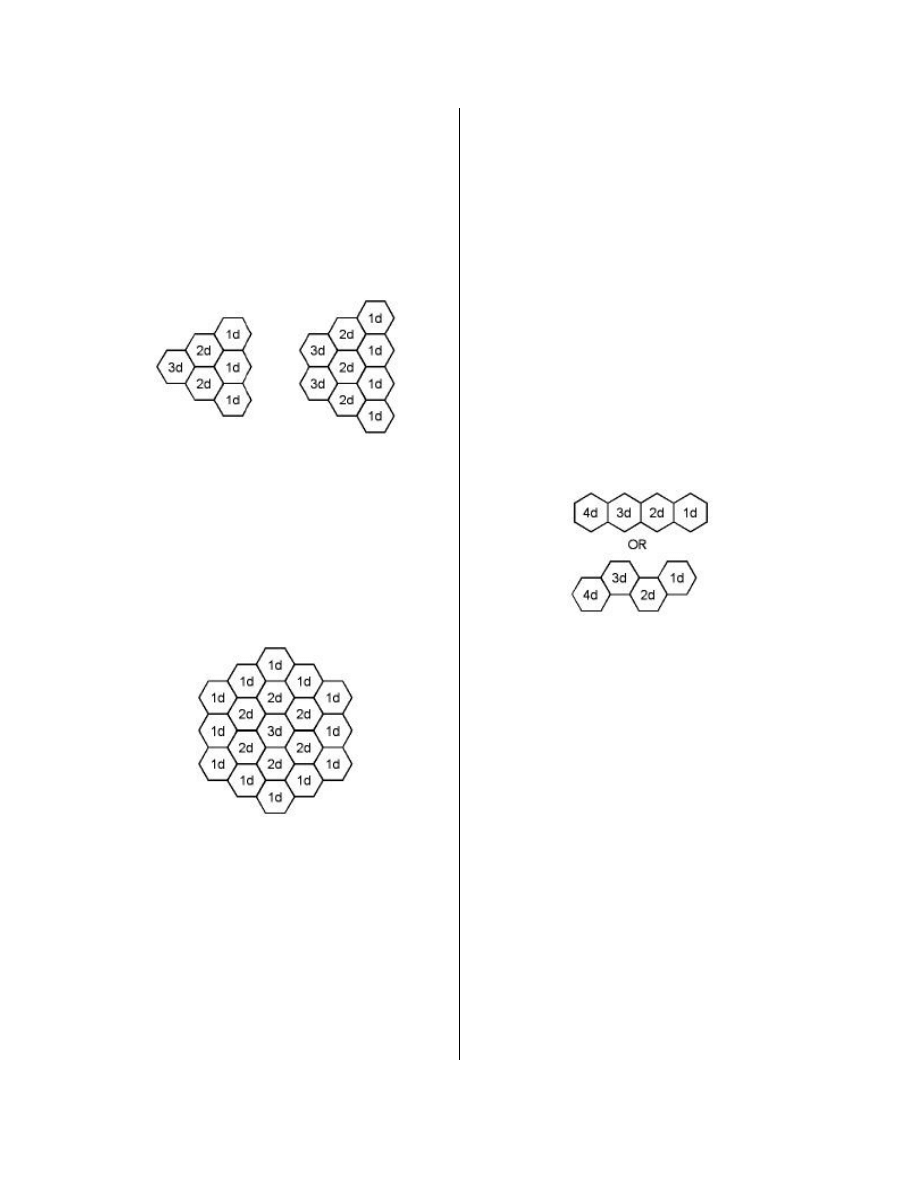
STUDiO187: Power Core Page - 65
caught in his own power it will affect him just the
same. For effects that are of continuing range like
line or cone, remember to downgrade the effect by 1
PP (the original power’s PP) for every hex in distance
from the Actor it travels.
Cone: Much like line, this modifier will allow the
power to venture away from the Actor in a linear
direction; however, it also grows in width as it
does in length.
Cost:
•
+1:3 for single hex starting point
•
+1:2 for a duel hex starting point
END: Add cost for calculation
Explosion: With this effect the power starts at
full power in one hex and radiates out in all
directions in circles of effect, continuing outward
and engulfing everything within the sphere. The
effect will travel 1 hex per level of effect and
affect everything indiscriminately within its path.
Cost:
•
+1:3 OCP
•
+1 PP if the power does not affect the
caster on the initial blast (radiant)
END: Add cost for calculation
Hole: This Modifier may be applied to any Power
that affects an area. A Power with this Modifier
has a hole in the center where the Power has no
effect. The hole will move with the Actor if the
affected area moves with the Actor.
Cost:
•
+1 PP for a static hole whose size is defined
when the Power is purchased.
•
+2 PP for any size hole, determined when
the Power is used.
END: Add for calculation
Landscape: This is an area affect whose
dimensions are epic. It causes a power to blanket
in miles rather then hexes. Choose any other
form of area effect and modify it with this cost
and then exchange hex for mile to determine
area of effect.
Cost: +2:1 OCP
Line: The power will affect every Target within a
straight line. If the Line is obstructed by a wall or
surface feature (like a hill) and the power cannot
penetrate the object, it will go along the path of
least resistance. Like maybe up the wall or over
the hill. People do not count as obstacles.
Cost: +1:3
END: Add cost for calculation
Path: The Actor must be moving to have this
effect occur. The effect will follow the Actor and
will encompass the entire hex of each hex he
passes through.
Cost: +1:4
END: Add cost for calculation
Ring: This causes the power to form a ring (or
sphere) around the Actor with the power effect.
No objects within the ring (or sphere) will be
affected. Only those passing through the ring (or
sphere) or those caught along it's circumference
will feel the effect. Range is determined by the
effect to be applied just as you would for an
explosion. There must always be a minimum
radius of 1. The Actor may decide to only allow
the ring to travel a certain distance for an
additional cost. This Area effect will look and
work much like explosion unless it is used on a
power that has duration.
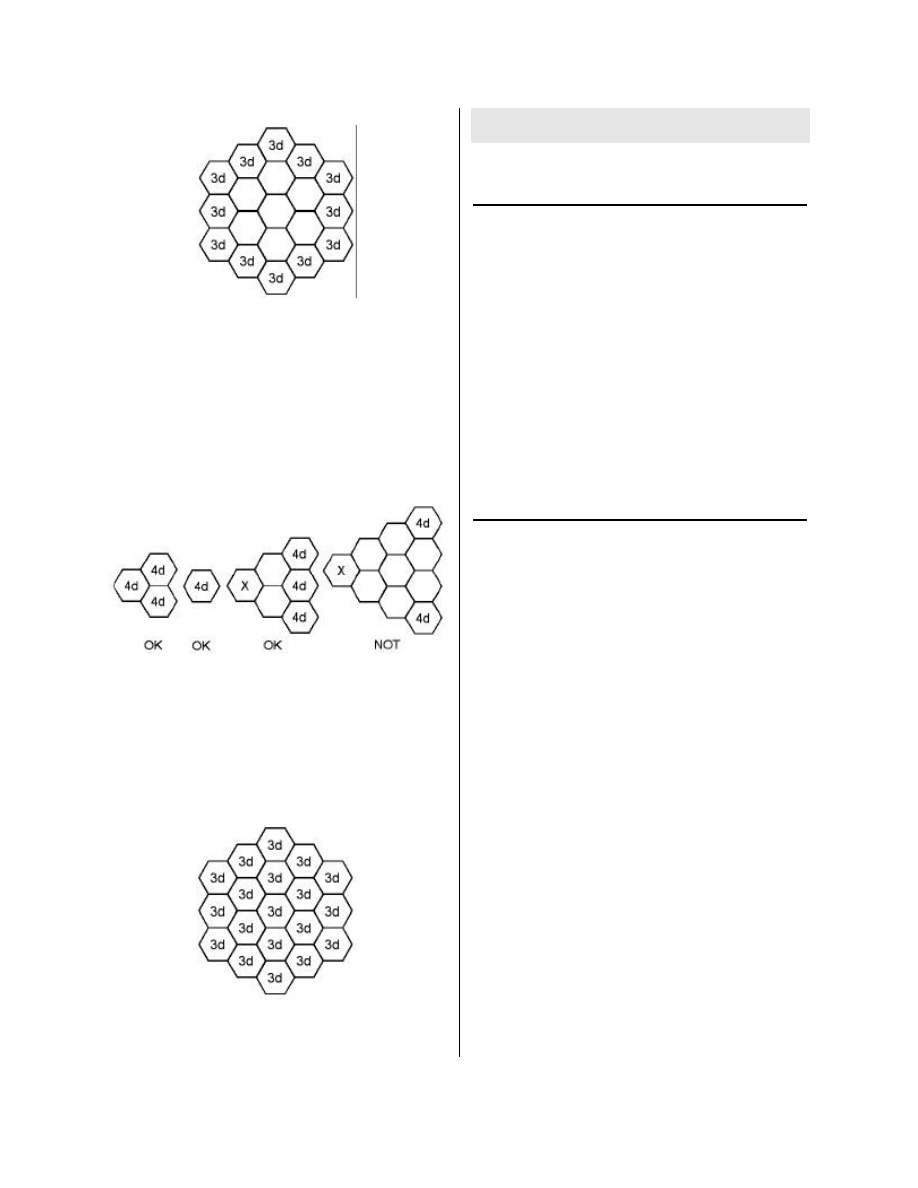
STUDiO187: Power Core Page - 66
Cost:
•
+1:3 for standard ring
•
+1 PP to make ring mobile
•
+1 PP to control ring diameter
END: Add modifier for cost
Single: Power effects 1 entire hex. The Player
may buy multiple hexes. These hexes need not
be adjacent but may not have more then 1 hex
between them.
Cost: +1 PP per hex.
END: Add cost for calculation
Static: This modifier does not change the range
but when applied the modified effect will not
diminish its delivery with distance. Thus, an
explosion would do the same damage right to the
edge of its blast radius.
Cost: add modifier cost again.
If you spend 3 PP on explosion and make it static, the
explosion will cost you 6 PP instead.
END: Add modifier cost to OCP to calculate End.
Bane
This is a particularly nasty modifier. Every time the
power encounters some type of defense it will modify
to pierce that defense in the next phase. So, if it hit
Hardened Armor then the next phase, it would treat
that Armor as normal. The next phase it would treat
the Armor as half value. The next phase it would treat
the Armor as 0 value. If the Target has defenses vs.
this type of attack then it will get to work on them next.
This power will also adapt to powers such as
Desolidification, Dampening - Shielding and
Absorption - Defense.
Cost: +2:1
END: Add cost for calculation
Chain
This adder is kind of cool. It causes a power to jump
from one Target to another. There are several factors
involved in making a power "Chain". By default, the
leaping power will not affect a Target more then
once, is indiscriminant and will only leap to adjacent
hexes. The power level will drop by 1 level per
transition and will continue to leap until it runs out of
Targets or out of power, which ever comes first.
Distance: This is the amount of hexes the power
will leap to strike a new target.
Cost: +2 PP per additional hex.
Discriminate: The power will only affect Targets
of the Actor's choice. There are two levels of this
node. The first will keep the power from affecting
the Actor. The second will keep the power from
affecting anyone the Actor does not wish to be
affected.
Cost:
•
+1 PP for Actor only
•
+2 PP for anyone
Multi-Pass: The power will continue to leap until
it runs out of juice. It will strike Targets regardless
of whether they have been struck already or not.
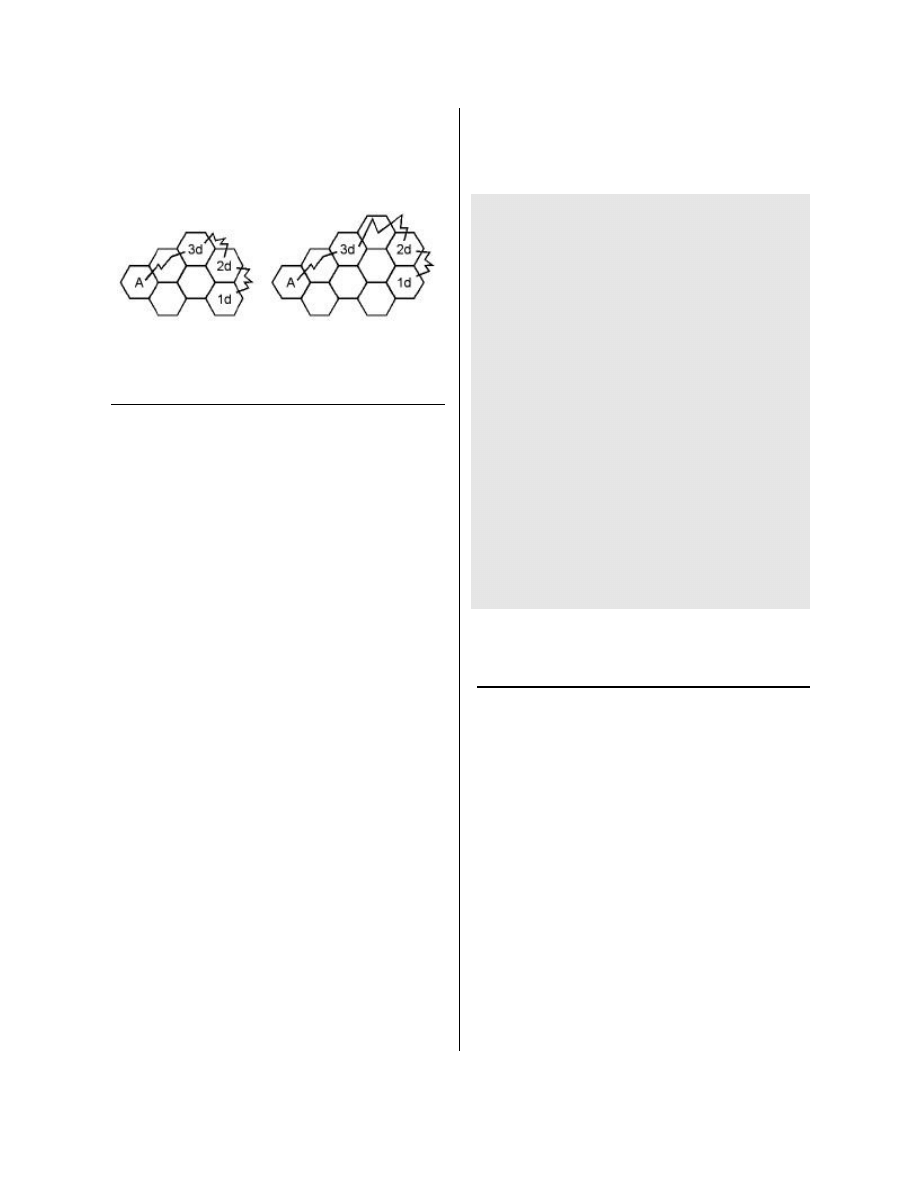
STUDiO187: Power Core Page - 67
It will also strike the closest Target first. It could
even bounce between two Targets over and over
again, until it ran its course.
Cost: +3 PP
Cost: +1:3 OCP
END: Add to cost for calculation.
Chorus
This modifier allows Actors to ban together with the
power to produce a more powerful effect.
Boost: This modifier allows an Actor to ban
together with other Actors to perform a more
potent result. One Actor must play the “lead”
while the others take the supporting roles. The
lead will make the UP - roll and will generally be
the highest level. All of the supporting Cast must
also have the same power, same effect and
same modifiers, especially this one. They do not
have to be the same power level however nor is
there any requirement or limitation to the number
of people who can participate. The power level
used will be equal to the total of all whom are
participating. The lead will make his skill roll at a
minus equal to the number of supporting actors.
Additionally, all members of the chorus must use
this as their action for the phase.
Cult: This is a more massive version of
boost and does not require the Cast
(followers) to have any powers. The Actor
(lead) has to have the power and the
followers merely have to concentrate on the
Actor. The level of concentration must be
absolute and the followers must be
dedicated to the Actor’s intent. The Actor will
gain +1 PP equal to the square root (round
down) of the number of followers. The Actor
will need the skill Power Conductor. The
Actor will roll his Power Conductor level + his
Will against a Competent difficulty (12). For
every point he rolls over the difficulty he will
be able to gain 1 point from the Cast. This is
of course limited to the number of points the
Cast can give him.
Cost: +1:1 OCP
Lord D’nkhi is high priest of the Uk’lani cult. They wish
to bring about a meteor strike on the town of Salem.
Lord D’nkhi has 7d6KDm Wounding with the
modifiers Chorus – Boost – Cult and Area Effect –
Single - 7 hexs + Landscape. This will allow him to
deliver 7d6KDm to everything within 7 square miles (a
hex and the surrounding 6 but in miles). This is pretty
devastating but most buildings should be able to
survive with minor damage and anyone inside should
be fine. This is where the chorus comes in. Lord
D’nkhi is level 8 in Power Conductor. He has
managed to suck in 72 followers. This gives him a
maximum of 8 extra PP to use. His Will is a 6 and he
rolls a 7. This gives him a total of 21. This roll will give
him a potential of 9 extra points. The number of
followers he has will only allow him to get 8 extra
points so that is what he gets. So, what is the end
result of all this chanting and casting? Lord D’nkhi
exacts his revenge on the town of Salem by delivering
a blanket of death and destruction across a three
mile radius of downtown. Everything within a three
mile radius will suffer 13d6 or 1 Kill. This is enough to
destroy most of downtown and kill a great deal of its
inhabitants.
Cost: +1:1 OCP
END: Add cost for calculation
Charges
A Power with Charges may only be used a limited
number of times per day. Charges may represent a
gun with a limited number of shots, a magic spell that
can only be cast a few times a day, and so forth.
Each Charge only last one phase, so Charges of
powers such as Force Field or Armor are of very
limited usefulness.
Amount: This is the number of times the power can
be used before it needs to be refueled or recharged.
This is generally accomplished one of several ways.
Activity: The Actor must perform an action that
will replenish his charges. This action must be
defined and needs to take a significant amount of
time. Not as long as sleep. This might include
meditation or study. Assume 1 charge per 10
minutes as a baseline.

STUDiO187: Power Core Page - 68
Cost: +1:4
END: No extra
Clips: Each clip holds the number of charges.
The Actor should be allowed to carry as many
clips as is logical. A soldier usually carries 6 clips
for his rifle. If he were not traveling through the
jungle and didn't have to carry all that shit he
might carry as many as 20. The Clips option is
purchased to represent that the Actor can carry
extra ammo with him. It takes 3 full phases to
reload a clip.
A sword requiring that it suck souls to replenish its
power would not use clips. It would find them along
the way.
Cost: +1:3
END: No extra
Rest: The actor needs to get 1 full cycle of sleep
to regain his charges.
Cost: No extra cost
END: No extra
Retrievable: This ammo can be picked up and
used again.
Arrows, bolts, synth-web lines, caltrops, murder balls.
Cost: +1:5
END: No extra
Components
Components are physical objects that the Actor must
have to use his power. This is generally one handful
of a common material. This material must be on the
Actor at the time of use and he must be physically
able to access it.
NOTE: For the costs listed below you will notice –1
OCP or +1 OCP, etc. Subtract or add this number to
the OCP in the cost at the end of the power.
Expendable: These types of components are
destroyed upon using the power. They generally
crumble and turn to dust or dissipate into smoke.
Cost: -1 OCP
Internal: This type of component is either
injected into or consumed by the Actor. The
components effects will last for the entire scene.
The component is naturally destroyed during its
use.
This is a great way to simulate Blacklace, the Under
Dog Power pill or even Marine Boy’s water breathing
gum.
Cost: No modifier
Quantity: This causes the Actor to provide a
larger amount of the component as fuel for the
power. The amount is measured in Cargo Points
(see movement powers). The maximum number
of Cargo points is 3. If the Actor wants it to be
more then he may, but it will only be for flavor. If
the Actor specifies a living being then he must kill
that being just before invoking the power. If the
Actor specifies something larger then a car then
it is up to the Judge to allow Expendable as an
additional modifier. The Actor may not use more
then one component if he adds this modifier. Any
additional components will be considered part of
the Cargo Points
Cost:
•
-1 OCP per 2 Cargo Points up to 6
Value: The Actor may increase the value of the
required components.
•
-1 OCP for Slightly Valuable
Ivory, gold, Semi-Precious Stones, An animal – lamb,
dove or specific insect like a black widow.
•
-2 OCP for Very Valuable
A human, Precious Stones, Rare or Dangerous
Animal, Specifically ornamented object.
•
-3 OCP for Exceptionally Valuable
One of a kind artifact, Power Core, A nearly extinct
animal, An exceptionally expensive item.
Range: This allows the Actor to be within the
vicinity of the material rather then having it in his
possession. If the Player chooses a component
that has a value then the Judge will decide
whether he can purchase Expendable. The Actor
should not be allowed to destroy other people’s
weapons by invoking his power. It would make
the game unbalanced.
Cost: +1 OCP per hex of range
Cost:
•
-1:5 OCP for 1 component

STUDiO187: Power Core Page - 69
•
-1 OCP for second component
Control
These modifiers affect the control of the power. They
can make it better, worse or even uncontrollable. A
player who wishes to make a colorful Actor concept is
going to find it hard to stay away from these little
gems. Remember, powers that stay on for long
periods of time will be affected by control modifiers
only when put to the test. Thus, Armor would be
tested every time it was struck, not every phase it was
on. If a power requires an Activation Roll, then the
player will roll 3d6. He will be trying to equal or beat a
CV (Control Value). The base CV for the following
modifiers starts at 8.
Ablative: Ablative Powers work fine the first time,
but then receive an Activation Roll that must be
beaten every phase the power is used for the
Power to work. With each use of the Ablative
Power, the Activation roll increases by 1.
Endurance costs are paid whether the Power
works or not. Ablative Powers return to their
starting state by the next scene or under
circumstances defined by the Judge. The
activation roll starts at the base CV (8) for its
second use, with the CV increasing by one for
each use after. The player can decrease this
effect by raising the usage level. For every extra
usage level the player will stay at each level an
extra phase. Thus, for a cost of -1 PP per 5 OCP,
the first two uses would be without a roll. The
next two would be at a CV of 8 and so on. This
cannot be attached to powers that are only used
once or twice an adventure.
Cost:
•
-1:3 OCP for abundantly used powers
•
+1 OCP for rarely used powers
•
+1 OCP per extra usage level
Activation: A Power with Activation is less
reliable than normal, and only works sometimes.
The player makes an Activation Roll trying to
defeat the Power's Activation CV (Control Value).
Activation Rolls must be made every phase the
power is in use, after paying the Endurance cost
for the Power. If the Activation Roll fails, then the
Power doesn't work. The Activation roll is based
on the player’s Use Power roll.
The Blink can teleport but it requires him to make an
activation roll every time he tries. He is level 4 in his
UP – Teleport and he has a Move of 6. This gives him
an AV of 10. His activation CV is 16. He must roll at
least a 6 or better to even be able to teleport. This
returned him 1 PP per 4 OCP.
Cost:
•
-1:2 for a CV of 20
•
+1 OCP per -2
Always On: With this modifier the player’s power
and is always on by default. The power stays on
even if the player is unconscious. Powers with
this Modifier cannot be pushed. But, a player can
buy the power again without this modifier and add
the two together by activating the second power.
The rules for Endurance are switched for powers
with this modifier. If the player wants to turn the
power off he must spend the Endurance it would
normally cost to activate it.
Cost: -1:4 OCP
Burnout: Burn-Out is slightly different from
Activation and Jamming in that the Activation Roll
is made each time after the power is used. If the
roll fails, then the Power is burned out and is
unavailable for use until recovered. The recovery
will happen after the end of the scene or can be
up to the JUDGE.
Cost:
•
-1:2 OCP for a CV of 18
•
+1 OCP per -2 CV.
Concentrate: A Power with a Concentrate
Modifier requires the player to concentrate
partially or totally on the task of turning on and
using the Power. As a result of the concentration,
the player will be at either half their normal
Defense Value, or at a CV of zero. Once the
player begins using this Power, they are aware of
nothing around them. Thus, if their concentration
is broken either voluntarily, or by a successful
attack against them, the Power turns off and any
necessary preparations must be made again.
Cost:
•
-1:4 OCP for half CV
•
-1:3 OCP for 0 CV.
Fine Control: A Power with Fine Control can be
used like a tool. Attacks can be used to carve or
shape, heat or cool objects. Energy attacks could
be used to weld metals, Flight could be used to

STUDiO187: Power Core Page - 70
sky-write, et cetera. All Fine Control usage will
require a roll versus a CV set by the JUDGE,
unless it targets another player, in which case the
player gets to resist per norm. Complex uses
may require the player to have an appropriate
professional skill as well. Fine Control could even
be used to pull off really amazing stunts such as
carefully burning all the oxygen out of the room,
shooting a hole in a gas tank without igniting the
gas, or other dramatically heroic deeds, all with
the appropriate CV assigned by the JUDGE.
Cost Modification: +1:4
Jamming: Jamming works much the same way
as burnout, except the Jamming Roll is made
before the use. Endurance costs for the Power is
still paid.
Cost:
•
-1:2 OCP for a CV of 20
•
+1 OCP per -2 CV.
Side Effects: Side Effects cause bad things to
happen to the player when he uses his Power.
The player suffers the Side Effects every time the
Power is used.
Caustic: The player will take 1 Hit per power
level of the modifier every time he uses the
power. He will have no defense from this
damage.
Cost: -2 PP per power level
Damage: The player will deliver several
spots of damage wherever he uses the
power. This damage, while superficial leaves
behind a serious clue as to who was there.
The damage can also grow due to
circumstance but that is up to the Judge.
Hot Foot has a fire blast but it has flames that fly off
of it and land nearby causing secondary burns
wherever he goes. This is not a problem on the
street, as they will harmlessly burn themselves out.
But in a house he is quite likely to cause the whole
building to burn down.
The Stranger's dimensional doors warp whatever
material they come in contact with. This may not
cause him a load of trouble but it will let any enemy of
his know where he's been and nobody wants him
using those damn things from their house.
Cost: -1:4
Stunning: The player will take 5 Stun every
time he uses the power. He will have no
defense from this damage.
Cost: -1:4
Resilient: Resilient Powers do not turn off when
the player is stunned or unconscious. They are
not always on, but the player must actively turn
the power off. Watch out when using heavy
endurance powers with this modifier, a player
could go unconscious for quite a long time given
the right circumstances.
Cost: +1:3
Uncontrollable: Powers with this Modifier are not
under the player's control. Although the player
possesses the Power, he cannot consciously turn
it on. The Power only works whenever and
however the JUDGE chooses. The JUDGE will
choose whether he believes the power is
appropriate to his campaign and whether he
feels like dealing with this
Cost: -2:3
Warm-Up/Warm-Down:
Crossover
This modifier will allow a power to cross The
Membrane and effect targets in other dimensions.
The player will have to be able to observe his target
with a targeting sense. The player must specify the
dimension he wishes to be able to do this in or may
specify any for an additional cost. If the player
specifies The Membrane, he will be able to affect
targets within The Membrane as well as ethereal
targets (Ghosts). See Crossover in the Sons of
Fuzion section for more detail on The Membrane,
Ethereal beings and other dimensional matters.
Cost:
•
+1:5 OCP for 1 dimension
•
+1:4 OCP for 5 dimensions
•
+1:3 OCP for all dimensions
Draining
STUDiO187: Power Core Page - 71
The use of this power causes another power or stat to
be lowered. It is a PP per PP exchange and may only
be placed on powers with a duration or with a
continuing effect.
Cost:
•
-1:4 OCP for a 1:3 PP exchange
•
-1:3 OCP for a 1:2 PP exchange
•
-1:2 OCP for a 1:1 PP exchange
Durable
This modification causes a power to be extremely
tough when it comes to adjustments from a target.
This modification is bought for an individual power
rather then the entire player (as opposed to Power
Defense). Subtract the durability from the adjustment
before applying it to the power. If this is purchased for
deception powers (like Illusion) or stealthy powers
(like Invisibility), use the defense value to subtract
from the targets perception.
Cost: +1 PP for 2 points of defense
Duration
This modifier allows the player to add a duration
effect to a given power. Once a hit is made, the
player does not need to roll for the continuing effect
on the following phases. For Continuous and
Tapering it must be a power that does not naturally
have a duration and does not offer it as a
subcategory. Boost is only for powers that do offer a
duration and if it is a subcategory, the player must
have purchased the portion. All duration effects must
have a way to dispel or cancel the effects that is
reasonably common and should be somewhat
obvious.
For a continuing Fire Blast, the player would roll to hit.
If successful, the target would take normal damage
that phase and would continue to take damage as
specified by the type of duration or until the player
could stop, drop and roll to put himself out.
Boost: This modifier will give the power even a
longer duration. For every level of Boost the
powers duration will be increased by that
multiple.
4 Levels of Boost will increase the duration by x5.
Cost: 1 PP level of Boost per 4 OCP
END: +2 Points per Boost level.
Continuous: With this version, the player has
direct control over the powers duration. It turns
off when he turns it off. Apply all effects each
round at the same intensity. If the target dispels
the power then the player will need to score
another hit to affect the player any further.
Cost: 1:OCP
END: Original cost every phase.
Tapering: This modifier will cause a power to
continue it effects on a target at a diminishing
rate. The power in question will diminish at 1
level of effect per phase. Depending on how the
player’s armor works this effect may or may not
have to deal with the armor each phase. It will
depend on the situation and the Judge’s decision.
In addition, the player cannot turn off the effect
once in motion. It will have to run it’s course
unless someone can dispel the effect.
A 6d6 SD Wounding attack would do 6d6 on the
initial attack. The player could then focus on another
action the next phase and the target would take 5d6.
The target could kill the player in the next phase and
would still take 4d6 SD. And unless he manages to
dispel the effect, he will take 3d6 SD the next phase,
then 2d6 SD and finally 1d6.
Cost: 1:OCP
END: x2 Normal Cost
Effect Group
This limitation causes your power to only effect
certain power sources. It's an extremely logical
modifier for many powers. A good example would be
an EMP burst that would only effect technology. If
your power is used on any group other then the ones
specified, there would be no effect. If you purchase
more then one group per power, add the number
before the OCP to get your modified cost. Thus, if you
were to purchase magic and undead it would cost
you: -1:5 OCP.
Undead: Only effects creatures that are soulless
or have their soul detached from The Gaia.
Cost: -1:2 OCP
Magic: Only effects beings, powers or items
STUDiO187: Power Core Page - 72
using mana as a power source. As for magic
using people this requirement is not to include
spell casters only true mages.
Cost: -1:3 OCP
Technology: Only effects objects that rely on
machinery or electronic equipment. Like robots,
cybernetics, computers, vehicles and the like.
Cost: -1:4 OCP
Inorganics: Only effects non-living tissue. The
only thing this power will not work on is living
tissue. This includes all forms of self-duplicating,
sustenance dependant organisms. These
materials will also include those that were once
alive.
An Oak table would be fine as would an ivory
necklace. Even a sheet of paper could not be
effected.
Cost: -1:5 OCP
Elementals: Only affects the race of creatures
known as elementals or items using elemental
essence.
Cost: -1:2 OCP
Psionics: Only works on powers, creatures and
items of a psionic nature.
Cost: -1:3 OCP
Sin: Only works on powers, creatures and items
that use Sin as there power source.
Cost: -1:2 OCP
Virtue: Only works on powers, creatures and
items that use Sin as there power source.
Cost: -1:2 OCP
Endurance Dial
This modifier covers all types of endurance
adjustments.
Double Cost: This causes the power to use
twice the normal endurance cost.
Cost: -1:2 Endurance Cost.
Half Cost: Causes the power to use 1/2 normal
endurance.
Cost: +1:4 Endurance cost
No Cost: Causes the power to use no
endurance.
Cost: +1:2 Endurance cost
Required: Causes a power that has normally
has no Endurance cost to use Endurance.
Calculate the cost as per normal.
Cost: -1:3 Endurance cost
Extension
The player is able to extend his power to others. This
can be done one of two ways.
Assimilate: The player is able to cause a power
that normally only affects him to affect a target.
The player pays the endurance and has full
control over the power. If the power is an attack
then the Target must be allowed to evade even if
he wouldn't really see it (like teleport or shifting).
Cost: +1:3 OCP
END: x2 Normal
Lend: The player is able to lend the power to a
target to use. The target has full control of the
power and must pay the endurance cost for the
power. The player cannot use this power while
he is lending it to the target but he may take it
back whenever he wishes.
So, if Tom gives Bill the power of flight then Tom can
watch Bill from the ground because he will not be
able to fly so long as Tom has the power. Bill could
take the power back while Tom was at about 50'
causing him to fall to his death but Bill's a nice guy he
lets Tom land before taking back his power.
Cost: 1:4 OCP
Focus

STUDiO187: Power Core Page - 73
When making a focus, the player creates an
empowered item. If the player looses the item he also
looses those powers until the item is regained or
replaced. Foci are divided into two types: Grabbable
and Attached. A Grabbable Focus may be taken
away from the player with a disarm maneuver or a
grapple – item maneuver. An Attached Focus may be
removed from a non-resisting player (unconscious,
cooperating, etc.) in one Round. If removing the
Focus would cause the player any Damage (a
cybernetic eye, metal skeleton, etc.), then the Focus
Modifier should not be taken.
Cost:
•
-1:2 OCP for a grabbable Focus
•
-1:4 OCP for an Attached Focus.
Gestures
This requirement causes a player to have to perform
a task of some sort to cause the power to work. This
could be hand motions, spoken phrases, stomping
his foot on the ground, spinning around, whatever.
The player will only receive the modifier for the first
and second gesture he applies to the power. The
gestures must be performed one phase before the
power kicks in. If the player is struck and damaged
before the power goes off then it will be disrupted and
will not occur. The player may also option to require
that the gesture be maintained during the duration of
the power. This may only be added if the power has
an extended duration (longer then 1 phase). If the
player is unable to perform the gesture then he will
not be able to use the power.
Cost:
•
-1:5 OCP
•
-1 OCP for a second gesture
•
-1 OCP for duration option
Hardened
This is a counter measure for Defense Piercing
attacks. If the player's Defense is hardened and he is
struck by a Defense Piercing attack, he will totally
ignore the Piercing modifier. If it is an Ignoring attack,
the player may be able to gain half defense value,
depending on the type of attack. This is a Judge's
call.
Cost: +1:3 OCP.
Humanity Loss
This modifier causes the power to either cost the
player humanity to use or to cause a target to lose
humanity when affected by it.
Cost: Every time the player uses the power he
will lose humanity. The player will lose 1 point of
humanity per OCP. This humanity is recovered at
the rate equal to the player’s presence per day.
Cost: -1:3 OCP
Cause: When this power is used on a target it
will be delivered with such horror or pain (or
both!) that the target will lose 1 point of humanity
per OCP. This humanity is recovered at the rate
equal to the player’s Presence per day.
Cost: +1:2 OCP
Indirect
Indirect allows a Power to ignore intervening barriers
between the player and the target, including but not
limited to: walls, fences, Force Walls, buildings, et
cetera. Barriers purchased with the Power Modifier
Hardened will block Indirect attacks. Range penalties
apply to the use of an Indirect Power, and are
calculated from the player to the target. The target
will get his normal DV against this attack but will be at
a –2 to DV if he is unaware that the player can
perform this trick. Generally, Indirect Powers always
originate in a certain location in relation to the player,
and must always target away from the player. For
additional cost, the location of this point of origin may
vary.
Cost:
•
1:4 OCP for a fixed point of origin
•
-1 OCP for variable distance from the player.
END: No extra
Knockback Dial
This dial modifies a wounding attacks knockback
effect.
Double: This is for high impact powers that do
damage with a wholop of a punch. Double the
knockback effect.
STUDiO187: Power Core Page - 74
Sonic attacks, explosions, Accelerated Kinetic Punch.
Cost:
•
+1:4 OCP
•
–1 OCP per additional x2
Half: This is for low impact powers that do
damage that have little punch. Halve the
knockback effect.
Lasers, light sabers, or slasher rounds.
Cost: -1:4 OCP
Zero: This is for powers that do non-impact
damage. There will be no knockback effect for
the attack.
Acid, Microwave Laser, Phaser, Ghost Blade.
Cost: -1:3 OCP
Link
Let's say you want to join two powers together like
maybe an Attack Blast and a power drain. There are
two ways to do this. You can fuse two powers
together or assign a secondary effect to another
power.
Fuse: By using this option you can cause two
separate powers to activate at once. In addition,
you will not be penalized for using both
maneuvers. They will be treated as one power. If
it's an attack, only one to-hit roll will be needed.
Cost:
•
+1 PP if the two powers must always be
attached.
•
+2 PP if they can still be used
separately.
END: Both powers normal end cost.
Secondary Effect: With this modifier, you may
link a second power effect to an existing power.
In this process the first effect must succeed for
the second effect to occur. This means,
penetrating any defenses against the first effect.
No roll to hit will be necessary for the second
effect to occur and any defenses penetrated by
the first effect will not be used against the second
effect. You can use any two effects, but the effect
of the modified power always goes second. It is
up to JUDGE if you will be allowed to use the two
powers separately or if they must always be used
together. It would seem to more fair to allow the
separate use being that the player is paying so
many extra points for the link.
Cost: +1:4 OCP of modified power.
END: End cost of the two powers plus 1.
Natural
This adder causes a power to become part of the
player's natural makeup. It is no longer treated as a
power but as a natural ability. This is important for
Adjustment purposes. Anyone trying to adjust the
player's power will have a difficult time. If the target
has "stats" or if he has "all powers and stats” for his
adjustment he might be able to affect the power but
this is up to the Judge. Claws would be kind of hard
to transfer from a tiger, as would wings from an
Angelic. This modifier should only be used for certain
powers. Psionic powers cannot receive this modifier
due to the way in which they work. Magic powers are
also quite hard to explain as natural. It is mostly for
powers that are physical in nature.
Cost: +1 PP per power.
Permanent
By placing this modifier on a power, the player is able
to cause the effects of his power to last until a certain
condition is met. Judges should approve the use of
this modifier before the player even thinks about
buying it because it can be abused readily.
Choose from the nodes below to determine the
condition and cost of this modifier. The target cannot
begin to recover from the effect until the situation
occurs. Judges should remember that the player
would not necessarily know how to undo the effects.
The use of a healer with Diagnose might be
necessary. The power Healing can undo the effects
regardless of the needed material or situation but the
difficulty goes up by 4 points per level of
commonness.
Very Common: This would be a very common
situation that could happen anywhere or anytime.
Examples would include: water, sunshine, shadows,
dirt, fire, and common over the counter drugs.
STUDiO187: Power Core Page - 75
Cost: +1:OCP
Rare: These situations are not as commonplace
but are also not too hard to come by with a little
effort.
Examples would include: magical healing, exposure
to radiation, illegal or prescription drug, expensive or
rare material like diamonds or uranium.
Cost: +2:OCP
Unique: This is the most devastating form of
permanency and is the hardest to cure. The
player will specify a very specific ritual, material
or condition that needs to occur before the
effects will be lifted. These can be very difficult
but not impossible to come. If it is an event then it
must be relatively soon (within a year or two) or
this modifier will become too unbalancing.
Examples would include: A ritual that can only be
found in an ancient book, sprinkling moon (Luna)
rock on the effected area, the willing nuptials of a
virgin, kiss from a princess.
Cost: +3:OCP
Persistent
This modifier will cause a power to attack a certain
number of times before fizzling out. The player only
needs to make the initial attack. If this initial attack is
missed then every phase afterward the power will
continue to attack the target until it hits. This will
continue until the number of purchased attacks is
reached. Once the attack hits it will then cease to
attack again and again (it only hit one time). The
power will then fizzle out or land in the dirt. The
player will not need to pay any attention to the power
nor will he spend any additional endurance for the
subsequent rounds. The power is not smart and it will
have to make slightly wide turns, so should the target
shut a door behind him or turn down a tight corridor
then the power will crash into the obstacle. Imagine a
heat-seeking missile.
Homing: A more deadly version of Persistent.
The power in question not only attacks the same
target every round but it improves its chances of
hitting each subsequent phase. Every time it
misses it will add 1 to the next roll and this is a
cumulative effect.
Cost: -1 from the OCP of the cost.
Raw Dog's murder balls do 4d6 KD and are
Persistent for 3 Attacks. This would normally cost him
4 extra points (+4 PP per 4 OCP = 1 PP per OCP) but
by adding homing the cost becomes +8 (+4 PP per 3
OCP). In this case he would be better off lowering the
damage to 3d6 KD or raising it 5d6 KD. This may
sound expensive but the ball will attack for 4 phases
(unless it hits sooner) and will get a +1 the next phase
every time it misses. So, by the 4th phase the ball will
be at +4 to hit.
Cost: +1:4 OCP per attack
Piercing
This is a modifier that allows a power effect that cuts
through the target's defenses. There are many
different forms of piercing effects and they include all
forms of defense. The type of piercing is based on
the type of effect. Thus, for an attack blast, the
piercing attack would be anti-armor and or anti-stun
defense (PD or ED). But for a muting attack it would
be Mute defense. See the examples below to better
understand how this works.
Armor Piercing: By adding this modifier, the
player is able to 1/2 the targets KD or EKD with
his attack.
This type of effect is for things like Teflon bullets,
plasma rounds, master craftsman arrowheads or a
master blade.
Cost: +1:2 OCP
Armor Ignoring: A very rare form of attack
usually occurs as supernatural attacks but could
also be the result of chemical or biological
weaponry. You must devise a plausible attack
form to justify this form of modifier and one
common form of defense that it will have no
effect against. Some examples are as follows.
Lord Paradox is a time manipulator who has a
temporal attack blast. The only defense is
longevity (and of course immortality). The Wraith
has the Hand of Death (a sole sucking touch). He
must, however, touch bare skin to bare skin. A
thin piece of cloth will stop his attack, but if the
player’s armor is really his skin (even organic

STUDiO187: Power Core Page - 76
steel) he’ll be in for a big surprise. The Human
Dynamo use electricity and his attack blast is
stopped by and non-conductive armor, like
ceramic or Plaston. A gas attack is of course
stopped by a gas mask or not needing to
breathe. No knockback goes well with this
modifier.
Cost: +1:1 OCP for No KD or No EKD
Stun Piercing: This effect halves PD or ED.
Often found modifying martial art maneuvers,
stun pistols, police quality stun batons, maybe a
sonic attack blast or perhaps a crushing
telekinesis effect.
Cost: +1:4 OCP for PD or ED
Stun Ignoring: This attack ignores PD or ED.
Just as rare as armor ignoring, stun ignoring
attacks must be well thought out and must have
a common defense that will stop it all together.
Here are a few examples. Touch mastery (exotic
martial arts maneuvers often involving Chi)
whose defense could be any type of armor.
Knockout gas whose defense would be not
having to breathe or self contained breathing.
Again, a sonic attack whose defense would be
any form of sound defense like level dampers.
Cost: +1:2 OCP for No PD or ED.
Defense Piercing: It's kind of hard to explain
how this modifier differs from the normal type of
attack it's modifying. Let's just say, you spent the
points on it; it's a more powerful version. For
Mute it may be that you are using a radioactive
burst of light or if you are doing a mind control,
perhaps your psionic signature is advanced. At
any rate, the type of defense it affects is based
on the type of attack it's modifying. This modifier
can be attached to any attack that has Defense
power for it other then PD and ED and will cut
that defense value in half.
Cost: +1:2 OCP
Defense Ignoring: Just like defense piercing
except the target will receive no defense value
verses the attack. Again, any form of ignoring
attack must have a common defense type. For a
muting ignoring attack, a pair of reflective
sunglasses might do the trick. For power drain,
skin-to-skin might be the way to go.
Cost: +1:1 OCP
Power Requirement
The player must choose a power that must be used
to use this power. The power in question can be
required to be used the previous phase, the same
phase or during it’s duration. It doesn’t matter cost
wise.
Cost: -1:3 OCP
Range Dial
This modifier will cover all forms of range
modifications for powers.
Add: Causes powers that normally have no
range to have range. Calculate range as per
Wounding.
Cost: +1:3 OCP
Degenerative: This causes ranged powers that
do not normally degenerate over ranged
distances to drop by 1 Power level per hex.
Cost: -1:3 OCP
Double Modifier: The player will double all
range modifiers to hit his target.
Cost: +1:4 OCP
Half Range: By adding this modifier to a power
that normally has range, the power will lose half
of effective range.
Cost: -1:4 OCP
Increased Range: By adding this modifier to a
power that normally has range, the power will
have 5 times its effective range.
Cost: +1:4 OCP per multiple
To increase range by x10, the player will pay +2 PP
per 4 OCP or +1 PP per 2 OCP.
No Modifier: The player will have no range
modifier to hit his target.
STUDiO187: Power Core Page - 77
Cost: +1:4 OCP
No Range: By adding this modifier to a power
that normally has range, the power will become a
touch only power.
Cost: -1:3 OCP
Refresh
This requirement will cause the player to have to
perform a task each time he wishes to use the power.
This task shall take at lease 1 Round (12 seconds).
Once the task has been performed he may use the
power at any time but once used he must perform the
task to use the power again.
Cost: -1:2
Situation
Some powers work better, worse and even not at all
when in the presence of certain conditions. Each of
these situations must be very specific, somewhat rare
and only one situation per power. This modifier is
provided to cover anything the other requirement
modifiers left out so if there is another modifier that
fits the bill better, use that one. Also, the power will
use its regular endurance cost before the modifier.
Some examples would include: During a powerful
storm, Temperature over 100
0
F or below 0
0
F, Player
under extreme stress, player at death's door, etc. Not
stuff like, when the wind blows, after a meal or in the
presence of music.
Double: The power works at twice the power
level during the situation.
Cost: +1:4 OCP
Half: The power will work at half the power level
during the situation.
Cost: -1:4 OCP
Null: The power will not work during these
conditions.
Cost: -1:3 OCP
Only: The power will only work during these
conditions.
Cost: -1:2 OCP
Sticky
This is an addition to any power with a duration.
Anyone who comes into contact with the power effect
will suffer the effects as well for the rest of the
duration as though they had been targeted.
Aggressive: The power is exceptionally viscous
because it will jump out and strike at anyone who
comes within its reach. Any target that comes
within the reach of the effect must evade Vs the
original AV of the attack.
Cost: +1:OCP per hex of range. This is added to
the Sticky modifier.
Dark Lord Golgotha has a Living Fire elixir. He hurls it
at the center of the room. It explodes for an area
effect of 4d6 KD in one hex. It has a Tapering
Duration, Sticky and Aggressive Level 2. This means
that if anyone comes within 2 hexes of the hex the fire
occupies, the fire will reach out and set him ablaze.
The target must dodge an AV equal to the original
throw to avoid a roasting. For the Sticky portion of the
power it will cost 3 PP per 4 OCP (2+1 per 4 OCP) of
the power. So 8 OCP would cost the player an
additional 6 PP.
Cost: 1:4 OCP
Temporary
This modifier causes powers that are normally
constant to become non-constant. The player needs
to activate them each phase and must pay
endurance each phase as well.
Cost: -1:3 OCP
Time Dial
These modifiers affect the time aspect of powers. It
can be anything from causing powers to take longer
then usual to being able to delay their effects.
Trigger: Trigger allows the player to set up a
Power that will go off when a given circumstance
occurs. This circumstance cannot depend on any

STUDiO187: Power Core Page - 78
senses the player does not possess. The trigger
could be a switch or a tripwire or even at a certain
time. Endurance costs are paid when the player
sets the Power. The Trigger may he spotted with
Perception rolls, unless the Power also has the
Invisible Modifier.
Fixed: The player must decide on the trigger
effect when this modifier is purchased and
cannot change it later.
Cost: +1:5 OCP
Flexible: The player may choose a different
triggering effect every time he uses it.
Cost: +1:3 OCP
END: No extra
Warm-up: This modifier causes a power to have
to warm-up before it can be used. This can either
be for the first use per scene or per use.
Switch: The power has to be switched on to
be used and requires a warm-up period
before it can be used. It takes one phase to
turn the power on. The amount of time it
takes to warm up is based on the time chart
and is determined by the player.
Cost:
•
-1:5 OCP for 1 phase warm-up
•
-1 OCP per extra phase of warm-up time
up to a maximum of 3 additional phases
(-1:2 OCP maximum)
Constant: There is no “switch on” phase but
the player must warm the power up each
time he wishes to use it.
Cost:
•
-1:4 OCP for a 1 phase warm-up
•
-1 OCP per additional warm-up phase
up to 2 additional phases (-1:2 OCP
maximum)
Time Requirement
The power will only work at a certain time. If that time
should pass then the power will instantly shut down.
Cost:
•
1:4 OCP Common Time Event
Day or Night, Months with an R, Even or Odd Years
•
1:3 OCP Restricted Time Event
Certain Hour, Dusk and Dawn, Certain Season
•
1:2 OCP Specific Time Event
During Solstice, During Solar or Lunar Eclipse
Visibility Dial
Some powers have a normally visible effect while
others have a normally invisible effect. This modifier
will allow the player to adjust several variables along
this theme. If a power is visible it means that it can be
detected by at least two (usually three) senses.
Exuberant: This causes a power to be extra
powerful when it comes to its appearance.
Whether it's really loud or very bright or has a
powerful smell associated with it.
Cost: -1:5 OCP
Invisible: This modifier causes a power that
would normally have a visible effect to not have
that effect. This can be to one or all senses.
Cost:
•
+1:4 OCP
•
-2 OCP to beat Detection
Visible: This modifier causes a power that is
normally invisible to become visible. This can be
to two or more senses.
Cost: -1:4 OCP

STUDiO187: Power Core Page - 79
Item Designer Plug-in
This section will help players design items more
realistically. It will reflect the cost and properties of
items of power with a much better degree of
efficiency. This is an additional plug-in and by no
means needs to be used for creating powered items.
If the campaign is lightning fast Kung-Fu action thriller
style then this option may cause the game to become
too heavy. Players should however experiment with it
before making that decision because the item
designer has been developed to give a true feel to the
items and gives more of a cyber punk feel.
Cybernetics has not been taken into account for this
plug-in because sufficient rules exist in the main body
to create them. Players who wish to use cybernetics
as their powers may wish to read Hell's Cookbook
(coming) for more information on how cybernetics
and powers work together.
Getting Started
First of all, we are going to work with option points
instead of power points. This is for two reasons. The
first is that it helps separate super beings from those
who wield super items. The second reason is that it
gives us more room to play with the numbers.
The player must choose what type of item he is
working with. Is it technology, magic or organic? It has
no bearing on the cost but will have everything to do
with developing the item itself, not to mention game
play elements. The item must be something that can
be taken away from him. Even if you have to knock
him out to do it. But it should not involve any skill nor
should it take longer then a few minuets. If the item
does not fit these criteria then it is a power not an
item.
If a player is making an item that already exists then
he must use that item as a base for creation. He will
then modify it to fit the item he wants. Thus, all of the
stats of that item come with the item as a starting
point. The player can then fuse extra stuff into them
with the Item Designer. Design costs should never be
calculated for the original item, the player will get the
original item the same way he did the first time (like
buying it from the store of stealing a new one).
John is playing Qul Teh an inter-dimensional warrior
who came to Earth several years ago. Qul Teh has a
mystical broad sword whose blade is made of
entropy. John will have to start with the broad swords
stats and then modify from there. Thus, the sword will
have a minimum strength of 5 to wield it. John could
give the sword +2 strength so that anyone could wield
it with a minimum strength of 3 and his damage
would be 1KD higher.
If an item can shift into another item then you must
account for those items stats at that time. For the best
example of this see Sir Bryant, in the Solo's plug-in in
the Sons of Fuzion section.
If an item has duel purposes and is really two items in
one then the player should design the items
separately and then give himself 25% back on each
item when they are linked together. This is assuming
that they cannot work apart from one another. If the
player can take them apart and use them separately
then he will not receive the 25% on either item. If one
item will still work without the other then give him 25%
back on the item that will not. This is very important
when creating powered armor. The player needs to
purchase the armor separate from everything else
due to differing damage and repair rules. Each
system should also be bought separately so that
different systems can be taken out rather then the
whole suit at once.
If players whish to use this system for designing
mecha it will work with some tweaking but it is not the
ideal choice. Bubble Gum Crisis, Mekton and the
hoards of Plug-in on the net should provide you with a
more efficient system. This engine is mostly for
Psionic, magic, techno organic and Super tech items.
This engine is for use by starting players and Judges
and is especially handy for players with the ability to
create the item that they are about to design. A player
can not just make this item because he has the
points. If he has the skills necessary, the time to
invest and the resources available then by all means
go to it. But if he does not have these three elements
then he is going to have to find someone who does.
Players should only use this engine for designing their
own specialized weapons or for modifying their
existing ones. If it is an item that they can buy then
they should buy it. If it gets lost, they can just buy
another one.
Magic
Everybody loves magic items. And hey, why not? You
can give them as rewards for services and they make
great treasure. Plus, it looks cool when you whip out
your flaming sword and wade through a sea of
STUDiO187: Power Core Page - 80
zombies. There's nothing better then a promise of
good magic items to get a party of people to risk life
and limb to complete your adventure. As for Judges,
it is double reward to have an item generator. Not
only can you entice players with magic items you
have made up but using this plug-in you can convert
modules much more easily.
Technology
Technological items are the most common form of
powered items that can be found. Slight
advancements in technology are all over the place.
With corporations being able to field-test their new
toys without much fallout from the police and
corporations they are able to advance much more
quickly then ever before. So, killing an Arasaka agent
who has wandered into the wrong section of the
combat zone could easily explain where you got that
cool rifle that fires balls of plasma. This will also give
the Judge the ability to explain why the cops and
military aren't just rolled over by the SPBs. Mecha
and Road Strikes fit this category and you can make
them using this system but it is not designed to that
end. They do exist in the Dark Millennium (hell,
they're all over the place) but this is not the best
designer to develop them. See Hells Cookbook for
more in-depth information on how Mecha play a part
in the world.
Organic
This is the rarest form of item that a player can
acquire but it does exist. Many corporations have
been working on new life forms genetically created to
fit specific needs. In addition, many of the "powered"
life forms have been summoned from other
dimensions and some have been animated by
sorcerers. Whether the organic is technological, alien
or magical in nature it will still be considered organic
for purposes of effect. Thus, if it is destroyed, it is
dead.
Make It
Now that you have chosen what the item is, you must
choose what it can do. Create the item as you would
a power. You can choose any power or modifier
except Focus. That will be handled here. That
modifier is for people who do not wish to use the item
generator for their item. Also, you will not convert to
Option Points until the next stage; so don't worry
about that yet. Just spend normally and then total up
your points for the next stage.
Statistics: Remember to take into account stat
requirements and additions. The player can add
1 statistic level per 2 PP. There is no maximum
but the Judge must (as always) approve these
levels so that they will fit within his campaign.
Cost: +2 PP per statistic point increase.
Skills: Items can also have skills built into them.
Skills cost 1 power point per level. This sounds
expensive but this level will add to the players
level no matter how high it goes. Not only that,
but it will add to anyone who picks it up.
Cost: +1 PP per level increase.
Endurance/Ammo
Some items use endurance while others do not. If an
item has charges and uses no endurance then it is
assumed that the charges are also the items
endurance.
Actor: The item feeds off of the Actors
endurance when used. Whatever power is
utilized each phase the Actor must pay that
power END cost from his own endurance supply.
Ammo: If the item uses ammo for it’s power
source then use the Charges Modifier Power.
Battery: Use the Grouping Power Endurance
Battery to determine the items power supply.
None: The item requires no endurance to use.
The action may still cost endurance (like
swinging a sword, or firing a gun) but the items
powers will not cost anything. Use the power
modifier Endurance dial
Convert
Now convert the total power point cost into option
point cost. This is a straight conversion so do not
multiply. That's right, if the power cost is 15 PP, then
the item will only cost 15 Option Points or 3 Power
Points if you prefer. Wow, that's cheep!
Hold onto your panties, we aren't finished yet. There
STUDiO187: Power Core Page - 81
are a lot of decisions you have yet to make which will
probably affect the cost.
The first item in the list will be the default value and
will have no cost.
Accessibility
How easy it for you toy to be taken, lost or dropped?
Grabble: The item is not attached to the body in
a way that it cannot be taken in one phase by
target. In extreme circumstances the item can be
jarred loose from the player and in the case of a
weapon, a target could disarm the player.
Attached: The item is attached to the player and
must be removed by a series of actions.
Locked: The item must be removed with a
cryptic series of actions, like a lock,
electronic code or chemical combination.
Cost: +25% on top of the attached cost.
Cost: +25%
Inconspicuous: The item in question does not
lead targets to believe that the item is source of
the players powers. The item will also not appear
to have any powers of it's own. This is not a
defense against True Sight or Detect.
Cost: +25%
Durability
Every item has Structural Damage Points and some
items have an Armor Value.
Armor: If the item is armor then don't buy an
armor value for it because it already has one. As
for SDP, armor can take 1 penetration per level
of SDP purchased before it is destroyed and
starts with one free.
Armor Value: For items that are not armor the
player can purchase an armor value for them.
For every level the player purchases the item will
gain KD (and EKD) equal to 1/5 of the items OCP
(in OPs).
Cost: +10% per level
SDP: Every item starts with an SDC of 5. Use this
number like hits. Stun only has half effect. For
every level purchased, the player will get an
additional 5 points of SDP.
Indestructible: The item is invincible to damage
of just about any kind. The player or Judge must
decide on a way (it can be very rare) that the item
can be destroyed. In the case of armor it would
mean that the armor could still be reduced to
zero protection but it could always be repaired.
Cost: +100%
Repair
When an item has been damaged it will cease to
function when it has taken more then half of it's SDP.
Armor, on the other hand, will no longer protect the
penetrated area (see Hell's Cookbook for new hit
locations.....coming soon). The damage adds up until
the item is fixed. Multiply cost to replace the item with
percentage of damage done (SDP or Penetrations) to
calculate the cost of repairs.
Self-Healing: The item is able to regenerate on
its own. It will heal 1/5 of its damage per day per
level. This will not continue after total destruction.
Cost: +20% per level
Replacement
The player must decide how the item can be
replaced if it is lost, stolen or destroyed.
Irreplaceable: Cannot be replaced. If it is
destroyed it is gone forever. If it is lost or taken it
must be retrieved to regain it.
Time / Money: The player can use time and or
money to replace the item. This is to simulate
that he has to build a new one. The amount of
money is $100 per OCP for materials and the
time 1 day per OCP. The player can option to
convert the points to one or the other. The player
must have the ability to build the item himself. In
most cases, it means that he built the first one.
If the player wants it to take longer and cost less he
STUDiO187: Power Core Page - 82
can convert some (or all) of the cost points into time.
So, if John's sword normally cost 10 points to make it
would cost him $1000 for materials and 10 days to
manufacturer. But, he shifts 8 of the money points to
time points. Now it will only cost $200 for materials
and will take him 18 days of work.
The player does not have to be the one re-
building the item. It can reflect that he has a
friend or an organization that will do it for him. He
does not need to buy a contact and this person or
organization will always do it. The player can also
stock up on the items by spending the money
and or time. The player can halve these numbers
by doubling the cost.
Cost:
•
+10% if it is player
•
+25% if it is someone else
Task
The player may have to choose a task that he
must perform to gain a new item. This is a much
more vague cost basis and Judges may wish to
consider the repercussions of allowing their
players to choose this type of replacement. It
breaks down into three categories; simple, hard
and extreme. The player needs to develop this
task before game play. The difference between
Task and Irreplaceable is that the player knows
exactly where the item is, it will be the same
exact type of item and he will have full knowledge
of the dangers and will know all of the obstacles
before him.
Extreme: The player must do a task that
should take no less then 2 days of time per
OCP. Basically the same as Time / Money
but the payer must perform the task himself
and the task should involve danger and or
complexity.
Player has to journey to the underworld and pick from
the tree of swords, a long and dangerous trek.
The player must break into Militech laboratories or
their secret armory and steal a new one.
Hard: The player must perform a task of
difficulty. This should require that he perform
an expensive, lengthy or dangerous (a
human sacrifice) task. It should involve about
1 day per OCP of his time and should have
an element of danger or complexity.
Cost: +15%
Simple: The player has to perform a
relatively easy task to replace the item.
Perhaps he works for an organization that
issues them. The cost is only to reputation or
hassling.
YOU LOST ANOTHER ONE! I hope you know these
things don't grow on trees! I want a full report on how
you lost it. THEN, I want you to tell the commissioner
how your additional overtime efforts will help to repay
the costs to the corporation!
If the players are put in a position or place where the
player will not have access to the materials to replace
the item then he is shit out of luck.
If the party gets sent back to the Paleozoic Era then
rebuilding you laser gun is going to be a little tough
and this is exactly why items are cheaper.
Cost: +25%
Build It
Now you must add all of your percentages together
and add 100%. Then multiply that number by the
Item's OCP. This is your cost. This can be in Option
Points or you can convert it to Power Points, it's up to
you. If you convert it to Power Points then you must
round up so you may want to keep it Option Points.
To build the item the player must now spend money
and time along with using the proper facilities and
skills. If this is an item for a starting player then skip
this process. It is assumed that he already did all of
this or acquired it from someone who did.
Construction: The player must have the skills
necessary to adequately build the item. This will
be up to the Judge it will usually require at least
two skills. The Difficulty will be a competent roll +
Total Cost Points (in OP). This will be for each
part and the player may break the item up into
different components. A team of people could
work on the item together, each building a
different part.
If more then one-person works on a given part
then take the highest level of the group. For each
person who is equal to or within 1 level of that
person add 2 to the roll. For each person who is

STUDiO187: Power Core Page - 83
at least half the level you may add 1. Below half
the level will not help at all in large groups. In a
small group (say 2-4 total) even those who have
no level may add 1 each but only for small
groups. This will keep players from hiring 200
retards to add to his roll. The Judge may also
lower the time required. For the extra people,
maybe he could divide the total time by the total
number of people working on the project if a
really good success is rolled.
Cost: The cost will be equal to the cost to
replace it x5. This is to reflect the research that
has to go into developing the original design.
Wrap Up
Well, there it is now you have your item and you know
what it can and cannot do and what it's going to take
to replace it if it ever gets lost or destroyed.
STUFF!
Here are a few items to get you started and to give
you some examples of how this works. Not finished
yet, sorry!
Kevlar: Not a new item but here is an alternative way
to use it. X-Tolerant – Ballistics.
Sword of Wounding:
Sword of Sharpness:
Symbiotic Suit:

STUDiO187: Power Core Page - 84
Spell Design Engine Plug-in
This section is for players who wish to play players
who do not have magic cruising through their veins.
They rely ancient words, potions, rituals and
components to gain their effect. Unlike traditional
powers, spells do not cost any points. The player
must learn a skill for each spell he intends to cast.
The skill roll will be based on a difficulty set by the
power level of the spell. The beauty of this option is
that the player really has no inherent powers of his
own but can access them through his rituals. This
keeps power adjusters from fucking with you and
most corporations are not that interested in spell
casters. They would prefer the pure mages.
Anyone who wishes to cast or design spells must
learn Magic Theory. This skill will allow the player to
grasp the concept of how words, gestures and
components can warp reality. It allows the player to
visualize how imagination can overcome reality and
all that jazz. Basically, it keeps any smoo from
picking up a magic book and blowing up the world!
For every level in Magic Theory the player can design
and cast a spell with 2 Power Levels.
There are a few terms that need to be discussed
before we get ahead of ourselves.
Power Level (PL): This is equal to the power points
the spell would cost before any modifiers.
Intensity: This number is double the PL and will be
used as the base difficulty for most rolls.
Spell Construction
There are several steps a player has to follow when
creating a spell. The very first step is deciding what
the spell is going to do and how powerful it’s going to
be. The power level is very important because it is
going to determine just about everything about the
spell. The player then needs to modify the spell so
that it will cost zero or less points. This can be a
tough experience being that it may take a lot of
tweaking to get it to zero or less cost. The player will
do this by adding on modifiers until the power costs 0
PP or less (negative) per level.
Before you go off making spells you must first make
a Research - Magic roll with a difficulty to be
determined by the environment the player has to
work in. It will also take 1 day per point of difficulty to
research and generate the spell. The player can rush
it by 1 day per +1 to the difficulty. There is no roll
necessary to actually write the spell. If the player
makes the research roll then he has found all the
knowledge to correctly perform the task. The Judge
should make the difficulty roll in secrecy because the
player will not know the result of his hard work until
he successfully casts the spell. The player is
assumed to be level 1 in the spell upon completion.
This sounds worse then it actually is. Available
materials and assistants can modify this difficulty. The
sections below handle the different situations that will
modify the difficulty.
Impossible: This is the absolute worst condition
imaginable. He is constantly distracted with
people bugging him or he has to work a day job.
Maybe he is married and has a nagging wife (or
she has an overbearing husband) along with a
few brats. Or perhaps the player is out of his
environment like jail, another country or
dimension. He has to develop the spell during the
few minutes he gets to steal for himself in the
evening or whenever.
The difficulty is 2x the Intensity.
Normal: The majority of his time can be spent
constructing the spell and he has little in the way
of distractions.
The difficulty is 1.5x the Intensity.
Optimal: His distractions are none as he is the
master of his time and those who oppose this are
quickly remove from the equation.
The difficulty is equal to the Intensity.
If a player does not fit in any of these categories then
put him into the closest one. There are also a few
additional modifiers that will help the mage to create
his masterpieces.
Assistants: For each person who is equal to or
within 1 level of the mage add 2 to the roll. For
each person who is at least half the level you
may add 1. Below half the level will not help at all
in large groups. In a small group (say 2-4 total)
even those who have no level may add 1 each
but only for small groups. This will keep players
from hiring 200 water head retards to add to his
roll. The Judge may also lower the time required.
For the extra people, maybe he could divide the
total time by the total number of people working
STUDiO187: Power Core Page - 85
on the project if a really good success is rolled.
Lab: If the player has access to a mage’s lab it
will help things along. First off, he will have a shit
load of components to play with and he will have
materials to test theories with.
Wow, what type of materials and what kind of tests?
Hey what about those cool components, what kind
would he have? Look, I don’t have a fucking clue but
let’s suffice it to say that there is a lot of neat shit lying
around. Maybe some antigravity juice, some eye of
newt and a few dragon balls.
At any rate the lab helps a whole lot. The Judge
should rate the lab from 1-5. A 1 being a garage
with a bunch of occult books the player snagged
from the library (Magic for Dummies) along with
a few reprints of actual magic books or maybe
even one really good one. A three being an entire
floor of a good sized house with some gizmos on
tables and a bunch of zappy things along with a
bunch of nasty things in jars. A five would be a
mansion dedicated to being a lab. It would have
more of those zappy things and a few rooms of
jars with nasty stuff along with a dedicated library
of occult books and would probably have a few
creatures not found any where on earth skulking
around.
The player can subtract the lab value from the
PL before calculating the Intensity.
Mentor: A mentor is anyone who is at least three
levels above the student. A mentor can subtract
the difference between his teaching level and the
players Research – Magic level. The mentor
must be available and willing to devote a great
deal of time during the development of the spell.
Learning Spells
Once the player has created his spell he must learn
how to use it. As stated earlier, the player will
automatically gain level 1 in any spell he has
developed for no additional OP cost. Spell casting is
difficult at best and requires the player to spend some
extra time learning how to control it. Add 1 to the
existing level before calculating the cost in OP to go
to the next level. Judges may wish to add an extra 1
for very complex and particularly nasty spells.
Learning a new spell is far easier then making a new
one. The player merely needs to learn the skill for
casing the spell.
Casting Spells
Casting spells is done in the same manner as any
skill roll. If it is a targeting spell and the player misses
on an attack roll he will affect something else. A
missed fireball might hit a group of bystanders (Ribs
anyone!?) or it could light up the entire hallway. In
some cases a failed roll will indicate a non-
happening. The Judge should make this decision.
Fumble/Backlash: Some games like to cause
magical backlashes whenever a player fumbles
his roll. Fuck that. These are the heroes and that
shit doesn’t happen to them. BUT. If a player is
being abusive, stupid or is trying to cast a spell
right from the book (-3 right off the bat) then he
might fall pray to a backlash.
Dispelling: If a player has a similar spell to the
target (or the target’s effect ie. - Wall of Fire) then
he may attempt to dispel it. The player rolls
against the casters original success roll. If he
beats the roll then ‘poof’ it is dispelled. This can
also be done as a defense but a failure will
indicate an automatic hit. The spells must be very
close in nature. Differences in powers levels do
not make them different and modifiers usually
don’t make enough difference. If the player has
the lower power level he should be at a –1 per
PP to dispel the effect. If he is at a higher level
then he should be at a +1 per PP to dispel the
effect. Effects make all the difference in the
world, as do differing powers all together. Again,
Judges, this is your call. Dispelling will not work
against anything that cost the player or target
Power Points (real powers).
A Few For The Road
Here are a few samples of some cool spells we have
come up with. Feel free to make your own, modify
these or convert spells from other games. If you
make some cool stuff E-Mail the Studio and let us
know. If we like them, we’ll either link to your site from
our Dominion page or post them on ours. If we really
like them we’ll include them in the final release.
Web Wall: Entangle linked to Force Wall.

STUDiO187: Power Core Page - 86
Hand of Horror: Wounding linked to Humanity
Attack.
STUDiO187: Power Core Page - 87
Brain Power
This section is dedicated to rules regarding psionics
as powers, the implications there of and what else the
players should know.
From the Get-go!
Psionics are the most common form of power. Every
SPB and his brother is a psionic. Well, maybe not that
many but it is very common. Most cops are trained to
deal with psionics and have special equipment to
handle these freaks. It is quite common for people to
fear these individuals and corporations love to exploit
their abilities, so exposure is dangerous. Players must
be careful not to wind up on the cutting table. Finding
a job, however, is never a problem.
What Makes it Psionic?
Psionics are paranormal abilities that get their juice
from the player’s brain. The unit of power has many
names and none of which is incorrect. The Chinese
call it Chi, while the Japanese call it Ki. The Asian
Indians call it Prana and the Jedi’s call it The Force.
For Power Core we are going to call it Flux. Dr. Chan
Lee has pioneered the study of psionic subjects for
the past ten years and is the fore most authority on
the subject. In Dark Millennium he was the scientist
who proved that this power existed. He also went on
to develop instruments and drugs to enhance,
dampen and control psionic abilities.
Flux is an energy that flows throughout all living
sentient beings entire bodies. The brain in the form of
thought controls the flow of Flux (Yes, the early brain
wave machines were measuring the manifestation of
Flux). Flux travels in very complex patterns and is
even more unique to a person then DNA. All thinking
creatures have Flux but few are able to access it in
the form of ‘powers’. Where do you draw the line?
The Judge will be the judge of that. The Judge may
wish to require players to purchase all psionics in a
psionic power pool but it is not necessary or required.
He may also require the Add – Psionic Potential or
the stat Psi. That is also not a requirement but a
possibility. If the Judge and the players wish to go this
route then allow players to have a maximum of 3 PP
per level of Psi or per Add – Psionic Potential per
power.
Attacking
Attacks come in all shapes and sizes. See the
individual powers for the rules on how to use psionics
on targets. As for wounding, a player does not have
to purchase the node Mental to have a psionic attack.
This will just mean that the player manifests the Flux
into energy before striking the target. The target will
use normal defenses rather then Resistance.
As for a base stat, there can be several. If the player
is doing a classical, stare at the guy, type attack then
use Will. If it’s a, point your finger, type of attack then
use Reflexes.
For skills that have a to-hit value, use the UP–Skill +
die roll to deliver the attack otherwise use the power
level + skill level + the die roll.
Defending
All psionic attacks are defended with the derived stat
Resistance. The power Mental Defense in the original
rules is wacked out. If a player wants to be able to
resist mental powers better, then he needs to
purchase a higher Will or boost his Resistance.
Subtract the resistance directly from the Delivery.
Assigning
As with magic, almost any power can be psionic
ability. If a player is playing a psionic then he opens
the door to almost any power but he should stay
consistent with a theme. There are several types of
psionic pathways to choose from and players should
be encouraged but not forced to choose one upon
the generation of his player.
Bio-kinetics: This group trains in modifications
of the body. On a basic level, players will be able
to modify stats, increase healing and improve
their bodies’ performance. At the upper end of
the spectrum, players will be able to learn how to
morph their form, adjust targets stats, form armor
and the like.
This is Dark Millenniums official way to explain Chi.
Converts: This is a culmination of smaller
groups that concentrate their flux into other forms
of energy. Here are a few examples.
Cyrokinetics use Flux to remove or displace
heat in a given location causing the
temperature to drop (cold powers).
Pyrokinetics use Flux to induce heat into a
given location raising the heat.
STUDiO187: Power Core Page - 88
Electrokinetics use Flux to generate
electricity and introduce it into an area.
Espers: This group is based on using the Flux to
enhance player’s perception. It will include
cognitive and perception powers.
Teeks: This group of training involves the many
uses of telekinesis. It can include ranged
manipulation, flying, ranged punches,
knockback, force fields, force walls and any
other power that works with Kinetic energy.
Telepaths: This group of training involves
learning how to manipulate mental patterns and
includes telepathic communication, mind control
powers, illusions and any power that involves
manipulating mental patterns.
Psionic Items
Psionic items are fairly commonplace in Dark
Millennium. Several corporations have jumped onto
this technology and most government agencies have
found it necessary to develop psionic items for
national security.
Scramblers
Flux Scramblers scramble patterns above normal
levels. This will knock out super powered psionic
abilities but allow the target normal life function.
Anyone who has Top Secret clearance (government
or corporation) will undoubtedly have a flux scrambler
either as a cybernetic or a worn item. And any agent
or officer who might have to detain a Psionic will be
equipped with a Flux Scrambler built into their cuffs.
Use the Adjustment Power, Dampen to achieve this
result. Tag on the modifier Effect Group – Psionics.
Boosters
Psionic energy at this point in time is not very efficient.
Mankind has yet to fine-tune the pattern to eliminate
waste. Boosters are used to filter and condense the
pattern so that the psionic has more juice to work
with. More advanced boosters actually manipulate
the pattern for the player granting him abilities that he
does not possess otherwise. Powers that would
require a skill roll will still require that skill to use with
any form of efficiency.
Use the Adjustment Power Aid for these items.
Cortex Probes
This is the darkest path psionic technology has taken.
These hideous devices have just recently been
outlawed due to public outcry and the government’s
inability to keep up with corporate advancements (if
you can’t control it, outlaw it). The sentence for using
such a devise is extremely severe.
These devices are generally used to pry sensitive
information from individuals and are often used to
implant and/or wipe out memories from unfortunate
victims. For a short period of time courts were using
these devices to try and convict individuals without
having to have due process. Criminals stop giving up
and would often fight to the death knowing that if they
were caught they would be convicted for any and all
crimes they committed without any chance of beating
the rap. Riots became extremely sever with the
reprogramming efforts began in 2018 and the prison
system eliminated this procedure as part of it’s
mandatory treatment in 2023. It is, however, a good
option for inmates who wish to get out sooner.
Drugs
Drugs can be used to scramble and boost psionic
abilities as well. Drugs cannot be used to give a
player a certain power but can open the door for any
psionic power to develop. This is a way to explain a
player buying a psionic power with the Charges
Modifier – Internal.
STUDiO187: Power Core Page - 89
Flash Sheets
This section is going to provide you with a ton of quick
reference information to make using this system
easier.
Out with the old, In with the new!
As you can already see we have changed the cost
system for power modifiers. This was done to keep
the system relative and to boost the convertibility. If,
however, you prefer the original Fuzion modifier cost
system then you can use the chart below to
determine cost and retribution. The first row is for the
ratio cost and the second row is the modification to
power cost.
1:4+
1:3
1:2
1:1
2:1
3:1
4:1
1
2
3
4
5
6
7
Power Calculator
We realize that the modifier cost can be a bit bulky,
so here is a quick calculation chart that should ease
the pain. The top row is for the modifier ratio and the
left column is for the original power cost.
Power 1:5 1:4 1:3 1:2 1:1 2:1 3:1 4:1
1
1
1
1
1
1
2
3
4
2
1
1
1
1
2
4
6
8
3
1
1
1
2
3
6
9
12
4
1
1
2
2
4
8
12
16
5
1
2
2
3
5
10 15
20
6
2
2
2
3
6
12 18
24
7
2
2
3
4
7
14 21
28
8
2
2
3
4
8
16 24
32
9
2
3
3
5
9
18 27
36
10
2
3
4
5
10 20 30
40
11
3
3
4
6
11 22 33
44
12
3
3
4
6
12 24 36
48
13
3
4
5
7
13 26 39
52
14
3
4
5
7
14 28 42
56
15
3
4
5
8
15 30 45
60
16
4
4
6
8
16 32 48
64
17
4
5
6
9
17 34 51
68
18
4
5
6
9
18 36 54
72
19
4
5
7
10 19 38 57
76
20
4
5
7
10 20 40 60
80
How ‘bout them Difficulties
The original Fuzion rules are geared towards a 3d6
based system rather then the d10 interlock setup.
While this system can be played as such we have
designed Power Core and the whole Dark Millennium
system around a d10 base. Why, you might wonder?
Well, for one, it puts less into the hands of chance.
With a smaller gap in the roll potential players will
feel those hard earned levels and those expensive
stats a lot better. And secondly, it makes transition
into the interlock system much easier. The difficulty
levels and respective numbers for a d10 based
system to be found in this text are not listed in the
Fuzion book so we made our own. The 3d6 based
numbers and the difficulty designations come from
the Fuzion Official rules. We also tweaked it down a
notch being that this is lower keyed environment.
Difficulty Designation
d10 3d6
Challenged
6
10
Everyday
9
14
Competent
12
18
Heroic
15
22
Incredible
18
26
Legendary
21
30
Super Heroic
24
34
Competently Super Heroic
27
38
Exceptionally Super Heroic
30
42
Incredibly Super Heroic
33
46
Legendary Super Heroic
36
50
Cosmic
39
54
Competently Cosmic
41
58
Exceptionally Cosmic
44
62
Incredibly Cosmic
47
66
Legendary Cosmic
(Fucking Impossible)
50
70

STUDiO187: Power Core Page - 90
Keep an eye out because in the next few weeks the final full release of Power Core will be up. Again, we
apologize for the delays but we think you can now understand why!
We hope you enjoy this plug-in to the fullest extent and get ready because the Sons of Fuzion are just over the
horizon. These are going to be pre-made NPCs that you will actually want to download! Every player will have a
picture, a history and will be laid out on a character sheet. Any organizations that they belong to will be mapped
out with two map sizes. One size will be 8½x11 the other will be on large format for figure use. They will all be in
PDF format. You can take the large format maps to any graphic reproduction business (Kinkos, Copy Cat) and
have a large map plotted out for a couple of bucks. You can then have them laminated for a couple more and
this will add years to their life.
Thanks To:
Hero Games and R Talsorian Games for the Fuzion system.
Jason A. Dour for creating the first really good powers plug-in for fuzion. If you hadn't noticed we used some of
Jason's conversion notes.
Marvel, DC, Image, Verotic (R.I.P.), and our favorite - Heavy Metal comics for super influence over the years.
Casy Burge for contributions to the Core.
Credits
Senior Director – Otto Blix
Assistant Director - Lynx
Illustrations and Grafixxx – Otto Blix
Play Testing:
Cory Scott
Lynx
Otto Blix
Created By: STUDiO187
For: Fuzion – Dark Millennium
Written By: Otto Blix & Lynx
For Comments, Suggestions or Questions:
You can contact us at -
studio187@home.com
,
lynx@studio187.com
or
blix@studio187.com
Or better yet visit us at
www.studio187.com
ENJOY IT ya' dirty bastards!
Document Outline
- Attack Powers
- Defense Powers
- Movement Powers
- Adjustment Powers
- Morphing Powers
- Communication Powers
- Skill Powers
- Statistic Powers
- Sense Powers
- Manipulation Powers
- Grouping Powers
- Power Modifiers
- Item Designer
- Spell Designer
- Psionic Designer
- Flash Sheets
- Credits
Wyszukiwarka
Podobne podstrony:
Korporacje transnarodowe beta v2
Fuzion Prime v2 2
Fuzion Prime v2 2
prezentacja power media
Power D, zebranie zarządu
karty płatnicze (power point)
elastyczność popytu (power point)
kryptologia w bankowości (power point)
Agoni Ťci receptor w alfa i beta adrenergicznych
DTC v2
europejski system nagród (power point)
TQM zarządzanie jakością (power point)
więcej podobnych podstron