
English for P
hysics
Teaching materials for students at AGH UST Krakow, Poland
by Elżbieta Kania (AGH UST ) You are free to display and print these materials for your personal, non-commercial use, but you may not
otherwise reproduce any of the materials without the prior written consent of the owners. You may not distribute copies of the materials in
any form (including by e-mail or other electronic means.)
NANOTECHNOLOGY
Adapted from:
http://www.ehow.com/how-does_4568126_nanotechnology-work.html
and
http://www.howstuffworks.com/nanotechnology
I. Pre-reading questions
1) How would you define nanotechnology?
2) What applications has it already found?
3) How can it prove useful in medicine?
4) Can you think of any risks it can carry?
II. Complete some facts about nanotechnology with the correct words from the list:
sensitive, cells, macro-sized, bulk, implementation, tissues, fundamental, fenomenal, self-
assembling, attributed, inside-out, exposed to, expanded, raw, combustible, implications,
residues, residual, in its wake, replicate, transparent, customized, stable, volatile, self-
assembling, opaque, attributed.
Nanotechnology is a science with unforseen ...................................................... The possibility
to remake materials from..............................opens up a whole new manufacturing process
which uses the .......................... building blocks of our universe.
This ability will allow finished products to be .................................. to order. The self-
...................... features of the DNA, proteins and enzymes are what scientists are looking to
...................... on a molecular level.
Nano-particles are shown to be more .................... and reactive. This is ................. to
the increased surface area these ................... components are ................................. in the nano-
state. Nano-particles can be different colour than in their ................................. forms. Copper
is an ........................ colour but becomes .................................. at nano-state. Some particles,
like aluminium, a ................. material in macro-scale, become ...................... when reduced
to a nano-particle.
The environmental ......................................... posed by nanotechnology development
are, as yet, unknown. One study showed physical ....................... of nano-particle agents in
the brain and lung ................. of rats exposed to nano-particles.

English for P
hysics
Teaching materials for students at AGH UST Krakow, Poland
by Elżbieta Kania (AGH UST ) You are free to display and print these materials for your personal, non-commercial use, but you may not
otherwise reproduce any of the materials without the prior written consent of the owners. You may not distribute copies of the materials in
any form (including by e-mail or other electronic means.)
III. Work in pairs.
Student A: read the text How nanotechnology works.
Student B: read the text Nanowires and Carbon Nanotubes.
Student B: ask student A: 1) How large is nanoscale?
2) What is the connection between quantum physics and nanoscale?
3) What is electron tunneling?
4) What use would engineers like to make of nanotechnology?
Student A: ask student B: 1) What are nanowires and what application may they find in
electronics?
2) What are carbon nanotubes and what do their properties depend
on?
Student A: How nantechnology works:
Experts sometimes disagree about what constitutes the nanoscale, but in general, you can
think of nanotechnology dealing with anything measuring between 1 and 100 nm. Larger than
that is the microscale, and smaller than that is the atomic scale.
Nanotechnology is rapidly becoming an interdisciplinary field. Biologists, chemists, physicists
and engineers are all involved in the study of substances at the nanoscale. Dr. Störmer hopes
that the different disciplines develop a common language and communicate with one another
[source: Störmer]. Only then, he says, can we effectively teach nanoscience since you can't
understand the world of nanotechnology without a solid background in multiple sciences.
One of the exciting and challenging aspects of the nanoscale is the role that quantum
mechanics plays in it. The rules of quantum mechanics are very different from classical
physics, which means that the behavior of substances at the nanoscale can sometimes
contradict common sense by behaving erratically. You can't walk up to a wall and
immediately teleport to the other side of it, but at the nanoscale an electron can -- it's called
electron tunneling. Substances that are insulators, meaning they can't carry an electric
charge, in bulk form might become semiconductors when reduced to the nanoscale. Melting
points can change due to an increase in surface area. Much of nanoscience requires that you
forget what you know and start learning all over again.
So what does this all mean? Right now, it means that scientists are experimenting with
substances at the nanoscale to learn about their properties and how we might be able to take
advantage of them in various applications. Engineers are trying to use nano-size wires to
create smaller, more powerful microprocessors. Doctors are searching for ways to use
nanoparticles in medical applications. Still, we've got a long way to go before
nanotechnology dominates the technology and medical markets.
In the next section, we'll look at two important nanotechnology structures: nanowires and
carbon nanotubes.

English for P
hysics
Teaching materials for students at AGH UST Krakow, Poland
by Elżbieta Kania (AGH UST ) You are free to display and print these materials for your personal, non-commercial use, but you may not
otherwise reproduce any of the materials without the prior written consent of the owners. You may not distribute copies of the materials in
any form (including by e-mail or other electronic means.)
Student B:Nanowires and Carbon Nanotubes
Currently, scientists find two nano-size structures of particular interest: nanowires and
carbon nanotubes. Nanowires are wires with a very small diameter, sometimes as small as 1
nanometer. Scientists hope to use them to build tiny transistors for computer chips and other
electronic devices. In the last couple of years, carbon nanotubes have overshadowed
nanowires. We're still learning about these structures, but what we've learned so far is very
exciting.
A carbon nanotube is a nano-size cylinder of carbon atoms. Imagine a sheet of carbon atoms,
which would look like a sheet of hexagons. If you roll that sheet into a tube, you'd have a
carbon nanotube. Carbon nanotube properties depend on how you roll the sheet. In other
words, even though all carbon nanotubes are made of carbon, they can be very different from
one another based on how you align the individual atoms.
With the right arrangement of atoms, you can create a carbon nanotube that's hundreds of
times stronger than steel, but six times lighter [source: The Ecologist]. Engineers plan to
make building material out of carbon nanotubes, particularly for things like cars and
airplanes. Lighter vehicles would mean better fuel efficiency, and the added strength
translates to increased passenger safety.
Carbon nanotubes can also be effective semiconductors with the right arrangement of atoms.
Scientists are still working on finding ways to make carbon nanotubes a realistic option for
transistors in microprocessors and other electronics.
In the next section, we'll look at products that are taking advantage of nanotechnology

English for P
hysics
Teaching materials for students at AGH UST Krakow, Poland
by Elżbieta Kania (AGH UST ) You are free to display and print these materials for your personal, non-commercial use, but you may not
otherwise reproduce any of the materials without the prior written consent of the owners. You may not distribute copies of the materials in
any form (including by e-mail or other electronic means.)
IV. Read "The Future of Nanotechnology" and "Nanotechnology Challenges, Risks and
Ethics" and compare the information in the texts with the answers you gave to pre-
reading questions.
The Future of Nanotechnology
In the world of "Star Trek," machines called replicators can produce practically any physical
object, from weapons to a steaming cup of Earl Grey tea. Long considered to be exclusively
the product of science fiction, today some people believe replicators are a very real
possibility. They call it molecular manufacturing, and if it ever does become a reality, it
could drastically change the world.
Atoms and molecules stick together because they have complementary shapes that lock
together, or charges that attract. Just like with magnets, a positively charged atom will stick
to a negatively charged atom. As millions of these atoms are pieced together by
nanomachines, a specific product will begin to take shape. The goal of molecular
manufacturing is to manipulate atoms individually and place them in a pattern to produce a
desired structure.
The first step would be to develop nanoscopic machines, called assemblers, that scientists can
program to manipulate atoms and molecules at will. Rice University Professor Richard
Smalley points out that it would take a single nanoscopic machine millions of years to
assemble a meaningful amount of material. In order for molecular manufacturing to be
practical, you would need trillions of assemblers working together simultaneously. Eric
Drexler believes that assemblers could first replicate themselves, building other assemblers.
Each generation would build another, resulting in exponential growth until there are enough
assemblers to produce objects [source: Ray Kurzweil]. Assemblers might have moving parts
like the nanogears in this concept drawing.
Trillions of assemblers and replicators could fill an area smaller than a cubic millimeter, and
could still be too small for us to see with the naked eye. Assemblers and replicators could
work together to automatically construct products, and could eventually replace all
traditional labor methods. This could vastly decrease manufacturing costs, thereby making
consumer goods plentiful, cheaper and stronger. Eventually, we could be able to replicate
anything, including diamonds, water and food. Famine could be eradicated by machines that
fabricate foods to feed the hungry.
Nanotechnology may have its biggest impact on the medical industry. Patients will drink
fluids containing nanorobots programmed to attack and reconstruct the molecular structure
of cancer cells and viruses. There's even speculation that nanorobots could slow or reverse
the aging process, and life expectancy could increase significantly. Nanorobots could also be
programmed to perform delicate surgeries -- such nanosurgeons could work at a level a
thousand times more precise than the sharpest scalpel [source: International Journal of
Surgery]. By working on such a small scale, a nanorobot could operate without leaving the
scars that conventional surgery does. Additionally, nanorobots could change your physical
appearance. They could be programmed to perform cosmetic surgery, rearranging your
atoms to change your ears, nose, eye color or any other physical feature you wish to alter.
Nanotechnology has the potential to have a positive effect on the environment. For instance,
scientists could program airborne nanorobots to rebuild the thinning ozone layer. Nanorobots
could remove contaminants from water sources and clean up oil spills. Manufacturing
materials using the bottom-up method of nanotechnology also creates less pollution than

English for P
hysics
Teaching materials for students at AGH UST Krakow, Poland
by Elżbieta Kania (AGH UST ) You are free to display and print these materials for your personal, non-commercial use, but you may not
otherwise reproduce any of the materials without the prior written consent of the owners. You may not distribute copies of the materials in
any form (including by e-mail or other electronic means.)
conventional manufacturing processes. Our dependence on non-renewable resources would
diminish with nanotechnology. Cutting down trees, mining coal or drilling for oil may no
longer be necessary -- nanomachines could produce those resources.
Many nanotechnology experts feel that these applications are well outside the realm of
possibility, at least for the foreseeable future. They caution that the more exotic applications
are only theoretical. Some worry that nanotechnology will end up like virtual reality -- in
other words, the hype surrounding nanotechnology will continue to build until the limitations
of the field become public knowledge, and then interest (and funding) will quickly dissipate.
In the next section, we'll look at some of the challenges and risks of nanotechnology.
Nanotechnology Challenges, Risks and Ethics
The most immediate challenge in nanotechnology is that we need to learn more about
materials and their properties at the nanoscale. Universities and corporations across the
world are rigorously studying how atoms fit together to form larger structures. We're still
learning about how quantum mechanics impact substances at the nanoscale.
Because elements at the nanoscale behave differently than they do in their bulk form, there's a
concern that some nanoparticles could be toxic. Some doctors worry that the nanoparticles
are so small, that they could easily cross the blood-brain barrier, a membrane that protects
the brain from harmful chemicals in the bloodstream. If we plan on using nanoparticles to
coat everything from our clothing to our highways, we need to be sure that they won't poison
us.
Closely related to the knowledge barrier is the technical barrier. In order for the incredible
predictions regarding nanotechnology to come true, we have to find ways to mass produce
nano-size products like transistors and nanowires. While we can use nanoparticles to build
things like tennis rackets and make wrinkle-free fabrics, we can't make really complex
microprocessor chips with nanowires yet.
There are some hefty social concerns about nanotechnology too. Nanotechnology may also
allow us to create more powerful weapons, both lethal and non-lethal. Some organizations
are concerned that we'll only get around to examining the ethical implications of
nanotechnology in weaponry after these devices are built. They urge scientists and politicians
to examine carefully all the possibilities of nanotechnology before designing increasingly
powerful weapons.
If nanotechnology in medicine makes it possible for us to enhance ourselves physically, is that
ethical? In theory, medical nanotechnology could make us smarter, stronger and give us other
abilities ranging from rapid healing to night vision. Should we pursue such goals? Could we
continue to call ourselves human, or would we become transhuman -- the next step on man's
evolutionary path? Since almost every technology starts off as very expensive, would this
mean we'd create two races of people -- a wealthy race of modified humans and a poorer
population of unaltered people? We don't have answers to these questions, but several
organizations are urging nanoscientists to consider these implications now, before it becomes
too late.
Not all questions involve altering the human body -- some deal with the world of finance and
economics. If molecular manufacturing becomes a reality, how will that impact the world's
economy? Assuming we can build anything we need with the click of a button, what happens

English for P
hysics
Teaching materials for students at AGH UST Krakow, Poland
by Elżbieta Kania (AGH UST ) You are free to display and print these materials for your personal, non-commercial use, but you may not
otherwise reproduce any of the materials without the prior written consent of the owners. You may not distribute copies of the materials in
any form (including by e-mail or other electronic means.)
to all the manufacturing jobs? If you can create anything using a replicator, what happens to
currency? Would we move to a completely electronic economy? Would we even need money?
Whether we'll actually need to answer all of these questions is a matter of debate. Many
experts think that concerns like grey goo and transhumans are at best premature, and
probably unnecessary. Even so, nanotechnology will definitely continue to impact us as we
learn more about the enormous potential of the nanoscale.
To learn more about nanotechnology and other subjects, follow the links on the next page.

English for P
hysics
Teaching materials for students at AGH UST Krakow, Poland
by Elżbieta Kania (AGH UST ) You are free to display and print these materials for your personal, non-commercial use, but you may not
otherwise reproduce any of the materials without the prior written consent of the owners. You may not distribute copies of the materials in
any form (including by e-mail or other electronic means.)
NANOMATERIALS
Adapted from Wikipedia (http://en.wikipedia.org/wiki/Nanomaterials).
Nanomaterials is a field that takes a
materials science
-based approach to
nanotechnology
. It
studies materials with morphological features on the
nanoscale
, and especially those that have
special properties stemming from their nanoscale dimensions. Nanoscale is usually defined as
smaller than a one tenth of a micrometer in at least one dimension,
[1]
though this term is
sometimes used for even smaller materials.
On 18 October 2011, the
European Commission
adopted the following definition of a
nanomaterial:
[2]
A natural, incidental or manufactured material containing particles, in an unbound state or as
an aggregate or as an agglomerate and where, for 50% or more of the particles in the number
size distribution, one or more external dimensions is in the size range 1 nm – 100 nm. In
specific cases and where warranted by concerns for the environment, health, safety or
competitiveness the number size distribution threshold of 50% may be replaced by a threshold
between 1 and 50%.
An important aspect of nanotechnology is the vastly increased
ratio
of surface area to volume
present in many nanoscale materials, which makes possible new
quantum mechanical
effects.
One example is the “
quantum
size effect” where the electronic properties of solids are altered
with great reductions in particle size. This effect does not come into play by going from
macro to micro dimensions. However, it becomes pronounced when the nanometer size range
is reached. A certain number of
physical properties
also alter with the change from
macroscopic systems. Novel mechanical properties of nanomaterials is a subject of
nanomechanics
research. Catalytic activities also reveal new behaviour in the interaction with
biomaterials
I. Read the passage Nanomaterials and find words or expressions synonymous to:
greatly
become active
very noticeable
necessary or appropriate
the level at which sth starts to happen
being the result of sth
a total number or amount made up of smaller parts
II Work in pairs Student A: read the passage Fullerenes
Student B: read the passage Nanoparticles

English for P
hysics
Teaching materials for students at AGH UST Krakow, Poland
by Elżbieta Kania (AGH UST ) You are free to display and print these materials for your personal, non-commercial use, but you may not
otherwise reproduce any of the materials without the prior written consent of the owners. You may not distribute copies of the materials in
any form (including by e-mail or other electronic means.)
Fullerenes
Rotating view of Buckminsterfullerene C
60
Main article:
Fullerene
The fullerenes are a class of
allotropes of carbon
which conceptually are
graphene
sheets
rolled into tubes or spheres. These include the
carbon nanotubes
(or
silicon nanotubes
) which
are of interest both because of their mechanical strength and also because of their electrical
properties.
For the past decade, the chemical and physical properties of fullerenes have been a hot topic
in the field of research and development, and are likely to continue to be for a long time. In
April 2003, fullerenes were under study for
potential medicinal use
: binding specific
antibiotics
to the structure of resistant
bacteria
and even target certain types of
cancer
cells
such as
melanoma
. The October 2005 issue of Chemistry and Biology contains an article
describing the use of fullerenes as light-activated
antimicrobial
agents. In the field of
nanotechnology
, heat resistance and
superconductivity
are among the properties attracting
intense research.
A common method used to produce fullerenes is to send a large current between two nearby
graphite electrodes in an inert atmosphere. The resulting
carbon
plasma
arc between the
electrodes cools into sooty residue from which many fullerenes can be isolated.
There are many calculations that have been done using ab-initio Quantum Methods applied to
fullerenes. By
DFT
and TDDFT methods one can obtain
IR
,
Raman
and
UV
spectra. Results
of such calculations can be compared with experimental results
Nanoparticles
Main article:
Nanoparticle
Nanoparticles or
nanocrystals
made of metals, semiconductors, or oxides are of particular
interest for their mechanical, electrical, magnetic, optical, chemical and other properties.
Nanoparticles have been used as
quantum dots
and as chemical
catalysts
such as
nanomaterial-based catalysts
.

English for P
hysics
Teaching materials for students at AGH UST Krakow, Poland
by Elżbieta Kania (AGH UST ) You are free to display and print these materials for your personal, non-commercial use, but you may not
otherwise reproduce any of the materials without the prior written consent of the owners. You may not distribute copies of the materials in
any form (including by e-mail or other electronic means.)
Nanoparticles are of great scientific interest as they are effectively a bridge between bulk
materials and
atomic
or
molecular
structures. A bulk material should have constant physical
properties regardless of its size, but at the nano-scale this is often not the case. Size-dependent
properties are observed such as
quantum confinement
in
semiconductor
particles,
surface
plasmon resonance
in some metal particles and
superparamagnetism
in
magnetic
materials.
Nanoparticles exhibit a number of special properties relative to bulk material. For example,
the bending of bulk
copper
(wire, ribbon, etc.) occurs with movement of copper
atoms/clusters at about the 50 nm scale. Copper nanoparticles smaller than 50 nm are
considered super hard materials that do not exhibit the same
malleability
and
ductility
as bulk
copper. The change in properties is not always desirable. Ferroelectric materials smaller than
10 nm can switch their magnetisation direction using room temperature thermal energy, thus
making them useless for memory storage.
Suspensions
of nanoparticles are possible because
the interaction of the particle surface with the
solvent
is strong enough to overcome
differences in
density
, which usually result in a material either sinking or floating in a liquid.
Nanoparticles often have unexpected visual properties because they are small enough to
confine their electrons and produce quantum effects. For example
gold
nanoparticles appear
deep red to black in solution.
The often very high surface area to volume ratio of nanoparticles provides a tremendous
driving force for
diffusion
, especially at elevated temperatures.
Sintering
is possible at lower
temperatures and over shorter durations than for larger particles. This theoretically does not
affect the density of the final product, though flow difficulties and the tendency of
nanoparticles to agglomerate do complicate matters. The surface effects of nanoparticles also
reduces the incipient
melting temperature
Student B
Ask your friend questions to achieve information about the missing parts of the sentences.
1. The fullerenes are.............................
2. These include....................................
3. They are of interest because.....................
4. Potential medicinal applications of fullerenes are....................
5. A common method to produce fullerenes is .........................
Student A:
Ask your friend questions to achieve information about the missing parts of sentences:
1. Nanoparticles are made of.....................................
2. Nanoparticles have been used as...........................

English for P
hysics
Teaching materials for students at AGH UST Krakow, Poland
by Elżbieta Kania (AGH UST ) You are free to display and print these materials for your personal, non-commercial use, but you may not
otherwise reproduce any of the materials without the prior written consent of the owners. You may not distribute copies of the materials in
any form (including by e-mail or other electronic means.)
3. Nanoparticles are of great scientific interest because.................
4. Nanoparticles exhibit a number of special properties relative to bulk material, like .........
5. Nanoparticles often have unexpected visual properties because........................

English for P
hysics
Teaching materials for students at AGH UST Krakow, Poland
by Elżbieta Kania (AGH UST ) You are free to display and print these materials for your personal, non-commercial use, but you may not
otherwise reproduce any of the materials without the prior written consent of the owners. You may not distribute copies of the materials in
any form (including by e-mail or other electronic means.)
NANOMEDICINE
Adapetd from Wikipedia ( http://en.wikipedia.org/wiki/Nanomedicine).
Nanomedicine is the
medical
application of
nanotechnology
.
[1]
Nanomedicine ranges from
the medical applications of
nanomaterials
, to
nanoelectronic
biosensors, and even possible
future applications of
molecular nanotechnology
. Current problems for nanomedicine involve
understanding the issues related to
toxicity
and
environmental impact
of
nanoscale materials
.
One nanometer is one-millionth of a millimeter.
Medical use of nanomaterials
Two forms of nanomedicine that have already been tested in
mice
and are awaiting human
trials are using gold nanoshells to help diagnose and treat
cancer
, and using
liposomes
as
vaccine
adjuvants and as vehicles for drug transport.
[7][8]
Similarly, drug detoxification is also
another application for nanomedicine which has shown promising results in rats.
[9]
A benefit
of using nanoscale for medical technologies is that smaller devices are less invasive and can
possibly be implanted inside the body, plus biochemical reaction times are much shorter.
These devices are faster and more sensitive than typical drug delivery.
[10]
Drug delivery
Nanomedical approaches to
drug delivery
center on developing
nanoscale particles
or
molecules to improve drug
bioavailability
. Bioavailability refers to the presence of drug
molecules where they are needed in the body and where they will do the most good. Drug
delivery focuses on maximizing bioavailability both at specific places in the body and over a
period of time. This can potentially be achieved by molecular targeting by nanoengineered
devices.
[11][12]
It is all about targeting the molecules and delivering drugs with cell precision.
More than $65 billion are wasted each year due to poor bioavailability. In vivo imaging is
another area where tools and devices are being developed. Using
nanoparticle
contrast agents
,
images such as ultrasound and MRI have a favorable distribution and improved contrast. The
new methods of nanoengineered materials that are being developed might be effective in
treating illnesses and diseases such as cancer. What nanoscientists will be able to achieve in
the future is beyond current imagination. This might be accomplished by self assembled
biocompatible nanodevices that will detect, evaluate, treat and report to the clinical doctor
automatically.
Drug delivery systems, lipid- or polymer-based nanoparticles,
[13]
can be designed to improve
the
pharmacological
and therapeutic properties of drugs.
[14]
The strength of drug delivery
systems is their ability to alter the
pharmacokinetics
and
biodistribution
of the drug. When
designed to avoid the body's defence mechanisms,
[15]
nanoparticles have beneficial properties
that can be used to improve drug delivery. Where larger particles would have been cleared
from the body, cells take up these nanoparticles because of their size. Complex drug delivery
mechanisms are being developed, including the ability to get drugs through cell membranes
and into cell
cytoplasm
. Efficiency is important because many diseases depend upon
processes within the cell and can only be impeded by drugs that make their way into the cell.
Triggered response is one way for drug molecules to be used more efficiently. Drugs are
placed in the body and only activate on encountering a particular signal. For example, a drug
with poor solubility will be replaced by a drug delivery system where both hydrophilic and

English for P
hysics
Teaching materials for students at AGH UST Krakow, Poland
by Elżbieta Kania (AGH UST ) You are free to display and print these materials for your personal, non-commercial use, but you may not
otherwise reproduce any of the materials without the prior written consent of the owners. You may not distribute copies of the materials in
any form (including by e-mail or other electronic means.)
hydrophobic environments exist, improving the solubility.
[16]
Also, a drug may cause tissue
damage, but with drug delivery, regulated drug release can eliminate the problem. If a drug is
cleared too quickly from the body, this could force a patient to use high doses, but with drug
delivery systems clearance can be reduced by altering the pharmacokinetics of the drug. Poor
biodistribution is a problem that can affect normal tissues through widespread distribution, but
the
particulates
from drug delivery systems lower the volume of distribution and reduce the
effect on non-target tissue. Potential nanodrugs will work by very specific and well-
understood mechanisms; one of the major impacts of nanotechnology and nanoscience will be
in leading development of completely new drugs with more useful behavior and less side
effects.
I Comprehension
Read the first two passages ( introductory paragraph and Drug delivery ) and answer the
questions:
1. What two forms of nanomedicine have already been tested?
2. How does bioavailibility differ from drug delivery?
3. How can nanoparticles improve drug delivery and and bioavailibility?
4. What drug delivery mechanisms employing nanotechnology are being developed?
5. What is triggered response?
6. What problems does the regulated drug release eliminate?
II Note the use of -ing clauses with the meaning having done something:
Instead of saying: Drugs activate after they have encountered a particular signal
we can say: Drugs activate on encountering a particular signal.
In the following sentences substitute the clauses with "after" with -ing clauses:
1. The scientist switched on the computer after he had entered the laboratory.
2. After the patient had been admitted to hospital, he filled in the form.
3. The company will start the production of the new medicine after they have bought the
patent.
4. Nanorobots will be introduced for drug delivery, after they have been proved to be totally
safe.

English for P
hysics
Teaching materials for students at AGH UST Krakow, Poland
by Elżbieta Kania (AGH UST ) You are free to display and print these materials for your personal, non-commercial use, but you may not
otherwise reproduce any of the materials without the prior written consent of the owners. You may not distribute copies of the materials in
any form (including by e-mail or other electronic means.)
5. This new technology will be implemented after it has been tested on animals.
III Complete the noun forms in the second column.
Verb
Noun
impede
release
clear
approve
assemble
leak
conduct
Adjective
Noun
soluble
efficient
toxic
continuous
internal
immune
IV Read the passage Cancer and find three ways in which nanoparticles can be used in cancer
diagnosing treatment.
English for P
hysics
Teaching materials for students at AGH UST Krakow, Poland
by Elżbieta Kania (AGH UST ) You are free to display and print these materials for your personal, non-commercial use, but you may not
otherwise reproduce any of the materials without the prior written consent of the owners. You may not distribute copies of the materials in
any form (including by e-mail or other electronic means.)
Cancer
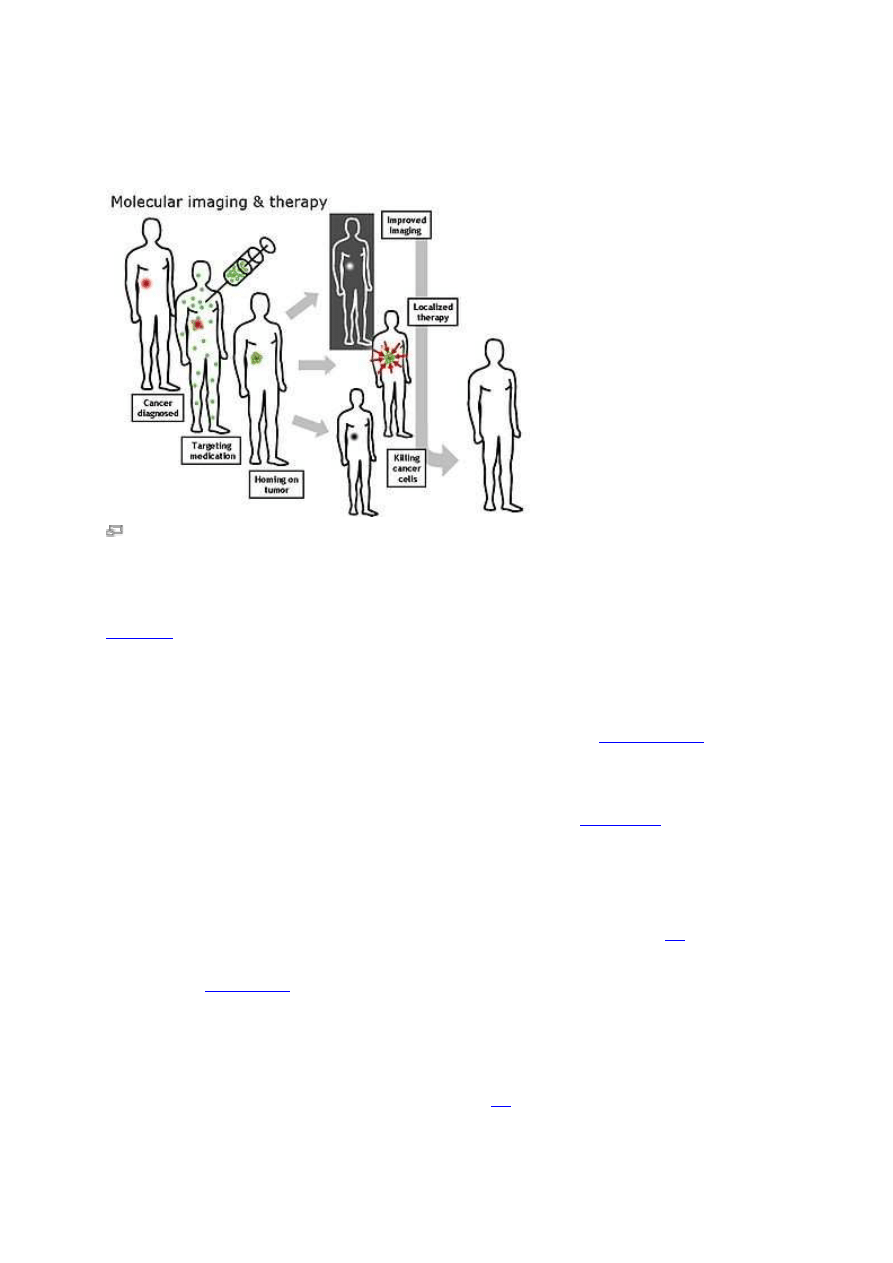
A schematic illustration showing how nanoparticles or other cancer drugs might be used to
treat cancer.
The small size of nanoparticles endows them with properties that can be very useful in
oncology
, particularly in imaging. Quantum dots (nanoparticles with quantum confinement
properties, such as size-tunable light emission), when used in conjunction with MRI
(magnetic resonance imaging), can produce exceptional images of tumor sites. These
nanoparticles are much brighter than organic dyes and only need one light source for
excitation. This means that the use of fluorescent quantum dots could produce a higher
contrast image and at a lower cost than today's organic dyes used as
contrast media
. The
downside, however, is that quantum dots are usually made of quite toxic elements.
Another nanoproperty, high surface area to volume ratio, allows many functional groups to be
attached to a nanoparticle, which can seek out and bind to certain
tumor cells
. Additionally,
the small size of nanoparticles (10 to 100 nanometers), allows them to preferentially
accumulate at tumor sites (because tumors lack an effective lymphatic drainage system). A
very exciting research question is how to make these imaging nanoparticles do more things
for cancer. For instance, is it possible to manufacture multifunctional nanoparticles that would
detect, image, and then proceed to treat a tumor? This question is under vigorous
investigation; the answer to which could shape the future of cancer treatment.
[25]
A promising
new cancer treatment that may one day replace radiation and chemotherapy is edging closer to
human trials.
Kanzius RF
therapy attaches microscopic nanoparticles to cancer cells and then
"cooks" tumors inside the body with radio waves that heat only the nanoparticles and the
adjacent (cancerous) cells.
Sensor test chips containing thousands of nanowires, able to detect proteins and other
biomarkers left behind by cancer cells, could enable the detection and diagnosis of cancer in
the early stages from a few drops of a patient's blood.
[26]

English for P
hysics
Teaching materials for students at AGH UST Krakow, Poland
by Elżbieta Kania (AGH UST ) You are free to display and print these materials for your personal, non-commercial use, but you may not
otherwise reproduce any of the materials without the prior written consent of the owners. You may not distribute copies of the materials in
any form (including by e-mail or other electronic means.)
The basic point to use drug delivery is based upon three facts: a) efficient encapsulation of the
drugs, b) successful delivery of said drugs to the targeted region of the body, and c) successful
release of that drug there.
Researchers at
Rice University
under Prof. Jennifer West, have demonstrated the use of
120 nm diameter
nanoshells
coated with gold to kill cancer tumors in mice. The nanoshells
can be targeted to bond to cancerous cells by conjugating
antibodies
or
peptides
to the
nanoshell surface. By irradiating the area of the tumor with an infrared laser, which passes
through flesh without heating it, the gold is heated sufficiently to cause death to the cancer
cells.
[27]
Nanoparticles
of
cadmium selenide
(
quantum dots
) glow when exposed to ultraviolet light.
When injected, they seep into
cancer
tumors
. The surgeon can see the glowing tumor, and use
it as a guide for more accurate tumor removal.
In
photodynamic therapy
, a particle is placed within the body and is illuminated with light
from the outside. The light gets absorbed by the particle and if the particle is metal, energy
from the light will heat the particle and surrounding tissue. Light may also be used to produce
high energy oxygen molecules which will chemically react with and destroy most organic
molecules that are next to them (like tumors). This therapy is appealing for many reasons. It
does not leave a “toxic trail” of reactive molecules throughout the body (chemotherapy)
because it is directed where only the light is shined and the particles exist. Photodynamic
therapy has potential for a noninvasive procedure for dealing with diseases, growth and
tumors.
V What other medical applications of nanotechnology have you heard of?
VI Read the passage Neuroelectronic Interfaces and answer the following questions:
1. What is neuro-electronic interfacing and what does it require?
2. What might its future advantages be?
3. What are the two possible power sources for the application in neuro-electronic
interfacing?
4. What are the practical limitations to this innovation?
Neuro-electronic interfaces
Neuro-electronic interfacing is a visionary goal dealing with the construction of nanodevices
that will permit computers to be joined and linked to the nervous system. This idea requires
the building of a molecular structure that will permit control and detection of nerve impulses
by an external computer. The computers will be able to interpret, register, and respond to
signals the body gives off when it feels sensations. The demand for such structures is huge
because many diseases involve the decay of the nervous system (ALS and multiple sclerosis).
Also, many injuries and accidents may impair the nervous system resulting in dysfunctional

English for P
hysics
Teaching materials for students at AGH UST Krakow, Poland
by Elżbieta Kania (AGH UST ) You are free to display and print these materials for your personal, non-commercial use, but you may not
otherwise reproduce any of the materials without the prior written consent of the owners. You may not distribute copies of the materials in
any form (including by e-mail or other electronic means.)
systems and paraplegia. If computers could control the nervous system through neuro-
electronic interface, problems that impair the system could be controlled so that effects of
diseases and injuries could be overcome. Two considerations must be made when selecting
the power source for such applications. They are refuelable and nonrefuelable strategies. A
refuelable strategy implies energy is refilled continuously or periodically with external sonic,
chemical, tethered, magnetic, or electrical sources. A nonrefuelable strategy implies that all
power is drawn from internal energy storage which would stop when all energy is drained.
One limitation to this innovation is the fact that electrical interference is a possibility. Electric
fields,
electromagnetic pulses (EMP)
, and stray fields from other in vivo electrical devices can
all cause interference. Also, thick insulators are required to prevent electron leakage, and if
high conductivity of the in vivo medium occurs there is a risk of sudden power loss and
“shorting out.” Finally, thick wires are also needed to conduct substantial power levels
without overheating. Little practical progress has been made even though research is
happening. The wiring of the structure is extremely difficult because they must be positioned
precisely in the nervous system so that it is able to monitor and respond to nervous signals.
The structures that will provide the interface must also be compatible with the body’s immune
system so that they will remain unaffected in the body for a long time.
[30]
In addition, the
structures must also sense ionic currents and be able to cause currents to flow backward.
While the potential for these structures is amazing, there is no timetable for when they will be
available
Wyszukiwarka
Podobne podstrony:
2.dla studentów, Zaawansowane materiały i nanotechnologia UJ, CHEMIA, Chemia nieorganiczna
Sołoducho, Nanomateriały, struktury w nanotechnologii
Sołoducho, Nanomateriały, co to jest nanotechnologia
Nanomateriały i nanotechnologie (Dawid Barcz)
2010 ZMP studenci
gruźlica dla studentów2
Prezentacja 2 analiza akcji zadania dla studentow
Szkolenie BHP Nowa studenci
Student Geneza
Kosci, kregoslup 28[1][1][1] 10 06 dla studentow
higiena dla studentów 2011 dr I Kosinska
Studenci biegunka przewlekła'
WYKŁAD STUDENCI MIKULICZ
Wyklad FP II dla studenta
Inwolucja połogowa i opieka poporodowa studenci V rok wam 5
więcej podobnych podstron