2014-04-03
1
Introduction to linguistics
Lecture 2: Phonetics
Definitions
• Phonetics
– the science which studies speech
sounds.
– describes, classifies and transcribes speech
sounds.
• Branches of phonetics:
– Articulatory phonetics
;
– Acoustic phonetics
;
– Auditory phonetics
.
2
Branches of phonetics
• Articulatory phonetics
– studies how speech
sounds are made (= articulated) by the vocal
organs;
– We will focus on articulation of sounds.
• Acoustic phonetics
– studies the physical
properties of speech, as transmitted between
mouth and ear;
• Auditory phonetics
- the study of how the ear
receives the speech signal.
3
Decribing speech sounds
• To do so, we need to know:
– what a speech sound is,
– how each sound differs from other sounds.
• Speech is a continuous flow of sound. To
analyse it, one has to divide it into smaller
chunks.
– This is the process of
segmentation
.
– Speech sounds are called
segments
(vowels and
consonants).
4
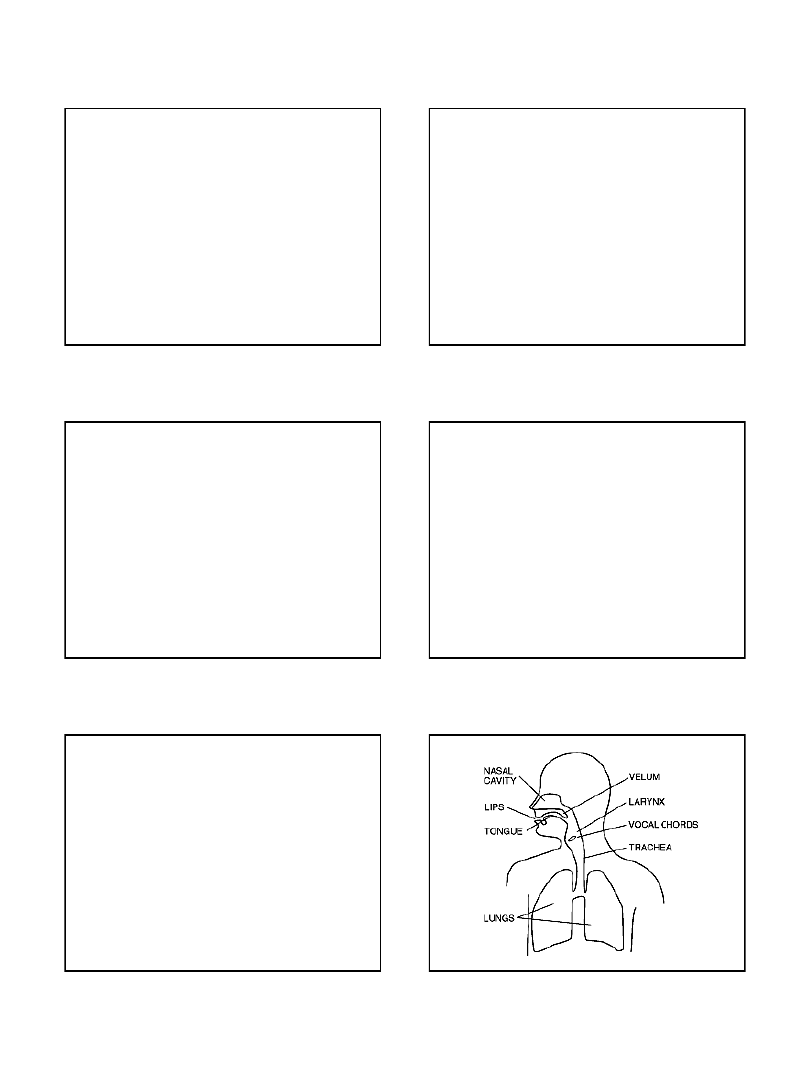
Production of speech sounds
• Sound production involves the movement of
air.
• Most speech sounds are produced by an
air
stream
that originates in the
lungs
and is
pushed up through the
trachea
and the
oral
and nasal cavities
.
• Differing
vocal tract
shapes result in the
differing sounds of language.
5
6
2014-04-03
2
Production of speech sounds
• This happens during four separate but
interrelated processes:
1. Initiation process
2. Phonation process
3. Oro-nasal process
4. Articulation
7
1. The initiation process
• In English (and most other languages), all
speech sounds need a
pulmonic (lung) air
stream
for their production.
• The airstream used for speech is always
moving
out of the lungs
and
up to the
trachea
.
8
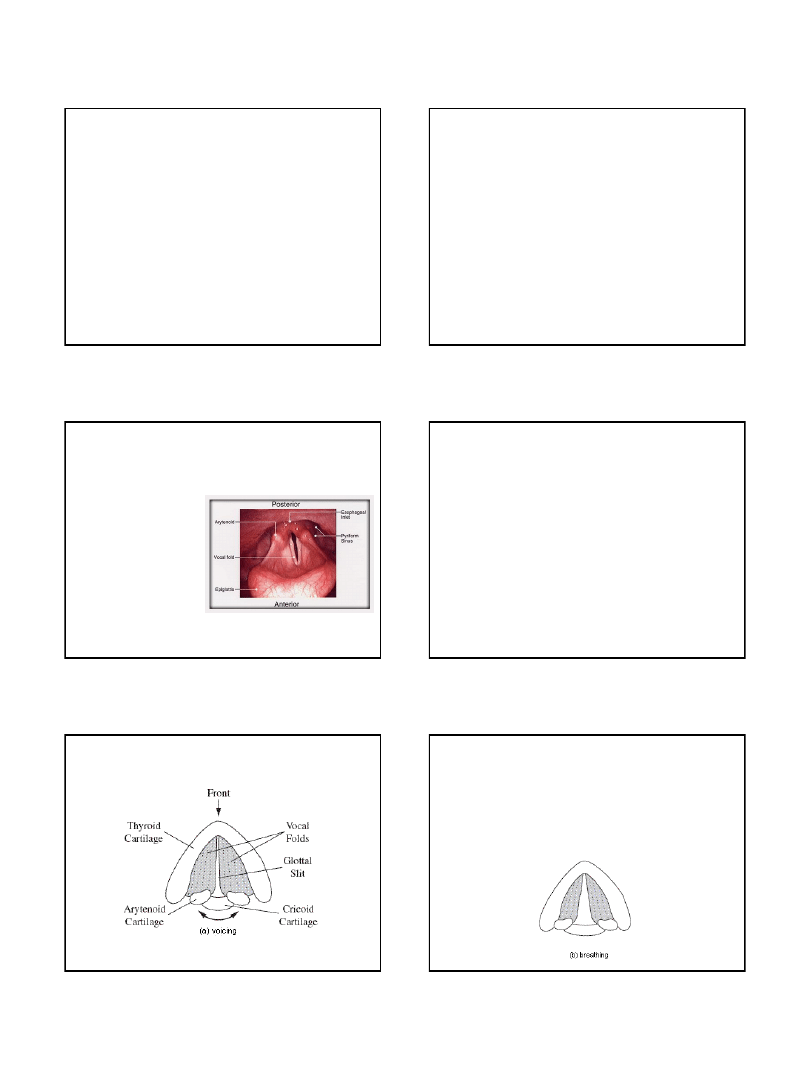
2. The phonation process
• In the trachea, the
air passes
through
the larynx
.
• The larynx contains
the
vocal folds
.
• The space between
the vocal folds is
called
glottis
. This is
where the process of
phonation occurs.
9
2. The phonation process
• The speaker can bring the vocal folds into
different positions:
• Narrow glottis
: when the vocal folds are
brought together in such a way that only a
narrow space is left for the air to pass
through.
– The passage of air makes them vibrate. The
resulting sound waves characterise
voiced sounds
.
10
Narrow glottis
11
2. The phonation process
• Open glottis
: This is the state of the glottis in
normal breathing, as well as in the production
of
voiceless sounds
.
12
2014-04-03
3
2. The phonation process
• Closed glottis
: The vocal folds are brought
together so that no air can pass between
them.
– The resulting sound is called
glottal stop
. In some
accents of English, the glottal stop can replace the
sound /t/ in words like foo
t
ball, bo
tt
le, bi
t
, etc.
13
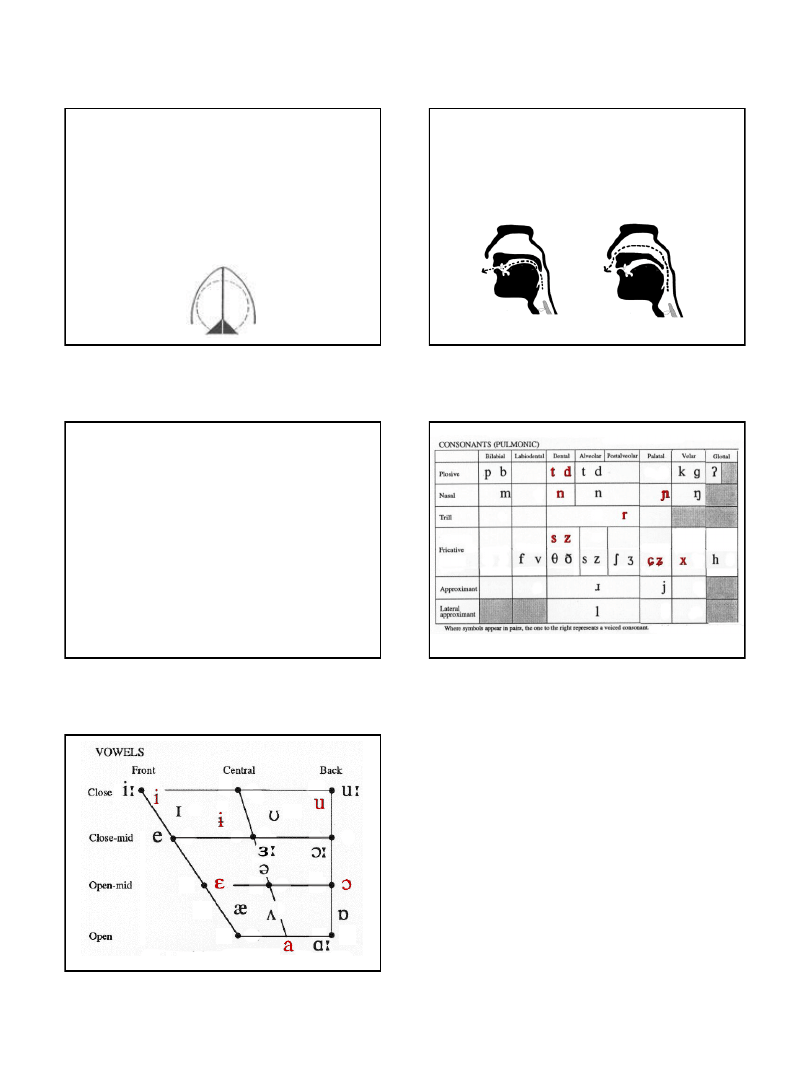
3. The oro-nasal process
• After the air passes through the larynx, it can
go either
into the oral cavity
or
into the nasal
cavity
.
14
4. The articulation process
• After the air goes into either of these cavities,
the different articulators
modify the air
stream
to produce the different English
consonants.
– E.g., when producing the sound /p/, the lips come
together and and the air is relased with a puff of
air.
– When producing the /m/ the air is released
through the nasal cavity.
– In the same way we use the different articulators
to produce different sounds.
15
16
17
Wyszukiwarka
Podobne podstrony:
8 Intro to lg socio1 LECTURE2014
4 Intro to lg morph LECTURE2014
3 Intro to lg phonol LECTURE201 Nieznany
7 Intro to lg pragm2 LECTURE2014
5 Intro to lg semant LECTURE201 Nieznany
9 Intro to lg socio2 LECTURE2014
6 Intro to lg pragm1 LECTURE201 Nieznany
10 Intro to lg neuroling LECTURE2014
8 Intro to lg socio1 LECTURE2014
4 Intro to lg morph LECTURE2014
więcej podobnych podstron