Elementary Podcast Series 01 Episode 05
page 1 of 23
The United Kingdom’s international organisation for educational opportunities and cultural relations. We are registered in England as a charity.
This downloadable pdf file contains support materials and the transcript of the podcast.
While you listen
Download the LearnEnglish Elementary podcast. You’ll find all the details on this page:
http://www.learnenglish.britishcouncil.org/elementary-podcasts
While you listen, read and answer the questions below.
Section 1
1. What do you know Tess and Ravi? Tick all the
phrases you think are true. There may be more
than one right answer.
a) Tess bought her new cat in a pet shop
b) Tess’s cat is black and white
c) Ravi prefers dogs to cats
d) Tess can’t decide what to call her cat
Section 2
2. What do you know about Didier Drogba? Tick
all the phrases you think are true.
a) He was born in Ivory Coast
b) His parents moved to France when he was
five years old
c) He started playing football in France
d) He does charity work for Africa
Section 3
3. How many points does Vineeta get in the quiz?
Tick the correct number.
a) none
b) one
c) two
d) three
Section 4
4. What does Graham say about New Zealand
and the Lord of the Rings films? Tick all the
phrases you think are true. Remember there may
be more than one right answer
a) The director of ‘Lord of the Rings’ is from New
Zealand.
b) The three Lord of the Ring films were all
c) More tourists visited New Zealand after the
films won a lot of Oscars
d) More than a billion tourists have visited New
Zealand since the films were made.
Section 5
5. How many people prefer cats to dogs? Tick the
correct number.
a) one
b) two
c) three
d) four
Section 6
6. How many people live in the flat with Carolina?
Tick the correct number.
a) Carolina + five others
b) Carolina + four others
c) Carolina + three others
d) Carolina + two others
7. What do you know about Carolina? Tick all the
phrases you think are true. Remember there may
be more than one right answer.
a) She’s very tired
b) She has a cup of tea before she goes to bed
c) She’s going to study Environmental Science
d) She’s going to register at the university in the
morning.
Section 7
8. What do you know about the three-legged
chickens? There is more than one right answer.
a) They can run very fast
b) There are a lot of them on the farm
c) The farmer breeds the chickens to eat
d) The farmer and his family often eat them for
Elementary Podcast Series 01 Episode 05
page 2 of 23
The United Kingdom’s international organisation for educational opportunities and cultural relations. We are registered in England as a charity.
filmed in New Zealand'
dinner
Answers: see Answer page at the end of this document
Elementary Podcast Series 01 Episode 05
page 3 of 23
The United Kingdom’s international organisation for educational opportunities and cultural relations. We are registered in England as a charity.
Section 1: “I didn't know you had a dog!” – talking about pets
Tess: Do you want to know my big news for this week, Ravi?
Ravi: Let me guess. You’re going to be the star of a brand new Hollywood movie? You’ve won the
lottery?
Tess: Not quite, Ravi. I’ve got a cat!
Ravi: Really?
Tess: Well, it’s just a baby cat – a kitten, but yes, I got him yesterday. He’s gorgeous.
Ravi: It’s a boy cat then? Where did you get him?
Tess: Well, my friend Kate found him in the street. And Kate’s already got two cats so I said I’d take
this one.
Ravi: What colour is he?
Tess: Well, he’s only small but he’s a brown tabby.
Ravi: What’s a tabby again? Is that the stripy one?
Tess: That’s it – tabbies are the ones with sort of dark stripes – like a tiger. He’s really lovely.
Ravi: What are you going to call him?
Tess: D’you know, I just don’t know. I’ve got lots of ideas for names but I can’t decide. I thought
maybe you could help me. What would you call a cat?
Ravi: Hmm. That’s a difficult question. To be honest, Tess, I’m more of a dog person. I’ve never really
thought about names for cats.
Tess: You don’t like cats?
Ravi: Well, it’s not that I don’t like cats. I just prefer dogs, that’s all. Anyway, I’ve got an idea, why
don’t you call your cat ‘Gordon’.
Tess: Hmm. I don’t think so. I need to think of a name soon though, really.
Tom’s tip
1. A lot of British people have pets – and they like to talk about them. So even if you don’t
like animals yourself, it’s a good idea to be interested in other people’s pets. It’s also a very
easy thing to talk about when you don’t know someone very well and you can’t think of
anything to say! You can talk about your pets or ask questions about other people’s.
2. Some learners think that ‘he’ and ‘she’ are only used for people and that we always use
‘it’ for animals. That isn’t really true. When we don’t know if an animal is male or female, for
example, we see a lion in a programme on the television, or we see a dog in the street,
then we use ‘it’. But when we know if the animal is male or female then we use ‘he’ or
‘she’. You can see this clearly in the dialogue between Glen and Stella below.
Section 1 - Exercise 1
Use the phrases in the boxes to fill the gaps in the text below. (See ‘Answer Page’ for answers)
How long have you had her?
Have you got any pets?
I had a pet mouse
I’m not really an animal person.
she’s got long black hair
That’s a nice name.
She’s about five now I think.
What sort of dog is it?
I got her from
She’s a girl.
Glen: Good morning Stella. Sorry I’m a bit late. I had to take my dog to the vet.
Stella: Hi. That’s OK. The meeting hasn’t started yet. I didn’t know you had a dog.
Glen: Oh yes. I’ve always had dogs – ever since I was a kid.
Stella: _____________________
Glen: She _____________________. She’s a mixture – a bit of everything I think.
Stella: _____________________
Glen: Erm, a couple of years now. _____________________ the local dogs home ..yes, two years ago.
Stella: From the dogs home?
Glen: Yeah. It was love at first sight. There are hundreds of lovely dogs who need a good home – you
don’t need to buy one.
Elementary Podcast Series 01 Episode 05
page 4 of 23
The United Kingdom’s international organisation for educational opportunities and cultural relations. We are registered in England as a charity.
Stella: Was she a puppy?
Glen: No, she was already adult. _____________________.Her name’s Cleo because
_____________________ like Cleopatra – and of course she’s absolutely gorgeous.
Stella: _____________________
Glen: Thanks. She’s a real cutie. What about you Stella. _____________________
Stella: No. It’s too much responsibility. _____________________ when I was a kid and I forgot to feed
him and he died. It was horrible – I cried for a week.
Glen: Oh dear. It’s just that Cleo’s pregnant – that’s why we were at the vet’s. I’ll have four or five baby
Cleos in a month’s time – if you’re interested.
Stella: I don’t think so Glen. _____________________I like them, but I don’t really want to live with one, if
you know what I mean. Anyway, Mr Johnson has just gone into the meetings room – we’d better
go or we’ll both be late. Why don’t you ask him if he’d like one of your puppies?
Compare your answers with the text on the answer page.
Section 1 – Exercise 2 -
"I've got a cat"
If someone starts talking about a pet, you can ask them a lot of questions to keep the conversation going.
Or you can tell them about your pet or pets.
Look at the examples from the dialogues in the boxes:
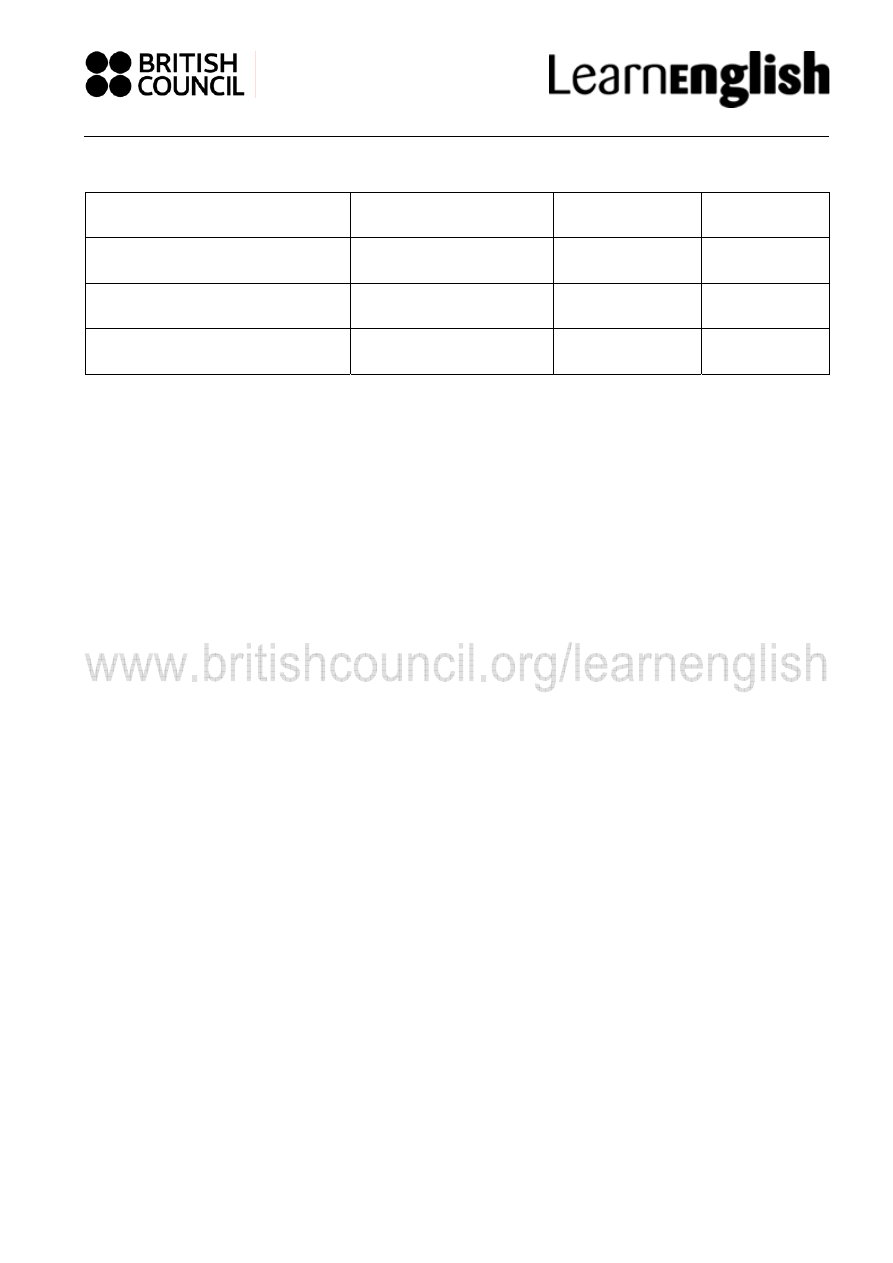
Ask... Tell...
Ask what sort of
dog/cat
What sort of dog is it?
1:
She’s a girl.
She’s a mixture – a bit of everything I think.
She’s a street cat.
2:
Ask people to
describe them,
especially the
colour and length
of their fur/hair
What colour is he?
3:
He’s really lovely.
She’s absolutely gorgeous She’s got long black hair.
He’s a brown tabby.
4:
Ask about their
name
What are you going to call
him?
5:
Her name’s Cleo because...
What a nice name.
6:
Ask about age
Was she a puppy?
7:
She was already adult.
She’s about five now I think.
She’s getting a bit old now.
8:
Ask about where
and when they
got them
Where did you get him?
How long have you had her?
9:
I got him yesterday.
I saw her in the pet shop and I just had to have her.
10:
Ask about health
How’s your dog?
11:
I had to take my dog to the vet.
He’s much better now, thanks.
12:
Talk about your
pets - past and
present
Have you got any pets?
13:
I had a pet mouse when I was a kid…
14:
Talk about
people’s opinions
of pets
You don’t like cats?
15:
To be honest, I’m more of a dog person.
I like them, but I don’t really want to live with one.
16:
Elementary Podcast Series 01 Episode 05
page 5 of 23
The United Kingdom’s international organisation for educational opportunities and cultural relations. We are registered in England as a charity.
Now add one of these phrases to each box above!
Answers: see Answer page at the end of this document
No. My parents didn't want us to
have animals in the house.
She's a cross between a
Labrador and an Alsatian
Oh, he just needs
some injections
Is she a special
breed?
Didn't you have a hamster or
something when you were young?
George – because he
looks a bit like my uncle
Oh dear. What's
wrong with him?
Is she very old,
then?
My mum's dog had puppies so I
decided to take one.
They make too much
mess in the house
Did you find her in
the street?
What does she
look like?
She’s got spots – you know, a bit
like a Dalmatian.
Are you an animal
person?
What's she called? She's just a
kitten.
Section 2: I’d like to meet
You listened to Olu talking about Didier Drogba.
Is there a famous sportsperson that you can write about? If you can think of someone, make some
notes to answer these questions:
• What's his/her name?
• What nationality is he/she?
• What sport does he/she play?
• What do you know about his/her sports career?
• Why is he/she famous?
• Do you know anything about his/her personal life?
• Do you like him/her? Why? Why not?
• Is he/she famous for other things too? What?
Now put your notes together to write a paragraph about the person and why you’d like to meet him or
her. If you want, you can send your paragraph to learnenglishpodcast@britishcouncil.org
__________________________________________________________________________
__________________________________________________________________________
__________________________________________________________________________
__________________________________________________________________________
__________________________________________________________________________
__________________________________________________________________________
__________________________________________________________________________
__________________________________________________________________________
Elementary Podcast Series 01 Episode 05
page 6 of 23
The United Kingdom’s international organisation for educational opportunities and cultural relations. We are registered in England as a charity.
Transcript
Tess: Hi Olu.
Olu: Hi Tess.
Tess: Where are you calling from Olu?
Olu: From West London.
Tess: And what do you do?
Olu: I’m still at school. In Year 12
Tess: OK. And who would you like to meet, Olu? Who are you going to talk to us about?
Olu: I’d like to meet Didier Drogba.
Ravi: Drogba? The footballer? Chelsea? You do know I’m from Manchester, don’t you, Olu? You know,
Manchester United?
Olu: Yeah, well, it’s not just because he’s Chelsea.
Tess: Come on Olu – don’t listen to him. Why would you like to meet Didier Drogba? Tell us something about
him.
Olu: Well, he’s a footballer – you already know that – and he’s from Ivory Coast, in West Africa, and he plays
great football.
Tess: And do you like him because he’s a good footballer?
Olu: Well, I do, I like the way he plays and he scores some great goals and all that, but there’s more than that.
He was born in Ivory Coast but he moved to France when he was five – he went on his own to live with his
uncle. Imagine that – a five year-old boy moving to a new country by himself?
Tess: Wow.
Olu: And then he went back to Ivory Coast but moved back to France a bit after that. His family were really poor,
you know, and they had to move around to look for work and that.
Tess: So did he start playing football in Ivory Coast?
Olu: No – in France. And this is another thing I like about him, see, most players at the really big clubs go there
when they’re quite young but Drogba played for a few years with small teams and worked his way up, through
hard work. He was 26, I think, when he went to Chelsea. But anyway, what I like him for most is that even
though he’s made it now and he’s got loads of money and that he really hasn’t forgotten where he came from.
He does loads of work for Unicef – he’s like an ambassador or something for them so he does all this charity
work. Y’see, my dad came here from Nigeria when he was really small and, I’ve never been to Africa but all you
see on TV is about problems in Africa all the time so it’s really good to see someone who comes from
somewhere like Ivory Coast doing good things, you know.
Ravi: And Ivory Coast were in the World Cup in Germany, weren’t they?
Olu: Yeah. It’s the first time they’ve got to the World Cup Finals, and they did OK. Drogba was African footballer
of the year as well.
Tess: And what would you like to say to Didier Drogba if you met him, Olu?
Olu: Erm, I guess I’d say thank you to him for the work he does for Africa and for showing people something
good from Africa. And for scoring all those goals for Chelsea!
Ravi: Hmmm. I don’t know about that. But that was great Olu, thank you.
Elementary Podcast Series 01 Episode 05
page 7 of 23
The United Kingdom’s international organisation for educational opportunities and cultural relations. We are registered in England as a charity.
.
.
.
Section 3: Quiz
Exercise 1
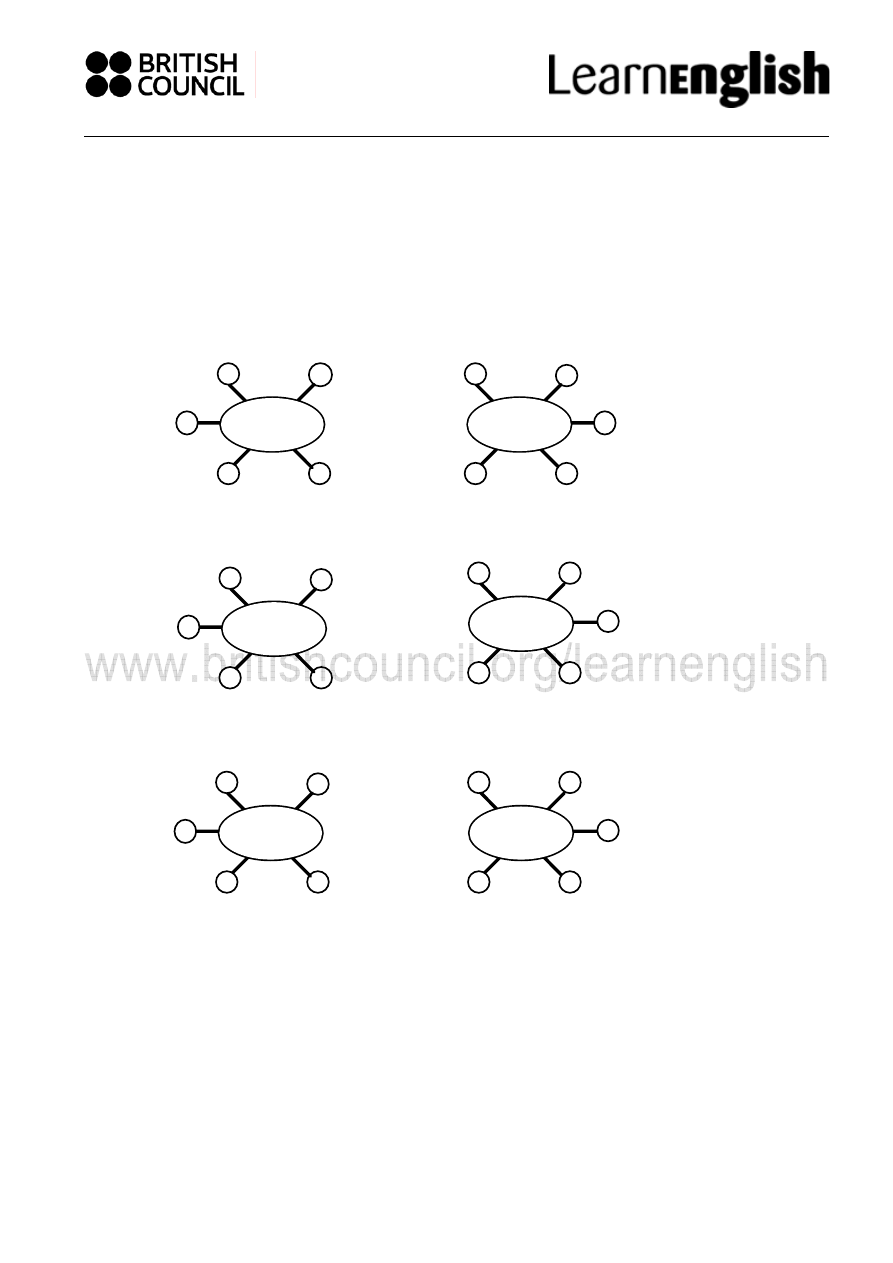
The quiz in this podcast was called ‘Beginning with…’ – for example, ‘think of an animal beginning
with ‘p’ – the answer could be ‘polar bear’ or ‘pig’ – there are lots of possibilities. Fill in the names of
things beginning with different letters on the diagram below.
There are lots of possible answers, but you can find some suggestions on the Answer Page.
vegetable
C
P
O
B
L
F
sport
S
T
B
animal
C
H
S
T
E
Y
bird
E
S
P
C
D
colour
P
O
B
C
you
choose!
P
S
T
E
G
V
Section 4: Our person in...
You listened to Graham talking about New Zealand and the places that were used in the film ‘Lord of
the Rings’.
Is there a beautiful place (or places) in your country that you’d like to tell people about? It could be an
area of mountains, or a natural park, or a forest – or even a beautiful village or town. Or you could tell
us about a beautiful place that you’ve visited in another country.
Elementary Podcast Series 01 Episode 05
page 8 of 23
The United Kingdom’s international organisation for educational opportunities and cultural relations. We are registered in England as a charity.
Think about these questions:
• What’s the place called?
• Where is it?
• What is it like? (Describe the place)
• Is it famous? What for?
• Do a lot of tourists go there?
• What do people do there?
• When did you first go there?
• Do you go there a lot?
Now write a paragraph about the place. If you want, you can send your paragraph to
learnenglishpodcast@britishcouncil.org
__________________________________________________________________________
__________________________________________________________________________
__________________________________________________________________________
__________________________________________________________________________
__________________________________________________________________________
__________________________________________________________________________
__________________________________________________________________________
__________________________________________________________________________
__________________________________________________________________________
__________________________________________________________________________
__________________________________________________________________________
__________________________________________________________________________
__________________________________________________________________________
__________________________________________________________________________
Transcript
Graham: When I was a boy and I first read Lord of the Rings, I dreamt of visiting the places Tolkien, the author
of the Lord of the Rings trilogy, created. Hobbiton, Middle Earth, Mount Doom. Now, finally, I have found all of
these places, here, in New Zealand.
Peter Jackson, who directed the Lord of the Rings films, was born in Wellington – the capital city of New
Zealand. When he was looking for places to make the fantastic worlds he needed for his films he knew where to
look. New Zealand has all kinds of scenery – and you can see a lot of it in the three films. The green hills of
Matamata became Hobbiton and the Queenstown area became the Eregion Hills – and lots of other places – all
with a little bit of help from computer magic.
People in New Zealand are proud of their country’s star role in the films but they are also happy at what Lord of
the Rings has done to bring tourists to New Zealand. After the third film in the trilogy, The Return of the King,
won 11 Oscars the number of tourists who visited New Zealand went up by 8%. More than a billion people have
visited the Lord of the Rings website – fantastic publicity for this small country.
For me, this is my boyhood dream come true – a tour of the amazing worlds of Lord of the Rings – and all right
here in New Zealand.
Elementary Podcast Series 01 Episode 05
page 9 of 23
The United Kingdom’s international organisation for educational opportunities and cultural relations. We are registered in England as a charity.
Section 5: Your turn
In Your Turn you heard 5 people answer this question: “Which do you prefer – cats or dogs?"
What do you think?
Here are some things people talked about:
• Dogs really love you
• Cats only care about food
• Cats are easy to look after
• You have to take dogs for walks – and clean up their poo!
• Cats are more intelligent than dogs
• Cats are boring
• Dogs are more fun to play with
• It’s cruel to keep a dog in the city
• Dogs
and cats are a problem when you want to go on holiday
Which ones do you agree with? Which do you prefer – dogs or cats?
Write down your opinion. You can talk about any dogs or cats that you have at home or that you
know. If you want, you can send your opinion to learnenglishpodcast@britishcouncil.org
__________________________________________________________________________
__________________________________________________________________________
__________________________________________________________________________
__________________________________________________________________________
__________________________________________________________________________
__________________________________________________________________________
__________________________________________________________________________
__________________________________________________________________________
__________________________________________________________________________
__________________________________________________________________________
__________________________________________________________________________
__________________________________________________________________________
__________________________________________________________________________
__________________________________________________________________________
__________________________________________________________________________
__________________________________________________________________________
__________________________________________________________________________
__________________________________________________________________________
__________________________________________________________________________
__________________________________________________________________________
Elementary Podcast Series 01 Episode 05
page 10 of 23
The United Kingdom’s international organisation for educational opportunities and cultural relations. We are registered in England as a charity.
Transcript
Tess: “Which do you prefer - cats or dogs?” It’s a very simple question but people have very strong opinions.
Let’s hear what they said.
Voice 1: Dogs. Definitely. Why? Look – if you’ve got a dog it really loves you. All cats care about is who feeds
them. You can think a cat loves you but if someone else gives it food it’ll be gone.
Voice 2: Well, I’ve got two cats so I think you know what my answer will be. But cats are just so much easier to
look after. With dogs you’ve got to take them for walks all the time and all of that and you have to clean up their
poo – yeuch.
Voice 3: That’s easy. Dogs are noisy, smelly and stupid; cats are much more intelligent. If you’re sitting on your
sofa, right, it’s lovely when a cat comes and sits on you and purrs. Would you want a big daft dog to come and
sit on you?
Voice 4: Cats are just so boring. All they do is sit around and sleep all day. They’re selfish, basically. Dogs play
with you and stuff. They’re fun, you know.
Voice 5: Well, to be honest, I’m not really an animal lover. I think it’s cruel to keep dogs in the city – they should
be in the country. Cats make me sneeze and they’re a real problem if you want to go on holiday. If I had to have
a pet I’d probably have a goldfish.
Ravi: Interesting. What about you Tess? Why do you prefer cats?
Tess: I just do. Cats are so much more intelligent than dogs, I think. I like dogs too but, you know, like the last
person said, I think it’s a bit cruel to keep a dog in a small flat like mine.
Section 6: Carolina
Section 6 - Exercise 1
Look at some parts of Carolina’s conversation with her new flatmates. Put the expressions in the right
places.
Do any of you know
I’m from Venezuela
So it’s seven o’clock in the evening
I arrived about an hour ago
If that’s OK with you
That would be great
I got the train to Newcastle
Nice to meet you all
What course are you doing
1. Jenny: Have you just arrived? I’m sorry – I didn’t catch your name.
Carolina: Carolina. Yes, ____________________________ .
2. Charlotte: Did you fly to Newcastle?
Carolina: No, ______________________________ . I flew to London – to Heathrow.
3. Charlotte: Ah, OK. Where are you from?
Carolina: _____________________________ .
4. Jenny: What’s the time difference between here and Venezuela?
Carolina: It’s four hours behind here. _______________________________ in Venezuela now.
5. Charlotte: Do you want a cup of tea Carolina?
Carolina: No thanks. I’m going to go to bed. _______________________ where we have to go to
register tomorrow?
6. Emily: I do. I went there today. I can go with you if you want?
Carolina: Really? _____________________________ .
Elementary Podcast Series 01 Episode 05
page 11 of 23
The United Kingdom’s international organisation for educational opportunities and cultural relations. We are registered in England as a charity.
7. Jenny: Can I come too? I need to register as well. _________________________ Carolina?
Carolina: Environmental Science. How about you?
8. Emily: Shall we go at about nine tomorrow morning? Is that too early for you Carolina?
Carolina: No. Nine o’clock is OK. __________________________ , sorry, …Jenny?
9. Jenny: Now, you get yourself to bed Carolina – you look exhausted.
Carolina: OK. I am. ___________________________ . See you in the morning.
Answers: see Answer page at the end of this document
Section 6 - Exercise 2
Look again at some conversations in the airport.
Choose all the phrases the people can say – there is always more than one correct answer.
Look again at parts of Carolina’s conversation with her new flatmates. Choose all the phrases that people
can say – there is always more than one correct answer.
1. Jenny: Have you just arrived? I’m sorry – I didn’t catch your name.
Carolina: Carolina. Yes, ______________________.
a) I got here about an hour ago
b) I arrived about an hour ago
c) I’m here about an hour
d) I’ve been here about an hour
2. Charlotte: Did you fly to Newcastle?
Carolina: No, __________________________. I flew to London – to Heathrow.
a) I got the train from London
b) I went to Newcastle by train
c) I came to Newcastle by train
d) I got the train to Newcastle
3. Charlotte: Ah, OK. Where are you from?
Carolina: _____________________________
a) It’s
Venezuela
b) I’m from Venezuela
c) I’m
Venezuelan
d) From
Venezuela
4. Jenny: What’s the time difference between here and Venezuela?
Carolina: It’s 4 hours behind here. So _____________________________ in Venezuela now.
a) it’s seven o’clock in the evening
b) it’s seven pm
c) it’s
nineteen
hours
d) it’s seven in the evening
5. Charlotte: Do you want a cup of tea Carolina?
Carolina: No thanks. I’m going to go to bed. ________________________where we have to go to
register tomorrow?
a) Does anyone know
b) Do you know
c) Do any of you know
d) Anyone
knows
Elementary Podcast Series 01 Episode 05
page 12 of 23
The United Kingdom’s international organisation for educational opportunities and cultural relations. We are registered in England as a charity.
6. Emily´: I do. I went there today. I can go with you if you want.
Carolina: Really? _________________________ .
a) That would be great
b) That’s very kind of you
c) That was great
d) Thank you very much
7. Jenny: Can I come too? I need to register as well. _________________________ Carolina?
Carolina: Environmental Science. How about you?
a) What’s your course
b) What are you studying
c) What course are you doing
d) What course do you do
8. Emily: Shall we go at about nine tomorrow morning? Is that too early for you Carolina?
Carolina: No. Nine o’clock is OK. _________________________, sorry, …Jenny?
a) If that’s OK with you
b) If that’s good with you
c) If that’s all right with you
d) If that’s well with you
9. Jenny: Now, you get yourself to bed Carolina – you look exhausted.
Carolina: OK. I am. ____________________________ . See you in the morning.
a) It was nice to meet you all
b) Nice to meet you all
c) I’m pleased to meet you all
d) Lovely to meet you all
Answers: see Answer page at the end of this document
Section 6 - Exercise 3
Now complete this conversation with your own answers. Imagine that you’ve just arrived at university and
you’re meeting your new flatmates for the first time. You can practise the conversation with a friend.
Hi. I’m Jenny. I’m in Room 3.
_________________________________________________________________________
Nice to meet you. Have you just arrived?
_________________________________________________________________________
Did you fly here?
_________________________________________________________________________
Ah. OK. Where are you from?
_________________________________________________________________________
That’s interesting. What’s the time difference between here and there?
_________________________________________________________________________
Elementary Podcast Series 01 Episode 05
page 13 of 23
The United Kingdom’s international organisation for educational opportunities and cultural relations. We are registered in England as a charity.
Do you want a cup of tea?
_____________________________________________________________________________
[ask about where to register]
_________________________________________________________________________
I went there today. I can go with you tomorrow if you like.
_________________________________________________________________________
No problem. What course are you doing?
_________________________________________________________________________
Shall we go at about nine tomorrow morning? Is that OK with you?
_________________________________________________________________________
You look tired!
_________________________________________________________________________
OK. See you tomorrow. Sleep well.
_________________________________________________________________________
Transcript
Carolina has arrived in Newcastle. Another student is showing her round the student accommodation.
Gemma: ... and if you get lost just ask someone. Anyway, this is the kitchen. Like I said, there are five of you in this flat and
this is the kitchen for your flat. The other flats have all got their own kitchens. Right – I think that’s everything, I’m going to
get back. I’m sure you want some time to unpack your stuff. Some of the other girls in your flat are here already. You’ll
probably meet them here in the kitchen a bit later.
Carolina: OK. Thanks Gemma. Thanks for showing me around.
Gemma: No problem. I’ll probably see you around. OK. See you. I’m sure you’ll have a great time in Newcastle.
Carolina: Thanks. Bye
(in the shared kitchen )
Carolina: Erm. Hello.
Charlotte: Hi. Oh! Are you in Room 4? Hi! Come in!
Carolina: Hi. Yes, I’m in Room 4. I’m Carolina.
Charlotte: Hi Carolina. I’m Charlotte. Nice to meet you. I’m in Room 2. We’re neighbours.
Carolina: Oh, right. Nice to meet you.
Emily: I’m Emily. I’m in number 1.
Carolina: Nice to meet you.
Emily: Nice to meet you.
Jenny: And I’m Jenny. Hi.
Carolina: Hi Jenny. Do you all know each other?
Jenny: No – we just met this afternoon. There’s another girl, Beth, but she’s not here at the moment. Have you just arrived?
I’m sorry – I didn’t catch your name.
Carolina: Carolina. Yes, erm, I arrived about an hour ago.
Charlotte: Did you fly to Newcastle?
Carolina: No, erm, I got the train to Newcastle. I flew to London – to Heathrow.
Charlotte: Ah, OK. Where are you from?
Carolina: I’m from Venezuela.
Emily: Really? Wow! Have you flown from Venezuela today? You must be exhausted.
Carolina: Yes. I am actually. I just wanted to meet you all before I went to bed.
Jenny: What’s the time difference between here and Venezuela?
Carolina: It’s four hours behind here. So it’s seven o’clock in the evening in Venezuela now.
Charlotte: Do you want a cup of tea Carolina?
Elementary Podcast Series 01 Episode 05
page 14 of 23
The United Kingdom’s international organisation for educational opportunities and cultural relations. We are registered in England as a charity.
Carolina: Erm. .. No thanks. I’m going to go to bed. Erm. Do any of you know where we have to go to register tomorrow?
Emily: I do. I went there today. I can go with you if you want?
Carolina: Really? That would be great.
Jenny: Can I come too? I need to register as well. What course are you doing Carolina?
Carolina: Erm … Environmental Science. How about you?
Jenny: French and Politics. I think we have to register in the same place.
Emily: You do. It’s all in the same building. Shall we go at about nine tomorrow morning? Is that too early for you Carolina?
Carolina: No. Nine o’clock is OK. If that’s OK with you, sorry, erm …Jenny?
Jenny: Nine’s fine. It’s a date! Now, you get yourself to bed Carolina – you look exhausted.
Carolina: OK. I am. Nice to meet you all. See you in the morning.
Charlotte/Jenny/Emily: Goodnight/See you tomorrow/See you in the morning.
Section 7 - The joke
Exercise 1
Read the sentences below, and put them in the right order. You can either cut them up and arrange them,
or write the number in the space on the left. For answers, see the Answer Page transcript.
Quickly, the man stops his car
“I breed them” says the farmer. “There are three of us, me, my wife and our son.
He drives a bit faster – 70 kilometres an hour – but the three-legged chicken just runs faster too. The
man goes faster and faster but the chicken keeps running.
“Well”, says the farmer, “I don’t know. We haven’t caught one of them yet.”
The farmyard is full of three-legged chickens. There are three-legged chickens everywhere.
So, he sees the farmer in the farmyard and he asks him, “Where do all of these three-legged
chickens come from? This is amazing”.
‘How strange’ he thinks, ‘a three-legged chicken’. He starts to drive a bit faster – 40 kilometres an
hour - but the chicken goes faster too.
“Amazing” says the man, “How’s the meat? Does it taste good?”
We all like chicken legs, so … I made a three-legged chicken, so we can all have a leg at dinner
time”.
A man is driving slowly down a country road when he sees a chicken run in front of his car. Nothing
strange about that – but then, he notices that the chicken has three legs.
When they are both doing over one hundred kilometres an hour, the chicken turns a corner into a
farm.

Elementary Podcast Series 01 Episode 05
page 15 of 23
The United Kingdom’s international organisation for educational opportunities and cultural relations. We are registered in England as a charity.
Section 7 - Exercise 2
Now try to tell the joke yourself. Use these words to help you. When you see a slash (/) it means that one
or more words are missing. Then check your answers – the transcript is on the Answer page at the end of
this document
• A man / driving / country road / a chicken / in front of his car.
• Nothing strange about that – but then, he / the chicken / three legs.
• “/ strange” he thinks, “a three-legged chicken”.
• He / bit faster – 40 kilometres an hour - but the chicken / too.
• He / faster – 70 kilometres an hour – but the / chicken / too.
• The man / faster and faster / the chicken / running.
• When / both / over one hundred kilometres an hour, the chicken / into a farm.
• Quickly, the man / his car.
• The farmyard / three-legged chickens. There / three-legged chickens everywhere.
• So, he / the farmer in the farmyard and he /, “Where / three-legged chickens / from? / amazing”.
• “I breed / ” says /
• “There / three /, me, my wife and our son.
• We / chicken legs, so … I / a three-legged chicken, so / all / a leg at dinner time”.
• “Amazing” / man, “ / the meat? / good?”
•
“Well”, / the farmer, “ / know. We haven’t caught / yet ”
Tom the teacher - Exercise 1
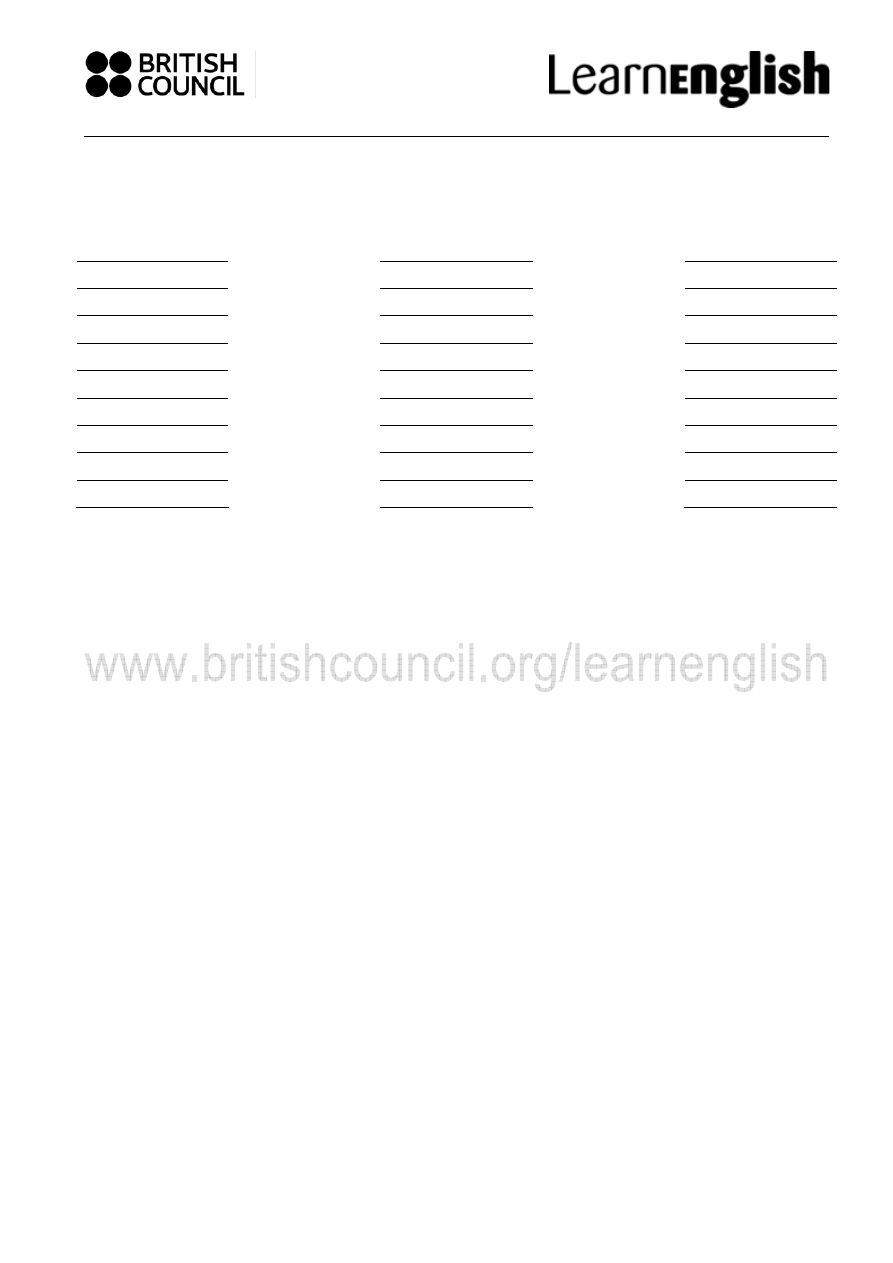
Decide if these verbs are ‘regular’ (we add ‘ed’) or ‘irregular’. Put them in the right place.
arrive begin come decide do
drive
feel go forget
know
like look
make meet move need remember
see
visit
Regular Irregular
For answers, see the Answer Page
Elementary Podcast Series 01 Episode 05
page 16 of 23
The United Kingdom’s international organisation for educational opportunities and cultural relations. We are registered in England as a charity.
Tom the teacher - Exercise 2
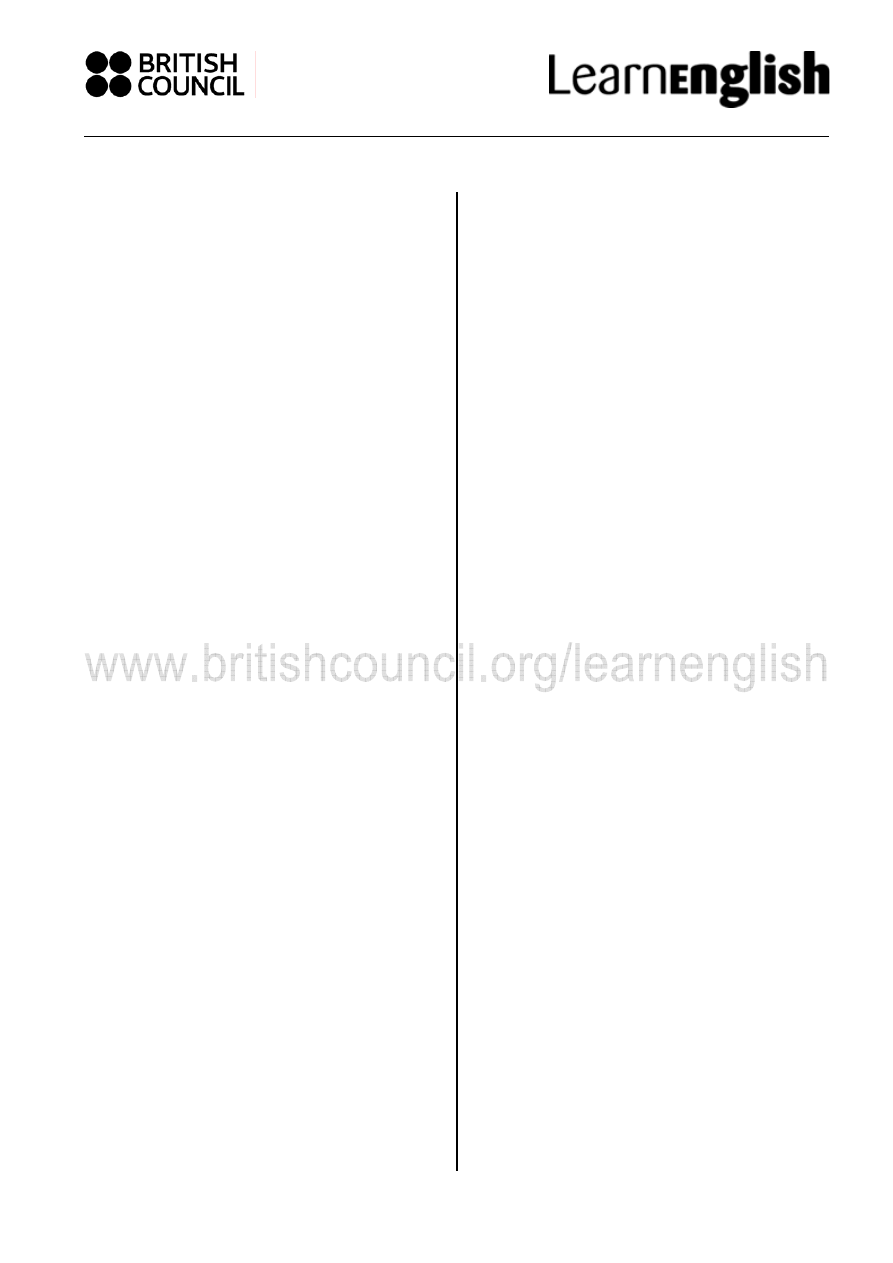
Fill in the missing forms of these irregular verbs.
Base form
Past simple
Past participle
begin
came
do
drove
felt
forget
known
made
meet
see
Tom the teacher - Exercise 3
Now see if you can use the verb forms correctly in sentences. Use the verb in brackets and write the
correct form in the space. For answers, see Answer page at the end of this document
1
I’m going to _______________ the new Tarantino film this weekend. Do you want to come?
(see)
2
Is everyone ready? OK, then let’s _______________ .
(begin)
3
We _______________ all the way from Paris to Madrid. We were exhausted when we got
there.
(drive)
4
Does anyone _______________ what time the shop opens?
(know)
5
Did you _______________ anyone interesting at the party?
(meet)
6
It was terrible! I’ve never _______________ so embarrassed in my whole life!
(feel)
7
I’m sorry. I can’t _______________ on Saturday. What about Sunday afternoon?
(come)
8
Nissan cars are _______________ in Japan.
(make)
9
Have you ever _______________ anyone famous?
(meet)
10 What did you _______________ at the weekend? Anything exciting?
(do)
11 It’s mum’s birthday tomorrow. You haven’t _______________ have you?
(forget)
12 How did you _______________ when she told you the news?
(feel)
Elementary Podcast Series 01 Episode 05
page 17 of 23
The United Kingdom’s international organisation for educational opportunities and cultural relations. We are registered in England as a charity.
Answers
While you listen – Answers
1) c,d 2) a,c,d 3) b 4) a,b,c 5) b 6) b 7) a,c,d 8) a,b,c
Section 1 - “I didn't know you had a dog!” – talking
about pets
Glen: Good morning Stella. Sorry I’m a bit late. I had to take
my dog to the vet.
Stella: Hi. That’s OK. The meeting hasn’t started yet. I didn’t
know you had a dog.
Glen: Oh yes. I’ve always had dogs – ever since I was a kid.
Stella: What sort of dog is it?
Glen: She. She’s a girl. She’s a mixture – a bit of
everything I think.
Stella: How long have you had her?
Glen: Erm, a couple of years now. I got her from the local
dogs home ..yes, two years ago.
Stella: From the dogs home?
Glen: Yeah. It was love at first sight. There are hundreds of
lovely dogs who need a good home – you don’t need to buy
one.
Stella: Was she a puppy?
Glen: No, she was already adult. She’s about five now I
think. Her name’s Cleo because she’s got long black hair
like Cleopatra – and of course she’s absolutely gorgeous.
Stella. That's a nice name.
Glen: Thanks. She’s a real cutie. What about you Stella.
Have you got any pets?
Stella: No. It’s too much responsibility. I had a pet mouse
when I was a kid and I forgot to feed him and he died. It was
horrible – I cried for a week.
Glen: Oh dear. It’s just that Cleo’s pregnant – that’s why we
were at the vet’s. I’ll have four or five baby Cleos in a
month’s time – if you’re interested.
Stella: I don’t think so Glen. I’m not really an animal
person. I like them, but I don’t really want to live with one, if
you know what I mean. Anyway, Mr Johnson has just gone
into the meetings room – we’d better go or we’ll both be late.
Why don’t you ask him if he’d like one of your puppies.
Section 1: Exercise 2
1) Is she a special breed?; 2) She's a cross between a
Labrador and an Alsatian; 3: What does she look like?; 4)
She’s got spots – you know, a bit like a Dalmatian.; 5)
What's she called?; 6) George – because he looks a bit like
my uncle; 7) Is she very old, then?; 8) She's just a kitten.; 9)
Did you find her in the street?; 10) My mum's dog had
puppies so I decided to take one.; 11) Oh dear. What's
wrong with him?; 12) Oh, he just needs some injections; 13)
Didn't you have a hamster or something when you were
young?; 14) No. My parents didn't want us to have animals
in the house.; 15) Are you an animal person?; 16) They
make too much mess in the house
Section 3: Quiz – Exercise 1
Some possible answers: vegetable: carrot, cauliflower,
cucumber, corn; pea, pepper, potato; onion; broccoli,
beetroot, bean; lettuce, leek, lentil. sport: swimming, skiing,
skating, sailing; football, fishing, fencing; tennis, trampoline,
tae kwon do; volleyball; baseball, basketball, bowling,
bodyboarding. animal: cat, cow, chimpanzee, camel,
cheetah; horse, hippopotamus, hyena; sheep, seal, snake,
shark; tiger, turtle, tortoise; elephant. colour: purple, pink;
yellow; orange, olive; green, grey, gold; black, brown, beige,
blue. bird: eagle, emu; swan, sparrow; parrot, peacock,
pelican, pigeon; canary; duck.
Section 6: Carolina - Exercise 1 - Answers
1) I arrived about an hour ago; 2) I got the train to
Newcastle; 3) I’m from Venezuela; 4) So it’s seven o’clock in
the evening; 5) Do any of you know; 6) That would be
great ; 7) What course are you doing; 8) If that’s OK with
you; 9) Nice to meet you all
Section 6: Carolina - Exercise 2 - Answers
1. a,b,d; 2. a,c,d; 3. b,c,d; 4. a,b,d; 5. a,b,c;
6. a,b,d; 7. a,b,c; 8. a,c; 9. a,b,d
Section 7: the Joke: transcript
OK. A man is driving slowly down a country road when he
sees a chicken run in front of his car. Nothing strange about
that – but then, he notices that the chicken has three legs.
"How strange" he thinks, "a three-legged chicken". He starts
to drive a bit faster – 40 kilometres an hour - but the chicken
goes faster too. He drives a bit faster – 70 kilometres an
hour – but the three-legged chicken just runs faster too. The
man goes faster and faster but the chicken keeps running.
When they are both doing over one hundred kilometres an
hour, the chicken turns a corner into a farm.
Quickly, the man stops his car. The farmyard is full of three-
legged chickens. There are three-legged chickens
everywhere. So, he sees the farmer in the farmyard and he
asks him, “Where do all of these three-legged chickens
come from? This is amazing”. “I breed them” says the
farmer. “There are three of us, me, my wife and our son. We
all like chicken legs, so … I made a three-legged chicken,
so we can all have a leg at dinner time”. “Amazing” says the
man, “How’s the meat? Does it taste good?”
“Well”, says the farmer, “I don’t know. We haven’t caught
one of them yet.”
Tom the teacher - Exercise 1 - Answers
Regular: arrive, decide, like, look, move, need, remember,
visit; Irregular: begin, come, do, drive, feel, forget, know,
make, meet, see
Tom the teacher – Exercise 2 - Answers
Base form
Past simple
Past participle
begin
began
begun
come
came
come
do
did
done
drive
drove
driven
feel
felt
felt
forget
forgot
forgotten
know
knew
known
make
made
made
meet
met
met
see
saw
seen
Tom the teacher - Exercise 3 - Answers
1. see; 2. begin; 3. drove; 4. know; 5. meet; 6. felt;
7. come; 8. made; 9. met; 10. do; 11. forgotten;
12. feel
Elementary Podcast Series 01 Episode 05
page 18 of 23
The United Kingdom’s international organisation for educational opportunities and cultural relations. We are registered in England as a charity.
Transcript
Download the LearnEnglish Elementary podcast.
You’ll find all the details on this page:
http://www.learnenglish.britishcouncil.org/elemen
tary-podcasts
Section 1 - “I didn't know you had a dog!” –
talking about pets
Ravi: Hello again and welcome to LearnEnglish
Elementary podcast number five. I’m Ravi – from
Manchester
Tess: And I’m Tess – from London. We’re here with
Gordon – our producer. Hello Gordon.
Gordon: Hello!
Tess: …. and, as usual, we’ve got lots of interesting
things for you to listen to. But first of all, do you
want to know my big news for this week, Ravi?
Ravi: Let me guess. You’re going to be the star of a
brand new Hollywood movie? You’ve won the
lottery?
Tess: Not quite, Ravi. I’ve got a cat!
Ravi: Really?
Tess: Well, it’s just a baby cat – a kitten, but yes, I
got him yesterday. He’s gorgeous.
Ravi: It’s a boy cat then? Where did you get him?
Tess: Well, my friend Kate found him in the street.
And Kate’s already got two cats so I said I’d take
this one.
Ravi: What colour is he?
Tess: Well, he’s only small but he’s a brown tabby.
Ravi: What’s a tabby again? Is that the stripy one?
Tess: That’s it – tabbies are the ones with sort of
dark stripes – like a tiger. He’s really lovely.
Ravi: What are you going to call him?
Tess: D’you know, I just don’t know. I’ve got lots of
ideas for names but I can’t decide. I thought maybe
you could help me. What would you call a cat?
Ravi: Hmm. That’s a difficult question. To be
honest, Tess, I’m more of a dog person. I’ve never
really thought about names for cats.
Tess: You don’t like cats?
Ravi: Well, it’s not that I don’t like cats. I just prefer
dogs, that’s all. Anyway, I’ve got an idea, why don’t
you call your cat ‘Gordon’.
Tess: Hmm. I don’t think so. I need to think of a
name soon though, really. Anyway, let’s move on.
Section 2 – I’d like to meet
Tess: Let’s start with I’d Like to Meet. If you’re
listening for the first time, I’d Like to Meet is the part
of the show where someone tells us about the
famous person – alive or dead – that they’d like to
meet – and why. This time round we’ve got Olu with
us. Hi Olu.
Olu: Hi Tess.
Tess: Where are you calling from Olu?
Olu: From West London.
Tess: And what do you do?
Olu: I’m still at school. In Year 12
Tess: OK. And who would you like to meet, Olu?
Who are you going to talk to us about?
Olu: I’d like to meet Didier Drogba.
Ravi: Drogba? The footballer? Chelsea? You do
know I’m from Manchester, don’t you, Olu? You
know, Manchester United?
Olu: Yeah, well, it’s not just because he’s Chelsea.
Tess: Come on Olu – don’t listen to him. Why
would you like to meet Didier Drogba? Tell us
something about him.
Olu: Well, he’s a footballer – you already know that
– and he’s from Ivory Coast, in West Africa, and he
plays great football.
Tess: And do you like him because he’s a good
footballer?
Olu: Well, I do, I like the way he plays and he
scores some great goals and all that, but there’s
more than that. He was born in Ivory Coast but he
moved to France when he was five – he went on
his own to live with his uncle. Imagine that – a five
year-old boy moving to a new country by himself?
Tess: Wow.
Olu: And then he went back to Ivory Coast but
moved back to France a bit after that. His family
were really poor, you know, and they had to move
around to look for work and that.
Tess: So did he start playing football in Ivory
Coast?
Olu: No – in France. And this is another thing I like
about him, see, most players at the really big clubs
go there when they’re quite young but Drogba
played for a few years with small teams and worked
his way up, through hard work. He was 26, I think,
when he went to Chelsea. But anyway, what I like
him for most is that even though he’s made it now
and he’s got loads of money and that he really
hasn’t forgotten where he came from. He does
loads of work for Unicef – he’s like an ambassador
or something for them so he does all this charity
work. Y’see, my dad came here from Nigeria when
he was really small and, I’ve never been to Africa
but all you see on TV is about problems in Africa all
the time so it’s really good to see someone who
comes from somewhere like Ivory Coast doing
good things, you know.
Ravi: And Ivory Coast were in the World Cup in
Germany, weren’t they?
Elementary Podcast Series 01 Episode 05
page 19 of 23
The United Kingdom’s international organisation for educational opportunities and cultural relations. We are registered in England as a charity.
Olu: Yeah. It’s the first time they’ve got to the World
Cup Finals, and they did OK. Drogba was African
footballer of the year as well.
Tess: And what would you like to say to Didier
Drogba if you met him, Olu?
Olu: Erm, I guess I’d say thank you to him for the
work he does for Africa and for showing people
something good from Africa. And for scoring all
those goals for Chelsea!
Ravi: Hmmm. I don’t know about that. But that was
great Olu, thank you.
Tess: And don’t forget, we’d like to hear from you,
our listeners. Tell us which famous person, dead or
alive, you’d like to meet – and why. Email us at
‘learnenglishpodcast@britishcouncil.org., that’s
learnenglishpodcast - all one word – at -
britishcouncil – all one word dot org, that’s o-r-g.
Ravi: I’ll tell you what Tess, why don’t you call your
cat Didier? That’s a great name for a cat.
Tess: Hmm. I don’t think so, really.
Section 3 – Quiz
Tess: OK. Now it’s quiz time. What is it this time
Ravi?
Ravi: It’s something a bit different today – we’ve got
our two players joining us on the telephone – I hope
– Hello Vineeta?
Vineeta: (on phone) Hi Ravi
Ravi: And hello Jason.
Jason: (on phone) Hello
Ravi: Jason – where are you from and how old are
you?
Jason: Erm .. I’m 15 and I’m from Durham.
Ravi: Near Newcastle? That’s where Carolina is.
What’s the weather like in Durham today Jason?
Jason: Not great, really. It’s a bit cloudy.
Ravi: Oh dear. How are things where you are
Vineeta? Where are you?
Vineeta: I’m in Plymouth.
Ravi: OK Plymouth – we’ve got opposite ends of
the country here, Durham and Plymouth. It’s north
against south. Sorry, Vineeta, what’s the weather
like in Plymouth?
Vineeta: Not too bad. Quite sunny.
Ravi: OK. Better than Durham. Right. Do you both
know what you have to do? I’ll explain for our
listeners. I’m going to ask Jason and Vineeta some
questions. To answer, they press any button on
their phone and we’ll hear a buzzer. Let’s hear
yours Jason.
(sound of Jason’s buzzer)
Ravi: And yours Vineeta
(sound of Vineeta’s buzzer)
Ravi: Great. Now, the quiz is called ‘Beginning
With ..’ – your answer has to begin with the letter I
give you – so if I say, for example, ‘a sport
beginning with 'F’ you could say ‘football’. Let’s
have a practice run to begin with. Fingers ready?
An animal beginning with P
(Jason’s buzzer)
Ravi: Jason?
Jason: Polar bear
Ravi: Yes. OK then, let’s play. First one to three is
the winner. Ready?
Jason & Vineeta: Ready
Ravi: OK then, let’s go. A vegetable beginning with
‘L’
(Jason’s buzzer)
Ravi: Jason!
Jason: Lettuce
Ravi: Right. One nil to Jason. A colour beginning
with ‘Y’.
(Jason’s buzzer)
Ravi: Jason again.
Jason: Yellow
Ravi: Right. Two nil. Come on Vineeta. A bird
beginning with ‘E’.
(Vineeta’s buzzer)
Ravi: Vineeta.
Vineeta: Eagle.
Ravi: Yes. Well done Vineeta. Two one. OK. A
sport beginning with ‘G’
(Jason’s buzzer)
Ravi: Jason.
Jason: Golf
Ravi: Yes! That’s three for Jason so you’re the
winner. Well done Jason. And bad luck Vineeta. He
was just a bit quicker than you.
Vineeta: Yeah.
Ravi: But never mind. Well done to both of you and
thank you both for playing. Now, Tess, a cat’s
name beginning with …..
Tess: I wish I could decide. Remember listeners
that if you’ve got any ideas for games we can play,
we’d love to hear them. You can send them to the
usual address..
Section 4 – Our person in
Tess: Right, now then. The next part of our podcast
is Our Person In – the part of the show where we
hear from different people around the world. You’ll
like it this time Ravi – you like Lord of the Rings.
Graham Baxter is …Our Man in New Zealand.
Graham: When I was a boy and I first read Lord of
the Rings, I dreamt of visiting the places Tolkien,
the author of the Lord of the Rings trilogy, created.
Hobbiton, Middle Earth, Mount Doom. Now, finally,
I have found all of these places, here, in New
Zealand.
Elementary Podcast Series 01 Episode 05
page 20 of 23
The United Kingdom’s international organisation for educational opportunities and cultural relations. We are registered in England as a charity.
Peter Jackson, who directed the Lord of the Rings
films, was born in Wellington – the capital city of
New Zealand. When he was looking for places to
make the fantastic worlds he needed for his films
he knew where to look. New Zealand has all kinds
of scenery – and you can see a lot of it in the three
films. The green hills of Matamata became
Hobbiton and the Queenstown area became the
Eregion Hills – and lots of other places – all with a
little bit of help from computer magic.
People in New Zealand are proud of their country’s
star role in the films but they are also happy at what
Lord of the Rings has done to bring tourists to New
Zealand. After the third film in the trilogy, The
Return of the King, won 11 Oscars the number of
tourists who visited New Zealand went up by 8%.
More than a billion people have visited the Lord of
the Rings website – fantastic publicity for this small
country.
For me, this is my boyhood dream come true – a
tour of the amazing worlds of Lord of the Rings –
and all right here in New Zealand.
Ravi: Great. I’d love to go to New Zealand. I’ve
always wanted to go.
Tess: Me too. The scenery sounds amazing. And it
always looks so green in pictures.
Ravi: Yeah. It looks fantastic. Don’t forget listeners
that we’d love to hear about the scenery or
countryside in your country. Is there a special place
you like to go or some especially famous
countryside? You can write and tell us about it. As
usual the address is
learnenglishpodcast@britishcouncil.org. Go on,
why not write, we’re always happy to hear from our
listeners?
Section 5 – Your turn
Tess: Now, for Your Turn this time, since I’ve got a
new cat, we decided to ask people a very important
question – “Which do you prefer - cats or dogs?”
It’s a very simple question but people have very
strong opinions. Let’s hear what they said.
Voice 1: Dogs. Definitely. Why? Look – if you’ve got
a dog it really loves you. All cats care about is who
feeds them. You can think a cat loves you but if
someone else gives it food it’ll be gone.
Voice 2: Well, I’ve got two cats so I think you know
what my answer will be. But cats are just so much
easier to look after. With dogs you’ve got to take
them for walks all the time and all of that and you
have to clean up their poo – yeuch.
Voice 3: That’s easy. Dogs are noisy, smelly and
stupid; cats are much more intelligent. If you’re
sitting on your sofa, right, it’s lovely when a cat
comes and sits on you and purrs. Would you want
a big daft dog to come and sit on you?
Voice 4: Cats are just so boring. All they do is sit
around and sleep all day. They’re selfish, basically.
Dogs play with you and stuff. They’re fun, you
know.
Voice 5: Well, to be honest, I’m not really an animal
lover. I think it’s cruel to keep dogs in the city – they
should be in the country. Cats make me sneeze
and they’re a real problem if you want to go on
holiday. If I had to have a pet I’d probably have a
goldfish.
Ravi: Interesting. What about you Tess? Why do
you prefer cats?
Tess: I just do. Cats are so much more intelligent
than dogs, I think. I like dogs too but, you know, like
the last person said, I think it’s a bit cruel to keep a
dog in a small flat like mine.
Ravi: OK. What about you listeners? Cats or dogs –
which do you prefer? You can write and let us
know. It’s learnenglishpodcast@britishcouncil.org.
We’d love to hear from you.
Section 6 – Carolina
Tess: Right. Now it’s time to meet Carolina again.
Carolina is from Venezuela and she’s come to the
UK to live and study – and have fun! Last time we
listened Carolina was on the train from London to
Newcastle in the north of England, where she’s
going to study at university. Let’s see what
happened when she arrived in Newcastle. Another
student is showing her round the student
accommodation.
Gemma: ... and if you get lost just ask someone.
Anyway, this is the kitchen. Like I said, there are
five of you in this flat and this is the kitchen for your
flat. The other flats have all got their own kitchens.
Right – I think that’s everything, I’m going to get
back. I’m sure you want some time to unpack your
stuff. Some of the other girls in your flat are here
already. You’ll probably meet them here in the
kitchen a bit later.
Carolina: OK. Thanks Gemma. Thanks for showing
me around.
Elementary Podcast Series 01 Episode 05
page 21 of 23
The United Kingdom’s international organisation for educational opportunities and cultural relations. We are registered in England as a charity.
Gemma: No problem. I’ll probably see you around.
OK. See you. I’m sure you’ll have a great time in
Newcastle.
Carolina: Thanks. Bye
(in the shared kitchen )
Carolina: Erm. Hello.
Charlotte: Hi. Oh! Are you in Room 4? Hi! Come in!
Carolina: Hi. Yes, I’m in Room 4. I’m Carolina.
Charlotte: Hi Carolina. I’m Charlotte. Nice to meet
you. I’m in Room 2. We’re neighbours.
Carolina: Oh, right. Nice to meet you.
Emily: I’m Emily. I’m in number 1.
Carolina: Nice to meet you.
Emily: Nice to meet you.
Jenny: And I’m Jenny. Hi.
Carolina: Hi Jenny. Do you all know each other?
Jenny: No – we just met this afternoon. There’s
another girl, Beth, but she’s not here at the
moment. Have you just arrived? I’m sorry – I didn’t
catch your name.
Carolina: Carolina. Yes, erm, I arrived about an
hour ago.
Charlotte: Did you fly to Newcastle?
Carolina: No, erm, I got the train to Newcastle. I
flew to London – to Heathrow.
Charlotte: Ah, OK. Where are you from?
Carolina: I’m from Venezuela.
Emily: Really? Wow! Have you flown from
Venezuela today? You must be exhausted.
Carolina: Yes. I am actually. I just wanted to meet
you all before I went to bed.
Jenny: What’s the time difference between here
and Venezuela?
Carolina: It’s four hours behind here. So it’s seven
o’clock in the evening in Venezuela now.
Charlotte: Do you want a cup of tea Carolina?
Carolina: Erm. .. No thanks. I’m going to go to bed.
Erm. Do any of you know where we have to go to
register tomorrow?
Emily: I do. I went there today. I can go with you if
you want?
Carolina: Really? That would be great.
Jenny: Can I come too? I need to register as well.
What course are you doing Carolina?
Carolina: Erm … Environmental Science. How
about you?
Jenny: French and Politics. I think we have to
register in the same place.
Emily: You do. It’s all in the same building. Shall we
go at about nine tomorrow morning? Is that too
early for you Carolina?
Carolina: No. Nine o’clock is OK. If that’s OK with
you, sorry, erm …Jenny?
Jenny: Nine’s fine. It’s a date! Now, you get
yourself to bed Carolina – you look exhausted.
Carolina: OK. I am. Nice to meet you all. See you in
the morning.
Charlotte/Jenny/Emily: Goodnight/See you
tomorrow/See you in the morning.
Tess: Right. Carolina seems to be OK in
Newcastle. Her flatmates sound nice.
Ravi: Yeah. How does it work? She doesn’t share a
room with anyone, does she?
Tess: I don’t think so. I didn’t. Usually a ‘flat’ has
four or five rooms – single rooms – and then those
four or five people have a shared kitchen and
maybe a shared bathroom too.
Ravi: Oh, OK. I see. Anyway, we’ll hear more about
Carolina next time.
Section 7 – The Joke
Ravi: Now it’s time for …da-dah! Gordon and his
amazing jokes. So what have you got for us today
Gordon? Parrots? Talking dogs?
Gordon: Chickens. They can’t talk though.
Ravi: OK. Come on then. Let’s hear it.
Gordon: OK. A man is driving slowly down a
country road when he sees a chicken run in front of
his car. Nothing strange about that – but then, he
notices that the chicken has three legs. "How
strange" he thinks, "a three-legged chicken". He
starts to drive a bit faster – 40 kilometres an hour -
but the chicken goes faster too. He drives a bit
faster – 70 kilometres an hour – but the three-
legged chicken just runs faster too. The man goes
faster and faster but the chicken keeps running.
When they are both doing over one hundred
kilometres an hour, the chicken turns a corner into
a farm.
Quickly, the man stops his car. The farmyard is full
of three-legged chickens. There are three-legged
chickens everywhere. So, he sees the farmer in the
farmyard and he asks him, “Where do all of these
three-legged chickens come from? This is
amazing”. “I breed them” says the farmer. “There
are three of us, me, my wife and our son. We all
like chicken legs, so … I made a three-legged
chicken, so we can all have a leg at dinner time”.
“Amazing” says the man, “How’s the meat? Does it
taste good?”
“Well”, says the farmer, “I don’t know. We haven’t
caught one of them yet.”
Tess: I don’t get it.
Elementary Podcast Series 01 Episode 05
page 22 of 23
The United Kingdom’s international organisation for educational opportunities and cultural relations. We are registered in England as a charity.
Ravi: Oh, Tess. They can’t catch the chickens
because they’re so fast.
Tess: So do they taste good or not?
Ravi: Never mind Tess, never mind. Right. That’s
all we’ve got time for this time but don’t go away.
After this little break you’re going to hear Tom, our
English teacher. After every show, Tom talks about
the language you heard and gives you ideas to help
you learn. So, don’t go away, but I’ll say goodbye
now. See you next time.
Tess: Bye! Don’t forget to send us your emails!
Here’s that address one more time. It’s
learnenglishpodcast@britishcouncil.org.
Tom the teacher
Tom:
Hi, my name’s Tom – you’ll hear from me at the
end of every podcast. I’m going to talk about some
of the language that you heard, and talk about
ways to help you learn English. Today I want to talk
about verbs. You probably know that most verbs in
English are ‘regular’. That means that the forms are
very easy to remember. For all regular verbs, we
make the past form in the same way. We add ‘E, D’
(or just ‘D’ if the verb already ends in ‘E’). For
example, the verb ‘look’. The verb is ‘look’ and to
make the past form we just add ‘E,D’. ‘Looked’. And
the verb ‘like’. It already ends in ‘E’ so we just add
‘D’ to make the past. ‘Liked’.
So far so good. But the bad news is that a lot of the
most common English verbs, verbs that you need
to use all the time, are ‘irregular’. This means that
they don’t follow the same rule. ‘Have’ is an
irregular verb. You already know that the past of
‘have’ isn’t ‘haved’ – it’s ‘had’. But there are a lot
more of them.
Listen to part of Carolina’s conversation with her
new flatmates. Can you hear the three different
forms of the verb ‘fly’?
Charlotte: Did you fly to Newcastle?
Carolina: No, erm, I got the train to Newcastle. I
flew to London – to Heathrow.
Charlotte: Ah, OK. Where are you from?
Carolina: I’m from Venezuela.
Emily: Really? Wow! Have you flown from
Venezuela today? You must be exhausted.
Did you hear the three forms? They were ‘fly’, ‘flew’
and ‘flown’. If you use a coursebook, or have a
grammar book to study, it probably has a list of
irregular verbs. And the list is organised in three
columns. If you look for the verb ‘fly’ you will see
‘fly’ in the first column, ‘flew’ in the second column
and ‘flown’ in the third. Listen again.
Charlotte: Did you fly to Newcastle?
Carolina: No, erm, I got the train to Newcastle. I
flew to London – to Heathrow.
‘Fly’ is the base form of the verb – some people call
it the infinitive. We use it in lots of different ways.
For example – we use it with ‘going to’ to talk about
the future. ‘He’s going to fly to London next week’.
We use it with ‘do’ and ‘did’ to make questions, ‘Did
you fly to Newcastle?’
Remember that this first column is not the present
tense. It might look the same – we say ‘I fly to
London every week', but remember that we say ‘he
or she flies’.
The second column is ‘flew’. This column is easy -
it’s the past simple form. ‘Flew’ is the past simple of
fly. Carolina flew to London and then she got the
train to Newcastle.
Now let’s look at the third column. Listen again.
Carolina: I’m from Venezuela.
Emily: Really? Wow! Have you flown from
Venezuela today? You must be exhausted.
The third column is ‘flown’. Some people call it ‘the
past participle’. We never use this form alone – we
use it with other verbs. We often use it with ‘have’
or ‘has’ to make the present perfect, like Emily did –
‘Have you flown from Venezuela today?’. Or we
can say ‘I’ve never flown in a helicopter’.
We also use the third column with the verb ‘be’ in
sentences like ‘Nissan cars are made in Japan’ or
‘My bag was stolen on the bus’. So, that’s the three
columns in an irregular verb list.
Now we need to think about the best way to learn
these irregular forms. It probably isn’t a very good
idea to sit down with a list of irregular verbs and try
to learn all of them. There are a lot of irregular
verbs in English, and some of them will be verbs
that are new to you. The important thing is to learn
the three forms of the verbs that you already know,
so that you can use those verbs correctly.
Make a page in your notebook for irregular verbs –
make three columns and fill in the verbs that you
already know. Verbs like ‘make’, ‘do’, ‘meet’, ‘have’
and ‘go’ for example. Then write a sentence with
Elementary Podcast Series 01 Episode 05
page 23 of 23
The United Kingdom’s international organisation for educational opportunities and cultural relations. We are registered in England as a charity.
each form as an example. Example sentences will
help you to remember the forms. Then when you
find a new verb you can add it to your list. You can
find a link to a list of irregular verbs on our website
– use it to check the forms of the verbs that you
know and add them to your notebook.
Now let’s talk about something different. The
weather. Listen to Ravi talking to the people who
are going to do the quiz.
Ravi: What’s the weather like in Durham today
Jason?
Jason: (on phone) Not great, really. It’s a bit cloudy.
Ravi: Oh dear. How are things where you are
Vineeta? Where are you?
Vineeta: (on phone) I’m in Plymouth.
Ravi: OK Plymouth – we’ve got opposite ends of
the country here, Durham and Plymouth. It’s north
against south. Sorry, Vineeta, what’s the weather
like in Plymouth?
Vineeta: Not too bad. Quite sunny.
Now, some people say that the British talk about
the weather all the time. Well, we don’t talk about it
all the time, but it is true that we talk about it a lot. I
think one reason for that is that the weather here
changes a lot. You can never be sure of the
weather in Britain – it’s often a surprise - so there is
always something to say about it.
But we don’t often have long conversations about
the weather. It’s a very useful way of starting a
conversation with someone, especially someone
that you don’t know very well, in a shop for
example. You can say “Nice weather isn’t it?” or
“What terrible weather we’re having”, or “What a
lovely day”. The person will respond and then
probably move the conversation on to another
topic.
One more thing about the weather. A lot of people
think that the British use the phrase “It’s raining
cats and dogs”. Now, this phrase does exist in
English, but I must say that I’ve never used it in my
life, and I don’t remember anyone saying it to me
either. It really isn’t very common, and it’s probably
best not to use it yourself. It really isn’t very natural.
Before I go, I’d like to tell you about a useful phrase
that I noticed in this podcast. Listen to this extract.
Gemma has just shown Carolina her new flat.
Listen to the phrases she uses when she says
goodbye.
Gemma: Right – I think that’s everything, I’m going
to get back. I’m sure you want some time to unpack
your stuff. Some of the other girls in your flat are
here already. You’ll probably meet them here in the
kitchen a bit later.
Carolina: OK. Thanks Gemma. Thanks for showing
me around.
Gemma: No problem. I’ll probably see you around.
OK. See you. I’m sure you’ll have a great time in
Newcastle.
Did you notice that Gemma says “I’ll probably see
you around”? Gemma hasn’t made any
arrangements to see Carolina again, and they
aren’t doing the same course, but because they
both study at the same university, they might meet
one day in the café or in a corridor. So she says “I’ll
probably see you around”. Try to use “I’ll probably
see you around” when you say goodbye to
someone this week.
OK. That’s all from me today. I’ll talk to you all
again on the next podcast. Remember you can
send your questions to me at
learnenglishpodcast@britishcouncil.org. I’ll be
happy to answer your questions! In a moment you’ll
hear the address for the website where you can
read everything you’ve heard in this podcast. So
bye for now! See you next time..
Wyszukiwarka
Podobne podstrony:
S01E02 Transkrypcja pytania
S01E09 Transkrypcja pytania
S01E01 Transkrypcja pytania
S01E10 Transkrypcja pytania
S01E06 Transkrypcja pytania
S01E08 Transkrypcja pytania
S01E04 Transkrypcja pytania
S01E05 Transkrypcja
S01E07 Transkrypcja pytania
S01E03 Transkrypcja pytania
Magdalena Zamorska Transkulturowość Buto Japonia, Welsch i pytania o tożsamość
Mechanika Semest I pytania egz
prelekcja ZUM z pytaniami
pytania przykladowe exam zaoczne(1)
BM6 Transkrypcja
pytania nowe komplet
Pytania egzaminacyjneIM
więcej podobnych podstron