Elementary Podcast Series 01 Episode 08
page 1 of 23
The United Kingdom’s international organisation for educational opportunities and cultural relations. We are registered in England as a charity.
This downloadable pdf file contains support materials and the transcript of the podcast.
While you listen
Download the LearnEnglish Elementary podcast. You’ll find all the details on this page:
http://www.learnenglish.britishcouncil.org/elementary-podcasts
While you listen, read and answer the questions below.
Section 1
1. What do you know about Ravi? Tick all the
phrases you think are true. There may be more
than one right answer.
a) He’s got a new flat
b) He’s moving to the new flat on Saturday
c) His new flat is very cheap
d) He’s going to make dinner for Tess on
Saturday.
Section 2
2. What do Megan and Ravi say about David
Attenborough? Tick all the phrases you think are
true.
a) He’s a television presenter
b) He’s over eighty years old
c) He’s made a lot of programmes about nature
and wildlife
d) He’s made a lot of TV advertisements
Section 3
3. How many correct answers do Amy and
Brandon get in the quiz? Tick the correct number.
a) 5
b) 4
c) 3
d) 2
Section 4
4. What does Bill Steadman say about Christmas
in Prague? Tick all the phrases you think are
true. Remember, there may be more than one
right answer.
a) People eat fish at Christmas
b) They buy the fish from supermarkets
c) They keep the fish in the bath at home
d) The children give the fish a name
Section 5
5. Which of these programmes do people say are
the best things on TV? Tick all the correct
answers.
a) sport
b) reality TV
c) documentaries
d) films
Section 6
6. What is ‘a round’? Tick the correct answer.
a) a special drink
b) a
table
c) a
snack
d) a drink for everyone at the table
7. What does Carolina have to drink? Tick the
correct answer.
a) a Newcastle Brown
b) a
lager
c) a
pineapple
juice
d) a mango juice
Section 7
8. Why is the man trying to remember the word
‘rose’? Tick the correct answer.
a) He wants to give his wife a rose on
Valentine’s Day
b) 'Rose' is his wife’s name
c) Roses are his favourite flowers
d) ‘Rose’ is the name of a good Indian
restaurant.
Answers: see Answer page at the end of this document
Elementary Podcast Series 01 Episode 08
page 2 of 23
The United Kingdom’s international organisation for educational opportunities and cultural relations. We are registered in England as a charity.
Elementary Podcast Series 01 Episode 08
page 3 of 23
The United Kingdom’s international organisation for educational opportunities and cultural relations. We are registered in England as a charity.
Section 1 – “I wanted to ask you something” – asking for a favour
Tess: Hello again and welcome to the LearnEnglish Elementary podcast number eight. I’m Tess, from
London.
Ravi: And I’m Ravi, from Manchester. You’re looking great as usual Tess, how are you?
Tess: Thanks, Ravi. I’m very well thanks. How are you?
Ravi: I’m fine thanks. Actually, I’m very well. You know I told you I was looking for a new flat?
Tess: Yes.
Ravi: Well, I found a new place over on Carswell Road – near the swimming pool. It’s really nice.
Much bigger than the one I’m in now.
Tess: What’s the rent like?
Ravi: Well, it is quite expensive, quite a bit more than I pay now. But it’s a lot nicer.
Tess: Great. When are you moving?
Ravi: Well, I wanted to ask you about that. What are you doing on Saturday?
Tess: Nothing special? Why?
Ravi: Well, do you think you could help me move some stuff to my new place? Can you spare two or
three hours in the afternoon?
Tess: Yeah, I suppose so.
Ravi: You can say ‘no’ if you want to you know.
Tess: No, it’s OK, I don’t mind.
Ravi: That’s brilliant. Thank you. I’ll tell you what, I’ll make dinner for you at the new flat after we’ve
moved my things. Does that sound OK?
Tess: Ooh. That’ll be lovely, thanks.
Ravi: Great. Have a think about what you want to eat. Right. Well, we’d better get on.
Section 1 - Exercise 1
Use the phrases in the boxes to fill the gaps in the text below. (See ‘Answer Page’ for answers)
anything on Friday
I don’t think so
that sounds great
do me a favour
I need to take
You don’t have to
do you think you could
No problem
you’ve got time
don’t be silly
Thanks a million
Stella: I wonder if you could ____________________ ? Are you doing ____________________ after
work?
Dave: Let me think. Friday? No, ____________________ . Why?
Stella: Well, ____________________ a box of books home for the weekend, and my car’s in the
garage at the moment, and they’re really heavy. So, ____________________ give me a lift?
Dave: Sure. ____________________.
Stella: ____________________, I can get a taxi.
Dave: No, ____________________. You’ll never get a taxi on a Friday evening. I’ll take you. I’m
going in your direction anyway.
Stella: ____________________. You can come in for a coffee or something if
____________________. You’ve never seen my flat have you?
Dave: No, never, but I’d like to. I’ve heard a lot about it. OK, ____________________. It’s a date.
Elementary Podcast Series 01 Episode 08
page 4 of 23
The United Kingdom’s international organisation for educational opportunities and cultural relations. We are registered in England as a charity.
Tom’s tip
Asking for a favour:
Sometimes we need help, and we need to ask another person to help us. We know that the other
person doesn’t have to help us, and that we are using their time and effort, but we still need their
help. This is called 'asking for a favour'.
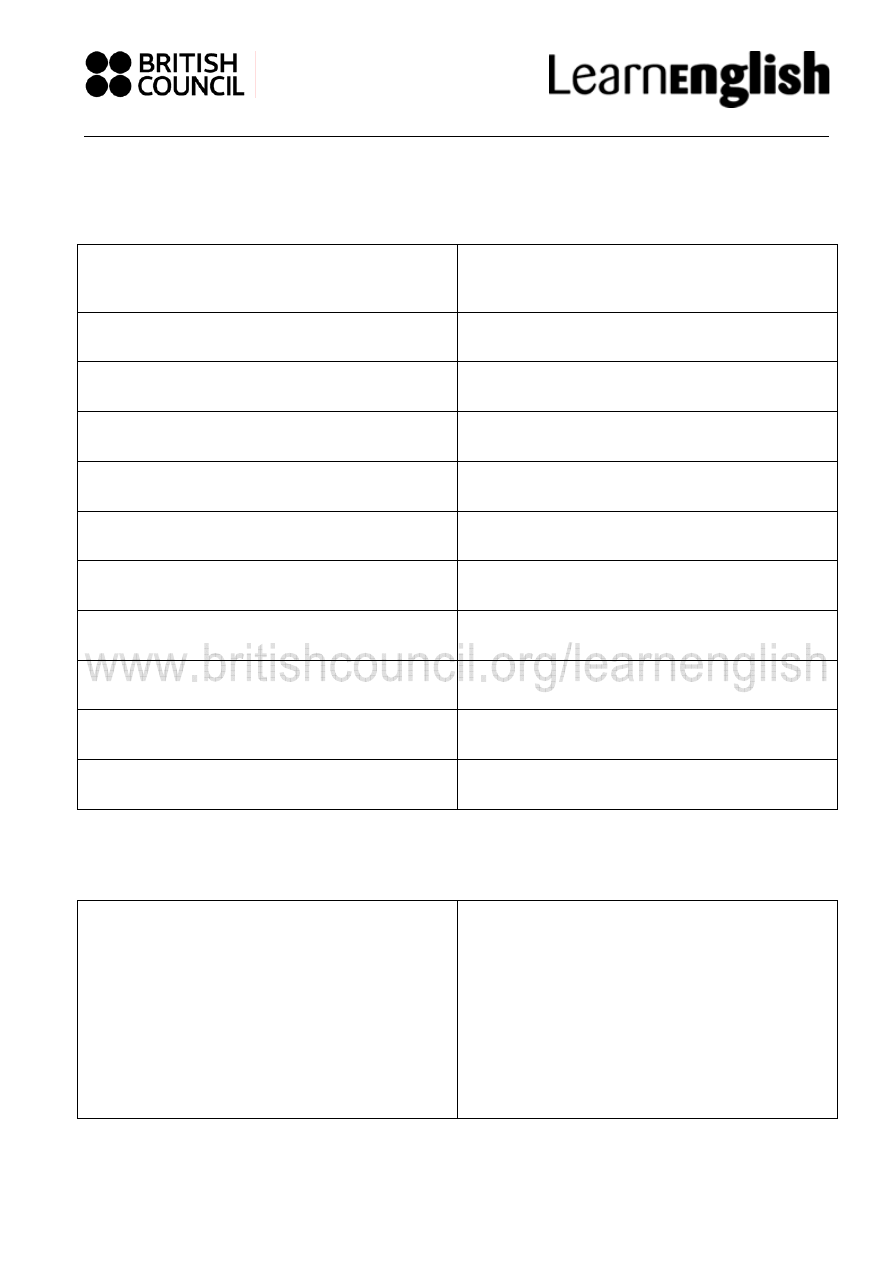
British people normally don't ask for help directly. Look at the table below. The dialogue between
Stella and Dave is a very good example of how to ask for a favour.
1. Person A sends a signal that he/she is going
to ask for help – this gives Person B some time
to prepare what he/she is going to say
I wonder if you could do me a
favour?
2. Person A then says when he/she needs the
favour…
Stella:
Are you doing anything on Friday
after work?
3. …this again allows Person B to say he/she is
busy, or can't help
Dave:
Let me think. Friday? No, I don’t
think so. Why?
4. Person A then explains what help he/she
needs, and asks if Person B will help
Stella:
Well, I need to take a box of books
home for the weekend, and my car’s
in the garage at the moment, and
they’re really heavy. So, do you think
you could give me a lift?
5. Person B says yes or no
Dave:
Sure. No problem.
6. Person A then gives Person B another
opportunity to 'escape' – to say no.
Stella:
You don’t have to, I can get a taxi.
7. Person B says again that he/she will help
Dave:
No, don’t be silly. You’ll never get a
taxi on a Friday evening. I’ll take
you. I’m going in your direction
anyway.
8. Person A thanks Person B…
Thanks a million.
9. … and sometimes offers a 'reward' -
something that Person B will enjoy…
You can come in for a coffee or
something if you’ve got time. You’ve
never seen my flat have you?
10. … and asks Person B to agree
Stella:
Would that be OK?
11. Person B agrees
Dave:
OK, that sounds great. It’s a date.
Section 1 – Exercise 2
Now look at the tapescript for section 1. Ravi is asking Tess to do him a favour. Does the dialogue follow
the same structure as the dialogue between Stella and Dave?
Put the phrases that Ravi and Tess use in the right places in the table below. The answers are on the
answer page at the end of this document.
Ravi: Well, I wanted to ask you about that. What are you doing on Saturday?
Tess: Nothing special. Why?
Ravi: Well, do you think you could help me move some stuff to my new place? Can you spare two or three
hours in the afternoon?
Tess: Yeah, I suppose so.
Ravi: You can say ‘no’ if you want to you know.
Tess: No, it’s OK, I don’t mind.
Elementary Podcast Series 01 Episode 08
page 5 of 23
The United Kingdom’s international organisation for educational opportunities and cultural relations. We are registered in England as a charity.
Ravi: That’s brilliant. Thank you. I’ll tell you what, I’ll make dinner for you at the new flat after we’ve moved
my things. Does that sound OK?
Tess: Ooh. That’ll be lovely, thanks.
Ravi: Great. Have a think about what you want to eat.
1. Person A sends a signal that he/she is going to
ask for help – this gives Person B some time to
prepare what he/she is going to say
1:
2. Person A then says when he/she needs the
favour…
2:
3. …this again allows Person B to say he/she is
busy, or can't help
3:
4. Person A then explains what help he/she needs,
and asks if Person B will help
4:
5. Person B says yes or no
5:
6. Person A then gives Person B another
opportunity to 'escape' – to say no.
6:
7. Person B says again that he/she will help
7:
8. Person A thanks Person B…
8:
9. … and sometimes offers a 'reward' - something
that Person B will enjoy…
9:
10. … and asks Person B to agree
10:
See ‘Answer Page’ for answers
11. Person B agrees
11:
Section 1 – Exercise 2
Now add these phrases to the table above. You can write the phrases or just write the letters of the
phrases in the correct box. There are 2 phrases to add to each box.
a) Ah, yes – I wanted to ask you something
b) Are you busy this evening?
c) Great
idea!
d) I can always ask somebody else.
e) I haven't got any plans. Why?
f) I'd like to buy some plants but I can't carry them
home on the bus. Could you give me a lift?
g) I'll buy you a drink afterwards
h) Is that alright for you?
i) It’s really no trouble at all.
j) It's no problem if you're too busy
k) Let me take you out for dinner as a thank-you
l) I wonder if you could do me a favour?
m) No, don’t worry, that's fine.
n) Not much. Why?
o) Of course I will.
p) Oh thank you so much
q) That's really kind of you, thanks.
r) Well, I'm going to paint my living room, and I'd
really like some help
s) What are you up to on Sunday?
t) What do you say?
u) Yeah, okay. That's fine.
v) You're on! I'd like that.
See ‘Answer Page’ for answers
Elementary Podcast Series 01 Episode 08
page 6 of 23
The United Kingdom’s international organisation for educational opportunities and cultural relations. We are registered in England as a charity.
Section 2: I’d like to meet
You listened to Megan talking about David Attenborough.
Is there a TV presenter that you can write about? It could be someone that you like, or someone that you
don’t like!
Make some notes to answer these questions:
• What’s his/her name?
• Where is he/she from?
• What kind of programmes does he/she present? Reality TV shows? Documentaries? News
programmes? A quiz? A talk show?
• Do you like the programmes? Why / why not?
• Is he/she very popular in your country? And in the rest of the world?
• Why do you like or dislike him/her?
• What do you know about his/her personal life?
Now put your notes together to write a paragraph. If you want, you can send your paragraph to
learnenglishpodcast@britishcouncil.org. You can read the transcript on the next page.
__________________________________________________________________________
__________________________________________________________________________
__________________________________________________________________________
__________________________________________________________________________
__________________________________________________________________________
__________________________________________________________________________
__________________________________________________________________________
__________________________________________________________________________
__________________________________________________________________________
__________________________________________________________________________
__________________________________________________________________________
__________________________________________________________________________
Transcript
Ravi: And joining us today is Megan. Hello Megan. […] OK then Megan, tell us, who would you like to meet?
Megan: I’d like to meet David Attenborough.
Ravi: Great choice. I know who David Attenborough is – I think anyone who watches television in Britain will
know who he is – but maybe you can explain to people who don’t watch television in Britain who David
Attenborough is and what he’s well known for.
Megan: Well actually Ravi, David Attenborough’s wildlife programmes have been seen by more than one billion
people all over the world so I think people will know who he is. They might not know his name but I think they’ll
recognise him. Erm, he’s a TV presenter and he makes programmes about nature and wildlife and the natural
world and they are just fantastic. Erm .. I’ll say the names of some of the programmes in case anyone
recognises them, erm, there was Life on Earth, the Life of Birds, the Blue Planet, Planet Earth – there’s been so
many of them.
Ravi: And what is it about David Attenborough that you like?
Megan: Oh, everything. He’s getting quite old now – he’s over 80 now, but he looks great – he’s got really white
hair. And I love his voice – he just sounds so interested in the animals that he’s talking about and sometimes he
gets really close to them and he’s almost whispering but you can just see how interested and excited he is. I
Elementary Podcast Series 01 Episode 08
page 7 of 23
The United Kingdom’s international organisation for educational opportunities and cultural relations. We are registered in England as a charity.
think the programmes are brilliant. But the other thing is that the programmes are always about the animals not
about him. Y’ know some presenters just talk about themselves all the time. I think his programmes are the best
things on TV.
Ravi: So, you like animals then Megan?
Megan: I love them. I want to be a vet.
Ravi: And what would you say to David Attenborough if you met him?
Megan: Well, I’d like to say "thank you" I think for his programmes and tell him that I think they’ve been really
important in telling people about climate change and global warming and the real things that are happening to
animals because of what people do. I think his programmes have made a lot of people realise the problems
animals have to face. And I’d like to ask him what he thinks will happen in the future, y’know, if it’s too late to
save the planet, kind of thing.
Ravi: Y’know. I think I’d really like to meet David Attenborough as well. I really love those programmes. Do you
know what he said about TV advertisements Megan?
Megan: No?
Ravi: He said he will never do an advertisement on TV. He says if people know you will take money to say you
like something then they can’t trust you anymore or believe what you say.
Megan: Yeah. You really do trust him when you listen to him.
Ravi: Well, thanks Megan – that was great.
Section 3: Quiz
Exercise 1
You heard Amy and Brandon playing a numbers quiz. All of the questions were connected with time. Can
you remember the answers?
1. There are seven d____________ in a w____________
2. There are twelve m____________ in a y____________
3. There are twenty-four h____________ in a d____________
4. There are sixty s____________ in an h____________
5. There are thirty or thirty-one d____________ in a m____________
6. There are sixty m____________ in an h____________
See ‘Answer Page’ for answers
Exercise 2
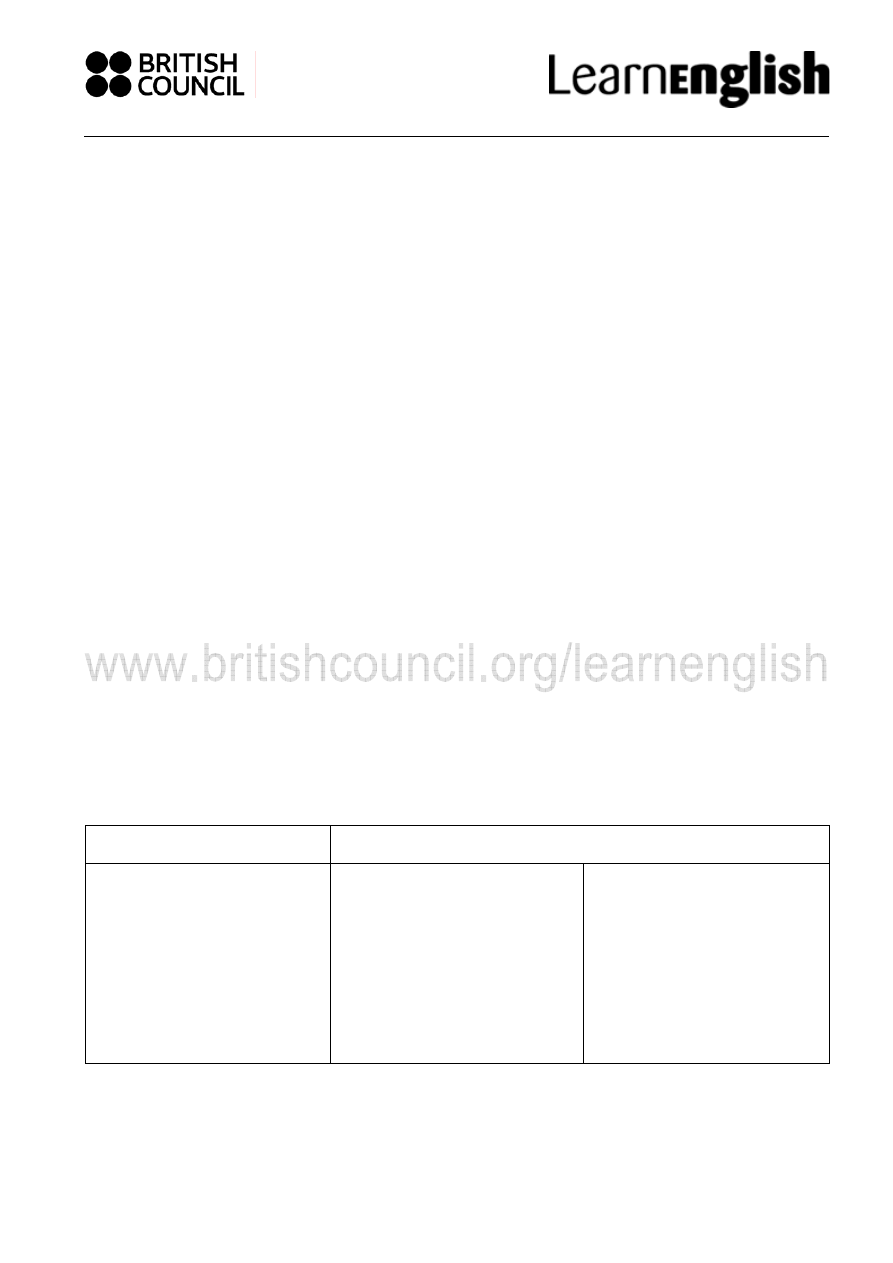
Now fill in the names of the months and the days in the diagram. See ‘Answer Page’ for answers
Days of the week:
Months of the year:
M____________
T____________
W____________
T____________
F____________
S____________
S____________
J____________
F____________
M____________
A____________
M____________
J____________
J____________
A____________
S____________
O____________
N____________
D____________
Elementary Podcast Series 01 Episode 08
page 8 of 23
The United Kingdom’s international organisation for educational opportunities and cultural relations. We are registered in England as a charity.
Section 4: Our person in...
You listened to Bill talking about a Christmas tradition in Prague. Can you say something about Christmas
traditions in your country? Or maybe a different celebration that happens in your culture or religion? Or you
could write about traditions in another country or place that you’ve visited.
Think about these questions:
• What is the celebration?
• When is it? Does it happen at the same time every year?
• Is it a family celebration?
• What do people do before the celebration? What do they buy?
• What do people do on the day(s) of the celebration?
• What do people do after the celebration?
• What do people eat?
• Is there anything that you think is unusual or interesting about what happens?
Now put your ideas together to write a paragraph about a tradition in your country. If you want, you can
send your paragraph to learnenglishpodcast@britishcouncil.org
__________________________________________________________________________
__________________________________________________________________________
__________________________________________________________________________
__________________________________________________________________________
__________________________________________________________________________
__________________________________________________________________________
__________________________________________________________________________
__________________________________________________________________________
__________________________________________________________________________
__________________________________________________________________________
__________________________________________________________________________
Transcript
Bill Steadman is our man in Prague.
Bill: When the huge fish tanks appear outside supermarkets here in Prague you know that it must be almost
Christmas. The tanks are full of carp – the fish traditionally eaten at Christmas here in the Czech Republic and
in other central European countries.
For my first Christmas in the Czech Republic I found this tradition a little strange. Carp isn’t usually eaten in
Britain – it’s a fish that is often full of small bones and the flavour is a little, well, different. But what I found really
strange about the Czech habit of eating carp at Christmas is how they do it.
People usually buy the fish from tanks outside supermarkets and take them home– alive – and put them in the
bath. Spending a few days in clean bath water cleans the carp and makes it taste better when it is eaten on
Christmas Eve. A friend of mine told me that when her son was four years old he asked why they were keeping
the carp in the bath. “To clean it” she told him. Later that day my friend went to look at the carp in the bath and
Elementary Podcast Series 01 Episode 08
page 9 of 23
The United Kingdom’s international organisation for educational opportunities and cultural relations. We are registered in England as a charity.
saw, to her horror, a bath full of bubbles. Her helpful son had added a generous handful of soap powder to the
bath to make sure their carp was lovely and clean. That was one family that didn’t eat carp that year.
All my friends with children tell me that there is one golden rule – never give your carp a name. When Christmas
Eve arrives you’ll find it very difficult to explain to your children why their pet has suddenly disappeared.
Section 5: Your turn
In Your Turn you heard 5 people answer this question: ‘What are the best - and worst – things on TV?’
What about you? What do you think about TV programmes? Do you have strong opinions about
programmes that you like and programmes that you hate? Here are the things that people talked about:
• sport
• reality
shows
• soap operas
• the weather forecast
• nature
documentaries
• films
• action programmes
and here are some more ideas:
• quiz
shows
• talk
shows
• the news
• the weather forecast
• comedy
programmes
• police/crime
series
• historical drama
… and there are lots of other programmes that you can talk think about too!
So, write down what you think are the best – and worst – things on TV . And explain why.
If you want, you can send your paragraph to learnenglishpodcast@britishcouncil.org
__________________________________________________________________________
__________________________________________________________________________
__________________________________________________________________________
__________________________________________________________________________
__________________________________________________________________________
__________________________________________________________________________
__________________________________________________________________________
__________________________________________________________________________
__________________________________________________________________________
__________________________________________________________________________
__________________________________________________________________________
__________________________________________________________________________
Transcript
Tess: Now, let’s move on to Your Turn, the part of our podcast when we find out what you think. This time round
we asked a two part question – what are the best – and worst – things on TV. Let’s hear some answers.
Voice 1: Best thing – sport. I know people complain about it but it’s all I watch, really. Worst thing – reality TV
shows – definitely. There are hundreds of them and they are all completely stupid.
Voice 2: Well, I like soap operas. I watch two or three of them, you know. You really feel like you know the
characters. I’ve watched them for years. What do I always switch off? Probably the weather forecast. It’s never
right so what’s the point in watching it?
Voice 3: I don’t watch much TV but I do like the nature documentaries. I saw one about whales and it was just
amazing. I don’t know how they do it. But apart from that, I don’t know. There’s too much sport on television. I
just turn it off straight away.
Elementary Podcast Series 01 Episode 08
page 10 of 23
The United Kingdom’s international organisation for educational opportunities and cultural relations. We are registered in England as a charity.
Voice 4: I can’t really go to the cinema very often now I’ve got children so I like to watch films on TV. They don’t
have the most recent films but, you know, it’s OK. That’s what I watch mostly. I can’t stand all the sport on TV
though. It never ends!
Voice 5: Erm.. what do I like? Have you seen Silver Fox? I love action programmes like that, you know, exciting
things. It’s better than the news and the political programmes and that. Bo-ring!.
Tess: How about you Ravi. What would you say?
Ravi: Sport, I’m afraid. That’s pretty much all I watch on TV. I watch DVDs most of the time. Let us know what
you think – what are the best – and worst – things on TV?
Section 6: Carolina
Section 6 - Exercise 1
Look at some parts of Carolina’s conversation with her new flatmates. Put the expressions in the right
places.
Here you are.
I’m having Newcastle Brown
I’ll buy a round later.
No, it’s the first time.
What other fruit juices have you
got?
I’ll have a fruit juice
So, same again everybody?
I’ll take the lagers
What are you drinking?
You can give me a hand with the
drinks.
1. Jamie: Haven’t you ever been to a pub before?
Carolina: ____________________________________
2. Jamie: You don’t have to buy a round, not if you don’t want to.
Carolina: Oh… no, that’s OK. ____________________________________
3. Jake: ____________________________________
All: yes, yes please, yep, same again, same for me please.
4. Jake: Carolina? ____________________________________
Carolina: Oh dear I don’t know. What is everyone else having?
5. Carolina: Oh dear I don’t know. What is everyone else having?
Jamie: ____________________________________. It’s a really good beer. From Newcastle of course.
6. Jamie: We call it lager. Would you like one?
Carolina: No, I don’t think so. ____________________________________ – what have they got?
7. Jake: Well, pineapple – that’s what Helen’s drinking, but besides that, I’m not sure. Come up to the bar
with me and we’ll ask. ____________________________________
8. Jake: ____________________________________
Barman: Pineapple, cranberry, mango, apple, and orange.
9. Barman: That’s eleven pounds fifty please.
Jake: ____________________________________
10. Barman: And that’s eight fifty change.
Jake: Thanks. OK, let’s get these back to the table. ____________________________________ – if you
can bring the …..
Elementary Podcast Series 01 Episode 08
page 11 of 23
The United Kingdom’s international organisation for educational opportunities and cultural relations. We are registered in England as a charity.
Section 6 - Exercise 2
Look again at Carolina's conversations. Choose all the phrases that people can say – there is always more
than one correct answer.
1. Jamie: Haven’t you ever been to a pub before?
Carolina: _________________________________
a) No I haven’t
b) No,
never
c) No, it’s the first time.
d) No, I wasn’t
2. Jamie: You don’t have to buy a round, not if you don’t want to.
Carolina: Oh… no, that’s OK. _________________________________ a round later.
a) I can buy
b) I’ll
buy
c) I’m
buying
d) I’ll
get
3. Jake: So, _________________________________
All: yes, yes please, yep, same again, same for me please.
a) same again everybody?
b) does everyone want the same again?
c) do you all want the same again?
d) one more for all?
4. Jake: Carolina? _________________________________
Carolina: Oh dear I don’t know. What is everyone else having?
a) What are you drinking?
b) What would you like to drink?
c) What do you want to drink?
d) What will you drink?
5. Carolina: Oh dear I don’t know. What is everyone else having?
Jamie: _________________________________ Newcastle Brown. It’s a really good beer. From
Newcastle of course.
a) I’m
drinking
b) I’m having
c) I’m
taking
d) I’m
with
6. Jamie: We call it lager. Would you like one?
Carolina: No, I don’t think so. ______________________________ a fruit juice – what have they got?
a) I’d
like
b) I’ll have
c) I
have
d) I’d
prefer
7. Jake: Well, pineapple – that’s what Helen’s drinking, but besides that, I’m not sure. Come up to the bar
with me and we’ll ask. _________________________________
a) You can help me with the drinks
b) You can give me a hand with the drinks.
c) You can carry some of the drinks
d) You can assist me with the drinks
8. Jake:
_________________________________
Barman: Pineapple, cranberry, mango, apple, and orange.
Elementary Podcast Series 01 Episode 08
page 12 of 23
The United Kingdom’s international organisation for educational opportunities and cultural relations. We are registered in England as a charity.
a) What other fruit juices are there?
b) What other fruit juices have you got?
c) What other fruit juices do you have?
d) What more fruit juices can I have?
9. Barman: That’s eleven pounds fifty please.
Jake: _________________________________
a) Here you are
b) There it is
c) Take
this
d) Here’s twelve pounds
10. Barman: And that’s eight fifty change.
Jake: Thanks. OK, let’s get these back to the table. _________________________________ the
lagers –if you can bring the …..
a) I can take
b) I’ll
take
c) I’ll
carry
d) d) I take
Answers: see Answer page at the end of this document
Transcript
Carolina is from Venezuela and she’s come to England to live, study and have fun. She wasn’t having much fun last time
because she had a really bad cold but she’s feeling better now and she’s going out to the pub with some friends.
In the pub
Jamie: Carolina! Hi! We’re over here!
Carolina: Oh hi! I couldn’t see you!
Voice: ... And the man says “I know. It is amazing. He hated
the book”.
Jamie: Come and sit down. There’s a space next to Henry.
Carolina: Excuse me, sorry. Hello Henry.
Henry: Hi.
Jamie: And this is Helen, and Nigel, and Gemma and Jake.
All: hi, hello, hi Carolina etc
Carolina: Hello everybody.
Jake: Right. It’s my round.
Carolina: Round? I don’t understand.
Jamie: Haven’t you ever been to a pub before?
Carolina: No, it’s the first time.
Jamie: We take it in turns to buy a round – that’s what you
do in a pub. Everyone buys a round.
Carolina: But is a round a drink?
Jamie: No. One person buys a drink for everyone at the
table – that’s called a round. Then next time someone else
buys one. Henry bought the first one and now Jake’s buying
the next one, so it’s his round. But you don’t have to…. not
if you don’t want to….if you don’t want a drink or something.
Carolina: Oh… no, that’s OK. I’ll buy a round later.
Jake: So, same again everybody?
All: yes, yes please, yep, same again, same for me please.
Jake: Carolina? What are you drinking?
Carolina: Oh dear I don’t know. What is everyone else
having?
Jamie: I’m having Newcastle Brown. It’s a really good beer.
From Newcastle of course.
Carolina: Ugh! It doesn’t look like the beer I know. It’s very
dark!
Jamie: No, probably not. You probably drink lager – that’s
the pale beer, you know the light coloured one. We call it
lager. Would you like one?
Carolina: No, I don’t think so. I’ll have a fruit juice – what
have they got?
Jake: Well, pineapple – that’s what Helen’s drinking, but
besides that, I’m not sure. Come up to the bar with me and
we’ll ask. You can give me a hand with the drinks. OK, so
that’s two bottles of Newcastle Brown, a pint of lager, a half
of lager, a Diet Coke, a pineapple juice – and whatever
Carolina wants.
At the bar
Jake: So, are you enjoying Newcastle?
Carolina: Yes I am. I haven’t seen much of it yet. I’ve just
started classes and I had a really bad cold for a few days.
But I like what I’ve seen.
Barman: Y’ being served?
Jake: No. Um, two bottles of Newcastle Brown, a pint and a
half of lager, a Diet Coke and a pineapple juice please. And
what other fruit juices have you got?
Barman: Pineapple, cranberry, mango, apple, and orange.
Carolina: Um, mango please.
Jake: And a packet of crisps please – cheese and onion.
Barman: Right you are.
Jake: And how long have you known Jamie?
Carolina: We met on the train coming up from London.
Jake: Well he seems to like you.
Carolina: Oh, does he?, Well I ….
Barman: That’s eleven pounds fifty please.
Jake: Here you are.
Barman: And that’s eight fifty change.
Jake: Thanks. OK, let’s get these back to the table. I’ll take
the lagers –if you can bring the …..
Tess: Oooh. Jamie seems to like Carolina. Well, well.
Ravi: I knew you’d say that. Do you buy rounds if you go to
the pub, Tess?
Tess: I don’t usually. It can be really expensive, can’t it?
Anyway, at least Carolina knows what a round is now. I
don’t really go to the pub much anyway. I prefer to be
outdoors.
Elementary Podcast Series 01 Episode 08
page 13 of 23
The United Kingdom’s international organisation for educational opportunities and cultural relations. We are registered in England as a charity.
Section 7 - The joke
Exercise 1
Read the sentences below, and put them in the right order. You can either cut them up and arrange them,
or write the number in the space on the left. For answers, see the Answer Page transcript.
“A rose” says the other man.
“It’s red – smells nice. Romantic – you give it to people you love on Valentine’s Day. What do you
call it?”
“Now, let me think for a minute. You know that flower?”
“Rose! What was the name of the Indian restaurant we went to last Saturday?”
“The best Indian food I’ve had in ages. Excellent. And really cheap too”.
“Yes! That’s it!” and he shouts into the living room
after dinner the two men were in the kitchen doing the washing up and chatting and
and one couple invited the other for dinner one night.
And the first man says, “Oh gosh. My memory’s terrible.”
And the other man says “Sounds great. I love Indian food. What was the restaurant called?”
One of the men says to the other, “We went to a great restaurant last week – had a fantastic meal.
the two women were in the living room, having a chat.
There were two married couples
They had a lovely meal and
Section 7 - Exercise 2
Now try to tell the joke yourself. Use these words to help you. When you see a slash (/) it means that one
or more words are missing. Then check your answers – the transcript is on the Answer page at the end of
this document.
• There / two married couples and one couple / the other / dinner one night.
• They / meal and after dinner the two men / kitchen doing the washing up and chatting and the two
women / living room, / a chat.
• One of the men / the other, “We / restaurant last week – / a fantastic meal. The best Indian food I /
in ages. Excellent. And really cheap too”.
• And the other man says “Sounds great. I / Indian food. What / called?”
• And the first man says, “Oh gosh. My / terrible. Now, / think for a minute. You know that flower? It’s
red – / nice. Romantic – you / people you / Valentine’s Day. What / call it?”
• “A rose” says the other man.
• “Yes! That’s /!” and he / into the living room, “Rose! What / name / Indian restaurant we /
Saturday?”
Elementary Podcast Series 01 Episode 08
page 14 of 23
The United Kingdom’s international organisation for educational opportunities and cultural relations. We are registered in England as a charity.
Tom the teacher - Exercise 1
Can you remember which prepositions we use with these time phrases? Put the phrases in the right
column. Choose from: ‘in’, ‘on’, ‘at’ or ‘no preposition’.
Christmas
last summer
Saturday
the weekend
tomorrow
Christmas Day
my birthday
the afternoon
this weekend
yesterday
December
next Monday
the summer
three o’clock
the 5
th
April
1990
in
on
at
- (no preposition)
Answers: see Answer page at the end of this document
Tom the teacher - Exercise 2 - Multiple choice
Now put the right preposition in the spaces. Choose from ‘at’, ‘in’, ‘on’, or ‘ – ‘ (no preposition)
1. I’m going to have a holiday __________ September this year.
2. Jane’s coming round for dinner __________ tomorrow.
3. We always go out to an expensive restaurant __________ my birthday.
4. Families often get together __________ Christmas.
5. What are you doing __________ next Sunday?
6. My sister’s birthday is __________ the 25
th
of April.
7. I was born __________ 1983
8. I always do my yoga exercises __________ the morning.
9. I’ve got an important exam __________ Monday.
10. A lot of people get ill __________ the winter.
Answers: see Answer page at the end of this document
Tom the teacher - Exercise 3
You heard Jamie talk about ‘pints’ in the pub with Carolina. British people use the metric system of litres
and kilograms, but they often use old British measurements too. Here are some British measurements that
you might need to understand. Read the definitions and put the words in the right spaces.
a foot (ft or ')
a pint (pt)
a stone(st)
an inch (in or ")
a mile (m)
a pound (lb)
a yard (yd)
1.
People use this for measuring liquids. It’s equal to about half a litre (0.57l). It’s ____________.
2.
This is used to measure distances. It’s equal to 1,609 metres. It’s ____________.
Elementary Podcast Series 01 Episode 08
page 15 of 23
The United Kingdom’s international organisation for educational opportunities and cultural relations. We are registered in England as a charity.
3.
People use this to talk about distance and length. We use this a lot when we talk about how tall
someone is. It’s equal to about 30 centimetres. It’s ____________.
4.
People use this to talk about length and distance too. It’s equal to about 2.5 centimetres. It’s
____________.
5.
People also use this to talk about distance. It’s almost the same as a metre – it’s equal to .9 of a
meter to be precise. It’s ____________.
6.
People use this to talk about how heavy people are - how much they weigh. It’s used a lot more
than kilograms for people’s weight. It’s equal to about 6 kilograms (6.3kg). It’s ____________.
7.
People use this to talk about how heavy people are too. We often use it for food too. It’s equal
to about half a kilogram (0.45kg). It’s ____________.
Answers: see Answer page at the end of this document
Elementary Podcast Series 01 Episode 08
page 16 of 23
The United Kingdom’s international organisation for educational opportunities and cultural relations. We are registered in England as a charity.
Answers
While you listen – Answers
1) a,b,d; 2) a,b,c; 3) a; 4) a,b,c; 5) a,c,d; 6) d; 7) d;
8) b.
Section 1 – “I wanted to ask you something” – asking
for a favour
Stella: I wonder if you could do me a favour? Are you
doing anything on Friday after work?
Dave: Let me think. Friday? No, I don’t think so. Why?
Stella: Well, I need to take a box of books home for the
weekend, and my car’s in the garage at the moment, and
they’re really heavy. So, do you think you could give me
a lift?
Dave: Sure. No problem.
Stella: You don’t have to, I can get a taxi.
Dave: No, don’t be silly. You’ll never get a taxi on a
Friday evening. I’ll take you. I’m going in your direction
anyway.
Stella: Thanks a million. You can come in for a coffee or
something if you’ve got time. You’ve never seen my flat
have you?
Dave: No, never, but I’d like to. I’ve heard a lot about it. OK,
that sounds great. It’s a date.
Section 1: Exercise 2
1) Ravi: Well, I wanted to ask you about that.
2) Ravi: What are you doing on Saturday?
3) Tess: Nothing special? Why?
4) Ravi: Well, do you think you could help me move some
stuff to my new place? Can you spare two or three hours in
the afternoon?
5) Tess: Yeah, I suppose so.
6) Ravi: You can say ‘no’ if you want to you know.
7) Tess: No, it’s OK, I don’t mind.
8) Ravi: That’s brilliant. Thank you.
9) Ravi: I’ll tell you what, I’ll make dinner for you at the new
flat after we’ve moved my things.
10) Ravi: Does that sound OK?
11) Tess: Ooh. That’ll be lovely, thanks.
Section 1: Exercise 3
Box 1: a) Ah, yes – I wanted to ask you something &
l) I wonder if you could do me a favour? Box 2: b) Are
you busy this evening? & s) What are you up to on
Sunday? Box 3: e) I haven't got any plans. Why? & n)
Not much. Why? Box 4: f) I'd like to buy some plants
but I can't carry them home on the bus. Could you
give me a lift? & r) Well, I'm going to paint my living
room, and I'd really like some help. Box 5: o) Of
course I will. & u) Yeah, okay. That's fine. Box 6: d) I
can always ask somebody else. & j) It's no problem if
you're too busy. Box 7: i) It’s really no trouble at all. &
m) No, don’t worry, that's fine. Box 8: p) Oh thank you
so much & q) That's really kind of you, thanks. Box 9:
g) I'll buy you a drink afterwards & k) Let me take you
out for dinner as a thank-you. Box 10: h) Is that
alright for you? & t) What do you say? Box 11: c)
Great idea! & v) You're on! I’d like that.
Section 3: Quiz – Exercise 1 - Answers
1. There are seven days in a week.
2. There are twelve months in a year
3. There are twenty-four hours in a day
4. There are sixty seconds in an hour
5. There are thirty or thirty-one days in a month
6. There are sixty minutes in an hour
Section 3: Quiz – Exercise 1 - Answers
Days: Monday, Tuesday, Wednesday, Thursday, Friday;
Saturday; Sunday. Months: January, February, March,
April, May, June, July, August, September, October,
November, December.
Section 6: Carolina - Exercise 1 - Answers
1) No, it’s the first time. 2) I’ll buy a round later. 3) So, same
again everybody? 4) What are you drinking? 5) I’m having
Newcastle Brown 6) I’ll have a fruit juice 7) You can give me
a hand with the drinks. 8) What other fruit juices have you
got? 9) Here you are. 10) I’ll take the lagers
Section 6: Carolina - Exercise 2 - Answers
1) a,b,c; 2) a,b,d; 3) a,b,c; 4) a,b,c; 5) a,b; 6) a,b,d;
7) a,b,c; 8) a,b,c; 9) a,b,d; 10) a,b,c.
Section 7: the Joke: transcript
Gordon: OK then. There were these two married couples,
OK? And one couple invited the other for dinner one night.
So, they have a lovely meal and after dinner the two men
were in the kitchen doing the washing up and chatting and
the two women were in the living room, having a chat.
One of the men says to the other, “We went to a great
restaurant last week – had a fantastic meal. The best Indian
food I’ve had in ages. Excellent. And really cheap too”.
And the other man says “Sounds great. I love Indian food.
What was the restaurant called?”
And the first man says, “Oh gosh. My memory’s terrible.
Now, let me think for a minute. You know that flower? It’s
red – smells nice. Romantic – you give it to people you love
on Valentine’s Day. What do you call it?”
“A rose” says the other man.
“Yes! That’s it!” and he shouts into the living room, “Rose!
What was the name of the Indian restaurant we went to last
Saturday?”
Tom the teacher - Exercise 1 - Answers
in: December, the summer, 1990, the afternoon. at: three
o’clock, the weekend, Christmas. on: Saturday, the 5
th
April,
my birthday, Christmas Day. no prep: tomorrow, yesterday,
last summer, next Monday, this weekend.
Tom the teacher – Exercise 2 - Answers
1) in; 2) –; 3) on; 4) at; 5) –; 6) on; 7) in; 8) in; 9) on;
10) in.
Tom the teacher - Exercise 3 - Answers
1) a pint; 2) a mile; 3) a foot; 4) an inch; 5) a yard;
6) a stone; 7) a pound.
Elementary Podcast Series 01 Episode 08
page 17 of 23
The United Kingdom’s international organisation for educational opportunities and cultural relations. We are registered in England as a charity.
Transcript
Download the LearnEnglish Elementary podcast.
You’ll find all the details on this page:
http://www.learnenglish.britishcouncil.org/elemen
tary-podcasts
Section 1 – “I wanted to ask you something”
– asking for a favour
Tess: Hello again and welcome to the
LearnEnglish Elementary podcast number eight.
I’m Tess, from London.
Ravi: And I’m Ravi, from Manchester. You’re
looking great as usual Tess, how are you?
Tess: Thanks, Ravi. I’m very well thanks. How
are you?
Ravi: I’m fine thanks. Actually, I’m very well. You
know I told you I was looking for a new flat?
Tess: Yes.
Ravi: Well, I found a new place over on Carswell
Road – near the swimming pool. It’s really nice.
Much bigger than the one I’m in now.
Tess: What’s the rent like?
Ravi: Well, it is quite expensive, quite a bit more
than I pay now. But it’s a lot nicer.
Tess: Great. When are you moving.
Ravi: Well, I wanted to ask you about that. What
are you doing on Saturday?
Tess: Nothing special. Why?
Ravi: Well, do you think you could help me move
some stuff to my new place? Can you spare two
or three hours in the afternoon?
Tess: Yeah, I suppose so.
Ravi: You can say ‘no’ if you want to you know.
Tess: No, it’s OK, I don’t mind.
Ravi: That’s brilliant. Thank you. I’ll tell you what,
I’ll make dinner for you at the new flat after we’ve
moved my things. Does that sound OK?
Tess: Ooh. That’ll be lovely, thanks.
Ravi: Great. Have a think about what you want to
eat. Right. Well, we’d better get on. Lots of things
for you, as usual. We’ve got Gordon – hello
Gordon
Gordon: Hello
Ravi: Gordon’s our producer and king of the bad
jokes. We’ve got the quiz, we’ve got fish in the
bath we’ve got good and bad TV but first of all
we’ve got I’d Like to Meet.
Section 2 – I’d like to meet
Ravi: And joining us today is Megan. Hello
Megan.
Megan: Hi Ravi.
Ravi: Where are you today Megan?
Megan: I’m at home. In Reading.
Ravi: Oh yeah, I know it. Do you like it?
Megan: It’s OK. I quite like it, yeah.
Ravi: OK then Megan, tell us, who would you like
to meet?
Megan: I’d like to meet David Attenborough.
Ravi: Great choice. I know who David
Attenborough is – I think anyone who watches
television in Britain will know who he is – but
maybe you can explain to people who don’t
watch television in Britain who David
Attenborough is and what he’s well known for.
Megan: Well actually Ravi, David Attenborough’s
wildlife programmes have been seen by more
than one billion people all over the world so I
think people will know who he is. They might not
know his name but I think they’ll recognise him.
Erm, he’s a TV presenter and he makes
programmes about nature and wildlife and the
natural world and they are just fantastic. Erm .. I’ll
say the names of some of the programmes in
case anyone recognises them, erm, there was
Life on Earth, the Life of Birds, the Blue Planet,
Planet Earth – there’s been so many of them.
Ravi: And what is it about David Attenborough
that you like?
Megan: Oh, everything. He’s getting quite old
now – he’s over 80 now, but he looks great –
he’s got really white hair. And I love his voice –
he just sounds so interested in the animals that
he’s talking about and sometimes he gets really
close to them and he’s almost whispering but you
can just see how interested and excited he is. I
think the programmes are brilliant. But the other
thing is that the programmes are always about
the animals not about him. Y’ know some
presenters just talk about themselves all the time.
I think his programmes are the best things on TV.
Ravi: So, you like animals then Megan?
Megan: I love them. I want to be a vet.
Ravi: And what would you say to David
Attenborough if you met him?
Megan: Well, I’d like to say "thank you" I think for
his programmes and tell him that I think they’ve
been really important in telling people about
climate change and global warming and the real
things that are happening to animals because of
what people do. I think his programmes have
Elementary Podcast Series 01 Episode 08
page 18 of 23
The United Kingdom’s international organisation for educational opportunities and cultural relations. We are registered in England as a charity.
made a lot of people realise the problems
animals have to face. And I’d like to ask him what
he thinks will happen in the future, y’know, if it’s
too late to save the planet, kind of thing.
Ravi: Y’know. I think I’d really like to meet David
Attenborough as well. I really love those
programmes. Do you know what he said about
TV advertisements Megan?
Megan: No?
Ravi: He said he will never do an advertisement
on TV. He says if people know you will take
money to say you like something then they can’t
trust you anymore or believe what you say.
Megan: Yeah. You really do trust him when you
listen to him.
Ravi: Well, thanks Megan – that was great. And
remember that we’re always happy to hear from
you so if you’d like to tell us about a TV presenter
in your country you can send it to us at
learnenglishpodcast@britishcouncil.org, that’s
learnenglish - all one word - at- britishcouncil – all
one word DOT org, that’s o-r-g.
Section 3 – Quiz
Tess: OK now. It’s time for our quiz, as usual.
Our players this time are Amy. Hi Amy.
Amy: (on phone) Hello
Tess: And Brandon. Hello Brandon.
Brandon: (on phone) Hi Tess.
Tess: Let’s start with you Amy. Where are you
calling from?
Amy: From Leeds. I’m from Yorkshire.
Tess: And what do you do?
Amy: I’m studying to be a nurse. I’ve just started.
Tess: Oh. Are you enjoying it?
Amy: Yeah, it’s great so far.
Tess: OK. Great. Now how about you Brandon.
Where are you calling from?
Brandon: I’m in Penzance in Cornwall.
Tess: Wow – the very tip of the country. I used to
go to Cornwall on holiday when I was a kid.
Brandon: We still get loads of holidaymakers
every year.
Tess: Well, it’s such a beautiful area. Anyway,
we’ve got a new quiz for you this time – a
numbers quiz. How are you with numbers Amy?
Amy: Well, I’ll do my best.
Tess: OK. Here’s what you have to do. You’re
going to work together to answer some riddles.
I’ll give you an example. There are 7 D in a W.
Can you tell me what the ‘D’ and the ‘W’ stand
for?
Brandon: Is it 7 days in a week?
Tess: OK, so you get the idea. Now, either of you
can answer and if, together, you can get five
correct answers, you both win a prize. OK you
two?
Brandon & Amy: OK / Yes
Tess: So, here’s the first one. There are twelve M
in a Y.
Amy: Twelve months in a year?
Tess: Well done! One out of one. Next one.
Twenty-four H in a D.
Brandon: Twenty-four hours in a day.
Tess: That’s it. Two out of two. Three more to
get. Next one. Sixty S in an M.
Brandon: It’s sixty seconds in a minute, isn’t it?
Tess: It is. Two more to get. Normally, there are
30 or 31 D in an M.
Amy: Days in a month?
Tess: Right! Four out of four. One more to get.
Sixty M in an H.
Brandon: Sixty minutes in an hour!
Tess: Yes Well done you two! Five out of five.
OK – you’ve both won a book token and we’ll be
sending them to you very soon. Thanks for
playing – and well done. Ravi – I’ve got one for
you. Eleven P in an F T.
Ravi: Easy. Eleven players in a football team.
Good game though. Remember if you’re listening
that you can send your ideas for games we can
play to learnenglishpodcast@britishcouncil.org.
Section 4 – Our person in
Ravi:
OK. Time now for Our Person In. At the start of
the podcast I promised you fish in the bath – and
here they come. Bill Steadman is our man in
Prague.
Bill: When the huge fish tanks appear outside
supermarkets here in Prague you know that it
must be almost Christmas. The tanks are full of
carp – the fish traditionally eaten at Christmas
here in the Czech Republic and in other central
European countries.
For my first Christmas in the Czech Republic I
found this tradition a little strange. Carp isn’t
usually eaten in Britain – it’s a fish that is often
full of small bones and the flavour is a little, well,
different. But what I found really strange about
the Czech habit of eating carp at Christmas is
how they do it.
Elementary Podcast Series 01 Episode 08
page 19 of 23
The United Kingdom’s international organisation for educational opportunities and cultural relations. We are registered in England as a charity.
People usually buy the fish from tanks outside
supermarkets and take them home– alive – and
put them in the bath. Spending a few days in
clean bath water cleans the carp and makes it
taste better when it is eaten on Christmas Eve. A
friend of mine told me that when her son was
four years old he asked why they were keeping
the carp in the bath. “To clean it” she told him.
Later that day my friend went to look at the carp
in the bath and saw, to her horror, a bath full of
bubbles. Her helpful son had added a generous
handful of soap powder to the bath to make sure
their carp was lovely and clean. That was one
family that didn’t eat carp that year.
All my friends with children tell me that there is
one golden rule – never give your carp a name.
When Christmas Eve arrives you’ll find it very
difficult to explain to your children why their pet
has suddenly disappeared.
Tess: Ahh. So the poor children think they’ve got
a fish as a pet and then it disappears and they
have to eat it for Christmas. Poor things.
Ravi: What I want to know is how do they have a
bath when the fish is in the bath? Do they just
have a bath with the fish? Very strange. But
anyway, if any of you has something interesting
to tell us about what you eat at festivals in your
country then write and let us know. The address
is learnenglishpodcast@britishcouncil.org.
Section 5 – Your turn
Tess: Now, let’s move on to Your Turn, the part
of our podcast when we find out what you think.
This time round we asked a two part question –
what are the best – and worst – things on TV.
Let’s hear some answers.
Voice 1: Best thing – sport. I know people
complain about it but it’s all I watch, really. Worst
thing – reality TV shows – definitely. There are
hundreds of them and they are all completely
stupid.
Voice 2: Well, I like soap operas. I watch two or
three of them, you know. You really feel like you
know the characters. I’ve watched them for
years. What do I always switch off? Probably the
weather forecast. It’s never right so what’s the
point in watching it?
Voice 3: I don’t watch much TV but I do like the
nature documentaries. I saw one about whales
and it was just amazing. I don’t know how they
do it. But apart from that, I don’t know. There’s
too much sport on television. I just turn it off
straight away.
Voice 4: I can’t really go to the cinema very often
now I’ve got children so I like to watch films on
TV. They don’t have the most recent films but,
you know, it’s OK. That’s what I watch mostly. I
can’t stand all the sport on TV though. It never
ends!
Voice 5: Erm.. what do I like? Have you seen
Silver Fox? I love action programmes like that,
you know, exciting things. It’s better than the
news and the political programmes and that. Bo-
ring!.
Tess: How about you Ravi. What would you say?
Ravi: Sport, I’m afraid. That’s pretty much all I
watch on TV. I watch DVDs most of the time. Let
us know what you think – what are the best –
and worst – things on TV? Send your answers to
learnenglishpodcast@britishcouncil.org.
Section 6 – Carolina
Ravi:
OK. It’s time now to catch up with Carolina.
Carolina, you’ll remember, is from Venezuela and
she’s come to England to live, study and have
fun. She wasn’t having much fun last time
because she had a really bad cold but she’s
feeling better now and she’s going out to the pub
with some friends.
In the pub
Jamie: Carolina! Hi! We’re over here!
Carolina: Oh hi! I couldn’t see you!
Voice: ... And the man says “I know. It is
amazing. He hated the book”.
Jamie: Come and sit down. There’s a space next
to Henry.
Carolina: Excuse me, sorry. Hello Henry.
Henry: Hi.
Jamie: And this is Helen, and Nigel, and Gemma
and Jake.
All: hi, hello, hi Carolina etc
Elementary Podcast Series 01 Episode 08
page 20 of 23
The United Kingdom’s international organisation for educational opportunities and cultural relations. We are registered in England as a charity.
Carolina: Hello everybody.
Jake: Right. It’s my round.
Carolina: Round? I don’t understand.
Jamie: Haven’t you ever been to a pub before?
Carolina: No, it’s the first time.
Jamie: We take it in turns to buy a round – that’s
what you do in a pub. Everyone buys a round.
Carolina: But is a round a drink?
Jamie: No. One person buys a drink for everyone
at the table – that’s called a round. Then next
time someone else buys one. Henry bought the
first one and now Jake’s buying the next one, so
it’s his round. But you don’t have to…. not if you
don’t want to….if you don’t want a drink or
something.
Carolina: Oh… no, that’s OK. I’ll buy a round
later.
Jake: So, same again everybody?
All: yes, yes please, yep, same again, same for
me please.
Jake: Carolina? What are you drinking?
Carolina: Oh dear I don’t know. What is everyone
else having?
Jamie: I’m having Newcastle Brown. It’s a really
good beer. From Newcastle of course.
Carolina: Ugh! It doesn’t look like the beer I
know. It’s very dark!
Jamie: No, probably not. You probably drink
lager – that’s the pale beer, you know the light
coloured one. We call it lager. Would you like
one?
Carolina: No, I don’t think so. I’ll have a fruit juice
– what have they got?
Jake: Well, pineapple – that’s what Helen’s
drinking, but besides that, I’m not sure. Come up
to the bar with me and we’ll ask. You can give
me a hand with the drinks. OK, so that’s two
bottles of Newcastle Brown, a pint of lager, a half
of lager, a Diet Coke, a pineapple juice – and
whatever Carolina wants.
At the bar
Jake: So, are you enjoying Newcastle?
Carolina: Yes I am. I haven’t seen much of it yet.
I’ve just started classes and I had a really bad
cold for a few days. But I like what I’ve seen.
Barman: Y’ being served?
Jake: No. Um, two bottles of Newcastle Brown, a
pint and a half of lager, a Diet Coke and a
pineapple juice please. And what other fruit
juices have you got?
Barman: Pineapple, cranberry, mango, apple,
and orange.
Carolina: Um, mango please.
Jake: And a packet of crisps please – cheese
and onion.
Barman: Right you are.
Jake: And how long have you known Jamie?
Carolina: We met on the train coming up from
London.
Jake: Well he seems to like you.
Carolina: Oh, does he?, Well I ….
Barman: That’s eleven pounds fifty please.
Jake: Here you are.
Barman: And that’s eight fifty change.
Jake: Thanks. OK, let’s get these back to the
table. I’ll take the lagers –if you can bring the …..
Tess: Oooh. Jamie seems to like Carolina. Well,
well.
Ravi: I knew you’d say that. Do you buy rounds if
you go to the pub, Tess?
Tess: I don’t usually. It can be really expensive,
can’t it? Anyway, at least Carolina knows what a
round is now. I don’t really go to the pub much
anyway. I prefer to be outdoors.
Ravi: Gordon. I bet you’re often in the pub.
Surrounded by people laughing at your jokes.
Gordon: That’s right Ravi.
Section 7 – The Joke
Ravi: Is it time for your joke now? Come on then.
I hope it’s a good one.
Gordon: They’re all good, Ravi. Ready for it?
Ravi: Go on.
Gordon: OK then. There were these two married
couples, OK? And one couple invited the other
for dinner one night. So, they have a lovely meal
and after dinner the two men were in the kitchen
doing the washing up and chatting and the two
women were in the living room, having a chat.
One of the men says to the other, “We went to a
great restaurant last week – had a fantastic meal.
The best Indian food I’ve had in ages. Excellent.
And really cheap too”.
And the other man says “Sounds great. I love
Indian food. What was the restaurant called?”
Elementary Podcast Series 01 Episode 08
page 21 of 23
The United Kingdom’s international organisation for educational opportunities and cultural relations. We are registered in England as a charity.
And the first man says, “Oh gosh. My memory’s
terrible. Now, let me think for a minute. You know
that flower? It’s red – smells nice. Romantic –
you give it to people you love on Valentine’s Day.
What do you call it?”
“A rose” says the other man.
“Yes! That’s it!” and he shouts into the living
room, “Rose! What was the name of the Indian
restaurant we went to last Saturday?”
Tess: My dad’s like that. His memory’s awful.
Ravi: Yeah, mine too. Actually I forget things as
well. Thanks for the joke …erm … what’s his
name again?
Tess: Very funny Ravi. Thanks Gordon. And
that’s all from us for today but don’t go away
because our English teacher, Tom, will be here
in a little while talking about what you heard and
ways to help you learn. So, it’s goodbye from me
and Ravi …
Ravi: Bye
Tess: … but don’t go away and keep sending
your emails to
learnenglishpodcast@britishcouncil.org. Bye!
Tom the teacher
Tom: Hi, my name’s Tom. At the end of every
podcast, I talk about some of the language that
you heard, and some ways to help you learn
English.
Today I want to talk about prepositions – words
like ‘on’, ‘at’ and ‘in’. It’s very difficult for learners
to use these words correctly in English. We use
prepositions all the time – in lots of different
ways. But today I’m only going to talk about one
situation – using prepositions in time phrases –
with words like ‘Saturday’, ‘Christmas’ or
‘December’.
Listen to Ravi. Which preposition does he use
before ‘Saturday’?
Ravi
Well, I wanted to ask you about that. What are
you doing on Saturday?
Tom: That’s right – he uses ‘on’. We say ‘on
Saturday’ – or ‘on’ any other day of the week.
‘On Sunday’, ‘on Monday’, ‘on Tuesday’ – all of
the days. Now listen to part of Gordon’s joke. The
man in the joke is trying to explain what a ‘rose’
is. Listen to the preposition with ‘Valentine’s
Day’.
Gordon: Romantic – you give it to people you
love on Valentine’s Day.
Tom: He said ‘on Valentine’s Day’. Valentine’s
Day isn’t a day of the week, but it is a day – a
single day. So we use ‘on’ again. Now listen to
one more. This is Bill in Prague talking about the
fish that they eat. Listen for the time phrase.
Bill: Spending a few days in clean bath water
cleans the carp and makes it taste better when it
is eaten on Christmas Eve.
Tom: Yes, it was ‘on’ again. He said "on
Christmas Eve". Can you guess why? Christmas
Eve is what we call the day before Christmas day
– the 24
th
of December. So, Christmas Eve is a
single day. So we use ‘on’. So – when we’re
talking about a single day, we use ‘on’. We can
say "on my birthday" or "on the first of
December" or "on the day I met you".
And we use it for dates too – because they’re
single days – 'on the first of January’, ‘on the
twenty-fifth of April’, ‘on the tenth of July’. There’s
just one more thing I need to tell you about using
(or not using!) ‘on’ in time phrases. Listen to this
line from Gordon’s joke.
Gordon: What was the name of the Indian
restaurant we went to last Saturday?
Tom: Hmm. He said "last Saturday" – he didn’t
use ‘on’. The reason is simple. We don’t use a
preposition when we use ‘last’. We just say ‘last
Saturday’. No ‘on’. And it’s the same with ‘next’
and ‘this. We just say "What are you doing next
Saturday?" or "Let’s have dinner this Saturday".
No ‘on’. So now you know how to use ‘on’ in time
phrases!
In other time phrases we might use ‘at’ or ‘in’ –
for example we say "at the weekend" or "at
Christmas", and we say "in December" or "in the
afternoon". It’s quite difficult to remember them
all. But if you can remember that we use ‘on’ for
single days, it will make life a lot easier for you!
Elementary Podcast Series 01 Episode 08
page 22 of 23
The United Kingdom’s international organisation for educational opportunities and cultural relations. We are registered in England as a charity.
People often make mistakes with prepositions
because they aren’t thinking in English. They
think in their own language and then translate the
words into English. And that’s when they make
mistakes – and not only with prepositions – with
lots of different things.
When you’re writing you have time to think – you
can look at grammar books, or your notebook, for
help. But speaking is different – you often don’t
have time to think. If you want to speak English
well – you have to start trying to think in English.
You can do this with practise. Look at things that
you see around you – at home or in the street
and say the words in English. You can say them
out loud if you’re alone – if not just think them.
Then start trying to say or think sentences – ‘I’m
going to the kitchen now. I’m going to make my
lunch’. Talk to yourself about what you’re doing
in English – out loud or in your head. Try to do
this for a short time at first – then you can
increase the time. Try to do it for an hour every
day – it will soon get easier. And your brain will
learn to think in English. Try it. I’m sure you’ll
notice the difference after a while.
And now for something different. In this podcast
we heard Carolina meeting some people in a
pub. She learnt a new word. Listen.
Carolina: But is a round a drink?
Jamie: No. One person buys a drink for everyone
at the table – that’s called a round. Then next
time someone else buys one. Henry bought the
first one and now Jake’s buying the next one, so
it’s his round. But you don’t have to…. not if you
don’t want to….if you don’t want a drink or
something.
Tom: Pubs are a big part of British culture. British
people often go to the pub, and you will often be
invited to go too. This doesn’t mean that you
have to drink alcohol. You can drink lots of
different things in a pub – and you can do a lot of
different things too. You can have a meal for
example. A lot of pubs serve very good food – at
lunchtime or in the evening – and it’s usually
cheaper than eating in a restaurant. A lot of pubs
have live music, or maybe karaoke evenings.
Another popular thing is a pub quiz. Teams of
people try to answer questions to win a prize.
That’s a good way to practise your English! So,
it’s good to know some phrases in English that
you need to use in a pub. In this podcast
Carolina learnt what ‘to buy a round’ means. Now
listen to Jake. Can you understand all of the
drinks that he’s going to buy?
Jake: Come up to the bar with me and we’ll ask.
You can give me a hand with the drinks. OK, so
that’s two bottles of Newcastle Brown, a pint of
lager, a half of lager, a Diet Coke, a pineapple
juice – and whatever Carolina wants.
Tom: The word ‘pint’ is probably new for you.
Jake is going to buy a pint of lager. ‘A pint’ is a
British measurement – it’s a little bit more than
half a litre – point five seven of a litre in fact. We
use it informally to mean a pint of beer. And ‘a
half’ means half a pint of beer – so that’s more or
less a quarter of a litre. Now one more useful
phrase. Listen.
Jake: So, same again everybody?
All: yes, yes please, yep, same again, same for
me please
Tom: You’ll hear ‘same again’ a lot in the pub,
especially when people are buying rounds. It
means ‘another of the same drink that you had
before’. If someone says “What would you like to
drink?” you can say ”Same again please”.
Now, just before I go, I noticed a useful phrase
that you can try and use this week. It’s a phrase
that means ‘I’m sure’. Listen and see if you can
hear it.
Ravi: Gordon. I bet you’re often in the pub.
Surrounded by people laughing at your jokes.
Gordon: That’s right Ravi.
Tom: The phrase is ‘I bet’. We use it informally
and it means ‘I’m sure’. For example, we can say
"I bet it’s going to rain tomorrow" or "I bet Ana
forgot her homework again". Try and use ‘I bet’ in
your conversations in English.
OK. That’s all from me today. I’ll talk to you all
again on the next podcast. Remember you can
send your questions to me at
learnenglishpodcast@britishcouncil.org. I’ll be
happy to answer your questions! Or write to me
about any interesting language that you noticed.
In a moment you’ll hear the address for the
Elementary Podcast Series 01 Episode 08
page 23 of 23
The United Kingdom’s international organisation for educational opportunities and cultural relations. We are registered in England as a charity.
website where you can read everything you’ve
heard in this podcast. So bye for now! See you
next time.
Wyszukiwarka
Podobne podstrony:
S01E02 Transkrypcja pytania
S01E09 Transkrypcja pytania
S01E01 Transkrypcja pytania
S01E10 Transkrypcja pytania
S01E06 Transkrypcja pytania
S01E04 Transkrypcja pytania
S01E08 Transkrypcja
S01E07 Transkrypcja pytania
S01E03 Transkrypcja pytania
S01E05 Transkrypcja pytania
Magdalena Zamorska Transkulturowość Buto Japonia, Welsch i pytania o tożsamość
Mechanika Semest I pytania egz
prelekcja ZUM z pytaniami
pytania przykladowe exam zaoczne(1)
BM6 Transkrypcja
pytania nowe komplet
Pytania egzaminacyjneIM
więcej podobnych podstron