42
EQUINE WOUND MANAGEMENT
timely fashion. This implies that infl ammation should initially be stimulated and later on be inhibited. In fact,
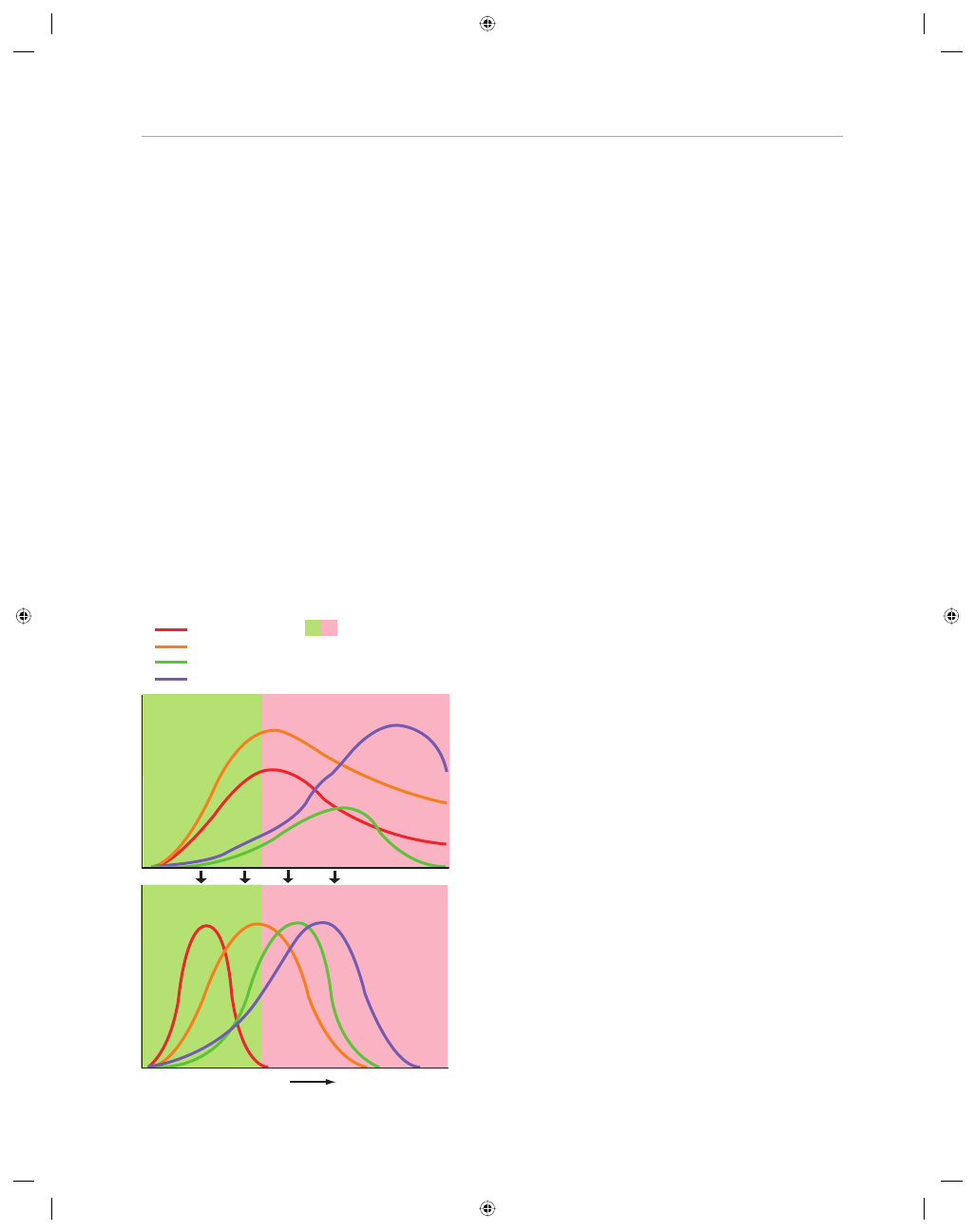
we should aim to model the course of the infl ammatory response in a horse wound to a more “pony-like course”
(Figure 1.22).
Roughly speaking, this means that infl ammation should be encouraged until the wound is fi lled with
granulation tissue, and that it should be inhibited from that point onward to reduce the formation of EGT and
facilitate contraction and epithelialization. By modulating the infl ammatory response, the successive phases of
the healing process will simultaneously be infl uenced. The initial enhancement of infl ammation will also boost
the formation of granulation tissue and the initial impetus to wound contraction, whereas the preclusion of
chronic infl ammation will benefi t both wound contraction and epithelialization (for more details see Chapter
8). Therefore, treatment of wounds healing by second intention can be simplifi ed by focusing on the infl amma-
tory phase and can be subdivided in either stimulation or inhibition of the infl ammatory response.
Stimulation of the Infl ammatory Response
The initial infl ammatory response in horses should be encouraged and in no manner be limited. Simultane-
ously, the formation of granulation tissue will be enhanced, which is desirable until the wound cavity has fi lled
in. First, the need for infl ammation and the risk of infection can be reduced by surgical debridement, regardless
of whether a wound is to be sutured. Surgical debridement is required when necrosis, exposed cortical bone,
or frayed tendons are present in the wound of a horse because cellular debridement, by the infl ammatory
response, is slow in horses.
Furthermore, it is advisable to bandage the wound with interactive dressings or topical gels that increase
infl ammation and stimulate healing.
42
Solcoseryl
®
(Solco Basle Ltd., Birsfelden, Switzerland) was proven experi-
mentally to stimulate infl ammation in the wounds of horses.
43
A gel containing activated platelets (Lacerum
®
,
BeluMedX, Little Rock, AK) may also be expected to do this,
44,45
as should alginate dressings, acemannan-
Time
Horse wounds
Pony wounds
Inflammatory phase
Formation of granulation tissue
Wound contraction
Epithelialization
+
_
Figure 1.22. Schematic representation of the wound healing phases
in horses. Infl ammation should initially be stimulated (green shaded
area) until the wound is fi lled with granulation tissue, and thereafter
be arrested (pink shaded area) to reduce the formation of exuberant
granulation tissue and facilitate contraction and epithelialization. In
fact, we should aim to treat horse wounds in such a way that the
pattern of healing will resemble that of ponies.
Wyszukiwarka
Podobne podstrony:
00056, 0175013cc64ee78507084900af84e387
CCF20091215 00056
00056, 73a9522fa7d543de3e60eee8d1a9c1d5
00056, 8f73580b15374c74c00f1a3181db9d66
00056, d0d36194cc485b89242f68137083e792
00056, 4b1f5cfdc69be17a3e3cffb70b7fe870
00056, b245dbd0cbbc0081cec2260716ec0875
00056, 0175013cc64ee78507084900af84e387
CCF20091215 00056
00056, b245dbd0cbbc0081cec2260716ec0875
00056, 07f3f4bc194f8357ffb8651692e4431a
CCF20091215 00056
00056, 0675507b03ce0aa241611abe62c43a63
00056, 5c4d26f45710aa052d73ab48a8408220
00056, ef4ef85359d6e6113036328b48933f27
więcej podobnych podstron