
Technical Journal of Engineering and Applied Sciences
Available online at www.tjeas.com
©2013 TJEAS Journal-2013-3-10/904-908
ISSN 2051-0853 ©2013 TJEAS
Investigation the vibration of chain saw by simulating cutting tree
Masoud Fayzi
1
, Ali Jafari
2*
and Hojat Ahmadi
2
1- Master science of Mechanical Engineering of Agricultural Machinery, University of Tehran, karaj,
Iran
2- Associte professor of Mechanical Engineering of Agricultural Machinery, University of Tehran,
karaj, Iran
Corresponding author Email: jafarya@ut.ac.ir
ABSTRACT: One of machines that whose operator is exposed to large magnitude of hand-arm
vibration is chain saw. Some studies are accordance whit this. These vibrations can cause vascular,
neurological and musculoskeletal disorder, collectively named as hand-arm vibration syndrome.
Main sources of vibration for this machine are single cylinder engine and the interaction of the chain
with the wood being worked on. Current study was done to investigate the effect of engine speed
and Species of wood on the vibration of front handle of 070-stihl chain saw during the cutting
simulating tree. The result showed that the effect of different operation, different axes and different
speeds on the value of RMS acceleration was significant at 1% level. The peak of frequency
spectrum was in the frequency in accordance with the hook of piston. By change in species of wood
occasionally the peak frequency was shifted to other centre frequency between the range
frequencies of 63Hz to 100 Hz.
Keywords: hand-arm vibration, hard wood, RMS acceleration, 1/3 octave, frequency weighted
acceleration, accelerometer
INTRODUCTION
Almost any people are exposed to vibration during all days. Daily exposure to whole-body vibration over a
number of years can disturb the central nervous system (Anonymous, 1989). The hand-arm transmitted
vibration can cause complex vascular, neurological and musculoskeletal disorder, collectively named as hand-
arm vibration syndrome (Ko Ying et al, 2011). Therefore it is important to, that the vibration effect of different
machines should be studied. Sam and Kathirvel (2006) measured and calculated vibration characteristics of
walking and riding type power tillers during. Their results indicated forward speed, terrain, type of power tiller
and mode of operation influence on acceleration levels and the hand-arm system (Sam and Kathirvel, 2006).
Later Sam and Kathirvel (2009) tried to reducing hand transmitted vibration of walking and riding type power
tillers by use of vibration isolators for engine and handle bar (Sam and Kathirvel, 2009). Paddan and Griffin
measured and evaluated whole-body vibration in 100 different vehicles in 14 groups according to British
Standard BS 6841 (1987) and International Standard ISO 2631 (1997) (Paddan and Griffin, 2002). Four types
of engine mountings and one handle isolator where installed on hand tractor and where investigated effect of
them in reduction of work stress during field operation in India (Tewari and Dewangan, 2009). Goglia et al
measured vibration on steering wheel of small four-wheel drive tractor. They compared data whit ISO 5349 and
concluded 10% of exposed persons being infected with the finger blanching after less than 2 years (Gogliaa, V
et al, 2003). One study was done for reducing hand arm vibration in petrol driven grass trimmer. In this study
different suspended handles were designed and developed and installed on this machine. Results indicated
that not all the handles were effective in reducing hand-arm vibration and operators are not fully aware of the
level of vibration (Ko Ying et al, 2011).
The chainsaw is one of hand-held tools that expose self operators to high levels of noise and hand-arm
vibration which can lead to hearing loss and conditions such as vibration white finger syndrome and Raynaud's
phenomenon. The results of study on the sample that included 142 men were chainsaw operators and 569
were not, indicated that the prevalence of the vibration syndrome in control group who did not handle the
chainsaw was 18%. The prevalence in this group was high. Nevertheless the prevalence in the men using the
chainsaw was significantly higher at 44% (Taylor et al, 1971). Pyykko et al studied the effect of hand-arm
vibration on hearing loss in a group of lumberjacks in the years 1972 and 1974-1978. (Pyykko et al, 1981).
Tech J Engin & App Sci., 3 (10): 904-908, 2013
905
Farkkila et al measured the hand grip forces at both handles of chainsaw in 89 professional lumberjacks.
Subjects’ whit vibration-induced white fingers had a higher ratio of hand grip force to the maximal voluntary
compression force than the lumberjacks without this syndrome in both handles (Farkkila et al, 1979).
In present study the vibration on the front handle of portable, hand-held, petrol-engine chainsaw during the
work on set-up that simulating the cutting tree was measured. The measurement was repeated in different
speeds of engine and different Iranian Hardwoods.
So the current study was done with objective to measurement the vibration of one chainsaw during the
cutting wood and investigates the effect of diversity of wood on characteristics of hand-arm vibration of
chainsaw.
MATERIALS AND METHODS
For this study a 070-stihl chainsaw was selected. This type of chainsaw is widely used in Iran for cutting
different Size of trees and Transformation the large diameter logs to timbers in Forests. Three engine speeds
was selected for tests. First speed was 6000rpm, speed of engine at maximum chainsaw power. In third speed
the trigger lever was be completely pressed and in Second speed trigger lever was in position between two
other speed.
Also we selected three Species of hardwood that grow in Forests of the north of Iran, Hornbeam by
Scientific name as Carpinus betulus, Beech by Scientific name as Fagus orientalis and Alder by Scientific name
as Alnus subcordata. A timber with dimension as
of each Species was prepared
immediately after cutting three trees that was Located at similar condition of Height above sea level. In order to
Prevention of Loss of moisture during the transportation of forest to Laboratory, timbers were covered by nylon.
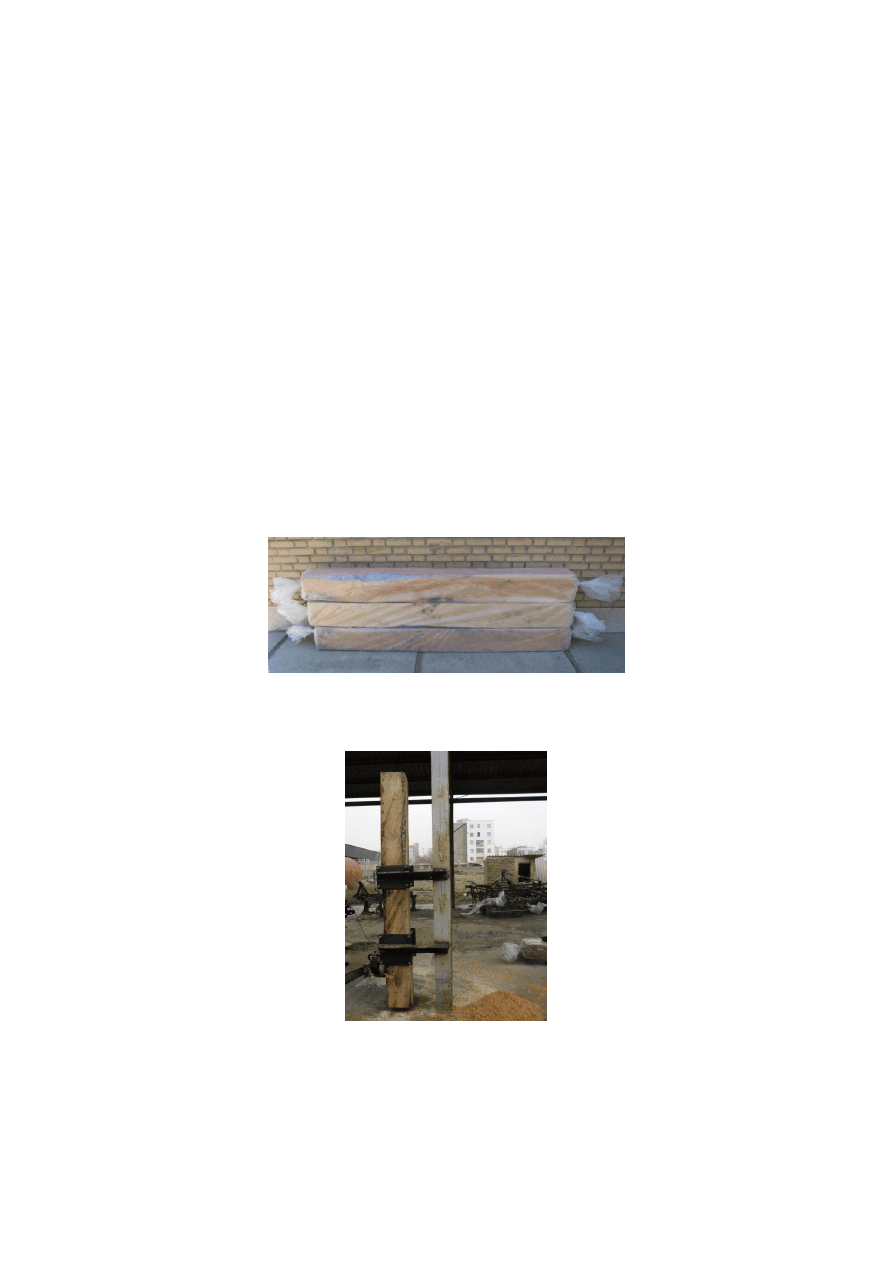
Figure (1) showed the timbers after transportation to Laboratory.
Figure 1. timbers in nylon
To hold timbers a vertical, a set up was made. Set up included two mandibles consist of two plates that
anchor together whit four Bolts. The mandibles weld to a strong pillar. Please look to figure (2).
Figure 2. set up for test
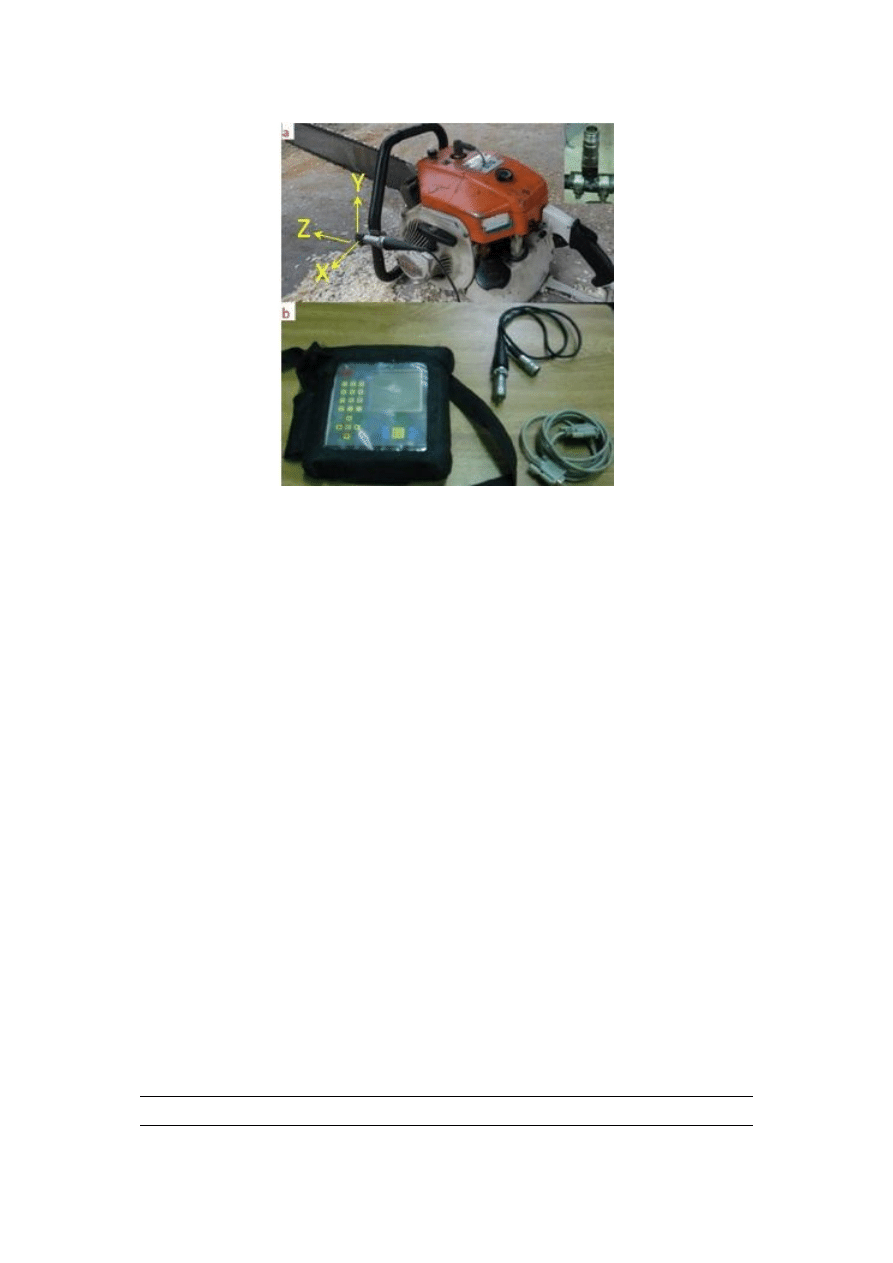
The different accessories employed in this study were handle adapter, multipurpose accelerometer (VMI-
192) and data acquisition system (easy viber). The adapter was rigidly fixed on the front handle of the chainsaw
so that there was no motion between the adapter and the handle grip. This equipment is showed in figure (3).
Tech J Engin & App Sci., 3 (10): 904-908, 2013
906
Figure 3. (a) - adapter and accelerometer on the hand grip of chainsaw (b) - data acquisition system, accelerometer and cables
One professional male operator was chosen for this study that hi was healthy and in good physical
condition. Values of age, height and weight of the operators were 31.3 years, 170.4 cm and 67.3 kg,
respectively.
The experiment was conducted in split-factorial design where different woods were taken as main plot,
different speeds and different directions as factors. 81 tests in three Species of hardwood, three speeds of
engine, three Perpendicular axes and three repeats were conducted. Similar tests were conducted without
cutting wood. All tests were conducted according to ISO 5349.
The orientation of the measurement axes was selected according to ISO 5349 that is shown in figure (3).
The vibration acceleration at various conditions was measured and recorded in the data acquisition system and
data were transferred to computer. The recommendation of ISO-5349 (2001) was followed for calculating the
frequency-unweighted acceleration and frequency-weighted acceleration in 1/3rd octave bands at 6.3 and 1250
Hz (ISO 5349, 2001). To test the effect of different engine speed levels, different Species of hardwood and
different axes on the rms acceleration, One-way analysis of variance was performed.
RESULTS AND DISCUSSION
The result of ANOVA that was performed to test the different root mean square acceleration of different
speeds, different axes and different operations is illustrated in table (1). This result showed that the RMS
acceleration in different operation, different axes and different speeds was significant at 1% level. The
interaction between operation and speed was not significant means the effect of speed on RMS was similar in
all operations but the effect of speed in different axis was not similar because the interaction between speed
and axis was significant at 1% level. The interaction between operation and axes was significant at 1% level. It
can be understand that properties of wood affected on the RMS in three perpendicular axes means that it is
possible the largest vibration in different woods occur in different axis. The interaction between operation,
speed and axes was significant at 1% level.
The acceleration spectra of chainsaw employed in this study in condition without cutting log, had the
highest peak in the Y
h
-axis in the frequency in accordance with the speed of engine. These peaks in 6000rpm,
7720rpm and 8630 rpm speeds of engine occurred in 100Hz, 128.5Hz and 144Hz respectively. In the X
h
-axis,
the highest peak was in the frequency that was similar whit Y
h
-axis. In the Z
h
-axis, the highest peak was in the
double frequencies but they had a peak in the similar frequency whit Y
h
-axis and X
h
-axis. The acceleration
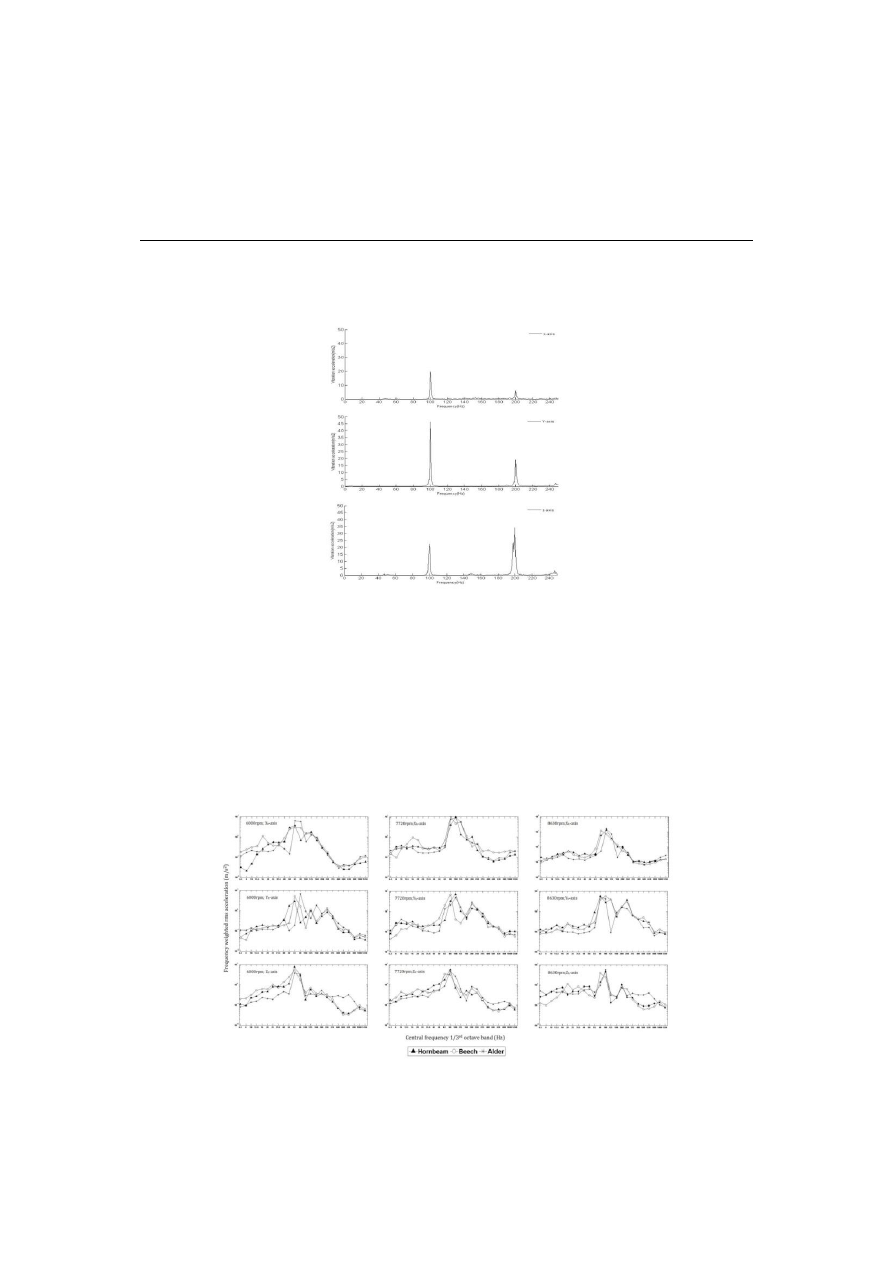
spectra at frequency range of 0-250Hz at 6000rpm have been showed in figure (4).
Table 1. ANOVA for the effect of different level of speeds, different species hardwood and different axis on the RMS acceleration
Source of variation
df
Sum of square
Mean square
Calculated F
3
42265/77
14088/59
40/62
**
Tech J Engin & App Sci., 3 (10): 904-908, 2013
907
8
2774/38
346/80
2
55830/18
27915/09
116/74
**
2
31200/54
15600/27
65/24
**
6
3159/18
526/53
2.20
ns
6
20612/45
3435/41
14/37
**
4
25755/60
6438/90
26/93
**
12
10621/19
885/10
3/70
**
64
15304/30
239/13
40/62
**
The acceleration of chainsaw during cutting log had the highest peak in the lower frequencies than the
condition without cutting log because the interaction between chain and wood, decrease the speed of engine.
Figure 4. frequency spectra in the X
h
,Y
h
and Z
h
axes at 6000rpm
The frequency weighted rms acceleration at 1/3
rd
octave bands from 6.3Hz to 1250Hz is shown in figure
(5). It can be seen that the frequency weighted rms acceleration from three species hardwood and in different
speeds of engine followed a similar pattern. The highest peak in all directions, speeds and species accoutred in
frequency 1/3
rd
band from 63Hz to 100Hz since the major acceleration is due to hook of piston. The highest
peak of Alder usually is in the higher frequencies than the Hornbeam and Beech because the speed of engine
during cutting this wood is more than other two. In the Z
h
-axis, the value of frequency weighted rms
acceleration at frequencies between 315Hz to 800Hz is more than hornbeam and beech. The maximum value
of frequency weighted rms acceleration in X
h
-axis and is found at 100Hz with the magnitude of 16.30447 m/s
2
during cutting the Alder notwithstanding the largest peaks in acceleration spectra without cutting was in Y
h
-
axis.
Figure 5. frequency weighted acceleration (rms) in one-third octave band
REFERENCES
Anonymous. 1989. Human vibration. Bruel & Kjar CO. Online publication. Denmark.

Tech J Engin & App Sci., 3 (10): 904-908, 2013
908
Farkkila M, Pyykko I, Korhonen O, Starck J. 1979. Hand grip forces during chain saw operation and vibration white finger in
lumberjacks. British Journal of Industrial Medicine. 36: 336-341.
ISO 5349-1. 2001. Mechanical vibration
— Measurement and evaluation of human exposure to hand-transmitted vibration.
ISO International standard.
Ko Ying H, Ooi Lu E, Zaidi Mohd R. 2011. The desigen and development of suspended handles for reducing hand-arm
vibration in petrol driven grass trimmer. Journal of Industrial Ergonomics. 41: 459-470.
Paddan GS, Griffin MJ. 2002. Evaluation of whole-body vibration in vehicles. Journal of Sound and Vibration. 253: 195-213.
Pyykko I, Starck J, Farkkila M, Hoikkala M, Korhonen O, Nurminen M. 1981. Hand-arm vibration in the aetiology of hearing
loss in lumberjacks. British Journal of Industrial Medicine. 38: 281-289.
Sam B, Kathirvel K. 2006. Vibration Characteristics of Walking and Riding Type Power Tillers. Biosystems Engineering. 95
(4): 517
– 528.
Sam B, Kathirvel K. 2009. Development and evaluation of vibration isolators for reducing hand transmitted vibration of
walking and riding type power tillers. Bio systems Engineering. 103: 427-437.
Taylor W, Person J, Kell RL, Keighley GD. 1971. Vibration syndrome in Forestry Commission chain saw operators. Brit. J.
Induster. 28: 83-89.
Tewari VK, Dewangan kN. 2009. Effect of vibr
ation isolators in reduction of work stress during field operation of hand
tractor. Biosystems Engineering. 103: 146-158.
Wyszukiwarka
Podobne podstrony:
Abolicja podatkowa id 50334 Nieznany (2)
4 LIDER MENEDZER id 37733 Nieznany (2)
katechezy MB id 233498 Nieznany
metro sciaga id 296943 Nieznany
perf id 354744 Nieznany
interbase id 92028 Nieznany
Mbaku id 289860 Nieznany
Probiotyki antybiotyki id 66316 Nieznany
miedziowanie cz 2 id 113259 Nieznany
LTC1729 id 273494 Nieznany
D11B7AOver0400 id 130434 Nieznany
analiza ryzyka bio id 61320 Nieznany
pedagogika ogolna id 353595 Nieznany
Misc3 id 302777 Nieznany
cw med 5 id 122239 Nieznany
D20031152Lj id 130579 Nieznany
mechanika 3 id 290735 Nieznany
więcej podobnych podstron