
TECHNICAL INFORMATION GUIDE
Alcatel 1650 SMC
STM-4/1 Optical Multi-Service Node


Table of Contents
Introduction............................................................................................................ 2
1650SMC Advantages ............................................................................................ 2
1650SMC Applications............................................................................................ 3
Product Description ................................................................................................ 3
Functional Description............................................................................................ 4
SDH Cross Connect subsystem....................................................................................5
Clock reference .........................................................................................................5
Control subsystem......................................................................................................5
STM-1/4 interfaces subsystem .....................................................................................6
Traffic port subsystem.................................................................................................6
ISA Matrix switch subsystem ........................................................................................8
Auxiliary and overhead subsystem ............................................................................. 10
Power subsystem...................................................................................................... 11
Physical description .................................................................................................. 11
Abbreviations .......................................................................................................... 12


TECHNICAL INFORMATION GUIDE
ALCATEL 2 >
Alcatel 1650 SMC / Release 4
Introduction
.SDH (Synchronous Digital Hierarchy) is today the
dominant transport technology in metropolitan and
regional networks.
With the ever-growing demand for high-speed data
communications, Alcatel enhances its leading portfolio of
optical transport equipment with data-aware
functionality – aggregation, switching and forwarding
traffic in the proper data layer – to deliver high
performance multi-technology networking solutions.
Alcatel’s Optical Multi-Service Nodes (OMSN) –
equipped with ISA (Integrated Service Adapter) plug-in
modules – provide world-class Next Generation SDH
functionality and capacity through aggregation of
broadband multi-protocol traffic patterns such as
Ethernet, MPLS, ATM and Packet Ring.
Alcatel 1650 SMC Optical Multi-Service Node is an ideal
space saving, next-generation multi-service building
block for local and metropolitan networks, providing
unmatched performances for its room occupation.
1650SMC offers telecom carriers and service providers
the powerful solution to build intelligent optical
networks with integrated TDM and Packet capabilities
and achieve the optimal balance between new
competitive service offerings and traditional revenue-
generating services.
The Alcatel 1650SMC is compliant with the Synchronous
Digital Hierarchy (SDH) defined in ITU-T
Recommendation G.707.
It can be configured as a Multi Line Terminal
Multiplexer, as an Add/Drop Multiplexer or as small
cross-connect for applications in linear links, rings, and
meshed networks. In all applications various network
protection mechanisms are provided.
Alcatel 1650 SMC features all standard PDH and SDH
interfaces from 2Mbps to 622 Mbps and offers Integrated
Service Adapter (ISA) modules specifically designed for
rate-adaptive transport of Ethernet and Gigabit
Ethernet traffic patterns through the optical network
optimizing the transport infrastructure to new data
traffic patterns:
− Ethernet, Gigabit Ethernet, ATM and MPLS-based
Packet Ring switching capabilities for improved data
streams’ connectivity
− cost-effective management and transport of packet-
based data applications within the existing optical
infrastructure – no need to add specific overlay data
networks
− ability to create new revenues from today’s and
future competitive data services by enforcing and
verifying SLAs (Service Level Agreements) based on
embedded QoS (Quality of Service) patterns.
All this makes the Alcatel 1650 SMC act as an ideal
multi-protocol transport node that reveals its
outstanding performance when used as building block in
access/edge metro rings, where traffic coming from
different clients can be consolidated into common SDH
transport resources by means of cell- or packet-based
statistical multiplexing.
1650SMC Advantages
The main strategic advantages of the OMSN family are:
− Completeness: a comprehensive range of network
elements for all transmission needs, from customer
premises applications to metropolitan networks, to
long-haul and ultra long-haul terrestrial and trans-
oceanic applications.
− Simplicity: the unnumbered possibilities offered by
OMSN for network construction are provided by the
fewest building blocks. Reuse of modules between
different systems is almost total.
− Future-readiness: in addition to traditional
transmission applications, OMSN deals effectively
with data traffic patterns providing aggregation,
switching and forwarding traffic in the proper data
layer.
− Backward compatibility: OMSN guarantees full
inter-working with the existing installed base in
broad terms: from optical compatibility, to DCC
(Data Communications Channels) compatibility, to
network management. In other words, existing
networks can be upgraded with new equipment
without constraints.
− Cost-effectiveness: by sharing replaceable units
(common parts as well as traffic ports) among
different systems but also reusing entire shelves for
stand-alone ADM and large Cross-Connects
configurations, network operators can largely reduce
the impact of spare holding and personnel training
which typically affect overall network operation
costs. The installation of one equipment where
several similar or different ones are normally used
brings relief to costs of ownership.
− Management: no matter how the network is built or
what networking technologies are used for edge and
backbone applications (Ethernet, ATM, SDH, WDM)
OMSN delivers one unified management solution.
TECHNICAL INFORMATION GUIDE
ALCATEL 3 >
Alcatel 1650 SMC / Release 4
In addition, 1650SMC brings the following specific
benefits:
− Flexibility: a Compact ADM-4 card concentrates two
STM-4 or STM-1 plug in modules, SDH matrix,
synchronization functions and equipment control
management. The Compact ADM cards can be 1+1
EPS protected. Three slots are then available for
allocation of traffic ports, where flexibility is total.
The system may be configured for example as
2xSTM-4 rings cross-connect exploiting the
maximum drop capacity of 12x STM-1 signals or 63 x
2Mbit/s. Multiple SNCP rings may be terminated by
the same node (e.g. up to 8 x STM-1 rings). The VC
cross-connect size provides full connectivity at all VC
layers for up to 32x32 STM-1 equivalent payloads.
− Reliability: 1650SMC offers two types of network
protections: Linear Multiplex Section Protection
(MSP) and Sub-Network Connection Protection
(SNCP). Node protection in addition to line
protection is possible as all replaceable units are
optionally redundant. Power supply protection is
inherent as the DC/DC conversion function is
distributed on each card.
− Easiness: 1650SMC has a centralized control
architecture that limits the presence of processors
and software to the Equipment Controller and
Matrix units and to the ATM and ISA PR-EA switch
card. Traffic ports have no on-board processors and
are common to the family members. 1650SMC also
offers local and remote SW download, has the
minimum possible set of replaceable items and
hugely shares hardware items with other members
of the OMSN family.
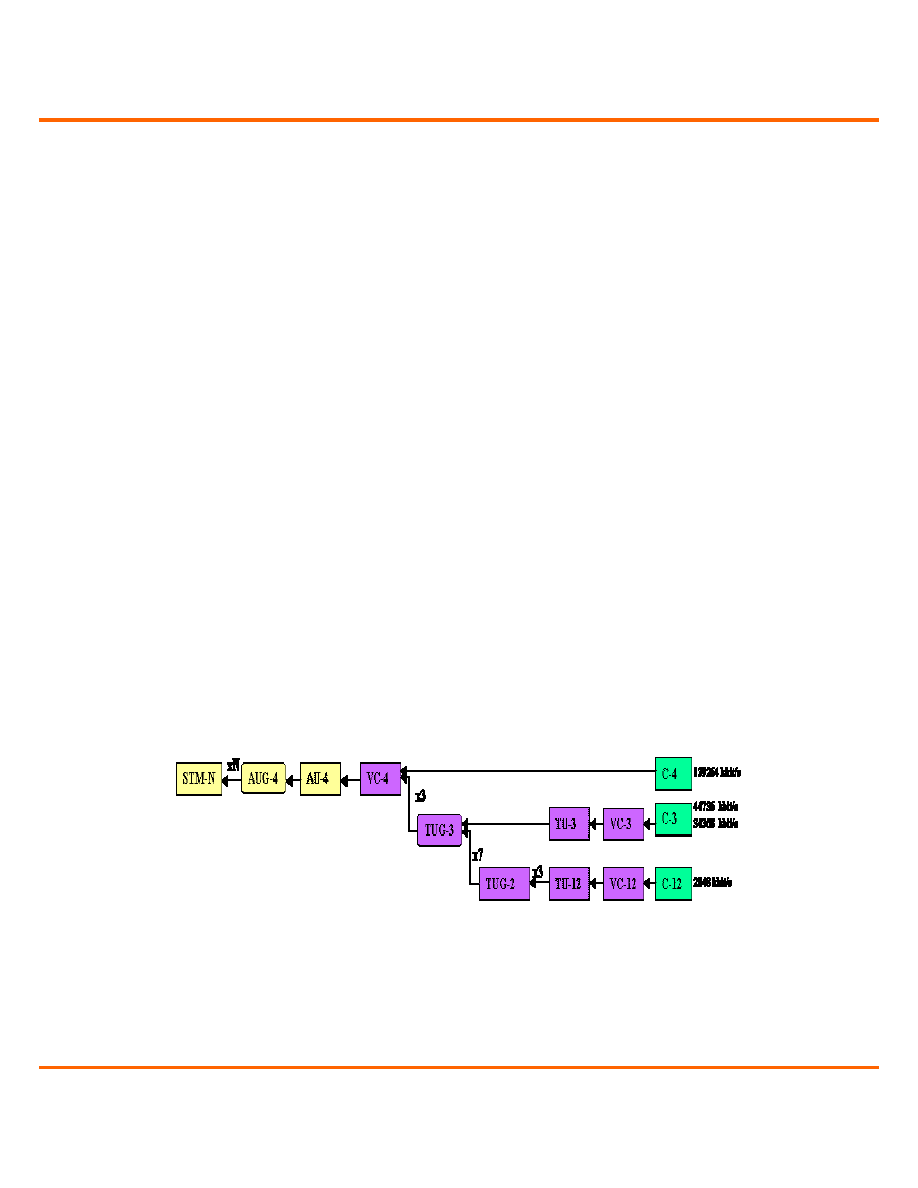
Figure 1 1650SMC Multiplexing structure
1650SMC Applications
The 1650SMC can be used for transmission over G.652,
G.653 and G.654 fibers. The main applications can be
identified in the following areas:
− Customer premises;
− Local and Metropolitan Rings;
− Regional meshed backbones;
− Point to point links with intermediate drop/insert
and/or regeneration stations;
− Multi-service data-centric Metro Edge context;
Alcatel 1650 SMC Optical Multi-Service Node offers
integrated data-aware capabilities that help
improving bandwidth utilization and network
dimensioning. Alcatel 1650 SMC acts as an ideal
multi-protocol transport node that allows
consolidation of different traffic patterns (TDM,
ATM, IP, Ethernet, Packet Ring) onto shared SDH
VCs, while performing traffic control functions such
as shaping and policing, which are vital to avoid
network congestion and to provide QoS.
Product Description
1650SMC is an STM-1/4 Network Element for
transmission and cross-connection of a wide range of
PDH and SDH signals. It can operate as a multi
Terminal or as cross connect with up to 28xSTM-1
equivalent ports capacity. The matrix size is 32x32 STM-
1 equivalent at the High Order and Low Order VC level.
Figure 1 shows the multiplexing schemes implemented
by 1650SMC.

TECHNICAL INFORMATION GUIDE
ALCATEL 4 >
Alcatel 1650 SMC / Release 4
The traffic units can be plesiochronous (PDH) or
synchronous (SDH). The plug-in cards can be of the
following types:
− 63x2Mbit/s unit;
− 63x2Mbit/s unit G.703/ISDN-PRA unit;
− 3x34/45Mbit/s Switchable unit;
− 4x140Mbit/s-STM-1 Switchable electrical unit;
− 4xSTM-1 electrical unit;
− 4xSTM-1 electrical/optical unit;
− 1xSTM-4 optical unit;
− ATM switch (4x4 VC-4) unit;
− 11x10/100 BaseT i/f Ethernet unit;
− 14x10/100 BaseT i/f Ethernet access unit;
− 4xGigabit Ethernet rate adaptive unit;
− Packet Ring modules:
•
Packet Ring Edge Aggregator with 4x10/100
BaseT i/f;
•
Packet Ring Edge Aggregator with 1Gbit
Ethernet i/f.
Equipment Controller, SDH Matrix and clock reference
unit are centralized into Compact ADM cards that can
host STM-1 and STM-4 plug-in modules:
− Compact ADM-1 up to 2 x STM-1 modules or 1 x
STM-4 plus 1 x STM-1;
− Compact ADM-4 up to 2 x STM-1/4 modules or
mixed configuration.
All electrical traffic ports can be optionally protected in
N+1 configuration.
According to the network topology, single ended and dual
ended MSP (Multiplex Section Protection) can be
implemented between any STM-n interfaces. SNCP (Sub
Network Connection Protection) inherent (SNCP/I) as
well as non-intrusive (SNCP/N) are also provided at all
VCi levels.
The SDH ports that participate in a protection scheme
(MSP or SNCP) can be flexibly selected by craft terminal
or management system, regardless of their position in
the shelf (traffic port or access module).
1650SMC can realize non-intrusive Path Overhead
Monitoring (POM) functions on 100% of Low Order and
High Order VCs.
Short and long haul optical interfaces are available for
STM-1 and STM-4 interfaces. STM-1 interfaces can also
perform bi-directional transmission over a single fiber by
means of splitters/combiners.
A software protocol between the two ends makes sure
that fiber cuts are properly detected and generate LOS
alarms even in presence of signal reflection.
A centralized matrix implements the cross-connect
function. The full non-blocking matrix allows cross–
connection of up to 32x32 STM-1 equivalent at High
Order level and Low Order level between all traffic ports.
A wide auxiliary capacity, in accordance with SDH
standards, is available for embedded services. An
Engineering Order Wire channel, with DTMF signaling,
can be accessed by a micro-telephone for maintenance
facility.
The clock reference function, located in the Compact
ADM units, synchronizes the 1650SMC and provides
generation and distribution of a synchronization clock.
The clock can be locked to an external 2MHz or 2Mb/s
source, to any STM-N ports or 2Mbit/s traffic ports or to
the internal oscillator. The SSM (Synchronization Status
Message) quality and priority algorithms are supported.
The Equipment Controller, located on the Compact ADM
cards, provides configuration, alarm status and
performance monitoring data. A software download
facility (Local and Remote) is available in order to update
the complete software of the control subsystem.
The system can be managed either by a CMISE Craft
Terminal running on a Personal Computer attached to
the F interface or by the Alcatel OMSN Network
Management System through the Q interface.
Moreover, the 1650SMC can work as a Mediation Device
for Alcatel NEs accessible through the Q2/RQ2 interface.
In this way, it is possible to transport information about
alarms and configurations of PDH or/and Access System
to/from a centralized TMN using the standard SDH DCC
network.
DC/DC converters, located on each board, guarantee
powering of the system. The distribution of power
supplies inherently guarantees protection.
Functional Description
The equipment consists of the following subsystems:
− Compact ADM subsystem, composed of:
•
SDH Vci cross-connect subsystem;
•
Clock Reference subsystem;
•
Equipment Control subsystem;
•
2 x STM-1/4 interfaces;
− Traffic port subsystem
•
ISA Matrix switch subsystem
•
Auxiliary and overhead subsystem
•
Power subsystem

TECHNICAL INFORMATION GUIDE
ALCATEL 5 >
Alcatel 1650 SMC / Release 4
SDH Cross Connect subsystem
The 1650SMC SDH cross-connect is built upon a non-
blocking matrix that can interconnect AU4s, TU3s and
TU12s between any SDH or PDH ports accessing the
system.
Several types of connections may be established, such as:
− ·unidirectional point-to-point;
− ·bidirectional point-to-point;
− ·unidirectional point-to-multipoint;
− ·SNCP Drop & Continue;
The capacity of the matrix is 32x32 STM-1 equivalent
ports at the High Order and Low Order VC level.
Table 1 High Order/Low Order connectivity for 1650SMC
The SDH VC matrix implements single-ended SNCP/N
(non-intrusive) and SNCP/I (inherent) protections.
Clock reference
The synchronization subsystem provides the timing
reference required by all components in the network
element and represents the SDH Equipment Clock
(SEC). The subsystem performs the functionality
identified by the ITU-T recommendation G.783 as SDH
Equipment Timing Source (SETS). The SDH Matrix unit
realizes the SETS function
The SETS accepts synchronization inputs from a number
of sources:
− STM-n lines;
− 2Mb/s traffic ports;
− 2MHz / 2Mb/s external input;
− Internal oscillator.
Automatic selection of one of those sources is achieved by
selector B using either quality (SSM algorithm) or
priority criteria. Also manual selection is possible.
The SETS function produces two outputs.
The NE clock reference is used as internal timing source
and to synchronize the outgoing SDH STM-n signals.
Two external 2MHz or 2Mb/s outputs are generated as a
possible source for external devices.
Up to 6 candidate references may be selected among all
STM-n and 2Mb/s traffic ports in the system. Two 2MHz
or 2Mb/s external inputs and two outputs are available.
When configured as 2Mb/s, the external I/Os can carry
the SSM timing marker information.
The SETG function has three modes of operation: locked,
holdover and free-running. In holdover mode, the SETG
holds the frequency of the last valid reference with a
maximum drift of 0.37ppm per day. The accuracy of the
local oscillator is 4.6 ppm. When the SDH matrix is
protected in 1+1 configuration, also the Clock Reference
function is protected.
Control subsystem
The control subsystem realizes the Synchronous
Equipment Management Function (SEMF) defined by
ITU-T Recommendation G.783. It communicates with
external management systems through a standard QB3
CMIP interface.
The management information model is compliant to the
ITU-T G.774 series of recommendations.
Communication with the local craft terminal is also
based on the same interface.
The control subsystem is responsible for applying the
configuration requested by the element manager or craft
terminal and to report the status of the equipment as
well as alarm and performance information. It is also
responsible to drive automatic protection switching.
1650SMC has centralized control architecture, built upon
a two-level model:
− Equipment Controller (EC) for DCC networking,
CT/OS interface and data-base management;
− Shelf Controller (SC) for provisioning, alarm
detection, performance monitoring and equipment
protection switching.
Two microprocessors are dedicated respectively to the EC
and SC functions. They communicate through an
internal bus (ISSB / Intra Shelf Serial Bus).
The Shelf Controller processor interfaces directly
through a backplane parallel bus (ISPB / Intra Shelf
Parallel Bus) all circuits (ASICs) implementing the SDH
functions in the shelf, for data collection (alarms,
performance monitoring) and configuration provisioning
purposes.
STM-1 STM-4 ports
140Mb/s
ports
34Mb/s
45Mb/s
ports
2Mb/s
ports
Ports
AU-4 TU-3 TU-12
VC-4
VC-3
VC-12
AU-4
Yes - - Yes -
-
TU-3
- Yes -
- Yes -
STM-1
STM-4
TU-12
- -
Yes - - Yes
140Mb/s
VC-4
Yes - - Yes -
-
34Mb/s
45Mb/s
VC-3
- Yes -
- Yes -
2Mb/s
VC-12
- -
Yes - - Yes

TECHNICAL INFORMATION GUIDE
ALCATEL 6 >
Alcatel 1650 SMC / Release 4
The Message Communication Function (MCF)
implemented by the Equipment Controller can manage
up to 8 DCC channels. Selection of the STM-n ports and
of the DCCm or DDCr channel is performed via Local
Craft Terminal.
A PCMCIA Flash Card located in the Equipment
Controller unit provides Mass storage for the
configuration database and SW package. The Equipment
Controller can also perform mediation device functions
for co-located Alcatel equipment managed through the
Q2/RQ2 interface.
The management information directed to or retrieved
from Q2/RQ2 Network Elements (e.g. access
multiplexers, microwave radio systems, PDH terminals)
connected to the 1650SMC is transported through the
SDH DCCs to the TMN, thereby avoiding the
deployment of additional data communication networks.
When the Compact ADM card is protected in 1+1
configuration matrix and the Shelf Controller function
are protected.
A failure on the Equipment Controller unit has neither
impact on traffic, nor on automatic protection switching
functions managed by the Shelf Controller processor of
the SDH matrix unit.
STM-1/4 interfaces subsystem
Compact ADM-1 card can host 2 STM-1 optical plug in
modules, or 1 STM-4 optical plug in module plus 1 STM-
1 modules.
Compact ADM-4 can host 2 STM-4optical plug in or
mixed configuration of STM-1 and STM-4.
Traffic port subsystem
SDH and PDH traffic ports are available through the
following units:
− 63x2Mbit/s unit;
− 63x2Mbit/s unit G.703/ISDN-PRA unit;
− 3x34/45Mbit/s Switchable unit;
− 4x140Mbit/s-STM-1 Switchable electrical unit;
− 4xSTM-1 electrical unit;
− 4xSTM-1 electrical/optical unit;
− 1xSTM-4 optical unit;
− ATM switch (4x4 VC-4) unit;
− 11x10/100 BaseT i/f Ethernet unit;
− 14x10/100 BaseT i/f Ethernet access unit;
− 4xGigabit Ethernet rate adaptive unit;
− Packet Ring modules:
•
Packet Ring Edge Aggregator with 4x10/100
BaseT i/f;
•
Packet Ring Edge Aggregator with 1Gbit
Ethernet i/f.
63 x 2Mb/s unit
The unit provides the physical interface for the
asynchronous mapping of G.703 2Mb/s signals into SDH
VC12s.Each unit supports 63 interfaces.
The unit is the same for 75
Ω and 120Ω applications.
Impedance match is performed at the access module
level. 21x2Mb/s 75
Ω and 21x2Mb/s 120Ω access modules
provide the G.703 interconnection interfaces.
The Retiming unit implements the 2Mb/s retiming
function allowing synchronizing the outgoing 2Mbit/s
signals with the internal clock reference.
Retiming can be enabled/disabled at the 2Mb/s port level.
1650SMC can house up to 1+1 63x2Mb/s units and 3
21x2Mb/s access modules in the shelf.
3 x 34Mb/s / 45Mb/s unit
The unit provides the physical interface for the
asynchronous mapping of G.703 34Mb/s or 45Mb/s
signals into SDH VC3s. Each unit supports 3 interfaces.
The selection of the working mode (3x34Mb/s or
3x45Mb/s) is controlled via software.
Two dedicated access modules (3x34Mb/s and 3x45Mb/s)
are used for the 34Mb/s (75
Ω) and 45Mb/s (100Ω)
applications.
1650SMC can house up to 3 3x34M/45M units and 3
3x34Mb/s or 3x45Mb/s access modules.
Possible configurations: unprotected 3+0, 2+1 protection.
4 x 140Mb/s / STM-1 unit
The unit provides four bi-directional 140/155Mb/s G.703
interfaces. The selection of the working mode (per port)
is controlled via software.
The electrical interfaces are available on a
4x140/155Mb/s access module.
When a port is configured as STM-1, the VC4 can either
be unstructured or structured into lower order VCs.
1650SMC can host up to 3+0 or 2+1 unit and 3 access
modules.
4 x STM-1 electrical unit
The unit provides four bi-directional STM-1 G.703
interfaces. The electrical interfaces are available on a
4xSTM-1 electrical access module.
For each STM-1 the VC4 can either be unstructured or
structured into lower order VCs.
1650SMC can host up to 3+0 or 2+1 unit and 3 access
modules.

TECHNICAL INFORMATION GUIDE
ALCATEL 7 >
Alcatel 1650 SMC / Release 4
4 x STM-1 electrical / optical unit
The 4xSTM-1 electrical/optical unit provides four
electrical (G.703) or optical (several types) STM-1
interfaces.
The unit can host 2 replaceable STM-1 electrical or
optical (short or long haul) plug-in modules.
2 additional STM-1 interfaces managed by the unit are
available in the access area of the shelf by means of an
adapter housing the STM-1 electrical/optical plug-in
modules.
Any combination of electrical or optical (short or long
haul) is possible on the same unit.
1650SMC can house up to three 4xSTM-1 units.
The electrical or optical STM-1 interfaces can participate
in any combinations of 1+1 linear MSP or SNCP schemes
that can flexibly be established by craft terminal or
management system.
Ports participating in the protection scheme may belong
to the same unit or to different modules, including STM-
1 interfaces on Compact ADM card.
1 x STM-4 optical unit
The 1xSTM-4 optical unit provides one STM-4 optical
interface (on front panel). Several short and long haul
types are available.
1650SMC can house up to three 1xSTM-4 units.
The STM-4 interfaces can participate in any
combinations of 1+1 linear MSP or SNCP schemes that
can flexibly be set up by craft terminal or management
system.
ISA Ethernet 10/100 BaseT
ISA Ethernet module provides 10/100baseT interfaces
allowing the interconnection of two LANs in a point-to-
point configuration.
The major benefits that can be experienced utilizing ISA
Ethernet card in the SDH networks are:
− Interfaces cost reduction;
− Bandwidth shaping according to clients needs.
The interface cost reduction is achieved thanks to the
native interfaces provided on the board that allow
replacing the expensive up-link ports, which use the POS
(Packet Over SDH/SONET), traditionally. This leads to
an infrastructures optimization of the operator and cost
reduction for the end-user.
The bandwidth can be allocated to the end users in
accordance with the real need, independently from the
interface type.
The main board is 1 slot wide and can be housed in any
slot of the three slots available for traffic ports; it
provides 11 10BaseT/100BaseT interfaces. The access
module, to be allocated into the access area of the
1650SMC shelf, provides 14 additional
10BaseT/100BaseT interfaces.
The connection capacity towards the back panel of ISA
port is 4xVC4 equivalent. Up to three ISA Ethernet main
port + three ISA Ethernet Access module can be hosted
into 1650SMC shelf.
The unit is able to execute a rate-adapting action; hence
it is able to cross–connect a 10/100Mbit/s Ethernet
stream into an SDH virtual container of any dimension
(VC12, VC3, VC4).
The Ethernet frames received through the native
interfaces are mapped using the GFP protocol into the
SDH VC-x and then transmitted through the SDH.
Data transfer rate from Customer equipment is limited
in accordance with SDH capacity by the 802.3x flow
control mechanism.
The flow control mechanism is used to prevent the
congestion of the transmission network that may cause
packet discarding.
Full transparency with respect of the upper layer
protocols is maintained.
SDH bandwidth allocation can be managed following two
approaches:
− Each Ethernet interface is independently mapped
into 1xVC12/VC3/VC4. The container is then cross-
connected in the matrix as any other VC tributary.
− Each Ethernet interface can be mapped as N x
VC12/VC3 through the usage of packet
concatenation. Each VC runs independently inside
the SDH network; for each of these VC a dedicated
cross-connection is required inside the matrix.
Thanks to the information contained into the GFP
Header the frames are re-aligned at the sink side.
ISA Gigabit Ethernet
ISA Gigabit Ethernet provides 1000BaseSX/1000BaseLX
interfaces allowing the interconnection of two LANs in a
point-to-point configuration.
The card allows realizing the following connections in the
SDH Network:
− Transport of a Gigabit Ethernet signal between two
data equipment.
− Guaranteed QoS between end points over the
network.

TECHNICAL INFORMATION GUIDE
ALCATEL 8 >
Alcatel 1650 SMC / Release 4
These features comply with the following standards:
− IEEE 802.3z (gigabit interfaces)
− ITU G.707 and G.783 (including virtual
concatenation)
Gigabit-Ethernet port card can host up to four 1000Base
SX/LX interfaces SFP (Small Form Factor Pluggable).
Gigabit-Ethernet port card can be located in any traffic
ports slot.
The throughput towards the back panel is 622 Mb/s.
Up to twelve Gigabit Ethernet interfaces can be provided
in one shelf.
The traffic received by the 1000baseSX or 1000baseLX
Ethernet interfaces on the ISA-GbE card is mapped into
a number of VC-4 SDH containers, more precisely the
Gigabit Ethernet traffic passing trough 1 x Gigabit
Ethernet physical interface is mapped into a specific VC-
4-xv (x=12,3,4,5,6,7) structure using the standard virtual
concatenation.
Each Gigabit Ethernet frame is mapped without
modifications into a generic framing procedure frame
(GFP-ITU-T G.7041).
The flow control mechanism, implemented in accordance
with IEEE 802.3x, is used to prevent the congestion of
the transmission network that may cause packet
discarding.
ISA Matrix switch subsystem
1650SMC provides world-class next generation SDH
functionality and capacity through aggregation of
broadband multi-protocol traffic patterns.
Alcatel 1650 SMC can be equipped with Integrated
Service Adapter (ISA) plug-in modules that perform ATM
and Packet Ring transport and switching functions for
Virtual Private LAN Services at variable bit rates.
ISA ATM plug-in modules
For ATM-based network solutions, ISA-ATM plug-in
board on Alcatel 1650 SMC is the optimal solution for
transport and aggregation of ATM traffic. Digital
Subscriber Line (DSL), Local Multipoint Distribution
Service (LMDS) and UTRAN (UMTS Terrestrial Access
Network) are among the applications in which operators
and service providers can take benefit from deploying
ISA-ATM for optimal network utilization and cost-
effective network operation.
1650SMC can host ISA-ATM card 600 Mbps (1 slot wide
plug-in card) that uses ports located in modules
(traditional traffic ports) that are equipped in the OMSN
node that is hosting the ISA-ATM card.
ISA-ATM card 600 Mbps has an equivalent front-end of 4
structured VC-4s. Up to 16 ATM interfaces can be
connected to ISA ATM switch.
ISA-ATM V2 card 600 Mbps has an equivalent front-end
of 4 structured VC-4s. Up to 252 ATM interfaces can be
connected to ISA ATM V2 switch.
Up to two ISA ATM can be equipped into 1650SMC in
any of the available traffic slots; 1+1 protection 1+1 is
supported.
ISA ATM ports support point to point and point to
multipoint PVC (also referred as Hard-PVC) and Soft-
PVC connections.
Hard-PVC connection has to be provisioned, manually
(CT, EML) or automatically (higher layer management)
by the management platforms, node by node along the
entire connection path.
Soft-PVC connection has to be provisioned at the
extremities (defining VPI and VCI) while are signaled
and maintained along the path by PNNI protocol.
ISA-ATM supports the following traffic types:
− UBR;
− UBR+;
− CBR;
− VBR-rt, nrt;
− GFR.2.
Traffic congestion avoidance is guaranteed via Selective
Cell Discard (SCD) and combined Early and Tail Packet
Discard mechanisms (EPD, TPD).
ATM OAM (AIS, RDI, LOC, TSF) end-to-end, non-
intrusive monitoring and performance monitoring are
supported for maintenance purposes.
ISA ATM V2 has the same set of features of ISA ATM
with the addition enhanced E1 number of ports and IMA
functionality for UMTS application.

TECHNICAL INFORMATION GUIDE
ALCATEL 9 >
Alcatel 1650 SMC / Release 4
The following table summarizes the different kinds of
physical interfaces that can be terminated on the ISA-
ATM matrix:
1-slot wide ATM module
Throughput
600 Mbps
(4 x VC-4 equivalent)
Switching capability
VC and VP switching
OMSN PDH Ports
E1 (up to 16)
E1 (up to 252)
E3 (up to 12)
OMSN SDH Ports
VC-12 (up to 16)
VC-3 (up to 12)
STM-1 (up to 4)
Local Port
STM-1 mini-drawer
ATM ports number
16 (any mix of ports)
Connections
2000 max (VC or VP)
VC/VP connection
Hard VCC/VPC
Soft VCC/VPC PNNI)
Policing
UPC and NPC (VC/VP)
Shaping
Input and output (VC/VP)
Congestion mgm.
TPD, EPD, SCD
OAM
AIS, RDI, CC
Signalling
PNNI 1.0
Switch architecture
Shared memory with a total
buffer capacity of 64K cells
Table 2 ISA ATM characteristics
ISA Packet Ring switches
ISA Packet Ring modules provide the solution to
integrate Ethernet switching capability, multiple VLAN
services and Layer 2 Virtual Private Networks (L2-VPN)
into the optical transport network following the
smoothest and most cost-effective path.
ISA Packet Ring Edge Aggregator plug-in card is based
on Ethernet over MPLS technology and implement the
natural evolution from point-to-point Ethernet leased
lines towards point-to-multipoint and any-to-any
Ethernet architectures.
Its MPLS core engine ultimately ensures carrier-class
Ethernet with QoS-based Service Level Agreements
(SLA).
ISA packet ring card is composed of:
− ISA-PR-EA card 1.6 Gbps (1 slot wide plug-in card)
providing Ethernet 10/100 BaseT, 1000 Base SX/LX
(SFP optical modules):
•
PR-EA with 4x 10/100 i/f;
•
PR-EA with 1x1000 i/f.
Up to two ISA PR-EA can be equipped into 1650SMC in
any of the available traffic slots. 1+1 Protection is
supported.
ISA packet ring cards Ethernet services portfolio
includes:
− Virtual Private E-Line;
− Virtual Private E-LAN;
− Broadband Access & Distribution..
ISA packet ring cards supports the following Service SLA
attributes:
− Guaranteed;
− Regulated;
− Best Effort.
Per packet wire speed classification and prioritization
criteria includes:
− Port;
− 802.1p/q;
− SA, DA;
− TOS, DSCP;
− MPLS label (exp bits).
Traffic congestion avoidance is guaranteed via network
wide Global Congestion Avoidance Control jointly
providing statistical multiplexing for the Best effort
traffic burstiness.
Packets are forwarded towards their destination
according to the following criteria:
•
Port;
•
802.1q;
•
MPLS Label.
•
DA;

TECHNICAL INFORMATION GUIDE
ALCATEL 10 >
Alcatel 1650 SMC / Release 4
Auxiliary and overhead subsystem
The SDH standard offers a wide range of service
channels in the Section Overhead (SOH) and Path
Overhead (POH) bytes of the synchronous frame.
These bytes are used for alignment word, parity check,
network management operations; performance
monitoring; some data and orderwire channels are
available to the user.
Overhead bytes managed by the 1650SMC are listed in
the following tables.
Table 3 Supported Regeneretor Section OH bytes
Table 4 Supported Multiplex Section OH bytes
Table 5 Supported VC4/VC3 Path Overhead bytes
Table 6 Supported VC12 POH bytes
TCM allows monitoring within the operator domain. The
quality within the operator’s own domain can be proven
regardless of the received quality of the signal at the
entry point of the network.
In addition to the highlighted SOH bytes, the F2 and F3
bytes of the VC4/VC3 POH can be cross-connected or
dropped locally.
All such bytes can be flexibly (i.e. upon operator request)
cross-connected from/to any SDH or PDH (34Mb/s,
45Mb/s, 140Mb/s) port in the system or from/to local
AUX/EOW terminations.
1650SM provides the following auxiliary terminations:
− 2 x V.11 (64kb/s)
− 2 x RS-232 (64kb/s)
− 2 x G.703 (64kb/s)
− 1 x G.703 (2Mb/s)
POH bytes
Description
J1 Path
Trace
B3
Path Parity check
C2 Signal
label
G1
Path status indicator (REI, RDI)
F2/F3 64kb/s
user
data
channels
H4 Multi-frame
position
indicator
RSOH bytes Description
A1-A2 Framing
bytes
J0 Section
Trace
B1
RS Parity check
E1
RS Engineering OrderWire (EOW)
F1 64kb/s
user
data
channel
D1-D3
RS DCC channels
MSOH bytes Description
B2 MS
Parity
check
K1-K2
Multiplex Section Protection (MSP)
D4-D12 MS
DCC
channels
S1
Synchronization Status Message
(SSM)
M1
MS Remote Error Indication (REI)
E2
MS Engineering Orderwire
POH bytes
Description
V5
Path Parity check, REI, RDI,
Signal label
J2 Path
Trace
TECHNICAL INFORMATION GUIDE
ALCATEL 11 >
Alcatel 1650 SMC / Release 4
Power subsystem
The architecture of the power subsystem is distributed.
The input battery power can range from –48v to –60v is
delivered without level translation to all cards in the
shelf.
Each card has an on-board DC/DC converter that
generates the necessary voltages for the on board
components.
Distribution of power supplies inherently provides
protection against single converter failures.
Physical description
Main shelf physical description
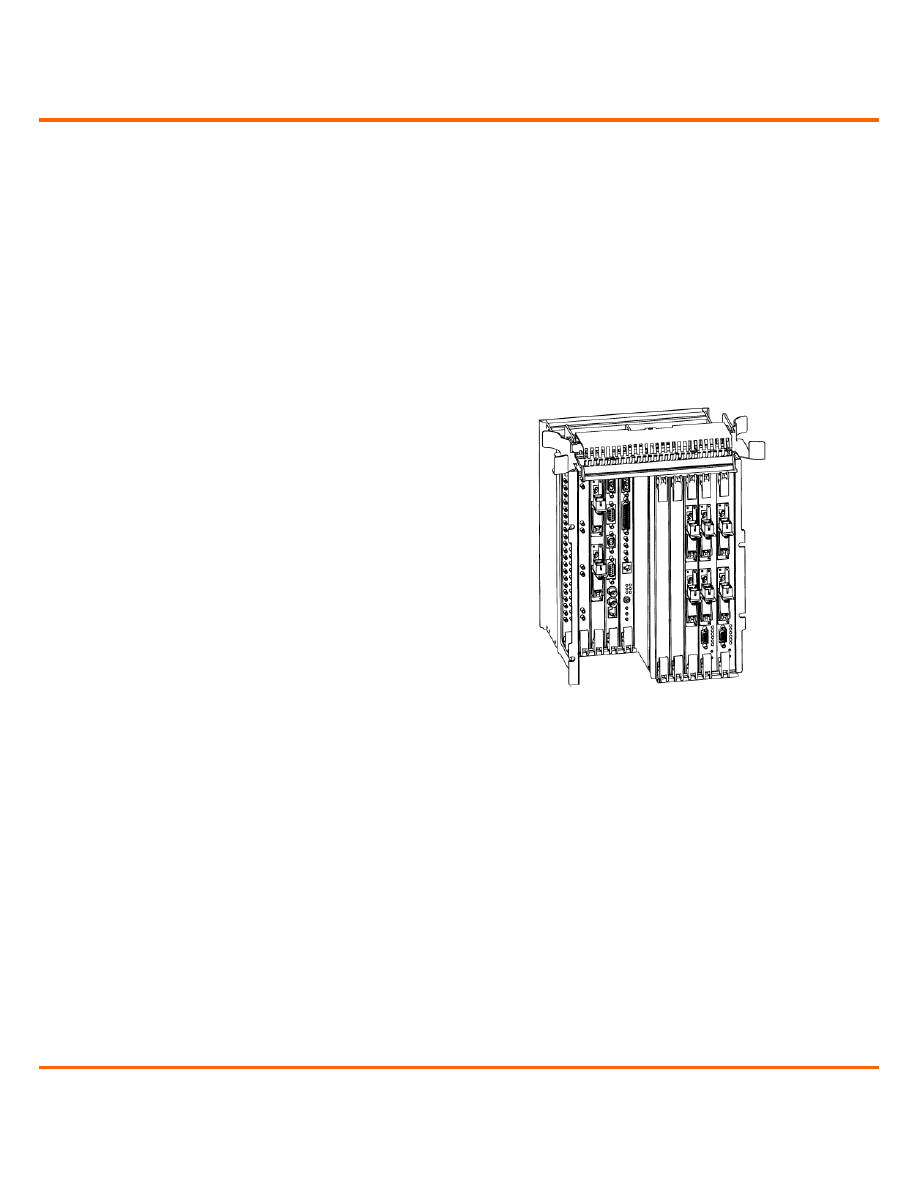
The mechanical design of the 1650SMC is based on half
19” ETSI compatible shelf, consistent with the Alcatel
standard S9 equipment practice.
The mechanical dimensions of the shelf are the following:
− 241 mm Wide x 350 mm High x 250 Deep
The cards to be housed inside the shelf have the
following dimensions:
− 265 mm High x 213 mm Deep.
The mechanical design provides EMI/EMC performances,
in compliance with ETSI standard 300 386-1
“Telecommunication Centre”.
The shelf is divided in two parts: the left side is devoted
mainly to access purposes; the right side is devoted to the
traffic units.
The access part (5 slots) can contain the following units
(88mm x 265mm):
− 1 slot for AUX, EOW, 2MHz or 2Mbit/s
synchronization I/O connection module (SERGI);
− 1 slots for general service connectors such as Power,
QB3 Int., Housekeeping, remote alarm, rack lamp,
Q2/RQ2 (CONGI);
− 3 slots for traffic access module. These slots can be
equipped with these units:
− 21x2Mbit/s access module (75Ω or 120Ω);
− 3x34 Mbit/s access module;
− 3x45 Mbit/s access module;
− 4x140/STM-1 electrical access module;
− Electrical Protection module (to be used for 34, 45,
140 and STM-1 electrical interface protection);
− 2xSTM-1 elec./opt. adapter module;
− 14xEthernet 10/100 access module;
Two slots of the right part are dedicated to Compact
ADM cards.
Three slots can be used for the allocation of traffic units:
− 63x2Mbit/s board;
− 3x34/45Mbit/s Switchable board;
− 4x140/STM-1 Switchable board;
− 4xSTM-1 elec./opt. board;
− 1xSTM-4 optical board;
− ISA Ethernet 11x10/100 BaseT;
− ISA Gigabit Ethernet 4x1000SX/LX;
− ISA ATM card;
− ISA PR-EA;
Figure 2 1650SMC physical view
The maximum quantity of each interface per shelf is:
− 63x2Mbit/s interfaces;
− 9x34 or 45 Mbit/s interfaces;
− 12x140Mbit/s interfaces;
− 16xSTM-1 electrical or optical interfaces;
− 7xSTM-4 optical interfaces;
− 75xEthernet 10/100 BaseT;
− 12xEthernet 1000 Base SX/LX;

TECHNICAL INFORMATION GUIDE
ALCATEL 12 >
Alcatel 1650 SMC / Release 4
Abbreviations
ABN ABNormal
condition
ADM Add
Drop
Multiplexer
AIS Alarm
Indication
Signal
APS Automatic
Protection
Switching
ATM
Asynchronous Transfer Mode
ATTD ATTendeD
AU Administrative
Unit
AUX AUXiliary
BA Booster
Amplifier
CRU
Clock Reference Unit
DBR Deterministic
Bit
Rate
DTMF
Dual Tone Multi Frequency
EC Equipment
Controller
ECT
Equipment Craft Terminal
EMI/EMC ElectroMagnetic Interference
ElectroMagnetic Compatibility
EOW
Engineering Order Wire
EPROM
Electrically Programmable Read Only
Memory
EPS Equipment
Protection
Switching
ETSI
European Telecommunication Standard
Institute
DXC
Digital cross Connect
IND INDicative
ITU-T
International Telecommunication Union
JE Joint
Engineering
LED Light
Emission
Diode
LOS Loss
Of
Signal
MCF
Message Communication Function
MSOH Multiplex
Section
OverHead
MSP Multiplex
Section
Protection
MS-SPRING Multiplex Section Shared Protection
RING
NE Network
Element
NURG Not
URGent
OFA
Optical Fibre Amplifier
OH OverHead
OOF
Out Of Frame
OS Operation
System
PDH
Plesiochronous Digital Hierarchy
POH Path
OverHead
ppm
Parts per million
RSOH Regeneration
Section OverHead
SBR Statistical
Bit
Rate
SEMF Synchronous
Equipment
Management
Function
SDH
Synchronous Digital Hierarchy
SNC-P
Sub Network Connection Protection
SOH Section
OverHead
SSM Synchronisation
Status
Message
STM Synchronous
Transport
Module
TMN
Telecommunication Management
Network
TSA Time
Slot
Assignment
TSI Time
Slot
Interchange
UBR Unspecified
Bit
Rate
URG URGent
VC Virtual
Channel
VC-x Virtual
Container
x
VP Virtual
Path

Alcatel and the Alcatel logo are registered trademarks of
Alcatel. All other trademarks are the property of their
respective owners. Alcatel assumes no responsibility for the
accuracy of the information presented, which is subject to
change without notice.
© 08 2003 Alcatel. All rights reserved.
3AL 78976 AAAA Ed. 02
Wyszukiwarka
Podobne podstrony:
EC08 FPC NTISR Strike TIG Outbrief (9May08)
EC08 FPC PS TIG FPC Outbrief (9May08)
Corrax tig weld
1650
Spawanie TIG piotrek, Studia, pomoc studialna, odlewnictwo i spawalnictwo, odlewnictwo i spawalnictw
TiG pytania kolokwium, Geodezja i Geoinformatyka UWM, III rok, TiG
hfn, Kartezjusz, 1. Rozwój filozofii Descartes'a (1594-1650)
mig,mag,tig
Spawanie TIG?rtek
PL Dąbrowa Z , Znalezisko szóstaka koronnego z 1650 roku, Grosz 95, 10 12 2003
SPAWANIE METODĄ TIG
TIG ST GiG, pytania powtórzeniowe (semestr letni)
EC08 FPC MDA TIG Overview FPC Outbrief (9 May 08)
5 Spawanie w gazach ochronnych TIG (141)
206 721206 spawacz metoda tig
09 Urządzenia i osprzęt do spawania metoda TIG
więcej podobnych podstron