
CWB-4/2009
205
Ali Allahverdi, Aras Rahmani
Cement Research Center,
School of Chemical Engineering,
Iran University of Science and Technology, Tehran
Chemiczna aktywacja naturalnej pucolany za pomocą
stałego aktywatora
Chemical activation of natural pozzolan with a solid compound
activator
1. Introduction
Natural pozzolans have attained a growing importance as suitable
supplementary cementing materials for partial replacement of plain
Portland cements and production of blended cements. This impor-
tance is due to considerable benefi ts including reduced production
costs, reduced heat evolution during hydration reactions, reduced
permeability of hardened cement paste, control of alkali-aggregate
reaction, and improved chemical resistance (1). The main disad-
vantage of partial replacement of Portland cement with natural
pozzolans is reduced early compressive strengths (2). In addition
to that, most of natural pozzolans increase the amount of required
water for a suitable concrete mix design and this could also result
in further reduction of compressive strength. The proportion of
natural pozzolan is therefore usually restricted to replacement of
less than 30% of clinker in blended cements (3).
Although reduced production costs has been considered as the
main reason for development of blended cements in the past de-
cades, the recent rapid production rates in European and Asian
countries is mainly due to reduced energy consumption along
with reduced environmental impacts, such as carbon dioxide
emission (3, 4).
The replacement percentage of pozzolanic materials in blended
cements can be increased, if their reactivity can be improved. Many
attempts have been made and different methods including calcina-
tions (5-7), acid treatment (8-10), prolonged grinding for increased
fi neness (11, 12), hydrothermal curing of precast products at
elevated temperatures (1, 13, 14), and use of chemical activators
(15, 16) have been studied for possibly improving the hydraulic
reactivity of the pozzolanic materials. A simple comparison based
on the relationship between increase in compressive strength
versus cost clearly confi rms the method of chemical activation as
the most effective one (2). The chemical activation of pozzolanic
materials such as fl y ash and natural pozzolan has been therefore
increasingly investigated during the recent decades. Emergence
of a new gender of inorganic binders, i.e. geopolymer cements,
1. Wprowadzenie
Naturalne pucolany mają rosnące znaczenie jako dodatkowe
spoiwa, które częściowo zastępują cement portlandzki w produkcji
cementów z dodatkami mineralnymi. To znaczenie związane jest
ze znacznymi efektami ekonomicznymi obejmującymi zmniejszone
koszty produkcji, obniżone wydzielanie ciepła podczas reakcji
hydratacji, zmniejszoną przepuszczalność stwardniałego zaczynu
cementowego, eliminację zagrożenia reakcją alkaliów z kruszywem
i zwiększoną odporność chemiczna (1). Główną ujemną stroną
częściowego zastępowania cementu portlandzkiego naturalną
pucolaną jest zmniejszona wczesna wytrzymałość na ściskanie (2).
Ponadto większość naturalnych pucolan zwiększa ilość wody nie-
zbędnej do uzyskania odpowiedniej mieszanki betonowej i to także
może pociągnąć za sobą zmniejszenie wytrzymałości na ściskanie.
Udział naturalnej pucolany jest z tych względów ograniczony do
zastępowania mniej niż 30% masowych cementu (3).
Aczkolwiek zmniejszone koszty produkcji uważane były za główny
powód rozwoju cementów z dodatkami mineralnymi w minionych
dziesięcioleciach, obecny szybki rozwój produkcji w Europie
i w Azji jest głównie spowodowany spadkiem zużycia energii wraz
ze zmniejszeniem wpływu na środowisko, a mianowicie emisję
dwutlenku węgla (3, 4).
Zawartość materiałów pucolanowych w cementach z dodatkami
mineralnymi może być zwiększona jeżeli ich reaktywność może
być poprawiona. Wiele prób przeprowadzono i różne metody
stosowano między innymi prażenie (5-7), obróbkę kwasami (8-
10), przedłużone mielenie w celu zwiększenia miałkości (11, 12),
dojrzewanie w warunkach hydrotermalnych prefabrykatów w pod-
wyższonej temperaturze (1, 13, 14) oraz stosowanie aktywatorów
chemicznych (15, 16) w celu zwiększenia chemicznej reaktywności
materiałów pucolanowych. Proste porównanie wykorzystujące za-
leżność pomiędzy wzrostem wytrzymałości na ściskanie a kosztami
wyraźnie potwierdza, że największą efektywność ma aktywacja
chemiczna (2). Z tego względu chemiczna aktywacja takich ma-
teriałów pucolanowych jak popiół lotny i naturalna pucolana jest

206
CWB-4/2009
coraz częściej badana w ostatnich dziesięcioleciach. Pojawienie
się nowych rodzajów spoiw nieorganicznych, a mianowicie cemen-
tów geopolimerowych opartych na materiałach pucolanowych, na
przykład na popiołach lotnych aktywowanych związkami alkaliów,
takich jak wodorotlenek sodu i szkło wodne jest wynikiem tych
badań (17-21). Rosnąca ilość opublikowanych w ostatnich latach
prac jest oczywistą wskazówką znaczenia tego zagadnienia.
Niezależnie od znacznych zalet w stosunku do cementu portlandz-
kiego konwencjonalne geopolimery mają szereg następujących
wad:
–
Stosowanie agresywnego ciekłego aktywatora nie jest łatwe,
a jego przygotowanie, przechowywanie, operowanie a zwłasz-
cza w warunkach polowych, co wymaga szczególnych środków
ostrożności i przepisów bezpieczeństwa.
–
Pogorszenie wyglądu w związku z powstawaniem wykwitów,
które są bardzo trudne, o ile w ogóle możliwe do eliminacji.
Nasze badania doprowadziły do opracowania taniego aktywatora
stałego, który jest skutecznym aktywatorem uzupełniających spoiw
i umożliwia wytwarzanie tanich, przyjaznych środowisku cementów.
Ten stały aktywator opiera się na cemencie portlandzkim (prawie
90% jego masy) i zawiera mieszaninę różnych składników: siarkę
i metale ziem alkalicznych. Jedynym zasadowym składnikiem tego
aktywatora jest cement portlandzki, a inne składniki nie wywołują
zasadowości wodnego środowiska. Z tego względu wytworzony
cement, w przeciwieństwie do żużla aktywowanego alkaliami i tra-
dycyjnego geopolimerowego, nie wykazuje szkodliwego zjawiska
wykwitów. Wyniki zastosowania tego stałego aktywatora w szeregu
różnych uzupełniających spoiw są interesujące.
Ta praca jest poświęcona naturalnej pucolanie złożonej z pumeksu,
który aktywowano tym stałym aktywatorem. Zbadano najbardziej
interesujące właściwości inżynierskie tego spoiwa, a mianowicie
czas wiązania, urabialność zaczynu i wytrzymałość na ściskanie
po 28, 60 i 90 dniach. Za pomocą rentgenografi i, elektronowej
mikroskopii skaningowej oraz dyspersyjnej analizy rentgenowskiej
(EDAX) zbadano skład fazowy i mikrostrukturę stwardniałego
zaczynu cementowego.
2. Część doświadczalna
2.1. Materiały
W pracy zastosowano naturalną pucolanę w rodzaju pumeksu
z góry Taftan położonej na południowym wschodzie Iranu. Ozna-
czono przede wszystkim skład chemiczny i mineralny stosowanej
pucolany. Wyniki analizy chemicznej przeprowadzonej zgodnie
z normą ASTM C311 podano w tablicy 1. Na rysunku 1 pokazano
rentgenogram tej pucolany. Jak można stwierdzić na dyfraktogra-
mie występują refl eksy faz krystalicznych:
Anortyt o wzorze empirycznym Na
0,05
Ca
0,.95
Al
1,95
Si
2,05
O
8
Biotyt o wzorze empirycznym KMg
2,5
Fe
2+
0,5
AlSi
3
O
10
(OH)
1,75
F
0,25
based on pozzolanic materials such as fl y ash, activated with
alkaline compounds such as sodium hydroxide and water glass
is a result of these investigations (17-21). The increased number
of published papers in recent years is a clear indication for the
importance of the subject.
In spite of signifi cant advantages compared to Portland cement,
the conventional geopolymer cements suffer from a number of
disadvantages including:
–
The use of an aggressive liquid activator is not easy and its
preparation, storage, handling, and especially use in the fi eld
requires special precautions and safety regulations
–
The deteriorating effects due to effl orescence formation that
is quite diffi cult or not possible to control
Our research activities have resulted in development of a low cost
solid compound activator that provides the possibility of effective
activation of supplementary cementing materials and production of
low cost green cements. The solid compound activator is based on
Portland cement (almost 90% by its weight) and contains a blend
of different solid chemical activators containing sulfure and alkali
metals. The use of chlorine containing activators was avoided for
the risk of steel bar corrosion in reinforced concrete. The resulting
cement is not as alkaline as alkali-activated slag and conventional
geopolymer cements and does not suffer from the deteriorating
effect of effl orescence. The results obtained from the application
of the solid compound activator on a number of different supple-
mentary cementing materials are interesting.
This work, however, is devoted to a pumice-type natural pozzolan
activated with the solid compound activator. The most important
engineering properties of the binder including setting time, relative
paste workability, 28-, 60-, and 90-days compressive strengths
are studied. The phase composition and the microstructure of the
hardened cement paste of the material were also investigated
using laboratory techniques of X-ray diffractometry, scanning
electron microscopy (SEM), and energy dispersive analysis by
X-ray (EDAX).
2. Experimental
2.1. Raw materials
Natural pozzolan used in this work was pumice-type obtained
from Taftan mountain, located at the south east of Iran. The used
pozzolan was fi rstly characterized for its chemical and mineralo-
gical compositions. The results of chemical analysis determined
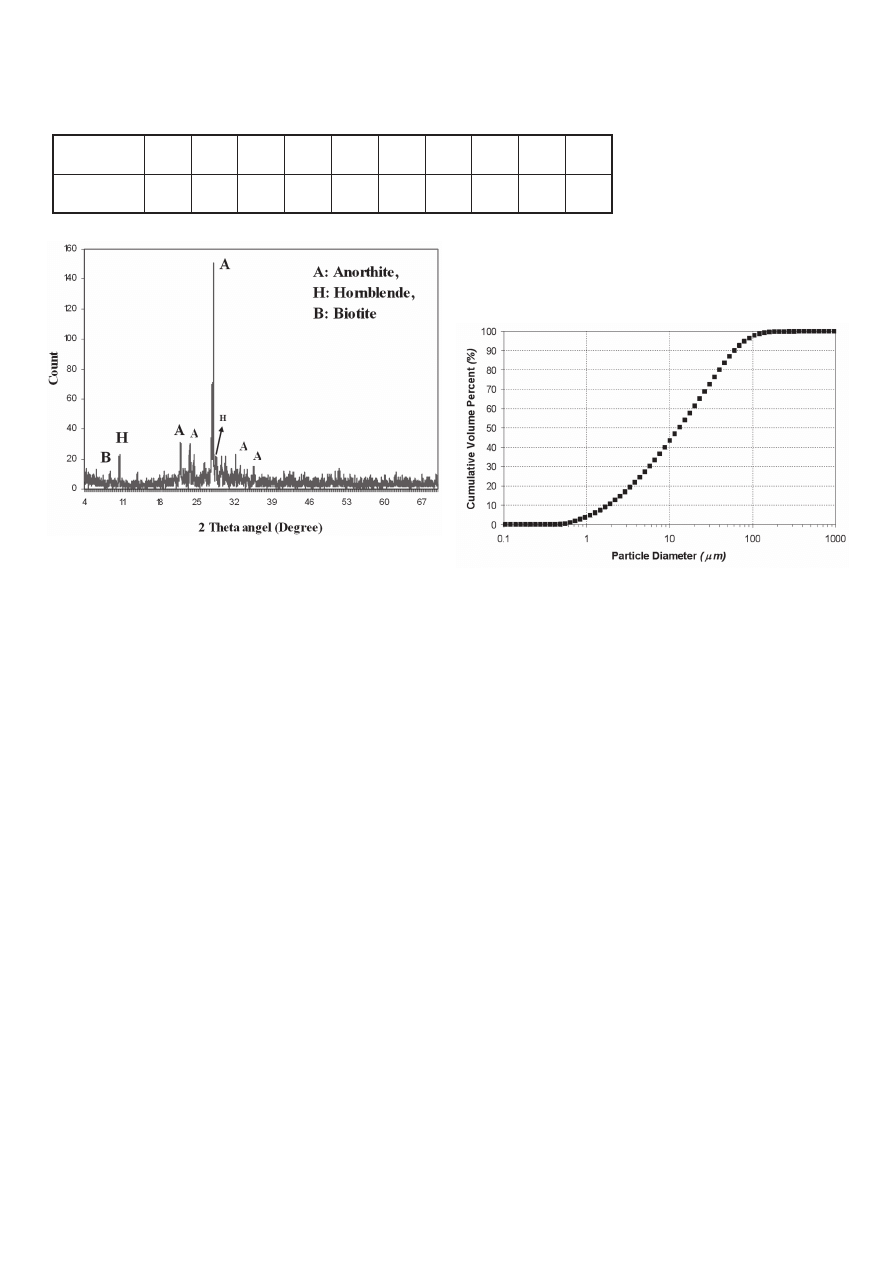
according to ASTM standard C311 are shown in Table 1. Figure 1
shows the X-ray diffraction pattern of the used pozzolan. As seen,
the crystalline mineral phases include;
Feldspar (Anorthite with empirical formula;
Na
0.05
Ca
0.95
Al
1.95
Si
2.05
O
8
),
Amphibole (Hornblende with empirical formula;
Ca
2
Mg
4
Al
0.75
Fe
3+
0.25
(Si
7
AlO
22
)(OH)
2
),
CWB-4/2009
207
Próbkę pucolany sporządzono mieląc ją w młynie kulowym do
powierzchni właściwej wynoszącej 305 m
2
/kg. Rozkład ziarnowy
tej próbki oznaczony za pomocą analizatora sitowego (Mastersizer
2000) pokazano na rysunku 2. Średnie ziarno zmielonej próbki
pucolany wynosiło 23,82 μm.
Stosowany w badaniach cement portlandzki II (według ASTM)
oraz klinkier portlandzki pochodziły odpowiednio z fi rm cemento-
wych Tehran i Khash. Cement portlandzki był zmielony w młynie
kulowym do powierzchni właściwej według Blaine’a wynoszącej
312 m
2
/kg. Natomiast próbkę klinkieru zmielono w laboratoryjnym
młynku kulowym do powierzchni właściwej według Blaine’a równej
306 m
2
/kg. Skład chemiczny i fazowy cementu portlandzkiego
i klinkieru portlandzkiego podano w tablicy 2.
Aktywator przygotowano z klinkieru portlandzkiego i małego do-
datku różnych aktywatorów chemicznych. Składu aktywatorów
chemicznych nie podano, gdyż jest to wynalazek, którego autorzy
są jego właścicielami. Zmieloną pucolanę naturalną i aktywator
złożony głównie z cementu portlandzkiego po dokładnym odwa-
żeniu zmieszano w proporcjach 77% pucolany i 23% aktywatora.
Do dokładnego zmieszania tych dwóch składników zastosowano
laboratoryjny młynek kulowy z niewielką ilością małych kul. Zaczyn
sporządzono mieszając spoiwo z wodą przez 5 minut w mieszarce
planetarnej, a następnie napełniano zaczynem formy o wymia-
rach 2 x 2 x 2 cm. Formy dojrzewały w atmosferze o wilgotności
przekraczającej 95% wW, w 25
o
C przez pierwsze dwie doby,
a następnie po rozformowaniu próbki dojrzewały w nasyconej
and Mica (Biotite with empirical
formula;
KMg
2.5
Fe
2+
0.5
AlSi
3
O
10
(OH)
1.75
F
0.25
).
The prepared sample of pozzolan
was previously ground in an industrial
closed-circuit ball mill to a Blaine
specifi c surface area of 305 m
2
/kg.
The particle size distribution of which
was determined by a laser particle
size analyzer (Mastersizer 2000) and the corresponding curve is
presented in Figure 2. The mean particle size of the ground natural
pozzolan was 23.82 μm.
Rys. 2. Rozkład ziarnowy zmielonej próbki pucolany
Fig. 2. Particle size distribution of ground pozzolan
Type II Portland cement (in accordance with ASTM standard) and
Portland cement clinker used in this work were prepared from
Tehran and Khash cement companies respectively. The prepared
sample of Portland cement was previously ground in an industrial
closed-circuit ball mill to a Blaine specifi c surface area of almost
312 m
2
/kg. The clinker sample, however, was ground in a laboratory
ball mill to a Blaine specifi c surface area of about 306 m
2
/kg. The
chemical and phase composition of both Portland cement and
Portland cement clinker are given in Table 2.
The compound activator was prepared from Portland cement
clinker and small amounts of some different chemical activators.
The composition of the compound activator is not introduced here
because of invention ownership. The prepared materials including
ground natural pozzolan and Portland cement-based compound
activator were weighed with good accuracy and mixed. The propor-
tions of the two materials were adjusted at 77.00% and 23.00% (by
total weight of binder) for ground natural pozzolan and compound
activator respectively. The mix was then thoroughly homogenized
for 10 minutes in a laboratory ball mill containing very few small
balls. To prepare paste specimens, the required amount of water
was added to the binder and after 5 minutes of mixing in a planetary
mixer, the fresh paste was cast into 2×2×2 cm moulds. The moulds
were stored at an atmosphere of more than 95% relative humidity at
25ºC for the fi rst 2 days and then after demoulding the specimens
were cured in lime-saturated water at 25ºC till the time of testing.
Tablica 1 / Table 1
SKŁAD CHEMICZNY PUCOLANY, % MASOWE
CHEMICAL COMPOSITION OF POZZOLAN (MASS%)
Składnik
Component
SiO
2
Al
2
O
3
Fe
2
O
3
CaO
MgO
SO
3
K
2
O
Na
2
O
Cl
-
LOI
%, masowe
mass %
61.57
18.00
4.93
6.69
2.63
0.10
1.95
1.65
0.04
2.15
Rys. 1. Dyfraktogram pucolany
Fig. 1. X-ray diffraction pattern of pozzolan

208
CWB-4/2009
wodzie wapiennej w 25
o
C aż do czasu badania. W związku z tym
że stosunek woda/spoiwo, a więc zawartość wody ma duży wpływ
na świeży i stwardniały zaczyn, ten stosunek przyjęto jako zmienną
wpływającą na urabialność i wytrzymałość na ściskanie badanego
spoiwa. Badaniami objęto siedem różnych wartości stosunku zmie-
niających się co 0,01 w zakresie od 0,30 do 0,35 oraz dodatkowo
0,37 mierząc jego wpływ na wytrzymałość na ściskanie próbek
zaczynu po 28, 60 i 90 dniach. W celu zbadania wpływu stosunku
w/s na urabialność świeżego zaczynu mierzono średnicę rozpływu
zgodnie z normą ASTM C230 uznając ten pomiar jako wskaźnik
urabialności. Początek i koniec wiązania oznaczano zgodnie
z normą ASTM C191-07 (Metoda normowa pomiaru czasu wiązania
hydraulicznego cementu za pomocą igły Vicata). W celu porównania
wytrzymałości na ściskanie próbek zaprawy z aktywowanej pucolany
naturalnej i z cementu portlandzkiego sporządzono kostki z zaprawy
o wynikach 5 x 5 x 5 cm zgodnie z normą ASTM C349-08 z tych
spoiw. Wytrzymałość zmierzono po różnych okresach wynoszących
28, 60, 90 i 360 dni. Stosowano znormalizowany piasek do zapraw
dostarczony przez fi rmę Tara Beton.
Wytrzymałość na ściskanie badano na prasie Toni Technic
z Niemiec, natomiast do badań rentgenowskich stosowano aparat
Philipsa, wybierając promieniowanie CuKα.
3. Wyniki i dyskusja
3.1. Konsystencja
Zmierzono średnicę rozpływu świeżego zaczynu wykazanego z ak-
tywowanej pucolany przy różnym stosunku w/s. Zaczyn z cementu
portlandzkiego wykonany przy stosunku w/c 0,36 i zmierzony w jej
przypadku rozpływ traktowano jako próbkę wzorcową. Otrzymane
wyniki przedstawiono na rysunku 3. Jak widać średnica rozpływu
zaczynu z aktywowanej pucolany przy stosunku w/s = 0,36 leży
bardzo blisko wyniku dla próbki wzorcowej. Im niższy stosunek
w/s tym trudniej jest wypełnić stożek pomiarowy, natomiast przy
stosunku 0,30 jest to w ogóle niemożliwe.
Since the ratio of water-to-binder (W/B) or the water content con-
siderably affects the properties of the fresh and hardened paste,
this ratio was considered as a variable and its effects on workability
and compressive strength of the paste was investigated. The W/B-
ratio was therefore adjusted at seven different levels of 0.30, 0.31,
0.32, 0.33, 0.34, 0.35, and 0.37 and the compressive strengths of
the paste specimens were measured at different ages of 28, 60,
and 90 days. For studying the effect of W/B-ratio on fresh paste
workability, the spread diameter was measured in accordance
with ASTM C230 (Standard Specifi cation for Flow Table for Use
in Tests of Hydraulic Cement) and considered as an indication of
relative workability. The initial and fi nal setting times of the material
were measured in accordance with ASTM C191-07 (Standard Test
Methods for Time of Setting of Hydraulic Cement by Vicat Need-
le). For comparing compressive strength of mortar specimens of
activated natural pozzolan and Portland cement, enough mortar
specimens of the size 5×5×5 cm were prepared in accordance
with ASTM C349-08 from both activated natural pozzolan and
Portland cement. This comparison was done at different ages of
28, 60, 90, and 360 days. The standard sand utilized for mortar
specimens was prepared by Tara Beton company.
A Toni Technique (Toni Technic, Germany) apparatus was used
for compressive strength testing. Laboratory techniques of
X-ray diffractometry (XRD; Philips Expert System), was used for
a more detailed investigation. The X-ray diffraction patterns of the
samples were recorded on a Philips Expert diffractometer using
CuKα radiation.
3. Results and discussion
3.1. Consistency of the paste
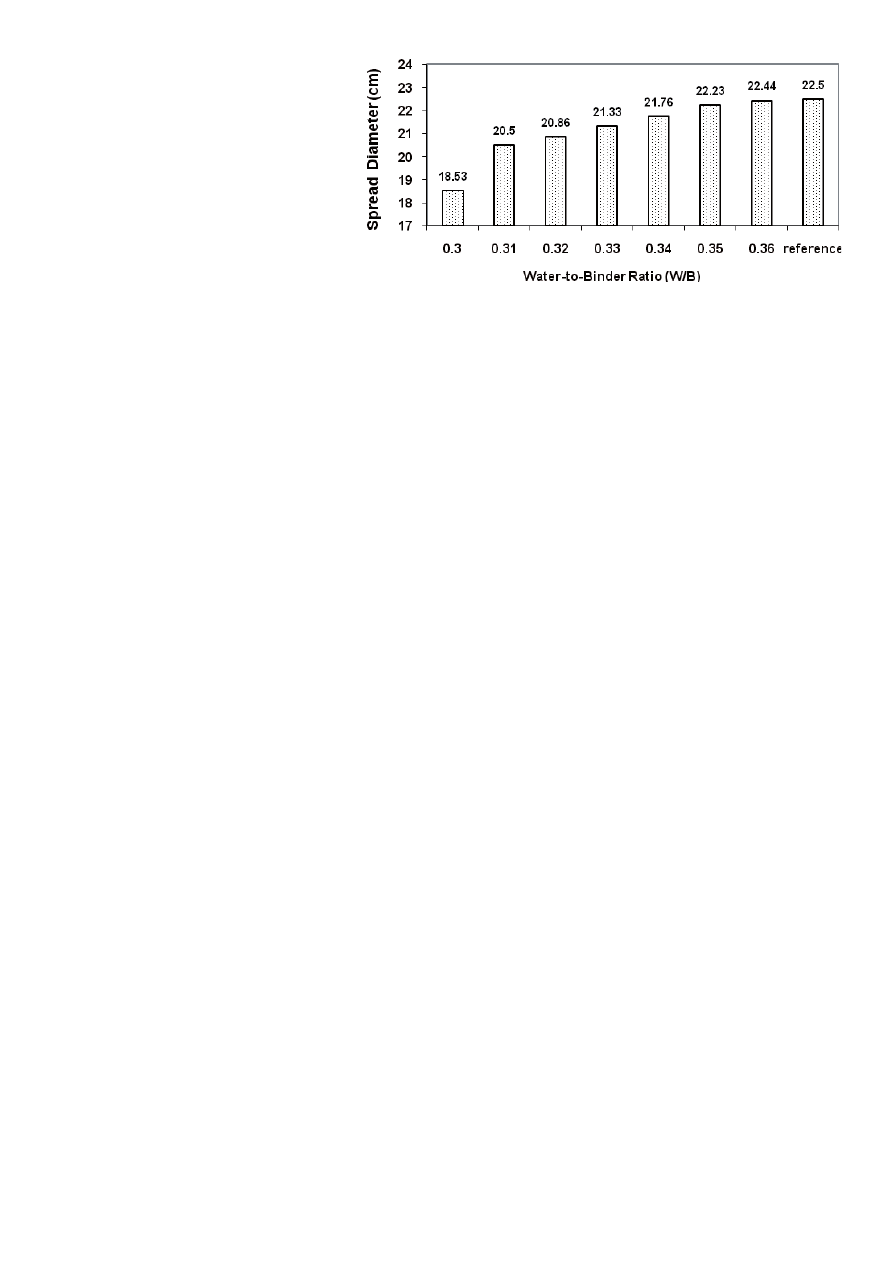
The spread diameter of the fresh paste of activated natural pozzo-
lan was measured at different W/B-ratios. Fresh Portland cement
paste prepared at a W/C-ratio of 0.36 was considered as the re-
ference material and its spread diameter was also measured. The
obtained results are presented on fi gure 3. The spread diameter of
the paste from activated natural pozzolan measured at W/B = 0.36
is quite close to that of reference paste. The lower the W/B-ratios,
Tablica 2 / Table 2
CHEMICZNY I FAZOWY SKŁAD CEMENTU I KLINKIERU PORTLANDZKIEGO
CHEMICAL AND PHASE COMPOSITION OF PORTLAND CEMENT AND PORTLAND CEMENT CLINKER
Składnik, % mas.
Component, mass%
SiO
2
Al
2
O
3
Fe
2
O
3
CaO
MgO
SO
3
K
2
O
Na
2
O
LOI
Free-CaO
Klinkier/Clinker
21.54
5.76
4.20
64.96
1.28
0.87
0.69
0.76
0.41
0.62
Cement portlandzki
Portland cement
22.70
4.64
3.27
62.99
3.50
2.00
0.66
0.25
0.62
0.68
Faza, % mas./Phase, mass %
C
3
S
C
2
S
C
3
A
C
4
AF
Klinkier/Clinker
53.57
21.35
8.16
12.78
Cement portlandzki/Portland cement
48.02
28.93
6.76
9.95
CWB-4/2009
209
3.2. Wytrzymałość na ściskanie zaczynu
z aktywowanej pucolany
Na rysunku 4 przedstawiono wyniki pomiarów
wytrzymałości zaczynów o różnym stosunku w/s,
badane po różnym czasie dojrzewania. Jak można
było oczekiwać wytrzymałość na ściskanie rosła
ze spadkiem stosunku w/s, a wyniki brzegowe
otrzymano przy najwyższym i najniższym stosunku.
Wzrost wytrzymałości przy malejącym w/s z 0,36
do 0,31 wynosi bez mała 30%. Wyjątek w ogólnej
zależności wytrzymałości na ściskanie od stosunku
w/s zaczynu stanowią wyniki po 28 i 60 dniach,
które wykazują znaczny spadek wytrzymałości
gdy stosunek w/s zmniejsza się z 0,31 do 0,30.
Powodem tej wyjątkowej zależności jest fakt, że
bardzo niski stosunek w/s spowodował trudności w prawidłowym
wypełnieniu form co pociągnęło za sobą powstanie niejednorod-
ności w stwardniałym zaczynie. Trzeba równocześnie podkreślić,
że zaczyn z aktywowanej pucolany ma znacznie gorszą urabial-
ność od zaczynu z cementu portlandzkiego, a to w połączeniu
z małym w/s czyni trudnym jego odpowietrzenie w trakcie wibracji.
Te pozostałe w zaczynie pustki powietrzne są traktowane jako
defekty strukturalne pogarszające wytrzymałość nieorganicznych
materiałów wiążących (22, 23).
Występuje znaczny wzrost wytrzymałości na ściskanie zaczynów
o różnym w/s z czasem dojrzewania. Ten wzrost jest szczególnie
duży przy małym stosunku w/s. Przy stosunku w/s równym 0,36
wzrost wytrzymałości na ściskanie po 60 dniach w porównaniu
do wytrzymałości po 28 dniach wynosi bez mała 19%, podczas
gdy w przypadku stosunku w/s = 0,30 wynosi około 34%. Ten
stosunkowo powolny, jednak znaczny wzrost wytrzymałości
z czasem dojrzewania jest dowodem na stosunkowo powolny
postęp hydratacji, który następuje w długim czasie. Taka właści-
wość została zanotowana w przypadku cementów zawierających
stosunkowo duży dodatek pucolany (2, 3, 5, 7, 9). Drugim waż-
nym zagadnieniem jest znaczne zmniejszenie wytrzymałości na
ściskanie po 28 dniach, gdy w/s zaczynu spada z 0,31 do 0,30
o czym już wspomniano. Ten spadek zaznacza się po 28 dniach
i po 60 dniach, jednak zmniejsza się z czasem. Spadek wynosi
po 28 dniach około 10%, podczas gdy po 60 dniach tylko 2,4%.
Natomiast po 90 dniach twardnienia wytrzymałość na ściskanie
wzrosła o 4,3% w zaczynie o w/s = 0,30 w porównaniu z zaczy-
nem o w/s – 0,31. Jeżeli mniejszą wytrzymałość zaczynu o w/s
= 0,30 przypisywaliśmy defektom mikrostrukturalnym związanym
z bardzo złą urabialnością podczas procesu formowania próbek,
szybszy wzrost wytrzymałości po dłuższym okresie może być
prawdopodobnie spowodowany wypełnieniem wcześniej występu-
jących pustek produktami dalszej hydratacji pucolany. Długi okres
powstawania hydratów może stopniowo zmniejszyć, a w końcu
usunąć większość defektów mikrostrukturalnych.
Maksymalna wytrzymałość na ściskanie po 28 dniach tward-
nienia zaczynu wynosi prawie 42 MPa w przypadku w/s =
0,31. Tę znaczną wytrzymałość na ściskanie można porównać
the lower the paste workability. According to the experiences, the
fresh paste casting was quite easy at W/B-ratios as low as 0.32.
Lower W/B-ratios, however, made the fi lling of the mold process
relatively diffi cult. It was very diffi cult to properly fi ll the molds with
the paste having a W/B-ratio equal 0.30.
3.2. Compressive strength of the paste from activated
pozzolan
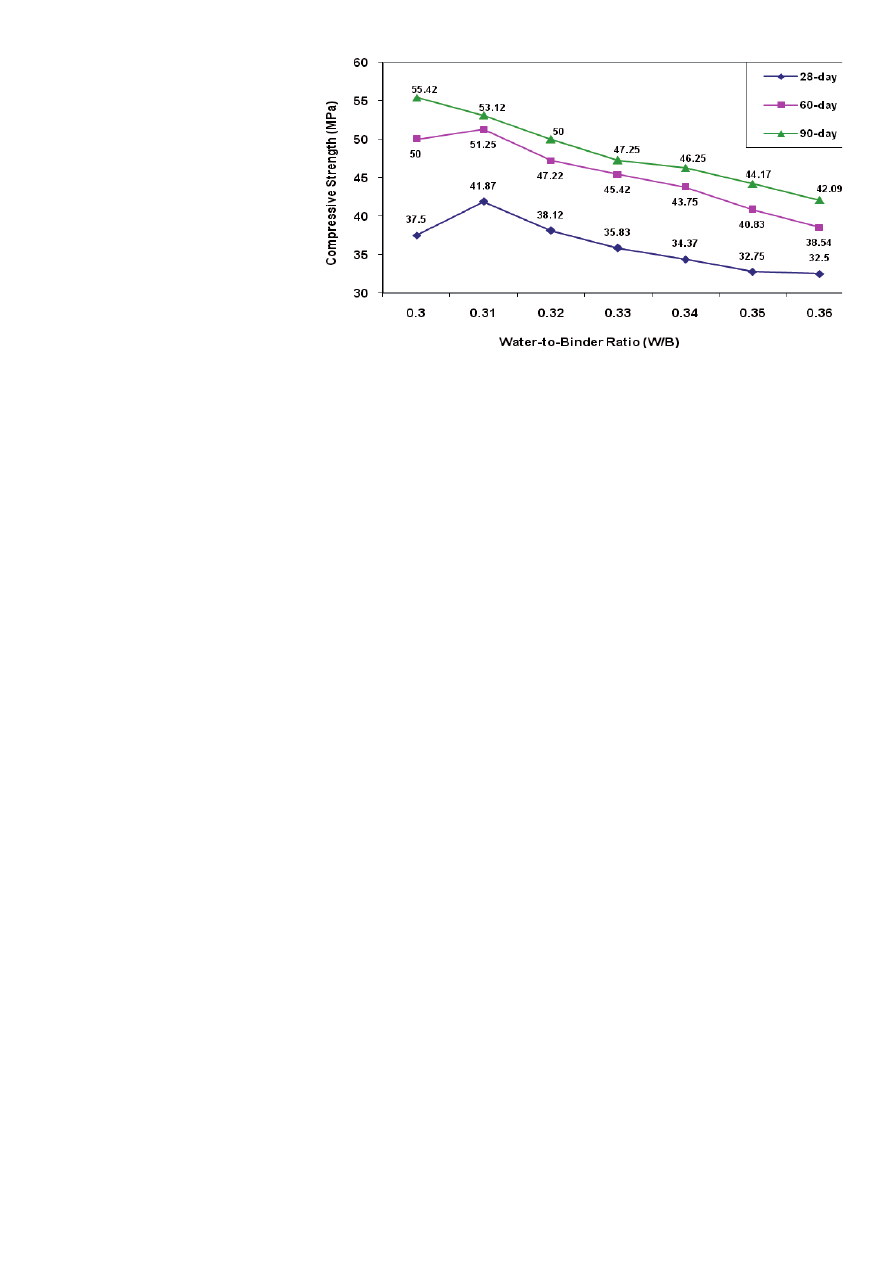
In Figure 4, the compressive strengths of the pastes with different
W/B-ratios and at different curing ages are depicted. As usual,
compressive strength increases with decreasing W/B-ratio and
the extreme values were obtained at the lowest and highest W/B-
ratios.
The strength increase for decreasing W/B-ratio from 0.36 to 0.31
is almost 30%, that is signifi cant. As an exception to the general
relationship between compressive strength and W/B-ratio of the
paste, the results after 28 and 60 days show a considerable dec-
rease of strengths when W/B-ratio is reduced from 0.31 to 0.30.
The reason for this exception is due to the fact that extremely low
W/B-ratio that made the casting process very diffi cult and resulted
in the formation of e.g. inhomogeneity in the hardening paste.
It must be simultaneously noted that the paste of the activated
pozzolan has worse workability compared to Portland cement
paste and this fact in case of low W/B-ratio makes it diffi cult to
remove the trapped air bubbles under vibration. Such trapped air
voids are considered as effective structural defect weakening the
strength behavior of inorganic binders (22, 23).
There is a signifi cant increase of compressive strength of the paste
with different W/B-ratios with curing age. This increase is higher
especially at lower W/B-ratios. At W/B-ratio of 0.36, the increase of
compressive strength after 60 days compared to 28-day strength is
equal to almost 19%, whereas at W/B-ratio of 0.30, is about 34%.
The relatively slow, but considerable gain of strength versus curing
age, is an indication of relatively slow hydration that progress con-
siderably over relatively long time. Such a behavior has also been
reported in cement blends containing relatively high proportions
of pozzolanic materials [2,3,5,7,9]. Another important point is the
considerable decrease of 28-day compressive strength when W/B-
Rys. 3. Zmiany średnicy rozpływu w zależności od stosunku w/s
Fig. 3. Variations of spread diameter versus water-to-binder ratio
210
CWB-4/2009
z wytrzymałością cementów portlandzkich.
Jednak w przypadku zapraw sytuacja jest
odmienna. Porównanie wytrzymałości na
ściskanie zapraw z aktywowanej pucolany
i cementu portlandzkiego pokazano na
rysunku 5. Wytrzymałość na ściskanie
zapraw z naturalnej pucolany jest znacznie
niższa. Jednak wytrzymałość na ściskanie
po dłuższym okresie dojrzewania, to jest po
90 i 360 dniach jest znacznie wyższa niż
akceptowalna graniczna wartość określona
dla zapraw cementu portlandzkiego po 28
dniach według normy ASTM C150.
W porównaniu do zaprawy z cementu
portlandzkiego, która osiąga stosunkowo
szybki wzrost wytrzymałości w początko-
wym okresie, lecz nie wykazuje przyrostu po
90 dniach i po dłuższym okresie, zaprawy
z ktywowanej pucolany zachowują się zu-
pełnie inaczej. W tych ostatnich wczesna wytrzymałość jest mała,
jednak jej przyrost po długim okresie czasu powoduje osiągnięcie
znacznych wytrzymałości.
Wytrzymałość na ściskanie zaprawy z aktywowanej pucolany
naturalnej po 360 dniach dojrzewania wykazuje znaczny przyrost
wynoszący 15% w stosunku do wytrzymałości po 90 dniach. Ta
znaczna wytrzymałość na ściskanie po długim okresie potwierdza
wolny ale stały postęp hydratacji aktywowanej pucolany natu-
ralnej. Dodatkowo mogą zachodzić reakcje chemiczne zaczynu
z aktywowanej pucolany i ziarn po długim czasie dojrzewania.
Wymaga to jednak szerszych badań, z zastosowaniem odpo-
wiednich metod.
3.3. Czas wiązania
Przeprowadzenie pomiarów czasu wiązania poprzedzono do-
braniem odpowiedniej ilości wody w celu otrzymania zaczynu
o właściwej konsystencji zgodnie z ASTM C191. Odpowiednia ilość
wody wynosiła 25% i 33% masowych odpowiednio dla cementu
portlandzkiego i aktywowanej pucolany. Wyniki pomiarów czasu
wiązania pokazano na rysunku 6. Natomiast czasy wiązania poda-
ne w normie ASTM C150 są następujące: początek 45 a koniec 376
minut. Jak wynika z pomiarów uzyskany czas wiązania zaczynu
z aktywowanej pucolany jest zgodny z tymi wymaganiami.
3.4. Badania rentgenowskie
Dyfraktogram aktywowanej pucolany po 60 dniach twardnienia
pokazano na rysunku 7. Jedynymi krystalicznymi fazami wy-
stępującymi w materiale są anortyt i hornblenda, które są także
zawarte w naturalnej pucolanie. Te krystaliczne fazy są w związ-
ku z tym stosunkowo trwałe w obecności aktywatora, natomiast
bezpostaciowe składniki pucolany ulegają hydratacji reagując
z aktywatorem i wodą.
ratio is reduced from 0.31 to 0.30, the exception mentioned before.
This reduction that is just seen after 28 and 60 days diminishes with
time. The amount of reduction at the age of 28 days is about 10
%, whereas a lower reduction of about 2.4% is observed after 60
days. After 90 days of hardening, however, almost 4.3% increase
in compressive strength is found when W/B-ratio is reduced from
0.31 to 0.30. If the strength reduction of the paste with W/B-ratio
of 0.30 is attributed to microstructural defects arising from very
low paste workability during casting, decrease of this reduction
and later strength increase can be probably caused by fi lling the
existing earlier voids with the products of the pozzolan hydration.
Long time formation of hydrates can gradually reduce and fi nally
remove most of the microstructural defects.
The maximum compressive strength after 28 days of paste harde-
ning is almost 42 MPa at W/B-ratio of 0.31. Such high compressive
strength can be compared to that of Portland cement strength.
However, for mortars the situation is different. The comparison
of the compressive strength of activated natural pozzolan and
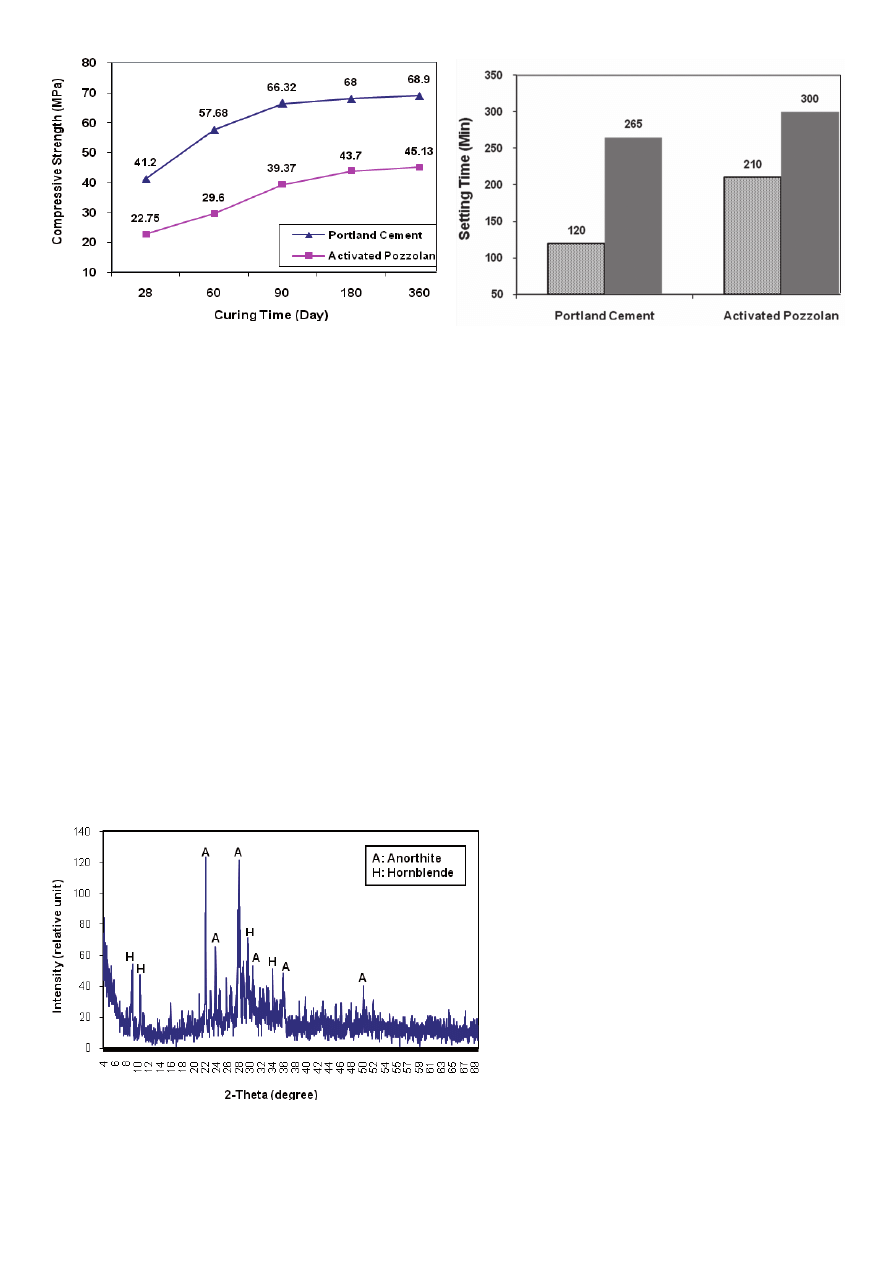
Portland cement mortars is presented in fi gure 5. As seen, the
compressive strength of mortars from activated natural pozzolan
is evidently lower. However, strengths after long curing periods, i.e.
for 90 and 360 days, are signifi cantly higher than the acceptable
limit defi ned for 28-day compressive strength of Portland cement
mortar in ASTM C150, i.e. 28 MPa.
In comparison to Portland cement mortars which show a relatively
high rate of strength development at early age, but no increase
after 90 days and later, the mortars of activated pozzolan behave
quite differently. Although the rate of early strength development
is quite low, it continues over relatively very long time. The com-
pressive strength of Portland cement mortar after 360 days of
hardening shows only increase of about 4% compared to its 90-day
compressive strength, but for activated natural pozzolan mortar
the strength gain continues over relatively long time.
Rys. 4. Wytrzymałość na ściskanie w zależności od stosunku w/s zaczynu po różnym czasie doj-
rzewania
Fig. 4. Compressive strength versus W/B-ratio of the paste after different curing ages
CWB-4/2009
211
Hydratacja aktywowanej pucolany nie jest związana także z po-
wstawaniem faz krystalicznych wykrywalnych rentgenografi cznie.
Trzeba w związku z tym zastosować w przyszłości inne metody
obejmujące analizę termiczną, spektroskopię w podczerwieni oraz
magnetyczny rezonans jądrowy.
3.5. Badania za pomocą mikroskopu skaningowego
Pod mikroskopem skaningowym badano zaczyn z aktywowanej
pucolany po 60 dniach dojrzewania. Jak można stwierdzić na
rysunkach 8 i 9 mikrostruktura preparatów składa się z matrycy,
w której występują małe cząstki o różnych wymiarach i nieregular-
nych formach. Matryca jest stosunkowo jednorodna oraz zwarta.
Wyniki mikroanaliz EDAX niektórych cząstek (A i B) zebrano
w tablicy 3. Dla porównania skład chemiczny faz krystalicznych
występujących w pucolanie, to jest anortytu i hornblend,y podano
w tablicy 4.
Porównanie składów chemicznych podanych w tablicach 3 i 4
pokazuje, że skład cząstek w zaczynie jest bliski anortytu, głównej
The compressive strength of activated natural pozzolan mortar
after 360 days of hardening shows a high increase of almost
15% compared to its 90-day strength. This considerably high
compressive strength after long curing time confi rms slow, but
constant progress of the activated natural pozzolan hydration. In
addition, there might occur chemical interactions at the interface
of activated pozzolan paste and sand grains over relatively long
curing times. This, however, requires more investigations using
suitable laboratory techniques.
3.3. Initial and fi nal setting time
For measurement of setting times, the required amount of water
for standard paste consistency was fi rst determined for each of the
two binders in accordance with ASTM C 191. The results were 25
and 33% (by mass of binder) for Portland cement and activated
pozzolan respectively. The results of setting time measurements
are presented on fi gure 6.
The minimum and maximum time limits defi ned in ASTM C150
standard for initial and fi nal setting time of Portland cement paste
at standard consistency are 45 and 376 minutes respectively. As
seen, both the initial and fi nal setting time of activated
pozzolan paste are within these standard limits.
3.4. X-ray diffraction analysis
The X-ray diffraction pattern of hardened activated pozzo-
lan paste after 60 days of curing is shown in fi gure 7. The
only crystalline phases present in the material include An-
orthite and Hornblende, which were present in the starting
pozzolan powder. The crystalline phases of the starting raw
material are therefore chemically stable in the presence of
solid compound activator and this is the amorphous part of
the material, which takes part in the cementing reactions
with compound activator and water.
The hydration of the activated pozzolan also do not pro-
duce any crystalline or X-ray detectable compounds. The
other methods should then be used for characterization
Rys. 5. Wytrzymałość zaprawy na ściskanie w funkcji czasu dojrzewania
Fig. 5. Compressive strength of mortar specimens versus curing age
Rys. 7. Dyfraktogramy stwardniałego zaczynu z aktywowanej pucolany
Fig. 7. X-ray diffraction pattern of hardened paste of activated pozzolan
Rys. 6. Początek i koniec wiązania zaczynów
Fig. 6. Initial and fi nal setting time
212
CWB-4/2009
of this paste composition including TG-DTA, FTIR spectroscopy,
and MAS NMR spectroscopy.
3.5. SEM studies
The hardened paste of activated pozzolan after 60 days of cu-
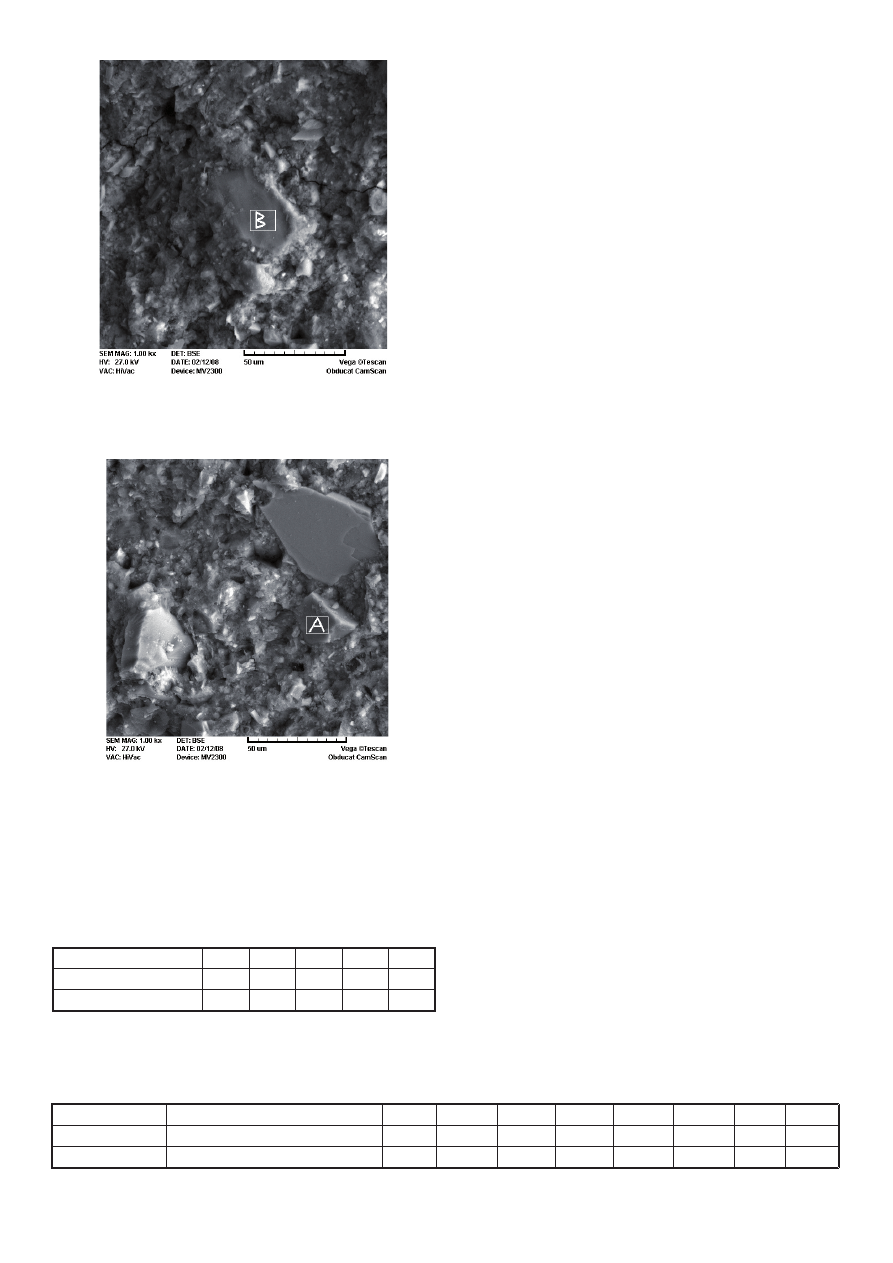
ring was studied using scanning electron microscopy. As it can
be seen on fi gures 8 and 9 which show SEM micrographs, the
paste microstructure consists of a matrix in which small crystals
of different sizes and irregular shapes are embedded. The matrix
is relatively uniform and well compacted.
The results of EDAX microanalysis of some particles (A and B) are
presented in table 3. For comparison, the chemical composition of
the crystalline phases identifi ed in pozzolan powder, i.e. Anorthite
and Hornblende, are given in table 4.
A comparison of the chemical composition, given in tables 3 and 4,
clearly shows that the crystals embedded in binder matrix are close
to anorthite, i.e. the main crystalline phase of both the pozzolan
powder and the 60-day cured hardened paste. The crystalline
phases of hornblende and biotite were diffi cult to identify in SEM
studies due to their small quantities.
4. Conclusions
The experimental results obtained in the study of pumice-type
natural pozzolan activation using a solid activator based chiefl y
on Portland cement and small content of chemical substances,
confi rm the signifi cant potential of this activator in activating pumi-
ce-type natural pozzolan. This activator can be used for production
of low cost hydraulic binder from natural pozzolan. The 28-day
compressive strength of the mortar specimens from the activated
natural pozzolan, reached almost 30 MPa, which is higher than
the minimum acceptable limit defi ned for 28-day compressive
strength of Portland cement mortar in ASTM C150. Although the
rate of strength development is lower compared to Portland ce-
ment mortar, but it continues over relatively long time resulting in
signifi cantly high compressive strengths up to 45 MPa after 360
days of hardening. Both initial and fi nal setting time are practically
acceptable and within the ASTM standard limits defi ned for Port-
land cement paste. The products of hydration are not detectable
by X-ray method and other suitable laboratory techniques must
therefore be sought for characterizing the reaction products.
Rys. 8. Mikrofotografi a stwardniałego zaczynu z aktywowanej pucolany
Fig. 8. SEM micrograph of hardened activated pozzolan paste
Rys. 9. Mikrofotografi a stwardniałego zaczynu z aktywowanej pucolany
Fig. 9. SEM micrograph of hardened activated pozzolan paste
Tablica 3 / Table 3
SKŁAD CHEMICZNY OTRZYMANY MIKROANALIZĄ RENTGENOWSKĄ,
% MASOWE
CHEMICAL COMPOSITION OBTAINED FROM EDAX ANALYSES,
MASS %
Element
Na
Ca
Al
Si
O
Mikroobszar A/Region A
4.37
5.84
12.73
25.59
51.46
Mikroobszar B/Region B
2.83
9.77
14.97
26.09
46.34
Tablica 4 / Table 4
WZORY I SKŁAD CHEMICZNY ANORTYTU I HORNBLENDY
CHEMICAL COMPOSITION OF ANORTHITE AND HORNBLENDE, MASS %
Phase
Chemical formula
Na
Ca
Al
Si
O
Mg
H
Fe
Anorthite
CaAl
2
Si
2
O
8
0.41
13.72
18.97
20.75
46.14
-
-
-
Hornblende
Ca
2
[Mg
4
(Al,Fe
3+
)] Si
7
AlO
2
2(OH)
2
-
9.76
5.75
23.94
46.76
11.84
0.25
1.70

CWB-4/2009
213
fazy krystalicznej pucolany. Natomiast fazy krystaliczne hornblendy
i biotytu były trudne do znalezienia pod mikroskopem elektronowym
z uwagi na ich małą zawartość.
4. Wnioski
Wyniki badań pumeksowej pucolany naturalnej aktywowanej akty-
watorem opartym na cemencie portlandzkim potwierdza jego dużą
zdolność aktywacyjną w przypadku stosowanej pucolany. Ten akty-
wator może być stosowany do produkcji dobrych i tanich materia-
łów wiążących. Wytrzymałość na ściskanie zaprawy z aktywowanej
pucolany osiągnęła bez mała 30 MPa, co przekracza graniczną
wartość minimalną podaną dla zaprawy z cementu portlandzkiego
po 28 dniach twardnienia w normie ASTM C150. Aczkolwiek tempo
wzrostu wytrzymałości jest mniejsze niż cementu portlandzkiego, to
jednak jego wzrost przez długi okres czasu powoduje osiągnięcie
dużej wytrzymałości na ściskanie na poziomie 45 MPa po 360
dniach twardnienia. Czas wiązania zaczynu jest również dobry,
mieszczący się w granicach podanych w normie ASTM C150 dla
cementu portlandzkiego. Produkty hydratacji nie są wykrywalne
rentgenografi cznie i wymagają zastosowania odpowiednich metod
w celu pełniejszego scharakteryzowania zaczynu.
Literatura / References
1. F. M. Lea, The Chemistry of Cement and Concrete, third edition, Edward
Arnold, London, 1974.
2. C. Shi and R. L. Day, Comparison of different methods for enhancing
reactivity of pozzolans, Cement and Concrete Research, 31, pp. 813-818,
(2001).
3. B. Uzal and L. Turanli, Studies on blended cements containing a high
volume of natural pozzolans, Cement and Concrete Research, 33, pp.
1777-1781, (2003).
4. P. K. Mehta and P. J. Monteiro, Concrete, Microstructure, Properties,
and Materials, Prentice Hall, Englewood Cliffs, NJ, 1993.
5. R. C. Mielenz, L. P. Witte, and O. J. Glantz, Effect of calcination on natural
pozzolans, Proceedings of Symposium on Use of Pozzolanic Materials,
Philadelphia, PA, USA, pp. 43-91, (1949).
6. G. Rossi and L. Forchielli, Porous structure and reactivity of some natural
Italian pozzolans with lime, Cemento, 73, pp. 215-221, (1976).
7. U. Costa and F. Massazza, Infl uence of thermal treatment on the activity
of some natural pozzolans with lime, Cemento, 73, pp. 105-122, (1977).
8. S. Techner, The texture and surface area of kieselguhrs after various
treatments, Clay Miner. Bull., 1, pp. 145-150, (1951).
9. K. M. Alexander, Activation of pozzolanic materials with acid treatment,
Aust. J. Appl. Sci., 6, pp. 224-229, (1955).
10. R. T. Hemmings, E. E. Berry, B. J. Comelius, and D. M. Golden, Eva-
luation of acid-leached fl y ash as a pozzolan, Proc. Master. Res. Soc.,
136, pp. 141-161, (1989).
11. K. M. Alexander, Reactivity of ultra fi ne powders produced from siliceous
rocks, J. Am. Concr. Inst., 57, pp. 557-569, (1960).
12. M. K. Chatterjee and D. Lahiri, Pozzolanic reactivity in relation to
specifi c surface of some artifi cial pozzolans, Trans. Indian Ceram. Soc.,
26, pp. 65-74, (1967).
13. M. Collepardi, A. Marcialis, L. Massida, and U. Sanna, Low pressure
steam curing of compacted lime-pozzolan mixtures, Cem. Concr. Res., 6,
pp. 497-506, (1976).
14. K. M. Alexander and J. Wardlaw, Limitations of the pozzolan-lime
mortars strength test as method of comparing pozzolanic reactivity, Aust.
J. Appl. Sci., 6, pp. 334-342, (1955).
15. K. M. Alexander, Activation of pozzolanic materials by alkali, Aust. J.
Appl. Sci., 6, pp. 224-229, (1955).
16. R. L. Day and C. Shi, Activation of natural pozzolans for increased
strength of low-cost masonry units, Proceedings of 6th Canadian Masonry
Symposium, Saskatoon, pp. 499-507, (1992).
17. Allahverdi, A. and Škvara, F., Fly ash-based geopolymer cement,
Binding Geopolymeric Mixtures, Czech Patent No. 291443, fi lled on:
January 10, 2003.
18. Allahverdi A. and Škvára F., Development of an Acid-Resistant Geopo-
lymeric Cement, International Congress of Chemical and Process Engine-
ering 16th (CHISA 2004), Prague, Czech Republic, 22-26 August, 2004.
19. Allahverdi A., Mehrpour K., and Najafi Kani E., Investigating the Possibi-
lity of Utilizing Pumice-Type Natural Pozzolan in Production of Geopolymer
Cement, Ceramics-Silikáty 52 (1), pp. 16-23, 2008.
20. John L. Provis, Chu Zheng Yong, Peter Duxson, and Jannie S.J. van
Deventer, Correlating mechanical and thermal properties of sodium sili-
cate-fl y ash geopolymers, Colloids and Surfaces A: Physicochemical and
Engineering Aspects, Volume 336, Issues 1-3, pp. 57-63, 2009.
21. Prinya Chindaprasirt, Chai Jaturapitakkul, Wichian Chalee, and Ubol-
luk Rattanasak, Comparative study on the characteristics of fl y ash and
bottom ash geopolymers, Waste Management, Volume 29, Issue 2, pp.
539-543, 2009.
22. Peter Duxson, John L. Provis, Grant C. Lukey, Seth W. Mallicoat,
Waltraud M. Kriven, and Jannie S.J. van Deventer, Understanding the rela-
tionship between geopolymer composition, microstructure and mechanical
properties, Colloids and Surfaces A: Physicochemical and Engineering
Aspects, Volume 269, Issues 1-3, pp. 47-58, 2005.
23. P. Forquin, A. Arias, and R. Zaera, Role of porosity in controlling the
mechanical and impact behaviours of cement-based materials International
Journal of Impact Engineering, Volume 35, Issue 3, pp. 133-146, 2008.
Wyszukiwarka
Podobne podstrony:
Akryl na szablonie krok po kroku, Przedłużenie naturalnej płytki za pomocą akrylu kamuflującegox
13 Pomiar rezystancji za pomocą mostka prądu stałego
DEPRESJA, Wyznaczenie depresji naturalnej za pomocą
regulacja prędkości kątowej obcowzbudnego silnika prądu stałego za pomocą przerywacza tyrystorowego
Masę solną można barwić za pomocą barwników naturalnych, prace techniczne, masa solna i inne robótki
13. Pomiar rezystancji za pomocą mostka prądu stałego
Wyznaczanie gęstości cieczy za pomocą wagi Mochra i gęstości ciała stałego i cieczy przy pomocy p
Oczyść swoje tętnice za pomocą 6 naturalnych sposobów
Regulacja prędkości kątowej obcowzbudnego silnika prądu stałego za pomocą przerywacza tyrystorowego
Wyznaczanie gęstości cieczy za pomocą wagi Mochra i gęstości ciała stałego i cieczy przy pomocy 2
Wyznaczanie natężenia nieznanego źródła światła za pomocą fotometru, Technologia chemiczna, semestr
13 Pomiar rezystancji za pomocą mostka prądu stałego
regulacja prędkości kątowej obcowzbudnego silnika prądu stałego za pomocą przerywacza tyrystorowego
Naturalne odkażanie pomieszczeń za pomocą olejków eterycznych
Oczyść swoje tętnice za pomocą 6 naturalnych sposobów
Czy rekrutacja pracowników za pomocą Internetu jest
więcej podobnych podstron