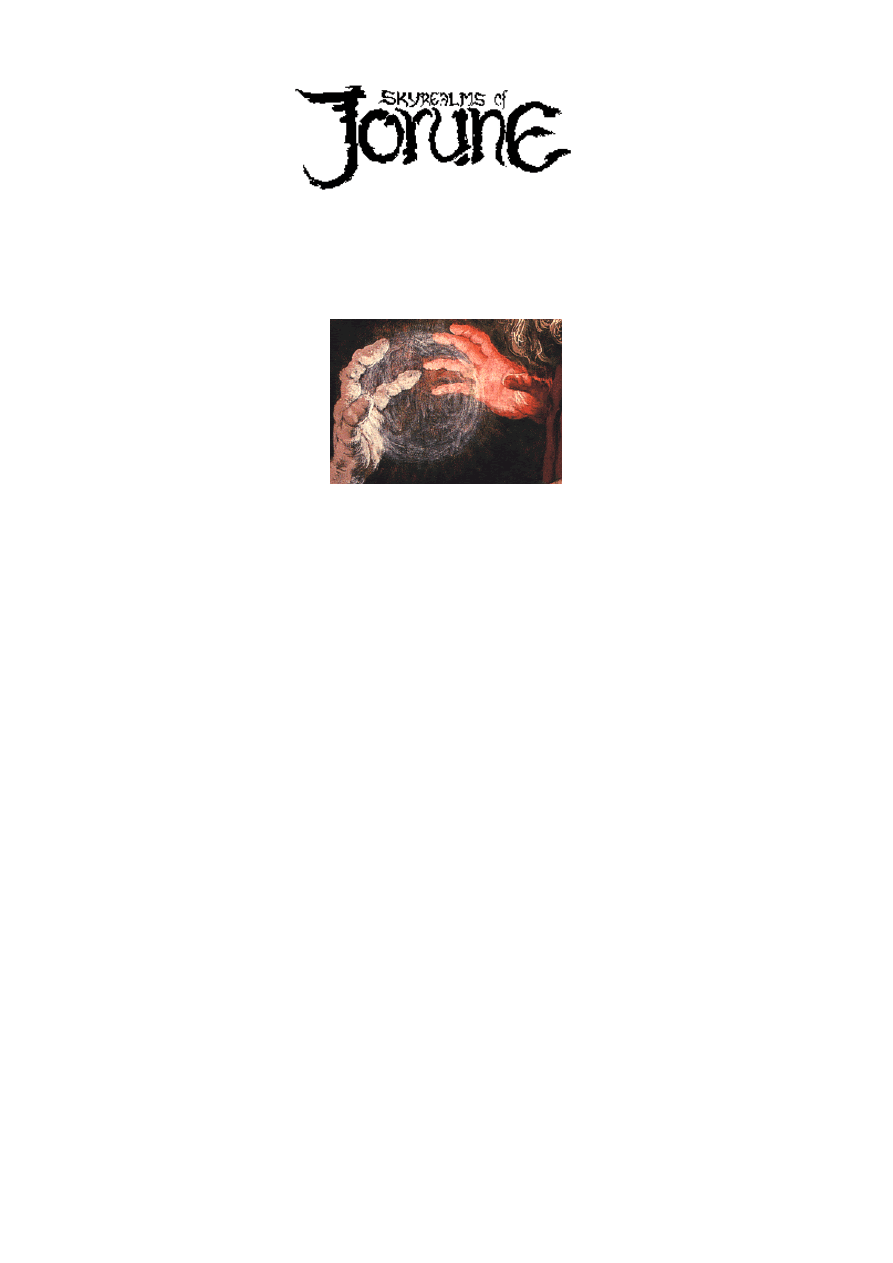
Weaving and manipulating the isho
By Sholari James
To cast a dysha, one must be able to weave the isho.
To weave the isho, one must be able to shape it
To shape the isho, one must understand it
To understand the isho, one must see and feel it
To see and feel the isho, one must be muadra
- Caji Gends
The isho energy of Jorune is a vital part of the everyday life of many species of the world.
Most acutely tuned to the isho are the shanta. Humans, who are generally oblivious to the
invisible forces surrounding everything, care little for what isho possibly could do for them.
However, one of the human sub-species – the muadru – can perceive the isho and can learn
how to manipulate it. To most of the muadru, isho is something that must be understood or
handled in order to lead a normal life. Although given the possibility to perceive and properly
manipulate the isho many muadru, out of ignorance or laziness, do not train to use this gift.
What is isho?
Isho is a multi-polaric form of energy that is more easily manipulated than, for example
electricity. It can be likened to “sticky” energy that can be twined and bundled together in
various strengths and combinations to create natural or artificial phenomena of awesome
power. The most noticeable trait of isho is that it can be stored in certain materials and is
drawn to normal electrical activity, even as minute as the activity in living cells. Crystals and
certain other materials are “charged” or “soaked” with isho through longer natural processes,
while living creatures seem to rapidly draw isho to them and accumulate it in their bodies.
The isho naturally creates the sho-sen (isho wind), which flows between Jorune and its
moons, as well as other amazing natural phenomena, such as warps and isho storms.
[See Isho – The Invisible World essay for more details on isho]

The Muadru – Heirs of the Invisible Fire
As humanity adapted to the strange world of Jorune it become attuned the isho around them.
While the first few generations of humans were unable to store any isho at all in their bodies
(thus showing up as “holes” in the sho-sen – invisible to lower lifeforms with tra-sense), the
later generations soon became soaked in the isho. The cells quickly adapted and isho moved
in as parasitic partner. It did not harm the humans, nor did the humans seem to benefit from it
at first.
It wasn’t until great surges of isho passed through the sho-sen during a period of 50 years (the
great lunar constellation – known among humans as the Age of Monsters) that the isho started
to destroy or alter human cellular stability. Various mutations of humans, which had been
damaged by isho were born. Most of these were simply natural failures or freaks, but quite a
few survived thanks to their enhanced tolerance to isho. Not only could they survive large
isho quantities without cellular damage, they also became capable to accumulate the isho
instead of simply soaking and seeping it. In most cases the growth of human tissue decreased
at the expense of the isho accumulating cells. Thus, the isho-damaged humans never grew to
normal height or build and remained weaker than their less changed cousins.
This natural alteration of humanity seemed at first to be a curse and it would take more than a
millennia before the curse was understood to be a mighty gift. Not until sholari Sho Copra-
Tra of Tashka discovered the racial potential of Caji Gends, did the muadru understand the
great gift bestowed upon them by Sho-Caudal.
The gift given to muadru was the ability to accumulate isho and perceive it. However, only
through learning the secrets of weaving and through extensive training would muadru become
caji. Weaving dyshas and operating shantic technology is not a natural talent. These are skills
that a muadra must learn. His body simply serves as the tool with which to perform these
skills.
Today, most muadra families living in civilised realms will learn how to live with their isho
accumulating bodies through kerning excess isho and maintaining the isho stability of their
bodies. Some train to become caji and earn a name of respect for themselves in their societies.
While most muadra will know how to kern, many muadra lack the focus or education to form
even the simplest naull orb. These muadra are referred to as isho illiterates or muads. In
realms or areas where muadra are openly oppressed the number of isho illiterates will be
higher as weaving often is totally banned. There are also those muadra who learn only to
weave the simple desti lightning blast dysha, without truly mastering the weave technique.
They are not even capable of weaving a nuall orb and no or little tra-sense. Because of their
violence and ignorance, they are known among both humans and muadru as dytes and are
responsible for much grief and prejudice towards muadru all over Jorune.
Muadra adolescence – Awakening the Fire
Muadru children seldom accumulate enough isho to give off more than small sparks (and then
only during isho storms). A young muadra’s body does not seem to accumulate much isho.
Like with most other races the isho simply washes through them with the sho-sen. During the
muadra childhood it is therefore impossible to weave dyshas. Muadra children can still train
to use their tra-sense, but as their isho is limited this is often very hard. However, some very
isho potent muadra families have been known to have especially gifted children, who learn
much about their tra-sense before reaching adolescence.
As soon as the muadra child reaches early adolescence his body changes and the muadra
becomes acutely aware of the isho passing through him. Now, the isho starts accumulating in
the cells until it has to be expelled somehow.

When this phenomena is first noticed in the muadra child, it is referred to as The Awakening
of the Inner Fire. It is sometimes surrounded by ceremony and reverence (as many muadru
families’ greatest fear is that their children won’t enter this stage). Among some muadru the
Awakening of the Inner Fire heralds the ascension to adulthood. From this day onwards the
muadra is sent to the Kerning Bay to learn the mysteries of the isho – and most importantly –
how to kern. Most children will have learnt the basics of kerning from eager or worried
parents, but now they can perform the kerning themselves, as their bodies finally are ready for
it. Also, for the first time the child will have enough isho to start using his tra-sense in a
meaningful way. A whole new world opens up to the muadra. In older days, the awakened tra-
sense was referred to as the Witching Eye and was something purposely undeveloped and
frowned upon by muadra families, as it brought only confusion and prejudice.
Kerning
Unlike humans and most other races of Jorune (except for shantas), the muadru accumulate
large amounts of isho in their bodies. This isho build-up can and often does create problems
for the muadra. When a muadra body is brimming with isho it will try to escape the body. The
first noticeable aspect of this is when the muadra’s eyes change colour slightly to that of their
dominant isho polarity/colour. (Muadra eyes are normally slightly duller or devoid of colour
than human eyes). The muadra will feel uneasy and even irritated during this isho build-up.
When the limit has been reached the muadra will give off short sparks when touching surfaces
that conduct isho well (accidentally activating crystals etc).
If the isho build-up has been rapid (during an isho storm or very close to something
“charging” the sho-sen) the isho will not have had time to “seep into” the muadra body
enough and will flee quicker. On these occasions the muadra can feel pains in especially the
joints and forehead and will give off random uncontrolled bursts of isho. This time the
uncontrolled energy bursts are more violent and can burn objects or even set them alight. A
muadra’s house, belongings and even his clothes might catch fire from the discharges, why
the tradition to stay outdoors during isho storms was developed. It’s these energy discharges
that have earned the muadru their ill repute as fire starters and roof burners.
In order to maintain the isho balance of their bodies the muadra learn to kern the excess isho.
This is easily done after some initial training and requires little preparation. The muadra
simply channels his isho into an inanimate body, such as a rock, the ground or even a
building, until he has reached a comfortable level. (Requiring a successful roll against a moon
skill of his choice). When kerning into the ground or other inanimate matter the process will
take up to 10 rounds to complete (depending on material and amount of isho). Therefore,
many muadru communities have fashioned themselves with pillars, kernodes, of isho
conductive rock that draws the kerned isho more rapidly (reducing the kerning time to 1-2
rounds). Most of these kernodes are situated in kerning bays for practical and lawful reasons
(as humans don’t want muadru running around kerning where they please). Many kernodes of
the kerning bays also serve as practice targets during dysha practice. Some advanced kernodes
will hold onto kerned or dyshas isho for up to 1 hour and can be drained by other caji. A caji,
one who wishes to master the isho through weaving, will train his body to accumulate large
amounts of isho. This isho will of course take longer time to kern and his accumulating
abilities can constitute a risk during an isho storm. Experienced caji therefore learn to kern
larger amounts of isho in a short time. Such is the price for power.
Experienced caji have also learnt how to kern other muadra, a valuable skill during severe
isho storms.
During isho storms, when the isho build-up is rapid, unstable, and of chaotically mixed
polarity/colour, muadru purposely kern most of their isho. It is dangerous to keep even low

amounts of isho during these occasions, as it seems to act as a catalyst for the new, rapidly
incoming isho of the storm. Kerning has to be performed several times during an isho storm to
prevent involuntary isho discharges.
When a body has accumulated much more isho than it normally can handle it will start giving
of uncontrolled discharges, as mentioned above. However, if the build-up was very strong and
swift, or if the muadra in question was capable of accumulating large amounts of isho, the
fleeing isho will start to burn. This is referred to as Burning and is something feared among
all muadru. The isho will flare away from the body with effects such as lighting surrounding
objects and electrocuting those nearby. Often the isho will start to “burn” already in the body,
creating nasty burns and erupting wounds all over the muadra’s body. This process can easily
kill a muadra if it is not stopped or controlled (successful roll against the lowest moon skill).
There are plenty of legends about great caji shooting flames from the eyes and mouth or
simply erupting totally in flame. It is said that Dharcopra Caji Sanghil Kur-Tanis of Miedrinth
turned into a pile of ash during the great isho storm of 3438 PC.
Tra-sense – The Third Eye
Muadru do not only have isho accumulating bodies – they have also attuned to the isho in a
way that enables them to perceive the fluctuations of the sho-sen and the isho itself. By
concentrating and shutting out all other senses, the changes and disturbances of the sho-sen,
as well as objects containing isho, can be perceived. As isho flows or radiates in different
directions and with varying polarity and make-up it can be tuned in on. Muadra refer to this as
Floating with the isho. There is a saying “One cannot see the sho-sen if one wades through it.
One must float with the sho-sen to see it”, which explains the necessity of attuning to the sho-
sen.
Separated polarities/colours of isho are more easily perceived, as they are refined, while the
general sho-sen with its mixed polarities is harder to grasp. Therefore, dyshas, crystals, warps
and isho technological devices are easier to perceive than the sho-sen.
Caji have tried to describe what they perceive with their tra-sense in more understandable
optical terms. In the Iscin Scriptures on Isho, Copra Caji Shutumil of Sydra explained that a
dysha looked like a bundle of multicoloured strands, a crystal was a glowing lamp, while a
warp was a glowing star with strands extending endlessly in all directions. With his tra-sense
a muadra can perceive what it is he weaves and therefore extract and select chosen amounts of
isho of different colours. Without the tra-sense, weaving would be chancing and never
successful. A caji learn new dyshas by first studying the dyshas of their sholaris until they
know and recognise the dysha make-up by heart. Only then can they try to weave it
themselves.
With their tra-sense, a skilled caji can actually feel the presence of larger isho disturbances
and even be able to locate it, as it acts as a beacon in the sho-sen. Warps and powerful isho
technological devices have been located in this way. Over closer distances (5-50 m) smaller
isho concentrations can also be detected, such as crystals, dyhas, smaller shantic devices etc.
Dyhshas can be perceived more easily, as they are brittle isho disturbances that “shock” the
sho-sen with their presence. They can only exist for brief periods and will either discharge
their isho upon contact with another object or be naturally unwoven by the sho-sen. A caji can
therefore study the general make-up of a dysha at a distance up to 50m (more in cases of very
experienced cajis).
Tra-sense is not a passive sense that the muadra can rely on. The normal human sensory input
is much stronger than the tra-sense. A muadra must therefore actively concentrate to use his
tra-sense. While boccord must expend isho to receive the signatures around them, a muadra
must only concentrate on the isho around him to notice the larger disturbances and their

make-up. Even if experienced caji find it easy and instantaneous to use their tra-sense, they
must nevertheless actively choose to use it every time.
[See Isho – The Invisible World essay for more details on the signature recognition abilities of
the boccord.]
The tra-sense of the muadra is very crude and primitive compared to that of indigenous Joruni
lifeforms, making them extremely short-sighted compared to a shanta. A muadra can only
perceive the bigger fluctuations and disturbances of the sho-sen and cannot see subtler
reactions as signatures. Operating isho technological devices therefore requires close contact
with the artefact in question (1-2 m).
The Weaving
The different polarities/colours of the isho act and look very differently. Some are “sticky”
and easy to weave into certain forms or combinations, while others are slippery and hard to
combine. Strands of some colours extend into larger patches or blotches, while strands of
other colours have jagged edges that seem to cut other strands if not combined correctly. To
add to the confusion, these traits differ when increasing the strength of the colour or in certain
combinations.
A dysha can also be “constructed” in two very different ways. The isho of the dysha bolts are
combined within the body of the weaver and channelled outward to an extremity, such as the
hands. Other colours might be “trickled” into this channelling while the isho passes outwards
through the body. A caji weaving a bolt can be recognised by the glow of his hands or even
arms. Strands of the dominant colour can often be seen trickling over the hands. Bolts are
generally easy to learn at first, but very hard to alter or bundle. The bolt is shot or flung from
the body and requires only little arm motion. As the bolts are easier to weave than orbs, they
can be found among many Joruni animals, as a part of their natural weapons.
Orbs require more theoretical weaving knowledge and are generally harder to learn at first.
Orbs can on the other hand be woven into a multitude of combinations and can be used for
many purposes. The standard orb will be orange-sized and will look like a bundle of tightly
woven energy, often of one colour. An orb is thrown much like a stone or ball, but will not
drop as rapidly, thus giving the appearance of defying gravity. It is actually the weave that
sets the limit to the orbs range, rather than gravity. Weaving of orbs is not common among
simpler animals and is seen by many shanta and muadru as a sign of intelligence.
A dysha is woven by extracting different raw polarities/colours of isho from the cajis’s body
and then weaving them together in various combinations, weave patterns and strengths. The
weaving requires the movement of fingers at first, which has given the phenomena its name –
weaving. Visible strands of differently coloured isho will be visible flowing from the
fingertips and will be woven together to an expanding orb in the palm of the weaver.
Inexperienced cajis will require both hands and all fingers to weave, while the more
experienced caji need only one hand. After a while the weaving is so swift and no longer
needs the movement of the fingers that the orb simply grows in the hand. Some very skilled
cajis can even weave orbs and bolts on other parts of the body.
A young muadra training to become a caji will spend time studying the make-up of his
master’s naull orb with his tra-sense. He will also learn by heart the secret rules that apply to
the weaving of the various colours of isho. When the apprentice knows how a naull works and
how it is woven in theory, it is time for him to learn how to extract certain colours from the

isho within him (using his moon skills). Some colours are easier to extract than others (Desti
for example) and the whole process requires much practice to master.
When the apprentice has mastered the extraction of all colours of isho, he is ready to weave
his own naull orb. This is the first physical attempt at weaving the isho and followed very
carefully. Most important is the ability to weave a naull orb that can be released from the hand
of the weaver. This is vital before learning how to weave dyshas. Weaving a naull orb or a
dysha for the first time will require a strong imprinting of the caji, in order for him to instantly
recognise the exact dysha make-up. Therefore the caji sacrifices part of his own isho
accumulating ability to learn or imprint a dysha. This is mainly his ability to recognise and
extract colours (colour points) from his body. This loss of spectrum can easily be regained
through draining a crystal for its colour spectrum (colour points). The first naull orb will be
very large, but will shrink to a football-sized orb with time and experience. First weave of a
person’s naull orb is normally followed by a Caji ceremony at the Kerning Bay. The
apprentice has earned his title as a caji – a weaver – and the respect of the muadra community.
Not all muadru have the focus to become caji, so it is a great honour.
After this, the caji will study hard under a sholari to learn dyshas. The sholari often demands
something in return of the caji for his services. This might be protection, servitude, moral
development or a promise to teach others.
Dyshas are never (or extremely rarely) learnt by chance. The secret of their composition and
weave technique are handed down from sholari to apprentice. To learn a certain dysha, one
must find a sholari who masters it and ask to become his apprentice. Some dyshas are family
traits and others well kept secrets of caji societies and cults. The hunt for dysha “recipes” is
nearly as intensive as the caji hunt for crystals (which are required in the learning process to
gain colour points).
Weaving a dysha does not always succeed. A failed weaving normally results in no dysha
being woven and that the process needs to be restarted from scratch. However, in some cases
the weave fails miserably and the caji fumbles the process. Dyshas might unweave in the air,
cannot be released, have weak effect, fly erratically or even gain greater or opposite effect.
These fumbles are feared, as they can cause great bodily injury to a caji. Terrible burn scars
are common among the dytes who haven’t mastered any other weaving than that of the
lightning blast dysha.
Most weaving failure are the result of inexperience or stress of the weaver. However, in some
cases it is other circumstances that cause the dysha to behave differently. This can be the other
weavers interfering or the proximity of powerful isho boosters or shantic technology. Some
locations of the sho-sen can be extremely strong with isho or very weak. Weaving in a an isho
storm is also a quick way to end one’s caji career. In many cases it succeeds – in many more
the caji starts Burning, blows his arm off or becomes bound to his target and suffers the same
effect. The effect an isho storm can have on a dysha (apart from multiplying the risk of
fumbling) is impossible to predict. It is best avoided entirely. Lastly, the various elements will
greatly change the effect of a dysha. Weaving underwater seems to enhance the effect and
range of a bolt, while an orb becomes harder to unweave. Weaving in or close to fire will
charge dyshas of Du greatly, while the late CopraCaji Eryc Samros of Kirlan proved that
weaving dyshas of Shal and Desti close to an electrical discharge creates truly cataclysmic
effects.

The Ever-Changing Dyshas
A caji will spend much of his lifetime mastering his dyshas and learning new ones. Learning a
dysha and how to weave it well is, however, not the only thing a caji will strive to master. A
dysha might have a certain effect, but its appearance, weave quality, range and duration can
differ greatly. A dysha is a tool that can be adapted to certain circumstances and certain needs.
A relatively simple dysha can be bundled by a skilled caji, giving it horrendous and powerful
effect. It is this effect that scares mundane humans the most. It seems that the isho
surrounding the caji is the only limit to the effect of the dysha.
Bundling a dysha’s duration, range or effect are among the first things a caji learns. Very
experienced cajis will also learn several other clever weave tricks, such as tight weaving,
adding false colours, one hand weaves, combining effects, false dyshas etc. Many of these
weave tricks have been developed to refine the dysha’s use or to make it harder for opponents
to unweave or interfere the dysha. It is said that true caji sholaris even can weave dyshas that
can be left behind as traps or dyshas that are invisible to all without tra-sense. It is the
diversity that makes the dysha a powerful tool and a deadly weapon.
Most of the common dyshas available to muadra and the effect of these will be known by
cajis, even if they do not the secrets of the weaving itself. There are, however some secret
dyshas known only by sinister caji cults or otherwise learnt from benevolent shantas. These
are well kept secrets and their use trademarks of the weavers.
All caji are aware of the fact that there exists a multitude of other dyshas. Being true isho-
harmonics, shantas are collectively believed to know the weaving of more than 1000 different
types of dyshas. Many of these are used for everyday purposes to make life easier or as forms
of communication. Most admired of the shantic dyshas are the powerful orbs that have
multiple effects or last indefinitely. While some of the simpler, everyday shantic dyshas could
be taught to cajis, there is a physical limit to what a muadra can learn. Their bodies are not
fully adapted to Jorune and some things are simply too hard or impossible to learn. Without a
fully developed tra-sense it is also impossible to weave finer details of the complex orbs.
Teaching a human a new form of dysha is among the shanta a terrible sin and only allowed
after long and careful consideration.
Other isho skills
The caji have explored the abilities of their isho accumulating bodies over the centuries and
other skills have been developed by cajis except for dysha weaving and tra-sense. The
unweaving is the skill most associated with normal weaving. It is the skill to quickly study the
make-up of a dysha being woven and spending isho in order to unweave it at it’s seems. Isho
from the caji’s body is extracted in strands of different colours that are known to negate or
unravel weavings of its opposite colours. The unweaving is risky business at best, as it
requires the dysha to come near enough to be unwoven (making dodging harder). Some
dyshas are harder to unweave than others and there is always a risk of the opposing caji
having used weave tricks. Needless to say, an acute tra-sense and a good grasp of the colour
spectrum is essential to survival.
Among the weave tricks is the skill to leech off others isho through constantly unravelling
dyshas. In this way caji have learnt how to transfer isho between them and even weave
powerful dyshas together (team weaving).
One of the most useful skills of a caji is the ability to force the body to accumulate large
quantities of isho during a short period of time. It is called caji entropy and is a process where
the caji seeks out the strongest points of the surrounding sho-sen and forces large amounts of

isho into his body. The effect is only temporary, as the body cannot “soak” properly in such
large quantities of isho. If the hasn’t been used or kerned within an hour the isho will start
fleeing chaotically, often resulting in a Burning.
The ability to perceive great isho disturbances has always drawn muadru to warps. The warp
itself is brittle phenomena that normally “falls” when something passes through it. Caji have
learnt to stabilise warps by gently fusing their hands to the warp and balancing its chaotic
isho. It is a skill that is very hard to master, but which has given enormous wealth to the
World Weaver Cult of the muadru. The World Weavers can be found working for many rulers
of the Joruni realms. Their services consist of finding warps, warp-secure areas, stabilising
and maintaining stable warps and slamming enemy warps. It is said that the World Weaver’s
true goal is gain enough understanding about warps so that they can be mapped. If they would
succeed with this feat they would become both powerful and dangerous.
Isho Technology – Shantic Technology
Shantic- or isho technology is the common word used by cajis and iscin all over Jorune for the
mysterious and often ancient artefacts found among the ruins of the shantic culture. Most are
composed of crystals and other natural isho conductive materials and will seem dead or
lifeless until given isho or woven instructions. To humans, shantic technology is extremely
hard to understand and impossible to operate. It is the muadru who are a link between the
world of the shantas and humans.
The same weave technique that is used to weave dyshas is used when operating shantic
technology. The device will either already have a woven pattern that needs to be altered or
will need a certain woven pattern to start. In some cases the weaving must be imprinted
permanently with parts of the weaver’s colour spectrum (adding colour points). In other cases
crystals need activation or channelling material needs to be “opened”. In all cases the use of
one’s body’s isho is vital.
To perceive shantic technology and to understand its use requires a tra-sense and, often
theoretical knowledge about isho technology (Lore: Shantic Technology) Among humans,
only the muadru have the physical capabilities to learn these skills.
Among the most common shantic technological devices are the basic cut crystals that will
release its stored isho in a typical effect. Crystal cutting has been known to shantas for many
thousands of years. Among humans, the knowledge how to cut crystals originated from the
seafaring Erucian culture. It is unknown how they obtained this knowledge (and other related
isho knowledge), but the craft spread over the centuries to all human realms. Today, the
Erucian or Classic cut is still the only way of cutting crystals known among non-shantas.
Another popular shantic tool is the crystal armour (which absorbs the isho from dyshas hitting
it) and crystal gauntlets. Crystal gauntlets are commonly found among caji and contain an
array of different clear and coloured cut crystals, enabling the caji to use crystals, enhance his
tra-sense, study the sho-sen, or parry incoming dyshas. The crystal gauntlet is a very common
tool among the Kakulya Brotherhood of Jaspian crystal schooner trimsmen.
A more powerful isho technological device is the cle-eshta which has many functions, such as
analyzing the sho-sen, searching for a copra, enhancing dyshas, open and stabilise warps,
summon and program evid, and control complex isho tech devices. Cle-eshtas are well known
among caji as a powerful tool.

[See the Isho Technology essay for more details on how shantic technology works and a list of
artefacts.]
The muadra society
The muadra of Jorune live in human societies and often regard themselves as totally human,
despite the prejudice towards them that exists. Nevertheless, many muadra feel that they are a
completely different people. Years of segregation or even exile have created a unique muadra
culture that is most noticeable in the eastern Doben-al, Sobayid and southern Heridoth. Here,
the isho world has mixed with everyday life, religion and history. In Sobayid, the isho culture
of the muadra is extremely strong and influences even the mundane human community. Many
humans talk about the Isho Culture or the Ishara Culture (after the Ishara Temple of
Miedrinth). In these regions, a muadra’s life is surrounded by ceremonies and traditions that
mean little or nothing at all to humans who do not perceive the isho. Most caji in this area will
learn the same range of dyshas, which they claim are the traditional dyshas first taught by Caji
Gends. Therefore they are sometimes referred to as the Followers of Gends. As with all
beliefs, The Way of Gends has many branches, such as coprists, various moon legions etc.
The Way of Gends has also spread to Khodre, Jasp, muadru of Dobre and to a select few
muadru in Thantier. Miedrinth, the muadru stronghold of Jorune, has recently seen the advent
of a new isho culture, known as Seytra. Numerous other smaller (and sometimes sinister)
muadru cults or societies also exist all over the civilised world. Some of these are feared and
persecuted even by the common muadru populace for their beliefs.
The Awakening of the Inner Fire and the Caji Ceremony are only a few of the many cultural
highlights of a muadra’s life. Special procedures during isho storms, reverence to the sho-sen,
Kerning Bay communions, cleansing of an area’s isho and isho charged forest weddings are
but a few of the mysterious muadra ceremonies that reach human ears as rumours only.
Especially the caji status and the relation between caji and sholari is surrounded by much
ceremony, mysticism and traditions. A sholari has an enormous respect in the muadra
community, much like holy men. Harming a sholari is a great crime and will cause great
anger in the muadra community. Several caji might follow a sholari through the country to
learn wisdom and new ways to wave dyshas. Most of these apprentices will protect their
sholari fiercely from any harm or injustice.
Caji etiquette is mentioned many times by humans – often accompanied with a sigh and a
shake of the head. It is complicated, as it involves weaving naull orbs, comparing of sho-sen
perceptions and references to old ways of conduct. It is based upon the much more complex
shantic etiquette which originally involved manipulation of the copra and the surrounding
isho as well as cryptic moral ways of conduct referred to as the Way of Life. The most
noticeable trait of the simplified caji etiquette is the holding of hands behind the back while
meeting for the first time. This is a non-aggressive gesture that also is said to make weaving
harder. Many human rulers will demand at least this (or kerning) when meeting with a
muadra. Displaying a naull orb is a very polite gesture and refraining from doing this can
often be seen as a sign of mistrust or an insult. Likewise, coming to close to a caji’s naull orb
or even touching it, it regarded as a great insult and intrusion of privacy. Hishtins and other
humans interacting frequently with caji will have learnt how to add isho to a naull crystal as a
primitive way of displaying their otherwise invisible naull. Touching of the brow is also
common in Sobayid, symbolising the Tra-Sense or Witching Eye and that the person in
question accepts that he is perceived/examined with tra-sense.

Dyshas duels are often surrounded by romantic ideals. It is often believed to be the result of
wronged caji, insults to one’s sholari or generally mysterious transgressions of the strange caji
etiquette. In reality, dysha duels often end in terrible injuries and tragedy. A dysha duel will
involve weave tricks, bundling of dyshas and unweaving, while running for cover. They
generally last only a few weaves, as someone is bound to get hit sooner or later. Vast amounts
of isho are generally used to defeat the opposition as quickly as possible. Strict rules of
engagement exist if the duel takes place in a Kerning Bay and in many cases it is forbidden to
weave the most dangerous dyshas. Needless to say, humans have forbidden all duelling
outside of Kerning Bays (as is all dysha use in most cities). Nevertheless, dysha duels are very
common among the dytes and more unscrupulous caji fighting for power in the muadru
neighbourhoods of the greater cities. The more martially inclined caji will wear various
weaving aids, be adept at weaving and own crystal armour, to better fend for themselves in
duels.
Document Outline
Wyszukiwarka
Podobne podstrony:
Sky Realms of Jorune Law and Order on Jorune
Sky Realms of Jorune Injuries and Healing
Sky Realms of Jorune The Lamorri
Sky Realms of Jorune The Sky People
Sky Realms of Jorune The River
Sky Realms of Jorune Isho The Invisible World
Sky Realms of Jorune Salu Sailors
Sky Realms of Jorune Thivin Families
Sky Realms of Jorune Jorune Astrology
Sky Realms of Jorune Khodre
Sky Realms of Jorune Rammin
Sky Realms of Jorune Acubon Secrets
Sky Realms of Jorune Iscin Religions
Sky Realms of Jorune Revised Timeline
Sky Realms of Jorune Limilates
Sky Realms of Jorune Introduction
Sky Realms of Jorune Religions of Jorune
Sky Realms of Jorune Natural Hazards of Jorune
Sky Realms of Jorune Jorune According to Sholari James
więcej podobnych podstron