!"# $%& !'
By Sholari James
The Reunited Khodre lies many leagues west of Burdoth, across the dry and hostile Doben-al
wastelands. Its culture and loyalty is often associated with its powerful neighbour on the other
side of the wastelands, but this is not entirely true. While Khodre is a fairly new actor on the
political arena and an expanding realm, its roots stretch far back into the misty history of
mankind on Jorune.
G
G
E
E
O
O
G
G
R
R
A
A
P
P
H
H
Y
Y
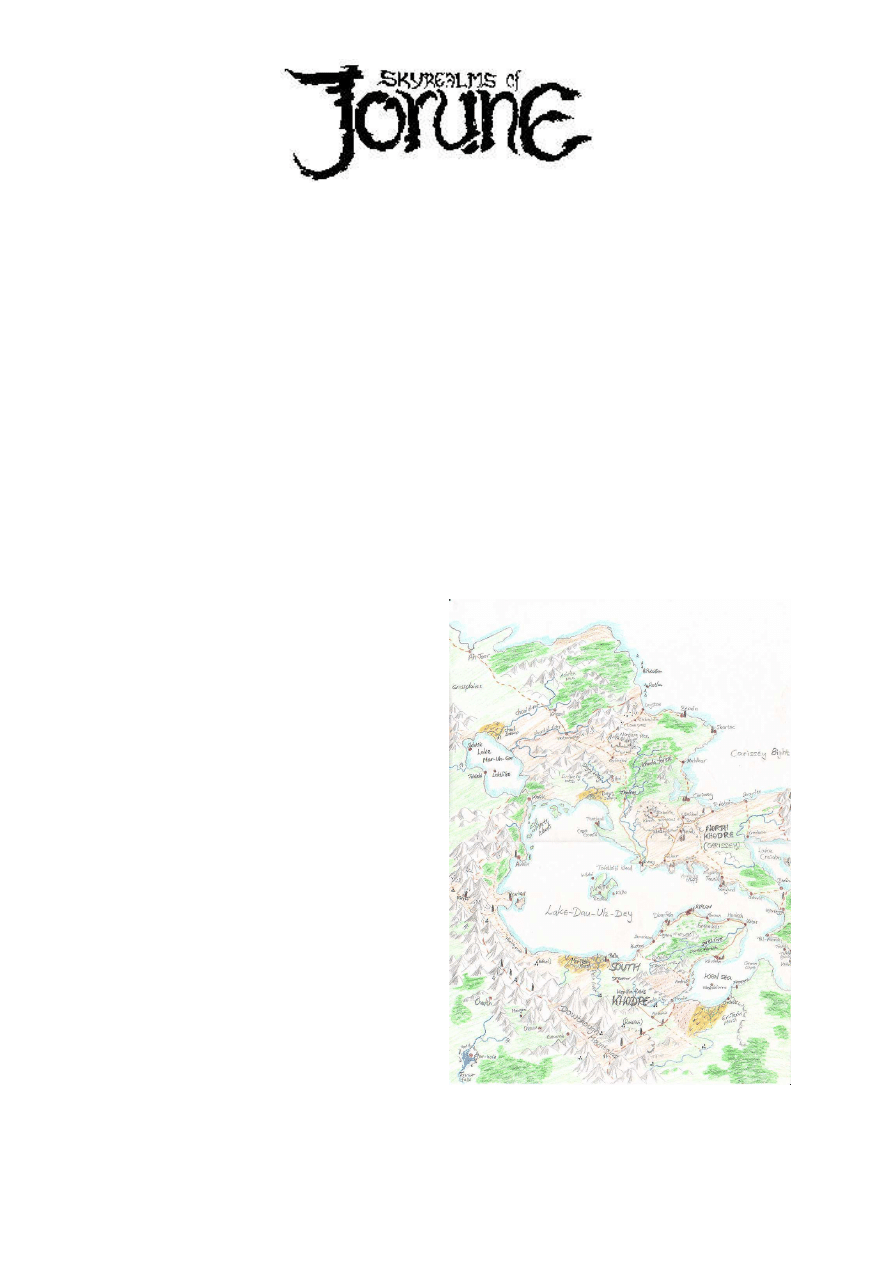
Between the vast grasslands of
Temauntro
and
the
desolate
wastelands of the Doben-al, lies the
fertile valleys and fields of Khodre.
The green fields and fair cities of
Khodre are on a constant vigilance
against boccord barbarians from the
east and crugar savages from the
west.
To the south and west lies the mighty
Dowtrough
Mountains.
Jorune’s
highest
mountain
chain
and
constantly
snow
clad,
these
mountains provide the Khodrens with
wealth in the form of crystal, ore and
gem mines and also serve as natural
barrier against the crugar hordes of
central Temauntro.
Khodre encircles Jorune’s greatest
inland lake, Dau-Uh-Dey, but for a
small portion to the west. Lake Dau-
Uh-Dey splits Khodre into a natural
northern and southern part. Traffic is
heavy upon the great lake as
merchants, fishermen, transporters,
pirates and acubon ply the waves. The
great lake is a vital link in keeping the
realm united and without it
The realm of Khodre

transportation from one end of the realm to the other would take many weeks. In actual size,
Khodre is huge, but in most places scarcely populated compared to other realms, such as
Burdoth, Heridoth and Thantier.
Southern Khodre is the home of the ruling kesht families and it is here that most of the
realm’s wealth and most of its political intrigues can be found. Southern Khodre is also the
greenest and most fertile part of the realm. The largest cities are found in southern Khodre and
Khodren civilisation is centred on the peninsula that juts northward into the great lake. On this
peninsula lies the capitol Kirlan and the neighbouring university town S’nabla. Southern
Khodre also houses most ancient ruins from the original inhabitants of the lands and most of
the scars from the crugar invasions. Therefore, the borders of southern Khodre are heavily
guarded and patrolled. Stern forts and high guard towers gaze out over the Doben-al plains
and the grim foothills of the Dowtrough Mountains.
Northern Khodre is a more rugged and rocky. Great hills or inland mountains harbour old
mines, where mainly metals and crystals are produced. It is in northern Khodre the open sea
ports are found. These are vital to Khodre’s economy and a vital trading link to the other
civilised relams. Great trading armadas leave these harbours for Jasp, Dobre, Lundere,
Burdoth, Heridoth and Anasan. The great Jaspian Trading Houses have for centuries had a
strong influence here. Their power stretches far beyond monetary power in northern Khodre,
and it is not uncommon to find Jaspian Trading Lords among the kims and kimmits of the
area. Also northern Khodre guards it borders carefully. The crugar are a menace to the west
and the lands of the barbarian boccord tribes of Ros Crendor are watched from old guard
towers to the east. However, most of the forts of northern Khodre are in a sad or ruined state.
It is the scars of the long civil strife that ravaged the countryside in northern Khodre and
nearly tore the realm apart forever.
In the western parts of Khodre lie great crystal mines among the foothills of the Dowtrough
Mountains. The great wealth of these mines lured many Khodrens and immigrants to these
barren areas where wealth could easily be made. This area is full of conflicts and crugar tribes
claim it as their ancestral grounds. Raids are frequent and the military of both Khodre and
Burdoth is present to guard the wealth of Khdore’s ruling families. Ghost towns dot the
landscape and a re quiet reminders to all that life can be short and brutal in these parts of the
realm. Except for crystals, the Dowtrough Mountains also supply merchants with the beautiful
kulunn marble which is used in the magnificent palaces, temples and state buildings
throughout Khodre, Jasp and Burdoth.
Close by, in the westernmost areas of Lake Dau-Uh-Dey, lies the Pirate Islands archipelago. It
is small stretch of land between the Dowtrough and Sudberg Mountains which is not claimed
by crugar or Khodrens. Among its treacherous reefs, island and cliffs are the hideouts and safe
havens of Lake Dau-Uh-Dey’s many pirates. Most notorious of these havens is the pirate
town of Kask. Its streets are full of scum and villain and its ports guarded by the fleet of the
pirate lords. There is no law in Kask and human and crugar walk the dangerous streets.
Raiders from Kask have built up a considerable fortune during the chaos of the civil strife and
have fortified the town against Khodren military raids. The rulers of Kask have become a
force that has to be reckoned with.

H
H
I
I
S
S
T
T
O
O
R
R
Y
Y
The first people to inhabit the lands around Lake Dau-Uh-Dey were the Korrin. The Korrin
people wandered down from their age-old refuge in the Dowtrough Mountains around 600
PC. Among the mountain vales they had found protection from the shantas but had become
separated from other survivors. No Earth-Tec had survived the colony disaster and the Korrin
had returned quickly to their roots. The increasing numbers of crugar finally forced them to
seek new lands. They settled in the fertile fields and hills south of Lake Dau-Uh-Dey and
worshipped a pantheon of gods (the Sa-Ying pantheon) associated with the waters and the
mountains. These gods had strong and varying personalities. They were of two hosts. The
Water Gods and the Mountain Gods. The Water Gods lived in all waters and were in charge
of the lakes, rivers, rain, snow, the fish of the lakes and streams as well as the protection of
boats. The Mountain Gods lived among the high Dowtrough Mountain peaks and were in
charge of the winds, the lands, the growing of crops and animals of the forests. Together they
had created man and hidden inside them the secret of the stars. The two hosts were constantly
contesting with each other’s powers and playing tricks on each other’s realms. This friendly
and mischievous competition was reflected in the Korrin culture as well. Offerings were
placed in Spirit Houses along the shores of lakes, rivers and on cliffs on in special small
temples among the mountains.
The gods and their traditions moulded the Korrin into simple farmers, hunters and fishermen,
never building great towns. The name they gave the new land is forgotten. Their tongue was a
surviving strand of Colonial Chinese and many aspects of their culture preserved traces of
their Terran ancestry.
When settling the shores of the great lake, the Korrin came into contact with the Homo
Aquatus humans who had survived in the area. The Homo Aquatus (calling themselves
Humans of the Aquamon Line or Last Humans) were relieved to find that their Land Cousins
had survived the Blind Ones Fury and the Korrin were grateful for the help the Linjau (“Deep
Ones”) gave them regarding edible fish, fishing techniques and the construction of boats.
Careful, sporadic trading commenced between the two cultures and they respected each
other’s territories. None of the people were numerous enough to cause conflict between them.
Slowly, some of the Korrin started to settle the northern shores of Lake Dau-Uh-Dey.
However, all islands of the lake were regarded the territories of the Acubon. To this day the
remnants of the Korrin people will not settle on any island, as it brings bad luck (“Never have
water as your neighbour to the north, south, west and east.”).
The crugar clans continued to pass silently through the lands of the Korrin during their Great
Wanderings. Most of them passing the still more numerous humans south of the great lake
and settling among their brethren in Temauntro. Old and forgotten Korrin legends speak of
the Kaujau (“Furred Ones”) that passed south of their lands and over the great Dowtrough
Mountains. The crugar would later return to become the greatest threat to the region.
A great plague swept through the Korrin lands in 800 PC. It would be nothing compared to
the plagues that would come during later centuries, but is still remembered in sad old songs.
During this time the Homo Aquatus suffered terribly and were believed to be extinct by the
Korrin. Great laments were made over their lost cousins.
However, in 1100 PC the Homo Aquatus re-appeared, now as the acubon. They had changed
physically and mentally and were very xenomorphic. The forced seclusion in their underwater
world to survive the plagues had altered them somehow. The Korrin never learnt their secret,
but trade between the two people started again. The Korrin and their ancestors would be the
people who best understood the acubon and the ones most often used as negotiators or
interpreters.

In the lands north of Lake Dau-Uh-Dey the Korrin met and mixed with the boccord tribes
during the great boccord migration west- and northward from Ros Crendor in 1100 PC. This
migration would eventually bring some boccord tribes all the way to Jasp. It was a successful
mix between the Korrin and the boccord, without much tension or hostilities. However, while
their cultures and traditions became mixed, the fransei language prevailed at the expense of
the original Korrin tongue. The boccord blood still runs deep among the people of northern
Khodre, who are known for being big, bulky miners.
When the greatest plagues swept through the humans lands in 1200-1700 PC, the acubon
suffered greatly and disappeared from the shores of Lake Dau-Uh-Dey. The Korrin believed
them extinct and created many laments for their lost brethren that still are sung today. It took
the Korrin and the Fransei tribes of the northern lands more than 500 years to return the
population to what it was before the plague years.
Around 1500 PC the first Jaspian Trading Houses started to establish themselves along the
coasts of the Jaspian Sea and the Carissey Bight. Jaspian-Salu trading ships had been present
in the area for more than 200 years, but now the traders had become a great political power
that created strong fortifications around their harbours. Safe harbours became small towns and
forts, but soon grew into cities and protectorates along Temauntro’s north-eastern coast. Many
such trading ports were also established along the northern coast of the Korrin/Fransei lands
and the organised Jaspians made their influence felt in the area. Jaspian crystal schooners
started to chart the inner regions of the land and Jaspian explorers mapped Lake-Dau-uh-Dey.
They brought influences of a greater civilisation and sophisticated tools to the Korrin and
Fransei tribes in the area, while bartering for natural goods of the lands. Of special interest
were the great crystal deposits north of Lake Dau-Uh-Dey and the first crystal mines were
established. The Jaspians seemed to have a great appetite for crystals and cemented their
power in the inner regions of what was to become northern Khodre.
[See Acubon Secrets essay for more information about the acubon.]
In 2200 PC a large group of Thanterian people migrated to the lands through the western
passes of the Thodic Mountains and through the wastelands of the Doben-al. They were of
Coronian descent and their culture had flourished in eastern and central Thantier after a
century of unity. The great number of people established colonies in these lands north of the
Thodic Mountains and the simple Korrin people were no match to the battle hardened and
highly competitive Coronians. Towns and forts were established, but soon grew into cities
along Lake Dau-Uh-Dey’s southern shores. It was the Coronians that gave the region its first
documented name, Carissey and introduced metal coinage that replaced the crystal currency
previously used. Powerful dakrani families such as the DharWin, DharMartin, Galitei and
Corolia take turns at ruling Carissey over the centuries to come. Along with their powerful
infantry and more sophisticated civilisation came more effective means to till the earth and
the secret of durlig. The Korrin were at first conquered, but soon absorbed all the foreign
influences. Their language was replaced by the language of the Coronians, Than, and their
ways forgotten. The most crucial blow to the Korrin and the final destruction of their culture
was the loss of their religion. The Coronian priests would not tolerate any other worship than
that of The God and the Korrin shrines of worship in the forests were slowly abandoned.
[See Spread of humanity and Religions of Jorune essay for additional details about the Korrin
and their gods]
The Coronians had no respect for the acubon of the lake and their territorial claims. They soon
came into conflict with the strange and extremely territorial acubon. The acubon made all sea-
faring and fishing incredibly risky for nearly two decades before the Korrin managed to
negotiate a truce between their Coronian overlords and the acubon. The eastern territories of

the acubon and some island were declared “Homelands” of the acubon and off-limits to
humans. These lands are still today fiercely protected by the acubon, who do not tolerate
human trespassers. Slowly trade was resumed between the two people and through the more
organised Carissean and Jaspian traders the beautiful and mysterious coleel gems were
introduced to world trade.
After a century or two, the Coronians soon found that they were more isolated from their
homelands than their colony brethren in Drail. Drail could be reached during all seasons by
ship, while the mountain passes north of Thantier could only be used safely during mullin.
Slowly the Coronians changed. While the dakrani maintained the traditions of their homeland,
the people had mixed with the Korrin and their surviving traditions. In order to defend
Carissey against the Jaspians and the tribal mixture of men north of the lake, the Coronians
had to adapt to their new environment and accept the remains of the Korrin as part of their
people. Every chief and war party was needed to secure the precious crystal mines from the
Jaspians. Mines were created along Lake Dau-Uh-Dey’s western shores and a great struggle
for power started. The winner of this conflict was the Coronians (Now referring to themselves
as Carisseans) as they had successfully allied and integrated themselves with the Korrin
people south of the lake. They conquered and claimed also the northern lands as part of
Carissey after the terrible battle of Dakhol in 2392 PC. The Jaspians agreed to surrender their
mines and their power in northern Carissey, on the condition that they could keep their
northern sea ports and some shares in the northern mines to secure their need for crystals. The
Jaspians slowly regained their influence and, slowly, the Jaspians crept southward and extend
their monetary trading influence throughout Carissey. A crystal schooner Skyport and a
Jaspian trading district was built in Kirlan in 2493 PC and cemented their economic power in
Carissey.
Ramian sometimes attacked the settlements of the northern ocean coast from 2200 PC and
onwards. These attacks were however few, as the ramian avoided the numerous Jaspian
settlements along the coast out of fear of crystal schooner retaliation upon Voligire.
As the Holy Coronian Empire was founded in Thantier in 2459 PC the ties to Carissey grew.
Emperor Jan Hakiron wished to unite all Coronian people and sent many emissaries to the old
Carissey colonies in the far north. The current rulers of Carissey, the Corolia Family, were
blinded by the power and gifts of the Emperor and his offers of alliance and protection. They
chose to subject Carissey to the great Empire and made it an official colony of the Holy
Coronian Empire in 2465 PC. However, this alliance did not last. The ruling families of
Carissey had changed and no longer resembled their southern cousins. When the Emperor
chose to raise the taxes to pay for his war against the ramian and the Erucians, the Carisseans
revolted in 2480 PC. It was a peaceful revolt where the outnumbered forces of the Holy
Coronian Empire were sent home and the ruling Corolia family dethroned. Carissey officially
declared its independence and cut all political ties with Thantier. Arhad DharMartin, the new
ruler of Carissey and the leader of the Carissean revolt against the Coronian Empire, was
declared the first Sage of Carissey.
Cultural differences still existed between northern and southern Carissey. The southern
Carisseans were of mixed Coronian and Korrin descent, while the northern Carisseans were of
mixed Korrin and boccord descent. The dakrani families and Thanterian culture was strong in
the south, while the Jaspians and the tribal ways of the fransei tribes were strong in the north.
In an attempt to unite all Carisseans before the chasm grew too wide, Sage Arhad DharMartin
tried to expand Carissey into the lush farmlands of westernmost Ros Crendor in 2482 PC.
This resulted in the first unification of the Ros Crendorian barbarians who repelled the
invaders from all but the westernmost strip of their land along the shores of Lake Dau-Uh-
Dey. Many border skirmishes erupted after this and the Ros Crendorian reputation as savage

raiders and cruel barbarians was established as they started to plague northern Carissey.
Through the transgressions of the Ros Crendorians, Sage Arhad successfully united the people
from northern and southern Carissey against the new enemy to the east. Great border forts
were built to defend Carissey and the new territories from the barbarians. The barbarian raids
escalated over the decades as more and more boccord raiders found Carissey to be a rich land
ripe for plundering. In 2542 PC the young Sage Hyron DharMartin (grandson of sage Arhad)
waged a second war upon the barbarians to stop their raiding and gain popular support by
claiming more fertile lands for the miners of the northern region. This attempt failed
miserably as the Ros Crendorian tribes once again united and rallied under their priestesses.
Due to disastrous tactical manoeuvres, Sage Hyron himself fell during the retreat from a
battlefield. All of the land taken by his grandfather fell to the barbarians who also took the
Border Hill forts and put them to use against the Carisseans. After sage Hyron’s death, the
DharWin family ascended the throne and maintained a vigilant guard against the eastern
enemy by heavily manning the remaining forts along the Crendorian Mountains.
The time between 2550 and 2750 PC was dominated by peace and prosperity for the
Carisseans. Their wealth increased as their caravans sold coleels, crystals, gems, ore and other
goods of the region to neighbouring countries or merchants. During this time the crugar raids
along the western shores of Lake Dau-Uh-Dey increased. Pirates also started to attack rich
merchant ships or raid smaller towns. The pirate strongholds were situated in the westernmost
reaches of the great lake, in the treacherous Pirate Islands archipelago. Their main port was
Kask, a Carissean mining town that had fallen to crugar raiders in 2684 PC. The name Kask
was from then on associated with ruthless pirates and the lawless crugar/human city of the
west.
At the end of 2700 PC the crugar nations started their drive eastward, towards the sacred
“Birthing Lands” (Gauss Valley) of their ancestors. The crugar clans of central and eastern
Temauntro were too numerous and charismatic leaders and priests fought over power. A
common goal united the Temauntro crugar with the crugar clans of the Doben-al and they
started pushing towards Burdoth. Most of this massive movement passed over the southern
Dowtrough Mountains, south of Carissey and along the northern slopes of the Thodic
Mountains. However, border raids increased and travel south of Carissey became very
perilous. Many inhabitants of southern Carissey start migrating to northern Carissey to get
away from the troublesome crugar raiders.
After the crugar were stopped and driven out of Burdoth in 3010 PC the crugar clans started
striking aimlessly at civilisations around them. The great bulk of the migration still resided in
the Doben-al and grew more and more restless for each year that passed. In 3111 PC the
crugar clans of southern Doben-al launched an organised attack upon Carissey. The sheer
numbers of crugar forced the defenders northward and soon all of southern Carissey was
overrun and occupied. Sage Astos Galitei along with the entire ruling family Galitei was
destroyed, Kirlan occupied and masses of refugees fled over the great lake to their cousins in
the north. Many cruel deeds were done by the barbaric crugar during this time and all
Khodrens today learn about the crugar oppression and the Years of Slavery. A great number
of human were killed during the occupancy and many slaves were led over the Dowtrough
Mountains and into Temauntro. Ancestors of these slaves still reside in squalor along
Temauntro’s western coast today.
When times could not possibly be worse, the ramian chose to invade the northern sea coast of
Carissey. Ports were attacked and ramian eecroh scoured the countryside. The only thing
stopping the ramian from gaining total control over Carissey’s northern coast was the mass of
refugees from southern Carissey who fought desperately against the invaders. Thriddle
scholars believed that the crugar and the ramian had agreed on this tactic, although most

human iscin still do not believe the crugar are capable of such organized warfare and cross-
species diplomacy.
It was during this time that the Jaspians came to the aid of the Carisseans. In reality, the
Jaspian Trading Houses suffered terribly from the ramian attacks upon their ports in northern
Carissey. The Jaspian fleet of ships and crystal schooners attacked the ramian fleet and were
very successful at routing it. With the aid of the Jaspians, Carissey was liberated in 3142 PC
and a sage of the Corolia family ascends the throne in Kirlan. For the first time in history,
Jaspians had showed other human realms the potential of their Crystal Fleet and their well-
trained army. However, never since has the fleet been engaged in open warfare, and the secret
of the crystal schooners is still carefully guarded by the Jaspians.
Trade continued between Carissey, Ardis and Lusail as soon as the ramian had been driven
out of Burdoth in 3160 PC. The traders would however bring more and more Burdothians
seeking land and fortune in Carissey. These people had lost land during the ramian invasion
or were the losers of the Lusail – Ardis conflict. As so many people had been killed by the
crugar in southern Carissey, there was a natural gap to fill. With the new Burdothian
immigrants came the klades. These had never existed in Carissey before, as the Jaspian
Trading Houses had been so strong. The klades, however, were in for very hard times, as the
Jaspians did everything within their power to prevent them from settling and establishing
markets and klade districts. An economic war with frequent eruptions of violence began in the
shadows of the Carissean cities.
Around 3200 PC, the crugar town of Imagri was founded on the western shores of Temauntro.
Its influence and organisation of the tribes and the crugar’s Iscin worship could be felt all the
way to Carissey.
A great number of Lelligirian ex-patriots migrate to the city of Carissey in northern Carissey
in 3337 PC after great political and religious unrest in Lusail. The sheer bulk of the Lelligirian
immigrants create tensions in Carissey that can still be felt today as the city is clearly divided
into two halves.
In 3390 PC the crugar threat was overwhelming. The Dowtrough Mountains swarmed with
raiders or clans seeking new territories and Sagess Jollai Corolia of Carissey feared that it
would only be a matter of time before the numerous crugar invaded Carissey again. She
started building forts along the southern border of Carissey and brought in expert builders
were imported from Thantier. Her forts would become famous for their superior construction
and vigilance against the crugar in the years to come and her name forever remembered. The
sagess also promised land to all immigrants who would settle and fortify the westernmost
parts of Carissey. This opened up great opportunities for the Burdothian immigrants who
started to build many mining towns along Lake Dau-Uh-Dey’s western shore. These lands
were situated upon the foothills of the crugar-infested Dowtrough Mountains and dangerously
close to Kask. Life was harsh and towns would disappear over night as crugar raiders or
pirates from Kask attacked. In 3398 PC two great Ardisian whitehand families, Dharmery and
DSerris, took advantage of Sagess Jollai’s offer to settle western Carissey. They were
financially strong and brought their own troops to protect them. Soon they ran lucrative
crystal mines deep in the Dowtrough Mountains, much angering the crugar in the area. The
Carissean families were content with the Burdothians fighting the crugar along their western
borders and alliances soon made the new Ardisian families stronger.
When Sagess Jollai Corolia died while giving birth to her third son in 3408 PC, Kesht
Markiss DSerris managed to gain popular support among the people of northern Carissey, the
klades and the Jaspians. He usurped the ruling house Corolia and exiled the husband of Jollai
and her sons to Thantier. He became the first Burdothian sage in Carissey and his elevation to

power heralded the diminishing power of the Thanterian houses that have ruled Carissey for
centuries. The Burdothian houses showed their support to the klades and increased their
power and influence in the kimmits of the realm. The rivalry between the houses would
become more and more bitter over the years and Kirlan earned its reputation for its many
political plots and intrigues between ruling houses, klades, Jaspians, rebels from the unruly
north and religious leaders trying to destroy rivals. These intrigues continue to this day.
In 3411 PC the crugar started attacking the borders of Carissey. The attacks were organised
and soon Carissey found itself at war again. The Burdothian families found use of their house
troops and the crugar forts of Jollai Corolia served as powerful pillars that remained standing
among the on-rolling sea of crugar. After six years of fighting, the crugar slowly withdrew
from Carissey. The defenders were too well organised and the clan leaders started to bicker
among themselves. At this time a new and charismatic leader arose among the more civilised
crugar in the west. It was Chaln Dolcha of Imagri who united the crugar nations and ignited
the holy crusade towards the Birthing Lands in Burdoth. The main bulk of the crugar passed
just north of the foothills of the Thodic Mountains, but great havoc was also caused further
north, in Southern Carissey, for more than twenty years to follow and most Carisseans
withdrew to the coastline of southern Carissey. When the crugar reached the political chaos of
Burdoth and Heridoth they ignited the Energy Weapons War. Chaln Dolcha was killed by
Thanterians as the crugar were driven eastward. The great bulk of retreating crugar
temporarily swarmed the countryside of southern Carissey. Raiders plundered the countryside
as far north as Kirlan and human refugees fled to the fortified cities. It is in this chaotic state
that Khodre Allonkarb came to the aid of the Carisseans in 3440 PC. He joined the
Carissean’s efforts against the crugar and drove every crugar war-band out of the realm. His
military campaign together with his affair with Sagess Lailia Dharmery resulted in a strong
alliance between Burdoth and Carissey and Carissey formally became a protectorate of
Burdoth. Carissey changed its name to North and South Khodre in 3441 PC, although the
northern tribes dissented to the union with Burdoth. In return for its alliance to Burdoth,
Khodre was to gain the protection of the Dharsage’s Energy Weapons, the new artefacts that
had changed the world.
After the Energy Weapons War, Khodre was officially free from its bonds to Burdoth, but
remained loyal to the Dharsage. The drenn system became accepted in Khodre and the realm
created its own Drenn Wall. Other changes in Burdothian society under the Allonkarbs would
result in similar changes in Khodre. The ongoing “Burdothisation” of the Khodre created
more tensions in northern Khodre and other realms started treating Khodre as a puppet state of
Burdoth.
When Khodre Allonkarb became ill in 3462 PC, he acknowledged young Saress Dharmery as
his daughter, much to the amazement of Burdothians and Kodrens. That same year she
succeeded her mother, Lailia, and took the name Khodre after her father.
In 3474 PC the Council of Ten unveiled the Dharsage’s shirm-eh – daij trade with the ramian.
The circumstances and the following council ruling that Burdoth should rebuild and pay
countries that suffered the ramian attacks, were never made public. Burdoth was already
heavily burdened with the maudra problems and the fact that great financial efforts were taken
to keep the brittle realm united. There was little room for great expenses, such as those
imposed by the Council of Ten. Deals were made in secret and one of these involved Saress
Khodre. In order to pay for damages to lands ravaged by ramian, Saress Khodre relinquished
control over some of Khodre’s lucrative northern mines. These would be governed by the
Council of Ten for 15 years. Nobody knows for certain what Saress Khodre got in return, but
the steady increase in Khodren earth-tec and know-how is silent proof of her price to help
Burdoth financially.

New crugar raids started in 3477 PC and a strong force of Burdothians, equipped with earth-
tec, was stationed in western Khodre under great protests from the Council of Ten. The
Burdothian soldiers were however welcomed by Saress Khodre. At the same time, a strong
independence movement grew in Northern Khodre, hurtling the realm in a great downward
spiral. Under the great boccord leader Corobis Jarec, mining towns and larger cities of
Northern Khodre started to declare their independence from Saress’ rule. The people of
Northern Khodre were tired of foreigners reaping the rewards for their toils in the mines and
the “Burdothisation” of the realm. The powerful Jaspian Trading Houses supported the rebels
and drove out any klade presence they encountered in the north. Piracy hit Lake Dau-Uh-Dey
with force in 3480 PC when Saress Khodre issued letters of marque and incited the pirates to
strike against rebel ships and ports without fear of retaliation from the Sagess. The pirate
Kingdom of Kask evolved into an immense power during this time. The Civil War became
official when the Warship “Faraki” was sunk by rebels from Northern Khodre in 3485 PC. At
one stage the acubon were lured into the conflict by the rebels of the north and attacked sages
Saress Khodre’s army as it crossed their eastern territories. Saress Khodre ordered the use of
Earth-tec weapons upon acubon to keep them in line. The tiresome Civil War escalated in
3497 PC and finally ended in 3498 PC when Saress Khodre finally defeated the rebels and
reclaimed Northern Khodre. Corobis Jarec was brought in shame to Kirlan and publicly
executed and the Reunited Khodre was declared by Saress Khodre.
Today, Sagess Saress Khodre is mightier than she ever has been before and has stepped out
into the international political arena. There is still moderate unrest in the realm, but in general,
the public is weary of strife and conflict. The guard towers in the south, west and east are
once again heavily manned and all mines in the realm are governed by Khodrens. The
financial situation is steadily getting better as the end of the Civil War has re-opened all trade
routes. The healthy competition between the klades and the Jaspian Trading Houses help
ensure the financial growth of the region. With its large areas of land, its moderate arsenal of
earth-tec and strong battle-hardened army, Khodre has become a new actor on the political
arena. An actor, which Khodre Dhardrenn is unsure whether he has under his control.
K
K
H
H
O
O
D
D
R
R
E
E
N
N
T
T
I
I
M
M
E
E
L
L
I
I
N
N
E
E
600 PC
(date approx.) The Korrin people migrate down from their refuge in the
Dowtrough Mountains and start settling the eastern foothills and the southern
shores of Lake Dau-Uh-Dey. They come in peaceful contact with acubon, who
until then had believed theselves to be the last human survivors.
600-800 PC Crugar continue to pass silently through the southernmost reaches of the Korrin
lands or south of the region. They are named
Kaujau (“Furred Ones”) by the
Korrin but appear harmless.
800 PC
(date approx.) A grim plague sweeps through the Korrin settlements. It affects
the Homo Aquatus terribly and all west of the Kral sea perish in the initial two
years of the plague. The Homo Aquatus are believed extinct and the Korrin
create songs of lament over their lost cousins.
1100 PC
(date approx.) The Homo Aquatus re-emerge, now as the Acubon. They have
changed physically and mentally during their seclusions and are now very
xenomorphic.

1105 PC
Boccord of the Fransei Tribes make their way to Jasp to seek new homes. Some
stay and mix with the Korrin people of what is to become northern Khodre.
Although many of the Korrin traditions and religion survive, the Korrin
language is slowly replaced with a mix of Fransei, Korrin and Entren.
1200-1700 PC A series of plagues sweep through the lands.The acubon suffer greatly and
disappear from the shores of Lake Dau-Uh-Dey and the Korrin believes them
extinct. It takes the Korrin and the Fransei tribes of the northern lands more than
500 years to return the population to what it was before the plague years.
1300 PC
First Jaspian and salu trading ships are seen in the area. Some coastal trade with
the Korrin and Fransei tribes of northern Khodre.
1500 PC
(date approx.) Jaspian coastal trade established along what is to become
Khodre’s northern coast and as far as Ros Crendor. Great Trading Houses
establish protected and sometimes fortified ports that attract commerce and
grows into towns. Sophistication of the Korrin and Fransei tribes in the area
increases after Jaspian influence.
2200 PC
A massive migration of Coronian families, pushed northward by the death-
throes of the Erucian Empire, reaches the shores of Lake Dau-Uh-Dey. They
colonise the area and subdue the Korrin people in the south without any greater
problems. The region is named Carissey and metal coinage is introduced to
replace crystal currency currently in use. Temples, towns and forts are built to
secure the Coronian’s claim to the land. The new rulers of the land immediately
clash with the acubon of the lake and a bitter conflict ensues that makes the lake
perilous to all humans.
2392 PC
Battle of Dakhol. The Coronian settlers of Carissey (Now Khodre) conquer all
of northern Carissey and wrest the lucrative crystal mines and the political
power in the area from the Jaspian Trading Houses.
2465 PC
After many successful negotiations with the Coronian descendants in Carissey,
Carissey officially becomes part of the Holy Coronian Empire.
2480 PC
After heavy taxation by Emperor Korrad Vayid II, to pay for the expenses of the
ramian wars, Carissey peacefully revolts and breaks away from the Holy
Coronian Empire. Arhad DharMartin becomes the first Sage of Carissey.
2482 PC
An expanding Carissey tries to conquer the fertile western parts of Ros Crendor
under Sage Arhad DharMartin. The Ros Crendorians show their awesome united
power for the first time and expel the invaders. Organised border raiding from
both parties commence. The Border Hill forts are erected by the Carisseans to
protect them from the Ros Crendorian barbarians.
2542 PC
Carissey wages a second war upon Ros Crendor under Sage Hyron DharMartin
to stop the raiding and claims the land beyond the border hills. Once again the
clans unite to a powerful force and repel the invaders. The forts of the Border

Hills are taken by the Ros Crendorians and placed under the guardianship of the
Manjere tribe.
2684 PC
Kask falls to crugar raiders. The mining town slowly turns into a human/crugar
pirate citadel over the years.
2700 PC
The crugar nations start their drive eastward, towards the sacred “Birthing
Lands” (Gauss Valley) of their ancestors.
Border raids into Carissey increases
and travel south of Carissey becomes very perilous.
3111 PC
First major crugar assault on Carissey region. Southern Carissey is occupied and
Kirlan taken. The entire ruling family Galitei is destroyed as Sage Astos Galitei
and his relatives are killed. At the same time ramian start raiding the northern
sea coast of Carissey.
3142 PC
With the aid of the Jaspians, Carissey is liberated and a sage of the Corolia
family ascends the throne in Kirlan.
3200 PC
(date approx.) The City of Imagri settled in Temauntro. The tribes of the area
are more organised and the crugar unification starts spreading throughout
Temauntro. The consequences of this are felt as far as Carissey.
3337 PC
Lelligirian ex-patriots emigrate to city of Carissey. Great tensions arise between
the massive amounts of immigrants and the original inhabitants.
3390 PC
Sagess Jollai Corolia builds many forts along Carissey’s southern borders to
protect the realm against the growing crugar threat. She also grants land in
western Carissey to immigrants that can defend it and the mines there.
3398 PC
Ardothian families (Dharmery and DSerris) develop mining operations and
political organization of western Carissey. Their great influence soon spreads
into central Carissey.
3408 PC
Sagess Jollai Corolia of Carissey dies in childbirth. Kesht Markiss DSerris
manages to ususrp the Corolia family and becomes Sage of Carissey. The first
Carissean sage not of Coronian descent.
3411 PC
Crugar attack the borders of southern Carissey. The forts and immigrant
defenders of Carissey withstand the crugar onslaught and the majority of the
crugar migrate towards Burdoth.
3439 PC
Crugar forces driven out of Burdoth, cross the Doben-al and start swarming into
southern Carissey. They cause much havoc and Carisseans flee to the cities.
Kirlan is besieged.
3440 PC
Dharsage Khodre Allonkarb’s forces liberate the besieged Carisseans and drive
the crugar out of Carissey. Khodre stays in Carissey for several weeks, enjoying
the company of Sagess Lailia Dharmery after defeating crugar forces and places
Carissey under the protection of Burdoth.

3441 PC
Carissey changes name to North and South Khodre and the “Burdothisation” of
Khodre begins.
3462 PC
Prince Khodre becomes very ill. He acknowledges Saress Dharmery of South
Khodre as his daughter, much to amazement of Burdothians and Khodrens.
Saress lets it be officially known that she is Khodre Dhardrenns half-sister by
taking on the last name Khodre (she has used her mothers name until this time).
She succeeds her mother, Lailia, who is only 52, but is old enough to want to
pass on her rule. Prestige of Khodrens is boosted significantly by the changes.
They become part of Burdoth for all practical purposes.
3474 PC
The daij-shirm-eh trade between Burdoth and Voligire is discovered. Sagess
Saress Khodre gives up the rights to some of Khodre’s northern mines for 15
years to pay for damages caused by ramian. She gains unlimited access to earth-
tec and earth-tec know-how in return for her secret aid to Burdoth.
3477 PC
Major border disputes at Temauntro border. Most recent crugar attack on
Khodre; permanent detachment of Burdothian guard established in Khodre
under the protests of the Council.
Corobis Jarec starts inciting provinces of northern Khodre to declare their
independenc and declares the existence of the realm Northern Khodre.
3480 PC
Piracy hits Lake Dau-uh-dey under direction of Saress (she is issuing letters of
marque). The pirates only attack settlements and ships from Northern Khodre.
3485 PC
Civil War erupts between North and South Khodre as the Warship “Faraki” is
sunk by rebels from Northern Khodre.
3498 PC
Saress Khodre finally defeats the rebels and reclaims Northern Khodre. Corobis
Jarec is brought in shame to Kirlan and publicly executed and the Reunited
Khodre is declared by Sagess Saress Khodre.
L
L
I
I
V
V
I
I
N
N
G
G
I
I
N
N
K
K
H
H
O
O
D
D
R
R
E
E
Khodre is today modelled after the Burdoth system. It recognises the ranks of keshts and
drenns and has its own Drenn Wall in Kirlan. The military is structured like the mighty army
of the Dharsage and the legal system follows all the modern and liberal changes that take
place in Burdoth. Also the monetary system is a copy of Burtdoth’s currency with gemstars,
gemclusters, gems, gemlinks and gemules. Coleels are sometimes also used as currency
(being worth up to half a gemcluster) and raw crystals are still used for barter. While gems are
used all over southern Khodre, barter is still common in the backwater regions of northern
Khodre where fragments of the old tribal ways still exists.
In southern Khodre there is still a strong influence from the old thanterian settlers that came to
the region nearly 1500 years ago. It can be seen in the lavish architecture of the beautiful
palaces and state buildings and the strong walls of the towns and forts. The oldest ruling
families are of Coronian heritage and although they have assumed the titles of drenn and
kesht, they have kept much of their dakrani power over the populace. In Khodre, drenns and

keshts wiled much more power than in Burdoth. The ruling families of thanterian origin have
also kept many of their old dakrani customs, such as the regal dances, court language, honour
codes etc.
During the last centuries the Burdothian architecture has dominated and today most cities are
beautiful blend of the two styles. Burdothian ruling families have their own way and are very
different from the older houses of Khodre. People in the countryside are normally honoured to
be part of the Burdothian civolisation and see Khodre Allonkarb as a great liberator. Most of
them do not know more than they are told by their rulers and everybody has been dazzled by
the opportunities of tauthership and the possibility of an elevation in grace.
In northern Khodre the old tribal ways of the extinct Korrin culture and the Fransei tribes that
migrated to area still exist to some degree. A more primitive and war-like culture can be
found here and at least one fourth of the populace are of mixed boccord descent. Some
villages still organise themselves into tribes and follow the election of their own leaders rather
than the Sagess. The Jaspian culture has left some influences around the mines and ports of
the area. In the northern ports it is common to find houses with the traditional pointed roofs of
the Jaspians and see Jaspian clothes in the streets and on the ships. The tradition that a
Trading House rules and protects a town or the port of a town is still widespread.
The secluded coves and bays of the northern cliff shores of Lake Dau-Uh-Dey are home to the
most simple of fishermen. These villages are truly ancient and date back to the time the
Korrin inhabited the lands. Forgotten stone shrines can be found in the countryside and some
Korrin words are still used by the fishermen. Customs and tradition are date back to the
Korrin culture even if most of the gods and the language is forgotten. Trade with the acubon
is also most common here as the two people have established a trust for each other over the
millennia. The increased exposure to the xenomorphic acubon has led to a greater
understanding of this people. Fishermen of northern Dau-Uh-Dey are often consulted or used
as intermediates or interpreters when dealing with the acubon.
The greater cities of Khodre have attracted many other cultures and races. Woffen and salu
sailors are frequently seen among the northern sea ports, while corastin and thriddle are
common in Kirlan, S’nabla, Carissey and other important cities. As Khodre is scarcely
populated and holds great wealth, entire families of fortune seekers have flocked there from
Burdoth, Heridoth, Jasp and Thantier. Coronian entrepreneurs, Burdothian settlers, Skamaan
condrij etc etc. As the many immigrants bring their traditions and religions, the cities of
Khodre are often a brewing pot for trouble or religious schisms. The sagess has declared that
all religions may build one temple in Kirlan (only one) and all that break the laws of peace
will be expelled from the capitol. Needless to say there is still violence and agression as
Tolamuun astrologers and Dow monks slander each other from their star-gazing towers and
the Pluran Church converts believers through extortion and guilt.
Living in Khodre is interesting and full of opportunities. It is a fairly unexplored realm in the
eyes of most civilised denizens. It holds great diversity, wealth but also danger by being
located so close to two great enemies. Khodre is a new actor on the political arena and this
can be felt by all flocking to the realm and those living in it. Be it for good or for bad, the
inhabitants of Khodre have started to swell with pride and a sense of nationalism.
Wyszukiwarka
Podobne podstrony:
Sky Realms of Jorune Salu Sailors
Sky Realms of Jorune Thivin Families
Sky Realms of Jorune Jorune Astrology
Sky Realms of Jorune Law and Order on Jorune
Sky Realms of Jorune Injuries and Healing
Sky Realms of Jorune Rammin
Sky Realms of Jorune Acubon Secrets
Sky Realms of Jorune The Lamorri
Sky Realms of Jorune Iscin Religions
Sky Realms of Jorune Revised Timeline
Sky Realms of Jorune Limilates
Sky Realms of Jorune Introduction
Sky Realms of Jorune Religions of Jorune
Sky Realms of Jorune The Sky People
Sky Realms of Jorune Natural Hazards of Jorune
Sky Realms of Jorune Jorune According to Sholari James
Sky Realms of Jorune Moons of Jorune
Sky Realms of Jorune Isho Technology
Sky Realms of Jorune Racial Attributes
więcej podobnych podstron