A C T I V I T I E S S H E E T
September 2009
© Pearson Longman 2009 PHOTOCOPIABLE
- 1 -
S
TARTING OFF
Work with a partner to answer the questions below.
1. Look at the languages below. Which of them have the most speakers (as a first or second language)? Put them in
order, from most speakers to least.
A
RABIC
C
HINESE
E
NGLISH
F
RENCH
S
PANISH
2. English is an official language in many countries. Make a list of as many of them as you can in two minutes.
B
EFORE YOU READ
Look at the questions below and discuss the answers with a partner.
1. How many people in the world speak English as a
first or second language?
a. less than 1 billion
b. about 1 billion
c. more than 1 billion
2. What percentage of emails are sent in English?
a. 55%
b. 65%
c. 75%
d. 85%
3. What percentage of web pages are in English?
a. 50%
b. 60%
c. 70%
d. 80%
4. What percentage of words in English originally come
from other languages?
a. about 25%
b. 25% - 50%
c. 50% - 75%
d. over 75%

A C T I V I T I E S S H E E T
September 2009
© Pearson Longman 2009 PHOTOCOPIABLE
- 2 -
F
IRST READING
Read the first part of the text (paragraphs 1 and 2) quickly and check your answers.
S
ECOND READING
Read the text again and match the paragraph headings to the correct paragraphs.
H
OW
E
NGLISH IS
E
NGLISH REALLY
?
E
NGLISH
T
OMORROW
A
W
ORLD
L
ANGUAGE
E
NGLISH
T
ODAY
B
IGGER AND
B
IGGER
V
OCABULARY
1
Eight words in the text are
underlined
. Match them to the definitions below.
COLLECT
ACCORDING TO
BORROW
COMPARISON
SLANG
HUGE
NATIVE SPEAKER
OBVIOUS
1. very informal language used by a certain group of
people, especially young people (NOUN)
2. putting two or more things together to see how they
are similar and how different (NOUN)
3. someone who learnt a language as their first
language (NOUN)
4. easy to see or understand (ADJECTIVE)
5. very very large (ADJECTIVE)
6. use something that belongs to somebody else for a
(usually short) time (VERB)
7. to get and keep objects because you think they are
attractive or interesting (VERB)
8. in the opinion or words of somebody else
(PREPOSITION)
V
OCABULARY
2
Complete the sentences using one of the words from Vocabulary 1. You may need to change the form of the word.
1. He was a very friendly man. In ____________________, his brother was not very nice at all.
2. ____________________ the police, it was a very bad accident.
3.
My teacher is a ____________________. She’s Scottish and it took me a long time to get used to her accent.
4. Your dog is _____________
_______! It’s as big as a horse.
5.
I couldn’t understand what they were saying. It was English, but I think they were using some sort of
____________________.
6. We ____________________ money from the bank to start our business.
7. The ____________________ answer is not always the correct one. Sometimes you have to think a bit more.
8.
My sister ____________________ teddy bears. She’s got about a hundred now.
T
HIRD READING
Read the text again and answer the questions.
1. We know exactly how much of the internet is in English - true or false?
2. English has only recently started taking words from other languages - true or false?
3. Samuel Johnson’s dictionary was the first ever written - true or false?
A C T I V I T I E S S H E E T
September 2009
© Pearson Longman 2009 PHOTOCOPIABLE
- 3 -
4. What kind of words are not ‘official’ English words? Can you think of similar words in your own language?
5. What do most of the new words coming into English have in common?
6. According to the text, what makes English a truly international language?
V
OCABULARY
3
The text talks about new words and gives three examples: defriend, noob and chiconomics. What do you think the words
mean? Write a definition for each one.
defriend (VERB)
/ˑdiːfrend/
...
noob (NOUN)
/nuːb/
...
chiconomics (NOUN) /t
ʃɪkəˑnɒmɪks/ …
V
OCABULARY
4
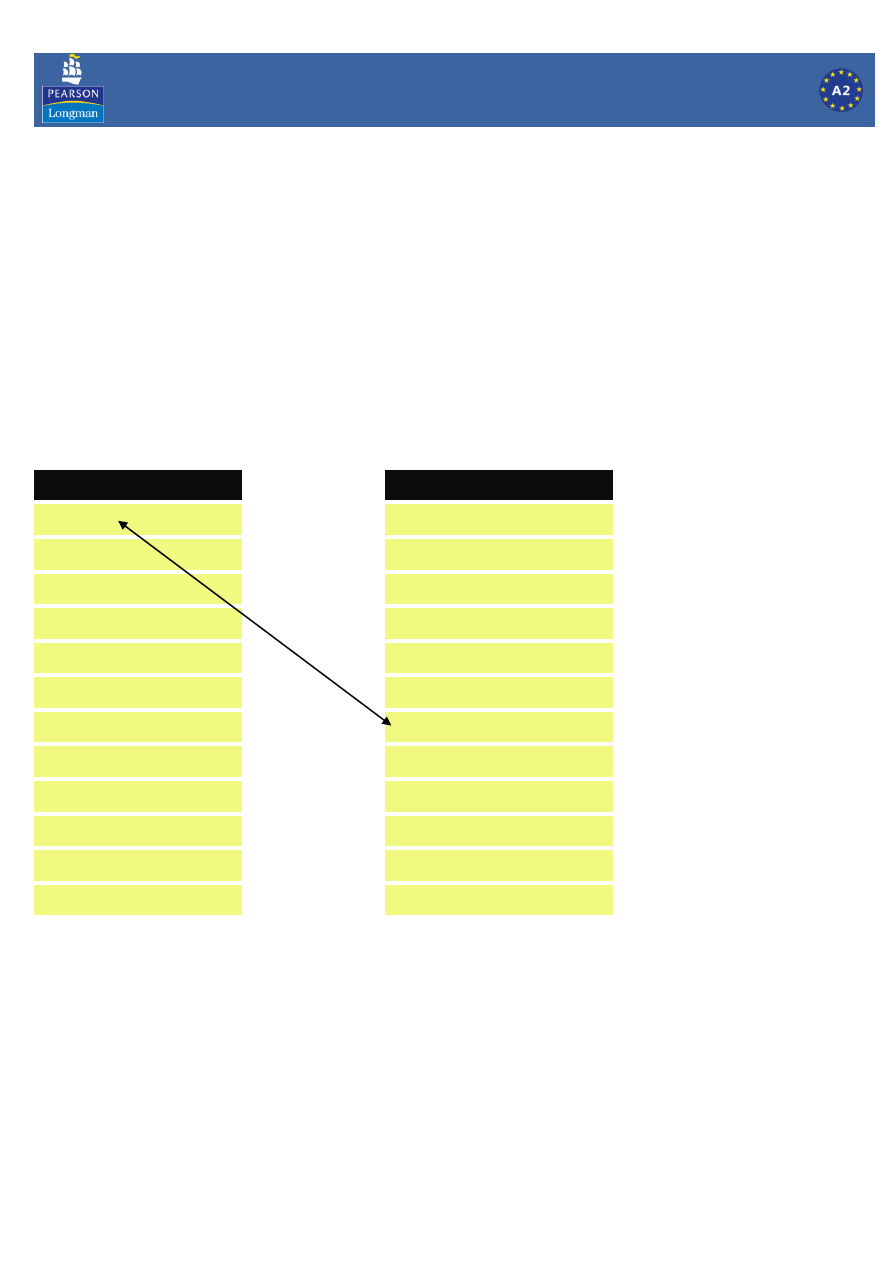
As the text says, English has taken words from hundreds of languages. Look at the words from the right-hand column and
match them to the languages they originally come from.
English Word
Original Language
alcohol
Inuit (an eskimo language)
boss
Egyptian
paper
Turkish
dollar
Dutch
guitar
Polish
anorak
German
sauna
Arabic
ambulance
Norse (old Scandinavian)
shampoo
French
window
Spanish
horde
Hindi
yoghurt
Finnish
S
PEAKING
Discuss the questions below in small groups. Then tell the rest of the class your ideas.
1.
Which of the words above are the same in your language? What other ‘foreign’ words does your language have?
2. Is it good for languages to use a lot of words from other languages? Can you think of any possible problems if a
language uses a lot of words from other languages?
© Pearson Longman 2009 PHOTOCOPIABLE
- 4 -
It has more than a
million words, almost two
billion speakers and is
growing all the time. Why
is the English Language so
successful?
1. ________________
No other language is
spoken in so many
countries, by so many
people, so often. Probably
around 1.8 billion people
speak English as a first or
second language and it is
the official language in 53
countries.
English is the language
of the internet. Around 75%
of the emails sent in the
world and 80% of the world
wide web is in English.
2. ________________
The English language
has always been happy to
collect
words from other
languages and the English
we speak today has words
from hundreds of other
languages.
According to
the linguist David Crystal,
more than three-quarters of
the words in English today
are
borrowed
from other
languages, many from Latin
and French. Take a look at
the list of foreign words in
English on the right.
3. ________________
How many words are
there in English? Usually, if
we want to find this out we
look in a dictionary, but the
problem with English is that
it is always changing
– new
words are always coming
into the language. The
vocabulary of English is
always growing.
In 1755 Samuel Johnson
wrote ‘A Dictionary of the
English Language’. It was
not the first dictionary of
English but it was easily the
best of the time. The
dictionary took Johnson
nine years to finish. A long
time? Perhaps, but for
comparison
, the French
Academy was writing a
dictionary of French at the
same time; they had 40
writers and it took 40 years.
Johnson not only finished
his dictionary four times
faster, he also wrote it
completely by himself.
Johnson’s dictionary had
almost 43,000 words.
Today, English has over
one million ‘official’ words
and many other unofficial
slang
or regional words.
No other language has
such a
huge
vocabulary.
4. ________________
English is always
growing; new words are
always coming into the
language. Nowadays, most
new words are connected
with technology, but there
are plenty of others as well:
noob, defriend and
chiconomics, for example.
English has many dialects
and there are many
different specialist kinds of
English (legal English,
financial English and so
on).
5. ________________
English will continue to
grow. There will be many
more kinds of English in the
future: internet chat
English, SMS English and
so on. And English will be
international in a new way:
already there are more
second-language English
speakers than
native
speakers
. English will truly
be a world language.
English: The Magpie
Language Like the
magpie, the English
language loves to pick up
things it finds. English has
always happily taken words
from other languages - in
fact, three of every four
words in English come from
other languages. Some are
obvious
, like pizza
(Italian), kindergarten
(German) and astrology
(Greek), but what about the
less obvious ones? Look at
the English words below;
which languages are they
originally from?
alcohol
boss
paper
sauna
ambulance
dollar
shampoo
anorak
window
horde
guitar
yoghurt
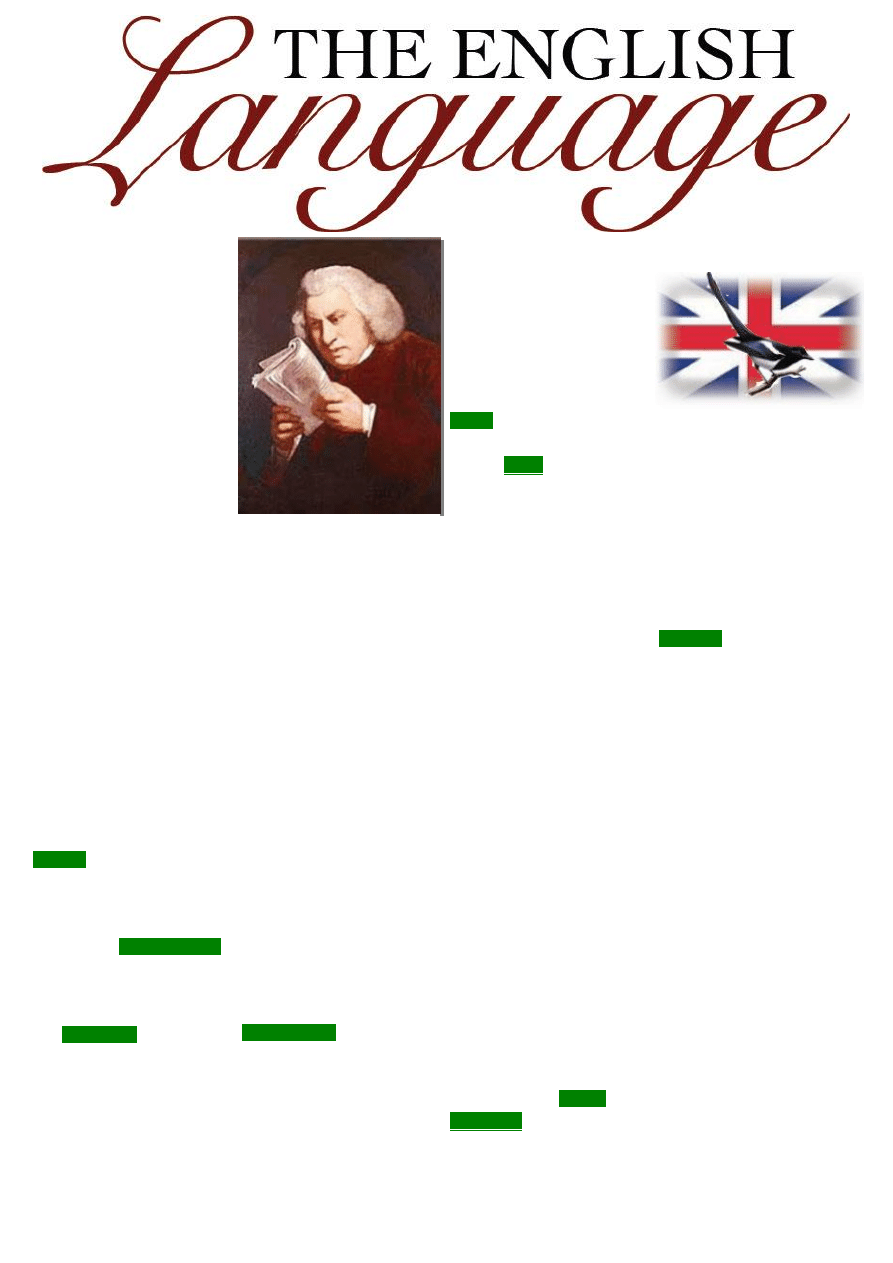
Samuel Johnson
Wyszukiwarka
Podobne podstrony:
march 2009 lowersecondary students
september 2009 uppersecondary students
september 2009 lowersecondary teachers
april 2009 lowersecondary students
newsletter february 2009 lowersecondary students
october 2009 lowersecondary students
march 2009 lowersecondary students
september 2008 lowersecondary students(1)
may 2009 lowersecondary students
september 2009 uppersecondary students
june 2009 lowersecondary students
april 2009 lowersecondary exam students
october 2009 lowersecondary exam students
OBLIGACJE 10 11 2009 dla studentów
Ostry zawał serca wykład 09.2009 IVrok studenci, IV rok Lekarski CM UMK, Kardiologia, Ćwiczenia, Pre
february 11 lowersecondary students
RNA niekodujące 2009 dla studentów
december 2008 lowersecondary students
ldep september 2009
więcej podobnych podstron