
Leigh T. i. Penman
A Second Christian Rosencreuz?
Jakob Böhme’s Disciple Balthasar Walther (1558–c.1630)
and the Kabbalah. With a Bibliography of Walther’s
Printed Works*
Introduction
In the eighteenth chapter of his commentary on Genesis, entitled Mys
terium Magnum (completed 1624), the Lusatian theosopher Jakob Böhme
(1575–1624) made a startling declaration concerning the reception of the
Ten Commandments atop Mount Sinai. According to the account of
Exodus, God had commanded Moses to hew two tables of stone upon
which He would inscribe the text of the Decalogue for the instruction of
His chosen people. This Moses did, ‘and it came to pass . . . Moses came
down from Mount Sinai with the two tables of testimony’ (Ex 34:29).
Böhme’s account, however, differed significantly. For, according to the
cobbler, the text of the new covenant was not recorded on ‘two tables of
stone.’ Rather, Böhme asserted, God had given Moses ‘another writing
upon a globe (Kugel).’
1
To would-be defenders of Böhme’s orthodox Lutheran character in
the years after the shoemaker’s death, this particular passage, which
brazenly contradicted the sacred word of scripture, posed a decidedly
*
Elements of this article were presented at the Association for the Study of Eso-
tericism Conference, University of California, Davis June 8–11 2006, where I re-
ceived stimulating feedback from Arthur Versluis (Michigan State) and Marsha
Keith Schuchard that encouraged further research upon Walther. Further ad-
vice was offered by Prof. Charles Zika (Melbourne). I would also like to thank
Matthias Wenzel (Oberlausitzische Bibliothek der Wissenschaften, Görlitz) and
Dr Robert Schweitzer (Bibliothek der Hansestadt Lübeck) for their friendly as-
sistance during the preparation of this article, as well as Ilona Fekete (Eötvös
Loránd University, Budapest) for her invaluable bibliographical help and com-
ments upon the manuscript.
1
Böhme 1730, VII: 121: ‘[G]leichwie Moses die Tafeln zerbrach, und Gott Mose
eine andere Schrift auf eine Kugel gab.’

A S
econd
c
hriStiAn
r
oSencreuz
?
155
thorny problem. Already during his lifetime, Böhme had been perse-
cuted on several occasions by Lutheran authorities in his home-town of
Görlitz on account of his enthusiastic tendencies. In 1613, following the
distribution of manuscript copies of his first work, Aurora, Böhme was
forbidden to record or further disseminate his ideas. In 1624, the local
pastor Gregor Richter accused him of being the Antichrist. That same
year, Böhme’s first printed work, the Weg zu Christo (Way to Christ) had
been decried by one Lutheran theologian as actually consisting the ‘weg
von Christo’ (way from Christ) (Widmann 1624: 5). As an open invita-
tion for further accusations of heresy, it was therefore important for the
shoemaker’s followers to explain away this curious assertion concern-
ing a globe of the covenant.
2
The editor of the so-called Toruń edition
(thorner Ausgabe) of Böhme’s work (8 vols, 1652–74), one of the most
systematic early attempts to defend Böhme’s theosophy from accusa-
tions of heterodoxy, therefore directly addressed this dangerous pas-
sage.
3
Next to the crucial citation, the editor hastily inserted the follow-
ing marginal notation:
What the author [Böhme] here states appears to contradict the
clear text of Moses, Exodus 34:1, Deuteronomy 10:1 and 1
st
Kings
8:9, which expressly speak of stone tablets. This may be explained
thusly: the thoughts of the blessed, deceased Jacob Böhme concern-
ing the two globes [sic! Böhme only mentioned one] upon which the
law was recorded derived from a conversation with Dr. Balthasar
Walther, who read it in Reuchlin, and lived with Böhme for an entire
quarter-year.
4
2
In England the problem was avoided altogether, for the passage in John Ellistone
and John Sparrow’s 1656 translation (Mysterium Magnum, London: Lodowick
Lloyd, ch. 18, §21, p. 81) egregiously mistranslated Kugel as ‘table of stone’.
This choice echoed the words of the King James Bible: ‘And God gave Moses
another Scripture upon a Table of stone. . .’.
3
For a bibliographical description and analysis, see Buddecke 1937, I: 80–6 (Item
32).
4
‘Merckwürdigkeiten’ 1730, X: 91: ‘Es findet sich in den Collectaneis des jüngern
Richters eine dienliche Anmerkung/ so in dieses Buch Myst. Mag. gehört/
und zwar zum 19. Cap. § 20 [sic! the reference should be to Chapter 18 § 20]
der letzten Zeilen wo Autor schreibet: Wie Gott Mose eine andere Schrifft auf
eine Kugel gab. Dabey besagter Collector folgends erinnert: Daß allhie, der
Autor scheinet wider den klaren Text Mosis, Exod 34:1, Deut 10:1, 1 Reg 8:9
zu schreiben/ der von steinern Taffeln expresse schreibet/ damit verhält sichs

L
eigh
t. i. P
enmAn
156
The passage does indeed exist in Reuchlin’s De arte Cabalistica, where the
Pforzheimer wrote that ‘the kabbalists believe that God first recorded
his covenant (legem) onto a fiery globe, applying dark fire to white fire.’
And as Reuchlin’s citations make clear, this idea had indeed an even
longer history amongst older kabbalistic authorities (1517: fol. lx–ii
v
).
But despite claiming to have read ‘works of many high masters’ (viel
hoher Meister Schriften) Böhme could not speak Latin, let alone Hebrew,
and therefore could have had no direct access to Reuchlin or his sources.
So who then was this Balthasar Walther, portrayed here by the editor of
the Toruń edition not only as an apparent expert in kabbalistic tracts, but
also as someone who had poisoned Böhme’s pious Lutheran thoughts
with its teachings and perhaps also with other heretical material?
The definitive biographical account that we possess concerning Bal-
thasar (also Balthazar, Baldasar, Baldassar, Baltzer, Paltzer, etc.) Wal ther
was first printed in the early 1650s by the Silesian noble Abraham von
Franckenberg, as part of his extensive report upon Böhme’s life.
Of those learn’d men that convers’d with [Böhme] in the greatest
familiarity, was one Balthazar Walter, this Gentelman was a Silesian
by birth, by profession a Physician, and had in the search of the an-
tient Magick learning, travell’d [for six years] through Egypt, Syria
and the Araby’s, and there found such small remainders of it, that he
return’d empty, and unsatisfy’d, into his own Country, where hear-
ing of this man, he repair’d to him, as the Queen of Sheeba with King
Solomon, [to] try him with those hard Questions, concerning the soul
[i.e. Böhme’s Psychologia Vera] . . . from whence, and from frequent
discourses with him, he was so satisfy’d that he there stay’d three
months, and profess’d, that from his converse, he had reciev’d more
solid answer to his curious scruples, than he had found among the
best wits of those more promising Climats, and for the future, de-
tested from following rivulets, since God had open’d a fountain at
his own door (Franckenberg & Hotham 1654: fol. E2
rv
.)
In as much as this account mentions Walther’s three-month stay with
Böhme, and indeed his interest in ‘antient Magick learning’, it undoubt-
also: des sel. Jacob Bœhmens Teut. Meinnung von den 2. Kugeln/ darauf das
Gesetz geschrieben/ rühret her aus mündlicher Conversation mit Dr. Balthasar
Walthern, der es beym Reuchlino gelesen/ und ein ganz viertel Jahr beym J.B.
gewohnet.’

A S
econd
c
hriStiAn
r
oSencreuz
?
157
edly represented the major source of the Toruń editor’s conjectures. Yet
as I have remarked elsewhere (Penman Forthcoming a), this standard
view of Walther’s life communicated to us by von Franckenberg presents
two competing, if not entirely contradictory elements to the physician’s
character. Was Walther another Christian Rosencreuz, as the first half of
this account, which reflects the journey of Frater C.R. in the Rosicrucian
Fama Fraternitatis, suggests? Or a sensitive student of the mysteries, as
the second portion, where Walther learns at the feet of Böhme, hints? An
esoteric master, or merely a disciple? It is these questions that I would
like to address here, utilizing several newly (re)discovered manuscript
and print sources that offer new insights into Walther’s life and interests.
Amongst these is the identification of von Franckenberg’s major source
for his Walther biography; a series of several short statements made
by Walther himself to Johann Angelus Werdenhagen, and printed in
Werdenhagen’s edition of Böhme’s Psychologia Vera in 1632. Concerning
manuscript evidence, in addition to the correspondence of the Torgau
chiliast Paul Nagel with the Paracelsian physician in Leipzig, Arnold
Kerner, in which Walther is discussed on several occasions (Leipzig
MS), further documents that I have found in Lübeck, Germany conclu-
sively demonstrate the physician’s active interest in magical, kabbalistic
and Paracelsian texts. This final detail is of crucial importance, for while
many scholars, primarily following von Franckenberg’s account, have
identified Walther as the source of Böhme’s kabbalistic ideas (or ana-
logues thereof), actual evidence of Walther’s expertise in these matters
has lacked (Schulitz 1993: 16). I wish to demonstrate in this article that
further investigation into Walther’s own career and interests through
these sources not only proves that he did indeed furnish Böhme with
ideas drawn from kabbalistic writings, but also that there exist broader
Paracelsian and Schwenckfeldian contexts in which we might consider
Walther’s life and activities, establishing him as an important and in-
teresting protagonist in his own right independent of his connection to
Böhme’s circle and developing philosophy.
Walther and the Kabbalah: die Morgenlandfahrt
Until the recent discovery of the Lübeck manuscript, the greatest sug-
gestion that we possessed concerning Walther’s kabbalistic proclivities
was simultaneously the most bizarre and suggestive of the anecdotes
communicated to us by von Franckenberg: namely, his fabled trip to the
Orient. This trip, or pilgrimage, has long been a source of intense specula-

L
eigh
t. i. P
enmAn
158
tion, and, due to its similarity with the account of Christian Rosencreuz’s
legendary travels, the question of whether or not it was ever undertaken
has been called into question on at least one occasion.
That three separate contemporary sources attest to the details of the
journey demonstrate that such pessimism is unwarranted, although
the partially contradictory accounts that survive indeed evince some
problematic evidentiary diversions. Concerning these sources, firstly
we have von Franckenberg’s assertion that Walther had spent six years
travelling in the Orient in search of magical wisdom. The origin of
this account actually stems from another source, indeed Walther him-
self, who informed Johann Angelus Werdenhagen of the extent of his
travels sometime before December 1631 (Werdenhagen 1632: 63–4;
Franckenberg 1730: 15). It seems, however, that on this account Walther
himself is not to be trusted, for a third, lesser known source—a now
lost entry in the Diarium of the Görlitz cartographer and astronomer
Bartholomäus Scultetus (1540–1614)—contradicts Walther’s words in
no uncertain terms. In August of 1599, Scultetus recorded:
On the 19th of August 1599 Balthasar Walther visited my step -
mother’s bath house garden and laid out the items he had collect-
ed since 1597 when he journeyed outward from Poland through
Walachia, Greece, Asia, Syria, Egypt and the Mediterranean. . .
5
Scultetus’ account makes clear that Walther’s experiences were not gath-
ered during some epic six-year journey, or even a two-year odyssey that
might have taken place between 1597 and 1599. Indeed, his travels must
have consisted of several shorter excursions conducted after 1597 from
a base somewhere in Poland. The fact that Walther visited Scultetus
on three more occasions in Görlitz during 1588 (on 19th February, 1st
August and 26th December) confirms that during this period, the long-
est continuous time that Walther could have spent in the Orient was no
more than eight months.
5
The entry has been reprinted in Jecht 1924: 63: ‘1599 Aug. 19. Balthasar Walther,
so seither An. 1597 von Polen aus durch die Walachei, Graecium Asiam Syriam
Aegyptum und per mare medit gewandert, in der Schwiegermutter Badegärtlein
kommen und seine mitgebrachten Sachen ausgelegt. Ich habe empfangen ein
gemein Kreuz vom Oelbaum mit eingelegten Heiligtume, zwei Paternoster,
eines de terra Adami de Damasco schwarz, das andre von Oelbaumholz ex
monte Oliveti, Johannisbrot ex deserto Bethabarae, 4. Samen der Baumwolle
aus der Insel Cypern.’

A S
econd
c
hriStiAn
r
oSencreuz
?
159
It is worth noting that, while we cannot entirely discount the idea
that Walther might have exaggerated the duration of his travels in or-
der to impress his friend Werdenhagen, (and indeed, being undoubt-
edly aware of the content of the Rosicrucian Fama, emphasized similar-
ities between his own experiences and those of Father C.R.), I suggest
the two accounts must not necessarily be understood as contradictory.
Werdenhagen’s report, after all, did not specify that Walther’s kabba-
listic expertise was gained during a single stay abroad, rather that he
spent six years there in total: ‘[Walther] mihi retulit, quod in hoc conatu
integrum sexennium in Ægypto, Arabia, & illis vicinis terris confecis-
set’ (Werdenhagen 1632: 64). It is indeed possible that while Walther
had returned from a series of shorter trips from the Middle East to visit
Scultetus in Görlitz in August of 1599, he might also have conducted
several more during the years that followed.
Yet assuming that the physician did indeed spend a significant
amount of time in the Holy Land in pursuit of magical and kabbalis-
tic knowledge, several questions are thereby raised. What did Walther
do there? Who did he visit? There are endless possibilities. As the gifts
Walther bestowed upon Scultetus and noted by the cartographer in
his Diarium demonstrate, during his travels the physician had at least
reached the Mount of Olives, the Syrian city of Damascus, the desert
of Betharaba beyond the river Jordan and the island of Cyprus.
6
On the
way, it is highly likely that Walther visited the city of Safed in modern
Israel, a renowned spiritual centre famous for its numerous mystical
practitioners of kabbalah. In Safed, he might have met with followers of
Joseph Karo (1488–1575), the Sephardic Rabbi Moses Cordovero (1522–
70) or even Isaac Luria (1534–72) in order to study different kabbalistic
philosophies, or have encountered any number of the numerous kab-
balistic/alchemical writings circulating in the region during this time
(Patai 1994: 321–94). I have little doubt, however, that even assuming a
command of Hebrew (which cannot be demonstrated from any of his
surviving literary works), had Walther spent six years in the Holy Land
or only six weeks, his chances of actually learning from kabbalistic and
magical experts, usually governed by strict rules of secrecy and initi-
ation, were minimal. It is almost certainly for this reason that an ‘empty
and unsatisfy’d’ Walther, like the mythical Christian Rosencreuz before
him, found such ‘small remainders’ of the ancient magical teachings of
the magi during his travels (Franckenberg & Hotham 1654: fol. E2
r
). Yet
we must keep in mind that, for the time, Walther’s journey (or series
6
The full citation is given in note 5, above.

L
eigh
t. i. P
enmAn
160
of journeys) consisted of almost unimaginable distance and hardship.
The fact that he undertook one such trip—or perhaps several—is proof
enough of Walther’s interest and resolve in engaging with such mat-
ters.
At the Origins of Walther’s Kabbalistic and Magical Interests
The roots of Walther’s interest in these subjects, however, lay much
closer to home than the far-flung shores of the Holy Land. Born in 1558
in Liegnitz, a major centre of Schwenckfeldian activity in Silesia, Wal-
ther’s education appears to have been relatively conventional. In 1579
he matriculated at the University of Frankfurt/Oder, where he studied
medicine (Liebe & Thenner 1887: 270b). As a student there he moved
in the same circles as the theologian and apocalypticist Leonhard
Krentzheim of Görlitz, later Lutheran superintendent in Liegnitz, and
his contribution of several congratulatory poems to various publica-
tions during his university years suggests that he led an active social
life while studying.
7
Shortly after the conclusion of his studies, we find
him in the principality of Anhalt as a court physician, where his first lit-
erary work, a poetic pamphlet without the slightest hint of Paracelsian
or magical tendencies was printed in Zerbst in 1585 (see References I,
Item 3).
The decisive moment for Walther was, however, about to occur. For
on the 19th July 1587—a decade before his first trip to the Orient—the
young physician found himself for the first time in the Upper-Lusatian
city of Görlitz. Walther’s goal there was not to visit a then thirteen year
old shoemaker’s apprentice named Jakob Böhme, but instead, perhaps
upon Krentzheim’s suggestion, to establish contact with the ‘secta medi-
corum Paracelsi’, a burgeoning community of learned and enthusias-
tic Paracelsians inside the town’s walls (Lemper 1970: 347–60). This
group was truly diverse. In addition to the friend and correspondent
of Valentin Weigel, Abraham Behem, chief among them was the afore-
mentioned astronomer, mathematician and cartographer who had once
studied with Tycho Brahe in Leipzig: Bartholomäus Scultetus. The con-
nection between Walther and Scultetus, both personal and philosophic-
al, must have been immense and instantaneous. For, in addition to es-
7
For details of Walther’s personal bibliography, refer to Section I of the Refer-
ences (below).

A S
econd
c
hriStiAn
r
oSencreuz
?
161
tablishing an enduring friendship, Scultetus also gave several magical
and Paracelsian religious manuscripts to Walther (Koch 1916: 4, 26, 30–1;
Jecht 1924: 60; Sudhoff 1898: Items 15, 83–5). Several of these manuscript
works survive today in a codex in Lübeck, Germany. A further (now
lost) codex, once in the collection of the city library of Wrocław, Poland
(former Cod. Rhed. 334) has been extensively catalogued by Karl Sudhoff
during the final years of the nineteenth century (1898: 499–538).
Outside of the pilgrimage to the Middle East, these manuscripts
comprise the most direct confirmation that we have of Walther’s kab-
balistic expertise. Although information concerning the matter is dif-
ficult to come by, Scultetus evidently acquired many of the texts he
passed on to Walther around 1567, when he was in contact with several
well-known kabbalistic practitioners, including Jeremias Waldner and
the Straßburger Franz Brun. During the same period he also prepared
commentaries and editions of several of Paracelsus’ medical works
(Gondolatsch 1936: 76), such as a manuscript edition of the Archidoxes
in collaboration with Franz Kretschmeir (Telle 1992: 212–13, 226). While
the folio volume in Wrocław consisted entirely of religious commentar-
ies and other theological works authored by Paracelsus (Sudhoff 1898:
499–538), the Lübeck codex, a thick quarto volume bound in vellum, is
wholly magical in content, consisting entirely of tracts copied either
from earlier manuscripts or out of printed books. The selection is more
than a little surprising. It begins with Latin extracts from the Picatrix,
and continues with a commentary by a Hungarian (Michal Eyking)
upon the kabbalah, a version of books one and two of the infamous
manual of angel magic, the Liber Raziel, a copy of the Imagines Abelis filii
Adæ, extracts from Trithemius on the seven spirits, a short astrological
tract called the Astrum Magicum, several magical works by Paracelsus
(including De septem stellis and De arte magica) in addition to texts by
Pietro d’Abano and Hermes Trismegistus himself. Walther’s connection
to the Lübeck codex is demonstrated by several notations throughout
the text (although mainly in the Liber Raziel).
8
On one leaf we find the
8
Other indications of date and place in the Lübeck MS include: fol. 35
r
, ‘A
o
86
21 Mai [symbol] in tracte germinos intelligit’; fol. 40
r
, ‘Anno 89 im Juli’; fol. 91
r
,
‘Ex scriptis Cracovi H. Scultetus & Walthery ab mo[. . .rest has been trimmed]’;
fol. 94
v
, ‘1 May Anno 89 Harpersdorf ex Bart. Scultetij’; fol. 110
v
, ‘Ex libri
Bartholomaii Sculteti Gorlitiani et scripti 3 Mai[. . .]; fol. 111
r
, ‘3 Mai A
o
89 novi
Calend. ex Sculteto Gorlitiano Mathem.’; fol. 126
r
, ‘Scriptum Bartol. Sculteti
Gorlitiani Mathem. libris. 6 Mai A
o
89 calendarium novum computatum in
Harpersdorf.’

L
eigh
t. i. P
enmAn
162
suggestive notation ‘Gorlicii ex scripto Cracovij Rhetici Scriptj Barthol.
Scultety 21 Febr. A
o
1567. Ex huius scripto B. Walthery Iun. 30 Aprilis
A
o
[15]89 novi calen. Harper[sdorf]’(Lübeck MS, fol. 88r). It is with this
formulation (‘B. Walther Iun.’) that Walther signed the majority of his
printed works and poetical contributions.
This annotation is significant, not only because it supplements previ-
ous evidence of Scultetus’ role in the copying and distribution of Para-
celsian and magical manuscripts during the 1560s, but also because it de-
finitively links Walther to heterodox Paracelsian groups in Harpersdorf,
a subject to which I will shortly return. According to Sudhoff, the
Wrocław folio was devoid of any mention of Görlitz, Scultetus or indeed
Walther himself. However, his careful lexicographic al description of the
volume (including the tendency of one scribe to write in tight columns),
strongly suggests that the manuscript was prepared by the same scribes
in Harpersdorf who copied the texts of the Lübeck manuscript. What is
more, the dates of composition mentioned within the individual tracts in
both codices demonstrate that they were produced simultaneously.
9
As
Sudhoff has pointed out, that there existed a close relationship between
several of the Wrocław texts with other Paracelsian manuscripts copied
by Scultetus in the late 1560s and preserved today in Wolfenbüttel and
Munich, further suggests their provenance amongst Walther’s Görlitz
circle (Sudhoff 1898: 530, 534).
However, more so than for its involvement in the copying and pro-
duction of Paracelsian manuscripts, the Silesian village of Harpersdorf
was of enormous significance during the final third of the sixteenth cen-
tury as the central point of a thriving and tolerant Schwenckfelder com-
munity, comprised mainly of members earlier expelled from Walther’s
birthplace of Liegnitz (Weigelt 1973: 195–212). The existence of the two
Harpersdorf manuscripts therefore suggests an enduring connection
between Walther and Schwenckfeldian communities in Silesia, and fur-
thermore between Schwenckfeldian sympathizers and Paracelsian net-
works in the area and beyond during the late sixteenth century. This
is a connection that predated and would endure even after Walther
made Böhme’s acquaintance around 1617, for the cobbler himself was
supported by several Silesian nobles, each with their own contacts to
Schwenckfeldian groups
(Fechner 1857: 61; Weigelt 1973: 205). Böhme
9
The Lübeck MS was copied between 1586 and May 1589 (see above note 8), the
dates of which broadly coincide with those found in the Wrocław MS, which
span from the 21st August 1588 to June 1589.

A S
econd
c
hriStiAn
r
oSencreuz
?
163
even addressed one letter to Johann Jakob Huser, brother of the editor of
the 1596 edition of Paracelsus’ works, friend of Scultetus, and therefore
perhaps also of Walther, Johann Huser (c.1545–c.1600) (Lemper 1976: 83;
Telle 1992: 160).
Unfortunately, because original magical and kabbalistic works au -
thored by Walther are absent from both the Wrocław and Lübeck codi-
ces, it is difficult to gauge the depth with which he read in these par-
ticular treatises, or assess the level of expertise that he had reached in
working with them. Clearly, he thought them at least worthy of having
copied. However, as Federico Barbierato has recently argued, magic-
al books and manuscripts enjoyed almost constant popularity during
the sixteenth and seventeenth centuries irrespective of the expertise or
intentions of their possessors, mainly on account of their decorative,
dan gerous, and therefore attractive nature. Indeed, he suggests that the
majority of those who possessed magical works, such as the Picatrix
and Liber Raziel, probably did not even use them for magical purposes
(Barbierato 2002: 163). I find it however difficult to doubt the words of
Jakob Böhme when he stated that Walther was a true ‘enthusiast of the
mysteries’: particularly in light of his later undertakings in search of
magical, kabbalistic and occult knowledge, especially his trip(s) to the
Holy Land.
There is, however, further evidence of Walther’s enduring connec-
tion to Paracelsian networks of communication throughout Germany.
Following his 1617 encounter with Böhme and his subsequent conver-
sion to the cobbler’s theosophy, Walther would not only be involved in
the distribution of Böhme’s manuscripts, but also copies of Paracelsian
and other magical texts. A prominent example of this activity is the
transmission history of the short ‘Mysterium Lapis Philosophorum ex
MS codice Balthasaris Waltheri Silesij’, an undoubtedly apocryphal ac-
count of an act of transmutation achieved by Paracelsus in 1527, the
secret of which was supposedly recorded in a series of magical sym-
bols on the pommel of his sword. Not only did Walther pass this text
on to the chiliast Paul Nagel in Torgau (Karlsruhe MS, 383–4), but he
also provided a copy to the Hamburg dissident, manuscript collector
and Rosicrucian respondent, Joachim Morsius, who promptly set the
account in print in his Magische Propheceyung Aureoli Philippi Theophrasti
Paracelsi (1625). There, Morsius would exult Walther with the titles
‘Equitis Hierosolymitani, Theosophiæ [sic] & Secretioris medicinæ exi-
miè periti, amici carissimi’ (1625, fol. B1
r
). The original manuscript of
this pseudo-Paracelsian text, from which the text of the printed edition
was set, can be found today within the pages of the Lübeck codex: proof

L
eigh
t. i. P
enmAn
164
that the collection itself indeed once belonged to Walther, and then later
to Morsius.
With the identification of these two manuscript codices once in Wal-
ther’s possession, or in possession of those with whom he trafficked,
we have two concrete examples of the physician’s enduring interest in
Paracelsian and magical writings that exist entirely independently of
his enthusiasm for Böhme’s philosophy, and more importantly, sug-
gest a broader context for analyzing his life and work independently
of the Böhme-mythos. Indeed, supplementary sources make these new
contexts even more clear. For a short period during the late sixteenth
century, Walther was active as an alchemist, metallurgist and physician
in Hungary and Wallachia (Fechner 1857: 69). In 1621, he served as per-
sonal physician to Prince August of Anhalt-Plötzkau (Böhme 1730, IX:
12:77), one of the first enthusiasts of the Rosicrucian brotherhood in the
Holy Roman Empire, who possessed extensive contacts amongst mem-
bers of what I have called the ‘chiliastic underground’: a loose network
of heterodox spiritualists linked by millenarian tendencies product of
Paracelsian enthusiasm (Penman 2008). Shortly before that, he was ac-
tive as the supervisor of the laboratory at the court of Johann Georg I
in Dresden, responsible for the production of medicaments under the
order of the Saxon court physician (Worbs 1966: 11). It is worth mention-
ing that there are also repeated mentions of Walther in the company of
Paracelsians, not only in Böhme’s Theosophical Epistles, but especially in
the manuscript correspondence of Paul Nagel. As I have detailed else-
where (Penman Forthcoming a & b), Nagel’s letters reveal Walther as an
active member of a startlingly large network of Paracelsian and heretic-
al sympathisers, not only in Saxony, Silesia, Poland and Bohemia, but
also throughout Europe. Indeed, both Walther’s thirst for occult knowl-
edge and independence of mind were so great that, for a brief period in
the 1610s and early 1620s (before Böhme’s conclusion of the Psychologia
Vera and a time in which he remained ambivalent towards Böhme’s the-
osophy) he was an active follower of one of Böhme’s chief opponents,
the Thuringian antinomian and dissident Esajas Stiefel and his nephew,
Ezechiel Meth.
Somewhat frustratingly, Walther’s printed works don’t adequately
reflect the extent of his interests in magical and kabbalistic areas as we
might reasonably expect. Nor, surprisingly, do they even evince a par-
ticular enthusiasm for Paracelsian medicine or philosophy. Outside of
several congratulatory and other poetical contributions, and excluding
the previously mentioned Ode dicolos tetrastrophos (1585), Walther com-
posed only one other major work of note, a Latin language biography of

A S
econd
c
hriStiAn
r
oSencreuz
?
165
Prince Michael ‘the Brave’ of Walachia (1558–1601). It was during a visit
in June and July of 1597 to Michael’s court at the foot of the Carpathians
that Walther received a manuscript from a certain Andreas Tarnow,
which detailed the Prince’s considerable exploits. Perhaps in an attempt
to secure patronage, Walther promptly transposed the account into Latin
(having first had it set into Polish), and added a poetic Epigramm and
Elegia to its conclusion. The book was ultimately printed, with a warm
dedication to his ‘great friend and supporter’ Bartholomäus Scultetus,
on the feast day of St Michael in 1599: shortly after Walther’s return
from the Holy Land (Walther 1599: A3
v
). In terms of its reception, it was
by far the most successful of Walther’s literary works, being reprinted
on several occasions during the seventeenth and eighteenth centuries.
Yet despite the lack of any significant evidence brought forth with-
in the pages of Walther’s printed works concerning his connection to
Paracelsian philosophy and social networks, the existence of a diverse
manuscript tradition indeed demonstrates a burgeoning interest in
kab balistic, magical and allied areas of knowledge that began in the
1580s. With this context in mind, it becomes clear that when Walther
first encountered Jakob Böhme in Görlitz in 1617, it was not a result of
the physician intentionally travelling there in order to visit the shoe-
maker, retiring like ‘the Queen of Sheeba with King Solomon’, as von
Franckenberg portrayed it, but rather to deepen contacts with the net-
work of Paracelsians that had existed in the town since the 1570s: the
same network whose common interests and generosity with manuscript
sources had inspired Walther’s initial journey to the Holy Land, ‘with the
greatest industry and effort, in search of the true hidden wisdom, which
one might call kabbalah, magic, alchemy, or, more correctly, theosophy’
(Franckenberg 1730: 15). That Walther upon his return would continue
to seek after numerous and diverse sources of the magical wisdom that
he so very much desired, and so disappointedly could not find amongst
the magi, should represent no real surprise. And while, unlike Christian
Rosencreuz, this disappointment did not lead him to found a secret so-
ciety in order to distribute the data that he had indeed succeeded in
collecting during his adventures, it lead instead to an intensification of
his connections with pre-existing networks of magical, kabbalistic and
Paracelsian practitioners in the Holy Roman Empire and beyond. While
the revelation of Walther’s connection to the two manuscript codices
in Lübeck and Wrocław firmly demonstrates the physician’s kabbalistic
and magical proclivities, more importantly, it shows that it is amongst
the secretive networks of Paracelsian and Schwenckfeldian protagonists
L
eigh
t. i. P
enmAn
166
that we must search in order to find further information and contexts for
understanding and analyzing Walther’s life.
Conclusion
In conclusion, I would like to return to the globe of the covenant, sup-
posedly given by God to Moses atop Mt Sinai, and consider afresh the
vexed question of Böhme, Walther, and the kabbalah. For the fact that
Böhme was happy to communicate this idea in the pages of his Mysterium
Magnum does, I argue, indeed provide an indication of Walther’s influ-
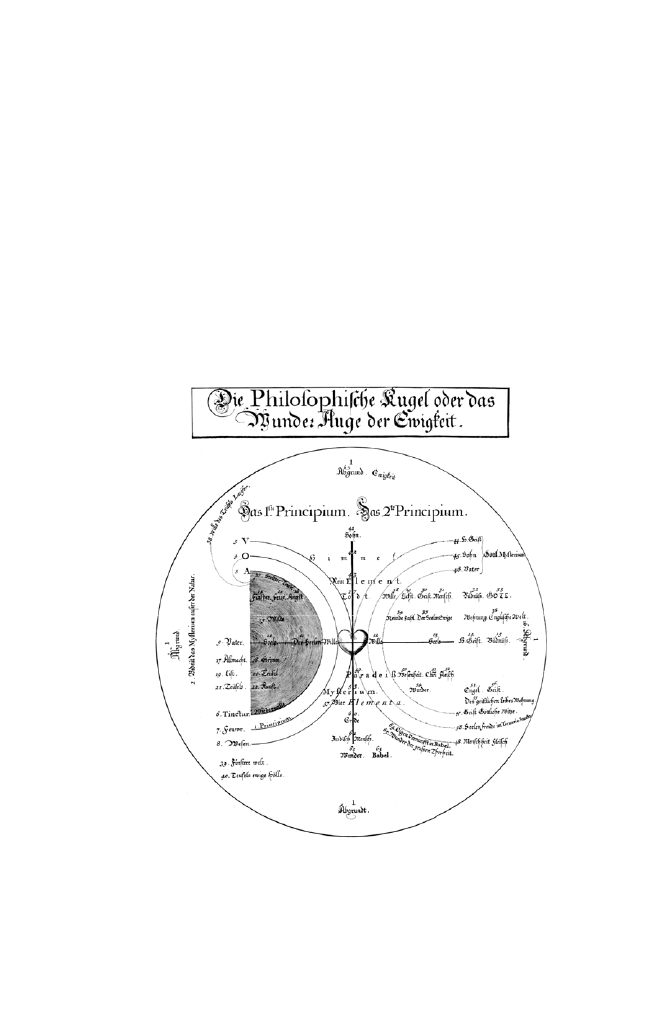
ence upon Böhme’s theosophy. For between 1617 and 1621 Böhme not
Böhme’s ‘Philosophical globe or Wonder-eye of eternity’. an engraving from the
Vierzig Fragen von der Seelen Urstand (= Sämtliche Schriften iii: 30).

A S
econd
c
hriStiAn
r
oSencreuz
?
167
only answered 40 questions concerning the soul posed to him by the
Liegnitzer in the Psychologia Vera, but at Walther’s insistence, also at-
tempted to illustrate his theosophical system using a complex graphic
entitled ‘God’s wonder-eye of eternity’ (‘Merckwürdigkeiten’ 1730, X:
85–6): a graphic that Böhme also named the ‘philosophical globe’ (philo
sophische Kugel) (see figure). In as much as the ‘philosophical globe’ em-
bodied an attempt to bring together all the features of his difficult the-
osophy in a graphical representation that incorporated the immaterial
qualities of God’s love with landmarks of the physical and metaphysical
landscape, it could indeed be said that this was, in many ways, Böhme’s
attempt to elaborate the details of God’s covenant above and beyond
the Decalogue itself. The existence of an actual Böhmian globe seems
to therefore support the opinion of the anonymous editor of Böhme’s
Toruń edition, who, although he was no eyewitness to the events he
described, might have indeed been correct when he pointed to Walther
as the source for Böhme’s ‘globe of the law’.
References
I. Balthasar Walther’s Printed Works
The following chronological list of known works by Walther incorporates both
prose and poetic texts, excluding editions of Böhme’s Psychologia vera, (already
recorded by Buddecke [1937]). Where appropriate, a description of the type of
work Walther contributed to the text in question has been added. Following the
title, a list of known holding libraries (Loc) has been indicated, inclusive of call
numbers. In the case of Items 6a–c, this list is not exhaustive. Finally, when pos-
sible, reference has been made to appropriate entries in the ‘Verzeichnis der im
deutschen Sprachbereich erschienenen Drucke des 16. Jahrhunderts’, <http://
www.vd16.de> (abbreviation: VD16), and the ‘Verzeichnis der im deutschen
Sprachraum erschienenen Drucke des 17. Jahrhunderts’ <http://www.vd17.
de> (abbreviation: VD17).
Item 1. [1581: Congratulatory poem, in]
GRATVLATIONES | IN HONO-|REM ORNATISSIMI, ET | DOCTISSIMI
IVVENIS [. . .] | MAR-|TINI NOSSLERI, CVM MAGI-|STERII PHILOSOPHICI
GRA-|DV IN ACADEMIA FRANCO-|FORDIANA A [. . .] | M. IACOBO
EBERTO,| PHILOSOPHICI ORDINIS DE-|CANO ET PROFESSORE |
PVBLICO, ORNA-|RETVR.| SCRIPTÆ | AB | AMICIS | FRANCOFORDIÆ
MAR-|CHIONVM | ANNO M. D. LXXXI.| XII. CAL. MAII.|
Loc: Berlin, Staatsbibliothek Preußischer Kulturbesitz, 8 in: Xc 555.
VD16 ZV 6968

L
eigh
t. i. P
enmAn
168
Item 2. [1582: Congratulatory poem, in]
Gratulatoria | IN NVPTI-|AS REVERENDI, PIE|TATE, DOCTRINA, ET VIRTV-
|te præstantis viri Dn Magistri MARTINI | NOSSLERI Monsterbergensis Silesij,
Pa-|storis apud Fürstewaldenses fidelis-|simi, Sponsi, | ET | [. . .] EVAE | [. . .]
Basilij Mehl-|horns primarij ciuis Francofordensis | filiæ, Sponsæ. Scripta |
ab Amicis.| FRANCOFORDIÆ AD ODERAM,| IN OFFICINA IOANNIS |
EICHORN.| M. D. LXXXII.| 14. Maij
Loc: Berlin, Staatsbibliothek Preußischer Kulturbesitz, 20 in: Xc558 R.
VD16 ZV 6984
Item 3. [1585]
Ode | Dicolos Tetrastrophos, totum re=|demtionis opus, à Christo Seruatore
nostro hu=|mano generi præstitum, breuiter com=plectens, | AD | [. . .]
CHRIS TO PHORVM AB HOIM | in Ermbsleben, Conradsburg, VVegeleben,
Drie-|sig, etc. Primatus Halberstadiensis per-|petuum Camerarium | [Orna-
ment] | ILLVSTRISS. PRINCIPIS | AC DOMINI DN. IOACHIMI ERNESTI |
Principis Anhaldini, Comitis Ascaniæ […] | Consiliarium intimum ac | præ ci p-
uum, Dn. ac promotorem | suum obseruandum | SCRIPTA | A BALDASARE
VVALTHERO IVN. S. | SERVESTAE | Bonauentura Faber excudebat.| ANNO
M. D. LXXXV.
Loc: Halle, Universitätsbibliothek, an Id 4212 (11).
VD16 ZV 23734
Item 4. [1587: Congratulatory poem, in]
Trostschrift | Weiland | Des Hochwirdigen und | Durchläuchten/ Hochgebornen
Fürsten | und Herrn/ Herrn Georgen/ Fürsten zu An-|halt/ Graffen zu
Ascanien/ Herrn zu Zerbst | und Bernburgk/ Thumprobsten zu Mag-|deburg
und Meissen/ Coadiutorn | in Geistlichen sachen zu | Merssburgk. | An | S. F.
G. geliebten Herrn brudern/ | Fürst Johansen zu Anhalt etc. beyde Hoch-|löb-
licher/ Christlicher und milder Gedechtnüs. | [. . .] | M.D.LXXXVII.
[On leaf C7
v
: Gedruckt zu Zerbst/ durch Bonaventur Schmid.]
Loc: Wolfenbüttel, Herzog August Bibliothek, A: 812.5 Theol. (6).
VD16 G 1331
Item 5. [1587: Congratulatory poem, in]
Coniugio | DOCTISSIMI | ET HVMANISSIMI | VIRI, DOMINI FRANCISCI
CRO-|SCHELII SVEBVSIENSIS, SPONSI: ET PV-|dicißimæ virginis DORO-
THEAE Peuce-|rianæ, IOACHIMI filiæ, Gorli-|censis, Sponsæ, | Benè pre-
cantur amici, | [Ornament] | GORLICII | Excusum typis Ambrosij Fritschij |
M.D.LXXXVII.
Loc: Görlitz, Oberlausitzische Bibliothek der Wissenschaften, Ba VII 4° 16,24.
Not in VD16.

A S
econd
c
hriStiAn
r
oSencreuz
?
169
Item 6. [1599]
BREVIS ET VERA | DESCRIPTIO | RERVM AB | ILLVST. AMPLISS. | ET
FOR TISS. MILITIAE | CON-|trapatriæ suæ Reiq[ue] Pub. Christianæ hostes |
Duce ac Dn. Dn. Jön Michaele, Mol-|dawiæ Transalpinæ sive VValachiæ |
Palatino gestarum, | In eiusdem aula Tervvisana fideliter collecta | opera &
studio | Baldassaris Waltheri Iun. S. | 15 [printer’s signet] 99 | GORLICII Typis
Johannis Rhambæ.
Loc: Budapest, Országos Széchényi Könyvtár, Ant. 2864–2865; Ant. 4670(6);
RMK III. 933b; Copenhagen, Det Kongelige Bibliotek, 70, 410. 2 eks.; Gör litz,
Oberlausitzische Bibliothek der Wissenschaften, B IV 4° 25,5; Halle, Uni ver si-
tätsbibliothek, Ung II 45; Jena, Thüringer Universitäts- und Landes bibliothek,
4 Bud.Pol.29(21); Lüneburg, Ratsbücherei, Göa 94; Oxford, Bodleian Library,
Vet. D1 d.37; Stuttgart, Württembergische Landesbibliothek, HBF 325; Vienna,
Österreichische Nationalbibliothek, 64.F.43 (2); Wolfenbüttel, Herzog August
Bibliothek, A: 17.20 Pol. (1); Munich, Bayerische Staatsbibliothek, 4 Turc. 75
[lost.].
VD16 W 932
Item 6a. [1603, another edition]
‘Brevis Rerum a Michaele Moldavviae Transalpinæ sive VValachiæ Palatino
Michaele gestarum descriptio.’ pp. 227–55, in Nicholas Reusner, ed.
RERVM | MEMORABILIVM | IN PANNONIA SVB TVR-|CARVM
IMPERA TORIBVS, A CAPTA | CONSTANTINOPOLI VSQVE AD HANC |
ætatem nostram, bello, militiaq[ue] | gestarum. | EXEGESES | sive | NAR-
RATIONES ILLVSTRES | VARIORVM ET DIVERSORVM | AVCTORVM. | [. . .]
FRANCOFVRTI, | Impensis Claudij Marnij, & hæredum | Ioannis Aubrij. |
[single rule] | M. DC. III.
Loc: Berlin, Staatsbibliothek Preußischer Kulturbesitz, Se 2848<a>; Cambridge,
University Library, Dd*.2.3(D); Dresden, Sächsische Landesbibliothek, Hist.
Hung.381; Gotha, Forschungs- und Landesbibliothek, Hist 8° 05569 (02);
London, British Library, C.73.c.7.(1.); Munich, Bayerische Staatsbibliothek, 4.
Eur. 232; Oxford, Christ Church Library, a.1.277; Wolfenbüttel, Herzog August
Bibliothek, A: 37.4 Hist. (2); T 5.4
o
Helmst. (4).
VD17 23:230278P
Item 6b. [1627, another edition:]
‘Brevis Rerum a Michaele Moldavviae Transalpinæ sive VValachiæ Palatino
Michaele gestarum descriptio.’ pp. 227–55, in Nicholas Reusner, ed.
SYNDROMVS | RERVM TVRCI-|CO-PANNONICARVM, | HISTORIAM CEN-
TVM QVINQVA-|ginta annorum complectens; | QVA QVICQVID A CAPTA
CONSTANTINOPOLI | ad Annum usq[ue] partæ per Christum salutis MDC.
[. . .] OMNIA E DIVERSIS SCRIPTORIBVS COLLECTA, ET IN | unum hoc
corpus bono publico redacta. | [woodcut] | FRANCOFVRTI AD MOENVM,
| Typis & sumptibus Wechelianorum, apud Danielem & | Dauidem Aubrios &

L
eigh
t. i. P
enmAn
170
Clementem Schleichium. | [single rule] | M.DC.XXVII.
Loc: Dresden, Sächsische Landesbibliothek, Hist.Hung.382; Göttingen, Nieder-
sächsische Staats- und Universitätsbibliothek, 4 H TURC 850:1; Munich, Bayer-
ische Staatsbibliothek, 4 Eur. 274–1; 4 P.lat. 322; 4 Polon. 29; Wolfenbüttel, Herzog
August Bibliothek, A: 74.1 Hist. (1).
VD17 23:230309F
Item 6c. [1770, another edition:]
‘Brevis Rervm a Michaele Moldawiae Transalpinae sive Walachiae Palatino ges-
tarvm descriptio.’ pp. 232–261, in Nicholas Reusner, ed.
RERVM MEMORABILIVM | IN | PANNONIA | SVB | TVRCARVM IMPERA-
TORIBVS | A | CAPTA CONSTANTINOPOLI | VSQVE | AD ANNVM MDC.
BELLO MILITIAQVE GESTARVM | NARRATIONES ILLVSTRES | VARIORVM,
ET DIVERSORVM | AVCTORVM. | [. . .] | RECVSAE | COLOCAE M. DCC.
LXX.
Loc: Buffalo, SUNY, DB932 .R47 1770; Cambridge, University Library, Acton.
c.42.73; London, British Library, 9315.ee.13; Oxford, Bodleian Library, 24183
d.9.
Item 7. [1625: Two Short Poems, in Joachim Morsius, ed.]
Magische Propheceyung | AUREOLI PHILIPPI | THEOPHRASTI PARACELSI,
| Von | Entdeckung seiner 3. Schätzen. | Darvon der erste in Friaul: Der an-
der zwischen | Schwaben und Bayern: Der dritte zwischen | Franckreich und
Hispanien soll gefunden | werden/ | Zur zeit der Regierung des Gelben Mitter-
näch=|tigen Löwens. | Worbey gefüget | Die Characteres Chymici, dardurch
er Mysterium lapidis | Philosophorum beschrieben/ und so in seinem Rapier
knopffe gefunden worden seyn: | Und | PAULI GREBNERI vaticinia de Leone
Septentrionali | & ruina Antichristi. | Gedruckt PHILADELPHIÆ | M. DC.
XXV. | S. Antonius. | Temporibus Antichristi periculosum erit sapere, | periculo-
sum loqui, periculosum | tacere.
Loc: Hannover, Leibniz Bibliothek, N-A 84; Uppsala universitetsbibliotek, A 200
C.
Not in VD17. See Sudhoff 1898: no. 330; Bruckner 1971: no. 30.
II. Manuscript Sources
Karlsruhe, Badische Landesbibliothek, MS Allerheiligen 3.
Leipzig, Universitätsbibliothek, MS O 356.
Lübeck, Bibliothek der Hansestadt, MS Math. 4˚ 9.
III. Printed Sources
Barbierato, Federico
2002 Magical Literature and the Venice Inquisition from the Sixteenth to the
Eighteenth Centuries. In: Carlos Gilly & Cis van Heertum (eds), Magia,

A S
econd
c
hriStiAn
r
oSencreuz
?
171
Alchimia, Scienza dal ‘400 al ‘700. L’influsso di Ermete Trismegisto. Vol. I; pp.
159–75. Florence: Centro Di.
Böhme, Jakob
1730 Theosophia Revelata. Alle theosophische Schriften. [= Sämtliche Schriften.
W.-E. Peuckert & A. Faust (eds). 11 vols. Stuttgart: Frommann-Holzboog,
1952–61.]
Bruckner, John
1971 A Bibliographical Catalogue of SeventeenthCentury German Books Published
in Holland. The Hague: Mouton.
Buddecke, Werner
1937 Die Jakob BöhmeAusgaben. Ein beschreibendes Verzeichnis. Göttingen: Häntz-
schel.
Fechner, Hermann Adolph
1857 Jakob Böhme. Sein Leben und seine Schriften, mit Benutzung handschriftlicher
Quellen dargestellt. Ein Beitrag zur Geschichte der neuen Philosophie. Görlitz:
Julius Köhler. [= Neues lausitzisches Magazin 33 (1857): 313–446 & 34
(1858): 27–138.]
Franckenberg, Abraham von
1730 Gründlicher und wahrhafter Bericht von dem Leben und Abscheid des in Gott
seligruhenden Jacob Böhmens. . . [= Böhme 1730, X: (5)–31].
Franckenberg, Abraham von & Durant Hotham (ed. & trans.)
1654 The Life of Jacob Behmen. London: Printed for H. Blunden.
Friedlander, Ernst, Georg Liebe & Emil Thenner (eds)
1887 Älterer UniversitätsMatrikeln. Band I. Universität Frankfurt a. O. Leipzig:
S. Hirzel.
Gondolatsch, Max
1936 Der Personenkreis um das Görlitzer Convivium und Collegium Musi-
cum im 16. und 17. Jahrhundert. Neues lausitzisches Magazin 112: 76–155.
Jecht, Richard
1924 Die Lebensumstände Jakob Böhmes. In: Richard Jecht (ed.), Jakob Böhme
Gedenkgabe der Stadt Görlitz seinem 300 jährigen Todestage; pp. 7–76. Görlitz:
Magistrat der Stadt. [= Neues lausitzisches Magazin 100 (1924): 179–248.]
Koch, Ernst
1916 Scultetica. Neues lausitzisches Magazin 92: 20–58.
Lemper, Ernst-Heinz
1970 Görlitz und der Paracelsismus. Deutsche Zeitschrift für Philosophie 18: 347–
60.
1976 Jakob Böhme. Leben und Werk. [East] Berlin: Union Verlag.
‘Merckwürdigkeiten’
1730 Mehrere Merckwürdigkeiten von J. Böhmens. . .Person. . . [= Böhme 1730, X:
61–96].
Morsius, Joachim
1625 Magische Propheceyung. . .Philippi Theophrasti Paracelsi. ‘Philadelphiae’:
No Printer.

L
eigh
t. i. P
enmAn
172
Patai, Raphael
1994 The Jewish Alchemists. History and Sourcebook. Princeton: Princeton Uni ver-
sity Press.
Penman, Leigh
2008 The Chiliastic Underground. PhD Dissertation. University of Mel-
bourne.
Forthcoming a ‘Balthasar Walther: The Life of a Wandering Paracelsian Phys-
ician.’
Forthcoming b ‘Between Erfurt and Görlitz. The Torgau Chiliast Paul Nagel
(died c. 1627) and his relationship to Jakob Böhme and Esaias Stiefel.’
Reuchlin, Johann
1517 De arte Cabalistica. Hagenau: Thomas Anshelm.
Schulitz, John
1993 Jakob Böhme und die Kabbalah. Frankfurt/Main: Peter Lang Verlag.
Sudhoff, Karl
1898 Versuch einer Kritik der Echtheit der Paracelsischen Schriften. Zweiter Theil.
Paracelsische Handschriften. Berlin: Georg Reimer.
Telle, Joachim
1992 Johann Huser in seinen Breifen. Zum schlesischen Paracelsismus im 16.
Jahrhundert. In: Joachim Telle (ed.), Parerga Paracelsica. Paracelsus in Ver
ganenheit und Gegenwart; pp. 159–248. Stuttgart: Franz Steiner.
Walther, Balthasar
See personal bibliography in References, Section I.
Weigelt, Horst
1973 Spiritualistische Tradition im Protestantismus: die Geschichte des Schwenck
feldertums in Schlesien. Berlin: Walter De Gruyter.
Werdenhagen, Johann Angelus [with Jakob Böhme]
1632 [Greek: Psychologia] vera I.B.T. XL Quæstionibus explicata[. . .]. Amsterdam:
Janßon.
Widmann, Peter
1624 Christliche Warnung, Für einem new außgesprengeten Enthusiastischen Büch
lein, . . . Der Weg zu Christo. . . . Leipzig: Abraham Lamberg für Eliae Rehe-
feld & Johann Grosen.
Worbs, Erich
1966 Balthasar Walther. Ein Porträt aus dem schlesischen Frühbarock. Schle
sien 11: 8–13.
Wyszukiwarka
Podobne podstrony:
Jay Weidner The Ka the Ba and the Kabbalah
Balthasar Church Authority and the Petrine Element
KABBALAH AND THE HERMETIC TRADITION
Blue Hour The Story of Jacob Black and Renesmee Cullen
Mettern S P Rome and the Enemy Imperial Strategy in the Principate
Diet, Weight Loss and the Glycemic Index
Ziba Mir Hosseini Towards Gender Equality, Muslim Family Laws and the Sharia
pacyfic century and the rise of China
Danielsson, Olson Brentano and the Buck Passers
Japan and the Arctic not so Poles apart Sinclair
Pappas; Routledge Philosophy Guidebook to Plato and the Republic
Pragmatics and the Philosophy of Language
Haruki Murakami HardBoiled Wonderland and the End of the World
SHSBC388?USE LEVEL OT AND THE PUBLIC
Doping in Sport Landis Contador Armstrong and the Tour de Fran
drugs for youth via internet and the example of mephedrone tox lett 2011 j toxlet 2010 12 014
Nouns and the words they combine with
Racism and the Ku Klux Klan A Threat to American Society
więcej podobnych podstron