
Sign Language
for Beginners
Discover the Art of Sign Language
Sonia Hollis

SIGN LANGUAGE
FOR BEGINNERS
DISCOVER THE ART OF
SIGN LANGUAGE
SONIA HOLLIS

© 2011 Learn Sign Language Ltd
The right of Sonia Hollis to be identified as the author of this work is
asserted world-wide. All rights reserved. No part of this publication
may be produced, stored or transmitted in any form by any means,
electrical, mechanical or otherwise without the prior written
consent of the author.
Edited by Marie-Louise Cook.
Printed and bound in Great Britain by
Print Smarter
Bristol and West House
Post Office Road
Bournemouth BH1 1BL
Member of NABO
To join visit: www.nabo.biz

3
CONTENTS
1. What is British Sign Language?
5
2. Learning the basics of British Sign Language
11
3. Etiquette needed when communicating
with Deaf people
13
4. Is sign language easy to learn?
17
5. Different Sign Language Systems used in schools
21
6. Career opportunities using British Sign Language
25
7. About the author Sonia Hollis
29
8. Special Reader’s Offer: FREE “Let’s Sign” Pocket
32
Dictionary and a FREE two-disc DVD when you buy
both British Sign Language Level 1 and 2 DVDs.

4

5
WHAT IS BRITISH
SIGN LANGUAGE?
British Sign Language (BSL) is the name of the sign
language which is used in the United Kingdom. It
is the first language of approximately 150,000 Deaf
people in the British Isles. Thousands more who
are not Deaf (such as employers of Deaf people,
relatives/friends and interpreters) use BSL.
British Sign Language is a visual-gestural language
without a conventional written form. It has its own
grammar utilising facial expressions (non-manual
features), handshapes and upper body movements to
convey meaning. It’s also a spatial and visual language.
Many beginners think it is similar to mime (which it
is not). The important thing to remember is that the
grammar used in BSL is completely different to that
used in English.
Sign language can vary from country to country, even
among those whose first language is English. For
example, British Sign Language is different to American
Sign Language (ASL), Irish Sign Language (ISL) and
Northern Ireland Sign Language (NISL).
British Sign Language also has regional dialects. For
example, some signs used in the northern parts of
England may be different to those used in the south
1

6
of the country. Within some regions, you will also find
‘local signs’ that can be classed as slang. And just like
local slang in any town or city, new phrases and words
come in and out of fashion or just evolve over time.
British Sign Language users successfully campaigned
for BSL to be recognised as an official British Language.
It is now recognised like the other languages of the
United Kingdom such as Scottish, Welsh and Gaelic.
Components of British Sign Language
British Sign Language is a visual-gestural language
which uses various components. Let’s have a look at
some of its features…
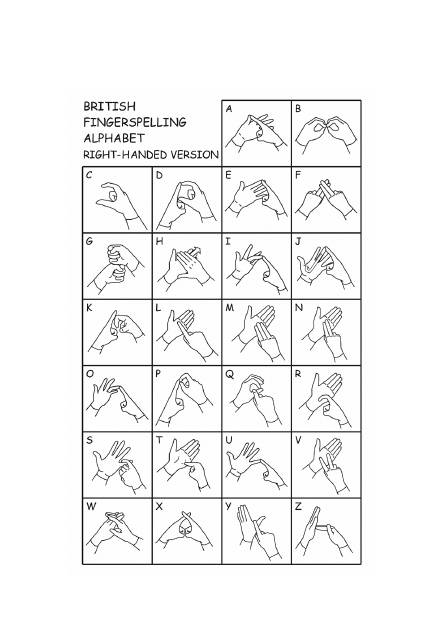
Finger spelling
Finger spelling is a manual code for representing the
letters of the English alphabet and is not a signed
language.
Finger spelling is generally mixed in with signing and
is especially used for spelling nouns (place names,
people’s names, names of everyday objects, etc.) and
for spelling words that have no direct signed equivalent.
British Sign Language uses a two-handed manual
alphabet system whereas other countries like the USA
use a one-handed system.

7
The speed and clarity of finger spelling also varies
between different signing communities. Generally,
older Deaf people use more finger spelling than
younger Deaf people which is often connected to their
educational upbringing.
When someone fluent in sign language reads finger
spelling, they don’t usually look at the signer’s hand(s),
but maintain eye contact and look at the face of the
signer.
People who are learning finger spelling often find it
impossible to understand using just their peripheral
vision and end up looking at the person’s hand rather
than their face. Look directly at the person’s face and
lip pattern and you will gradually find it easier to
understand.
Normally one of the first lessons students learn is to
finger spell the alphabet.
Spatial grammar and simultaneity
Sign languages exploit the unique features of the
visual medium. Oral language is linear. Only one sound
can be made or received at a time. Sign language is
visual; hence a whole scene can be taken in at once.
Information can be loaded into several channels and
expressed simultaneously.

8
For example, in English you might say “I drove here”.
To add information about the drive, you’d have to
make the phrase longer (“I drove here along a winding
road”) or even add a second (“I drove here. It was a
nice drive.”) In British Sign Language, however, you
can convey information about the shape of the road or
the pleasing nature of the drive by inflecting the motion
of the hand, or by taking advantage of non-manual
signals such as body posture and facial expression, at
the same time as you sign the verb ‘drive’. Therefore,
while in English the phrase “I drove here and it was
very pleasant” is longer than “I drove here”, in British
Sign Language the two may be the same length.
Placement
Placement is used in relation to the placing or
establishing of signs in space. The signer locates or
places particular referents within the signing space
in different types of relationship with the signer and
with the other referents. Once a signer has set up the
‘placement’ of a particular sign - ‘the house is over
there’ by signing the word ‘house’ and ‘putting it in a
space in front of you’ (‘placing it’) then the signer can
use his eye gaze and directional verbs to refer to this
particular sign.
Don’t worry if this seems complicated! It will become
a lot clearer as you start to learn British Sign Language
and put what you see and learn into practise.

9
Non-manual features
Non-manual features are actions produced by any part
of the body other than the hands. They include actions
of the eyes, mouth, cheeks, face, head, shoulders and
torso.
They have different types of function within the
structure of the language and are an extremely
important aspect of BSL.
Handshapes
There are numerous handshapes that are individually
categorised in BSL. Groups of handshapes are known
as ‘classifiers’ which incorporate specific details of the
referent by the handshape itself.
A few examples of different classifiers can be described
as:
• Handling/grasping: You can use different
handshapes that show how you physically hold or
use something. For example, sewing with a needle,
or doing the ironing. These are described as ‘iconic
signs’ as they often ‘look’ how you actually perform
something.
• Flat surfaces: You can have a different handshape
that will indicate if something has a flat surface such
as ‘floor’, ‘door’ or ‘wall’.

10
• People and vehicles: This group of classifiers has
a function that is similar to the use of pronouns
in English. For example, different handshapes can
indicate if you are looking up at something, if one
person is involved in an action or many people.
There are also various handshapes that indicate if
you are talking about a vehicle or other mode of
transport.
Signing structure
All languages use different kinds of sentence structure,
but usually one type is used most often. In English,
this is the SVO sentence (subject-verb-object). In the
sentence ‘Sophie bought a car’ for example, ‘Sophie’ is
the subject, ‘bought’ is the verb, and ‘car’ is the object.
Another type of sentence structure is called ‘Topic
Comment Structure’. This type of structure is not
commonly used in English. It is used so often in BSL
that people tend to describe BSL as a Topic Comment
Structure. The signer gives the topic first and is then
able to focus and give more detail on the comment
that follows.
So the sentence ‘Sophie bought a car’ would be signed:
‘Car (you would point to it after signing it) who
bought? ... Sophie.’

11
2
LEARNING THE BASICS OF
BRITISH SIGN LANGUAGE
Your complimentary DVD shows you the basics of
British Sign Language and will help you get started.
One of the first aspects of sign language that people
learn is to fingerspell the alphabet.
They often find it easier to learn from videos because
the visual nature is difficult to convey in a book.
With the DVD you will:
• Learn what British Sign Language is
• Learn how to sign the British Sign Language
alphabet
• Develop your receptive skills with a finger spelling
quiz
• Learn how to sign basic numbers
• Learn how to introduce yourself to a Deaf person
• Learn how to sign the days of the week
• Learn how to sign basic questions
As explained earlier, sign language does have regional
differences. You will also find that there are slightly
different signs for numbers and some alternatives to
the days of the week depending on whether you are
12
based in the North or South. However, this should not
cause you a problem because they are all right.
© 2011 Cath Smith - LET’S SIGN Series - www.DeafBooks.co.uk
cath@deafsign.com - 01642 580505

13
3
ETIQUETTE NEEDED WHEN
COMMUNICATING WITH
DEAF PEOPLE
Sign Language Etiquette
When you are communicating with Deaf and Hard
of Hearing people, there are various communication
strategies that you need to remember.
For communication to flow naturally and smoothly, be
aware that a signer needs space for making his own
signs and he needs to be able to see other signers from
the waist upwards to get the full visual message. That’s
why signers tend to sit or stand further apart than
speakers of spoken languages do. A benefit of this of
course is that signed communications can carry on at
a distance or other situations that are impossible for
speech!
Communication can be affected by ‘visual noise’ such
as dim lights, glare, dazzle, bold wall patterns and
anything in the physical visual background that may be
distracting. This is the same as trying to have a spoken
conversation as a loud motorbike roars past, or if you
are in a group of people and everyone is talking at the
same time.

14
There are rules and etiquette for smooth communication
and conversation that need to be followed with sign
language. So let’s begin with how you can get the
attention of a Deaf person to begin communicating
with them.
Getting attention
To start communicating with a Deaf person, it is
necessary to get their attention. This can be done in
various ways… If the Deaf person is quite close to you
and is looking away, you can gently tap him on his
shoulder or arm (tapping anywhere else is considered
rude). If he is further away, you can wave your hand.
Another possibility is to make a vibration that will reach
that person - for example, banging your fist on a table.
The first two options (tapping the person on the arm
or shoulder or waving your hand or an object to get his
visual attention) are quite common when dealing with
individuals.
In a group, it is slightly different. You could tap a
bystander and ask them to relay your tap to the person
whose attention you want to get. It could result in a
whole chain of people tapping each other in order to
get the attention of the desired person.
With larger groups, you could flick the lights on and
off. This is a useful way to make announcements to a
whole group.

15
Some ways of getting attention are considered
impolite. For example, you may see children trying
to get the attention of their Deaf parents by trying to
turn their heads or tugging at their chin. This form of
attracting attention is unacceptable - unless the Deaf
people concerned are in the middle of an argument
and NEED the attention!
Flicking the lights on and off purely to get the attention
of only one person is also considered rude. Only use
this method if you want the attention of a group of
people.
Once the person has been contacted by a tap or a wave,
and it is evident that communication is desired then
the person receiving the signed message is expected to
keep eye contact until a natural break occurs.
It is normal for the signer and the recipient to be
engaged in signed conversation and at least for one
of them to be nodding (the equivalent in the spoken
language of saying, “Okay. I understand.”)
Both signed language and spoken language still
follow the same rules of etiquette and turn taking
but obviously in a slightly different way. For example,
in signed languages, it is customary to ‘catch’ the
signer’s attention when you want to interrupt, make
a contribution or take your turn by just raising your

16
hands ready to sign. If the other person is happy for
you to take your turn then his hands will drop down.
The receiver can interrupt the sender by looking away
or by waving for attention. He may also catch the
sender’s eye by shaking his head or using a sign to
indicate disagreement.
The sender shows that he has finished by dropping
his hands from the signing space and looking at the
receiver.

17
IS SIGN LANGUAGE
EASY TO LEARN?
Sign Language is a visual language and the best
way that you can learn it is to see it in action and
watch the positions of the hands and the facial
expressions.
When I first started to learn sign language back in 1992,
I found it very addictive and just wanted to know more.
I even used to practise in the mirror!
I tried to get my hands on anything to do with sign
language, whether it was videos, books about Deaf
people or watching the signers on TV…
I must confess that in the beginning, I found the signers
on TV went way too fast for me to understand, but I
enjoyed watching their facial expressions.
Once I started to learn sign language, I wrote down
the things that I had learnt and practised them each
week. Sometimes, I found it difficult to decipher my
writing and the pictures that I had drawn. Watching an
instructional video was much easier because I could see
exactly how it should be done.
I started with the initial level which lasted about 30
weeks (this is equivalent to the Level 1 British Sign
4

18
Language DVD - www.learnsignlanguage.co.uk - in
content).
I found the more I practised, the easier it became. I
used to write down sentences and then see if I could
work out how to sign them using BSL rather than Sign
Supported English (explained in a different chapter).
It also helped to practise with a friend.
As with many sign language beginners, I found it very
difficult to receive sign language back from a Deaf
person. If you’re finding it hard, be assured that it
DOES get easier!
It’s crucial that you look at the Deaf person’s face
rather than their hands. This may seem surprising but
it is easier to understand the signs when you do this
because you will automatically see the signs in your
peripheral vision.
When I first starting learning sign language, I used
to attend regular Deaf club meetings to practise
but I didn’t dare look at Deaf people in case I didn’t
understand them! Gradually, I learnt to sign basic stuff,
which enabled me to have simple conversations with
Deaf people. My confidence grew and I began to feel
more comfortable having eye contact with different
Deaf people.

19
When you learn more sign language you will also learn
some coping strategies, like how to rephrase certain
things if the conversation is not being understood.
You’ll also learn how to ask a Deaf person to repeat
themselves. These are all taught in the Level 1 BSL DVD
set.
I know how daunting it can feel when you begin. My
advice is to keep practising and use all the resources
you can whether it’s from your Deaf friends, hearing
friends who sign, DVD’s, books, the internet, etc.

20

21
DIFFERENT SIGN
LANGUAGE SYSTEMS
USED IN SCHOOLS
Signed English (SE)
This is a system that is often used in schools to teach
Deaf children the grammatical aspects of English, such
as using word endings and plurals, etc. For example,
for the word ‘walking’, the sign for ‘walk’ would be
used and then the ending of that particular word
would be finger spelt. Past tenses would also be shown
along with other features. This is not a language in its
own right - it is just a tool for teaching English.
Sign Supported English (SSE)
Sign Supported English is similar to Signed English,
although it doesn’t finger spell or fully represent the
endings of words,’ ing’, ‘ed’, etc. BSL signs are used
but follow the format and structure of English. For
example, if the phrase “I went shopping today and
it was busy” was signed in SSE then the signs would
follow the same structure as the sentence. However,
if this was signed in BSL then the order of the signs
would be slightly different and would most likely follow
this format: “Me shopping today...busy”. This would
5

22
be accompanied by the appropriate facial expressions
to show that it was busy.
The balance of BSL signs to English varies greatly
depending on the signer’s knowledge of the two
languages. A single sign is often differentiated into
a number of English words by clearly mouthing the
word. To understand SSE, you need good lip reading
(speech reading) skills, as well as a thorough knowledge
of English grammar.
Paget Gorman Sign System
The Paget Gorman Sign System was originated in
Britain by Sir Richard Paget in the 1930s and developed
further by Lady Grace Paget and Dr Pierre Gorman. It
was designed to be used with children who had speech
or communication difficulties, such as Deaf children.
It is a grammatical sign system which reflects normal
patterns of English. The system uses 37 basic signs and
21 standard hand postures, which can be combined
to represent a large vocabulary of English words,
including word endings and verb tenses. The signs do
not correspond to natural signs of the Deaf community.
The system was widespread in Deaf schools in the UK
from the 1960s to the 1980s, but since the emergence
of British Sign Language and the BSL-based Signed
English in Deaf education, its use is now largely
restricted to the field of speech and language disorder.

23
Makaton
This is a system of communication that uses a
vocabulary of “key word” manual signs and gestures to
support speech, as well as graphic symbols to support
the written word. It is used by and with people who
have communication, language or learning difficulties.
This includes people with articulation problems (for
example, people with cerebral palsy); and people with
cognitive impairments which might be associated with
conditions such as autism or Down’s syndrome, and
their families, colleagues and carers. It can be used
to help the development of speech and language
in children, or by adults as a means of functional
communication for everyday use.
Communication using Makaton involves speaking
(when possible) while concurrently signing key words.
The sign vocabulary is taken from the local Deaf sign
language (with some additional ‘natural gestures’),
beginning with a ‘core’ list of important words.
However, the grammar generally follows the spoken
language rather than the sign language. Makaton does
make limited use of the spatial grammatical features of
directionality and placement of signs. It is used in over
40 countries worldwide and Makaton Keyword Signing
varies from country to country.
It was developed in the early 1970s in the UK for
communication with residents of a large hospital

24
who were both Deaf and intellectually disabled. The
name is a blend of the names of the three people who
devised it: Margaret Walker, Kathy Johnston and Tony
Cornforth.
Makaton is run by the MVDP (Makaton Vocabulary
Development Project) which controls the copyright to
Makaton and depends on the associated income for its
funding. This restricts the use of Makaton pictograms
to licensed educational programmes and home use.
Other simpler forms of manual communication
have also been developed. They are neither natural
languages nor even a code that can fully render one.
They communicate with a very limited set of signals
about an even smaller set of topics and have been
developed for situations where speech is not practical
or permitted, or secrecy is desired.

25
6
CAREER OPPORTUNITIES
USING SIGN LANGUAGE
Some people who learn sign language may be
interested in building a career working with Deaf
people or children.
There are a variety of choices depending on your level of
interest. You could work as a sign language interpreter,
social worker, support worker, a teacher… you could
work in a care home for Deaf people, in a special
school, in a hospital, in an audiology department…the
list is endless.
The first most important thing is to become skilled at
the language itself. Like anything, it will take dedication
and practice. Sign Language cannot be learnt from a
book because it is a visual language and needs to be
seen in action to help you see where you need to place
your hands, what speed you need to do the signs, the
facial expressions you need, etc.
As discussed previously Sign Language is a recognised
language and as such there are standards that need to
be met when you want to learn it as a career choice.
In the UK, there is a governing body called Signature
http://www.signature.org.uk/ (previously known as the
Council for the Advancement of Communication with

26
Deaf People - CACDP). It is a UK recognised awarding
body and registered charity whose aim is to improve
communication between Deaf and hearing people.
Signature offers a portfolio of qualifications in sign
language and other forms of communication with Deaf
and Deafblind people, including qualifications in:
• British Sign Language (BSL)
• Irish Sign Language (ISL)
• Deaf and Deafblind Awareness
• Communication Tactics with Deaf and
Deafblind People
• Lip Speaking
• Note Taking
• Sign Language Interpreting (BSL/English)
All of Signature’s qualifications are accredited by the
Qualifications and Curriculum Authority (QCA) and
appear on the National Qualifications Framework.
Courses leading to Signature qualifications are provided
at over 850 colleges and other centres around the UK.
Signature also works alongside the NRCPD (the National
Register of Communication Professionals working with
Deaf and Deafblind People http://www.nrcpd.org.uk)
which is the UK registration body for professional British

27
Sign Language Interpreters*, Lipspeakers, Deafblind
Interpreters (Manual) and Speech to Text Reporters.
An online directory is available for service providers
who require a Language Service Professional (LSP).
*excluding Scotland
There are various levels involved in learning sign
language (and if you want a career using sign language
then you need to aim for quite a high level). The levels
are:
• Level 1 award in British Sign Language
• Level 2 certificate in British Sign Language
• Level 3 NVQ Certificate in British Sign Language
• Level 6 NVQ Certificate in British Sign Language
(recently changed from NVQ 4)
As you might expect, going through these different
levels will take time and effort but the result is worth it.

28

29
ABOUT THE AUTHOR
SONIA HOLLIS
I started learning to sign because at the time I
worked as a Nursery Nurse in a Montessori nursery
school and there was a Deaf child attending who
only communicated using basic sign language.
Once I started to learn, I knew that I wanted to work
with Deaf children.
I attended the local college for 30 weeks and passed
my Level 1 in British Sign Language. Since I wanted
to work formally with children through the County
Council, I decided to continue my studies.
I then continued on a two-year course for the Level 2
(the same content is in the Level 2 British Sign Language
DVD), and once I had achieved it, I could work as a
Communication Support Worker with the same Deaf
child who had attended the Montessori nursery school.
By then, the child had moved to a local mainstream
school.
Finding the language extremely rewarding and knowing
there was more to learn, I started a Level 3 course. This
was done over monthly weekend courses and was
more intense with the need to submit video evidence
of competency in both signing and understanding
7

30
the language. I had to prove in my filming that I was
able to converse using more technical and complex
vocabulary. After a year, I passed this level and decided
I wanted to work with Deaf adults and become a
professional sign language interpreter.
I enrolled on a University Course in Wolverhampton
to study BA Hons British Sign Language/English
Interpreting which I decided to do part-time whilst
still working at the school. The travelling was quite
intense…but worth it.
At the same time, I was also teaching sign language
Level 1 and Level 2 at a local college and some nearby
work establishments.
Five years later, I graduated from University and was able
to work as a Trainee Interpreter, although I still needed
to continue my studies for interpreting to get to the
highest level and qualify as a Member of the Register
of Sign Language Interpreters. Whilst working as a
Trainee Interpreter, I began my Level 4 NVQ in British
Sign Language (the current highest BSL qualification)
and BSL Interpreting and after more studying and
weekends away and proving of competence, I was
finally able to register as a fully qualified sign language
interpreter. This happened in 2000.
Once I had become an interpreter, I decided to
leave education and set up my own sign language

31
interpreting agency called BSL Communication, which
is still thriving and provides access to sign language
interpreters on a nationwide basis.
I wanted to find a way of passing on my knowledge
and help the students that I was teaching at college
and those who did not have the time to go to college
or who just wanted to learn sign language at home.
People often asked me how to sign, which inspired
me to create the Learn Sign Language Series
(www.learnsignlanguage.co.uk). This has evolved from
the Level 1 British Sign Language DVD to a complete
series of British Sign Language DVDs. I’ve now added
an American Sign Language Level 1 DVD to the series.
These DVDs allow you to learn at home at a pace that
suits you.
I hope this has inspired you to learn sign language, and
I wish you luck in your chosen path.
Best wishes.
Sonia Hollis

8
SPECIAL READER’S OFFER
For a limited time, if you buy the British Sign Language
Level 1 DVD and Level 2 DVD together, you’ll receive:
•a FREE copy of the 404-page “Let’s Sign” Pocket
Dictionary (worth £9.99)
PLUS
•a FREE two-disc DVD set called “Learn British Sign
Language The EASY Way” (worth £39.99.)
The “Let’s Sign” Pocket Dictionary contains 1000
illustrated signs covering baby and early years, school
and work settings.
The two-disc DVD set “Learn British Sign Language
The EASY Way” covers all the Level 1 content plus
bonus sections covering extra fingerspelling practise
with over 90 names and the six major handshapes in
BSL covering an additional 400 signs.
To order, simply visit:
www.learnsignlanguage.co.uk/offer.html
DISCOVER THE ART OF
SIGN LANGUAGE
A quick and easy way to learn basic
sign language so that you can
communicate more easily with your
Deaf friends and family.
Inside, you’ll discover:
• What sign language is
• Different sign language systems
• How to communicate with Deaf people
• Sign language career opportunities
You’ll also receive a FREE DVD to learn the basics of sign language.
Author Sonia Hollis has been working with the Deaf Community for
over 10 years and co-ordinates widely used interpreting services. As
an MRSLI qualified interpreter with a Bachelor’s Degree in British Sign
Language & Interpreting as well as an NVQ4, Sonia taught British Sign
Language across business and education organisations. Passionate about
widening participation with and for the Deaf Community, she developed
“Learn Sign Language – The Easy Way” to give everyone access to this
beautiful and important language.
“You are a brilliant teacher. I just work in a shop, but I often have Deaf
customers, and now I can at least communicate a little bit with your
help.” Catherine
“I was born Hard of Hearing but wasn’t diagnosed until I was 8, but I
have profoundly Deaf student friends at University. Simple words like
these really help our communication, so thank you.” Cara
Learn Sign Language Ltd
Tel: 0800 988 6119 • www.learnsignlanguage.co.uk
Wyszukiwarka
Podobne podstrony:
08 Tibetan Language for Beginners
NLP for Beginners An Idiot Proof Guide to Neuro Linguistic Programming
Assembly Language for Kids Commodore 64 Addendum
Artificial Neural Networks for Beginners
a practical guide on pharmacovigilance for beginners
Sign language
06 Bulgarian Greek for beginners
Java for Beginners by Knowledge flow
Cambridge University Press A Guide to MATLAB for Beginners and Experienced Users J5MINFIO6YPPDR6C36
eReport Wine Making For Beginners
Practical Course Spanish Grammar for Beginners (Russian)
Latin for Beginners
Blues For Beginner
Baby Sign Language
Evolution for Beginners[1]
hypnosis for beginners (1) fvuu Nieznany
Fourier Analysis for Beginners p156
Linguistics for Beginners
Nlp Reading Body Language For Seduction
więcej podobnych podstron