
A/C SYSTEM GENERAL DIAGNOSTIC PROCEDURES
1993 Mitsubishi Montero
1993 AIR CONDITIONING & HEAT
A/C General Diagnostic Procedures
Diagnosis is an important first step in A/C system servicing.
To save time and effort, systems should be carefully checked to
identify the causes of poor performance. By using the following
diagnostic charts, defective components or system problems can be
quickly located. To identify problems that are specific to one system,
refer to the repair section of this manual. The charts in this section
apply to all systems.
PREPARATION FOR TESTING
1) Attach Low and High pressure gauges.
2) Start engine and allow to warm up.
3) Set system to COOL and blower to HIGH.
4) Open car doors and hood.
5) Run engine at fast idle for 2-3 minutes.
AIR CONDITIONING SYSTEM PERFORMANCE CHECK
AIR CONDITIONING SYSTEM PERFORMANCE CHECK TABLE
PERFORM TESTS: SHOULD BE: IF:
Temperature Check Temperature Check Is:
* Switch to LOW blower.
* Close doors.
* Check outlet temperature. 35-45
F Too warm - Check
control lever
operation, heater
water valve, cooling
system and gauge readings.
PERFORM TESTS: SHOULD BE: IF:
Visual Check Visual Check Shows:
* Compressor Quiet with no leaks Noisy - Check belts,
oil level, seals,
gaskets, reed valves.
* Condenser Free of obstructions Blocked - Clean off.
Plugged - Flush or
replace.
* Receiver-Drier Dry and warm to touch Frosty - Check for
restriction, replace
desiccant.
* Sight Glass Clear or few bubbles Bubbly, foamy or
streaks - Check
gauge readings.
* High Side Lines Dry and warm to touch Frosty or very hot
- Check for
restriction or
overcharge.
* Low Side Lines Dry and cool to touch Frosty or warm
- Check for
restriction, low
charge or bad valve.
* Expansion Valve Dry Frosty - Check for
moisture or
restriction. Check
sensing bulb.
* STV Dry and cool to touch Frosty or warm
- Check gauge
readings for valve
malfunction.
* Evaporator Dry and cold to touch Freezing or warm
- Check expansion
valve, STV or
thermoswitch.
PERFORM TESTS: SHOULD BE: IF:
Gauge Readings Gauge Readings are:
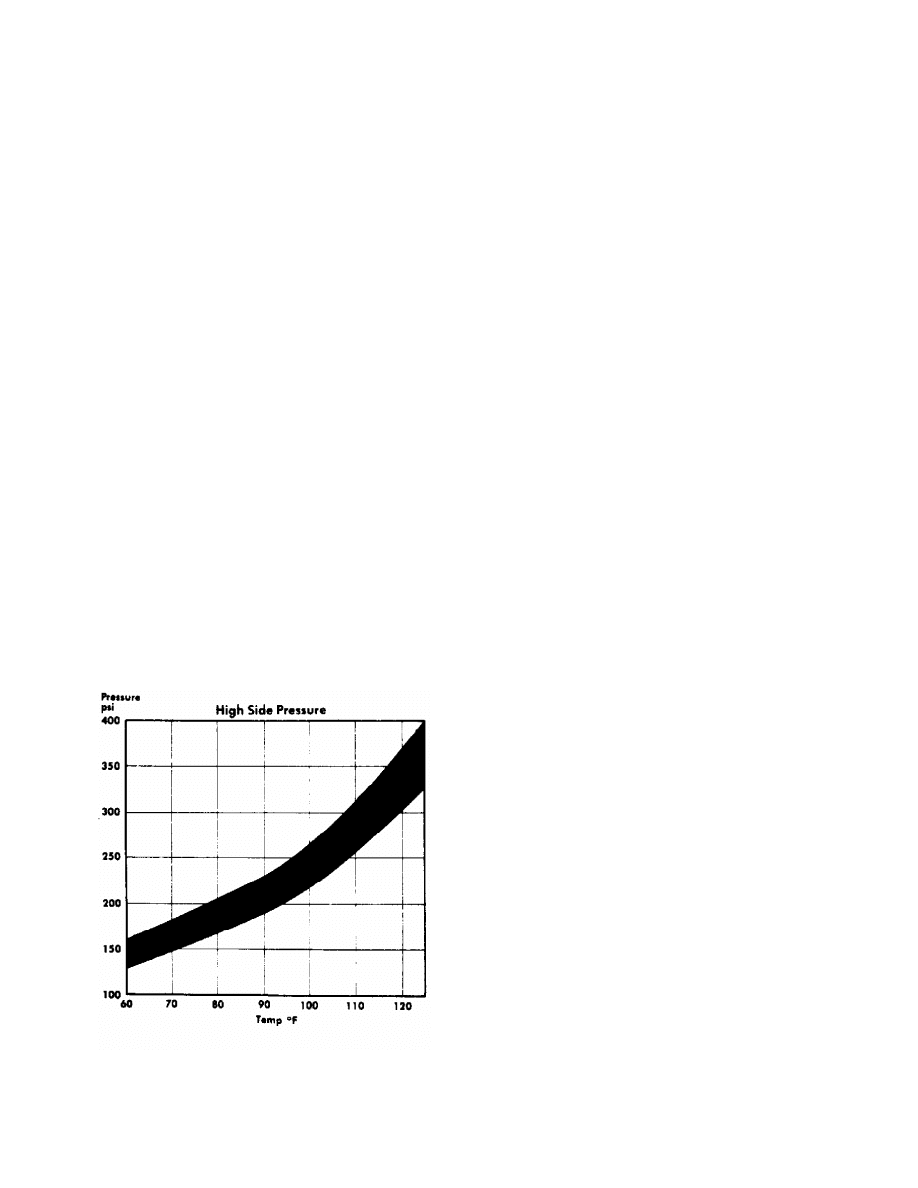
* High Side Gauge See Pressure Chart Above or below normal
- See A/C Diagnosis.
* Low Side Gauge See Pressure Chart Above or below normal
AMBIENT TEMPERATURE/PRESSURE
Fig. 1: Ambient Temperature/Pressure (R-12)
EVAPORATOR TEMPERATURE/PRESSURE
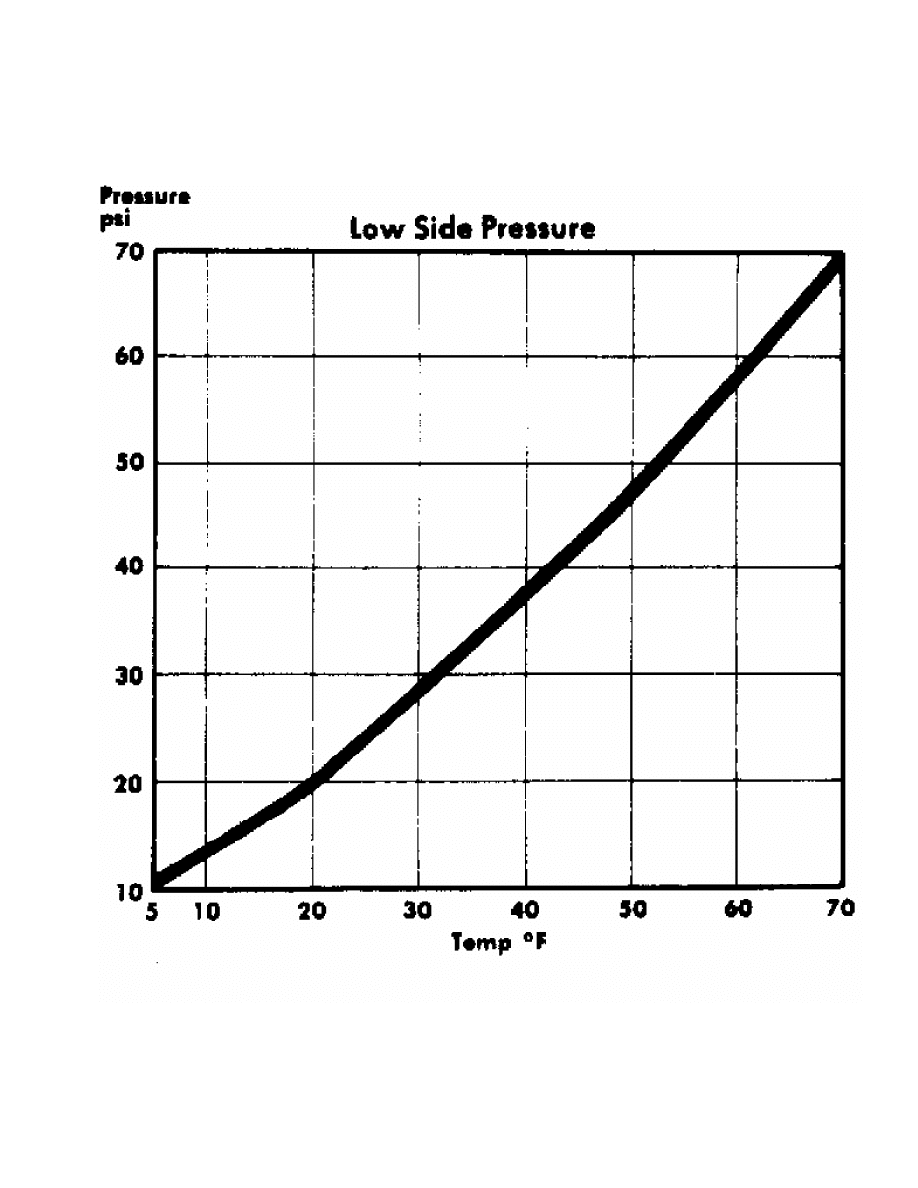
Fig. 2: Evaporator Temperature/Pressure (R-12)
A/C DIAGNOSIS W/GAUGES FOR SYS. W/INSUFFICIENT OR NO COOLING
A/C DIAGNOSIS W/GAUGES FOR SYS. W/INSUFFICIENT OR NO COOLING TABLE
Low Side
High Side
Other Symptoms (1)
Diagnosis
Gauge
Gauge

NORMAL
NORMAL
No or few bubbles in sight
Some Air & Moisture
glass. High side gauge may
in System
go high. Low side gauge
does not fluctuate with
compressor on/off cycle.
NORMAL
NORMAL
Cools okay in morning but
Excessive Moisture
not during hot part of day.
in System
Bubbles in sight glass.
Discharge air warm when low
side gauge drops into
vacuum.
NORMAL
NORMAL
Thermostatic sw. sys. only-
Defective
compressor cycles off & on
Thermostatic Sw.
too rapidly.
NORMAL
NORMAL
Cycling clutch sys only -
Misadjusted
to
compressor doesn’t turn on
Thermostatic Sw. or
HIGH
soon enough.
Defective Pressure
Discharge air becomes warm
Sensing Switch
as low side pressure rises.
LOW
LOW
Bubbles in sight glass.
Low R-12 Charge
Outlet air slightly cool.
LOW
LOW
Sight glass clear.
Excessively Low
Outlet air very warm.
R-12 Charge
LOW
LOW
Outlet air slightly cool.
Expansion Valve
Sweating or frost at
Stuck Closed Screen
expansion valve.
Plugged or Sensing
Bulb Malfunction
LOW
LOW
Outlet air slightly cool.
Restriction on
High side line cool to touch.
High Side
Sweating or frost on
high side.
LOW
HIGH
Evaporator outlet pipe cold.
STV Stuck Open
Low side goes into vacuum
when blower is disconnected.
HIGH
LOW
Evaporator outlet pipe warm.
STV Stuck Closed
Outlet air warm.
HIGH
LOW
Noise from compressor.
Compressor
Malfunction
HIGH
HIGH
Outlet air warm.
Compressor
Liquid line very hot.
Malfunction
Bubbles in sight glass.
or
R-12 Overcharge
HIGH
HIGH
Outlet air slightly cool.
Large Amount of Air
Bubbles in sight glass.
of Air & Moisture
in System
HIGH
HIGH
Outlet air warm.
Expansion Valve
Evaporator outlet sweating
Stuck Open
and frost.

(1) - If equipped with a low refrigerant charge protection system,
compressor operation may have stopped.
AIR CONDITIONING GENERAL TROUBLE SHOOTING
CONDITION & POSSIBLE CAUSE
Compressor Not Working
* Compressor clutch circuit open.
* Compressor clutch coil inoperative.
* Poor clutch ground connection.
* Fan belts loose.
* Thermostatic switch inoperative.
* Thermostatic switch not adjusted.
* Ambient temperature switch open.
* Superheat fuse blown.
Excessive Noise or Vibration
* Missing or loose mounting bolts.
* Bad idler pulley bearings.
* Fan belts not tightened correctly.
* Compressor clutch contacting body.
* Excessive system pressure.
* Compressor oil level low.
* Damaged clutch bearings.
* Damaged reed valves.
* Damaged compressor.
Insufficient or No Cooling; Compressor Working
* Expansion valve inoperative.
* Heater control valve stuck open.
* Low system pressure.
* Blocked condenser fins.
* Blocked evaporator fins.
* Vacuum system leak.
* Vacuum motors inoperative.
* Control cables improperly adjusted.
* Restricted air inlet.
* Mode doors binding.
* Blower motor inoperative.
* Temperature above system capacity.
HEATING GENERAL TROUBLE SHOOTING
CONDITION & POSSIBLE CAUSE
Insufficient, Erratic, or No Heat
* Low coolant level.
* Incorrect thermostat.
* Restricted coolant flow through heater core.
* Heater hoses plugged.
* Misadjusted control cable.
* Sticking heater control valve.
* Vacuum hose leaking.
* Vacuum hose blocked.
* Vacuum motors inoperative.
* Blocked air inlet.
* Inoperative heater blower motor.
* Oil residue on heater core fins.
* Dirt on heater core fins.

Too Much Heat
* Improperly adjusted cables.
* Sticking heater control valve.
* No vacuum to heater control valve.
* Temperature door stuck open.
Airflow Changes During Acceleration
* Vacuum system leak.
* Bad check valve or reservoir.
Air From Defroster At All Times
* Vacuum system leak.
* Improperly adjusted control cables.
* Inoperative vacuum motor.
Blower Does Not Operate Correctly
* Blown fuse.
* Blower motor windings open.
* Resistors burned out.
* Motor ground connection loose.
* Wiring harness connections loose.
* Blower motor switch inoperative.
* Blower relay inoperative.
* Fan binding or foreign object in housing.
* Fan blades broken or bent.
Wyszukiwarka
Podobne podstrony:
ac system general servicing
etzi-zagadnienia do zaliczenia-2016, ELEKTRONIKA I TELEKOMUNIKACJA PRZ - systemy pomiarowe i diagnos
uk+éad Procedury Zintegrowanego Systemu Zarz¦ůdzania , Procedura Zintegrowanego Systemu Zarządzania
Znieczulenie do procedur diagnostycznych Procedury nieinwazyjne wymagające współpracy pacjenta
Skrypt - Obsługa przyrządów pomiarowych z wykorzystaniem standardu SCPI, Nauka i Technika, Automatyk
Ćw 6 ZASTOSOWANIE STEROWNIKA PLC W KOMPUTEROWYCH SYSTEMACH POMIAROWO DIAGNOSTYCZNYCH
UMOWA O ROBOTY BUDOWLANE W SYSTEMIE GENERALNEGO WYKONASTWA, Dokumenty,wzory pism,rozporządzenia,praw
21. PLAN PRZEBIEGU DIAGNOZY, Procedura informowania rodziców na temat diagnozy dziecka:
Obsługa aparatury pomiarowej z wykorzystaniem SCPI oraz środowiska VEE PRO, Nauka i Technika, Automa
Procedura mycia i dezynfekcji systemów ssących i ślinociągowych, procedury medyczne - gabinet stomat
Umowa o roboty budowlane (w systemie generalnego wykonawcy), Umowy protokoły budowlanka
etzi-zagadnienia do zaliczenia-2016, ELEKTRONIKA I TELEKOMUNIKACJA PRZ - systemy pomiarowe i diagnos
07 AC Service and Diagnosis
04 AC System and Components
Immunity Based Intrusion Detection System A General Framework
System Curiosity Diagnostics wkrótce na rynku
SYSTEMY PRAWA KARNEGO I PROCEDURY KARNEJ NA ZIEMIACH POLSKICH PO 1918 ROKU
więcej podobnych podstron