Polish-English Contrastive Grammar, Grzegorz Krynicki ILS Summer Semester 2010
1
Topic 4: Cardinal Vowels. English and Polish Vowels
1
Cardinal vowels and vowel quadrilateral
English dialects we will consider are
o RP – Received Pronunciation, received meaning „accepted‟, also known as Queen's English, BBC English;
o GA – General American, Midwestern accent spoken by newscasters.
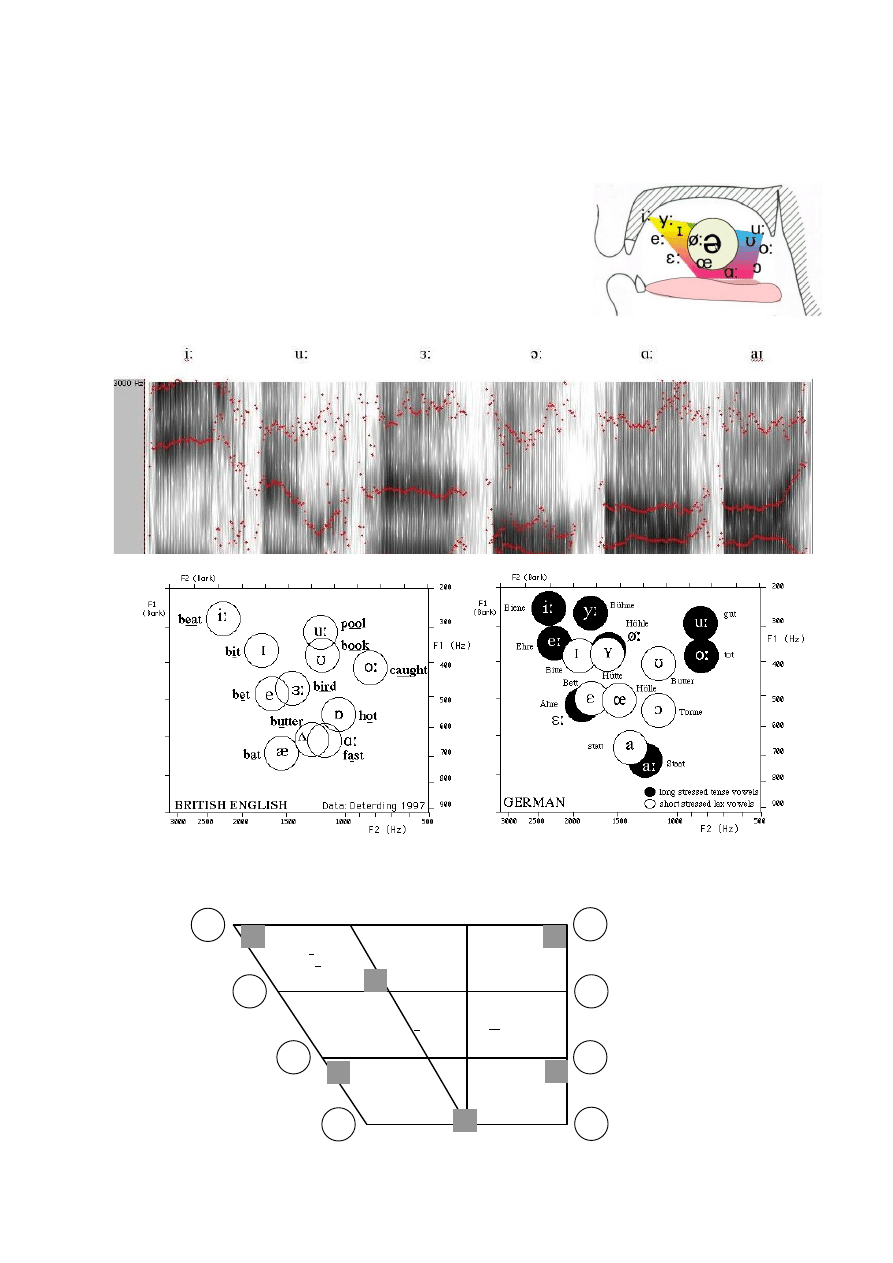
A vowel quadrilateral (Germ. Vokalviereck, Vokaltrapez) was invented by
Daniel Jones (1887-1967) to represent the positions of the highest point of the
tongue during the production of the vowel.
It includes cardinal vowels - sounds produced when the tongue is in extreme
positions, either front or back, high or low, with lips being either rounded or
unrounded. Cardinal vowels define the space for all the other vowels.
It was later found to more exactly reflect some acoustic properties of vowels:
the frequencies of two high energy bands in a vowel sound spectrum (as the
one below for RP vowels), i.e. the first and second vowel formant (F1 and F2 below)
F3
F2
F1
In the vowel chart diagram below (cf. Wells 2000), the circled symbols represent primary cardinal vowels (i.e. without
lip-rounding; their rounded counterparts are called secondary cardinal vowels; not included in the diagram), the shaded
symbols represent Polish vowels, the remaining symbols represent English vowels.
front central back
high (close)
mid
low (open)
ɚ
RP HOD
AmE POWER
AmE POD
FATHER
HEED
ROSES,
HAPPY
HID
HEAD
HAD
HUD
HORDE
HOOD
WHO’D
BIRD
ABOUT
AmE BIRD

Polish-English Contrastive Grammar, Grzegorz Krynicki ILS Summer Semester 2010
2
2
Vowel qualities
Simple vowels (i.e. pure vowels or monophthongs) can be described with the following criteria
2.1 Position of the body of the tongue: vertical and horizontal
Tongue vertical position: high (=close), mid, low (=open) vs. tongue horizontal position: front, central, back. Sometimes the mid
region is divided into: high-mid (=half-close) and low-mid (=half-open) regions.
2.2 Lip position: rounded and unrounded
In English, the high back and mid back vowels (/
/, //, //) are rounded. Low back // gets slight rounding as well. The
remaining vowels are unrounded. Additionally, unrounded lip shapes are divided into neutral e.g. for /
/ and spread e.g. for //
and /
/.
2.3 Length and tenseness
Long/short distinction is replaced by vowel tenseness, with the “long” vowels being tenser than the “short” vowels, because
American equivalents of the RP short/lax vowels are not always so short - in many American accents, all vowels can
become lengthened for emphasis
Both in RP and GA, vowels are a bit longer before voiced consonants in a syllable-final position than before voiceless
consonants. This phenomenon is called Pre-fortis clipping (pre = before; fortis = voiceless; clipping = shortening). For
example, the vowel /
/ in „bat‟ // is shorter, because /t/ is unvoiced, while the same vowel in „bad‟ // is longer,
because /d/ is voiced.
Vowel stress in English also makes vowels longer, as English is a stress-timed language (in English time intervals
between stressed syllables are equal; in Polish, as a syllable-timed language, all syllables are of approx. equal length)
3
English simple vowels
There are some differences between the vocalic system of GA and RP. Crucial differences are
no /
/ in GA;
rhotacized /
/ and /
/ are absent from RP;
GA has /
/ in most words where RP has //, e.g. //, // vs. //, //. However, in some of those words GA has
/
/, e.g. // vs. //;
RP has /
/ in some words where GA has //, e.g. //, //, // vs. //, //, /l/. But notice //,
/
/ for both.
In the table below, all GA and RP vowels are listed with their appropriate vowel quality descriptions
Symbol
Symbol name
Example
Tongue position
Lips
Length/
Tenseness
vertical
horizontal
script i (with triangular colon)
beat
high (close)
front
spread
long/tense
script i
roses /
/ high (close)
front
spread
short/lax
small capital i
bit
high (close)
front
spread
short/lax
script e
bet
mid
front
neutral
short/lax
ash, digraph a-e
bat
low (open)
front
neutral
short/lax
caret, wedge, turned v
cut
low (open)
central
neutral
short/lax
reversed epsilon, reversed open e
nurse
mid
central
neutral
long/tense
(GA) rhotacized reversed epsilon
nurse
mid
central
neutral
long/tense
schwa
about /
/ mid
central
neutral
short/lax
(GA) rhotacized schwa, schwa with hook color / / mid
central
neutral
short/lax
script a
palm
low (open)
back
neutral
long/tense
(RP) turned script a
lot
low (open)
back
rounded
short/lax
open o
caught
mid
back
rounded
long/tense
upsilon
put
high (close)
back
rounded
short/lax
script u
boot
high (close)
back
rounded
long/tense
4
English complex vowels
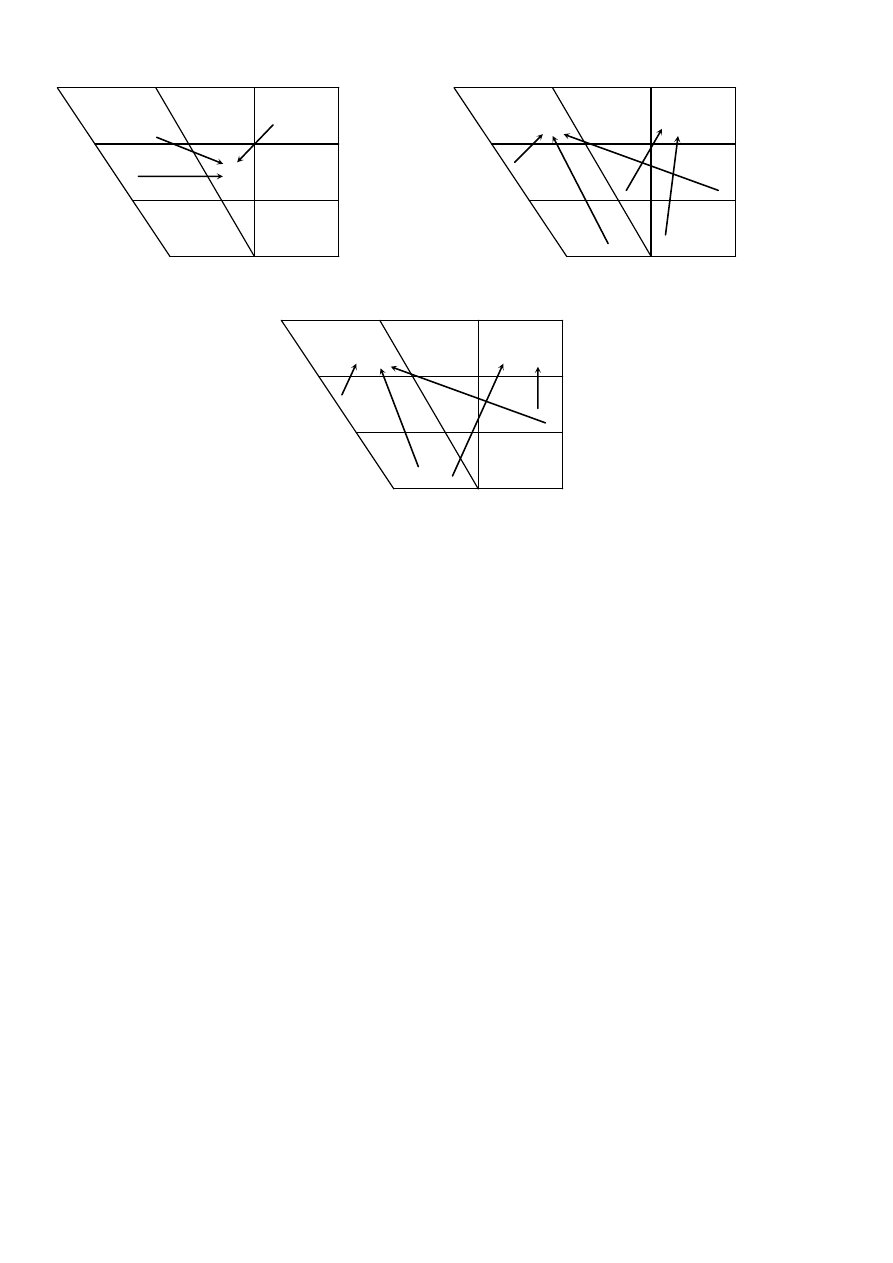
English complex vowels include diphthongs and triphthongs. Diphthong – a sequence of two vowels pronounced together, the two
vocalic elements being members of the same syllable. In English we have centring diphthongs and rising diphthongs. RP
centring and rising diphthongs are the following
Polish-English Contrastive Grammar, Grzegorz Krynicki ILS Summer Semester 2010
3
front central back
high
mid
low
BEAR
BEER
POOR
front central back
high
mid
low
PAID
BITE
BOY
TOE
HOUSE
GA has only rising diphthongs
front central back
high
mid
low
PAID
BITE
BOY
LOUD
SO
In GA there are no centring diphthongs because GA is a rhotic accent and /
/, //, // become //, //, //. In rhotic accents /r/
can occur without a following vowel. RP is a non-rhotic language so /r/ does not occur unless a vowel follows.
triphthongs – have no phonemic status in English. They occur when the non-centring diphthongs are followed by schwa.
they occur before the /r/ contained in a suffix added to the root. Thus /
/, //, //, //, // become //, //, //,
/
/, // in (fire, employer, layer, mower, power)
as a separable element in a compounds (nowadays, throwaway)
as inseparable parts of a word (mayor, boa, fire, sour, soya)
5
Selected differences between Polish and English vowels
numbers: 6 in Polish vs. 12 in English (excluding Polish nasals and English diphthongs)
quantity
o has a phonemic distinction in English;
o the contrast involves both quantity and quality, with a possible exception of the mid-central pair;
o lacking in Modern Polish but present in Old Polish
nasal vowels
o oral/nasal contrasts in Polish as opposed to a slight degree of nasalisation in English;
o nasal allophones in Polish [
ĩ ɨ̃ ũ ɑ̃] (instynkt, symfonia, kunszt, tramwaj)
o alternatively, Polish nasal vowels can be treated as sequences of vowel+consonant, e.g., /
kɛmpa/ kępa, /rɛŋka/
ręka; /
ŋ/ is then treated as a separate phoneme and not an allophone of /n/
diphthongs
o 8 BrE and 5 AmE English diphthongs
o Polish diphthongs in loanwords (Eu-ropa, au-tor); phonetically comparable sequences of vowel+glide in Polish,
e.g., maj; notice however that they are split by a syllable boundary (ma-ja), or by a morpheme boundary (da-j)
other
o lack of mid-central vowel in Polish
o rhotic/non-rhotic dialects of English; r-colouring with vowel followed by /r/
o /
æ/ ~ /ɑː/ pairs in AE and BE before /f, s, Ѳ, n/
References
Wells, J.C., 2000. Longman Pronunciation Dictionary. Second edition. Harlow: Pearson Education Limited.
http://www.hi.is/~peturk/KENNSLA/02/TOP/VowelsDiphth.html
http://www.ling.mq.edu.au/speech/phonetics/index.html
Iivonen, Antti. Vowel charts.
http://www.helsinki.fi/speechsciences/projects/vowelcharts/
E-DaF: Illustrationen 3.
http://zif.spz.tu-darmstadt.de/jg-07-1/beitrag/wchan4.htm
http://en.citizendium.org/wiki/Vowel
Burkhard Dretzke. 1998. Modern British and American English pronunciation. Paderborn: Schoening. p. 35
Wyszukiwarka
Podobne podstrony:
vowels and cardinal vowels diagram
DIALOG Polish and British political system docx
practise about chinnese and english
P J Pirie Portrait of Debussy 5 Debussy and English Music
Manual of Savate and English Boxing the Leboucher Method
Polish to English
Vajrayana Treatise in Tibetan and English
26a Mercedes Benz Codes in German and English ADDENDUM
The Gateless Gate (chinese and english)
catholic prayers in latin and english
A syntactic contrastive analysis of the relative clauses in Arabic and English
52 Mad Dogs and Englishmen
The Structure of DP in English and Polish (MA)
English and Polish Verb Phrase
więcej podobnych podstron