
Annual Meeting of the
New Champions
Rethinking Personal Data
Dalian
, People’s Republic of China, 12 September 2013
September 2013

World Economic Forum
The New Data Commons
Annual Meeting of New Champions,
Dalian, China, 12 September 2013
Summary
Participants at the Annual Meeting of New
Champions held a private session to discuss
innovations and risks in the use and exchange of
personal data as part of the on-going Rethinking
Personal Data project
(
The focus of the session was on discussing a new
approach to using and sharing personal data that
strikes the right balance between managing the
risks that can be created when personal data is
used and exchanged, and promoting innovation
through the free flow of personal data. Striking
this balance is key to fostering a sustainable
personal data ecosystem that fulfils its
tremendous potential for social and economic
good while respecting the rights of individuals.
The participants felt that in order to strike this
balance, a new approach is necessary that is
more flexible, based on the uses of data rather
than the collection of data, and is centred on the
individual. In order to implement a new approach,
business, legal, and technical innovation will be
necessary to create the right operating
environment.
The dialogue will continue with multiple interaction
touchpoints with different stakeholder
communities over the remainder of 2013.
Introduction
This private workshop convened a range of
stakeholders as part of an on-going project which
aims to promote the trusted flow of personal data
by advancing the need for a flexible set of usage-
based principles, centred on the individual, to
govern data use. The group included several
practitioners who use personal data to solve
pressing business or social challenges.
The session opened by recapping the need for
change to achieve a balanced personal data
ecosystem. It was acknowledged that shifting the
attention from the ‘collection’ of personal data to
the ‘use’ of this data would be the appropriate and
practical course of action to take in the era of Big
Data. To do this will require new policy
frameworks and technological innovations, as well
as a means for effectively engaging the individual.
And the creation of these new systems requires
rethinking traditional notions of collection
limitations, use specification, and notice and
consent
– all of which were valid in the past, but
are now insufficiently flexible and robust to be
effective in today’s world.
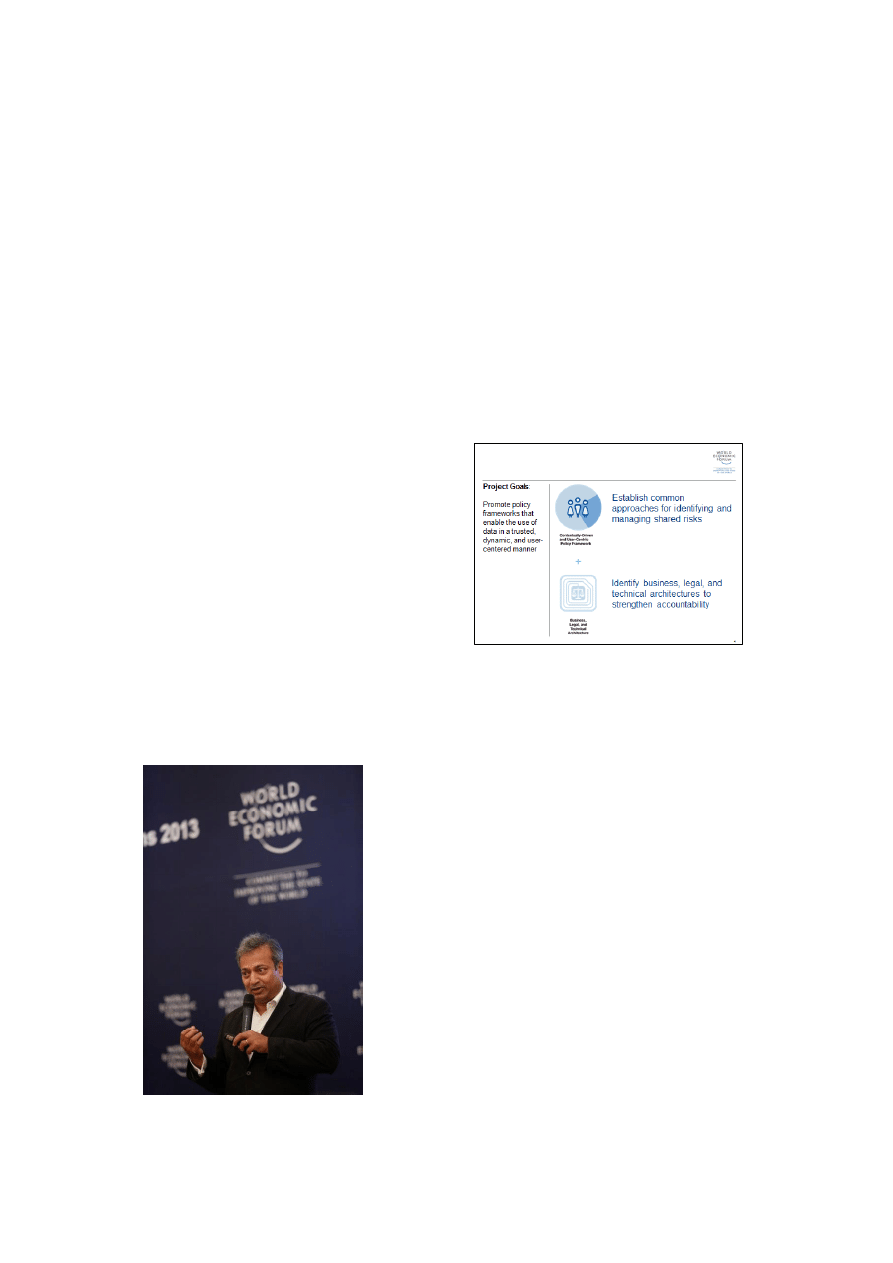
To further the dialogue on some of these issues,
the Rethinking Personal Data initiative team is
focused on promoting the need for innovation in
the business, legal, and technical architecture
underpinning the personal data economy, and for
a policy approach accepted by all parties that is
based around the context in which data is used,
and centred on the individual.
Identifying Opportunities
and Risks, and Striking
Balance
The session was structured around three main
questions: How can we use personal data to
discover new opportunities? What are the risks
and harms associated with these innovations?
How do we balance the opportunities available
with the potential risks and harms?
When discussing the first question the group
noted that a discussion focusing on the benefits of
personal data use, rather than potential downside
risks, was overdue. It was also recognised that
there are many potential innovations possible in
the personal data space that could bring value to
governments, enterprises and society at large.
However, due in part to media coverage, it was
observed that most people are more acutely
aware of the risks of personal data use, rather
than the benefits, which impedes progress in
multiple ways.
There were many good cases of innovative uses,
for example, the United Nations World Food
Programme noted that mobile call data records
(CDR) were employed by their Vulnerability
Assessment Mapping (VAM) program to enhance
food security risk management and contingency
planning. Companies are using CDRs to identify
and predict malaria hotspots by linking mobile
operator data with disease datasets. This helps to
more efficiently plan for and administer
vaccinations and other medication. Some
companies are using personal data to optimize
the traffic network and urban planning efforts
emerging markets. Finally, there were examples
of mobile operators that have found ways to
monetize their signalling traffic in new, innovative
(B2B) business models.
There was a general consensus that data-driven
innovation was highly leveraged
– the more data
that a system has the greater potential for
innovation. It is also context-driven. That is, the
innovations are driven by need in a given
circumstance, which may be different from that in
which the data was originally collected. As more
data is attracted into a system, and data sets can
be flexibly layered on top one another, there is
greater potential for further innovation.
The dialogue then shifted to a discussion of the
risks that could occur when personal data is used.
Risks manifest at different levels, and while most
businesses have systems in place to identify
various classes of risk that impact them directly
(financial, operational, etc.), in general these
organizations are not equally focused on risks to
individuals or society.
Regardless of the system or set of controls in
place, the potential exists for misuse or harms
breaches. Some participants reminded the group
that whenever a data set was assembled, some
degree of misuse was inevitable.
Also discussed was the role that legislation plays
in addressing or responding to various risks.
Many participants warned of the unintended
consequences of legislation that can occur as
times and technologies change. Highly effective
regulations can have reduced efficacy over time
as technologies evolve and circumstances shift. A
possible resolution is for all parties to be involved
in the design and implementation of policy
frameworks.

It was raised that a common misperception is that
the risks of personal data use affect the individual,
however, the benefits impact society at large. As
this misperception propagates further, it is
reasonable to expect that individuals might feel
apprehensive about personal data use and
exchange. However, if more is done around
communicating the individual and company-
specific benefits, public opinion may view
personal data use far more favourably.
Balancing the risks to individuals, businesses, and
society with the benefits that each of these groups
receive was viewed as a key priority. The
participants discussed the necessity to have a
robust risk management system that does not
stifle innovation in the personal data space. A
number of potential approaches for doing so were
mentioned.
Encouraging the development of new, exciting
data visualization tools was one suggestion to
connect more effectively with individuals, which is
in keeping with the notion that increased
engagement of the individual must be a central
priority going forward. If individuals had a way of
viewing with whom their data has been shared,
and for what purpose, the group felt that they
would have greater agency in managing their own
risk exposure.
Technological innovations were also at the heart
of a robust system. Advances in the way that
data is anonymized and aggregated have the
potential to enhance individual’s privacy
protections while still allowing researchers,
government agencies, businesses, and other
stakeholders the flexibility that they need to
innovate. A potential system could feature
permissions that are coded into the data and
automatically detect the allowability of a forward
transfer or use.
Finally, legal tools could be updated by borrowing
established conventions from other fields to create
stronger legal protections that can be practically
implemented.
Broadening the dialogue and
moving forward
Overall participants felt that the structure for
discussion proposed by the World Economic
Forum was the right way to further the
conversation. However, there still remain many
additional steps that need to be taken in the
coming months.
The legal and technological tools need to be
further developed and enhanced. In order to
develop a policy framework to underpins these,
additional socialization and dialogue is necessary.
Legal experts, personal data and privacy experts,
and policymakers from multiple geographies
should all be consulted to ensure that any set of
solutions is truly global in nature and can be
successfully implemented in practice.
Just as important is the participation of the
practitioner community. Businesses,
governments, and social organizations that use
personal data to innovate and address key
challenges are vital in ensuring that new tools and
approaches fit the needs of those who will be
employing them.
The dialogue is ongoing, and the Rethinking
Personal Data project will be hosting a series of
meetings leading up to the 2014 World Economic
Forum Annual Meeting in Davos-Klosters,
Switzerland. The next discussion on a new
approach for using personal data will take place at
an IIC Policy Discussion in London on 11 October
2013, and with the project Steering Board and
Working Groups.


Contact
Sincere thanks are extended to the industry experts
who contributed their unique insights to this workshop.
We are also grateful for the commitment and support of
A.T. Kearney in their capacity as project adviser.
Visit www.weforum.org/personaldata
Contact:
William Hoffman
Associate Director
Information Communication and Technology Industries
Tel.: +1 212 703 2332
E-mail:
Justin Shepherd
Project Manager (A.T. Kearney Secondee)
Information Communication and Technology Industries
Tel.: +1 212 7032393
E-mail:

8
The
World Economic Forum is
an independent international
organization committed to
improving the state of the world
by engaging business, political,
academic and other leaders of
society to shape global,
regional and industry agendas.
Incorporated as a not-for-profit
foundation in 1971 and
headquartered in Geneva,
Switzerland, the Forum is tied
to no political, partisan or
national interests.
World Economic Forum
91-93 route de la Capite
CH-1223 Cologny/Geneva
Switzerland
Tel.: +41 (0) 22 869 1212
Fax: +41 (0) 22 786 2744
contact@weforum.org
www.weforum.org
Wyszukiwarka
Podobne podstrony:
GNU Linux Tools Summary
EXPORTS OF ICT EQUIPMENT
Point Rethinking Affirmative Action
Project Management Six Sigma (Summary)
report ICT 3 juin 08
Summary and Analysis of?owulf
Count of Monte Cristo, The Book Analysis and Summary
4-Tourism strategy summary, Turystyka, Turystyka uzdrowiskowa i odnowa biologiczna, Polityka i plano
Catcher in the Rye, The Book Analysis and Summary
1984 Chapter by Chapter Summary and Reaction
Summaries of the Four Arab Israeli Conflicts in the th?n
The Great?pression Summary and?fects on the People
Animal?rm Book Summary
great expectations summary
Bio CHP summary
ELEMENTARY GRAMMAR CONSTRUCTIONS SUMMARY
SHSBC340 SUMMARY I
A?rewell to Arms Book Summary
3xSMA Summary How to Trade It
więcej podobnych podstron