
BASIC PRINCIPLES
of the
COMMUNIST LEAGUE
LITERATURE DEPARTMENT

NOTES
First Printing • November 2004
Second Printing • March 2005
1
Communism, as a social system, is a society without classes, without
a coercive state and without social inequality. Communism is the
society of general freedom, where all power rests in the hands of
an educated, organized and self-acting people. It is a social system in
which all aspects of society — politics, economics, culture and social
relations — are organized and developed for the benefit of all humanity,
and not for the profit of a few.
Communism, as a political philosophy, is the principled framework
that outlines the conditions within which the proletariat develops its
program of liberation. In its theory, communism explains the
developments of classes and class society, and how these developments
affect the organic antagonisms between different classes. In its action,
communism seeks to organize the highest possible unity of proletarian
forces in order to achieve its aims. Communism — as established in its
principles — is a guide to action. It is the theoretical lamp that lights
the way forward, not a roadmap or blueprint.
2
Capitalism is, in essence, the production of commodities for profit.
Capitalism requires a constant revolutionizing of technology and
the instruments of production in order to maintain or increase its
profits. The concrete result has been the creation of an integrated and
interdependent global capitalist system, where nation-states serve as
centers of power for this or that capitalist combination. Capitalist
1
Communist League
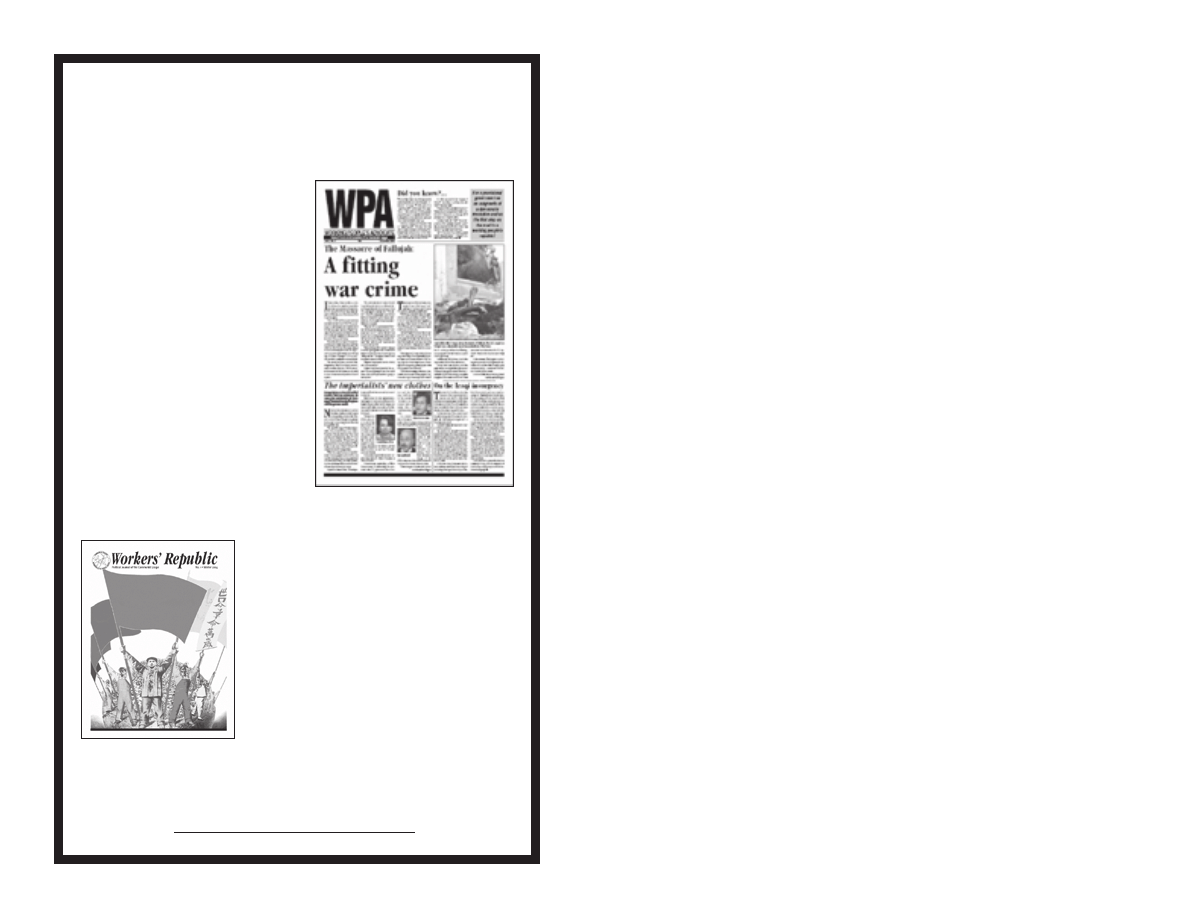
Publications
Workers’ Republic
Political journal of the Communist
League. Published four times a
year by the Central Committee as
an organ of communist theory and
discussion. 16 pp. US$1 per issue
Working People’s
Advocate
Monthly voice and Central
Organ of the Central Commit-
tee of the Communist
League. Published as an
organ of education, agitation
and organization. US10¢ per
issue
Contact your local distributor of this pamphlet to get
a copy of these publications, or e-mail the League at
league@communistleague.tk.

competition, the drive for greater profits, not only forces the
revolutionizing of production, it also forces capitalism to produce more
commodities than society needs. The epidemic of overproduction is
the natural consequence of a system where the production of
commodities for profit is the driving force.
Modern capitalism has taken all of this to its highest and final level
— imperialism. Individual capital and individual capitalists have
combined into monopolies. The capital of industry has merged with
banking and finance capital, and has used its combined strength to reach
around the world. Through the export of capital, the most powerful
capitalist nation-states have divided the world — its resources, its capital
and its people — among themselves. But the world is finite, and
competition among these imperialist Great Powers for the spoils of the
earth is the natural consequence.
3
As much as the production of commodities for profit defines
the essence of capitalism as an economic system, so private
property defines the essence of the economic power of the
capitalist class. Private property is not, as some bourgeois propagandists
would have you believe, the same as personal property. Private property
— or, more correctly, bourgeois private property (also known as capital)
— is a social construction, used by the capitalists as a means of justifying
their tyranny in the economy.
The abolition of private property in favor of social or common
property means the returning of the product of labor to the laborer.
Since capital is a social product, produced by teams of proletarians, it
can only be held in social ownership. Breaking private property into
smaller chunks can only work if that capital is based on pre-capitalist
foundations, like large farms. Modern, large-scale capitalist production
cannot be broken into smaller elements without destroying the means
of production themselves.
4
Capitalist class society developed three main classes: the proletariat,
bourgeoisie and petty-bourgeoisie. The proletariat is the class in
society that subsists solely from the sale of its labor power and
draws no profit from the production of commodities or any other kind
2
without exploitation and oppression makes their organization so much
a house of cards. Our enemy is armed to the teeth, but our ability to act
in our own class interests is the most powerful weapon of all. Like our
namesakes of history, and with a conviction forged in the fires of today’s
struggles, we once again raise the battle cry:
The proletarians have
nothing to lose but their chains. They have a world to win. Workers
of the world, unite!
19

of capital. At once, these conditions place the proletariat in a special
place: on the one hand, the proletariat under capitalism finds itself at
the mercy of those who own the means of production and are dependent
on the demand for their labor; on the other hand, the proletariat as a
class is an indispensable part of production and cannot be discarded
like so much obsolete machinery. Thus, the proletariat is the key to
transforming society, due to their central place in production. They are
the only genuinely revolutionary class.
The bourgeoisie is the class in society that subsists on the surplus
value created by the proletariat in the process of production. The
bourgeoisie, the capitalist class, maintains its economic position by virtue
of its private ownership of the means of production, which allows it to
exploit the proletariat through work for wages while reaping the profit
on the commodities created by labor. The bourgeoisie’s need to create
ever-larger profits results in an increasing concentration of power in
the hands of the proletariat; they are compelled to bring together in
greater masses, which gives the proletariat the ability to feel their strength
when acting in unison.
Between the proletariat and the bourgeoisie stands a third class: the
petty bourgeoisie. As capitalism has advanced, the petty bourgeoisie
has been transformed to serve a more proper role. As many broad
sections of the petty bourgeoisie were forced to join the ranks of the
proletariat, their places were taken by “new” elements created by the
bourgeoisie to better serve modern capitalist production. The petty
bourgeoisie as a class found itself being simultaneously ruined and
reborn as a managerial appendage serving the bourgeoisie, thus
becoming a stable force in the service of capitalism.
5
In order for the proletariat to establish its own workers’ republic,
which is the first step on the road to the abolition of classes, it
must raise itself to the level of a ruling class. The first great conflict
in which the proletariat must engage in order to achieve the establishment
of a workers’ republic is the battle for democracy. This is because it is
on the political plane that all classes are bound together and placed in a
common arena. Direct economic struggles between the proletariat and
the bourgeoisie often are confined to one workplace, one region or one
3
socialism, as a trend of petty-bourgeois socialist thought, has been able
to provide a relatively coherent program of action for these dispirited
and disoriented petty bourgeois. Under conditions of sharp and open
class struggle, the ugliest and most backward elements of the national
socialist petty bourgeois can emerge, leading these forces on to the
path toward fascism, traveled in the past by the likes of Mussolini,
Pilsudski and Hitler.
27
Communism has its ideological enemies; it also has its allies
and friends. An ally of communist proletarians can be found
among the movement of proletarian socialism. Generally
speaking, proletarian socialists are either sections of the proletariat who
are not yet sufficiently clear about the conditions of the liberation of
their class (or are not yet willing to draw the necessary conclusions
from their experiences), or they are individual petty bourgeois seeking
a deeper alternative.
In general, communists and proletarian socialists can find much
common ground for united action, up to and including within the
common organizational framework of a principled workers’ political
party. Thus, for communists to carry out work among and alongside
proletarian socialists, it may be necessary to become a member of one
or more of these bourgeois and petty-bourgeois socialist organizations,
with the goal of winning as many of these proletarians to the project
of building a principled, revolutionary political party of the proletariat,
composed of communists and proletarian socialists.
28
Today, the proletariat possibly faces its darkest hour. The
dichotomy posed to the proletarians of the world at the
outbreak of the First World War — “socialism or barbarism”
— is no longer adequate. The choice facing the world proletariat today
is:
socialism (the self-liberation of the proletariat) or death (through
fascist barbarism and/or nuclear war). There is no middle course. The
proletariat must take its future into its own hands, or else risk an unending
future of slavery and humiliation.
Our enemy is strong, but our unity gives us limitless strength. Our
enemy is well organized, but our solidarity and commitment to a future
18

industry. Thus, they are prone to isolation and marginalization.
On the other hand, the political struggles between the proletariat
and the bourgeoisie take on a generalized, societal character. A political
victory by the proletariat in one region or country generally has an
effect on the position of the proletarians in other areas. Communists
seek the broadest possible union of the proletariat on a political level
for the purposes of uniting the localized and isolated struggles of the
working class — including economic struggles — into a common battle
for revolutionary democracy, designed to aid the proletariat and its task
of elevating itself to a ruling class. This is why every class struggle is, in
the final analysis, a political struggle.
6
Because the class struggle is a political struggle, the proletariat
must be organized as a distinct and independent political body.
Concretely, this means that proletarians need to unite into a single
political organization that is able to challenge the bourgeoisie on its
own field and win — a political party of the working class. Communists
do not form a proletarian political party that stands in opposition to
other genuine parties of the working class.
Communists do not have any interests or principles that politically
separate it from the proletariat as a whole. The principles of communism
distinguish their adherents from other proletarians in only two ways:
first, in all struggles of the proletariat, communists point out and bring
to the front the interests of the entire class, regardless of this or that
difference; and, second, in the various stages of the class struggle,
communists always represent the interests of the movement as a whole,
not just the views of this or that leadership. Thus, the communists are
on the one hand the most advanced and resolute component of the
proletariat of every country, and on the other hand are the most
theoretically developed and are able to articulate and understand the
various developments, conditions and results of the class struggle.
7
The liberation of the proletariat from capitalism is the
responsibility and task of the proletariat itself. Historical experience
has shown that all other classes cannot accomplish the outstanding
political, economic and social tasks of capitalist society without
4
and terminology — “the people” and “the masses” are their generally
popular terms — in order to obscure the identity of which class is
really in power: the petty bourgeoisie.
However, as varied and distinct as many of these organizations are
from each other, they can, in the main, be placed in one of two main
subcategories: bureaucratic socialism and democratic socialism.
Bureaucratic socialism means the rule of a petty-bourgeois bureaucracy
in place of and over the proletariat. The bureaucratic socialist sees the
proletariat as “too oppressed,” “too uncultured” and “too uneducated”
to serve effectively as revolutionary leaders. Thus, the bureaucratic
socialist believes some kind of bureaucratic caste must substitute itself
for direct proletarian rule. Seemingly on the opposite pole is democratic
socialism. The main programmatic characteristic of democratic socialism
is its fetishism of bourgeois democratic forms, and conscious limitation
of its action to the boundaries established by bourgeois democracy.
However, like its fellow trends of petty-bourgeois socialism, democratic
socialism also presupposes the existence of an elite caste of professionals
and petty-bourgeois “specialists” that will “assist” the proletariat.
26
Another trend of petty-bourgeois socialism necessarily
deserving of special attention is national socialism. National
socialism refers to that trend of petty-bourgeois socialism
that rejects out of hand the importance of the international character
of the proletariat, its revolution and the transition to communism.
Modern national socialism is an offshoot from bureaucratic socialism.
National socialism, as a broader concept, lies at the heart of all trends
of petty-bourgeois socialism — including those trends that quite loudly
attempt to repudiate and distance themselves from nationalist ideology.
Over time, however, especially as the class struggle acquires a sharper
character where they operate, the national socialist petty bourgeois begins
to apply this nationalist method to his or her own conditions.
A more recent trend of national socialism is found among
organizations and individuals involved in the “anti-globalization”
movement. Primarily nationalistic in outlook and scale, the petty
bourgeoisie has the most to lose from the advances in capitalist
production that have spurred on the move toward globalization. National
17

endangering their class position and privileges in the process. While
communists certainly welcome democratic and social justice movements
among other classes, and will aid any such genuine movements with all
our might, we do not see them as a substitute for an independent
proletarian movement fighting for its own interests.
Inevitably, in the course of the class struggle, individuals from the
bourgeoisie and petty bourgeoisie will present themselves to the
proletariat and offer to assist. When such people from other classes
join the proletarian movement, the first demand upon them must be
that they do not bring with them any remnants of bourgeois or petty-
bourgeois prejudices, privileges and ways of functioning, and that they
irreversibly assimilate into the proletariat. Sometimes, in spite of their
best efforts, these people cannot assimilate themselves into the proletariat
and cannot break from their prejudices and privileges. In a political
party of the working class, they are a falsifying element. If there are
grounds that necessitate tolerating them, it is a duty only to tolerate
them, to allow them no influence or place in party leadership, and to
keep in mind that a break with them is only a matter of time.
8
The structure of the proletarian party, the political party of the
working class, will inevitably vary from country to country, from
region to region. While the specific structures and forms of a
proletarian party must as a rule be flexible and responsive to the demands
of the situation, communists believe that such structures must be based
on clearly defined principles that best serve to further the work of the
party and the cause of the proletariat itself. Democracy, specifically the
freedom to criticize, is essential to the development of the proletarian
party. Without democracy, the party inevitably degenerates into a narrow,
confessional sect, where its members are little more than automatons
carrying out the wishes of a leadership elite.
Once a full democratic discussion has taken place and a vote has
been taken, it is time for the party to act. Unity, specifically the power
of a united party in action, is the necessary compliment to democratic
discussion. Unity in action allows for the party membership as a whole
to test the validity of the decisions it has made. This works to the
5
degeneration of revolutionary development.
24
By far, the proletariat’s greatest ideological enemy within its
own ranks comes from those who support the theories and
programs of bourgeois socialism. Bourgeois socialism, as
its name implies, is defined as those who seek to use generally socialistic
policies and methods as a means of easing social ills, while at the same
time preserving the basic social, economic and political relations
generated by bourgeois society. The bourgeois socialists want all the
advantages of modern social conditions without the struggles and
dangers necessarily resulting from them. Bourgeois socialism requires
that the proletariat should remain within the bounds of existing society,
but should cast away all its hateful ideas concerning the bourgeoisie.
Most of today’s “official” organizations of the proletariat — whether
they call themselves “Social Democratic,” “Socialist,” “Labor” or
“Communist” — are representatives of bourgeois socialism. All their
talk of “socialism” or “communism” is limited to idealistic appeals
designed to bolster (or discipline) their own membership, while their
practical activity is aimed at preserving the same institutions that lead
sections of the proletariat to rise up and revolt. In periods of
revolutionary or radical upheaval, these “socialists” can play a special
role on behalf of the bourgeoisie. Throughout the 20th century, the
bourgeoisie has turned toward the various forms of bourgeois socialism
to save itself from destruction (revolution). Regardless of its form, the
ultimate outcome was the same: capitalist class relations were preserved,
and the proletariat and its organizations of struggle were destroyed.
25
Even though bourgeois socialism represents the greatest
ideological threat, it is neither the most pernicious nor the
most confusing. While bourgeois socialism represents the
interests of the bourgeoisie and its preservation using “socialist” means,
petty-bourgeois socialism represents the interests of those middle layers
of professionals, independent producers, intellectuals divorced from
class relations, middlemen and profiteers, etc. Unlike bourgeois socialism,
which is relatively honest and straightforward regarding which class
will rule, petty-bourgeois socialism often hides behind various labels
16

advantage of both sides in a dispute. It allows both the majority and the
minority in any dispute to be proven correct, without any equivocation
that can be raised due to partial or inadequate participation. Minorities
seek to become majorities, and have the unalienable right to do so.
Unity in action allows those minorities the opportunity to say, based on
the experience of actually carrying out the above stated decision, that
they were correct or incorrect.
9
Any struggle between the proletariat and the bourgeoisie inevitably
involves the state. The state is the crux of the capitalist system
and bourgeois rule. The overthrow of capitalist rule cannot take
place without the overthrow of the capitalist state. The state is not
some amalgam of governmental agencies and deliberative bodies. Those
are more or less mere forms of administration. The central element of
the state is the organized and developed body of armed men and women
that enforces the decisions of the bourgeoisie. Above all else, the central
task of these armed bodies is the defense and preservation of private
property. Thus, the modern capitalist state is a specialized instrument
for the maintenance of bourgeois rule.
Although the capitalist state attempts to stand over and rule all
classes, it remains an overarching instrument of the bourgeoisie. Even
during those times when the bourgeoisie is forced to share space with
representatives of the petty bourgeoisie and proletariat in the agencies
and deliberative formations of government, the fundamental elements
of the state remain solidly under their control. Communists do not
seek to simply grab hold of the capitalist state and wield it for its own
purposes. The fundamental character, the role and control, of the state
does not change with the granting of broader political rights.
10
The workers’ republic — referred to historically as the
dictatorship of the proletariat — is not merely another form
of the state, or of class rule. Rather, it represents the transition
between defeated bourgeois rule and the classless, communist society.
The state is the linchpin of class society. Its abolition is key to the
abolition of class distinctions and antagonisms. But the abolition of
the state cannot be accomplished merely with the stroke of a pen. The
6
22
Always and at all times, communists wage a relentless struggle
against the influence of bourgeois ideology in its ranks and
in those of the proletariat as a whole. Bourgeois ideology,
like all doctrines of ruling classes, are meant as a means of passive
social control over exploited and oppressed groups. In modern capitalist
class society, primary elements of bourgeois ideology include
individualism, subjectivism, pragmatism, chauvinism and mysticism.
These four main branches of bourgeois ideology encompass all other
elements and serve as the pillars of the bourgeoisie’s ideological control
of society.
For communists, the fight against bourgeois ideology must begin
with a systematic and broad-based attack on the ideology of pragmatism.
More than any other ideology, pragmatism restrains the proletariat in
its struggle for the abolition of classes and class antagonisms. A decisive
break by the proletariat with the bourgeois methods of pragmatism
will mean that a great step forward in the struggle for the classless,
communist society has been taken.
23
Communism is not the only political viewpoint that stands
apart from bourgeois ideology, or regards itself as anti-
capitalist. In fact, there are a wide variety of political currents,
both within and outside of the proletariat, that stand in opposition to
capitalist exploitation and oppression. Because human thought is a
product of definite social conditions, as refracted through the distorting
lens of class relations, so it is that the various differences within the
socialist movement also reflect this distortion. All of the various and
sundry trends of socialist thought can be placed into one of the class-
based categories of socialism with little or no difficulty. The difficulty
one might encounter in this process stems merely from the divergence
of thought and action.
Class-based understanding of the development of socialist thought
is essential to the development of the proletariat as a class capable of
bringing about a classless society. By tracing the development of class
ideology within the broader socialist movement, it becomes relatively
easier to avoid mistakes and errors that, when considered initially, may
seem formally correct, but ultimately lead to a retardation or even
15

capitalist state, due to its nature as a combination of armed agencies,
must not only be dismantled, but its armed forces must be broken up
and atomized.
In all, the workers’ republic has four main tasks: 1) the ouster of
the bourgeoisie from political power; 2) the eradication of the old organs
of the bourgeois state; 3) the institution of democratic workers’ control
of production through the abolition of private property; and 4) the
raising of the productive forces to a level where the material basis for
class distinctions and class antagonism is forever eliminated. As the
material basis for class distinctions and antagonisms disappears, those
who were hitherto counted among the bourgeoisie and petty bourgeoisie
will enter the ranks of labor. The proletariat comes to encompass all
members of society, and the proletariat itself ceases to be a class. Thus,
the state becomes an anachronism of society, to be discarded like an
empty orange peel. With the disappearance of classes comes the
disappearance of the state.
11
The opening phase of communism means the victory over
class antagonisms. With the final abolition of private property
and classes, the state will have been dismantled and disbanded.
What remains will be a superstructure of administrative bodies,
coordinating the production and distribution of goods on an
international scale. During this first phase of communist society, this
superstructure will exist as an arbiter of equality. This is because, under
the first phase of communism, classes have been abolished, but different
strata continue to exist.
The final transition to the highest phase of human society — the
highest phase of communism — will be the victory over strata and
bourgeois right. At that moment, the last vestiges of administrative
superstructure will become redundant, and can be easily disbanded and
replaced by the free association of laborers and producers. With the
victory over bourgeois right and strata, it will finally be possible to
inscribe as the singular law of society: From each according to their
ability, to each according to their need.
7
to come into conflict with the imperialist Great Powers and had deposed
its colonial viceroys or semicolonial compradors. Analogous to this,
communists also ally themselves with states seeking to break the chains
that bind them to the imperialist division of labor and hierarchy. In
such instances, our support is conditional and meant to intersect those
proletarians that seek to defend the political, economic and social gains
they have made.
21
Because capitalism is a social system based on minority rule
and the exploitation of the laboring majority, the bourgeoisie
relies on the use of armed force to maintain its control.
However, in times of severe political and economic crisis, the
maintenance of bourgeois rule demands the use of extralegal forces
that aim to smash the power of the proletarian organizations. Though
it often defines itself in a myriad of names and titles, it is known
universally by one term: fascism.
Put simply, fascism is a political movement of the petty bourgeoisie.
It is the reaction of the petty bourgeoisie to both their ruin at the hands
of capitalism (due to that system’s collapse) and their impending entry
into the ranks of the proletariat (generally as a result of a victorious
proletarian revolution). There are many political forms taken by a fascist
movement, contingent on the material conditions within which the latter
emerges. Historically, when fascism gains state power, they immediately
fuse with and accommodate the most conservative and backward
elements of the capitalist state machinery. Fascism in power takes the
form of a police state, domestically, and an imperialist empire,
internationally.
Fascism represents at once the decay of capitalist class society and
the latter’s organic direction. That is, the totalitarian and barbaric
methods of fascism are representative of the extent to which the
bourgeoisie is willing or able to sacrifice all other classes for its survival.
However, the bourgeoisie does not, and will never, reach a full consensus
on the use of fascism, though it may seem as though such a consensus
exists at times. Communists view fascism and the fascist movement as
the shock troopers of bourgeois reaction and counterrevolution against
proletarian action and the workers’ republic.
14

12
The transition to the classless, communist society is not a
singular event. Rather, the transition from capitalism to
communism is a series of fundamental transformations — a
series of “revolutions within revolutions” — that prepare the ground
for future progressive development. These revolutions within revolutions
affect all aspects of society, and are aimed at creating a new material
reality more conducive for historical forward movement. Accompanying
a revolution in politics, an economic revolution is needed to secure the
abolition of private property, and the transformation of economic life
from one based on production for profit to one based on production
for common good. This necessitates placing the means of production
in common ownership.
The transformation of social relations also requires a cultural
revolution within the revolution. Culture reflects all the social
contradictions embodied in the political and economic relations. Thus,
if the political and economic relations of a given society are not
sufficiently developed, a poverty of culture will necessarily exist. In
Even if there has been a successful transformation in the political and
economic arenas of society, there will still exist a poverty of culture
because of the tentative and relatively chaotic nature of the new relations.
This is the impetus for a cultural revolution within the broader social
revolution.
13
The rise of the world market and a relatively integrated world
capitalist system has ruled out in advance the idea that the
transition from capitalism to communism can be completed
on a local or national scale. Even if a proletarian revolution in a given
country succeeded in eliminating all aspects of the indigenous
bourgeoisie, that section of the proletariat is still confronted with the
combined power of the bourgeoisie of all countries. Thus, resolving
decisively the contradictions associated with the transition to
communism requires the overthrow of the bourgeoisie, and the abolition
of private property, on a world scale.
Capitalism’s attempts at integrating the world capitalist market have
resulted in the central contradiction of today’s society — the
contradiction between the international character of the capitalist market
8
as a matter of principle the bourgeois conception of “illegal” or
“foreign” proletarians.
At the same time, though, communists also recognize that the final
unity of the proletariat is not a linear process. It may be necessary for
certain sections of the proletariat to take a step away from their brothers
and sisters, as a means of developing a more solid and established
unification later. Such is often the case with proletarians from racially
or nationally oppressed backgrounds. We recognize that it may be
necessary for these proletarians to exercise their right to self-
determination, up to and including independence, as a means of breaking
the old dynamics of national chauvinism, and cultivating that instinctive
internationalist impulse — which will eventually lead toward a reunion
of both sections of the proletariat under a single banner.
20
A fundamental hallmark of class society is war. Under the
rule of the bourgeoisie, wars of conquest and colonization
have been waged by every generation, at the expense of
untold millions of proletarians. In its drive for new markets and pools
of resources, the bourgeoisie will not always be able to peacefully extend
its reach. As the crises of overproduction grip capitalist societies, it
becomes more and more necessary for the bourgeoisie to resort to
military action in order to open new areas of exploitation. In today’s
society, war also means flirting with the specter of limitless devastation
in the form of nuclear annihilation.
Communists oppose all wars but those that advance the struggle
for liberation and the abolition of classes. Always and at all times,
communists are for the defeat of the bourgeoisie in times of war. Such
a defeat, even when it is a defeat for both sides, is a “lesser evil” when
compared to the alternative. As part of this, communists always point
out the connection between war abroad and attacks on proletarians at
home, and point out that the only way to end both of these horrific
phenomena is to transform the movement against war into a movement
for liberation and the abolition of classes.
The only instances when we communists can find ourselves allying
with such semicolonial states is when they were the product of a
legitimate popular democratic movement that had consciously chosen
13

and the national character of the bourgeoisie and capital itself —
becoming more and more aggravated. In order for this contradiction to
be resolved progressively, it is necessary for the character of capital to
match the character of its market. One of the central tasks of a workers’
republic, as it moves ever closer to the abolition of classes, is the
systematic integration of society on a world scale. National political
structures must give way to the formation of a global body politic and
a global political system; national cultures must integrate and evolve
into a worldwide culture that takes the best elements of all societies
and democratizes them.
14
Communists do not stand apart from the proletariat as a
whole, but take our place as part of the most politically
advanced and active elements of our class. What distinguishes
communists, as individuals and as a current, from the proletariat at large
is our understanding of the world around us, and the principles and
program that flow directly from this knowledge. Central to the task of
bringing communist politics to the proletariat is consistent activity in
organizations where there are concentrations of working people.
Communists reject the view that the victory of the proletariat over the
bourgeoisie, and the establishment of a workers’ republic, can be
accomplished solely though economic organization and action. Limiting
the struggle of the proletariat to the economic arena at the expense of
fighting to fulfill the political interests of the proletariat, or merely adding
a political veneer to the existing economic struggle, only disarms workers
in the face of an armed and organized capitalist state. Breaking down
the walls between economics and politics is a key goal of communists,
and guides our work by setting forth the task of organizing the proletariat
consciously and politically — as a political party seeking to win political
power.
15
The programmatic demands of the communists are based
on the concrete conditions where they operate, and the
objective needs of the proletariat in its struggle against the
bourgeoisie. There is no ready-made blueprint or cookbook that lays
out in advance the kind of demands communists raise at a given time.
9
composition of both the exploiting and exploited classes. Communists
see the elimination of these forms of superexploitation and
superoppression as a necessary task — and predicated on the abolition
of class society, which perpetuates the institutional and societal divisions
— and will work alongside those who share this goal.
The ideological prejudices and backwardness inherent in
superexploitation and superoppression permeate all aspects of capitalist
class society. As hard as it may try, even the best proletarian party cannot
fully escape the distorting effects of this ideology. A caucus may be
formed by members of a superoppressed or superexploited group within
the proletarian political party in order to educate and agitate among all
members of the organization about the special conditions that face
these social groups. From time to time, it may also be necessary to
develop special interest groups to handle special tasks related to the
development of communist consciousness among superexploited and
superoppressed groups.
19
Proletarians have no “homeland,” “fatherland” or
“motherland.” Rather, proletarians, by virtue of their
position in capitalist class relations, have a fundamental bond
with their brothers and sisters in all countries of the world. All
proletarians, regardless of where in the world they are, share a common
position in society: they all have nothing but their labor power to sell,
and nothing but their labor power on which they can rely. The concrete
results of these common conditions are a nearly universal psychological
makeup and habits of life that parallel what we all see as elements of a
national culture.
Communists regard themselves as proletarian internationalists, in this
sense, and seek at all times to bring forward the unconscious instinct
toward internationalism and develop it as part of a conscious struggle
for self-liberation. As such, communists do not regard the existing
political borders of nation-states to be the boundaries of our activity
or solidarity. On the contrary, communists seek to break down these
borders and build closer ties between the proletarians of different
countries and continents. Communists struggle for the broadest possible
unity of proletarians regardless of nationality or citizenship. We reject
12

The long-term demands of communists are centered on the tasks
associated with the overthrow of the bourgeoisie and capitalist rule,
and the establishment of a workers’ republic. Their formulation may
change with the conditions of the area in which they are raised, but the
general demands remain the same. In general, communists do not seek
to develop immediate demands — that is, demands that arise
spontaneously from the daily struggles of the proletariat.
We communists support and defend all immediate demands and
struggles of the proletariat, even while we may be critical of the partial
or limited character of the demands or struggle. The role of communists
in struggles based on immediate demands is to formulate demands and
slogans that seek to build on the immediate demands of the proletariat,
and advance their consciousness to an acceptance of the long-term
demands of communists. These communist demands, which serve as a
way to bridge the gap between the immediate struggles and the long-
term struggle for a workers’ republic, are never counterposed to the
immediate demands of the proletariat, and are never a substitute for
the long-term program of proletarian power.
16
Because the movement for proletarian self-liberation and
the abolition of classes is primarily a political movement,
communists concentrate on the formulation of political
demands that match the material conditions in which they operate. As
with all types of concrete communist demands, political slogans and
positions are formulated based on the objective needs of proletarians
in a given area. The political demands of communists can generally be
grouped into two categories: democratic and socialist. It is a central
task of communists to be able to strike the balance between these two
forms of political demands, so that they can have the maximum effect
when raised among the proletariat.
The importance of raising political demands of a democratic nature
stems from both the objective needs of the proletariat and the overall
understanding communists have regarding the road to the overthrow
of the capitalist system. Just as it is a central mistake for proletarians to
limit themselves to either immediate or long-term demands in all arenas
of struggle, so too it is an error to reject raising democratic or socialist
10
political demands. A system of democratic and socialist political
demands, paralleling the dynamic relationship between immediate and
long-term slogans in all areas of the class struggle, is necessary to advance
the political struggle of the proletariat for its emancipation.
17
Demands for a broader democratic system can play an
important role in the development of a proletarian movement
for self-liberation and the abolition of classes. Democracy,
like all other terms that represent political concepts, has a definite social
and class content. Communists reject the idea that bourgeois democracy
is a genuine democratic model for society as a whole. Communists
believe that democracy demands not only the elaboration of specific
rights extended to all in society, but also that these rights must be
enforced and guaranteed by society. Communists seek to replace
bourgeois democracy with proletarian democracy — a democratic
political system that benefits those who are the most oppressed and
exploited in capitalist class society, and thus benefits all people.
This is not to say, however, that communists simply wait for the
victory of the proletarian revolution and the establishment of a workers’
republic before developing a more democratic system. On the contrary,
always and at all times, in word and deed, communists work to push
forward the boundaries of bourgeois democracy. The broader, more
advanced and generous bourgeois democracy is, the easier it is for the
proletariat to win political power and begin the transition from capitalism
to communism. Communists work to not only extend the boundaries
of political democracy, but also to break down the artificial barrier
erected by the bourgeoisie between politics, economics, culture and
social relations, and to extend democracy into all these areas.
18
The division of labor into definite classes is the primary
antagonism of society. However, there are groups of people
that suffer from privations and prejudices that cross these
class lines, and create dynamics and antagonisms that communists must
address. These added divisions, which center on differences of gender,
race, nationality, age, ability and sexuality, are barriers that were
established in the birth pangs of class society, and serve to clarify the
11
Wyszukiwarka
Podobne podstrony:
Basic Principles Of Perspective Drawing For The Technical Illustrator
S Belavenets Basic principles of game are in middlegame (RUS, 1963) w doc(1)
Basic Principles Of Celestial Navigation James Allen
Boris Wild Principle of the Boris Wild Instant Memorized Deck
FIDE Trainers Surveys 2010 03 31 Georg Mohr The Principle of the Second Weakness
San Min Chu I The Three Principles of the People by Dr Sun Yat Sen Doctrine of Nationalism
Wiley Finance, Principles of Private Firm Valuation [2005 ISBN047148721X]
The Policy of the German Hanseatic League Respecting the Mercantile Marine
Davis Foulger Models of the communication process, Ecological model of communication
Adventures of the Vampire Bowling League
Julia Latham League of the Blade 01 Thrill of The Knight
Kenyon, Sherrilyn League 01 Born of the Night
Berkeley A Treatise Concerning the Principles of Human Knowledge
Historia filozofii nowożytnej, 16. Berkeley - a treatise concerning the principles of human knowledg
Historia filozofii nowożytnej, 16. Berkeley - a treatise concerning the principles of human knowledg
Hume An Enquiry Concerning the Principles of Morals
Helsinki Principles on the Law of Maritime Neutrality
Eric Racine Pragmatic Neuroethics Improving Treatment and Understanding of the Mind Brain Basic Bioe
Descartes, Rene The Principles of Philosophy
więcej podobnych podstron