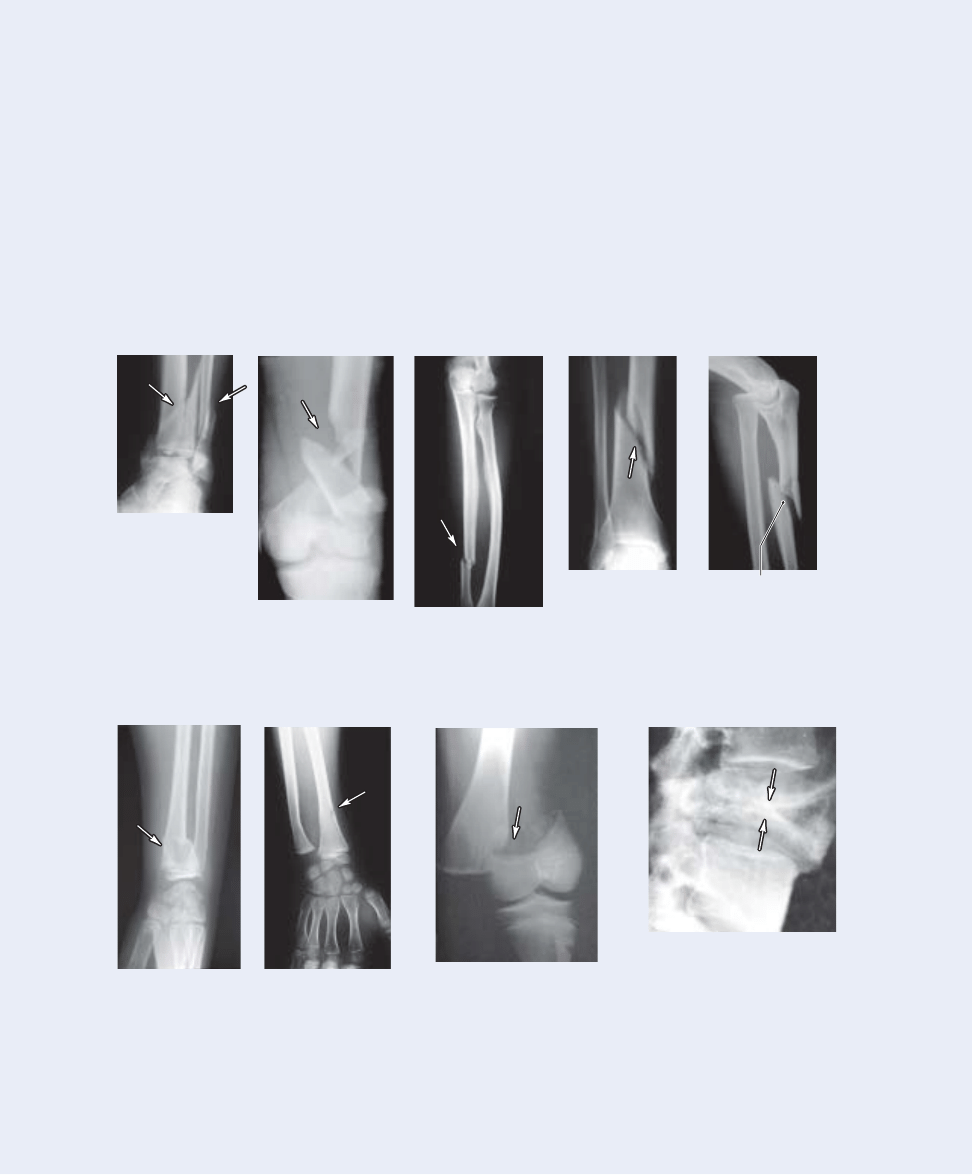
A Pott fracture
occurs at the ankle
and affects both
bones of the leg.
Comminuted fractures,
such as this fracture of
the femur, shatter the
affected area into a
multitude of bony
fragments.
Transverse fractures,
such as this fracture of
the ulna, break a shaft
bone across its long
axis.
Spiral fractures,
such as this fracture
of the tibia, are
produced by
twisting stresses
that spread along
the length of the
bone.
Displaced fractures
produce new and
abnormal bone
arrangements;
nondisplaced
fractures retain the
normal alignment of
the bones or
fragments.
Compression fractures occur
in vertebrae subjected to extreme
stresses, such as those produced
by the forces that arise when you
land on your seat in a fall.
Epiphyseal fractures, such
as this fracture of the femur,
tend to occur where the bone
matrix is undergoing calcifica-
tion and chondrocytes are
dying. A clean transverse
fracture along this line generally
heals well. Unless carefully
treated, fractures between the
epiphysis and the epiphyseal
cartilage can permanently stop
growth at this site.
In a greenstick
fracture, such as this
fracture of the radius,
only one side of the
shaft is broken, and
the other is bent. This
type of fracture
generally occurs in
children, whose long
bones have yet to
ossify fully.
A Colles fracture,
a break in the distal
portion of the radius,
is typically the result
of reaching out to
cushion a fall.
Fractures are named according to their external appearance,
their location, and the nature of the crack or break in the bone.
Important types of fractures are illustrated here by
representative x-rays. The broadest general categories are
closed fractures and open fractures. Closed, or simple,
fractures are completely internal. They can be seen only on
x-rays, because they do not involve a break in the skin. Closed
fractures are usually relatively simple to treat, as the
surrounding tissues keep the broken ends of the bone aligned.
Open, or compound, fractures project through the skin. These
fractures, which are obvious on inspection, are more dangerous
than closed fractures, due to the possibility of infection or
uncontrolled bleeding. A transverse fracture involves a break at
right angles to the long axis of a bone, and a comminuted
fracture involves a shattering of the affected bone(s). Many
fractures fall into more than one category, because the terms
overlap. Representative examples of the common types of
fractures are shown in
Figure 6–18.
206
Focus
Types of Fractures
Figure 6–18
Major Types of Fractures.
Wyszukiwarka
Podobne podstrony:
Fundamentals of Anatomy and Physiology 8e DES MART5891 08 SE DE#2DDEA
Fundamentals of Anatomy and Physiology 8e M15 MART5891 08 SE C15
Fundamentals of Anatomy and Physiology 8e A01 MART5891 08 SE ESHT
Fundamentals of Anatomy and Physiology 8e M27 MART5891 08 SE C27
Fundamentals of Anatomy and Physiology 8e A01 MART 5891 08 SE FM
Fundamentals of Anatomy and Physiology 8e Z03 MART 5891 08 SE ANS
Fundamentals of Anatomy and Physiology 8e Z05 MART 5891 08 SE PCRED
Fundamentals of Anatomy and Physiology 8e Z02 MART 5891 08 SE App
Fundamentals of Anatomy and Physiology 8e Z07 MART 5891 08 SE INDX
Fundamentals of Anatomy and Physiology 8e Z08 MART 5891 08 SE END
Fundamentals of Anatomy and Physiology 8e Z04 MART 5891 08 SE GLOS
Fundamentals of Anatomy and Physiology 8e ZO6 MART 5891 08 SE S#2DE0F
Fundamentals of Anatomy and Physiology Glossary 2
Fundamentals of Anatomy and Physiology 22 Chapter
Fundamentals of Anatomy and Physiology FM
Fundamentals of Anatomy and Physiology Appendix III
Fundamentals of Anatomy and Physiology Appendix I
Fundamentals of Anatomy and Physiology Appendix II
Fundamentals of Anatomy and Physiology ENDPAP
więcej podobnych podstron