Mesoweb Publications
EARLY MAYA WRITING ON AN UNPROVENANCED MONUMENT:
THE ANTWERP MUSEUM STELA
by Erik Boot
Rijswijk, the Netherlands (e-mail: wukyabnal@hotmail.com)
Introduction
The subject of this note is a small monument in the collection of the Ethnographic Museum of
the city of Antwerp, Belgium.
1
The inventory number of this monument is A.E. 3870, and it
entered the collection of the museum in Antwerp on January 4, 1864. On that day the
monument was donated to the museum by Eugène de Decker of Antwerp. The monument is
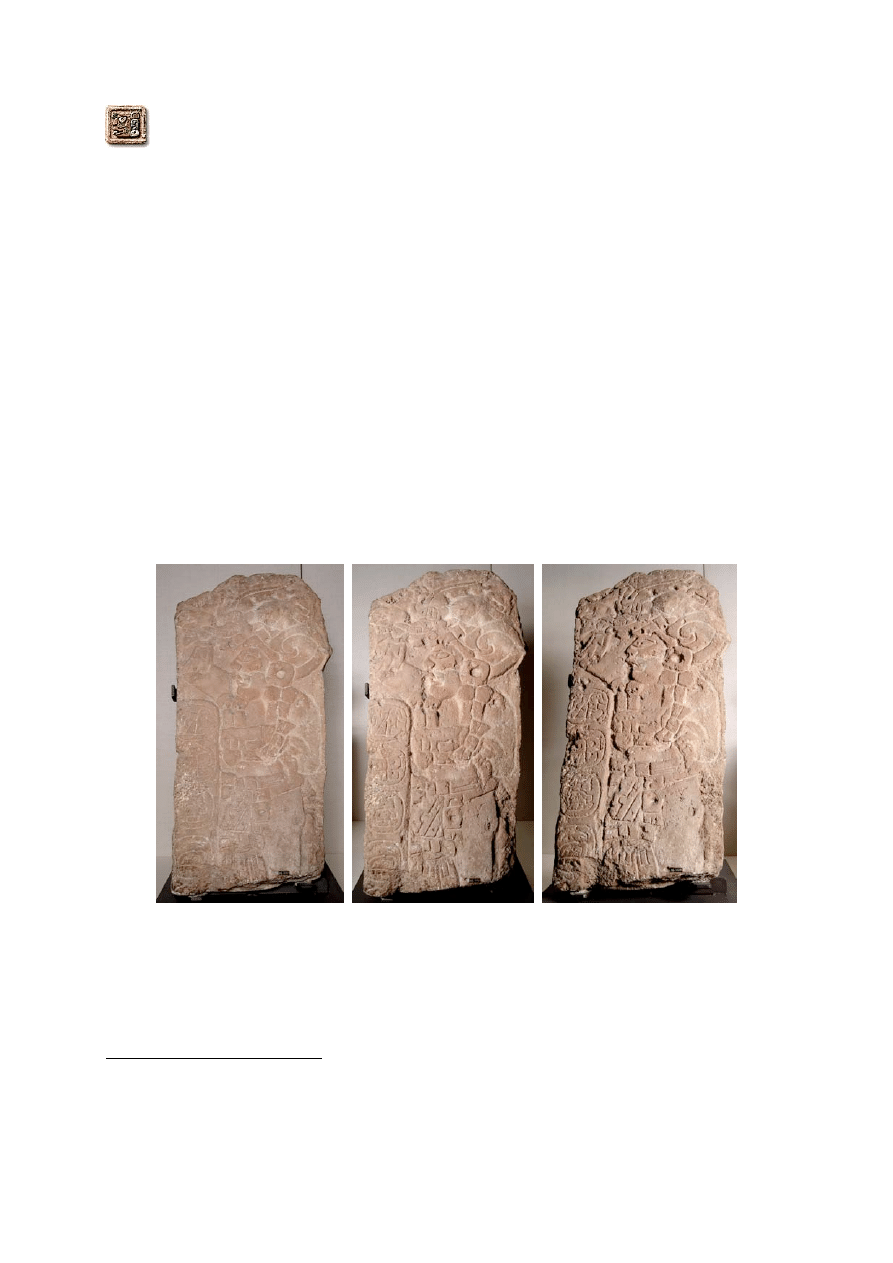
broken off at the level of the knees of the figure portrayed. The surviving top fragment,
sculpted in greyish limestone, has a height of 90.5 cm and a width of 45.5 cm (Figure 1).
Figure 1: Three Views of the Front of the Antwerp Museum Stela
(photographs courtesy of the Ethnographic Museum, Antwerp)
This stela of unknown provenance has been the subject of previous published research (Boot
1999a, 1999b, 2005a: 22 [note 10]; Mora-Marin 2001: 29-30, Figure 1.29; Purin, Lambrechts,
1
The writing of this note is made possible through the kind permission of Mireille Holsbeke, curator
of the Amerindian and Oceanic collections at the Ethnographic Museum in Antwerp, Belgium.
2006 Early Maya Writing on an Unprovenanced Monument: The Antwerp Museum Stela. Mesoweb:
www.mesoweb.com/articles/boot/Antwerp.pdf.
2
and Ruyssinck 1988: No. 61; Taube 2004: 46, Figure 24). The monument was inspected in
person in 1988, 1994, and 1998. In this note the image and hieroglyphic text on the monument
will be discussed, illustrated through a series of photographs specifically produced for the
present purpose.
2
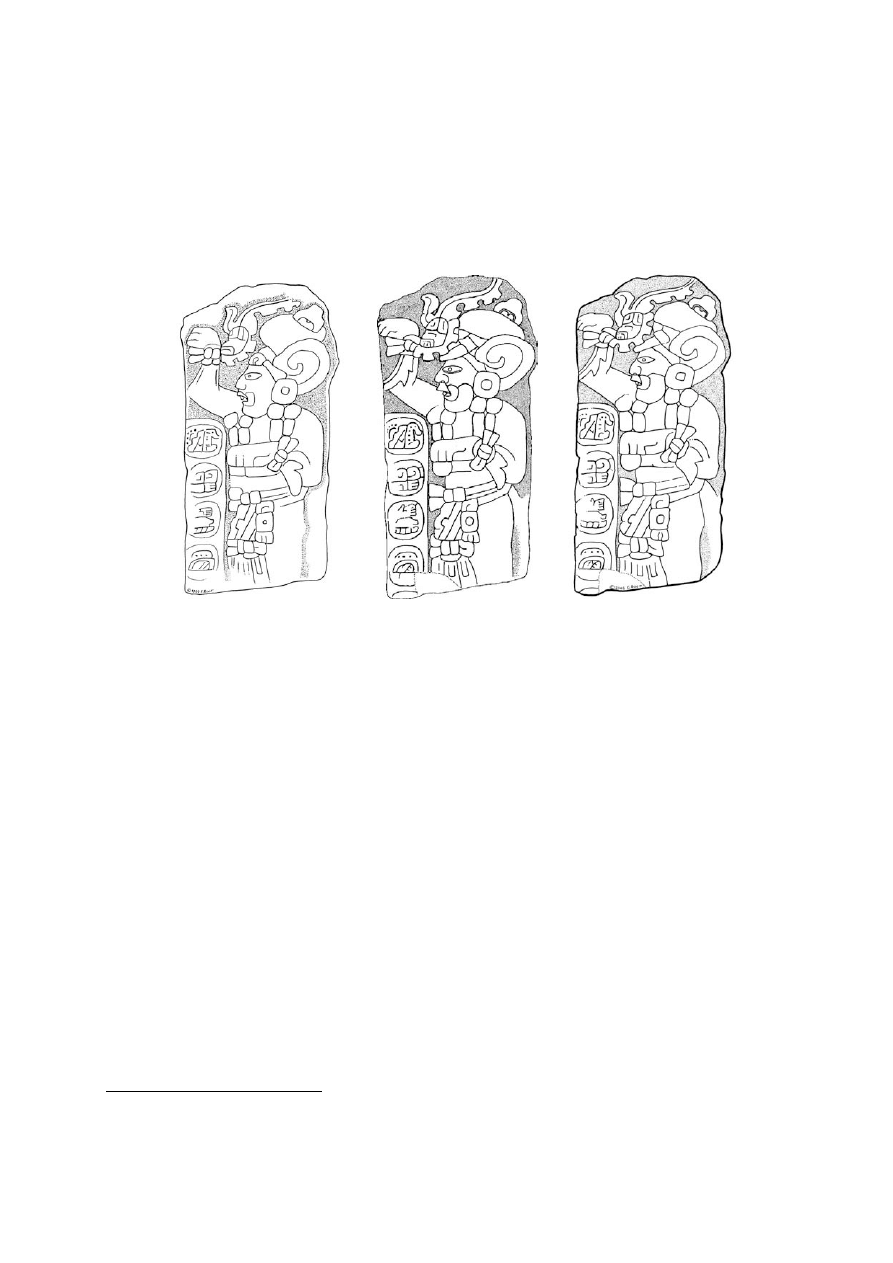
A new drawing is also incorporated into this note (Figure 2c).
a
b
c
Figure 2: Drawings of the Antwerp Museum Stela, a) Erik Boot (1999),
b) Karl Taube (2004), c) Erik Boot (2006)
A comparison is made with Late Preclassic and Early Classic monuments and hieroglyphic
texts that have been found in archaeological context since my initial research on this
monument (Boot 1999a, 1999b).
The Image on the Antwerp Museum Stela
About 80 percent of the surviving surface on the Antwerp Museum Stela illustrates a striding
or standing male anthropomorphic figure facing left. He raises his right arm. To his wrist an
object is attached consisting of a small head and an elongated tail-like element. This object is
tied to the wrist with a small knot. His left arm and paw-like hand are raised halfway up his
chest, to the level of the central element of his collar. This collar is made of large beads which
can be found hanging from his shoulders. He wears a large balloon-like headdress that
2
The series of digital photographs was made available to the author, produced by the photographic
department at the Ethnographic Museum at the author’s request. All photographic images in this note
are derived from this series of photographs.
3
contains a large inner scroll. This scroll may indicate that the headdress was made of a long
piece of cloth wrapped around the head. The headdress is topped with a sign that is cataloged
as T533 (Thompson 1962). The element inside the lower segment of this sign is U-shaped,
providing a dating mechanism for the monument (see below). The face has a prominent nose,
and the upper jaw is pushed forward from the lower jaw. A single small tooth is visible within
the opened mouth. This particular facial composition also provides a dating mechanism for
the monument (see below). This anthropomorphic figure has a large human eye. Around his
waist is a simple band, tied with a knot to which a belt assemblage is attached. The belt
assemblage hangs in front of his body and consists of a main element resembling an
anthropomorphic or zoomorphic head (as the profile would suggest), an ear spool complex, a
large knot, and possibly three elongated celts.
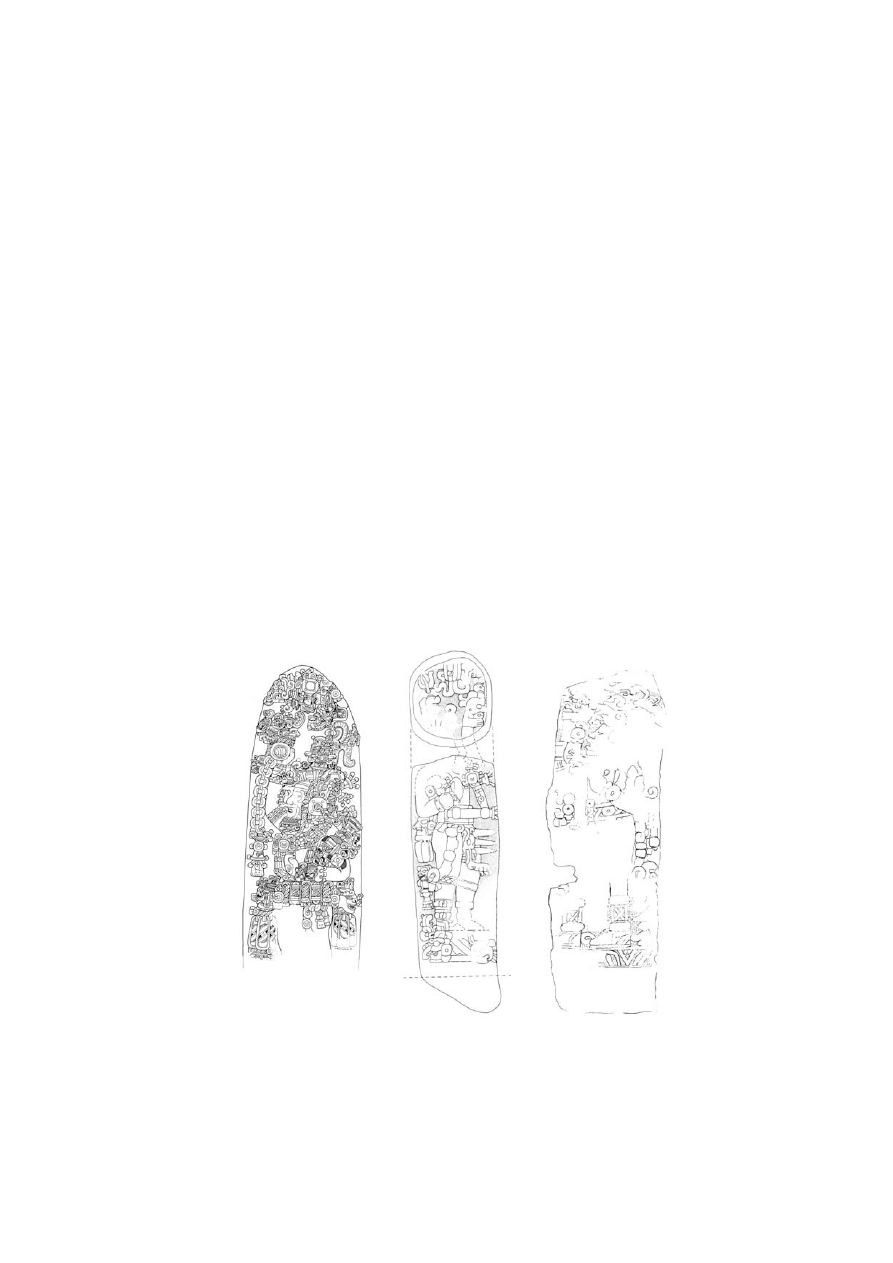
The overall image of this monument can be compared with a series of monuments of Early
Classic and possibly Late Preclassic origin. Several monuments illustrate a human individual
in a standing or striding position raising an object (Boot 1999a, 1999b), for instance Tikal
Stela 31, Uolantún Stela 1, and La Sufricaya Stela 1 (Figure 3).
a
b
c
Figure 3: a) Tikal Stela 31, Front (drawing by John Montgomery), b) Uolantún
Stela 1, Front (drawing by William R. Coe, after Martin 2000: Figure 8), c) La Sufricaya
Stela 1 (drawing by Nikolai Grube, after Estrada-Belli 2002: Figure 39)
4
Tikal Stela 31 can be dated to circa 9.0.10.0.0 or A.D. 445 (the opening Initial Series date on
the monument’s back); stylistically Uolantún Stela 1 can be dated to about a century earlier
(Martin 2000: 56), while La Sufricaya Stela 1 dates from before A.D. 435 (Foley 2005: 2).
The Antwerp Museum Stela predates all these monuments. This summation I base on specific
stylistic and iconographic features of the monument. Most intriguing are the facial features of
the anthropomorphic individual. These facial features can be compared to the facial features
of some of the individual figures as depicted in the San Bartolo murals (Figure 4).
a
b
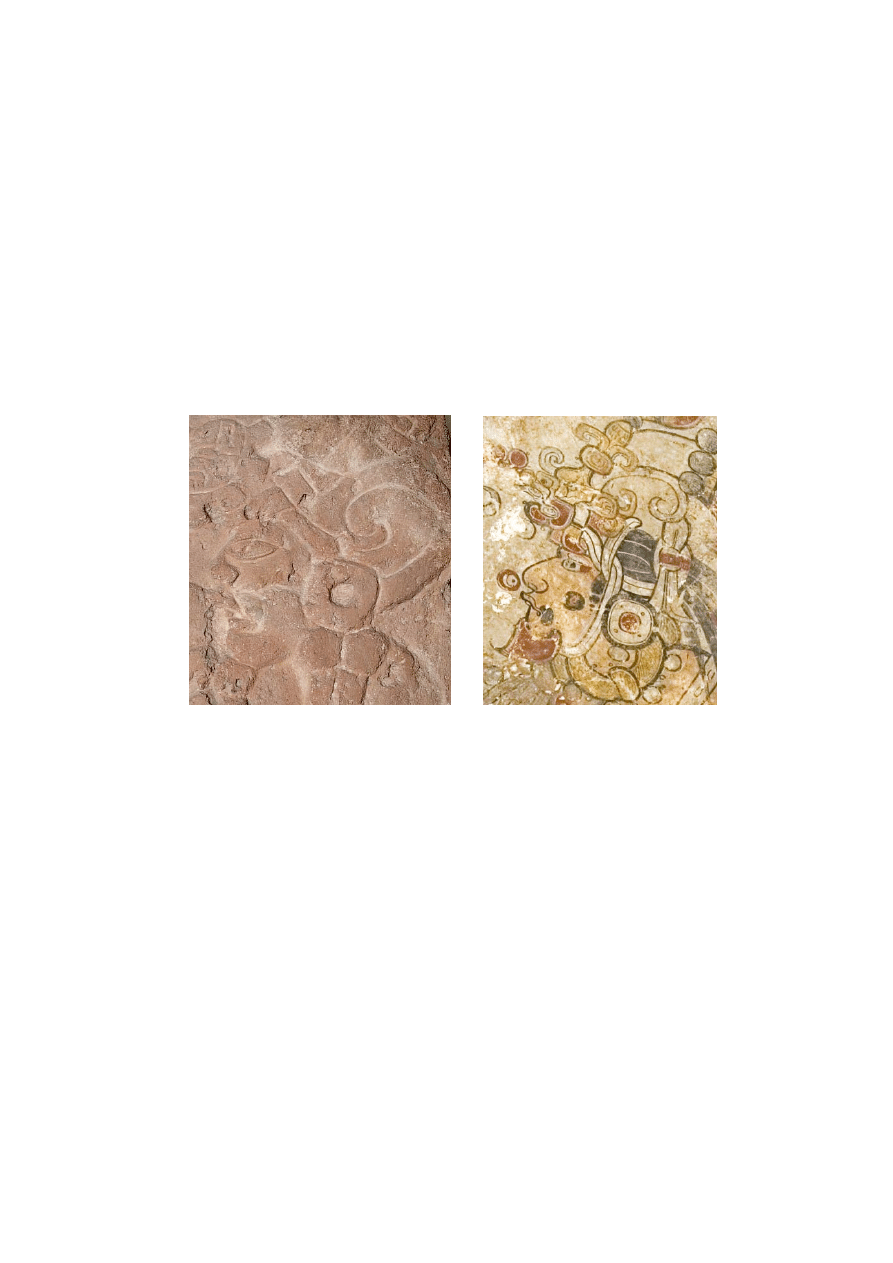
Figure 4: Comparison of Facial Features, a) Antwerp Museum Stela (photograph
courtesy of the Ethnographic Museum Antwerp), b) San Bartolo, Mural (photograph
by Kenneth Garrett/National Geographic Society) (image horizontally reversed)
The facial features of these two individuals are characterized by a large nose with clear
indication of the nostril, a large elongated eye with pupil, a protruding or extended upper jaw
and lip, a single tooth, a backward placed lower jaw, and a marked area around the mouth.
The mouth with extended upper jaw and lip and single tooth showing is a common indicator
of the supernatural status of the individual or entity depicted (Boot 1999a: 106). With the
murals at San Bartolo dated to circa 100 B.C. (Saturno 2005: 1; compare to Saturno et al.
2005: 4, 6-7), this fact may contribute to the dating of the Antwerp Museum Stela. In the San
Bartolo mural the dark and long hair of the individual is visible and tied to the back. He wears
a large balloon-like headdress with a large inner curl. The individual on the Antwerp Museum
Stela also wears a large balloon-like headdress with a large inner curl.
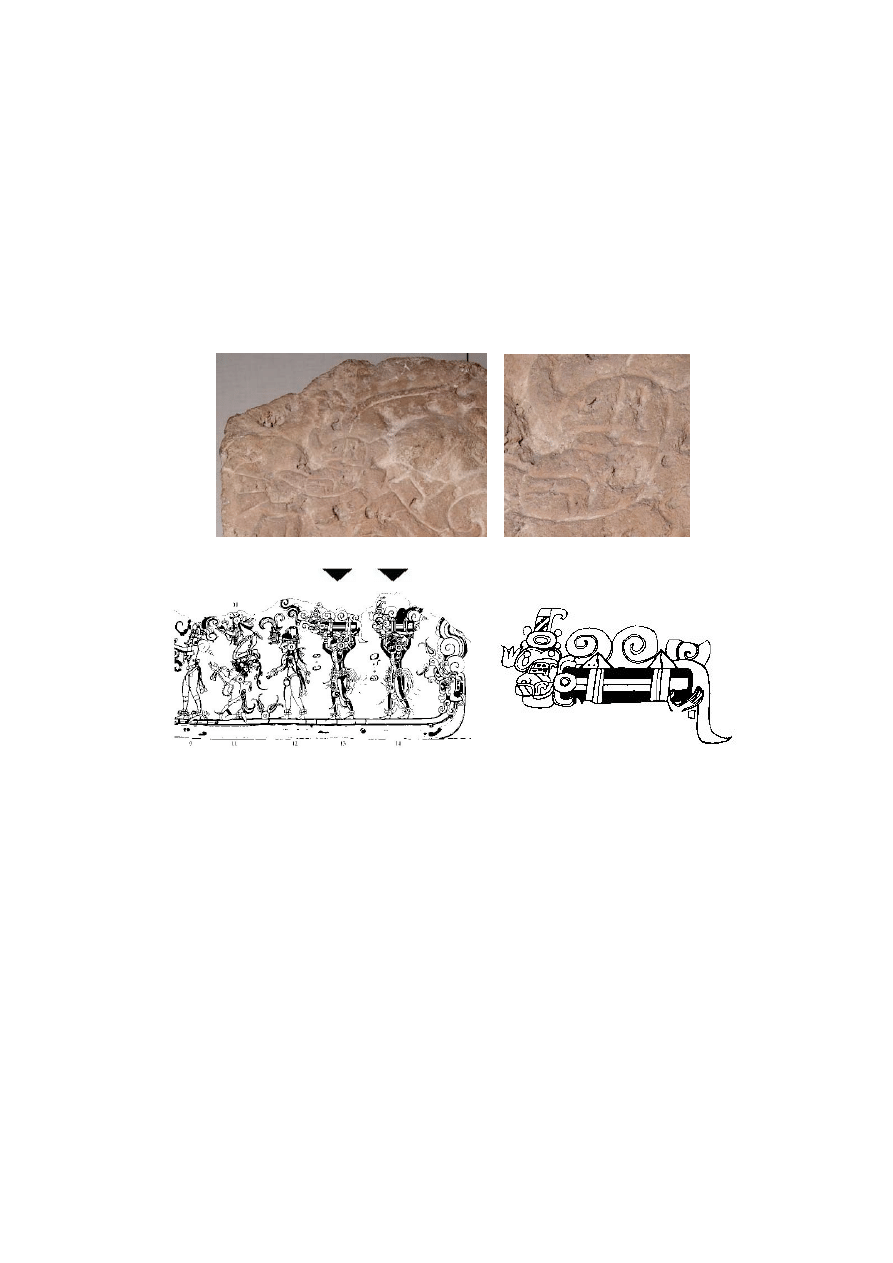
5
The comparison between this monument and the San Bartolo murals can be taken a step
further. The individual on the Antwerp Museum Stela has his right arm and hand raised.
Attached to this right hand an intriguing object can be found. It has a small head on its left,
while the elongated tail-like part of the object hovers above his balloon-like headdress (Figure
5a). The North Wall of the Las Pinturas sub-I murals at San Bartolo provides a total of
fourteen individuals, part of which is of concern here (Figure 5b).
a
b
Figure 5: The Raised Object, a) Details of the Antwerp Museum Stela
(photographs courtesy of the Ethnographic Museum, Antwerp), b) Details of the
North Wall procession at San Bartolo (after Saturno et al. 2005: Figure 5 & 30a)
The static objects as raised by Individuals 13 and 14 in the North Wall composition contain
specific iconographic characteristics that make a comparison possible to the raised object on
the Antwerp Museum Stela. Note as such the small face which can be found on the left side of
the objects. This face can be directly compared to the small face on the front of the raised
object on the Antwerp Museum Stela (Figure 5a, detail & Figure 5b, detail). The San Bartolo
example of the small face has a clear ear spool and a kind of small headdress with a curl. The
Antwerp Museum Stela example of the small face does not have an ear spool, but it does have
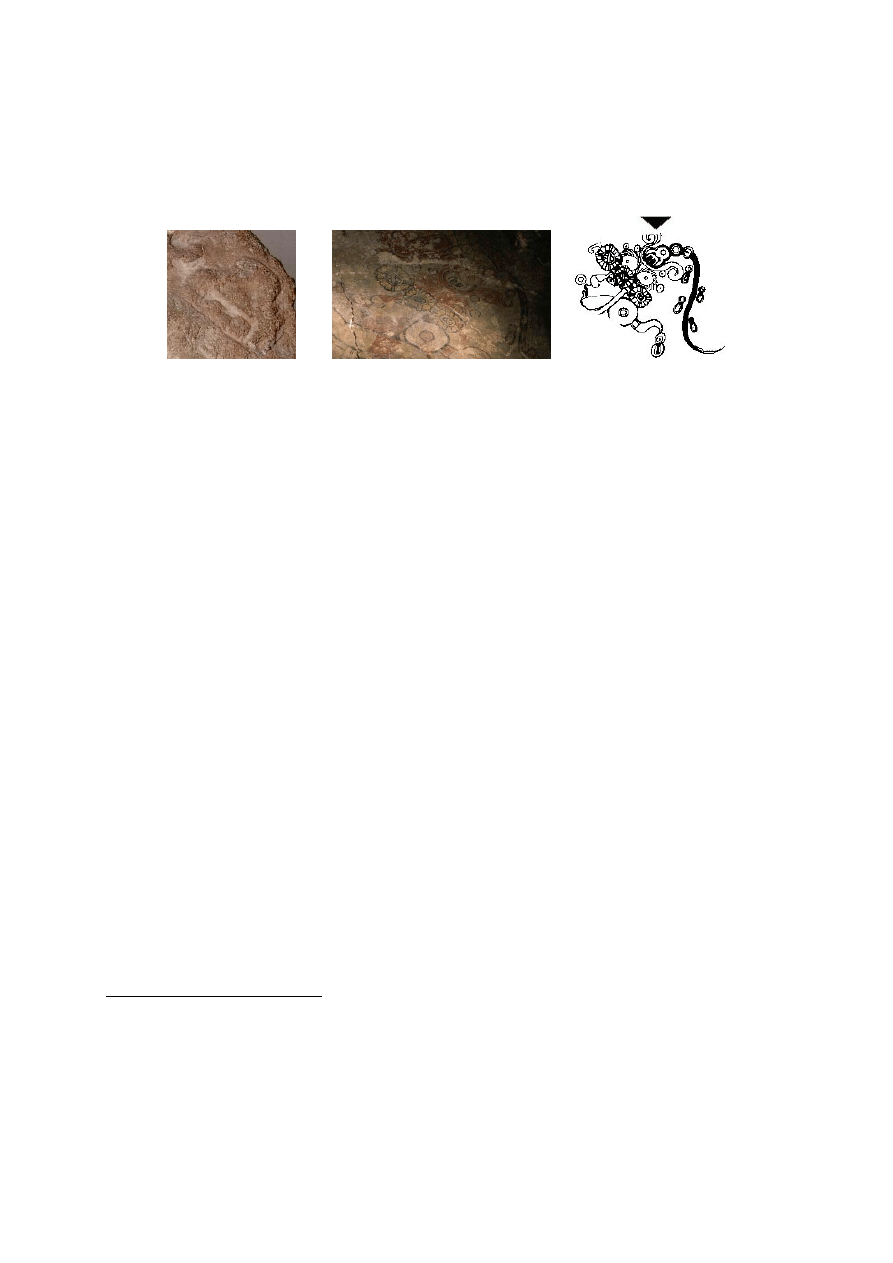
6
a kind of headdress which curls (the elongated tail-like part). The main static part of the San
Bartolo object is not present in the Antwerp Museum Stela design.
a
b
Figure 6: The T533 Sign in Headdresses, a) Antwerp Museum Stela (photographs
courtesy of the Ethnographic Museum, Antwerp), b) San Bartolo, West Wall, Individual 11 (detail
of photograph [after PMAE 2001]; detail of drawing after Saturno et al. 2005: Figure 29b)
The headdress of the individual on the Antwerp Museum Stela is topped by a simple and
abstract design, a depiction of a sign cataloged by Thompson (1962) as T533 (Figures 1-2, &
6a). Within Maya iconography this sign seems to function as a flower or perhaps a small seed
bud from which sprouts a jeweled or fruit bearing vine. On the Antwerp Museum Stela there
is only the T533 sign; the lower part of this sign contains a U-shaped element. Within the San
Bartolo murals several headdresses are topped with the same sign, as can be seen in the
headdress of Individual 11 on the North Wall (Figure 6b). In this example a long jeweled vine
sprouts from the sign. The lower part of the sign has a U-shaped element. The presence of the
U-shaped element is yet another indication of an early date for the Antwerp Museum Stela.
The Hieroglyphic Text on the Antwerp Museum Stela
The intriguing facet of the Antwerp Museum Stela is not only its early iconographic style, but
the fact that it contains a single-column hieroglyphic text (Figures 1-2, & 7). Although this is
an early text several of the hieroglyphic signs can be identified and can be compared to other
early Maya hieroglyphic texts.
3
3
In this note the following orthography will be employed: ', a, b', ch, ch', e, h, j, i, k, k', l, m, n, o, p, p',
s, t, t', tz, tz', u, w, x, and y. In this orthography the /h/ represents a glottal aspirate or glottal voiced
fricative (/h/ as in English “house”), while /j/ represents a velar aspirate or velar voiced fricative (/j/ as
in Spanish “joya”) (Grube 2004). In this essay there is no reconstruction of complex vowels based on
disharmonic spellings (compare to Houston, Stuart, and Robertson 1998 [2004] and Lacadena and
Wichmann 2004, n.d.; for counterproposals see Kaufman 2003 and Boot 2004, 2005b). In the
transcription of Maya hieroglyphic signs uppercase bold type face letters indicate logograms (e.g.
'AK), while lowercase bold type face letters indicate syllabic signs (e.g. ma). Queries added to sign
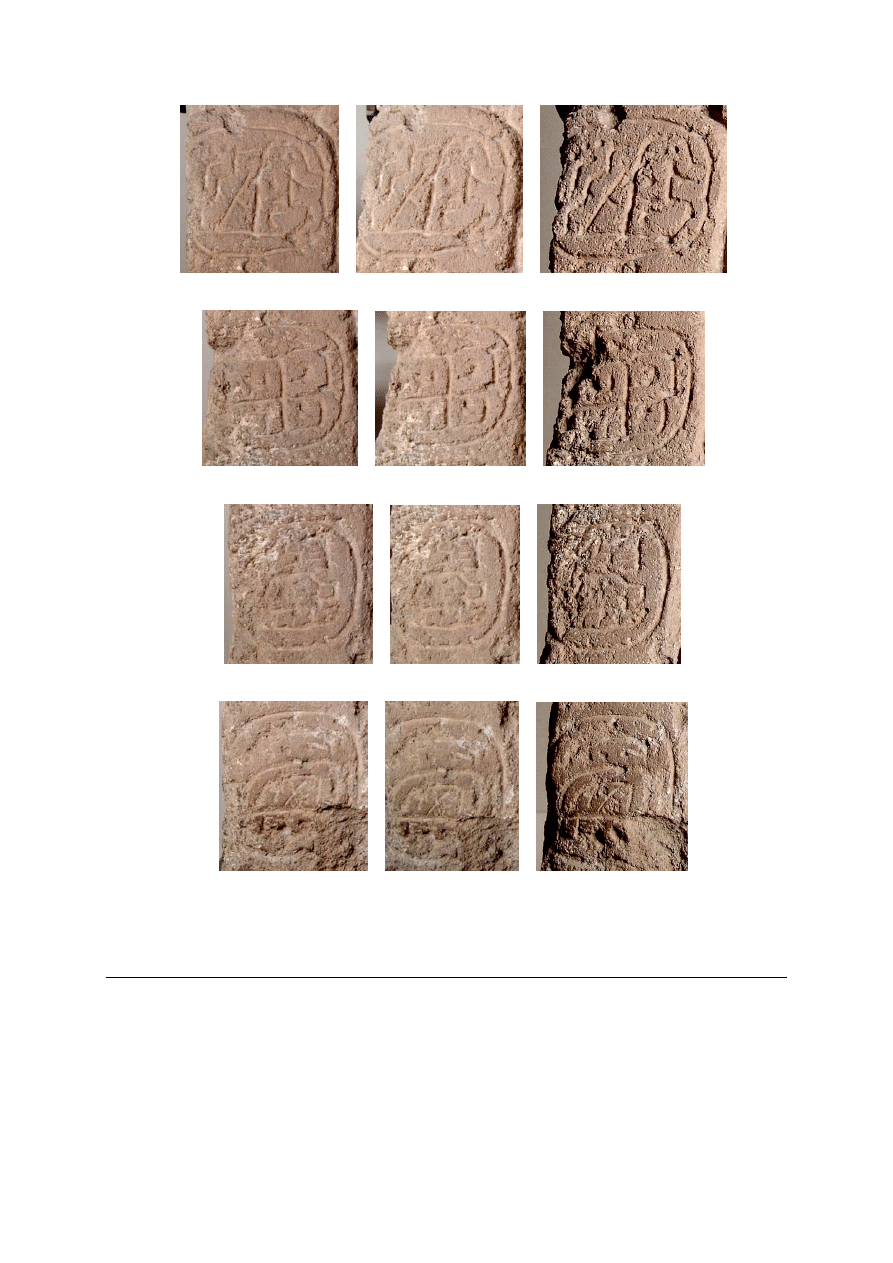
7
a
b
c
d
Figure 7: Three Views of the Four Surviving Hieroglyphic Collocations on the
Antwerp Museum Stela (photographs courtesy of the Ethnographic Museum, Antwerp)
identifications or transcribed values express doubt on the identification of the assigned logographic or
syllabic value (e.g. ye?). Items placed between square brackets are so-called infixed signs (e.g.
STEP[ye]); order of the transcribed signs indicates the epigraphically established reading order. All
reconstructions (i.e. transliterations) in this essay are but approximations of the original intended
Classic Maya (“epigraphic”) linguistic items (Boot 2002: 6-7), a written language which was
employed by the various distinct language groups already formed in the Classic period. Older
transcriptions and/or transliterations are captured between double pointed brackets (e.g. «t'ab'»).
Citing of so-called T-numbers (e.g. T533) refers to the hieroglyphic signs as numbered and cataloged
by Thompson (1962; sign list online at www.famsi.org/mayawriting/thompson/index.html).
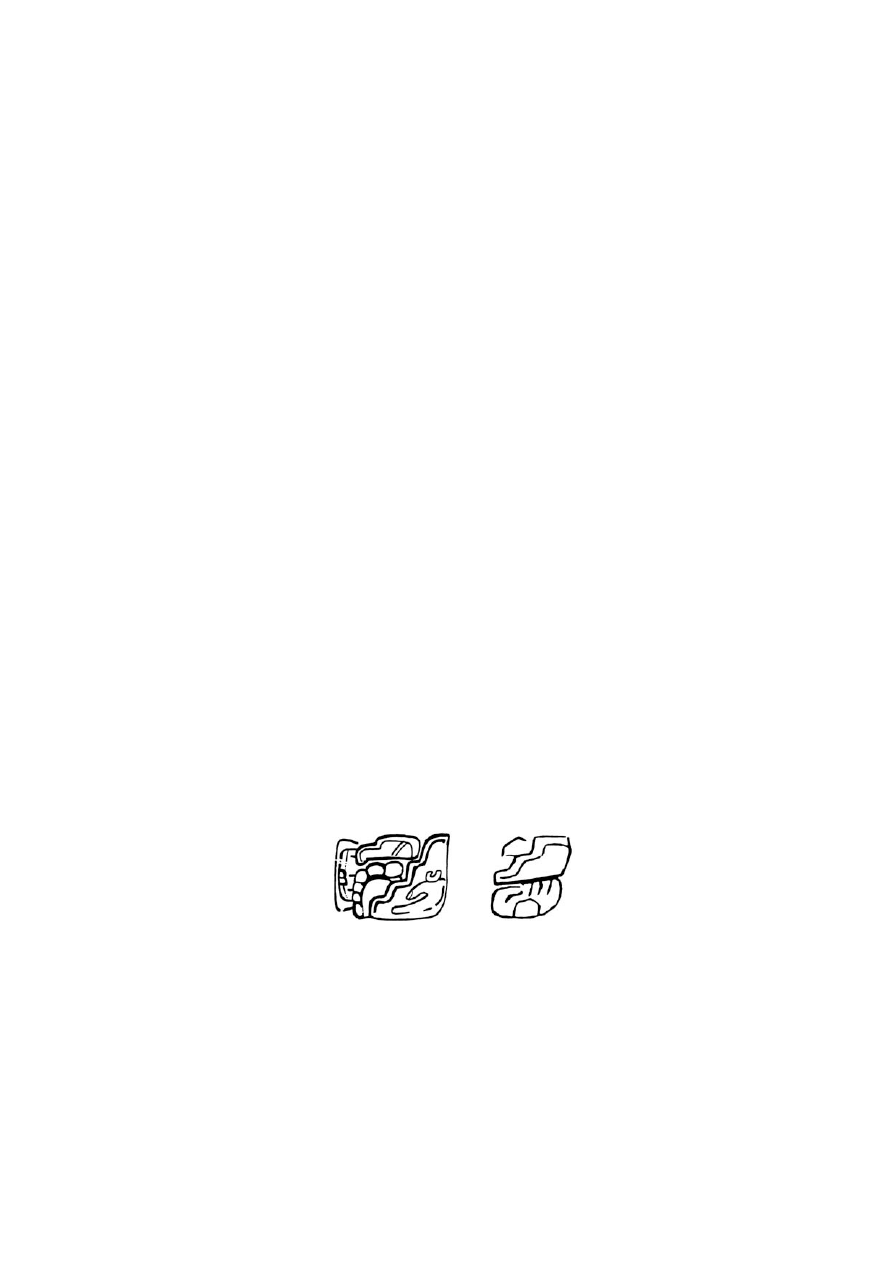
8
The hieroglyphic text possesses a rare feature. The individual collocations are each contained
in a rounded cartouche. Other early texts can be found contained in round or rounded
cartouches (e.g. The Cleveland Plaque [Stone 1996: Figs. 1-2], three reworked jade plaques
with text in oval cartouches from royal tomb at Calakmul [UAdC 2000: Tomo I & II, cover]).
As the small Antwerp Museum Stela has been broken off at the height of the knees of the
standing individual only part of the text has survived. Four rounded cartouches have survived
in full, while only the top part of a fifth cartouche has survived. The signs within the
hieroglyphic text have been incised into the monument. The text of the four collocations can
be transcribed tentatively as follows:
A1
STEP=ASCEND/RAISE-ye?
A2
yu-?
A3
ma-'AK
A4
'u-?
The hieroglyphic text opens with a collocation at A1 that can be transcribed as STEP
=ASCEND/RAISE-ye? (Figure 7a). The first sign is a depiction of a stepped structure or
platform; this hieroglyphic sign has been nicknamed STEP. As epigraphic research on Classic
Maya hieroglyphic texts has shown, this sign introduces a verb root for ASCEND/RAISE
(thus the transcription STEP=ASCEND/RAISE). The second sign is more difficult to identify.
In later Classic Maya texts this STEP sign takes a yi complement as suffix; in early texts this
is a ye sign. A good example can be found in the text on The Diker Vase, a small stone bowl
of unknown provenance but with iconographic ties to the Early Classic Peten iconographic
tradition (Figure 8a).
a
b
Figure 8: Early Texts Containing the Sign Combination STEP-HAND.SIGN,
a) Stone Vessel, b) Dumbarton Oaks Pectoral (drawings by David Mora-Marín)
In the text on The Diker Vase, now at the Metropolitan Museum of Art (Coe 1973: 26-27), the
ye is infixed into the STEP sign. Another early example may be found in the text on the
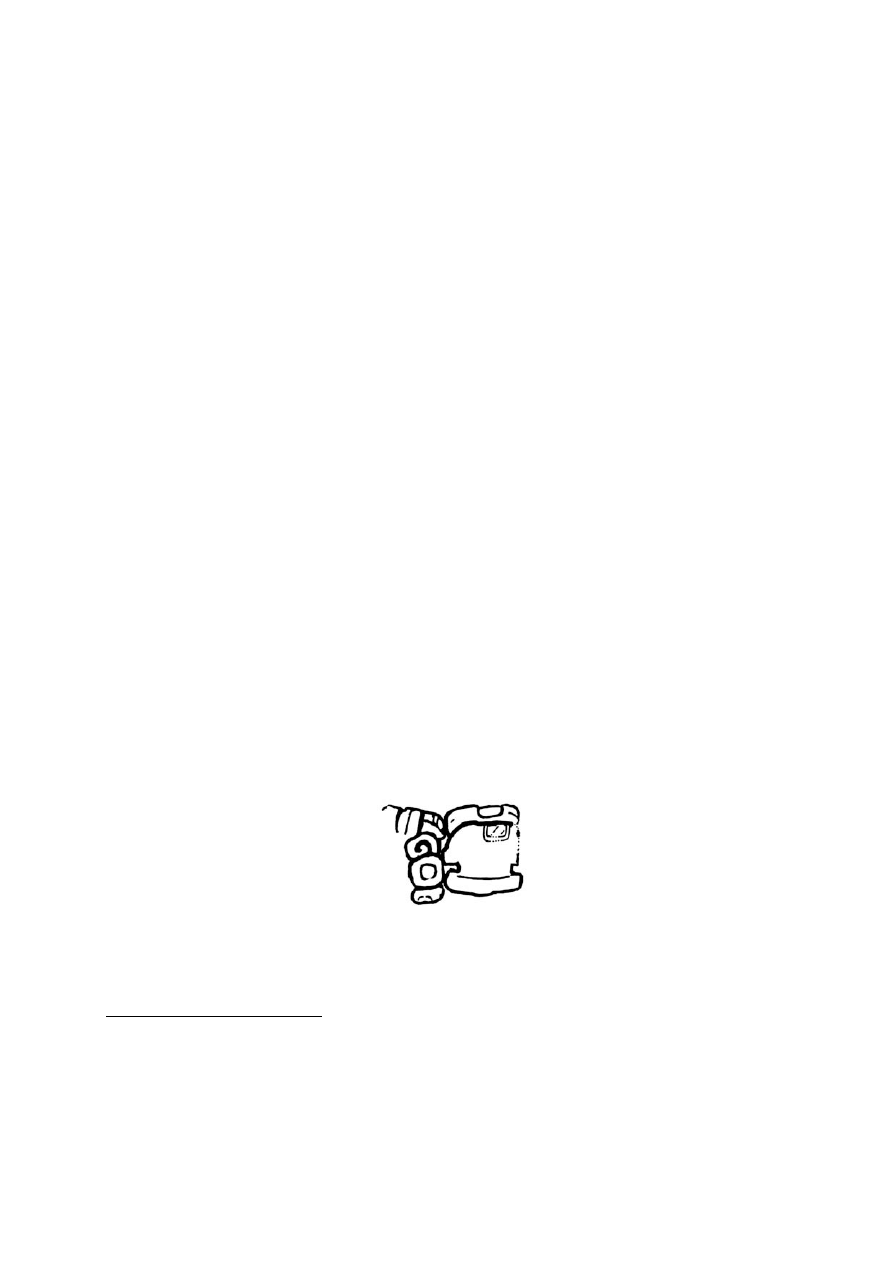
Dumbarton Oaks pectoral. The opening verb is clearly represented by a STEP sign, suffixed
with a hand sign (Figure 8b). This particular hand sign may be an early variant for ye, at a
9
time when the diagnostic characteristics of several different hand signs were not yet fully
developed (compare to Boot 2003). Rotation and opening of the hand had possibly not yet
taken place (but compare to Mora-Marín 2003: 22). Based on these ye signs, of which the
Diker Vase example is most clear, I suggest that the sign suffixed to the STEP sign in the
hieroglyphic text on the Antwerp Museum Stela is ye. In an earlier essay on this monument I
suggested a transliteration «t'ab'-» for the root of the verb. If this is correct, this collocation
may be transcribed T'AB'?-ye? for t'ab'ay, a verbal expression for “raised”.
4
The cartouche at A2 contains two signs (Figure 7b). The first sign seems to be yu, of which
the center and right side element have survived. The second sign is more difficult to identify,
and I leave it without an identification. This collocation would provide the subject of the
verbal expression t'ab'ay. The opening syllabic sign yu may lead to a possessed noun y-u..., in
which y- would be the third person prevocalic possessive pronoun and -u... would be the
opening sound of the proper name of the object itself.
5
The collocation at A3 consists of two hieroglyphic signs (Figure 7c). The top sign I identify
tentatively as a variant of the syllabic sign for ma, while I identify the bottom or main sign as
TURTLE.SHELL for 'AK. The collocation ma-'AK may lead to mak. This is probably the
personal name of the individual responsible for the raising of the object as illustrated on the
Antwerp Museum Stela and hieroglyphically described in the accompanying text as T'AB'?-
ye? yu-?.
Figure 9: Part of the Nominal Phrase in the San Diego Cliff Drawing
(drawing by David Mora-Marín)
4
The spelling T'AB'?-ye? probably led to t'ab'ay (or perhaps t'ab'ey). With an additional -ya sign it
would have read t'ab'ayey. This -ey suffix can be found in spellings as HUL-ye for hul-ey (Tikal, El
Zapote), 'i-k'a-je-ya for i-k'aj-ey (Tortuguero), and yi-ta-je for yitaj as well as wi-ni-ki-je-ya for
winik-j-ey (Chichén Itzá) (Boot 2004: 3-4).
5
Words that come to mind are -uj and -yuy, both words for “jewel; necklace” (Boot 2002: 80, uh;
Kaufman 2003: 1030). The objects raised may indeed be considered a “jewel” of some sort. However,
as the second sign remains undeciphered, this remains just a thought.
10
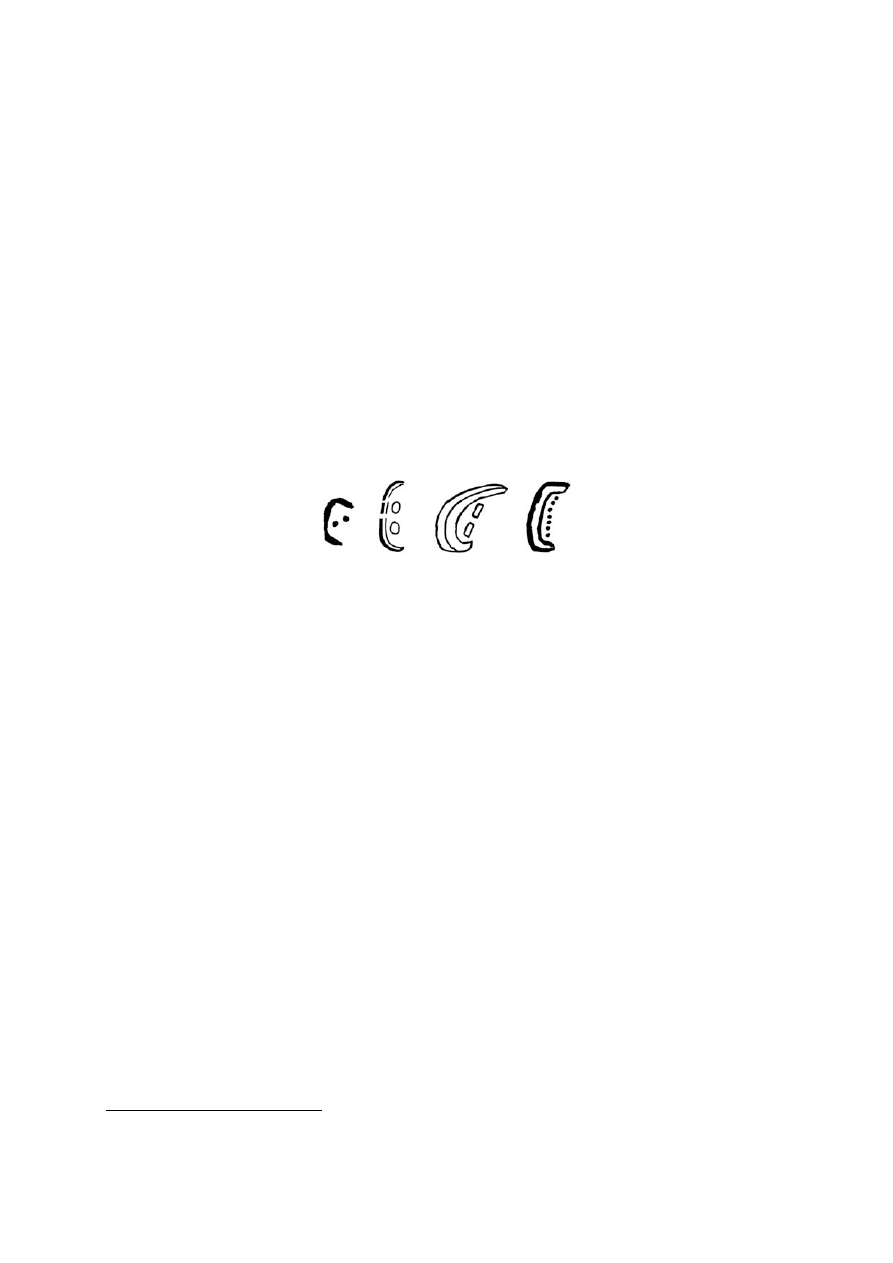
The Early Classic text of the San Diego Cliff Carving provides a nominal phrase of which a
part seems to be written as ma?-'AK, possibly for mak (Figure 9). This early text may thus
substantiate the fact that the putative Mak within the Antwerp Museum Stela text indeed may
be a nominal phrase or personal name.
The collocation at A4 consists of two signs, of which only the first sign can be identified with
certainty (Figure 7d). This sign is an early variant of one of the signs for 'u. Other early
examples of the 'u sign contain two dots or even a row of many dots (Figure 10). The
example of the 'u sign on the Antwerp Museum Stela has three dots. This kind of 'u sign with
dots was still in use in the Classic period (e.g. Kerr No. 4669).
Figure 10: Various Examples of the 'u Sign
(drawings by David Mora-Marín)
Unfortunately the second sign can not be identified as it only partially survived, but probably
the sign 'u is part of a kind of relationship statement which opened with u-, the third person
preconsonantal possesive pronoun.
The short text on the Antwerp Museum Stela is an example of an introductory and dedicatory
statement that includes a common dedicatory verb (STEP-ye?, or T'AB'?-ye?), possibly the
proper name of the object (yu-?), then either the name of object's possessor or a continuation
of the object's name (ma-'AK). The text probably provides a further relationship statement
('u-?). The surviving part of the fifth cartouche does not contain a hieroglyphic sign.
Possible Provenance and Dating of the Monument
The Antwerp Museum Stela entered the collection at the Ethnographic Museum in 1864,
6
through a donation by Eugène de Decker. No information survives of the probable origin of
6
It is probably only a coincidence, but the famous Leiden Plaque also entered the collection of the
National Museum of Antiquities in Leiden, the Netherlands, in the year 1864. It became part of the
11
the monument. For many years the monument was attributed to the Zapotec culture (Purín,
Lambrechts, and Ruyssinck 1988: No. 61). In 1999, based on an analysis of the iconography
and hieroglyphic text I attributed the monument to the Maya culture and tentatively dated it to
the Late Preclassic period at circa 200 B.C. to A.D. 200 (Boot 1999a: 113). Based on that
preliminary study I suggested a possible Highland Maya or southern Pacific or piedmont
origin for the monument and identified it as one of the earliest monuments to bear a Maya
hieroglyphic text (Boot 1999a, 1999b). This identification has been largely followed in more
recent research, although the possible area of origin was suggested to be lowland Maya and
possibly a coastal area, for instance Tabasco, while the dating was suggested to be the second
century B.C. (Taube 2004: 46).
a
b
Figure 11: Sides of the Antwerp Museum Stela, a) Top Part of the Left Side,
b) Top Part of the Right Side (photographs courtesy of the Ethnographic Museum, Antwerp)
In my own independent research I also identified the Antwerp Museum Stela as being of
lowland Maya origin, based on a comparison of various miniature stelae with comparable
iconography, all of which have a lowland Maya origin (Boot 2005a: 22 [note 10]). Based on
the above analysis it can be suggested that the iconography is lowland Maya, while the
hieroglyphic text contains signs comparable to a variety of mainly portable Late Preclassic
and Early Classic objects, most of them of unknown provenance. Also the limestone
collection of the National Museum of Ethnology in Leiden in 1903. The Leiden Plaque was found
close to Puerto Barrios (a coastal community) in Guatemala by the Dutch engineer J. A. van Braam
(Van Dongen, Forrer, and Van Gulik 1987: 200-201).

12
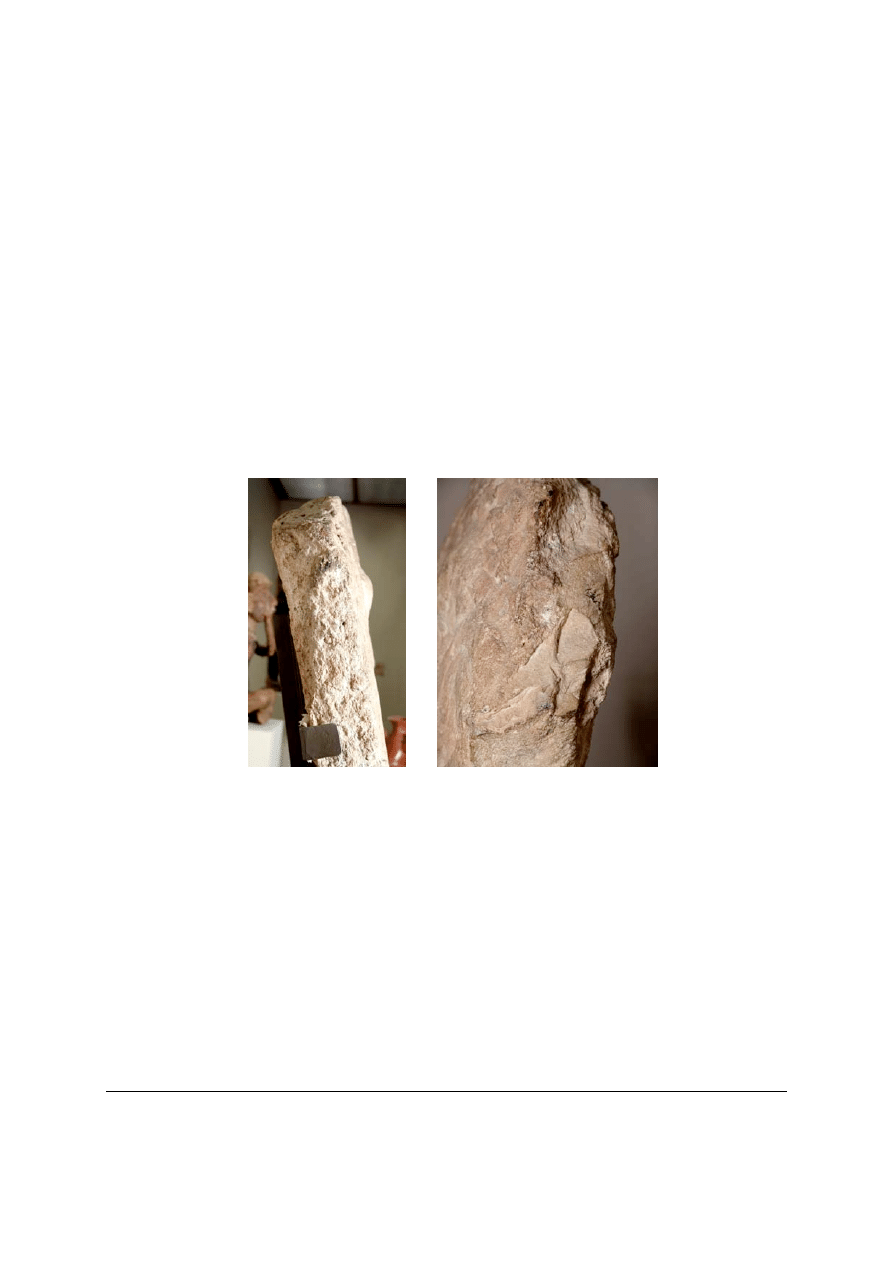
composition suggests a lowland Maya origin (Taube 2004: 46). The possible coastal area
origin, as suggested by Taube, is based on the presence of shell-derived stucco remains on the
left side and back of the Antwerp Museum Stela (Figure 11a).
In previous research the monument was dated to a period of circa 200 B.C. to A.D. 200 (Boot
1999a, 1999b, 2005a) or the second century B.C. (Taube 2004: 46). Based on a comparison
with specific iconographic details from the San Bartolo murals, which date to the first century
B.C., the date of the Antwerp Museum Stela can be more or less confirmed as second or first
century B.C. The provenance of the monument is still a matter of debate. The iconography
suggests clear parallels to Late Preclassic and Early Classic monuments and murals from the
central and northeastern Petén region. It is from this region that the Antwerp Museum Stela
may have its origin. The presence of shell-derived stucco on the monument may indicate that
the Antwerp Museum Stela may not have been found in its primary context. Albeit a tentative
suggestion, like many small portable monuments the Antwerp Museum Stela may have been
moved from its primary location to an area where shell-based stucco was in use. As Martin
(2000) has shown, (large) monumental sculpture was also removed in antiquity from its
primary context and relocated. The fact that the Antwerp Museum Stela is relatively small
(and broken) may contribute to the suggestion that the monument could have been removed
from its primary and original location prior to its middle nineteenth century discovery,
possibly to be found in a coastal area where shell-derived stucco was used in antiquity. It
would not surprise me that the Antwerp Museum Stela was discovered in the eastern lowland
Maya region, close to the coastal area.
Final Remarks
The subject of this note was a small standing monument in the collection of the Ethnographic
Museum in Antwerp, Belgium. As in previous research I identify this monument as a stela
and refer to this monument as the Antwerp Museum Stela (Boot 1999a: 114 [note 5]). The
iconographic and epigraphic analysis clearly identifies the monument as culturally Maya, with
its origins probably in the (northeastern) lowland Petén Maya area and dating from the Late
Preclassic period, possibly the second to first century B.C. With this tentative date the
hieroglyphic text on the monument ranks among the earliest texts ever produced, especially in
comparison to the currently earliest text found at San Bartolo that possibly dates to circa 300
to 200 B.C. (Saturno, Stuart, and Beltán 2006: 1).

13
The Antwerp Museum Stela seems to illustrate an individual of supernatural status whose
iconographic characteristics can be compared to individuals of supernatural status in the
murals at San Bartolo. These characteristics include the extended upper jaw and lip and the
single tooth. The supernatural status of this individual may be indicated additionally by the
T533 sign on top of his headdress.
7
The text associated with this individual seems to refer to
the raising (T’AB’?-ye?) of an object (yu-?), the object as attached to the raised right hand. A
personal name (ma-’AK) seems to follow, while possibly a relationship of some sort (’u-?)
was recorded. The hieroglyphic text on the Antwerp Museum Stela seems to directly reflect
the action illustrated on the monument. The individual depicted on the monument may
actually be an impersonator of a supernatural entity, whose action (the raising of an object)
and personal name are contained in the hieroglyphic text.
8
Further research on the iconography and hieroglyphic text may substantiate the suggestions
made in this note. This further research may also include a search into the life of Eugène de
Decker, the man who donated the monument to the museum in Antwerp in 1864, to possibly
establish the nineteenth century place of origin of the monument.
Acknowledgments
I thank curator Mireille Holsbeke of the Ethnographic Museum in Antwerp, Belgium, for the
permission to publish this note on the monument from the museum and the series of digital
photographs made for the occasion. Without this series of photographs the quality of the
illustrations in this note would have been much less. I thank Barbara MacLeod and Joel
Skidmore for comments on a previous version of this note. As always, unless noted otherwise,
the opinions expressed in this note are mine.
7
In recent epigraphic and iconographic research by Barbara Macleod and Luís Lopes it is suggested
that the sign cataloged as T533 could in fact be sprouting maize. When it appears in headdresses it
may signal supernatural status and a relation to maize (MacLeod 2006, personal communication via e-
mail, January 23, 2006). The T533 sign at San Bartolo can be found in the headdresses of two female
supernatural entities that are directly associated with the Maize God, indicating the association of the
symbol with maize-related supernatural entities or individuals.
8
The impersonation of supernatural entities was a common phenomenon during the Classic period.
Hieroglyphic inscriptions referred to this impersonation through a specific formula (Houston and
Stuart 1996), which at present I transliterate as ub'ahil anul (...) and paraphrase as “(he is) the image
incarnate of (name of the god impersonated)”.

14
References
Boot, Erik
1999a Early Maya Hieroglyphic Writing: An Analysis of Text and Image of a Small
Stela in the Ethnographic Museum in Antwerp, Belgium. In Yumtzilob 11 (1):
105-116. Online version available at URL:
<http://www.yumtzilob.com/voorwerp_boot-antwerpen.htm>
1999b Hiërogliefenschrift uit de vroeg-Maya periode. In Vrienden van het
Ethnografisch Museum Antwerpen, Jaargang 26, Nummer 1-2: 1-4.
2002 A Preliminary Classic Maya-English, English-Maya Vocabulary of Hieroglyphic
Readings. Mesoweb Resources: www.mesoweb.com/resources/vocabulary/index.html.
2003 The Human hand in Maya Hieroglyphic Writing. Mesoweb: www.mesoweb.com/
features/boot/Human_Hand.pdf.
2004 Suffix Formation on Verb Stems and Epigraphic Classic Maya Spelling
Conventions: The Employment and Function of Final Ca Syllabic Signs.
Manuscript dated July 5, 2004. Rijswijk, the Netherlands. Circulated among
fellow epigraphers.
2005a Continuity and Change in Text and Image at Chichén Itzá, Yucatán, Mexico:
A Study of the Inscriptions, Iconography, and Architecture at a Late Classic to
Early Postclassic Maya Site. Leiden: Research School CNWS, Leiden University.
CNWS Publications, Vol. 135.
2005b Classic Maya Words, Word Classes, Contexts, and Spelling Variations.
Manuscript dated July 4, 2005. Rijswijk, the Netherlands. Circulated among
fellow epigraphers.
Coe, Michael D.
1973 The Maya Scribe and His World. New York: The Grolier Club.
Estrada-Belli, Francisco (editor)
2002 Archaeological Investigations at Holmul, Peten, Guatemala. Preliminary
Results of the Third Season, 2002. Preliminary Report. Online version available
at URL: <http://www.vanderbilt.edu/estrada-belli/holmul/reports/index.html>
Foley, Jennifer
2005 En busca de la población clásico temprano en La Sufricaya, Petén. In XVII Simposio
de Investigaciones Arqueológicas en Guatemala, 2004, edited by Juan Pedro LaPorte,
Bárbara Arroyo, and Héctor E. Mejía, Section 2, Chapter 15. Online version
available at URL: <http://www.famsi.org/reports/03101es/15foley/15foley.pdf>
Grube, Nikolai
2004 The Orthographic Distinction Between Velar and Glottal Spirants in Maya
Hieroglyphic Writing. In The Linguistics of Maya Writing, edited by Søren
Wichmann, pp. 61-81. Salt Lake City: University of Utah Press.

15
Houston, Stephen D., and David Stuart
1996 Of gods, glyphs, and kings: divinity and rulership among the Classic Maya. Antiquity
70:289-312.
Houston, Stephen D., David Stuart, and John Robertson
1998 Disharmony in Maya Hieroglyphic Writing: Linguistic Change and Continuity in
Classic Society. In Anatomía de una civilización: Aproximaciones inter-
disciplinarias a la cultura maya, edited by Andrés Ciudad Ruíz et al., pp.
275-296. Madrid: Sociedad Española de Estudios Mayas. Publicaciones de la
SEEM 4. Republished in The Linguistics of Maya Writing, edited by Søren
Wichmann, 2004, pp. 83-101. Salt Lake City: University of Utah Press.
Kaufman, Terrence
2003 A Preliminary Mayan Etymological Dictionary (with the assistance of John Justeson).
FAMSI Grantee Report. URL: <http://www.famsi.org/reports/01051/pmed.pdf>
Lacadena, Alfonso, and Søren Wichmann
2004 On the Representation of the Glottal Stop in Maya Writing. In The Linguistics
of Maya Writing, edited by Søren Wichmann, pp. 103-162. Salt Lake City:
University of Utah Press.
n.d.
Harmony Rules and the Suffix Domain: A Study of Maya Scribal Conventions.
URL: <http://email.eva.mpg.de/~wichmann/harm-rul-suf-dom7.pdf>
Martin, Simon
2000 At the Periphery: The Movement, Modification and Re-use of Early Monuments
in the Environs of Tikal. In The Sacred and the Profane: Architecture and
Identity in the Maya Lowlands, edited by Pierre Robert Colas et al., pp. 51-61.
Markt Schwaben, Germany: Verlag Anton Sauerwein. Acta Mesoamericana, Vol. 10.
Mora-Marín, David
2000 The Grammar, Orthography, Content, and Social Context of Late Preclassic
Mayan Portable Texts. Unpublished Ph. D. dissertation. Albany, New York:
Department of Anthropology, College of Arts and Sciences, The University of
New York at Albany. Copy in possession of the author.
2003 The Primary Standard Sequence: Database Compilation, Grammatical Analysis, and
Primary Documentation. FAMSI Grantee Report. URL:
<http://www.famsi.org/reports/02047/index.html>
PMAE
2001 The Early Maya Murals at San Bartolo, Guatemala. Peabody Museum of
Archaeology and Ethnology. Online news report available at URL:
<http://www.peabody.harvard.org/SanBartolo.html/>
Purín, Sergio, Miriam Lambrechts, and Micheline Ruyssinck
1988 De Azteken. Kunstschatten uit het Oude Mexico. Deel Twee: Catalogus
Nrs. 1-346 + 10 Platen. Brussels, Belgium: Koninklijke Musea voor Kunst
en Geschiedenis.

16
Saturno, William A.
2005 Nuevos descrubrimientos en San Bartolo, Petén. Conferencias del Museo
Popol Vuh, 2005, núm. 1. Online version available at URL:
<http://www.popolvuh.ufm.edu.gt/SaturnoSB.pdf>
Saturno, William A., et al.
2005 The Murals of San Bartolo, El Petén, Guatemala. Part 1: The North Wall.
Ancient America, No. 7. Barnardsville, North Carolina: Center for Ancient American
Studies.
Saturno, William A., David Stuart, and Boris Beltrán
2006 Early Maya Writing at San Bartolo, Guatemala. Science Magazine: Science
Express.:1-6. Online version avaliable at URL: <http://www.sciencemag.org> and
URL: <http://www.sanbartolo.org>
Stone, Andrea
1996 The Cleveland Plaque: Cloudy Places of the Maya Realm. In Eighth Palenque Round
Table, 1993, edited by Martha J. Macri and Jan McHargue, pp. 403-412. San
Francisco: The Pre-Columbian Art Research Institute.
Taube, Karl A.
2004 Olmec Art at Dumbarton Oaks. Pre-columbian Art at Dumbarton Oaks, No. 2.
Washington, D.C.: Dumbarton Oaks. Online version available at URL:
<http://www.doaks.org/OlmecArt.pdf>
Thompson, J. Eric S.
1962 A Catalog of Maya Hieroglyphs. Norman, Oklohoma: University Press of Oklahoma.
UAdC
2000 Los Investigadores de la Cultura Maya 8, Tomos I & II. Campeche: Universidad
Autónoma de Campeche.
Van Dongen, Paul L. F., Matthi Forrer, and Willem R. Van Gulik
1987 Masterpieces from the National Museum of Ethnology. Leiden, the
Netherlands: National Museum of Ethnology.
Wyszukiwarka
Podobne podstrony:
W Saturno, D Stuart, B Beltrán Early Maya Writing at San Bartolo, Guatemala
Whittaker E T On an Expression of the Electromagnetic Field due to Electrons by means of two Scalar
Writings on Mullah Nassr?din Gurdjieff
An introduction to the Analytical Writing Section of the GRE
Multitasking on an AVR
Early Morning Reflections on the Felicitousness of
Chestnuts Roasting On An Open Fire
Ebsco Cabbil The Effects of Social Context and Expressive Writing on Pain Related Catastrophizing
#0502 – Storing Luggage on an Airplane
Latin in Legal Writing An Inquiry into the Use of Latin in the M
The divine kingship of the Shilluk On violence, utopia, and the human condition, or, elements for a
[Engineering] Electrical Power and Energy Systems 1999 21 Dynamics Of Diesel And Wind Turbine Gene
Combinatorial Optimisation of Worm Propagation on an Unknown Network
0415277442 Routledge Russell on Metaphysics Selections from the Writings of Bertrand Russell Apr 200
variations on an italian folk song
Jim Marrs An Overview of the War on Terror
#0671 – Vacationing on an Island
więcej podobnych podstron