
2011
|
H
AU
: Journal of Ethnographic Theory
1 (1): 1–62
The divine kingship of the Shilluk
On violence, utopia, and the human condition,
or, elements for an archaeology of sovereignty
David G
RAEBER
,
Goldsmiths, University of London
Since Frazer’s time, Shilluk kingship has been a flashpoint of anthropological debates
about the nature of sovereignty, and while such debates are now considered irrelevant to
current debates on the subject, they need not be. This essay presents a detailed analysis of
the history, myth, and ritual surrounding the Shilluk institution to propose a new set of
distinctions: between “divine kingship” (by which humans can become god through
arbitrary violence, reflexively defining their victims as “the people”) and “sacred kingship”
(the popular domestication of such figures through ritual), and argues that kingship always
represents the image of a temporary, imperfect solution to what is taken to be the
fundamental dilemma of the human condition—one that can itself only be maintained
through terror.
Keywords: divine kingship, sacred kinship, ritual, violence, sovereignty
“God kills us.”
States, I once suggested, have a peculiar dual character. They are always “at the
same time forms of institutionalized raiding or extortion, and utopian projects”
(Graeber 2004: 65). Obviously they are also many other things. But those two
elements always remain crucial to their nature. In this essay I’d like to put some
flesh on this assertion by reexamining one of the most famous cases in the history
of anthropology: the divine kingship of the Shilluk of the Nilotic Sudan.
The Shilluk kingdom might seem an odd case since it clearly is not a state by
any of the usual definitions of the term—the king lacked any sort of administration
and had little systematic power. Nonetheless, I suspect this is one of the reasons
generations of anthropologists have found the Shilluk case so compelling. There is
an intuition, here, that some of the key mechanisms of political power are best
This work is licensed under the Creative Commons | © David Graeber.
Attribution-NonCommercial-NoDerivs 3.0 Unported. ISSN 2049-1115 (Online)
1 I should note that “Shilluk” is an Arabization of the native term, Collo or Chollo. Most
of the king’s current subjects now use Chollo when writing in English. I have kept to the
historical usage largely to avoid confusion.

2 | David G
RAEBER
observed when stripped to their bare essentials. I would also insist that this is not
because the Shilluk political system is in any sense “primitive”; not because forms
of sovereignty were only beginning to emerge like some half-formed idea. To the
contrary, it seems obvious that anyone living so close to ancient centers of
civilization like Egypt, Meroe, or Ethiopia was likely to be perfectly aware of what a
state was. Rather, it was because those elements in Shilluk society who would have
liked to create something along those lines had, by the time first Ottoman and then
British colonial authorities arrived, achieved such limited success at convincing the
bulk of the Shilluk population to go along with them. As a result, the Shilluk
kingdom was a system of institutionalized raiding, and a utopian project, and very
little else.
The word “utopian” might seem odd here; but one might just as easily
substitute “cosmological project.” Royal palaces, royal cities, or royal courts almost
invariably become microcosms, images of totality. The central place is imagined as
a model of perfection, but at the same time, as a model of the universe; the
kingdom, ideally, should be another reproduction of the same pattern on a larger
spatial scale. I emphasize the word “ideally.” Royal palaces and royal cities always
fall slightly short of Heaven; kingdoms as a whole never live up to the ideals of the
royal court. This is one reason the term “utopia” seems appropriate. These are
ideals that by definition can never be realized; after all, if the cosmos, and the
kingdom, really could be brought into conformity with the ideal, there would be no
excuse for the predatory violence.
Perhaps the most fascinating aspect about the Shilluk material is that these two
elements are so clearly seen as linked. Sovereignty—that which makes one a
sovereign—is seen as the ability to carry out arbitrary violence with impunity. Royal
subjects are equal in that they are all, equally, potential victims; but the king too is a
victim in suspense, and in myth as well as ritual, it is at the moments when the
people gather together to destroy the king—or at least to express their hatred for
him—that he is mysteriously transformed into an eternal, transcendental being. In a
cosmological system where separation is seen as balanced antagonism, opposition
literally as at least potential hostility, the king inhabits a kind of tiny paradise, set
apart from birth, death, and sickness; set apart from ordinary society; representing
exactly this sort of imperfect ideal. Yet his ability to do so rests on a delicate
balance of relations of opposition and barely contained aggression—between
humans and gods, between king and people, between fractions of the royal family
itself—that will, inevitably, destroy him.
All this will become clearer as I go on. Let me begin, though, with a very brief
survey of theories of divine kingship and the place of the Shilluk in them. Then I
will demonstrate how I think these pieces can be reassembled to create the
elements for a genealogy of sovereignty.
Theories of divine kingship
2011
| H
AU
: Journal of Ethnographic Theory 1 (1): 1–62
The Shilluk first became famous, in Europe and America, through James Frazer’s
The golden bough
. They are so firmly identified with Frazer that most are unaware
the Shilluk did not even appear in the
The golden bough
’s first two editions (1890
and 1900). Originally, in fact, Frazer drew largely on Classical literature in making
an argument that all religion was to some degree derived from fertility cults
centered on the figure of a dying god, and that the first kings, who embodied that

A
RCHAEOLOGY OF SOVEREIGNTY
| 3
god, were ritually sacrificed. This idea made an enormous impression on
anthropology students of the time (and even more, perhaps, on artists and
intellectuals), many of whom were to fan out across the world looking for traces of
such institutions in the present day. The most successful such student was a young
doctor and amateur ethnologist named Charles Seligman, who discovered in the
Shilluk kingdom an almost perfect example, in 1911 sending Frazer a description
that he incorporated, almost verbatim, in the book’s third edition (Seligman 1911,
Frazer 1916, Fraser 1990: 200–201).
One reason the Shilluk seemed to fit the bill so nicely was that Frazer argued
divine kingship was originally a variety of spirit possession. To find a king whose
physical health was felt to be tied to the fertility and prosperity of the kingdom, or
even, that was therefore said to be ritually killed when his powers begin to wane,
was not difficult. There were endless examples in Africa and elsewhere. But for
Frazer, divine kings were literally possessed by a god. Frazer also felt this notion
would necessarily lead to a practical problem: how does one pass this divine spirit
from one mortal vessel to another? Clearly it would demand some sort of
ceremony. Yet death tends to be a random and unpredictable affair. Frazer
concluded the only way to carry out the ritual in a predictable way was to execute
the king, either after a fixed term, or at the very least, when his weakened condition
meant death seemed to be approaching anyway.
The Shilluk seemed to provide a genuine example. The Shilluk king, or
reth
,
was indeed said to embody a divine being—a god or at least a demi-god—in the
person of Nyikang, the legendary founder of the Shilluk nation. Every king was
Nyikang. The
reth
was not supposed to die a natural death. He might fall in battle
with the nation’s enemies. He might be killed in single combat after a rival prince
demanded a duel, as they had a right to do, or be suffocated by his own wives or
retainers if he was seen to be physically failing (a state which was indeed seen to
lead to poor harvests or natural catastrophes). On his death, though, Seligman
emphasized, Nyikang’s spirit left him and entered a wooden effigy. Once a new
reth
was elected, the candidate had to raise an army and fight a mock battle against
the effigy’s army in which he was first defeated and captured, then, having been
possessed by the spirit of Nyikang, which passed from effigy back into his body,
emerged victorious again.
Frazer made the Shilluk famous and their installation ritual has become one of
the classic cases in anthropology—which in a way is rather odd, since the Shilluk
are on of the few Nilotic peoples never to have been the subject of sustained
anthropological fieldwork. In 1948, for instance, E. E. Evans-Pritchard, taking
advantage of new ethnographic material, delivered his “Frazer lecture” on the
subject. The lecture was essentially designed to put the death-blow to Frazer’s
whole problematic. Evans-Prichard argued that there was no such thing as a divine
king, that Shilluk kings were probably never ritually executed, and that the
installation ritual was not really about transferring a soul, but about resolving the
tension between the office of kingship (figured as Nyikang), that was set above
everyone equally, and the particular individual who held it, with his very particular
background, loyalties, and local support base:
2011
| H
AU
: Journal of Ethnographic Theory 1 (1): 1–62
In my view kingship everywhere and at all times has been in some degree
a sacred office.
Rex est mixta persona cum sacerdote. This is because a
king symbolises a whole society and must not be identified with any part

4 | David G
RAEBER
of it. He must be in the society and yet stand outside it and this is only
possible if his office is raised to a mystical plane. It is the kingship, and
not the king who is divine (1948: 36).
The intricacies of Shilluk royal ceremonial, according to Evans-Pritchard, arose
from “a contradiction between dogma and social facts” (ibid: 38). The Shilluk were
a people sufficiently well-organized to wish for a symbol of national unity, in this
case, the king, but not enough to allow that symbolic figure to become the head of
an actual government.
Evans-Pritchard was always a bit coy about his theoretical influences, but it is
hard not to detect here a distant echo of the Renaissance doctrine of the “King’s
Two Bodies,” that is, the “body politic,” or eternal office of kingship, ultimately
including the community of his subjects, and “body natural,” which is the physical
person of the individual king. This intellectual tradition was later to be the subject
of comprehensive study by the German historian Ernst Kantorowicz (1957), whose
student Ralph Giesey (1967), in turn, explored the way that during English and
French inauguration rituals, as well, the relationship between the two bodies was
acted out through royal effigies. Later anthropologists (Arens 1979, 1984; Schnepel
1988, 1995) recognized the similarity with Shilluk ritual and went on to explore the
parallels (and differences) much more explicitly.
Evans-Pritchard’s essay opened the way to a whole series of debates, most
famously, over his claim that ritual king-killing was simply a matter of ideology, not
something that ever really happened. The “did Africans really kill their kings?”
debate raged for years, ending, finally, with a general recognition that at least in
some cases—the Shilluk being included among them—yes, they did. At the same
time, Frazer’s ideas turned out to have not been nearly as dead as expected.
No one has been more responsible for the Frazerian revival than the Belgian
anthropologist Luc de Heusch—who, ironically, began his intellectual journey
(1962) setting out from Evans-Pritchard’s point that in order to rule, a king must
“stand outside” society. Essentially he asked: what are the mechanisms through
which a king is made into an outsider? In any number of African kingdoms, at
least, this meant that at their installations, kings were expected to make some kind
of dramatic gesture that marked a fundamental break with “the domestic order”
and domestic morality. Usually this consisted of performing acts—murder,
cannibalism, incest, the desecration of corpses—that would, had anyone else
performed them, have been considered the most outrageous crimes. Sometimes
such “exploits” were acted out symbolically: pretending to lie next to one’s sister or
stepping over one’s father’s body when taking the throne. At other times they were
quite literal: kings actually would marry their sisters or massacre their close kin.
Always, such acts marked the king as a kind of “sacred monster,” a figure
effectively outside of morality (de Heusch 1972, 1982, 2000).
2011
| H
AU
: Journal of Ethnographic Theory 1 (1): 1–62
Marshall Sahlins (1981, 1983, 2007) has taken all this much further, pointing
out, for one thing, that in the vast majority of kings, in all times and places, not only
try to mark themselves as exterior to society, but actually claim to come from
someplace other than the places they govern. Or at least to derive from ancestors
who do. There is a sense almost everywhere that “society,” however conceived, is
not self-sufficient; that power, creative energy—life, even—ultimately comes from
outside. On the other hand, raw power needs to be domesticated. In myth, this
often leads to stories of wild, destructive young conquerors who arrive from far

A
RCHAEOLOGY OF SOVEREIGNTY
| 5
away, only to be eventually tamed on marriage to “daughters of the land.” In rituals,
it often leads to ceremonies in which the king is himself conquered by the people.
De Heusch’s concern was different. He was mainly interested in how, in
African installation rituals, kings are effectively “torn from the everyday kinship
order to take on the heavy responsibility of guaranteeing the equilibrium of the
universe” (1997: 231). Kings do not begin as outsiders, they are made to “stand
outside society.” But in contrast to Evans-Pritchard, he insisted this was not just a
political responsibility. They stand outside society not just so they can represent it
to itself, but so that they can represent it before the powers of nature. This is why,
as he repeatedly emphasized, it is possible to have exactly the same rituals and
beliefs surrounding actual rulers, largely powerless kings like the Shilluk
reth
, and
“kings” who do not even pretend to rule over anything at all, but were simply
individuals with an ”enhanced moral status.”
Here, Frazer did indeed prove useful: especially because he began to map out a
typology. In “The dying god” (Part III) Frazer described how kings can act as a
kind of magical charm manufactured by the people, which de Heusch calls a
“fetish body,” or “a living person whose mystical capacity is closely tied to the
integrity of his physical being”
And while Frazer might not have understood that
such kings were seen as being created by the people, as de Heusch held, he was
quite correct in holding that, having been so consecrated, their physical strength
was tied to the prosperity of nature, and that’s why they could not be allowed to
grow sickly, frail, and old. In a later volume, “The scapegoat” (Part VI), Frazer
discovered a second, equally important, but very different aspect of divine kingship:
the king who absorbs the nation’s sin and pollution, and is thus destroyed as a way
of disposing of collective evil. The two are so different they would seem difficult to
reconcile. Yet in a surprising number of cases (e.g., Quigley 2005) both seem to
coexist.
Recently, it has been the scapegoat aspect of divine kingship that has received
particular attention—largely because so many students of the institution (e.g.,
Makarius 1970, Scubla 2002) have been influenced by the “scapegoat theory” of
French historian and literary critic Rene Girard—a theory which argues that hidden
psychological scapegoat mechanisms lie at the root of all forms of myth, ritual, and
ultimately, social life itself. Girard’s is one of those arguments that seems on the
face of it absurd—largely because it is; it is always absurd to argue that human social
life can be reduced to one single mechanism, let alone a secret one—but somehow,
despite that, contains at its core something that many serious scholars cannot help
but find profoundly compelling. This seems to especially happen to when the
argument sets out from the proposition that, despite appearances, all human
society is really founded on some kind of fundamental violence. This is Girard’s
2011
| H
AU
: Journal of Ethnographic Theory 1 (1): 1–62
2 I am summarizing, not assessing, theories at this point so I will not enlarge on the fact
that de Heusch seems to me to be working with a fundamentally mistaken idea of the
nature of African fetishes, which are rarely embodiments of fertility but ordinarily
embodiments of destructive forces (Graeber 2005). I think he is quite right and
profoundly insightful when he argues that kings are often created by the same
mechanisms as fetishes, as I have myself argued for Merina sovereigns (1996), mistaken
when he goes on to claim that the key innovation here is that unlike fetishes the power
of kings does not have to be constantly ritually maintained, since there are any number
of counter-examples (e.g., Richards 1968).

6 | David G
RAEBER
argument. Since we learn to desire by observing what others desire; we all want the
same things; hence we are all in competition. The only way humans can avoid
being thus plunged into a Hobbesian war of all against all is to direct their mutual
hostility outwards, onto some kind of external object. And this is what we regularly
do, selecting some arbitrary victim, who is first reviled as the cause of all their
troubles and expelled from the community, most often, by killing him. The most
surprising element in Girard’s argument is that this invariably leads to a kind of
reversal: once the victim is killed, the former scapegoat is suddenly come to seen
to us, not an embodiment of evil, but an exalted being, even a god, because he is
now the embodiment of our ability to create human society by the very act of
killing him. This mechanism he argues is the origin of all, and continues to lie at
the heart of, all society and culture. The argument is, in classic Freudian style,
circular: since we cannot face the reality, we are always denying it; therefore, it
cannot possibly be disproved. Still, applying this model to the problem of divine
kingship has interesting effects. Kings become, effectively, scapegoats in waiting
(Muller 1980). Hence de Heusch’s “exploits” are, for Girardians, actual crimes.
They ensure that the king is, by definition, a criminal; hence it is always legitimate
to execute him, should it come to that. His sacred pneuma, then, is anticipatory:
the reflected glow of the role the king might ultimately play in embodying the unity
of the people in finally destroying him.
Over the course of all of these debates the idea that such kings embody gods
was gradually abandoned. De Heusch rejected the expression “divine kingship”
entirely. Kings actually taken to be living gods are extraordinarily rare: the Egyptian
Pharaoh may well have been the only entirely unambiguous example (Frankfort
1978).
Better to speak of “sacred kingship.” These are legion. But sacred kings
are not necessarily temporal rulers. They might be; but many are utterly powerless.
Different functions—the king as fetish, the king as scapegoat, king as military
commander or secular leader—can either be combined in the same figure or
distributed across many; in any one community, any given one of them may or
may not exist (de Heusch 1997).
De Heusch’s ultimate conclusion is that A. M. Hocart (1927, 1933, 1936) was
right: kingship was originally a ritual institution. Only later did it become something
we would think of as political—that is, concerned with making decisions and
enforcing them through the threat of force. As with any such statement, though,
the obvious question is: what does “originally” mean here? Five thousand years ago
when states first emerged in Egypt and Mesopotamia? And if so, why is that
important? Or is the idea, instead, that whenever states emerge, it is invariably
from within ritual institutions? This seems highly unlikely to be true in every case.
Or is he simply saying that it is possible to have kings with ritual responsibilities
and no political power, but not the other way around? If so it would appear to be a
circular argument, since then it would only be those political figures who have
ritual responsibilities whom the analyst is willing to dignify with the name of “king.”
It seems to me that de Heusch’s real accomplishment is to demonstrate that
what we are used to thinking of as “government” (or maybe better, “governance”)
is not a unitary phenomenon. Simonse (2005: 72) for instance observes that really,
all most Africans ask of their sacred kings is what most Europeans demand of their
2011
| H
AU
: Journal of Ethnographic Theory 1 (1): 1–62
3 Though part of the problem of course is that it is not entirely clear what to “be” a god
would even mean.

A
RCHAEOLOGY OF SOVEREIGNTY
| 7
welfare states: health, prosperity, a certain level of life security, protection from
natural disasters.
He might have added: however, most do not feel it necessary or
desirable to grant them police powers in order to accomplish this.
The question of governance, then, is not the same as the question of
sovereignty. But what is sovereignty? Probably the most elegant definition is that
recently proposed by Thomas Hansen and Finn Stepputat (2005, 2006): in its
minimal sense, sovereignty is simply the recognition of the right to exercise
violence with impunity. This is probably the reason why, as these same authors
note, those arguing about the nature of sovereignty in the contemporary world—
and particularly about the breakdown of states, the multiplication of new forms of
semi-criminal sovereignty in the margins between them—rarely find the existing
anthropological literature on sacred kingship particularly useful.
This need not be so. Actually, the existing literature contains elements from
which a relevant analysis could, quite easily, be constructed. It would have to begin
with the notion of transcendence: the fact that in order to become the constitutive
principle of society, a sovereign has to stand outside it. True, this is slightly
different from what either Evans-Pritchard or de Heusch were proposing. Both are
working essentially within the Durkheimian tradition that is mainly interested in
the creation of a social order, how a group can only constitute itself as a group in
relation to something that effectively stands outside it. The king is simply a
particular example of those “sacred” objects through which profane society
constitutes itself. Starting instead from the principle of sovereignty means
beginning instead from the idea of moral order, and realities of violence. It then
follows from the understanding that the various “exploits” or acts of transgression
by which a king marks his break with ordinary morality are not normally seen to
make him immoral, but a creature beyond morality. As such he can be treated as
the constituent principle of a system of justice or morality—since, logically, no
creature capable of creating a system of justice can itself be already bound by the
system he creates. Let me appeal to one famous example here. European visitors
to the court of King Mutesa of the Ganda kingdom would occasionally try to
impress him by presenting him with some new state-of-the-art rifle; he would
generally respond by testing the rifle out by randomly picking off one or two of his
subjects on the street. Clearly this was a calculated political gesture; the Europeans
4 Simonse’s comment has a particularly piquant irony when one considers the current
popularity of the notion of “biopower”—the idea that modern states claim unique
powers over life itself because they see themselves not just ruling over subjects, or
citizens, but as administering the health and well-being of a biological population.
Probably the question we should be asking is how it ever happened that there were
governments that did
not have such concerns.
2011
| H
AU
: Journal of Ethnographic Theory 1 (1): 1–62
5 I am simplifying their argument. Sovereign power for Hansen and Stepputat is marked
not only by impunity but by a resultant transcendence—the “crucial marks of sovereign
power” are “indivisibility, self-reference, and transcendence” (2005: 8), as well as a
certain “excessive” quality. In many ways their argument, especially when it draws on
that of Georges Bataille with his reflections on autonomy and violence, comes close to
the one that I will be developing. But it is also exactly in this area that it deviates the
most sharply, since Bataille’s position is ultimately profoundly reactionary, reading
authoritarian political institutions back into the very nature of human desire. My
position is more hopeful.

8 | David G
RAEBER
were trying to make a point of their superior firepower, Mutesa responded by
demonstrating his own absolute power within his own domains. But Ganda kings
were notorious for arbitrary, even random violence against their own subjects. This
however did not prevent Mutesa from also being accepted as supreme judge and
guardian of the state’s system of justice. Instead, such random acts of violence
confirmed in him in a status similar to that often (in Africa) attributed to God, who
is seen simultaneously as an utterly random force throwing lightning and striking
down mortals for no apparent reason, and as the very embodiment of justice and
protector of the weak.
This, I would argue, is the aspect of African kingship which can legitimately be
labeled “divine.” Such creatures transcend all ordinary limitations. Whether they
were said to embody a god is not the issue
.
The point is that they
act
like gods—or
even God—and get away with it.
For all that European and American observers ordinarily professed horror at
behavior like Mutesa’s, this divine aspect is the one that is echoed in the modern
nation-state. Walter Benjamin posed the dilemma quite nicely in his famous
distinction between “law-making” and “law-maintaining” violence. Really it is
exactly the same paradox, cast in the new language that became necessary once the
power of kings (“sovereignty”) had been transferred, at least in principle, to an
entity referred to as “the people”—even though the exact way in which “the people”
were to exercise sovereignty was never clear. No constitutional order can constitute
itself. We like to say that “no one is above the law” but if this were really true laws
would not exist to begin with: even the writers of the United State constitution or
founders of the French Republic were, after all, guilty of treason according to the
legal regimes under which they had been born. The legitimacy of any legal order
therefore ultimately rests on illegal acts—usually, acts of illegal violence. Whether
one embraces the Left solution (that “the people” periodically rise up to exercise
their sovereignty through revolutions) or the Right solution (that heads of state can
exercise sovereignty in their ability to set the legal order aside) the paradox itself
remains. In practical terms, it translates into a constant political dilemma. How
does one distinguish “the people” from a mere unruly mob? How does one know
if the hand suspending habeas corpus is that of a contemporary Abraham Lincoln,
or of a contemporary Mussolini?
What I am proposing here is that this paradox has always been with us.
Obviously, any thug or bandit who finds he can regularly get away with raping,
killing, and plundering at random will not, simply by that fact, come to be seen as a
power capable of constituting a moral order or national identity.
The
overwhelming majority of those who find themselves in such a situation never
think to make such claims—except perhaps among their immediate henchmen.
The overwhelming majority of those who do try fail. Yet the potential is always
there. Successful thugs do become sovereigns, even, creators of new legal and
6 The Ganda kingship, for example, was almost entirely secular. Not only are we not
dealing with a “divine king,” in the sense of one identified with supernatural beings, we
are not even dealing with a particularly sacred one—except insofar as any king is, simply
by virtue of hierarchical position, by definition sacred.
2011
| H
AU
: Journal of Ethnographic Theory 1 (1): 1–62
7 Benjamin himself suggested that popular fascination with the “great criminal” who
“makes his own law” derives from precisely this recognition.

A
RCHAEOLOGY OF SOVEREIGNTY
| 9
moral systems. And genuine “sovereignty” does always carry with it the potential
for arbitrary violence. This is true even in contemporary welfare states: apparently
this is the one aspect that, despite liberal hopes, can never be completely reformed
away. It is precisely in this that sovereigns resemble gods and that kingship can
properly be called “divine.”
This is not to say that Evans-Pritchard was wrong to say that kings are also
always sacred. Rather, I think this perspective allows us to see that the mechanics
of sacred kingship—turning the king into a fetish or a scapegoat—often operate
(whatever their immediate intentions) as a means of controlling the obvious
dangers of rulers who feel they can act like arbitrary, petulant gods. Sahlins’
emphasis on the way Stranger Kings must be domesticated, encompassed and thus
tamed by the people is a classic case in point. It is by such means that divine kings
are rendered merely sacred. In the absence of a strong state apparatus, the
situation of power is often fluid and tenuous: the same act that at one point marks
a monarch as a transcendent force beyond morality can, if the balance of forces
shift, be reinterpreted as simple criminality. Thus can divine kings be made into
scapegoats.
There is every reason to believe this applies to the Shilluk king (or
reth
) of the
eighteenth and nineteenth centuries as well. Consider the following two stories,
preserved in Westermann (and bearing in mind that while there is no way to know
if these incidents ever actually happened, it doesn’t really matter, since the
repetition of stories constitutes the very stuff of politics):
Story 1: One day a man named Ogam was fishing with a member of the
royal family named Nyadwai. He caught a choice fish and the prince
demanded he turn it over, but he refused. Later, when his fellow villagers
suggested this was unwise, he pointed out there were dozens of princes,
and belittled Nyadwai: ‘who would ever elect him king?’
Some years later, he learned Nyadwai had indeed been elected king.
Sure enough he was summoned to court but the king’s behavior
appeared to make a point of rising above the matter. “The king gave him
cattle; built him a village; he married a woman, and his village became
large; he had many children.”
Then one day, many years later, the King destroyed the village and killed
them all (Westermann 1912: 141)
Here, we have an example of a king trying to play god in every sense of the term.
Such a king appears arbitrary, vindictive, all-powerful in an almost Biblical sense. If
one examines it in the context of Shilluk institutions, however, it begins to look
rather different. Ordinarily, Shilluk kings did not even have the power to appoint
or remove village chiefs. In the complete absence of any sort of administrative
apparatus, their power was almost entirely personal: Nyadwai created and
destroyed Ogam’s village using his own personal resources, his own herd of cattle,
his own personal band of retainers. If he had tried to exterminate the lineage of a
real village chief, not one he had himself created, he would likely have found
himself in a very serious trouble. What’s more, a
reth
’s power in fact was almost
entirely dependent on his physical presence:
2011
| H
AU
: Journal of Ethnographic Theory 1 (1): 1–62
Story 2: There was once a cruel king, who killed many of his subjects,
“he even killed women.” His subjects were terrified of him. Then one
day, to demonstrate that his subjects were so afraid they would do
anything he asked, he assembled the Shilluk chiefs and ordered them to

10 | David G
RAEBER
wall him up inside a house with a young girl. Then he ordered them to
let him out again. They didn’t. So he died (Westermann 1912: 175).
The story might even serve as a story of the origin of ritual regicide, though it isn’t
explicitly presented as such, since this was precisely the way kings were said to have
originally been put to death. They were walled in a hut with a young maiden. (The
custom was discontinued, it was said, when once the maiden died first, and the
king complained so loudly about the stink that they agreed from then on to
smother him: Seligman 1911: 222, 1932: 91–92, Westermann 1912: 136, Hofmayr
1925: 300).
Stories like these help explain a peculiar confusion in the literature on Shilluk
kingship. Nineteenth century travelers, and many twentieth century observers,
insisted the
reth
was an absolute despot wielding complete and arbitrary power
over his subjects. Others—most famously Evans-Pritchard (1948)—insisted that he
was for most effective purposes a mere symbolic figurehead who “reigned but did
not govern,” and had almost no systematic way to impose his will on ordinary
Shilluk. Both were right. As divine king,
reths
were expected to make displays of
absolute, arbitrary violence, but the means they had at their disposal were
extremely limited, and most of all, they found themselves checked and stymied
whenever they tried to transform those displays into the basis for any sort of
systematic power. True, as elsewhere, these displays of arbitrariness were, however
paradoxically, seen as closely tied to the
reth
’s ability to dispense justice: nineteenth
century
reths
could spend days on end hearing legal cases, even if, under ordinary
circumstances, they were lacking in the means to enforce decisions and appear to
have acted primarily as mediators.
Writing in the 1940s, at a time when displays of arbitrary violence on the part
of a
reth
would certainly have been treated as criminal by colonial police, and
when the royal office had become a focus for Shilluk national identity and
resistance, Evans-Pritchard had every reason to downplay such stories of
brutality.F
9
Nonetheless they are crucial; not only for the reasons already
8 Though we should probably make note of the denouement: they elected a new king,
who promptly accused them of murder and killed them all.
2011
| H
AU
: Journal of Ethnographic Theory 1 (1): 1–62
9 In a broader sense, he was doubtless aware that the colonial perception of Africa as a
place of arbitrary violence and savagery had done much greater violence to Africans—
that is, justified much worse atrocities—than any African king had ever done. This is the
reason most contemporary Africanists tend to avoid these stories. But it seems to me
there’s nothing to be gained by covering things up: especially since the actual arbitrary
violence performed by most African kings was in fact, negligible or even completely
imaginary (what mattered were the stories), and even those who even came close to
living up to Euro-American stereotypes, like Shaka or Mutesa, killed far few of their
own subjects than most European kings during the period before they became
figureheads.

A
RCHAEOLOGY OF SOVEREIGNTY
| 11
The Shilluk as seen from Equatoria
Here let me turn to the work of Dutch anthropologist Simon Simonse on
rainmakers among a belt of peoples (the Bari, Pari, Lulubo, Lotuho, Lokoya,
among others) in the furthest southern Sudan. Rainmakers are important figures
throughout the area but their status varies considerably. Some have (at one time or
another) managed to make themselves into powerful rulers; others remain
marginal figures. All of them are liable to be held accountable in the event that (as
often happens in the southern Sudan) rain does not fall. In fact, Simonse, and his
colleague, Japanese anthropologist Eisei Kurimoto, are perhaps unique among
anthropologists in being in the vicinity when events of this kind actually
hap
perse crowds assembled to kill him. A French traveler in
the 1860
did not
pened.
10
What Simonse describes (reviewing over two dozen case studies of historically
documented king-killings) is a kind of tragic drama, in which the rainmaker and
people come to gradually define themselves against one another. If rains are
delayed, the people (led by the chief warrior age grade) will petition the rainmaker,
make gifts, rebuild his residence or put back into effect taxes or customs that have
fallen into abeyance so as to win back his favor. If the rain continues not to fall,
things become tense. The rainmaker is increasingly assumed to be withholding the
rains, and perhaps unleashing other natural disasters, out of spite. The rainmaker
will attempt stalling techniques (blaming others, sacrificial rituals, false confessions);
the young men’s age set will begin to rally more and more constituencies against
the king to the point where finally, the king must either flee, or confront a
community entirely united against him. The methods of killing kings, Simonse
notes, tend to take on the gruesome forms they do—beatings to death, burials
alive–because these are ways in which everyone could be said to have been equally
responsible. It is the community as a whole that must kill the king. Indeed, it only
becomes a unified community—“the people” properly speaking—in doing so: since
the creation and dispatching of rainmakers is about the only form of collective
action in which everyone participates. All this is, perhaps, what a Girardian would
predict, except that, far from being solemn sacrificial rituals with willing victims that
Girard describes, king-killing more often resembled lynch-mobs, and rainmakers
fought back with every means at their disposal. Often in fact we hear of one lonely
armed rainmaker holding off an entire incensed population. During a famine
between 1855 and 1859, one Bari king who had acquired a rifle used it on three
separate occasions to dis
s was later told:
We asked Nyiggilo to give us rain. He made promises and
demanded cattle as a payment. Despite his spells the rain
come. So we got angry. Then Nyiggilo took his rifle and
threatened to kill everybody. We had to leave him be. Last year
the same thing happened for a third time: then we lost patience.
We slit Nyiggilo’s stomach open and threw him into the river: he
will no longer make fun of us (in Simonse 1992: 204).
2011
| H
AU
: Journal of Ethnographic Theory 1 (1): 1–62
10 If nothing else one can say the question “do they really kill their kings” can be said to be
definitively settled: though, at the same time, it is also clear that it is the least powerful of these
figures who are the most likely to fall victim.

12 | David G
RAEBER
It is easy to see why rainmakers might wish to acquire a monopoly on firearms, or
to develop a loyal personal entourage. In fact Simonse argues that, throughout the
region, when state-like forms did emerge, it was typically when rainmakers, caught
in an endless and very dangerous game of bluffing and brinksmanship with their
constituents, successfully sought means to reinforce their position: by intermarrying
with neighboring kings, allying themselves with foreign traders, establishing trade
and
gs often really would take on the role attributed to
the
, etc—became
peo
e of
craft monopolies, building up a permanent armed following, and so on (2001:
94–97).
In such polities “the people,” insofar as such an entity could be said to have
existed, was seen essentially as the king’s collective enemy. Simonse (1992: 193–
195) records several striking instances of European explorers encountering kings in
the region who urged them to open fire into crowds or to carry out raids against
enemy villages, only to discover that the “enemies” in question were really their
own subjects. In other words, kin
m in rain dramas: of spitefully unleashing arbitrary destruction on the people
they were supposed to protect.
Simonse compares the opposition between king and people with the
segmentary opposition between lineages or clans described by Evans-Pritchard
among the Nuer (Simonse 1992: 27–30), each side defining itself, coming into
being really, through opposition to the other. This opposition is necessarily
expressed by at least the potential for violence. It might seem strange to propose a
segmentary opposition between one person and everybody else, but if one returns
to Evans-Pritchard’s actual analysis (1940), it makes a certain degree of sense.
Evans-Pritchard stressed that in a feud, when clan or lineage A sought to avenge
itself on clan or lineage B, any member of lineage B was fair game. They were
treated, for political purposes, as identical. In fact, this was Evans-Pritchard’s
definition of a “political” group—one whose members were treated as
interchangeable in relation to outsiders.
If so, the arbitrary violence of divine
kings—firing randomly into crowds, bringing down natural disasters—is the perfect
concrete expression of what makes a people a people—an undifferentiated,
therefore political group. All of these peoples—Bari, Pari, Lolubo
ples only in relation to some particularly powerful rainmaker; and owing to the
rise and fall of reputations, political boundaries were always in flux.
Simonse’s analysis strikes me as important. True, in the end, he does appear to
fall into a Girardian framework (probably unavoidably, considering his material),
seeing scapegoat dramas as the primordial truth behind all politics. So he can say
that ritual king-killing of the Shilluk variety is best seen a kind of compromise, an
attempt to head off the constant, unstable drama between king and people by
institutionalizing the practice,
while the state, with its monopoly on force, is an
attempt to eliminate the drama entirely (Simonse 2004). Myself, I would prefer to
see the kind of violence he describes not as revealing of the essential natur
11 So today: an American citizen might be so little regarded by his own government that
she is kicked out of hospitals while seriously ill or left to starve on the street; if,
however, she then goes on to be killed by the agent of a foreign government, an
American has been killed and it will be considered cause for war.
2011
| H
AU
: Journal of Ethnographic Theory 1 (1): 1–62
12 It’s also important to note here that, as Schnepel emphasizes (1991: 58), the Shilluk
king was not himself a rainmaker: rather, he interceded on the part of his subjects with
Nyikang, who was responsible for the rains.

A
RCHAEOLOGY OF SOVEREIGNTY
| 13
society, but of the essential nature of a certain form of political power with cosmic
no means inevitable, but which is very much still with us.
second is broadly
spired by the ongoing work of Marshall Sahlins on comparative cosmologies; the
t to
kings who make themselves the equivalent of gods
—
ead off or control the danger of such forms of power. A
onceived as offering a kind of (tentative,
lves on Christ, despite his obvious lack of martial
omplex and overlapping networks of
in a potential relation of war with
other peoples, is premised on a prior but usually hidden state of war
pretensions—one by
Three propositions
The core of my argument in this essay boils down to three propositions, and it
might be best to lay them out straightaway, before returning to the Shilluk material
in more detail. The first proposition I have already outlined; the
in
third might be considered my own extrapolation from Simonse:
1.
Divine kingship
, insofar as the term can be made meaningful, refers not to
the identification of rulers with supernatural beings (a surprisingly rare
phenomenon),
bu
arbitrary, all-powerful beings beyond human morality—through the use of
arbitrary violence.
The institutions of sacred kingship, whatever their origins, have typically
been used to h
direct line can be traced from such divine kingship to contemporary forms
of sovereignty.
2.
Sacred kingship
can also be c
imperfect)
resolution for the elementary problematic of human existence
proposed in creation narratives.
It is in this sense that Clastres (1977) was right when he said that state
authority must have emerged from prophets rather than chiefs, from the
desire to find a “land without evil” and undo death; it is in this sense, too,
that it can be said that Christ (the Redeemer) was a king, or kings could so
easily model themse
qualities. Here, in embryo, can we observe what I have called the utopian
element of the state.
3.
Violence
, and more specifically, antagonism, plays a crucial role here. It is
the peculiar quality of violence that it simplifies things, draws clear lines
where otherwise one might see only c
human relationship. It is the particular quality of
sovereign violence
that it
defines its subjects as a single people
.
This is, in the case of kingdoms, actually prior to the friend/enemy
distinction proposed by Karl Schmitt. Or, to be more specific, one’s ability
to constitute oneself as a single people
between the sovereign and the people
.
2011
| H
AU
: Journal of Ethnographic Theory 1 (1): 1–62
13 As I mentioned earlier, the Egyptian Pharaoh may be the only example. Another is the
Nepali king. But the latter case makes clear that identification with a deity is not is in
itself, necessarily, an indicator of divine kingship in my sense of the term. The Nepali
king is identified with Vishnu, but this identification either originated or only came to
be emphasized in the 19th century when the king lost most of his power to the Prime
Ministers; it was, in fact, the token of what I’ve been calling sacred kingship, in which
the king became too “set apart” from the world to actually govern.

14 | David G
RAEBER
The Shilluk kingdom then seems to be especially revealing in all three of these
areas, not, as I say, because it represents some primordial form of monarchy, but
because, in Shilluk rulers’ attempts to build something like a state in the absence of
any real administrative apparatus, these mechanisms become unusually transparent.
I also suspect the reality behind divine kingship is also particularly easy to make
out here because the particular nature of Nilotic cosmology: most of all, Nilotic
conceptions of God, who manifests himself in mortal life almost exclusively
through disaster. One consequence is a peculiar relation between the transcendent
and utopian elements, where it is the hostility of the people that makes the king a
transcendent being capable of offering a kind of resolution to the dilemmas of
mortal life. Be this as it may, I will spend the rest of this essay examining how these
three principles—divine kingship, sacred kingship, and sovereign violence—came
together in the historical Shilluk kingdom, in its stories of mythic origin and in its
yal ritual, before returning to make a final brief reflection on their wider
f it
con
dy known as Shilluk “raiding
cou
ired a great deal of cattle and used it
to
It is unclear if there even was a single figure called the “
reth
” in the early 17
th
century, or whether the royal genealogies that have come down to us really just
ro
implications.
A brief outline of Shilluk history
The Shilluk are something of an anomaly among Nilotic people. Most Nilotes are
semi-nomadic pastoralists, for whom agriculture was very much a secondary
occupation, famed for their fierce egalitarianism, whose social life revolves largely
around their herds. The Shilluk were not entirely different—like Nuer and Dinka,
they tended to see their lives as revolving around cattle—but in practice they have,
for the last several centuries at least, become far more sedentary, as they were
fortunate enough to find themselves along a particularly fertile stretch of the White
Nile that allowed for intensive cultivation of durra, a local grain. The result was a
very dense population—by the early 19th century estimated at around two hundred
thousand—living in some hundred settlements arranged so densely along the Nile
that foreigners often described the 200 miles of the heart of Shilluk territory as i
sisted of one continuous village. Many remarked it appeared to be the most
densely settled part of Africa outside of Egypt itself (Mercer 1971, Wall 1976).
“Fortunate” though might seem an ill-chosen word here, since owing to the
density of population, a bad harvest could lead to devastating famine. Lacking
significant trade-goods, the Shilluk soon became notorious raiders, attacking camps
and villages for hundreds of miles in all directions and hauling off cattle and grain
and other spoils. By the 17th century, the 300 mile stretch of the Nile north of the
Shilluk country, unsuitable for agriculture, was alrea
ntry,” with small fleets of Shilluk canoes preying on caravans and cattle camps.
Raids were normally organized by settlement chiefs.
The Shilluk
reth
appears to have been just one player in this predatory
economy, effectively one bandit chief among many, and not even necessarily the
most important, since while he received the largest share of booty, his base was in
the south, closer to the pastoral Dinka rather than the richer prey to the north
(Mercer 1971:416). Nonetheless, the
reth
acqu
2011
| H
AU
: Journal of Ethnographic Theory 1 (1): 1–62
maintain a personal entourage of Bath Reth or “king’s men” who were his
principle retainers, warriors, and henchmen.

A
RCHAEOLOGY OF SOVEREIGNTY
| 15
patched together a series of particularly prominent warriors.
The institutions of
“divine kingship” that have made the Shilluk famous appear to have been created
by the
reths
listed as number nine and ten on most royal genealogies: Tokot
(c1670–1690), famous for his conquests among the Nuba and Dinka, but most of
all, by his son Tugo (c1690–1710), who lived at a time when Shilluk successes had
been reversed and the heartland itself was under attack by the Dinka. Tugo is said
to have been the first to create a permanent royal capital, at Fashoda,
and to
create its shrines and famous rituals of installation (Ogot 1964, Mercer 1971, Wall
1976, Schnepel 1990: 114; Frost 1974). Ogot was the first to suggest that Tugo
effectively invented the sacred kingship, fastening on the figure of Nyikang—
probably at that time just the mythic ancestor of some local chiefly line—and
transforming him into a legendary hero around which to rally a Shilluk nation that
was, effectively, created by his doing so. Most contemporary historians have now
come around to his position.
Actually, we are only beginning to understand the full significance of what
happened in a larger region context. The Shilluk kingdom was just one among
many, and there appears to have been an ongoing alliance, perhaps from quite
early on, between the Shilluk and the powerful Funj Sultanate of Sinnar, not far to
the north (Spaulding 2007). It is possible that at least some of these ideas on which
Shilluk sacral kingship were originally pioneered by the Funj, originally refugees
displaced by the Shilluk themselves, but who gradually created a rich synthesis of
Nubian, Christian, and Islamic cultural elements.
Much historical work still needs
to be done. Nonetheless, the precise origin of these ideas is not what’s most
important. What’s important is why they were adopted. Here, the one thing that’s
most clear from reading the Shilluk’s own accounts is that what happened
represented a kind of gender revolution. It is important to bear in mind here that
in most Nilotic societies matters of war (hence politics) are organized through male
age-sets. Presumably this must have once been true here as well, but over time,
their Shilluk equivalents have been comparatively marginalized (Howell 1941: 56–
66).
Instead, political life came to be organized around the
reth
in Fashoda, and
Fashoda, in turn, became a settlement composed almost entirely of women.
14 Frost (1974: 187–188) suggests the institution might ultimately derive from military
leaders referred to as
bany, who at least among the neighboring Dinka, also have rain-
making responsibilities.
15 The name is an Arabization of its real name, Pachod. It is, incidentally, not the same as
the “Fashoda” of the famous “Fashoda crisis” that almost brought war between Britain
and France in 1898, since “Fashoda” in this case is—however confusingly—an
Arabization of the name of a rather desultory mercantile town called Kodok outside
Shilluk territory to the north.
16 According to Spaulding (2006) the Funj, who were not Nilotic, both practiced ritual
king-killing, and a similar marriage pattern, whereby royal wives moved back in such a
way as to become the conduits between the capital and villages.
2011
| H
AU
: Journal of Ethnographic Theory 1 (1): 1–62
17 Among the eastern Nilotic societies considered by Simonse, the chief warrior age set
was also responsible for representing the people against, and ultimately, if necessary,
killing the king. Among the Shilluk this role seems to have been passed to royal
women.

16 | David G
RAEBER
We do know that at the time Shilluk divine kingship took shape, the status of
women, or at least that of royal woman, was a much contested political issue.
Tugo’s reign was in fact preceded by that of a female
reth
, one Queen Abudok,
Tokot’s sister.
According to Westermann’s account (1912: 149–50), Abudok
came to power and ruled for some years, but eventually Shilluk chiefs took
umbrage at being ruled by a woman, and demanded she step down. She concurred,
naming Tugo, then a young man in her care, as her successor. Later, according to
the story, she appeared in Fashoda with a bag of lily seeds, strewing them about as
she announced that henceforth, the royal lineage would grow larger and larger and
scatter across the country like those seeds, until it engulfed the country entirely.
Abudok’s act is usually interpreted as a spiteful prophecy, but one could just as
easily read it as a story about the foundation of Fashoda itself, and the creation of
the system of divine kingship usually attributed to her former ward, Tugo. Was it
really Abudok who designed these institutions, perhaps when she placed Tugo on
the throne to begin with? We cannot know. But certainly the common wisdom,
that these institutions were purely the brainchild of Tugo himself seems
implausible. It is very difficult to imagine a king who decided on his own accord to
deny himself the right to name his own successor, or to grant his own wives the
right to have him executed. If nothing else, we can certainly say that the system that
emerged was, effectively, a kind of political compromise between male princes,
royal women, and commoner chiefs—one that ensured no woman ever again
attempted to take the highest office, but otherwise, granted royal women an
extraordinary degree of power.
Let me outline just what an important role Shilluk royal women continued to
play:
Where most African kings lived surrounded by a hierarchy of male officials,
these were entirely absent from Fashoda. The
reth
lived surrounded only by his
wives, who could number as many as a hundred, each with her own dwelling.
No other men were allowed to set foot in the settlement after nightfall (Riad
1959: 197). Since members of the royal clan could not marry each other (this
would be incest) these wives were uniformly commoners.
The king’s senior wife seems to have acted as his chief minister, and had the
power to hold court, and decide legal cases, in the
reth
’s absence (Driberg 1932:
420). She was also responsible for recruiting and supervising secondary wives.
In the absence of any administrative apparatus, royal women also appear to
have become the key intermediaries between Fashoda and other communities.
o
Royal wives who became pregnant returned in their sixth month to
their natal villages where their children were born and raised. They
were as the saying goes “planted out” and allied themselves with a local
2011
| H
AU
: Journal of Ethnographic Theory 1 (1): 1–62
18 Actually, it is not entirely clear when Abudok ruled. Some genealogies leave her out
entirely. Hofmayr places her before Tokot, and this has become the generally accepted
version. Westermann (1912: 149–50) is ambiguous but seems to agree; however, his
version also seems to make her the founder of Fashoda, which should place her closer
to the time of Tugo, and elsewhere, in his list of kings (on page 135) he places Abudok
after Tokot.. Crazzolara (1950: 136n4) insists that she ruled after Tokot, as regent while
Tugo was still a child.

A
RCHAEOLOGY OF SOVEREIGNTY
| 17
commoner chief (Pumphreys 1941: 11) who became the patron of the
young prince or princess. Those sons who were not eventually either
elected to the throne or killed in internecine strife went on to found
their own branches of the royal lineage, whose numbers, as Queen
Abudok predicted, tended to continually increase over the course of
Shilluk history as a result.
o
Royal daughters remained in their mothers’ villages. They were
referred to as “Little Queen” and “their council sought on all matters
of importance” (Driberg 1932: 420). They are not supposed to marry
or have children, but in historical times at least, they became notorious
for taking lovers as they wished—then, if they became pregnant,
demanding hefty payments in cattle from them to hush the matter up
(Howell 1953b: 107–108.)
o
Princesses might also be appointed as governors over local districts
(Hofmayr 1925: 71; Jackson in Frost 1974: 133–134), particularly if
their brothers became king.
Royal wives who had borne three children, and royal widows, would retire to
their natal villages to become
bareth
, or guardians of royal shrines (Seligman
1932: 77–78). It was through these shrines that the “cult of Nyikang” was
disseminated.
These women of course also became key political conduits
between commoner chiefs and the royal court.
While as noted above it was considered quite outrageous for a king to kill a
woman, royal wives were expected to ultimately order to the death of the king.
A
reth
as said to be put to death when his physical powers began to fade—
purportedly, when his wives announced that he is no longer capable of
satisfying them sexually (Seligman 1911: 222; Howell and Thomson 1946: 10).
In some accounts (e.g., Westermann 1912: 136) the execution is carried out by
the royal wives themselves.
One may argue about the degree to which this
whole scenario is simply an ideological façade, but it clearly happened
sometimes: Hofmayr for instance writes of one king’s affection for his mother,
“who had killed his father with a blow from a brass-ring” (1925: 127, in Frost
1974: 82).
I should emphasize that Shilluk society as a whole was in no sense a matriarchy.
Women held extraordinary power within the royal apparatus, but that apparatus
was not in itself particularly powerful. The fact that the Queen could render
judicial judgments, for instance, is less impressive when one knows royal judgments
19 They, not the fathers, remained in control of the offspring of such unions. Colonial
sources (Seligman 1911: 218, Howell 1953b: 107–108) insisted that in the past,
princesses who bore children would be executed along with the child’s father,
20 Another key medium for the spread of the cult of Nyikang appears to have been
mediums loosely attached to the shrines, who had usually had no previous attachment
to the court. According to Oyler (1918a: 288) these too were mainly women.
2011
| H
AU
: Journal of Ethnographic Theory 1 (1): 1–62
21 Seligman and Seligman (1932: 91) say there were two versions of how this happens: in
one, the wives strangle the king themselves, in the other, they lay a white cloth across his
face and knees as he lies asleep in the afternoon to indicate their judgment to the male
Ororo who actually kill him.

18 | David G
RAEBER
were not usually enforced. Governance of day-to-day affairs seems to have rested
firmly in the hands of commoner male settlement chiefs, who were also in charge
of electing a new king when the old one died. Village women also elected female
chiefs who had jurisdiction over women’s affairs but these were much less
important.
Property was passed in the male line. The
reth
himself continued to
exercise predatory and sometimes brutal power through his personal retainers,
occasionally raiding his own people as a mode of intervening in local politics.
Nonetheless, that (divine, arbitrary) power seems to have been increasingly
contained within a ritual apparatus where royal women played the central political
role.
Insofar as royal power became more than a sporadic phenomenon; insofar as it
came to embed itself in everyday life, it was, apparently, largely through the agency
of the
bareth
and their network of royal shrines, spread throughout Shillukland.
Here, though, the effects could hardly be overestimated. The figure of Nyikang,
the mythic founder of the nation, came to dominate every aspect of ritual life, and
to become the very ground of Shilluk social being. Where other Nilotic societies
are famous for their theological speculation, with sacrifice—the primary ritual—
always being directed to God and attendant cosmic spirits, here, everything came
to be centered on the “cult of Nyikang.” This was true to such a degree that by the
time Seligman was writing (1911, 1932), he found it difficult to establish what
Shilluk ideas about God or lineage ancestors even were. To give some sense of the
royal spirits’ pervasiveness: while Nuer and Dinka who fell ill typically attributed
their condition to attack by “air spirits,” and sought cures from mediums possessed
by such spirits, most Shilluk appear to have assumed they were being attacked by
former kings—most often, Nyikang’s aggressive son Dak—and sought the aid of
mediums possessed by Nyikang himself (Seligman and Seligman 1932: 101–102).
While most ordinary Shilluk, as we shall see, assiduously avoided the affairs of
living royalty, dead ones soon came to intervene in almost every aspect of their
daily lives.
The obvious question is how long it took for this to happen. Here, information
is simply unavailable. All we know is that the figure of Nyikang gradually came to
dominate every aspect of Shilluk life. The political situation in turn appears to have
stabilized by 1700 and remained so for at least a century. By the 1820s however
the Ottoman state began attempting to establish its authority in the region, and this
coincided with a sharp increase in the demand for ivory on the world market. Arab
merchants and political refugees began to establish themselves in the north of the
country. Nyidok (1845–1863) refused to receive official Ottoman envoys, but he
kept up the Shilluk tradition of guaranteeing the safety of foreigners. Before long
there were thousands of the latter, living in a cluster of communities around Kaka
in the far north.
Reths
responded by creating new trade monopolies, imposing
systematic taxes, and trying to create a royal monopoly on firearms.
They do not
appear to have been entirely unsuccessful. Foreign visitors at the time certainly
22 Oyler says they acted as “magistrates” but their jurisdiction was limited to disputes
between women (1926: 65–66).
2011
| H
AU
: Journal of Ethnographic Theory 1 (1): 1–62
23 Already in the 1840s foreign sources begin speaking of an annual tribute in cattle and
grain, sometimes estimated at 10% (Frost 1974: 176). This seems however to have only
been an early- to mid-19th century phenomenon.

A
RCHAEOLOGY OF SOVEREIGNTY
| 19
came away under the impression they had been dealing with a bona fide monarch,
with at least an embryonic administration. At the same time, some also reported
northerners openly complaining it would be better to live without a
reth
entirely
(Mercer 1974: 423–24).
The situation ended catastrophically. As the ivory trade was replaced by the
slave trade, northern Shilluk increasingly signed up as auxiliaries in Arab raids on
the Dinka; by 1861, a foreign freebooter named Mohammed Kheir thus managed
to sparked a civil war that allowed them to sack Fashoda and carry out devastating
slave raids against the Shilluk heartland itself (Udall 1998: 474–82; Kapteijns and
Spaulding 1982: 43–46). The sack of Fashoda was followed by some forty years of
almost continual warfare. The north battled the south; foreign powers (first the
Ottoman regime, then the Mahdist regime in Khartoum, then finally the British)
intervened trying to establish client governments; several
reths
were executed as
rebels against one side or the other; Shilluk herds were decimated and the carnage
was such that the population fell by almost half. In 1899 British rule was
established, Shilluk territory restricted and those outside it resettled, and the
reth
reduced to the usual tax-collector and administer of local justice under a system of
indirect colonial rule. At the same time, the royal installation ritual, which had
fallen into abeyance during the civil wars, was revived and probably reinvented,
and royal institutions, along with the figure of Nyikang, became if anything even
more important as symbols of national identity—as indeed, they remain to the
present day.
Today, the position of the
reth
remains, but, like the Shilluk themselves, just
barely. The tiny Shilluk kingdom has been in recent decades unfortunate enough
to be located precisely on the front-lines of the Sudanese civil war. Ordinary
Shilluk have been victims of massacres, famines, massive out-migration, and forced
assimilation, to the extent that by the end of the war some were arguing there is a
real danger of cultural or even physical extinction (e.g., Nyaba 2006). The peace
settlement of 2005 has helped end the immediate existential crisis, but by no
means brought the Shilluks’ troubles to an end (Johnson 2011).
Mytho-history
A word on Nilotic cosmologies
In order to understand the famous Shilluk installation rituals we must first examine
their mythic framework. This is somewhat difficult, since as almost all early
observers point out, their Shilluk informants—much unlike their Nuer and Dinka
equivalents—were not much given to cosmological speculation. Instead, everything
was transposed onto the level of historical epic. Still, in either case, it would seem
the same themes were working themselves, so it seems best to begin by looking at
Nilotic cosmologies more generally.
2011
| H
AU
: Journal of Ethnographic Theory 1 (1): 1–62
Nilotic societies normally treat God as a force profoundly distant and removed
from the human world. Divinity itself is rendered little or no cult; at least not
directly. Instead Divinity is usually seen to be “refracted” through the cosmos,
immanent particularly in storms, totemic spirits, numinous objects, or anything
inexplicable and extraordinary. In one sense, then, God is everywhere. In another,

20 | David G
RAEBER
he is profoundly absent. Creation stories almost invariably begin with a traumatic
separation. Here is one typical, Dinka version.
Divinity (and the sky) and men (and the earth) were originally contiguous;
the sky then lay just above the earth. They were connected by a rope…
By means of this rope men could clamber at will to Divinity. At this time
there was no death. Divinity granted one grain of millet a day to the first
man and woman, and thus satisfied their needs. They were forbidden to
grow or pound more.
The first human beings, usually called Garang and Abuk, living on earth
had to take care when they were doing their little planting or pounding,
lest a hoe or pestle should strike Divinity, but one day the woman
‘because she was greedy’ (in this context any Dinka would view her
‘greed’ indulgently) decided to plant (or pound) more than the permitted
grain of millet. In order to do so she took one of the long-handled hoes
(or pestles) which the Dinka now use. In raising this pole to pound or
cultivate, she struck Divinity who withdrew, offended, to his present great
distance from the earth, and sent a small blue bird (the colour of the sky)
called atoc to sever the rope which had previously given men access to
the sky and to him. Since that time the country has been ‘spoilt,’ for men
have to labour for the food they need, and are often hungry. They can
no longer as before freely reach Divinity, and they suffer sickness and
death, which thus accompany their abrupt separation from Divinity
(Lienhardt 1961: 33-34).
In some versions, human reproduction and death are introduced simultaneously:
the woman needs to pound more grain specifically because she bears children and
needs to feed her growing family. Always, the story begins with the rupture of an
original unity. Once, heaven and earth were right next to each other, humans could
move back and forth between them. Or: there was a rope, or tree, or vine, or some
other means of passage between the two. As a result, people lived without misery,
work, or death. God gave us what we needed. Then the connection was destroyed.
Stories like this can be termed “Hesiodic” because, like Hesiod’s Prometheus
story (or for that matter, the story of the Garden of Eden) they begin with blissful
dependency—humans being supplied whatever they need from a benevolent
creator—to an unhappy autonomy, in which humans eventually win for themselves
everything they will need to grow and cook food, bear and raise children, and
otherwise reproduce their own existence, but at a terrible cost. It does not take a
lot of imagination to see these as first and foremost as metaphors of birth, the loss
of the blissful dependency of the womb, which the cutting of the cord, in the
Nilotic versions, simply makes unusually explicit.
The problem is that once separation is introduced into the world, conjunction
can only mean catastrophe. In the current state of things, when Divinity—as an
absolute, universal principle—manifests itself in our lives, it can only take the form
of floods, plagues, lightning, locusts, murrains. Natural disasters are, after all,
indiscriminate; they effect everyone; thus, like the indiscriminate violence of divine
kings, they can represent the principle of universality. But if God is the annihilation
of difference, then sacrifice—in Nilotic society the archetypal ritual—is its recreation.
2011
| H
AU
: Journal of Ethnographic Theory 1 (1): 1–62
24 One anomalous element has been eliminated: in this version the cord ran parallel to
the earth; in most, it is arranged vertically.

A
RCHAEOLOGY OF SOVEREIGNTY
| 21
The slaughter and division of an animal becomes a reenactment of the primal
act of creation through separation; it becomes a way of expelling the divine
element from some disastrous entanglement in human affairs and reestablishing
everything in its proper sphere again.
This is accomplished through violence: or
to be more explicit, through killing, blood, heat, fire, and the division of once-living
flesh.
There is one way that Divinity enters the world that is not disastrous. This is
rain. Rain—and water more generally—seen as a nurturant, essentially feminine
principle, is often also treated as the only element through which humans can still
experience some approximation of that primal unity. This is quite explicit in the
southeastern societies studied by Simonse. The ancestors of rainmaking lines were
often said to have emerged from rivers, only to be discovered by children minding
cattle on the shore; in rituals, they recreated the vines that originally connected
heaven and earth; they embody peace, coolness, fertilizing water (1994: 409–411).
Hence during important rain-making rituals, communities must maintain a state of
“peace” (
edwar
). Physical violence, drumming, shouting, drunkenness, dancing are
all forbidden; even animals sacrificed in rain ceremonies had to be smothered, so
no blood was spilled, and they had to be imagined to go to their deaths voluntarily,
without resistance. The state was ended with a bloody sacrifice at the end of the
agricultural season.
Edwar
though this was simply an exaggerated version of the
normal mode of comportment with the community—within human, social space—
since even ordinarily, hot, bloody, violent activity was exiled to the surrounding
wilderness. This was true of hunting and war but it was also true of childbirth (the
paradigm of traumatic separation): women in labor were expected to resort to the
bush, and, like returning hunters or warriors, had to be purified from the blood
spilled before returning to their communities (1994: 412–416).
The legend of Nyikang
The human condition, then, is one of irreparable loss and separation. We have
gained the ability to grow our own food, but at the expense of hunger; we have
gained sex and reproduction, but at the cost of death. We are being punished, but
our punishment seems utterly disproportionate to our crimes. This is another
element stressed by Lienhardt, and another way in which the Nilotic material
resonates with the Abrahamic tradition. None of Lienhardt’s informants claimed to
understand why wishing to have a little more food was such a terrible crime. It is
our fate as humans to have no real understanding of our situation. If God is just, at
the very least we do not understand in what way He is just; if it all makes sense, we
cannot grasp quite how. It is possible that ultimately, there simply is no justice.
When God is invoked, in Nilotic languages—including Shilluk—it is ordinarily as an
exclamation, “Why, God?,” above all when a loved one falls sick, with the
assumption that no answer will ever be forthcoming.
Now, the Shilluk appear to be one of the few Nilotic peoples for whom such
creation myths are not particularly important. The Shilluk past begins, instead,
2011
| H
AU
: Journal of Ethnographic Theory 1 (1): 1–62
25 So too, incidentally, with Vedic sacrifice, which reproduces the original creation of the
world through the division of the body of a primordial being, or Greek sacrifice, which
constantly recreated the divisions between gods, animals, and mortals, and so. All these
religious traditions appear to be historically related.

22 | David G
RAEBER
with an historical event: the exile of Nyikang from his original home. Still, one
story is quite clearly a transposition of the other. Nyikang himself is the son of a
king whose father descended from Heaven.
His mother Nyakaya was a crocodile,
or perhaps part crocodile: she continues to be revered as divinity inhabiting the
Nile.
He is sometimes referred to as “child of the river.”
Originally Nyikang and his brother Duwat lived in a faraway land by a great lake
or river in the south.
They speak of it as the end of the earth, or some call it the head of the
earth. . . . In that land death was not known. When a person became
feeble through great age, he was thrown out in the cattle yard, or in the
road near it, and the cows would trample him until he had been reduced
to the size of an infant, and then he would grow to manhood again
(Oyler 1918b: 107).
Other versions downplay this element—probably because the story that follows
turns on a dispute over royal succession, and it is difficult to understand how this
would come up if no one ever died. In some the people are divided over who to
elect. In others, Nyikang is passed over in favor of his half-brother Duwat, seizes
some royal regalia, and flees with his son Cal and a number of followers. Duwat
follows in pursuit. In the end the two confront each other on either side of a great
river. In some versions (Hofmayr 1910:328) Duwat curses his brother to die, thus
bringing death into the world. In others, he simply curses him never to return.
Always, though, the confrontation ends when Duwat throws a digging stick at his
brother and tells him he can use it to dig the graves of his followers. Nyikang
accepts the stick, but defiantly, announces he will use it as an agricultural
implement, to give life, and that his people will thus grow food and raise children
to overcome the ravages of death (Hofmayr op cit, Oyler 1918b: 107–108,
Westermann 1912: 167, Lienhardt 1979: 223).
Obviously, this is another version of the creation story: the loss of a blissful
deathless paradise where people were nonetheless permanently infantilized by
their dependence on higher powers (in this version, arguing over succession to the
kingship when the king in fact will never die.) Even the digging stick reappears.
This is a story of loss, but—as in so many version of this myth—also a defiant
declaration of independence. Nyikang’s followers create a kind of autonomy by
acquiring the means to reproduce their own life. Turning the symbol of death into
an instrument of production is thus a perfect symbol.
Nyikang’s first sojourn is at a place called Turra, where he marries the daughter
of the local ruler Dimo and has a son, the rambunctious and unruly Dak. Conflicts
soon develop, and there are a series of magical battles between Nyikang and his
father-in-law, which Nyikang always wins. Dak grows up to become a scourge of
the community, attacking and pillaging at will. Finally, the entire community joins
26 In other versions, he traces back to a white or grey cow, created by God in the Nile.
2011
| H
AU
: Journal of Ethnographic Theory 1 (1): 1–62
27 Seligman (1931: 87–88) describes her as the embodiment of the totality of riverine
creatures and phenomena, and notes that the priestesses who maintain royal shrines
also maintain her cult. Offerings to her are left on the bank of the Nile. She is also the
goddess of birth. When river creatures act in unusual ways, they are assumed to be
acting as her vehicle; when land ones do the same they are assumed to be vehicles of
Nyikang.

A
RCHAEOLOGY OF SOVEREIGNTY
| 23
together to kill him. They decide they will sneak up on him while he’s relaxing
outside playing his harp. According to Riad’s informant “they were very afraid that
Nyikang would avenge his son’s death if only a few people murdered Dak, so they
decided that all of them would spear him and his blood would be distributed upon
all of them” (1959: 145). In other words, having been victims of arbitrary predatory
violence, they adopt the same logic Simonse describes in the killing of sacred kings.
“The people” as a whole must kill him. In this case, however, they do not succeed.
Nyikang (or in some versions Dak) receives advance warning, and comes up with
the idea of substituting an effigy made of a very light wood called
ambatch
, which
he places in Dak’s stead. The people come and one by one spear what they take to
be the sleeping Dak. The next day, when the real, live Dak appears at what is
supposed to be his own funeral, everyone panics and runs away (Westermann
1912: 159; Oyler 1918b: 109; Hofmayr 1925: 16; Crazzolara 1951: 123–127).
This is a crucial episode. While neither Nyikang or Dak are, at this point, kings
(they are both later to become kings), the story is clearly a reference to the logic
described by Simonse: that both king and people come into being through the
arbitrary violence of the former, and the final, unified retaliation of the latter. At
the same time it introduces the theme of effigies. Nyikang and Dak are, indeed,
immortalized by effigies made of
ambatch
wood, kept in the famous shrine of
Akurwa, north of Fashoda. These play a central role in the installation of a new
reth
and since Evans-Pritchard at least have been seen as representing the eternity
of the royal office, as opposed to the ephemeral nature of any particular human
embodiment. Here the first effigy is created literally as an attempt to cheat death.
Even more, as we’ll see, it seems to reflect a common theme whereby the people’s
anger and hostility—however paradoxically—becomes the immediate cause of the
king’s transcendence of mortal status.
To return to the story: Nyikang, Dak, and their small band of followers decide
the time has come to move on and seek more amenable pastures. They have
various adventures along the way. Here Dak serves as Nyikang’s advance guard
and general, often getting himself in scrapes from which Nyikang then has to
rescue him. The most famous is his battle with the Sun, in which Nyikang again
confirms his aquatic character. Dak is the first to pick a fight with the Sun, and at
first, he and his father’s followers are scorched by the Sun’s terrible heat, forcing
Nyikang to revive many by sprinkling water over them. In the end Nyikang
manages to best the enemy by using water-soaked reeds to slash—and thus “burn”—
the legs of the Sun, who is thus forced to retreat (Westermann 1912: 161, 166;
Oyler 1918b: 113–114, Hofmayr 1925: 18, 55; see Lienhardt 1954: 149, Schnepel
1988: 448). Finally, he enters Shilluk-land, settles his followers, brings over existing
inhabitants, even—in many stories—discovering humans masquerading as animals
and revealing their true nature, and turning them into Shilluk clans.
2011
| H
AU
: Journal of Ethnographic Theory 1 (1): 1–62
The latter is actually a curious element in the story. Godfrey Lienhardt (1952)
insisted that unlike Nuer or Dinka heroes, who as ancestors, created their people
as the fruit of their loins, Nyikang creates the Shilluk as an “intellectual” project.
He discovers, transforms, gives names, grants roles and privileges, establishes
boundaries, gathers together a diverse group of unrelated people and animals and
makes them equal parts of a single social order. This is true, though putting it this
way rather downplays the fact that he does so through right of conquest: that is, that

24 | David G
RAEBER
he appears amidst a population of strangers who have never done anything to hurt
him and threatens to kill them if they do not do his will.
It is not as if such
behavior was considered acceptable behavior by ordinary people under ordinary
circumstances. In most stories, the figure of Nyikang is saved from too close an
association with unprovoked aggression by effectively being redoubled. He plays
the largely intellectual role, solving problems, wielding magic, devising rules and
status, while the sheer arbitrary violence is largely pushed off onto his son and alter
ego, Dak. In the Shilluk heartland, especially, Nyikang is always described as
“finding” people who fell from the skies or were living in the country or fishing in
the river, and assigning them a place and a ritual task (to help build some house or
shrine, to herd Nyikang’s sacred cattle, to supply the king with certain delicacies,
etc.). Only in the case of people who transform themselves into animals—fish,
turtles, fireflies, etc.—does he usually have to call in Dak, to net or spear or
otherwise defeat them, whereon they ordinarily turn back into human beings and
submit themselves. Submission is what renders people Shilluk (the actual word,
Chollo
, merely means subjects of the
reth
.)
Though in a larger sense, intellectual
understanding and physical conquest are conflated here; the stories of shape-
shifters are paradigmatic: one can only tell what they really are by successfully
defeating, even skewering them—that is, literally pinning them down.
For all this, Nyikang’s conquest of Shilluk-land remains curiously unfinished.
The myths specify that he managed to subdue the southern half of the country, up
to about where the capital is now.
After this things stalled, as the people, tired of
war, begin to murmur and increasingly, openly protest Nyikang’s leadership.
Finally, at a feast held at the village of Akurwa (what is later to become his temple
in Fashoda), Nyikang chides his followers, instructs them on how to maintain his
shrine and effigy, and vanishes a whirlwind of his own creation.
Nyikang, all Shilluk insist, did not and could never die. He has become the
wind, manifest in animals who behave in strange and uncharacteristic ways, birds
that settle among crowds of people; he periodically comes, invisible, to inhabit one
or another of his many shrines (Seligman 1911: 220–26, Seligman 1934,
Westermann 1912: xlii, Oyler 1918a, Hofmayr 1925: 307, Howell and Thomson
1946: 23–24). Above all he remains immanent in his effigies, and the sacred
person of the king. Yet in the story, his transcendence of the bonds of mortal
28 I will return to this point later. Of course, one could argue that this sort of behavior was
considered legitimate in dealing with strangers: Shilluk were notorious raiders, and were
in the 18th and 19th centuries apparently not above acts of treachery when dealing with
Arabs or other foreigners in the “raiding country”—for instance, offering to ferry
caravans across the Nile and then attacking, robbing or even massacring them. (At the
same time foreigners who entered Shillukland itself were treated with scrupulous
courtesy and guaranteed the safety of their persons and property.) Still, as we will see,
ordinary Shilluk tended to rankle most of all at attempts to turn predatory violence into
systematic power which is exactly what Nyikang was doing here.
2011
| H
AU
: Journal of Ethnographic Theory 1 (1): 1–62
29 Westermann (1912: 127–134) summarizes the origins of seventy-four different clans. If
one discounts the three royal lineages included, and the six for whom no origin is given,
we find that forty nine were descended from “servants” of Nyikang, six from “servants”
of Dak, six of Odak, one of Tokot, and, most surprisingly, three from servants of
Queen Abudok, the last royal figure to play this role—another testimony to her one-
time importance.

A
RCHAEOLOGY OF SOVEREIGNTY
| 25
existence follows his rejection by the people. Neither is this mere mumbling and
discontent: some versions make clear there was at least the threat of actual
rebellion. In one (Crazzolara 1951: 126), Nyikang is speared in the chest by an
angry follower. He survives, but then assembles his people to announce his ascent.
In every version, he is replaced by an effigy made of
ambatch
, and remains as the
vehicle of the prayers of his people, as their intercessor before God. It is through
Nyikang, for example, that the king appeals to God for rain (Schnepel 1991: 58–
59). Though even here the relationship of animosity does not disappear. Unlike
more familiar gods, who by definition can do no wrong, the hero continues to be
the object of periodic anger and recrimination:
Their veneration of Nikawng does not blind their eyes to his faults.
When a prayer has been offered to Nikawng, and the answer is not given,
as had been hoped, the disappointed one curses Nikawng. That is true
especially in the case of death. When death is approaching, they sacrifice
to Nikawng and God, and pray that death may be averted. If the death
occurs the bereaved ones curse Nikawng, because he did not exert
himself in their behalf (Oyler 1918b: 285).
This passage gains all the more power when one remembers that illness itself was
often assumed to be caused by the attacks of royal spirits—most often, Dak—and
that mediums possessed by the spirit of Nyikang were the most common curers.
Yet in the end we must die, as Nyikang did not; his transcendence of death
resulted from, and perpetuates, a relation of permanent at least potential
antagonism.
In fact, it was not just Nyikang. None of the first four kings of Shillukland died
like normal human beings. Each vanished, their bodies never recovered; all but the
last were then replaced by an effigy. Nyikang was replaced by his timid elder son
Cal, who disappeared in circumstances unknown; then by the impetuous Dak, who
also vanished in a fit of frustration over popular grumbling over his endless wars of
conquest, and finally, by Dak’s son Nyidoro.
Nyidoro marks a point of transition. He vanished, but only
after
death. Nyidoro
was murdered by his younger brother Odak, whereon his body magically
disappeared. As a result there was some debate over where he merited a shrine
and effigy at all, but in the end it was decided that he did.
If Nyidoro was the first king to die, his killer and successor, Odak was the first
to be ritually killed. This, however, was a consequence of not of internal conflict
(as in the case of his own usurpation), but external warfare: Odak was defeated in a
battle with the Dinka and the Fung. After witnessing the death of all of his sons
except one, he threw Nyikang’s sacred spears in the river in a gesture of despair,
crying “now all my sons are dead.” Needless to say this greatly hurt the feelings of
the one son who remained alive. This young man, named Duwat, had been
endlessly belittled by his father in the past, and this was the final straw. After
promising his father he would degrade all those sons’ children to commoners, he
snatched one of the spears from the river and single-handedly drove the enemy
away (Hofmayr 1925: 66–68, 260–62).
2011
| H
AU
: Journal of Ethnographic Theory 1 (1): 1–62
Apparently Odak was discreetly finished off soon afterwards, and when Duwat
became king, one of his first acts was to degrade the descendants of his brothers to
a lower status than the royal clan. They became the Ororo, excluded from
succession, but who nonetheless play a key role in royal ritual.
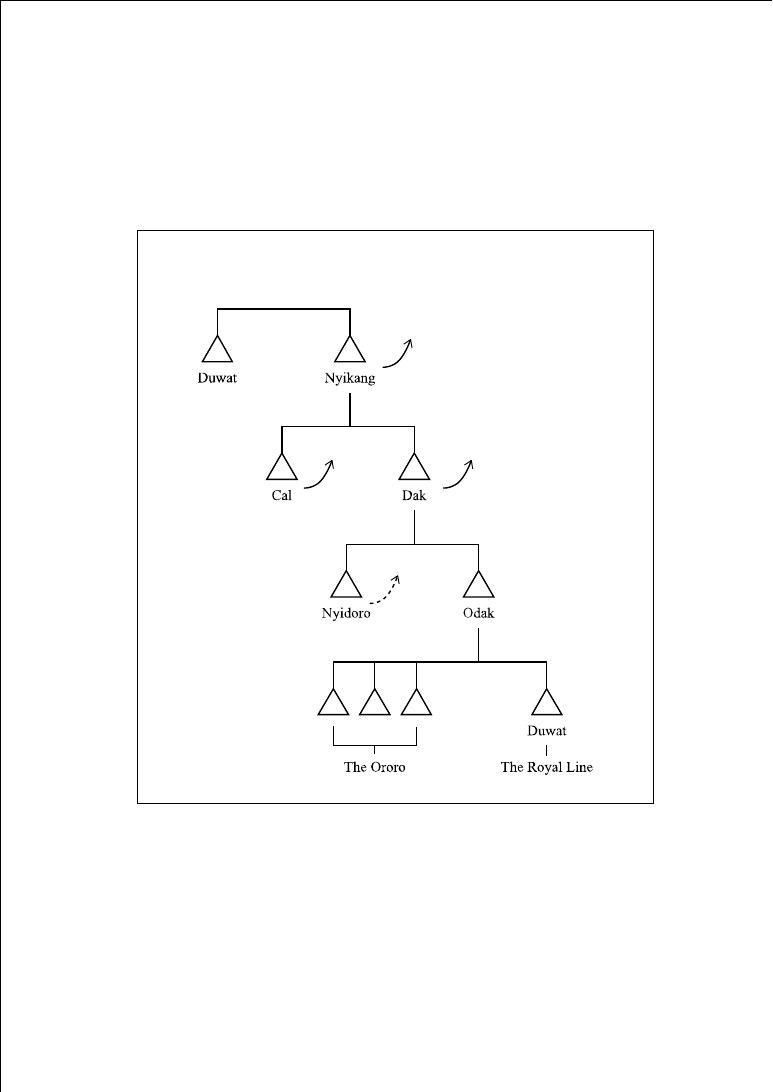
26 | David G
RAEBER
The story began with a Duwat, and with this second Duwat, one might say the
first round of the mythic cycle comes to an end. It begins with stories modeled on
birth and ends with stories of death: first, the non-deaths of Nyikang and Dak,
rejected by their subjects; then, establishing the two typical modes of putting an end
to a particular holder of the royal office, that is, either through internal revolt
(challenge by an ambitious prince) or being ritually put to death.
Figure 1. mythic origins of the Ororo and the Royal line.
Note: solid arrows refer to rulers who, rather than dying, vanished
and were replaced by effigies; the broken arrow refers to rulers who
died but whose body vanished and was not replaced by an effigy.
2011
| H
AU
: Journal of Ethnographic Theory 1 (1): 1–62
The role of the Ororo is especially important. This is a class who represent a
veritable institutionalization of this constitutive relation of hostility, and potential
violence, on which the eternity of the kingdom is founded. Generally, princes who
are not elected found their own lineage within the royal clan named after their

A
RCHAEOLOGY OF SOVEREIGNTY
| 27
royal ancestor, and his tomb becomes their lineage shrine. In theory, the king can
degrade any of these branches to Ororo status by entering into their lineage shrine
at night and performing certain secret rites, but the shrines are guarded and if
they’re caught trying to enter, the attempt is considered to have failed. One
reth
(Fadiet) is remembered to have failed in an attempt to reduce the descendants of
Nyadwai to Ororo status but it is not clear if any other king has ever been
successful (Pumphreys 1941: 12–13, Hofmayr 1925: 66; Howell 1953: 202). Most
sources suggested none have: another dramatic reflection on the limited power of
Shilluk kings. Some (e.g., Crazzolara 1951: 139) suggest that one reason a king
might wish to do so is that marriage is forbidden within the royal lineage; it is only
by reducing a branch to Ororo status that a king can then take one of its daughters
for his wife.
Moreover, it is precisely this degraded nobility whose role it is to
preside over the death of kings. Male members of the caste who accompany the
king during ceremonies are sometimes referred to as the “royal executioners,” but
here meaning not that they execute others on the king’s orders, but rather that it is
they who are in charge of presiding over the execution of the king. A
reth
would
always have a certain number of Ororo wives; it is they who are expected to
announce when he is sick or failing in his sexual powers; according to some, it is
they who actually suffocate the king (Seligman 1911: 222; cf. note 21). In other
versions it is the male Ororo bodyguard, who also preside over his burial.
All
sources stress it is difficult to know anything for absolute certain about such matters,
about which discreet people knew better than to much inquire, and doubtless
practices varied, but it is critical that the king was constantly surrounded by those
he had originally degraded, and who were eventually to kill him.
At this point we have reached historical times, which begin with the long and
prosperous reign of King Bwoc, immediately followed by Tokot, Queen Abudok,
and the historical creation of the sacred kingship at the end of the 17
th
century.
There is one last story worth telling here. This is the story of the
mar
. The
mar
was some kind of talisman or element of royal regalia that had originally belonged
to Nyikang. By the early twentieth century no one quite remembered what it had
been: a jewel of some kind, or perhaps a crystal, or a silver pot. According to some,
it was a magical charm capable of assuring victory in war. According to others, it
was a general token of prosperity and royal power (Hofmayr 1925: 72–75, Paul
1952).
According to Westermann (1912: 143–144) the
mar
was a silver pot that, waved
in front of one’s enemies, caused them to flee the field of battle. Tokot employed
it in many successful wars against the Shilluk’s neighbors, many of whom he
incorporated into Shillukland, but eventually—a familiar scenario now—his
followers grew tired of fighting far from their wives and families, and began to
protest and refuse his orders. In a fit of pique, he threw the
mar
into the Nile.
Here the story fast-forwards about a half century to the reign of Atwot (c1825–
1835), who is elected as a warrior king on the behest of a cluster of settlements
30 However Seligman and Seligman (1932: 48) says kings would only take Ororo wives if
they were “unusually attractive” since no child of an Ororo could ever become king.
2011
| H
AU
: Journal of Ethnographic Theory 1 (1): 1–62
31 In some versions, the Ororo men are responsible for killing the king “by surprise” if he
is wounded in battle or grievously ill (Hofmayr 1925: 178–180), the women kill him
otherwise.

28 | David G
RAEBER
plagued by Dinka raiders. He fights a battle with the invaders but is defeated, so, in
a bold move, he decides to retrieve the talisman. Atwot consults with the
descendants of Tokot’s wives at his lineage shrine, and, despite widespread
skepticism, rows out with his companions to the spot where the mar was lost,
sacrificing three cows along the way, and dives to the bottom of the river. He
remains underwater so long his companions think he is lost, but after many hours,
returns with the genuine article. Atwot proceeds to raise an army, conquers the
Dinka and is victorious against all that stand in his path. However, before long, the
same thing begins to happen: he is carried from conquest to conquest, but his
warriors begin protesting the incessant wars, and finally Atwot too throws the pot
back in the river in frustration. There have been no subsequent attempts to
retrieve the
mar
.
The story seems to be about why the Shilluk kingdom never became an empire.
It is as if every time kings move beyond defending the home territory or
conducting raids beyond its borders, every time they attempt to levy armies and
begin outright schemes of conquest, they find themselves stymied by protests and
passive resistance. They respond with passive aggression: vanishing in a huff,
throwing precious heirlooms in the river. As we’ll soon see, the scene of the king
sacrificing cows and then diving down into the river to find a lost object appears to
be a reference to a stage in the inauguration ceremonies in which the candidate has
to find a piece of wood that will be made into new body of Nyikang. Yet here,
instead of an image of eternity, the river becomes an image of loss. According to
one source (1952), the
mar
was “the luck of the Shilluk,” now forever lost. It seems
likely the debate over the nature of the
mar
reflected a more profound debate
about whether military good fortune was always luck for the Shilluk as a whole—a
question on which royal and popular perspectives are likely often to have been
sharply divided. And the fact that such arguments were said to be going on in the
time of Tokot, in the generation immediately before the creation of the institutions
of sacred kingship, once again underlines how much debate there was at that time
about the very purposes of royal power.
Return to Fashoda
At this point we can return to those institutions themselves.
First of all, a word about the role of violence. Godfrey Lienhardt (1952) insists
Nyikang (and hence, the king) has to be seen only as a continuation of the Shilluk
conception of God. God is ordinarily seen as neither good nor evil; anything
extraordinary contains a spark of the divine; above all, God is the source of life,
strength, and intelligence in the universe. Similarly, Nyikang is the source of
Shilluk custom, but not, necessarily, of a system of ethics, and kings—who are
referred to as “children of God”—were admired above all for their cleverness, and
2011
| H
AU
: Journal of Ethnographic Theory 1 (1): 1–62
32 This sort of behavior was occasionally noted even in colonial times. According to
Howell and Thomson (1946: 76), there used to be ceremonial drums kept in Fashoda
for royal funerals with special guardians, until
reth Fafiti, annoyed that his predecessor
had not used them to honor the previous
reth, threw them in the Nile.

A
RCHAEOLOGY OF SOVEREIGNTY
| 29
for the ruthless ingenuity with which they played the game of power.
Royals
regularly slaughtered their brothers and cousins as a preemptive measure, with the
assumption that they were almost necessarily plotting against the king; assassination
and betrayal was expected, and successful conspirators, admired. Lienhardt
concludes that intelligence and success (the latter typically reflected in prosperity)
were the main Shilluk social values: “kings, and all others inspired by
juok
[divinity], are sacred because they manifest divine energy and knowledge, and they
do so by being strong, cunning, and successful, a well as appearing to be in closer
touch with the superhuman than ordinary men” (Lienhardt 1952: 160; so too
Schnepel 1988: 449).
All this seems true—but the situation seems to have been rather more
complicated. God was also spoken of as the source of justice, the last resort of the
poor and unfortunate. The king of course dispensed justice as well. The apparent
paradox is, as I’ve emphasized, typical of divine kingship: the king, like God,
stands outside any moral order in order to be able to bring one into being. Still,
while a prince who successfully lured potential rivals to a feast and then massacred
them all might be admired for his cunning, this was hardly the way ordinary people
were expected to behave. Nothing in the literature suggests that if a commoner, or
even an ordinary member of the royal clan, decided to act in a similar fashion to
head off later quarrels over their father’s cattle, this would be regarded as anything
but a despicably criminal—by the king (if the matter was brought before him) or by
anybody else. It was, rather, as if ruthlessness of this sort was to be limited to the
royal sphere, and the royal sphere carefully contained and delimited from ordinary
life in part for that very reason.
Father Crazzolara, for instance, insists that this was precisely what the
commoner chiefs (called
Jago
) who elected the king wanted: to ensure that
everything surrounding kings and princes remained shrouded in mystery, so that it
had no effect on ordinary life. “Disputes and intrigues among members of the
royal family were known to exist and were shared by the great
Jagos
and their
councilors, but seldom affected the people at large. . . . Strifes and murders in the
higher social ranks were settled among the great men, in great secrecy, and could
never imperil the unity of the country” (Crazzolara 1951: 129). Indeed, he
observed, most ordinary Shilluk would never have dreamed of approaching the
royal residence at Fashoda, and when the king did set out on a journey, “most
people used to go into hiding or keep out of his path; girls especially do so” (ibid.:
139).
At the same time, the organization of the kingship those chiefs upheld, with no
fixed rule of succession, but rather, a year-long interregnum during which dozens
of potential candidates were expected to jockey for position, plot and intrigue
against each other, more or less guaranteed that only very clever, and very ruthless,
men could have much chance of becoming
reth
. It also guaranteed that the
violence on which the royal office was founded on always remained explicit, that
reths
were never too far removed from the simple bandit kings from which they
were presumably descended.
2011
| H
AU
: Journal of Ethnographic Theory 1 (1): 1–62
33 Similarly Schnepel: the ingenious application of violence was valued in itself—or, at
least, valued insofar as it was seen to contribute to the “vitality” of the Shilluk nation as a
whole.

30 | David G
RAEBER
Everything is happening as if the
reth
’s subjects were resisting
both
the
institutionalization of power,
and
the euphemization of power that seems to
inevitably accompany it. Power remained predatory. Take for example the matter
of tribute. The king’s immediate power was based in the
Bang Reth
, his personal
retainers, a collection of men cut off from their own communities: orphans,
criminals, madmen, prisoners taken in war. He provided them with cattle from his
herds, along with ornaments and other booty; they minded his cattle, accompanied
royal children, acted as spies, and accompanied him on raids against Arab or
Dinka neighbors. They did not, however, have anything to do with the collection
of tribute. According to one colonial source, there was no regular system for
exacting tribute. Instead, the king would intervene in feuds between communities
that had resisted his attempts at mediation:
The Reths. . . were extremely rich in cattle. They acquired these largely
in the following way. Whenever one settlement waged unjustified war
upon another or refused repeatedly to obey his order, the Reth would
raise as a “royal levy” the adjacent settlements, who would go and drive
off the malefactors’ cattle and burn their villages. The strength of the levy
would vary with the readily calculable strength of the opposition but a
good margin of safety would be allowed to ensure that the levy would win.
It is said that such levies were in fact seldom resisted, the victim being
glad to save their skins at the cost of most of their cattle. The participants
in the levy got a percentage of the cattle taken but the majority went to
the Reth (Pumphreys 1941: 12; compare Evans-Pritchard 1948: 15–16).
Significantly, it was precisely in the 1840s when Shilluk kings, emboldened by an
alliance with foreign merchants, began trying to move beyond raiding and create a
systematic apparatus for the extraction of tribute, that many ordinary Shilluk began
to cast doubt on the very legitimacy of the kingship, and to throw in their lot with a
different set of predatory freebooters (Mercer 1974: 423–24). As it turned out, the
results were catastrophic—the Arab slave-traders with whom they aligned
themselves turned out to be far more ruthless and destructive than anything they
had previously encountered—but the pattern remains clear. As in the stories about
the mar, popular resistance appeared at exactly the point where royal power tried
to move beyond mere predatory raiding, and to formally institutionalize itself.
The kings’ rather unsavory retainers lived at the margins of Fashoda. Its center
was composed of his own compound, and the houses of his wives. All sorts of dark
rumors surrounded the place. According to Seligman’s account, quoted near
verbatim in
The
golden bough:
2011
| H
AU
: Journal of Ethnographic Theory 1 (1): 1–62
During the day the king surrounded himself with his friends and
bodyguards, and an aspirant to the throne could hardly hope to cut his
way through them and strike home. It was otherwise at night. For then
the guards were dismissed and the king was alone in his enclosure with
his favourite wives, and there was no man near to defend him except a
few herdsmen, whose huts stood a little way off. The hours of darkness
were therefore the season of peril for the king. It is said that he used to
pass them in constant watchfulness, prowling round his huts fully armed,
peeping into the blackest shadows, or himself standing silent and alert,
like a sentinel on duty, in some dark corner. When at last his rival
appeared, the fight would take place in grim silence, broken only by the
clash of spears and shields, for it was a point of honour with the king not

A
RCHAEOLOGY OF SOVEREIGNTY
| 31
to call the herdsmen to his assistance (Frazer 1913: 22, Fraser 1990:
200–201).
This was to become one of Frazer’s more famous romantic images, but in the first
edition in which the Shilluk material appear, in 1913, the passage was
accompanied by a footnote explaining that “in the present day and perhaps for the
whole of the historical period” succession by ritual combat “has been superseded
by the ceremonial killing of the king” (Frazer 1913: 22n1). This would suggest we
are not dealing with a Victorian fantasy here—or not only—but with a Shilluk one, a
legend about the ancient past.
But even here things are confusing: Frazer is
simply citing Seligman, but Seligman also contradicts himself by simultaneously
insisting (i.e., 1911: 222; also Hofmayr 1925: 175) that even in his own day,
reths
did tend to sleep during the day and keep armed vigil at night, and that the drowsy
behavior of the
reth
, the one time he did meet one, would appear to confirm this.
In fact, such stories seem to be typical of the mysteries surrounding royalty. Very
few people knew what really went on at Fashoda, and everything concerning kings
was tinged with confusion, fascination, and danger.
35
All evidence suggests that, except perhaps during periods of civil unrest or
when the
reth
had concrete evidence of some particular conspiracy, life in Fashoda
was distinctly more relaxed. True, many observers do remark on the eerie quiet of
the place, much in contrast with other Shilluk settlements. But this is for an
entirely different reason. Fashoda was entirely lacking in children (e.g., Riad 1959:
197). As the reader will recall, not only was the settlement occupied almost entirely
by women, the king’s wives were sent back to their natal villages in order to give
birth, and the children were not raised in Fashoda. It is a place where there is sex,
but no biological reproduction, no nursing, no child-rearing—but also, no old age,
grave illness or natural death, since the king is not allowed to grow frail and pass
away in the normal fashion, and his wives normally return to their parents’
settlements before they grow very old.
All of this very much recalls the villages described by Simonse further to the
south, where birth and killing—or anything involving the spilling of blood—were
considered “hot,” violent, dangerous activities which should be kept entirely
outside the confines of inhabited space. Even animal sacrifices had to be, like the
Shilluk
reth
, smothered so that no blood was spilled. These restrictions were
especially severe during the agricultural season, since they were the key to ensuring
34 Curiously, Evans-Pritchard (1948) ended up arguing exactly the opposite: that stories of
ritual king-killing were the myth, and that in most cases one was really dealing with
assassinations or rebellions. Mohammed Riad (1956: 171–177) however went through
all existing historical information and could only find two examples of important
rebellions in all Shilluk history, only one of which could really be called successful. Of
twenty six historical kings, he noted, fifteen “surely met their death in the ceremonial
way” (ibid.: 176). Of the others, two were killed in war, three executed by the
government in Khartoum, and six died of unknown causes. On the other hand he
includes the four known cases of murder by rival princes as ceremonial deaths, which
does rather muddy the picture. At least it makes clear this did happen, but only rarely.
2011
| H
AU
: Journal of Ethnographic Theory 1 (1): 1–62
35 On both sides: Hofmayr writes “at night he [the Reth] is awake and walks heavily armed
around the village. His hand is full of spears and rifles. Whoever comes close to him is
doomed” (1925: 175, in Schnepel 1991: 50).

32 | David G
RAEBER
rain. Rain, in turn, was the temporary restoration of that happy conjunction of
heaven and earth was severed in the beginning of time. It seems hardly
coincidental, then, that almost all of the
reth
’s ritual responsibilities involved either
presiding over ceremonies appealing to Nyikang to send the rains, or harvest
rituals (Oyler 1918a: 285–286, Seligman and Seligman 1932: 80–82)—or even, that
it was considered a matter of principle that the king and his wives did work at least
a few symbolic fields, and followed the same agricultural processes as everybody
else (Riad 1959: 196).
I might add here that many of the more exotic-seeming practices of the capital
seem to be adopted from ordinary Shilluk practice. As the reader will recall, all
women, for example, were expected to leave their husbands and return to their
natal villages in the sixth month of pregnancy (Seligman and Seligman 1932: 69)—
though in the case of non-royals, they returned with their baby shortly after giving
birth—old people deemed to be suffering unduly from incurable conditions were
often “helped to die” (Hofmayr 1925: 299). According to Howell, even the effigies
had a kind of demotic precedent, since if someone dies far from home her kin can
hold a ceremony to pass her soul to a stick of ambatch, which is also the wood
used to make effigies, so that it can be buried in her stead (1953: 159; see also
Oyler 1918: 291).
What I have described above, at any rate, were the things that an ordinary
Shilluk was likely to actually know about Fashoda. The overall picture seems clear.
Fashoda was a little image of heaven. However imperfect, it was the closest one
could come, in these latter days, to a restoration of the primal unity that preceded
the separation of the earth and heaven. It was a place whose inhabitants experience
neither birth nor death, although they do enjoy the pleasures of the flesh, ease,
treasure and abundance (there was rumored to be a storehouse of plundered
wealth and certain clans were charged with periodically bringing the
reth
tasty
morsels), and also engaged in agricultural production—if, like the original couple,
Garang and Abuk, only just a little bit.
It is, then, an undoing of the dilemma of the human condition. Obvious it was a
partial, provisional one. The Shilluk
reth
was, as Bernhardt Schnepel aptly put it
(1995), “temporarily immortal.” He was Nyikang, but he was also not Nyikang;
Nyikang was God, but he was also not God. And even this limited degree of
perfection could only be brought about by a complex play of balanced antagonism
that would inevitably engulf him in the end.
The intallation ritual: description
All of this, I think, gives us the tools with which to interpret the famous Shilluk
installation ceremonies.
2011
| H
AU
: Journal of Ethnographic Theory 1 (1): 1–62
One must bear in mind here that this ritual is one of the few occasions in which
an ordinary Shilluk was likely to actually see a
reth
: the others being while he is
administering justice, and possibly, during raids or war. Almost every clan played
some role in the proceedings, whether in the preparation or rebuilding of royal
dwellings beforehand to bringing sacrificial animals, regalia, or presiding over
certain stages of the rituals themselves. It was in this sense the only real “national”
ritual. The sense of popular participation was made all the more lively since, the
rituals being so endlessly complicated and there usually having been such a long a

A
RCHAEOLOGY OF SOVEREIGNTY
| 33
time since they had last been performed, each step would tend to be accompanied
by lively debate by all concerned as to what the correct procedure was.
When a king dies, he is not said to have died but to have “vanished,” or to have
“gone across the river”—much as was said of Nyikang. Normally, Nyikang is both
immanent in the person of the king, and also, in an effigy kept in a temple in the
settlement of Akurwa, north of Fashoda. This effigy too is destroyed after a king’s
death. The
reth
’s body is conveyed to a sealed hut and left there for about a year,
or at least until it is certain that nothing remains but bones; at that point, the Ororo
will convey the skeleton to its permanent tomb in the
reth
’s natal village, and
conduct a public a funeral dance. It is only afterwards that a new
reth
can be
installed.
This interim period, while the king’s body lies decomposing and Nyikang’s
effigy is gone, is considered a period of interregnum. It is always represented as a
time of chaos and disorder, a “year of fear.” According to Howell and Thompson,
who wrote the most detailed account of the rituals, messengers send out word that
“There is no land—the Shilluk country has ceased to be” (1946: 18). Others speak
of the land as “spoiled” or “ruined,” the same language used in Dinka and Nuer
songs to describe the state of the world since the separation of heaven and earth
(Howell 1952: 159–160). At any rate it is clear that with the rupture in the center,
the image of perfection on earth and thus guarantor of the kingdom, everything is
thrown into disarray. During this time, all important matters are put on hold, other
than, presumably, the frantic politicking surrounding the election of the new
reth
.
There were usually at least a dozen potential candidates. Settlement chiefs lobbied
for their favorites, princesses offered bribes, royals conspired and plotted and there
was a real fear that everything would descend into civil war. As the chief of Debalo
explained in 1975:
It is the period when we fear each other. I fear you and you fear
me. If we meet away from the village, we can kill each other and
no-one will prevent us. So the meaning of
wang yomo
[year of fear]
is that we are all afraid and keep to our own homes, because there
is no king (Singer 1975, in Schnepel 1988: 443).
This sounds very much like a Hobbesian war of all against all. Still, when the
chief suggests that the chaos is the result of the mere absence of the king’s power to
impose justice, one must bear in mind that this is a local official who grew up in a
time of strong state authority, during which the
reth
was subordinated to, but also
supported by, Sudanese police. In earlier centuries, as we’ve seen, the
reth
did not
play this role. Rather, it would seem that the interregnum was the time when royal
politics—ordinarily kept at a safe distance from ordinary people’s lives—really did
spill over into society as a whole, and that, as a result, anyone became a potential
enemy.
Traditionally, the interregnum lasted roughly a year, and ended during the
“cool months” after the harvest in January and February, when the new election
would be held so that the
reth
could be installed. It was considered important the
installation be completed in time to allow the new
reth
to preside over rainmaking
ceremonies in April.
2011
| H
AU
: Journal of Ethnographic Theory 1 (1): 1–62
Neither was the election itself, conducted by twenty major chiefs or
Jago
,
presided over by the Chief of Debalo, definitive. As Schnepel (1988: 444) notes,
the college of electors did not so much the select a king as identify the candidate

34 | David G
RAEBER
the chiefs feel most likely to be able to successfully endure the series of tests and
crises that make up the ritual. Every step, in fact, was a kind of an ordeal and, thus,
another judgment. Candidates often feared assassination at critical points of the
ceremony; it was said if they were so much as injured in the course of them, they
would be declared unfit and disqualified. (For commoner participants, the rituals
were also tinged with fear, but at the same time, enormously entertaining. The
effigies of Nyikang and Dak, according to most sources, were seen as particularly
amusing.)
Let me lay out the events, in abbreviated form, in roughly their order of
occurrence.
Once the electoral college, presided over by chiefs of the Northern and
Southern halves of the country, had reached a decision, word was sent to the
prince, who could be expected to be lingering nearby:
The method of summoning the
reth was interesting. . . . The chief of
Gol Nyikang
sent his son by night to get him. Whether or not there was
a mock fight between the selected candidate and the messengers I do not
know, but the traditional form of the words announcing the choice was
told to me. It is an interesting example of Shilluk “understatement” when
talking of the
reth—“you are our Dinka slave, we want to kill you” which
means “You are our chosen
reth, we want to install you in Fashoda”
(Thomson 1945: 154).
(At this point it is possible to finally proceed with the final burial of the old king
and the initiation of his shrine—this, unlike the election, which is primarily an affair
of commoners, is presided over strictly by royals.)
The candidate-elect is now summoned, shaved and washed by Ororo women,
and placed in seclusion. Immediately thereafter, select detachments of men from
the Northern and Southern halves of the country begin, set out on expeditions to
acquire materials needed in the ritual, and particularly, with which to remake the
effigy of Nyikang.
36 Schnepel (1988) provides the best published blow-by-blow summary. What follows is
drawn from my own reading of the standard primary sources: Munro 1918; Oyler
1918a; Hofmayr 1925; Howell and Thomson 1946, 1952; Thomson 1948; Howell
1952a, 1953a; Anonymous 1956; but also Riad 1959, who adds some telling details. All
these seem to be derived from three ceremonies: the installations of Fafiti (1917), Anei
(1944) and Dak (1946).
37 The name given the northern half of the country during the ritual, the south being Ghol
Dhiang. It is interesting of course that the northern half should be named after Nyikang
since this is the portion of the country Nyikang is said
not to have conquered, but it is
also where his effigy normally resides.
38 There is some confusion over when this ceremony takes place. Schnepel (1988) follows
Howell and Thomson (1946) in placing it immediately after the election, but Riad
(1959: 182) suggests the latter were describing an exceptional circumstance and that the
funeral normally occurred well after the new
reth’s installation.
2011
| H
AU
: Journal of Ethnographic Theory 1 (1): 1–62
39 Wendy James, one of the peer reviewers notes, not without justice, that this essay rather
downplays the larger significance of the division of Shillukland into a Northern and
Southern half, which has political as well as ritual implications. Invaders and powerful
foreign influences (the Turks, the Mahdi, Arab traders, the Funj) invariably enter from

A
RCHAEOLOGY OF SOVEREIGNTY
| 35
This effigy is so important, and so famous, that it is fitting to offer a full
description. Actually Nyikang’s effigy is one of three such: in addition to his, there
is also an effigy of his rambunctious son Dak, and finally, one of his older, but
timid, son Cal. Nyikang and Dak’s effigies almost always appear together; the effigy
of Cal is far less important, only appearing at the very last day of the ceremony.
The body of Nyikang’s effigy consisted of a five and half-foot trunk of
ambatch
wood, adorned with cloth and bamboo, and topped with a crown of ostrich
feathers. Dak is similar in composition but his body is much smaller; however,
unlike Nyikang, his effigy is normally carried atop an eight-foot-tall bamboo pole.
(The effigy of Cal consists primarily of rope.) Ordinarily, all three are kept in
Nyikang’s most famous shrine, in the village of Akurwa—said to be the very place
where Nyikang vanished into the whirlwind. Their traditional keepers are a clan
called Kwa Nyikwom (“Children of the Stool”), the inhabitants of the place:
These effigies are not merely symbols. They may “become active” at any
time, and when active they are Nyikang and Dak. The effigy of Nyikang
is rarely taken on a journey in normal times, though it is often brought
out to dance during religious festivals at Akurwa itself. The effigy of Dak
makes periodical excursions through the country. Both effigies have an
important part to play in the ceremonies of installation. The soul of
Nyikang is manifest in the effigy for the occasion, and he must march
from Akurwa to Fashoda to test the qualities of the new successor and to
install him in the capital (Howell and Thomson 1946: 40).
Before this can be done, however, the effigy of Nyikang—destroyed after the death
of the former
reth
—has to be entirely recreated, and that of Dak, refurbished.
All the expeditions that set out of the country to gather materials are organized
like war parties, and some of them—such as those sent into the “raiding country” to
acquire ivory, silver and cloth, originally were expected to acquire them by
ambushing villages or caravans. In more recent times they have been obliged
instead to buy them in markets to the north of Shillukland. However, whether they
were sent outside the country to hunt ostriches or antelopes, or to gather rope or
bamboo, all these parties are clearly seen as seizing goods by force, and they made
little distinction between Shilluk and foreigners, since along the way “they are given,
or take, what they want from Shilluk as they pass” (ibid.: 38).
All of these expeditions also seem to be under the broad aegis of Dak, whose
effigy remains in the temple during the whole of the interregnum, except when
leading occasional expeditions outside.
The “raiding country” to the north of
Shillukland is seen as his particular domain.
the north, and this historical pattern is endlessly reproduced in the ritual. Fashoda of
course stands precisely at the border between the two halves.
40 The ororo who carry the king’s skeleton to its final resting place have a similar right to
“seize small gifts and ransom from those unfortunate enough to cross their path”
(Howell 1952: 160) and even those villages preparing gear for the ritual can do the
same from anyone passing by at the time (Anonymous 1956: 99). But as we’ll see it is
the effigies of Nyikang and Dak especially who are famous for this sort of thing.
2011
| H
AU
: Journal of Ethnographic Theory 1 (1): 1–62
41 For example, two months before the ceremonies begin, the effigy of Dak presides over
an expedition to Fanyikang to obtain certain sacred ropes (Howell and Thomson 1946:
38).

36 | David G
RAEBER
The most important of these expeditions by far is the one dispatched to find
the new body of Nyikang. It is led by the effigy of Dak, accompanied by his
keepers from among the Children of the Stool, along with some men from the
settlement of Mwuomo in the far north of the Shilluk country, who act as divers.
After sacrificing a cow so that its blood runs into the river, they set out from
Akurwa in canoes to an island in the midst of the “raiding country” called “the
island of Nyikang.” A drum is beaten; Dak scours the waters of the Nile; when a
white bird appears to indicate the right spot, ornaments are cast into the water as
an offering, along with a sacrificial ram, and a diver descends to search for an
ambatch
trunk of roughly the right size to make the new body of Nyikang (Howell
1953: 194). If he finds one, the body is wrapped in a white cloth and carried back
to Akurwa, where both Nyikang and Dak are outfitted with their newly acquired
cloth, feathers, and bamboo. But luck was not guaranteed. Riad’s informants
emphasized that Nyikang himself has specifically instructed his descendants to
observe this custom as an “ordeal,” to test the
reth
-elect, since, although the latter
does not participate in the ceremony, Nyikang will not appear if he disapproves of
the electors’ choice. In fact, they emphasized that if the trunk could not be found,
the entire ceremony had to be conducted again, starting from Akurwa, and that
after ten failures, the
reth
-elect would be killed and another candidate selected
(1959: 189–190)—though, as with most dire warnings of the dangers of the
ceremony, no one could remember a specific occasion when anything like this had
actually occurred.
Once Nyikang has been brought to life again in the form of an effigy, he and
Dak march to the northern border of the country and begin to assemble an army,
drawn from the men of the Northern half. It is said that they retrace the steps of
his original conquest of the country. The effigies are carried, and surrounded, by
the Children of the Stool, many armed with whips to frighten away those who
come too close, followed by a retinue carrying his drums, pots, shields, spears, and
bed. No one is allowed to carry weapons in the effigies’ presence, so when they
stay overnight at village shrines, their hosts, who would ordinarily be carrying
spears, carry millet stalks instead. During this time Nyikang would usually retire,
and Dak come out to dance with, and bless, the assembled crowds. Everyone
comes out to see the show, and to ask for cattle, sheep, spears, etc. But they also
hide their chickens:
It is usual for gifts of a sheep or a goat to be presented or exacted by
Nyikang, and it was noticeable how all small stock or fowl were either
shut up or driven away from the vicinity of Nyikang, for Nyikang has the
right to anything he fancies. As Nyikang proceeds with Dak his son
beside him, the escort chants the songs of Nyikang and Dak recounting
their exploits of conquest. From time to time Nyikang turns round and
dances back as if to threaten those following. When he does this, Dak
rushes ahead, carried in a charging position, his body held horizontally
pointed like a spear. . . (Howell and Thomson 1946: 41-42).
Occasionally, though things could also get out of hand:
2011
| H
AU
: Journal of Ethnographic Theory 1 (1): 1–62
It is accepted custom among the Shilluk that Nyikang and his followers
may seize cattle, sheep or goats which cross their path (most Shilluk are
wise enough to keep them out of the way) or to demand them as
offerings together with other smaller gifts from the occupants of the

A
RCHAEOLOGY OF SOVEREIGNTY
| 37
villages through which they pass. This licensed plundering, which is often
abused beyond the bounds of piety by Nyikang’s retinue, is treated by
the Shilluk with admirable tolerance… At one point on the march at
Moro, however, their demands were thought to be excessive and were
resisted, a demonstration which nearly ended in armed conflict and
which delayed the party for a while (Howell 1953: 195).
At the same time, the whole procedure is considered something of a farce. Howell
remarks that “the effigies are treated by the Shilluk with a mixture of hilarity and
dread: mixed emotions that are always apparent” (ibid.: 192). At any rate, it is clear
enough what’s happening. The effigies, assembled from pieces drawn from outside
the country, descend on Shillukland like an alien, predatory force. On one level
what they are doing is all in good fun; on another, they represent forces that are
quite real, and the consequences are potentially serious.
Nyikang and Dak proceed from settlement to settlement, gathering their forces,
retracing, as noted, their original path of conquest. Often members of new
communities will at first oppose them, then, energized, rally to their side. Finally,
they approach Fashoda.
The king has all this time been in seclusion in the capital, but on hearing of
Nyikang’s passage through Golbainy, the capital of the Northern Half of the
country, he flees at night to take refuge in Debalo, the capital of the Southern Half.
During that night all fires are put out in both villages. The chief of Debalo
challenges the
reth
-elect, asking his business. He replies “I am the man sent by
God to rule the land of the Shilluk” (Hofmayr 1925: 145). Unimpressed, the chief
has his men try to block his party from entering, leading to mock battles where,
after being repelled three times, the
reth
-elect finally enters. At this point the fires
are relit, using fire-sticks. According to Riad, three are lit in front of the king’s hut,
one from the royal family, one from the Ororo, and one from the people. “These
fires, one of the symbols of royalty, are never put out as long as the king lives, and
are transported to Fashoda when the king moves to the capital” (Riad 1959: 190).
Once in Debalo, the
reth
-elect gathers his own followers. At some times he is
surrounded by men seeking forgiveness for sexual misdemeanors: he grants this in
exchange for gifts of sheep and goats. At others he is himself treated “like a small
boy,” belittled and humiliated by the chief, made to sleep in a rude hut and to herd
sheep or cattle. He is formally betrothed to an eight- to ten-year-old girl, called the
nyakwer
or “girl of the ceremonies,” who will be his almost constant companion
from them on. Gradually, the southern chiefs all arrive with their warriors, to
match Nyikang’s army of the north. Both sides prepare for a ritual battle which is
always fought along the banks of a river that represents the official border between
the two divisions of the country.
The candidate marches up surrounded by the Ororo, who are his bodyguards
but at the same time, the symbols of his mortality. He proceeds north towards
2011
| H
AU
: Journal of Ethnographic Theory 1 (1): 1–62
42 Actually, Riad claims these fires are traditionally lit at the same time as the water
ordeal—but in order to make the claim, he has to also argue that in former times, the
king used to move back and forth between Fashoda and Debalo during his seclusion.
Whether or not this is the case, the parallel he or more likely his informants are trying
to draw here—between water in the North, and fire in the south—seems significant.
Seligman (1934: 9) adds one of the three fires is transported to Fashoda as the “life
token” of the king.

38 | David G
RAEBER
Fashoda sitting backwards on an ox, which is led by its tail, and alongside a heifer,
also walking backwards. Nyikang dispatches messengers to mock him. Before
crossing the river, he and the girl step over a sheep, then a black bull before
crossing the river, thus consecrating them for sacrifice. It is said in earlier days he
used to step over an old man who was then trampled by the people after him,
usually, to death. The two forces proceed to do battle, each side unleashing a
volley of millet stalks in lieu of spears. Nyikang’s followers, however, are also
armed with whips, reputed to be so powerful that a direct blow could cause
madness. As a result, the southern forces are put to rout, and at the height of the
battle, the bearers of Nyikang and Dak sweep forward and surround the
reth
-elect,
carrying him off as prisoner to Fashoda, together with the “girl of the ceremonies.”
On their arrival, the heifer is ritually sacrificed.
Once in the capital, however, the two figures begin to fuse. Nyikang’s sacred
stool is taken from his shrine; a white canopy is arranged around it, and the effigies
and their captives are brought inside. First Nyikang is first placed on the throne,
then removed and replaced with the
reth
-elect. He begins to tremble, and exhibit
signs of possession—the soul of Nyikang, it is said, has left the effigy and entered
the king. He’s doused with cold water. At this point the effigies retreat to their
shrine, and the
reth
is revealed to the assembled people, as his wives (newly
transferred from the harem of the previous king) warm water for a ritual bath
“while the Ret sat like a graven image on the chair” (Munro 1918: 151), himself
now an effigy, and later was led out before the assembled people. In one case, at
least, observers remarked he seemed visibly in trance. After the sacrifice of an ox,
he was led to a temporary “camp” just opposite the shrine, where he was bathed in
great secrecy, with water alternately warm and cool, to express the desire that he
“rule with an even temper” (Howell and Thomson 1946: 64) and avoid extremes.
This bath was part of a broader process of communion with the spirit of Nyikang
of which was considered arcane knowledge about which outsiders should know
little, but according to some, the
reth
spent many hours of contemplation as the
soul passed fully into him.
The transfer of Nyikang’s soul marked the new
reth’s
last public appearance for
at least three days. Afterwards king remained in seclusion, guarded only by some
Ororo and a few of his own retainers. Once again he is treated like a boy, expected
to tend a small herd of cattle, and accompanied only by his betrothed child bride.
At some point, though, adult sexuality intervenes. An Ororo woman (or in some
versions, there are three of them) lures the king away to the shrines on the mound
of Aturwic in Fashoda and seduces him;
while he is thus distracted, Nyikang
steals out from another of the shrines and kidnaps the “girl of the ceremonies.” On
the king’s return, he discovers her gone and, pretending outrage, begins searching
everywhere. On finally realizing what’s happened, he confronts the chief of Kwa
Nyikwom (who is acting as Nyikang’s spokesman), explaining that the girl had been
properly betrothed by a payment in cattle, and Nyikang had no right to her. The
chief however insists that the herds used—which are, after all, the old
reth
’s herds—
are really Nyikang’s.
2011
| H
AU
: Journal of Ethnographic Theory 1 (1): 1–62
43 According to certain other versions he now commits incest with a half-sister, a very
outrageous act. This is incidentally the closest the
reth comes to committing one of de
Heusch’s “exploits” and most sources do not even mention it.

A
RCHAEOLOGY OF SOVEREIGNTY
| 39
Finally it comes down to another contest of arms. Both sides marshal their
forces in Fashoda. This time, Nyikang is accompanied not only by the ferocious
Dak but his hapless son Cal. A smaller mock battle follows, but this time, the
Northerners’ whips prove ineffective. The
reth
sweeps in and recaptures the girl
from Nyikang; finally, the effigies have to fight their way back into their own
shrines, and negotiate their effective surrender. The girl remains with the king, who
has, in his victory, demonstrated that he and not the effigy is the true embodiment
of Nyikang. At this point the effigies disappear, and do not return for the
remainder of the ceremonies.
At this point, too, the drama is also effectively over. The new
reth
spends the
next day on his throne at Aturwic, holding court amidst an assembly of the nation’s
chiefs. Each places his spear head down in the ground and delivers a speech urging
the new ruler to respect elders and tradition, protect the weak, preserve the nation,
and similar sage advice. Drums salute their words; the king is invested in two silver
bracelets that serve as marks of office; an ox is speared. Finally the king is given a
tour of the capital. Everything is back in place. The newly installed
reth
sends cattle
for sacrifice to each of the shrines of Nyikang scattered throughout the country
Some weeks later he is ready to preside over his first major ritual, a series of
sacrifices calling on Nyikang to call on God to send the rain. Once the first rains
fall, the effigies leave Fashoda and return to their shrine in Akurwa, and do not
return until the new king dies.
Since the drama began with the people’s representatives announcing,
“euphemistically,” that they wish to kill the candidate-elect, it might be best to end
it by noting that even here, in the
reth’s
most benevolent function, there were
similar, darker possibilities. While one would imagine a newly inaugurated
reth
would have nothing but enthusiasm for his role as rainmaker, this was not always
assumed to be the case.
The king is the only authorized person to refuse or permit sacrifices at
the important ritual ceremonies. The act of sacrificing animals to
appease Juok, the highest spirit, and Nyikang, the demi-god, cannot be
correctly undertaken without the king’s sanction. Without sacrifices the
people’s wishes cannot be granted. It follows that the king is the real
power in religious matters, and sometimes he withholds his beneficial
powers if he feels the disloyalty of his subjects or their hatred towards
him (Riad 1959: 205, citing Hofmayr 1925: 152n1).
In other words, while the
reth
, unlike Simonse’s rainmaking kings, was not
personally responsible for bring down rain through magical means, his role was, at
least potentially, not so different. A drought might well be blamed on royal spite—
and presumably, begin to spur a political crisis, even if it was unlikely to end with
an actual lynch mob.
The installation ritual: analysis
2011
| H
AU
: Journal of Ethnographic Theory 1 (1): 1–62
To some degree, the symbolic structure of the ritual is quite transparent. There is a
constant juxtaposition of North and South, the former the division of Nyikang, the
latter, of the king. The North is identified with the eternal, universal “kingship”;
the South, with the particular, mortal king. Hence as Evans-Pritchard put it, in the
ritual, “the kingship captures the king” (1948: 27). Having been defeated as a

40 | David G
RAEBER
human, the
reth
-elect becomes Nyikang, and is thus able to defeat the effigy and
banish it back to its shrine.
Another obvious element is the opposition of fire and water. At the same time
as the image of Nyikang emerges from the river far to the north, new fires are lit in
Debalo, the capital of the South, that will burn for the rest of the king’s reign and
be put out when he dies. Water here is eternity. It doesn’t even “represent”
eternity, it
is
eternity; the Nile will always be there, and always the same. With the
rains, it is the permanent source of fecundity and life. It is utterly appropriate
therefore that Nyikang, whose mother was a crocodile and is called “child of the
river,” should emerge from its waters.
Fire on the other hand is, like blood, the
stuff of worldly transformation. In this case, the fires correspond to the mortal life
of the individual king; they will exist exactly as long as he lives. It is thus equally
appropriate that when the synthesis of Nyikang and
reth
, between the eternal
principle and mortal office-holder, occurs, it should be accompanying by putting a
fire to water. The “bath” during which the king becomes fully one with the demi-
god also unites the two elemental principles. Fire meets water as mortal man meets
god.
All these elements are, as I say, relatively straightforward. Other elements are
less so. The most puzzling is in the role of Nyikang’s son Dak. Existing analyses—
even those that have a great deal to say about the effigies (Evans-Pritchard 1946,
Arens 1984, Schnepel 1988)—focus almost exclusively on Nyikang, who is always
assumed to represent the timeless nature of the royal office. They rarely have
anything to say about Dak. But in many ways Dak seems even more important
than Nyikang: if nothing else, because (just as in the legends he is the first to
transcend death through the means of an effigy) his is the only effigy that was
genuinely eternal. When the king dies, Nyikang returns to his mother in the river.
Dak remains. Dak’s effigy then presides over the re-creation of Nyikang’s. What is
one to make of this?
It might help here to return to the overall cosmological framework. The reader
will recall that the Shilluk Creator is rarely invoked directly, but largely approached
through Nyikang.
The all-powerful being who exists in the minds of the Shilluk as a remote
and amoral deity is called Juok. Juok is the Shilluk conception of God
and is present to a greater and lesser degree in all things. Juok is the
explanation of the unknown, the reassuring justification of all the
supernatural phenomena, good and bad, of which life is made up. The
principal medium through whom Juok is approached is Nyikang. The
distinction between them is not clear. Nyikang is Juok, but Juok is not
Nyikang. . . . Further the soul of Nyikang is reincarnate in every Shilluk
reth, and thus exists both in the past and the present. Nyikang is the reth,
but the
reth is not Nyikang. The paradox of the unity yet separation is
not easy to define. The Shilluk themselves would find it difficult to
explain. Juok, Nyikang, and the
reth represent the line through whom
divinity runs. . . . The
reth is clearly himself the medium through which
2011
| H
AU
: Journal of Ethnographic Theory 1 (1): 1–62
44 All this is actually quite explicit: “as soon as the king dies, the spirit of Nyikang goes to
his mother Nyikaya in the river, and the people will have to go to the river and bring
him, and they will have to beg him to accept” (Singer in Schnepel 1988: 449).

A
RCHAEOLOGY OF SOVEREIGNTY
| 41
both Nyikang and, more vaguely, Juok are approached, and is the
human intercessor with God (Howell and Thomson 1956: 8).
After many years of contemplation and debate scholars of Nilotic religions have
learned to read such paradoxical phrases (“God is the sky, but the sky is not God”)
as statements about refraction and encompassment. Nyikang is an aspect of God,
but God is in no way limited to that aspect.
We are presented, as in a rain-making ceremony, with a very straightforward
model of a linear hierarchy:
God
|
Nyikang
|
the
reth
|
the people
The
reth
intercedes for the people and asks Nyikang to intercede with God to
bring the rains. If the rain comes, it temporarily joins everything together. However,
as we’ve seen, at every point there is potential antagonism. The people may hate
the
reth
or wish to kill him; they may curse Nyikang; the
reth
may withhold the
rains out of resentment of the people; the king and Nyikang raise armies and do
battle with each other.
Only God seems to stand outside this, but only because God is so distant: in
Nuer and Dinka cosmologies, where Divinity is a more immediate concern, we
learn that the human condition was first created because of God’s (apparently
unjustified) anger against humans, and there are even stories of defiant humans
trying to make war on God and on the rain (Lienhardt 1961: 43–44). Antagonism
here appears to be the very principle of separation. Insofar as the
reth
is not
Nyikang, it is first of all because the two sometimes stand in a relation of mutual
hostility.
This too is fairly straightforward. Certainly, there are ambiguities—for instance,
about how and whether the people themselves could be said to partake of divinity,
since divinity is, after all, said to be present in everything—but these are the
ambiguities typical of any such hierarchical system of encompassment.
Things get a little more complicated when one examines prayers offered
directly to God. Here is one in Westermann, pronounced during a cattle sacrifice
to cure someone who is sick:
There is no one above thee, thou God. Thou becamest the grandfather
of Nyikango; it is thou (Nyikango) who walkest with God; thou becamest
the grandfather (of man), and thy son Dak. If famine comes, is it not
given by thee? So as this cow stands here, is it not thus: if she dies, does
her blood not go to thee? Thou God, and thou who becamest Nyikango,
2011
| H
AU
: Journal of Ethnographic Theory 1 (1): 1–62
45 Though in this case made even more confusing by reversing the order in the second
example. If this is not simply a mistake on the author’s part, it could be taken as a
telling sign of the reversibility of some of these hierarchies.

42 | David G
RAEBER
and thy son Dak! But the soul (of man), is it not thine own? (1912: 171,
also in Lienhardt 1952: 156).
Here we have the same sort of hierarchical participation (God became Nyikang)
but king is gone and Dak appears in his place:
God
|
Nyikang
|
Dak
|
human beings
Dak’s presence might not be entirely surprising here because it was most often
Dak’s attacks that make people to sick to begin with. If so Dak, however much
subordinated, also represents the active principle that sets everything off. This
often seems to be his function.
Certainly, Dak is nothing if not active. This is especially obvious when Dak is
paired with Nyikang, which he normally is. Nyikang’s effigy is larger and heavier; it
is clearly meant to embody the
gravitas
and dignity of authority. His image thus
tends to stay near the center of things. In ordinary times, the effigy remains in the
temple at Akurwa even when Dak’s effigy leaves it to tour the country; when the
two do travel together, it is always Dak who moves about, interacts, while Nyikang
takes on a more “statesmanlike” reserve (Schnepel 1988:437). True, one could
argue this is simply a consequence of Dak’s subordinate status: Nyikang is the
authoritative center, Dak his worldly representative, his errand-boy. But even here
there are ambiguities. Most strikingly, while Dak is smaller than Nyikang, he
towers above him, always being carried atop an eight foot pole. Nyikang, in
contrast, stays close to the ground; in fact his effigy is often held parallel to the
ground, while Dak’s is ordinarily vertical. Similar ambiguities appear in stories
about the two hero’s lives. Sometimes, especially in his youth, it is Dak who is
always getting himself in trouble and Nyikang with his magical power who has to
step in to save him. But later, during the conquest of Shillukland, it is more likely
to be the other way around: Nyikang is foiled by some problem, and Dak proves
more ingenious, or more resourceful with a spear, and manages to solve it.
There is also the peculiar feature of Cal, Nyikang’s feckless older son who
never accomplishes anything and whose image appears only when the effigies’
forces lose. Dak and Cal seem to represent opposites: pure aggression versus
absolute passivity, with Nyikang again defining the center. Yet in what way is
Nyikang superior if one is more like the useless Cal?
What I would suggest is that this is not just a dilemma of interpretation for the
outside analyst; it reflects a fundamental dilemma about the nature of political
power that Shilluk tend to find as confusing as anybody else. Rituals can be
2011
| H
AU
: Journal of Ethnographic Theory 1 (1): 1–62
46 Actually Westermann claims this is the only prayer offered directly to God but
Hofmayr (1925: 197–201) and Oyler (1918a: 283) both produce other ones (viz.
Seligman 1934: 5).

A
RCHAEOLOGY OF SOVEREIGNTY
| 43
interpreted as ways of puzzling out such problems, even as, simultaneously, they
are also ways of making concrete political change in the world.
Critical here is the role of the interregnum, the “year of fear.” Wherever there
are kings, interregna tend to be seen as periods of chaos, violence, times when the
very cosmological order is thrown into disarray. But as Bernhardt Schnepel (1988:
450) justly points out, this is the reason most monarchies try to keep them as brief
as possible. There is no particular reason those organizing the Shilluk installation
ceremonies could not have declared, say, a three to five-day period of chaos and
terror—in fact, by the 1970s, that’s exactly what they did decide to do, abandoning
the year-long interregnum entirely (ibid.: 443). If for centuries before they didn’t, it
indicates, if nothing else, that this year of fear was fundamentally important.
Its importance, I think, is the key to understanding the importance of Dak as
well. During the interregnum, royal politics, ordinarily bottled up in the figure of
the
reth
, overflows into society at large. The result is constant peril. During this
period Nyikang is gone, and Dak alone remains. The return to normalcy begins
with the stage of “preparations,” conducted under Dak’s general aegis, and often,
under his direct supervision. Expeditions set out to appropriate the materials with
which to reconstruct the royal office, starting with the effigies. They uproot plants,
they hunt and kill animals, they ambush and plunder camps and caravans. Nor do
they limit their depredations to foreigners. They “take what they like” from Shilluk
communities as well.
Dak’s expeditions, then, represent indiscriminate predatory violence directed at
every aspect of creation: vegetable, animal, every sort of human being. As I have
pointed out, “indiscriminate” in this context also means “universal.” Ordinarily,
when one is in the presence of a power that can rain destruction equally on anyone
and everyone, that is what Shilluk refer to as Juok, or God.
This is not to say that
Dak is God (or, to be more precise, it is. God is Dak, but Dak is not God.) Dak is
the human capacity to act like God, to mimic his capricious, predatory
destructiveness. In the stories, this is how he first appears: raining death and
disaster arbitrarily. From his own perspective “taking what he likes.” From the
perspective of his victims, playing God. During the interregnum then, it is not just
royal politics that spills over into society at large; it is divine power itself—the violent,
arbitrary divine power that is, as Shilluk institutions ensured no one could never
forget, the real essence and origin of royalty.
Of course God (Juok) is not simply a force of destruction—he is also, originally,
the creator of everything—and it is probably worth noting that this is also the only
point in the ceremonies where anyone really makes or fashions anything. Still, this
is not what’s emphasized. What is emphasized is appropriation, which is perhaps
2011
| H
AU
: Journal of Ethnographic Theory 1 (1): 1–62
47 God seems particularly immanent in violence or destruction. The above-cited prayer
says “spear-thrusts are of Juok”, and one of the few ways that God was regularly invoked
in common speech is when people call out “why, God?” when someone falls seriously
ill. Among related Nilotic speakers in Uganda, “anything to do with killing must have
juok in it” (Mogenson 2002: 424). On the other hand, in formal speech, God, so absent
from the everyday life of ordinary Shilluk, pervades every aspect of royal existence.
When speaking with members of the royal clan, one can never speak of their going
someplace, or getting up, or staying someplace, or entering a house, instead they are
“taken by God” to that place, “lifted by God,” “nursed by God,” “stuffed in the house
by God,” and so on (Pumphreys 1937).

44 | David G
RAEBER
the most distinctly human form of activity. Through a combination of
appropriation and creation, Dak’s people thus fashion Nyikang. Once they have
done so, and Nyikang returns, he (unlike Dak) limits his depredations to his own
Shilluk nation, retracing his original journey of conquest. But there seems to be a
calculated ambiguity here. Do the Shilluk become Shilluk—Nyikang’s subjects—
because they collectively construct Nyikang (the classic fetish king, created by his
people) or because he then goes on to conquer them (the classic divine king,
raining disaster or the threat of disaster equally on all)?
The interregnum, then, is a time when divine power suffuses everything. This is
what makes the creation of society possible. It is also what makes the creation of
society necessary, since it results in an undifferentiated state of chaos and at least
potential violence of all against all. Social order—like cosmic order—comes of
separation, and the resultant creation of a relatively balanced, stable set of
antagonisms. That one is, in fact, dealing with divine power here is confirmed by
stories about the nature of the election itself. The electoral college is made up
primarily of commoners, with a few royal representatives, but many insisted that
“in former times” a delegation from the Nuba kingdom, the ancient allies of
Nyikang, performed a ritual, a “fire ordeal,” involving throwing either sticks or
pebbles in a fire, that ensured that the new
reth
was chosen directly by God
(Westermann 1912: 122; Hofmayr 1925: 451). Even in current times, the election
is taken to represent God’s choice: this is what allows the
reth
to tell the chief of
Debalo that he is the man “sent by God to rule the land of the Shilluk” (Lienhardt
1952: 157).
The people and God are here interchangeable.
With Nyikang’s return, God leaves the picture, and Dak is again reduced to his
father’s deputy. Divinity begins to be properly bottled up. Nyikang may continue
Dak’s predatory ways, looting and pillaging as he reenacts his conquests, but it has
all become something of a burlesque.
Over the course of the ceremonies, Nyikang’s spirit, having been coaxed out of
the river, is transferred first into the effigy, then, just as reluctantly, into the body of
the
reth
-elect. In doing so, Nyikang is also moving forward in history: from his
birth from the river in mythic times, to his heroic exploits in the beginning of
Shilluk history, to his current incarnation in the body of a contemporary king. If
we look at what is happening in the South, surrounding the candidate, however, we
see a very different kind of drama. I have already mentioned the contrast between
the water symbolism surrounding Nyikang and the fire symbolism surrounding the
king. This is also a juxtaposition of mortality and eternity. Nyikang might be
constructed, but he is constructed of eternal materials. (There will always be a river,
just as there will always be ostriches and bamboo.) He then moves from the
generic—and thus timeless—to the increasingly particular, and hence historic. But
he will never actually die, just disappear and begin the cycle all over again. The
king on the other hand is from the start surrounded by reminders of his own
mortality.
2011
| H
AU
: Journal of Ethnographic Theory 1 (1): 1–62
48 The presence of foreigners here—even if legendary—seems to be a reminder of the
universality of the divine principle. Note too the opposition between this “fire ordeal”
in which the candidate is chosen by God, and the “water ordeal” in which he is
confirmed by Nyikang.

A
RCHAEOLOGY OF SOVEREIGNTY
| 45
If the fires are the most obvious of these reminders, the most important are
surely the Ororo. The Ororo preside over every aspect of the king’s mortality. As
degraded nobility, their very existence is a reminder that royal status is not eternal:
that kings have children, that most of them will not be kings; that eventually, royal
status itself will pass away. In royal ritual, Ororo have a jurisdiction over everything
that pertains to sexuality and death. They are the men who carry out the sacrifices
for the king by spearing and roasting animals, they are the women that wash, shave,
and seduce the king; they will provide his highest-ranking wives; they protect but
eventually kill him; they officiate over the decomposition and burial of his corpse.
Throughout the ceremonies, the
reth
-elect is surrounded by Ororo. When he is
defeated and seized by Nyikang, he is plucked from amidst his own mortality.
This is not to say that the
reth
is ever more than “temporarily” immortal. Even
after his capture, the Ororo soon return.
This theme plays itself out throughout the ceremony. If the drama in the North
is about the gradual containment of arbitrary, divine power, the drama in the South
is about human vulnerability. The
reth
-to-be is mocked, treated as a child, forced
to ride backwards on an ox. His followers never wield arbitrary power over
humans. Unlike Dak and Nyikang, they do not loot or plunder or hold passers-by
for ransom. They do, however, constantly offer animals up for sacrifice. Just about
every significant action of the king is marked by his stepping over (thus,
consecrating) some animal that is later sacrificed.
In one sense this is the exact
opposite of what Nyikang and Dak are doing. Sacrificial meat is redistributed,
so
instead of stealing live beasts, he is distributing the flesh of dead ones. This is
especially significant since, when presiding over sacrifices meant to resolve feuds,
Shilluk kings have been known to state quite explicitly that the flesh and blood of
the animal he sacrifices should be considered as his own (Oyler 1920: 298). Since
in ordinary Shilluk sacrifices the life and blood of the creature (unlike the flesh)
are said to “go up to God”—and to Nyikang—it would seem the king is here playing
the part of humanity as a whole, placing himself in a willfully subordinate position
to the cosmic powers that will ultimately take hold of him.
In a larger sense, sacrifice—in all Nilotic religions the paradigmatic ritual—is
about the re-establishment of boundaries.
Divinity has entered into the world; the
ordinary divisions of the cosmos (for instance, between humans, animals, and gods)
have become confused; the result is illness or catastrophe. So while sacrifice is,
here as everywhere, a way of entering into communication with the Divine, it is
ultimately a way of putting Divinity back in its proper place. If the interregnum, the
reign of Dak, is a time of indiscriminate violence against every aspect of creation,
sacrifice is about restoring discriminations: respect (
thek
) to use the Nuer/Dinka
49 It happens so often that most such examples I actually purged from my account, above,
to avoid monotony.
50 This is not to say that Nyikang’s passage does not include some acts of sacrifice, since
otherwise there could be no feasts; only that this is not a particularly important aspect of
what he does. With the king it is clearly otherwise.
2011
| H
AU
: Journal of Ethnographic Theory 1 (1): 1–62
51 In the absence of any detailed publish material on Shilluk sacrifice, I am drawing here
on Evans-Pritchard (1954, 1956) on the Nuer, but even more Lienhardt’s work on the
Dinka (1961) and Beidelman’s (1966a, 1981) reinterpretations of this material.

46 | David G
RAEBER
phrase,
separation, appropriate distance. In this sense, the entire installation
ceremony is a kind of sacrifice, or at least does the same thing that a sacrifice is
ordinarily meant to do. It restores a world of separations.
Of course, if the ritual is a kind of sacrifice, it is reasonable to ask: who is the
victim? The
reth
-elect? A case could be made. The ceremony begins with the
people informing the candidate that they wish to kill him. During his time in
Debalo, he is treated very much like an ox being prepared for sacrifice: sacrificial
oxen, too, are secluded, manhandled and mocked—even while those who mock
them also confess their sins (Lienhardt 1961: 292–95).
Then in the end the ox’s
death becomes the token of a newly created community, its unity brought into
concrete being in the sharing of the animal’s flesh. Here one could almost see the
humiliated princely candidate in a messianic role, giving of himself to man and god,
sacrificing himself in the name of Shilluk unity. But if so, there’s an obvious
objection. He doesn’t seem to be sacrificing very much. To the contrary: the
ceremonies end with the new king happily installed in Fashoda, accepting the
allegiance of his subjects, inspecting the buildings, reassembling a harem, perhaps,
if so inclined, plotting bloody revenge on those who had formerly insulted him.
Still, all this is temporary. The king is, ultimately, destined to die a ritual death.
So is the king a sacrificial victim on temporary reprieve? I would say in a certain
sense he is. Every act of sacrifice does, after all, contain its utopian moment. Here,
it is as if the king is suspended inside that utopian moment indefinitely—or at least,
so long as his strength holds out.
Let me explain what I mean by this. Normally, this utopian moment in sacrifice
is experienced first and foremost in the feast, after the animal is dead, when the
entire community is brought together for the collective enjoyment of its flesh.
Often this is a community that has been created, patched together from previously
unrelated or even hostile factions, by the ceremony itself. Even if that is not the
case, they must put aside any prior differences. According to Lienhardt, for Dinka,
such moments of communal harmony are the closest one can come to the direct
experience of God—or, to be more specific, God in his aspect of benevolent
universality:
In Divinity the Dinka image their experience of the ways in which
human beings everywhere resemble each other, and in a sense form a
single community with one original ancestor created by one Creator. . . .
When, therefore, a prophet like Arianhdit shows that he is able to make
peace between normally exclusive and hostile communities, to persuade
them to observe between them the peaceful conventions which they had
previously observed only internally, and to unite people of different
origins in a single community, he proves that he is a ‘man of Divinity’. . . .
A man is recognized as a powerful ‘man of Divinity’ because he creates
52 The Shilluk cognate appears to be
pak, usually translated “praise,” which also refers to
specialized formal language used within and between clans (see Crazzolara 1951: 140–
142). As usual, though, there isn’t enough material on Shilluk custom to make a
sustained comparison.
2011
| H
AU
: Journal of Ethnographic Theory 1 (1): 1–62
53 Admittedly, I am relying here on Lienhardt’s detailed description and analysis of Dinka
sacrifice, supplemented by Evans-Pritchard’s Nuer ethnography, but this is as I say
because no parallel Shilluk account exists. For what it’s worth Evans-Pritchard (1954:
28) felt it appropriate to use Shilluk statements to throw light on Nuer practices.

A
RCHAEOLOGY OF SOVEREIGNTY
| 47
for people the experience of peace between men and of the uniting of
forces which are normally opposed to each other, of which Divinity is
understood to be the grounds (1961: 157).
It is in this sense that God “also represents truth, justice, honesty, uprightness,” and
so on (1961: 158). It is not because God, as a conscious entity, is just. In fact,
Dinka—like most Nilotic peoples—seem haunted by the strong suspicion that he
isn’t. It is because truth, justice, etc, are the necessary grounds for “order and
peace in human relations,” and therefore, truth, justice, etc,
are
God. The point of
sacrificial ritual then is to move from one manifestation of the divine to the other:
from God as confusion and disaster, to God as unity and peace. Normally it is the
feast which seems to act as the primary experience of God, but often the divine
element takes even more concrete form in the undigested grass extracted from the
cow’s stomach. It seems significant that the one Shilluk sacrifice for which we have
any sort of description—other than those meant to bring the rain—is aimed at
creating peace between two parties to a feud (Oyler 1920b). The
reth
here plays
the part of the Dinka prophet. After he emphasizes that the ox’s flesh and blood
are really his own, the animal is speared, and the chyme, the half-digested grass in
question, used to anoint the former feuding parties. “That was done to show their
united condition” (ibid.: 299).
Nuer insist that chyme is, like the blood and more
generally the “life,” the part of the sacrificed animal that belongs to God (Evans-
Pritchard 1956: 212; Evens 1989: 338). Generally speaking, in Nilotic ritual,
chyme
is treated as the stuff of pure potential: it is grass in the process of
becoming flesh; undifferentiated substance in the way of creative transformation.
As such it is itself the pure embodiment of life. It seems to me that this is the
utopian moment in which the
reth
is suspended. Not only is he, as
reth
, the
ground for “order and peace in human relations,” of unity and hence of justice, he
is the person actually responsible for mediating and resolving disputes. This then is
the social equivalent of rain, and chyme, like falling water, is the very physical
substance of the divine in its most benevolent aspect. All this is stated almost
explicitly in the peace sacrifice: the king is the ox, he is God, he is peace, he is the
unity of all his subjects. This too, is how the
reth
can be both sacrificial victim in
suspense, and living in a kind of small version of paradise.
The installation ritual begins with a nightmare vision of a world infused with
divine power, in which no separations exist, and all human relations are therefore
tinged with potential violence. It is the worst kind of unity of God and world. It
ends with the restoration of the best kind. In this sense, it is the transformation of
divine king into sacred king. Dak, in his untrammeled form, embodies the former.
The proceedings seem to be based on the assumption that the primordial truth of
power—that it is arbitrary violence—has to be acknowledged so it can then be
contained. One might argue the two main forms of sacred kingship identified by
Luc de Heusch are the two principle strategies for doing this. Each plays itself out
54 “The thought was that the animal eats a bit here and there, but in the stomach it all
becomes one mass. Even so the individuals of the two factions were to become one.”
(Oyler 1920b: 299).
2011
| H
AU
: Journal of Ethnographic Theory 1 (1): 1–62
55 And also chyle, which is the further digested grass in the animal’s second stomach. This
is the stuff even more closely identified with life but I thought I would spare the reader
all the niceties of bovine digestive anatomy.

48 | David G
RAEBER
in a different division of the country. In the North, divine power is reduced to a
fetish—literally, an effigy—which is constructed by, and hence to some degree
therefore manageable by ordinary humans. In the South we see the making of a
classic scapegoat king. Ultimately the two become one: the king not only becomes
Nyikang, he also, at least momentarily, becomes an effigy. Ordered, hierarchical
relations (God-Nyikang-king-people) are restored. The new king is (as Dak was
originally) in a sense all of them at once, even as he is also the means to keep them
apart, suspended in a kind of balanced antagonism. As such he is a victim himself
suspended, temporarily, in miniature version of the original unity of Heaven of
Earth, in a strange village with sex but without childbirth, a place of ease and
pleasure, devoid of hunger, sickness and death.
The paradise however is temporary, and the solution always provisional,
incomplete. Arbitrary violence can never be entirely eliminated. Heaven and earth
cannot really be brought together, except during momentary thundershowers. And
even the simulation of paradise is bought at a terrible price.
Some words by way of conclusion
I have framed my argument in cosmological terms because I believe one cannot
understand political institutions without understanding the people that create them,
what they believe the world to be like, how they imagine the human situation
within it, and what they believe it is possible or legitimate to want from it. While
every cosmology is in a certain sense unique, anyone coming at this material from
a background in Judaism, Christianity, or Islam is unlikely to feel on entirely
unfamiliar ground here—certainly, much more familiar ground then when dealing
with Polynesian or Amazonian cosmologies. There is a reason early
anthropologists often saw Nilotic peoples as the closest living cousins of the
Biblical patriarchs: not only are Semitic and Nilotic languages distantly connected,
in each case we are dealing with semi-nomadic pastoralists, monotheists with a
lineage-based form of organization. While many of the earliest ethnographers,
such as Seligman himself, used such similarities to make explicit racist arguments
that all that they considered the real achievements African civilization were a result
of migrations from the Middle East, the problem here was simply the assumption
that the similarities were somehow created by “higher civilizations” from outside,
rather than being, in a sense already there because the ancestors of African and
Middle Eastern pastoralists were simply more similar in their existential concerns—
their way of framing the basic dilemmas of human existence—the reasons for
suffering, the justice of God—than adherents of Abrahamic religions were
necessarily willing to acknowledge.
Though to some degree, too, they deal with issues that are universal.
2011
| H
AU
: Journal of Ethnographic Theory 1 (1): 1–62
It would have to be so, or it would not be possible to make cross-cultural
generalizations about “divine kingship,” “sacred kingship,” or “scapegoats” to begin
with. This essay is really founded on two such generalizations. The first is that it is
one of the misfortunes of humanity that we share a tendency to see the successful
prosecution of arbitrary violence as in some sense divine, or at least, to identify it
with some kind of transcendental power. It is not entirely clear why this should be.
Perhaps it has something to do with the utterly disproportionate quality of violence,
the enormous gap between action and effect. It takes decades to bring forth and
shape a human being; a few seconds to bring all that to nothing by driving a spear

A
RCHAEOLOGY OF SOVEREIGNTY
| 49
into him. It takes very little effort to drop a bomb; unimaginable effort to have to
learn to get about without legs for the rest of one’s life because one no longer has
any as the result of one. Even more, acts of arbitrary violence are acts that for the
victims and their friends and families must necessarily have enormous significance,
but have no intrinsic meaning. Meaning after all implies intentionality. But the
definition of “arbitrary” is that there is no particular reason why one person was
shot or blown up and another wasn’t. Such acts are therefore by definition
meaningless; this is just what allows arbitrary acts of weather to be referred to as
“acts of God.” Meaning abhors a vacuum. Particularly when we are dealing with
actions or events of enormous significance, it is hard to resist the tendency to
ascribe some kind of transcendental meaning, or at least to assume that one exists.
It is in this absolute absence of meaning that we encounter the Divine.
Of course this is only a potential. As I remarked earlier, it is not as if any bandit
who finds himself in a position to wreak havoc with impunity is necessarily going to
be treated as a god (except perhaps in his immediate presence). But it is also clear
that the apparatus of sacred kingship is a very effective way of managing those who
do.
Here I introduce my second cross-cultural generalization. The sacred,
everywhere, is seen as something that is or should be set apart. As much as an
object becomes the embodiment of a transcendental principle or abstraction, so
much is it to be kept apart from the muck and mire of ordinary human life, and
surrounded, therefore, with restrictions. These are the kind of principles of
separation that Nuer and Dinka, at least, refer to with the word
thek
, usually
translated “respect.” Violent men almost invariably insist on tokens of respect, but
tokens of respect taken to the cosmological level—“not to touch the earth,” “not to
see the sun”—tend to become severe limits on one’s freedom to act violently. If
nothing else the violence can, as in the Shilluk case, be bottled up, limited to a
specific royal sphere which is under ordinary circumstances scrupulously set apart
from ordinary daily affairs.
2011
| H
AU
: Journal of Ethnographic Theory 1 (1): 1–62
We will never know the exact circumstances under which Shilluk royal
institutions came into being, but the broad outlines seem fairly clear. The ancestors
of the Shilluk were likely in most essentials barely distinguishable from their Nuer
or Dinka neighbors—fiercely egalitarian pastoralists who settled along an unusually
fertile stretch of the Nile. There they became more sedentary, more populous, but
also began regularly raiding their neighbors for cattle, wealth and food. To some
degree this appears to have been born of necessity; to some degree, it no doubt
became a matter of glory and adventure. An incipient class of war chieftains
emerged who assembled wealth in the form of cattle, women, and retainers. They
became the ancestors of Shilluk royalty. However, the royal clan itself only appears
to have developed, at least in the form it eventually took, after a prolonged struggle
over the nature of the emerging political order, the role of women, and the power
and jurisdiction of commoner chiefs. The compromise that eventually emerged
appears to have been brilliantly successful in creating and maintaining a sense of a
unified nation, capable of defending itself and usually dominating the surrounding
territories, without ever giving the royals with their fractious politics much chance
to play havoc with local affairs. Above all, ordinary Shilluk appear to have resisted
the emergence of anything resembling an administrative system. Communications
between Fashoda and other settlements were maintained not by officials, but
principally by relations with and between royal sisters, wives and daughters. Any

50 | David G
RAEBER
attempt at creating systematic tribute relations, at home or abroad, appears to have
been met with such immediate and widespread protest the very legitimacy of the
kingship was soon called into question. As a result the royal treasury, such as it was,
consisted almost entirely of wealth that had been stolen—seized in raids against
foreigners, or against Shilluk communities that resisted attempts to mediate
disputes. The playful raiding during installation rituals was simply a reminder of
what everyone already knew: that predatory violence was and would always remain
the essence of sovereignty. Above all, there seemed to be an at least implicit
understanding that such matters ought not be in any way obfuscated—that the
euphemization of power was essential to any project of its permanent
institutionalization, and this was precisely what most people did not wish to see.
My use of the term “utopia” is somewhat unconventional in this context. By
“utopia,” I mean any place that represents an unattainable ideal, particularly, an
impossible resolution of the basic dilemmas of human existence—however those
might be conceived. Utopia is the place where contradictions are resolved.
Part of
my inspiration here is Pierre Clastres’ argument (1977) that among the Amazonian
societies he knew, states could never have developed out of existing political
institutions. Those political institutions, he insisted, appeared to be designed to
prevent arbitrary coercive authority from ever developing. If states ever could
emerge in this environment (and it seems apparent now that, in certain periods of
history, they did) it could only be through figures like the Tupi-Guraní prophets,
who called on their followers to abandon their existing customs and communities
to embark on a quest for a “land without evil,” an imaginary utopia where all would
become as gods free of birth and death, the earth would yield its bounty without
labor, and all social restrictions could therefore be set aside (H. Clastres 1995).
The state can only arise from such absolutist claims, and above all, from an explicit
break with the word of kinship. Luc de Heusch’s original insight on African
kingship (1962) as having to mark an explicit break with the domestic order
anticipates such arguments. Obviously he was to take it in what might seem a very
different direction. But how different is it really?
Certainly, Shilluk kings do share certain qualities with Nuer and Dinka
prophets, even if unlike them they don’t predict the coming of a new world where
all human dilemmas will be resolved.
Certainly, the organization of the royal
capital did represent a kind of partial unraveling of the dilemmas of the human
condition. But we can also consider de Heusch’s idea of the “body-fetish.” The
reader will recall that the basic idea here is that rituals of installation turn the king’s
own physical person into the equivalent of a magical charm; he is the kingdom, its
milk and its grain, and any danger to the king’s bodily integrity is thus a threat to
the safety and prosperity kingdom as a whole. If he grows old and sickly, defeats,
crop failures and natural disasters are likely to result. Hence the principle, so
common in Africa, that kings ought not to die a natural death.
56 Or better put, the place where existential dilemmas are reduced to contradictions, so
that they can be resolved.
2011
| H
AU
: Journal of Ethnographic Theory 1 (1): 1–62
57 Specially, kings were like prophets seen as being possessed by divine spirits (Shilluk
prophets, when they appeared, were often possessed by Nyikang), mediated disputes
on a national level that local authorities could not deal with, and relied on a following of
young men who were themselves cut off from the ordinary domestic order because,
having no access to cattle, they could not ordinarily expect to marry.

A
RCHAEOLOGY OF SOVEREIGNTY
| 51
For this reason the king “must keep himself in a state of ritual purity,” as Evans-
Pritchard stressed, and also, “a state of physical perfection” (1948: 20). All sources
agree on this latter point, and it is a common feature of sacred kingship. A
legitimate candidate to the throne must not only be strong and healthy, he must
have no scars, blemishes, missing teeth, asymmetrical features, undescended
testicles, deformities, and so forth. What’s more his bodily integrity must be
fastidiously maintained, particularly at ritual moments: we are told that if during the
installation ceremonies the
reth
is injured in any way, “even if the king is only
punched and blood appears” (Singer in Schnepel 1988: 444), he was immediately
disqualified for office. For this reason some sources insist kings could not even
fight in war, but were rather borne along as a kind of standard while others were
fighting; historical narratives suggest this was not always the case, but certainly, if
the king were seriously injured, this could not be allowed to stand, and he would
be discreetly dispatched.
The very idea of physical perfection is revealing. What does it mean to say
someone is physically perfect? Presumably that they correspond to some idealized
model of what a human is supposed to be like. But how do we even know what
humans are supposed to be like? There is only one way: by observing actual
humans. But actual humans are never physically perfect; in fact, when compared
with the model of generic human we have in our heads, most seem at least slightly
wrong, too short, too fat, too thin, misshapen. This is partly because when moving
from tokens to types, we wipe out change and process: real humans grow, age, and
so on; generic humans are, first of all, caught forever at some idealized moment of
their lives. But it is also an effect of the process of generalization itself: in moving
from tokens to types, we always seem to generate something which we find more
proper or appealing than the tokens—or at least the overwhelming majority. In this
sense the kind is indeed an abstraction or transcendental principle: the ideal-typical
human, though here I am using the phrase not in Weber’s sense, but rather, from
the understanding that, like Leonardo da Vinci, when we try to imagine the typical,
we usually instead end up generating the ideal.
Insofar as the
reth
is the
embodiment of the nation, and of humanity as a whole before the divine powers;
insofar as he is the generic human, he must be the perfect human. Insofar as he is
an image of humanity removed from time and process, he must be preserved from
any harmful transformation until the point where, when this becomes impossible,
he must be simply destroyed and put away. In the sense the king’s body is less a
fetish than itself a kind of micro-utopia, an impossible ideal.
There is always, I think, a certain utopian element in the sacred. That which is
sacred is not only set apart from the mundane world, it is set apart particularly
from the world of time and process, of birth, growth, decay, and also, simple
bodily functions, ways in which the body is continuous with the world. I have
explored this phenomenon in detail elsewhere (Graeber 1997). What is most
striking in the case of sacred kingship, this is reflected above all in an urge to deny
the king’s mortality; and this denial is almost invariably effected by killing people.
To put it in the terms of my three proposals from the first section: there is a
kind of circle here. On the one hand, insofar the dangers of divine kingship are
contained by the rituals of sacred kingship, the utopian element, the degree to
2011
| H
AU
: Journal of Ethnographic Theory 1 (1): 1–62
58 This is of course what “ideal” actually means: it is the idea lying behind some category.

52 | David G
RAEBER
which kings represent a magical resolution of the dilemmas of human existence,
themselves become a kind of sacred trap. But ultimately the utopia itself can only
be maintained through terror. What we now think of as “the people” or “the
nation” emerges as a side-effect.
Rulers of early states—Egyptian and Mesoamerican pyramid-builders being only
the most famous example—had a notorious tendency to develop obsessions with
their own mortality. In a way this is not hard to understand; like Gilgamesh, having
conquered every other enemy they could imagine, they were left to confront the
one that they could never ultimately defeat. Killing others, in turn, does seem one
of the few ways to achieve some sort of immortality. That is to say, most kings are
aware that there are rulers remembered for reigns of peace, justice and prosperity,
but they are rarely the ones remembered forever. If history will accord them
permanent significance, it will most likely either be for one or two things: vast
building projects (which often themselves entail the death of thousands) or wars of
conquest. There is an almost literal vampirism here: ten thousand young Assyrians
or Frenchmen must be wiped from existence, their own future histories aborted,
so the name of Assurbanipal or Napoleon can live forever.
Shilluk refused to allow their
reths
to engage in this sort of behavior, but in the
institutions of Frazerian sacred kingship we encounter the same relation in a far
more subtle way. The connection is so subtle, in fact, that it has gone largely
unnoticed. But it comes especially clearly into focus if one compares the Shilluk
kingdom with its most notoriously brutal cousin: the kingdom of Buganda located
on the shores of Lake Victoria a few hundred miles to the south. In many ways,
the similarities between the two are quite remarkable. Ganda legends too trace the
kingship back to a cosmic dilemma about the origins of death; here too, the first
king did not die but mysteriously vanished in the face of popular discontent; here
too, the next three kings vanished as well; here too, there were elaborate
installation rituals with mock battles, the lighting of ritual fires, and a chaotic year-
long interregnum. Yet in other ways the Ganda kingship is an exact inversion.
2011
| H
AU
: Journal of Ethnographic Theory 1 (1): 1–62
Much of the difference turned on the status of women. In Buganda, women did
almost all subsistence labor, while having no autonomous organizations of their
own; men formed a largely parasitical stratum, the young ones organized into
militarized bands, older ones into an endlessly elaborate administrative apparatus
that seemed to function largely to keep the younger ones under control, or
distracted in endless wars of conquest. The result was, by any definition, a bona
fide state. It was also one of those rare cases when bureaucratization did not in any
sense lead to any significant euphemization. While the king was not identified with
any divine being, he remained very much a divine king in our sense of the term: a
dispatcher of arbitrary violence, and higher justice, both at the same time. However,
where the Shilluk king was surrounded by executioners whose role was eventually
to kill him, the Ganda king was surrounded by executioners whose role was to kill
everybody else. Thousands might be slaughtered during royal funerals, installations,
or when the king periodically decided there were too many young men on the
roads surrounding the capital, and it was time to round a few hundred up and hold
a mass execution. Kings might be killed in rebellions, but none were ritually put to
death. As Gillian Feeley-Harnik (1985: 277) aptly put it, regicide, here, seems to

A
RCHAEOLOGY OF SOVEREIGNTY
| 53
have been replaced by civicide.
When David Livingstone asked why the king
killed so many people, he was told that if he didn’t, everyone would assume that he
was dead.
Ray remarks that the capital was, as so often in such states, “a microcosm of the
kingdom, laid out so that it reflected the administrative order of Buganda as a
whole” (1991: 203); the king was the linchpin of the social cosmos, distributor of
titles and spoils, and hence, the ultimate arbiter of all forms of value. His was a
secular court, with few of the formal trappings of sacral kingship. Still, the person
of the king is always sacred, and the very fact that this was a regime based almost
solely on force meant that the ritual surrounding the person of the king took on a
unique ferocity. The
kabaka
, as he was called, did not leave the palace except
carried by bearers and the punishment for gazing directly at him was death.
The rules of courtly etiquette, such as the prohibition against sneezing or
coughing in the king’s presence. . . were considered as important as the
laws of the state, for behavior towards the king’s person was regarded as
an expression of one’s allegiance to the throne he represented. Thus
Mutesa sometimes condemned his wives to death because they coughed
while he was eating (ibid.: 172).
Foreign observers like Speke and Livingstone wrote in horror of even wellborn
princesses being dragged off to execution for the slightest physical infraction of
courtly etiquette.
This might seem about as far as one can get from the Shilluk
court, where women were sacrosanct and it was the king who was eventually
executed. But in fact it was a precise inversion. The constant element is the illusion
of physical perfection at the center, which brings with it the need to suppress
whatever are taken to be the most significant signs of bodily weakness, illness, or
lack of physical control—and above all, the fact that this illusion was ultimately
enforced by threat of death, The difference is simply that the direction of the
violence is here reversed. It is, perhaps, a simple result of a different balance of
political forces. In the war between sovereign and people, the
reth
was at a constant
disadvantage. The
kabaka
in contrast had definitively won. His ability to rain
arbitrary destruction was unlimited not just in principle, but largely in practice, and
the bodies of royal women were simply the most dramatic means of its display.
Granted, the situation was not ultimately viable. Such victories can never be
sustained. Even in the 19
th
century, it was assumed that every
kabaka
, driven mad
by power, would eventually go too far, and be destroyed—if not be real flesh-and-
blood rebels, then at least by the angry ghosts of his victims. By the end of the
century the entire system was overthrown and mass executions abolished. What I
really want to draw attention to here though is first of all, the intimate connection
between the otherworldly perfection of royal courts and their violence—to the fact
that such utopias do, always, rest on what we euphemistically call “force.” The
second point is that the violence always cuts both ways. This is the truth that is
59 Probably literally: Christopher Wrigley, the grand old man of Ganda studies, makes a
plausible case that what we are dealing with here is a very old and probably fairly typical
institution of sacred kinship suddenly transformed, a few generations before, into a state
(1996: 246). A bureaucracy was superimposed with disastrous results.
2011
| H
AU
: Journal of Ethnographic Theory 1 (1): 1–62
60 No doubt some of this was simply to impress foreigners with the absoluteness of royal
power; but such customs aren’t improvised whole cloth.

54 | David G
RAEBER
being acknowledged in the Shilluk stories that show how Dak’s effigy—which
represents what I have called the principle of divine kingship, the human capacity
to become a god through violence—was created when the people as a whole set out
to kill Dak, or how Nyikang vanished and became a god when everybody hated
him.
What I would suggest is that this has remained the hidden logic of sovereignty.
What we call “the social peace” is really just a truce in a constitutive war between
sovereign power and “the people,” or “nation”—both of whom come into existence,
as political entities, in their struggle against each other. Furthermore, this elemental
war is prior to wars
between
nations.
To call this a “war” is to fly in the face of almost all existing political theory,
which—whether it be a matter of Karl Schmidt’s argument that the first gesture of
sovereignty is declaring the division of friend and foe, to Max Weber’s monopoly
of legitimate use of force within a territory, to the assertion in
African Political
Systems
that states are entities that resolve conflict internally through law, and
outside, through war—assume there is a fundamental distinction between inside
and outside, and particularly between violence inside and violence outside—that, in
fact, this is constitutive of the very nature of politics. As a result, just about
everyone (with the possible exception of anthropologists) who wishes to discuss the
nature of “war” starts with examples of armed conflicts between two clearly defined
political and territorial entities, usually assumed to be nation-states or something
almost exactly like them, involving a clash of armies that ends either with conquest,
or some sort of negotiated peace.
In fact, even the most cursory glance at history
shows that only a tiny percentage of armed conflicts have taken such a form. In
reality there is almost never a clear line between what we’d now call “war” and what
we’d now call “banditry,” “terrorism,” “raids,” “massacres,” “duels,”
“insurrections,” or “police actions.” Yet somehow in order to be able to talk about
war in the abstract we have to imagine an idealized situation that only rarely
actually occurs. True, during the heyday of European colonialism, from roughly
1648 to 1950, European states did attempt to set up a clear system of rules to
order wars between nation-states, and in this period one finds a fair number of
wars that do fit this abstract model, and in which all parties are playing by the rules;
but these rules were only considered to apply within Europe, a tiny corner of the
globe. Outside it, the same European powers became notorious for their
willingness to toss aside the most apparently solemn agreements with native
governments and their willingness to engage in every sort of indiscriminate violence.
Even the signatories to the Geneva Conventions were careful to include a proviso
that they did not apply to colonial wars. Most of the world was, effectively, a free-
fire zone. Since 1950, the rest of the globe has come to be included in the system
of nation-states, but as a result, since that time, no wars have been formally
declared, and despite hundreds of military conflicts, there have been only a
handful that have involved the clash of regular armies between nation-states.
Obviously, the conceptual apparatus—the way we imagine war—is important.
But it seems to me it is mainly important in occluding that more fundamental truth
2011
| H
AU
: Journal of Ethnographic Theory 1 (1): 1–62
61 Or, sometimes they skip from description of monkeys, other sorts of animal behavior,
or speculations about early hominids to wars between fully constituted nation-states.
But generally there is nothing in between.

A
RCHAEOLOGY OF SOVEREIGNTY
| 55
that the Nilotic material brings so clearly into focus. As those European travelers
discovered, when asked by Nilotic kings to conduct raids or rain random gunfire
on “enemy villages” that actually turned out to be inhabited by the king’s own
subjects, there is no fundamental difference in the relation between a sovereign
and his people, and a sovereign and his enemies. Inside and outside are both
constituted through at least the possibility of indiscriminate violence. What
differentiates the two—at least, when the differences are clear enough to bear
noticing—is that the insiders share a commitment to a certain shared notion of
utopia. Their war with the sovereign becomes the ground of their being, and thus,
paradoxically, the ground of a certain notion of perfection—even peace.
Any more realistic exploration of the nature of sovereignty, I believe, should
proceed from examination of the nature of this basic constitutive war. Unlike wars
between states, the war between sovereign and people is a war that the sovereign
can never, truly, win. Yet states seem to have an obsession with creating such
permanent, unwinnable wars: as the United States has passed over the last half
century from the War on Poverty to the War on Crime to the War on Drugs (the
first to be internationalized) and now, to the War on Terror. The scale changes
but the essential logic remains the same. This is the logic of the assertion of
sovereignty. Of course, no war is (as Clausewitz falsely claimed) simply a contest of
untrammeled force. Any sustained conflict, especially one between state and
people, will have elaborately developed rules of engagement. Still, behind those
rules of engagement always lies at least the threat—and usually, periodically, the
practice—of random, arbitrary, indiscriminate destruction. It is only in this sense
that the state is, as Thomas Hobbes so famously put it, a “mortal god.”
I don’t think there is anything inevitable about all this. The will to sovereignty is
not, as reactionaries always want us to believe, something inherent in the nature of
human desire—as if the desire for autonomy was always also necessarily the desire
to dominate and destroy. Neither however does the historical emergence of forms
of sovereignty mark some kind of remarkable intellectual or organizational
breakthrough. Actually, taken simply as an idea, sovereignty, like monotheism, is
an extraordinarily simple concept that almost anyone could have thought of. The
problem is it is not simply an idea: it is better seen, I think, as proclivity, a tendency
of interpretation immanent in certain sorts of social and material circumstances,
but one which nonetheless can be, and often is, resisted. As Luc de Heusch makes
clear, it is not even essential to the nature of government. Only by putting
sovereignty in its place, it seems to me, can we can begin to look realistically at the
full range of human possibilities.
Bibliography
Anonymous. 1956. “The installation of a new Shilluk king.”
Sudan Notes and
Records
37: 99–101.
Arens, W. 1979. “The divine kingship of the Shilluk: a contemporary evaluation,”
Ethnos
44: 167–181.
2011
| H
AU
: Journal of Ethnographic Theory 1 (1): 1–62
———. 1983. “A note on Evans-Pritchard and the prophets,”
Anthropos
78: 1–16.

56 | David G
RAEBER
———. 1984. “The demise of kings and the meaning of kingship: royal funerary
ceremony in the contemporary southern Sudan and Renaissance France.”
Anthropos
79: 355–67.
Beidelman, Thomas O. 1966a. “The ox and Nuer sacrifice: some Freudian
hypotheses about Nuer symbolism.”
Man
(n.s.) 1: 453–467.
———. 1966b. “Swazi royal ritual.”
Africa
36 (4): 373–405.
———. 1981. “The Nuer concept of
thek
and the meaning of sin: explanation,
translation, and social structure.”
History of Religions
21 (2): 126–155.
Beltrame, Giovanni. 1881.
Il fiume bianco e i Dénka
. Verona: Mazziana.
Burton, John W. 1980. “Sacrifice: a polythetic class of Atuot religious thought.”
Journal of Religion in Africa
11 (2): 93–105.
———. 1982. “Nilotic women: a diachronic perspective.”
Journal of Modern African
Studies
20 (3): 467–91.
Clastres, Hélène. 1995.
The land-without-evil: Tupí-Guaraní prophetism
,
translated y Jacqueline Grenez Brovender. Urbana: University of Illinois Press.
Clastres, Pierre. 1977.
Society against the state: the leader as servant and the
humane uses of power among the Indians of the Americas
. Translated by
Robert Hurley. New York: Urizen Books.
Crazzolara, J. P. 1950.
The Lwoo.
Part I:
Lwoo migrations
. Verona: Missioni
Africane.
———. 1951.
The Lwoo.
Part II:
Lwoo traditions
. Verona: Missioni Africane.
Driberg, J. H. 1932. “The status of women among the Nilotics and Nilo-Hamites.”
Africa
5 (4): 404–421.
Evans-Pritchard, Edward E. 1940.
The Nuer: a description of the modes of
livelihood and political institutions of a Nilotic people
. Oxford: Clarendon
press.
———. 1948.
The divine kingship of the Shilluk of the Nilotic Sudan
. The 1948
Frazer Lecture. Cambridge: Cambridge University Press.
———. 1951. “Shilluk king-killing.”
Man
51: 116.
———. 1954. “The Meaning of Sacrifice Among the Nuer.”
Journal of the Royal
Anthropological Institute
84: 21–33.
———. 1956.
Nuer Religion
. Oxford: Clarendon Press.
Evens, T. M. S. 1989. “The Nuer incest prohibition and the nature of kinship:
alterological reckoning.”
Cultural Anthropology
4 (4): 323–346.
Feeley-Harnik, Gillian. 1984. “Issues in divine kingship.”
Annual Review of
Anthropology
14: 273–313.
2011
| H
AU
: Journal of Ethnographic Theory 1 (1): 1–62
Frankfort, Henri. 1978.
Kingship and the gods: a study of ancient near eastern
religion as the integration of society and nature
. Chicago: University of Chicago
Press.

A
RCHAEOLOGY OF SOVEREIGNTY
| 57
Fraser, Robert. 1990.
The making of
The golden bough
: the origins and growth of
an argument
. New York: St. Martin’s Press.
Frazer, James. 1913a.
The dying god
. Part III of
The golden bough
. London:
Macmillan.
———. 1913b.
The scapegoat.
Part VI of
The golden bough
. London: Macmillan.
Frost, John. 1974.
A history of the Shilluk of the southern Sudan
. Ph.D.
dissertation, University of California, Santa Barbara.
Giesey, R. E. 1967.
The royal funerary ceremony in renaissance France
. Geneva:
Libraire E. Droz.
Girard, René. 1977.
Violence and the sacred
. Baltimore: Johns Hopkins
University Press.
Graeber, David. 1996. “Beads and money: notes toward a theory of wealth and
power.”
American Ethnologist
23 (1): 4–24.
———. 1997. “Manners, deference and private property.”
Comparative Studies in
Society and History
39 (4): 694–728.
———. 2004.
Fragments of an anarchist anthropology
. Chicago: University of
Chicago Press.
———. 2005. “Fetishism and social creativity, or fetishes are gods in process of
construction.”
Anthropological Theory
5 (4): 407–438.
Gray, Robert. 1961.
A history of the southern Sudan 1839–1889
. Oxford: Oxford
University Press.
Hansen, Thomas Blom and Finn Stepputat. 2005.
Sovereign bodies: citizens,
migrants, and states in the postcolonial world
. Princeton: Princeton University
Press.
———. 2006. “Sovereignty revisited.”
Annual Review of Anthropology
35: 295–315.
Heusch, Luc de. 1962. “Aspects de la sacralité du pouvoir en Afrique.” In
Le
Pouvoir et le sacré
, edited by L. de Heusch, P. Derchain, A. Finet, 139–158.
Bruxelles: Université Libre, Institut de sociologie (Annales du Centre d’études
des religions, 1).
———. 1972.
Le Roi ivre ou l’origine de l’état
. Paris: Gallimard.
———. 1982.
Rois nés d’un coeur de vache
. Paris: Gallimard.
———. 1997. “The symbolic mechanisms of kingship: rediscovering Frazer
.
”
Journal of the Royal Anthropological Institute
3 (2): 313–332.
———. 2000.
Le roi de Kongo et les monstres sacrés
. Paris: Gallimard.
———. 2005. “Forms of sacralized power in Africa.” In
The Character of Kingship
,
edited by Declan Quigley, 25–37. Oxford: Berg
Hocart, A. M. 1927.
Kingship
. London: Oxford University Press.
2011
| H
AU
: Journal of Ethnographic Theory 1 (1): 1–62
———. 1933.
Progress of Man: a short survey of his evolution, his customs and his
works
. London: Metheun.

58 | David G
RAEBER
———. 1936.
Kings and councilors: an essay in the comparative anatomy of human
society
. Chicago: University of Chicago Press.
———. 1952.
The life-giving myth, and other essays
. London: Methuen.
———. 1954.
Social origins
. London: Watts.
Hofmayr, Wilhelm. 1911. “Religion der Shilluk.”
Anthropos
6: 120–131.
———. 1925.
Die Shilluk. Geschichte, religion, und leben einze Niloten-Stammes
.
Mölding: Verlag der Administration des Anthropos.
Howell, P. P. 1941. “The Shilluk settlement.”
Sudan Notes and Records
24: 47–
67.
———. 1952a. “The death and burial of Reth Dak wad Fadiet of the Shilluk,”
Sudan
Notes and Records
33: 156–65.
———. 1952b. “Observations on the Shilluk of the Upper Nile. The laws of
homicide and the legal functions of the Reth.”
Africa
, 22: 97–119.
———. 1953a. “The election and installation of Reth Kur wad Fafiti of the Shilluk,”
Sudan Notes and Records
34: 189–203.
———. 1953b. “Observations on the Shilluk of the Upper Nile. Customary law:
marriage and the violation of rights in women.”
Africa
23: 94–109.
Howell, P. P. and W. P. G. Thomson. 1946. “The death of a Reth of the Shilluk
and the installation of his successor.”
Sudan Notes and Records
27: 5–85.
———. 1952. “The death of Reth Dak wad Fadiet and the installation of his
successor: a preliminary note.”
Man
52: 102–4.
Johnson, Douglas H. 2011.
The root causes of Sudan’s civil wars.
James Currey:
Woodbridge and Rochester NY.
Kapteijns, Lidwien, and Jay Spaulding. 1982. “Precolonial trade between states in
the Eastern Sudan, ca 1700 – ca 1900.”
African Economic History
11: 29–62.
Kantorowicz, E. H. 1957.
The king’s two bodies: a study in medieval political
theology
. Princeton: Princeton University Press.
Kunijwok, G. A. W. 1982.
Government and community in a modern state: a case
study of the Shilluk and their neighbors
. Ph.D. thesis, Oxford, Bodleian library.
Kurimoto, Eisei. 1992. “An ethnography of ‘bitterness’: cucumber and sacrifice
reconsidered.”
Journal of Religion in Africa
22 (1): 47–65.
Lienhardt, R. Godfrey. 1952. “The Shilluk of the Upper Nile.” In
African Worlds
,
edited by Daryl Forde, 138–63. Oxford: Oxford University Press.
———. 1953. “Nilotic kings and their mothers’ kin.”
Africa
25 (1): 29–42.
———. 1961.
Divinity and experience: the religion of the Dinka
. Oxford: Clarendon
Press.
2011
| H
AU
: Journal of Ethnographic Theory 1 (1): 1–62
———. 1979. “Getting your own back: themes in Nilotic myth,” in
Studies in Social
Anthropology
, edited by J. H. M. Beattie and R. G. Lienhardt, 213–37. Oxford:
Clarendon Press.

A
RCHAEOLOGY OF SOVEREIGNTY
| 59
Mercer, Patricia. 1971. “Shilluk trade and politics from the mid-seventeenth
century to 1861.”
Journal of African History
12 (3): 407–426.
Mogenson, Hanne. 2002. “The resilience of
juok
: confronting suffering in Eastern
Uganda.”
Africa
72 (2): 420–436
Muller, Jean-Claude. 1980.
Le Roi bouc émissaire: pouvoir et rituel chez les
Rukuba du Nigéria Central
. Montreal: Serge Fleury.
Munro, P. 1918. “Installation of the Ret of the Chol (King of the Shilluks).” In
Pagan Tribes of the Nilotic Sudan
, edited by C. G. and B. Z. Seligman, 541–
547. London: Routledge.
Nyaba, Peter Adwok. 2006. “The Chollo Predicament: the Threat of Physical
Extermination and Cultural Extinction of a People.”
http://www.dur.ac.uk/justin.willis/nyaba.htm, accessed 4/8/2007.
Ogot, B. A. 1961. “The concept of Juok.”
African Studies
20: 134–140.
———. 1964. “Kingship and statelessness among the Nilotes.” In
The Historian in
Tropical Africa
, edited by Jan Vansina, R. Mauny, L.-V. Thomas, 294–299.
London: Oxford University Press.
Oyler, D. S. 1918a. “Nikawng’s place in the Shilluk religion.”
Sudan Notes and
Records
1: 283–301.
———. 1918b. “Nikawng and the Shilluk migration.”
Sudan Notes and Records
1:
107–15.
———. 1919. “The Shilluk’s belief in the Evil Eye.”
Sudan Notes and Records
2:
122–137.
———. 1920a. “The Shilluk’s belief in the Good Medicine Man.”
Sudan Notes and
Records
3: 110–116.
———. 1920b. “The Shilluk peace ceremony.”
Sudan Notes and Records
3: 296–
299.
———. 1926. “Shilluk notes.”
Sudan Notes and Records
9: 57–68.
Paul, A. 1952. “The mar of the Shilluk.”
Sudan Notes and Records
33: 165–166.
Pumphreys, M. E. C. 1936. “Shilluk ‘royal’ language conventions.”
Sudan Notes
and Records
, 20: 319–321.
———. 1941. “The Shilluk tribe.”
Sudan Notes and Records
24: 1–46.
Quigley, Declan. 1993.
The interpretation of caste
. Oxford: At the Clarendon
Press.
———. 2000. “Scapegoats: the killing of kings and ordinary people.”
Journal of the
Royal Anthropological Institute
6 (2): 237–54.
———. 2005. “Introduction: the character of kingship.” In
The Character of
Kinghip
, edited by Declan Quigley, 1–23. Oxford: Berg.
2011
| H
AU
: Journal of Ethnographic Theory 1 (1): 1–62
Ray, Benjamin C. 1991.
Myth, ritual, and kingship in Buganda
. New York: Oxford
University Press.

60 | David G
RAEBER
Riad, Mohamed. 1953. “Some observations of a fieldtrip among the Shilluk.”
Wiener Volkerkundliche Mitteilungen
, 3: 70–78.
———. 1959. “The divine kingship of the Shilluk and its origin.”
Archiv für
Völkerkunde
14: 141–284.
Richards, Audrey. 1968. “Keeping the king divine.”
Proceedings of the Royal
Anthropological Institute
, 23–35.
Sahlins, Marshall. 1981. “The stranger-king or Dumézil among the Fijians.”
Journal of Pacific History
16: 107–132.
———. 1983. “Raw women, cooked men, and other “great things” of the Fijian
Islands.” In
The Ethnography of Cannibalism
, edited by Paul Brown and
Donald Tuzin, 72–93. Washington D.C.: Society for Psychological
Anthropology.
———. 2008. “The stranger-king: or, elementary forms of the politics of life.”
Indonesia and the Malay World
36 (105): 177–99.
Schnepel, Burkhard. 1986.
Five approaches to the theory of divine kingship and
the kingship of the Shilluk of the Southern Sudan.
Ph.D. thesis, Oxford:
Bodelian Library.
———. 1988. “Shilluk royal ceremonies of death and installation,”
Anthropos
83:
433–52.
———. 1990. “Shilluk kingship: power struggles and the question of succession,”
Anthropos
85: 105–24.
———. 1991. “Continuity despite and through death: regicide and royal shrines
among the Shilluk of Southern Sudan.”
Africa
61 (1): 40–70.
———. 1995.
Twinned beings: kings and effigies in Southern Sudan, East India and
renaissance France
. Göteborg: Institute for Advanced Studies in Social
Anthropology.
Scubla, Lucien. 2002. “Hocart and the royal road to anthropological
understanding.”
Social Anthropology
10 (3): 359–76.
———. 2003. “Roi sacré, victime sacrificielle et victime émissaire.”
Revue du
MAUSS
22: 197–221.
Seligman, Charles Gabriel. 1911. “The cult of Nyakang and the divine kings of the
Shilluk,”
Fourth Report of the Welcome Tropical Research Laboratories
,
Volume B, General Science: 216–38.
———. 1931. “The religion of the Pagan Tribes of the White Nile.”
Africa
4 (1): 1–
21.
———. 1934.
Egypt and negro Africa: a study in divine kingship
. The 1933 Frazer
Lecture. London: Routledge.
2011
| H
AU
: Journal of Ethnographic Theory 1 (1): 1–62
Seligman, Charles Gabriel and Brenda Z. Seligman. 1932. “The Shilluk.”
In
Pagan
Tribes of the Nilotic Sudan
. London: Routledge, pp. 37–105..

A
RCHAEOLOGY OF SOVEREIGNTY
| 61
Simonse, Simon. 1992.
Kings of disaster: dualism, centralism and the scapegoat
king in the Southeastern Sudan
. Leiden: Brill.
———. 2005. “Tragedy, ritual and power in Nilotic regicide: the regicidal dramas of
the Eastern Nilotes of Sudan in contemporary perspective.” In
The Character
of Kinghip
, edited by Declan Quigley, 67–100. Oxford: Berg.
Singer, André. 1975.
The Shilluk of Southern Sudan
. BBC, Disappearing World
Series. Directed by Chris Curling. Anthropological consultants Paul Howell,
Walter Kuniy Wok, and André Singer. 52 minutes
Spaulding, Jay. 2007.
The heroic age in Sinnar.
Asmara: Red Sea Press.
Thomson, W. P. G. 1948. “Further notes on the death of a reth of the Shilluk
(1945).”
Sudan Notes and Records
29: 151–60.
Udal, John O. 1998.
The Nile in darkness: conquest and exploration, 1504–1862
.
Norwich: Michael Russell.
Wall, L. Lewis. 1975. “Anuak politics, ecology, and the origins of Shilluk
kingship.”
Ethnology
15: 151–162.
Westermann, Dietrich. 1911.
Shilluk people: their language and folklore
.
Philadelphia: Board of Foreign Missions of the United Presbyterian Church of
North America.
Wilson, Monica. 1959.
Divine kings and “the breath of men.”
The 1959 Frazer
Lecture. Cambridge: Cambridge University Press.
Wrigley, Christopher. 1996.
Kingship and state: the Buganda dynasty
. Cambridge:
Cambridge University Press.
Young, M. 1964. “The divine kingship of the Jukun: a re-evaluation of some
theories.”
Africa
36: 135–52.
La royauté divine des Shilluk. Violence, utopie, et condition
humaine, ou éléments pour une archéologie de la souveraineté.
Résumé : Depuis Frazer, la royauté Shilluk a été au cœur des débats
anthropologiques sur la nature de la souveraineté. Or, ces débats ne devraient pas
aujourd’hui être considérés comme non pertinents pour les discussions actuelles
sur le sujet. Cet essai présente une analyse détaillée de l’histoire, du mythe et du
rituel qui entourent l’institution Shilluk et propose de distinguer entre « royauté
divine » d’une part (un moyen pour des humains de devenir dieux par l’usage de
la violence arbitraire, et de définir leurs victimes comme « le peuple »), et la
« royauté sacrée » de l’autre (une domestication populaire de telles figures par le
rituel). Il est proposé que la royauté représente toujours une image temporaire et
une solution imparfaite à ce qui est le dilemme fondamental de la condition
humaine — et qui ne peut se maintenir que par la terreur.
2011
| H
AU
: Journal of Ethnographic Theory 1 (1): 1–62

62 | David G
RAEBER
2011
| H
AU
: Journal of Ethnographic Theory 1 (1): 1–62
David G
RAEBER
’s original research project focused on relations between former
nobles and former slaves in a rural community in Madagascar, focusing on magic
as a tool of politics, the nature of power, character, and the meaning of history
(
Lost people: magic and the legacy of slavery in Madagascar
, Indiana University
Press, 2007). He has also worked extensively on value theory (
Towards an
anthropological theory of value: the false coin of our own dreams
, Palgrave, 2001),
and has recently completed a major research project on social movements
dedicated to principles of direct democracy, direct action, and has written widely
on the relation (real and potential) of anthropology and anarchism. He has recently
published a book on the history of debt (
Debt: the first 5,000 years
, Melville
House Publishing, 2011).
Wyszukiwarka
Podobne podstrony:
Dead zones of the imagination On violence, bureaucracy, and interpretive labor David GRAEBER
The?y I woke up late for an?oulty exam
Webel Terror, Terrorism, and the Human Condition
Turning Modes of Production Inside Out Or, Why Capitalism is a Transformation of Slavery David Gra
Understanding the effect of violent video games on violent crime S Cunningham , B Engelstätter, M R
Glińska, Sława i inni The effect of EDTA and EDDS on lead uptake and localization in hydroponically
Correspondence of Roosevelt and Truman with Stalin on Lend Lease and Other Aid to the Soviet Union
A review of the epidemiological evidence on tea, flavanoids, and lung cancer
Knowns and Unknowns in the War on Terror Uncertainty and the Political Construction of Danger Chri
The Effects of Performance Monitoring on Emotional Labor and Well Being in Call Centers
The Divine Nature of JESUS CHRIST
Haraway (on) Technological sensibilities and the cyberpolitics of gender
A NEW CATALOGUE OF THE CERAMBYCIDAE (COLEOPTERA) OF ISRAEL WITH NOTES ON THEIR DISTRIBUTION AND HOST
The Divine Nature of JESUS CHRIST
Comments on a paper by Voas, Payne & Cohen%3A �%80%9CA model for detecting the existence of software
Anatomy Based Modeling of the Human Musculature
Optional Protocol to the International Covenant on Economic, Social and Cultural Rights
sagan pale blue dot a vision of the human futu
więcej podobnych podstron