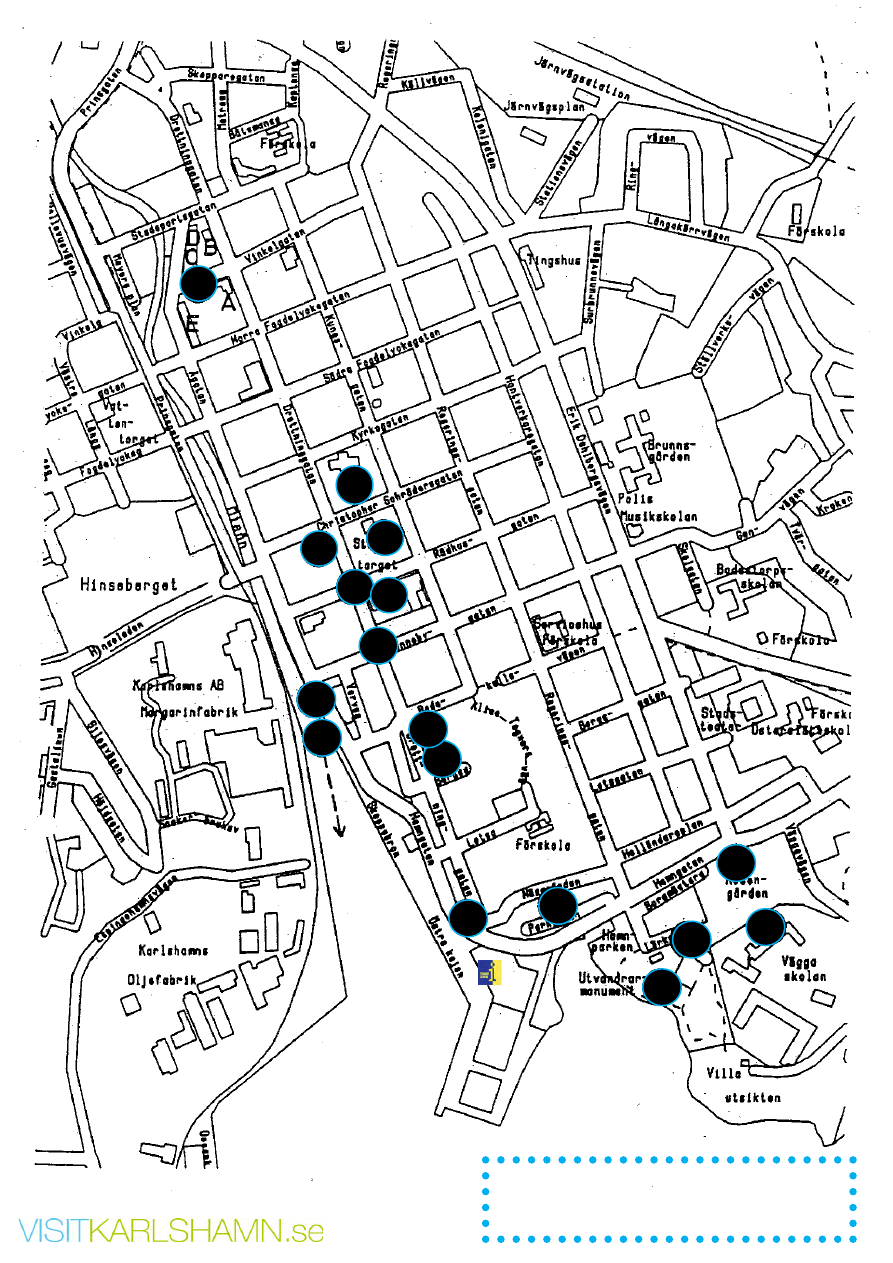
1. Town Hall (current)
1899-1900. Built in Dutch Renaissance style.
2. Asschierska Half-timbered house
The old ”Asschierska huset” from the 1600’s is a good
example of one of the old terrace houses. This was once
the town hall of Karlshamn. It is a beautiful half-timbered
house, just a stone’s throw from the church.
3. Böljelek
Fontaen sculpted by Conrad Carlman. Represents a mer-
maid who brings two ships from the waves. It has been at
its location since December 1936.
4. Carl Gustafs church
Karl Gustaf’s church is believed to have been designed
by the multi-talented Erik Dahlberg and pre-recorded
guided tours are available.
5. Culture Quarters
The historical buildings of Karlshamn are well preser-
ved and the Culture Quarters has some very interesting
attractions.
The Swedish punsch factory, the silver forge, the art gal-
lery, the printer’s workshop and the merchant houses.
One of Sweden’s finest antique trading houses is situated
at the Skottsbergska gården. The buildings are from the
1700’s and in the cellars you can see how business was
conducted 200 years ago.
The ground and first floor were used as accommodation
for the businessmen and the shops, storehouses and
stables are situated beside River Mieån which runs at the
bottom of the garden.
In the museum there are exhibits reflecting the fishing
and shipping industries as well as a section paying tri-
bute to the memory of Alice Tegnér. A building which is a
remarkable example of a house from the 1600’s is called
Holländarhuset.
The art gallery is situated in an old storehouse and there
is a permanent display of paintings from the 40’s.
6. Island Traffic and the guest harbour
Karlshamn’s old harbour is situated at the mouth of the
river Mieån and this explains why the street is called Åga-
tan (River street).
If you walk along the quay you come to the First Hotel
Carlshamn and the ferry terminal, here it is possible to
take boat trips.
From the harbour depart numerous fishing tours, those
destined for the Pukavik bay have become especially
popular.
7. The Citadel of Karlshamn
The citadel was built at Frisholmen in 1675, at about the
same time that Denmark declared war on Sweden. It
was used for 200 years although it wasn’t very effective
against artillery fire. There are many other well preserved
Citywalk in Karlshamn!
defence buildings in the area and some are 300 years old,
of special interest is the poisoned well.
In the summer the island’s flowers are magnificent, you
can take a boat trip out to the island. During the summer
there are daily boat departures for the Citadel.
8. Custom house
The custom house is located in the southern part of
Drottningatan and it is a well-preserved port warehouse
from the beginning of the 1800 century.
9.Utvandrarmonumentet - The emigrants’ monument
is located in the Hamnpark (the park in the harbour).
Wilhelm Moberg wrote about the Swedish emigration to
America in his novels and a large number of people left
Sweden via Karlshamn. Axel Olsson’s famous statue de-
picts the key characters, Karl-Oskar and Kristina, looking
out over the sea before starting their adventure.
10. Fiskestugan - Fishing cottage
In the park nearby one can visit the 300 year old fishing
cottage which is open to visitors during the summer. It
gives you a real insight into the lives of the fishing com-
munity in the 1600’s.
11. Rosengården - The Rosegarden
Here you can find a statue of ”Lilla Maja” in memorial of
Alice Tegnér.
12. Väggaskolan - The Vägga school
The Vägga schools buildings were designed by Gunnar
Asplund in two stages, the second stage was done 20
years after.
13. Näsgränden
A narrow street with many fine old houses.
14. The hotel of the emigrants’ ”Hoppet”
The wooden houses in Karlshamn are different to thoose
in other towns, the front door is positioned in the middle
and is framed by two large wooden pillars which are
painted in contrasting colours.
A good example of this type of house is ”The Hoppet
Hotel”, which was described in Wilhelm Moberg’s novel
“Utvandrarna” – “The Emigrants” another great example
is Alice Tegnér’s childhood home (see nr. 15) on the street
called Drottninggatan.
15. Drottninggatan 15
Alice Tegnér’s childhood home.
16. Drottninggatan-Ronnebygatan
Typical of 1874 years of building laws that pre-wrote slant
cut corners on the property to improve visibility at street
corners.
17. The market place
You are now back at the market place where this walk
started.
During the summer there are guided tours around the city. Monday
evenings only from the end of June until the mittle of August. Guided
tours can also be booked through the Tourist Office +46 (0) 454 812 17.
Price according to ”Guideförening- ens” rate.
5
4
3
2
17 1
16
6
7
15
14
8
13
9
10
11
12
Wyszukiwarka
Podobne podstrony:
Madera pieszo
Korsyka pieszo i rowerem
Leuven pieszo
Zimowy Turbacz na narty i pieszo
PLAN WYNIKOWY PIESZO I ROWEREM
na Kasprowy pieszo compressed
Mrożek, Pieszo streszczenie
Łambinowice gmina pieszo rowerowa
Zimowy Turbacz na narty i pieszo
więcej podobnych podstron