
ARAB-BYZANTINE WAR, 629-644 AD
A thesis presented to the Faculty of the U.S. Army
Command and General Staff College in partial
fulfillment of the requirements for the
degree
MASTER OF MILITARY ART AND SCIENCE
Military History
by
DAVID E. KUNSELMAN, LCDR , SC, USN
B.A., St. Mary’s College of Maryland, St. Mary’s City, MD,1995
Fort Leavenworth, Kansas
2007
Approved for public release; distribution is unlimited.

REPORT DOCUMENTATION PAGE
Form Approved
OMB No. 0704-0188
Public reporting burden for this collection of information is estimated to average 1 hour per response, including the time for reviewing instructions, searching existing data sources, gathering and maintaining the
data needed, and completing and reviewing this collection of information. Send comments regarding this burden estimate or any other aspect of this collection of information, including suggestions for reducing
this burden to Department of Defense, Washington Headquarters Services, Directorate for Information Operations and Reports (0704-0188), 1215 Jefferson Davis Highway, Suite 1204, Arlington, VA 22202-
4302. Respondents should be aware that notwithstanding any other provision of law, no person shall be subject to any penalty for failing to comply with a collection of information if it does not display a currently
valid OMB control number. PLEASE DO NOT RETURN YOUR FORM TO THE ABOVE ADDRESS.
1. REPORT DATE (DD-MM-YYYY)
14-12-2007
2. REPORT TYPE
Master’s Thesis
3. DATES COVERED (From - To)
FEB 2007 - DEC 2007
5a. CONTRACT NUMBER
5b. GRANT NUMBER
4. TITLE AND SUBTITLE
Arab-Byzantine War, 624 AD
5c. PROGRAM ELEMENT NUMBER
5d. PROJECT NUMBER
5e. TASK NUMBER
6. AUTHOR(S)
David E. Kunselman
LCDR, SC, USN
5f. WORK UNIT NUMBER
7. PERFORMING ORGANIZATION NAME(S) AND ADDRESS(ES)
U.S. Army Command and General Staff College
8. PERFORMING ORGANIZATION REPORT
NUMBER
ATTN: ATZL-SWD-GD
100 Stimson Ave.
Ft
.
Leavenworth, KS 66027-2301
9. SPONSORING / MONITORING AGENCY NAME(S) AND ADDRESS(ES)
10. SPONSOR/MONITOR’S ACRONYM(S)
11. SPONSOR/MONITOR’S REPORT
NUMBER(S)
12. DISTRIBUTION / AVAILABILITY STATEMENT
Approved for public release; distribution is unlimited.
13. SUPPLEMENTARY NOTES
14. ABSTRACT
Islam arose out of a cataclysmic change in society and economics in the Arabian Peninsula
during the early seventh century. The adherents of the new religion immediately launched a
campaign against the Byzantine Empire, the military, cultural and economic superpower of the
age. In the course of just a few years the Arabs had conquered the valuable territories of
modern day Palestine, Syria, Jordan and Lebanon from the Byzantines who in turn withdrew to
Anatolia after great losses. This was the first encounter between Islamic and Christian
people and the aftermath set the stage for the Islamic conquest of North Africa, the Crusades
and many other historical conflicts. The paper seeks to answer the question “Why did the
Byzantine Empire fail in the defense of these territories” by looking at diplomatic,
military, economic and social differences between the Arab and Byzantine sides. The research
is based on a variety of secondary sources and several translated primary sources. The
conclusion is that the Byzantines failed to recognize and address the great social changes
that were taking place in the contested region while the Arabs expertly exploited the dynamic
situation
15. SUBJECT TERMS
Byzantine Empire, Arab, Early Islam, Syria, Yarmuk, early Medieval warfare
16. SECURITY CLASSIFICATION OF:
17. LIMITATION
OF ABSTRACT
18. NUMBER
OF PAGES
19a. NAME OF RESPONSIBLE PERSON
a. REPORT
Unclassified
b. ABSTRACT
Unclassified
c. THIS PAGE
Unclassified
UU
111
19b. TELEPHONE NUMBER
(include area
code)
Standard Form 298 (Re . 8-98)
v
Prescribed by ANSI Std. Z39.18

ii
MASTER OF MILITARY ART AND SCIENCE
THESIS APPROVAL PAGE
Name of Candidate: David E. Kunselman
Thesis Title: Arab-Byzantine War
Approved by:
, Thesis Committee Chair
(Mr. Louis A. DiMarco, MA)
, Member
(Dr. Thomas M. Huber, Ph.D.)
, Member
(CDR Peter Callaghan, MS.)
Accepted this14th day of December 2007 by:
, Director, Graduate Degree Programs
Robert F. Baumann, Ph.D.
The opinions and conclusions expressed herein are those of the student author and do not
necessarily represent the views of the U.S. Army Command and General Staff College or
any other governmental agency. (References to this study should include the foregoing
statement.)

CERTIFICATION FOR MMAS DISTRIBUTION STATEMENT
1. Certification Date: 14 December 2007
2. Thesis Author: David E. Kunselman, LCDR, SC, USN
3. Thesis Title: Arab-Byzantine War 629-644 AD
4. Thesis Committee Members:
Signatures:
5. Distribution Statement: See distribution statements A-X in ST 20-10 2007, p. B-8, then circle
appropriate distribution statement letter code below:
A B C D E F X
If your thesis does not fit into any of the above categories or is classified, you must coordinate
with the classified section at CARL.
6. Justification: Justification is required for any distribution other than described in Distribution
Statement A. All or part of a thesis may justify distribution limitation. See limitation justification
statements 1-10 on reverse, then list, below, the statement(s) that applies (apply) to your thesis
and corresponding chapters/sections and pages. Follow sample format shown below:
EXAMPLE
Limitation Justification Statement /
Chapter/Section / Page(s)
Direct Military Support (10)
/
Chapter 3
/
12
Critical Technology (3)
/
Section 4
/
31
Administrative Operational Use (7)
/
Chapter 2
/
13-32
Fill in limitation justification for your thesis below:
Limitation Justification Statement /
Chapter/Section /
Page(s)
/
/
/
/
/
/
/
/
/
/
7. MMAS Thesis Author's Signature:
iii

iv
STATEMENT A: Approved for public release; distribution is unlimited. (Documents with this statement
may be made available or sold to the general public and foreign nationals).
STATEMENT B: Distribution authorized to US Government agencies only (insert reason and date ON
REVERSE OF THIS FORM). Currently used reasons for imposing this statement include the following:
1. Foreign Government Information. Protection of foreign information.
2. Proprietary Information. Protection of proprietary information not owned by the US
Government.
3. Critical Technology. Protection and control of critical technology including technical data with
potential military application.
4. Test and Evaluation. Protection of test and evaluation of commercial production or military
hardware.
5. Contractor Performance Evaluation. Protection of information involving contractor performance
evaluation.
6. Premature Dissemination. Protection of information involving systems or hardware from
premature dissemination.
7. Administrative/Operational Use. Protection of information restricted to official use or for
administrative or operational purposes.
8. Software Documentation. Protection of software documentation - release only in accordance
with the provisions of DoD Instruction 7930.2.
9. Specific Authority. Protection of information required by a specific authority.
10. Direct Military Support. To protect export-controlled technical data of such military
significance that release for purposes other than direct support of DoD-approved activities may jeopardize a
US military advantage.
STATEMENT C: Distribution authorized to US Government agencies and their contractors: (REASON
AND DATE). Currently most used reasons are 1, 3, 7, 8, and 9 above.
STATEMENT D: Distribution authorized to DoD and US DoD contractors only; (REASON AND DATE).
Currently most reasons are 1, 3, 7, 8, and 9 above.
STATEMENT E: Distribution authorized to DoD only; (REASON AND DATE). Currently most used
reasons are 1, 2, 3, 4, 5, 6, 7, 8, 9, and 10.
STATEMENT F: Further dissemination only as directed by (controlling DoD office and date), or higher
DoD authority. Used when the DoD originator determines that information is subject to special
dissemination limitation specified by paragraph 4-505, DoD 5200.1-R.
STATEMENT X: Distribution authorized to US Government agencies and private individuals of
enterprises eligible to obtain export-controlled technical data in accordance with DoD Directive 5230.25;
(date). Controlling DoD office is (insert).

v
ABSTRACT
ARAB-BYZANTINE WAR 629-644 AD, by LCDR David Kunselman, 111 pages.
Islam arose out of a cataclysmic change in society and economics in the Arabian
Peninsula during the early seventh century. The adherents of the new religion
immediately launched a campaign against the Byzantine Empire, the military, cultural
and economic superpower of the age. In the course of just a few years the Arabs had
conquered the valuable territories of modern day Palestine, Syria, Jordan and Lebanon
from the Byzantines who in turn withdrew to Anatolia after great losses. This was the
first encounter between Islamic and Christian people and the aftermath set the stage for
the Islamic conquest of North Africa, the Crusades and many other historical conflicts.
The paper seeks to answer the question “Why did the Byzantine Empire fail in the
defense of these territories” by looking at diplomatic, military, economic and social
differences between the Arab and Byzantine sides. The research is based on a variety of
secondary sources and several translated primary sources. The conclusion is that the
Byzantines failed to recognize and address the great social changes that were taking place
in the contested region while the Arabs expertly exploited the dynamic situation.

vi
ACKNOWLEDGMENTS
This thesis would never have been possible without the moral support and late
night editing from my lovely wife, Molly Kunselman. Additionally, I owe thanks to
Betsy Moss and Filiberto Bracalante for inspiration, whether intentional or not on their
part.

vii
TABLE OF CONTENTS
Page
MASTER OF MILITARY ART AND SCIENCE THESIS APPROVAL PAGE ............. ii
CERTIFICATION FOR MMAS DISTRIBUTION STATEMENT ................................. iii
The Letter ........................................................................................................................ 1
Questions ........................................................................................................................ 2
Focus and Limitations ..................................................................................................... 3
Battle of Uhud ................................................................................................................. 6
Geography ....................................................................................................................... 9
Pre-Islamic Culture ....................................................................................................... 10
Tribalism ................................................................................................................... 10
Towns ........................................................................................................................ 12
Poetry ........................................................................................................................ 14
Religion ..................................................................................................................... 14
Government ............................................................................................................... 15
Trade routes .............................................................................................................. 17
Frankincense ............................................................................................................. 18
Demography .................................................................................................................. 20
Formation of Islam ........................................................................................................ 21
Moral decay of Arabs ................................................................................................ 22
Retreat from Mecca ................................................................................................... 23
Caliphate ................................................................................................................... 24

viii
Roman Rule .................................................................................................................. 29
Geography ..................................................................................................................... 30
Demography .................................................................................................................. 32
Culture .......................................................................................................................... 33
Roman ....................................................................................................................... 33
Art ............................................................................................................................. 33
Cities ......................................................................................................................... 34
Economics ..................................................................................................................... 35
Government .................................................................................................................. 38
Religion ......................................................................................................................... 42
Diplomacy ..................................................................................................................... 45
The Crisis in Syria ........................................................................................................ 47
Equipment ................................................................................................................. 53
Infantry ...................................................................................................................... 54
Cavalry ...................................................................................................................... 55
Motivation ................................................................................................................. 55
Doctrine ..................................................................................................................... 56
Tactics ....................................................................................................................... 57
Navy .......................................................................................................................... 59
Army ......................................................................................................................... 60
Themata..................................................................................................................60
Infantry ...................................................................................................................61
Cavalry ...................................................................................................................62
Siege equipment ........................................................................................................ 63
Doctrine ..................................................................................................................... 64
Persia ......................................................................................................................... 66
Dathin ........................................................................................................................ 67
Yarmuk ..................................................................................................................... 69
The cities ................................................................................................................... 73
Taurus Mountains ..................................................................................................... 74
Stalemate ....................................................................................................................... 82
Failure in Syria .............................................................................................................. 82
Religious Fervor ........................................................................................................... 83
Battlefield Prowess ....................................................................................................... 84
Subterfuge and Betrayal ................................................................................................ 84
Military Genius ............................................................................................................. 85

ix
Economic Weakness ..................................................................................................... 86
Diplomatic Blunders ..................................................................................................... 87
Social Change ............................................................................................................... 88
“Shadowing War” ......................................................................................................... 89
Echoes of 636 ................................................................................................................ 90

x
ILLUSTRATIONS
Page

1
CHAPTER 1
INTRODUCTION
The
Letter
In 629 AD, the prophet Mohammed sent letters to the Kings of Persia, Yemen and
Ethiopia and to Emperor Heraclius, inviting them to accept Islam. Mohammed stated,
“If you become a Muslim you will be safe, and God will double your reward, but if you
reject this invitation of Islam you will bear the sin of having misguided your subjects”.
It was an ultimatum, from an unknown holy man beyond the fringe of civilization to the
most powerful rulers in the world.
Emperor Heraclius was the most powerful and successful ruler in the world. The
Byzantine Empire controlled nearly all the land touching the Mediterranean, and had for
nearly a century. Heraclius had defeated the only other significant power, the Persians,
on their own land and had personally appointed the current Persian ruler. Constantinople
and Alexandria were world-renowned centers of learning and art. Byzantine merchants
traded from India to France. The relics of the True Cross were safe under Byzantine
guard in Jerusalem. The seat of the Empire may have moved from Rome to
Constantinople, the imperial language changed from Latin to Greek, but the empire of the
Caesars was still great.
By 644 all this had changed. The mighty Byzantine war machine had been
devastated and imperial forces driven from Egypt, Syria and Mesopotamia by a small
army of desert barbarians. The book industry in Alexandria was destroyed. The True
Cross was in the hands of non-believers. The Muslims were building a new capital in

2
Damascus and a new temple in Jerusalem while the Byzantines were fighting a last ditch
guerilla war in their Anatolian homelands.
Questions
Why did the Byzantine defense fail? The obvious reasons do not seem to apply.
The Byzantine Empire repelled the initial incursion by the Muslims in 629, so they can
hardly have been surprised when the Arabs returned in 633. The Empire was at peace
with all of its other neighbors. The Byzantine military was large and battle-hardened
after a victorious 30-year war with the Persians, so lack of military acumen was not a
factor. The Empire was the economic and political center of the world, able to call on
allies and resources unmatched by any other country at the time. The campaign was
fought on a relatively narrow front for the Empire; the Muslim forces could not bypass
Byzantine forces in Syria or attack them from another direction. Heraclius himself, the
most successful general in the western world, led the Byzantine armies
. There is no
obvious reason why the Empire should not have been able to repel the Arabs.
Additionally, the Muslims appear to have been at a great disadvantage. The
Muslim armies were simultaneously at war with the Sassanid Persian Empire and
Byzantine Empire, fighting on two widely separated fronts
. The armies of both the
Byzantine and Sassanid empires greatly outnumbered the total Muslim forces. The Arab
army did not have a military tradition, nor experience in large-scale warfare. The
leadership of the Muslim forces changed frequently as Mohammed died in 632 and was
replaced by Caliph Abu Bakr who then died in 634 and was succeeded by Caliph Omar.
The Arab homeland in Mecca was not a resource rich territory, and with Mohammed’s
audacious letter to the neighboring leaders it is unlikely they were developing much in

3
the way of trade or alliances. The Arabs had no major technological advantage; both
sides used similar weaponry and armor. There is no obvious reason that Arabs should
have had any advantage against an enemy, especially one so formidable as the Byzantine
Empire.
Despite these seemingly unfavorable odds, the Arabs won. The Byzantine forces
lost every significant battle, and had an entire army annihilated by an inferior force at
Yarmuk. Cities that had withstood years in the face of advanced Persian siege-craft fell
quickly before the Arabs. The Muslim conquests would have effects that outlasted both
the Caliphate and the Byzantine Empire; the Middle East would remain dominated by
Islam to the present.
It is the intent of this thesis to answer this question: Why did the Byzantines fail
in the defense of these lands? What strategic, geographic, demographic and cultural
factors contributed to Arab power during the invasion? What strategic, geographic,
demographic and cultural factors diminished Byzantine power during the defense? Why
did the field armies of Byzantium perform so poorly against the Arabs? Why did the
cities of Syria and Palestine capitulate? What tactics and techniques were developed or
used by each side during the campaign? How did these affect the outcome? Were there
technological, societal, organizational, logistical or intelligence differences, which aided
the Arabs or hindered the Byzantines?
Focus and Limitations
This thesis focuses on the reigns of Caliph Abu Bekr (632-634) and Caliph Omar
(634-644). Only actions and conditions in the area between the Taurus Mountains and

4
Arabian Peninsula will be considered, except if events outside the region have a major
strategic implication to the campaign. This area includes the modern day countries of
Palestine, Jordan, Lebanon, Israel, western Iraq and Syria; but will be referred to
generally as Syria in this paper and the people of these areas as Syrians. The historical,
cultural, economic and military backgrounds of both the Byzantines and the Arabs will be
examined. For the purposes of this paper, the Byzantines are considered to be the
government and any subjects of the Empire, which includes most Syrian people. The
term Arabs is used to refer to the people of the Arabian Peninsula who have a common
linguistic and ethnic heritage, while the term Muslim refers to adherents of the Islamic
religion; though during the conflict these two groups are the same.
All sources used in researching this topic were either written in English or
translated into English. Translated sections from Arab in the Koran and Haditha, both of
which are religious texts were reviewed for relevance. The paper includes sections
translated from Greek and Latin of Maurice’s Strategikon and other Byzantine military
manuals. More unusual primary sources were studied, including sermons, icons,
mosaics, architecture and archeological findings when they seemed appropriate to the
cultural or military context.
There are numerous secondary sources from the Muslim point of view, ranging
from histories written by scholars a couple of centuries after the events to detailed
campaign analysis by modern military commanders. The Byzantine side is less rich, with
older sources skirting around the disastrous campaign and modern sources being mainly
focused on setting the stage for the Crusades three centuries later or on much later
periods. Both have advantages and drawbacks, but the volume on both sides is adequate

5
to develop a balanced understanding of the people, nations and armies involved in this
conflict.
The study of the earliest conflict between Muslims and a Western civilization has
cultural implications, which continue to impact us today. It was during this campaign
that Jerusalem became a contentious issue between Christian and Islamic people. The
failure of the Byzantine Empire to stop the Muslim invasion gave the Arabs a fertile and
resource rich base to launch a campaign of conquest that would turn North Africa away
from Christianity, subjugate Spain for centuries and only be stopped in the fields of
Tours. The Arab conquests would introduce new spices, the astrolabe, lateen sails,
algebra and a new number system to the West. On the other hand, the Crusades, Barbary
piracy, the current religious strife in Palestine and Lebanon, and even our Global War on
Terror have roots which can be traced back to 7
th
century when a prophet from the desert
declared war on the most powerful empire in Christendom.
1
Dr. Majid Ali Khan, Muhammad The Final Messenger (New Delhi: Islamic
Book Service), 75.
2
Walter Kaegi, Byzantium and the Early Islamic Conquest (Cambridge:
Cambridge University Press), 65
3
Ibid., 67.

6
CHAPTER 2
THE ARABS
Battle of Uhud
In late March 624 AD, 3000 men of the Querish tribe formed an army and headed
north from the small market town of Mecca to crush the forces of the tribal exiles once
and for all. The exiles immediately responded by sending their best 1000 warriors
southward to intercept the Querish before they reached the city. The two armies met at a
volcanic ridge near the desert called Uhud.
The leader of the exiles arranged his forces across a chokepoint below the ridge,
in order to limit the numerical advantage of his enemy by denying his flanks. He filed
the infantry into a small valley, his cavalry on the gently sloping ridge to their right and
placed his archers to anchor the line on the left from the top of a steep hill. The Querish
aligned in the open plain with their infantry in the center and cavalry on both flanks.
Both sides had their women to the rear to provide medical and moral support to the
warriors.
The Querish infantry surged forward, but were brutally mauled and their leader
killed in the assault. The exiles launched a quick cavalry charge on the right, shattering
the line. The Querish fell back in shock. The retreat turned rapidly to a route as the
exiles pursued them mercilessly. The armies were quickly in the Querish camp and the
exile infantry began looting while the cavalry mopped up fleeing soldiers to hold for
ransom.
The young commander of the Querish cavalry had managed to keep his forces in
check throughout the melee and now saw his opportunity. He coordinated a two-

7
pronged charge at the exile archers still on the hill and annihilated them. He then turned
his force against the cavalry, which he promptly swept from the field. His attention
returned to the looting infantry, which he drove into a defile against the ridge and
slaughtered like cattle.

DUE TO COPYRIGHT RESTRICTIONS,
IMAGES ARE NOT INCLUDED
IN THIS ELECTRONIC EDITION.
Figure 1. Battle of Uhud
Source: Glubb, John. The Great Arab Conquests. Englewood Cliffs, NJ: Prentice Hall.
1963.
8

9
By the end of the afternoon, the commander of the exiles was backed into a
narrow crevice in the ridge, which was the only avenue for escape. He and fourteen
companions were all that was left of his mighty army. The Querish held the field and the
young commander of the cavalry decided it was not worth the lives of his men to pursue
the exiles up such an easily defended route against an enemy so willing to sacrifice
himself despite the odds. The few remaining exiles escaped when night fell.
The Battle of Uhud was insignificant on the world stage at the time. It was fought
between two tribes in the great Arabian Desert, an area far from the centers of the great
civilizations. It is, however, very instructive about what followed. It showed a tactical
sophistication, which few believed these people possessed. The ferocity of combat and
the tenaciousness of the exile forces would soon be widely respected. The desert culture
of these armies would spread like wildfire. Their poetry would be sung on three
continents, their language would become the language of trade and learning. The Querish
cavalry leader, Khalid al-Waleed, would defeat the two greatest empires of the day and
earn the moniker “Sword of Allah”. The leader of the exiles, Mohammed, would become
the founder of one of the greatest empires in the world and the founder of one of the
world’s great religions, Islam. This tremendous accomplishment only leads to questions:
where did these people come from, what were they like, how did they become such
powerful conquerors?
Geography
Geography played a significant role in the growth of Arab culture and in
influencing their interaction with other people. The Arabian subcontinent or “Island of
the Arabs”
is a peninsula of about a million square miles, making it roughly the size of

10
Texas. It is bracketed by the Red Sea on the West, Persian Gulf in the Northeast, and
Indian Ocean on the South and East. There are natural harbors on each body of water.
Near the northeast corner is the swampy delta of the Tigris and Euphrates rivers (see
figure 2).
It is also ringed on three sides by mountains: to the North called the Hijaz are
steep and tall; a range which spurs in toward Medina, Jabal Shammar is low and rugged
and the South-western side of the peninsula is framed by high ridges called Jabal Nabi
and Shu’ayb.
In the center of this frame of mountains and water is the Arabian Desert. There is
little rain and only a few wadis crossing the bleak expanses. There are scattered life-
supporting oasisses except in the “Empty Quarter” in the South, which is devoid of most
everything but endless dunes. Only the far southern edge of the peninsula receives
enough rainfall to support agriculture above a subsistence level. This geography isolated
the people of Arabia and caused them to develop a unique culture adapted to the bleak
landscape.
Pre-Islamic
Culture
Tribalism
The Bedouin or nomadic people of Arabia were a wildly independent and insular
people, largely due to the austere environment of the peninsula. They lived in small
family groups and most had to relocate frequently to ensure adequate food and water was
available throughout the year. This led to the development of a tribal culture, built on
family ties. Tribalism was the most important feature in all parts of Arab life. It was the
most important feature of their system of government. Tribalism affected the way they

11
conducted warfare. The tribe was even the basis of Arab morality and religion.
In theory, all members of a tribe had the same rights and privileges. In practice
there was a strong tradition of old patriarchs making the important decisions for the tribe
and these positions of honor were usually hereditary within one family of the tribe. In the
hard life of the desert people did not always survive to take on their hereditary roles, so
an accurate knowledge of ancestry was imperative to minimize power struggles within
the tribe and “genealogies preserved by and reported from tribes”
were maintained in
great detail. Tribal leaders had no rights to govern, but much influence and many
responsibilities. Leader’s influence was generally personal in nature, with the majority of
the tribe supporting wise and charismatic men. Their responsibilities included
preparedness “in war to be ready to sacrifice their lives and in peace their possessions on
behalf of fellow tribesmen”
.
Despite the generous example expected from tribal leaders on behalf of members,
the tribes themselves tended to be jealous of the scarce resources in the deserts,
particularly water and grazing lands. It was a matter of tribal survival to maintain access
to adequate resources to support the population of the tribe. It was common knowledge
that “anyone venturing into the territory of a strange tribe does so at the risk of being
killed and robbed by these strangers”
.
The combination of natural dangers and the dangers posed by other tribes,
resulted in an extremely close relationship between families within a tribe. The members
of ones tribe would normally be the only friends, potential mates or allies one would ever
know. Members of a tribe will stand by ”his brother in distress and may not ask if he is
right or wrong”
. Loyalty to the tribe was a moral imperative surpassing religion, law or

12
ld.
even personal survival.
This extreme form of loyalty to the tribe had innumerable effects on Arabian
culture, but perhaps the most important was the bellicose nature of the interaction
between tribes. Specifically, “a person’s life, honor and goods were protected by his
relatives, who were obliged to assist him in trouble and to avenge or seek compensation
for him if he was wronged…therefore all adult men had to be able to fight”
. All men
were warriors, and all would support any member of their tribe against any outsider. The
honor of the person, clan or tribe was jealously guarded even when water or grazing land
was not immediately at stake. An infraction on the honor of another clan would lead to a
blood feud or possibly all out war.
The code of honor was another prevalent aspect of Arab culture. It was even
noted by 5
th
century Roman historian Herodotus who stated “There are no men who
respect pledges more than the Arabs”
. The honor system was especially powerful in the
Bedouin or nomadic tribes, but was characteristic of the whole culture. Their “high sense
of honor which determines all the actions of the Bedouin is the basis of his morality”
and led the Arabs to become some of the most trusted merchants in the ancient wor
Towns
The nomadic Bedouin were the cultural heart of the Arab people, but their
lifestyle was not the only one present in Arabia. In general, the desert did not provide all
the resources needed to support the life of the Bedouin tribes. They needed grains in
droughts, tools for hunting and materials to repair tents and clothing. There were
merchants and farmers who filled these needs. These non-nomadic Arabs needed bases
to live and work from. They needed towns.

13
The towns in Arabia developed differently than the nomadic tribes but took on
many of the Bedouin characteristics. Major towns in the interior were essentially
Bedouin in character, with local religions, few resources and dominated by a single
powerful tribe. Towns in the southern and northern fringes would have some Arab
features but be influenced by non-Arab civilizations, including Greeks, Romans, Persians
and Egyptians. In general, the towns reflected the austere nature of the environment.
Houses “consisted of an inner room and an outer courtyard, many identical houses next to
each other”
and rooms were limited in size by the timber available for the roof, to about
five by seven meters.
In the towns, the major tribal affiliations still held, but the Bedouin honor system
was “softened a little by common interest in the holy artifacts and trade”
permitting a
less violent interaction between tribes than was typical in the desert. The stratified
economies of farmers, merchants and Bedouins in the towns involved more complex
relationships between clans and differentiated clans by wealth. While the need for
economic relationships dampened the tribal hostilities to a certain extent, the closer
interaction and stratification could lead to even more brutal blood feuds between the
clans when one started. For example, in Mecca at the time of Mohammed, “hardly
anyone could leave his fortified grounds without risk”
due to the relentless blood feuds.
The wars and feuds would be put on hold for large festivals and markets
associated with religious ceremonies. These “truce” days allowed interchange of ideas,
poetic expression
and trade between tribes whether hostile or friendly. Towns in the
South or on major trade routes would benefit from a large influx of outside traders at
these times as well.

14
Poetry
The only significant form of art practiced throughout Arabia prior to Islam was
poetry. The majority of Arabs were illiterate and poetry was the only manner of passing
knowledge from one generation to the next or from one tribe to the next. In short, “Arabs
owed their awareness of constituting a people, in spite of all tribal contradictions,
principally to their most important common spiritual possession, their poetry.”
Poetry
was spoken in an Arabic that transcended tribal dialects and brought people together.
The best poets were prized members of any tribe, providing entertainment, preserving
knowledge and even gaining battlefield advantage by cursing the enemy.
Poets also
enhanced and spread religious practice among the tribes.
Religion
The original religious beliefs of the Arabs are a bit murky, but most scholars
believe they were primitive, with an emphasis on the natural surroundings and the spirits
who were believed to rule those surroundings. Simply stated, “up until about the fourth
century AD almost all the inhabitants of Arabia were polytheists”
. They were largely
open-minded and each tribe had its own gods, but people understood and respected the
power of other gods.
In fact, it was an Arab saying that “When you enter a village,
swear by its god.”
This polytheism was often manifested by worshiping at a well or an unusual
stone. The “Ka’bah” a large black stone at Mecca was venerated widely in the interior,
but other “god stones” also existed as centers of worship in other cities. Frequently these
stones were used as sacrificial alters with goats, camels, gold and frankincense being the
most common sacrifices. Particularly bad times or unusually brutal tribes may have

15
caused more extreme sacrifices, as third century philosopher Porphyry notes, “the
inhabitants of Duma in Arabia used each year to sacrifice a boy.”
The enormous trade and military interchange with the Romans led to more spill
over of Roman religion into the Arabian culture. Some gods became popular across the
Peninsula. Two goddesses, a sort of Fate and Mother Earth, were popular in the
civilizations in South Arabia. Allah, a sort of “father of gods” similar to Saturn, became
popular in the interior during Roman times (100 BC-300 AD).
Christian monasteries were established in Arabia as early as 340 AD, setting the
stage for increased religious influence.
This continued to the point that “in the fourth
to sixth centuries Christianity made major inroads into Arabia.”
Throughout the late
Roman times, the growth of Jewish and Christian influence in Arabia accelerated the
popularity of Allah as a similar monotheistic god. By the end of the sixth century AD,
Allah continuing to grow in importance had replaced the moon-god Hubal as the god
associated with the Ka’bah.
This contrast of foreign influences and Bedouin culture,
along with geographic isolation, led to a uniquely Arab evolution in religion, further
contributing to their sense of being a group apart, an independent people separate from
the great powers of their time.
Government
The Arabian Peninsula was a crossroads of empires. Rome, Persia, Abyssinia
and both the Byzantine Empire and Sassinid Persia tried to influence Northern Arabs to
control Arabia in general. Despite this, Arabia had maintained its long independence.
The only invasion of the interior of the Arabian Peninsula was in 24 BC by Aelius
Gallus when he attempted to seize the incense lands in South Arabia for Rome. His

16
legions were “ravaged by thirst and hunger, betrayed by local guides, the Romans
despaired and limped back to Egypt.”
In the end, the Arabs were “able to escape from
political influence of the Roman Empire” just as they escaped all other would be
conquerors.
Even without outside conquerors, the Bedouin culture that maintained them as an
independent people prevented them from expanding themselves. Their “kingdoms, based
on powerful aristocratic families, prevented the emergence of any strong central
power.”
The Kings of merchant cities Petra, Gerrha, Palmyra, Mecca, Medina, Qana,
Marib capital of Saba (Sheba in the Bible) established local civilizations but none that
spanned the deserts or incorporated even the majority of Arab people.
The Sassanian
Empire dominated East Arabia (area including modern Kuwait and United Arab
Emirates) beginning in 230 AD, but apparently maintained control through client states
rather than by direct intervention and remained mainly on the coasts.
The Romans did
much the same, clinging to the coasts and using Arab clients, in northern Arabia. Thus,
Arabia always remained Arab.
Much of this autonomy was a result of geography, some a result of the ferocious
warrior spirit of the Arabs, but much of it was sustained by the fabulous wealth of the
South Arabian kingdoms and the Arab merchants who were able to use money, guile and
frankincense to play the great empires against each other for centuries.
Economy
The economy on the Arabian Peninsula was improbably successful considering
the nature of the terrain. The Arab merchants provided the link between the world of

17
Europe and the East. They supplied the most valuable commodities and transported
materials, people and ideas across some of the most forbidding landscapes in the world.
Trade routes
Arabia “occupies a central position between India, Africa, Mesopotamia and the
Mediterranean world, which meant that people or goods passing from one to the other
would be obliged to have dealings with them.”
The Arabs caravanned spices and
incense to Mesopotamia, Egypt and the Levant beginning as early as 783BC.
By the
first century AD they established a maritime link between Mediterranean, Arabia and
India. The first century Greek historian Strabo writes “as many as one hundred and
twenty vessels were sailing from the Egyptian coast to India.”
This burgeoning cross-cultural trade enabled the Arabs to become wealthy while
still maintaining their largely nomadic culture. They developed important towns along
the desert trade routes, and even cities in the maritime south, but the majority of the
Arabs continued to travel as Bedouin herders or powerful merchants. These merchants
traveled widely, from the capitals of the Roman and Persian Empires to the shores of the
Indian Ocean. They were familiar with numerous lands and were well aware of the great
events happening in the world.
The largest and most important trade route passed from Marib, the capital of the
southern Arabian kingdom of Saba (or Biblical Sheba) through the interior to Mecca and
ended at Petra in the Levant. The entire route was in the desert and protected from non-
Arabs by the terrain. “Mecca at this time was no sleepy hollow.”
In fact it was a busy,
powerful commercial town “almost monopolizing the entrepot trade between the Indian
Ocean and the Mediterranean.”
It was also the site of a large trade market, a holy site,

18
and was the home of the powerful Querish clan. Perhaps importantly, Mecca was the
halfway point on the Frankincense road.
Frankincense
Arabia has been blessed twice in history with inordinate wealth. In modern times
this wealth stems from the huge petroleum reserves in the sands of the peninsula. In
ancient times it was the combination of location and frankincense, which made the Arabs
wealthy.
Frankincense, a largely forgotten agricultural product made from the sap of the
Boswellia tree, was the most valuable commodity in the world for thousands of years. It
was worth many times its weight in gold and had a bewildering array of uses. Ancient
peoples from Assyrian through Roman times used it to consecrate temples, make
cosmetics, mask the odors of cremations, drive off mosquitoes and generally make life in
a world without sanitation more pleasant.
Frankincense seemed to be a boom commodity that would never go bust. In the
fifth century BC, Herodotus stated, “Arabia is the most distant to the south of all
inhabited countries and this is the only country which yields frankincense
. Pliny the
Elder (first century Roman naturalist and military commander) wrote centuries later
about the processing plants that “no vigilance is sufficient to guard the factories, before
the workers are allowed to leave the premises they have to take off all their clothes” to
prevent the theft of frankincense.
At time of Christ “more than 3000 tons of
Frankincense may have been exported annually.”
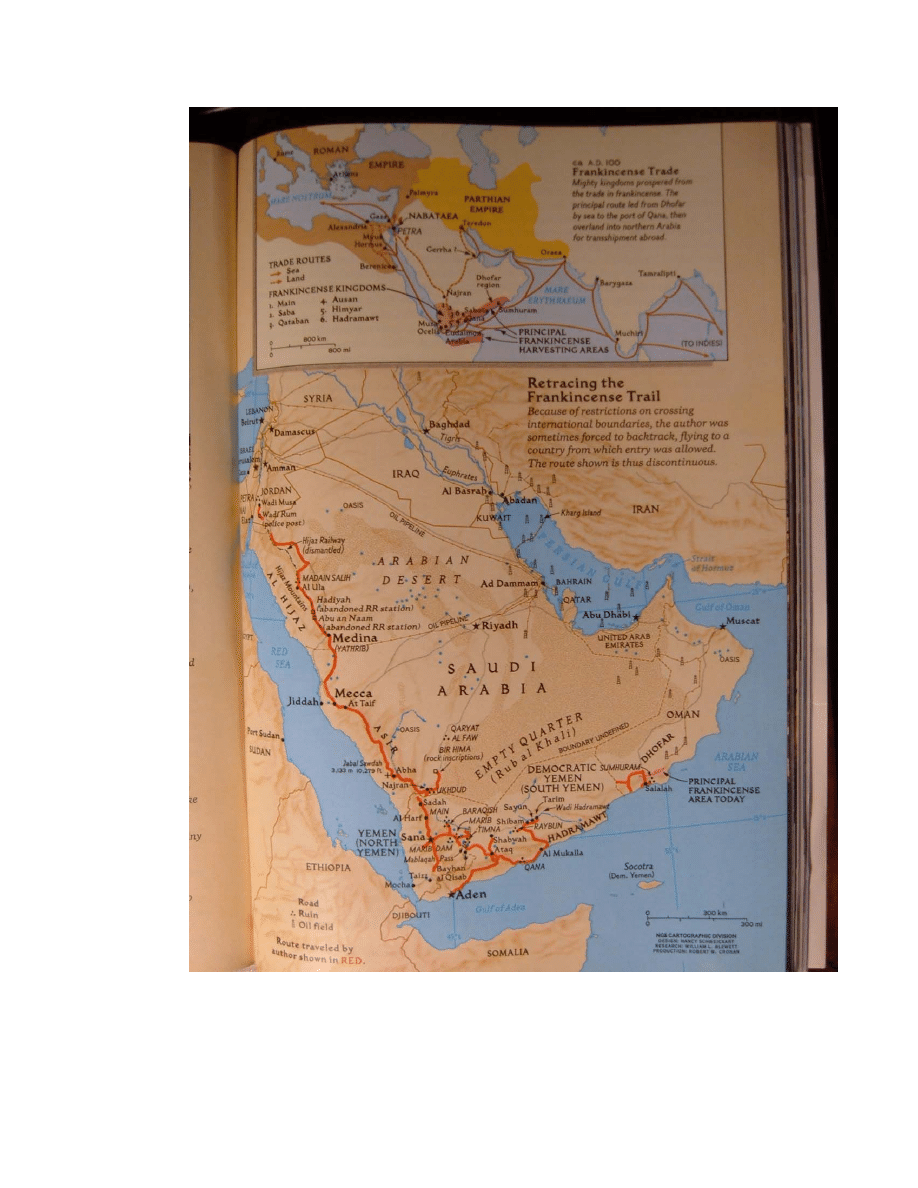
Figure 2. Frankincense Trade
Source: National Geographic, “Arabia’s Frankincense Trail”, October, 1985. 485.
19

20
This staggering wealth only moved to the huge civilizations of Europe and Persia
across the Arabian deserts in the caravans of Arabian merchants. This passage was “a
rugged journey of some 80 marches” on camel or foot across the merciless Arabian
Desert.
The Arabs carefully controlled the production sites and caravan routes. The
merchant towns in the interior and the kingdoms in the South “developed a powerful
cartel, a kind of OPEC of its time” to ensure the safety of their valuable cargo and it’s
sources.
The Biblical kingdom of Sheba and the famous merchant cities of Petra and
Mecca were built on wealth of the frankincense trade: all of Arabia profited. “The
existence in south Arabia of frankincense, myrrh and other aromatics – all much in
demand in the civilizations of the Mediterranean and Mesopotamia – brought wealth and
renown to it’s Arabian cultivators and expeditors.”
However, the trade of frankincense took a downturn in the late Roman period.
First, Christianity spread across the empire like wild fire in the third century AD.
“Christians wished to distance themselves from pagan and Jewish practices”
leading to
a decrease in demand for frankincense and a mounting recession in Arabia. In the fourth
century, “Romans banned pagan practices” including the use of frankincense.
The
rapidly declining economic situation in Arabia was exacerbated when the dam of Marib
which had served all of the South Arabian kingdoms broke and irrigation became
impossible in 6
th
century AD.
This mounting economic crisis combined with
agricultural disaster led to the movement of nearly the entire population of South Arabia
northward in search of a new life during the second half of the sixth century.
Demography
Up until the third century AD, the majority of Arabs still lived in the Arabian

21
Peninsula. Large numbers lived in the desert interior as nomads, more lived on the trade
routes and fringes as merchants and a third large group lived in the south irrigating fields,
receiving ships from India and harvesting frankincense. By the end of the fourth century
the demographics changed dramatically. The major Arab governments in the south and
west were collapsing with the frankincense market. The dam of Marib was breached
flooding many croplands, destroying towns and making irrigation impossible in the
south. People moved to the other areas of the Peninsula and Syria in order to survive.
By the beginning of the sixth century AD, Arabs were living in Syria and
Mesopotamia under Byzantine rule, in Iran under Sassinid Persian rule and in small
numbers across the Peninsula.
In effect, the Arabs of the south had braved the deserts
and hostile tribes of the interior to move to the areas on the northern edge of Arabia.
The trials and conflicts these people experience while spreading northward
became a sort of national epic akin to Moses’ exodus from Egypt.
The environmental,
tribal and economic adversity they faced was unprecedented, yet they survived. A
national identity was built, a common language and alphabet flourished. This movement
cemented the cultural unity of Arabia while the encroachment into the lands controlled by
the Sassinid and Byzantine empires further accelerated the emerging unification of the
Arab people.
Formation of Islam
Shocked by the rapid collapse of the economy that had sustained their cities and
wandering tribes, the Arabs fell into a cultural morass that made them even more
despondent. Their agriculture could no longer support the population. Their neighbors
were huge monotheistic and urban empires, which considered the Arabs as both

22
uncultured and heretical. The trade with India continued, but was in no way
compensation for the collapse of the frankincense market. The people starved in the
Peninsula and their culture was suppressed while their labors were taxed in the Sassinid
and Byzantine Empires. This led to a deepening dissatisfaction and eventually a
revolutionary change in the Arab people.
Moral decay of Arabs
The Arabs in the late sixth and early seventh century were listless and lost people.
They were no longer the wealthy powerful merchants they had been, but they still
retained their fierce tribal loyalties.
The Arabs of this time blamed failures in their morality for the collapse of the
economy and the south Arabian kingdoms. They had “familiar evils of a wealthy
commercial society, extremes of wealth and poverty, an underworld of slaves and
hirelings, social class barriers”
. The Arabs themselves were aware of these failings, as
the early Muslim historian Ibn Hisham (ninth century) reports, “previously we were a
barbarous people who worshipped idols, ate carrion and committed shameful deeds.”
This moral collapse led to a fervor for a new religious foundation among Arabs.
Many in the northern areas accepted the Byzantine orthodox Christianity, while many in
Persia became Zoroastrians. In the interior, many charismatic leaders claimed divine
inspiration and established new cults based on old pagan religions. The greatest new
religious force was started in Mecca by a middle-aged merchant of the Querish tribe
named Mohammed.
Mohammed was born into a noble family in Mecca but was orphaned at a young
age, to be raised by his grandfather in a Bedouin tribe until he was a teenager. He

23
returned to Mecca and quickly became an important merchant captain. He started
working for a twice-widowed woman with a large fortune who was ten years his senior.
He soon married her, which elevated him to a position of wealth and leisure.
Mohammed developed terrible headaches during his fortieth year, which led him
to seek respite in the desert mountains near Mecca. While visiting the mountains, he
claims to have had revelations from Allah about the correct way to live and the proper
observance of religion. These prophecies were revealed in a typically Arab format,
beautiful poetry. He collected the poems in a book thereafter called the Koran.
Mohammed began teaching his new religion in Mecca and immediately had
several converts. The first was his wife, but she was quickly followed by his father-in-
law Abu Bakr, his friend and cousin Omar and his son-in-law Ali. The new religion was
apparently popular among marginalized groups and the poor but disliked by the leaders
of the Querish tribe. As Mohammed became more influential he started to denounce the
idolatry and pagan rituals still dominating Mecca. In response, the Querish began
persecuting new converts and even attempted to assassinate Mohammed.
Retreat from Mecca
In response to the persecution by the Querish, the new Muslims were either exiled
or fled from Mecca. They accepted an invitation from the elders to come to a city about
250 miles north of Mecca on the old trade routes: Medina. This flight to Medina is
known as the Hijra.
Mohammed spent the next eight years in Medina. During this time, he
consolidated his hold on the faithful and developed the formal doctrine that would
become the basis for the new Arab religion of Islam. It seems that the majority of the

24
people of Medina accepted the new religion rapidly. They formed pure a community of
believers, converting or driving out Jews, pagans and Christians from the city. With
power consolidated in Medina, Mohammed conducted a series of wars against Mecca
which would eventually result in the conversion of most the Querish to Islam and the
surrender of the city and the holy Ka’bah in 630 AD. Interestingly, this victory was
achieved despite the total destruction of the army of Medina in the Battle of Uhud
described in the introduction to this chapter. The Muslims lost several battles, but their
perseverance and courage was so inspiring that it caused many of the Querish to convert
after witnessing the power of the new faith.
Caliphate
Mohammed died two years after the capture of Mecca leaving the newly founded
Muslim empire in a predicament.
Abu Bakr, the first male convert to Islam, was
elected as the “leader of the faithful” or caliph when Omar, the second male convert and
a brilliant politician, added his support to Abu Bekr's claim.
During this crisis of leadership several allied Arab tribes initiated wars against the
Muslims. Abu Bakr sent armies against each of them and put the newly converted Khalid
in charge of an elite force that moved rapidly from one campaign to another to add
decisive power and leadership against each enemy tribe. The strategy was incredibly
successful, Khalid subjugated the entire Arabian Peninsula in a matter of weeks. The
first caliph built the first Arab empire in history.
Religion/State
This new empire was a theocratic state run by an overtly political religion.

25
Mohammed was a ruler, warrior and prophet ever since the time of the Hijra and the Abu
Bekr was his successor as ruler, warrior and leader of the church. The state and church
were one and the same. The Muslim armies fought with a courage inspired both by the
ancient tribal honor system and by a new faith promising to its adherents that “they will
be served with a goblet at a gushing fountain...and shall sit with bashful, dark-eyed
virgins” forever if they died in service of Allah.
The resources of all the tribes were
applied to the religious goals of spreading the realm of Islam, while the religion was
carefully crafted as a political tool to incorporate new people into the society of the
Arabs.
This Caliphate erupted onto the international scene in late 632 AD with a surprise
military excursion into both Persia and Syria. Both the Sassanians and Byzantines were
utterly confounded by this new force arriving on their southern borders. Both empires
dispatched armies of allied auxiliaries to deal with the threat, only to have those armies
annihilated by numerically inferior Muslim forces.
It was the first taste of a new type
of war. A political war waged for religious reasons by a passionate and determined group
of military evangelicals. It was called Jihad.
1
Carl Brockelmann, , Moshe Perlmann, and Joel Carmichael, History of the
Islamic Peoples (New York: Capricorn Books, 1960), p 1.
2
Robert G. Hoyland, Arabia and the Arabs. (New York: Routledge, 2001), p9.
3
Brockelmann, p5.
4
Ibid, p4.
5
Ibid, p4.
6
Hoyland, p114.

26
7
Herodotus translated by Abrey De Selincourt, The Histories (Baltimore:
Penguin, 1954), p205.
8
Brockelmann, p5.
9
Hoyland, p17.
10
Brocklemann, p6.
11
Ibid, p6.
12
Ibid, p9.
13
Ibid, p11.
14
Ibid, p12.
15
Hoyland, p139.
16
Brockelmann, p8.
17
Hoyland, p139.
18
Ibid, p185.
19
Hoyland, p186.
20
Ibid, p30.
21
Ibid, p147.
22
Brockelmann, p9.
23
Thomas Abercrombie, “Arabia’s Frankincense Trail,” National Geographic,
vol 168, no 4 (1985): p496.
24
Brockelmann, p3.
25
Ibid, p3.
26
Abercrombie, p485.
27
Hoyland, p28.
28
Ibid, p1.
29
Ibid, p60.

27
30
Hoyland, p44.
31
H.A.R. Gibb Mohammedanism; an Historical Survey (London: Oxford
University Press, 1949), p17.
32
Ibid, p17.
33
Abercrombie, p484.
34
Herodotus, p248.
35
Abercrombie, p484.
36
Ibid, p484.
37
Ibid, p482.
38
Ibid, p487.
39
Hoyland, p2
40
Ibid, p107.
41
Abercrombie, p509.
42
Ibid, p499.
43
Hoyland, p230.
44
Brockelmann, p53.
45
Hoyland, p233.
46
Ibid, p230.
47
Ibid, p9.
48
Ibid, p9.
49
A. I. Akram, The Sword of Allah : Khalid bin al-Waleed, his life and campaigns
(Karachi: National Publishing House, 1970), p49.
50
Matthew Gordon, The Rise of Islam (Westport: Greenwood Press, 2005), p11.
51
Brockelmann, p51.
52
N.J. Dawood, The Holy Koran (London: Penguin Books, 2000), p446

28
53
Akram, p232.

29
CHAPTER 3
THE BYZANTINES
Roman
Rule
476 AD was not a year of particular note in the Roman Empire. The Empire had
ruled the Mediterranean basin for a millennia, during which it had faced numerous
challenges, lost territories, regained them, suffered terrible setbacks and revolutions, but
had always persevered. That year, Rome was sacked for the fourth time, but the empire
did not shudder. The capital of the Empire had moved to a new city. In 330 AD,
Emperor Constantine had re-founded the old Greek colony of Byzantium into the new
capital of the Empire, renaming that colony Constantinople. The sack of the cradle of the
Empire and the ravaging of Italy by Visigoths was seen as a temporary setback.
The
Roman Empire surged on, still the epitome of civilization, wealth and power it had been
for countless generations. Within the space of a few decades, a series of ambitious
emperors had once again placed Rome under Imperial rule. By 560 AD, Imperial
soldiers under Emperor Justinian again patrolled the Via Appia, the seas were ruled by
Imperial ships and the barbarians driven from Italy, Spain and Morocco. The knowledge,
power and language of the ancient Romans was still a reality. The glory of Rome had
merely moved from the Tiber to the Bosophorus.
In 565 AD, when Emperor Justinian died, there was every reason to believe the
Empire would be the most powerful nation in the world for another thousand years. A
strategically powerful geographic position, a huge population relative to other nations, an
ancient and influential culture, a diversified and vibrant economy, a sophisticated
government, and creative diplomatic corps all contributed to the aura of invincibility of

30
the Empire. This aura would turn out to be an illusion. A mere seventy years later, the
political and military might of the Empire would be reduced to a fraction of its glory
under Justinian, but it was a collapse a which the Byzantines did not foresee.
Geography
Following Justinian’s restoration, the Byzantine Empire was the largest nation in
the world. It’s limits stretched from Spain, down both shores of the Mediterranean to
include Southern France, Italy, the entire Balkan Peninsula, all of Africa north of the
Sahara, Egypt, Palestine, Syria and Anatolia. It stretched across the Anatolian headlands
to include the interior, most of what is now Georgia and Armenia, the Crimea and most
of the shores of the Black Sea.
The Empire was a maritime power, built around two large seas and it’s capital
was at the point of confluence of those seas. Despite this maritime character, the empire
included a vast range of topography. The flood plains of Egypt, abutted the desert sands
of North Africa in the South. In the West, the plains of Spain and marshes of France
curved around to the Alps and Dolomites in the North. East of the large mountains were
the rugged forest of the Balkans and the steppes of the North coast of the Black Sea. The
Eastern frontier led from the Caspian Sea through Mesopotamia to the Arabian Desert. It
was a nation with every kind of terrain, almost limitless resources and tied together by
seas patrolled by the most powerful navy in the world.
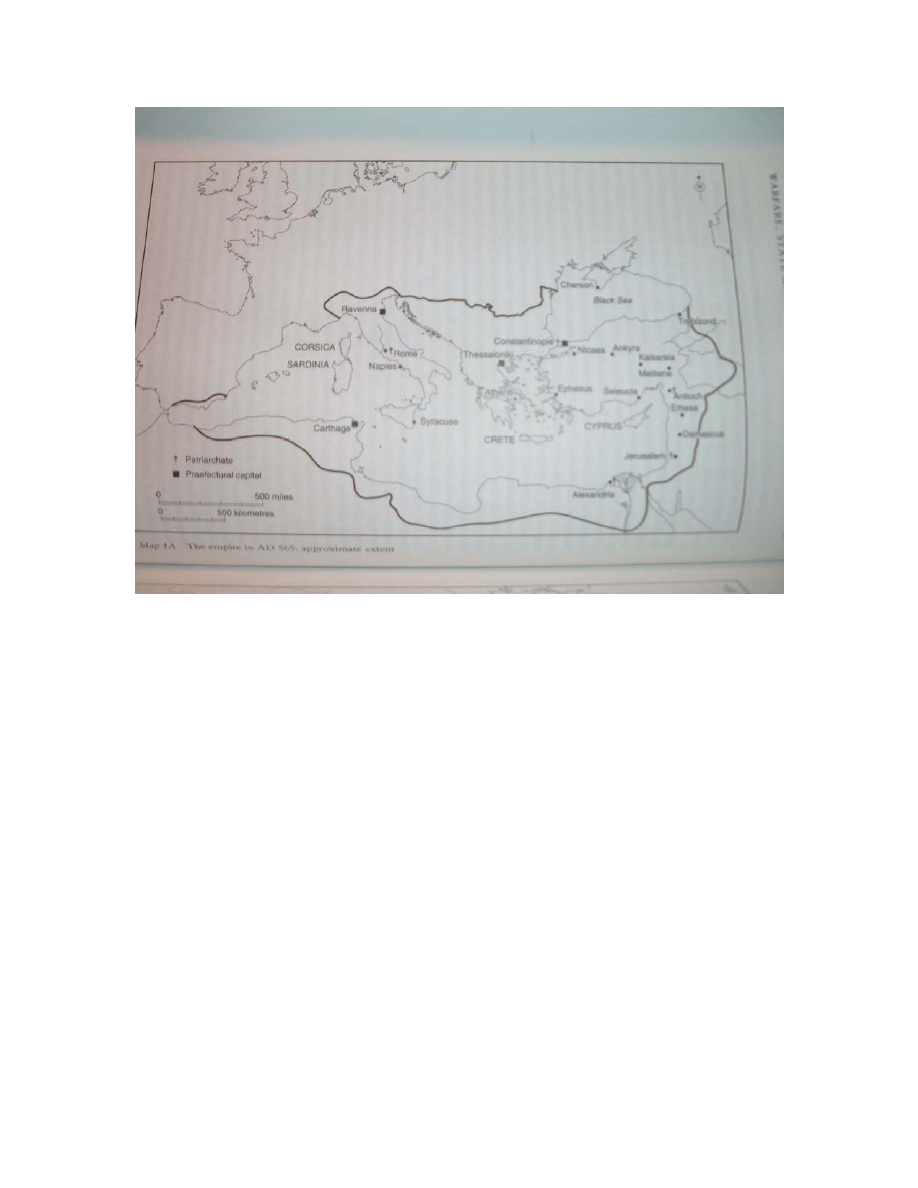
Figure 3. Byzantine Empire in 630 AD
Source: Haldon, John. Warfare, State and Society in the Byzantine World 565-120 ,
London: UCL Press. 1999.
The political terrain was not quite as benign as the natural. The Empire was
bordered by barbarian Avars in the Balkans and Crimea. Italy and France faced the
growing Frankish kingdoms. Nomadic desert tribes were an irritation in Africa and
Arabia. The most difficult border however, was the Eastern border with the great
Sassinid Persian Empire
The Byzantine Empire inherited the long-standing border and rivalry with the
Persian Empire from Rome. The border between the two great empires had shifted back
31

32
and forth across Mesopotamia and Syria for centuries. The ancient Romans first fought
to gain control of this slice of land in 92 BC. The various Persian dynasties and Caesars
periodically would renew the war, make modest gains or suffer modest losses without
either side ever establishing an advantage.
Demography
Part of the reason neither the Byzantine nor Persian empire was ever able to
establish an advantage and conquer the other was that they both faced huge demographic
hurdles. Both were huge, multi-ethnic and multi-religious nations. This was further
aggravated by the people native to the land in question, Arabs and Jews who did not want
to be ruled by outsiders from either empire.
The population of the Byzantine Empire was largely agrarian, with nomads on the
fringes and large, prosperous cities in Anatolia, Greece, Egypt and Syria. The eastern
part of the Empire was largely free of barbarian incursions and did not suffer
depopulation similar to Italy and Spain.
It is difficult to estimate the actual population
of the Empire, but Constantinople alone is estimated to have a population in excess o
500,000 people
f
. Other important cities such as Antioch, Jerusalem, Alexandria and
Rhodes would certainly have added many thousands more, to say nothing of the huge
peasantry required to support urban populations of this size.

33
Culture
Roman
Probably the most important aspect of Byzantine culture at this time is that it was
Roman. In fact, “to the Byzantines, their empire was none other than the Roman Empire,
perfected through Christianity, and they admitted no distinction or discontinuity from
antiquity.”
This sense of continuity with ancient Rome pervaded every aspect of their
culture. They continue to write in Latin, prize military prowess and build on a grand
scale with Roman style decoration. They had a millennium of cultural and political
dominance to revere and contemplate. With the growth of Christianity, they also had a
unifying religion, which admited no other god is equal to theirs. They believed they were
superior culturally, militarily, intellectually and morally.
This sense of superiority was so engrained to their culture that “the Byzantines
persisted in regarding themselves as the only civilized nation” and called all non-
Byzantine people “barbarians”.
This self-confidence was well placed, but “they
continued to treat the rest of the world with condescension” which on occasion led to
diplomatic and military blunders.
While the empire included many people who were not Christian or Roman, these
did not have a large impact on the culture of the Empire as a whole. At the other end of
the spectrum, the people of Anatolia were very patriotic, considered themselves Romans,
Orthodox Christians and defenders of both the state and religion.
It was their empire,
their culture and their art to which the rest of the world looked in wonder.
Art
Byzantine art in this period was even more invasive than the imperial armies. The

34
ultural
modes of decoration were copied across Europe while “its churches became the pattern
for those in Russia and Italy.”
For centuries “Byzantine art was the ‘regulating art’ of
Europe” against which all other art was modeled and judged.
The Byzantine artists produced mosaics, sculpture, icons, jewelry and clothing
that were the envy of the world. The true expression of Byzantine art was to be found in
their churches. They developed a new style of church radically different from the old
Roman temples which was to dominate ecclesiastical architecture until the arrival of the
Gothic style 500 years later. Inevitably, the greatest expression of their greatest art was
in their greatest city. Emperor Justinian started the Church of Santa Sophia or “Holy
Wisdom” in 532, to be “a church, the like of which has never been seen since Adam, nor
ever will be”
. Its scale dwarfed any other Christian building constructed for 1000
years. It is a tribute to the vibrant Byzantine culture at the time since it was built in less
than 5 years, consecrated on 27 December 537 by Justinian’s successor Justin II. It
remains today the gem of the crown city and a testament to their belief in their c
superiority.
Cities
Constantinople was the greatest city in the world in the 6
th
and 7
th
centuries.
Medieval Arabs felt that “no other place in the world was comparable in size, in
geographical location and in importance.”
This glowing praise for it’s geography was
justified by a superb location on a promontory overlooking one of the best natural harbors
in the world. Furthermore, this harbor sat on the Bosophorus, which at the time was the
most important waterway in the world, connecting the Orient with Europe. The massive
population of the city dwarfed any European or African cities. Politically, it remained the

35
heart of the Empire and, to the Byzantines at least, civilization. It dominated the empire,
but it was not the only city.
The long periods of security in the Roman East had led to the growth of numerous
cities, which provided resources for the Byzantine Empire. Damascus and Aleppo were
large cosmopolitan cities, which were transit points for Arabian and Indian spices and
incense. Antioch was terminus of the Silk Road and a center of Christian theological
creativity. Jerusalem was the spiritual cradle of Christianity and a destination for
pilgrims from all over Europe. Alexandria, the ancient Greek city dominating Egypt,
controlled nearly inexhaustible agricultural resources and was the home of the greatest
repository of ancient knowledge in the Great Library. All of these cities were important
and added greatly to the powerful economic engine, which gave the empire such
resilience over the centuries.
Economics
The huge expanse and enormous expenditures of the Empire were sustained by a
diversified and vibrant economy. The largest part of this economy was agricultural, but
even in agriculture the vast variety of geography encouraged diversification.
Small farm holdings were the most common form of economic activity
throughout the empire. These holdings were jealously protected by government, even to
the point of breaking up large holdings. This was largely a fiscal expedient as small farm
holdings were distributed to soldiers, saving payroll and limiting necessity for
mercenaries.
Small farms produced nearly everything necessary for the survival of
both rural and urban populations. These small, generally prosperous farms grew cereals

36
y.”
14
and grapes, “fruits, medicinal herbs, cotton and mulberry trees” in the costal regions.
In the interior lands they produced “abundant cattle, sheep and pigs were bred as well as
horses for the racecourse and for the needs of the arm
A maritime nation such as the Byzantine Empire needed more industry than just
farms to thrive. The Balkan “forests gave the material necessary for house construction
and shipbuilding.”
These materials were then floated down river to the coastal cities
where ships were built and merchant could carry the timber to the major cities where it
was needed.
The large cities had manufacturing industries, which produced “silk fabrics, the
heavy gold brocades”, reliquaries, elegant glassware, ivories that were the envy of the
West
. Most of these industries were tightly controlled by trade guilds, which both
protected secrets and controlled prices for goods. The bulk of these goods were used in
the cities by the court or the churches, but many were also transported across the Empire
to sell in foreign markets.
Geography played a huge role in international commerce. The Empire was
“situated at the junction of the communications between Asia and Europe, and Europe
and Africa; all routes, by land, sea or river, connecting eastern Europe with the
Mediterranean passed through Byzantine territory.”
The Empire was at center of
overland trade routes between Europe, Syria, China, India, Arabia, Russia and
Scandinavia. The Western terminus of the Silk Road from China was in the Byzantine
city of Antioch, while the Northern Terminus of the Frankincense route was in Byzantine
controlled Palestine.
The sea routes were just as important as those crossing the land. The Byzantine

37
ntinents.
20
Empire “controlled the coasts where the great trade routes of the world debouched; its
merchants gathered up and then distributed throughout the Mediterranean countries all
that those routes brought in.”
This debouching and distributing was greatly aided by
the enormous Byzantine merchant fleet, which was called “the mistress of the seas.”
So dominant was this combination of geography and fleet that the Empire largely
controlled the European trade in spices, perfumes, precious stones, incense and rare metal
and had a complete monopoly on raw silk. To the East, Byzantine merchants exported
wine, pelts and caviar to the Orient. Byzantine craftsmanship in enameled glass, fine
fabrics, and jewelry was exported to three co
The extensive trade links the Empire maintained required an advanced system of
finance. Christian morality in the government made this a little more complicated since
“money-lending at interest was forbidden by law.”
The lack of money lending was
largely addressed by the strength of the Byzantine currency. It was a standardized
coinage which, “Emperors hardly ever had recourse to the practice, then so common, of
debasing the coinage.”
Over the centuries the reliability of this currency had made “the
Byzantine gold piece, the nomisma, the veritable international coin.”
It was used as a
medium of commerce throughout Europe and even copied by later Arab invaders.
This powerful economy was undoubtedly the most successful in early Medieval
Europe. Succinctly, the “Byzantine Empire was indisputably the richest and most
populace State in Christendom.” This wealth was so extraordinary that a contemporary
stated “two thirds of the world’s wealth is to be found at Constantinople.”
While this
was definitely an exaggeration, there is no doubt that the Empire was an economic
superpower and her neighbors were well aware of that fact.

38
Despite this awe-inspiring economy, by the latter half of the sixth century,
Byzantium was in dire straits fiscally. Emperor Justin II had squandered many of the
gains his father made and began a series of costly wars and internal disputes which
outlived him and his immediate successor right up until the selection of Maurice as
emperor in 582. The result was that “from the moment he assumed the throne of
Byzantium, Maurice had to face one overriding problem: lack of money” Maurice was
determined to set the finances of the Empire back on a firm footing.
His parsimony has
become legendary. He made some terrible errors as a result of his drive for economy.
First, he “refused to ransom no less than 12,000 prisoners taken by the Avars, who
consequently put them to death”. He followed this cold-hearted decision with another; he
cut military rations by a quarter, which led to mutinies in Italy and Spain. He finally
destroyed his own reign when he decreed the army should quarter in the Danube during
winter of 602 instead of coming home to spend Christmas with their families. The army,
already distressed by his miserly actions elected Phocas, one of their generals to lead a
rebellion and overthrow the government.
Government
The Imperial budget has been estimated at as much as 640 million gold coins at
the time Maurice began his reign.
That would be approximately 400 billion dollars at
current gold prices, but the purchasing power would be relatively more in Byzantine
times. This was a huge sum by any measure, and a proficient bureaucracy was necessary
to distribute it properly.
Fortunately, the “Byzantine administration was strongly centralized and wisely

39
ize the
was
organized.”
There was a large professional bureaucracy to address everything from
military matters, to engineering to tax collection and paying tribute to allies. The
bureaucrats even ensured that grain was distributed from Egypt and other rich growing
areas to the cities and famished regions by the navy at government expense.
While the Empire theoretically still had an Imperial Senate, the entire bureaucracy
was beholden directly to the emperor. The salary or “roga (cash payment) was
distributed once a year to the higher functionaries by the emperor himself” to ensure their
loyalty. The lower level bureaucrats and tax collectors were paid by assistants, but “the
file past the Emperor lasted three days.”
The problem with any monarchial system government is that no matter how loyal
and competent the administration, if the monarch is inadequate the whole country will
suffer. Byzantium had its share of great leaders such as Justinian, but in the late sixth
century Justin II was the emperor. He went mad sometime in 574 and would “try to hurl
himself from windows, which had to be fitted with bars for his protection”
. His mother
Sophia appointed Tiberius to be co-regent. Tiberius was elected emperor in 578 but died
in 582. On his deathbed, he followed ancient Roman custom and adopted a successor, a
young general named Maurice who had recently reorganized the army and led successful
campaigns against Persia and the Turks.
Maurice immediately set about reforming the government. He first established
Exarchates at Carthage and Ravenna to rule Africa and Italy under military
government.
This gave the local military governor or stratego the power to organ
entire province for defense and was a major revision from civil government. This
necessary because war with Persia had flared up again and the field armies were needed

40
in the East. The war dragged on until Persia erupted into civil war in 591. Maurice aided
one of the claimants to the throne, Chosroes II who then succeeded in seizing the Persian
crown. The two negotiated a peace settlement, which gave Byzantium all of
Mesopotamia west of the Tigris. This was a huge diplomatic coup for Maurice; at one
stroke he gained an ally in his most powerful neighbor, ended a long war and got an
unprecedented territorial concession. Unfortunately, this is the time when his parsimony
with the army caught up with him. In 602, Phocas led his Army out of Bulgaria and
marched into Constantinople.
Phocas assumed the crown, but Maurice was still alive and in hiding. Chosroes
used the overthrow as an excuse to initiate a new war against Phocas and reverse the
concessions he had made to Maurice. The only general in the East at time was an ally of
Maurice, Narses who began a counter rebellion against Phocas rather than defend against
the Persian onslaught. Phocas withdrew his armies from Balkans to counter problems in
East and began a purge, which killed his best generals
. Over the next several years,
Persia seized Syria and much of Anatolia, while the Avars occupied most of the Balkans.
Phocas’s main response was increasing paranoia and wholesale persecution of Jews and
anybody associated with Maurice.
In 609 AD, the Exarch of Carthage, one of the last appointees of Maurice,
promoted his son, Heraclius to General of the Army and sent him to Constantinople.
Heraclius arrived with a fleet and a small army and was immediately welcomed into the
city by the disillusioned populace. He assumed the crown on Saturday 3 October, 610.
He had Phocas brought to the Imperial palace where he personally killed and beheaded
the former emperor.

Heraclius was taking a huge gamble by assuming the crown in Constantinople.
“Never had any of his predecessors inherited so desperate a situation. To the west, the
Avars and Slavs had overrun the Balkans, their raiding parties regularly approaching the
gates of Constantinople; to the east the Persian watch-fires at Chalcedon, immediately
across the Bosphorus, were clearly visible from the windows of the imperial palace.”
Things continued to get worse; Antioch was seized in 611 and Damascus in 613.
Jerusalem fell to the Persians in 614 who then massacred the population and seized the
relic of the True Cross as booty. Egypt was overrun in 617 eliminating the breadbasket
of the Empire.
DUE TO COPYRIGHT RESTRICTIONS,
IMAGES ARE NOT INCLUDED
IN THIS ELECTRONIC EDITION.
Figure 4. Campaigns of Heraclius
Source: Glubb, John. The Great Arab Conquests. Englewood Cliffs, NJ: Prentice Hall.
1963.
41

42
Heraclius reacted to these disasters with brilliant foresight and calm. He
continued running the provinces of Italy, Africa and Spain under Exarches, now called
Themes led by a Strategos. Soldiers were settled in the Themes receiving land grants
instead of cash in exchange for service. He increased taxation, fined Phocas’s cronies,
got subsidies from the Orthodox Church based on a promise to restore Jerusalem and the
True Cross. In 619 he established a truce with Avars.
Finally, in 622 Heraclius launched his campaign against the Persians. He
removed the army from besieged Constantinople launched an attack on Persia through
Armenia, circumventing the Persian forces. The Patriarch and citizens held the city while
Heraclius fought a series of campaigns behind enemy lines, which led to the plundering
of Ctesiphon (the Persian capital) and execution of Chosroes in 628. Persia’s armies
were destroyed and all disputed and conquered lands were returned to Byzantium. Persia
would never recover. Heraclius led the victory procession into Constantinople with the
True Cross at the front in September 628 and then made a pilgrimage to return the Cross
to it’s rightful place in Jerusalem.
Religion
When Heraclius entered Jerusalem with the True Cross, he was not only basking
in the glory of his military triumphs, he was also fulfilling his responsibility as the
religious leader of the world. The fact that “the Emperor was not only a prince; he was
also the head of the Christian Church” is frequently forgotten in our society with a strong
separation of church and state, but in the Byzantine Empire the state and the church were
like different departments in the same agency, with the emperor the leader of both.

43
This unity of church and state made the issues of heresy and religious schism very
important topics for the emperors. In theory, all of Christendom was Orthodox and under
Roman suzerainty. Reality was quite a bit different. The barbarians in the west still
claimed Roman heritage, but lived in feudal communities and followed the Pope in Rome
on religious matters. Areas of the Balkans and Crimea shifted political control and were
largely followers of the Arian heresy, who did not believe Christ was divine. Much of
Africa followed the Nestorian version of Christianity and the leadership of the Patriarch
of Alexandria. Most of Egypt and Syria followed a Monophysite philosophy.
Traditionally, the Empire was pragmatically tolerant of all forms of Christianity.
During the 6th century this tolerance began to diminish. Emperors began to
believe that they needed a strong, centralized religion to unite the diverse peoples of the
Empire. Various councils were appointed to reconcile the various sects, but on the whole
these were unsuccessful.
Frustrated by this lack of success, imperial policy changed. In 571, the Emperor
Justin “abandoned his earlier policy of guarded toleration in favor of open
persecutions.”
Many Egyptians were unhappy with the elimination of Nestorianism
(their preferred version of Christianity) and the ascendancy of Constantinople as religious
center over Alexandria.
The rift widened rather than closed between the two sects.
Relations with Rome were icier yet. The eastern and western churches were
locked in a constant power struggle, based more on worldly issues than spiritual ones.
The Pope continued to claim supremacy in all matters theological, while the Emperor and
Patriarch of Constantinople considered their theology more lawful. The rift greatly
widened under Maurice and Pope Gregory “the Great”; apparently these two powerful

44
personalities were irreconcilable.
The largest of the religious problems was the Monophysite debate. The
Monophysite theology, claiming there was only one nature of Christ, was in direct
contradiction with the Orthodox belief in two natures (divine and human). This doctrine
was the dominant belief in Egypt, Syria and most of the borderlands with Persia.
Emperor Zeno tried reconciliation in 491 AD, which managed to anger the Pope, the
Patriarch of Constantinople and the masses of Monophysites in the East.
By 511 AD
the Monophysites were mounting a low level insurgency in Syria and even marched on
the Imperial Palace in Constantinople, a full-scale revolt was narrowly avoided.
The
controversy even plagued the brilliant Justinian, who issued numerous edicts condemning
other sects but feared to address the Monophysite while engaged in the renovation of the
Empire. His successor, Justin, confiscated Monophysite churches and drove their monks
from the convents. The debate would continue unresolved until Jerusalem, one of the
centers Monophysite faith fell under the Persian invasion in 608 AD.
The Persians were greatly aided in their invasion by yet another marginalized
religious group, the Jews. Jews lived in small numbers in most cities throughout the
Empire, but were a large percentage of the population throughout Syria, Palestine and
Mesopotamia. They were generally treated like other non-Orthodox religions, though
there had been occasional persecutions over the centuries. This changed dramatically
during the reign of Emperor Phocas (602-610). This paranoid emperor “launched an all
out campaign for the persecution and forcible conversion of the Jews.”
Why he did this
while facing invasion from Persia is inexplicable, but the Jewish reaction was predictable.
They revolted in Antioch, Jerusalem and numerous other cities in the East. The Jews

45
massacred Christians wholesale, the Christians responded in kind. Jews across Syria
openly allied themselves with the Persian invaders. Cities full of battle-weary,
religiously disaffected Monophysites and Jews fell to the Persians in short order.
Diplomacy
Perhaps the greatest enduring strength of the Empire was it’s clever and ruthless
diplomatic strategies. The Roman Empire had always maintained an influential
diplomatic strategy; the Byzantine Empire raised it to an art. The Byzantines admired
diplomatically adroit leaders who could bring enemies under the suzerainty of Byzantium
without bloodshed
, and the emperors understood that even expensive diplomatic coups
are cheaper than military victories.
Despite their disdain for foreigners, the Byzantine understood that successful
diplomacy requires an understanding of the other party. In fact, “the study of the
barbarian world was the constant care of the imperial court. Among the departments of
the chancellery was one called the Bureau of Barbarians.”
This typically Byzantine
bureau studied the weaknesses, strengths and personalities of all the neighboring nations
and leaders. It ensured that “notes were kept of the most influential families, what
presents pleased them best, which of their sentiments or interests might be most usefully
cultivated, and what political or economic relations might be established with them.”
In short, it was a standing diplomatic intelligence agency.
Good intelligence was not the only part of the Byzantine diplomatic strategy.
Emperors “granted annual subsidies and gave magnificent presents” to neighboring
leaders.
The strategos granted Roman titles to leaders to appeal to the vanity of those

46
leaders. The primary goal of this largesse was to get neighbors to aid in the defense of
the Empire by becoming allied states, providing forces at the fringes of the Empire.
This tactic was remarkably successful when pursued with care. The Empire
maintained treaties with Khazars, Ghassinid Arabs, Croats, Serbs, Armenians, Russians,
and Pechengs. By creating these alliances, the Empire eliminated potential enemies and
gained buffers against other enemies. Most of the Empire’s most stable borders were
held by these allied states.
Where the Empire failed to develop allied satellites, it aimed “to divide its
opponents, to neutralize them by playing one off against another and to foment
jealousies, grudges and clashes between them.”
The Empire would subsidize one side
and then another or grant titles to both. The Byzantines typically had a much more
sophisticated understanding of the internal politics of their adversaries than any of the
“barbarians” could hope to have of the Imperial court.
The ceremonies of court were also an instrument of the diplomatic strategy.
Byzantium “pursued a policy of pomp and prestige, designed to display the material
resources and intellectual superiority of the realm.”
Visitors to the court would be
awed with feasts, performances and elaborate displays (such as a throne on an elevator
and automata worked from precious metals) designed to impress and intimidate. The
court itself was a tool in the hands of the diplomatic corps. The Emperor
“kept at his court a whole staff of claimants to all the
thrones in the world. The sons of many princes were
brought up in Constantinople in the luxurious surroundings
of the palace; the victims of civil war were also welcome
there: unsuccessful pretenders and vanquished
competitors”

47
This “staff” of claimants gave the emperor a ready resource to foment rebellion in hostile
nations and a way to nurture future alliances.
The Crisis in Syria
The previous discussion describes how the Roman Empire had continued to live
on after the fall of Rome in the form of the Byzantine Empire. It remained the
intellectual, religious and economic center of Europe. It’s people continued to be
patriotic, it’s arts and court were a wonder to all beholders. It’s army and navy
dominated the entire Mediterranean basin. Its diplomats crafted a unified and economical
strategy that had sustained the Empire for centuries. By 630 AD, even the Persian
menace that had vexed the ancients lay prostrate at the feet of Emperor Heraclius. The
Byzantines had every right to be proud of their heritage and every reason to expect
continued success in the future. There was but one thorn in their side in early 7
th
century;
Syria.
Syria had suffered terribly during the Persian wars. Cities changed hands from
the Byzantines, to Jewish revolutionaries, to the Persians and back to the Empire again.
Massacres had created huge rifts among the population, while an eight-year occupation
had distanced the sentiments of the people from the Empire. In parts of Syria the
“occupation lasted fifteen years, a whole generation up to and including young adults-in
an era of short life-spans, perhaps half the total population-would never have experienced
Byzantine rule at all.”
Long-standing religious divisions were still unresolved. The
economy was in shambles after being the frontline in a 50-year war. Matters were so
grave that Heraclius spent the first three years after his victory on a whistle-stop style

48
tour of Syria trying to reconstruct the Imperial apparatus and eliminate corruption.
Despite this intense focus on reconstructing Syria, somehow the Byzantine
administration made some grave oversights regarding Syria during this time. First, no
further attempt was made to reconcile the Monophysite faith with Orthodoxy. Secondly,
the professional army was withdrawn from Syria to support a new campaign in the
Balkans. Third, and most grave, the Byzantines quit paying the subsidy to the Ghassinid
Arabs.
The Ghassinid tribe had been loyal allies of the Empire for centuries. Originally
these Arabs had prospered on the Frankincense trade in southern Syria, but they had
slowly become an almost exclusively mercenary outfit supporting the Empire with
intelligence about Persia and events in the Arabian deserts. The Ghassinids had become
Christian (Monophysite of course) and had received many Byzantine titles and gifts. The
Ghassinids had even provided part of the invading force into Persia. In 629 AD the
Ghassinids fought and won a brutal battle against a new threat, a large religiously
motivated army from the Arabian Peninsula.
This encounter, near the town of Mu’ta
was the first conflict between the Muslims and Byzantium. Despite the long-standing
relationship, strategic placement and loyal support, the money was cut off in 630 AD. In
one stroke, the Empire lost a buffer against an unknown enemy, lost its intelligence
capability and a standing army in southern Syria, and irritated a powerful group of
warriors. It was a diplomatic blunder of unprecedented scale and would cost the Empire
dearly.
1
John Norwich, Byzantium The Early Centuries (New York: Knopf, 1989), p173.

49
2
Norman Baynes and H.S.L.B. Moss, eds., Byzantium; an introduction to East
Roman Civilization. (Oxford: Clarendon Press,.1961), p52.
3
Baynes and Moss, p53.
4
El-Cheikh, p21
5
Baynes and Moss, p53.
6
Ibid, p54.
7
Ibid, p119.
8
Ibid, p107.
9
Ibid, p107.
10
Ibid, p166.
11
Nadia El-Cheikh,
Byzantium Viewed by the Arabs. (Cambridge Mass.: Harvard
University Press, 2004), p140.
12
Baynes and Moss, p56.
13
Ibid., p59.
14
Ibid., p59.
15
Ibid., p59.
16
Ibid., p62.
17
Ibid., p63.
18
Ibid., p80.
19
Ibid., p65.
20
Ibid., p81.
21
Ibid., p57.
22
Ibid., p71.
23
Ibid., p71.
24
Ibid., p68.

50
25
Norwich, p275.
26
Ibid, p276.
27
Baynes and Moss, p78.
28
Ibid., p74.
29
John Haldon, Byzantium in the Seventh Century : The transformation of a
culture (Cambridge: Cambridge University Press, 1997), p26.
30
Baynes and Moss, p75.
31
Norwich, p 270.
32
Ibid., p 273
33
Ibid., p 280.
34
Ibid., p283.
35
Ibid., p284.
36
Baynes and Moss, p76.
37
Norwich, p270.
38
Baynes and Moss, p96.
39
Haldon, p49.
40
Norwich, p181.
41
Ibid., p187.
42
Ibid., p281
43
Baynes and Moss, p54.
44
Ibid, p54.
45
Ibid., p54.
46
Ibid., p55.
47
Ibid., p57.
48
Ibid., p57.

51
49
Ibid., p60.
50
Fred Donner, The Early Islamic Conquests.(Princeton, N.J.: Princeton
University Press, 1981), p100.
51
Akram, p83.

52
CHAPTER 4
THE WAR
Conflicting
Goals
After the consolidation of the tribes in the Arabian Peninsula, Mohammad
determined to unite all the Arab speaking people under the banner of Islam. In 629, he
began sending exploratory forces into Syria and Iraq to offer a stick or a carrot to the
large contingents of Arabs in those areas.
At the same time, Heraclius was trying to rebuild the Empire after the decisive but
costly defeat of Persia in 628. Byzantium was “trying to reconstruct their tribal alliances
from the ground up, extending their ties among the Syrian and northern Hijazi nomadic
groups in order to form the defensive coalitions needed to guard Syria from the southeast.
It was, just this effort to extend their political control over these tribes that made the
Byzantines appear such a threat to the Muslims, who also aspired to bring the tribes under
control.”
A conflict between the two empires was inevitable. It was a war, which would
pit a brilliantly led and highly motivated force against the most sophisticated military
machine in the region. Both sides would be surprised and frustrated by their enemy.
Arab
Forces
The armies of the Muslims were greatly expanded by the consolidation of Arabia,
but they were still tribal forces. Warfare was part of everyday life for the majority of the
Arabs, but they were not a professional army. Their equipment, modes of operation and
tactics were those of tribal desert warriors.

53
Equipment
The equipment of a Muslim warrior was his personal possession, neither provided
nor regulated by the army. As such, there was a vast variety of equipment in use in the
army. In general, the “principal weapon was the sword, though lances and spears were
also carried”
. This was not the scimitar that would become popular later, but “the sayf,
the straight, hilted sword.”
The sayf was both a thrusting and a slashing weapon of
about “96cm in length and 6-7cm in width.”
There was quite a variety of this basic
design. Most were produced, cheaply, in Arabia, but “the best swords came from India,
followed by those made in the Indian fashion in Yemen.”
The spear used by the Muslims “was a thrusting weapon with an iron point” of
about 6-7m in length.
It was “almost always an infantry weapon; cavalry duels were
typically fought with swords.”
The spear was used mainly to halt cavalry attacks as it
was ineffective as an individual infantry weapon and the Arabs did not train to operate as
a phalanx.
The most devastating weapon in the Muslim arsenal was the bow and arrow.
Muslims forces did not move against an enemy unless their “bows and arrows supplied
covering fire.”
Hunting and tribal raids developed these skills among most Arab men
and “archery was highly esteemed among the Muslims”
. Both horse and foot archers
used composite bows made of horn, wood and bone with a double S shape.
These were
made specifically for the individual warrior and could be deadly out to range of 180-240
meters, though they were not accurate much beyond 70 meters.
Concentrations of Arab
archers were brutally efficient on the field of battle and earned a formidable reputation
among their enemies, for example: “a Persian who fought at the battle of Qadisiya

54
commented on the superiority of Muslim over Persian firepower.”
Muslim soldiers also used a variety of items for defense, though they occasionally
would face an enemy with just sword in hand. Armor “was highly prized, and was
doubtless imported from the more technically advanced nations like the Persians or
Byzantines. It normally consisted of a pot helmet and coat of chain mail.”
It was
extraordinarily expensive and “mail was passed on from one generation to another as a
prized possession.”
While mail was a sign of wealth, shields were available to far more warriors.
Shields were made of wood or of leather stretched on a wood frame. Normally, they
were round and less than a meter in diameter
. The small size and light construction
were critical if the shield was used by a Muslim warrior who also planned to fire his bow
at the enemy.
The Arabs were as technologically advanced as most armies of the day, but they
were not prepared to assault cities. The main Muslim siege weapon was a “swing-beam
engine, similar to the trebuchet used in Western medieval siege warfare.”
Despite the
advanced technology, there were not many fortified cities to gain experience at siege
warfare in the Arabian Peninsula. As a result “early Muslim use of artillery against
fortified enclosures was sporadic and largely ineffective.”
Infantry
Despite the modern image of mounted Arab armies sweeping across the desert,
the backbone of the Muslim forces during the 7
th
century was infantry. This infantry,
which “included substantial numbers of foot archers, aided by the high degree of mobility
and flexibility of their armies, seems to have been a key factor in their victories against

55
emy closed.
22
Roman (Byzantine) and Sassinid forces.”
This superiority came in spite of the fact that the “Arabs could not fight a close-
order infantry battle.”
They did not have sufficient armor nor were they trained to
fight in close well-disciplined ranks. Additionally, “they had not heavy support
weapons.”
Instead, they fought as a flexible, light infantry. Their “archers mostly
fought on foot” and drew their sayf when the en
Cavalry
Wealthy Arabs, as wealthy people throughout the medieval world, rode their
horses into battle. These horses were already a distinctive and hardy breed which, would
develop into the modern Arabian.
The Muslims used both mares and stallions in
combat.
They were careful to ensure the horses were rested for combat and “the horse
was led alongside the camel until needed for fighting.”
The Arabs, and their enemies in the region, had stirrups and used lances
extensively. Lance combat techniques were apparently still undergoing innovation as
the Muslims couched lances “both along the withers of the horse and over the head
between the ears.”
The cavalry were used as both a shock force against the flanks of an
enemy and, more importantly, as a pursuit force to chase down routed enemy soldiers.
Motivation
The Muslim armies were a highly motivated force with almost mythical morale in
the face of powerful enemies. Much of this can be attributed to the fervor their young
religion instilled in the force, but the promise of paradise was far from the only force
motivating the conquering armies.

56
Clan solidarity was a powerful force in the Arab culture. As discussed in an
earlier chapter, loyalty to the clan and tribe was more important than any other form of
morality. This loyalty ethic was extended to the entire umma (community of Islam) by
Mohammad. Within the umma soldiers were highly respected and “success in war gave
them the prestige and the means to find resources beyond those of pastoralism.”
Prestige was not the only resource a Muslim warrior earned. There were
tremendous economic rewards as well. Lists or diwan were kept of all warriors on
campaign so they could be paid cash salaries.
These salaries were paid for life and
grew larger the more campaigns the warrior fought. Even more lucrative was the
division of spoils after a battle, when each man was given a portion of all captured
equipment, money, horses and even people. Persons snatched in a raid or during a route
would often be ransomed.
Bravery was especially rewarded in the Muslim army. A “warrior who won a duel
took all the possessions of his vanquished foe, and this was apart from his normal share
of the spoils taken in battle.”
The possessions of an enemy leader vanquished in a duel
would frequently include prized body armor and weapons. Furthermore, generals would
give extra gifts to soldiers who did well in a battle (as much as 10,000 dirhams, roughly
the yearly salary of a general).
The combination religious, societal and economic
rewards greatly motivated the Muslim armies.
Doctrine
It is almost impossible to discuss Muslim military doctrine. One author states:
“Arab methods of warfare at this period were so haphazard that no such deduction can be
made.”
There was very little predictability, uniformity or consistency in the leadership,

57
organization or even strategy in Arab armies, much less anything resembling professional
literature.
Generalship was a tenuous affair in Muslim armies. “Men were appointed to
command armies for many different reasons: they were loyal to the regime, they could
recruit followers and attract men to their service, they could organize the collection and
payment of revenues and they were effective and knowledgeable commanders in
battle.”
He could also be fired for lack of bravery, lack of skill in command, because
another man was more loyal to the Caliph or even lack of piety.
Usually armies were organized in tribal units and “tribal groups appear to have
fought as separate units.”
Some tribes were larger or more war-like and would have
larger contingents, while others would be smaller. Parts of a tribe would also be
separated into different armies to keep any popular tribal leaders from usurping power
from the men appointed by the Caliph.
Grand strategy was centrally directed and the “Caliphs in Madina exercised a
considerable degree of control over the armies.”
While the distances involved required
that individual generals have great latitude in fighting campaigns, “communications
between the capital and the front lines in Syria and Iraq may not have taken much more
than a week each way.”
The Caliphs maintained a good strategic picture of the wars
and directed generals to move forces to accomplish the most urgent tasks. A lack of
formal doctrine was not a great hindrance to the Muslims.
Tactics
Muslim tactics during their early wars were creative and played to their strengths.
They exploited their knowledge of the deserts, used the tenets of their religion to

58
undermine enemies, and used their native skills to counter more traditional military
prowess.
The Arabs were at home in the desert and used the wastes as both a highway and
a sanctuary. They moved rapidly in and out of the desert with “camels providing the
main means of transport of men and materials.”
The camel was an integral and crucial
part of the Muslim army, providing strategic transportation for forces, moving logistics
trains and in emergency, acting as a food and water reserve for the forces. The Muslim
armies “were extremely light and mobile, and their tactics consisted of a wild charge, of
advance and retreat and turning movements, cutting communications and supplies.”
Endless tribal warfare had made them expert guerillas. Their skill had been famous for
centuries. Ammianus Marcellinus, almost 150 years before Mohammad, talks of
Malechus, an Arab leader who had worked for Sassanids coming to surrender to Julian
after a major Byzantine victory: “they were gladly received since they were well suited
to guerilla warfare.”
Islam provided the Arabs advantages on campaign. It was not long before their
enemies knew that an unbeliever “even if overtaken in arms fighting against the Muslims,
had only to call out profession of faith and his life must be spared.”
This chance for
mercy and even assimilation enabled the Muslims to gain new recruits and gave enemies
an alternative to fighting to the death.
Desert life did not give the Muslims experience with heavy cavalry similar to
their more advanced enemies, but it did give them skills, which could counter the cavalry.
They learned to use spears “with devastating effect against cavalry charges.”
Caltrops
were also used to impede the advance of cavalry.
Most importantly, “Muslims’ archers

59
may have shielded their cohorts from the full force of the Sassanian and Byzantine heavy
cavalry and thereby neutralized their superiority in this respect.”
No one characteristic of the Muslim army was sufficient to defeat the Byzantines.
Instead, the Muslim religion combined with desert warfare skill and superb archery was
to prove an efficient combination for winning battles during the war. The openness of
Islam to converts would weaken many opponents when faced with showers of deadly
arrows coming from an unexpected direction. Mercy was a weapon for the Arabs.
Byzantine
Forces
The Byzantine Empire had a military tradition stretching back millennia. The
Imperial war machine was rationally organized, superbly equipped and well trained.
There was a large navy, a sort of national guard called the Themata, a professional field
army, advanced artillery (including a secret weapon) and sophisticated body of doctrine.
Navy
In the 7
th
century, Byzantium had the most powerful fleet in the Mediterrean. It
was larger, better equipped, organized and trained than any contemporary navy. The
empire had reorganized the fleet after the collapse of the western part of the Empire and
“the organization of the fleet was an original creation of the Byzantines.”
It was led by
a “Strategos of the Carabisiani” and two admirals and consisted of around 300 ships.
The ships were mostly purpose-built oared galleys, which were ideal in the benign waters
of the Mediterrean. The fleet was designed and operated as an offensive arm of the
Empire, moving armies and supplies between theatres and around enemy strongholds.

60
The navy was a powerful force to which few enemies could respond.
Army
The ancient Roman system of legions was slowly reformed to respond to
barbarian invasion long before the rise of Islam. By the time of Justinian (6
th
century),
the armies of the Empire had been completely reorganized and the principal fighting arm
had switched from infantry to cavalry. There were still infantry, but they were part of a
type of local militia. The cavalry included both the locals and the elite professional
mobile force.
Themata
The new organization was based around the Theme. It was essentially geographic
area, which was obligated to train and equip a certain number of soldiers of different
types. The thematic armies could be called upon as a sort of militia to protect the local
area but would also provide men to aid the Imperial field armies when necessary. The
theme usually provided light cavalry to the field armies, but would have a large mix of
cavalry and infantry for defense.
The theme system depended on two other sources of troops to fight the wars of
the Empire. First were the fedorati, which were a collection of soldiers from satellite
states and mercenaries. Most of the fedorati were cavalry, though the most crucial
against the Arabs, the Ghassanids were largely an infantry force. The second important
source of non-thematic troops was the emperor’s personal army of professional heavy
cavalry.

61
Infantry
Infantry were largely ignored by the Empire, to such an extent that Maurice
prefaces his chapter on infantry with “infantry tactics, a subject which has been long
neglected and almost forgotten in the course of time.”
This is not to say they were not
used, but they were largely local forces to provide security in the rear area and movable
sanctuary for the decisive cavalry arm.
The thematic infantry was a sophisticated team with a mix of capabilities. There
were heavily armed foot soldiers who Maurice states “should have shields of the same
color, Herulian swords, lances, helmets.”
Unfortunately, by this time the economic
might of the Empire could not guarantee all would have armor, so “the picked men of the
files should have mail coats, all of them if it can be done, but in any case the first two in
the file.”
In addition to these armored columns, there were also “approximately one-
third of the infantry should be light-armed archers.”
These men carried “bows on their
shoulder with large quivers about thirty or forty arrows” as well as shields, javelins and
spears.
The infantry was organized in regular units of one thousand men which were
subdivided several times down to a ten man squad. Each infantry squad was
accompanied by it’s own light logistics wagon with “a hand mill, an ax, an adz, a saw,
two picks, a hammer, two shovels, a basket, some coarse cloth, a scythe, lead–pointed
darts, caltrops tied together with light cords.”
This ensured that there would always be
adequate equipment to construct defenses and re-arm soldiers who lost or broke weapons
during a battle. The thematic infantry, despite neglect by the military bureaucracy was
potentially a formidable force.

62
Cavalry
The Byzantine army was built around the mobility of the cavalry. Light cavalry
provided by the themes and some fedorati patrolled the vast frontiers and conducted raids
against enemies. The Imperial heavy cavalry acted as a strategic reserve and would move
to trouble spots as needed.
An unusual mix of light cavalry was recruited from client states and the themes.
Mostly they were armed with swords, bows and lances. Particularly famous were the
Avar horse archers and the Armenian cavalry. All in all, these were effective forces but
they were of variable quality and reliability.
The core of the Byzantine army was the very well equipped and profession
Imperial cavalry. This was a multi-purpose force, which could both fight at a distance or
charge with shocking force into an enemy army. This force had several names over the
centuries, including Scholae, Comitatus, and Kataphraktoi but it was always a highly
professional and elite force.
The professional soldier of the Imperial cavalry was the best-trained and equipped
warrior of his age. He trained to “shoot rapidly mounted on his horse at a run.”
He
performed regular formation drills, including wheels and turns with large units. He was
protected with hooded coats of mail and helmets and armed with sword, bow and two
cavalry lances “of the Avar type.”
Even the horses had “protective pieces of iron about
their heads and breast plates of iron or felt.”
He rode in a saddle equipped with stirrups
and solid seat to provide a good platform for fighting.
The professional cavalry was
expected to have cloaks, tents, and at least two servants with extra horses.
The major drawback to the Imperial heavy cavalry was the cost. The only way a

63
professional force like this could be maintained was to keep it small. Therefore, it was
stationed in central areas of the Empire and deployed as needed to areas of conflict.
The heavy cavalry probably numbered about 40,000 in the mid 7
th
century, but a large
portion was typically kept in the Balkans to suppress the Avars.
It is likely that a
significant portion of the remainder of these troops were part of the force occupying
northern Iraq.
Siege equipment
The Byzantine army built on its Roman heritage and developed sophisticated
military engineering and siege craft techniques. They used both tension (bow like) and
torsion (catapult) type machines to throw both rocks and bolts.
The Byzantine army
also used a large swing-arm counter weighted trebuchet, which was more sophisticated
than the one used by the Arabs.
To support their field armies, the Byzantines had a
torsion machine “mounted on carts and swiveling from side to side,” a sort of mobile
artillery.
Beyond the creative use of traditional artillery, the Byzantines also had some non-
traditional equipment. “Perhaps the best-known Byzantine artillery device is the liquid
fire projector.”
This “weapon consisted of a tube attached, via a leathern swivel joint,
to a sealed canister” which contained a combustible liquid mixture popularly know as
“Greek fire.”
The clever Byzantine inventors were able to scale the device down to a
hand-held flame thrower and up “as a large-scale projector for use on board ship and in
sieges.”

64
Doctrine
Byzantines had a rich and sophisticated body of doctrine reflecting their serious
and professional approach to war. The officer corps of the army was literate and critical,
producing works such as the Anonymous Treatise on Strategy (circa 630) and
Nikephoros Treatise on Skirmishing (much later but describes the tactics of the
“Shadowing War” discussed later).
There was also great weight given to military
thought by emperors, best exemplified by Emperor Maurice’s Strategikon but also by
works commissioned by other emperors.
The army was organized in a rational and uniform manner based on groups of ten,
one hundred, one thousand and ten-thousand men. These units organized and led in a
very structured manner with non-commissioned officers, junior officers, field grade
leaders and generals. The sergeant, called a dekark or file-leader, led a group of 10 men
both in drill and battle. Junior officers were titled Moirarch, and acted both as a deputy
to a leader of a column and could lead detachments to perform special tasks. Field grade
officers or Menarchs led columns of cavalry or infantry, a unit of 1000 men. A general
or Strategos would lead an army of 10,000 men or a combination of several of these with
other generals working for him.
Generals served at the pleasure of the emperor, but were career military officers,
not political appointees. The need for professional leadership was recognized by
Emperor Maurice: “the best general is not the man of noble family, but the man who can
take pride in his own deeds.”
The two major doctrinal texts that remain from this era show the professionalism
of the force. The Strategikon and Treatise on Strategy have detailed chapters on logistics,

65
training, drill and formations, tactics, leadership, combat engineering, sieges, gathering
intelligence, command and control, military discipline and punishment of criminals and
cowards. They show diagrams of formations and fortifications. They discuss the modes
of warfare of principal enemies, the minutia of preparing a march camp and the
considerations a general should have when planning a grand campaign. The body of
Byzantine doctrine is both sophisticated and informative.
The tactics of the Byzantine army were focused on the professional Imperial
cavalry attacking the enemy and using a line of infantry as a refuge. The professional
soldiers were also expected to perform flanking movements and to screen the flanks of
the formation. There seems to be a distrust of the auxiliary forces, as Maurice places the
professionals on both flanks and in the front.
This distrust seems counterintuitive based
on Heraclius’s successes against the Sassanids, but it may have had some grounding in
truth based on what would happen in the war against the Arabs.
Campaigns
In 629, Mohammad ordered several of his generals to take armies in different
directions to locate and attempt to convert other Arab speaking peoples to Islam. He also
sent the famous letter to the rulers of the world, including Heraclius, giving them the
opportunity to convert. It was an audacious move and one that would certainly lead to
war.
One of these armies of conversion moved northward from Madina to convert the
Ghassanid Arabs from the Nestorian Christianity. This led to the first encounter between
the Muslims and the Byzantines near the town of Mu’tah (as discussed earlier) on the

66
southern edge of Palestine in 629.
At first, the Muslims tried to negotiate a conversion,
but the offer was rejected. Next, a Muslim raiding force was sent to the area to extract
revenge for the killing of an emissary by the Ghassanid Arabs.
The raiding party encountered a large force of Ghassanid infantry possibly backed
by a small contingent of Byzantine soldiers in flat area adjacent to a date grove. The
leader of the Muslims, Zeid ibn Haritha, followed the tradition of the wars of conversion
in Arabia and ordered a charge into the Byzantine force. The Muslims were rapidly cut
down and several prominent leaders killed. Khalid ibn al-Walid, the same leader who
just a few years ago had defeated Mohammad at Uhud (see chapter 2) but was newly
converted to Islam, took command.
Khalid recognized the situation was untenable and
“then by retiring methodically, the survivors under Khalid’s firm leadership, withdrew
from the field.”
The first encounter between a Byzantine force and a Muslim force had not gone
well for the Muslims. Khalid saved the army and the Muslims promoted a brilliant
leader, but the Ghassanid auxiliaries held the field. Ironically, this easy victory may have
convinced the Byzantines that the Muslims were not a serious threat which contributed to
Heraclius’s decision later to cut the subsidy to the Ghassanids.
Persia
After Heraclius smashed the Persian army and Emperor Chosroes was killed, he
set up a program to rebuild Persia as a friendly but independent nation. Chosroes
successor, Siroes was paranoid that another member of the royal family would usurp his
new crown and so murdered all his competition. It was to no avail as “Siroes himself was
murdered after a reign of only eight months. This sent Persia into another crises since all

67
the male members of the royal family had been put to death, no legitimate successor to
the Crown could be found.
In 632, the Persians were in no state to be fighting another war. The Muslims, on
the other hand were rampaging. Mohammad died that year and many tribes had revolted
and committed apostasy. Mohammad’s successor, or Caliph, was Abu Bekr. Abu Bekr
immediately launched forces toward each of the rebellious tribes and quickly brought
them all back in order. The general sent to the border with Persia was none other than
Khalid ibn al-Walid again. He suppressed the apostasy there and then immediately
moved on to convert the Arab tribes in southern Iraq.
It was not long before the “Arabs overran the rich agricultural country east of the
Euphrates.”
Khalid quickly learned that the “Persians were unable to operate in the
desert”
and would retreat to the desert every time the Persian army threatened to defeat
him. The “Arab strategy was based on the fact that they were secure in the desert and
could raid settled areas as they liked.”
It began to seem that the Arabs acted with
impunity while the Persian forces were impotent.
Khalid caused some tribes to convert and won several battles against the Persians.
He was preparing for a new season of raiding in the Euphrates area when Abu Bekr
ordered him to Syria. Khalids efforts would pave the way for other generals to conquer
all of Persia in the next few years, but in 633, Abu Bekr was orchestrating a concerted
effort to bring all the Arab tribes in Syria into the fold.
Dathin
In the early spring of 633, Amr ibn al Aasi was dispatched to Palestine, an “area
with which he was familiar from his commercial travels before the rise of Islam.”

68
His mission was to negotiate the conversion the Ghassanids and other Arab tribes in the
area. He held negotiations with the local commander but engaged the local forces with
vengeance when the talks broke down.
The local Byzantine commander gathered his forces and moved to drive the
Muslims out of Palestine. Amr ibn al Aasi “engaged and defeated a Byzantine force at
Dathin on track between Aila and Gaza.”
It was the first defeat of a Byzantine force by
the Muslims. It was not the last.
After Dathin, the Muslims won a string of small victories against local forces.
They raided towns and ransomed civilians. In hopes of stopping this chaos, a force of
5000 Byzantine and auxiliary troops from Caesarea led by a commander named Sergius
marched southward to meet the Muslims. Sergius and his force were defeated at Araba.
Amr, not willing to let the defeated army retreat, began “pursuing the retreating enemy,
he overtook them again and inflicted further casualties including Sergius himself.”
Another force, under Abu Ubayda, was active in the Golan region and seized a
town called Ma’ab.
Shortly thereafter, Amr ibn al-Aasi subjugated the Arab tribes in
the Negev.
Muslim armies moved at will through the deserts and struck where they
wanted.
At first, the Muslims avoided major cities. They were focused on consolidating
control over the Arab tribes in the Byzantine area most of whom lived in the hinterland.
The Caliph kept sending reinforcements to Syria to support the consolidation over the
next year, and the Muslims continued to be a menace.
The Byzantines became alarmed as the raiding parties became armies and started
attacking towns. It was not long before Abu Bekr found himself involved in major

69
operations in Syria and Palestine. He “wrote Khalid ibn al Waleed to come from Iraq and
reinforce the Muslims.”
Khalid received the order in March 634. He immediately
gathered the best of his soldiers and made an epic eight day march across the desert with
no supply train (see figure 5 ). It was a risky move, but when Khalid arrived near
Palmyra it was a complete surprise to the Byzantines. Khalid then “moved southwards
toward Damascus” and launched an attack against a Byzantine force at Marj Rahit, which
was repulsed, but the movement of his army forced the Byzantines to evacuate a critical
defensive position near the town of Deraa on the Yarmuk river.
Yarmuk
The Muslim forces in Syria began to have a telling effect. The local Arabs began
to convert and actively aid the Muslims in there raids and attacks. The attacks continued
to become more brazen under the leadership of Khalid. Finally, Heraclius ordered a force
out of Caesarea to envelop and destroy the army of Amr ibn al Aasi which was currently
in Beersheba.
Khalid again took his army across the desert and destroyed the
Byzantine force at the battle of Ajnadain, in July 634, before it could reach Beersheba.
Following Ajnadain, the Byzantine army concentrated on defending the Deraa
gap near the Yarmuk river since any invasion of northern Syria would have to come
through that gap (see figure ).
The Muslim forces and Byzantine forces fought several
battles for this terrain but all were inconclusive. Khalid concentrated his efforts here and
finally pushed the Byzantines back. On the day he was finally successful, he received
news of the death of Abu Bekr in August of 634. The new caliph, Umar had Khalid
replaced by Abu Abaida, a man more known for piety and loyalty than Khalid.

DUE TO COPYRIGHT RESTRICTIONS,
IMAGES ARE NOT INCLUDED
IN THIS ELECTRONIC EDITION.
Figure 5. Syria and the Deraa Gap
Source: Glubb, John. The Great Arab Conquests. Englewood Cliffs, NJ: Prentice Hall.
1963.
70

71
With the Deraa gap open, the Muslim forces moved north and besieged
Damascus. Khalid was ordered to take command of the four armies besieging the city by
Abu Abaida. Khalid began negotiations with the disaffected monophysite bishop of the
city. The bishop made arrangements to open a gate for the Muslims who poured in and
began attacking the garrison. The city quickly sued for peace.
After the fall of Damascus, the Muslims laid siege to Jerusalem while Heraclius
moved his headquarters to Antioch. The Muslims controlled all of Syria except the
coastal cities of Tyre, Sidon, Beriut and Tripoli and the great city of Caesarea. Heraclius
organized a new army to come drive the Muslims out of Syria. Two thirds of this new
Byzantine army was made up of Ghassinid Arabs and Armenians.
The Armenians
seem to have been a completely independent force operating in conjunction but not under
command of the Byzantine general.
The other third of the force was Byzantine
peasants from Asia Minor. As soon as this force took the field in 636, the Arabs
abandoned all of their conquests of the last 12 months, including Damascus to avoid the
risk of forces being isolated and picked off by the superior Byzantine army.
Both
armies moved, inevitably, back toward the Deraa gap.
The armies collided just north of Deraa on a four mile wide plain between a lava
field and the chasm of the Yarmuk river (see figure). The armies faced each other across
part of the chasm for four months. This stalemate was grating for the Byzantine side as
the Arabs faced them “across the river chasm…prevented their using the heavy cavalry
effectively.”
The chasm did not inhibit Muslim archery though, which harassed the
Byzantine lines incessantly.
The whole situation was made worse by friction between
the Armenians and the Byzantines. The Ghassanids were completely passive toward

their fellow Arabs and the Armenians seem to have refused to follow Byzantine lead in
any action. Meanwhile, Abu Abaida let Khalid take operational control of the Muslim
forces at Yarmuk.
DUE TO COPYRIGHT RESTRICTIONS,
IMAGES ARE NOT INCLUDED
IN THIS ELECTRONIC EDITION.
Figure 6. Battle of Yarmuk
Source: Glubb, John. The Great Arab Conquests. Englewood Cliffs, NJ: Prentice Hall.
1963.
The battle started on 20 July 636 with a dust storm blowing into the faces of the
Byzantine line. During the night, the Muslims had seized the only bridge crossing the
Wadi al Ruqqd, behind the Byzantine line and the only route out of the plain.
The
Arabs attacked. It is unclear exactly what transpired, and almost every account says
72

73
something different. There are accounts of the Ghassanids retreating from the fight and
of the Armenians refusing commands but fighting bravely. Most accounts are
contradictory as is analysis by modern writers. One thing is clear, by the next morning,
the Byzantine army had ceased to exist.
The cities
After Yarmuk, “the ability of the Byzantines to offer coordinated resistance to the
Muslims virtually collapsed.”
Emperor Heraclius withdrew his few remaining field
forces across the Taurus mountains. Without the threat of a major confrontation with a
Byzantine army, the Muslims “separated into smaller forces that were active in different
localities at the same time.”
Abu Abaida seized Hims and made the town the headquarters for the Muslims.
Khalid bin al-Walid was sent to “reduce Chalcis and Aleppo.” Amr bin al-As made
treaties with Antioch, Cyrrhus, Manbij and other places.
The Muslims now used their de-facto control of the country-side to intimidate
their opponents while using the promise of good treatment to encourage cities to
capitulate. The “Muslims often tried to by-pass the enemy military commanders” since it
was believed the professional military commanders were more loyal to Heraclius.
“They wanted to encourage breakaway local officials and populations, who were willing
to sever ties with the former imperial authority and now switch over to recognize the
authority of the Muslims, although not necessarily convert Islam.”
On the whole it
was a very sensible strategy. After all, “towns in Mesopotamia, Syria, Palestine and
Egypt had negotiated terms with commanders of invading Zoroastrian Sassanian armies.”
There was no reason to be surprised that the leaders of a number of towns again

74
negotiated terms for surrender of their towns to the invading Muslims.
After the collapse of northern Syria, Abu Abaida returned south to “invest
Jerusalem.”
The Muslims quickly mopped up the towns in the interior,
“the imperial government had striven to prevent private individuals from possessing
arms, for the sake of public order and the avoidance of the creation of virtual private
armies by large land owners.”
This policy “prevented individuals from possessing the
weapons and the experience with weapons that might have encouraged them to try
violent resistance of their own against the Muslims.”
The coastal cities were another issue. They remained defiantly Byzantine and the
Arabs deliberately campaigned against each of them. It was often a considerable time
before the towns could be conquered definitively.
This difficulty was a result of the
powerful Byzantine fleet that still ruled the Mediterranean. The Byzantines could
maintain contact by sea, “allowing them to raid and reestablish their lost authority”
despite Muslim garrisons in the littorals.
Caesarea, falling in 641, held against the
Muslim siege for seven years and her “long resistance was made possible by regular
Byzantine supplies reaching it by sea”
. The city of Tripoli resisted until 644 for
similar reasons.
Taurus Mountains
The retreat from Syria was a brutal blow to the Empire that had just fought almost
fifty years to maintain control of the Holy Land. The utter destruction of three armies in
as many years by an enemy would cause most nations to sue for peace. Instead, the
Byzantines prepared for a long war.
The Emperor set the example as he retreated over the Taurus Mountains, he

75
“consciously devastated the border areas along the southern approaches to the Taurus
mountains in 637-41.”
His plan was to make an invasion of Asia Minor painful for the
Arabs. He “created a no-man’s land of destruction and emptiness as part of his defense-
in-depth against the Arabs.”
He was ruthless in his determination to protect the
remainder of the Empire. Thousands of acres of farms were burned and entire village
populations were relocated to Anatolia. Heraclius ordered the destruction of the town of
Maltya for attempting to negotiate independently with the Arabs.
It was absolutely
necessary to control the passes through the mountains and the Empire could not afford
more betrayals like Damascus or Yarmuk.
The Byzantines were experts at this kind of war with the “long traditions of
Roman and Byzantine border wars with the Persians, ways of cutting off roads and
defending heights, were more relevant than much of the earlier experience with the
Arabs, which did not involve mountain warfare.”
The campaigns became much less dramatic. The Arabs “were not successful in
devising effective answers to the Byzantine creation of a defense in depth of the
mountain passes.”
Furthermore, the Muslims now “penetrated areas where there was
no longer any Arab population with whom they might hope to make special arrangements
and from whom they might receive special cooperation and guidance against the
Byzantines.”
The Arabs became frustrated with the slow progress and Umar ordered
the destruction of Arabissos “because of its inhabitants refusal to give information on the
Byzantines to the Muslims.”
In short, the Arabs were out of their element in this new
kind of warfare.
The Muslims had succeeded in consolidating all the Arabs under the wing of

76
Islam. They fought one of the most brilliant campaigns in history against two great
empires simultaneously and won. The Arab forces in Persia seized Ctesiphon in 636, the
same year as the Battle of Yarmuk, the last Sassanid emperor became a refugee and was
slain by thieves in 651. The Arabs seized Egypt in 645, leaving the North African coast
open to further invasion. The entire Middle East was under Muslim sway. The war was
a disaster for Byzantium, mitigated only by the fact that the Empire survived. The
Byzantine army learned to respect their Arab adversaries, but much to the chagrin of the
Arabs, the Empire did not capitulate and the war would continue across the mountain
passes for generations.
1
Donner, p100.
2
Ibid.
3
John Glubb, The Great Arab Conquests (London: Hodder and Stoughton,
1963), p65.
4
Hugh Kennedy, The Armies of the Caliphs (New York: Routledge, 2001), p173.
5
Ibid., p175.
6
Ibid., p173.
7
Ibid., p175.
8
Ibid., p176.
9
Glubb, p65.
10
Kennedy, p177.
11
Ibid.
12
Ibid.
13
Ann Hyland, The Medieval Warhorse (Dover NH: Pheonix Mill, 1994) p46.

77
14
Glubb, p65.
15
Kennedy, p169.
16
Ibid., p171.
17
Ibid., p184.
18
Ibid., p185.
19
John Haldon Warfare, State and Society in the Byzantine World 565-1204.
(London: UCL Press, 1999), p215.
20
Glubb, p142.
21
Ibid., p142.
22
Kennedy, p177.
23
Hyland, p19.
24
Ibid., p46.
25
Hyland, p46.
26
Ibid., p46.
27
Hoyland, p241.
28
Kennedy, p59.
29
Hoyland, p99.
30
Arkam, p465.
31
Ibid., p466.
32
Glubb, p132.
33
Kennedy, p21.
34
Donner, p223.
35
Kennedy, p4.
36
Ibid., p4.
37
Donner, p222.

78
38
Glubb, p142.
39
Hoyland, p79.
40
Glubb, p114.
41
Kennedy, p175.
42
Ibid., p176.
43
Donner p223.
44
Baynes and Moss, p304.
45
Ibid., p304.
46
Haldon, Warfare, State and Society p112.
47
Maurice, Strategikon (Philadelphia: University of Pennsylvania Press, 1984)
p137.
48
Ibid, p139.
49
Ibid, p139.
50
Haldon, Warfare, State and Society p217.
51
Maurice p139.
52
Ibid., p139.
53
John Haldon, Byzantium in the Seventh Century (Cambridge: Cambridge
University Press, 1990) p210
54
Maurice, p11.
55
Ibid., p12.
56
Ibid., p13.
57
Ibid., p14.
58
Treadgold, Byzantium and its army, 284-1081.( Stanford, Calif.: Stanford
University Press, 1995),
p17.
59
Ibid., p63.

79
60
Ibid, p66.
61
Haldon, Warfare, State and Society, p135.
62
Ibid., p137.
63
Ibid., p136.
64
Ibid., p138.
65
Ibid.
66
Ibid.
67
Dennis, 1985. Three Byzantine military treatises. (Washington, D.C.:
Dumbarton Oaks, 1985) p139.
68
Maurice, p87.
69
Ibid., p62.
70
Donner, p101.
71
Glubb, p92.
72
Ibid., p92.
73
Ibid.,, p93.
74
Ibid., p129.
75
Ibid.
76
Ibid.
77
Ibid.
78
Donner, p115.
79
Glubb, p132.
80
Donner, p115.
81
Glubb p132.
82
Donner, p116.
83
Ibid.,

80
84
Ibid.,, p117.
85
Ibid., p118.
86
Glubb p 132.
87
Ibid., p134.
88
Ibid., p146.
89
Ibid., p150.
90
Hyland p47.
91
Glubb, p173.
92
Ibid., p174.
93
Hyland p47.
94
Ibid., p178.
95
Ibid.
96
Donner, p149.
97
Ibid, p149.
98
Ibid.,, p147.
99
Ibid., p149.
100
Walter Kaegi . Byzantium and the early Islamic conquests.( Cambride:
Cambridge University Press, 1995), p239.
101
Ibid., p239.
102
Ibid., p266.
103
Donner, p151.
104
Kaegi, p260.
105
Ibid., p260.
106
Donner, p154.
107
Ibid.

81
108
Ibid.
109
Ibid.
110
Kaegi, p269.
111
Ibid., p237.
112
Ibid.
113
Ibid., p238.
114
Ibid., p242.
115
Ibid., p243.
116
Ibid.
117
Ibid., p244.

82
CHAPTER 5
AFTERMATH
Stalemate
After the depopulation of the Taurus frontier, the warfare between the Byzantines
and the Arabs was reduced to raiding. The Arabs mounted expeditions into Anatolia
almost every year for the next century, and besieged Constantinople on at least 6 different
occasions. The Byzantines resisted and eventually drove off every incursion. The
conflict became almost ritualistic for both sides. The Arabs concentrated their efforts in
Africa and India, conquering huge and wealthy territories. In 750, the Byzantines were
secure enough to begin offensive operations in Bulgaria and Armenia.
Both the Arabs
and the Byzantines were content to allow the Taurus line to become a stalemate, trying to
change the strategic situation on that front was simply too dangerous and costly for either
side.
The Byzantine army was able to hold the Taurus frontier and repel all incursions
until the sack of Constantinople by Christian crusaders in 1204, nearly six centuries after
the battle of Yarmuk. They were one of the most capable forces in history on the
defense. The long-term effectiveness of their defense begs the question: Why did the
Byzantine defense of Syria fail?
Failure in Syria
As discussed in the previous chapters, there were many factors increasing Arab

83
power and just as many factors diminishing Byzantine power during the campaigns of the
630’s. Religious fervor is frequently cited in Islamic sources as the primary factor, but
battlefield prowess, subterfuge, military genius, economic weakness and diplomatic
blunders all played a greater part than religion in the campaigns. The most important
factor contributing to the collapse of the Byzantine defense was social change in Syria.
Religious
Fervor
The religious fervor of the early Muslim warriors is frequently cited as the
greatest component of the victories in Syria.
The courage and ferocity of Muslim
warriors cannot be doubted as they faced off against vastly superior forces in both Syria
and Mesopotamia. But attributing this to religious conviction does not fit with the reality
of 6
th
century Syria.
While religious fervor was certainly prevalent in the Arab armies, it was not
universal. Their greatest general, Khalid ibn-al Waleed was at best a half-hearted
convert, who contravened religious practices with an ostentatious life-style and a
resistance to religious authority that led to his removal from command after his greatest
victory.
Many of the common soldiers were not true believers either, numerous tribes
had to be subjugated by force of arms after Muhammad’s death and their subsequent
apostasy.
On the other side of the coin, Byzantine religious conviction further diminishes
the validity of religion being the crucial factor in the collapse of the defense. While it is
true that Christianity was not homogenous in the Empire, the fervor of the populations
cannot be ignored. When the Sassinid Persians seized the True Cross, the Byzantine
armies fought a brutal multi-year campaign deep within enemy territory to recover the

84
relic. Heraclius gained much of his legitimacy as Emperor from his blessing by the
Patriarch of Constantinople and bishops were generally the most important leaders in the
cities of Syria.
Religion was just as important in Byzantium as Arabia.
Battlefield
Prowess
As discussed in the previous chapters, the Muslim armies displayed incredible
prowess on the battlefield, but this was not the decisive factor in the collapse of the
defense of Syria. Both sides used essentially the same types of weapons; straight swords
and spears. The individual soldiers were also similarly experienced in combat, assuming
a lifetime of blood feuds in Arabia would give similar experience to a thirty-year war
against the Sassinid Persians.
Even the significant differences between the sides should not have been decisive.
The Byzantine cavalry was the most proficient in the world, and the courage displayed by
the Byzantine forces during the war with the Sassinid Empire cannot be assumed to have
disappeared during the Syrian campaign. Arab archery was superb and used to great
effect at Yarmuk, but was useless against fortified cities. Battlefield prowess, while
undoubtedly important, was not the decisive factor.
Subterfuge and Betrayal
Many sources emphasize the importance of subterfuge and betrayal as critical
factors in the collapse of the Byzantine defense of Syria.
Again, while they were
certainly issues that the commanders had to address, betrayal and subterfuge were not the
most important reason for the Byzantine loss.

85
The Arabs were justifiably proud of their ability to subvert key people in cities to
open gates or outright surrender the town. They also enticed field armies of Byzantine-
Arab auxiliaries to inaction, making Byzantine success more difficult. The Byzantine
forces also faced problems with other auxiliaries, as seen with the Armenians at Yarmuk
(see chapter 4).
On the other hand, the Byzantines had a long history of using subterfuge in war at
both the strategic and tactical levels. This was such and important part of Byzantine
military culture that there is a whole chapter of doctrine in the Strategikon devoted to
methods of using subterfuge to defeat enemies.
It details such things as using false
embassies, infiltrating enemy cities, and several other techniques used by the Arabs
during the war. It is impossible that these techniques were a surprise to the Byzantines,
and subterfuge was not the major reason for the failure of their defense.
Military
Genius
Military genius at both strategic and tactical levels is necessary to conquer vast
swaths of civilization like the Arabs achieved in the 7
th
century. But, again, military
genius does not explain why the Byzantine defense failed in Syria.
The Muslims certainly had a truly great tactical genius in Khalid ibn al-Waleed.
His determined and creative personality saved the Muslim army from disaster at Mu’ta.
He developed the technique of camelback desert maneuver that would perplex numerous
foes. Most importantly, Khalid orchestrated a victory at Yarmuk that is similar to
Hannibal’s at Cannae in brilliance and scale, but with longer lasting effects. Despite this,
he was removed from command before the conquest was complete.

86
On the Byzantine side, Heraclius was undoubtedly a strategic genius. He led an
amphibious rebellion against Phokas from modern day Libya. He then launched an
invasion of Persia that anticipates Macarthur’s amphibious turning movement at Inchon
by a millennia, which he then used to destroy the Persian menace once and for all.
Finally, it was his fertile mind that developed the defense in depth along the Taurus
Mountains that would eventually stem the hemorrhage of Byzantine territory and hold the
Arabs a bay for centuries.
In effect, both sides had military genius at their aid during the war in Syria.
While Khalid’s brilliant battlefield command was probably necessary to conquer Syria, it
was not the most important factor in the failure of the Byzantine defense.
Economic
Weakness
Economic weakness is frequently a contributing factor to the decline of great
nations. This was certainly the case for the Byzantine Empire in Syria. Thirty years of
war in Persia had devastated the economy, but again it was not the decisive factor.
The Byzantine economy was a wreck after the victory over the Sassinid Persians.
Phokas had notoriously misspent imperial funds and the enemy had occupied most of the
wealthy territories for the entire war. Syria was in shambles, farms in Anatolia had lain
fallow for decades and entire regions had been plundered to feed the Persian war
machine. All the while, armies had to be maintained and bribes to allies and auxiliaries
had to be paid. The Empire was broke on the eve of the war with the Arabs.
The Arabs, however, were not better off economically than the Byzantines. After
the collapse of the frankincense economy, the big Arabs kingdoms were economically

87
devastated. As discussed earlier, breech of the Marib dam had destroyed what economy
still existed in Southern Arabia. The Arabs began the war with even fewer economic
resources than the war-ravaged Byzantine Empire. Therefore, economic weakness was
certainly not the major factor in the failure of the defense of Syria.
Diplomatic
Blunders
With the multi-generation war against the Sassinid Persians, the Byzantines had
become very focused their own national survival. This combined with economic
hardship after the war led the Byzantines to make some awful diplomatic blunders,
especially the canceling of the subsidy to the Ghassinid Arabs and the alienation of the
Armenian auxiliaries. As grave as these blunders were, they should not have been critical
in defense of Syria.
The Ghassinids and the Armenians were both long-standing allies of the
Byzantines, with relationships spanning centuries. Both groups had been supported
throughout the war with the Sassinids and had fought bravely despite the fact that
Constantinople itself was besieged for most of the war. They were both reliable allies,
who the Byzantines could reasonably have expected to stay allies despite a diplomatic
gaffe. Even in the face of a blunder, it should have been easy for the Emperor to recover
their long-standing allegiance. Diplomatic blunders were definitely a contributing factor
to the failure of the defense in Syria, but should have been recoverable if there were not
other, more important factors.

88
Social
Change
The most important factor contributing to the failure of the Byzantine defense of
Syria was the vast social changes, which had taken place in Syria and Arabia before the
war. These changes and their consequences support many of the other factors and
became a dynamic and unanticipated force, which the might of the Byzantine Empire
could not resist.
The first major social factor was the decades of Sassinid rule in Syria. Syria had
always been a restive region, with insurrections being fought all the way back to
Augustus’s time as Emperor, but the legions had always maintained a façade of
invulnerability, which protected and preserved the Imperial rule. Thirty years of Persian
occupation had shattered that façade. The Sassanids, focused on fighting the war, had
largely left the cities of Syria to rule themselves for a whole generation. The Empire was
no longer seen as a necessary part of life.
At the same time, the populations of Syria were beginning to think of themselves
as a separate entity from the Empire, the Arabs had coalesced into a single people. The
trek of the southern tribes northward after the Marib dam disaster spread a uniform
culture across Arabia. Muhammad used this base to forge a nation by incorporating old
religious practice into a unifying monotheistic religious and political government. The
Arabs were a young and confident nation.
The Byzantines aggravated the situation by persecuting the Monophysite
Christians in Syria. The religious leaders of the Empire saw the Monophysite/Orthodox
split as a dangerous division in the Empire and wanted to unify all the people under one
religion, but the approach was suppression rather than reconciliation. As a result the

89
Syrians, largely Monophysites, resisted. When the Arabs arrived with a doctrine which
permitted other religions “of the Book” to practice without persecution so long as they
paid a tax, the Syrians saw this as preferable to persecution by other Christians.
These social forces proved insurmountable to the Byzantines. The alienation of
the Syrian people made the defense untenable. In effect, Syria had become a foreign
country. Cities, which resisted Persian sieges for years, capitulated without a fight.
Ancient allies refused to help or even provided intelligence to the enemy. Minor
diplomatic blunders were magnified in the eyes of the Syrian people. Armies could no
longer be raised locally by the Emperor to replace armies defeated in battle. The
Byzantine defense crumbled in the face of the disdain of the Syrian people. Emperor
Heraclius wisely withdrew and formed a dead zone between the remainder of the Empire
and the diseased provinces, which risked infecting the entire country.
“Shadowing
War”
The defense in depth that Heraclius set up on the Taurus Mountains led to the
evolution of the “Shadowing War”. The Byzantine frontier forces would fight a low
intensity guerilla campaign while following the Arab armies across Anatolia and the local
forces would burn crops and remove populations to make the land hostile to the invader.
Once the Arab columns could no longer sustain themselves in the field, the Byzantine
army would attack and harass them until they retreated back over the mountains.
The Byzantine resilience beyond the Taurus and the continued success of the
shadowing war was a shock to the Arabs. The Arabs continued to run roughshod over
other enemies, conquering all of North Africa, occupying Sicily and Spain and even

90
invading France, but they were stymied on the Byzantine front. Over the decades, the
raids into Anatolia became first ritualistic and eventually non-existent, they were simply
not worth the cost in men and material to the Arabs. The Arabs never developed a
counter strategy to the Byzantine tactics.
The Arabs did learn lessons from the Byzantine shadowing war, which they
continue to use today. The deliberate avoidance of decisive combat, destruction of
anything worthwhile to the enemy, use of local populace as intelligence gatherers and
guerilla forces are all tactics with which the Byzantines punished Arab invaders in
Anatolia. They let the Arabs exhaust themselves in the Taurus Mountains and against the
walls of Byzantine cities in what is one of the longest successful defensive campaigns in
history. It would take another Muslim empire, the Turks, rising up from the Anatolian
heartland to bring Byzantium to its knees in 1453.
Echoes of 636
The conquest of Syria by the Arabs in the 630’s was the defining moment in their
history. There is absolutely no parallel in Western history for how crucial this period was
for Islamic culture. In many ways we are still hearing echoes of 636.
The Arabs launched a spree of conquests, which outstrip most others in history in
speed and scope. Their empire was as large as Alexander’s or Napoleon’s and built in
roughly the same amount of time, but it lasted centuries compared to the rapid collapse of
the Macedonian or French empires. They built a culture based on this conquest, which
was the most advanced in the world. Arab scholars translated ancient scripts, Arab
architects built glittering cities and palaces, Arab mathematicians developed algebra and

91
the numeral system used throughout the West today. The Arabs are justifiably proud of
this heritage.
Their pride in this heritage continues to have a huge impact on modern Arab
thought and culture. The Koran and Haditha were written during this time and still
dominate theological discussions throughout Arabia. The religious and cultural practices
of the seventh century have seen a philosophical revival in the Wahhabi movement,
which dominates much of Arabia today.
This pride carries over to the way the Arabs fight. The Arabians of the Syrian
invasion were “extremely war-like, but their methods of fighting were primitive”.
Arabs
are proud of this primitiveness and it’s success against the Byzantines and continue to
emulate it today, focusing on “personal bravery, to the neglect of skill”
as can be seen
today in Iraq or Palestine with brave suicide bombers attacking sophisticated, skillful
enemies.
Finally, the most telling echo from 636 is that of fighting in a country where the
populace is hostile. The Byzantine defense of Syria was in many ways an invasion; the
Empire was no longer a welcome ruler. When the Arabs offered an alternative, the
people aided them. Later, the Arabs had this very dynamic turned against them in the
Taurus Mountains, with similar results. The Arabs learned well the lessons of
confronting a hostile population and have used those lessons against numerous invaders,
most famously the Turks in the early 1900s, the Israelis in the 1980’s and the United
States in Iraq today.
Arabs are still taught about the battles and the achievements of the conquests of
the seventh century. Modern Muslim military commanders write books analyzing the

92
campaigns. They look back to the traditions and culture that gave them those glories.
Many long for a new Caliph, such as Abu Bekr or Umar who can unite the Arab people
and act as Muhammad’s successor and return glory to the Arab people. It is this dream of
lost glory, which drives many of America’s enemies in Arabia today, particularly Al
Qaeda.
The huge social changes in Arabia and Syria prior to the Arab-Byzantine war are
not unique in history. Enormous changes in economic situation, mass movements of
populations and marginalized people can be seen all across the world. Focusing on the
same geographic area, possible parallels are numerous. The economic explosion of the
Arab oil industry is not unlike the frankincense economy. The mass movement of
Palestinians from Israel may have some parallels with the Arab trek across the deserts
after the Marib dam collapsed. The Kurds are a people without a land, subject to foreign
rulers who do not value their traditions, somewhat like the Monophysite Christians in
Syria. How different is sectarian killing in Iraq or an Intifada in Palestine from an old
Arab blood feud? Perhaps the most troubling aspect of this is the American perception of
this being old news and somewhat irrelevant. Most of this has happened in less than two
generations, we may be as blind to social change as the Byzantines.
It puts the United States at a significant disadvantage in our dealings with Arabia
that we seem to be deaf to the echoes of 636 AD. An informal survey of a dozen U. S.
Army majors at the Command and General Staff College revealed that none had even
heard of the battle of Yarmuk, much less Caliph Umar or Khalid ibn al-Walid. The
greatest ruler and greatest general of the people who are currently America’s greatest
strategic challenge are a complete enigma to the American officer corps. Perhaps the

93
Byzantines are not the only empire to suffer at the hands of the Arabs.
1
John F. Haldon, Byzantium at war, AD 600-1453.( New York: Routledge, 1983),
p20.
2
Arkham, p26
3
Ibid., p40.
4
Kaegi, p76.
5
John Norwich, Byzantium: The Early Centuries. (London: Penguin Books,
1988), p306.
6
Maurice, p93.
7
John L. Esposito Islam : The Straight Path.(New York: Oxford University Press,
1998), p118.
8
Glubb, p369.
9
Ibid., p369.
10
Esposito, p259.

94
GLOSSARY
Cataphract or Kataphrakroi. Byzantine professional soldier, the heavy cavalry successor
to the Roman Legionaire. These were career soldiers and extremely expensive to
maintain, so they were typically used as a deployable reserve to move to trouble
spots around the Empire.
Caliph. Successor to the prophet, the religious, military and political leader of the Muslim
Empire.
Frankincense. Aromatic sap from a tree found exclusively in Southern Arabia and Yemen
which was used extensively in ancient times for religious and sanitary purposes.
Was the basis of an extraordinary merchant economy in Arabia which collapsed
in the 5
th
century AD with the rise of Christianity and the prohibitions against
many pagan rituals.
Sayf. Style of sword used by most Arabs in the 7
th
century. A long, straight sword
usually imported from Yemen or India
Theme. Unit of administration for Byzantine territory, similar to a modern state or
province. A Theme provided its own local militia and border patrols and would
levy troops to support the Imperial Army when operating nearby. Thematic
troops were not normally deployed far from their home territory.

95
APPENDIX A
CHRONOLOGY
306-Roman Emperor Constantine makes Constantinople the new capitol of the
empire, beginning the Byzantine Empire
476-Rome falls
570-Mohammad is born near Mecca
581-Byzantine Emperor Justin abolishes dynastic title of Ghassinid Arabs
582-Maurice becomes Byzantine Emperor
592-Maurice assists Chosroes to become Emperor of Sassanian Persia
602-Phokas becomes Byzantine Emperor by marching army into Constantinople
602-Emperor Chosroes of Persia invades Byzantine Empire to reinstate Maurice
610-Heraclius proclaimed Emperor
622-Mohammad fleas to Medina/Heraclius makes amphibious penetration to
outflank Persian field armies
625-Battle of Uhud
628-Heraclius completes conquest of Persia, sets up puppet government
630-Muslims capture Mecca from Querish tribe/Heraclius cancels subsidy to
Ghassind Arabs.
632-Mohammad dies/Abu Bekr becomes Caliph
632-Campaigns to stop apostasy/preliminary invasion of Persia and Palestine
634-Umar become Caliph/Khalid’s march from Persia to Syria across the desert
636-Battle of Yarmuk/Arabs conquer Persia
640-Establishment of Taurus defense line/Arabs invade Egypt
641-Heraclius dies
642-Arabs capture Alexandria
644-Caliph Umar Assasinated
1453-Turks capture Constantinople, ending Byzantine Empire

96
BIBLIOGRAPHY
Books
Akram, A. I. The Sword of Allah : Khalid bin al-Waleed, his life and campaigns. Karachi:
National Pub. House. 1970.
Ariès, Philippe, and Georges Duby. A History of Private Life. Cambridge, Mass.:
Belknap Press of Harvard University Press. 1987.
Baynes, Norman H., and H. S. L. B. Moss. Byzantium; an Introduction to East Roman
Civilization. Oxford: Clarendon Press. 1961.
Bosworth, Clifford E. The Arabs,Bbyzantium, and iran : Studies in Eearly islamic
History and Culture. Aldershot, Hants. ; Brookfield, Vt.: Variorum. 1996.
Bramson, Leon, and George W. Goethals. War: Studies from Psychology, Sociology,
Anthropology. New York: Basic Books. 1968.
Brockelmann, Carl, Moshe Perlmann, and Joel Carmichael. History of the Islamic
Peoples. New York: Capricorn Books. 1960.
Creighton, Colin, Martin Shaw, British Sociological Association, and University of Hull.
The Sociology of War and Peace. Dobbs Ferry, NY: Sheridan House. 1987.
Dawood, N. J. The Koran. London Penguin Books. 2000.
Dennis, George T. Three Byzantine MilitaryYtreatises. Washington, D.C.: Dumbarton
Oaks, Research Library and Collection. 1985.
Donner, Fred M. TheEearly IslamicCconquests. Princeton, N.J.: Princeton University
Press. 1981.
Eckhardt, William. Civilizations,Empires, and Wars : A quantitative history of war.
Jefferson, N.C.: McFarland. 1992
El-Cheikh, Nadia M. Byzantium Viewed by the Arabs. Cambridge, Mass.: Harvard
University Press. 2004.

97
Esposito, John L. Islam : The Straight Path. New York: Oxford University Press.1998.
Faris, Nabih A., and Philip K. Hitti. The Arab Heritage. Princeton, N. J.: Princeton
university press. 1944.
Fletcher, R. A. The Cross and the Crescent : Christianity and Islam from Muhammad to
the Reformation. London ; New York: Allen Lane. 2003.
Gabriel, Richard A. Empires at War. Westport, Conn.: Greenwood Press. 2005
Garsoi an, Nina G. Armenia Between Byzantium and the Sassanians. London:
Variorum Reprints. 1985.
Gibb, H. A. R.. Mohammedanism; an Historical Survey. London, New York: Oxford
Univ. Press. 1949.
Gilbert, Martin, and Martin Gilbert. The Atlas of Jewish History. New York: William
Morrow and Company. 1993.
Giorgio Levi della Vida Conference. Arabic poetry. 1973.
Glubb, John B. The Great Arab Conquests. London: Hodder and Stoughton. 1963.
Gordon, Matthew. The Rise of Islam. Westport, Conn.: Greenwood Press. 2005.
Grant, Michael, and Arthur Banks. Ancient History Atlas. New York: Macmillan. 1972.
Haldon, John F. General Issues in the Study of Medieval Logistics : Sources, Problems
and Methodologies. Leiden ; Boston: Brill. 2006.
Haldon, John F. Byzantium at War, AD 600-1453. New York: Routledge. 2003.
Haldon, John F. The Byzantine Wars : Battles and Campaigns of the Byzantine Era.
Stroud: Tempus. 2001.
Haldon, John F. Warfare, State and Society in the Byzantine World 565-1204. London ;
New York: UCL Press. 1999.
Haldon, John F. Byzantium in the Seventh Century : The Transformation of a Culture.
Cambridge ; New York: Cambridge University Press. 1997.

98
Haldon, John F. 1995. State, Army, and Society in Byzantium : Approaches to Military,
Social, and Administrative History, 6th-12th centuries. Aldershot, Great Britain ;
Brookfield, Vt., USA: Variorum. 1995
Haldon, John F. Byzantine Praetorians : An Administrative, Institutional, and Social
Survey of the Opsikion and Tagmata, c.580-900. Bonn: R. Habelt. 1984.
Haldon, John F. Recruitment and Conscription in the Byzantine army c. 550-950 : A
Study on the Origins of the Stratiotika Temata. Wien: Verlag der Osterreichischen
Akademie der Wissenschaften. 1979.
Harper, Prudence O. In Search of a Cultural Identity : Monuments and Artifacts of the
Sasanian Near East, 3rd to 7th century A.D. New York: Bibliotheca Persica. 2006.
Herodotus, and Aubrey De Sélincourt. The Histories. Harmondsworth, Middlesex,
Baltimore: Penguin Books. 1954.
Herrin, Judith. Women in Purple : Rulers of Medieval Byzantium. London: Weidenfeld &
Nicolson. 2001.
Hoyland, Robert G., Arabia and the Arabs. London: Routledge. 2001.
Hyland, Ann. The Medieval Warhorse : From Byzantium to the Crusades. Phoenix Mill ;
Dover, NH: Alan Sutton. 1994.
Kaegi, Walter E. Byzantium and theEearly Islamic Conquests. Cambridge ; New York:
Cambridge University Press. 1995.
Keegan, John. A History of Warfare. London: Hutchinson. 1993.
Keegan, John. The Face of Battle. Harmondsworth, Eng.: Penguin. 1978.
Kennedy, Hugh. The Armies of the Caliphs. London: Routledge. 2001.
Khan, Majid Ali. Muhammad: The Final Messenger. New Delhi: Islamic Book Service.
1981.
Lancaster, Osbert. Sailing to Byzantium: An Architectural Companion. London: J.
Murray. 1969.

99
Lewis, Bernard. From Babel to Dragomans : Interpreting the Middle East. Oxford ; New
York: Oxford University Press. 2004.
Lewis, Bernard. The Arabs in History. Oxford ; New York: Oxford University Press.
1993.
Mango, Cyril A. The Oxford History of Byzantium. Oxford ; New York: Oxford
University Press. 2002.
Maurikios, Maurice, Orbicius, Rufus, and George T. Dennis. Maurice's Strategikon :
Handbook of Byzantine Military Strategy. Philadelphia: University of Pennsylvania
Press. 1984.
May, Elmer C., Gerald P. Stadler, and John F. Votaw. Ancient and Medieval Warfare.
Wayne, N.J.: Avery Pub. Group. 1984.
Nebenzahl, Kenneth. Mapping the Silk Road and Beyond : 2,000 years ofEexploring the
East. London ; New York: Phaidon. 2004.
Nicolle, David. Warriors and their Weapons Around the Time of the Crusades :
Relationships between Byzantium, the West, and the Islamic world. Aldershot,
Hampshire England ; Burlington, Vt.: Ashgate/Variorum. 2004.
Nicolle, David. Yarmuk, AD 636 : The Muslim Conquest of Syria. London: Osprey. 1994.
Norwich, John J. The MiddleSsea : A History of the Mediterranean. London: Chatto &
Windus. 2006.
Norwich, John J. Byzantium : The Decline and Fall. New York: Knopf. 1996.
Norwich, John J. Byzantium : The Apogee. London: Viking. 1991.
Norwich, John J. Byzantium : The Early Centuries. New York: Knopf. 1989.
Peters, Rudolph. Jihad in Classical and Modern Islam : A reader. Princeton, NJ: Markus
Wiener. 1996.
Phillips, Thomas R., Sunzi, Flavius Vegetius Renatus, Maurice Saxe, Frederick, and
Napoléon. Roots of strategy; a collection of military classics containing: The art of
war, by sun tzu, 500 B.C.; the military institutions of the Romans, by Vegetius, 390

100
A.D.; My Reveries on the Art of War, by Marshal Maurice de Saxe, 1732; the
instruction of Frederick the Great for his generals, 1747; the Military Maxims of
Napoleon. Harrisburg, Pa.: the Military Service Publishing Company. 1941.
Phillips, Wendell Qataban and Sheba, Exploring the Ancient Kingdoms on the Biblical
Spice Routes of Arabia. New York: Harcourt, Brace. 1955.
Rawlinson, George. The Seventh Great Oriental Monarchy ; or the Geography, History,
and Antiquities of the Sassanian or New Persian Empire. London; New York:
Longmans; Scribner, Welford and Armstrong. 1876.
Rosen, Stephen P. War and Human Nature. Princeton, N.J. ; Oxford: Princeton
University Press. 2005.
Stewart, Desmond, and Time-Life Books. Early Islam. New York: Time, inc. 1967
Treadgold, Warren T. A Concise History of Byzantium. Houndmills, Basingstoke,
Hampshire ; New York, NY: Palgrave. 2001.
Treadgold, Warren T. Byzantium and its Army, 284-1081. Stanford, Calif.: Stanford
University Press. 1995.
Turabian, Kate L. A Manual for Writers. 6th ed. Revised by. John Grossman and Alice
Bennett. Chicago: University of Chicago Press, 1996.
Vryonis, Speros. Islam and Cultural Change in the Middle Ages : [4. giorgio levi della
vida biennial conference, may 11-13, 1973, near eastern center, univ. of calif., los
angeles]. Wiesbaden: Harrassowitz. 1975.
Wells, Colin. Sailing from Byzantium : How a Lost Empire Shaped the World. New
York: Delacorte Press. 2006.
Other Sources
Abercrombie, Thomas. “Arabia's Frankincense Trail.” National Geographic, October,
1985, 475-513.
Yemen . Wizarat al-Ilam wa-al-Thaqafah. Tourist Guide of Yemen Arab Republic. San'aa,
Y.A.R.: Ministry of Information and Culture, General Tourism Corp. 1980.

101
INITIAL DISTRIBUTION LIST
Combined Arms Research Library
U.S. Army Command and General Staff College
250 Gibbon Ave.
Fort Leavenworth, KS 66027-2314
Defense Technical Information Center/OCA
825 John J. Kingman Rd., Suite 944
Fort Belvoir, VA 22060-6218
Chair: Mr. Louis A. DiMarco
History Department
USACGSC
100 Stimson Ave.
Fort Leavenworth, KS 66027-2301
Dr. Thomas M. Huber
History Department
USACGSC
100 Stimson Ave.
Fort Leavenworth, KS 66027-2301
Commander Peter Callaghan
Navy Element
USACGSC
100 Stimson Ave.
Fort Leavenworth, KS 66027-2301
Document Outline
- MASTER OF MILITARY ART AND SCIENCETHESIS APPROVAL PAGE
- CERTIFICATION FOR MMAS DISTRIBUTION STATEMENT
- ABSTRACT
- ACKNOWLEDGMENTS
- TABLE OF CONTENTS
- ILLUSTRATIONS
- CHAPTER 1INTRODUCTION
- CHAPTER 2THE ARABS
- CHAPTER 3THE BYZANTINES
- CHAPTER 4THE WAR
- CHAPTER 5AFTERMATH
- GLOSSARY
- APPENDIX A CHRONOLOGY
- BIBLIOGRAPHY
- INITIAL DISTRIBUTION LIST
Wyszukiwarka
Podobne podstrony:
frendo byzantium on the eve of the arab conquest
Wyk ad 5 6(1)
uk ad pokarmowy
Wyk ad II
Tkanki wyk ad 1
Ekonomika Transportu wyk+ad 1
Wyk ad Fizyka 2
Wyk ad 04
AD
AD Order Of Battle
freeRadius AD tutorial
Na wyk ad id 312279 Nieznany
!BSI, wyk ad 4
więcej podobnych podstron