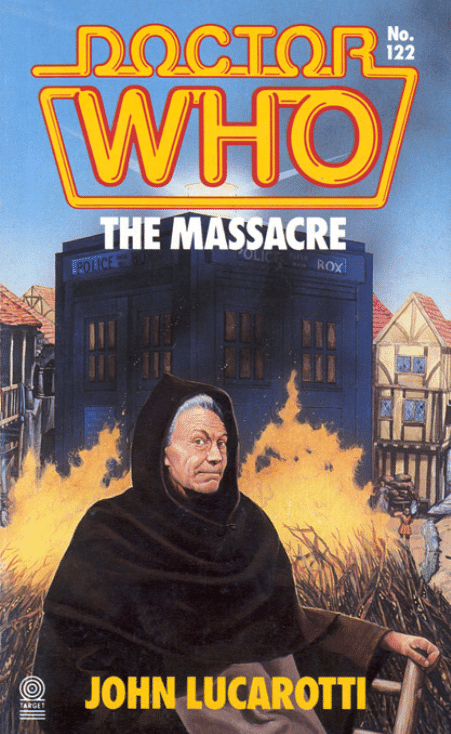

The TARDIS lands in Paris on 19 August 1572.
Driven by scientific curiosity, the Doctor
leaves Steven to meet and exchange views with
the apothecary, Charles Preslin.
Before he disappears, he warns Steven to stay
out of ‘mischief, religion and politics.’ But in
sixteenth-century Paris it is impossible to remain
a mere observer, and Steven soon finds himself
involved with a group of Huguenots.
The Protestant minority of France is being
threatened by the Catholic hierarchy, and danger
stalks the Paris streets. As Steven tries to find
his way back to the TARDIS he discovers that
one of the main persecutors of the Huguenots
appears to be – the Doctor.
Distributed by
USA: LYLE STUART INC, 120 Enterprise Ave, Secaucus, New Jersey 07094
CANADA: CANCOAST BOOKS, 90 Signet Drive, Unit 3, Weston, Ontario M9L 1T5
NEW ZEALAND: MACDONALD PUBLISHERS (NZ) LTD, 42 View Road, Glenfield, AUCKLAND, New Zealand
SOUTH AFRICA: CENTURY HUTCHINSON SOUTH AFRICA (PTY) LTD. PO Box 337, Bergvie, 2012 South Africa
UK: £1.95 USA: $3.50
CANADA: $4.95
NZ: $6.99
Science Fiction/TV Tie-in
ISBN 0-426-20297-X
,-7IA4C6-cacjhe-

DOCTOR WHO
THE MASSACRE
Based on the BBC television series by John Lucarotti by
arrangement with the British Broadcasting Corporation
JOHN LUCAROTTI
Number 122 in the
Target Doctor Who Library
A TARGET BOOK
published by
The Paperback Division of
W. H. Allen & Co. PLC

A Target Book
Published in 1987
By the Paperback Division of
W.H. Allen & Co. PLC
44 Hill Street, London W1X 8LB
First published in Great Britain by
W. H. Allen & Co. PLC 1987
Novelisation copyright © John Lucarotti 1987
Original script copyright © John Lucarotti 1966
‘Doctor Who’ series copyright © British Broadcasting
Corporation 1966, 1987
The BBC producer of The Massacre was John Wiles, the
director was Paddy Russell
The roles of the Doctor and the Abott of Ambroise were
played by William Hartnell
Printed and bound in Great Britain by
Anchor Brendon Ltd, Tiptree, Essex
ISBN 0 426 20297 X
This book is sold subject to the condition that it shall not,
by way of trade or otherwise, be lent, re-sold, hired out or
otherwise circulated without the publisher’s prior consent
in any form of binding or cover other than that in which it
is published and without a similar condition including this
condition being imposed upon the subsequent purchaser.

CONTENTS
Author’s Note
Dramatis Personae
Prologue
1 The Roman Bridge Auberge
2 Echoes of Wassy
3 The Apothecary
4 Double Trouble
5 The Proposition
6 Beds for a Night
7 Admiral de Coligny
8 The Escape
9 A Change of Clothes
10 The Hotel Lutèce
11 The Royal Audience
12 Burnt at the Stake
13 The Phoenix
14 Talk of War
15 Face to Face

Author’s Note
The historical events described in The Massacre are factual,
as were the 287 kilometres of tunnels and catacombs under
Paris, some of which may still be visited. The woodcut
engraving of the attempt on de Coligny’s life, which shows
a cowled cleric in a doorway, does exist. The author has
seen it.
John Lucarotti

DRAMATIS PERSONAE
The Doctor
Steven Taylor
Charles IX, the 22-year-old King of France
Catherine de Medici, The Queen Mother and Regent of
France
The Catholics
Henri of Anjou, the King’s younger brother
Francois, Duke of Guise
Marshall Tavannes
The Abbot of Amboise
Simon Duval, aide to the Abbot of Amboise
The Huguenots
King Henri of Navarre, Charles’s brother-in-law
Admiral de Coligny, Charles’s favourite advisor
Viscount Gaston Lerans, aide to Henri of Navarre
Anne Chaplet, the serving girl
Nicholas Muss, secretary to de Coligny
Charles Preslin, the apothecary

Prologue
The Doctor sat in the garden which always reminded him
of the Garden of Peace when Steven, no, not Steven, his
granddaughter, Susan, and that nice young couple, Barbara
and Ian, had their adventure with the Aztec Indians aeons
ago. But his reminiscences were elsewhere as he browsed
through a copy of Samuel Pepys’s famous diary of a
Londoner’s life in the second half of the seventeenth
century. He chuckled at a succinct observation and laid the
open book down beside him on the bench.
He looked around contentedly. His journeys through
time and space in the TARDIS had come to a temporary
halt. His differences, as he chose to refer to them, with the
Time Lords, of which, after all, he was one, were more or
less resolved. This celestial retirement was a far from
unpleasant condition when one’s memories were so rich.
He had had more than his fair share of adventure and
secretly he believed that his fellow Lords were a mite
jealous of his achievements.
‘As well might they be,’ he murmured to a passing
butterfly.
That was the moment when he heard their voices all
around him.
‘Doctor,’ they intoned in unison.
He looked up at the blue sky. ‘Yes, gentlemen?’
‘There is a certain matter we would –’ they continued
but the Doctor cut across them.
‘Just one spokesman, if you don’t mind,’ he said testily,
‘I’m not deaf.’
‘The subject concerns your activities –’ one of them
began.
‘Ah,’ the Doctor interjected.
‘– on the planet Earth in the sixteenth century,’ the
voice continued, ‘the year 1572 Earthtime, to be precise.’
‘My memory’s not quite what it was, gentlemen,’ the

Doctor replied, remembering in full his involvement in the
momentous events of that year. ‘Perhaps a further
indication would help me to recall exactly where the
TARDIS landed.’
‘Paris, France,’ the Time Lord said.
‘Paris, France,’ the Doctor repeated slowly as if he were
concentrating. ‘Yes, I do seem to remember some kind of
technical malfunction in the TARDIS which deposited me
there – but only briefly, I think, an hour or so in their
time, was it not?’
‘Several days, Doctor.’
‘Really? As long as that?’ The Doctor did his best to
sound surprised.
‘We shall accord you a period of time for reflection,
Doctor,’ the spokesman continued, ‘but be warned, our
research into the affair reveals that your conduct was
highly suspect.’
‘Indeed?’ the Doctor replied, and wondered how best to
extricate himself from yet another ‘difference’...

1
The Roman Bridge Auberge
The TARDIS landed with a jolt which almost threw the
young astronaut Steven Taylor off balance but the Doctor
did not seem to notice as he studied the parameters of the
time/place orientation print-out on the central control
panel of the time-machine.
‘Earth, again,’ he observed and waited for the digits of
the time print to stop as they clicked by. But they didn’t, at
least not the last two. The first settled at 1 and the second
at 5 but the last two fluctuated between 0 and 9
indiscriminately. ‘In the 1500s, we’ll know exactly when in
a moment,’ he added hopefully. But it was not to be. The
numbers kept flickering by on the screen.
‘No one should allow a kid like me to go up in a crate
like this,’ Steven joked but his humour was lost on the
Doctor. ‘Perhaps we should ask Mission Control for
permission to return for an overhaul.’
‘I am Mission Control,’ the Doctor replied sourly and
ordered Steven to open the door as he switched off the
main power drives, leaving the interior lighting on the
auxiliaries.
Steven obeyed and the stench of putrefaction which hit
him in the face almost made him ill on the spot. Under a
fierce sun in the clear blue sky the TARDIS stood in the
middle of mounds of decomposing rubbish. There was also
a wooden fence a little higher than the TARDIS which
entirely surrounded them and had a door in it.
‘Perfect,’ the Doctor observed as he looked out. He wore
his cloak over his clothes and his astrakhan hat was on his
head. In one hand he held his silver-topped cane, in the
other a handkerchief to his nose. ‘Putrescence, just what
we need,’ he added as someone on the other side of the
fence threw several rotting cabbages over it. ‘Couldn’t be

better.’
‘Your logic escapes, me, Doctor,’ Steven replied.
‘My dear boy,’ the Doctor said indulgently, ‘people
throw their rubbish over the fence rather than bring it in
which means that the TARDIS will remain unobserved
here whilst we –’ he gestured airily, ‘– explore.’
‘What’s to explore?’
‘The other side of the fence since the aromas on this
side of it give me a clue as to where we might be.’ The
Doctor momentarily lifted a corner of the handkerchief.
‘Garlic, definitely, garlic,’ he said and then told Steven to
fetch a cloak to wear so that they could begin their
exploration.
With the TARDIS locked behind them, the Doctor
picked his way delicately through the refuse towards the
door.
‘We’ll need to use the EDF system when we return,’ he
said just before they reached it.
‘What’s that?’ Steven asked.
‘The External Decontamination Function,’ the Doctor
replied.
‘A sort of spatial car-wash,’ Steven joked. The Doctor
glared at him, opened the door cautiously and peered out.
The fence was on a square of land on one side of the
unpaved, pitted street, rutted by carriage wheels. The
refuse that had not been thrown over the fence lay there
and was being picked at by emaciated dogs. The buildings
on both sides were mostly adjoining, between one and two
storeys high with overhanging eaves and slated or thatched
roofs. The walls were braced with woodenbeams and from
most of the small open windows with slatted shutters came
pungent odours of cooking.
The people on the street, and they were many, stood or
walked under the eaves or in the middle of it. There were
hawkers pushing carts laden with meats, vegetables, fish
and crustaceous seafoods of every kind. There was a knife-
sharpener with his grinding wheel, a carpenter with his

mobile lathe and the remainder of his tools in a leather
haversack on his back. There were also vendors with their
trays slung by straps from their necks, filled with every
variety of cheaply-made knicknack, and all of them were
selling their wares simultaneously at the stop of their
voices. They wore breeches, billowing shirts and clogs.
Most of them had shoulder-length hair, frequently
gathered in a bow at the back. Several had gaudy, gipsy-
like bandanas on their heads and a few wore curled, wide-
brimmed flat hats.
The women to whom they sold their goods wore full
flowing skirts and blouses and their hair was mostly tied
back with ribbons. Both buyer and seller negotiated with
shouts and yells, shoulder shrugs, arms akimbo, the
language of hands and the turning of backs, but each side
knowing that shortly the bargain would be struck.
The Doctor stood in the middle of the street, sniffed
and announced, ‘France.’
Steven smiled. ‘French is what they’re speaking,
Doctor,’ he said. ‘But when? And where?’
‘Fifteen hundred and something,’ the Doctor replied as
Steven wandered over towards the side of the street, trying
to read a sign in the ground floor window. ‘Don’t go there!’
the Doctor shouted. ‘Under the eaves or in the middle but
not there, Steven, it’s dangerous.’
‘Why?’ Steven asked and a moment later an arm
appeared from the first floor window of the house next
door and emptied a chamberpot. ‘Vive la France,’ Steven
muttered as he retreated hastily to the Doctor’s side.
‘Oh, look at that,’ the Doctor exclaimed, pointing to a
shuttered shop. ‘It’s an apothecary’s and it’s closed.’
‘Has been for some time, by the look of it,’ Steven added
as he looked at the faded paintwork on the sign.
‘In 1563, by decree, all religious prejudice was
abolished, and everyone had the right to practise according
to his or her beliefs,’ the Doctor stated. ‘But in 1567 it was
said that this pretext of religious freedom was undermining

the King’s authority.’
‘Really?’ Steven said, unable to think of anything else.
‘And amongst other restrictions, one that was imposed
was that no apothecary was permitted to exercise his
profession without a Certificate of Catholicisation,’ the
Doctor continued.
Steven stopped in the middle of the street and asked,
‘Why not? What had religion to do with a mortar and
pestle?’
‘Ideas, young man, heretical ideas concerning life and
death that were not in accord with the dogmas of the
Church of Rome,’ the Doctor replied, staring at the closed
apothecary shop. ‘The man who owned that place may well
have retired normally but equally so he may have been a
French Protestant, a Huguenot as they were called – still
are for that matter – who was driven out of business
because of his religious convictions.’
‘That’s a bit unjust,’ Steven sounded indignant.
‘A bit?’ The Doctor raised one eyebrow. ‘It got much
worse than that, Steven.’ He looked around again at the
street, at the shop and the people. ‘I wonder,’ he murmured
distractedly.
‘What, Doctor?’ Steven asked.
For a few moments the Doctor appeared not to have
heard the question and when he turned to face Steven his
eyes seemed far away and his voice was also distant. ‘Where
are we and when?’
Steven was taken aback. ‘In France in the 1500s. You
said so yourself.’
The Doctor’s eyes were suddenly sharp again and his
voice authoritative. ‘But exactly where in France, and more
precisely what date in which year?’
Steven waved an arm towards the people on the street.
‘Ask one of them,’ he exclaimed.
‘And be thought mad?’ the Doctor retored. ‘That’s a
dangerous condition in which to be considered these days,’
he added knowingly. ‘No, they are questions we must

answer for ourselves.’ He looked up at the house roofs and
beyond them. ‘The skyline should tell us where, a
cathedral spire, a tower, a château, a river.’ He paused and
then exclaimed. ‘That’s it! The river.’
He went over to a vendor with a tray of cheap
medallions and picked one up.
‘The Queen Mother, Catherine of Medici,’ the vendor
said quickly, ‘and recently struck. A good likeness, don’t
you think?’
‘Very,’ the Doctor replied and threw a small gold coin
onto the tray. ‘Where’s the river?’ he asked casually.
‘The Seine? Carry straight on, sir,’ the vendor replied as
he popped the coin into the moneybag secured to his belt
and hidden in his breeches pocked. ‘You can’t miss it.
There are two bridges, the large one onto the island where
the Cathedral is and the small one off the other side.’
‘Thank you, my good man,’ the Doctor replied jauntily.
‘Come along, Steven,’ he added and marched on down the
street. Once they were out of earshot he confided that they
were definitely in Paris. ‘You heard what he said, Steven,
the Seine, the two bridges, le Grand Pont and le Petit Pont,
and l’Ile de Cité with the Cathedral, Notre Dame.’
‘But we still don’t know the year,’ Steven reminded him.
‘If the apothecary was forced out of business, then it’s
post-67,’ the Doctor reasoned, ‘but a cursory glance at
Notre Dame will confirm that.’
‘It will?’ Steven questioned, not understanding. The
Doctor smiled at him indulgently.
‘Notre Dame, like Rome, was not built in a day,’ the
Doctor explained. ‘Nor in a century, not even a couple.
Started in the second half of the twelfth, it was completed
three centuries later, the last part being the broad steps
leading up to it. 1575 unless my memory serves me ill.’
Steven chose not to observe that it frequently had in the
past and, no doubt, would again in the future.
As they made their way along the street which
frequently twisted and turned one way and then another

they noticed that it widened and the houses became more
imposing in their style and structure. Then Steven saw the
spire of Notre Dame above the rooftops and pointed it out
to the Doctor.
‘That’s where we want to be,’ the Doctor conceded and
turned off into another street in line with the spire. Steven
noted the name of the street they had left, the rue des Fossés,
the Street of Ditches, which he thought was apt, and the
one they had entered, the rue du Grand Pont, the Street of
the Large Bridge, which they could now see ahead of them.
The bridge was made of stone and wide enough for two
horse-drawn carriages to pass in opposite directions unless
it was too crowded which invariably it was; and on either
side a jumble of houses and shops precariously overhung
the edges. As they approached the riverside the Doctor
looked to his right at the imposing square building that
stood on its own not far from the Seine.
‘The Louvre, the King’s council chamber and the first
important covered market in France,’ he observed. ‘It’s
worth a visit.’ Then he paused briefly.
‘Yes?’ Steven asked.
‘No new bridge to the island yet. That’s why it was
called le Pont Neuf, he added, ‘and started in 1578 by the
King, Henri III.’
‘So that puts us in the decade 67 to 77,’ Steven
remarked, smiling as the Doctor mopped his brow, ‘on a
midsummer’s day.’
‘A draught of chilled white wine wouldn’t be amiss,’ the
Doctor replied, ‘and there’s bound to be several inns on the
far side of the bridge.’
Once again they made their way among the bustling
throng, being pushed and squeezed to one side as a coach
with a liveried driver and a coat-of-arms emblazoned on its
doors forced a path through to the island. But once on the
other side of the river the crowd dispersed among the
streets leading away from the bridge.
‘There’s one,’ Steven said as he pointed to a sign with

the name Auberge du Pont Romain hanging on the wall of a
building with benches and tables outside where people
stood or sat, drinking and chatting. ‘Why the Roman
Bridge Inn?’ he asked.
‘Because the Romans built the original bridge,’ the
Doctor replied, ‘though they didn’t put up any houses.
They’re relatively recent, late fifteenth, early sixteerith
century.’
‘You seem to know French history like the back of your
hand, Doctor,’ Steven sounded slightly irked.
‘This period intrigues me,’ the Doctor said
enigmatically as they went inside.
The main room of the inn took up the entire ground
floor of the building. In opposing walls were several leaded
windows with tables of varying sizes with benches or chairs
spaced out across the floor. In front of the third wall stood
the wooden bar behind which were casks of wine sitting on
their sides in cradles, each one tapped. Set in the other wall
was a wide fireplace with a mantle, in the centre of which
hung a centurion’s helmet with Roman spears and
sheathed stabbing swords on either side. The ceiling was
low with heavy beams and in one corner a staircase led to
the rooms above. Almost all of the customers were outside
with only a few grouped around the bar over which
presided an aging, tall, cadaverous, balding landlord in
black breeches, hose, blouse and apron, who only spoke in
half-whispers.
‘Your pleasure, gentlemen?’ he murmured as the Doctor
and Steven approached the bar. The Doctor glanced briefly
at Steven before replying.
‘Two goblets of a light white burgundy, as chilled as is
possible,’ the Doctor replied.
‘That’ll be from the cask in the cellar,’ the landlord
muttered, ‘as cool a place as you will find on these hot-
headed August days. The lad will fetch some up,’ he added
and turned to the eleven-year-old boy who was dressed
identically to his master. After a brief whispered order the

boy lifted the trapdoor in one corner of the bar floor and
disappeared from view.
‘Now we have the month,’ Steven remarked while the
Doctor studied the group of young men who sat around a
table. Everything about them, except for one, exuded social
position and money, their clothes, their knee boots, their
swords, their rosetted or feathered hats and, above all, their
nonchalant air.
The Doctor grunted, ‘Young bloods, they’re always the
same anywhere, anytime.’
‘Not him,’ Steven pointed to the odd man out whose
clothes and attitude were less flamboyant than the others.
‘He’s employed by one of them, possibly as a secretary,
and, what’s more, I don’t think he’s French,’ the Doctor
replied, ‘he doesn’t look it. More German, I’d say.’
One of the young men looked at his companions. ‘Are
your glasses charged, my friends?’ he asked and without
waiting for a reply called to the landlord for another carafe
of wine. ‘We’ll make a toast.’
The more conservatively dressed member of the group
glanced apprehensively at the Doctor and Steven and
turned back to the young man who had spoken. ‘Be careful,
Gaston,’ he said, covering his mouth with his hand.
Gaston also glanced at the Doctor and Steven and then
laughed. ‘The trouble with you, Nicholas, is that you are
too cautious.’
‘And you are too provocative,’ Nicholas replied in
earnest. Gaston glanced over at the Doctor and Steven
again with a smile as the landlord came to the table and
refilled their goblets. Gaston picked his up as another man
came into the bar. Nicholas looked at Gaston with alarm.
‘Don’t be indiscreet,’ he warned as Gaston stood up and
raised his glass.
‘To Henri of Navarre, our Protestant king,’ Gaston
called out.
The toast had been proposed and had to be seconded.
The others stood up, including the reluctant Nicholas, and

raised their goblets. ‘To Henri of Navarre,’ they called out
in unison and drank.
The man at the bar spun around to face them and
grabbing the Doctor’s as yet untouched goblet of wine
raised it in front of his face. ‘And to his bride of yesterday,
our Catholic Princess Marguerite,’ he cried. Then he
gulped down the wine in one swallow as Gaston spluttered
and hit himself on the chest with a clenched fist.
The Doctor drew in his breath sharply as Gaston,
recovering quickly with a cough, looked at the stranger in
mild amusement and mock astonishment. ‘Simon Duval,’
he exclaimed, ‘what a surprise to find you in a tavern that’s
rid of rigid Catholic dogma.’ Then he turned to the
landlord. ‘Antoine-Marc, what decent wines have you to
offer?’ he asked, swirling the rest of his wine around the
goblet.
‘We sell the best Bordeaux to be found hereabouts, Sire,’
the landlord replied in a mumble.
‘Bordeaux. It’s such a thin Catholic concoction.’ He
turned to his companions in disdain. ‘Hardly fit for the
altar,’ he added.
Nicholas leant across the table in warning. ‘Gaston,’ he
exclaimed as Duval took a step forward, his hand reaching
for the hilt of his sword, then checked himself and eyed the
group coldly.
For his part Gaston waved each arm in the air one at a
time. ‘How would you rather I fought the duel, Simon?
With my right hand or my left?’ he asked nonchalantly.
Duval turned to Nicholas.
‘For a free-thinking German, Herr Muss, I congratulate
you on your good sense,’ he said and inclined his head to
the conservatively dressed Nicholas. ‘But I am dismayed to
find you in a tavern where our Princess Marguerite is
seemingly game for insult.’
Gaston raised an eyebrow. ‘Insult, Simon? I am not
aware of any said or intended against the noble lady.
Indeed, quite the opposite. I asked Antoine-Marc for a

wine as befits her rank and future. A bold burgundy of
character, don’t you agree, Nicholas?’ he smiled at his
friend who stood grim-faced across the table and then,
without waiting for a reply, ordered a carafe and more
glasses from the landlord.
The Doctor and Steven watched in silence as the
confrontation was played out. Both Gaston and Simon
Duval were tall, handsome young men who bore
themselves with the authority of social status and wealth
although Gaston’s air was the more languid. He was blond
and fair-skinned with pale blue eyes where Simon’s
complexion was more Latin and his eyes were brown. The
barboy carried the tray of goblets and set it down on the
table. Antoine-Marc brought over the carafe of wine and
poured equal measures into each glass. Then he withdrew
to safety behind the bar.
Gaston toyed with the stem of his goblet. ‘What was the
toast again, Simon?’ he asked.
‘The health, Viscount Lerans, of our Catholic Princess
Marguerite,’ Simon replied through clenched teeth.
‘So it was,’ Lerans replied lightly, looking around, ‘and
so let it be, gentlemen.’ He raised his glass. ‘To Henri’s
bride,’ he said and drank. Duval and the others followed
suit.
‘Is honour satisfied, Simon?’ Lerans asked as he
reclined again in his chair.
‘For the time being, Viscount Lerans,’ Duval replied as
he put down his goblet and walked to the bar. ‘I owe this
gentleman a glass of white wine,’ he said, pointing to the
Doctor. ‘Be so kind as to serve both him and his
companion another.’ He placed a coin on the bar.
‘That’s most agreeable of you, sir,’ the Doctor replied as
Duval nodded briefly to him and then, without looking at
the group at the table, left the inn.
As soon as Duval had gone, Lerans burst out laughing.
His friend, Nicholas Muss, looked at him angrily. ‘Why do
you provoke quarrels, Gaston?’ he demanded. ‘Aren’t

things difficult enough for us as they are?’
‘I would have thought that after yesterday’s marriage we
are, for the first time, my friend, in a position of strength,’
Lerans replied, ‘and the Catholics must accept that we are
no longer the underdogs.’ He stood up. ‘Let’s go to the
Louvre and hear the latest gossip of the Court.’ He threw a
gold coin on the table and with a curt bow to the Doctor
and Steven led the way out.
The Doctor and Steven watched while Antoine-Marc
poured their goblets of wine. Then the Doctor picked his
up and beckoned to Steven to follow him to a table where
they sat down out of earshot of the landlord.
‘It is the nineteenth of August in the year 1572,’ the
Doctor whispered dramatically.
‘Is that a guess or good judgement?’ Steven queried.
‘And, if the latter, what’s it based on?’
‘Their conversation.’ The Doctor glanced at the
landlord pocketting the coin that Gaston had left on the
table while the barboy put the empty goblets on a tray.
Then the Doctor leant forward confidentially. ‘The young
Protestant King Henri of Navarre married the Catholic
Princess Marguerite of Valois on the eighteenth of August
and Duval said the nuptials were celebrated yesterday.’
‘Yes, I heard that,’ Steven confirmed.
‘In which case, this is neither a place nor a time in
which to tarry,’ the Doctor said categorically.
‘Then drink up and we’ll move on,’ Steven replied. The
Doctor reached across the table and grabbed Steven’s hand.
‘No, first there is someone here I wish to talk to,’ the
Doctor said and explained that it concerned a scientific
matter which would hold no interest for Steven. ‘A simple
exchange of ideas to give me a better understanding of his
work,’ he concluded.
‘But you’ve just said we should be on our way,’ Steven
protested.
‘There’s no immediate danger and I shall be gone for
only a few hours at the most,’ the Doctor assured him.

‘What’s his subject?’ Steven asked, his curiosity aroused.
‘He’s an apothecary.’ The Doctor tried to sound off-
hand.
‘Not struck off, by any chance?’ Steven remembered the
Doctor’s distant look when they were in the street and the
murmured ‘I wonder.’
‘That’s – er – rather what I hope to – hum – find out,’
the Doctor answered uncomfortably.
‘And you know where his shop is?’ Steven persisted.
‘The general area – yes,’ the Doctor sounded vague.
‘Then I’ll help you find him,’ Steven smiled. ‘It’ll cut
the time in half and then we can be off.’
‘I’d rather you didn’t.’ The Doctor was on the defensive.
‘He’s a secretive man and does not take kindly to
strangers.’
‘So, you know him.’
The Doctor shook his head. ‘Only read about him in
some half-destroyed documents I once found. His name
was Prenlin, or Preslin, and he was on to something quite
important, but the documents didn’t say what. As I’ve said,
they were half-ruined and he was only a footnote.’
Steven sipped his wine. ‘But an intriguing one and you
want to play detective.’
The Doctor semi-smiled. ‘I suppose you could put it
that way,’ he admitted.
‘Then off you go, Doctor, and I wish you luck. But
where shall we meet, and when?’ Steven asked.
The Doctor thought for a moment before replying.
‘Here, Steven, this evening after the Cathedral has rung the
Vesper-bell which can be heard all over Paris.’ He put his
hand in his pocket, took out some coins and placed them
on the table. ‘You’ll need this,’ he added. ‘but stay out of
mischief, religion and politics.’
‘The last two are one and the same from what I can
gather,’ Steven replied, scooping the money into his
pocket.
‘And spell trouble, young man, so be warned.’ Then the

Doctor looked at the landlord. ‘Is it possible to find a
carriage hereabouts, landlord?’ he asked.
‘There’s always one or two for hire in front of Notre
Dame, sir,’ Antoine-Marc murmured, looking off into the
middle distance. ‘Shall I send the lad to fetch one?’
‘No, no, we’ll walk,’ the Doctor replied. ‘What do I owe
you?’
‘Nothing, sir. I took the liberty of permitting the other
gentleman to pay for all four glasses. It seemed the proper
thing to do,’ he whispered as convincingly as he could. The
Doctor stood up and left ten sous on the table.
‘I’ll walk with you,’ Steven volunteered and together
they left the auberge.
Notre Dame Cathedral stood at the back of a large
square on the eastern end of the island and Steven noticed
that the broad steps in front of it were completed. He
remarked on the fact to the Doctor but in reply received
only a noncommittal grunt. On one side of the square were
four carriages. The first three were ornate with crested
doors and plumed horses. The fourth was less elaborate
and the horse had a careworn air.
‘That’ll be the one for hire,’ the Doctor observed. ‘The
other three must be for the clerical hierarchy, by the look
of them.’
‘An ecclesiastical conclave,’ Steven suggested.
‘And no doubt plotting some mischief in the name of
God,’ the Doctor added and looked up at the driver. ‘Saint
Martin’s Gate in Montparnasse,’ he ordered, then opened
the door and sat down inside before looking down at
Steven. ‘Now, don’t forget to be at the auberge...’
‘After the Tocsin’s sounded,’ Steven completed the
phrase and the Doctor looked mildly exasperated.
‘Not the Tocsin, the Vesper-bell,’ he said and then told
the driver to move on. ‘The Tocsin’s a warning bell,’ he
threw at Steven as the carriage clattered away.
What neither of them knew was that Steven’s name for
the bell was by far the more accurate for both of them.

2
Echoes of Wassy
Simon Duval lurked under an archway near the bridge
which gave him an uninterrupted view of the auberge and
withdrew further back into the shadows as Viscount
Lerans, Nicholas Muss and the remainder of their party
came out and sauntered in his direction towards the
bridge.
Duval strained to overhear their conversation but even
their laughter was drowned out by the noises of the crowd.
He thought that it was most probably some vicious
pleasantry at the expense of the Catholic princess which
gave them such perverse delight. Then it was his turn to
chuckle as he reminded himself how short-lived their airs
and graces would be.
Shortly afterwards he watched with curiosity as the
Doctor and Steven left. He wondered who they might be.
Certainly they did not appear to be Frenchmen and his
inclinations were that they were English, Protestants, no
doubt, in Paris to support the Huguenot cause. Why else
would they have been in the Auberge du Pont Romain which
was becoming known among Catholics as a meeting place
for Huguenots?
He decided that their presence would be worth
reporting to his new superior, the Abbot of Amboise, who
was arriving that same evening to replace Cardinal
Lorraine who had ben summoned to Rome three days
before the royal wedding festivities. Duval had not yet met
the Abbot but knew of him, by reputation, as a Man of God
who sternly opposed all religious leanings not embraced by
the Holy See.
Then he went back into the auberge. ‘A word with you,
landlord,’ he said, pointing at Antoine-Marc as he crossed
over to the bar. Antoine-Marc looked alarmed and began

mumbling something about the change from the money for
the strangers’ drinks but Duval cut him short. ‘Who were
they, do you know?’ he asked.
‘I’d never seen them before, sir,’ Antoine-Marc
muttered.
‘Had the others – Viscount Lerans and Nicholas Muss –
do you think?’ Duval jingled some coins in his pocket.
Antoine-Marc pursed his lips. ‘Not that they gave any
sign, sir, but, of course, it’s difficult to say these days,’ he
drew out the last few murmured words to emphasise them,
‘what with the problems and me being a landlord obliged
to serve all who enter.’
‘But most of the time you know your customers?’ Duval
persisted.
‘If you are referring to the Huguenot gentlemen, sir, oh
yes, I know them well.’ Antoine-Marc’s whisper was sly.
‘Viscount Lerans and Nicholas Muss and their associates
frequently take a glass of wine here.’ He raised a protesting
hand. ‘Not, mark you, sir, by my choice, but a man must
live and a glass of wine down anyone’s gullet, be he
Catholic or Huguenot, puts two sous in my till.’
‘Watch and listen and I’ll put in more.’ Duval was
brusque as he placed some coins on the counter. Antoine-
Marc inclined his head slightly, took a goblet from under
the bar, placed it in front of Duval and poured in some
wine from a carafe.
‘Your continued good health, sir,’ Antoine-Marc
murmured as he scooped up the coins.
Steven had stood watching the Doctor’s carriage trundle
away across the small bridge on the south side of the island
until it was out of sight. Then he looked up at the ornate
twin towers of the Cathedral in front of him and decided to
go inside.
As he walked across the square he passed the three
stationary carriages with their liveried drivers immobile in
their seats under the broiling sun. One of the horses pawed

the ground briefly with a hoot, the second switched its tail
and, as Steven mounted the steps to the massive, intricately
carved western entrance, the third horse nodded its
plumed head.
Steven went into the shade and the coolness of the
interior. Candles burned in groups on either side of the
main altar and he looked around at the massive pillars
decorated with tapestries and heraldic banners stretching
up to the central dome high above him. There was a faint
lingering fragrance of incense in the air and as he sat down
in a pew he had a fleeting vision of the majestic pomp and
circumstance of the previous day’s marriage.
Now Notre Dame wore a mantle of serenity. Yet Steven
had seen and heard the confrontation in the auberge and
the Doctor had warned him that it was not a time for them
to linger in.
Involuntarily he shivered and wished that the Doctor
were with him. Now, that was absurd! He’d been in scrapes
before, both with and without the Doctor, in the past and
in the future, on earth and in the galaxies. Yet here, in the
peace and quiet of the Cathedral, he felt disquieted and
decided that the sunshine outside was preferable.
As he stood up to leave he saw three clergymen hurrying
along one aisle towards the door. They were richly dressed
in flowing robes and capes with skull caps on their heads.
They were talking among themselves and Stephen
overheard one of the priests, a well-built, rotund man, say
in a booming voice: ‘... with the Most Illustrious in Rome,
my Lord Abbot will allow them no shriving time, God be
praised.’
One of the other two, a cadaverous man whose hands
clutched the golden cross hanging around his neck,
chuckled. ‘Not even a few seconds for Vespers,’ he added as
they swept out through the open doorway.
The words ‘shriving time’ struck a distant chord in
Steven’s memory. Hadn’t they something to do with
death? he asked himself as he went out into the sweltering

mid-afternoon sunlight. As he worried the phrase in his
brain, his feet led him instinctively back towards the
auberge.
‘It’s from a play,’ he said aloud. ‘Oh, come on, Taylor,
you’ve acted in it, said those very words, “shriving time”.’
He began to sound angry as he struggled to remember.
‘When you were training to become an astronaut. Come on,
think. Name the plays you were in, idiot.’ He was furious
now and did not see the young girl who came running
around the corner and collided with him. ‘Whoa,’ he called
out as he grabbed her by the shoulders spinning both of
them around to keep their balance. ‘What’s the hurry?’
The girl looked at Steven in terror then wrenched
herself free from his hold and ran into the auberge. Steven,
taken aback, looked at the open door but from where he
stood he could not see inside.
‘Get out of my way,’ a voice snapped behind him and
Steven was roughly pushed to one side.
‘Watch it,’ Steven exclaimed as the man wearing an
officer’s uniform with a drawn sword and two other men
with pikes stormed into the auberge. Steven moved over to
the entrance and looked in.
The officer stood with his legs astride and pointed his
sword around the room at the customers. ‘Where’s the
girl?’ he demanded.
Viscount Lerans, Nicholas Muss and their friends were
seated back at their table with goblets of wine. Lerans had
his feet on the table.
‘Don’t point that thing at me, fellow,’ said Lerans. His
light tone carried a hint of menace as he lowered his feet
leisurely one at a time to the floor.
‘I am the Most Illustrious Cardinal Lorraine’s officer of
the guard and my orders are to apprehend the girl.’ The
officer tried to sound impressive. ‘So where is she?’
‘Well, I am the Viscount Lerans,’ he replied
nonchalantly as he stood up and rested his hand on the hilt
of his sword, ‘and I’m curious to know why three grown-

up, armed men should be pursuing a slip of a girl.’
‘She is a serving wench, Sire, who has run away from the
Most Illustrious Cardinal’s house and I am to fetch her
back,’ the officer replied.
‘But he’s away, isn’t he?’ Lerans bantered.
‘Who, Sire?’
‘Lorraine. In Rome or somewhere.’ Lerans glanced at
Muss for confirmation. The officer drew in his breath
sharply but realised that a sword and two pikes were no
match for the young men around the table.
‘She has been assigned to the Abbot of Amboise’s staff,’
the officer persisted.
Lerans studied the tip of one of his boots before
replying. ‘If she cared so little for one cleric’s service as to
run away, I doubt that she’d fare any better in another’s,’
he chuckled. ‘Above all, that of Amboise.’
‘Is the girl here, Sire?’ The officer chose to ignore the
scarcely veiled insults.
‘Yes,’ Lerans replied, ‘she’s crouched under the bar.’
Antoine-Marc who stood behind it, looked alarmed.
‘Seize her,’ the officer ordered the pikemen.
‘No,’ Lerans countermanded sharply, ‘leave her be.’
The officer hesitated before turning back to him.
‘Viscount Lerans, my Lord the Abbot of Amboise shall
learn of this occurrence when he arrives this evening and
he will no doubt act accordingly.’
‘No doubt,’ Lerans agreed affably and the officer of the
guard with his two pikemen turned on their heels and left
the auberge.
Steven stood to one side to let them pass. Then Lerans
saw him. ‘Ah, this morning’s stranger,’ he called out and
turned to Muss: ‘Remember him, Nicholas, when we made
sport with Simon Duval?’ Without waiting for a reply he
turned back to Steven. ‘Come and join us,’ he offered.
Steven crossed the room towards them. ‘What will you
do about the girl?’ he asked as Antoine-Marc brought
another goblet from the bar.

‘Oh, yes, the girl,’ Lerans exclaimed in mock surprise.
‘I’d forgotten about her.’ He clapped his hands. ‘You can
stand up now, wench,’ he called and the girl rose cautiously
from behind the bar. ‘Come here, no harm’ll fall upon you.’
The girl edged her way towards the table while Antoine-
Marc filled Steven’s goblet. ‘You shouldn’t play those sort
of games here, Sire,’ the landlord half-whispered to Lerans.
‘It’ll give my establishment a bad reputation.’
‘A bad one!’ Lerans laughed as he sank back into his
chair and pointed at the girl: ‘As a defender of helpless
maidens, how can that possibly be bad?’ He indicated a
chair and invited Steven to sit down. ‘English, aren’t you
and in Paris for yesterday’s celebrations?’
‘English, yes, but we only arrived today and are just
passing through,’ Steven replied.
Lerans picked up his goblet. ‘Where is your friend, the
older man?’
‘He’s gone to Montparnasse to visit an apothecary.’
Behind the bar Antoine-Marc had pricked up his ears.
Lerans raised his eyebrows. ‘Is he sick?’ he asked and
added that there were plenty of apothecaries in the
immediate neighbourhood. Steven explained that his
friend was a doctor and that the visit was a professional
one, an exchange of ideas.
Muss’s eyes narrowed. ‘A practising apothecary?’ he
enquired.
‘I don’t know,’ Steven replied.
‘What’s his name?’
Steven thought for a moment. ‘The Doctor did mention
it. Premlin, something like that.’
‘Preslin, Charles Preslin,’ Muss stated. ‘A Huguenot.’
Lerans snorted with delight. ‘Nicholas was fishing to
subtly discover whether you’re pro-Catholic or for us.’
Steven smiled. ‘I’m neutral,’ he said.
‘We, as you may have gathered, are not.’ Lerans glanced
at the girl who stood meekly beside the table. ‘And baiting
Catholics is my favourite sport.’

‘So I’ve noticed,’ Steven admitted with a laugh. Lerans
picked up his goblet. ‘Here’s a toast to your Queen Bess,
our ally, long may she reign’. They all rose and drank to
Queen Elizabeth’s health. Then he turned his attention to
the girl. ‘What’s your name, child?’ he asked.
‘Anne Chaplet,’ she replied.
‘In the service of the Most Illustrious Cardinal
Lorraine.’ He made the title sound ludicrous. ‘Yet a good
Catholic girl like you runs away – why?’
‘I’m not a Catholic, sir,’ Anne’s mouth was set
stubbornly.
Lerans looked at the others and then at her in
astonishment. ‘You’re a Huguenot,’ he exclaimed.
‘Yes, sir,’ she replied proudly.
Lerans chortled. ‘We must send you back,’ he rubbed
his hands together gleefully, ‘and have a spy in the
household.’
‘Oh, no, sir, please not that,’ she begged. ‘I don’t know
would what they would do to me.’
‘For running away? A good thrashing, I suppose.’
Lerans’ manner was only half-teasing. ‘But now that you’re
in contact with us, it’d be worth it, surely?’
‘But it wouldn’t be for running away, sir, it’d be for
something I overheard.’
Everyone around the table glanced at one another before
leaning towards her, their faces serious.
‘What did you overhear, Anne?’ Lerans measured out
his words.
‘Wassy,’ she replied. Steven did not understand but the
others obviously did.
‘What about Wassy?’ Lerans’s voice hardened.
‘It might happen again before the week’s out,’ she said,
wringing her hands. There was a catch in her voice as she
added: ‘That’s where I come from and that’s where my
father was murdered.’
Lerans reached out, placed his hands on Anne’s
shoulders, and looked directly into her eyes. ‘It’s very, very

important, Anne, that you remember every word you
overheard.’
Anne nodded and took a deep breath: ‘I was walking
along a corridor in the servants’ quarters, the one where
the Cardinal’s guards are housed, and I passed their door
which was open. There were two men in the room. One of
them was the officer who came here to take me back and
the other was a man I didn’t know but the officer called
him Roger when he said that there’d be more celebrations
before the week was out and that it’d be just like Wassy all
over again.’
Steven broke the ensuing silence. ‘May I ask where
Wassy is and what happened there?’
Nicholas Muss told him that Wassy was a small town
about two hundred kilometres to the east of Paris. In
March, 1562, some soldiers under the leadership of the
staunchly Catholic Duke Francois de Guise had massacred
twenty-five Huguenots who were attending a service in
their Reform Church there. Steven glanced at Anne.
‘My brother and I escaped by clambering up into the
loft and jumping from the roof onto a hayrick before the
Church was set on fire,’ she said simply. ‘My father was not
so lucky.’
‘It was the spark which ignited the Religious Wars in
France,’ Muss added, ‘and there have been sporadic out-
breaks of violence all over the country ever since. Francois
de Guise was assassinated within the year. Sudden death
without time to confess became the rule of thumb between
Huguenots and Catholics. But we hope that yesterday’s
marriage will bring about a reconciliation.’
Suddenly a chord was struck in Steven’s brain. He knew
the play where he had spoken those lines mentioning
shriving time. They were from Hamlet. He had played the
Prince who, plotting revenge for his father’s murder, cries
out:
‘He should those bearers put to sudden death

Not shriving time allowed.’
Of course: ‘shriving time’–the time allowed to a
condemned man so that he may make peace with God
before his execution.
What had the cleric said? ‘with the Most Illustrious in
Rome, [Steven now knew who he was] my Lord Abbot will
allow them no shriving time.’ The other priest had added:
‘Not even a few seconds for Vespers.’ Combined with
Anne’s story, it could only mean a Catholic conspiracy
against ‘them’. But who were ‘them’? He decided to let
Gaston and Nicholas solve that one.
‘Now, let me tell you what I overheard earlier this
afternoon’, Steven said, remembering not to mention a
play that hadn’t yet been written. ‘It was meaningless to
me until I heard what Anne had to say.’ He repeated word
for word the incident in the Cathedral.
There was a long silence after he had finished which
was finally broken by Lerans who looked at Anne and then
at Muss. ‘Safe-keeping for the girl, Nicholas, where?’ His
voice was brisk, authoritative.
‘The Admiral’s house,’ Muss replied without hesitation.
‘Where better than the residence of the Queen Mother’s
closest advisor?’ He turned to Steven: ‘Admiral de Coligny,
he’s a Huguenot, one of us, and as his secretary, I can keep
an eye on her.’
Lerans looked at two of his young companions.
‘Fabrice, you and Alain take her there,’ he ordered before
turning to Steven. ‘Now, what about you, Englishman?’ He
paused and then smiled. ‘Forgive my ill manners, I have
not introduced myself nor asked your name.’ He bowed his
head slightly. ‘I am Gaston, Viscount Lerans, the personal
aide to His Majesty, Henri of Navarre.’
‘My name’s Steven Taylor,’ Steven said and, half-raising
his hands in a mild protest, added, ‘but I’m not involved.
I’ve told you all I know and now I’m waiting for my friend,
the Doctor, to return as we’re both just passing through.’

‘Then I wish you well and a safe journey home,’ Lerans
replied and turned to the others. ‘Gentlemen, we have
matters to attend to.’ He walked over to the bar and place a
coin on it. ‘That should be sufficient, I think, including a
glass each for the Englishman and his friend when he
comes back,’ he said and, followed by Muss and the
remaining companion, went outside. Antoine-Marc
pocketed the coin and thought how much more would be
coming to him when next he spoke to Simon Duval.
Once they were on the street Lerans took Muss by the
arm. ‘Them,’ he said urgently and repeated it. ‘Us? All of
us? That’s unthinkable: we’re more than ten thousand
strong in Paris.’
‘Then a faction,’ Muss replied. ‘Not your master for that
would bring about a catastrophe for both causes.’
‘I agree. But nonetheless a group of us has been selected
for the Abbot’s justice.’ Lerans almost spat out the last
word.
‘But which one?’ Muss spread his hands in despair.
‘If I were a Catholic – which merciful Heaven I’m not –
I would consider that the most contentious Huguenots,
more so than our clergy, are those whose theories and
experiments had them disenabled in ’67,’ Lerans replied.
‘The apothecaries!’ Muss exclaimed.
Lerans pointed back at the auberge. ‘And if what that
young Englishman said is true, we have only a few hours in
which to warn them.’
‘Until Vespers.’
‘So we’ve no time to waste.’
They both strode off purposefully, forgetting that the
Doctor had gone to exchange ideas with a Huguenot
apothecary named Preslin.

3
The Apothecary
The windows were open yet the heat inside the carriage
was stifling as it rattled across the cobblestone streets
towards the Sorbonne, jiggling the Doctor about and
making him perspire profusely. But his physical
discomfort was far outweighed by the curiosity which had
led him to make the spur-of-the-moment decision to visit
Charles Preslin.
The carriage came to a halt and the driver, leaning over,
looked down. ‘That’ll be twenty sous,’ he said and the
Doctor handed him thirty as he stepped out. The driver
tipped his hat, shook the reins and the carriage rumbled
away.
The Doctor looked around him. The Sorbonne tower
stood in the centre of a small circus from which six busy
streets radiated like the spokes of a wheel. The Doctor
studied each of them in turn, looking for the mortar and
pestle sign of an apothecary. He could see three such signs
within the first thirty metres, all in different streets, and
set off to investigate each one in turn, knowing that,
regardless of the one he chose to begin with, the shop he
wanted would be the third.
Which, of course, it was and, moreover, it was closed
and had been for some considerable time by the state of it.
The window shutters were closed, the door locked and the
nameplate barely legible but the Doctor managed to
discern the name Chas. Preslin.
He moved back into the centre of the crowded street to
obtain a better overall view of the building. It was a two
storey house similar to the ones they had seen when they
left the TARDIS on the rubbish dump. There were two
windows on each floor and three of them were shuttered.
The fourth and smallest was the top one on the lefthand

side. At least someone lived there, the Doctor thought and
noticed a narrow lane between two houses a few metres
further down the street. ‘I’ll try the back door,’ the Doctor
muttered to himself and walked towards it, counting front
doors on the way.
The length of the lane was littered with rubbish and
opened out onto a general area of wasteland between the
backs of the houses. Some people had tried to cultivate
their small patches of soil in which vegetables struggled to
grow. Others kept pigs or hens in compounds and there
were a few tethered goats. The Doctor put his handkerchief
to his nose as he made his way among the washing lines
slung between the back windows and poles stuck in the
earth. He counted back doors as he went along until he
reached the one he calculated would be Preslin’s. He
knocked on it with his cane and waited. No one came to
the door so he looked up and saw that all the windows were
shuttered. He knocked again but there was still no reply.
‘There’s no good you doing that, he won’t come to the
door,’ a rosy-cheeked, stout woman announced from her
window in the house next door as she prodded some
washing out onto the line with a stick.
The Doctor looked up at her and raised his hat. ‘Pray,
how does one attract Monsieur Preslin’s attention,
madam?’
‘You open the door and you go inside,’ she replied.
‘Thank you, madam,’ the Doctor said and did as she had
advised, closing the door behind him.
Enough light filtered through the rear shutters toallow
the Doctor to make out his surroundings. The room
appeared to be an abandoned laboratory with bottles, jars,
phials and jugs stacked on several shelves around the walls.
In the middle of the room there was a table, covered with
dust with mortars and pestles and measuring instruments
lying on it. There was a door which the Doctor decided led
to the shop so he opened it and went into the short
corridor which lay beyond.

On his right was a narrow staircase winding up to the
floors above. The Doctor stood still and listened. He could
hear no sounds. ‘Monsieur Preslin,’ he called out and
waited. There was no reply. ‘Charles Preslin,’ he repeated
but again there was only silence. He sighed and opened the
door in front of him. He was right. It led to the shop with
its dust-covered counter and cobwebbed shelves. He went
back into the corridor and mounted the stairs. He looked
into both rooms on the first floor. One of them was a
bedroom and the other appeared to be a library. He went
up to the second floor and opened the door of the room
with the open shutter. A man sat at a desk by the window.
He was writing with a quill pen in a ledger and several
sheets of paper lay on the desk. The man did not look up as
the Doctor came into the room.
‘Is that you, David?’ he asked, his pen still scratching on
the parchment.
‘No, it’s not,’ the Doctor replied and waited as the man
carefully laid down his pen on the desk and then slowly, as
if preparing himself for a shock, turned around as he
removed the small half-spectacles from the tip of his nose.
‘And who may you be, sir?’ he asked quietly and
politely.
‘A doctor,’ the Doctor replied.
‘There are many such,’ the man replied as he stood up,
‘with clothes of different cuts, medicine, philosophy, the
sciences, even the arts.’ He studied the Doctor’s cape for a
moment before asking what lay under it. The Doctor
flicked it back off his shoulders and the man stared at him
for a while before speaking. ‘A strange attire,’ he observed
finally.
The Doctor smiled. ‘Of my own design,’ he said. ‘I
travel a lot and cannot abide discomfort.’ Then he
hesitated fractionally before asking, ‘You are Charles
Preslin, I presume?’
‘A doctor of what, did you say?’ the man said as the
Doctor took stock of him. He was in his fifties, of average

height, slim, balding with shoulder-length straggling grey
hair and with intelligent eyes in a careworn race.
‘Actually, I didn’t say,’ the Doctor replied and then
smiled, ‘a bit of everything, really, a doctor of dabbling, I
suppose, who’s looking for an apothecary named Charles
Preslin.’
‘To what end?’ the man asked.
‘It refers to a footnote I read in a scientific journal,’ the
Doctor explained and the man smiled wryly.
‘Oh, that,’ he said and, admitting that he was Preslin,
continued, ‘it dates back to ’66 when a few colleagues and I
were engaged in some research. It was just before the
certificate of Catholicisation was brought into force. And
that, of course, put paid to our work.’
‘Which was?’ the Doctor asked innocently.
Preslin’s eyes darkened with suspicion and, stretching
his left arm out, he raised his forefinger and waved it like a
metronome in front of the Doctor’s face. ‘Tch-tch-tch,’ he
clicked with his tongue, ‘you do not catch me out like that,
sir. I am too old and wily to confess conveniently to
heresy.’
‘I assure you, Monsieur Preslin, that was far from my
intention.’ The Doctor’s indignation was suddenly broken
by the sound of feet hurrying up the stairs. An armed,
heavily-set man barged breathlessly into the room.
‘The ferrets are abroad, Charles,’ he gasped before he
saw the Doctor. ‘Who’s he?’ he demanded, his hand
moving to the hilt of his sword.
‘A weasel, perhaps, I don’t know. But he’s been asking
questions,’ Preslin replied.
The man half-drew his sword. ‘They’re using the
Abbot’s arrival as an excuse to round us up. So let’s
despatch him and leave his carcass to the ferrets.’
‘Just a minute,’ the Doctor cut in angrily. ‘I came here
in good faith to talk to Monsieur Preslin and now I’m
being called a weasel and you’re proposing to leave my
body for the ferrets. I have no idea of what you’re talking

about.’
Preslin hesitated before admitting that the Doctor
might be telling the truth.
‘And if he’s not?’ the other one asked. ‘He’ll tell the
ferrets our escape route. No, we can’t risk it.’ He was
adamant and took a step towards the Doctor as he drew his
sword.
‘Put up your sword, David,’ Preslin spoke sharply and
then turned to the Doctor. ‘I must oblige you to come with
us, sir,’ he said.
‘That’s folly,’ David protested, pointing his sword at the
Doctor.
‘If he’s innocent, he’ll have time to prove it,’ Preslin
replied, ‘and if we find he’s guilty, well then, nothing’s
lost. Just keep an eye on him, David, whilst I tidy up.’
As Preslin busied himself at the desk, the Doctor asked
questions. He wanted to know who the ferrets and weasels
were and was told they were two species of Catholic
militants, both as unpleasant as they were dangerous.
Preslin closed the shutters and went into the other room to
collect his jacket.
‘I know your face. I’ve seen it before,’ David remarked
unpleasantly. ‘It was a long time ago when you were
younger. Say, ten years. About then...’
The Doctor shook his head. ‘You’re very much
mistaken, sir,’ he replied. ‘We’ve never met until now and,
once I have secured my release, you may rest assured that
you will never see me again.’
‘I’ve met this man,’ David said aggressively to Preslin as
he came back into the room.
‘Where?’ Preslin asked, eyeing the Doctor with renewed
suspicion.
‘I don’t remember – yet. It was not a pleasant encounter,
that much I can recall.’ David’s voice was filled with
menace. ‘But I’ll get it, have no doubt.’
‘Lead the way down the stairs. But prudently,’ Preslin
advised the Doctor as David indicated the open door with

his sword. It occurred to the Doctor that he might just
have time enough to slam it shut in their faces. ‘And don’t
touch the door whatever you think to do,’ Preslin added for
good measure.
They went downstairs and stood in the corridor. Preslin
opened the door into the shop and beckoned the Doctor to
go through.
‘I still think you are mistaken to insist that he
accompanies us,’ David stated as they passed into the shop.
‘We’ll debate it later,’ Preslin replied as he crossed over
to a shelf behind the counter and, lifting off a large jar
filled with dark green liquid, pressed the panel of wood
behind it. A section of shelves the width of a door swung
silently open. Beyond it was a flight of stone stairs leading
downwards. Preslin took a taper from under the counter
and lit it. Then the three of them left the shop and went
down the stairs with Preslin carefully pulling the secret
entrance shut after him.
With the flickering taper as their only light they made
their way carefully down the steps until they reached the
side of a narrow tunnel which led away in both directions.
In front, the Doctor hesitated at the entrance.
‘Turn left,’ Preslin said and they made their way along
the tunnel. The Doctor noted that there was a slight cool
dry breeze and that several other sets of stairs led into the
tunnel. They walked without talking, their footsteps
reverberating off the walls into the distance. Suddenly they
saw another flickering taper ahead of them.
‘Jules?’ Preslin called.
‘Yes, Charles?’ echoed the reply.
‘Are there many others?’ David shouted.
A peal of laughter came bouncing off the walls towards
them followed by the same voice: ‘You know how swiftly
Lerans and Muss can move.’
Lerans and Muss: the Doctor immediately recognised
the names and thought he could see a ray of light in the
tunnels of his mind, a way to extricate himself from the

predicament in which he found himself. ‘The gentleman’s
referring to Viscount Gaston Lerans and his friend,
Nicholas Muss, I believe,’ he said.
‘You know them?’ Preslin asked.
‘Coincidentally,’ the Doctor tried to sound nonchalant.
‘This afternoon, just before I came to see you, my
companion and I drank a goblet of wine with them in the
Roman Bridge Inn.’
‘How fortuitous,’ David replied sarcastically, ‘that you
just happened to be in the right place at the right time.’
‘Did you speak to them?’ Preslin asked.
‘Not exactly, no,’ the Doctor conceded. ‘They were
having an altercation with a man named Simon Duval.’
‘That pig!’ The words erupted from David’s mouth.
‘What was the row about?’ Preslin put the question
quietly in an effort to calm down David. The Doctor told
him everything that had happened whilst he was at the
Inn. David laughed at Lerans’s jibes to Duval.
‘Lerans is a bold one, a man after my own heart,’ he
exclaimed.
‘But lacking in discretion,’ Preslin said.
‘Exactly what Nicholas Muss remarked,’ the Doctor
added.
‘No matter, Lerans has the Admiral’s protection and
that’s as good as the Queen Mother’s.’ David was scornful
of Preslin’s concern. ‘Only by the law can they catch us
out, which is why there are ferrets and weasels,’ he
emphasised the word, ‘in our midst.’
Beyond the taper in front of them was a faint glow of
light and the Doctor became aware of the murmur of
voices. Then the taper disappeared to the right.
‘It sounds as though everyone was warned in time,’
Preslin remarked as the light became brighter and the
voices louder.
They reached the end of the tunnel and on turning to
the right entered a large, well-lit vaulted cave. There were
tables laden with bread, cheeses, cold meats and flasks of

wine, drawn from the casks which lined one side. There
were at least fifty people in the cave – men, women and
children – and the air was filled with the babble of voices
as the children played, the women prepared food or came
from or went into small cubicles which were cut into the
walls, and then stood and talked among themselves.
‘What have you there, Charles?’ a heavy-set bearded
man asked Preslin as they came into the cave. He indicated
the Doctor.
‘He claims he’s a traveller, passing through, who came
to talk to me about my work,’ Preslin replied.
‘Not one word of which I believe,’ David’s voice rang
out in hatred. ‘He’s a spy, a Catholic spy, a weasel sent
among us by Charles de Guise, the Most Illustrious
Cardinal of Lorraine.’ One of the listeners, a man of
medium height and flaming red hair, rubbed his chin
thoughtfully.
‘You’re talking rubbish,’ the Doctor retorted angrily.
‘What Charles Preslin has said is the truth.’
‘The tale you’ve told him’, retaliated David, ‘but I know
your face.’
‘As I do,’ the red-haired man said as deep laughter
began to rumble up from his belly. ‘He’s not a spy, he’s
much more than that.’
‘Then who is he?’ David cried and the red-haired man
beckoned him over and whispered in his ear.
‘I knew it!’ David shouted in exultation, looking at the
Doctor with undisguised hatred. ‘I’ll despatch him now.’
‘No,’ the red-haired man ordered. ‘We can put him to
better use.’
‘Who is he?’ Preslin asked. Before David could answer
the red-haired man hushed him and then beckoned Preslin
to his side and whispered in his ear. Preslin looked at the
Doctor in disbelief and dismay as one man whispered to
the next. Then they all drew their swords and stared at the
Doctor.
‘Whosoever you think I am, I am not,’ the Doctor said

in exasperation. ‘Now kindly allow me to leave as I have an
important rendezvous by Notre Dame at Vespers.’
All the men hooted with laughter ad Preslin went over
to the Doctor.
‘It is one, I fear, you will not keep, my lord,’ he said
gently but with venom in his voice. ‘So pray, be seated.’
The Doctor looked around, took the situation into
account and did the only thing possible. He sat down.

4
Double Trouble
In spite of the disagreeable confrontation with Lerans and
his companions at the auberge, Simon Duval sat at his desk
in the Cardinal’s palace and was not dissatisfied with his
day’s work so far. He had despatched troops to round up
the dissident Huguenot apothecaries in accordance with
the Abbot of Amboise’s orders and he had prepared a brief
document for his new master’s perusal on the presence of
the two strangers he had encountered in the auberge.
But by mid-afternoon his day had taken a turn for the
worse. The Captain of the Guard, accompanied by a flabby
young man whose name was Roger Colbert, came to report
Anne Chaplet’s flight and rescue by, of all people, Viscount
Lerans. Duval was livid with rage.
‘You dolt, you blundering imbecile, to permit him to
make a fool of you, of all of us,’ he ranted.
‘There were too many of them,’ the Captain blustered,
‘we’d’ve been killed.’
‘Perhaps a better fate than that which may lie in store
for you,’ Duval snarled, then took a deep breath and spoke
with icy calm. ‘Why did the wench run away?’
The Captain exchanged a nervous glance with Colbert
before clearing his throat. ‘It may have been because she
overheard something we said.’
‘But couldn’t possibly have understood, sir,’ Colbert
hastened to add while rubbing his plump, sweaty hands
together.
Duval looked straight through him and said, ‘If she
didn’t why did she run?’ He turned back to the Captain
and asked him what it was they were discussing that could
have frightened her. The Captain shook his head and was
at a loss for words.
‘Oh my life, I can’t say, sir,’ he confessed.

‘For your life, try harder,’ Duval replied and leant back
in his chair, linking his hands and putting his forefingers
to his lips.
‘The celebrations?’ the Captain half-asked Colbert,
glancing at him nervously.
‘Yes, yesterday’s celebrations,’ Colbert mumbled.
‘Nothing to frighten the wench there,’ Duval tapped his
lips gently with his fingertips, ‘so you must’ve said
something specific. What was it?’
The Captain rubbed his forehead for several seconds
before replying hesitantly: ‘One of us may have mentioned
Wassy.’
‘I – er – I remember the – er – town being – er – referred
to,’ Colbert stammered.
‘There’s nothing to fear in that,’ Duval began and
stopped abruptly before continuing in measured tones,
‘unless, of course, she’s a Huguenot.’
The Captain licked his lips and Colbert hung his head.
‘Is she?’ Duval whispered before exploding. ‘Is she?’ he
roared, jumping to his feet. ‘In the Most Illustrious
Cardinal’s palace, a Huguenot wench!’
Both the Captain and Colbert took a step backwards.
‘I have never been aware of her religious inclinations,
sir,’ the Captain burbled.
‘You, the Captain of the Most Illustrious Cardinal’s
personal guard, are not aware of the religious attitudes of
his staff. Then I shall tell you. Yes, she is a Huguenot, she
must be a Huguenot – for why else would Lerans defy you
to defend her?’ Duval rose from behind his desk, walked to
the front of it and prodded the Captain’s chest with his
forefinger. ‘You are dismissed, reduced to the ranks,’ he
shouted, ‘and your first duty as a common soldier will be to
provide me by five of the clock this afternoon with a
detailed report on the wench, naming any family or
relatives and where they may be found. Now, get out, both
of you!’
After they had fled the room, Duval walked over to the

window and stared down at the courtyard below. The girl
had to be located and recaptured, if possible, by the time
the Abbot was installed. Then he remembered the landlord
at the auberge and, grabbing his jacket, hurried out of the
palace.
Antoine-Marc’s memory needed a little monetary jogging
before it recalled that Anne had been taken by two of
Lerans’s companions to the Admiral de Coligny’s house for
safe-keeping. Duval was furious, knowing that it would be
difficult to prise her out of there, but his rage almost knew
no bounds when he returned to his office and learnt that
not one dissident Huguenot apothecary had been taken in
the afternoon raids. As the Commander put it with a shrug
of his shoulders, they had all simply disappeared.
‘I send you out to arrest twenty-three men and you come
back empty-handed!’ Duval shouted. ‘Why didn’t you
bring in their wives or their children as hostages?’
‘They’d gone too,’ the luckless Commander replied.
Duval threw himself into the chair behind his desk and
drummed his fingers on its surface before dismissing the
Commander with the wave of a hand. Once he was alone he
took stock of the situation. It was not satisfactory, far from
it. He would be forced to report that not a single Huguenot
apothecary was behind bars and, knowing the Abbot’s
reputation as a disciplinarian, he directed his thoughts to a
matter of much greater importance – saving his own skin.
He was still struggling with the problem when at five
o’clock the ex-Captain of the Guard reported that Anne
Chaplet’s only family – and this from hearsay among the
kitchen staff – was a brother, Raoul, and an aunt, name
unknown, both of whom lived in Paris.
‘Find them and arrest them,’ Duval ordered, ‘and the
sooner the better.’ The former Captain of the Guard
saluted him and left hurriedly.
Duval buckled on his sword and put on his plumed hat
to attend Vespers at Notre Dame where he would meet the

Abbot of Amboise. At least, he tried to convince himself,
he was going with something favourable, however slight, to
report.
Steven had passed away the afternoon visiting the Louvre
but his pleasure had been marred by a nagging concern for
the Doctor. It wasn’t anything he could put his finger on
and he had tried to push it out of his mind but it was still
there as he made his way back across le Grand Pont
amongst the crowd, pushing and jostling its way towards
the Cathedral. A carriage squeezed Steven with a lot of
others to one side and inside it he recognised Simon
Duval.
The Vespers Bell began to clang out its call to prayer
and Steven found himself being swept past the auberge
towards Notre Dame. He tried to fight against the human
tide but it was impossible and he was carried along with it
to the square in front of the Cathedral. Soldiers armed with
pikes held back the crowd to leave a path along which the
carriages of dignitaries attending the service could
approach the Cathedral steps.
Trumpeters and heralds stood on either side of the
doors and as each carriage drew up at the foot of the steps,
the occupant would be greeted with a fanfare befitting his
rank. Several drew shouts from the crowd. ‘Tavannes,’ they
cried to one who waved his plumed hat in recognition.
‘Guise,’ to another, a name which Steven already knew,
and then ‘Anne, Anne,’ to a middle-aged woman whose
two handmaidens daintily lifted the front of her full,
embroidered skirt so that she would not trip as she
mounted the steps.
Steven spotted Duval standing by the doorway with two
of the three clergymen he had seen in the Cathedral earlier
– the rotund priest with the booming voice and the
cadaverous one, still clutching his cross, as they inclined
their heads to the dignitaries entering the Cathedral.
Then the crowd fell silent as the last carriage rumbled

into view. It was a four-wheeled open wagon drawn by four
grey horses hand-led by liveried lackeys. On either side
walked six acolytes swinging thuribles filled with smoking,
perfumed incense. An ermine-trimmed, silken canopy,
laced with golden thread sheltered the ornate throne that
sat on the lavishly carpeted floor of the wagon.
On the throne sat the Abbot of Amboise in his black
and white robes with the cowl thrown back off his head.
He was looking from side to side, making discreet signs of
the cross to the crowd who stood silently in awe.
But Steven and Duval gawped at the Abbot in
incredulity, scarcely able to believe the evidence of their
eyes.
There was no mistaking the Abbot’s features. Simon
Duval was staring at the white-haired old man whose glass
he had taken in the auberge, while Steven’s attention was
riveted on the Doctor.

5
The Proposition
During the Vesper’s service Steven stood on the Cathedral
square in a state of shock. What was the Doctor playing at?
he asked himself. So absorbed was he in his search for an
answer that he was unaware of the soldiers pushing back
him and the crowd to clear a path to the Cardinal’s palace
where the Abbot would be taken when he came out of
Notre Dame.
The service ended and the Abbot stood on the steps in
front of the Cathedral to bless the crowd before being
helped up to the throne on the wagon. As the liveried
lackeys led the horses past Steven, he tried to catch the
Doctor’s eye but to no avail and the procession passed him
by.
On the other hand, Simon Duval was stunned with
admiration by the Abbot’s audacity to seek out, in disguise,
Lerans and Muss, the right-hand men of the two most
influential Huguenots in France, King Henri of Navarre
and the Admiral de Coligny. When Lerans and Muss saw
the Abbot again, Duval decided, they would laugh on the
other side of their faces at their jests against the Princess.
But more important to him, hadn’t the Abbot observed
how he had defended Princess Marguerite’s honour at the
auberge and had he not refilled the Abbot’s glass
courteously afterwards? The failures of the afternoon, the
apothecaries and the wench, were not of his making, others
had failed him and so, with a sigh of relief, he realised he
had nothing to fear from his first official encounter with
the Abbot of Amboise.
There were others in the crowd who watched the
proceedings with cold, curious eyes recording the names
and rank of those who, as a mark of obeisance to the Abbot,
attended the service. It was information which would be

passed on swiftly to their masters in the English, Dutch
and Spanish Courts.
As the crowd dispersed Steven made his way back to the
auberge and waited for the Doctor until Antoine-Marc
came over to his table and whispered that it was time to
leave.
‘But I’m waiting for my friend,’ Steven protested, ‘we
agreed to meet here.’
‘Can’t help that,’ Antoine-Marc murmured. ‘I’m about
to shut so you must go.’
Steven thought for a moment. ‘This is an auberge?’ he
asked.
‘It is,’ Antoine-Marc muttered.
‘Then I’ll take a room for the night,’ Steven replied.
Antoine-Marc hesitated and then smiled, ‘I’ll need your
papers,’ he confided, ‘it’s the law.’
Instinctively Steven felt his pockets. ‘I don’t have any
with me,’ he admitted, adding that where he came from
people weren’t obliged to carry them.
‘Things are different here,’ Antoine-Marc’s whisper had
a note of menace, ‘and no papers, no room.’
‘But I’m sure my friend will arrive soon,’ Steven said,
trying to convince himself as much as Antoine-Marc.
‘In which case you’ll meet him on the street,’ Antoine-
Marc muttered with finality.
Steven shrugged, stood up and went outside to wait.
The door shut behind him and he heard the bolts being
slid into place. He watched as the window shutters were
closed and then, with a sigh, he leant against the wall. He
could go back to the TARDIS but he hadn’t a key and he
certainly didn’t fancy spending the night waiting for the
Doctor on a rubbish dump.
The heat of the day had gone, it was still light and the
evening air was balmy so Steven decided to walk to the
riverside. As he did, the bells from the Cathedral clanged
out again which made him curious about the service as no
one was on the streets.

Suddenly he realised he was alone. Where he and the
Doctor had been jostled and shoved during the day, not a
solitary soul was in sight. And the bell still rang out. Then
the truth struck. The bell must be a tocsin, a warning, and
the empty streets told him there must be a curfew. As he
had no shelter he decided to wait under one of the
archways near the bridge which gave him cover and a view
of the auberge in case the Doctor should arrive.
It grew dusk and Steven, leaning against the side of the
archway, rapidly became bored. He had given up trying to
figure out the Doctor’s game and why he should choose to
impersonate the Abbot of Amboise but he knew he would
not see him before morning and the night stretched
endlessly ahead of him. Then the point of a pike pricked
the small of his back.
‘What are you doing here?’ he was asked gruffly.
‘Holding up the arch,’ Steven replied nonchalantly as he
braced himself.
‘Don’t be funny with me,’ the voice replied as the pike
prodded Steven’s back. The soldier’s arms are extended,
Steven thought, and he swung one arm in a downwards
and sideways stroke to knock the halberd away from his
back a split second before he spun around to grab the shaft
and pivot it upwards to hit the soldier on the side of his
head.
Caught off balance by the blow, the soldier hit the other
side of his head against the wall and, releasing the pike,
slumped to the ground. Steven snatched the pike and held
it like a staff in front of him as two other soldiers ran at
him from the shadows. He fended off their initial attack
with seesaw blows of the staff, disarming one of them. The
other soldier came back to the attack as Steven switched
his grip on the pike to hold it by one end and swung it
violently like a pendulum which sent the soldier’s pike
flying from his hands.
Steven heard applause behind him and he turned
around to face four more pikemen with a young officer, his

sword cradled in his elbow as he clapped his hands.
‘Prettily done, sir,’ the officer said, taking his sword by
the hilt. ‘I admire your mettle but I think you’d find us too
many.’ Steven heard the soldier behind him picking up his
pike so he threw down the one he held which was quickly
grabbed by the other soldier scrambling to his knees.
‘Now, tell me what you are doing here?’ the officer asked.
‘I was sheltering,’ Steven replied and explained about
being refused a room at the auberge.
‘And you have no papers?’
Steven shook his head and the officer turned to the
soldiers.
‘Take him to the prison at the Cardinal’s palace,’ he
ordered and smiled at Steven. ‘You’ll find a room there.’
The Doctor had sat fuming for too long. He was sick to
death of being stared at and being the butt of some secret
joke as every protest he made was received with hoots of
derisory laughter. Then to his astonishment a small
carriage with a driver and drawn by two Alsation dogs
came into the room.
‘What happened?’ Charles, the bearded, red-haired man
demanded as the driver stepped out of the carriage and
glanced nervously at the Doctor.
‘He – he – was there,’ the driver stuttered.
‘How could that be when he’s here?’ David roared,
pointing at the Doctor.
‘I saw him with my own eyes,’ the driver, a small
middle-aged man, protested. ‘He went into Notre Dame for
Vespers.’
All eyes turned to the Doctor as he jumped to his feet.
‘Who went into the Cathedral for Vespers?’ he demanded
in his most authoritative voice.
‘You did, but apparently you didn’t, Doctor,’ Preslin
replied lamely.
‘I have insisted throughout this ordeal,’ the Doctor
paused for dramatic effect, ‘that I am not the person you

presume me to be.’
Preslin looked embarrassed and then began to chuckle.
‘Forgive us, Doctor,’ he said, ‘but it would seem that you
bear an uncanny resemblance to our mortal enemy, the
Abbot of Amboise.’
‘I was convinced you were he, sir,’ admitted Charles.
‘Forgive me.’
‘And I also knew I’d seen your face before,’ David
conceded.
The Doctor looked around the silent room and his eyes
began to twinkle. ‘No harm’s been done, gentlemen, other
than the fact that I am a little late for my rendezvous. But
if someone would kindly escort me up to the streets and
fetch me a carriage, I’ll take my leave of you.’
‘That’s impossible, Doctor,’ Preslin said.
‘Why so, Preslin?’ The Doctor was indignant once
again.
‘There is a curfew until dawn,’ Preslin replied, ‘and no
one may go abroad.’
‘Not even your Abbot of Amboise’s apparent double?’
the Doctor snapped.
Preslin shook his head and explained that the Catholic
militia roamed the streets by night and he would not want
to place the Doctor’s safety in jeopardy. ‘You may continue
your journey tomorrow morning,’ he added and then
smiled. ‘My colleagues and I will spend the night
discussing our work with you, if you wish.’
‘Hmm,’ the Doctor replied and, deciding that Steven
could take care of himself, agreed. Preslin called for food
and wine and the apothecaries sat down around the table
with the Doctor.
But the Doctor failed to notice the bearded, red-headed
man named Charles draw the driver to one side and
whisper in his ear. The driver nodded, clambered into the
dog cart and drove off into the tunnels.
After Vespers Simon Duval had returned to his quarters in

the Cardinal’s palace and changed into his best finery for
the banquet at the Louvre in the Abbot’s honour.
Catherine de Medici, the Queen Mother and the young
King Charles IX were to preside and everyone of
importance in France, both Catholic and Huguenot, would
be in attendance, as well as the Ambassadors from
England, Spain, Holland, Germany, Italy and the Holy
See. Duval knew that with all the Court intrigues being
played out and alliances being sought there would be no
opportunity for him to speak to the Abbot. That must wait
until the morning. This evening it would be enough for
him to be presented and recognised.
Then as he reviewed his appearance in a mirror and
drew on his gloves, he anticipated with relish the
encounter he would manoeuvre at some point between
himself and Lerans. He took a final glance at the mirror,
slightly adjusted the tilt of his plumed hat, and left.
At least three hundred people were in the Receiving
Room at the Louvre and with the silks, laces, cockades,
wigs and pommades it was difficult to decide who were the
more beautifully attired, the women or the men. The 22-
year-old King sat enthroned on a dais to one side with his
mother, Catherine, watching as one by one the dignitaries
were announced and received by the Abbot of Amboise
with a slight inclination of the head. To a few he gave a
faint smile and to others a small gesture with his hand.
The presentations were made by order of rank with
preference shown, naturally, to the Catholics. But the
Huguenots were not ill-received and Admiral Gaspard de
Coligny was accorded a warm smile by the Queen Mother
after he had been presented.
Duval, for his part, overdid his bow with an extravagant
sweep of his hat which caused the Abbot to smile thinly at
him, a gesture Duval completely misinterpreted. Both
Lerans and Muss bowed curtly and formally before being
swallowed up by the crowd again.
‘I have the feeling I’ve seen him before,’ Muss remarked,

‘quite recently, too.’
‘When clerics sit on thrones, they all look alike to me,’
Lerans answered dismissively as Duval pushed his way
through the crowd to his side.
‘Well, Viscount Lerans, what is your impression of our
good Lord Abbot?’ His voice had an edge to it.
Lerans shrugged. ‘What would you expect it to be,
Simon?’ he replied. ‘He looks much like any other of that
ilk.’
‘You surprise me,’ Duval said, ‘But I’m sure that on
better acquaintance you’ll think differently.’ He turned to
Muss. ‘And your impression, Herr Muss?’
‘That I’d seen him before,’ Muss replied.
‘Mine as well,’ Duval smirked, ‘and, no doubt, all three
of us will see him again and again.’
A liveried lackey came to Lerans’s side and spoke
quietly to him. Lerans nodded and turned back to Muss
and Duval.
‘You must forgive me if I take leave of you, gentlemen,’
he said, smiling, ‘but, apparently, some friends of mine –
they’re apothecaries – need me.’ He bowed to a shaken
Duval and winked at Muss before making his way out of
the room.
For a moment Duval stared into Muss’s eyes which
sparkled with amusement. ‘Walk softly, Herr Muss,’ he
warned and moved away.
This was not the evening it should have been, Lerans
reflected, as the Alsations raced unerringly through the
dark underground ditches and catacombs until they ran
into the well-lit cave and stopped. Lerans stepped out of
the cart and grinned. ‘You must forgive me, ladies and
gentlemen, for my appearance but I was at the royal
reception.’
‘For this gentleman, sire?’ Charles asked, pointing at the
Doctor amid general laughter.
For a moment Lerans looked bemused and then turned

at the Doctor. ‘But we met, sir, did we not, this afternoon
at the Roman Bridge Auberge which you quit to find an
apothecary?’
‘That is so, Viscount Lerans,’ the Doctor replied as he
stood up, indicating Preslin with his hand, ‘and, as you see,
I found the gentleman.’
Lerans’s face became serious. ‘Where’s Steven Taylor,
your companion?’ he asked.
The Doctor raised his arms and said, ‘I have no idea.’
Lerans turned to Charles. ‘Put out the word to find him
at once,’ he ordered, ‘and bring him to safety.’ Charles
saluted, jumped into the dog cart beside the driver and
rode off. Lerans smiled at the Doctor. ‘An efficient means
of transportation, don’t you think, there’s far less traffic
down here than on the streets.’
‘Are there many of these tunnels?’ the Doctor asked.
‘Two hundred and eighty-seven kilometres of them, to
be precise, spread out like a giant spider’s web under the
city.’ Lerans clicked his fingers. ‘You can cross Paris like
that and they are exclusively ours.’
‘You mean they belong to the Huguenots?’ the Doctor
asked.
‘They are of Roman origin, a system of pagan burial
grounds which, naturally, are of no interest to good
Catholic souls so, day and night, we use them.’
‘Fascinating,’ the Doctor observed as the apothecaries
muttered among themselves. ‘Quite remarkable.’
‘But, my Lord, doesn’t he remind you of someone?’
David exploded impatiently.
‘Absolutely,’ Lerans grinned. ‘The man in whose
honour I was supposed to have dined tonight. They could
be identical twins.’ He glanced at Preslin. ‘Which reminds
me, I’ve missed my supper. Do you think I could have
something to eat?’ Turning back to the Doctor he invited
him to share a jug of wine.
Then, over the table and between mouthfuls, Lerans,
with enormous charm and wit, put to the Doctor the most

preposterous proposition he had ever heard.

6
Beds for a Night
When Simon Duval returned to his quarters after the
banquet he was gratified that he had been recognised by
the Abbot but irritated that Lerans had not only failed to
identify the cleric but had also been implicated in the
escape of the apothecaries. With the Duke de Guise and the
Marshall Tavannes, he had noted the amount of time
Admiral de Coligny spent in the Queen Mother’s company
and they had agreed it was a matter of utmost urgency to
draw the Abbot’s attention to the Huguenots’ influence
over Catherine and, as a result, over her son, the King.
As he lay on his back between silken sheets, his head
cradled in his hands, Duval mused on the new broom of
Catholicism which had swept into power through the
absence in Rome of the Most Illustrious Cardinal Lorraine.
The Abbot of Amboise would not mince words nor shy
away from deeds. Heresy in the form of the Germanic and
English denial of the Pope’s absolute supremacy, his
infallibility in matters of faith, would be ruthlessly put
down. The Queen Mother, quickly shown the error of her
tolerant ways, would dismiss in disgrace de Coligny and
those who served him. She would disperse the student
community studying the precepts of the heretics, Luther
and Calvin, in a district of Paris she had allowed to be
known as ‘little Geneva’ near the Sorbonne. But most
important of all, the marriage of Henry of Navarre to the
Princess Marguerite annulled by a decree from Rome and
France would once again sleep the sleep of the Catholic
just which Simon Duval now did with vengeance in his
heart.
Steven’s night began less comfortably. his bed was a
sodden palliasse on the floor of a small, dank cell in the

basement of the Cardinal’s palace and as he lay shivering in
the dark he thought that although the climatic conditions
may have been ideal for laying down bottles of wine they
did nothing to help the human spirit. He felt he was
justifiably angry with the Doctor about the secrecy and
deception of their presence in Paris and he was determined
to have it out with him when they met up again. To make
matters worse, every hour a guard passed by his cell with a
torch to make sure he was still there, which made sleeping,
already difficult enough, almost impossible.
However, at two o’clock in the morning his
circumstances changed when a resentful, recently demoted
guard shone the torch brightly in his face and recognised
him.
‘Ho, it’s you,’ he said aggressively. ‘Remember me?’
‘Unfortunately, yes,’ Steven replied and turned his face
to the wall.
‘Monsieur Duval will learn of your presence here
immediately.’ The ex-Captain of the Guard kicked Steven
in the small of the back before racing off to Duval’s
quarters.
‘What!’ Duval roared on hearing the news. ‘That man in
a cell! Get him out of there at once.’ He scrambled out of
his bed and threw on a brocaded dressing-gown. ‘Install
him in one of the Most Illustrious Cardinal’s guest rooms.
I shall he there to receive him,’ he shouted as he waved the
astonished guard from his room.
Steven recognised Duval but was taken aback by his
effusive reception.
‘My dear sir, that such an error could occur is
incomprehensible,’ Duval protested, ‘and I trust that when
you see My Lord the Abbot in the morning you will
remind him that I reacted with alacrity to a regrettable
situation.’
‘Of course, I shall,’ Steven replied, looking around the
magnificent room which had been given to him. ‘Very first
thing.’

Duval bowed and backed his way out, leaving Steven to
strip off and crawl between the silken sheets. Just before he
fell luxuriously asleep he chuckled and thought what a sly
old fox the Doctor was.
It was not a sentiment the Doctor would have shared.
Lerans had manoeuvred him into a difficult, dangerous
corner, and cunning would not be enough to extricate
himself but somehow he had to.
He looked at the earnest faces of the men who
surrounded him, among them Preslin, David and Lerans,
then slowly shook his head.
‘What you ask of me, gentlemen, is impossible,’ he
stated, ‘and your destinies lie in your own hands, not in
those of a stranger, which I am. The history of France is
not mine but yours to write. Besides, I am a fatalist and my
ethic is that what must happen will happen, regardless of
all that I may try to do.’ But inwardly the Doctor felt
ashamed. These were courageous men who deserved better
from him. He wanted to change his mind and say, ‘Yes, I’ll
play along with you,’ but he couldn’t. It was out of the
question.
There was an awkward silence which Lerans finally
broke. ‘Steven should be here soon,’ he said, ‘and when it’s
daylight you can continue your journey.’
Then the dog cart came dashing in from the tunnel and
Charles jumped out.
‘The Catholics have got him,’ he cried and explained
how Steven had been taken by a night patrol. Lerans
rubbed his chin thoughtfully and then turned to the
Doctor.
‘Remain here, Doctor,’ he said, ‘we’ll arrange his rescue.’
‘Where is Steven being held?’ the Doctor asked.
‘In a cell at the Cardinal’s palace,’ Charles replied.
David grunted. ‘That won’t make it any easier,’ he
confided to no one in particular.
‘Unless, of course, I order his release,’ the Doctor

announced, emphasising the first person singular. There
was silence as all eyes turned towards him. ‘But that would
be mean-spirited in the extreme, gentlemen, to play the
role you propose only because it suits my purpose. So,
confronted as I am with force majeure I shall play it for the
common good. But let me remind you once again,
Viscount Lerans, that I am a fatalist.’
‘My name is Gaston,’ Lerans replied and kissed the
Doctor on both cheeks.
Disengaging himself as best he could the Doctor said
that he would need to know everything about the Abbot,
whom he saw, where he went, what appointments were
arranged for him, and all of it to the last detail.
‘Our web of spies is like the tunnels, Doctor,’ Lerans
said. ‘It reaches out everywhere.’
The Doctor cleared his throat. ‘And, of course, I’ll be
driven around in that,’ he said, pointing to the dog cart.
Lerans nodded and smiled as he realised that the Doctor
was about to enjoy himself thoroughly.
Steven woke up with hot sunlight cascading through the
open casement windows. A servant was in the room who
said that he had taken the liberty of having Steven’s
unusual attire brushed, had drawn him a cooling bath and
asked if he required some refreshment before his
appointment with Simon Duval and the Abbot of Amboise.
Steven thanked him and suggested that a jug of milk with
some biscuits would make a pleasant breakfast.
An hour later Duval knocked respectfully on the door
and waited for Steven to invite him in.
‘I trust you slept well?’ Duval enquired.
Steven smiled. ‘The second part of the night was better
than the first,’ he replied.
Duval looked uncomfortable and admitted that the
incident was most unfortunate, then suggested that they
should visit the Abbot in his office immediately.
‘With pleasure,’ Steven said and tried to keep a serious

expression on his face as they left the room. The Cardinal’s
palace was the epitome of luxury with high, vaulted
corridors and priceless tapestries and paintings hanging on
the walls. The floors were tiled in marble and along the
centre was an exquisite red pile carpet. Here and there were
satin-covered chairs and the white double doors which
opened to the rooms beyond had superbly painted and
delicately decorated panels. Steven thought that it was a far
cry from the streets he and the Doctor had walked along
the previous day. Then they came to a double door with
two liveried halberdiers standing outside.
‘My Lord Abbot,’ Duval said to neither in particular
and the doors were promptly opened. Duval waved Steven
to lead the way in and the doors closed silently behind
them. They stood in a small, carpeted reception room
furnished with chairs, similar to the ones outside,and an
ornate desk. The man seated behind it jumped to his feet
as soon as he saw them. He had an harassed air to him but
he was clearly relieved to see Duval.
‘My Lord Abbot awaits, sir,’ he said, scurrying over to a
second double door to open one side of it. This time Duval
went in first, the door closing discreetly behind them.
The Abbot of Amboise sat on a high-backed, gilt chair
behind a huge, intricately carved, marble-topped desk. His
cowl was thrown back off his head and his hands joined as
if in prayer with the tips of his forefingers resting against
his pursed lips. But the eyes above them were cold and
hard. Steven decided that he had never seen the Doctor
look so angry.
‘Who is this fellow?’ the Abbot asked in glacial tones as
he swung his joined hands away from his lips to point
them at Steven.
Both Steven and Duval were completely taken aback
and, after a moment, a confused Duval looked from the
Abbot to Steven and back to the Abbot again while Steven
stood and stared.
‘What would the wretch with me?’ the Abbot

demanded, while Duval stammered and stuttered. ‘Speak
up, for mercy’s sake!’
‘I th – thought you kn – knew him, my Lo – ord,’ Duval
finally managed to say.
‘I have never seen him before in my life,’ the Abbot
snapped. ‘Put him back where he was found.’
‘Yes, my Lord, at once, my Lord,’ Duval replied and,
grabbing Steven by the arm, ushered him out of the room.
Subtle old devil, Steven thought as he let Duval lead
him away, realising that the Doctor had meant for him to
be taken back to the auberge.
‘Clap this creature in the cells,’ Duval ordered the
guards as soon as they reached the corridor.
‘That’s not what he meant,’ Steven protested as the
halberdiers grabbed him by his arms. ‘He wanted me taken
back to the auberge.’
For a fraction of a second Duval hesitated but then he
remembered the Abbot had said that he had never seen
Steven before. ‘The cells,’ Duval insisted and hurried back
to the Abbot’s office where his second reception was even
frostier than the first.
‘I ordered the arrest of some heretic apothecaries. Where
are they?’ the Abbot demanded as the door closed behind
Duval.
‘In hiding, my Lord,’ the luckless Duval replied. ‘They
heard of the warrant.’
‘How?’
Duval shook his head. ‘I don’t know, my Lord, other
than the fact that the Huguenot Viscount Lerans was
involved.’
‘And who might he be?’
‘He was presented to you at the banquet last night.’
‘As were many others,’ the Abbot snapped. ‘Describe
him.’
Duval looked around the room. They were alone, the
Abbot and he, so he leant forward across the desk and
lowered his voice. ‘The tall, blond-haired young man I

challenged at the Roman Bridge Auberge,’ he murmured
discreetly and then asked the Abbot if he remembered the
incident.
The Abbot’s eyes became those of a cobra as he looked
through hooded eyes at Duval. ‘Ah, that young man,’ he
muttered and abruptly ended the interview by ordering
Duval to bend every effort to find the apothecaries.
Once outside and walking slowly along the corridor
towards his own office Duval was curious about the
Abbot’s refusal to acknowledge Steven but was satisfied
that he had done the right thing to throw him back in a
cell.
It was not until later in the day he learned the Abbot
had personally signed a document ordering Steven’s
immediate release.

7
Admiral de Coligny
As soon as he was released Steven made his way to the
auberge to wait for the Doctor. The landlord, Antoine-
Marc, although not pleased to see him, was curious to
know how Steven had spent the night.
‘Asleep,’ was the only reply he received and Steven
toyed with his goblet of red wine whilst watching the door.
But the first familiar face he saw was Nicholas Muss who
came over and greeted him.
‘No sign of your friend?’ Muss asked and, while
Antoine-Marc tried to eavesdrop, Steven told him
everything that had happened since they last met.
‘The so-called Abbot was the Doctor,’ he concluded, ‘or,
if not, the spitting image of him and in that case why
would I have been released?’
‘Did you see him sign the document?’ Muss asked.
‘No, a guard came into the cell and told me I was free to
go,’ Steven replied.
‘So you’re waiting here for him,’ Muss said, ‘to have
something similar happen again tonight if he doesn’t show
up?’
‘I honestly don’t know, I’m completely at a loss because
I haven’t the faintest idea of what’s going on,’ Steven
admitted.
‘Then come with me to Admiral de Coligny’s house,’
Muss replied, ‘at least, there you’ll have a roof over your
head.’
‘But the Doctor?’ Steven protested as Muss laid a hand
on his shoulder.
‘In one guise or another, I’m sure he’ll turn up
eventually,’ Muss remarked enigmatically and paid for
Steven’s glass of wine as they left, leaving Antoine-Marc
some more information for Simon Duval.

‘There were no difficulties,’ the Doctor told Lerans back in
the cave, ‘as the Abbot walked out of one door, I walked in
by another, put his seal on Steven’s release and gave it to a
nervous, fat young man named Roger Colbert.’
Lerans laughed. ‘You’ve made a good start, Doctor.’
‘But where is Steven?’ the Doctor asked.
‘Safely tucked away at Admiral de Coligny’s house,’
Lerans replied, ‘and it’s better that he knows nothing of
your activities.’
‘Why?’ The Doctor was indignant.
‘Because the fewer who know, the better.’
‘These people know.’ The Doctor gestured to the
apothecaries and their families.
‘And they will remain here until you are gone.’
‘Then bring in Steven as well.’
‘No, Doctor, we can’t. Nicholas and I have discussed it.’
Lerans shrugged his regrets. ‘Steven thinks you are the
Abbot, and Duval believes the Abbot has been playing
you.’ He crossed his arms in front of him with his
forefingers pointing in opposite directions, ‘and that’s a
useful confusion to maintain.’
‘Why?’ the Doctor repeated irritably.
‘Duval will soon learn where Steven is and will have
him watched,’ Lerans replied, ‘but if Steven were to
disappear completely, Duval’s suspicions would be
aroused.’
‘And how long must this charade continue?’ the Doctor
snapped.
‘Until the Abbot and Duval are toppled from power,’
Leran’s tone was matter-of-fact.
‘And when will that be?’ the Doctor asked dryly.
‘It depends on you, Doctor,’ Lerans smiled, ‘so shall we
say, a week at the outside?’
The Doctor remembered the date. It was 20 August and
in less than four days a massacre would begin, one he knew
he could not stop. He had extricated Steven from one
prison only to have him put neatly into another, ensuring

that he, the Doctor, would do as he was told. Wryly he
conceded that Lerans and Muss were nobody’s fools.
At first Duval was mystified when Roger told him about
Steven’s release. It seemed illogical that the Abbot would
change his mind because he must have foreseen that the
Huguenots would react as they had. And then he saw the
master stroke. Both the wretched girl and the Abbot’s
faithful agent were now in the same house, de Coligny’s. It
was nothing short of genius. He would have liked to know
how the Abbot had learned about the scullery maid but it
didn’t matter. He was proud to be in the service of the
most subtle and devious Catholic politician in France so he
allowed himself the luxury of a few idle thoughts on the
eventual fate of Gaston, Viscount de Lerans who he knew
was no match for the Abbot of Amboise. His reverie was
broken by the summons to the Abbot’s office.
‘We are to attend upon Her Majesty and the King,’ the
Abbot announced after Duval had paid his respects. The
Abbot insisted they took the Cardinal’s carriage to the
Louvre.
Steven was fretting about the Doctor so he went to Lerans’
office in the Admiral’s house.
‘Nicholas informs me that you are comfortably
installed,’ Lerans said, waving Steven towards a chair.
‘I’d rather stand,’ Steven replied and expressed his
confusion and concern for the Doctor.
‘Stop worrying, Steven, I can assure you the Abbot is
not your friend,’ Lerans replied.
‘Then where is the Doctor?’ Steven insisted.
‘With the apothecary he went to see,’ Lerans said.
‘For twenty-four hours,’ Steven replied in disbelief.
Lerans laughed. ‘I know apothecaries and once you get
them together, there’s no stopping them,’ he said. ‘One of
them raises a point and another one says we need Joseph’s
opinion on that and off someone goes to find him. They

can go on for days.’
Steven knew that the Doctor’s concept of time was
different to anyone else’s but the fact that he hadn’t
reappeared (or had he?) still troubled him.
‘And an apothecary’s wife is a special kind of lady,’
Lerans continued. ‘They understand these gatherings and
know when to offer them some refreshment or even a bed,
if need be.’
‘Hhmmm,’ Steven said half-dubiously. There was a tap
on the door.
‘Come in,’ Lerans said and Anne came into the room
with a tray, a jug of wine and a goblet. ‘We need another,
Anne.’
She smiled at Steven, made a small curtsey, set the tray
on the desk and left.
‘You still take what she said seriously?’ Steven asked.
‘They’ve even been here to ask us to let them take her
back,’ Lerans replied. ‘That much fuss over a kitchen
maid? Yes, we take her seriously.’
‘Then what do you suspect?’
‘An assassination attempt on the life of my master, King
Henri of Navarre,’ Lerans replied, ‘engineered by the
Abbot of Amboise.’
‘Oh,’ Steven said reflectively.
‘Now do you understand?’ Lerans asked as Anne came
back into the room with the second goblet.
‘I think, perhaps, I’m beginning to,’ Steven replied as
Lerans poured some wine.
The Abbot of Amboise and Simon Duval entered the vast
Council Chamber of the Louvre with its friezes, paintings,
tapestries and brocaded curtains. At the far end of the
room was a dais with two steps and covered by a superbly
patterned carpet on which were two thrones and above
them a silken canopy in scarlet and gold over. Her Majesty,
Catherine, the Queen Mother, sat on one throne and His
Majesty, King Charles IX, on the other. On the marble

floor around the foot of the dais stood the Councillors and
Duval’s eyes quickly noted that both camps, Catholic and
Huguenot were represented.
The Catholics were led by the King’s younger brother,
Duke Henri of Anjou, with Francois, Duke of Guise, the
Duke of Nevers and Marshall Tavannes in attendance. For
the Huguenots were King Henri of Navarre, the Admiral
Gaspard de Coligny, Nicholas Muss and Viscount Gaston
Lerans.
‘My Lord Abbot.’ Both the Queen Mother and the King
murmured as he bowed over their outstretched hands.
‘Your Majesties,’ he replied and smiled thinly at both
camps.
‘Let us to business,’ the King said and promptly had a
fit of coughing which lasted for at least a minute, after
which he wiped the flecks of blood from the corners of his
mouth with a lace handkerchief. ‘Wine, give us wine,’ he
croaked. A golden chalice was handed to him by a servant
and he sipped from it. Then he leant back on his throne
and closed his eyes.
‘Rest, my son, rest,’ the Queen Mother said and patted
his hand. ‘We shall deal with the affairs of state.’ She
paused and looked down at the faces around her. ‘We shall
hear first from our loyal Admiral of France.’
Gaspard de Coligny was a well-built man in his early
fifties, a devoted servant of the crown and a fervent
believer in a united France, regardless of religious
inclinations. Although a Huguenot and lacking in a sense
of humour, his genuine humility had kept him close to the
royal family since. Charles became King at the age of ten
and his influence over the Queen Mother was unequalled.
‘Your Majesty, My Liege,’ he began, glancing from
Catherine to the open-mouthed young man who was still
gasping for air. ‘May I come back upon our allegiance to
the Dutch, the Sea Beggars as they are called.’
‘You always do, Admiral,’ Marshall Tavannes
interjected.

‘Their war with the Spanish Low Countries is a just one
and merits our aid,’ de Coligny continued, ignoring the
remark.
‘My dear Admiral, didn’t our brother-in-law, King
Henri of Navarre, who stands beside you, raise an English
army to aid the Sea Beggars?’ the Duke of Anjou asked
sarcastically. ‘And wasn’t it thrashed by the Spanish last
month at Mons?’
It was a mercenary force, sire, privately raised because of
your reluctance to see justice done.’ Navarre was
unperturbed. ‘Their hearts were not in the fight.’
‘God’s right and God’s might will always be with the
one truth faith,’ the Abbot intervened.
‘We talk of unjust territorial claims by the Spanish
against the Dutch.’ De Coligny shook his head sadly. ‘All
you can see is Protestant against Catholic, a continuing
religious war.’
‘I hate Spaniards as much as I love tennis,’ the King
spluttered from the throne.
‘Then, my Liege, lend our force of arms to the Dutch, to
the Sea Beggars,’ de Coligny cried.
‘Your Majesty, the Treasury could not support a French
intervention,’ Tavannes protested to the Queen Mother.
‘I need some fresh air,’ the King said.
‘My Lords, your opinions will be taken carefully into
consideration.’ With that Catherine, the Queen Mother,
ended the audience.
Henri, Duke of Anjou, speculated on how much longer
his elder brother had to live and how best he could
diminish the Huguenot influence over his mother. The
Abbot of Amboise now knew the lie of the land and the
three devoted secretaries, Duval, Lerans and Muss, had not
missed a word.
Within an hour the dog cart with Lerans was racing
through the tunnels towards the cave and an impatient,
anxious Doctor.

8
The Escape
Despite Lerans’s assurances, Steven was worried about the
Doctor. If he were not pretending to be the Abbot, then
where was he? He had been gone for a day and although
Steven thought that it was possible for the Doctor to be
still with Preslin he didn’t think it probable. He decided
that there was only one solution – to go to Preslin’s home
and find out for himself. But when he tried to leave the
Admiral’s house he was politely restrained and told that he
required the signed permission of either Lerans or Muss.
Angrily he demanded to see one or the other but was told
that Muss was with the Admiral and could not be
disturbed and Lerans had gone to the King of Navarre’s
residence.
As he stormed back to his room he met Anne in a
corridor beside the pantry. He drew her to one side and
discreetly asked if she knew a way out of the house without
being observed.
‘I haven’t been here long enough to know anything like
that, sir,’ she replied.
‘Isn’t there some way through the kitchens?’ Steven
persisted.
Anne thought for a moment before replying. ‘Not really,
sir,’ she said, ‘unless you talk about putting out the
rubbish.’
‘How do you do that?’ Steven asked.
‘By the tunnel from the scullery. It leads to the other
side of the wall but it’s ever so scary,’ she replied.
Steven smiled. ‘Will you show it to me?’ he asked.
Being mid-afternoon, the kitchens were deserted while
everyone took a siesta so Steven and Anne reached the
scullery without being seen. She pointed to a small door in
the wall.

‘That’s it, through there,’ she said.
‘Thank you, Anne, and not a word to anyone.’ Steven
smiled and put his forefinger to his lips.
‘Make sure you leave the outside door open because you
can’t get back if you don’t,’ Anne advised as she lit a taper
and handed it to Steven.
‘Bye bye,’ he said and touched her cheek with his hand.
‘Where are you going?’ she asked suddenly.
‘Montparnasse, to find a friend,’ Steven replied.
Anne let out a little squeal. ‘Oh, my aunt and
my brother live near there. Take me with you, sir.’
‘How can I, Anne, when you’re here for safekeeping?’
Steven asked.
Anne looked at Steven for a moment before replying.
‘I’ll tell them where you’ve gone,’ she said.
Steven was astounded. ‘There’s a name for people who
do that, young lady.’
Anne smiled. ‘Yes, I know,’ she admitted.
‘It’ll be dangerous,’ Steven reminded her.
‘I’ll be safe with you,’ she replied beguilingly.
Steven sighed. ‘This is against my better judgement but
come along if you must,’ he said and opened the door to
the tunnel which was about thirty metres long.
‘They say there are lots of these but much bigger under
Paris,’ Anne announced as they bent down to make their
way along it. Halfway along a tunnel led off to the right.
‘Where does that one go?’ Steven asked as they passed it.
‘I don’t know and I don’t want to,’ Anne’s reply was a
frightened whisper which made Steven chuckle. They
came to the door at the far end which opened inwards. He
extinguished the taper before peering outside. It was a
small three-sided enclosure, like a stable with a wicker gate
closing off the fourth side. He stepped out and Anne
followed him, shutting the door behind them. Steven
opened the wicker gate and looked up and down the street
at the back of the house. There were no sentinels in sight
and they hurried away in search of a carriage to take them

to Montparnasse.
As the Doctor changed into his Abbot’s habit, Lerans
explained the plan to him.
‘You’ll be taken to the entrance in Notre Dame,’ he
began.
‘There’s one in the Cathedral?’ The Doctor was
surprised.
‘We have ways in almost everywhere. The Catholics
sealed them and then forgot about them. We remembered
them and opened them. You entered the Cardinal’s palace
through the scullery yesterday,’ Lerans reminded him.
‘True, but why am I not going back there?’ the Doctor
asked as he finished dressing and Lerans produced a
transcript of the royal audience which he gave to the
Doctor to read.
‘That’s where we start undermining them,’ he said,
tapping the document with his forefinger, ‘with Tavannes.
And you have two hours, Doctor, as the Abbot should he
in his quarters resting and reading his Office.’
‘Should be, not will be,’ the Doctor remarked.
‘Almost certainly will be,’ Lerans replied with a smile.
A few minutes later the Doctor was on his helter-skelter
ride through the dark tunnels until the driver drew in the
reins and the dogs stopped.
‘Up the steps over there, sir,’ the driver said, handing
him a lit taper. ‘There’s a judas-hole in the door and when
you come back, I’ll be waiting here.’
The Doctor went up the steps to the door and blew out
the taper which he laid down on the top step. He peered
through the judas-hole and saw that he was looking into a
small crypt.
No one was in sight so he cautiously opened the door,
went into the crypt and closed it behind him. Light
filtered in and he saw that on either side of the crypt was a
stone tomb, with the effigy of a reclining knight in armour
on one and a woman in a flowing robe on the other.

At the end of the crypt was a wooden door with an iron
grill. The Doctor pushed down the latch and pulled the
door open. In front of him was a short flight of steps
leading up to one aisle of the Cathedral. The Doctor put
his hands in prayer in front of his face to conceal it and
went up the steps into the main body of the Cathedral. He
made his way swiftly to the west entrance and drew the
cowl over his head as he stepped out into the sun-shine.
With his head bowed he crossed the square and entered the
Cardinal’s palace, threw the cowl back off his head and
then, ignoring the salutes of the palace guards, made his
way to Duval’s office on the second floor.
Duval was seated at his desk rereading reports of the
vain attempts to find the Huguenot apothecaries when the
Abbot’s presence was announced. He stood up quickly and
respectfully as the Doctor swept into the room.
‘I wish a word with Marshall Tavannes,’ the Doctor
announced, ‘so escort me to his residence.’
‘I’ll summon a carriage, my Lord,’ Duval replied.
‘No, we’ll walk, my son,’ the Doctor replied. ‘A prelate
should be as one with his flock.’
‘Yes, my Lord,’ Duval agreed, although the last thing he
wanted to do was walk through the crowded streets on a
sweltering afternoon. But the people stood aside to permit
them free passage and the Doctor acknowledged their
politeness with little gestures of one hand.
‘Watchfulness is the mark of a good shepherd,’ he
observed as they made their way towards Tavannes’s
home, ‘’lest some predator fall upon his charges and devour
them.’
‘I agree, my Lord, we must always be on the alert for an
enemy in our midst,’ Duval replied with conviction.
‘Quite so, quite so,’ the Doctor murmured as they
entered the Marshall’s house. They were received in
Tavannes’s study.
‘If unprepared for it, my Lord, I am honoured by your
visit,’ said Tavannes, a portly man with a flowing

moustache who was in his mid-sixties.
‘I do not procrastinate, Marshall.’ The Doctor was curt.
‘Catholic must not fight Catholic. So I agree with your
hypothesis. France cannot afford a war with Spain.’
‘That’s the truth, my Lord, and the Queen Mother
knows it.’ Tavannes raised his arms in emphasis. ‘Also she
fears Spain’s force of arms.’
‘Yet both Catherine and her son favour de Coligny,’ the
Doctor reminded him.
Tavannes stroked his moustache and smiled. ‘The King
perhaps, but the Queen Mother has been wooed away.’
‘That was not evident today, Marshall,’ the Doctor
snapped.
‘It suits our purposes for the Admiral to believe he still
has her high esteem,’ Tavannes replied, ‘hut let me assure
you, my Lord, that the Court will soon be rid of the
Huguenot’s influence.’
The Doctor raised a protesting hand. ‘I serve only the
faith, Marshall, and I repeat, Catholic must not fight
Catholic,’ he said. ‘The politics of France are no concern of
mine.’
Looking at his face, Duval, who relished the thought of
Lerans’s and Muss’s humiliation, was convinced that the
Abbot could out-politic the Devil, if need be.
As they walked back towards the Cardinal’s palace, the
Doctor announced his intention of going to the Cathedral
to meditate and instructed Duval to return to his office.
‘I shall transcribe your conversation with Marshall
Tavannes at once, my Lord,’ Duval said.
The Doctor looked suitably horrified, ‘No, no, my son’,
he replied, ‘we spoke informally as man to man. What was
said will remain a secret between the three of us.’
‘Of course, my Lord, you may rely on my discretion.’
Duval bowed his head in respect and left.
The Doctor entered the Cathedral and, as he walked
along the aisle, was about to push the cowl off his head
when he saw the Abbot of Amboise walking in the opposite

direction along the nave.
Hastily, the Doctor dropped to his knees and bowed his
head as if in prayer whilst thinking that with ‘should be’s’
and ‘will be’s’ the sooner he and Steven were quit of Paris
the better.

9
A Change of Clothes
Steven and Anne found Preslin’s shop without much
difficulty and walked along the narrow lane to the back as
the Doctor had done on the previous day. Steven knocked
several times at the door but there was no reply.
‘Three of them’s in there hiding somewhere,’ the rosy-
checked, stout woman announced from the next door
window. ‘Unless they crept out in the middle of the night.’
She added that not much missed her eyes, either on the
street or behind it.
‘Hiding?’ Steven exclaimed.
‘The soldiers came by early yesterday evening, looking
for them, I suppose, but they went away empty-handed,’
she replied.
‘Was one of the three men elderly, wearing a cloak and
carrying a silver-knobbed cane?’ Steven asked.
‘He was the one who came asking for Monsieur Preslin
in the first place. But why don’t you go in and look?’ she
suggested. ‘It’s never locked.’
Tentatively, Steven tried the door and it swung open.
‘Thank you, madame,’ he said and, taking Anne by the
arm, went inside. They searched the house thoroughly but
found nothing to give Steven a clue that the Doctor had
been there.
‘They must have made good their escape before the
soldiers arrived,’ Steven said as they stood in the bedroom
which was a shambles with Preslin’s clothes strewn
everywhere.
‘And the neighbour didn’t see them leave, sir?’ Anne
sounded dubious. ‘A busybody like her’
‘Then can you explain it?’ Steven replied irritably.
‘No, sir, I can’t,’ Anne said.
‘But I must find him’, Steven was emphatic.

‘Best not in those clothes, sir,’ Anne suggested, ‘they’re
a bit funny and you’d soon be recognised if anyone were to
see you.’
Steven smiled wryly. ‘I think you’re right, Anne, but
what else have I to wear?’
‘His things, sir,’ Anne pointed to Preslin’s clothes.
‘By the look of them, we’re not the same build,’ Steven
replied.
‘There’s plenty of people in Paris who wear ill-fitting
clothes, sir.’ Anne scratched her head and smiled. ‘So many
you don’t even notice them. I’ll wait for you downstairs.’
Steven looked with dismay at the hose, the doublets, the
buckled shoes and the plumed hats lying on the floor and
the bed. He knew Anne was right but everything, apart
from the hat, was too small. He sighed and changed, then
he bound his clothes up in a bundle which he slung over
his shoulder and went downstairs. As soon as Anne saw
him, she had a fit of the giggles.
‘Nobody would ever know it was you, sir,’ she said, her
shoulders jiggling.
‘That’s a relief,’ Steven’s voice had an edge to it. ‘But
stop calling me sir all the time. My name’s Steven.’
‘Yes sir – er – Steven, sir,’ Anne replied.
He smiled. ‘Where does your aunt live?’
‘In the rue des Fossés Saint Jacques. It’s not far from here,’
Anne said.
‘Saint James’s Ditches,’ Steven translated. ‘I’ll take you
there.’
‘Very handsome you look, very handsome indeed,
sir,’ the neighbour said as Steven and Anne left the house.
Steven gave her a sickly smile. It did occur to him to say
that he would eventually return Preslin’s clothes but he
decided against it.
As they made their way through the streets Steven
discovered two things: the first was that Anne was right,
no one paid any attention to him, and the second was that
his borrowed shoes pinched. But the third discovery when

they reached the aunt’s modest home was much more
serious. A neighbour came in tears to say that Anne’s
brother and her aunt had been abducted on the previous
evening by Catholic soldiers.
At approximately the same time Roger Colbert presented
himself at the Admiral’s house and asked to see Nicholas
Muss. Nervously intertwining his plump fingers the young
man explained that Duval would he willing to exchange
the relatives for the wench.
‘Your master places considerable importance on
retrieving this – er – wench, as you call her,’ Muss said
calmly from behind his desk, ‘and for the life of me, I
cannot think why.’
‘She has a contract of employment which she has
broken’, Colbert replied, untwining his fingers to tap one
set on the back of the other hand. ‘A situation, sir, which I
am sure you would not tolerate in this household.’
‘Indeed not,’ Muss smiled, ‘it would mean instant
dismissal.’
‘That is not our way,’ Colbert returned the smile, ‘After
an appropriate reprimand the offender is given a second
chance.’
‘In the true Christian spirit,’ Muss retaliated.
‘Perhaps the girl should be allowed to decide for
herself?’ Colbert suggested.
‘Her return against her relatives’ release. That’s hardly
the same spirit, is it?’ Muss shook his head and then
pointed at Colbert. ‘Go back and tell Simon Duval to free
her family and come here himself with a guarantee on his
honour that they will not be abducted again.’ Muss leant
forward, put his elbow on the desk and raised his
forefinger towards the ceiling. ‘At that point, I will have
Anne Chaplet summoned here’ – he reversed the direction
of his finger – ‘to make her choice.’
Colbert inclined his head slightly and left the room.
After a few moments, Muss rang the small bell on his desk

and asked his secretary to fetch Anne. When he learned
she was missing he sent for Steven, only to be told that he,
too, had disappeared. In exasperation he hit the desk with
the his fist.
‘Find them, find them before the Catholics get wind of
this!’ he ordered.
The Doctor had returned to the cave and, whilst he
changed into his own clothes, Lerans listened to his
account of the meeting with Tavannes.
‘So now Catherine’s with them and the Admiral’s on his
way out,’ Lerans summarised when the Doctor had
finished.
‘That’s how it appears,’ the Doctor confirmed.
‘The Queen Mother’s equivocation I can understand,’
Lerans replied. ‘She’s always tried to maintain a balance
between Catholic and Huguenot. But getting rid of de
Coligny is more difficult to understand because he’s the
King’s man.’
‘You’re forgetting that Charles is tied to his mother’s
apron strings,’ the Doctor pointed out.
‘Not since she forced him to marry Elizabeth of
Austria,’ Lerans answered. ‘Since then he’s tried to be his
own master.’
‘But he’s sick,’ the Doctor emphasised.
‘Yes, I know, and his little brother, the Duke of Anjou,
the heir to the throne, is no friend of ours,’ Lerans added
and then asked the question the Doctor dreaded: ‘But how
do they intend to get rid of de Coligny?’
‘I don’t know,’ the Doctor lied and changed the subject.
‘Where’s Steven?’
‘Safe and sound at the Admiral’s house,’ Lerans replied
confidently and returned to his own question. ‘Obviously,
the Queen Mother must know. Anjou, Tavannes and Guise
would not dare move without her consent.’ He paused and
then smiled at the Doctor: ‘We’ll arrange an audience as
soon as possible with her for you, my Lord Abbot, to find

out.’
The Doctor looked at him with lugubrious eyes and
sighed in resignation.
Duval was furious when Colbert told him about Muss’s
reaction to the exchange.
‘No, I will not free them,’ he shouted and hammered on
his desk. ‘Not until the girl is here. Go back and tell him
that.’ There was a knock on the door. ‘What is it?’ he
snapped as a sentry came into the office with a sealed note
which he handed to Duval. Duval broke it open with a
small knife and read the message. Then he roared with
laughter and crumpled the parchment in his hand. ‘He’s
got her out of there! He’s done it! Quickly, Roger, go and
find them.’
‘Who sir?’ Colbert was completely confused.
‘The young man, the Abbot’s agent, and the wench,’
Duval replied excitedly. ‘Reach them before the Huguenots
do.’ He took Colbert by the sleeve. ‘There’s a promotion in
it if you succeed.’
Colbert scuttled from the room.
Steven stood on the street and tried to think. He was stuck
with Anne as she had nowhere to go. But neither had he.
The auberge was out of the question as both sides would
look for him there and he had no idea where the Doctor
was.
Finally he realised that, without papers, there was only
one safe refuge for him; the rubbish dump where the
TARDIS stood, but he was obliged to take Anne along.
Dressed as he was, a carriage was out of the question so
they made their way back across the city as quickly as
Steven’s blistering feet would allow. On the way they saw
patrols of Catholic soldiers and groups of men who looked
suspiciously like Huguenots on a similar mission – to find
them. Steven squeezed Anne’s shoulder in appreciation as
they walked unrecognised through the streets. He did not

relish the idea of waiting for the Doctor among the
putrescence, as the latter had described it, but he seemed to
have no choice.
Some distance from the dump, Steven saw the crowd
and, with a sinking heart and in spite of his feet, increased
his pace towards it. He knew what had happened. Someone
had opened the door to the rubbish dump and had seen the
TARDIS.
Steven forced his way through to the front of the crowd.
The door had been knocked down as well as most of the
front wall and the rubbish cleared away. The TARDIS was
surrounded by halberdiers and over it were three stout tree
trunks strapped together to form a triangular support for
the pulleys and ropes which made up the primitive crane
that was secured to the TARDIS and hoisting it,
centimetre by centimetre, into the air so that the horse
drawn cart waiting to one side could be backed in under it
and take it away.

10
The Hotel Lutèce
Lerans was angry and perplexed when Muss told him that
both Anne and Steven had disappeared. He wanted to
know how and why.
‘The how I can answer,’ Muss replied. ‘She must’ve
shown him the rubbish tunnel which was unguarded.’
‘So, he’s gone looking for his friend, the Doctor, but
why did he take the girl with him?’ Lerans demanded.
‘Surely, he knew the risks they’d be running’
‘I’d’ve thought so,’ Muss poured some water from a
pitcher on his desk into a glass and sipped it. ‘Both sides
are out looking, let’s hope we find them first. But what do
we tell the Doctor?’
Lerans stood up and leant on the desk with his fists to
face Muss. ‘Nothing. Not a word until the royal audience is
over, until we know what’s proposed as de Coligny’s fate.’
‘When will Catherine receive our Abbot?’ Muss asked.
Lerans turned away from the desk and spread out his
arms as he walked over to the window. ‘When I know their
Abbot’s plans for tomorrow, then I’ll prepare ours. But
count on it for tomorrow.’
Steven and Anne mingled with the crowd following the
cart with the TARDIS loaded on it.
‘Is that something to do with you?’ Anne asked. ‘Is that
why you took me there?’ Steven nodded. ‘But what is it?’
she continued.
‘A special type of carriage.’ He kept his voice down.
‘Where are the wheels?’ Anne’s curiosity was aroused.
‘As you can see. it doesn’t have any,’ he replied.
‘So it has to be pulled around like that,’ Anne
said, sounding derisory. ‘Not very fast, more funny, I’d
say...’

‘It’s... different,’ Steven conceded and wonder where the
TARDIS was being taken to.
An hour later the motley procession entered a Iarge
square with a forbidding fortress in the middle of it.
‘Where are we?’ Steven asked.
Anne looked at him in surprise. ‘You are a stranger to
Paris,’ she exclaimed. ‘That’s the Bastille prison and very
few who go in alive come out in the same condition, I can
tell you.’
Steven stared in horror as the horse-drawn cart reached
two huge wooden doors which opened to receive the
TARDIS and then closed behind it as the crowd dispersed.
‘I’m hungry, Steven, aren’t you?’ Anne asked perkily.
‘Yes, yes, I suppose we should eat something,’ Steven
mumbled, his mind elsewhere.
‘We’ve got to think about the curfew,’ Anne reminded
him, bringing up yet another problem.
They found a small inn near the square and ordered
wine, fruit juice, bread and cheese. Anne drank the juice
and munched her food with pleasure whilst Steven barely
touched his wine and nibbled distractedly at the wedge she
had prepared for him. Finally, she reached out with a hand
and touched his arm.
‘Don’t look so worried, Steven’, she said gently.
‘There are questions to he answered,’ he replied, ‘where
my friend, the Doctor, is and, when I find him, how we’ll
reach the carriage, but most immediately, where you and I
can spend the night without being arrested.’
‘That’s no problem, at all,’ Anne replied. ‘There are
some very good hotels in Paris.’
‘You need papers to stay in one,’ Steven protested,
‘believe me, I know.’
‘Not in these ones you don’t,’ Anne insisted. ‘Though
sometimes, if you leave it too late, finding rooms can be
difficult. So, eat up, we’ll have a good night’s sleep and see
what we can do about the other answers tomorrow.’
Steven studied Anne’s face fist a few moments. Her

fresh complexion was surrounded by a shoulder-length
tangle of auburn curls, her nose retroussé, and under it a
mouth which frequently twitched at the corners as though
she were about to burst out laughing, or giggling, at any
moment although her pale blue eyes were shrewd and
knowing.
‘How old did you say you were?’ Steven asked.
‘I didn’t – but I’m fifteen,’ she replied.
‘That’s not too young to give good advice,’ Steven said
and took a big bite of his bread and cheese.
Steven paid and as they left the inn he asked where was
the nearest hotel they could stay at. Anne replied that there
was one very close, only two streets away. As they walked
towards it, the tocsin bell began to chime.
‘Only just in time,’ Steven remarked, expecting to find
the hotel in front of them as they turned a corner. Instead
he was confronted with an old, abandoned cemetery,
overgrown with wild flowers and weeds amongst which a
number of sepulchres sprouted. ‘Here?’ he asked with some
surprise.
‘They say they’re very cool in the summer,’ Anne
assured him. ‘Lots of students sleep in them and nobody
minds.’ He laughed at her and put his arm around her
shoulders.
‘Which would you rather, madame?’ he asked. ‘The
southerly aspect, facing west, looking north or to the east?’
They found a tomb with a shelf on either side – and no
bones. Crouching, Steven used a branch with some leaves
on it to sweep off the dust whilst Anne collected some wild
flowers ‘to decorate their apartment’, as she put it. Steven
undid his bundle of clothes and made two pillows of them
and placed one on each shelf. Anne had been right, it was
pleasantly cool inside the tomb even though there was no
door.
Later, as they lay on their shelves in the gathering dusk,
Steven asked exactly where they were.
‘It’s called the Lutèce cemetery. Lutèce was the old

Roman name for Paris,’ Anne murmured sleepily.
‘The Hotel Lutèce,’ Steven mused, ‘I shall recommend
it to my friends.’ Chuckling, he fell asleep.
By morning, word of the TARDIS’s discovery had spread
throughout Paris with, possibly, the only exception being
the apothecaries and the Doctor in the cave. When the
King heard of it, he called for a horse and rode with several
courtiers, among them de Coligny and Tavannes, to the
Bastille to examine it. From a discreet distance Steven and
Anne watched them enter the fortress and saw the
TARDIS on the ground in the centre of the courtyard
before the doors were closed.
‘What do you make of it, de Coligny?’ the King asked
as, from what was considered a safe distance, they circled
the time-machine.
‘I have no idea, sire,’ the Admiral admitted.
‘An engine of war, perhaps, my Liege?’ Tavannes
suggested.
‘But what manner?’ the young King asked. ‘An
explosive device? It does not move unless it can fly like a
bird.’ He flapped his arms whilst everyone laughed
dutifully. ‘And why should it have been set down where it
was?’
‘Perhaps, sire, the answers lie inside,’ de Coligny
ventured.
‘We shall have it opened,’ the King replied and waved a
royal hand at no one in particular. ‘Fetch a locksmith, the
best there is to be found.’ He remounted his horse. ‘But
none shall enter therein unless we are present.’ The doors
opened and they rode back to the palace.
Lerans and Muss’s interest in the find was minimal.
Lerans had gone to the Cardinal’s palace to study the
Abbot’s schedule for the day which was posted, as was the
custom, on the main gates. Like the previous day, the only
opportunity for the Abbot’s substitution appeared to be
between three and five in the afternoon when he rested and

read his Office but the problem was that Catherine retired
to her rooms in the Queen’s Palace during the afternoon
and could not be disturbed.
For Muss’s part, his disinterest was due to his concern
for the Admiral’s position in the Court and he spent the
morning trying to work out, without much success, which
Catholic political manoeuvre would be most likely to bring
about his master’s downfall.
On the other hand, the Abbot of Amboise was most
interested in the bizarre machine but he was too
preoccupied with the relative strengths of Catholics and
Huguenots in other parts of France to go and look at it
himself. So he sent Duval who found the locksmith hard at
work trying to prise open the lock whilst being watched by
the halberdiers on guard.
‘What progress do you make?’ Duval asked. The
locksmith straightened up and scratched the back of his
neck.
‘With all the betties that I’ve got, my lord,’ he said,
jingling a ring with wires, hooks and odd-shaped needles
hanging from it, ‘with all of them there’s not a lock in
Paris, no, in all of France, that’ll keep me out.’ He pointed
at the keyhole in the TARDIS door. ‘But this one’s made
by the devil himself for it’s like none other I’ve ever seen.’
‘The black arts,’ Duval murmured as the locksmith
inserted another needle into the keyhole and tried to
manoeuvre it. Then he yelped and leapt back. ‘What is it,
fellow?’
‘It set my arm on fire inside,’ the locksmith blurted.
‘Show me,’ Duval said and examined the man’s arm. ‘I
see no sign of burning.’
‘Inside my arm, like a cramping of the muscles,’ the
locksmith wailed and then pointed at the key stuck in the
lock. ‘And how will I get that one out?’
‘Touch nothing,’ Duval ordered and turned to the
halberdiers. ‘Take this hapless creature and incarcerate
him alone for he is possessed by Satan, the Lord of

Darkness.’
Bemoaning his miserable fate, the locksmith was taken
away and thrown into one of the Bastille’s dungeons whilst
Duval made his way back to the Cardinal’s palace as
quickly as possible.
Lerans paced nerviously in front of the Doctor.
‘I can think of no better method than to have you wait
in the crypt of Notre Dame until a favourable opportunity
presents itself to escort you to the Queen Mother,’ he
confessed as the Doctor watched him wearily.
‘And if one doesn’t, what then?’ The Doctor had acid in
his voice.
‘One will, one must.’ Lerans was desperate. ‘But we must
be ready to take advantage of it.’
The Doctor sighed. ‘The interview with Catherine and
after that we shall leave you,’ he said. ‘How is Steven, by
the way?’
‘Fine. Very well,’ Lerans replied almost too quickly.
‘Mystified by your continuing absence, of course, but in
good spirits.’
‘Hmm... ‘ the Doctor said non-commitedly.

11
The Royal Audience
Steven weighed up the alternatives which seemed open to
him and came to the conclusion that returning to the
auberge was the logical thing to do. The Doctor had said
they would meet there so that was where Steven would wait
for him.
He would have preferred Anne to return to de Coligny’s
house but she argued that Duval’s men were watching it
and she would almost certainly be captured by them before
being safely inside its walls. Reluctantly, Steven agreed
with her and they set off towards the island and Notre
Dame.
Once again the day was clear, fine and hot as the mid-
morning crowds bustled about their business on the
streets. Steven held Anne’s hand as they jostled their way
towards the bridge but were forced to one side by an
approaching carriage.
Not until it was level with them did Steven realise that
the man inside with Duval was the Doctor. Or was he? he
wondered and then, taking the risk of drawing Duval’s
attention to them both, Steven shouted out the Doctor’s
name.
But the Abbot of Amboise ignored him.
‘Where’s he going? To the TARDIS?’ Steven asked
aloud.
‘To where?’ Anne was puzzled.
‘The Bastille and the carriage,’ he corrected himself.
‘We’ll go back and see,’ she suggested.
Steven thought for a moment before replying. ‘No, no,
we won’t. We’ll go to the auberge as planned.’
But as they reached le Grand Pont to cross the river,
Steven had an even greater surprise. A carriage came
rattling over it and drove of towards the Queen Mother’s

palace with one passenger inside, the Abbot of Amboise.
Or was that one the Doctor? Steven broke into a run,
dragging Anne along with him. ‘Doctor!’ he shouted
several times but the street noises were too loud for the
Doctor to hear and the carriage drew away.
‘One of those two men is my friend, the Doctor,’ Steven
stopped and gasped in exasperation.
‘But which one?’ Anne asked.
He shook his head. ‘If I knew that our troubles would be
over – well, almost over,’ he corrected himself thinking
about the TARDIS locked in the Bastille unless, of course,
that Abbot was the Doctor, in which case he should have
listened to Anne, but if it weren’t the Doctor then – he
gave up in confusion and took Anne to the auberge where
they mingled with the crowd outside and waited to see
what would happen next.
The two Abbots of Amboise arrived at their destinations
almost simultaneously, the first at the Bastille and the
second at the Queen Mother’s palace where the Doctor was
shown into an ante-chamber prior to being announced.
‘My Sovereign Lady,’ the Doctor murmured as he
bowed over Catherine’s hand.
‘What would my Lord Abbot with us?’ asked the
dumpy, plain, middle-aged woman in widow’s weeds who
ruled all of France over her son’s feeble protests.
‘I am concerned, your Majesty, about Admiral de
Coligny’s proposed alliance with the Protestant Dutch
against Catholic Spain in the Low Countries,’ the Doctor
said, ‘and I repeat, Catholic must not fight Catholic.’
‘Nor shall they, my Lord Abbot, there will be no
alliance and no war,’ Catherine replied. ‘We shall never
permit it and with good reason. Marshall Tavannes is
right, France cannot afford a war and moreover, as Henri
of Navarre learned to his cost, we are no match for the
Spanish force of arms.’
‘But the Admiral has the King’s ear, your Majesty, and

argues persuasively,’ the Doctor continued.
‘And I am the Queen Mother, Regent of France,’ she
answered.
‘With due respect, your Majesty, you were the Regent of
France. Since King Charles’s marriage you no longer are,’
the Doctor riposted.
Catherine dismissed the remark with a wave of her
hand. ‘Our son does as he is told, my Lord Abbot.’ Then
she leant forward on her throne, and lowered her voice.
‘And do not be concerned about the Admiral’s influence
over the King. It will be short-lived. Monsieur Bondot will
see to that.’
The Doctor knew he must draw her out, to sat exactly
what was to happen to de Coligny. ‘Bondot?’ he asked in all
innocence.
‘Our life has been spent in an attempt to reconcile
Catholic and Huguenot, to see them live together side by
side, free to worship as they will,’ she explained. ‘You may
insist the Huguenots are heretics, my Lord Abbot, but it is
a word we have tried to avoid – until now when our
beloved France is placed in peril by these reckless men.’
‘And what has Bondot to do with it?’ the Doctor
persisted.
The Queen Mother smiled at him. ‘Ask that of my
younger son, the Duke of Anjou, or Henri of Guise or the
Marshall Tavannes but not of us, my Lord Abbot, not of
us.’
As he clambered into his carriage to return to the
Cathedral and the crypt, the Doctor was dismayed that he
had failed to prise the word ‘assassinate’ from Catherine’s
lips but he felt he had sufficient clues to put Lerans and
Muss on the right track.
‘First, show me the wretch,’ the Abbot of Amboise
demanded, averting his eyes from the TARDIS in the
middle of the courtyard. He was taken to a dank, dark
dungeon where the unfortunate locksmith was chained to

one wall.
‘In the name of Our Lord, I command thee, malignant
Prince of Darkness, to be gone,’ the Abbot intoned while
the locksmith moaned.
The Abbot turned to Duval. ‘Lucifer entered this
miserable soul through his arm,’ he said and Duval
nodded, his hands joined in silent prayer. ‘The possession
is deep-rooted and the exorcism will be difficult and not
without anguish,’ the Abbot added with fervour as the
locksmith moaned again. ‘But the devil’s house must be
destroyed before we begin,’ he announced, ‘no place must
be left within which evil may hide.
Then he returned to the courtyard and, holding firmly
onto the cross that hung around his neck, circled the
TARDIS, studying it warily.
‘From the inferno of Hell, this fiendish engine came,’ he
cried out when he had finished examining it, ‘so shall it
return!’ He ordered the halberdiers to fetch straw and
enough wood to surround and cover the TARDIS
completely. ‘Let it be burned at the stake,’ he shouted in
religious ecstasy.
The officer in charge of the halberdiers approached and
saluted him.
‘My Lord Abbot,’ he spoke deferentially, ‘his Majesty
the King has expressed the desire to see what lies inside.’
‘Eternal damnation is within,’ the Abbot snapped back,
‘so do as I say: prepare this monstrosity for the stake. I
shall deal with the King and return to light the cleansing
fire that will rid the true faith of this satanic abomination.’
On that note the Abbot re-entered his carried and was
driven away with Duval towards the Louvre.
As they approached le Grand Pont the carriage stopped.
‘What’s amiss?’ Duval called up to the driver.
‘Another carriage which comes in the opposite
direction, sire,’ the driver answered.
The Abbot looked testily at Duval. ‘I am about God’s
business, tell the other to yield the way.’

‘Yes, my Lord,’ Duval replied and descended from the
carriage just as the driver called down that the other
carriage had turned to cross over the river to Notre Dame
and the way to the Louvre was now clear.
‘Who was it?’ the Abbot demanded as Duval clambered
back into the carriage.
‘A prelate, by his robes, my Lord,’ Duval replied, ‘but I
didn’t manage to see his face.’
Which was just as well, as the Doctor had recognised
Duval getting out of the carriage and, watching
surreptitiously, was relieved when the Abbot’s carriage
continued on its way. His carriage drove past the auberge
where Steven sat with his back to the square facing Anne
who saw the carriage on the far side of the square.
‘Isn’t that your friend?’ she asked and pointed, ‘the one
on his own in the carriage over there.’
Steven spun around and jumped to his feet. ‘Wait for me
here,’ he said. As quickly as he could he forced his way
through the jostling crowd and broke into a run towards
Notre Dame. The carriage stood at the foot of the steps and
Steven caught a fleeting glimpse of the Doctor entering the
Cathedral. ‘Doctor!’ he yelled but it was too late. He took
the steps two at a time and burst into the stillness of the
nave. He looked about him, along the aisles, everywhere he
could think of but there was no sign of him–the Doctor or
the Abbot, whichever one he was.
Steven retraced his steps back to the auberge but Anne
was no longer there. He asked a man who had been sitting
next to them where she was.
‘She left just after you dashed off,’ the man replied.
‘Did she say where she was going or when she’d be
back?’ Steven’s voice was urgent.
‘Not a word, just upped and went,’ the man said.
Steven looked desperately up and down the busy streets
but he knew it was hopeless. Also he half-knew Anne
believed he had found the Doctor and had gone back to the
Cardinal’s palace to try and secure the release of her

brother and her aunt.
‘A pretty little wench, she was,’ the man added with a
sly wink and Steven turned away.
Both Lerans and Muss hung onto every word the Doctor
recounted about his audience with the Queen Mother and
when he had finished they looked at one another.
‘But who is Bondot and how will he bring about the
Admiral’s downfall?’ Muss asked.
Lerans shrugged: ‘Nicholas, I have no idea. On neither
side does such a name exist, at least not to my knowledge.’
‘Then do we assume that it’s a codename for someone
highly-placed who could topple de Coligny?’ Muss replied.
‘Highly-placed? We know their proper names, so why
the masquerade?’ Lerans put the fingertips of one hand to
his forehead. ‘Unless Bondot is one of two people whose
names could never be associated with the Admiral’s defeat.’
‘The King or the Queen Mother,’ Muss volunteered.
‘Precisely,’ Lerans turned to the Doctor. ‘We need to
know.’
‘Gentlemen, I have run all the risks that I’m prepared to
in this venture,’ the Doctor spoke sternly. ‘Twice now I
have almost come face to face with the real Abbot of
Amboise. The third time could be an actual confrontation.
No, I agreed to see the Queen Mother and then be on my
way and I am holding you to those terms so, please, deliver
Steven to me.’
There was a long pause during which Lerans and Muss
exchanged an uncomfortable glance.
‘I’m afraid we can’t because we don’t know where he is,’
Lerans said finally.
‘He escaped from the Admiral’s house and took the
serving girl with him,’ Muss added, ‘but they are being
actively sought’ – he hesitated fractionally – ‘by Catholic
and Huguenot alike.’
‘Try looking on a rubbish dump,’ the Doctor snapped
back. Both Lerans and Muss’s eyes widened in

astonishment.
‘Why there in particular?’ Muss asked.
‘Why not?’ the Doctor replied.
‘A mysterious object was discovered on one and it has
been transported to the Bastille,’ Lerans explained.
‘And just before we came here, we heard that the Abbot
of Amboise was on his way to see the King for it to be
burnt at the stake,’ Lerans added.
‘What children you all are!’ the Doctor exclaimed and
then exploded into uncontrollable laughter.

12
Burnt at the Stake
Intimidated by the Abbot’s fire and brimstone eloquence
and, despite his curiosity about the ‘satanic abode’ (as the
Abbot described it) which sat in the courtyard of the
Bastille, the King gave his consent to burn it at the stake,
although he insisted that he should be present when it was
destroyed. The Abbot agreed but added that it could not be
burnt immediately.
‘Why not?’ The King was peeved.
‘I must gird the armour of the Lord around His feeble
vassal before I confront Lucifer and his demons in their
infernal lair,’ the Abbot rhetorised.
‘Quite so, Lord Abbot,’ the King replied, unable to
think of anything else.
‘I shall attend upon your Majesty one hour before the
tocsin sounds,’ the Abbot proclaimed, then bowed and
swept out of the room with Duval trotting at his heels.
Anne gave herself up to one of the sentries at the entrance
to the Cardinal’s palace and was taken to Colbert who had
her thrown into the cell with her brother and her aunt.
Then he hurried to Duval’s office to report that the wench
was back. But to his surprise Duval showed little interest
saying that for the time being she was unimportant as
matters of far greater moment were afoot.
For his part Steven stood on the riverbank, throwing
pebbles into the Seine whilst trying to resolve the dilemma
of contacting the Doctor. It was obvious that he was
masquerading as the Abbot of Amboise and the excuses put
forward by Lerans and Muss to explain away his
disappearance were patently lies. So Steven decided to go
back to de Coligny’s house and have it out with them. But

re-entering was almost as difficult as escaping had been.
He was refused admittance by the guards because he had
no appointment, no written authorisation and his
appearance wearing Preslin’s ill-fitting clothes was
unprepossessing. But after a heated discussion which
almost came to blows he persuaded one of them to fetch
the officer in charge.
‘Take me at once to Viscount Lerans or Nicholas Muss,’
he demanded vociferously of the officer who looked him
up and down with cold eyes.
‘State your business,’ the officer snapped.
‘That’s between myself and them,’ Steven retorted.
‘Then on your way with you, knave,’ the officer replied
and turned to leave.
‘All right, tell them Steven Taylor wants to discuss the
other Abbot of Amboise.’
The officer looked back at him. ‘What do you mean by
"the other"?’
Steven prodded a forefinger towards the officer’s gilded
doublet. ‘Just tell them what I’ve said.’ His voice was low
and dangerous.
The officer hesitated for a moment then told him to
wait and went leisurely into the building. His return a few
minutes later was more hurried and his manner respectful.
‘Come with me, please,’ he requested, ‘and I’ll take you
directly to them.’
Lerans was leaning against the wall beside the window
overlooking the courtyard and Muss was seated at his desk
as Steven was ushered into the office. Muss waved the
officer away; he shut the door behind him. Steven looked
from one to the other.
‘Well, where is he?’ he demanded. ‘And don’t bother to
say with Preslin.’
‘But, Steven, I give you my word, he is,’ Lerans
protested mildly.
‘Not when he’s pretending to be the Abbot!’ Steven
threw back. There was an awkward pause during which

Muss and Lerans exchanged a glance. ‘So where is he?’ he
repeated.
‘Safely underground in Paris,’ Muss said.
‘Take me to him.’
‘No, not yet.’
‘Why not?’
‘There is a Catholic conspiracy against Admiral de
Coligny but we don’t know what it is and your friend in his
role as the Abbot is helping us to uncover it,’ Muss
explained.
‘I don’t see that’s any reason to keep us apart,’ Steven
replied.
‘Please, Steven, his job is almost done,’ Muss said, ‘let
him finish it.’ Steven hesitated and Lerans stepped in.
‘Where’s the girl?’ he asked and Steven recounted his
adventures with Anne and the conclusion he had drawn.
‘There’s only one person who’ll succeed in rescuing
them and that’s the same one who got you out of there,’
Lerans said; ‘your friend, the Doctor, as the Abbot.’
There was a knock at the door. ‘Enter,’ Muss called out
and an officer of the Court was announced.
‘His Majesty the King requires the presence within the
hour of your masters and yourselves to accompany his
Majesty to the Bastille to witness the destruction on the
stake of a fiendish machine,’ he proclaimed. Both Muss
and Lerans inclined their heads in acceptance and the
officer withdrew.
But Steven was flabbergasted. ‘Destruction!’ he yelled,
‘but it belongs to the Doctor.’
‘We know, and we’ve told the Doctor it’s to be burnt at
the stake,’ Lerans replied calmly; ‘but he, for some strange
reason which he chose not to reveal, found it hysterically
funny.’
‘I’m coming with you,’ Steven said.
‘Not in those clothes, my friend,’ Lerans chuckled.
‘They’re hardly fitting for the King’s presence. But we’ll
deck you out as a courtier and no one will recognise you.’

In that they were wrong for, as the royal entourage stood
in the Bastille courtyard awaiting the King’s arrival, Duval
sidled over to him when Lerans and Moss were talking to
Henri of Navarre and the Admiral.
‘Congratulations, the wench is under lock and key,’ he
murmured with a faint wink, ‘and Maurevert’s here so it’s
planned for tomorrow.’
‘Oh, yes,’ Steven muttered, understanding only that
Anne was a prisoner again as Duval moved away and the
heraldic trumpeters announced the arrival of the royal
coach with the King and the Abbot at his side. The King
beckoned de Coligny over to the open carriage.
‘We chose not to invite their royal Highnesses, our dear
wife and our beloved mother, for fear they should be
distressed,’ he snickered. ‘Wise of us, eh, Admiral?’
‘Most thoughtful of you, my Leige,’ de Coligny replied.
The King turned to the Abbot. ‘Proceed to God’s work,
my Lord Abbot,’ he said and looked back at de Coligny.
‘Do sit beside us, Admiral.’ He patted the seat beside him
as the Abbot descended from the carriage.
The Abbot’s habit was woven in gold and silver threads
and the top of the wooden crook he held was studded with
diamonds and other precious stones. Behind the carriage
had been a procession of clerics and acolytes with thuribles
of smoking incense. Now they came forward chanting and
encircled the stake in the middle of which the TARDIS
was completely hidden by the wood and the bales of straw.
At the end of their chant, the Abbot began to intone in a
high falsetto voice and circle the stake. He was followed by
a cleric, whom Steven recognised as the rotund priest from
the Cathedral, carrying an ampulla from which the Abbot
sprinkled holy water onto the unlit fire.
When he had completed the round the Abbot raised his
staff into the air and with his normal voice, cried out: ‘Let
this cleansing fire consume your demonaical terrestial
abode and force you, Lucifer, Prince of Darkness, to return
to Hades to suffer the unending agonies of perdition.’ He

lowered the staff, held out his other hand and commanded
in ringing tones: ‘Bring forth the Flame of Righteousness
and of the True Faith.’ An acolyte, holding a flaming
torch, ran over and handed it to him.
‘Hie thee hence, Satan’, the Abbot screamed and threw
the torch onto one of the bales of straw.
The King held a lace handkerchief to his nose and
expressed the hope that the smoke would not start him
coughing as he wanted to discuss the coming war against
Spain with the Admiral, who beamed with pleasure. But
the topic was barely broached when the intense heat of the
bonfire drove everyone from the courtyard and the King,
before returning to the Louvre, ordered the doors to be
locked and desired everyone to accompany him to the
Bastille at nine o’clock the following morning to view the
cinders.
Steven was quietly frantic as he rode back with Muss
behind de Coligny to the Admiral’s house.
‘You said the Doctor laughed when you told him it was
to be burned at the stake?’ He kept his voice as controlled
as he could.
‘Yes, Steven, he thought it was the funniest joke he had
ever heard and called us all children,’ Muss replied, and
then looked at Steven questioningly. ‘But what is it?’
‘The Doctor didn’t tell you?’ Steven queried.
Muss shook his head and said ‘no’.
‘He’s the one to ask, not me,’ Steven replied.
‘But you do know?’ Muss persisted.
‘Some of the answers, yes,’ Steven admitted. ‘But not all
of them, by any means.’
‘Although he does,’ Muss stated.
Stevens nodded. ‘Every last one,’ he said and they rode
the rest of the way in silence.
The tocsin bell began to toll as they reached the
Admiral’s house and Steven found himself installed in a
comfortable room and invited to dine with Muss. The food
was exemplary and the wine vintage burgundy which made

absurd the experiences of the two previous nights, jail-to-
palace and tomb.
‘They’ve got Anne, you know,’ Steven said regretfully as
he toyed with his glass.
‘So you believe,’ Muss replied.
‘No, it’s a fact,’ Steven continued. ‘Duval told me.’
‘Duval?’
‘At the Bastille this evening. I don’t know who he
thinks I am but he came over and congratulated me for
getting her back,’ Steven answered. ‘And then he went on
to say that Mauryvard or Merriverd was here and that it
was on for tomorrow. I didn’t understand a word.’
‘That name, Steven, that name, what was it?’ Muss’s
voice was suddenly tense.
‘I’ve told you,’ Steven was taken aback. ‘Mauryviard,
Merrivert, something like that, I was worrying about Anne
and then the trumpets started blaring.’
‘Maurevert, Steven, was it Maurevert?’ Muss carefully
pronounced each syllable.
Steven turned the name over in his head before
replying. ‘Yes, Nicholas, that’s it – Maurevert.’
Muss pointed at Steven: ‘And Duval said it was on for
tomorrow?’
‘Yes,’ Steven replied.
Muss’s fist crashed down on the table. ‘Dear God,’ he
cried, ‘they mean to assassinate him.’
‘Who?’ a bewildered Steven asked.
‘The Admiral, Admiral de Coligny,’ Muss replied.

13
The Phoenix
Muss took Steven down to the cellars of the house and,
lighting a burning brand, he led the way into the tunnels.
‘For us, there’s no such thing as the curfew,’ he told
Steven as they hurried towards the home of King Henri of
Navarre.
‘And the Doctor is in one of these,’ Steven said.
‘A cave in a tunnel, though not this one,’ Muss replied
and explained about the network under Paris which the
Huguenots used.
They entered the house through the cellars and were
informed that Lcrans was dining with the newly-weds,
Henri and Marguerite.
‘Pray, interrupt them,’ Muss said. ‘I must talk to
Viscount Lerans immediately. It’s a matter of the utmost
urgency.’ They were ushered into an ante-room where
Lerans joined them moments later, still wiping his mouth
with a napkin.
‘What’s amiss, Nicholas?’ he asked and Muss repeated
all that Steven had told him.
Lerans looked at Steven. ‘You are absolutely certain that
was the name – Maurevert?’
‘As certain as I can be,’ Steven replied. ‘I’ve already told
Nicholas my mind was elsewhere.’ He looked from one to
the other. ‘But who is this Maurevert?’ he asked.
‘He’s well-known as a professional assassin who’ll kill
Catholic or Huguenot alike as long as he is paid
handsomely,’ Lerans explained, ‘and the Queen Mother’s
privy purse can well afford his fee.’
‘So now we know who Bondot is.’ Muss closed his eyes.
‘But when and where tomorrow? Someone must know.’
‘Not true, Nicholas,’ Lerans shook his head. ‘Bondot
chooses his own time and place: that’s the way he works.’

‘But he’ll need to know tomorrow’s itinerary for the
Admiral,’ Muss pointed out.
‘Have you told de Coligny about this yet?’ Lerans asked.
‘No, Gaston, I haven’t, it can wait until morning.’ Muss
opened his eyes with a slow smile: ‘By which time I shall
have prepared a second schedule for the Admiral’s day.’
‘We need a third, Nicholas,’ said Lerans. A glint came
into his eyes as he turned to Steven. ‘Who does Duval
think you are?’ he asked.
‘I have no idea,’ Steven confessed. ‘I’ve only met the
man three, no, four times including this evening, but he’s
convinced I am someone else.’
Lerans pulled the bell cord and waited in silence until a
liveried servant entered the room. ‘Give my humble
excuses to their Majesties, but I am unavoidably detained,’
he said and then added as an afterthought, ‘Fetch a pitcher
of good burgundy and three goblets.’
The servant bowed and left the room as Lerans turned
back to Steven: ‘Now sit down and tell us everything you
remember about your encounters with Duval.’
The pitcher was empty by the time Steven finished and
Lerans called for another, then topped up their glasses.
‘Duval must be convinced you are a secret agent for the
Abbot,’ he stated and looked to Muss for confirmation.
‘Don’t you agree, Nicholas?’
‘Yes, I do and I see what you’re driving at,’ Muss
replied. ‘The third itinerary, a totally false one, is given
surreptiously by Steven to Duval for Marshall Tavannes at
the aftermath of the stake tomorrow morning.’
‘Precisely,’ Lerans said, ‘the first itinerary is posted
publicly on the gates, the second is the one the Admiral
will actually follow and the third is to fox Maurevert, alias
Bondot.’ He stood up and looked at Steven. ‘If de Coligny
dies tomorrow there will be civil war.’ Then he chuckled
grimly. ‘Odd, isn’t it, Nicholas, that we entrust the future
of France to two strangers of whom we knew nothing forty-
eight hours ago.’

‘Of whom we still know very little,’ Muss replied
reflectively.
Steven drained his glass. ‘I’ll do as you ask but
immediately afterwards I wish to be reunited with the
Doctor.’
Muss and Lerans exchanged a glance. ‘For averting a
bloodbath that would be the least we could do,’ Lerans
said.
The morning of the 22 August, 1572 was like a pageant in
Paris because word of the destruction of the ‘satanic abode’
at the stake had spread quickly throughout the city. The
sun shone down from a cloudless sky and the streets from
the Louvre to the Bastille were lined with crowds as the
procession of clerics and dignitaries, including Steven and
Duval, Lerans and Moss, made its way towards the square
to await the King’s arrival with his Court at nine o’clock.
All around the Bastille was packed with the curious, but
the area directly in front of the wooden doors and on either
side was kept clear by halberdiers. The dignitaries
dismounted and their horses were led away.
Steven gave Lerans and Muss a sideways glance and
Lerans’s nod was almost imperceptible. Then Steven
moved towards Duval who was talking to a secretary from
the Duke of Anjou’s retinue but when Steven caught
Duval’s eye the conversation ended and Duval came over
cautiously to him. Steven offered to shake hands and the
folded piece of parchment was neatly transferred from one
palm to the other.
‘Tavannes,’ Steven murmured and turned away.
Cheering could be heard in the distance as the royal
entourage approached the Bastille. Both Huguenots and
Catholics were represented as Admiral de Coligny rode
side by side with Marshall Tavannes and Henri of Navarre
with the Duke of Anjou. Behind them came the royal
carriage with the King and the Abbot of Amboise and it
stopped about twenty metres in front of the doors.

‘Your Majesty, the power of the Lord shall be revealed,’
the Abbot said fervently.
‘All praise to God,’ the King replied as the Abbot
descended from the carriage. The Abbot wore the same
habit as the previous evening but on his head he wore a
mitre instead of a cowl and the staff he held in his left hand
was made of silver and topped by a golden cruciform. With
his right hand pressed firmly against the cross on his chest,
he paced slowly towards the door between the two ranks of
chanting clerics swinging their smoking thuribles of
incense. When he reached the doors the Abbot struck them
three times with the tip of his staff and commanded, in the
name of the Lord, that they be opened. Two halberdiers
and an officer who carried the keys approached, the doors
were unlocked and swung back.
There was a gasp of astonishment and consternation
from everyone present except the Abbot who recoiled in
horror. The TARDIS, impeccably clean, even shiningly so,
stood in the middle of a carpet of ashes at the centre of the
courtyard.
Steven’s secondary reaction after his immediate sense of
relief that the TARDIS hadn’t been destroyed was two-
fold; the first was, knowing the Doctor, how could he have
ever possibly imagined that it would burn? and the second
was that obviously the Doctor had been on board and
operated the EDF system. Suppressing a smile, Steven
looked around half-expecting to see the Doctor with his
arms folded laughing at everybody. But the only person
who resembled the Doctor was the Abbot and he was
apoplectic with rage and humiliation.
‘Shut those accursed doors so that we look no more
upon that diabolical abomination,’ he screamed and
retreated with a noticeable absence of dignity to the royal
carriage where the King asked him what he proposed to do
next. ‘Your Majesty must call an immediate Council of
War, a Catholic Council to which heretical Huguenots are
excluded,’ the Abbot snapped.

‘If my Lord Abbot so wishes,’ the King replied, ‘but
once matters of religion and this thing’ – he waved his
hand towards the closed doors – ‘are settled we propose a
general Council of War.’
‘Do you talk of Spain, sire?’ the Abbot asked with
incredulity but the King merely smiled and ordered a
return to the Louvre.
‘We struck a bargain,’ Steven reminded Muss as they
rode back to de Coligny’s house, ‘and I’ve kept my side of
it.’
‘We’ll honour ours as soon as the Admiral’s safely
home,’ Muss replied and then looked at Steven intently
before he asked, ‘What is that phoenix we have just seen?’
‘Something indestructible that has nothing to do with
the Devil but belongs to the Doctor,’ Steven answered.
‘Who is a sorcerer,’ Muss said.
‘Steven smiled: ‘A magician rather, because of his
intelligence.’
Muss was curious. ‘What is his learning and where did
he study?’
‘I don’t know,’ Steven admitted, ‘we met on our travels.’
‘You’re a fortunate young man,’ Muss said, ‘such a
companion is rare.’
‘Don’t I know it!’ Steven replied suppressing his
laughter.
When they reached the house Muss extracted a promise
from de Coligny not to leave it without him. Reluctantly,
the Admiral agreed, saying that he didn’t know what the
fuss was all about as no one was going to assassinate him:
his relationship with the King was too close. But,
nonetheless, de Coligny thanked him for his help and bade
him farewell before Muss took Steven to the tunnels and a
waiting dog cart.
‘This is blindfold astronaut training,’ Steven muttered
to himself as they hurtled through the darkness towards
the cave where the Doctor greeted him.
‘My dear boy, how nice to see you! Exhilarating means

of transportation that, isn’t it? he enthused, pointing to the
dog cart. ‘Now, come and meet my friends.’ Taking a
speechless Steven by one elbow he led him over to the
group of smiling apothecaries and their wives.
Steven was still recovering from the shock of the
Doctor’s casual manner towards him when Lerans came
racing into the cave, jumped out of the dog cart and drew
Muss to one side.
‘There are problems, Nicholas,’ he said. ‘The King has
called an extraordinary meeting of the Council.’
‘Why?’ Muss asked and Lerans glanced at Steven and
the Doctor.
‘The Abbot called for one,’ Lerans explained. ‘It’s about
their machine and Huguenots are excluded but there’s to
be a general meeting afterwards so now none of our
itineraries apply.’
‘It has created the same problem for Maurevert,’ Muss
observed. ‘He won’t know either where the Admiral will be
from one minute to the next.’
‘But he’s so resourceful and he’s operating on his own,’
Lerans replied.
‘By your expressions, gentlemen, there would appear to
be a certain difficulty – if not several – in which we are
involved,’ the Doctor remarked, coming over to them with
Steven.
‘Doctor, this is no longer your concern,’ Lerans replied,
‘both of you have honoured your agreements with us so
you are free to leave and continue your journey when you
will.’
‘Hmm... ’ the Doctor said after a brief reflection and
turned to Steven. ‘Are you ready to quit Paris, young man?’
he asked.
‘No, Doctor, I’m not,’ Steven replied.
‘Oddly enough, neither am I,’ the Doctor added, ‘as
there is still the last act of the Abbot of Amboise to play.’

14
Talk of War
The Abbot of Amboise’s Catholic Council of War was well-
attended but short-lived, The King, the Queen Mother, the
Dukes of Anjou and Guise as well as Marshall Tavannes
were there but, as the Queen Mother pointed out, the
Abbot was supposed to be their spiritual adviser rather
than the other way around
Even his harangue about the Huguenots practising the
Black Arts produced no more than a comment from the
King that perhaps a Huguenot cleric should be brought in
to deal with the situation. That, the Abbot screamed,
would be to yield all of France to heresy and Hell and, as
the Most Illustrious Cardinal of Lorraine was absent, he,
the Abbot of Amboise, was the only prison morally and
spiritually equipped to solve the problem.
‘You could try blowing it up, My Lord,’ Marshall
Tavannes suggested.
‘Or drowning it in the Seine,’ the King tittered.
‘Your Majesty, this is not a matter for levity,’ the Abbot
said crossly.
‘We quite agree, My Lord,’ the King replied, ‘and so we
shall leave its resolution in your’ – he hesitated for a
second
– ‘capable hands.’ Then he turned to a
courtier: ‘Are our Huguenot advisers in attendance?’
‘They are, your Majesty,’ the courtier answered.
‘Fetch them in and we shall apply our mind to other
matters – but only briefly as we are in the mood to play
tennis,’ the King said.
Feeling openly humiliated, the Abbot stormed from the
Council Chamber while Duval hastily passed on to a
surprised Tavannes the parchment Steven had slipped
him.
‘From the Abbot’s spy, Marshall,’ he murmured

confidentially before hurrying after the Abbot. Outside
they ignored the Huguenots although Lerans inclined his
head with a mocking smile to an unbending Duval.
Maurevert was average in height and build and as faceless
as most of the thousands who thronged the Paris streets.
He was indifferently dressed in a plain blouse, hose with
buckled shoes and a floppy hat without a plume.
Only two features distinguished him: his eyes which
were pale blue and alert, always darting from side to side,
and the oblong box he carried under one arm. When he
came to the house on the corner of a street with a
commanding view of le Grand Pont and the Louvre he
looked about him, took some passkeys from his pocket,
unlocked the door and slipped inside.
‘Ah, our loyal Admiral!’ the King called out as de Coligny
approached the two thrones. ‘Give us your thoughts on
how to dispose of that object sitting in the Bastille.’
‘Why, my Liege, I’d make it a present for Spain,’ he
replied with a smile, ‘delivered by our force of arms.’
The King shrieked with laughter but the Queen Mother
and the other Catholics were not amused.
‘Your proposed Spanish adventure is an obsession,’
Tavannes snapped.
‘Not so, Marshall,’ de Coligny retorted, ‘it reflects my
determination to give France a common cause and so
prevent further civil strife.’
‘The royal marriage has achieved that,’ the Duke of
Anjou said.
‘If that were true then I should find myself doubly
blest,’ Henri of Navarre replied, ‘but I fear it is not so.’
‘Oh, what scares you, cousin?’ Anjou retaliated.
‘An incident blown up out of all proportion to put Paris
in a tumult,’ Navarre answered.
‘But who would do such a thing?’ the King enquired.
‘They are called fanatics, sire,’ de Coligny said.

Tavannes snorted with derision. ‘Are you not one,
Admiral, with your talk of war with Spain?’
‘If you count my will to bring Frenchmen together, not
torn asunder by religious polemics, as the act of a fanatic,’
de Coligny threw back, ‘then, yes, I also am one of them.’
‘As we are too, good Admiral,’ the King echoed,
jumping to his feet, ‘so let us prepare for war.’
The Queen Mother stood up and faced her son. ‘We
cannot bear the expense of a war with Spain,’ she stated.
‘So you keep telling us, Mother – endlessly,’ he snarled
and then began to cough and retch. The Queen Mother
walked from the Council Chamber whilst the others waited
in an embarrassed silence until the King recovered, wiping
the flecks of blood from the corners of his mouth.
‘We adjourn this Council until three o’clock this
afternoon,’ he gasped and, leaning on the arm of a courtier,
left the Chamber as they all bowed respectfully.
Throughout the audience one Catholic had not said a
word. He was Francois, Duke of Guise, and the brother of
the Cardinal of Lorraine. Their father, also Francois of
Guise, had instigated and led the massacre at Wassy ten
years earlier, only to be assassinated himself a year later
and there were still rumours that de Coligny was
implicated in the murder.
For generations now the Guise family residence had
stood on a street corner which dominated both le Grand
Pont and the Louvre.
The Doctor and Steven’s final mission was to be a joint
assault on the Cardinal’s palace so they made their plans
together. The Doctor’s objective was the Abbot’s office and
a piece of parchment bearing his seal; Steven’s was the cells
and the rescue of Anne and her family.
‘There shouldn’t be any major problems,’ Steven said.
‘We need the Abbot out of the way but Duval, preferably,
at his desk. So you, as the Abbot, order Duval to hand over
Anne, her brother and her aunt into my custody as your

secret agent and whilst we’re down in the cells – ’
‘I purloin the page of parchment and put his seal on it,’
the Doctor interposed. ‘The writing can be done later. No,
dear boy, I foresee no difficulties at all.’
Steven leant forward confidentially across the table.
‘What about the assassination of Admiral de Coligny,
Doctor?’
‘What about it?’ The Doctor’s voice had an edge.
‘Aren’t we going to do anything?’
‘I’m not in the habit of meddling with history,’ the
Doctor replied frostily.
‘Oh,’ Steven sounded surprised. ‘But isn’t getting Anne
out of prison meddling; isn’t the parchment meddling?’
‘Not at all. I, as myself, play no part in these deceits,’ the
Doctor protested. ‘The person responsible is the Abbot of
Amboise who, by chance, resembles me.’
‘That’s called begging the question, Doctor,’ Steven
retaliated.
‘Absolutely not, not at all.’ The Doctor was most
indignant.
‘Do you know where and when it will take place?’
Steven paced out his words.
‘Of course, I do,’ the Doctor snapped back. ‘I’ve read my
history books!’
‘But you’ll do nothing to avert it.’
‘Not even lift my little finger,’ the Doctor replied,
raising it. ‘Don’t you understand? I cannot, simply cannot.
Nor can you,’ he added adamantly.
Steven sighed. ‘Very well,’ he said, ‘have it your way.’
‘History’s way,’ the Doctor said and returned briskly to
the business in hand. ‘We need to know, as soon as
possible, when the Abbot will leave the palace, hopefully
without Duval, and also where he goes.’ He called over
David and asked him to obtain the information.
Maurevert climbed the stairs to the top floor of the house
and entered the attic which ran the length of the building.

There were several skylights set in the roof but at the far
end was a window which he opened.
He looked out at the streets below. No one coming from
the Louvre and going to le Grand Pont, or vice versa, could
avoid being in his sight.
He smiled and opened the oblong box. It contained an
arquebus, a handheld rifle of the latest design, which was
supported in a crutch to make it steadier and more accurate
when fired. He set the arquebus in it and trained the
weapon on the street. It was perfect. He couldn’t miss.
Then he took the gun from the crutch and began to prime
it.
As soon as he reached the Cardinal’s palace, the Abbot
went directly to the reference library and, with Duval’s
help, began frantically searching through the tomes on
Devilry for something that resembled the TARDIS but
they found nothing.
‘There is a material woven by men that cannot be burnt,
my Lord,’ Duval volunteered. ‘The same must be true of a
metal forged in Hell, like the hardened lava from a
volcano.’
‘A hellish alchemy,’ the Abbot mused. ‘That is a
possibility, Duval. There must be something here on the
subject.’ He began looking along the bookshelves for an
appropriate volume.
Duval felt pleased with himself and thought a further
comment would not be out of order. ‘It is a pity the day’s
itinerary for the Admiral had to be changed,’ he ventured,
‘particularly after all your man’s pains to obtain the real
one.’
‘Hmm, yes,’ the Abbot replied abstractedly as he
reached for a book, ‘it may be in this one.’ He began to
thumb through the pages.
‘He passed it to me so neatly,’ Duval continued, ‘no one
could have seen and it would have made Bondot’s work
much easier.’

The Abbot shut the book and was about to return it to
the shelf but turned to Duval instead. ‘What are you
talking about?’ he snapped, sounding like the Doctor.
‘Your secret agent,’ Duval replied.
‘My secret agent!’ the Abbot exploded, sounding exactly
like the Doctor. ‘Explain yourself, man!’
Which Duval did, starting at the auberge when he first
met them both and up to his last encounter with Steven
outside the Bastille. During this lengthy recital the Abbot
continued his search for the book and did not interrupt,
though when he was referred to he looked sharply at him.
‘And I handed on the itinerary to Marshall Tavannes,’
Duval ended nervously.
The Abbot took down another book and silently looked
through it before turning to Duval. ‘I do not know whether
you are a fool, a knave or delusional,’ he finally announced;
‘a fool unwittingly duped by the Huguenots, a knave in
collusion with them, or delusional and imagining all.’
‘I am none of these. On my sacred oath, I swear it, my
Lord,’ the unhappy Duval pleaded.
‘Beware, my son, for your Immortal Soul,’ the Abbot
warned. ‘For I have never set foot, disguised or otherwise,
in the auberge you named. I have no secret agent in Paris,
most certainly not the man you brought before me and
whose release I am supposed to have ordered.’
Duval shook his head in total confusion.
‘Return to the office and prepare a document of
exorcism for the locksmith,’ the Abbot ordered. ‘When I
return from the Bastille I shall sign and personally execute
it.’
Word of the Abbot’s departure for the Bastille soon
reached the Doctor and Steven, both of whom were now
dressed for their roles.
‘Time for the last act, Doctor,’ Steven said with a grin.
‘After which, my boy, the Final Curtain,’ the Doctor
replied theatrically as they stepped into the dog cart and

raced off along the tunnels.

15
Face to Face
The Alsatians were running at breakneck speed when the
Doctor, to Steven’s amazement, called a halt.
‘Is something the matter?’ Steven asked, holding up the
flickering taper to peer at him.
‘Nothing of any importance, dear boy, just a penalty of
old age,’ the Doctor replied. ‘I need a breath of fresh air.’
He asked the driver where the steps beside them led.
‘Up to a small courtyard that’s accessible to the street,’
the driver replied.
‘I’ll be back directly,’ the Doctor said and took the taper.
Steven offered to go with him. ‘There’s no need, my lad, I
won’t be a moment,’ the Doctor reiterated and left them
sitting in total darkness as he climbed the steps to the
small door at the top.
He placed the lit taper in a special holder on the wall,
unlocked the door and stepped out into the courtyard. He
crossed it quickly to the street door which was barred from
the inside. He took off the bar, opened the door a crack and
put his eye to it. All was as he had anticipated.
It was almost three o’clock and Henri of Navarre with
Admiral de Coligy, having lunched together, were making
their way on foot towards the Louvre. Lerans and Muss
followed them, scanning either side of the street anxiously.
At various intervals there were men and women leaning
idly against the walls in the mid-afternoon heat or chatting
to one another. They were Huguenot agents on the look-
out for Maurevert who, from the attic window, saw the four
men approaching. He rested the loaded arquebus on its
crutch, cocked the firing mechanism and took careful aim
as there would only be enough time for one shot. He bit his
lower lip in concentration as his target came closer and
closer to the accurate range of his gun.

The Admiral was only seconds away from certain death.
The Doctor had the selfsame thought as the party drew
level with the door. It was now or never: the moment to
commit the ultimate offence of a Time Lord – an
intervention in history. He threw open the door and
stepped onto the street.
‘Admiral!’ he called out at the same moment as
Maurevert fired.
Surprised by the voice, de Coligny half-turned towards
the Doctor and the charge from Maurevert’s guns struck
his right shoulder instead of entering his heart.
The Doctor dashed back into the courtyard slamming
and barring the door behind him, then over to and through
the small door to lock it, grab the taper, and descend the
steps gracefully.
‘I feel much better for that,’ he announced as he
clambered into the dog cart beside Steven. ‘It did me a lot
of good.’ And they rode on.
There had been another witness to the attempt on de
Coligny’s life. Duval had watched it from the office
window and had seen the Abbot, with his own eyes, step
out onto the street.
Or had he? Was it all in his mind? Was he suffering
from delusions, as the Abbot had suggested? He threw
himself into a chair, put his head between his hands and
groaned in anguish.
He was still sitting in the chair when the Doctor swept
into the room, followed by Steven.
‘Is it well done?’ the Doctor demanded haughtily
as Duval struggled to his feet, his mouth hanging open in
astonishment.
‘My Lord does not know?’ Duval stammered as he
stared at Steven.
‘If I knew I would not have asked,’ the Doctor retorted.
‘It has failed, my Lord. I saw him helped away to his
house by Henri of Navarre, Lerans and Muss,’ Duval
replied, his eyes still fixed on Steven.

‘Why do you stare at him?’ the Doctor’s voice was
suspicious. ‘Do you not know him?’ Steven winked at
Duval.
‘My Lord, why am I kept in this quandry?’ Duval cried.
‘One minute you acknowledge him and the next you don’t.
You sign his release and then deny it. I am here to serve
you and the Catholic cause. ‘My Lord’– his voice was shrill
– ‘but what would you have me believe?’
‘In God’s work, my son, there are secrets with which few
are entrusted,’ the Doctor intoned pompously as Steven
suppressed a guffaw. ‘Now, place the Huguenot family in
the custody of my agent and see that his orders are obeyed
without question.’
Duval led Steven down to the cellars and left him
instructing Colbert to return Anne and her family home
where they were to remain under guard until further
notice. Duval returned to the Abbot’s office where the
Doctor had duly stolen the piece of parchment, stamped it
and tucked it under his habit.
‘My Lord Abbot, I told you that I witnessed the attempt
on Admiral de Coligny’s life,’ Duval began nervously.
‘Yes,’ the Doctor agreed from behind the Abbot’s desk.
‘And earlier in the library you suggested that I might
be suffering from delusions,’ Duval continued.
The Doctor realised that the inconsistencies had
seriously begun to show but all he said was ‘hmm – hmm’,
anticipating the next remark.
‘Yet I swear I saw someone who should never have been
there,’ Duval’s voice quavered.
‘Whom did you see?’ the Doctor asked blandly.
‘You, my Lord Abbot.’
The Doctor laughed. ‘But Duval, I was at the Bastille
where I met my agent.’ The Doctor shook his head: ‘No,
my son, whomsoever you saw, it was not me.’
At that instant the door opened and the Abbot of
Amboise – the real Abbot – came into the office. He
stopped in his tracks, thunderstruck. Duval stared

dumbfounded from one to the other. The Doctor was
surprised but recovered quickly as he had always known he
ran the risk of such an encounter. So he remained seated at
the desk and pointed at the Abbot.
‘Him, perhaps?’ he asked. Duval drew his sword.
‘Who is this imposter who usurps my office?’ the Abbot
shouted.
The Doctor stood up, his eyes glacial. ‘I was about to ask
the same question,’ he said sharply. Duval swung the tip of
his sword between them both.
‘One of you lies,’ he almost choked on the words.
‘That is obvious,’ the Doctor replied. ‘but which of us is
the liar? Am I? Or is he?’
‘I am the Abbot of Amboise,’ the Abbot protested at the
top of his voice.
‘So you say,’ the Doctor answered. ‘Perhaps others
should decide.’
‘There is nothing to decide! I am the Abbot of
Amboise!’ the Abbot screamed. ‘Kill him!’
The Doctor did not flinch as Duval turned his sword on
him.
‘Kill him, I order you, kill him!’ the Abbot screamed
again.
‘There speaks a man of God,’ the Doctor said calmly, ‘or
is it the Devil himself?’ The doubt in Duval’s eyes turned
suddenly to resolve and he spun around.
‘Begone Satan!’ It was a war cry as he ran the Abbot of
Amboise through, killing him instantly.
The Doctor leant on the desk and reflected that if one of
them had to die, he preferred fate this way; and, besides,
fanatics of any kind were always very dangerous.
There was a knock on the door and Duval looked
nervously at the Doctor.
‘What is it?’ the Doctor called out.
‘My Lord Abbot, you are summoned immediately to His
Majesty, the King,’ a voice replied.
The Doctor was annoyed but it was not the moment to

let Duval discover his blunder. ‘Call my carriage, we shall
be there,’ he ordered and looked at Duval. ‘You’d better
attend me, Duval, but no word of this, not yet. It has many
ramifications.’
‘I understand, my Lord,’ Duval’s hands were shaking as
he replaced his sword in its scabbard. The Doctor gave him
a goblet of water.
‘Drink this,’ he said and Duval gulped it down before
they left for the Louvre.
Steven had given his orders to Colbert, with a wink for
Anne, and was watching the small detachment march away
when he saw the Abbot’s carriage with Duval and the
Doctor drive off towards the Louvre. He wondered which
one it was as he walked back to the Abbot’s office where he
found the body.
‘Doctor!’ he cried out, momentarily rooted to the spot in
horror. Then, recovering slightly and hoping against hope
that it was not the Doctor, he closed and locked the door,
knelt down beside it and felt for a pulse. There was none.
He ripped open the habit and put his ear to its chest,
straining to hear a heartbeat, however faint. Again, there
was none.
He sat back on his heels and stared at the face in a
desperate attempt to find a distinguishing mark, a scar,
anything to reveal that the cadaver was not the Doctor. But
the resemblance was uncanny. He searched the corpse
thoroughly, seeking something that would enable him to
identify it one way or the other, even if it were the
TARDIS key to confirm his worst fear.
But there was nothing and staring at the mortal remains
in front of him he began to realise the magnitude of his
own dilemma. If this carcass, for that was what it was, was
once the Doctor then where was the key? In the Doctor’s
everyday clothes at the cave with Preslin and the
apothecaries? He could only assume so, but even if he were
to find it, had he the knowledge and the skill to operate the

TARDIS alone? Or was he doomed to spend the rest of his
days trapped in Paris during the second half of the
sixteenth century? As he slowly stood up he knew that
finally he must go back through the tunnels to the cave
and wait in the desperate hope that the Doctor would come
charging along in a dog cart.
The King had been playing tennis when he was informed
of the attempt on de Coligny’s life and he immediately
ordered the Council to be convened. ‘And that includes our
mother,’ he added as he stomped off the lawn, waving his
tennis racquet at the courtier.
At the assembly, the King listened attentively as Muss
and Lerans recounted the events. The Queen Mother sat
tight-lipped whilst the Dukes of Anjou and Guise, as well
as Tavannes, seemed mildly bored with the proceedings.
‘What made our dear Admiral so fortuitously turn away
as the shot was fired?’ the King asked when they were
done.
Lerans and Muss glanced at one another and the Doctor
before replying.
‘Some chance disturbance on the street, sire,’ Muss said.
‘Of what nature?’ the King enquired.
‘Someone shouted and, praise be to God, your Majesty,
the Admiral turned to see who it was,’ Lerans replied.
‘And who was it?’ the King persisted.
‘A stranger, my Liege, wishing the Admiral long life,’
Henri of Navarre lied as Duval looked from one to the next
knowing that all three were lying. Yet his Abbot stayed
silent.
‘And, in your opinion, where was this shot fired from?’
The King leant forward on his throne and the Catholics
ceased to be bored. But Lerans took the question in his
stride.
‘From his attic, sire,’ he said nonchalantly, pointing at
de Guise, ‘it was the only possible place.’
‘You’ll pay for that,’ de Guise drew his sword.

‘Where and when you will,’ Lerans threw back, sword in
hand.
‘Put up your swords, gentlemen,’ the King commanded
and both men bowed and sheathed them. ‘Has this would-
be assassin been apprehended?’
‘No, Your Majesty,’ Muss answered, his eyes fixed on
Tavannes. ‘In the confusion Maurevert, alias Bondot, fled.’
‘You know the assassin’s name?’ the King was amazed.
Then Lerans made a fatal mistake. ‘We know all about
the conspiracy against the Admiral, sire,’ he said.

16
A Rescue
There was a stunned silence after Lerans’s laconic remark.
The Queen Mother glanced anxiously at Tavannes and the
Duke of Anjou swallowed whilst de Guise stared with open
hatred at Lerans. The Doctor stood quietly as Duval
squirmed uncomfortably at his side.
‘We would hear of this conspiracy,’ the King said
eventually.
‘No one conspired against the Admiral,’ your Majesty,’
Tavannes protested.
‘Then what did we witness, a hunting accident?’ Henri
of Navarre did not spare his sarcasm.
‘A mad assassin’s bullet does not make a conspiracy,’ the
Duke of Anjou retorted.
‘If that shot had been mortal, my Liege, as it was
intended to be, all France would be embroiled in yet
another religious war,’ Muss observed.
‘God be praised for well-wishers, eh, My Lord Abbot?’
the King said earnestly as Lerans looked at the Doctor and
tried to discern which one he was. ‘And now pray give us
your thoughts on this distressing affair.’
‘Your Majesty does me great honour to consider that my
humble opinions are of merit in front of the Queen Mother
and these noble lords,’ the Doctor replied inclining his
head to the King. ‘I have already addressed this Council on
the question of war with Spain and I said then that
Catholic must not fight Catholic. Now, sire, permit me to
develop that theme. Huguenot must not take up arms
against another of his own faith, nor,’ the Doctor extended
one arm in emphasis, pointed at the two groups of men
who stood on either side of the thrones, and then spoke
with firmness and authority, ‘nor Catholic against
Huguenot nor Huguenot against Catholic.’

There were sharp intakes of breath from the Catholic
camp and the horrendous truth of whom he had killed
began to dawn on Duval. Both Muss and Lerans knew it
was the Doctor who was speaking. ‘We are all God’s
children, each and every one of us,’ the Doctor continued,
‘and it is not by acts of war nor bloody deeds that His
Kingdom shall be attained, rather should we look to our
own hearts and find therein those three blessed precepts of
Love, Humility and Charity.’
No one moved in the ensuing silence until the Doctor
bowed to the King. ‘With your Majesty’s permission, I
shall retire to Notre Dame and pray for all our Immortal
Souls.’
The King gestured to the Doctor with an open hand. ‘It
behoves us all to dwell upon your words, Lord Abbot,’ he
said, granting the Doctor’s request.
‘Stay here, Duval, and represent your Abbot,’ the
Doctor said brusquely and left the Chamber.
As soon as he was outside the door, Tavannes asked the
King to adjourn the Council.
‘Not yet, Marshall,’ the King replied. ‘We also have
something to say concerning Catholic and Huguenot. You
claim there was no conspiracy against our loyal de Coligny
and, indeed, that may be true but, nonetheless, we have a
special charge for you. As of this moment, we hold you
responsible for the Admiral’s safety. Station your men
around his house and, mark this well, Marshall, if anything
further were to happen to him, you would pay dearly for it.’
Tavannes bowed as the King turned to de Guise.
‘As for you, de Guise, you also have a service to render
your King,’ he said, ‘we declare our belief that the shot was
fired from your residence, with or without your knowledge
as may be, but we require you to bring to justice the would-
be assassin, Maurevert. Do we make ourselves clear?’
‘Abundantly so, my Liege,’ de Guise replied acidly and
bowed.
‘This Council is adjourned until – ’ The King hesitated:

‘No, not tomorrow, we shall play tennis all day, until the
next day, the Feast of Saint Bartholomew.’
With the Queen Mother white with fury beside him the
King left the Council Chamber.
Steven was still badly shocked when he reached the cave.
He had turned over the probabilities and the possibilities
that the body he had left lying on the floor was the
Doctor’s until rational thought was almost beyond him. He
sat heavily at a table and put his head in his hands. Preslin
came over to him.
‘Where’s the Doctor?’ he asked. ‘Is something wrong?’
Steven stared at him uncomprehendingly for several
seconds, then a look of total astonishment came over his
face as he jumped to his feet and hugged the bemused
apothecary. ‘He’s alive!’ he shouted. ‘He’s got to be alive!
The body didn’t have the parchment on it.’
‘Steven, what on Earth are you talking about?’ Preslin
asked, disengaging himself.
Steven tried to explain but the words wouldn’t come out
of his mouth in the proper order. ‘It doesn’t matter!’ He
was close to tears of relief. ‘It really doesn’t matter!’
But it did a little later when the Doctor arrived in a dog
cart. ‘You wicked old man,’ Steven cried reproachfully,
‘letting me believe that the body might have been yours.’
‘My dear boy, how you could have thought that for one
moment is quite beyond me,’ the Doctor replied in
surprise. ‘You know my knack’– he clicked his fingers –
‘for dominating a given situation.’ Then he took the
parchment out of his habit, called for a quill pen and some
ink and sat down to work.
Two other encounters were taking place about the same
time and neither was as pleasant as the Doctor’s reunion
with Steven. The first was between King Charles and the
Queen Mother in his chambers at the Louvre and any form
of royal protocol was dismissed out-of-hand.

‘I gave orders to be left alone, rnother,’ he said angrily as
she marched into his room.
‘It’s become your notion of late to give orders without
consulting me,’ she snapped back.
‘I happen to be the King of France, madame, you’d do
best to remember it,’ he retorted.
Catherine snorted with derision. ‘A pale shadow of a
King you make,’ she taunted. ‘Your younger brother,
Henri, would be ten times the King you are.’
‘Guard your tongue, mother, or you’ll end your days in a
convent,’ he threatened.
‘Child,’ she sneered, ‘you haven’t the courage.’
He reached for the bell rope. ‘All I have to do is pull
this.’
‘Do so, I beseech you. Summon your guards, have me
arrested. But you will need a good reason for your Council
and for the people of France who love me.’
‘That I’ll supply,’ he answered categorically. ‘The
conspiracy by you, Tavannes, my brother and de Guise to
assassinate Admiral de Coligny.’
‘Don’t forget the Abbot of Amboise,’ she sneered, ‘for all
his pious words he had a hand in it as well.’
‘I’ll s – s – send you all to the block,’ he stammered.
‘For trying to rid France of a foe?‘ she mocked.
‘The Admiral’s my friend. You, madame, God help me,
are the enemy.’
‘Am I? I think not, my son. I care too much for my
country to see it face ruin as de Coligny, every Huguenot
would have it.’ She paused for effect. ‘You have a nest of
vipers in your Court, Your Majesty.’ She spat out the
words. ‘You even married your sister off to one, that
Huguenot from Navarre, who’ll usurp your throne as quick
as look at you.’
The King tried to reply but suddenly his lungs were on
fire and with the first rasping cough, blood welled up into
his mouth. Any energy, any resistance he had, ebbed away
as the Queen Mother drew his head to her bosom.

‘There, little one, there,’ she said and caressed his back.
The second meeting took place in the office of the late
Abbot who still lay on the floor. Duval told his story of the
the two Abbots to Tavannes, Anjou and de Guise all of
whom listened attentively with an occasional glance at the
body. When they had finished Tavannes slowly circled the
corpse.
‘How can you serve us in death,’ he asked, staring down
at it, ‘better than you did alive?’
‘We’ll put about the story that the false Abbot’s
Huguenot secret agent entered the office and slew him’, de
Guise suggested.
‘It’s not enough,’ Tavannes countered and pointed to
the body. ‘That must be used.’
‘Throw it onto the streets, let the people see how
treacherous these Huguenots are,’ the Duke of Anjou
proposed.
Tavannes chuckled. ‘We’ll take the words from
Navarre’s own mouth and blow up an incident out of all
proportion to put Paris in a tumult. Even all of France.’ He
looked at the other men in turn, finally settling his eyes on
Duval. ‘Personally, my friend, I think you killed the right
man,’ he said and pointed again at the cadaver. ‘Let it be
found in the morning, more cruelly assassinated by the
Huguenots, in revenge for the attempt on de Coligny’s life.’
They left the office, locking it behind them as Duval
with renewed courage told them of Anne’s release.
‘Get them back,’ Tavannes ordered.
‘I shall attend to it personally, Marshall,’ Duval replied.
Lerans entered the cave as the Doctor was signing the
parchment with the Abbot’s signature.
‘You were magnificent, Doctor!’ he exclaimed.
‘They learned whom I am not,’ the Doctor replied, ‘and
Duval must’ve shown them the body by now.’
‘Whose body?’ Lerans asked and the Doctor told him all

that had happened.
‘Tavannes is wily,’ Lerans said, ‘and he’ll turn it to his
advantage, if he can. He dare not touch the Admiral but he
will try to find a way to attack us. Where are we most
vulnerable?’ he asked.
‘Anne Chaplet and her family,’ Steven replied and
briefly told Lerans how he had rescued them.
‘Then we’ve no time to waste,’ Lerans said. ‘Come on,
Steven, and you as well, David.’ The three of them leapt
into two dog carts and raced away.
Duval beat them to the house but only just and from
their cover behind a wall they could see him with Colbert
and four halberdiers who surrounded Anne, her brother
and her aunt.
‘Six of them to three of us,’ David growled. ‘Two to one,
they’re good odds.’
‘No, six to four,’ Lerans observed, looking at Anne’s
fourteen-year-old brother, Raoul. ‘He’s a likely-looking
lad.’
‘What’s the plan?’ Steven asked.
‘Let Duval half-mount his horse and then we’ll take
them out.’ Lerans replied as he drew his sword. David spat
on his hands and rubbed them together before drawing his.
Steven unsheathed the rapier that hung at his side and
hoped he hadn’t forgotten the fencing lessons he had taken
at the Space Academy.
‘Now!’ Lerans roared and they rushed out into the open
and towards Duval and his men who were taken
completely by surprise.
Duval almost fell as he tried to free his foot from the
stirrup and Colbert fumbled for the hilt of his sword three
times before he succeeded in drawing it. Raoul wrested one
of the pikes away from a halberdier and began swinging it
like a battle-axe which sent the other scurrying to safety
before trying to return to the attack.
‘That’s my hearty,’ David yelled as he grabbed a pike by
the shaft, pushed it to one side and ran the halberdier

through before turning to take on another. Lerans had
gone straight for Duval and they faced one another for a
moment before they began to fence. They cut, thrust and
parried with great skill and fought with ferocity and verve.
Then one of Duval’s thrusts ripped through the sleeve of
Lerans’s blouse and cut his arm.
‘First blood,’ Lerans observed, fighting tenaciously but
his arm was bleeding badly and he knew he had to finish it
swiftly or lose. Duval sensed the same thing and forced his
attack with renewed vigour. Deliberately Lerans gave
ground drawing Duval on and on whilst waiting for the
mistake he was certain Duval would make: over-
confidence.
Duval was fencing for the sword-arm and Lerans kept
parrying it to one side until Duval’s body was almost
unprotected and Lerans saw his chance. He flicked Duval’s
blade aside again and, lightning-fast, threw his sword into
his other hand and with two rapid advances thrust the
injured arm forward until his sword was buried to the hilt
in Duval’s chest.
Steven’s battle was less spectacular though he succeeded
in holding Colbert at bay but the moment Colbert saw
Duval fall to the ground he threw down his sword and took
to his heels with the one remaining pike-less halberdier
following him as fast as possible while the tocsin began to
chime.

17
Good Company All
In the safety of the cave Lerans’s arm was dressed and put
in a sling while David recounted heroic deeds on
everyone’s part, not failing to mention young Raoul who
beamed with pride. Then David pointed at Steven.
‘But him, you’d’ve thought he was a wild Scot the way
he was swinging his rapier like it was a claymore,’ David
shouted as everyone laughed. ‘Poor fat little Colbert was
scared out of his wits.’
Lerans went over to the Doctor. ‘You’ll be continuing
your journey in the morning,’ he said.
‘Just before the curfew’s lifted,’ the Doctor replied, ‘I
have a few matters to settle first.’
‘We shall never be able to express our gratitude,’ Lerans
added.
The Doctor looked at him ruefully. ‘You have nothing
to thank me for, young man.’
‘You are too modest, sir,’ Lerans smiled and then his
expression became wistful. ‘I know it’s not yet done here.
Between Catholic and Huguenot, the suspicions, the
mistrusts, the deceits are so deep rooted they will take
years to eradicate. Far beyond my time, I fear.’
The Doctor said nothing. Then suddenly Lerans’s face
brightened and he spread out his unslung arm. ‘Ladies and
gentlemen,’ he cried aloud, ‘let us be merry tonight, with
good wine and good vittles, for we are of good company
all.’
At the Cardinal’s palace, a quivering Colbert reported
Duval’s and the halberdiers’ deaths to Tavannes.
‘So much the better,’ the Marshall replied, ‘let their
bodies lie dumb witnesses to other lies we’ll tell.’ Then he
left for his meeting with the Queen Mother who received

him in her apartments.
‘You have the King’s consent, Your Majesty?’ he asked
immediately. She held out a piece of parchment which
bore the King’s seal.
‘Having signed it with tearful blutterings, His Majesty
announced that he would not quit his chambers until it
was done,’ she said with a venomous smile. ‘The phrase
His Majesty employed was quite poetic – let no soul rest
alive to reproach us.’
‘Here is the list of those Huguenots who are to die,’
Tavannes held out a scroll which the Queen Mother threw
aside.
‘No soul alive,’ she repeated. The Marshall looked at her
with horror.
‘All, Madame?’ he asked.
‘All,’ she replied.
‘And Navarre, your son-in-law... what of him?’
‘He will pay for his pretensions to the throne.’
‘Madame, Navarre must not die!’ Tavannes exclaimed.
‘Must not, Marshall?’ She was outraged.
‘Only pious tears will be shed for the massacre of a few
thousand Huguenots,’ Tavannes argued, ‘but a King’s
blood will bring about a Holy War, one we could not
contain.’
‘We owe no Huguenot an act of mercy,’ the Queen
Mother countered.
‘Mercy, Madame, never. But as a political act,’ Tavannes
insisted, ‘sparing him is imperative!’
The Queen Mother thought for a time before shereplied.
‘Very well, Marshall, but he and our daughter must quit
Paris,’ she stated, ‘and our son, Henri of Anjou, will escort
them to safety. However, see that they are gone tomorrow
for the gates of Paris will be closed before dawn on Saint
Bartholomew’s Day. And then not even we could save him.
Tavannes glanced at the discarded scroll of names,
bowed to the Queen Mother, and left, his duty to be done.

The Doctor awoke refreshed, stretched, splashed some
water on his face and looked around the cave. He thought
one end of it looked like kennels as there were several dog
carts standing in a line.
‘It will soon be sunrise,’ Lerans said with Steven at his
side, ‘and I know you want to be on your way.’
‘Hmm, yes,’ the Doctor replied, collecting his thoughts
before he called Preslin over.
‘This document,’ he said as he picked up the parchment,
‘is your passepartout out of France, signed and sealed by the
Abbot himself. It’ll see you and your friends safely to
Germany.
‘Thank you, Doctor.’ Each one in turn gave him a Gallic
hug before they rode off.
‘What about Anne, Raoul and their aunt?’ Steven asked
discreetly.
The Doctor looked at him sharply. ‘What about them?’
‘Anne helped me, found me a room at the Hotel Lutèce,
and Raoul fought with us against Duval. Can’t you help
them as well?’ he pleaded.
‘They mustn’t return home,’ Lerans added. ‘It’s too
dangerous.’
‘Couldn’t they come with us?’ Steven ventured.
‘Out of the question’, the Doctor exploded and
then looked at them in resignation. ‘Oh, very well,’ he
sighed and pointed to one of the two remaining dog carts.
‘Take that to the eastern outskirts of Paris and then go as
quickly as you can on foot to Picardy.’
‘Picardy?’ Raoul asked. ‘Why Picardy?’
‘Because I say so,’ the Doctor replied firmly.
‘Then Picardy it is,’ Anne said. She kissed the Doctor
and Steven on both cheeks, and clambered into the dog
cart with Raoul and her aunt.
‘But what will I do in Picardy?’ the aunt wailed.
‘Try growing roses, ma’am,’ the Doctor snapped in
exasperation and slapped one of the Alsatians on his rump,
sending the dog cart skittering off into the tunnels.

‘And now, young man, I think it’s time for us to go,’ the
Doctor said as he slipped the Abbot’s habit over his own
clothes.
‘But you don’t need those any more,’ Steven protested.
‘Officially, the Abbot of Amboise isn’t dead yet,’ the
Doctor replied and took Lerans’s hand between his. ‘My
best regards to Nicholas Muss.’
‘He’s with the Admiral,’ Lerans replied.
‘Where his duty lies,’ the Doctor said and smiled.
‘Please accept the word of a false Abbot when he says “God
be with you”.’
Lerans nodded and everyone watched in silence as the
Doctor and Steven rode off into the tunnel.
They entered the Bastille by a secret door as the bells of
Notre Dame began to chime and the Doctor handed Steven
the key to the TARDIS.
‘Open up the shop,’ he said, ‘I won’t be a moment.’ He
went into the guardroom where the Officer of the Guard
leapt to his feet.
‘What would My Lord Abbot at this hour?’ he
exclaimed.
‘Take me to the possessed locksmith,’ the Doctor
ordered and the Officer of the Guard led the way to the
dungeon where the poor man still hung, chained to the
wall. The Doctor went over to him, stretched out his arms
and placed his hands on the locksmith’s shoulders.
‘Begone, foul demon,’ he intoned with severity and
jiggled his arms up and down for good effect, then ordered
the luckless man cut down, fed and released.
‘What about my betties?’ the locksmith quavered.
‘Make another set, ungrateful wretch,’ the Doctor said
and left.
In the guardroom he announced that he was about to
exorcise the TARDIS but that no one should look at it
whilst he did so. Obediently the guards all turned their
faces to the wall as the Doctor went out onto the courtyard

and entered the TARDIS, locking the door behind him.
While the Doctor was taking off the habit Steven asked
him what the Abbot’s last role had been.
‘On his desk at the Cardinal’s palace, I saw an exorcism
order for the hapless locksmith so I executed it,’ the Doctor
replied, rearranging his cravat.
‘And why Picardy for Anne?’
The Doctor smiled. ‘Because the Governor of Picardy
was one of the few who refused to obey the King’s edict.’
Steven thought about that reply before he put his next
question. ‘And Lerans?’
‘What would you have expected of him,’ the Doctor
replied, ‘other than to fight to the last?’
‘Muss, as well, I suppose?’
‘He was thrown lifeless out of the window together with
de Coligny’s body,’ the Doctor stated the fact and then
added two others. ‘Ten thousand Huguenots died in Paris
alone, and the Massacre spread to bring a total of some fifty
thousand deaths throughout France. It was a senseless
tragedy which will never be forgotten in that country’s
history.’
‘One last question, Doctor. What was Preslin working
on?’ Steven scratched his head. ‘You never did tell me.’
‘Didn’t I?’ the Doctor raised his eyebrows. ‘It was the
theory of germinology, that diseases were caused by
bacteria. So I sent him to Germany where a scientist was
working on optics, inventing a microscope that would
enable Preslin to see the microbes.’
Bemused, Steven shook his head slowly from side to
side.
‘And you claim you don’t meddle!’ he said, grinning.
‘Don’t be impertinent, Steven,’ the Doctor replied with
the trace of a smile and pressed the dematerialisation
button.

Epilogue
He sat in the garden and waited for them to return as he
knew they would.
‘Doctor,’ they intoned together.
He looked up and raised an index finger. ‘One voice will
suffice.’
‘There are some questions which still remain
unanswered,’ a single voice continued.
‘Sans doute,’ the Doctor replied, speaking French for the
first time in centuries.
‘We shall deal with the apothecary Preslin first,’ a
second voice announced. ‘You sent him and his colleagues
to Germany.’
‘Pas moi, gentlemen,’ the Doctor replied. ‘The Abbot’s
seal took them there.’
‘Which you had purloined,’ a third voice accused.
‘You have proof of that, I trust?’ the Doctor retorted
sharply. ‘Witnesses, for example?’
There was an awkward silence. ‘Let us consider the
issue of the Chaplet girl and her relatives,’ a fourth voice
said eventually.
‘I hardly knew her,’ the Doctor replied.
‘Yet you sent her and her family to Picardy,’ the first
voice stated. ‘Why?’
‘It was too dangerous for them to return to their home,’
the Doctor explained.
‘Did they reach their destination?’ the second voice
asked.
‘I haven’t the foggiest notion,’ the Doctor said.
‘Yet, in another time on the planet Earth you welcomed
aboard the TARDIS a young woman of French origins
named Dodo Chaplet... ’ The third voice was menacing.
‘Doesn’t that strike you as odd?’
‘No. Why should it?’ the Doctor half-chuckled. ‘Chaplet
is to Dubois in France as Smith is to Jones in England. All

good common family names. I see no necessary
connection,’ he concluded, remembering that Dodo was
the spitting image of Anne.
There was another pause before the fourth Time Lord
spoke. ‘We have before us a contemporary woodcut by a
witness to the assassination attempt on the life of the
Admiral de Coligny,’ he said. ‘It clearly shows the presence
of a cleric in an open doorway. Can you explain that?’
‘May I see it?’ The Doctor was fascinated and held out
his hands into which the woodcut materialised. He studied
it carefully and thought to himself that the artist who had
made it had had a prodigious memory. Everything was
exactly as it had happened. ‘I think, gentlemen, we must
assume that the cleric is the Abbot of Amboise observing
the failure of the Admiral’s murder.’
He held out the woodcut which disappeared from his
hands. If only de Coligny had taken one half step further
towards me, he thought wryly, Maurevert’s shot would
have missed and I would be guilty as charged of changing
history, for better or for worse.
There was a long silence and he knew they were gone.
He picked up Pepys’s diary beside him on the bench,
opened it at random and tried to read. But his mind was
elsewhere.
He was back in the tunnels reliving the exhilaration of
those helter-skelter dashes through the darkness.
Document Outline
- Front cover
- Rear cover
- Title page
- Copyright
- Contents
- Author’s Note
- Dramatis Personae
- Prologue
- 1 The Roman Bridge Auberge
- 2 Echoes of Wassy
- 3 The Apothecary
- 4 Double Trouble
- 5 The Proposition
- 6 Beds for a Night
- 7 Admiral de Coligny
- 8 The Escape
- 9 A Change of Clothes
- 10 The Hotel Lutèce
- 11 The Royal Audience
- 12 Burnt at the Stake
- 13 The Phoenix
- 14 Talk of War
- 15 Face to Face
- 16 A Rescue
- 17 Good Company All
- Epilogue
Wyszukiwarka
Podobne podstrony:
The Massacre of Mental Patients in Ukraine, 1941 1943
The Katyn Massacre and Polish–Soviet
Gilad Atzmon Was the Norway massacre a reaction to the boycott Israel campaign
The Brentford Chainstore Massac Robert Rankin
Mullins Eustace, Murder by Injection The Great Swine Flu Massacre (1977)
The Brentford Chainstore Massac Robert Rankin
THE KATYN MASSACRE
THE ST VALENTINE S DAY MASSACRE AND OTHER MONOLOGUES Calanthe
Mullins Eustace, The Great Swine Flu Massacre
Czasowniki modalne The modal verbs czesc I
The American Society for the Prevention of Cruelty
Christmas around the world
The uA741 Operational Amplifier[1]
The law of the European Union
Parzuchowski, Purek ON THE DYNAMIC
A Behavioral Genetic Study of the Overlap Between Personality and Parenting
How to read the equine ECG id 2 Nieznany
Pirates of the Spanish Main Smuggler's Song
więcej podobnych podstron