Released December 2017
Year 3
|
Spring Term
|
Teaching Guidance
Pounds and pence
Converting pounds and pence
Adding money
Subtracting money
Giving change
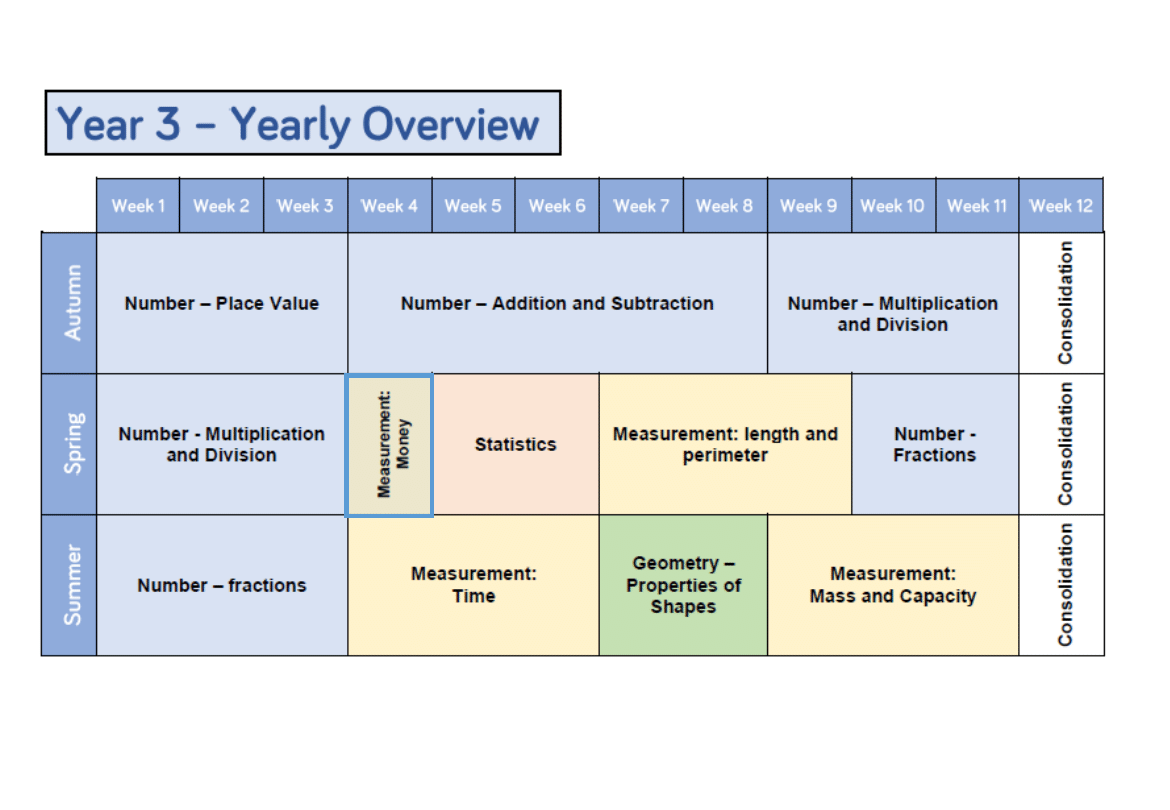
Week 4 – Measurement: Money
Add and subtract amounts of money
to give change, using both £ and p in
practical contexts.
Year 3
|
Spring Term
|
Teaching Guidance
Week 4 – Measurement: Money
Children need to know the value of each coin and note
and understand what these values represent.
They should understand that money can be represented
in different ways but still have the same value.
Children will need to be able to add coin values together
to find the total amount.
What is the value of the coin/note?
What does p mean?
Why do we have different values of coins and notes?
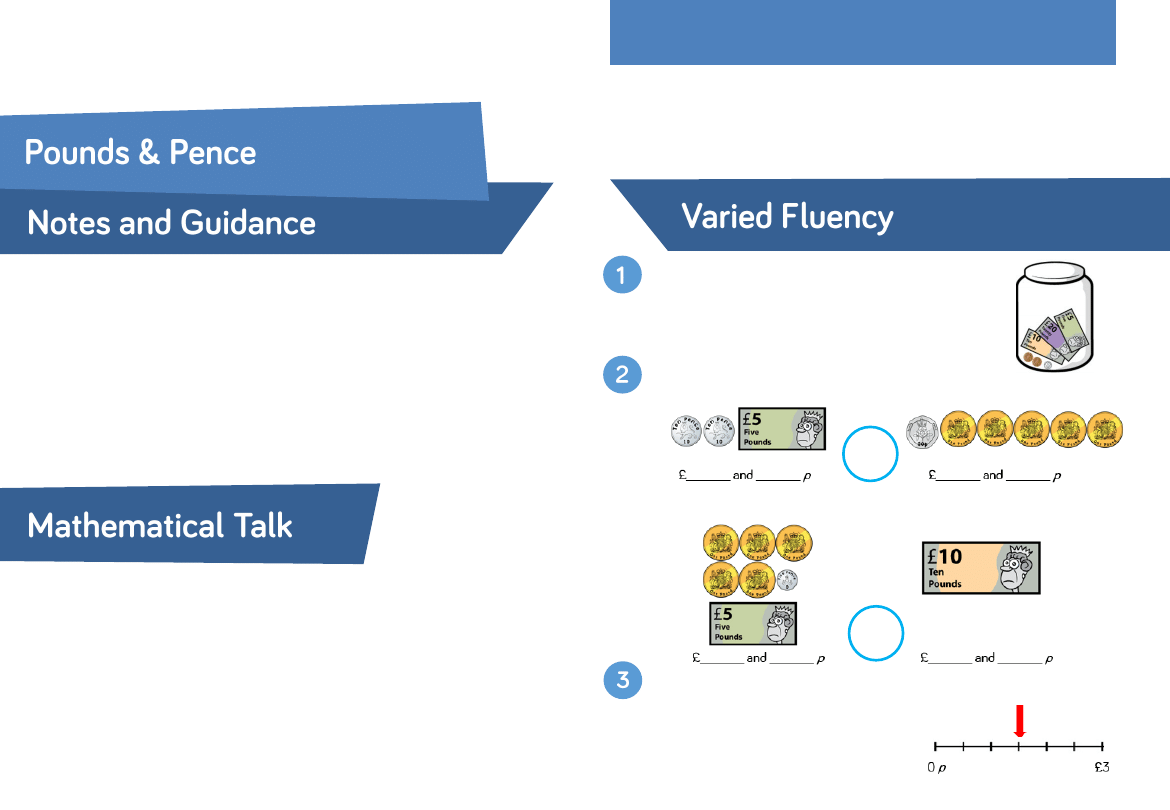
How much money does the jar contain?
The jar contains £______ and ____ p
Complete the statements using < , > or =
What amount of money is represented on the number line?
Give your answer in £ and p.
Week 4 – Measurement: Money
|
£2 + £1 + 50 p +
20 p +10 p = £3
and 80p
1 p + 2 p + 5 p + 10
p + 20 p = 38 p
Charlotte has 85 p in her purse.
Which coins could Charlotte have in her
purse?
Possible solutions:
•
50 p, 20 p,
10 p, 5 p
•
20 p, 20 p,
20 p, 20 p, 5 p
•
50 p, 10 p,
10 p, 10 p, 5 p
Roma had 5 different coins in his wallet.
What is the greatest amount of money he
could have in his wallet?
What is the least?
Year 3
|
Spring Term
|
Teaching Guidance
Week 4 – Measurement: Money
Children convert between pounds and pence using the
knowledge that £1 = 100 p
Children group pence to make pounds when counting
money. They apply their place value knowledge and use
their number bonds to 100
How many pennies are there in £1?
How can this fact help us to convert between pounds
and pence?
Explain what you need to do to convert pounds to
pence.
Explain how you convert pence to pounds.
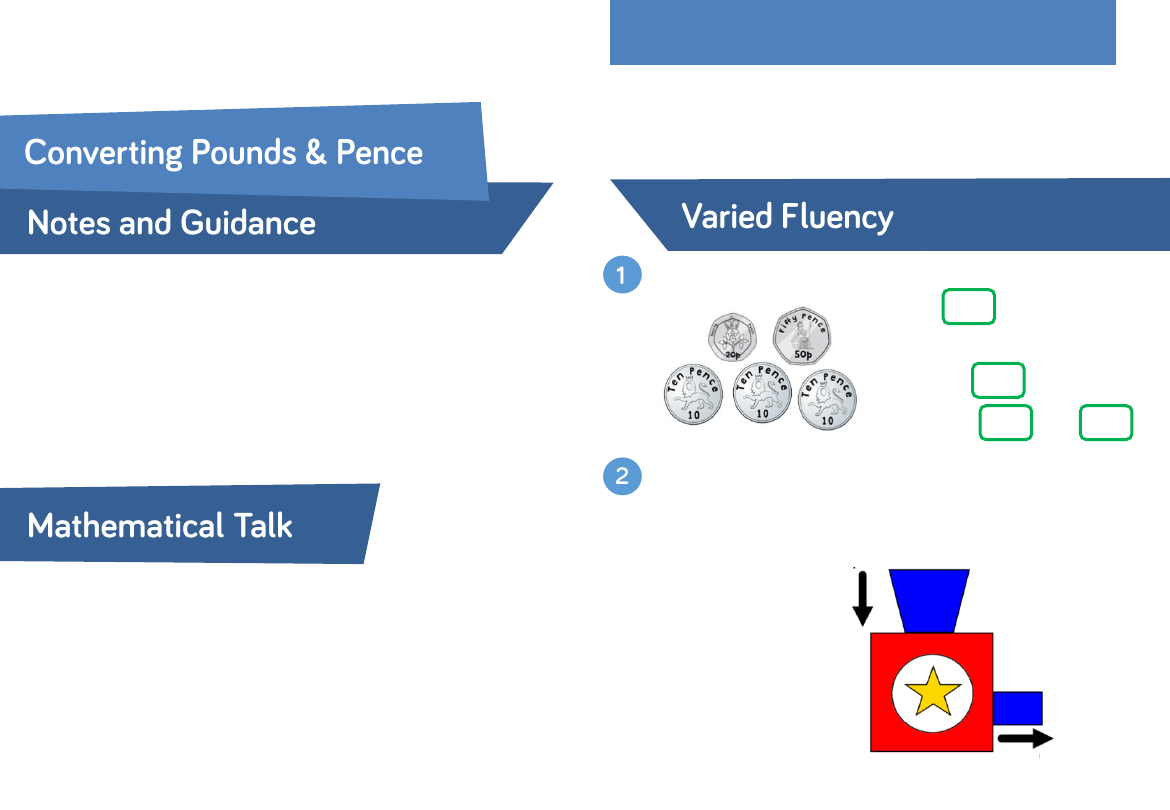
What is the total of the coins shown?
There is p.
We know that there are 100 p in £1
110 – 100 =
So there is £ and p
Here is a money-converting machine.
Money in pence goes in the top and comes out in pounds and
pence.
•
If 147 p went in,
what would come
out?
•
If £9 and 62 p
came out, what
went in?
Insert pence
£___ and ___p
Week 4 – Measurement: Money
|
She is incorrect.
There is £6 and 30
p. A sensible way
to group this would
be to group 50, 20,
20 10 to make £1.
£5 + £1 = £6, 20 +
10 = 30 so we have
£6 and 30 p.
Zaveun has 202 p.
Show all the possible combinations of
coins he may have.
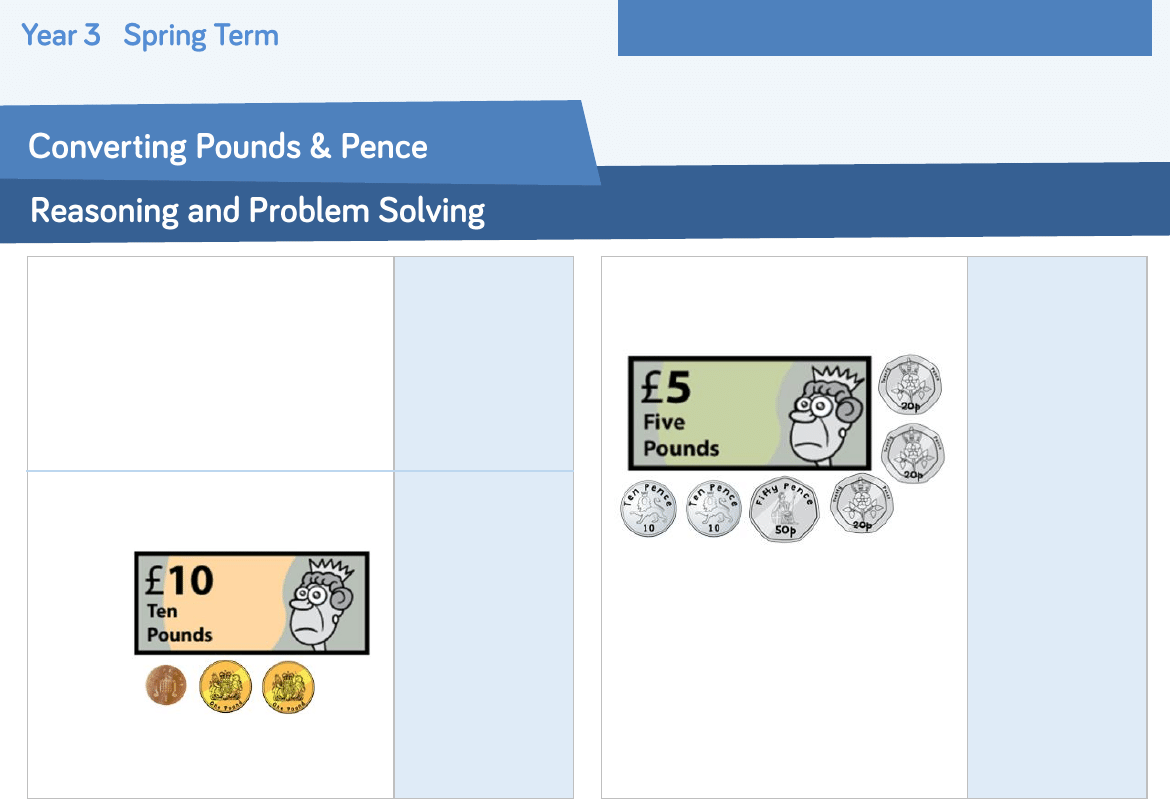
Ajay thinks that he has £10 and 3p.
Is he correct?
Explain it.
£2 and 2 p
£2, and 1 p and 1 p
£1 and £1 and 2 p
£1 and £1 and 1 p
and 1 p
Children may work
systematically to
find more solutions.
Ajay is incorrect
because he has
£12 and 1 p. Ajay
has counted 3
coins and thought
they were worth
the same value.
They are not worth
the same, all are
worth 1 but two are
£ and 1 is p.
Daisy thinks there is more than £5 but
less than £6. Is she correct?
Convince me.
Year 3
|
Spring Term
|
Teaching Guidance
Week 4 – Measurement: Money
Children build on their understanding of different coins
and their knowledge of converting.
Children use their understanding of the value of each
coin before they start to add across a pound boundary.
When adding across a pound boundary children should
be encouraged to look for number bonds (E.g. 70 p and
30 p), or ways to partition numbers differently to make a
pound.
What number facts could you use to calculate
mentally?
What would be the most efficient way to group the
coins? (E.g. 20 p + 20 p + 10 p = 50) Can you group
any of the coins to make a pound?
Can you partition any of the amounts to help you? Do
we need to think of a different way to partition?
How many different ways can you make a pound?
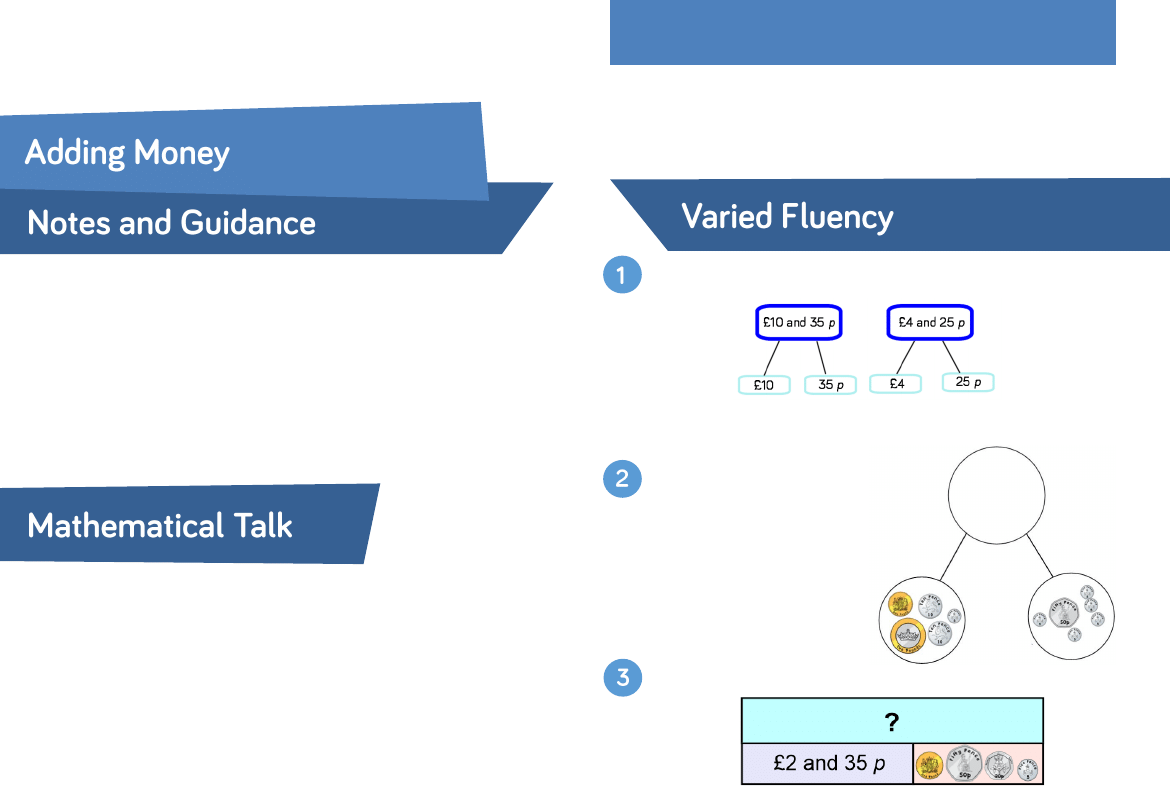
Find the total of: £10 and 35 p and £4 and 25 p.
Add the pounds then add the pence.
Complete the part-whole
model.
Represent the bar model with a calculation and solve it.
Week 4 – Measurement: Money
|
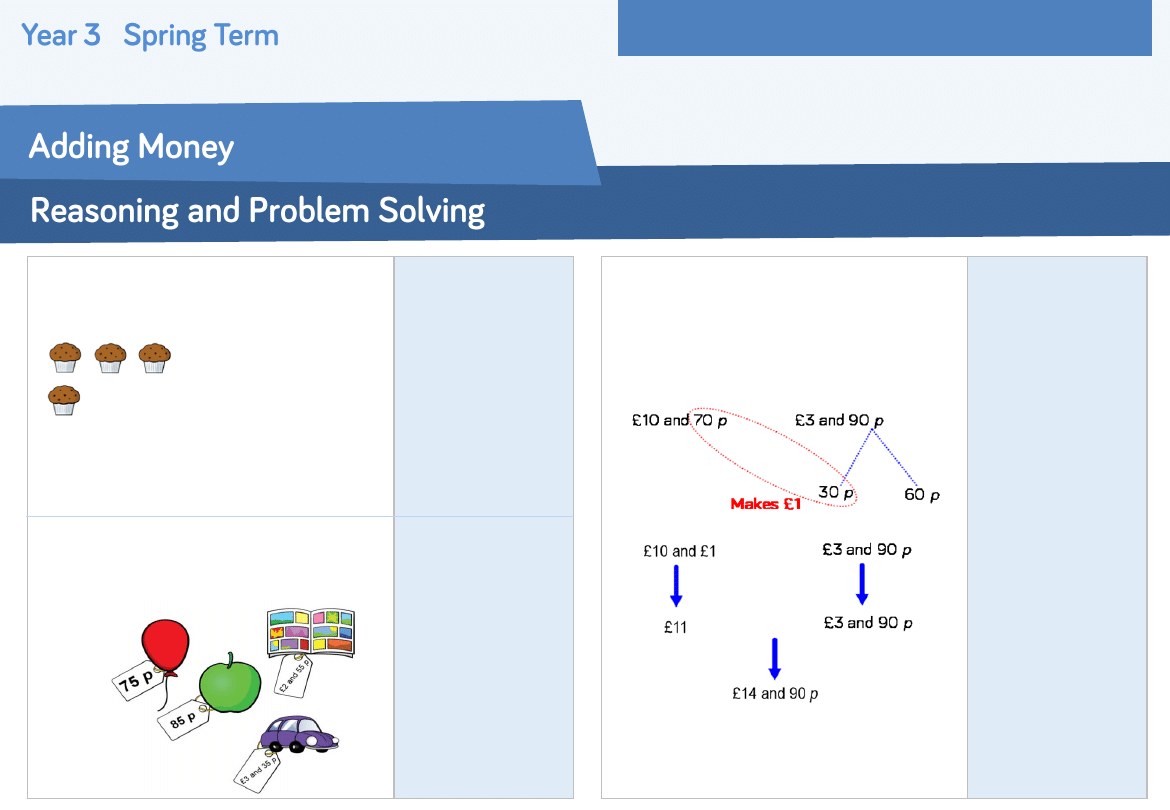
Ross has added
the original amount
of £3 and 90 p but
he partitioned 90 p
to use the 30 p
when making a
pound. Therefore,
he would only have
£3 and 60 p left.
Emma and Kate bought these muffins.
Muffins cost 35 p each. Emma bought
three times as many muffins as Kate.
How much did they each spend?
How much did they spend altogether?
How much more did Emma spend than
Kate?
Which 4 items could Penny buy if she
only had £5 and wanted to spend all of
her money?
Emma spent 105 p
£1 and 5 pence
Kate spent 35 p
Altogether they
spent £1 and 40 p
Emma spent 70 p
more.
Magazine, 2 apples
and a balloon = £5
Ross used the following method to find
the total of £10 and 70 p and
£3 and 90 p.
Can you spot and explain his mistake?
Year 3
|
Spring Term
|
Teaching Guidance
Week 4 – Measurement: Money
Children develop their knowledge of the value of coins
from Year 2 and use number lines to solve subtraction
problems involving money.
They continue to make connections between place value
and money.
Children use a number line to count on to help finding
change. They may also explore other methods and
compare which is most efficient.
How many more to the next ten?
When is the partitioning method not efficient?
Which number should I place on the number line first?
Shall we count on or back on the number line?
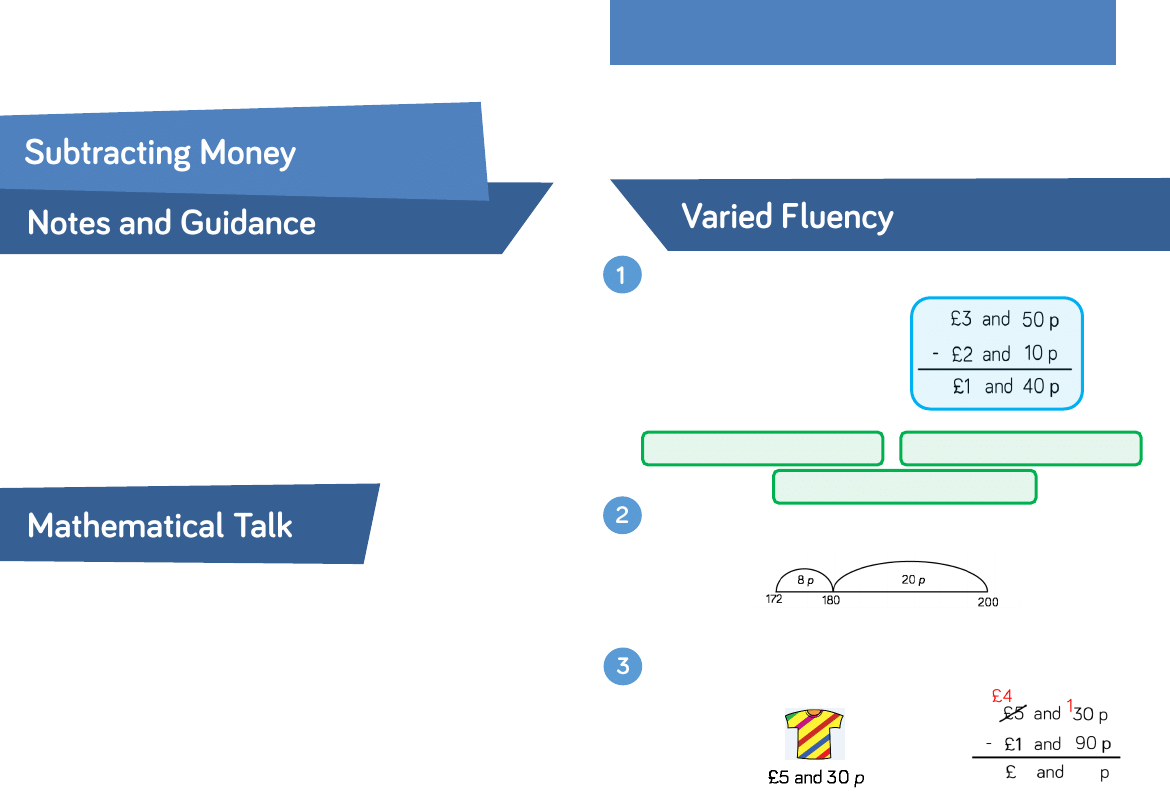
Calculate £3 and 50 p subtract £2 and 10 p
£3 - £2 = £1
50 p – 10 p = 40 p
£1 + 40 p = £1 and 40 p
Use this method to calculate:
£4 and 20 p - £2 and 10 p £6 and 35 p - £4 and 20 p
£21 and 40 p - £14 and 15 p
George has £1 and 72 p. Hannah has £2.
How much more money does Hannah have?
Use this method to find the difference between £4 and 20p
and £1 and 60 p
In a sale, a t-shirt is £1 and 90 p cheaper than usual. How
much does it cost during the sale?
Week 4 – Measurement: Money
|
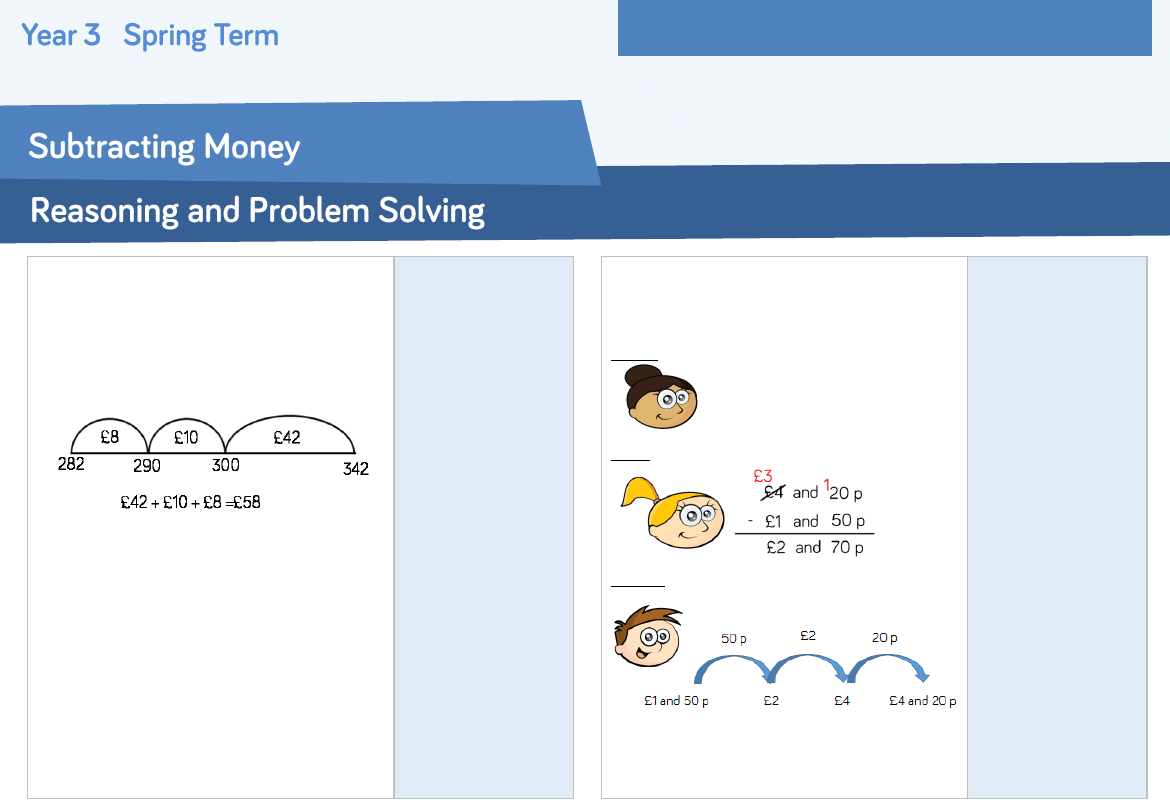
Children should
see that Aisha’s
method is the least
efficient as she has
calculated the
subtraction
incorrectly. They
can then give their
own opinion on
which of the other
methods is the
most efficient.
Dan saved £342 in his bank account.
He spent £282.
Does the subtraction below show how
much he has left?
Explain your answer.
The subtraction
does not show the
amount he has left
because he has
incorrectly
calculated the final
addition sentence.
Three children are calculating a
subtraction.
£4 and 20p minus £2 and 50p
Aisha
£4 - £2 = £2
20 p – 50 p = 30 p
£2 + 30 p = £2 and 30 p
Leila
Simon
Whose method is the most efficient?
Whose method is the least efficient?
Explain why.
Year 3
|
Spring Term
|
Teaching Guidance
Week 4 – Measurement: Money
Children use their subtraction skills with money to
calculate change. They continue to use a number line
and a part whole model to support their calculations.
Children apply previous skills and knowledge to
contextual problems.
What do we mean by ‘change’ in the context of money?
Why do we partition to give change?
Which method do you find most effective?
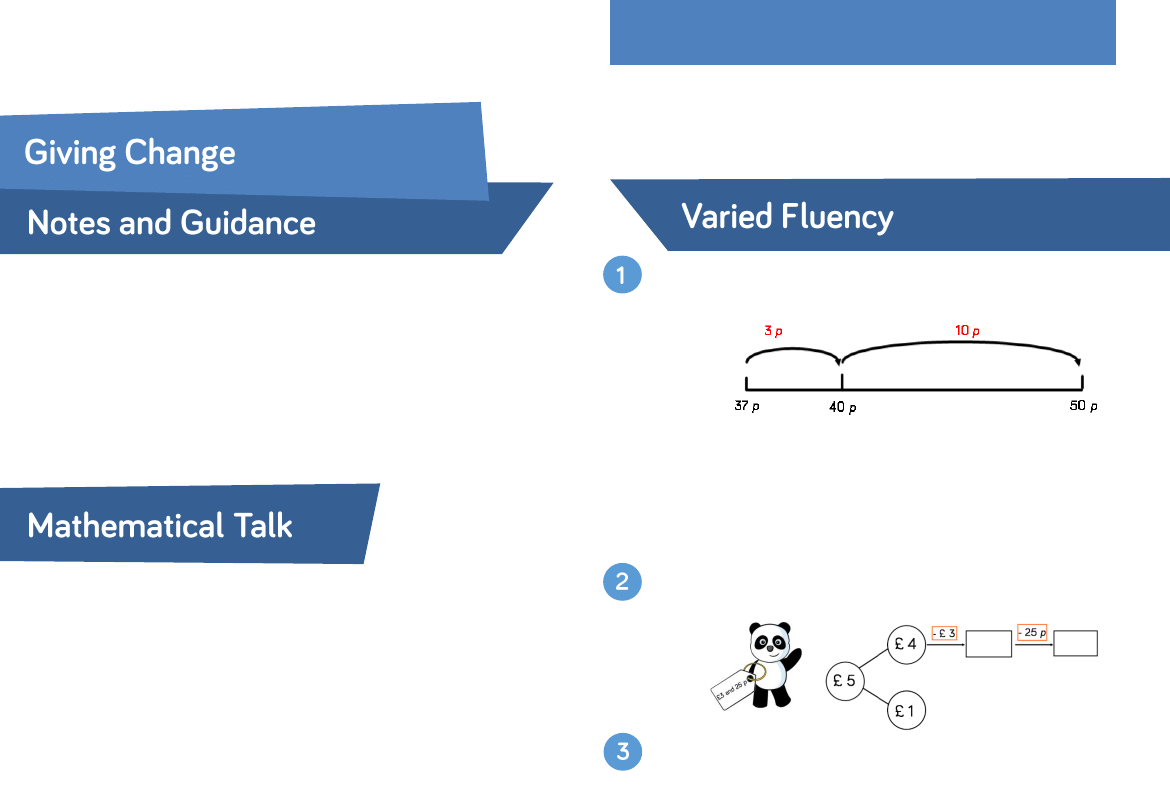
Gayle buys a chocolate bar for 37 p, she pays with a 50 p
coin. What change will she receive?
Use this method to calculate:
•
Sam has £1. He buys a lollipop for 55 p. How much
change does he receive?
•
Daniel has a five pound note. He buys a magazine for £3
and 60 p. How much change does he get?
Jo buys a teddy which costs £3 and 25 p. He pays using a £5
note. What change will he receive?
Neil buys a bike for £339 and 78 p. He hands the cashier
£400. What change will he receive?
Week 4 – Measurement: Money
|
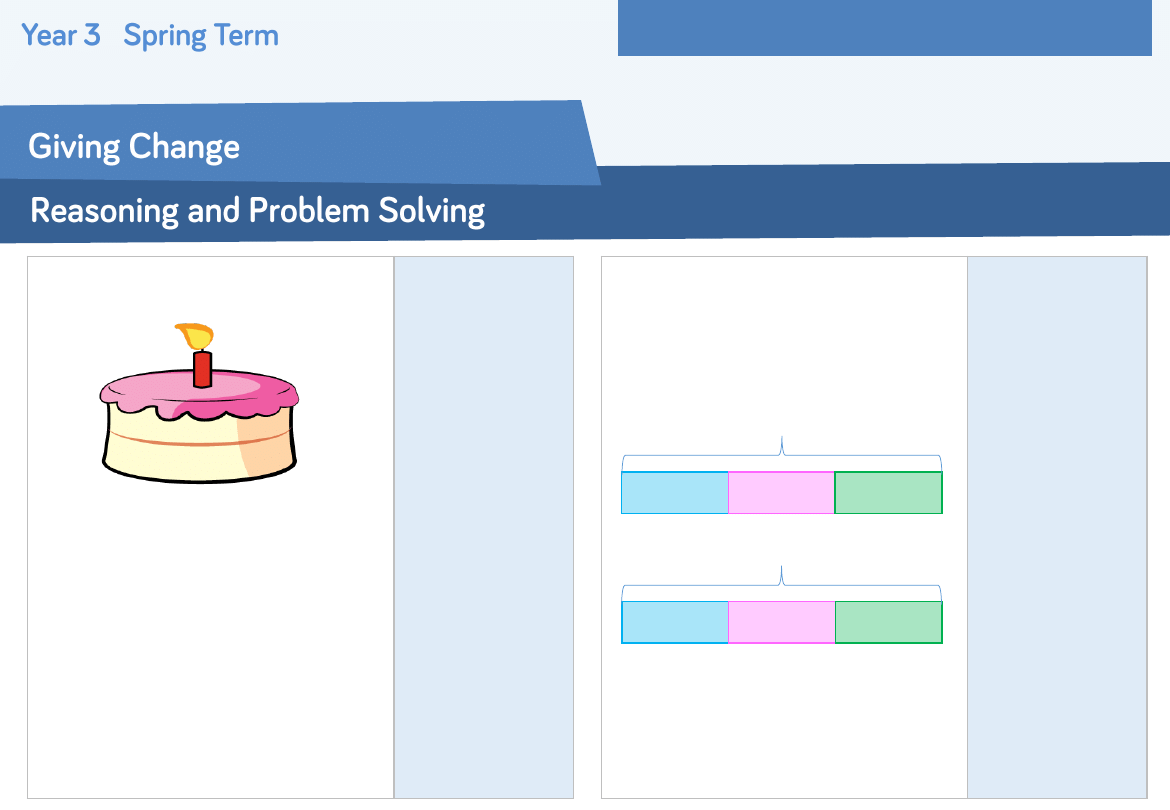
The first bar model
as the whole is £4
and the change
forms the part.
Jill spends £2 and 76 p on a cake in the
shop.
She pays with a £5 note. How much
change does she get?
If the shopkeeper gives her 6 coins in her
change, what coins might they be?
Possible Answers:
£2 and 24p
£1.00 £1.00, 10p,
10p, 2p, 2p
£1.00, £1.00, 10p,
10, 5p, 1p
Etc.
Sam goes to the shop with £4
He buys a book for £1 and 20 p and a
pencil that costs £1 and 45 p.
How much change does he get?
Which bar model represents the
problem?
£1 and 20 p £1 and 45 p
?
£1 and 20 p £1 and 45 p
£4
£4
?
Wyszukiwarka
Podobne podstrony:
Year 4 Spring Block 2 Area
Year 4 Summer Block 2 Money
Year 6 Spring Block 5 Perimeter Area and Volume
Year 6 Spring Block 4 Converting Units
Year 6 Spring Block 2 Percentages
Year 2 Spring Block 5 Length Height
Year 3 Spring Block 3 Statistics
Year 1 Spring Block 3 Length and Height
Year 5 Summer Block 3 Position and direction
Year 1 Summer Block 6 Time
Year 2 Summer Block 1 Position and Direction
Year 3 Summer Block 1 Number Fractions
Year 4 Summer Block 5 Properties of Shape
Year 1 Summer Block 3 Position and direction
Year 3 mixed year 23 Arithmetic Spring 2018
Year 4 Reasoning Spring 2018
Year 3 Year 34 Mark Scheme Reasoning and Problem Solving Spring 2018
Year 3 mixed year 34 Arithmetic Spring 2018
więcej podobnych podstron