Requires the use of the d20 Modern
Roleplaying Game, published by
Wizards of the Coast, Inc.
1
†A
BOUT
D
AWNING
S
TAR
Dawning Star was the first full-scale science fiction campaign setting built on d20
Modern and powered by the Future ruleset from Wizards of the Coast. The
critically-acclaimed setting was nominated for an ENnie for Best d20 Game. You
can learn more and download free material by visiting www.dawningstar.com.
†A
BOUT
T
ERRAFORMER
The Terraformer line of products from Blue Devil Games presents new material
designed for Dawning Star but usable in most science-fiction campaigns. Each
entry will offer a new prestige class, xenomorph, talent tree, feat, weapon, etc.
and advice on using it into your campaign and using it to “shape your world.”
†A
BOUT
B
LUE
D
EVIL
G
AMES
“Fiendishly Clever.” Blue Devil Games is one of the highest-quality small-press
publishers on the market today. BDG product lines include Dawning Star,
AEvolutions in support of
Monte Cook’s Arcana Evolved
, and the upcoming
Passages. Visit our website for more information: www.bluedevilgames.com.
†A
BOUT
L
EE
H
AMMOCK
Lead writer and game designer on the Dawning Star line, Lee has been
affectionately called the “Hemmingway of RPGs” for the quality of his writing
and prolific body of work. Lee has worked for numerous publishers, and is the
writer on the main story in the HALO Graphic Novel from Marvel Comics.
With the limited manufacturing capabilities of the humans on Eos, the use
of trains has increased due to their ability to move large amounts of cargo
with a minimal number of complex parts. While the tracks used by trains
require significant resources to construct, these resources (primarily iron)
are readily available on Eos, and the tracks are far easier to construct
than a nuclear power plant or a vectored-thrust engine. Thus, train tracks
have begun their slow march across Eos, connecting major settlements
with a quick and reliable mode of transportation.
The trains used on Eos come in two major forms: high-speed mag-lev
trains that rely on powerful electromagnets to hover above their tracks,
and wheel-driven trains that use grooved metal wheels on rail tracks.
Mag-lev trains are faster but are also more expensive to build and harder
to maintain. The Dawning Star Republic presently uses them only for
heavily traveled routes. The faction-camps that have constructed train
lines have all used wheeled trains due to the lack of energy and parts
necessary to build mag-lev trains. Most trains currently rely on fusion
reactors for power, though some use combustion engines. The streetcars
now used in Roger’s Point tie draw energy from the city’s power grid.
The train tracks laid thus far follow the terrain of least resistance,
bypassing canyons and mountains where possible in order to avoid
unnecessary construction. The need for a relatively straight track and
minimal inclines has required the building of some tunnels and bridges. In
this arena, the Republic’s ability far outstrips the faction-camps’. Faction-
camp trains regularly operate under speed restrictions due to the sharp
2
turns in their tracks necessitated by avoiding changes in elevation. Riding
a faction-camp train can be more like riding a rollercoaster of Old Earth,
and one had best keep their balance and their wits about them.
Most of the train tracks on Eos have been laid in the plains region of
central Dawnhome, though tracks can be found in all settled regions of
the continent. On the other continents train tracks are much less common,
and trains generally only serve the regions directly around the settlement
that built the tracks. These tracks are usually built on a raised section of
earth covered in gravel, or in more settled areas on concrete structures.
Concrete bridges are common at most river crossings or unavoidable
gorges, many of which also have additional space to accompany ground
vehicles on either side of the train to maximize the utility of the bridge.
Indeed, train tracks are usually built near existing roads and trade routes,
making it easier to reach the train if it breaks down.
The train tracks on Eos have been damaged on occasion by various
xenomorphs, such as Iron Scar scrappers digging at the tracks out of
mere curiosity. For this reason, the Republic and the faction-camps have
begun electrifying their tracks, hoping that a shock will dissuade curious
animals and would-be vandals. Electrified tracks inflict 1d6 points of
electricity damage per round on anything that touches them, Fortitude
save (DC 13) for half damage. Creatures failing the save are also stunned
for 1 round. These measures are suppressed at crossings. A few humans
and velin have been killed by these tracks after stepping on them and
being unable to extricate themselves. In one unfortunate incident, a
faction-camp train near Steel Edge was derailed after striking a massive
xenomorph corpse that lay on the track. Some claimed the corpse was a
darkling, but after the collision and resulting explosion there was little
remaining to inspect.
Currently no Republic lines link up with those of the faction-camps.
Even if such a scenario could be brokered, Republic train wheels use a
different track gauge than faction-camp wheels. The Republic has no
plans to connect its growing train network with any of those built by the
faction-camps, even those with which it has a tenuous alliance. Despite
this, there are a few locations where Republic trains pass within a short
distance (sometimes as little as a few hundred yards) of a faction-camp
rail. These areas are becoming increasingly vital trade spots. Small
boomtowns have sprung up in these areas, the busiest being Loose
Change located between Roger’s Point and Red Hill. There have been
some attacks on Republic tracks by what are assumed to be EFL
saboteurs, but thus far no conclusive evidence has been found of their
involvement. Tracks damaged in these attacks have come dangerously
close to causing a serious derailment, but so far such a catastrophe has
been averted by quick-thinking conductors. The EDF has begun
intermittent patrols of the more important tracks, and many of the more
important trains are now escorted by vectored-thrust aircraft that keep an
eye ahead of the train for track damage or ambush.
Both the EDF and the EFL have been working on developing military
transport trains to carry their troops and personnel into battle quickly and
in large numbers, but neither group has had much success. The EDF has
3
two prototype combat transport trains that are still in initial testing. The
current prize of the EFL military train project has been a large set of
flatbed cars that can be used as a launching and landing platform for
VTOL and other light aircraft, including a control tower and some basic
defensive positions. Considering their increasing importance of trains, if a
conflict does break out between the faction-camps and the Republic, the
tracks of both sides are sure to become some of the first targets.
Common Characteristics of Trains
Trains operate like other vehicles described in d20 Modern with a few
modifications. Trains cannot travel any course at will. They must travel on
a track, changing lines only at a switching station. Most trains on Eos can
remotely operate switching stations on the tracks they regularly use.
Trains cannot perform any simple maneuvers except for Ram, and even
then only if the target is on the tracks. Trains cannot use any stunts
except for Dash or Hard Brake; both of these abilities require one round
to perform, and they do not take effect for one minute. For example, it
takes the trains operator three rounds to set the train to reach top speed,
and it takes the train three minutes to actually reach top speed. Trains
require at least 2,000 feet of track to make a right-angle turn.
Trains are made up of a number of cars as limited by the pull of the
engine. Each train has at least one engine car, though most have several
in case of emergency or to alternate between refueling. Only one engine
can be active at a time. Many trains have an engine at both ends facing
different directions so the train can travel in both directions without having
to use a turnaround track. Most engines used on Eos contain all the fuel
they need, but some less efficient trains require a tanker truck behind the
engine to carry fuel. The rest of the cars of the train are generally flat
topped cargo cars, boxcars for carrying cargo that needs shielding from
the elements, or passenger cars.
The joints holding together train cars can be released as a full round
action, but most require a key or a pass code to do so. Unlinking such a
joint without the code requires a Disable Device check (DC 20).
Standard trains require the Surface Vehicle Operation (Trains) feat;
mag-lev trains require the Surface Vehicle Operation (Mag-Lev Trains)
feat. Operating a train without the appropriate feat incurs a -4 penalty to
all Drive skill checks.
Factions and Federations
Free Tracks Alliance
The organizational body of the faction-camps that deals with issues
regarding trains, the Free Tracks Alliance is a sub-department of the EFL,
though it has little interaction with the more military operations that
organization undertakes. Instead, the Free Tracks Alliance is concerned
with commercial and civilian matters, particularly building new train lines to
make travel easier between the faction-camps. Most of the faction-camps
are divided by ocean, leaving the Free Tracks Alliance little to do to bring
4
the camps closer together. However, the faction-camps on Dawnhome
are working hard to try and unite their disparate territories with train lines.
This is made the more difficult by the presence of the Republic, since it
has claimed most of the level, open terrain on the continent. As a result,
the Free Tracks Alliance is forced to build in less-than-ideal locations such
as mountain ranges or jungles.
The Free Tracks Alliance is organized by Peter Kaze of Sunder
Ridge, though his power over the efforts of individual camps is limited. He
acts as more of a group planner than a real leader, having no power to
force the faction-camps to do anything. Luckily, enlightened self-interest
has encouraged most of the faction-camps to work together, though most
faction-camp-owned train lines are little more than local efforts within each
settlement’s territory. Only Sunder Ridge has made a major effort to link
up the faction-camps with its Mountain Train line, but its progress has
been limited due to poor terrain. Because of this lack of organization there
is little standardization in the faction-camp trains beyond track gauge.
Each camp sets its own train schedules.
The trains used by the Free Tracks Alliance all have EFL security
agents assigned to them, though rarely in large number. Since there are
few restrictions on what can be shipped on board a Free Tracks Alliance
train, these security agents are more concerned with keeping the trains
undamaged and stopping fights on the train and less concerned with
customs duties. The trains of the Free Tracks Alliance are also an
efficient way of moving troops through EFL territory; soldiers are a
common sight on the trains.
Other than train lines supported by Roger’s Point and Sunder Ridge,
no faction-camps have train lines that extend more than 20 miles from
their main settlement. Most are working on developing their train lines,
especially Lanner’s Crossing and Delhi, but they have made little progress
thus far. Like most things among the faction-camps, the wealthier camps
have made more progress while the poorer faction-camps lag behind.
Movement Systems Incorporated
Commonly referred to as MSI, this relatively young corporation is based in
the Dawning Star Republic, though it has offices in several of the faction-
camps. Founded and owned by Lia Qian, reputed to be the second
wealthiest person in the Republic, it has the stated goal of bringing
privately owned train lines to all major settlements on Dawnhome. For
now MSI runs its limited fleet of trains on RTA and faction-camp tracks,
paying nominal rental fees for use. MSI primarily runs cargo trains on
some of the lesser used tracks and has no mag-lev trains in its small fleet
of vehicles, but it has quickly become the leading privately owned rail
transportation company.
MSI’s primary office is located in Dawning Star City. At any given time,
MSI has four trains running. Their most common routes travel the old Iron
Scar tracks and to Crosstrack. MSI currently does not offer passenger
service, but it is hoping to do so in the next year. MSI has no interest in
mag-lev trains for now due to their expense and high-maintenance
requirements. Most of the company’s clients are small-time miners and
5
farmers who can’t afford to arrange transit on an RTA train. MSI charges
15% less on average than the RTA for most services. This reduction in
cost does mean that MSI does not offer some services that the RTA
does, such as rail agents, but most customers don’t seem to mind. None
of the MSI trains go directly between faction-camp and Republic territory,
instead stopping in a major settlement and requiring all goods be
inspected before being carried to one of the border towns like Loose
Change.
Recently MSI has begun development of a new series of trains for
commercial uses besides transportation, such as portable factories or
smelters that can go wherever the tracks lead. This enables MSI to move
around production facilities as needed, and their specially built trains can
be highly customized according to the needs of different clients. Their
factory train can make anything from farming tools to simple firearms,
though it is legally restricted from building weapons outside direct EDF
supervision. Through these trains MSI hopes to be able to bring a bit of
civilization and convenience to some of the smaller settlements in the
Republic that do not possess such facilities of their own, and so far their
services are much in demand.
Republic Transit Authority
The civilian trains of the Dawning Star Republic are overseen by the
Republic Transit Authority, which is part of the Department of Trade. The
Republic Transit Authority, or RTA, is in charge of making sure all the
trains, buses, ferries, and other modes of civilian transportation operated
by the Republic run properly. The RTA is also responsible for mail
delivery, making it one of the largest parts of the Department of Trade.
The RTA has officers in nearly every Republic settlement and is a
ubiquitous part of the population. Much like the postmen of the United
States of old Earth, they have a strong belief that their services must
never be interrupted regardless of weather, violence, or xenomorph
activity. Because of this the RTA is reasonably well thought of by most
citizens of the Republic. However, despite their adherence to duty and
earnest attempts to keep everything running properly, the RTA has a
reputation for being late. Their trains are particularly notorious for this
shortcoming.
The RTA is headquartered in Dawning Star City and has major
branches in Iron Scar, Greenville, Harvest Town, and Red Hill. While the
RTA relies on the EDF and local police forces for security, it has its own
security officers, often called rail marshals. These officers are trained in
detecting forgeries, conducting searches, vehicle operation, and dealing
with troublemakers with minimal force. Most major trains used by the
Republic have a rail officer on board and they can be found in all major
installations of the RTA. Other than the rail officers, RTA personnel
include drivers, pilots, mechanics, traffic control officers, and customer
service representatives.
The RTA currently operates five major train lines: The Iron Scar
Express, the Red Hill Run, the Greenville Spur, the Harvest Town Spur,
and the Southeast Line. Passage on an RTA train is relatively
6
inexpensive. Purchase DCs run from 4-8 for a single passenger and 6-10
per ton of cargo. Weapons are not permitted as carry-on items on RTA
trains, although they may be stored in baggage. The baggage
compartments of an RTA train are usually under constant guard.
Major Train Lines of the Republic
Dawning Star City Metro-Line
While Dawning Star City was built in ramshackle fashion from whatever
parts were available, the engineers involved in doing so were some of the
finest urban planners the human race had to offer. While building Dawning
Star City they made sure to leave room for additional construction. This
included leaving sufficient space to build a series of underground and
elevated trains in the hopes of providing cheap public transportation for
the inhabitants of the city. This idea has recently been put into practice,
but so far progress has been limited.
The plan is to have an underground line that rings the city and
numerous elevated lines crossing major thoroughfares and connecting at
a station at City Center. The elevated lines would provide transportation
to all the major areas of Dawning Star City, including the spaceport, the
rail yard, and the Terraforming Fields. Currently the only functioning train
lines are the northern portions of the underground perimeter, though they
do provide easy access to most of the northern part of the city, including
the EDF Headquarters and the Terraforming Fields. There are currently
two trains operating on parallel tracks, always running in opposite
directions. The Republic hopes to have the entire perimeter finished in the
next decade, though funding issues may make this difficult.
The trains used in the underground tunnels are built in the style of old
Earth subways and are all fully enclosed passenger cars that draw power
from a third rail running parallel to the main train tracks. This system
draws off the city’s power grid, and the trains have no backup power
course. Travel on these lines is free, and they are commonly used by
those who commute to work at the EDF Headquarters and the
Terraforming Fields from their homes in the city.
Greenville Spur
Reaching from Crosstrack to Greenville, the Greenville spur is a small
length of track that sees an increasing amount of use. As the pectar fruit
and rubber tree orchards of the Green Sea increase in productivity, more
and more of their products are brought to Dawning Star City. Initially
Greenville relied on dirt roads and old ground vehicles to get their goods to
market, but two years ago the Greenville Spur was finished, making the
lives of the locals much easier. This has allowed the town to drastically
expand as supplies and tools are much easier to get into town.
Unfortunately, this physical and economic expansion has had little effect
on the seedier parts of the town.
The Greenville Spur is a single track that has a single scheduled run
each day between Crosstrack and Greenville and back. The trip takes
7
ten hours each way. This tight schedule leaves little room for delay, and
the cargo loaders in Greenville are renowned among the RTA for their
short tempers. There are no stops on the Greenville Spur, and the train
runs at high speed almost the entire time to discourage attacks by the
EFL out of Sunder Ridge. The specter of a highjacking is considerable
since the track is closely beset by the jungle. Attempts have been made
to cut the jungle growth back from the tracks, but the Green Sea grows
so quickly these efforts seem fruitless. Because of this security concern
the RTA usually stations extra rail marshals on the Greenville Spur,
though they have not been needed yet.
Harvest Town Spur
One of the busiest tracks in the Republic, the Harvest Town Spur was
recently expanded to include a second set of tracks to make it easier to
get the food grown in Harvest Town to market. The Harvest Town Spur
is a twelve-hour trip and runs twice each day. The trains go into Harvest
Town with tools, vehicles, and other manufactured goods and return with
container cars full of food. This food is rushed to Dawning Star City and
then distributed throughout the Republic. Due to the efficiency of this
operation most of the food grown in Harvest Town is in the grocery
stores of Dawning Star city within four days of being picked.
The level of rail activity in Harvest Town has had little effect on the
sleepy nature of Harvest Town outside the bustling rail depot. Still, the
presence of the trains has been felt, and many farmers use the whistles
of the inbound and outbound trains to schedule their work day. Despite all
the activity there have been no major accidents on the Harvest Town
spur, and its distance from any faction-camp makes the RTA think it is an
unlikely target. Much like the town it serves, the Harvest Town Spur is not
an exciting assignment, but it is a vital source of food for the Republic.
Iron Scar Express
The first of the mag-lev train lines on Eos, the Iron Scar Express is quickly
becoming the most heavily used line in the Republic. It links the Central
Railyard in Dawning Star City to the Rail Depot in Iron Scar, a journey that
takes just over 26 hours. The Iron Scar express is primarily used for
hauling ore and other raw materials from Iron Scar to the rest of Eos,
though a regular stream of people and manufactured goods also travel
the line. All the trains and tracks on this line are brand new and use the
latest technology, including a number of non-lethal weapon systems to
keep creatures off the tracks. The completion of the Iron Scar Express
has done much to bring Iron Scar closer to Dawning Star City and make
it feel like less of a frontier settlement, a change that not everyone in Iron
Scar appreciates. Already the influx of new citizens in the town has
caused some resentment among longtime residents. The Iron Scar
Express carries tools, food, and people on its trips to Iron Scar and
carries primarily ore on its return trips to Dawning Star City.
A set of standard tracks for wheeled trains run parallel to the mag-lev
tracks. These tracks were never finished before the mag-lev project
commenced. A number of small shipping operations including MSI use the
8
tracks to make runs to the settlements between Dawning Star City and
Iron Scar. The mag-lev tracks also remain within sight of the Iron Scar
Highway for almost its entire length. The Iron Scar Express only stops at
Iron Scar, Dawning Star City, and the small town of Dirtwell located in the
middle of the desert between Iron Scar and Dawning Star City. No other
towns near the tracks have the necessary facilities to offload a mag-lev
train, though some are being built.
The Republic currently only has two mag-lev trains, the Iron Stallion
and Jonah’s Runner. Both run continually between Iron Scar and Dawning
Star City, though they often suffer from maintenance difficulties. These
trains are usually made up of 30 cars, most of which are flatbed or
passenger cars.
Red Hill Run
One of the shorter rail lines on Eos, the Red Hill Run is a small train line
used to run supplies from Dawning Star City to Red Hill. The track
continues north of Red Hill to settlements in the farthest reaches of the
Northern Resource Zone, making half a dozen stops before stopping one
thousand miles south of Roger’s Point. It was completed four years ago
and has become one of the major unofficial trade routes to Roger’s Point.
The trains that run on the Red Hill Run are almost all cargo trains and
most stop at Loose Change, one of the areas where the tracks of the
EFL and the Republic are in close proximity. The RTA keeps a stern eye
on the Red Hill Run in the hopes of catching the smugglers that use it, but
so far their successes have been limited. It is believed a substantial part
of the RTA agents on this train line have been bribed, and an official
investigation by the Republic Rangers into the matter is underway.
The trains on the Red Hill Run bring all manner of manufactured goods
to Red Hill and usually return to Dawning Star City with food and cotton.
The trip to Red Hill takes approximately one day, though this can vary
due to weather, track damage, and other problems. Of all the train lines in
the Republic, the Red Hill Run has the worst reputation for running on
time. The tracks running to Red Hill are the standard three-meter gauge
used by the Republic, and all standard Republic trains can easily use the
tracks. Due to the heavy security concerns in the area the RTA has shut
down several switching stations to have better control over the flow of
trains, making scheduling difficult since fewer tracks are actually available
for use at a given time. Despite all the difficulties with the EFL in the area,
there has yet to be any violence on the Red Hill Run.
In the early years of the Red Hill Run most trains passed by Loose
Change or stopped only momentarily since it was not considered an
official stop on the line. Having little luck shutting Loose Change down, the
RTA has instead chosen to make it a stop on the Red Hill Run, charging
extra tariffs on goods loaded or unloaded there in addition to having a
large number of agents in the area looking for contraband. This has
allowed Loose Change to flourish and also curtailed the various smuggling
operations that once ran the town.
9
Southeast Line
The main line for points south of Dawning Star City, the Southeast Line
heads out of the city to the southeast and officially ends in the town of
Crosstrack. Two tracks continue from Crosstrack (the Greenville and
Harvest Town Spurs), making Crosstrack a major trade center for the
region. It has quickly become one of the major agricultural markets in the
Republic, and most of the food consumed in Dawning Star city arrives on
the Southeast Line. To safeguard the food supply, the tracks and
Crosstrack are patrolled regularly by the EDF.
The Southeast Line runs through the plains of Dawnhome into the
Green Sea, ending almost equidistant to Harvest Town and Greenville. It
is a wheel train that runs once a day, with each trip between Dawning
Star City and Crosstrack taking 22 hours. There are two sets of tracks
on the Southeast Line, with separate trains routinely heading in both
directions at the same time. It normally carries manufactured goods, fuels,
and vehicles to Crosstrack and returns to Dawning Star City brimming
with food. The Southeast Line also stops at a number of smaller
agricultural towns in the plains of Dawnhome, most of which are no-name
towns with only a few dozen inhabitants.
Both the Greenville Spur and the Harvest Town Spur use the same
gauge of track as the Southeast Line (three meters), and thus trains can
easily cross from one train line to the other. A switching station and
roundabout are present in Crosstrack for just such a purpose.
Major Train Lines of the Faction Camps
Brass Line
The primary east-west line serving Roger’s Point, the Brass Line hugs the
coast of the Gray Plain Gulf on which Roger’s Points sits. The Brass Line
links up a large number of fishing villages, lumber towns, and other small
settlements that rely on Roger’s Point for most other goods. On the
eastern edge of the line the tracks lead into the mountains, connecting
four mining towns that produce tin or silver. There are 20 stops on the
400-mile length of the Brass Line, and the Brass Line Express stops at all
of them twice a day. Most of the towns that the Brass Line stops at have
a population of 500 or less, but they have been increasing in size
dramatically in the six months that the line has been in operation. Patricia
Rogers hopes to eventually stretch out the Brass Line to such an extent
that Roger’s Point can survive on the food it brings alone. Travel on has a
Purchase DC of 7-9 per person and 9-12 per ton of cargo.
The train that runs the Brass Line usually pulls a configuration of 20
passenger cars, 20 cargo cars, and 40 flatbed cars, though this can be
changed to meet specific needs. The train usually has several EFL
security officers on board to keep the peace, but they have few actual
duties because there are few restrictions as to what can be transported.
The only goods that are not allowed on the Brass Line are volatile
chemicals or explosives since Patricia Rogers would rather not have one
of her very valuable trains blown up.
10
Mountain Train
The largest train line in the faction-camps outside of Roger’s Point, the
Mountain Train is a massive undertaking by Sunder Ridge. The Mountain
Train currently consists of 120 miles of winding mountain track with
numerous bridges and tunnels. Most of these features were built with the
assistance of the
Steel Wall,
a mecha on loan from Steel End. The
Mountain Train will eventually reach all the way from Sunder Ridge to
Roger’s Point, hugging the mountains unclaimed by the Republic and
providing a major transportation artery for the EFL. For now it merely
links together half a dozen mining towns which produce iron, copper, and
coal, though its presence has made getting the product to market much
easier. Like most rail towns these mining towns have grown recently, and
Sunder Ridge now sees the path of the Mountain Train as its main source
of territorial expansion in the face of the Republic Claims on the Southern
and Eastern Resource Zones. Traveling on the Mountain Train has a
Purchase DC of 7-8 per person or 9-11 per ton of cargo depending on the
destination.
While the engineers and architects of Sunder Ridge are very skilled,
riding the Mountain Train is a harrowing experience. For most of its length
it travels along cliffs and ledges, usually less than a meter from the edge.
Also the Mountain Train has more bridges and tunnels per mile than any
other train line on the planet, also making it the most expensive train line
to construct. Luckily Sunder Ridge has an abundance of iron with which to
do so. It’s common for those who ride it to wear blindfolds rather than see
the pitfalls right out the window. So far it has an excellent safety record
due to the skill and diligence of the conductors. The Mountain Train has
been laid out with two tracks side by side, allowing travel in both directions
without switching tracks. The two trains that serve the Mountain Train
track are both pulled by Hercules Train Engines and normally pull 50 cars,
most of which are flatbed or cargo cars. Little passenger travel occurs on
the Mountain Train.
Southern Circuit
One of the more ambitious and audacious projects undertaken by Patricia
Rogers, the Southern Circuit is a train line that stretches south from
Roger’s Point with the primary purpose of claiming territory for the faction-
camp and forcing a dispute with the Republic. The Southern Circuit is a
two-track line that goes straight from Roger’s Point towards Red Hill,
stopping 300 miles north of Red Hill in territory that is claimed by the
Republic. It serves precious few settlements and has little economic value,
instead existing only to create an area of influence for Roger’s Point. It is
a direct albeit non-military challenge to the Republic. For its part, the
Republic has yet to officially answer this challenge, but most experts
believe such an effort is underway already. The increased Republic
presence in Loose Change is thought to be the first step in whatever
strategy the Republic will ultimately employ. Traveling on the Southern
Circuit has a Purchase DC of 6-7 per person or 8-10 per ton of cargo,
reflecting the lack of demand for the route.
The Southern Circuit stretches almost a thousand miles south of
11
Roger’s Point through forest, mountains, and plains. It was hastily built and
has several lengths in the mountain that are particularly nerve-wracking at
high speed, but it is functional over its entire length. The Southern Circuit
takes 20 hours to travel, and a train makes the trip one direction each
day. There are only half a dozen mining towns along the length of the
Southern Circuit, most of which rely on the train to get their ore to market
in Roger’s Point. A few new towns have sprung up because of the
Southern Circuit making it easier to reach previously remote areas, but
this growth has been slow coming.
Street Cars of Roger’s Point
Roger’s Point is a bustling coast city with thousands of inhabitants always
in a hurry to get where they are going. Early in the days of the settlement
Patricia Roger’s felt a public transportation system would be needed to
avoid choking the streets with vehicles (which were expensive to make
and maintain) and to provide a valuable service for all of Roger’s Point’s
residents. After considering a subterranean train system, she settled on a
street car system with tracks set in the streets of Roger’s Points and
power lines strung overhead, drawing power from the city power grid.
These cars have been in service now for twelve years and have proved
a boon to the city, allowing most of its inhabitants to get around with
relative ease and without needing to own a vehicle or riding animal. Riders
pay for a weekly pass to use the street cars which allows them unlimited
use within that week and has a Purchase DC of 6. These cards allow for
a minimal amount of cargo, but special cargo cards can also be
purchased for a Purchase DC of 12.
The street cars are designed to serve as both passenger and cargo
transports, having folding seats that can be stowed to provide more cargo
room. The tracks run in all major areas of the city except the newer
outlying areas, where the infrastructure does not exist to support them.
Using the street cars most areas of Roger’s Point can be reached within
ten minutes, though during particularly busy days this can increase
dramatically. The cars rarely break down due to their stout manufacture,
though they are not particularly fast. The street cars are considered so
vital to Roger’s Point that any tampering with them incurs serious
penalties, usually involving corporeal punishment.
Railway Settlements
The following are settlements in the Republic that are closely tied to the
operation of the rail lines.
Crosstrack
Leader: Mayor Duncan Kee
Population: 1,505
Major Exports/Products: Food
Major Imports: Manufactured goods
Progress Level: 5
Purchase DC Limit: 30
12
Black market DC: 20
Item Restriction Limit: Restricted
Located 1,200 miles southeast of Dawning Star City, Crosstrack is a
small but growing town that relies on the rail lines for its livelihood.
Crosstrack is located where the Southeast Line ends and the Greenville
Spur and Harvest Town Spur begin, making it a hub for the transportation
of agricultural goods in the Republic. The tracks that have allowed
Crosstrack to prosper have only been completed in the last five years,
and while the town was settled two decades ago it has quadrupled in size
since they were finished. The town has a bustling and growing feel to it,
and most of the buildings look very new. For now the town prospers as
thousands of tons of produce and other agricultural products move
through it every month, but if the train lines ever move or stop running the
town will probably die off in short order.
The town is run by Duncan Kee, the democratically elected mayor of
the town. Despite its small size, it has a large number of EDF troops in its
garrison due to its importance as a transportation hub. The commander
of these troops, Captain Lilah Essex, is regularly seen inspecting trains
and their cargo for contraband or sabotage when she is not otherwise in
the company of the mayor. The two work together closely to ensure the
safety of the town, though some say there are more romantic reasons for
the time they spend together.
Other than the activity at the rail yard, which sees almost a dozen
trains in and out each day, little happens in Crosstrack. It is a quiet
farming town with little to draw the attention of outsiders other than the
trains that pass through it. The locals like it this way for the most part, and
while there is some concern that the town makes a tempting target for
the EFL, such threats have yet to bear any fruit.
Dirtwell
Leader: Jaikia Tane
Population: 830
Major Exports/Products: Relics, copper
Major Imports: Food, manufactured goods
Progress Level: 5
Purchase DC Limit: 30
Black market DC: 15
Item Restriction Limit: Restricted
Located almost halfway between Iron Scar and Dawning Star City,
Dirtwell is a little speck of a town that has nearly quadrupled in size since
the mag-lev train went through last year. Dirtwell was originally a small
mining town that produced copper from several nearby mines. Then a
number of ruins were discovered in the area, and Maximillian Dagos
became interested in the town. He financed the construction of the mag-
lev station that now fuels Dirtwell’s growth. Now, Maximillian Dagos has
bought up most of the copper mines in the area and is rapidly stepping up
production in them, but most locals say he’s really interested in the ruins in
the area. Two city ruins have been found within 50 miles of Dirtwell, in
addition to numerous underground facilities found by the miners.
13
Numerous squads of relic hunters have been seen in the town in the six
months since Maximillian Dagos took an interest in it, and few people are
happy about it.
The small mining town that existed before the new wave of attention
still exists at the center of Dirtwell, surrounded by dozens of flimsy shacks,
prefab buildings, and other quickly constructed structures. These buildings
house the miners and relic hunters brought in by Maximillian Dagos while
more permanent housing is under construction. They give Dirtwell the
appearance of a shanty town. For now sanitation in the town is severely
lacking, and most of Dagos’s employees eat in massive open-air kitchens.
While these conditions are soon likely to improve drastically, those not in
Dagos’s employ are unhappy about the entire situation. Their town has
effectively been overrun by strangers and turned into a pigsty. The leader
of the town is officially the town sheriff, Jaikia Tane, but she has seen her
power diminished in the face of Dagos’s money and influence. The leader
of the Dagos’s operations in town, an ex-EDF officer named Silas Preen,
has taken to constantly testing sheriff Tane’s resolve. In the near future
there is likely to be a showdown between the two and it very may well
turn violent. In an attempt to head this off sheriff Tane has tried to bring in
some Republic Rangers to assist her, while Silas Preen has brought in
more of Dagos’s personal security forces.
The area around Dirtwell is some of the most barren terrain on Eos.
Other than town wells there is no water of any form for dozens of miles in
any direction. Few life forms are found in the region, and the town has the
highest average daytime temperature of any settlement on the planet. It is
not a very pleasant place to live. Only the wealth of the nearby copper
mines and ruins keeps the people living in Dirtwell.
Loose Change
Leader: Republic Ranger Mort Jackson and Sadie Thompkins
Population: 236 (swells to several thousand when the trains are in)
Major Exports/Products: Contraband, food, manufactured goods
Major Imports: Contraband, food, manufactured goods
Progress Level: 6
Purchase DC Limit: 40
Black market DC: 5
Item Restriction Limit: Restricted
Located north of Red Hill, Loose Change is one of the few open and
obvious trading posts between the faction camps and the Dawning Star
Republic. It is a product of market forces that refuse to die. The town falls
directly between the last stretch of the Red Hill Run and the Suburban
Track. These tracks do not actually intersect, but do come within a few
thousand feet of each other. Because of this proximity it is common for
trains on both tracks to stop and unload goods into the small town that
has cropped up between the tracks. While Loose Change was originally a
smuggler settlement acknowledged by the EFL but opposed by the
Dawning Star Republic, it is now tacitly recognized by the Republic as
they had little hope of shutting it down without undue expenditure of
resources.
14
Loose Change exists in an interesting state of equilibrium, located
between two powers that are enemies but whose people wish to trade.
Loose Change allows an easy outlet for this trade between the two
countries, though on completely different terms. Roger’s Point and the
EFL allow anything and everything into Loose Change, up to and including
military weapons. The Republic on the other hand only allows food,
medicine, consumer goods, and other non-threatening items to come into
Loose Change through official channels, but the means they use to
control the flow of goods are imperfect. Smuggling weapons, vehicles, and
other contraband into Loose Change from the Republic is a lucrative
trade, employing trains, aircraft, and ground vehicles. Getting caught can
result in a stiff prison sentence, but many of the RTA and Republic
officials operating in Loose Change can be bought off with minimal graft.
The city of Loose Change itself has only a dozen permanent
structures, but it has scores of tents, shacks, and other temporary
structures, most of which house small-time merchants hawking their
wares to the passersby. The permanent buildings are owned by the more
successful merchants and the more long-term inhabitants, most of whom
are loyal to the EFL. The streets of the city are a chaotic jumble of dirt
and gravel, and it is not uncommon for them to change from day to day
as people coming into town pitch tents and tear down old shacks as they
move on. A number of dirt roads lead into the settlement from both
Roger’s Point and Red Hill. The only paved roads are found next to the
train tracks to better assist in the unloading of the trains.
After years of trying to get rid of Loose Change, six months ago the
Republic established a permanent customs station to try and control the
goods going through the town instead. Initially the station was led by a
bureaucrat named Fen Tikashi, but he was replaced after four months
following a corruption scandal. After two months with no replacement due
to a number of bureaucratic problems and some well placed bribes,
Republic Ranger Mort Jackson has assumed command of the station and
brought a new iron rule to the customs operations. He has cracked down
drastically on smuggling and in the few weeks he has been in office he
has raised a lot of ire among the people of Loose Change who are used
to looser interpretations of the law. If something doesn’t change soon, the
people of Loose Change may send Ranger Jackson out of town in a pine
box.
While the Republic attempts to curtail the illegal and illicit activities in
Loose Change, the EFL and Roger’s Point work to encourage them. The
local leader of the EFL, Sadie Thompkins, is the owner of the only
permanent bar in town, the Battered Bottle. She works behind the scenes,
running interference to keep the Republic on its toes and away from the
big shipments coming through. She serves up some small time operators,
who have angered her, to the Republic officials, but only enough to keep
the Republic thinking they are making headway. Sadie Thompkins is only
known to a select few individuals to be the leader of the EFL operations in
the area, though many know she served with the EFLSF in years past.
Some say she was even a Bladefisher for a few years.
15
The Dawning Star City Rail Depot, a.k.a. the Railyard
Leader: Chief Uli Jones
Population: 3209 (staff)
Major Exports/Products: Trains
Major Imports: Train parts, fuel
Progress Level: 6
Purchase DC Limit: 40
Black market DC: 20
Item Restriction Limit: Licensed
Not a settlement in the traditional sense, the Dawning Star City Rail
Depot is the single most important area in the Republic relating to trains.
All the trains of the Republic are built there, return there for overhauls, and
travel through there at least once a week. The Dawning Star Rail Depot
is one of the busiest cargo transfer points on the planet, with all of the
food and raw materials consumed by Dawning Star City brought in by
train and all the finished goods shipped out in return. Due to its
importance, the Dawning Star City Rail Depot (more commonly the
“Railyard”) is one of the most heavily protected areas of Dawning Star
City. The RTA and the EDF both patrol the Railyard regularly, and both
the criminal element and the EFL have learned not to try and pass
contraband through it. Instead they have to work around Dawning Star,
running goods by truck or air around the city to train depots outside the
city limits.
The Railyard is located south of Dawning Star City proper, on the
other side of the Jonah River. It is surrounded by a ten-foot fence with
regular watch towers in addition to regular ground patrols both on foot
and in vehicles. Trains enter through specific entrances, and each train’s
cargo is searched as it enters the city. The entire process is overseen by
the RTA and the EDF, with a special detachment of Republic Rangers on
permanent assignment to the Railyard to take care of any particularly
unusual problems. Inside the compound are a large number of platforms
for loading passengers and cargo. Three roundabouts and numerous
switching stations are present, allowing trains to be quickly rerouted as
needed. The place feels much like an airport of old Earth with a constant
bustle of cargo, people, and trains coming and going at all hours of the
night and day. In similar fashion all individuals are searched as they enter
the Railyard, and no weapons of any sort are allowed to be carried
without special government dispensation.
In the passenger portions of the Railyard, a number of shops and
services can be found, such as food vendors and bookstores. These
areas are filled with peopled during daylight hours, becoming far less busy
at night. The cargo areas of the Railyard are mainly made up of
warehouses and loading platforms, including a large number of cranes
and forklifts. Most of these machines are relatively new and there are
never enough available, meaning Dawson dragons and other
domesticated creatures are sometimes pressed into service.
16
Trains of the Republic
The
Dawning Star
arrived on Eos with no trains or tracks to lay, and all
the trains currently in service were built from scratch using designs from
old Earth. These trains were mainly constructed out of parts of the
Dawning Star and other vehicles, including salvaged fusion generators
from numerous ground transports. The end result is small fleet of engines
and train cars, no two of which look exactly alike. While there are certain
standards in design, such as wheel width, many of the particulars of
individual cars and engines are dependent on what materials were
available at the time. This can make repairs hard as there are few
standardized parts available.
The Dawning Star Republic has a single design it uses for its engines
and a number of standard configurations for its trains. These can be
altered according to specific needs, but they try to keep the trains in their
standard configurations. The mag-lev trains, of which the Republic only
has two, are not so limited and are generally reconfigured to maximize the
efficiency of each trip.
DS-HR Engine Unit
The standard train engine of the Republic, the Republic has a dozen of
these trains in service, and they hope to add more in the near future.
They see almost constant use due to their limited numbers and are only
taken out of service for necessary repairs. These engines are all
equipped with fusion reactors with a varying lifespan, but all are powerful
enough to pull a train 100 cars long if need be. The DS-HR Engine Units,
or “Herbies” as they are often called by their operators, have a crew of
two with one conductor and one engineer, though most trains carry extra
personnel trained in both jobs just in case.
The DS-HR has no weapons of note and does not come standard
with any sort of armor. The EDF has experimented with some combat
modifications, using special engine designs that are based on the DS-HR
but with significantly improved performance.
The DS-HR is ten squares long and four squares wide.
DS-MR Maglev Train Engine
One of the recent creations of the Dawning Star Rail Depot, the Maglev
Train Engine is hoped to usher in a new age of improved transportation
on Eos. Able to travel upwards of 200 miles an hour, it can make the run
between Iron Scar and Dawning Star City in 22 hours. The DS-MR is a
labor-intensive vehicle which requires constant tune-ups and maintenance,
but the costs are thought by the RTA to be worth the ease of travel it
allows. The DS-MR runs off of a small fusion reactor with a 30-year
lifespan, though fuel is not its primary limitation. The DS-MR requires five
hours of maintenance for every 30 hours of operation, meaning each DS-
MR spends one day each week out of service while being maintained.
Because mag-lev trains can travel backwards as easily as forwards,
only one engine is assigned to each train. Mag-lev trains can accelerate
and decelerate like normal vehicles, though particularly quick changes in
17
speed may be uncomfortable for passengers. Mag-lev train cars must be
specially calibrated and networked with the engine as each car has its
own magnet units. Generally mag-lev trains pull 30 cars at a time, but the
upper limit is 60. If a mag-lev train loses power or hits an area of track
that has suffered significant damage, the train will slowly come to a rest
on the tracks via emergency power. Derailing a mag-lev train is difficult
without an explosion or massive impact since it can go over any item of
Medium size or smaller on the tracks without difficulty.
The Dawning Star Republic has no interest in placing their mag-lev
trains in harm’s way and so has not experimented with adding any
weapons to them. Mag-lev trains do not normally have any armor plating.
The DS-MR is ten squares long and four squares wide.
Cargo Car
Used for hauling goods that cannot be exposed to the elements for
whatever reason, cargo cars are essentially boxes on wheels (hence the
name boxcars). Some are sealed containers for carrying liquid, but most
are simply large rolling crates. The average cargo car has a single sliding
door in its middle, on both sides, that is fifteen feet wide. These cars can
carry up too fifty tons of cargo, including individual items of up to Large
size. Most have locks on the doors, but that is not always the case. Due
to the large number of cargo cars needed by the RTA they tend to build
them out of whatever materials are on hand, from salvaged metal to
wood to plastic sheeting. Few cargo cars are particularly resilient, and
those that are tend to be reserved for special cargo.
Liquid cargo cars carry approximately 10,000 gallons of liquid and are
better made than standard cargo cars. They are usually all metal or
plastic and have numerous safeguards to keep the cargo from leaking,
such as double hulls and auto sealant systems--particularly if they are
carrying hazardous materials. Inflicting more than twenty points of
damage causes the hull of a liquid cargo car to rupture.
Mag-lev cargo cars are better made than the standard variety, usually
being made completely out of metal. They cannot move without being
attached to an engine and will slowly float to the ground without a suitable
power source.
Flatbed Car
The simplest of the train cars, a flatbed car is simply a flat surface on
which cargo can be stacked. It is open to the elements and provides no
protection for its cargo. It is usually used to transport raw materials like
lumber and ore as opposed to manufactured goods. Chains or rope are
used to secure the load, and most flatbed cars have a number of hooks
and fastening points for securing the load. In some poorer areas flatbed
cars are used to transport people, but doing so is often dangerous as it is
quite easy to fall off. Livestock are often transported on flatbed cars that
have a barrier erected around their perimeter.
Mag-lev flatbed cars are rare since mag-lev trains are primarily used
for less bulky goods. They cannot move without being attached to an
engine and will slowly float to the ground without a suitable power source.
18
Passenger Car
While there is no uniform design for passenger cars in the RTA, they do
all conform to some basic guidelines such as track gauge and connectors.
These cars are generally made of salvaged steel or aluminum, though
some have wood parts as well. The seats in passenger cars can be
anything from old acceleration couches from the
Dawning Star
itself, to
repurposed office chairs, to freshly made bench seats from the factories
of Dawning Star City. These chairs are only rarely comfortable, and they
are usually packed in tight. Most passenger cars can carry 40 people,
though this can vary drastically. Above the seats are storage
compartments that are sealed with a latch or hatch of some sort. Most
seats also have some storage space under the seats, but any item of
Small size or larger must be stowed in the baggage car.
Currently, while some passenger cars have reclining seats that can
function as beds, there are no proper sleeper cars among the trains of
the RTA. No train lines are currently long enough to warrant such
conveniences, and generally space is at a premium. A passenger car has
no ability to move on its own; it can only move when attached to a train
engine.
Mag-lev passenger train cars are essentially the same as normal
passenger train cars, except they are generally entirely metal and have
seats made specifically for the train. They cannot move without being
attached to an engine and will slowly float to the ground without a suitable
power source.
Passenger cars are twelve squares long and four squares wide.
MSI-43 Mine Processor Train
A recent development from Movement Systems Corporation, this twin-
engine, eight-car train is equipped to smelt and cast all manner of ore,
taking in chunks of metal and earth and turning out pure metal ingots.
Capable of smelting 30 tons of material day, it can carry 200 tons of ore
back to market under its own power. Crewed by three engineers, two
pilots, and 20 metallurgists to run the smelter, the train has living quarters
for all the crew. The normal operating procedure of the train is for it to
travel through mining towns convenient to train lines until it fills up on ore,
at which point it returns to Dawning Star City to unload. This process
usually takes upwards of two months, but is more efficient that carrying all
the raw ore back to Dawning Star City and smelting it.
The front and rear car of the Mine Processor Train are engines, both
of which are powered by a single fusion reactor. The two cars behind the
engine on the front are crew quarters; the third car is used for temporary
storage; the fourth car is the smelter; and the final four cars are used for
finished cargo. The Mine Processor Train has no weapons or armor as a
standard feature, though the crew invariably has a number of personal
weapons for repelling thieves and claim jumpers. The vehicle often travels
with a contingent of twelve corporate security officers when traveling
through less settled areas.
The Mine Processor Train is 100 squares long and 4 squares wide.
19
MSI-67 Mobile Factory Train
The most popular of MSI industrial trains, the MSI-67 is a multi-function
portable factory that can make everything from farm tools to weapons to
engine parts. Made up of two engines and 20 cars, it carries its own raw
materials, spare parts, and work force along with it. The train carries four
engineers, three drivers, ten machinists, sixteen corporate security
officers, and 20 mechanics to keep the whole thing running. Normally the
factory is configured in Dawning Star City to produce a certain good
needed by a specific settlement. Once configured, it heads to that
settlement to produce that good. The train then travels from town to town
producing whatever is needed, with one to ten days needed to
reconfigure the factory to produce different items. These excursions last
upwards of a month before the Mobile Factory returns to Dawning Star
City to re-supply. Only the largest towns can afford to bring the Mobile
Factory Train to their town due to the high costs involved, but it is the only
mobile manufacturing plant on Eos. The Mobile Factory Train spends
most of its days in the Resource Zones, producing goods needed for
agriculture and mining operations. The Mobile Factory Train carries
upwards of 100 tons of raw materials when leaving Dawning Star City, but
it can refill this load from various mining towns, or from the products of the
Mine Processor Train, which is often sent out along with the Mobile
Factory Train on particularly large jobs. The Republic makes ready use of
the Mobile Factory Train when it needs to build settlements or
infrastructure in a hurry, making it one of MSI’s biggest customers.
The front and rear car of the Mobile Factory Train are engines to
allow the train to travel in both directions without need of a turnabout. The
first three cars are used for living quarters; the fourth car is used for
storage; the fifth through tenth cars serve as cargo space for raw
materials or finished goods; and the last five cars hold the actual factory
components. The factory takes upwards of eight hours to set up its
normal operating mode, which requires several support vehicles such as
forklifts that are carried in the storage car. The train cannot move while
the factory is in operation. The Mobile Factory Train is not equipped with
any weapons or armor, but has a permanent attachment of security
personnel to defend it.
The Mobile Factory Train is 150 squares long and 4 squares wide.
T-56 Air Support Train
One of the two combat train prototypes constructed by the Dawning Star
Republic, the T-56 is meant to provide a stable landing surface and repair
services for vectored-thrust vehicles, such as the DS AC-18 Myrmidons
used by the Republic. The train is 20 cars long. Eight of the cars are
oversized flatbed cars used as landing platforms for VTOL vehicles;
however, it is rare for more than four to be assigned to the Air Support
Train at any given time due to the limited supply of such vehicles. The rest
of the cars are used for carrying up to 100 personnel including six
engineers, four drivers, 30 gunners, sixteen mechanics, six pilots, and 32
soldiers. The Air Support Train is meant to be a fully functional air base
on wheels, complete with refueling and repair facilities, defensive systems,
20
and its own security forces. While tactical doctrine involving the Air
Support Train is still being developed within the EDF, it will most likely be
deployed as a forward airbase during any armed conflict, and kept on the
move to keep the enemy from getting a fix on its location. Though it does
have some weapon systems, the Air Support Train is not designed to
enter combat directly. Rather, it functions something like a land-based
aircraft carrier, relying on its air vehicles for defense. The train is powered
by two fusion reactors with a ten year lifespan.
The front two cars and rear two cars of the Air Support Trains are
engines, and any one of them can pull the entire train if needed, meaning
the train can keep moving in either direction even if one engine is taken
out of commission. The first four cars serve as living quarters; the fifth
through seventh cars serve as storage; the eighth and ninth cars are
repair facilities, including cranes large enough to move a vehicle of up to
Gargantuan size (if the train is stationary and the stabilizing legs are
utilized); cars ten through seventeen serve as rearming stations and
landing pads for up to eight VTOL vehicles of up to Gargantuan size; and
the last three cars hold spare parts, munitions, and other supplies used for
the VTOL vehicles. The Air Support Train is equipped with Duralloy
armor, and has a dual mounted EDF-2 machinegun turret (3d12 damage)
on each engine and car. The third car carries a Falcon Missile Launcher
with 8 missiles, and the train carries at least 24 more missiles in storage.
The nineteenth car also has a pod of 20 heavy rockets, with 60 more
held in storage.
The Air Support Train is 240 squares long and 4 squares wide.
T-90 Ground Support Train
Seen as the companion to the T-56 Air Support Train, the T-90 is
designed to get troops quickly to the front and provide artillery fire support
while doing so. Similar in concept to the massive train guns of old Earth’s
20
th
-century wars, the Ground Support Train is effectively a massive
artillery and troop transport vehicle. The train has yet to see real combat
or any lengthy field testing. Instead it is still undergoing tests at the EDF
Headquarters outside Dawning Star City and the Ernie Artillery Range
south of the city. The train is expected to be ready for service in six
months, though it is unlikely to see any actual combat duty for some time.
The EDF sees it more as a deterrent than an actual tool of war. The
Ground Support Train has a crew of six engineers, four drivers, 48
gunners, 20 mechanics, twelve vehicle operators, and 200 soldiers. The
Ground Support Train is powered by a pair of fusion reactors, each with
a lifespan of 10 years.
The Ground Support Train has an engine at both ends, in case one
breaks down, and 21 cars in between. The train can be divided, splitting its
cars between the two engines, to spread its firepower out over a larger
area. The first eight cars are used for living quarters and storage for
those assigned to the train; the next three cars are used for storage; the
twelfth car holds a pair of Basil APCs and a repair shop for the train; the
thirteenth car serves as storage and holds four Ski-Skipper Hoverbikes
that are used for scout duty and forward observation; the fourteenth and
21
fifteenth car hold the EDF-982 Heavy Rail Cannon, the largest projectile
weapon in the EDF armory; the sixteenth car serves as an electronic
observation and communication post, linking into the EDF satellite network
and communication grid for reports on troop movements and to assist
with accurate artillery barrages; and the last five cars each hold two EDF-
180 artillery pieces, each of which is a 180mm rail gun. In addition to the
above-listed armaments, the Ground Support Train has a dual-mounted
EDF-2 machinegun turret (3d12 damage) on each engine and car. This
gives the Ground Support Train a massive amount firepower that can
easily be brought to bear anywhere there is a train track. Duralloy armor
is standard for the Ground Support Train.
The Ground Support Train is 250 squares long and 4 squares wide.
*Requires a train engine to move.
Trains of the Faction-Camps
The passenger, cargo, and flatbed cars used by the faction-camps are
functionally the same as those used by the Republic, except that the
faction-camps have no mag-lev cars. Passenger, cargo, and flatbed cars
are all regularly used by the faction-camps, though they are usually of
lower quality than those used by the Republic due to lack of parts.
Flatbed cars are especially common due to their ease of construction.
Hercules Train Engine
The main train engine used by the faction-camps, these are diesel-
powered engines based on old Earth designs and powered by petroleum
brought up from the ocean floor near Roger’s Point. Due to the lack of
advanced parts among the faction-camps, their trains are not powered by
fusion reactors and instead have to rely on other means of power
generation. About three of the twelve Hercules Train Engines in service
have been retrofitted with fusion reactors, and there are plans to
eventually retrofit them all, but for now the faction-camps are stuck with
what they have. A large and boxy vehicle, it is not very attractive, but it is
extremely solid. It is built to use 2.5 meter gauge track, meaning it cannot
use Republic tracks, but can use most faction-camp tracks. Currently
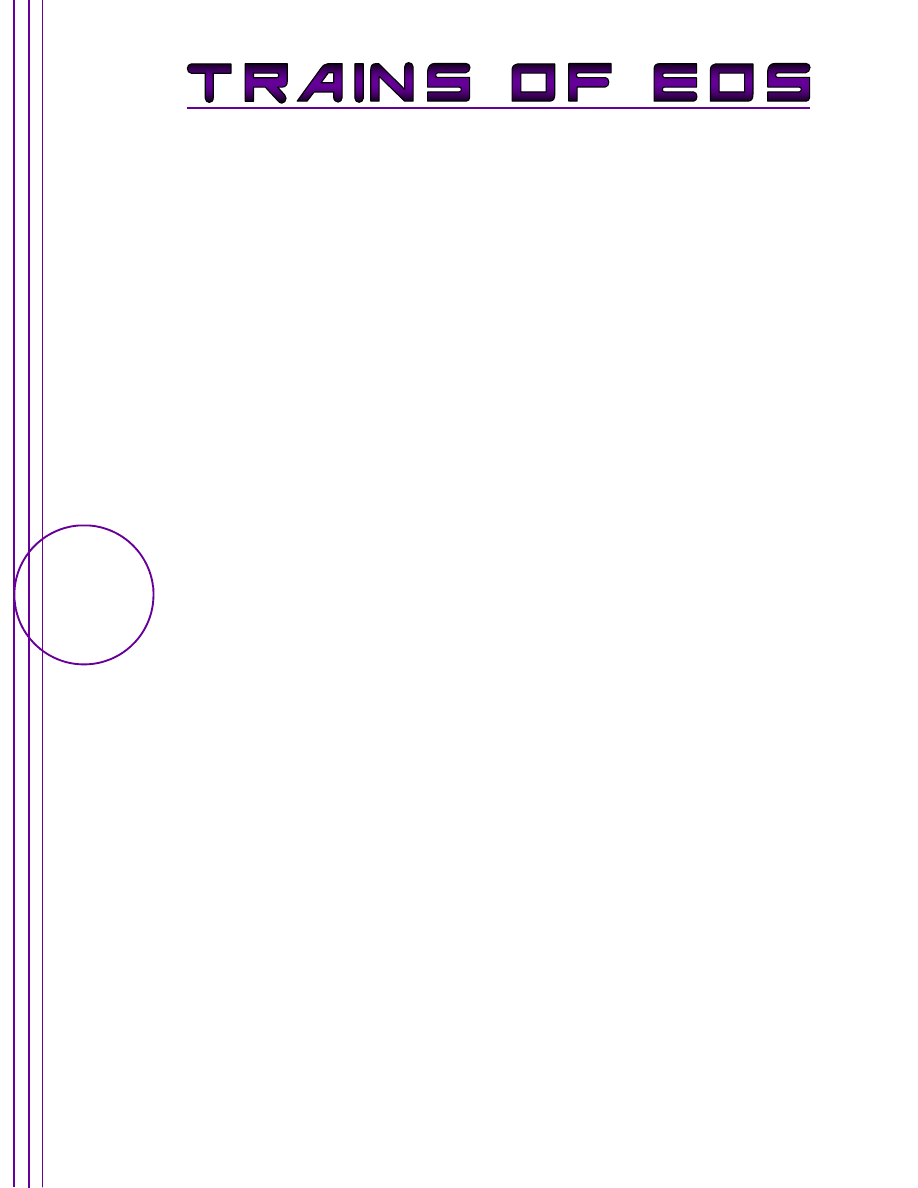
Name PL
Crew
Pass
Cargo
Init
Man
Top
Spd
Def Hard HPs Size Purch
DC Restrict
DS-HR Engine
6
2
4
1 ton
-6
-8
120
6
10
56
G
36
Lic (+1)
DS-MR Mag-Lev Engine
7
4
4
1 ton
+0
-4
600
6
10
50
G
42
Lic (+1)
Cargo
Car*
5 0 0 50t -12 -12 0 6 5 42 G 26 -
Flatbed
Car*
5 0 0 50t -12 -12 0 6 5 34 G 22 -
Passenger Car*
5
0
40
10t
-12
-12
0
6
5
45
G
28
-
MSI-43 Mine Processor
6
5
20
200t
-12
-14
100
2
10
240
C
48
Lic (+1)
MSI-67 Mobile Factory
6
7
46
200t
-10
-14
90
2
10
262
C
50
Lic (+1)
T-56 Air Support
6
56
48
120t
-10
-18
110
10
15
294
C
52
Mil (+3)
T-90 Ground Support
6
78
240
200t
-10
-20
100
10
20
316
C
54
Mil (+3)
22
Roger’s point has six of these machines; Steel End has two; Sunder
Ridge has two; Lanner’s Crossing has one; and Delhi has one. Most of
the Hercules Train Engines were built in Steel End or Roger’s Point.
Capable of pulling upwards of 100 train cars, the Hercules is a very
powerful machine. It is extremely reliable and while not fast, it can operate
for hours on end without fear of overheating or suffering mechanical
failure. Indeed the dependability of these machines has become legendary
among the faction-camps despite the fact they were all built from
scavenged parts. “Steady as Hercules,” has become a common
compliment among faction-campers, who far prefer their slow but solid
machines to the faster but more unreliable mag-lev trains of the Republic.
Armor and weapons are not standard features on the Hercules Train
Engine, though some faction-camps have added both in order to protect
their investments. The Hercules Train Engine is twelve squares long and
three squares wide.
Air Deployment Unit
A recent creation of Roger’s Point’s weapons development community,
the Air Deployment Unit is the first military train constructed by the faction-
camps. Meant to be part of a fast response strategy against future
Republic incursions similar to the attack on Red Hill, the Air Deployment
Unit is intended to get a sizeable amount of troops into position along with
air cover and supplies. The Air Deployment Unit is designed not only to
quickly deploy a number of light attack aircraft, but also provide direct fire
support for its troops. The vehicle has been rushed through its testing
phase by Patricia Rogers, and some think it is not ready for field duty. Its
crew is already undergoing field training around the area controlled by
Roger’s Point. The Air Deployment vehicle can only travel on faction-
camp rails, and transporting it off Dawnhome would be a major
undertaking. The Air Deployment Unit has a crew of four engineers, three
drivers, eight mechanics, 40 gunners, twelve pilots, and 80 soldiers. It can
carry an additional 80 soldiers if need be.
The Air Deployment Unit uses a single Hercules Train Engine for
mobility, though eventually a second engine is planned to be added to the
end of the train when one becomes available. Currently the Hercules
Engine assigned to the Air Deployment Unit has a fusion reactor. The Air
Deployment Unit consists of fifteen cars, though this can be switched
around as needed. The first car is a fuel car; the next four usually serve
as crew quarters and storage; the fifth car serves as a gunnery and
communication station, housing an R-23 Tangier Rocket Battery, a T-180
Tangier Heavy Cannon, an advanced communication and sensor suite
including radar and satellite communications; the sixth through twelfth cars
are flatbeds that are linked together to serve as a short, makeshift
runway for launching slingwings (see below); the thirteenth car is another
gunnery car with an R-23 Tangier Rocket Battery and a pair of Daxion
Arms D-12 Rail Cannons; and the fourteenth and fifteenth cars serve as
storage, repair and rearming bays for the slingwings. All the cars in the
train have two turrets with a pair of fire-linked D-1 Longarm Rifles (4d6
damage). The Air Deployment Unit is equipped with Alumisteel armor.
23
The slingwing launching platform is equipped with catapults for
launching and nets for landing. When these cars are not being used for
take off or landing operations, they are used as storage space for the
slingwings. The deck must be cleared before any slingwings may be
launched, which generally takes less than five minutes. The Air
Deployment Unit can carry up to twelve slingwings.
The Air Deployment Unit is 150 squares long and 4 squares wide.
Roger’s Point Street Cars
An impressive product of civilian engineering, the street cars of Roger’s
Point are surprisingly functional and flexible machines considering they
come from a town so oriented toward making tools of war. The street
cars are approximately 60 feet long, twelve feet wide, and ten feet tall.
The driver of the car stands at the front, while the passengers ride in 60
chairs lining the interior sides of the vehicle. These chars may be folded
up into the ceiling to open up storage space. When so configured, the
street car can carry up to ten tons of cargo. The vehicle can be exited
through doors on either side at the front, middle, and rear. The street cars
are made primarily of wood with steel supports and joints, though all the
undercarriage is made of steel.
The street cars run off power lines that stretch above their tracks. The
street cars use metal rods to remain in contact with these lines, though
they also have internal batteries that allow them to function for up to two
hours without an external power source. The street cars can only follow
the tracks laid out for them, but otherwise behave like normal vehicles.
They have no armor plating as a standard feature.
The Roger’s Point street cars are 12 squares long and 3 squares
wide.
The Slingwing
A recent development on the part of the EFL, these devices are similar to
the ultralight aircraft of old Earth. Built of little more than metal supports,
cloth, and an oversized motor, they are not very fast or resilient but they
are cheap and efficient. Powered by gasoline engines, they can be easily
constructed out of common materials and repaired just as easily.
Slingwings can even be disassembled in five minutes, collapsing to the
size of a Medium-size object; setting the slingwing back up takes ten
minutes. These vehicles have only been developed by the EFL within the
last year and have not seen much service outside of scouting and survey
operations, but the EFL hopes to use them as bombers in any future
military actions against infantry and armor units. The EFL realizes that the
slingwings would have no hope of shooting down actual combat aircraft,
and so instead concentrates on using them against ground targets.
Slingwings are not equipped with any armor to speak of and have little
protection for the pilot, granting only one-half cover. Because of their light
weight they can take off over very short distances, requiring only 300 feet
(100 feet with a catapult). Slingwings are usually equipped with 6 light
rockets, 4 Tangier Missile Launchers, or a D-12 Rail Gun Cannon. These
weapons are located along the bottom of the pilot’s seat and can be
24
changed very quickly due to a cleverly designed modular loading system.
Theoretically a slingwing that has expended its weapons can land, be
refueled rearmed, and get back in the air in less than five minutes. On a
full tank of gas, a slingwing has a range of 100 miles, but it is not equipped
to travel above an altitude of 5,000 feet.
The slingwing is 3 squares long and 5 squares wide. The slingwing is
considered an Ultralight class aircraft for purposes of the Aircraft
Operation feat.
Vehicular Weapons
EDF-982 Heavy Rail Cannon
The largest surface vehicle weapon in the EDF arsenal, it was designed
and built using parts from rail guns salvaged from the
Dawning Star
. The
first EDF-982 has only just recently entered service, and it is unlikely more
will be produced due to a lack of vehicles that can mount them and the
questionable tactical use of the weapon. While capable of inflicting
immense damage over long ranges, the Dawning Star Republic doesn’t
feel that such weapons are the direction its research should be heading.
As much a weapon of intimidation as utility, many fear the EFL will take
the development of the EDF-982 as a precursor to an attack on the
faction-camps.
The EDF-982 is a massive weapon that can accurately hit large
targets miles away, but it does not have pinpoint accuracy for smaller
targets. It can fire in both direct and indirect modes. The targeting
mechanism adds a +8 bonus to attack rolls if the operator takes a full-
round action before firing to aim. The EDF-982 cannot be fired at a target
closer than 1,000 ft. since its barrel cannot be depressed to a sufficient
angle. The EDF-982 has an automatic loading mechanism so it may fire
without pausing to reload. The automatic ammunition feed itself houses 50
rounds; once that is expended a new ammunition feed must be attached,
which takes five minutes. The standard shell of the EDF-982 is a solid
sabot round that inflicts 10d12 points of damage and ignores 10 points of
hardness. An experimental shrapnel-producing rounds has been
developed that inflicts 8d6 concussion damage on the target and 6d6
piercing damage on everything within 100 feet of the target, Reflex save
(DC 16) for half damage.
Name PL
Crew
Pass
Cargo
Init
Man
Top
Spd
Def Hard HPs Size Purch
DC Restrict
Hercules Train Engine
5
2
2
1 ton
-7
-8
110
6
10
56
G
32
Lic (+1)
Air Deployment Unit
5
55
92
100t
-10
-18
100
7
15
290
C
48
Mil (+3)
Roger’s Point Street Car
5
1
60
10t
-4
-4
70
6
5
48
G
29
Lic (+1)
Slingwing
5
1
0
20 lb.
+2
+2
130
8
5
24
H
23
Lic (+1)
25
EDF-180 Rail Cannon
A smaller version of the Magna-6 Rail Cannon used on the Armadillo
heavy tank, the EDF-180 is an economical version that can be more
easily constructed given the limited resources of Eos. Most of the EDF-
180s have been built using salvaged parts from the many rail cannons
mounted on the
Dawning Star
, but the newer models are made with
original parts. The EDF hopes that the EDF-180 will become the standard
heavy cannon for its forces within a few years and is currently working on
a plan to retrofit it to the Basil APCs still in service. The weapon can
already be seen in newer vehicles and installations of the EDF, such as
the Ground Support Train and the Fort Westmore near Hapeville.
The EFDF-180 is a direct-fire anti-armor weapon. It ignores 5 points of
hardness. Loading the weapon requires a move equivalent action.
R-23 Tangier Rocket Battery
An upgraded version of the technology used in the Tangier Missile
Launcher, this weapon system uses Tangier Missiles without guidance
systems as direct or indirect fire weapons. This weapon is a new favorite
among the EFL due to its ease of construction and relatively low cost. It is
becoming an increasingly common sight among the fortifications and
vehicles of the EFL, much to the consternation of the EDF since the R-23
is a formidable weapon platform. This is one more forceful step in the
EDF’s efforts to curtail the operations of the Tangier family.
The rockets can be equipped with either armor-piercing warheads
(6d12 damage, ignoring 5 points of hardness) or high explosive warheads
(6d6 damage to the target, 4d6 to everything within 30 feet, Reflex save
(DC 14) for half damage). The rockets may be fired in salvos using the
rules for automatic weapons, allowing the operator to strafe an area with
rockets. The Tangier Rocket Battery holds 20 rockets when fully loaded
and can be reloaded in five minutes.
TR-150 Tangier Heavy Cannon
The first entry into the cannon market by the Tangier family, the TR-150 is
meant to serve as a main battery weapon for armored vehicles and
fortifications. The EFL hopes to eventually field a tank using the Tangier
Heavy Cannon, but so far such plans are years off. For now the only
vehicle carrying the TR-150 is the Air Deployment Vehicle, though some
fortifications around the Southern Circuit have been reinforced with TR-
150s. While not as effective as the Magna-6 Rail Cannon used by the
Armadillo heavy tank, the TR-150 still packs an impressive punch.
The TR-150 uses a high-explosive round as its standard round. It
inflicts 4d6 concussion damage on everything within 15 feet of the target.
Reloading the TR-150 requires a move-equivalent action.
Weapon PL
Damage
Critical
Dmg
Type
Increment
RoF
Mag
Size
Weight
Purch
Restrict
EDF-982 Heavy Rail Cannon
7 Varies
19-20 Ballistic
6,000 ft.
S
50
C
12 tons
42 Mil (+3)
EDF-180 Rail Cannon
7 6d12
19-20 Ballistic
500 ft.
S
1
H
1,100 lb.
28 Mil (+3)
R-23 Tangier Rocket Battery
6 Varies
19-20 Concussion 4,000 ft.
A
20
H
1 ton
27 Mil (+3)
TR-150 Tangier Hvy Cannon
6 6d10
19-20 Ballistic
800 ft.
S
1
H
1,500 lb.
27 Mil (+3)
26
Margaret Pietov, Rail Marshal
Margaret grew up in one of the small settlements surrounding Dawning
Star City. She is first-generation Eotian. In her youth, her small town was
only connected to Dawning Star City by a single dirt road. When she
turned eight, the train came to town. Almost overnight the town became a
thriving farming town. Since that day Margaret has had a fascination with
trains.
When she turned eighteen she left home to see those wonders, but
found them to be less than she had hoped. Margaret found Dawning Star
City to be dirty, noisy, and crowded, nothing like the gleaming towers of
steel and science she had expected. The journey on the train though was
everything she had expected, so she set her sights on earning her living
on the rail lines. To this end she joined the Republic Transit Authority,
starting as a lowly baggage handler. When her experience with the militia
of her home town came to the attention of her superiors, she was moved
the Rail Marshal division during the days of its infancy and became one of
the first Rail Marshals.
Now she has been a Rail Marshal for nearly two decades, and while
some of her wonderment is gone, she still loves the trains she protects.
Rarely sleeping more than two nights in the same place, she is a modern-
day nomad, constantly traveling across the Republic keeping its train lines
safe. She has become something of a legend among train engineers, who
see her as a good luck charm. Things rarely go bad on the trains she is
assigned to, and if they do she’s always managed to control the situation.
Margaret Pietov’s appearance is described by many as bullish since
she retains the rather stout build of her early days on the farm. While not
what most would consider attractive, she has a kindness to her face that
many people find endearing. She keeps her hair cut short and her uniform
clean, always doing her best to look like an agent of the Republic.
Margaret Pietov (Dedicated Hero 4/Lawman 4): CR 8; Medium humanoid; HD
8d8+16; hp 56; MAS 14; Init +0; Spd 30 ft.; Defense 19, touch 16, flat-footed 16
(+6 class, +3 armor); BAB +6; Grap +8; Atk +9 melee (1d8+2, whipstick) or +9
melee (1d3 electricity and stun, stun gun), +7 ranged (2d6+2, EDF-9 Auto-Pistol);
Full Atk +9/+4 melee (1d8+2, whipstick) or +9/+4 melee (1d3 electricity and stun,
stun gun), +7/+2 ranged (2d6+2, EDF-9 Auto-Pistol); FS 5 ft. by 5 ft.; Reach 5 ft.;
SQ Force of law, legwork, weapon specialization (EDF-9); AL Dawning Star
Republic, RTA; SV Fort +9, Ref +2, Will +6; AP 10; Rep +3; Str 14, Dex 10, Con
14, Int 12, Wis 14, Cha 10.
Occupation: Law Enforcement
Skills: Drive +6, Gather Information +4, Intimidate +9, Investigate +8,
Knowledge (Civics) +6, Listen +11, Read/Write Language (English), Repair +4,
Search +7, Sense Motive +15, Speak Language (English), Spot +15, Treat Injury
+5.
Talents: Empathy, Intuition
Feats: Armor Proficiency (Light), Alertness, Attentive, Great Fortitude,
Personal Firearms Proficiency, Point Blank Shot, Simple Weapon Proficiency,
Surface Vehicle Operation (Trains), Weapon Focus (EDF-9), Vehicle Operation.
Possessions: Rough outs, whip stick, stun gun, EDF-9 with 4 clips, universal
communicator, sheet of train schedules, pocket watch.

OPEN GAME LICENSE Version 1.0a
The following text is the property of Wizards
of the Coast, Inc. and is Copyright 2000
Wizards of the Coast, Inc ("Wizards"). All
Rights Reserved.
1. Definitions: (a)"Contributors" means the
copyright and/or trademark owners who have
contributed Open Game Content;
(b)"Derivative Material" means copyrighted
material including derivative works and
translations (including into other computer
languages), potation, modification, correction,
addition, extension, upgrade, improvement,
compilation, abridgment or other form in
which an existing work may be recast,
transformed or adapted; (c) "Distribute"
means to reproduce, license, rent, lease, sell,
broadcast, publicly display, transmit or
otherwise distribute; (d)"Open Game Content"
means the game mechanic and includes the
methods, procedures, processes and routines
to the extent such content does not embody
the Product Identity and is an enhancement
over the prior art and any additional content
clearly identified as Open Game Content by
the Contributor, and means any work covered
by this License, including translations and
derivative works under copyright law, but
specifically excludes Product Identity. (e)
"Product Identity" means product and product
line names, logos and identifying marks
including trade dress; artifacts; creatures
characters; stories, storylines, plots, thematic
elements, dialogue, incidents, language,
artwork, symbols, designs, depictions,
likenesses, formats, poses, concepts, themes
and graphic, photographic and other visual or
audio representations; names and descriptions
of characters, spells, enchantments,
personalities, teams, personas, likenesses and
special abilities; places, locations,
environments, creatures, equipment, magical
or supernatural abilities or effects, logos,
symbols, or graphic designs; and any other
trademark or registered trademark clearly
identified as Product identity by the owner of
the Product Identity, and which specifically
excludes the Open Game Content; (f)
"Trademark" means the logos, names, mark,
sign, motto, designs that are used by a
Contributor to identify itself or its products or
the associated products contributed to the
Open Game License by the Contributor (g)
"Use", "Used" or "Using" means to use,
Distribute, copy, edit, format, modify,
translate and otherwise create Derivative
Material of Open Game Content. (h) "You" or
"Your" means the licensee in terms of this
agreement.
2. The License: This License applies to any
Open Game Content that contains a notice
indicating that the Open Game Content may
only be Used under and in terms of this
License. You must affix such a notice to any
Open Game Content that you Use. No terms
may be added to or subtracted from this
License except as described by the License
itself. No other terms or conditions may be
applied to any Open Game Content
distributed using this License.
3.Offer and Acceptance: By Using the Open
Game Content You indicate Your acceptance
of the terms of this License.
4. Grant and Consideration: In consideration
for agreeing to use this License, the
Contributors grant You a perpetual,
worldwide, royalty-free, non-exclusive license
with the exact terms of this License to Use,
the Open Game Content.
5.Representation of Authority to Contribute:
If You are contributing original material as
Open Game Content, You represent that Your
Contributions are Your original creation and/
or You have sufficient rights to grant the
rights conveyed by this License.
6.Notice of License Copyright: You must
update the COPYRIGHT NOTICE portion of
this License to include the exact text of the
COPYRIGHT NOTICE of any Open Game
Content You are copying, modifying or
distributing, and You must add the title, the
copyright date, and the copyright holder's
name to the COPYRIGHT NOTICE of any
original Open Game Content you Distribute.
7. Use of Product Identity: You agree not to
Use any Product Identity, including as an
indication as to compatibility, except as
expressly licensed in another, independent
Agreement with the owner of each element of
that Product Identity. You agree not to
indicate compatibility or co-adaptability with
any Trademark or Registered Trademark in
conjunction with a work containing Open
Game Content except as expressly licensed in
another, independent Agreement with the
owner of such Trademark or Registered
Trademark. The use of any Product Identity in
Open Game Content does not constitute a
challenge to the ownership of that Product
Identity. The owner of any Product Identity
used in Open Game Content shall retain all
rights, title and interest in and to that Product
Identity.
8. Identification: If you distribute Open Game
Content You must clearly indicate which
portions of the work that you are distributing
are Open Game Content.
9. Updating the License: Wizards or its
designated Agents may publish updated
versions of this License. You may use any
authorized version of this License to copy,
modify and distribute any Open Game
Content originally distributed under any
version of this License.
10 Copy of this License: You MUST include
a copy of this License with every copy of the
Open Game Content You Distribute.
11. Use of Contributor Credits: You may not
market or advertise the Open Game Content
using the name of any Contributor unless You
have written permission from the Contributor
to do so.
12 Inability to Comply: If it is impossible for
You to comply with any of the terms of this
License with respect to some or all of the
Open Game Content due to statute, judicial
order, or governmental regulation then You
may not Use any Open Game Material so
affected.
13 Termination: This License will terminate
automatically if You fail to comply with all
terms herein and fail to cure such breach
within 30 days of becoming aware of the
breach. All sublicenses shall survive the
termination of this License.
14 Reformation: If any provision of this
License is held to be unenforceable, such
provision shall be reformed only to the extent
necessary to make it enforceable.
15 COPYRIGHT NOTICE
Open Game License v 1.0 Copyright 2000,
Wizards of the Coast, Inc.
Modern System Reference Document
Copyright 2002-2004, Wizards of the Coast,
Inc.; Authors Bill Slavicsek, Jeff Grubb, Rich
Redman, Charles Ryan, Eric Cagle, David
Noonan, Stan!, Christopher Perkins, Rodney
Thompson, and JD Wiker, based on material
by Jonathan Tweet, Monte Cook, Skip
Williams, Richard Baker, Peter Adkison,
Bruce R. Cordell, John Tynes, Andy Collins,
and JD Wiker.
Dawning Star: Operation Quick Launch
Copyright 2004, Justin D. Jacobson
Helios Rising, Copyright 2006, Justin D.
Jacobson
INDICIA
Principal Writing by Lee Hammock. Cover
Illustration by Danilo Moretti. Editing and
Layout by Justin D. Jacobson.
'd20 System' and the 'd20 System'
logo are trademarks of Wizards of
the Coast, Inc. and are used
according to the terms of the d20
System License version 6.0. A copy
of this License can be found at
www.wizards.com/d20. d20 Modern
and Wizards of the Coast are
trademarks of Wizards of the Coast,
Inc. in the United States and other
countries and are used with
permission.
All other content is ©2006 Justin D.
Jacobson. Dawning Star, Operation Quick
Launch, Helios Rising, TERRAFORMER,
their corresponding logos, and all Blue Devil
Games logos are trademarks of Justin D.
Jacobson. This edition of TERRAFORMER is
produced under version 1.0a of the Open
Game License, version 6.0 of the d20 System
License, version 5.0 of the d20 System
Trademark Logo Guide, and the Modern
System Reference Document by permission of
Wizards of the Coast, Inc. Subsequent
versions of this product will incorporate later
versions. All rights reserved. Product Code
BDV5056.
Designation of Open Content: All of the
content not specifically enumerated as Closed
Content is Open Content, including but not
limited to the NPCs, equipment, xenomorphs,
and description of Julian measles.
Designation of Closed Content: Dawning
Star logos and titles, TERRAFORMER logos
and titles, the cover illustration and the term
vaasi and darkling.
Wyszukiwarka
Podobne podstrony:
Dawning Star Terraformer 01 Daybringer Prestige Class
Dawning Star Terraformer 10 Eotian Air Carriers
Dawning Star Terraformer 12 Invisibility Tech
Dawning Star Terraformer 05 Human Fighting Styles
Dawning Star Terraformer 03 Daxion Arms Weapons
Dawning Star Terraformer 06 Dawning Star University
Dawning Star Terraformer 09 Grass Widow Advanced Class
Dawning Star Terraformer 11 Relic Hunting
Dawning Star Terraformer 08 Aquatic Xenomorphs
Dawning Star Terraformer 02 Bone Orchard Encounter
Dawning Star Terraformer 01 Daybringer Prestige Class
Dawning Star Terraformer 10 Eotian Air Carriers
Dawning Star Terraformer 12 Invisibility Tech
Star Wars New Jedi Order 07 Edge of Victory I Conquest
Dawning Star Red Truth Revealed
Dawning Star Seeing Red
Dawning Star Sample PCs
07 System of government
więcej podobnych podstron