Requires the use of the d20 Modern
Roleplaying Game, published by
Wizards of the Coast, Inc.

1
†A
BOUT
D
AWNING
S
TAR
Dawning Star was the first full-scale science fiction campaign setting built on d20
Modern and powered by the Future ruleset from Wizards of the Coast. The
critically-acclaimed setting was nominated for an ENnie for Best d20 Game. You
can learn more and download free material by visiting www.dawningstar.com.
†A
BOUT
T
ERRAFORMER
The Terraformer line of products from Blue Devil Games presents new material
designed for Dawning Star but usable in most science-fiction campaigns. Each
entry will offer a new prestige class, xenomorph, talent tree, feat, weapon, etc.
and advice on using it into your campaign and using it to “shape your world.”
†A
BOUT
B
LUE
D
EVIL
G
AMES
“Fiendishly Clever.” Blue Devil Games is one of the highest-quality small-press
publishers on the market today. BDG product lines include Dawning Star,
AEvolutions in support of
Monte Cook’s Arcana Evolved
, and the upcoming
Passages. Visit our website for more information: www.bluedevilgames.com.
†A
BOUT
C
HAD
B
ARR
Born and raised in California and currently living in the island community of
Alameda, in the San Francisco Bay, Chad was “discovered” in the initial
Dawning Star xenomorph design contest and has been pitching in on Dawning
Star products ever since.
To:
director@dsrs
From:
ab@dsrs
Subject: Decipher pre-publication report
Authenticity Code
bar29203985092345073409867340987code
CRC Sum 010111100011
Director, attached is the decrypted report, to date, of the
xenomorphs provided by Tentaari Ambassador “Benjamin” on his
last visit 10 months ago. Their reluctance to provide some of their
knowledge about the lifeforms of Eos seems to have been worth the
wait.
Their claims of needing to provide the information in a ‘compatible’
format may or may not have masked their typical spoon-feeding of
information. The information was provided in Unispeak, which we
translated by borrowing some cycles on Sadler’s mainframe.
Our initial scan of the xenoforms was routine until an agent noted a
hiccup between 2 entries. We assumed it was a computer problem
but after troubleshooting we realized a significant difference between
density of information and file size.

2
Did they intend to hide the data and simply underestimate our
technical ability or is the data irrelevant? Only the entries that list
planets other than Eos were found in the scrambled data.
In any event, we’ve followed typical format and in the cases were a
translation into English wasn’t 100%, we’ve listed the closest
translation as possible and noted same by use of brackets.
Xenoform is used to indicate possible sentient lifeforms, while
xenomorph describes lower-order lifeforms. Some of the creature
names appear to be almost farcical, but we believe this is a
connotation derived from the difficulty in translation of proper nouns
from Unispeak into English. Only amphibious and aquatic creatures
are included in this report.
Datafile B-3
A
LBINO
H
ELLBENDER
One of the native species planetologists know we have impacted is
the albino hellbender. This amphibian was found in the caverns that
form a natural cistern under Dawning Star City. A diving team used
robots to discover the underwater system that leads from the
aquifers to the Jonas River. These caverns are one reason the city
was built were it is today, as it had a natural reservoir.
The hellbenders were captured and many still reside as
specimens in Dawning Star University’s biology department. A
smaller cavern was located upstream and a transplant project was
enacted.
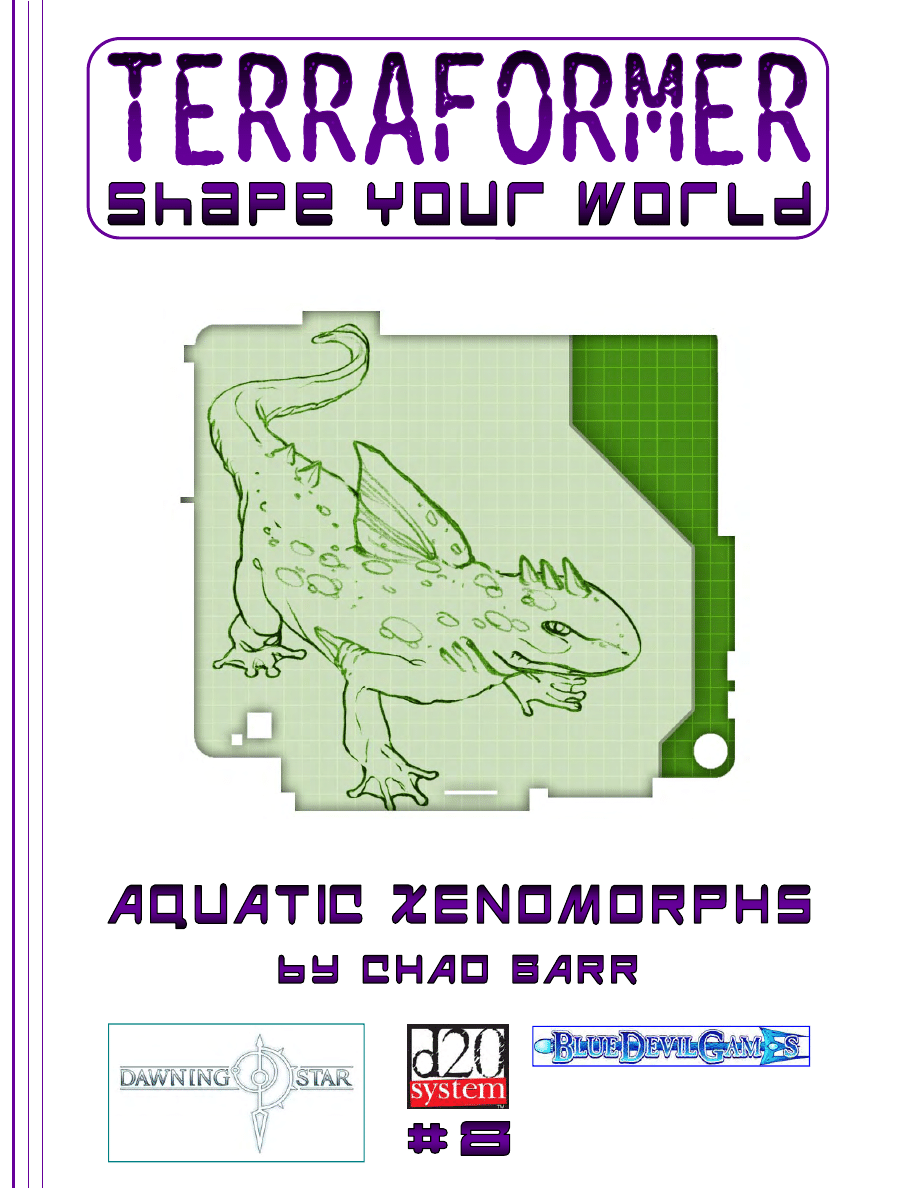
Large by earth standards the albino hellbender is a salamander,
averaging 2 feet long weighing an average of 12 pounds. They have
long catfish like whiskers from their lips, which help the blind
hellbender sense their terrain and help them hunt. When food is
located their round sucker like mouth attaches to their prey. In a
gory maneuver they roll over shredding off bits of their prey for
consumption. Terran crocodiles and deep-sea scavengers feed in a
similar manner.
Millions of tiny electroplates lining the dorsal and ventral skin flaps
along their body are their secret weapon, stunning or even killing
their prey or predators. The hellbender may resemble a salamander,
but their organs diverge from the norm, as they have both gills and a
pair of lungs, allowing them true amphibious capability.
The transplant hasn’t been entirely successful. They have been
meeting other local fauna, such as the Frilled Xaka, moving from the
underground cavern and either eating the smaller creatures or being
killed by more resilient prey, possibly even humans worried about
the hellbender’s reputation.

3
Species Traits
Amphibious (Ex): Although striped anurans are aquatic, they can
survive indefinitely on land.
Aquatic: Albino hellbenders can move in water without making
Swim checks and cannot drown in water.
Blindsight (Ex): With their whiskers and innate electrosense ability,
the hellbender can target creatures just as any other being, despite
lacking normal or low-light vision. Range is 30 ft.
Electroplate Field (Ex): The hellbender can generate an electric
field capable of killing small creatures and even children or frail
humans. Any creature touching a hellbender is automatically
exposed to the field. The hellbender can subject a foe to the field
with a successful touch attack. When at least half the hellbender’s
body is submerged in water, the hellbender can discharge the field
as a standard action which does not provoke an attack of
opportunity, exposing any creature within 15 feet to the field. The
field deals 1d4 points of electric damage. A successful save reduces
the damage by half. The hellbender’s bite does not expose the victim
to the field.
Bonus Feat: Albino Hellbenders gain the bonus feat Weapon
Finesse (Bite).
Albino Hellbender CR 1; Small animal; HD 2d8+2; hp 11; MAS 12; Init
+3; Spd 10 ft., swim 20 ft.; Defense 15, touch 14, flat-footed 14 (+1
size, +3, Dex, +1 natural); BAB +1; Grap –5; Atk +4 melee (1d4-2,
bite); Full Atk +4 melee (1d4-2, bite); FS 5 ft. by 5 ft.; Reach 5 ft.; SQ
amphibious, aquatic, blindsight, electroplate field; AL none; SV Fort
+4, Ref +6, Will +0; AP 0; Rep +0; Str 6, Dex 17, Con 12, Int 1, Wis
10, Cha 4.
Skills: Listen +5, Swim +12
Feats: Weapon Finesse (Bite)
Advancement: 3 HD (Small), 4-6 HD (Medium)
C
ARVER
L
EECH
Native to [3
rd
planetary body]. Parasites with square bodies and an
enlarged ovoid shaped head with 3 mouths, they lurk in bogs and
other warm murky places waiting for a meal to pass by. Grey in
color, their tint changes to a dark red as they consume more flesh
and blood. Being 1 foot long and an arm’s length around, they make
a strange site when squirming through the mud.
If they can, they try to drop on hosts from trees, but their cilia
make them clumsy climbers and often have to wait in murky puddles
for creatures to rest or come to drink. Once the primary mouth
latches on it burrows far enough into the victim’s flesh so the other
sucker-like mouths can begin feeding.

4
When not attached to a host, the carver leech tries to find one
while avoiding predators such as the [xenomorph]. They avoid
creatures of the same size or smaller unless they have gone without
food for extended periods of time. Though they prefer a living host,
they have also been found within the corpse of large animals, where
they breed.
[Xenomorph] and [xenomorph] classify these creatures as
monstrous vermin and kill them whenever they are encountered.
Species Traits
Blindsight (Ex): With their delicate, heat-sensitive cilia, carver
leeches can sense the presence of all warm-blooded creatures
within a 30 ft. radius.
Flesh Burrow (Ex): Once the carver leech has bitten a creature it
latches on and continues feeding, inflicting 1 point of damage per
round. A leech that has latched on can be removed with a Strength
check (DC 10) or a Medicine check (DC 10). A leech that has
inflicted 3 points of damage in this manner has burrowed too deeply
to be removed in this manner. Removing a leech in that state
requires a Medicine check (DC 20) or forcible removal with a blade,
which inflicts 2d6 points of damage. After 10 rounds, if the victim is
Large size or larger, the leech has burrowed its way to a place of
hibernation within the tissue of its victim and will continue to live
there, subsisting on its host. The vicitim suffers 1 point of Con
damage and loses an additional 1 point of Con damage until the
leech is removed or the host dies. After 10 rounds, the leech leaves
victims of Medium size or smaller of its own accord.
Resistance to massive damage: Carver leeches gain a +5
species bonus on Fortitude saves to negate the effects of massive
damage.
Tremorsense (Ex): Carver leeches can automatically sense the
location of anything within 60 feet that is in contact with the ground.
Immunities: Carver leeches are immune to mind-affecting effects.
Carver leech CR 2; Tiny vermin; HD 2d8+2; hp 11; MAS 12; Init +0;
Spd 5 ft.; Defense 14, touch 12, flat-footed 14 (+2 size, +2 natural);
BAB +1; Grap –7; Atk +3 melee (1d4, bite); Full Atk +3 melee (1d4,
bite); FS 2 1/2 ft. by 2 1/2 ft.; Reach 0 ft.; SQ blindsight, tremorsense,
immune to mind-affecting attacks, resistance to massive damage,
flesh burrow; AL none; SV Fort +4, Ref +0, Will +0; AP 0; Rep +0;
Str 10, Dex 10, Con 12, Int -, Wis 10, Cha 2.
Skills: Climb +1, Hide +13
Feats: None
Advancement: 3-4 HD (Small), 5-6 HD (Medium)

5
C
ENTURION
T
OAD
This xenomorph hibernates for most of its life, only becoming active
for the short rainy season of [4
th
planetary body]. The rest of the
time it remains torpid, relying on the leaf-litter to act as a blanket and
resisting frost and heat with a sugar-based antifreeze in their blood
to keep it alive. The bulbous creature has two front legs with spongy
gripping digits, while the majority of their body mass is the central
portion, 3 feet wide and weighing a deceptive 100 pounds. Principally
brown, splotches of black dot their orbital cavities.
The centurion toad is only half of an equation however. It has a
symbiotic relationship with a tuberous plant that grows only in certain
ranges near volcanic vents and on the back of the toad. The foot-
long blossoms are hollow, collecting rainwater. The base of the
blossom contains a dart laced with a toxin that causes heat stroke-
like sypmtoms in victims.
Centurion toads wake from hibernation just as the initial rush of
rainfall occurs. During this time they gorge on as much food
(principally insects and small rodents) as possible. They rely on the
flashfloods to draw them together with other members of their
species to mate. The centurion toad has very small rear
appendages, which they use primarily to steer through the water as
they float along with the deluge. Without water to provide a transport
medium they have to rely on slowly crawling along the ground.
The toads are able to stimulate the blossoms growing from their
hides, launching a fusillade of darts at their prey. They give a vocal
warning to any creature larger than them, which sounds like the
standard call of the [xenoform]. This noise is intensified during mating
when any number of centurion toads can find themselves within the
same area.
Adolescent centurion toads resemble lizards and are more active
before metamorphosis as they hunt for the necessary mass to grow
into adult form. They dig a shallow burrow where they will remain
virtually frozen for a year before emerging during the next rainstorm.
Species Traits
Amphibious (Ex): Although centurion toads are aquatic, they can
survive indefinitely on land.
Fire Darts (Ex): The blossoms contain toxic darts that the toad
can release as a standard action which does not provoke an attack
of opportunity. The darts release in all directions. The toad cannot
target a specific creature and cannot release less than all of its
darts. Any creature within 20 feet of the centurion toad when it
releases its darts must make a Reflex saving throw (DC 12) or be
struck by 1d3 of the darts. Each dart inflicts 1d2 points of piercing
damage and requires a separate saving throw to avoid the effects

6
of the toxin (Fort DC 12). A character failing the saving throw is
fatigued
. The toad can use this ability once per day.
Bonus Feat: Centurion Toads gain the bonus feat Toughness.
Centurion Toad: CR 2; Small animal, HD 2d8+2; hp 17; MAS 13; Init –
3; Spd 5 ft., swim 15 ft.; Defense 11, touch 8, flat-footed 11 (+1 size, -3
Dex, +3 natural); BAB +1; Grap -3; Atk +2 melee (1d2, tongue); Full
Atk +2 melee (1d2, tongue); FS 5 ft. by 5 ft.; Reach 5 ft.; SQ
amphibious, fire darts; AL none; SV Fort +1, Ref –1, Will +1; AP 0;
Rep +0; Str 10, Dex 6, Con 13, Int -, Wis 10, Cha 5.
Skills: Move Silently +7, Spot +5, Swim +8
Feats: Toughness
Advancement: 3-6HD (Medium), 7 HD (Large)
C
YCLOPOLITH
Arguably the largest living organism on the planet, this behemoth can
still be found in the largest lakes of [3
rd
planetary body]. Four
massive columnar legs, and a counter-balancing tail, support its huge
body. A long neck and snout-shaped head rise from its outer
armored shell. Its mouth employs a baleen mechanism, whereby it
scoops up and siphons out large quantities of water, mud, and
similar materials, retaining edible insects, plants, and other matter.
Orange coloration on its back fades to yellow as it nears the
underbelly, with crimson chevron-shaped markings lining the neck.
The cyclopolith stands 120 feet tall from head to toe and 60 feet
long, weighing approximately 12 tons. The creature helps to support
its weight by remaining partially submerged in the bodies of water it
names at its home. A single cavernous socket on the anterior of the
head contains a nodule which emits sonar waves that the creature
uses to sense its environment.
Full-grown cyclopoliths have no known natural predators. Scouts
have reported sighting wild [xenomorph] attacking young
cyclopoliths, but the outcome of these struggles is mixed. Female
cyclopoliths lay a clutch of eggs, which are very carefully tended, lest
they be crushed. These eggs are the size of large humanoids. Once
hatched, the young immediately find their way to the water.
Species Traits
Hold Breath (Ex): A cyclopolith can remain submerged
underwater for a number of hours equal to its Constitution score
before needing to surface for air.
Scoop (Ex): The cyclopolith feeds by scooping large swaths of
area into its mouth. It can scoop up a mass of material with a 10 ft.
radius as a standard action. Anything within this area must succeed
at a Reflex save (DC 41) or be scooped up into the creature’s maw.

7
Victims are not swallowed whole. They remain in the creature’s
mouth for 1d3 rounds, suffering 4d6 points of bludgeoning damage
per round until freed.
Carapace (Ex): The massive plates covering the cyclopolith
provide damage reduction 10/-.
Cyclopolith CR 16; Colossal animal; HD 40d8+400; hp 580; MAS 30;
Init +0; Spd 40 ft., swim 30 ft.; Defense 30, touch 2, flat-footed 30 (-8
size, +28 natural); BAB +30; Grap +62; Atk +46 melee (2d6+16,
stomp); Full Atk +46 melee (2d6 +8, stomp); FS 30 ft. by 30 ft.;
Reach 15 ft. (20 ft. with bite); SQ hold breath, low-light vision, scoop,
carapace; AL none; SV Fort +32, Ref +22, Will +12; AP 0; Str 43,
Dex 10, Con 30, Int 1, Wis 8, Cha 5.
Skills: Hide -16, Spot+4, Survival +5
Feats: None
Advancement: 41-42 HD (Colossal)
G
IANT
G
OBLIN
S
HRIMP
Found in the larger lakes of [3
rd
planetary body] these crustaceans
feed off smaller aquatic life. Their segmented transparent shell
reveals their membranes and internal organs, being pink or white.
They grow to about 8 feet long and 6 feet tall when presenting (to
attract a mate or fend off rivals). In combat, they use 2 pincers, and
their mouth hides a tube-like tongue that injects a slow-acting poison
into its prey. Mismatched claws, barnacle-encrusted legs, insectoid
eyes, and transparent shell give the creature a grotesque
appearance responsible for the name.
They leave the water only to cross a beach or sandbar to reach
another body of water. These migrations help keep food stocks
from depleting as well as being necessary for finding mates. Mating
causes foam to form on the outside of the male’s shell. This foam is
actually comprised of the young larvae surrounded by a protective
gel, which provides nourishment until they have developed into self-
sustainable infants.
Their flesh quickly spoils and becomes inedible when killed,
though [xenomorph] will eat them without hesitation.
Species Traits
Aquatic: These creatures can move in water without making
Swim checks and cannot drown in water.
Blindsight (Ex): Giant goblins shrimp have the ability to sense the
presence of other creatures underwater within a 60 ft. radius.
Improved Grab (Ex): If a creature is grabbed with both pincers,
the shrimp can make a free attack to inject poison.
Anesthetizing Poison (Ex): The bite of the creature injects a slow-

8
acting poison that eventually paralyzes its prey. A victim bitten by a
shrimp is exposed to the poison. A Fortitude save (DC 19) negates
the effects of the poison. The poison deals 1d6 points of Dex
damage as its primary and secondary damage.
Resistance to massive damage: The shrimp gains a +5 species
bonus on Fortitude saves to negate the effects of massive damage.
Sea Legs: Giant goblin shrimp are more comfortable in the water
and suffer a –1 circumstance penalty to all attack rolls, saves and
checks while on land.
Immunities: Giant goblin shrimp are immune to mind-affecting
effects.
Giant goblin shrimp CR 7; Large vermin; HD 10d8+40; hp 85; MAS
18; Init +1; Spd 20 ft.; Defense 21, touch 11, flat-footed 20 (+1 Dex, +10
natural); BAB +7; Grap +14; Atk +9 melee (1d6+3 plus poison, bite)
or +9 melee (1d4+2, 2 pincers); Full Atk +9 melee (1d6+3 plus
poison, bite) and +4 melee (1d4+1, 2 pincers); FS 10 ft. by 10 ft.;
Reach 10; SQ aquatic, blindsight, immune to mind-affecting attacks,
poison, resistance to massive damage; AL none; SV Fort +11, Ref
+4, Will +3; AP 0; Rep +0; Str 16, Dex 13, Con 18, Int -, Wis 10; Cha
5.
Skills: Hide +2, Move Silent +6, Spot +5, Swim +11
Feats: None
Advancement: 11-13 HD (Large)
P
OISONMAIDEN
N
UDIBRANCH
This creature was first discovered washed up on one of the
beaches of Sun City after a heavy storm. Though dead it nearly
killed the two men who tried moving the carcass.
These large slug-like creatures have 2 ocular tendrils, a simple
mouth, an air bladder, and 2 tendrils tipped with tiny poison injecting
barbules. Poisonmaidens grow large enough to envelop a human
sized being and have bright orange flesh with white circles dotting
their spongy bodies.
Nudibranches are bottom-feeding scavengers, crawling along the
floor of the ocean in search of meals, which can be sedentary sea
life or anything that may have sunk to the bottom after succumbing
to the poisonmaiden’s touch. When not crawling along the floor they
float through the water with help of their air bladder allowing ocean
currents to take them where they may. Poisonmaidens eat poison
glands and barbules from other creatures, which they absorb into
their own physiology. Even the touch of their soft spongy bodies can
numb unprotected limbs.
Poisonmaidens are usually encountered after a storm has
washed them on shore or into shallow water or when they get

9
tangled in fishing nets. Underwater explorers report sightings on rare
occasions. Most are found in the warm waters and reefs around
Sun City. Smaller, purple nudibranches have also been spotted, but
they have not been captured for study to determine if they are
related to the poisonmadens or a different species altogether.
Species Traits
Aquatic: Poisonmaidens can move in water without making Swim
checks and cannot drown in water.
Poison Immunity (Ex): Poisonmaidens are immune to all poison
including their own.
Poison Barbules (Ex): Their two tendrils can be used to strike
enemies injecting poison. A successful melee touch attack subjects
the victim to the poison. A Fortitude save (DC 16) negates the effect.
The poisonmaiden’s venom deals 1d6 points of Strength damage as
its primary and secondary damage.
Dermal Poison (Ex): The skin of the poisonmaiden exudes a
milder form of toxin, which is still dangerous to anyone touching their
flesh or being touched by the creature. A successful Fortitude save
(DC 16) negates the effect. The poisonmaiden’s dermal toxin deals
1d4 points of Strength damage as its primary and secondary poison.
Bonus Feat: Poisonmaiden nudibranches gain the bonus feat
Stealthy.
Poisonmaiden Nudibranch: CR 4; Large aberration; HD 5d8+20; hp
46; MAS 18; Init +1; Spd 10 ft., swim 20 ft.; Defense 13, touch 10, flat-
footed 12 (-1 size, +1 Dex, +3 natural); BAB +3; Grap +9; Atk +4
melee touch (0 plus poison, barbules); Full Atk +4 melee touch (0
plus poison, barbules); FS 10 ft. by 10 ft.; Reach 10 ft.; SQ aquatic,
poison immunity, poison barbules, dermal poison, darkvision 60 ft.;
AL none; SV Fort +5, Ref +2, Will +6; AP 0; Rep +0; Str 14, Dex 12,
Con 18, Int 1, Wis 12, Cha 5.
Skills: Spot +5, Hide +2, Move Silently +7, Swim +10
Feats: Stealthy
Advancement: 6-9 HD (Large), 10 HD (Huge)
S
CARLET
U
MBRELLA
These creatures usually swim in the deep sea of Eos, but rarely a
cold undercurrent will cause a few to float to the upper layers of the
ocean. These invertebrates are most noted for their remarkable
coloration: bio-luminous red flesh makes them invisible at greater
depths, but striking when viewed in sunlight.
Glowing red with blue and white pulses, this 10-foot round jelly-fish
creature takes the form of a large bowl, with a tail trailing from the
bottom, containing a stinger. When threatened by something that

10
doesn’t succumb to the stinger’s poison, they fold up and jet through
the water away from the danger.
Velin fishermen tell stories of undersea lightshows hosted by
dozens of scarlet umbrellas and claim they can bring mortals to
tears or inner peace. Roger’s Point has at least one entrepreneur
who’s offering trips specifically to view these creatures, though how
they are predicting locations is still guesswork.
Species Traits
Aquatic: Scarlet umbrellas can move in water without making
Swim checks and cannot drown in water.
Sprint (Ex): When folded up a scarlet umbrella can spear through
the water every other round as a double move, at a speed of 120
feet.
Photosense (Ex): Scarlet umbrellas sense light around them
within a 180-foot radius.
Poison Sting (Ex): If the scarlet umbrella hits with its stinger, it
injects a poison that numbs the target. Victims must succeed at a
Fortitude save (DC 14) or suffer the poison’s damage. The poison
deals 1d6 points of Dexterity damage as its initial and and secondary
damage.
Immunities: Scarlet umbrellas are immune to mind-affecting
effects.
Scarlet Umbrella: CR 3; Large vermin, HD 4d8+8; hp 26; MAS 14; Init
–2; Spd swim 10 ft.; Defense 10, touch 7, flat-footed 10 (-1 size, -1
Dex, +3 natural); BAB +3; Grap +7; Atk +2 melee (1d4 plus poison,
stinger); Full Atk +2 melee (1d4 plus poison, stinger); FS 10 ft. by 10
ft.; Reach 10 ft.; SQ aquatic, photosense, escape velocity, immune to
mind-affecting attacks, resistance to massive damage, AL none; SV
Fort +6, Ref –1, Will +1; AP 0; Rep +0; Str 10, Dex 7, Con 14, Int -,
Wis 10, Cha 5.
Skills: Move Silently +7, Spot +5
Feats: None
Advancement: 5-7HD (Large), 8 HD (Huge)
S
TRIPED
A
NURAN
Native to [3
rd
planetary body], this enormous amphibian lives along
patches of river with high grass where its tiger-like stripes give it an
advantage ambushing prey. Similar to a toad, it has no tail, 2 strong
jumping legs and four clawed arms sprouting from its forebody, with
large eyes to collect light from the night sky. Sprouting from its nose
is a 1-foot-long snorkel it uses to remain hidden underwater.
Weighing in at 600 pounds and 9 feet tall, the green and yellow
amphibious creature is a common sight to [xenoform] outside the

11
[cemetery?] and to traders using the rivers to move their goods via
barge. The striped anuran generally avoids anything its size or
larger, preferring to take on smaller more manageable prey.
Mating occurs all year and anurans give birth to a school of
nymphs that swim through the water tagging along with their parent
as possible, anxiously awaiting at the water’s edge when the mother
ventures onto dry land.
The creature lays in wait, submerged, breathing through its
snorkel until the moment to attack arrives. It slashes its prey with its
claws.
[Xenoform] control the anuran population with hunting parties,
harvesting the carcasses for meat. Particularly attractive skins are
dried and stretched across banners, or preserved for use in creating
submersible bladders for underwater diving and similar activities.
Species Traits
Amphibious (Ex): Although striped anurans are aquatic, they can
survive indefinitely on land.
Pounce (Ex): If the striped anuran leaps upon an enemy during
the first round of combat, it can make a full attack even if it has
already taken a move action.
Camouflage (Ex): When hiding among reeds and tall grass the
striped anuran gains a +8 species bonus to hide checks.
Swimming (Ex): The striped anuran gets a +8 species bonus to
Swim checks.
Striped Anuran CR 4; Large animal; HD 6d8+18; hp 45; MAS 16; Init
+3; Spd 30 ft., swim 10 ft.; Defense 15, touch 12, flat-footed 12 (-1
size, +3 Dex, +3 natural); BAB +4; Grap +12; Atk +7 melee (1d6+4,
claw); Full Atk +7 melee (1d6+4, 2 claws); FS 10 ft. by 10 ft.; Reach
10 ft; SQ amphibious, pounce, camouflage, low-light vision; AL none;
SV Fort +8, Ref +8, Will +3; AP 0; Rep +0; Str 19, Dex 16, Con 16, Int
1, Wis 12, Cha 6.
Skills: Hide +4 (+12), Listen +2, Move Silent +4, Spot +2, Swim +14
Feats: None
Advancement: 8-9 HD (Large), 10-17 HD (Huge)
END REPORT

OPEN GAME LICENSE Version 1.0a
The following text is the property of Wizards
of the Coast, Inc. and is Copyright 2000
Wizards of the Coast, Inc ("Wizards"). All
Rights Reserved.
1. Definitions: (a)"Contributors" means the
copyright and/or trademark owners who have
contributed Open Game Content;
(b)"Derivative Material" means copyrighted
material including derivative works and
translations (including into other computer
languages), potation, modification, correction,
addition, extension, upgrade, improvement,
compilation, abridgment or other form in
which an existing work may be recast,
transformed or adapted; (c) "Distribute"
means to reproduce, license, rent, lease, sell,
broadcast, publicly display, transmit or
otherwise distribute; (d)"Open Game Content"
means the game mechanic and includes the
methods, procedures, processes and routines
to the extent such content does not embody
the Product Identity and is an enhancement
over the prior art and any additional content
clearly identified as Open Game Content by
the Contributor, and means any work covered
by this License, including translations and
derivative works under copyright law, but
specifically excludes Product Identity. (e)
"Product Identity" means product and product
line names, logos and identifying marks
including trade dress; artifacts; creatures
characters; stories, storylines, plots, thematic
elements, dialogue, incidents, language,
artwork, symbols, designs, depictions,
likenesses, formats, poses, concepts, themes
and graphic, photographic and other visual or
audio representations; names and descriptions
of characters, spells, enchantments,
personalities, teams, personas, likenesses and
special abilities; places, locations,
environments, creatures, equipment, magical
or supernatural abilities or effects, logos,
symbols, or graphic designs; and any other
trademark or registered trademark clearly
identified as Product identity by the owner of
the Product Identity, and which specifically
excludes the Open Game Content; (f)
"Trademark" means the logos, names, mark,
sign, motto, designs that are used by a
Contributor to identify itself or its products or
the associated products contributed to the
Open Game License by the Contributor (g)
"Use", "Used" or "Using" means to use,
Distribute, copy, edit, format, modify,
translate and otherwise create Derivative
Material of Open Game Content. (h) "You" or
"Your" means the licensee in terms of this
agreement.
2. The License: This License applies to any
Open Game Content that contains a notice
indicating that the Open Game Content may
only be Used under and in terms of this
License. You must affix such a notice to any
Open Game Content that you Use. No terms
may be added to or subtracted from this
License except as described by the License
itself. No other terms or conditions may be
applied to any Open Game Content
distributed using this License.
3.Offer and Acceptance: By Using the Open
Game Content You indicate Your acceptance
of the terms of this License.
4. Grant and Consideration: In consideration
for agreeing to use this License, the
Contributors grant You a perpetual,
worldwide, royalty-free, non-exclusive license
with the exact terms of this License to Use,
the Open Game Content.
5.Representation of Authority to Contribute:
If You are contributing original material as
Open Game Content, You represent that Your
Contributions are Your original creation and/
or You have sufficient rights to grant the
rights conveyed by this License.
6.Notice of License Copyright: You must
update the COPYRIGHT NOTICE portion of
this License to include the exact text of the
COPYRIGHT NOTICE of any Open Game
Content You are copying, modifying or
distributing, and You must add the title, the
copyright date, and the copyright holder's
name to the COPYRIGHT NOTICE of any
original Open Game Content you Distribute.
7. Use of Product Identity: You agree not to
Use any Product Identity, including as an
indication as to compatibility, except as
expressly licensed in another, independent
Agreement with the owner of each element of
that Product Identity. You agree not to
indicate compatibility or co-adaptability with
any Trademark or Registered Trademark in
conjunction with a work containing Open
Game Content except as expressly licensed in
another, independent Agreement with the
owner of such Trademark or Registered
Trademark. The use of any Product Identity in
Open Game Content does not constitute a
challenge to the ownership of that Product
Identity. The owner of any Product Identity
used in Open Game Content shall retain all
rights, title and interest in and to that Product
Identity.
8. Identification: If you distribute Open Game
Content You must clearly indicate which
portions of the work that you are distributing
are Open Game Content.
9. Updating the License: Wizards or its
designated Agents may publish updated
versions of this License. You may use any
authorized version of this License to copy,
modify and distribute any Open Game
Content originally distributed under any
version of this License.
10 Copy of this License: You MUST include
a copy of this License with every copy of the
Open Game Content You Distribute.
11. Use of Contributor Credits: You may not
market or advertise the Open Game Content
using the name of any Contributor unless You
have written permission from the Contributor
to do so.
12 Inability to Comply: If it is impossible for
You to comply with any of the terms of this
License with respect to some or all of the
Open Game Content due to statute, judicial
order, or governmental regulation then You
may not Use any Open Game Material so
affected.
13 Termination: This License will terminate
automatically if You fail to comply with all
terms herein and fail to cure such breach
within 30 days of becoming aware of the
breach. All sublicenses shall survive the
termination of this License.
14 Reformation: If any provision of this
License is held to be unenforceable, such
provision shall be reformed only to the extent
necessary to make it enforceable.
15 COPYRIGHT NOTICE
Open Game License v 1.0 Copyright 2000,
Wizards of the Coast, Inc.
Modern System Reference Document
Copyright 2002-2004, Wizards of the Coast,
Inc.; Authors Bill Slavicsek, Jeff Grubb, Rich
Redman, Charles Ryan, Eric Cagle, David
Noonan, Stan!, Christopher Perkins, Rodney
Thompson, and JD Wiker, based on material
by Jonathan Tweet, Monte Cook, Skip
Williams, Richard Baker, Peter Adkison,
Bruce R. Cordell, John Tynes, Andy Collins,
and JD Wiker.
Dawning Star: Operation Quick Launch
Copyright 2004, Justin D. Jacobson
Helios Rising, Copyright 2006, Justin D.
Jacobson
TERRAFORMER 8, Copyright 2006,
Justin D. Jacobson
INDICIA
Principal Writing by Chad Barr. Cover
Illustration by Danilo Moretti. Editing and
Layout by Justin D. Jacobson.
'd20 System' and the 'd20 System'
logo are trademarks of Wizards of
the Coast, Inc. and are used
according to the terms of the d20
System License version 6.0. A copy
of this License can be found at
www.wizards.com/d20. d20 Modern
and Wizards of the Coast are
trademarks of Wizards of the Coast,
Inc. in the United States and other
countries and are used with
permission.
All other content is ©2006 Justin D.
Jacobson. Dawning Star, Operation Quick
Launch, Helios Rising, TERRAFORMER,
their corresponding logos, and all Blue Devil
Games logos are trademarks of Justin D.
Jacobson. This edition of TERRAFORMER is
produced under version 1.0a of the Open
Game License, version 6.0 of the d20 System
License, version 5.0 of the d20 System
Trademark Logo Guide, and the Modern
System Reference Document by permission of
Wizards of the Coast, Inc. Subsequent
versions of this product will incorporate later
versions. All rights reserved. Product Code
BDV5058.
Designation of Open Content: All of the
content not specifically enumerated as Closed
Content is Open Content, including but not
limited to the xenomorph descriptions and
statistics.
Designation of Closed Content: Dawning
Star logos and titles, TERRAFORMER logos
and titles, the cover illustration and the term
vaasi and darkling.
Wyszukiwarka
Podobne podstrony:
Dawning Star Terraformer 07 Trains of Eos
Dawning Star Terraformer 01 Daybringer Prestige Class
Dawning Star Terraformer 10 Eotian Air Carriers
Dawning Star Terraformer 12 Invisibility Tech
Dawning Star Terraformer 05 Human Fighting Styles
Dawning Star Terraformer 03 Daxion Arms Weapons
Dawning Star Terraformer 06 Dawning Star University
Dawning Star Terraformer 09 Grass Widow Advanced Class
Dawning Star Terraformer 11 Relic Hunting
Dawning Star Terraformer 02 Bone Orchard Encounter
Dawning Star Terraformer 07 Trains of Eos
Dawning Star Terraformer 01 Daybringer Prestige Class
Dawning Star Terraformer 10 Eotian Air Carriers
Dawning Star Terraformer 12 Invisibility Tech
Dawning Star Red Truth Revealed
Dawning Star Seeing Red
Dawning Star Sample PCs
Dawning Star Character Sheet
Dawning Star DSR 015178B 458 Beta Level Report
więcej podobnych podstron