T
he CATHEDRAL OF MUR-
CIA epitomises more than
600 years of art history. Its
construction, on the site
of the city’s Great Mosque,
began in 1394 and was con-
cluded in 1462, the year
when its vaulted roof was
completed. From that date
until the end of the 18
th
cen-
tury, a number of alterations
and additions were made to
the structure, and the build-
ing we see today incorpo-
rates several artistic styles.
THE CATHEDRAL
OF MURCIA
CATEDRAL
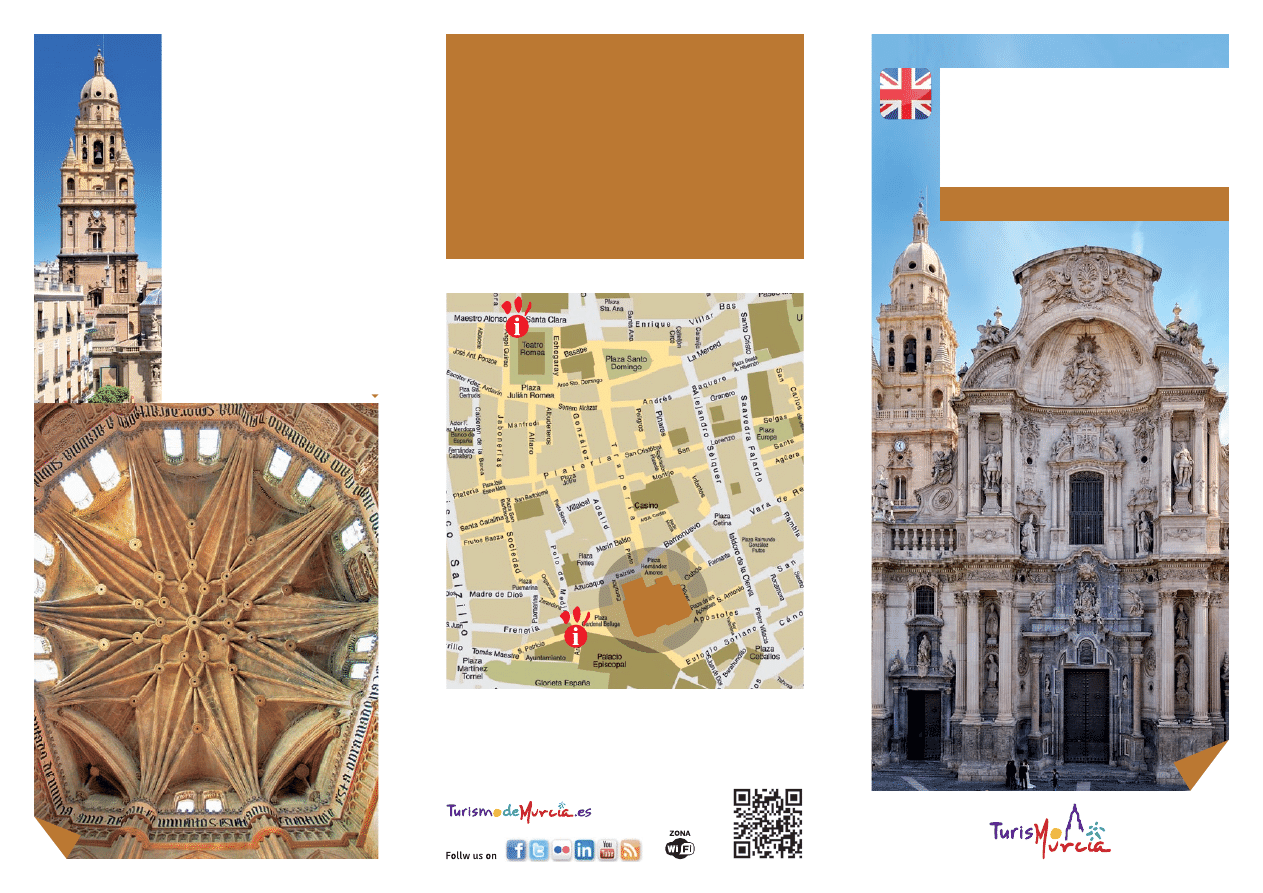
Stellar vault of the Vélez
Chapel
CatHedral
Monday to Sunday
from 7:00 a.m. to 1:00 p.m. and from 5:00
p.m. to 8:00 p.m. (July and August from 7:00 a.m.
to 1:00 p.m. and from 6:00 p.m. to 8:00 p.m.)
FREE ENTRANCE
Tel: 968 216 344
CatHedral MUSeUM
Tuesday to Saturday
from 10:00 a.m. to 1:00 p.m. and from
5:00 p.m. to 8:00 p.m. (July and August from 9:00 a.m. to 2:00 p.m.)
Sundays and public holidays
from 10:00 a.m. to 1:00 p.m.
Closed on Mondays
.
GUIDED TOURS:
968 219 713
tourist Information Office
Plaza Cardenal Belluga. Edificio Ayuntamiento.
30004 Murcia. Spain
e-mail: informacion.turismo@ayto-murcia.es
Tel.: 968 358 749
•
Fax: 968 358 748
D
E
P
Ó
S
IT
O
L
E
G
A
L:
M
U
-4
37
-2
01
3
EXTERIOR OF THE CATHEDRAL
The most impressive feature of the
exterior of this cathedral is its main
façade. Built in the baroque style,
and possessing a uniquely monu-
mental beauty, it is entirely dedi-
cated to the Virgin Mary, to whom
the church is consecrated. Divided
into two horizontal planes and three
vertical sections, for it was con-
ceived as a stone altarpiece open to
the plaza, the central part ends in a
great curved moulding that accom-
modates the sculpture of the As-
sumption of the Virgin.
At the base of each one of the ver-
tical sections a door opens onto
each of the church interior’s three
naves. The central door, known as
the Door of Forgiveness, is only ope-
ned during the most solemn great
occasions. The Door of Chains, in
the Plateresque style, and the Door
of the Apostles, in the florid Gothic
style, form the other entrances to
the church, on its northern and
southern walls, respectively.
Adjoining the façade is the bell
tower, the emblematic feature of the
Cathedral of Murcia and symbol of
the city. It was built between 1521
and 1793, and the three sections
of which it is compo-
sed exhibit different
styles, from the
renaissance first
section to the
neoclassical
cupola.
INTERIOR OF THE CATHEDRAL
The interior is composed of three Gothic naves with an ambulatory
and twenty-three chapels. The chapels are dedicated to the
patron saints of the guilds and to the interments of bishops and
nobles who promoted or supported the construction.
The ambulatory contains the Gothic jewel of the cathedral, and
perhaps the most frequently-visited of its chapels. This is the so-
called
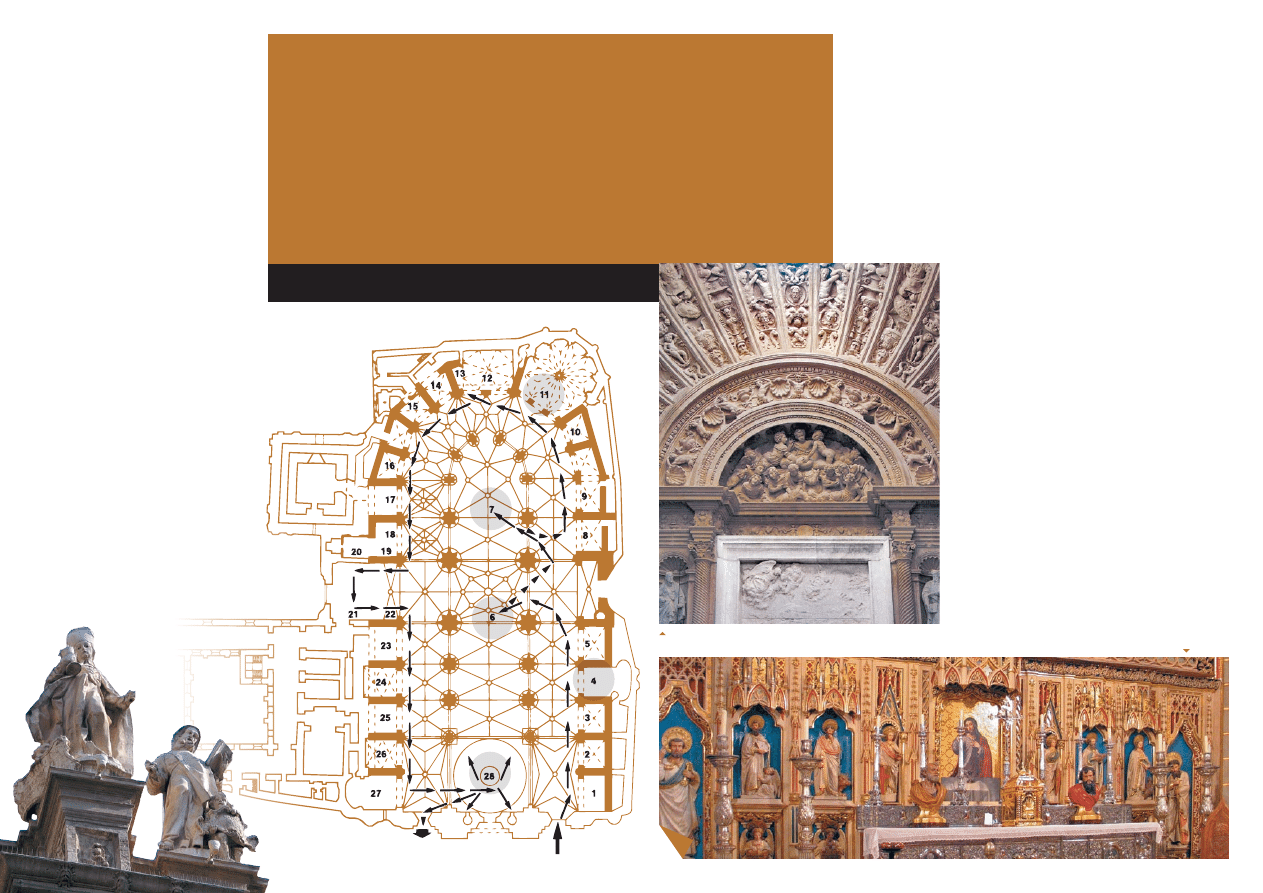
Vélez Chapel (11), built as a family mausoleum for the
Chacón Fajardo family. In the southern wall is the renaissance
chapel popularly known as
Junterones (4), commissioned by the
protonotary apostolic of Pope Julius II, and also designed as a
place of interment.
The
Main Chapel (7) is considered a royal
chapel, for it contains the remains of Alfonso
X of Castile. The altarpiece we see today dates
from 1863 and replaced the original renaissance
design, which was destroyed by fire. The chapel
is closed off with splendid grille work produced
during the late 15
th
century. Opposite, another
similar gate opens on to the
Choir (6), brought
from San Martín de Valdeiglesias and donated
by Queen Isabel II to replace the original. Above
the choir is the organ, built by Joseph Merklin
and one of the most important examples of
such work created in 19
th
century Europe.
At the foot of the church we find the Retrochoir
and the Counter-Façade.
the retrochoir (28) is
dedicated to the Immaculate Conception, while
opposite the Counter-Façade is dominated
by a relief of the Presentation of Jesus at the
Temple. For many, this is the most important
and beautiful of the cathedral’s naves.
Junterones Chapel
Main Altar
Entry via plaza Cardenal
Belluga
1
Chapel of the
Transfiguration
2
Christ of the Miracle
Chapel
3
Chapel of the Sacred
Heart of Jesus
4
Junterones Chapel
5
Chapel of Saint
Joseph
Door of the Apostles
6
Choir and organ
7
Main Altar. Saint Mary
8
Chapel of Saint John
of Nepomuk
9
Chapel of Saint Denis,
Bishop of Paris
10
Chapel of Christ of
Mercy
11
Vélez Chapel
12
Chapel of Saint
Anthony
13
Chapel of Our Lady of
the Incarnation
14
Chapel of Our Lady of
Succour
15
Pilar or Comontes
Chapel
Door of the Well
16
Chapel of Saint Mary
Magdalene de Pazzi
17
Sacristy Door
18
Chapel of Saint Andrew
19
Chapel of Saint
Bartholomew
20
Chapel of Christ of
Solace
Door of Chains
21
Virgin of the Milk
Altarpiece
22
Saint Christopher
Altarpiece
23
Chapel of Our Lady of
Solitude
24
Chapel of the
Nazarene
25
Chapel of Blessed
Andrés Hibernón
26
Chapel of Saint
Ferdinand
27
Baptismal Chapel, or
Chapel of Succour
28
Retrochoir, Immaculate
Conception
Exit via plaza Cardenal
Belluga
tour for those visiting the
CatHedral
DOOR
OF THE
APOSTLES
DOOR
OF CHAINS
DOOR OF
THE WELL
MAIN FAÇADE
PLAZA CARDENAL BELLUGA
EXIT
ENTRANCE
TOWER
MUSEUM
SACRISTY
Wyszukiwarka
Podobne podstrony:
Gastroenterologia prezentacje od katedry
popkultura baranska syllabus z Katedry Dalekiego Wschodu
Katedra w Brasílii
Laboratorium Katedry Inżynierii Procesowej
Tematy prac mgr Katedra Teleinformatyki 12 zgodne ze stoną KTI KNdostudentów
Karczmy i Katedry
1) KPA - TESTY z katedra, Aplikacja, KPA - testy
Pytania podpatrzone przez stazystów na katedrze anestezj ologii, AM, rozne, anestezjologia, Anestezj
Kronika Katedralna Krakowska
Katedra Inżynierii Wiedzy
Katedra owoców i warzyw, Studia, Egzamin inżynierski, Owoce i warzywa
inny projekt, Opis techniczny (6), KATEDRA BUDOWNICTWA
więcej podobnych podstron