dysleksja
MJA-P1_7P-072
EGZAMIN MATURALNY
Z JĘZYKA ANGIELSKIEGO
dla osób niesłyszących
POZIOM PODSTAWOWY
Czas pracy 120 minut
Instrukcja dla zdającego
1. Sprawdź, czy arkusz egzaminacyjny zawiera 10 stron (zadania
1 – 13). Ewentualny brak zgłoś przewodniczącemu zespołu
nadzorującego egzamin.
2. Pisz czytelnie. Używaj długopisu/pióra tylko z czarnym
tuszem/atramentem.
3. Nie używaj korektora, a błędne zapisy wyraźnie przekreśl.
4. Pamiętaj, że zapisy w brudnopisie nie podlegają ocenie.
5. Wypełnij tę część karty odpowiedzi, którą koduje zdający. Nie
wpisuj żadnych znaków w części przeznaczonej dla
egzaminatora.
6. Na karcie odpowiedzi wpisz swoją datę urodzenia i PESEL.
Zamaluj
pola odpowiadające cyfrom numeru PESEL.
Błędne zaznaczenie otocz kółkiem
i zaznacz właściwe.
Życzymy powodzenia!
MAJ
ROK 2007
Za rozwiązanie
wszystkich zadań
można otrzymać
łącznie
100 punktów
Wypełnia zdający przed
rozpoczęciem pracy
PESEL ZDAJĄCEGO
KOD
ZDAJĄCEGO
Miejsce
na naklejkę
z kodem szkoły

Egzamin maturalny z języka angielskiego dla osób niesłyszących
Poziom podstawowy
2
ROZUMIENIE TEKSTU CZYTANEGO
Przeczytaj dokładnie tekst. Zrób zadania 1, 2, 3 i 4 do tego tekstu.
SCOTLAND
Scotland is a wild and beautiful country. There are a lot of hills and mountains there.
The highest mountain in Great Britain, Ben Nevis (1,342 metres high), is in Scotland. Scottish
people call it simply ‘Ben’. The Scottish mountains are a popular centre for skiing
and snowboarding.
There are many rivers and lakes in Scotland. Scottish lakes are called ‘lochs’. The most
famous one, Loch Ness, is 24 miles (38 kilometres) long and its waters are very cold
and dirty. Many people visit Loch Ness because they want to see the famous Loch Ness
monster. The monster is called Nessie. The first time someone saw Nessie was about
a thousand years ago. Nobody knows if there really is a monster!
Scotland is also famous for a traditional musical instrument called ‘bagpipes’. In the past
Scottish soldiers used to play the bagpipes during battles. Another thing typical for Scotland
is a ‘kilt’, a type of a skirt, but not for women. It is for men. Some Scots still wear it on
special occasions.
Scotland is a part of Great Britain but it has got its own laws, school system and money.
The capital of Scotland is Edinburgh. There were conflicts in the past. The English won
the last battle in 1746. Nowadays relations between the Scots and the English are quite good.
“Team”, Nr 5, kwiecień 2000
Zadanie 1. (6 pkt)
Przeczytaj dokładnie zdania. Podkreśl TRUE, jeśli zdanie jest prawdziwe. Podkreśl
FALSE, jeśli zdanie jest fałszywe.
1. In Scotland there are a lot of mountains and hills.
TRUE / FALSE
2. Loch Ness is the name of a mountain.
TRUE / FALSE
3. The name of the Loch Ness monster is Ben.
TRUE / FALSE
4. Scottish people never wear ‘kilts’ nowadays.
TRUE / FALSE
5. Scotland’s capital is called Edinburgh.
TRUE / FALSE
6. They have their own laws in Scotland.
TRUE / FALSE

Egzamin maturalny z języka angielskiego dla osób niesłyszących
Poziom podstawowy
3
Zadanie 2. (6 pkt)
Przeczytaj dokładnie zdania. Wybierz i podkreśl jedno właściwe słowo.
1.
The Scottish mountains are a centre for summer / winter sports.
2.
A ‘loch’ is a lake / river.
3.
The waters of Loch Ness are clean / dirty.
4.
A ‘kilt’ is a skirt for a man / woman.
5.
The school systems in Scotland and England are the same / different.
6.
Relations between England and Scotland are nowadays quite good / bad.
Zadanie 3. (8 pkt)
Odpowiedz po angielsku na pytania. Pisz całymi zdaniami.
1. How high is Ben Nevis?
______________________________________________________________
2. Why do people visit Loch Ness?
______________________________________________________________
3. What are bagpipes?
______________________________________________________________
4. When was the last battle between the Scots and the English?
______________________________________________________________
Zadanie 4. (5 pkt)
Uzupełnij zdania wyrazami z ramki. UWAGA: Jeden wyraz nie pasuje do żadnego
zdania.
played ● called ● waters ● famous ● kilometres ● years
1. Ben Nevis is simply …………………. Ben by Scottish people.
2. Loch Ness is 38 ……………………. long.
3. The ………………….. of Loch Ness are very cold.
4. Scotland is ………………….. for its lakes and mountains.
5. Scottish soldiers ………………….. the bagpipes during battles .

Egzamin maturalny z języka angielskiego dla osób niesłyszących
Poziom podstawowy
4
REAGOWANIE JĘZYKOWE W CODZIENNYCH SYTUACJACH
Zadanie 5. (6 pkt)
Przeczytaj uważnie zadanie. Które zdanie (a czy b) jest typowe dla każdej osoby?
Zaznacz kółkiem jedną prawidłową odpowiedź.
1. A teacher
a) “You haven’t done your homework again!”
b) “Have you got anything to declare?”
2. A doctor
a) “Single or double room?”
b) “You have a cold and you should stay in bed.”
3. A waiter
a) “Where does it hurt?”
b) “What would you like to drink?”
4. A police officer
a) “You mustn’t drive so fast! Can I see your driving licence?”
b) “Have you made your bed yet?”
5. A pupil
a) “Cash or credit card?”
b) “Can you help me with this Maths exercise, please?”
6. A shop assistant
a) “Sorry, we haven’t got green T-shirts.”
b) “Can I see your ticket, please?”
Zadanie 6. (7 pkt)
Przeczytaj uważnie pytania i wybierz prawidłową odpowiedź. UWAGA: jedna
odpowiedź nie pasuje do żadnego pytania.
1. Would you like to go to the cinema?
2. How are you today?
3. How tall are you?
4. What time does the next train leave?
5. How much is the blue jacket?
6. What school subjects do you like best?
7. Have you got any pets?
A. At 6.30.
B. History and English.
C. Fine, thanks.
D. Yes, two cats and a goldfish.
E. I’m 1 metre and 70 centimetres
tall.
F. It’s ₤45.
G. Yes, I’d love to.
H. From platform 6.
Odpowiedzi:
1. ___,
2. ___,
3. ___,
4. ___,
5. ___,
6. ___, 7. ___.
Egzamin maturalny z języka angielskiego dla osób niesłyszących
Poziom podstawowy
5
Zadanie 7. (12 pkt)
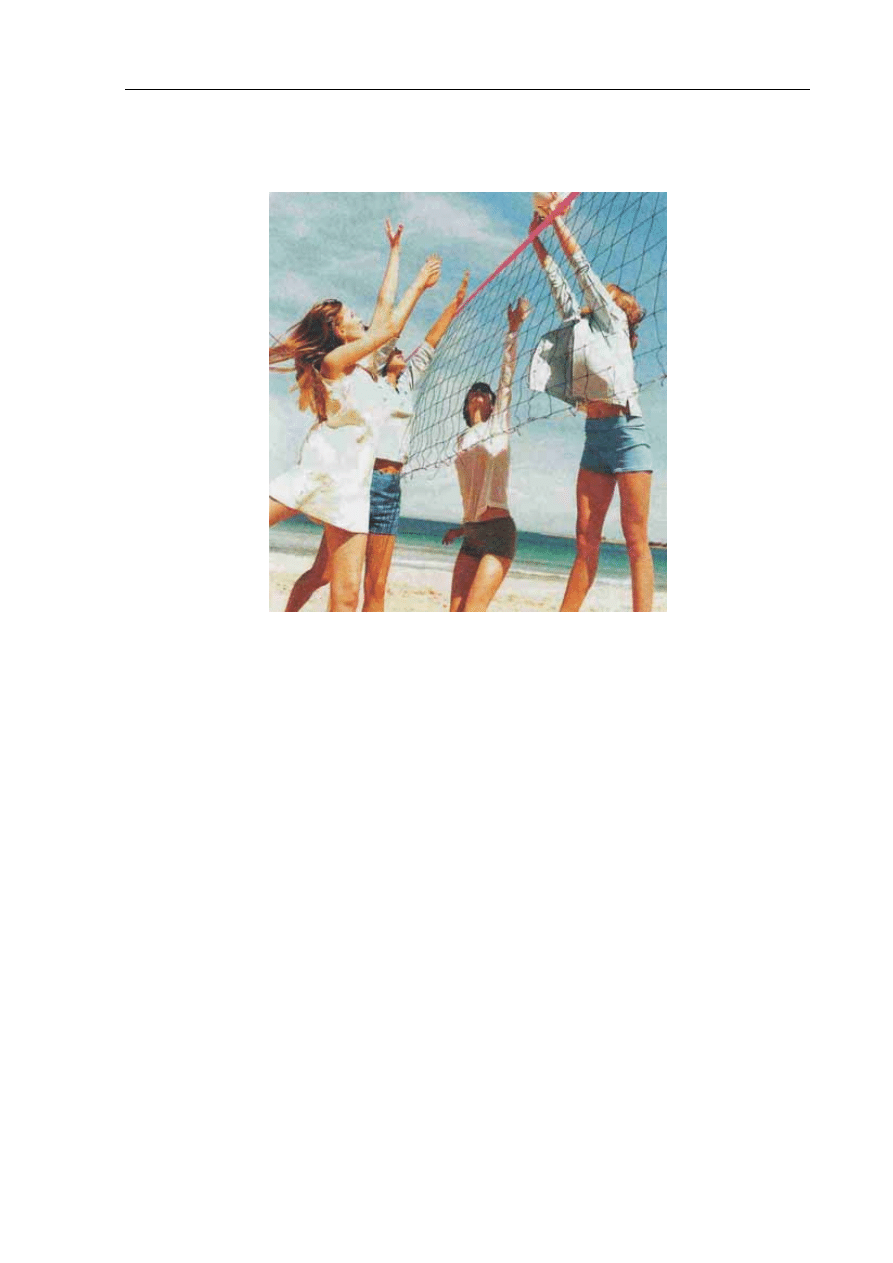
Popatrz na zdjęcie i odpowiedz na pytania po angielsku. Pisz całymi zdaniami. Wymyśl
odpowiedzi do pytań 5, 6 !
„Claudia”, Nr 6 (134), czerwiec 2004.
1. Who can you see in the photograph?
____________________________________________________________________
2. Where are they?
____________________________________________________________________
3. What are they doing now?
____________________________________________________________________
4. What is the weather like?
____________________________________________________________________
5. Where do they come from?
____________________________________________________________________
6. What are they going to do in the evening?
____________________________________________________________________

Egzamin maturalny z języka angielskiego dla osób niesłyszących
Poziom podstawowy
6
ROZPOZNAWANIE I STOSOWANIE STRUKTUR
LEKSYKALNO-GRAMATYCZNYCH
Zadanie 8. (5 pkt)
Wybierz i zaznacz kółkiem właściwą odpowiedź na każde pytanie.
1. What is your mother’s name?
a) My mother name Helen.
b) My mother name was Helen.
c) My mother’s name is Helen.
2. Where does he live?
a) He lived in New York.
b) He lives in New York.
c) He is living in New York.
3. Are you a student?
a) Yes, I do.
b) Yes, I am.
c) Yes, I did.
4. Did you watch television last Saturday?
a) No, I didn’t.
b) No, I wasn’t.
c) No, I haven’t.
5. What are you reading?
a) I read a newspaper.
b) I’m going to read a newspaper.
c) I’m reading a newspaper.
Zadanie 9. (5 pkt)
Wybierz właściwy wyraz i podkreśl go.
1. Now she is / are writing a letter.
2. They watch / watching television every day.
3. My sister have / has got blue eyes.
4. How many / much is milk?
5. Last Sunday I was / were in Cracow.
Egzamin maturalny z języka angielskiego dla osób niesłyszących
Poziom podstawowy
7
Zadanie 10. (5 pkt)
Wybierz właściwe dokończenia zdań. Wpisz odpowiednią literę do ramki.
1.
During holidays I’ll be able
to do
A.
… and go straight past the restaurant.
2.
Could I have
B.
… what I like.
3.
When you have a cold,
C.
… you should stay in bed.
4.
Turn left
D.
… because it’s going to rain tonight.
5.
Martha is closing
the windows
E.
…some more coffee, please?
Zadanie 11. (5 pkt)
Przeczytaj uważnie tekst, a potem wykonaj zadanie.
London lies on the River Thames. It is nearly 2000 years 1. ____ . It is one of the 2. ____
cities in the world. London is famous for 3. ____ historical buildings. Tourists 4. _____ from
all over the world to visit St. Paul’s Cathedral and the Houses of Parliament, 5. _____ you can
see the famous clock Big Ben.
Wybierz właściwy wyraz i zaznacz kółkiem jedną prawidłową odpowiedź.
1. 2. 3. 4. 5.
a) small
b) big
c) old
a) big
b) biggest
c) bigger
a) it’s
b) its
c) it
a) leave
b) go
c) come
a) where
b) how
c) when

Egzamin maturalny z języka angielskiego dla osób niesłyszących
Poziom podstawowy
8
PRZETWARZANIE TEKSTU
Zadanie 12. (10 pkt)
Przeczytaj tekst.
“PETER’S DOG”
Peter has got a dog. His name’s Jack but he’s called Jacky. It is a brown dog with a short
tail, long ears and a small black nose. He is a very nice and friendly dog. He likes to eat meat
and biscuits. Jacky eats his food in the dining room but he likes sleeping in the sitting room
on the sofa. Sometimes Jacky gets very dirty because he often plays with Peter and his sister
in the park. Jack’s favourite toy is a big yellow ball.
Napisz podobny tekst pt. “Tom’s cat”. Użyj wszystkich wyrazów z ramki. Pamiętaj
o niezbędnych zmianach!
cat ● Tina ● small ● black and white fur ● green eyes ● clean ● clever ● fish ●
chicken ● kitchen ● Tom’s room ● bed ● play ● Tom’s brother ● big garden ●
a small blue ball
“TOM’S CAT”
…………………………………………………………………………………………………
…………………………………………………………………………………………………
…………………………………………………………………………………………………
…………………………………………………………………………………………………
…………………………………………………………………………………………………
…………………………………………………………………………………………………
…………………………………………………………………………………………………
…………………………………………………………………………………………………
…………………………………………………………………………………………………
…………………………………………………………………………………………………
…………………………………………………………………………………………………
…………………………………………………………………………………………………

Egzamin maturalny z języka angielskiego dla osób niesłyszących
Poziom podstawowy
9
TWORZENIE TEKSTU WŁASNEGO
Zadanie 13. (20 pkt)
Napisz po angielsku do kolegi lub koleżanki list z ferii zimowych. Napisz, gdzie i z kim
spędzasz ferie, jaka jest pogoda, co robisz i kiedy wracasz. Pamiętaj o zachowaniu formy
listu!
CZYSTOPIS
…………………………………………………………………………………………………
…………………………………………………………………………………………………
…………………………………………………………………………………………………
…………………………………………………………………………………………………
…………………………………………………………………………………………………
…………………………………………………………………………………………………
…………………………………………………………………………………………………
…………………………………………………………………………………………………
…………………………………………………………………………………………………
…………………………………………………………………………………………………
…………………………………………………………………………………………………
…………………………………………………………………………………………………
…………………………………………………………………………………………………
…………………………………………………………………………………………………
…………………………………………………………………………………………………
…………………………………………………………………………………………………
…………………………………………………………………………………………………
…………………………………………………………………………………………………
…………………………………………………………………………………………………
…………………………………………………………………………………………………
…………………………………………………………………………………………………

Egzamin maturalny z języka angielskiego dla osób niesłyszących
Poziom podstawowy
10
BRUDNOPIS
Wyszukiwarka
Podobne podstrony:
ang pp niesl model
polski PP niesl
ang pp a
ang PP stand A rozw
a1 ang niesl
ang mod pp
ang transk pp
ang mod pp
a1 ang niesl
lo iii 1 pp ang
arkusz ang stand PP a
ang roz pp a
ZHP PP 1
Firma PP
więcej podobnych podstron