
THE CRITERIA FOR OPTIMIZING THE MANAGEMENT OF
TRANSPORT STRUCTURES
О. LINGAITIENĖ, V. LINGAITIS
Vilnius Gediminas Technical University
Lithuania
e-mail: vytautas.lingaitis@lra.lt
1. INTRODUCTION
The integration of various macrologistic transport system structures begins with
subsystems found in the concentration areas of potential users. First, logistic subunits of the
user zone oriented to organizing production, satisfying the market needs, should control
market relations as well as flows of materials, data, etc. At the same time, the above logistic
units of users integrating into a zone logistic subsystem of the macrologistic system as
subordinate and interacting entities should perform a number of the appropriate logistic
functions, including:
marketing production – economic logistics for developing and controlling the
implementation of production programmes optimal from the user’s and
manufacturer’s perspectives and aimed at manufacturing products of the required
quality, price, quantities for the market needs in the required time;
commercial logistics of purchasing, supply and replenishment for development
and implementation of perspective, current and operation programmes optimal
from the perspectives of production and the market and aimed at supplying and
replenishing materials and equipment;
organizational-production logistics for optimal control of production processes
predicted by the marketing production-economic logistics and forming the
relationships within the production as well as the material and data flows;
commercial sale logistics for developing and implementing optimal programmes
for distribution and sale of products made according to the production
programmes;
container-transport-warehouse logistics, universal with respect to other logistics
according to its nature and aims, but always concrete for the particular conditions
of transport, production and commercial activities.
Choosing logistic subunits from the organizational user system and their collateral
subordination under particular conditions to the structures of a macrologistic system should
POLITECHNIKA WARSZAWSKA
Wydział Transportu
Polska Akademia Nauk
Komitet Transportu

not be done automatically. Any element of such logistic subunits is an element of a
macrologistic system intended to perform the required function.
If users have no logistic subunits, they should be formed from the elements with
similar functions. Let us call the logistic units of a regional logistic system formed at the
users’ system ‘a logistic user’s structure’ (LUS).
In every zone of a region, a logistic structure ‘A zonal logistics control centre’ (ZLCC)
for managing transport and commercial activities is formed to service a group of users.
2. AIMS AND FUNCTIONS OF A ZONAL LOGISTICS CONTROL CENTRE
The main aims and functions of ZLCC are as follows:
forming transport and commercial structures, subsystems and elements aimed to
satisfy the market demands in terms of time and space;
safe, regular and timely introduction into the system of the suppliers’ material and
other flows with the subsequent payment according to the contracts and at minimal
cost, taking into account the available stocks;
safe storage of materials at minimal costs according to intersystem contracts and
obligations, taking into account the available stocks and raising their quality
standard by providing container, transport and commercial services;
safe, timely and regular delivery of the material and the related flows at minimal
cost to final users in a system, according to intersystem contracts, specifications
and technologies of transport and commercial operations, resulting in the
continuous process of reproduction of the production and other subsystems of a
system being serviced;
safe, regular and timely formation of material and the related flows at the sale
stage at the minimal costs and according to the contracts, taking into account the
available stocks and delivering some of them to the final users on the market in the
process of reproduction.
To achieve these aims at a particular zone, ZLCC performs various activities
according to the scenario selected, i.e. transport, commercial activities, including managerial,
financial, social and other functions. The key evaluation criteria of the achievement of the
selected goals of ZLCC and LUSes are based on the completion of the material flow in a zone
in due time, at the intended place and with products of the required quality and volume at
minimal material, labour, financial and other expenses [3].
ZLCC functions in compliance with its aims, interacting with logistic subsystems of
particular agents, including users, suppliers, middlemen, transport providers, etc. who may for
a time or permanently become functionally, linearly, by programme or goals, etc. subordinate
to ZLCC. Thus, a set of organizational-production logistic systems is formed. A general view
of an organizational production structure of a zonal logistic subsystem is given in Fig 1.
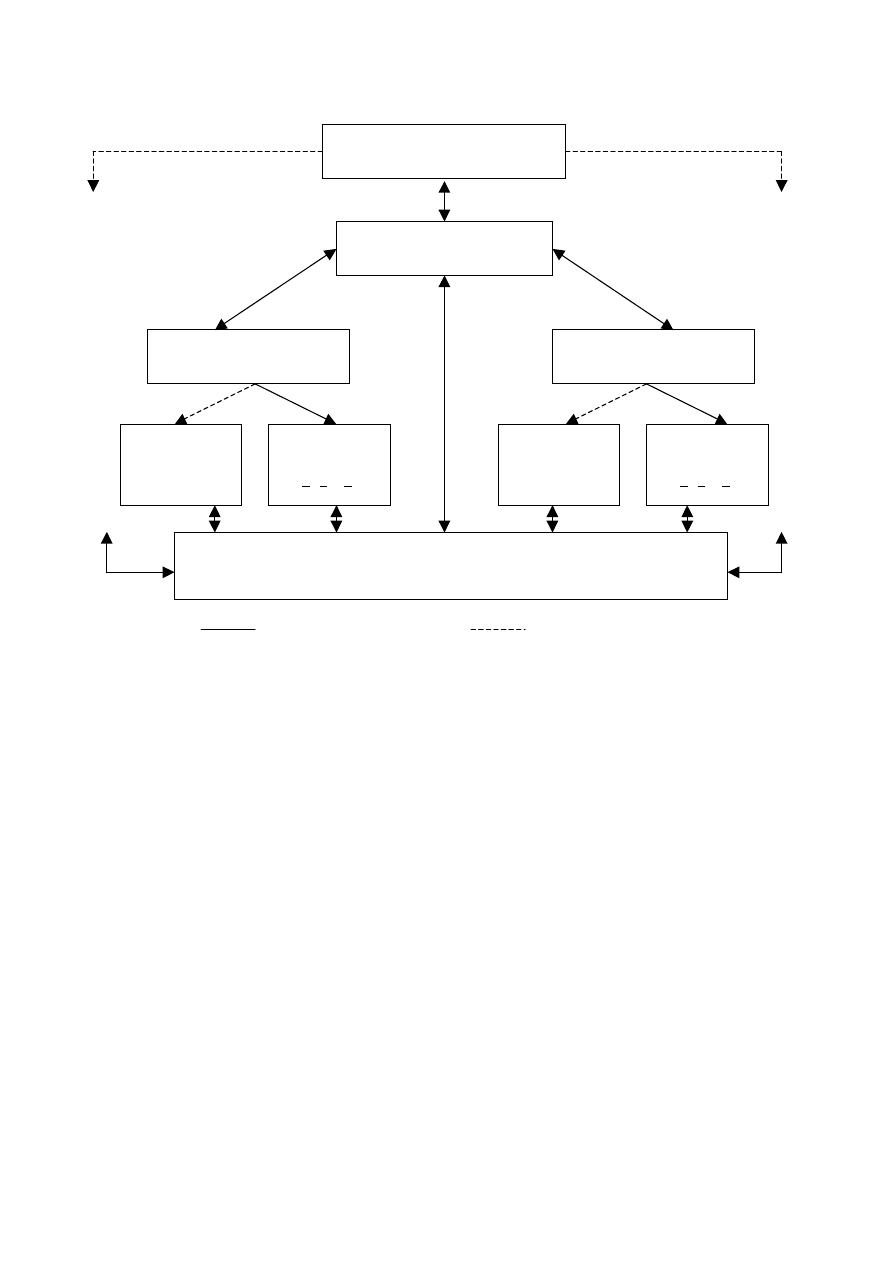
Fig 1. A general scheme of an organizational-production structure of a zonal subsystem of a
regional logistic system
In the considered version of the structure, ZLCC should become at any time an
operator of organizational-economic, informational-financial, social, organizational,
informational management for the whole segment of the market to which logistic services are
provided. At the same time, ZLCC becomes a local bank of material resources. The users by
making contracts and financing ‘invest’ their material demands in ZLCC under the contracts
and other documents, according to the products required. ZLCC, in turn, satisfies their needs
by forming flows of materials in accordance with the technology of transport and commercial
activities and by financing the servicing systems and subsystems, including suppliers,
middlemen, transport firms, etc. In this way, the materials are delivered in the required time to
the users, taking into account their demands and according to schedules of operations
developed in ZLCC in collaboration with the logistic subunits of users.
Taking into account similar aims, goals, functions and technologies of ZLCC
operation as well as seeking to centralize the development, control and coordination of the
perspective programmes and tactical schemes of transport and commercial activities,
including financial, technological, investment and innovative activities, etc. all ZLCC and
LUS may be combined into a regional macrologistic system, with the main control structure
referred to as ‘A regional logistics control centre (RLCC)’. Given the sufficient resources,
Regional logistic control
centre (RLCC)
Zonal logistic control
centre (ZLCC)
Logistic sub-unit of potential
middlemen
Logistic sub-unit of potential
middlemen
Logistic
subunits of
suppliers
n
S
S
S
...
2
,
1
Logistic subunits of container-transport service of a system
(subsystems of ZLCC, users, suppliers and potential middlemen)
Logistic
subunits of
suppliers
n
S
S
S
...
2
,
1
Logistic
subunits of
suppliers
n
S
S
S
...
2
,
1
Logistic
subunits of
suppliers
n
S
S
S
...
2
,
1
basic flows
,
reserve flows of a zone
such centres can form and control the reserve flows of materials for ZLCC and the users along
with carrying out organizational-economical, managerial, financial, organizational-
technological and informational activities in the region.
A regional logistic control centre in cooperation with ZLCC, logistic subunits of users,
suppliers, middlemen and other partners develops and controls the programme of logistic
activities for the region.
The considered version of an organizational-production structure of a macrologistic
system radically and optimally changes the production, transport and commercial activities
and the technology of the material and other flows in the region and, primarily, in zones of
users’ concentration.
3. A GENERAL MODEL OF THE MATERIAL FLOWS
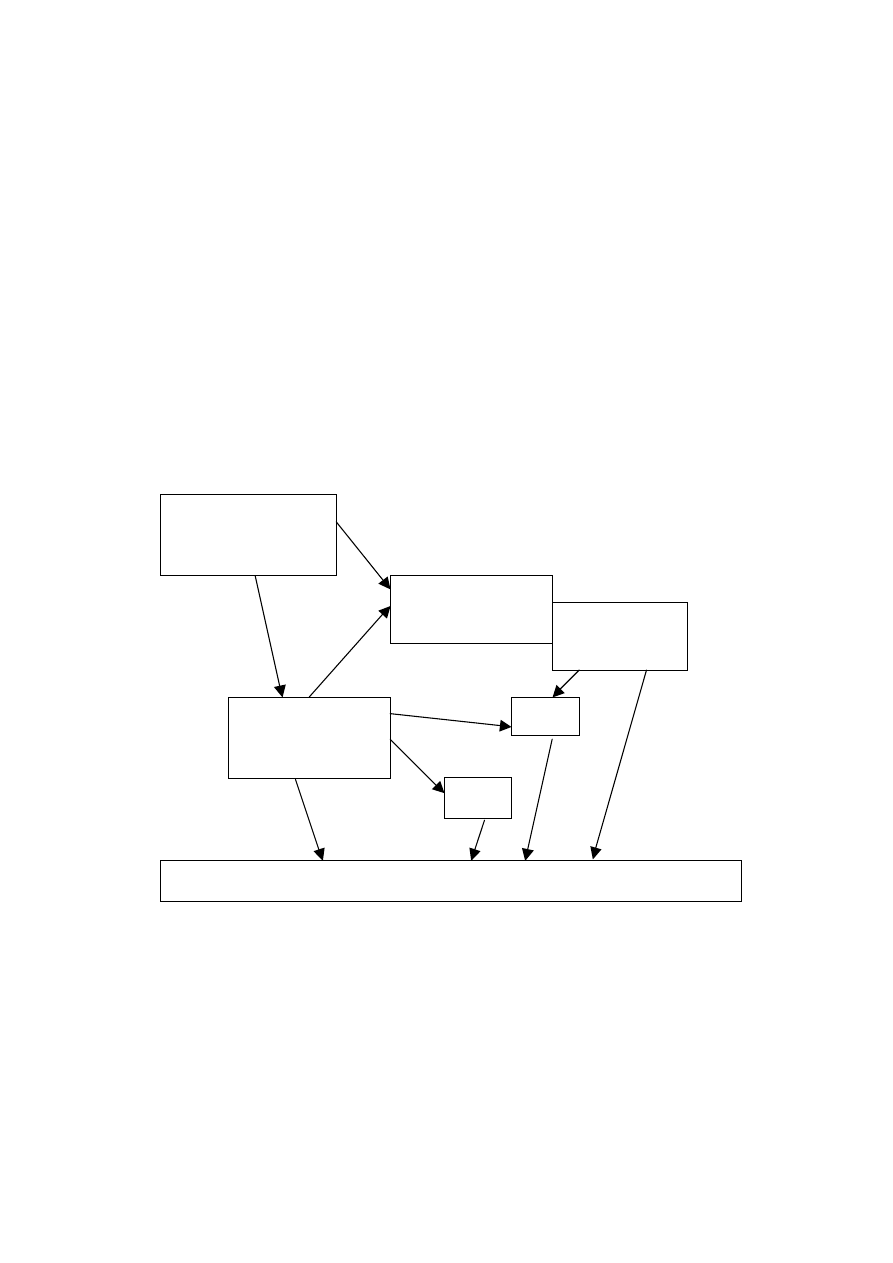
A general model of material flows for a new system is presented in Fig 2. In this case,
a flow of materials getting into the region is divided into a basic flow to users via zonal
logistic control centres and a subsidiary reserve or other flow going to users and ZLCC via
RLCC.
Fig 2. A general model of the material flows
Some other types of flows are also possible, e.g. the flows from structures I and II
shown in Fig 2. The first structure may be a production structure, optimally changing the
properties of products and making them ready for use by the final user. The second structure
may be a user’s logistic structure, additionally replenishing resources, taking into account the
user’s specialization or reserving a flow in the case of extreme conditions of the user’s
specific activities or for some other reason [5].
The optimality of organizational-production management structures should be
determined by considering their effect on the performance of a macrologistic system. The
FLOW OF
MATERIALS
FROM SUPPLIERS
Zonal logistic
control centre
A BASIC
FLOW
Regional logistic
control centre
USERS OF FLOWS OF MATERIALS
I
II

resulting performance of organizational-economic systems is characterized by the property
referred to as organizational-economic reliability.
The optimality of a particular system’s structure may be determined by the criteria
selected from a range of absolute or relative indicators of its performance as well as from the
respective indicators of systems, servicing a designed system and from the indicators of
systems serviced by it. Moreover, many other principles, conditions, limitations and
requirements may be taken as optimality criteria in developing methods of design and control
of macrologistic systems.
Formalized intentions and obligations associated with the logistic nature of the
discussed systems may also be considered the optimality criteria. For example, these may be
the production of quality products in the time and volume specified in the contract or
realization of the material and the related flows in the specified time and space, as well as
providing quality products in the required amounts, etc. at minimal expenses of material,
labour, financial and other resources. Taking into account the above considerations, an
optimality criterion may be considered any criterion suitable for this purpose from the
perspective of organizational-economic reliability of production, transport and commercial
activity performed in a particular organizational-economic and organizational-technological
situation taking place in the particular time and space.
4. THE CRITERIA FOR OPTIMIZING MANAGEMENT STRUCTURES
Following the requirement of organizational-economical and transport reliability,
optimum of organizational-industrial structure of macrologistical system is denoted by
volume of its useful work, which has been performed in high quality, in strictly laid down by
contractual obligations of the contractor period of time, and by amount of total expenditure of
substantiated and real work in industry, its supply, realization and trade, that can be evaluated
for a particular natural or any other integral unit of a useful work [3].
Having in mind this, optimum of a logistical system can be described by
P
– productivity
of the system within the period
t
, by the time of finishing by the system of the whole
complex or particular processes and flows within the interval “strictly on time” ! , in the
stated place
N
and with the products of the stated quality
Q , of set
S
and volume
V
, and
also
E
– total of the logistical expenditure for preparation and fulfilment of production in one
complex with its supply, realization, trade, transport services, which stimulates timely
reaction to changes in market demand and depending on it.
Having in mind this, probability
*
T
of achieving the maximum organizational-
economical and transport reliability of organizational-industrial structure of the system during
the period
t
shall be described by function of
E
V
S
Q
P
and
,
,
,
, !
, i. e.
( )
(
)
E
V
S
Q
P
f
t
T
,
,
,
,
,
*
max
!
=
when
.
,
,
,
min;
max;
const
V
S
Q
E
P
!
!
!
"
V
S
Q
,
,
,
!
– these are the fixed values, which, from the viewpoints of a consumer and
logistics, characterize moment of time of delivery of products having the set of earlier listed
features
V
S
Q ,
,
[4].
The time ! can be disaggregated into local intervals of time, which characterize processes
of delivery of the production “exactly on time” in individual flows to intermediate and
terminal consumers of the production.

E
P and
, as variables, are aggregated indices, including series of local
indices
(
)
(
)
n
i
E
m
j
P
i
j
,
1
,
,
1
=
=
=
. Indices
i
j
E
P and
characterize possibilities and
requirements of all the acting subsystems of logistical system and related systems, and also in
certain extend they can be conditioned by special for the real time federal, including regional,
interests.
Into the train of local indices, concerning the behavioural scenario chosen and logistics
taking part, it is possible to include, for instance, the following ones, presented in the form of
blocks, which in their turn can be disaggregated essentially:
1
j
P
– productivity of each industrial subsystem and any of its components (shops, sites,
technological equipment, other structures and their elements, etc.), and in each time period of
industrial cycle;
2
j
P
– productivity of each subsystem of material-technical supply and industrial-
technological set, and its individual elements, and in each stage of the said commercial
activities;
3
j
P
– productivity of each realization system and its elements, including possible
structures of wholesale and retail, and on every stage of the said commercial activities;
4
j
P
– productivity of container-transport services of the whole system, each of its
subsystems, each of its elements and of each stage of industrial-transport-commercial
activities;
5
j
P
– productivity of marketing system on the whole, its individual subsystems and of
every stage of industrial-transport-commercial activities;
6
j
P
– productivity of the whole system and its individual elements depending on its
investment and innovation politics;
M
R – reserve capacities of industrial, transport, commercial structures, which provide
timely and in duly extend rhythmic industrial activities, and frequency and velocity of their
usage (reserve: areas, technological equipment of industrial and commercial purposes, means
of container-transport, reserve of material and other resources in sections of nomenclature,
features, stores, directions and stages of usage, etc.);
1
i
E – expenditure on the whole and in each single element for building and usage of the
system on the whole, each subsystem and their elements;
2
i
E – expenditure on the whole and in each single element for each type of the above
listed industrial activities, each block of the behavioural scenario and each type of logistics,
and also for the achieving the system of goals or each of the goals;
3
i
E – expenditure for each stage or for each operation of the activities, given in the above
criterion, etc.
4
i
E – comparative value of the above mentioned expenditure for the unit of the above
mentioned industrial types of industrial-transport-commercial activities, including the unit of
industrial production or unit of labour;
n
i
E – profit of the system in general, absolute and comparative, falling to general and
comparative values of the above mentioned expenditure or productivity of the grand total
system activities, for each type of activities, for each block of behavioural scenario, each type
of logistics and for achieving the whole system of goals or each of the goals.

Each of the given other local indices considering economic, social or other interests may
be additionally disaggregated. For instance, out of expenses for industrial activities it is
possible to separate investments into major assets or expenses of material recourses, or their
particular elements. In such cases as a supplementary local index may be used
c
E
– costs of
major assets and, for instance,
M
E – expenditure of materials for production. At the same
time
M
c
E
E and
are excluded of the previous expenditure. Aiming to plan economy of energy
in processes of production, supply, realization, transport services and other, out of
corresponding industrial, transport, commercial costs there are separated costs of energy,
which is necessary for related elements in the process of production, storage and transporting
the production, and also costs of loaded and empty containers. Parameters of the local indices
i
j
E
P and
are formed under the influence of economical, technical and technological
exogenous and endogenous conditions, requirements and restrictions.
Parameters
i
j
E
P and
under impact of requirements and restrictions of servicing,
logistical and served systems gain values, located in various points of factorial space.
Complex account of
i
j
E
P and
, when choosing an organizational-industrial structure, which
guarantees for the logistical system maximum organizational-economical reliability, is
possible only on basis of compromise solution [6]. In such a case it is necessary to choose a
draft variant of a structure, which guarantees for the system being drafted some maximum
complex index of organizational-economical and transport reliability
!
T
. At the same time
each of local indices
(
)
(
)
n
i
E
m
j
P
i
j
,
1
and
,
1
=
=
has a possibility of planning its rational value.
Such a task can be solved, if parameters of organizational-economical and transport
reliability
(
)
(
)
n
i
r
m
j
r
i
j
,
1
and
,
1
=
=
of each local index
(
)
(
)
n
i
E
m
j
P
i
j
,
1
and
,
1
=
=
can gain maximum,
intermediate and minimum values, if none of
i
j
r
r and
shall have the values less than the
permissible minimum.
In case of taking as the minimum (worst) value of organizational-economical and
transport reliability
0
=
ij
r
, and the maximum (most preferable)
1
=
ij
r
, the above written
conditions can be written as follows:
1
0
!
!
ji
r
(1)
Natural values of the local indices
i
j
E
P and
are transferred into the corresponding to
them infinite values
i
j
Y
and
Y
. And at the same time it is possible to consider weight of each
index
(
)
(
)
n
i
E
m
j
P
i
j
,
1
and
,
1
=
=
. This enables control of the complex index of the organizational-
economical and transport reliability
*
!
T from the viewpoint of rationalization of those local
indices
i
j
E
P and
, which should be given preference for some reason.
The complex index of organizational-economical and transport reliability
*
!
T can be
obtained as geometrical mean of individual indices:
in
i
i
jm
j
j
r
r
r
r
r
r
T
!
!
!
!
!
!
!
=
...
...
2
1
2
1
*
"
(2)

Out of the equation (2) it is obvious, that if any of
0
=
j
r
or
0
=
i
r
, then
0
*
=
!
T
.
Correspondingly a high organisational-economical and transport reliability
*
!
T can be
provided only in case of complex rationalization of all the local indices
i
j
E
P and
.
The complex index
*
!
T must be calculated for all the variants of organizational-industrial
structure being compared. Preference shall be given for the variant, which corresponds to
*
max
!
T . The greater is the absolute value of
1
*
!
"
T
, the higher is organizational-economical
and transport reliability of the macrologistical system being drafted. The higher is the
complex index of organizational-economical and transport reliability, the higher is
organizational-economical and transport reliability of the macrologistical system being
drafted and the more useful is logistics in economical and social activities of the region.
5. CONCLUSIONS
In order to create a macrologistical system it is suggested in the article to build possible
integral compositions out of the necessary subsystems. Subsystem is a logical subunit of
consumers in a zone, the subunit complexly controls market oriented production, material and
other flows.
The system of criteria of optimization of management structures, which is described by
productivity of the system in a period of time and by total logistical expenditure, has been
depicted. Also probability of achievement of maximum organizational-economical reliability
has been defined.
Optimization in every particular case must be performed considering major indices
(criteria) in particular conditions. In our case such criteria are as follows:
4
j
P
,
5
j
P
and
4
i
E .
References
[1] M. Mazūra. Predicting Major Trends of Transportation Development. Transport Engineering
2002, XXI t., Nr. 2.
[2] M. Mazūra, O.Fadina. The reliability of forecasts in transportation. Transport Engineering 2002,
XVII t., Nr. 6, p. 219-223.
[3] O. Lingaitienė, V. Lingaitis. Multicriterion Analysis of Integration of Transport Structures in
Macrologistical Systems. Trans&MOTAUTO`05+. 12-th International Scentific-Technical
Conference on Transport Engeneering and Technologies and Military and Military-Education
Problems. Bulgarija, Vilico Tarnovo, 2005, p. 73-77.
[4] A. J. Kleywegt, V. S. Nori, and M.W. P. Savelsbergh. The Stochastic Inventory Routing Problem
with Direct Deliveries. Transportation Science 36, 2002, p. 94-118.
[5] A. Ziliaskopoulos. A Liner Programming Model for the Single Destination System Optimum
cynamic Traffic Assignment Problem. Transportation Science 34, 2000, p. 37-49.
[6] T. A. Carvalho, and W. B. Powell. A Multiplier Adjustment Method for Dynamic Resource
Allocation Problems. Transportation Science 34, 2000, 150-164.
Wyszukiwarka
Podobne podstrony:
p09 028
P20 028
028 LS kp2
EnkelNorskGramatik 028
p03 028
M Domańska, Dyskryminacja ze wzgledu na wiek w orzecznictwie TS eps 2011 04 028
028 Złota epoka musicalu lata 50
P32 028
p33 028
028 sesja V4F35RWRYJX7XXX6W4JRSVCYYK4ZXG4UDXPT5OY
p02 028
p11 028
P26 028
p41 028
p14 028
03 0000 028 02 Leczenie choroby Hurler laronidaza
p36 028
chf ch I cr 028
P22 028
więcej podobnych podstron