CS10.244
C–Series
24V, 10A, S
INGLE
P
HASE
I
NPUT
Sept. 2006 / Rev. 1.0 DS-CS10.244-EN / All parameters are specified at 24V, 10A, 230Vac and 25°C ambient unless otherwise noted.
www.pulspower.com Phone +49 89 9278 0 Germany
1/21
P
OWER
S
UPPLY
■
AC 200-240V Single-Phase Input
■
Efficiency up to 91.3%
■
Width only 60mm
■
20% Output Power Reserves
■
Full Output Power up to +60°C
■
3 Year Warranty
1. G
ENERAL
D
ESCRIPTION
2. S
HORT
-
FORM
D
ATA
Output voltage
DC 24V
Adjustment range
24 - 28V
Output current
10 – 8,6A
ambient <60°C
12 – 10,3A
ambient <45°C
Output power
240W
ambient <60°C
288W
ambient
<45°C
Output ripple
< 50mVpp
20Hz to 20MHz
Input voltage
AC 200-240V
Mains frequency
50-60Hz
±6%
AC Input current
typ. 2.2A
at 230Vac
Power factor
typ. 0.52
at 230Vac
AC Inrush current
typ. 48A peak
DC Input
210-375Vdc
Efficiency
typ. 91.3%
at 230Vac
Losses
typ. 23.4W
at 230Vac
Temperature range 0°C to +70°C
operational
Derating
6W/°C
+60 to +70°C
Hold-up time
typ. 45ms
at 230Vac
Dimensions 60x124x117mm
WxHxD
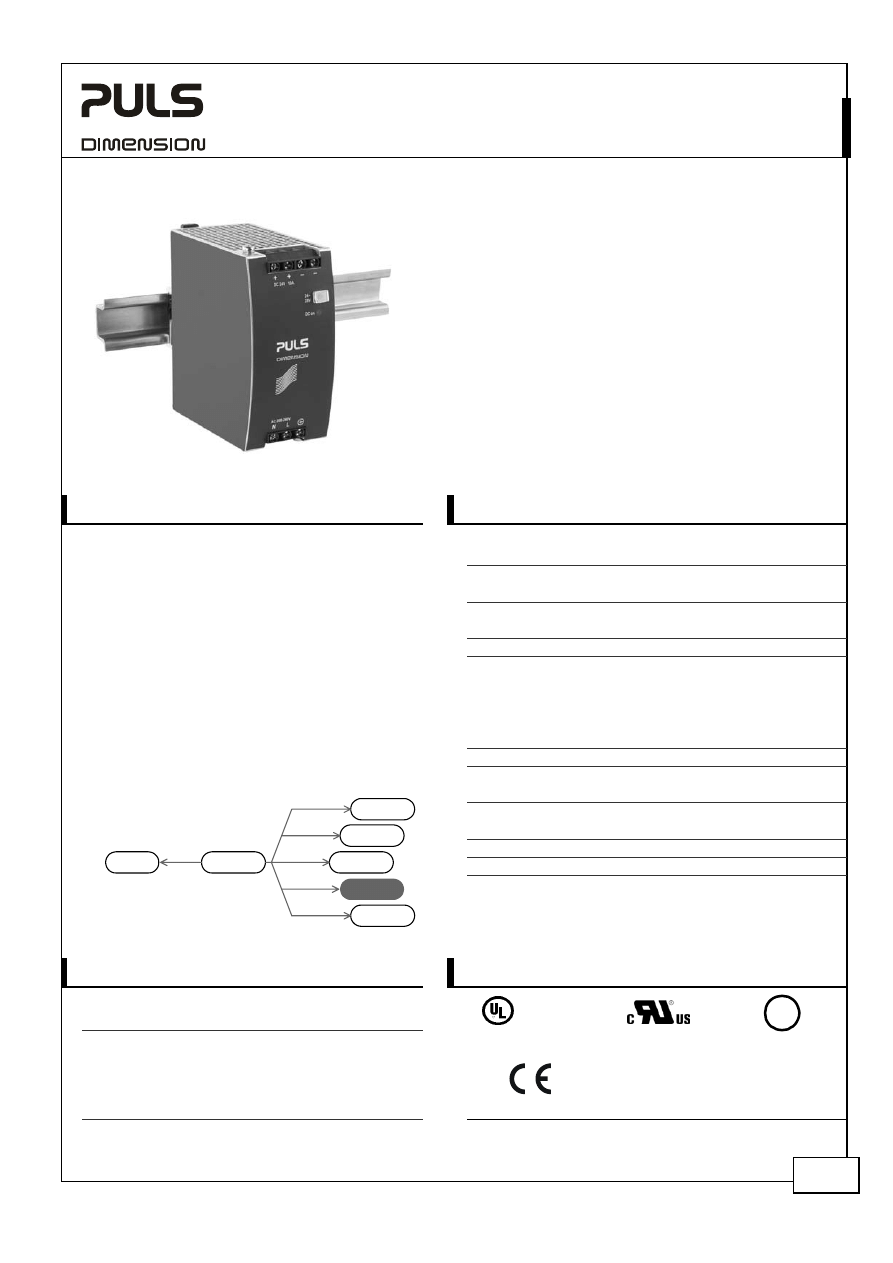
The Dimension C-Series are cost optimized power
supplies without compromising quality, reliability
and performance. The C-Series is part of the
Dimension power supply family, existing alongside
the high featured Q-series.
The C series includes all the essential basic functions
and the devices have a power reserve of 20%. This
extra current may even be used continuously at
temperatures up to +45°C. The most important
features are the small size, the high efficiency and
the wide temperature range.
The CS10.244 is a device for 200-240V mains only.
This supports regional applications and offers ad-
ditional cost savings without sacrificing functionality.
CS10.241
CS10.244
CS10.242
CS10.481
CS10.243
CS5.241
CS10.241-S1
Less
power
PFC
inductor
C-Series
Related products
48V
output
only
100-120V
only
200-240V
Spring-clamp
terminals
3. O
RDER
N
UMBERS
4. M
ARKINGS
Power
Supply CS10.244
Standard unit
IND. CONT. EQ.
18WM
LISTED
UL 508
UL 60950-1
GL
Marine, pending
Accessory UF20.241 Buffer
module
YRM2.DIODE
Redundancy module
ZM1.WALL
Wall
mount
bracket
ZM13.SIDE
Side
mount
bracket
EMC, LVD
CS10.244
C–Series
24V, 10A, S
INGLE
P
HASE
I
NPUT
Sept. 2006 / Rev. 1.0 DS-CS10.244-EN / All parameters are specified at 24V, 10A, 230Vac and 25°C ambient unless otherwise noted.
www.pulspower.com Phone +49 89 9278 0 Germany
2/21
I
NDEX
P
AGE
I
NDEX
P
AGE
1.
General Description ............................................1
2.
Short-form Data ..................................................1
3.
Order Numbers....................................................1
4.
Markings ..............................................................1
5.
AC-Input...............................................................3
6.
Input Inrush Current Surge .................................4
7.
DC-Input...............................................................4
8.
Hold-up Time.......................................................5
9.
Output .................................................................6
10.
Efficiency and Power Losses................................7
11.
Functional Diagram.............................................8
12.
Reliability .............................................................8
13.
Front Side and User Elements.............................9
14.
Terminals and Wiring..........................................9
15.
EMC....................................................................10
16.
Environment ......................................................12
17.
Protection Features ...........................................12
18.
Safety .................................................................13
19.
Dielectric Strength ............................................13
20.
Approvals .......................................................... 14
21.
Fulfilled Standards............................................ 14
22.
Used Substances ............................................... 14
23.
Physical Dimensions and Weight ..................... 15
24.
Installation and Operation Instructions .......... 15
25.
Accessory........................................................... 16
26.
Application Notes............................................. 17
26.1.
Peak Current Capability ......................... 17
26.2.
Charging of Batteries ............................. 17
26.3.
Back-feeding Loads ................................ 18
26.4.
Output Circuit Breakers ......................... 18
26.5.
Inductive and Capacitive Loads ............. 19
26.6.
Series Operation..................................... 19
26.7.
Parallel Use to Increase Output Power . 19
26.8.
Parallel Use for 1+1 Redundancy........... 19
26.9.
External Input Protection....................... 20
26.10.
Operation on Two Phases ...................... 20
26.11.
Use in a Tightly Sealed Enclosure .......... 20
26.12.
Mounting Orientations .......................... 21
I
NTENDED
U
SE
The power supply shall only be installed and put into operation by qualified personnel.
This power supply is designed for installation in an enclosure and is intended for the general use, such as in industrial
control, office, communication, and instrumentation equipment. Do not use this device in aircraft, trains and nuclear
equipment, where malfunctioning of the power supply may cause severe personal injury or threaten human life.
T
ERMINOLOGY AND
A
BREVIATIONS
PE and
symbol
PE is the abbreviation for Protective Earth and has the same meaning as the symbol
.
Earth, Ground
This document uses the term “earth” which is the same as the U.S. term “ground”.
T.b.d.
To be defined, value or description will follow later.
AC 230V
A figure displayed with the AC or DC before the value represents a nominal voltage with
standard tolerances (usually ±20%) included.
E.g.: DC 12V describes a 12V battery disregarding whether it is full (13.7V) or flat (10V)
As long as not otherwise stated, AC 100V and AC 230V parameters are valid at 50Hz and AC
120V parameters are valid at 60Hz mains frequency.
230Vac
A figure with the unit (Vac) at the end is a momentary figure without any additional
tolerances included.
D
ISCLAIMER
The information presented in this document is believed to be accurate and reliable and may change without notice.
CS10.244
C–Series
24V, 10A, S
INGLE
P
HASE
I
NPUT
Sept. 2006 / Rev. 1.0 DS-CS10.244-EN / All parameters are specified at 24V, 10A, 230Vac and 25°C ambient unless otherwise noted.
www.pulspower.com Phone +49 89 9278 0 Germany
3/21
5. AC-I
NPUT
AC
input
nom.
AC 200-240V
TN-, TT-, IT-Mains, see
Fig. 5-1
AC input range
180-264Vac continuous
operation
264-300Vac <
0.5s
Input
frequency
nom.
50 – 60Hz
±6%
AC 100V
AC 120V
AC 230V
Input
current
typ.
-
-
2.2A
at 24V, 10A see
Fig. 5-3
Power
factor
*)
typ.
-
-
0.52
at 24V, 10A see
Fig. 5-1
Crest factor **)
typ.
-
-
3,2
at 24V, 10A
Start-up
delay
typ.
- -
220ms
see
Fig. 5-2
Rise
time
typ.
-
-
35ms
0mF, 24V, 10A, see
Fig. 5-2
typ.
-
-
75ms
10mF, 24V, 10A, see
Fig. 5-2
Turn-on
overshoot
max.
- -
100mV
see
Fig. 5-2
Turn-on
voltage
typ.
-
-
155Vac
steady-state value, see
Fig. 5-1
Shut-down
voltage
typ.
-
-
137Vac
steady-state value, see
Fig. 5-1
*)
The power factor is the ratio of the true (or real) power to the apparent power in an AC circuit.
**) The crest factor is the mathematical ratio of the peak value to the RMS value of the input current waveform
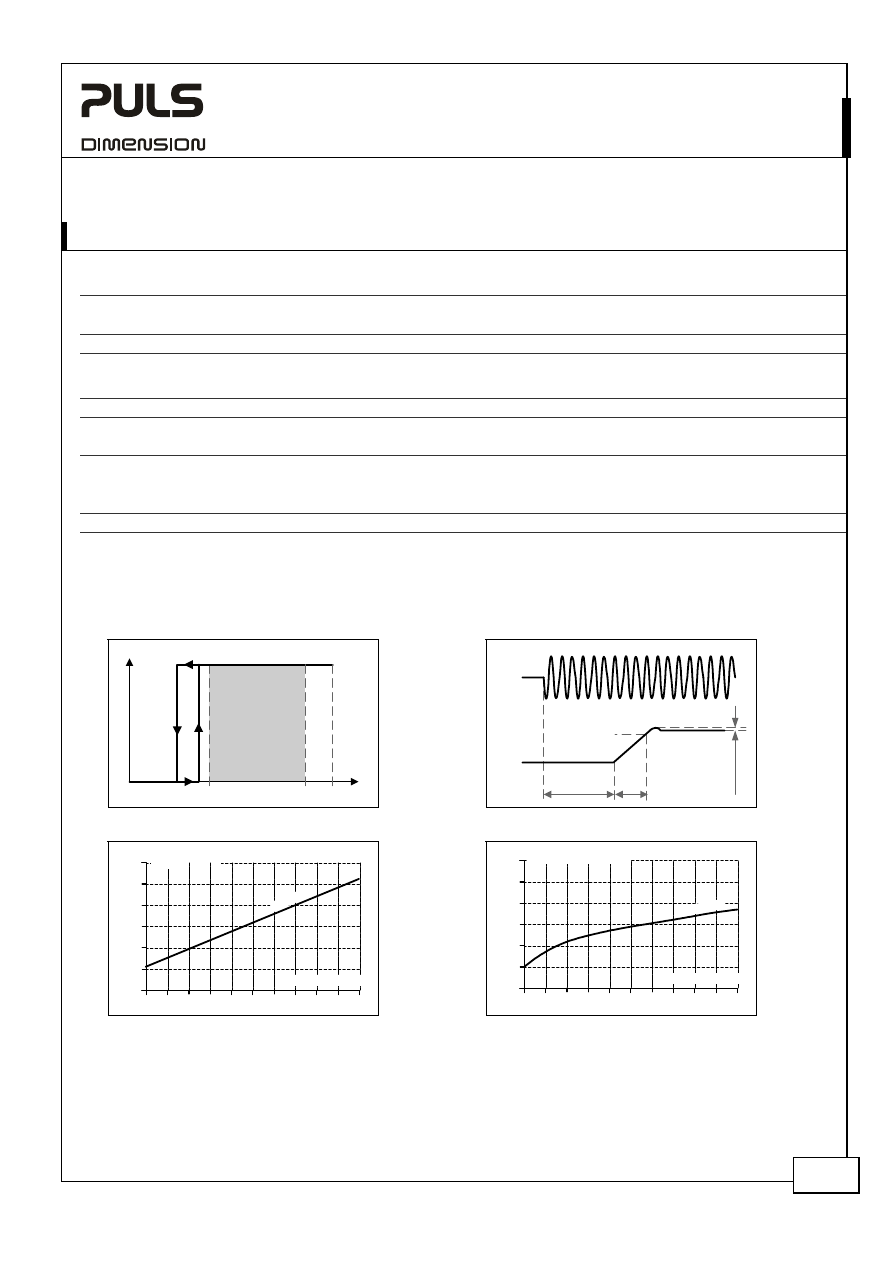
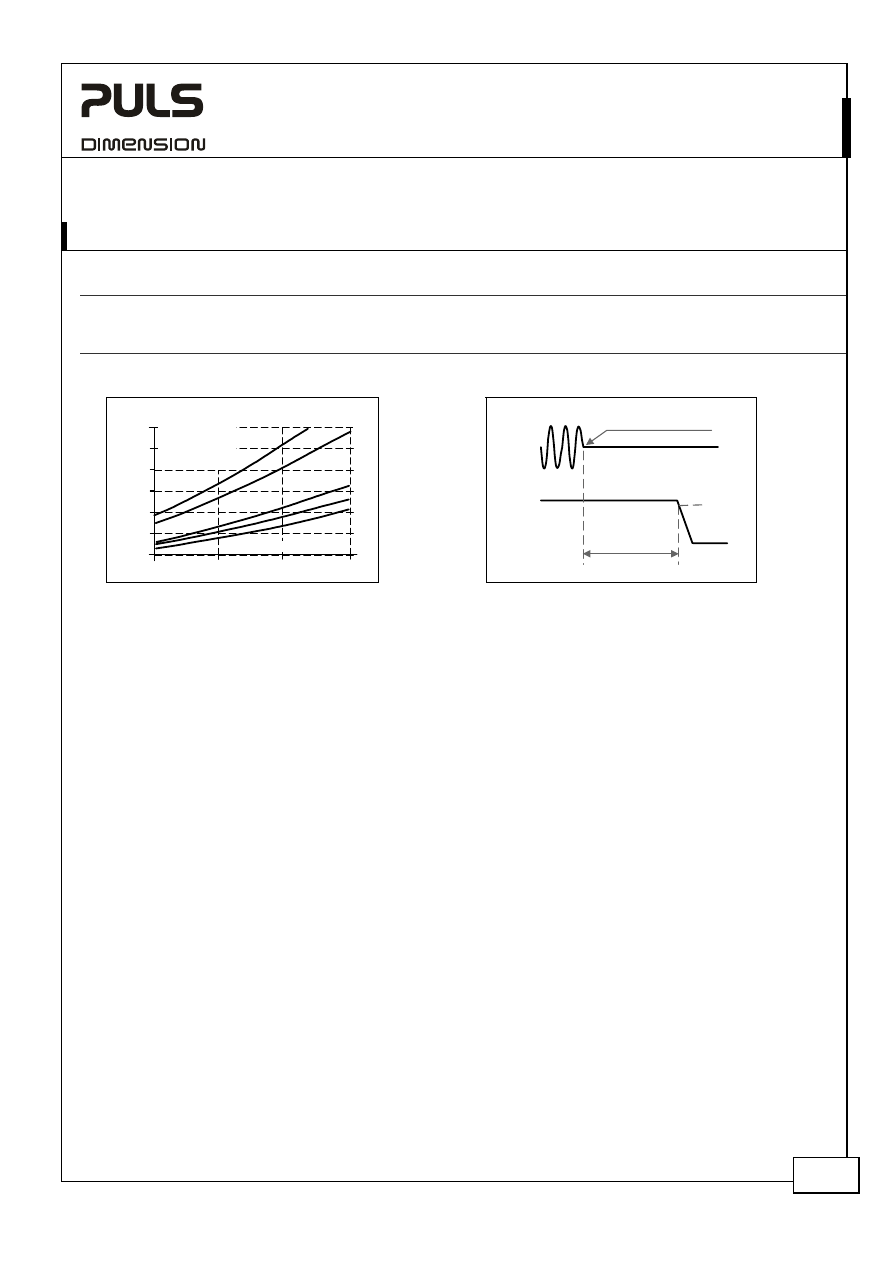
Fig. 5-1 Input voltage range
Fig. 5-2 Turn-on behavior, definitions
Tur
n
-on
180
V
IN
P
OUT
300Vac
S
hut
-down
264
200-240V
Rated Input
Range
Start-up
delay
Rise
Time
Ov
ershoot
- 5%
Output
Voltage
Intput
Voltage
Fig. 5-3 Input current vs. output load
Fig. 5-4 Power Factor vs. output load
12A
2
3
4
5
6
7
8
9
0
0.5
1
1.5
2
2.5
3A
Input
Current, typ.
10 11
Output Current
230
Vac
12A
2
3
4
6
8
0.35
0.4
10
Output Current
5
7
9
11
0.45
0.5
0.55
0.6
0.65
Power Factor, typ.
230Va
c
CS10.244
C–Series
24V, 10A, S
INGLE
P
HASE
I
NPUT
Sept. 2006 / Rev. 1.0 DS-CS10.244-EN / All parameters are specified at 24V, 10A, 230Vac and 25°C ambient unless otherwise noted.
www.pulspower.com Phone +49 89 9278 0 Germany
4/21
6. I
NPUT
I
NRUSH
C
URRENT
S
URGE
A NTC inrush limitation circuitry limits the input inrush current after turn-on of the input voltage.
The charging current into EMI suppression capacitors is disregarded in the first milliseconds after switch-on.
AC 100V
AC 120V
AC 230V
Inrush
current
max.
- -
59A
peak
at +40°C ambient, first start
typ.
- -
48A
peak
at +40°C ambient, first start
Inrush
energy
typ.
- -
3A
2
s
at +40°C ambient, first start
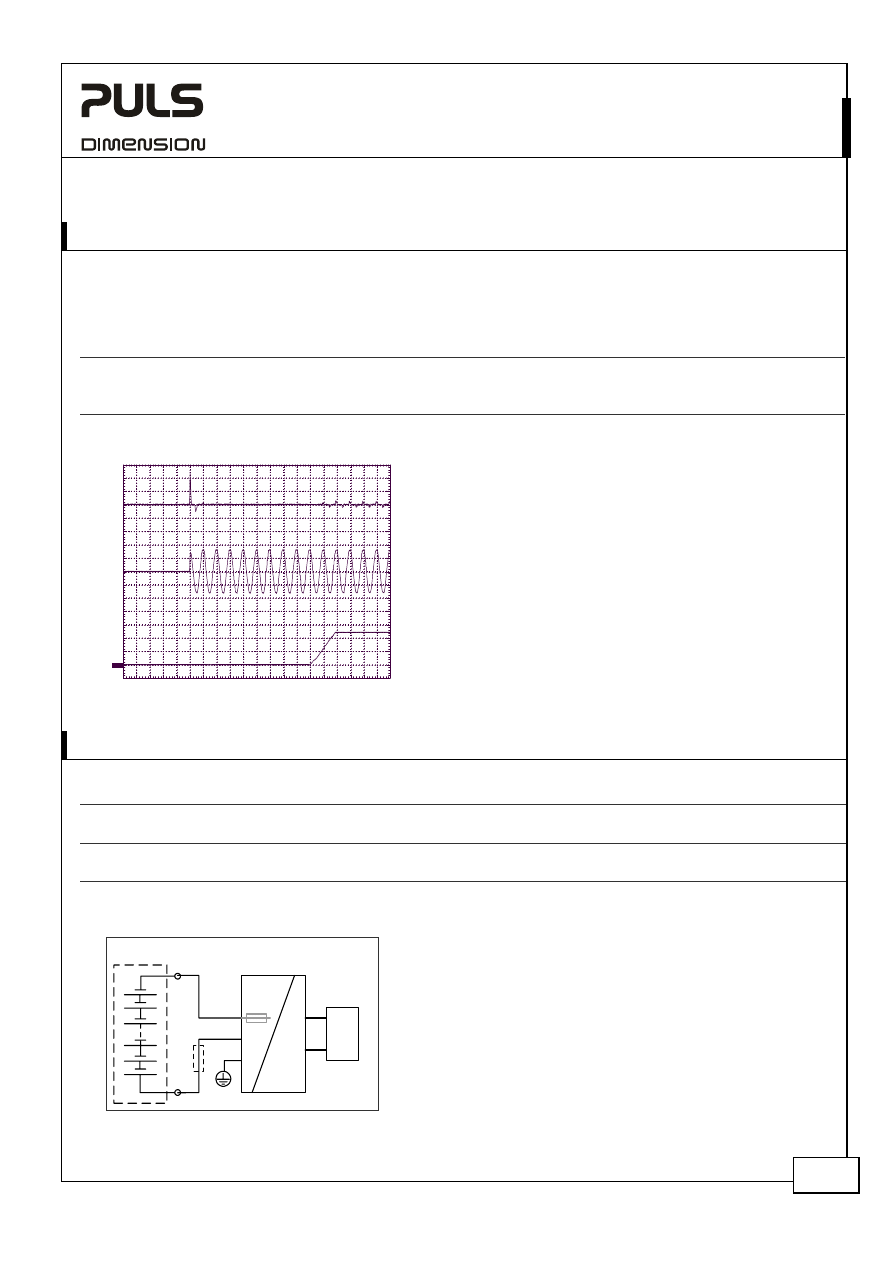
Fig. 6-1 Input inrush current, typical behavior
1 >
2 >
3
3 >
Input:
230Vac
Output:
24V, 10A
Ambient: 40°C
Upper curve:
Input current 20A / DIV
Medium curve: Input voltage 200V / DIV
Lower curve:
Output voltage 10V / DIV
Time scale:
20ms / DIV
7. DC-I
NPUT
DC input
nom.
DC 290V
DC input range
min.
210-375Vdc
continuous operation
DC input current
typ.
0.9A
290Vdc, 24V, 10A
Turn-on voltage
typ.
190Vdc
steady state value
Shut-down voltage
typ.
150Vdc
steady state value
Fig. 7-1 Wiring for DC Input
Fus
e
+
-
Load
L
N
PE
+
-
Power Supply
AC
DC
Battery
internal
fused
Instructions for DC use:
a)
Use a battery or similar DC source.
b)
Connect +pole to L and –pole to N.
c)
Connect the PE terminal to a earth wire or
to the machine ground.
In case the –pole of the battery is not connected
to earth, use an appropriate fuse to protect the N
terminal.
CS10.244
C–Series
24V, 10A, S
INGLE
P
HASE
I
NPUT
Sept. 2006 / Rev. 1.0 DS-CS10.244-EN / All parameters are specified at 24V, 10A, 230Vac and 25°C ambient unless otherwise noted.
www.pulspower.com Phone +49 89 9278 0 Germany
5/21
8. H
OLD
-
UP
T
IME
AC 100V
AC 120V
AC 230V
Hold-up Time
typ.
-
-
102ms
5A, 24V, see
Fig. 8-1
typ.
-
-
45ms
10A, 24V, see
Fig. 8-1
typ.
-
-
36ms
12A, 24V, see
Fig. 8-1
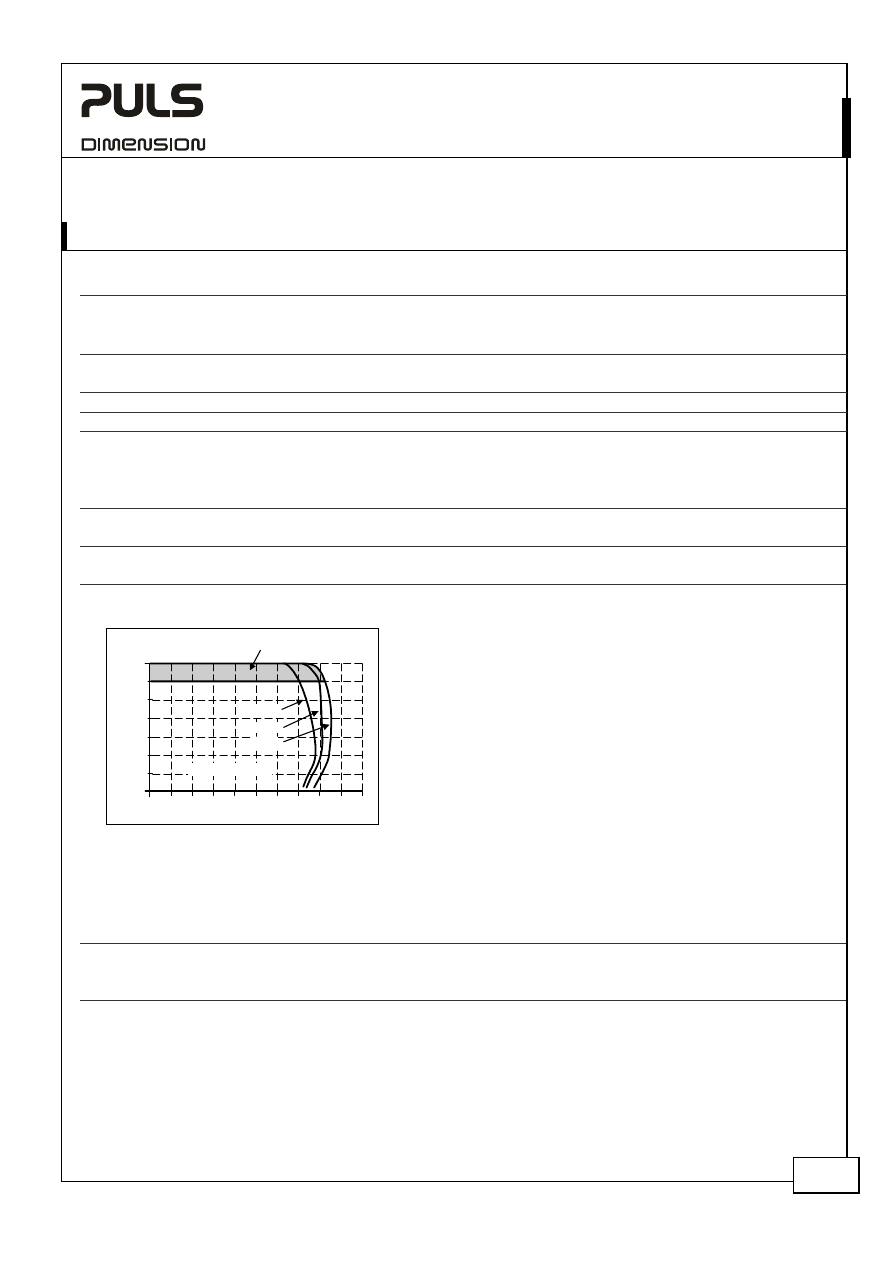
Fig. 8-1 Hold-up time vs. input voltage
Fig. 8-2 Shut-down behavior, definitions
0
20
40
120ms
170
200
230
264Vac
Hold-up Time
80
60
100
Input Voltage
a) 24V 5A typ.
b) 24V 5A min.
c) 24V 10A typ.
d) 24V 10A min.
e) 24V 12A min.
a
b
c
d
e
- 5%
Hold-up Time
Zero Transition
Output
Voltage
Intput
Voltage
Note: At no load, the hold-up time can be up to several seconds. The green DC-ok lamp is on during this time.
CS10.244
C–Series
24V, 10A, S
INGLE
P
HASE
I
NPUT
Sept. 2006 / Rev. 1.0 DS-CS10.244-EN / All parameters are specified at 24V, 10A, 230Vac and 25°C ambient unless otherwise noted.
www.pulspower.com Phone +49 89 9278 0 Germany
6/21
9. O
UTPUT
Output
voltage
nom.
24V
Adjustment
range
min.
24-28V guaranteed
max.
30V
at clockwise end position of potentiometer
Factory
setting
24.1V
±0.2%,
at full load, cold unit
Line
regulation
max.
70mV
180 to 264Vac
Load
regulation
max.
100mV
static value, 0A Æ 10A Æ 0A
Ripple and noise voltage
max.
50mVpp
20Hz to 20MHz, 50Ohm
Output
capacitance
typ.
7 000µF
Output current
nom.
12A
at 24V, ambient < 45°C, see
Fig. 9-1
nom.
10A
at 24V, ambient < 60°C, see
Fig. 9-1
nom.
10.3A
at 28V, ambient < 45°C, see
Fig. 9-1
nom.
8.6A
at 28V, ambient < 60°C, see
Fig. 9-1
Output
power
nom.
288W
ambient < 45°C
nom.
240W
ambient < 60°C
Short-circuit
current
min.
14A
load impedance 100mOhm, see
Fig. 9-1
max.
18A
load impedance 100mOhm, see
Fig. 9-1
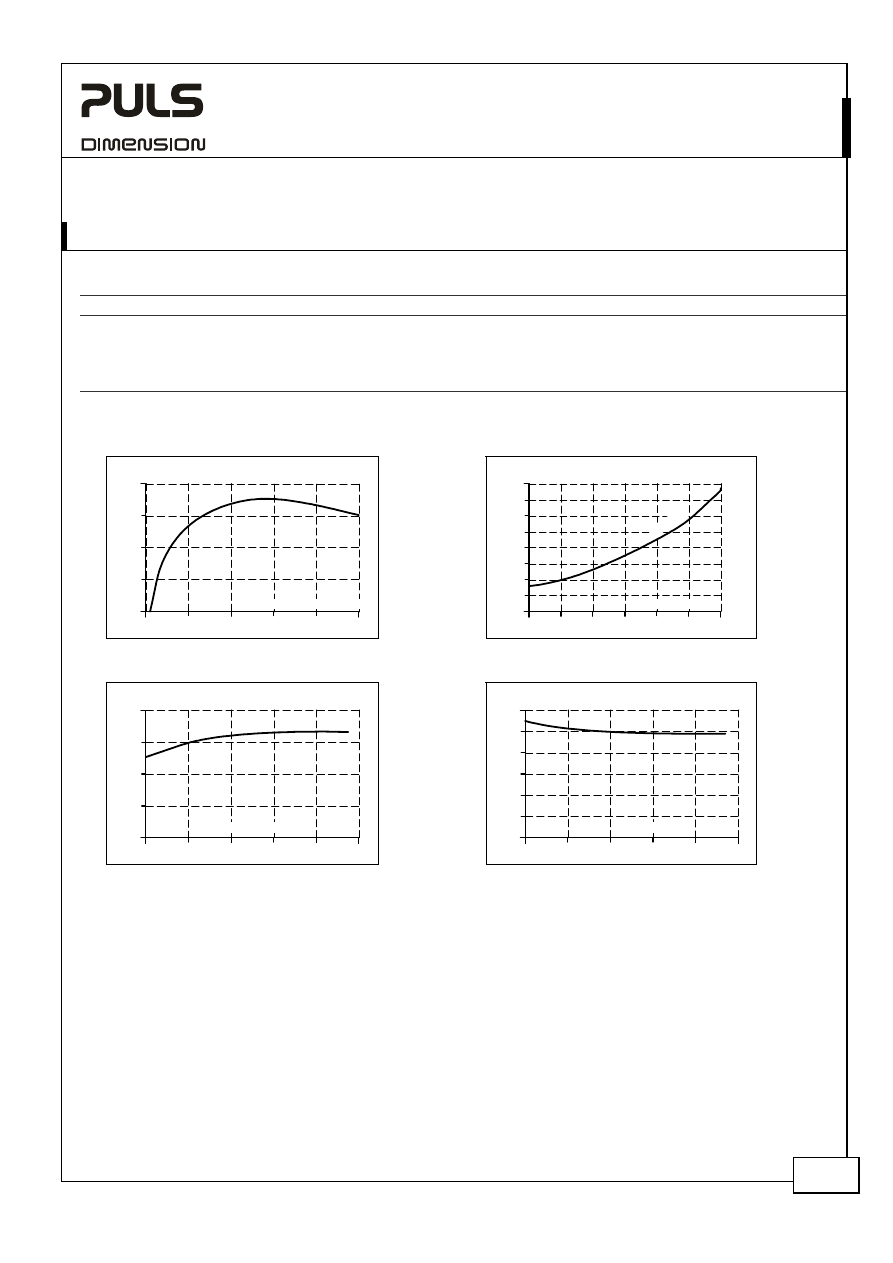
Fig. 9-1 Output voltage vs. output current, typ.
Output Voltage
0
0
4
8
12
16
4
8
12
28V
16
20
24
20A
10
6
2
14
18
Adjustment
Range
Output Current
+60°C
+25°C
-25°C
Peak current capability (up to several ms)
The power supply can deliver a peak current which is higher than the specified short term current. This helps to start
current demanding loads or to safely operate subsequent circuit breakers.
The extra current is supplied by the output capacitors inside the power supply. During this event, the capacitors will
be discharged and causes a voltage dip on the output. Detailed curves can be found in chapter 26.1.
Peak current voltage dips
typ.
from 24V to 18.5V
at 20A for 50ms, resistive load
typ.
from 24V to 17.5V
at 50A for 2ms, resistive load
typ.
from 24V to 12V
at 50A for 5ms, resistive load
CS10.244
C–Series
24V, 10A, S
INGLE
P
HASE
I
NPUT
Sept. 2006 / Rev. 1.0 DS-CS10.244-EN / All parameters are specified at 24V, 10A, 230Vac and 25°C ambient unless otherwise noted.
www.pulspower.com Phone +49 89 9278 0 Germany
7/21
10. E
FFICIENCY AND
P
OWER
L
OSSES
AC 100V
AC 120V
AC 230V
Efficiency
typ.
-
-
91.3%
10A,
24V
Power
losses
typ.
-
-
6.9W
0A
typ.
-
-
12.0W
5A,
24V
typ.
-
-
23.4W
10A,
24V
typ.
-
-
29.2W
12A,
24V
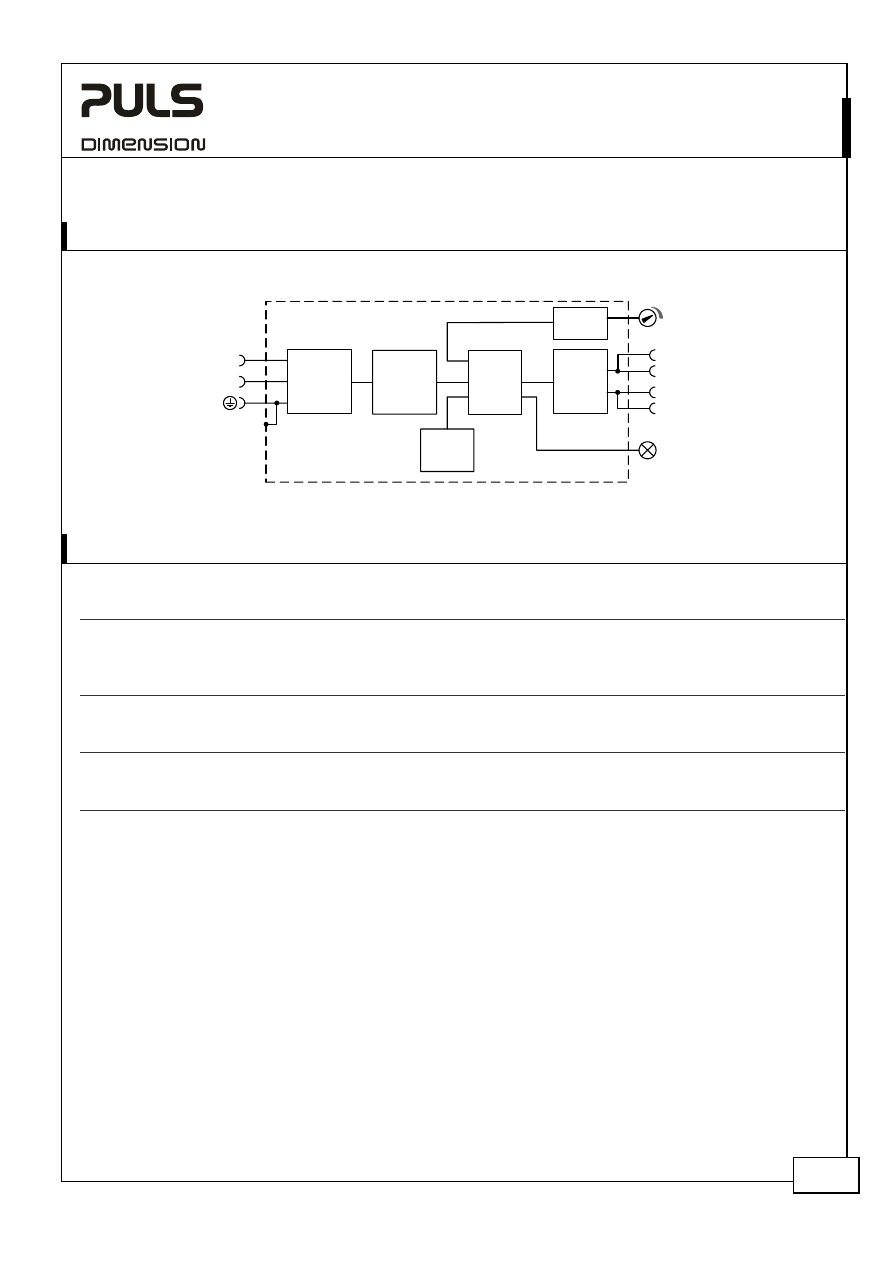
Fig. 10-1 Efficiency vs. output current at 24V
Fig. 10-2 Losses vs. output current at 24V
Efficiency
2
89
90
91
88
92%
230Vac
12A
4
8
10
Output Current
6
Power Losses
0
2
4
8
10
12A
0
4
12
16
24
28
32W
Output Current
8
6
20
23
0V
ac
Fig. 10-3 Efficiency vs. input voltage, 24V, 10A
Fig. 10-4 Losses vs. input voltage, 24V, 10A
Efficiency
170
190
210
230
250 270
Vac
88
89
90
Input Voltage
91
92%
Power Losses
9
12
15
18
21
Input Voltage
24
27W
170
190
210
230
250 270
Vac
CS10.244
C–Series
24V, 10A, S
INGLE
P
HASE
I
NPUT
Sept. 2006 / Rev. 1.0 DS-CS10.244-EN / All parameters are specified at 24V, 10A, 230Vac and 25°C ambient unless otherwise noted.
www.pulspower.com Phone +49 89 9278 0 Germany
8/21
11. F
UNCTIONAL
D
IAGRAM
Fig. 11-1 Functional diagram
+
+
-
-
V
OUT
Input Fuse
&
Input Filter
Output
Voltage
Regulator
Power
Converter
Output
Filter
DC
ok
L
N
Output
Over-
Voltage
Protection
Input
Rectifier
&
Inrush
Limiter
(NTC)
12. R
ELIABILITY
AC 100V
AC 120V
AC 230V
Lifetime expectancy
min.
-
-
75 000h
40°C, 24V, 10A
min.
-
-
53 000h
40°C, 24V, 12A
min.
-
-
118 000h
40°C, 24V, 5A
min.
-
-
15 years
25°C, 24V, 10A
MTBF SN 29500, IEC 61709
-
-
910 000h
40°C, 24V, 10A
-
-
774 000h
40°C, 24V, 12A
-
-
1 574 000h
25°C, 24V, 10A
MTBF MIL HDBK 217F
-
-
530 000h
40°C, 24V, 10A, Ground Benign GB40
-
-
477 000h
40°C, 24V, 12A, Ground Benign GB40
-
-
726 000h
25°C, 24V, 10A, Ground Benign GB25
The Lifetime expectancy shown in the table indicates the operating hours (service life) and is determined by the
lifetime expectancy of the built-in electrolytic capacitors.
Lifetime expectancy is specified in operational hours. Lifetime expectancy is calculated according to the capacitor’s
manufacturer specification. The prediction model allows a calculation of up to 15 years from date of shipment.
MTBF stands for Mean Time Between Failure, which is calculated according to statistical device failures, and indicates
reliability of a device. It is the statistical representation of the likelihood of a unit to fail and does not necessarily
represent the life of a product.
CS10.244
C–Series
24V, 10A, S
INGLE
P
HASE
I
NPUT
Sept. 2006 / Rev. 1.0 DS-CS10.244-EN / All parameters are specified at 24V, 10A, 230Vac and 25°C ambient unless otherwise noted.
www.pulspower.com Phone +49 89 9278 0 Germany
9/21
13. F
RONT
S
IDE AND
U
SER
E
LEMENTS
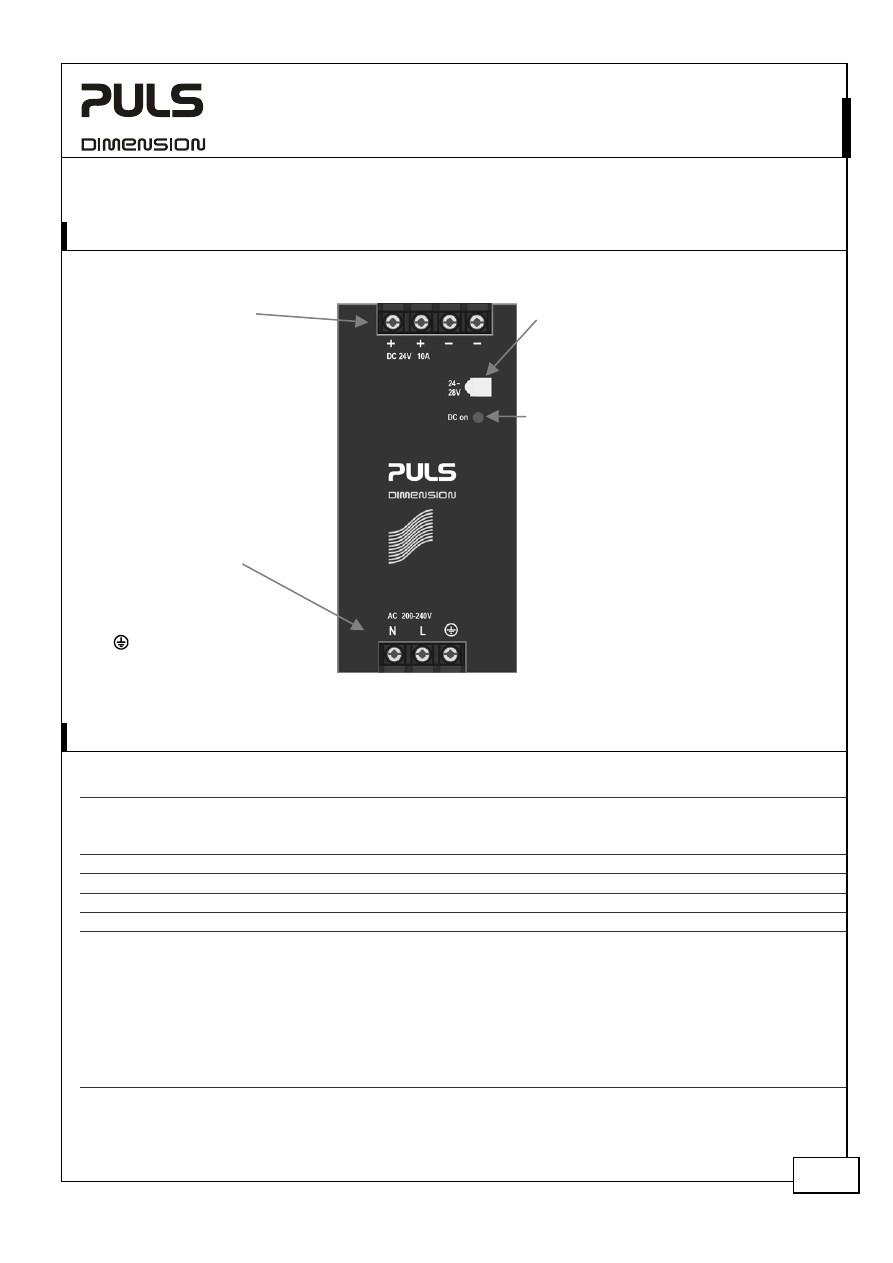
Fig. 13-1 Front side
Output voltage potentiometer
Open the flap to tune the output voltage.
Factory set: 24.1V
Output Terminals
Screw terminals
+ Positive output
- Negative (return) output
Dual pins per pole
Input Terminals
Screw terminals
N … Neutral input
L … Line (hot) input
... PE (Protective Earth) input
DC-on lamp (green)
On when the voltage on the output
terminals is > 21 V
14. T
ERMINALS AND
W
IRING
Type
Screw terminals
Solid
wire
0.5-6mm
2
Stranded
wire
0.5-4mm
2
American wire gauge
20-10 AWG
Ferrules
allowed, but not required
Wire stripping length
7mm / 0.275inch
Screwdriver
3.5mm
slotted or Pozidrive No 2
Recommended tightening torque
0.8Nm, 7lb.in
Instructions:
a)
Use appropriate copper cables that are designed for an operating temperature of:
60°C for ambient up to 45°C and
75°C for ambient up to 60°C minimum.
b)
Follow national installation codes and installation regulations!
c)
Ensure that all strands of a stranded wire enter the terminal connection!
d)
Up to two stranded wires with the same cross section are permitted in one connection point (except PE wire).
e)
Do not use the unit without PE connection.
CS10.244
C–Series
24V, 10A, S
INGLE
P
HASE
I
NPUT
Sept. 2006 / Rev. 1.0 DS-CS10.244-EN / All parameters are specified at 24V, 10A, 230Vac and 25°C ambient unless otherwise noted.
www.pulspower.com Phone +49 89 9278 0 Germany
10/21
15. EMC
The CE mark is in conformance with EMC guideline 89/336/EEC and 93/68/EEC and the low-voltage directive (LVD)
73/23/EWG. A detailed EMC Report is available on request.
EMC Immunity
EN 61000-6-2, EN 61000-6-1
Generic standards
Electrostatic discharge
EN 61000-4-2
Contact discharge
Air discharge
8kV
15kV
Criterion A
Criterion A
Electromagnetic RF field
EN 61000-4-3 80MHz-1GHz
10V/m
Criterion
A
Fast transients (Burst)
EN 61000-4-4
Input lines
Output lines
4kV
2kV
Criterion A
Criterion A
Surge voltage on input
EN 61000-4-5
L Æ N
N / L Æ PE
2kV
4kV
Criterion A
Criterion A
Surge voltage on output
EN 61000-4-5
+ Æ -
+ / - Æ PE
500V
500V
Criterion A
Criterion A
Conducted disturbance
EN 61000-4-6
0,15-80MHz
10V
Criterion A
Mains voltage dips
EN 61000-4-11
0% of 200Vac
40% of 200Vac
70% of 200Vac
0Vac, 20ms
80Vac, 200ms
140Vac, 500ms
Criterion A
Criterion C
Criterion C
Voltage interruptions
EN 61000-4-11
0Vac, 5000ms
Criterion C
Input voltage swells
PULS internal standard
300Vac, 500ms
Criterion A
Powerful transients
VDE 0160
over entire load
range
750V, 1.3ms
Criterion A
Criterions:
A: Power supply shows normal operation behavior within the defined limits.
C: Temporary loss of function is possible. Power supply might shut-down and restarts by itself. No damages or hazards for the
power supply occur.
Switching frequency
85kHz to 110kHz
input voltage dependent
CS10.244
C–Series
24V, 10A, S
INGLE
P
HASE
I
NPUT
Sept. 2006 / Rev. 1.0 DS-CS10.244-EN / All parameters are specified at 24V, 10A, 230Vac and 25°C ambient unless otherwise noted.
www.pulspower.com Phone +49 89 9278 0 Germany
11/21
EMC Emission
EN 61000-6-4
Generic standards
Conducted emission
EN 55011, EN 55022, FCC Part 15, CISPR 11, CISPR 22
Class B, input lines
EN 55022
Class A, output lines
Radiated emission
EN 55011, EN 55022
Class B
Harmonic input current
EN 61000-3-2
not fulfilled
Voltage fluctuations, flicker EN
61000-3-3
fulfilled
This device complies with FCC Part 15 rules.
Operation is subjected to following two conditions: (1) this device may not cause harmful interference, and (2) this
device must accept any interference received, including interference that may cause undesired operation.
The power supply does not fulfill the harmonic current standard EN61000-3-2.
Please note:
A power supply has to comply with EN 61000-3-2 (Standard for harmonic input current) when:
1) the end-device is used within the European Union and
2) the end-device is connected to a public mains supply with a nominal voltage
≥ 220Vac and
3) the power supply is:
- fitted in an end-device with an average input power in excess of 75W or
- fitted in an end-device with a continuous input power in excess of 75W or
- part of a lighting system.
Exceptions:
End-devices for professional applications with an input power > 1000W do not need to fulfill EN 61000-3-2.
Comments:
- The average input power must be determined in accordance with EN 61000-3-2.
- Industrial mains supplies with their own transformer are considered to be “non-public”.
- Where individual self-contained items of equipment are installed in a rack or case
(e.g. devices connected in parallel), they are regarded as being individually connected to the
mains supply. The rack or case need not be tested as a whole. Alternatively it is also permitted
to assess the whole rack or case. This is recommended for devices used in professional
applications with an input power greater than 1000W.
CS10.244
C–Series
24V, 10A, S
INGLE
P
HASE
I
NPUT
Sept. 2006 / Rev. 1.0 DS-CS10.244-EN / All parameters are specified at 24V, 10A, 230Vac and 25°C ambient unless otherwise noted.
www.pulspower.com Phone +49 89 9278 0 Germany
12/21
16. E
NVIRONMENT
Operational temperature
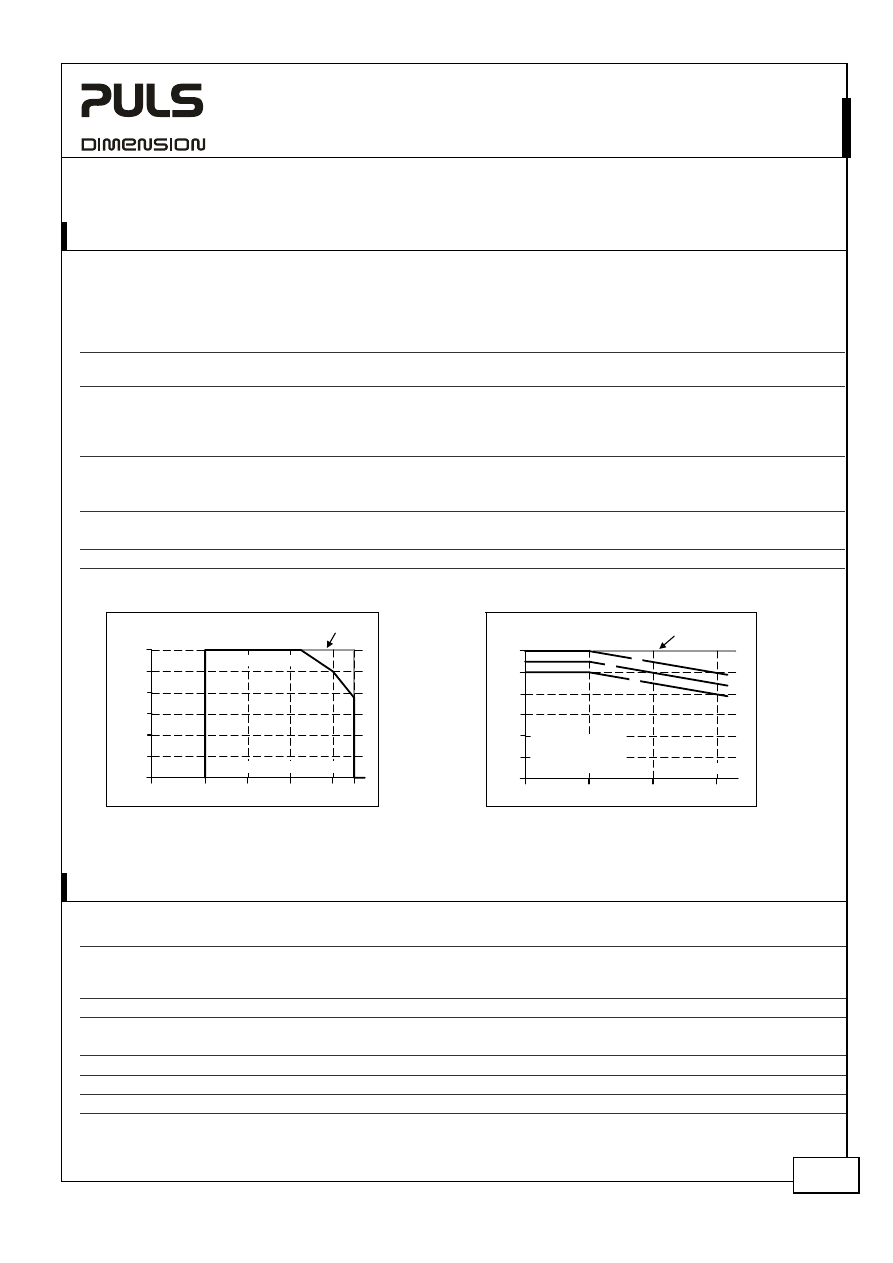
0°C to +70°C (32°F to 158°F)
reduce output power according
Fig. 16-1
Output de-rating
3.2W/°C
45-60°C (113°F to 140°F)
6W/°C
60-70°C (140°F to 158°F)
Storage temperature
-40 to +85°C (-40°F to 185°F)
storage and transportation
Humidity
5 to 95% r.H.
IEC 60068-2-30
Do not energize while condensation is present
Vibration sinusoidal
2-17.8Hz: ±1.6mm; 17.8-500Hz: 2g
2 hours / axis
IEC 60068-2-6
Shock
30g 6ms, 20g 11ms
3 bumps / direction, 18 bumps in total
IEC 60068-2-27
Altitude
0 to 6000m (0 to 20 000ft)
Reduce output power or ambient
temperature above 2000m sea level.
Output de-rating (for altitude)
15W/1000m or 5°C/1000m
above 2000m (6500ft), see
Fig. 16-2
Over-voltage
category
III
EN
50178, altitudes up to 2000m
II
Altitudes from 2000m to 6000m
Degree of pollution
2
EN 50178, not conductive
Fig. 16-1 Output current vs. ambient temp.,
Fig. 16-2 Output current vs. altitude, 24V
0
0
20
40
70°C
2
4
6
8
10
12A
60
Ambient Temperature
continuous
short
term
Allowable Output
Current at 24V
0
0
2000
4000
6000m
2
4
6
8
10
12A
Altitude
A... Tamb < 60°C
B... Tamb < 50°C
C... Tamb < 40°C
C
B
A
short term
Allowable Output
Current at 24V
The ambient temperature is defined 2cm below the unit.
17. P
ROTECTION
F
EATURES
Output
protection
Electronically protected against overload, no-load and short-circuits
Output over-voltage protection
typ. 35Vdc
max. 39Vdc
In case of an internal power supply defect, a redundant
circuitry limits the maximum output voltage. The output
shuts down and automatically attempts to restart.
Output over-current protection electronically
limited see
Fig. 9-1
Degree of protection
IP 20
EN/IEC 60529
Penetration protection
> 3.5mm
e.g. screws, small parts
Over-temperature
protection
yes
output shut-down with automatic restart
Input transient protection
MOV
Metal Oxide Varistor
Internal input fuse
T6.3A H.B.C.
not user replaceable
Note: In case of a protection event, audible noise may occur.
CS10.244
C–Series
24V, 10A, S
INGLE
P
HASE
I
NPUT
Sept. 2006 / Rev. 1.0 DS-CS10.244-EN / All parameters are specified at 24V, 10A, 230Vac and 25°C ambient unless otherwise noted.
www.pulspower.com Phone +49 89 9278 0 Germany
13/21
18. S
AFETY
Input / output separation
SELV
IEC/EN 60950-1
PELV
EN 60204-1, EN 50178, IEC 60364-4-41
double or reinforced insulation
Class of protection
I
PE (Protective Earth) connection required
Isolation resistance
> 5MOhm
input to output, 500Vdc
PE resistance
< 0.1Ohm
between housing and PE terminal
Touch current (leakage current)
typ. 0.64mA
230Vac, 50Hz, TN mains
< 0.85mA
264Vac, 50Hz, TN mains
19. D
IELECTRIC
S
TRENGTH
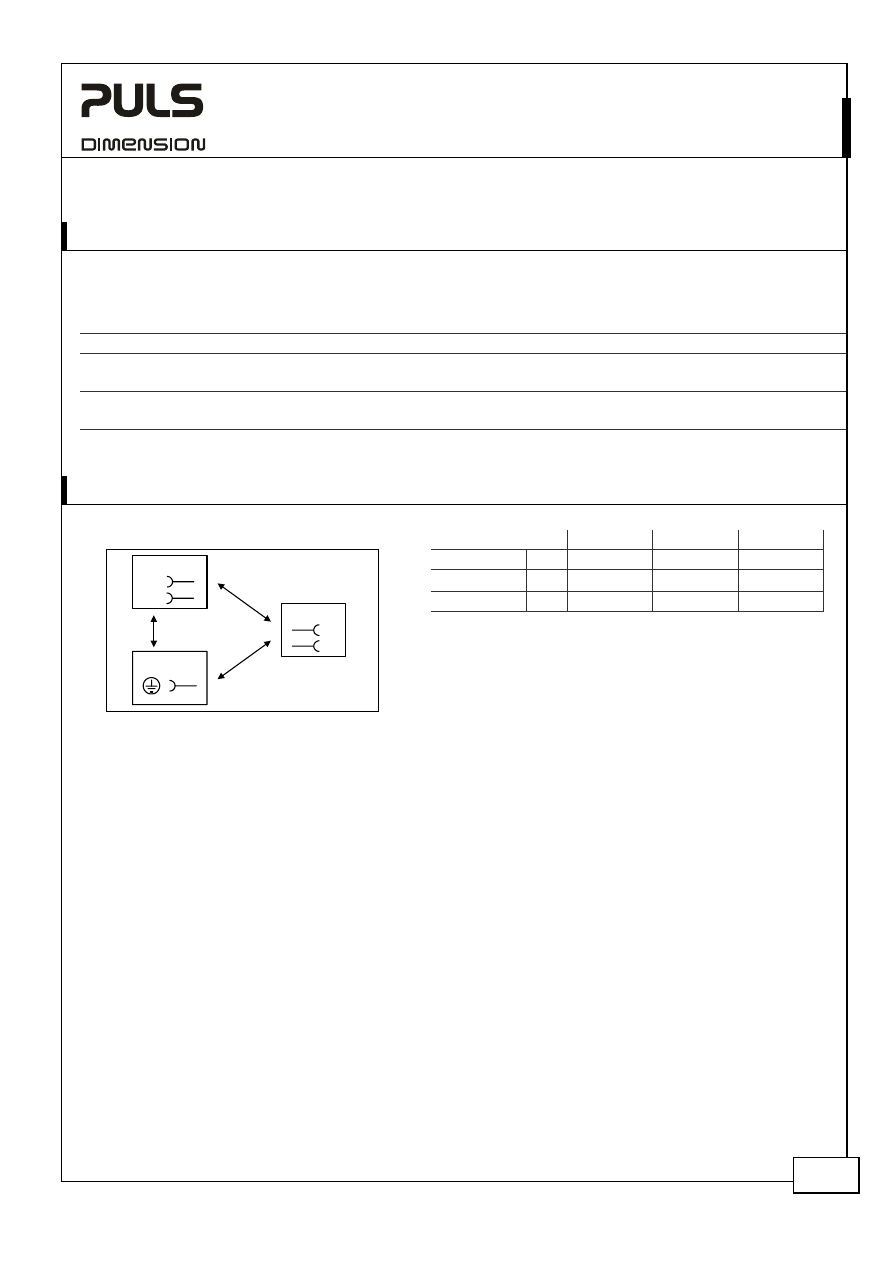
Fig. 19-1 Dielectric strength
A B C
Type test
60s
2500Vac
3000Vac
500Vac
Factory test
5s
2500Vac
2500Vac
500Vac
Field test
5s
2000Vac
2000Vac
500Vac
A
C
N
L
Input
Earth, PE
Output
-
+
B
Type tests and factory tests:
Conducted by the manufacturer. Do not repeat test in field!
Rules for field test:
Use appropriate test equipment which applies the voltage
with a slow ramp! Connect L and N together as well as all
output poles.
The output voltage is floating and has no ohmic connection to ground.
To fulfill the PELV requirements according to EN60204-1 § 6.4.1, we recommend that either the + pole, the – pole or
any other part of the output circuit shall be connected to the protective earth system. This helps to avoid situations in
which a load starts unexpectedly or can not be switched off any more when unnoticed earth faults occur.
CS10.244
C–Series
24V, 10A, S
INGLE
P
HASE
I
NPUT
Sept. 2006 / Rev. 1.0 DS-CS10.244-EN / All parameters are specified at 24V, 10A, 230Vac and 25°C ambient unless otherwise noted.
www.pulspower.com Phone +49 89 9278 0 Germany
14/21
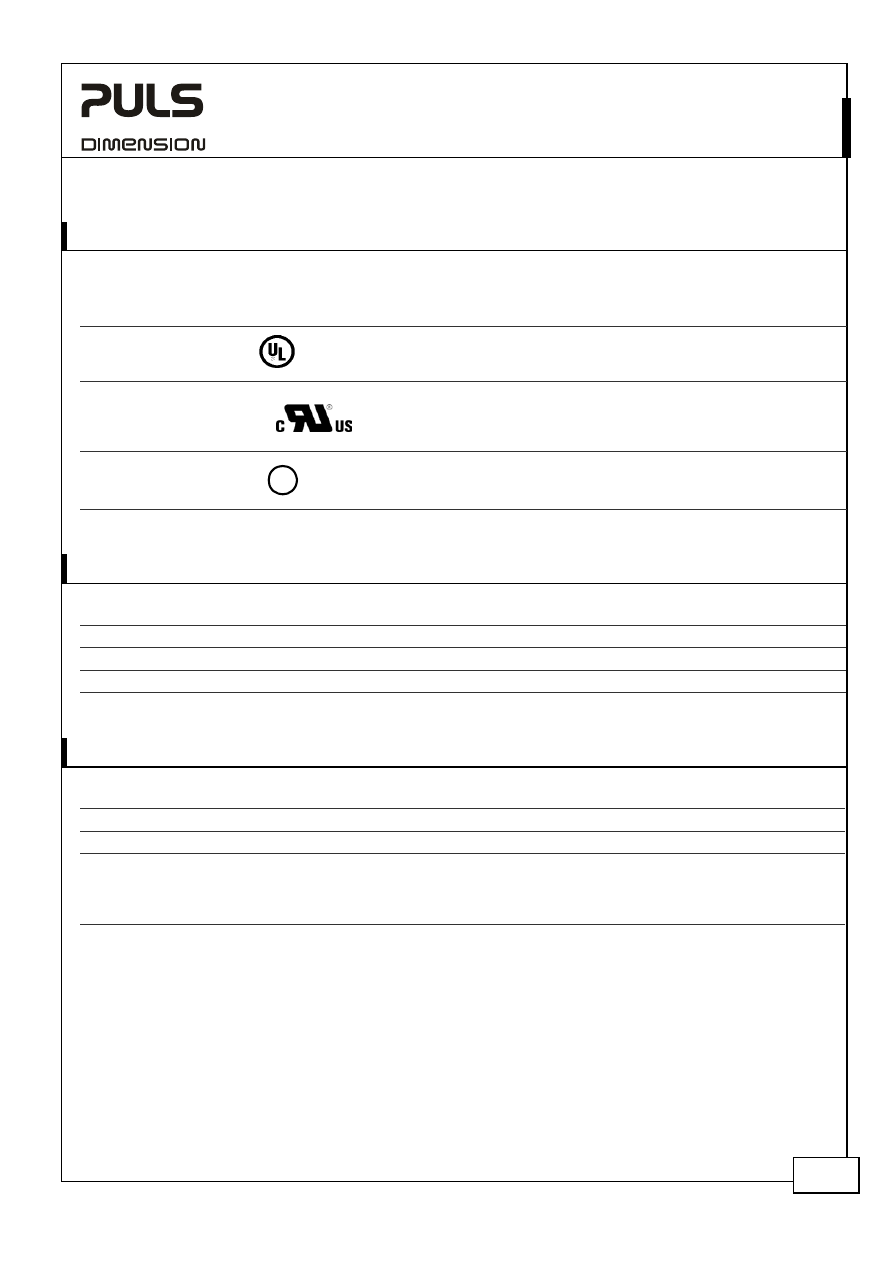
20. A
PPROVALS
IEC
60950-1
IECEE
CB SCHEME
CB Scheme,
Information Technology Equipment
(only for AC-input)
UL
508
IND. CONT. EQ.
18WM
LISTED
LISTED as Industrial Control Equipment
E198865
(only for AC-input)
UL
60950-1
RECOGNIZED E137006 recognized for the use in U.S.A. (UL 60950-
1) and Canada (C22.2 No. 60950)
Information Technology Equipment, Level 5
(only for AC-input)
Marine
pending
GL
ABS
GL (Germanischer Lloyd) classified and ABS (American Bureau for
Shipping) PDA for marine and offshore applications.
Environmental category: C, EMC2
21. F
ULFILLED
S
TANDARDS
EN 61558-2-17
Safety of Power Transformers
EN/IEC 60204-1
Safety of Electrical Equipment of Machines
EN/IEC 61131-1
Programmable Controllers
EN 50178
Electronic Equipment in Power Installations
22. U
SED
S
UBSTANCES
The unit does not release any silicone and is suitable for the use in paint shops.
Electrolytic capacitors included in this unit do not use electrolytes such as Quaternary Ammonium Salt Systems.
Plastic housings and other molded plastic materials are free of halogens, wires and cables are not PVC insulated.
The production material within our production does not include following toxic chemicals:
Polychlorized Biphenyl (PCB), Polychlorized Terphenyl (PCB), Pentachlorophenol (PCP), Polychlorinated naphthalene
(PCN), Polybrom Biphenyl (PBB), Polybrom Bipheny-oxyd (PBO), Polybrominated Diphenylether (PBDE), Polychlorinated
Diphenylether (PCDE), Polydibromphenyl Oxyd (PBDO), Cadmium, Asbest, Mercury, Silicia
CS10.244
C–Series
24V, 10A, S
INGLE
P
HASE
I
NPUT
Sept. 2006 / Rev. 1.0 DS-CS10.244-EN / All parameters are specified at 24V, 10A, 230Vac and 25°C ambient unless otherwise noted.
www.pulspower.com Phone +49 89 9278 0 Germany
15/21
23. P
HYSICAL
D
IMENSIONS AND
W
EIGHT
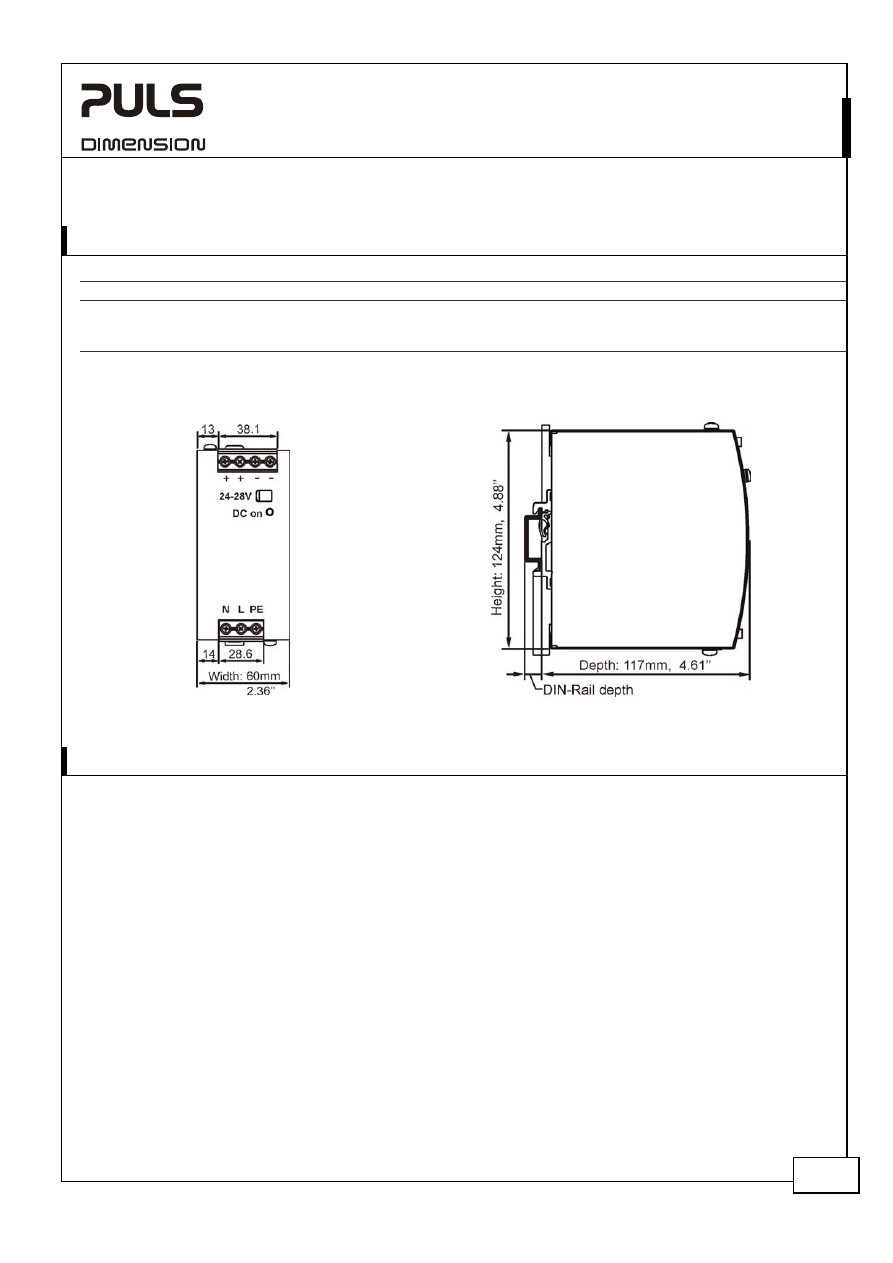
Weight
700g / 1.54lb
DIN-Rail
Use 35mm DIN-rails according to EN 60715 or EN 50022 with a height of 7.5 or 15mm.
The DIN-rail height must be added to the depth (117mm) to calculate the total required
installation depth.
Electronic files with mechanical data can be downloaded at www.pulspower.com
Fig. 23-1 Front view
Fig. 23-2 Side view
24. I
NSTALLATION AND
O
PERATION
I
NSTRUCTIONS
Mounting Orientation:
Output terminal must be located on top and input terminal on the bottom. For other orientations consult factory.
Cooling:
Convection cooled, no forced cooling required. Do not cover ventilation grid (e.g. cable conduit) by more than 30%!
Installation clearances:
40mm on top, 20mm on the bottom, 5mm on the left and right side are recommended when loaded permanently
with full power. In case the adjacent device is a heat source, 15mm clearance are recommended.
Risk of electrical shock, fire, personal injury or death!
Do not use the unit without proper earth connection (Protective Earth). Use the pin on the terminal block for earth
connection and not one of the screws on the housing.
Turn power off before working on the power supply. Protect against inadvertent re-powering.
Make sure the wiring is correct by following all local and national codes.
Do not open, modify or repair the unit.
Use caution to prevent any foreign objects from entering into the housing.
Do not use in wet locations or in areas where moisture or condensation can be expected.
Service parts:
The unit does not contain any service parts. The tripping of an internal fuse is caused by an internal defect. If damage
or malfunctioning should occur during operation, immediately turn power off and send unit to factory for
inspection!
CS10.244
C–Series
24V, 10A, S
INGLE
P
HASE
I
NPUT
Sept. 2006 / Rev. 1.0 DS-CS10.244-EN / All parameters are specified at 24V, 10A, 230Vac and 25°C ambient unless otherwise noted.
www.pulspower.com Phone +49 89 9278 0 Germany
16/21
25. A
CCESSORY
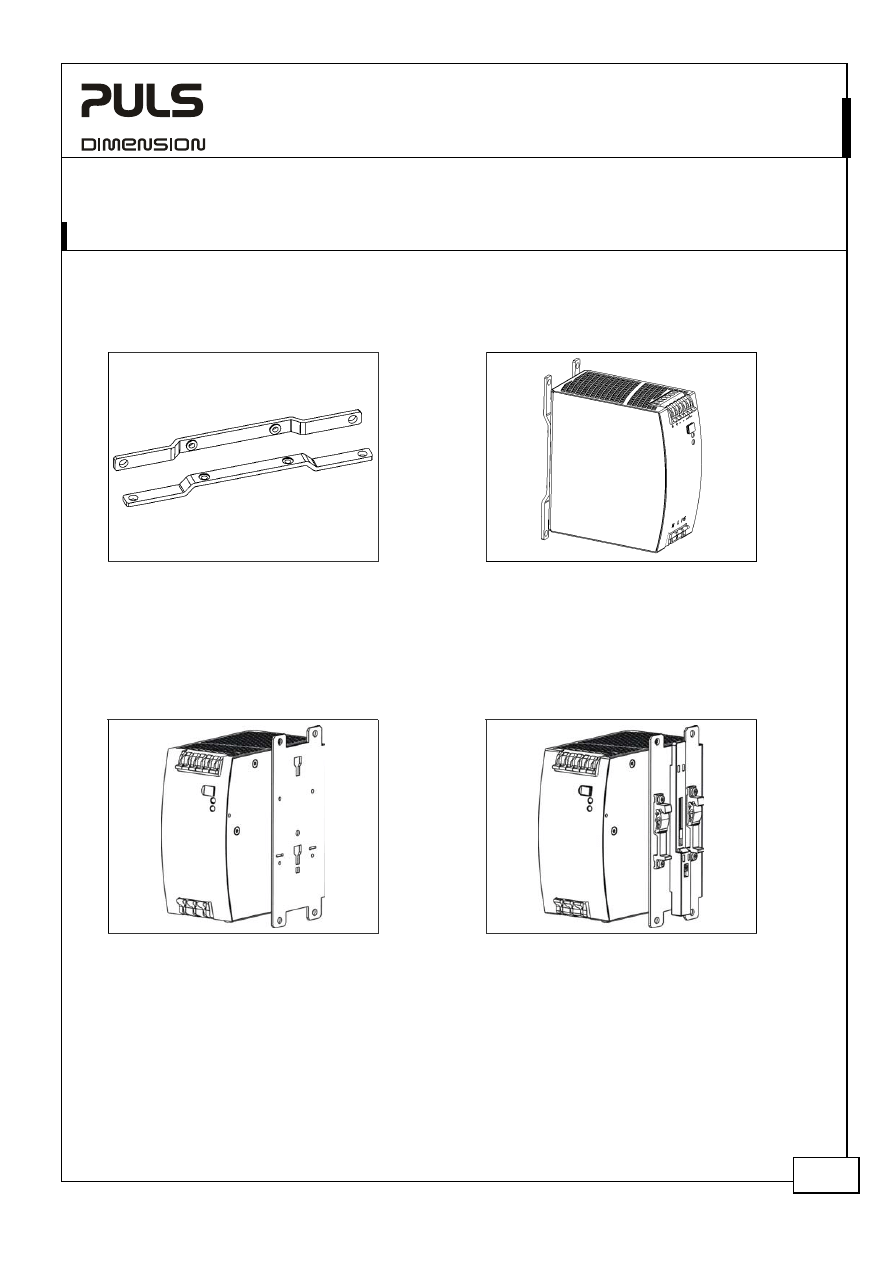
ZM1.WALL Wall mounting bracket
This bracket is used to mount Dimension units onto a flat surface without utilizing a DIN-Rail. The two aluminum
brackets and the black plastic slider of the unit have to be detached, so that the two steel brackets can be mounted.
Fig. 25-1 ZM1.WALL Wall Mounting Bracket
Fig. 25-2 Assembled Wall Mounting Bracket
ZM13.SIDE Side mounting bracket
This bracket is used to mount Dimension units sideways with or without utilizing a DIN-Rail. The two aluminum
brackets and the black plastic slider of the unit have to be detached, so that the steel brackets can be mounted.
For sideway DIN-rail mounting, the removed aluminum brackets and the black plastic slider need to be mounted on
the steel bracket.
Fig. 25-3 ZM13.SIDE Side Mounting Bracket
Fig. 25-4 Side Mounting with DIN-rail brackets
CS10.244
C–Series
24V, 10A, S
INGLE
P
HASE
I
NPUT
Sept. 2006 / Rev. 1.0 DS-CS10.244-EN / All parameters are specified at 24V, 10A, 230Vac and 25°C ambient unless otherwise noted.
www.pulspower.com Phone +49 89 9278 0 Germany
17/21
26. A
PPLICATION
N
OTES
26.1. P
EAK
C
URRENT
C
APABILITY
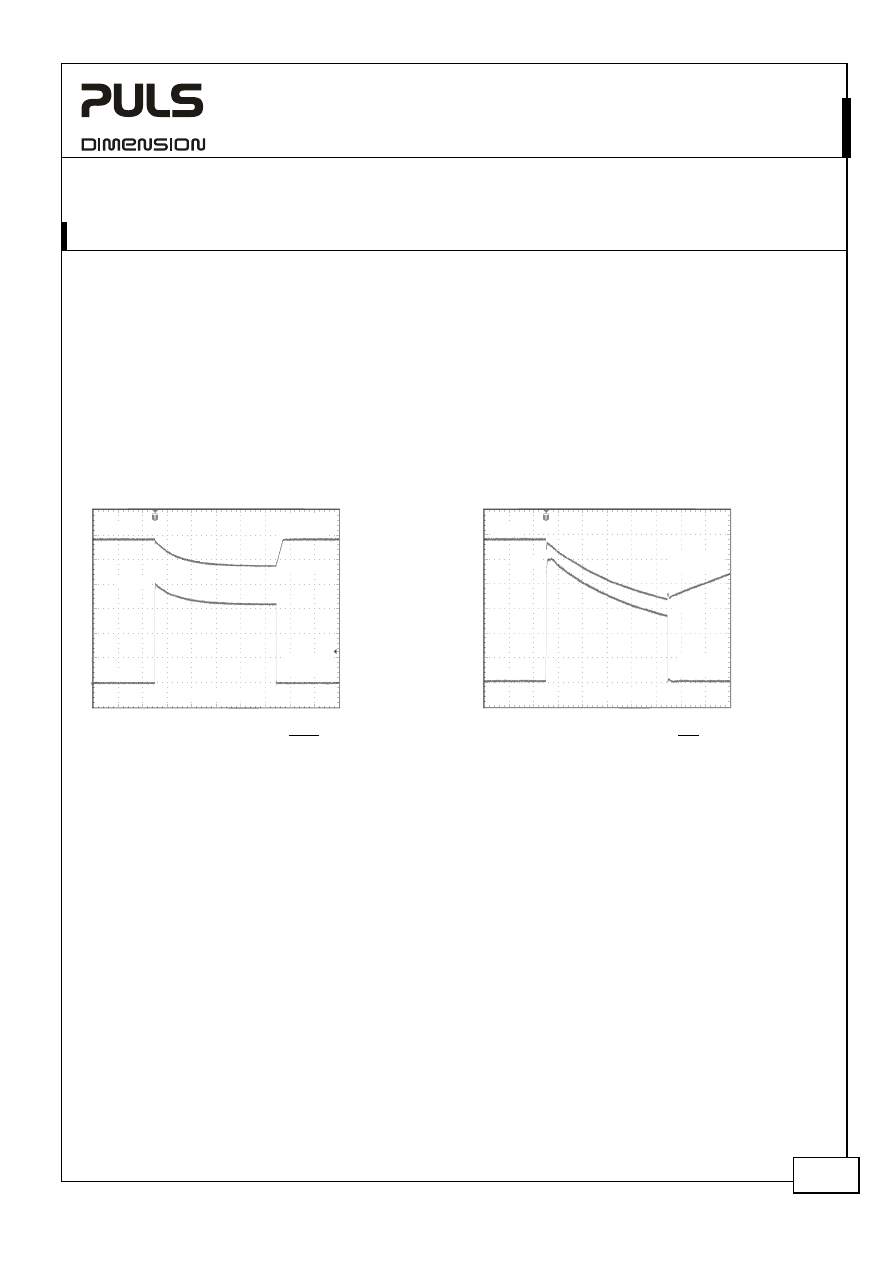
Solenoids, contactors and pneumatic modules often have a steady state coil and a pick-up coil. The inrush current
demand of the pick-up coil is several times higher than the steady state current and usually exceeds the nominal
output current (including the PowerBoost) The same situation applies, when starting a capacitive load.
Branch circuits are often protected with circuit breakers or fuses. In case of a short or an overload in the branch
circuit, the fuse needs a certain amount of over-current to trip or to blow. The peak current capability ensures the
safe operation of subsequent circuit breakers.
Assuming the input voltage is turned on before such an event, the built-in large sized output capacitors inside the
power supply can deliver extra current. Discharging this capacitor causes a voltage dip on the output. The following
two examples show typical voltage dips:
Fig. 26-1 Peak load 20A for 50ms, typ.
Fig. 26-2 Peak load 50A for 5ms, typ.
10ms/DIV
Output
Voltage
Output
Current
24V
0A
20A
18.5V
1ms/DIV
Output
Voltage
Output
Current
24V
0A
50A
12V
Peak load 20A (resistive) for 50ms
Output voltage dips from 24V to 18.5V.
Peak load 50A (resistive) for 5ms
Output voltage dips from 24V to 12V.
26.2. C
HARGING OF
B
ATTERIES
The power supply shall not be used to charge batteries. Choose Q-Series for charging batteries.
CS10.244
C–Series
24V, 10A, S
INGLE
P
HASE
I
NPUT
Sept. 2006 / Rev. 1.0 DS-CS10.244-EN / All parameters are specified at 24V, 10A, 230Vac and 25°C ambient unless otherwise noted.
www.pulspower.com Phone +49 89 9278 0 Germany
18/21
26.3. B
ACK
-
FEEDING
L
OADS
Loads such as decelerating motors and inductors can feed voltage back to the power supply. This feature is also called
return voltage immunity or resistance against Back- E.M.F. (Electro Magnetic Force).
This power supply is resistant and does not show malfunctioning when a load feeds back voltage to the power
supply. It does not matter, whether the power supply is on or off.
The maximum allowed feed back voltage is 35Vdc. The absorbing energy can be calculated according to the built-in
large sized output capacitor which is specified in chapter 9.
26.4. O
UTPUT
C
IRCUIT
B
REAKERS
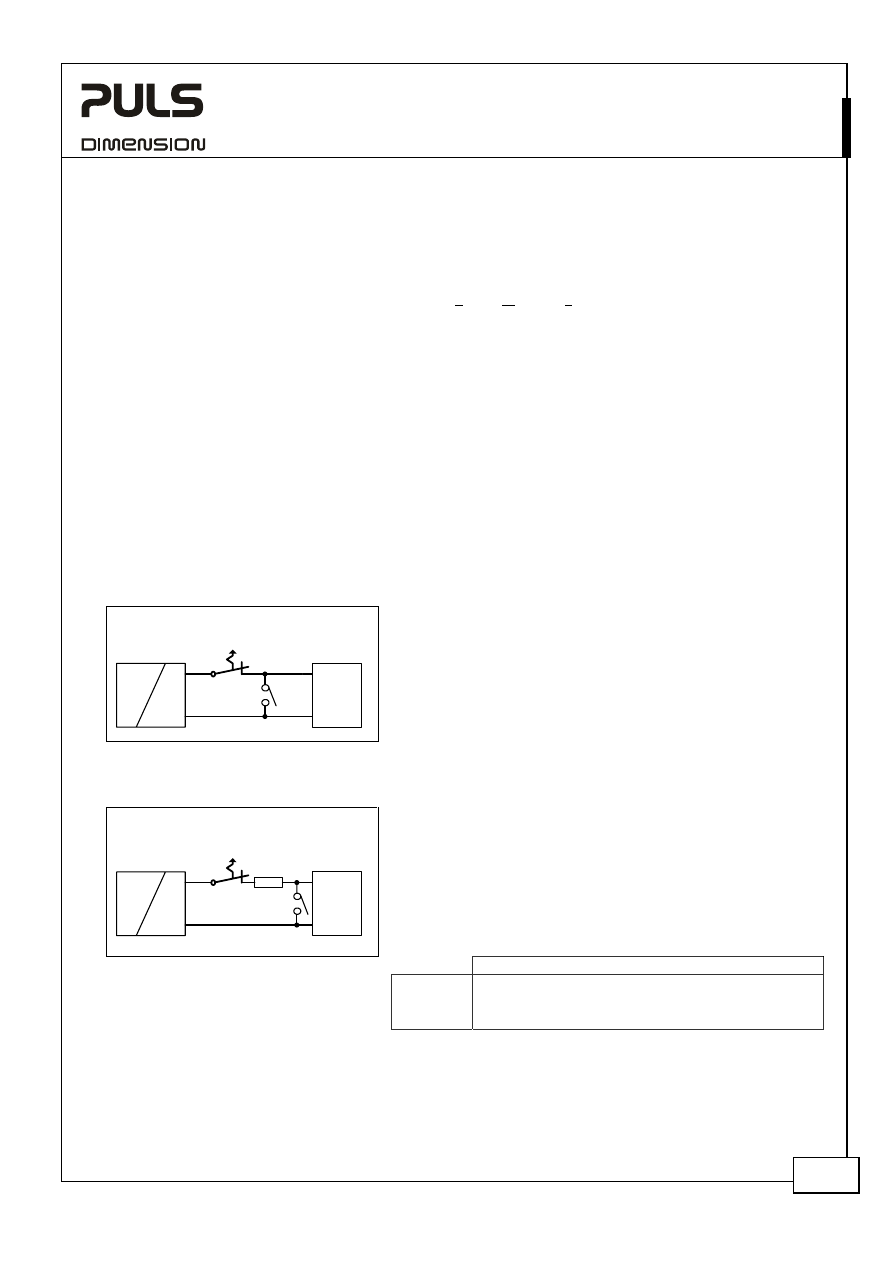
Standard miniature circuit breakers (MCBs) can be used for branch protection. Ensure that the MCB is rated for DC
voltage, too. The following tests show which circuit breakers the power supply typically trips.
Circuit breakers have huge tolerances in their tripping behavior. Therefore, these typical tests can only be used as a
recommendation or for comparing two different power supplies. Furthermore, the loop impedance has a major
influence on whether a breaker trips or not. Two tests were performed, representing typical situations:
Test 1: Short circuit with S1 on the power supply end of the cable (loop impedance approx. 20mOhm)
Fig. 26-3 Branch protectors, test circuit 1
Circuit
Breaker
Power
Supply
AC
DC
+
-
I
Load
+
-
S1
Parameters:
Input voltage:
230Vac, load current:
0A
The following circuit breaker tripped during the test:
A- or Z- Characteristic:: equal or smaller 25A
B- Characteristic:
equal or smaller 16A
C- Characteristic:
equal or smaller 13A
Test 2: Short circuit with S1 on the load end (additional impedance included; represents longer load wire length).
Fig. 26-4 Branch protectors, test circuit 2
R
Circuit
Breaker
Power
Supply
AC
DC
+
-
I
S1
Load
+
-
Parameters:
Input voltage:
230Vac, load current:
0A
The following circuit breaker tripped during the test:
A- or Z- Characteristic::
≤ 16A and R= 82mOhm
B- Characteristic:
≤ 6A and R= 180mOhm
C- Characteristic:
≤ 4A and R= 220mOhm
What does this resistance mean in wire length?
0.5mm
2
0.7mm
2
1.0mm
2
1.5mm
2
2.5mm
2
4.0mm
2
82mOhm
2.3m 3.2m 4.6m 6.9m 11.4m
18.3m
180mOhm
5.0m 7.0m 10.0m 15.0m 25.1m 40.1m
220mOhm
6.1m 8.6m 12.3m 18.4m 30.6m 49.0m
Example:
Which wire gauge must be used to trip a B-Characteristic circuit breaker with a rating of 6A? The load wire length is
21m.
Answer: A 6A B-Characteristic circuit breaker requires a loop impedance of less than 180mOhm (test results). The wire
length table shows that up to 25.1m wire with a cross section of 2.5mm
2
are below 180mOhm. A wire not smaller
than 2.5mm
2
shall be used.
CS10.244
C–Series
24V, 10A, S
INGLE
P
HASE
I
NPUT
Sept. 2006 / Rev. 1.0 DS-CS10.244-EN / All parameters are specified at 24V, 10A, 230Vac and 25°C ambient unless otherwise noted.
www.pulspower.com Phone +49 89 9278 0 Germany
19/21
26.5. I
NDUCTIVE AND
C
APACITIVE
L
OADS
The unit is designed to supply any kind of load, including unlimited capacitive and inductive loads.
26.6. S
ERIES
O
PERATION
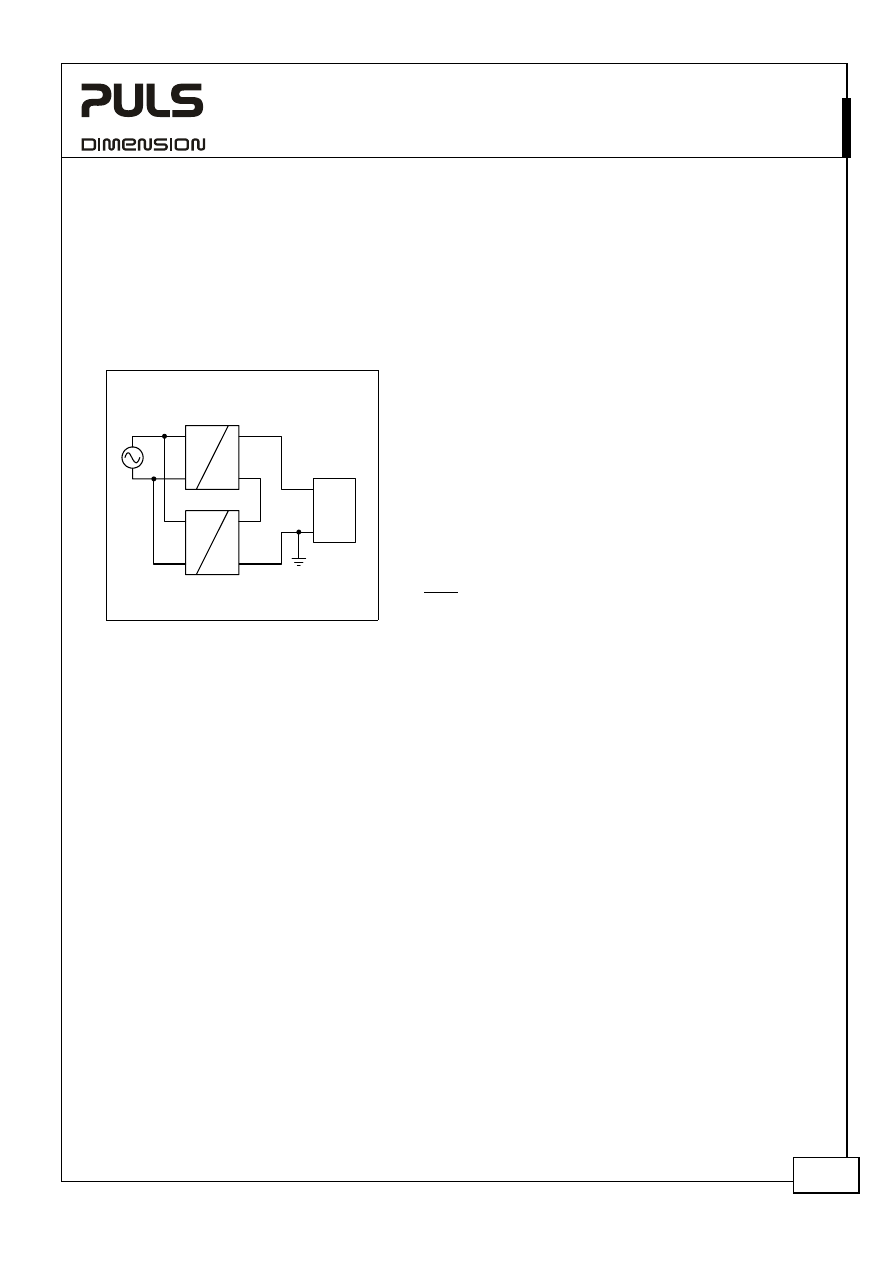
The power supply can be put in series to increase the output voltage.
Fig. 26-5 Schematic for series operation
Instructions for use in series:
Earth
Unit A
AC
DC
Unit B
AC
DC
-
+
-
+
Load
+
-
a)
It is possible to connect as many units in series as needed,
providing the sum of the output voltage does not exceed
150Vdc.
b)
Voltages with a potential above 60Vdc are not SELV any
more and can be dangerous. Such voltages must be installed
with a protection against touching.
c)
For serial operation use power supplies of the same type.
d)
Earthing of the output is required when the sum of the
output voltage is above 60Vdc.
e)
Keep an installation clearance of 15mm (left/right) between
two power supplies and avoid installing the power supplies
on top of each other.
Note: Avoid return voltage (e.g. from a decelerating motor or
battery) which is applied to the output terminals.
26.7. P
ARALLEL
U
SE TO
I
NCREASE
O
UTPUT
P
OWER
The power supply shall not be used in parallel to increase the output power.
26.8. P
ARALLEL
U
SE FOR
1+1 R
EDUNDANCY
Power supplies can be paralleled for 1+1 redundancy to gain a higher system availability. Redundant systems require
a certain amount of extra power to support the load in case one power supply unit fails. The simplest way is to put
two C-Series power supplies in parallel. In case one power supply unit fails, the other one is automatically able to
support the load current without any interruption. This simple way to build a redundant system has two major
disadvantages:
-
The faulty power supply can not be recognized. The green LED will still be on since it is reverse-powered from
the other power supply.
-
It does not cover failures such as an internal short circuit in the secondary side of the power supply. In such a -
virtually nearly impossible - case, the defective unit becomes a load for the other power supplies and the output
voltage can not be maintained any more.
This can only be avoided by utilizing decoupling diodes which are included in the decoupling module YR2.DIODE or
redundancy module YRM2.DIODE.
Recommendations for building redundant power systems:
a)
Use separate input fuses for each power supply.
b)
Monitor the individual power supply units. A DC-ok lamp and a DC-ok contact is included in the redundancy
module YRM2.DIODE. This feature reports a faulty unit.
c)
When possible, connect each power supply to different phases or circuits.
CS10.244
C–Series
24V, 10A, S
INGLE
P
HASE
I
NPUT
Sept. 2006 / Rev. 1.0 DS-CS10.244-EN / All parameters are specified at 24V, 10A, 230Vac and 25°C ambient unless otherwise noted.
www.pulspower.com Phone +49 89 9278 0 Germany
20/21
26.9. E
XTERNAL
I
NPUT
P
ROTECTION
The unit is tested and approved for branch circuits up to 20A. External protection is only required if the supplying
branch has an ampacity greater than this. In some countries local regulations might apply. Check also local codes and
local requirements.
If an external fuse is necessary or utilized, a minimum value is required to avoid undesired tripping of the fuse.
B-Characteristic
C-Characteristic
Ampacity max.
20A 20A
min.
10A 6A
26.10. O
PERATION ON
T
WO
P
HASES
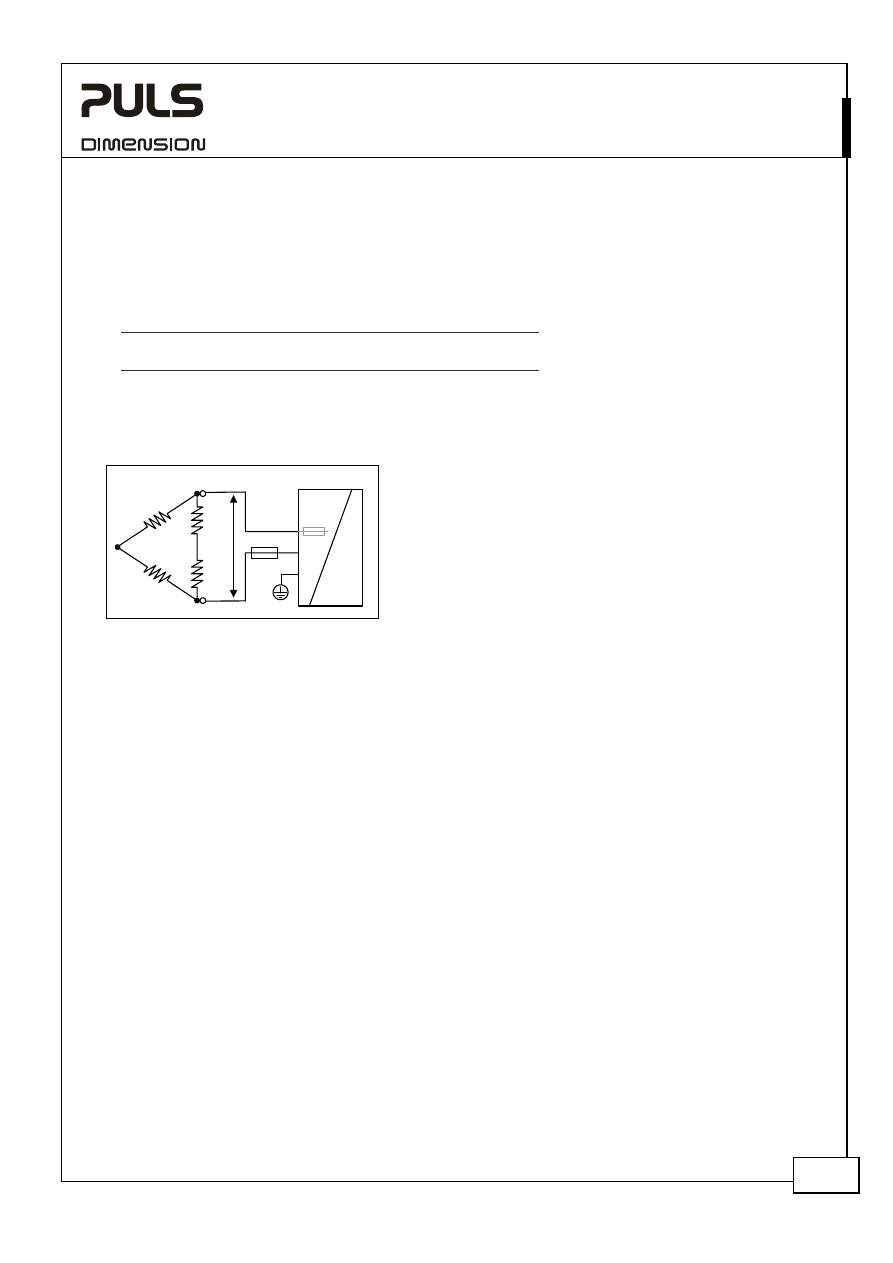
Fig. 26-6 Schematic for two phase operation
240V
+
10%
ma
x.
Fuse
L2
L1
L3
L
N
PE
Power Supply
AC
DC
internal
fused
Instructions for two phase operation:
a)
A phase to phase connection is allowed as long as the
supplying voltage is below 240V
+10%
.
b)
Use a fuse or a circuit breaker to protect the N input. The
N input is internally not protected and is in this case
connected to a hot wire.
Appropriate fuses or circuit breakers are specified in section 26.9
“External Input Protection”.
26.11. U
SE IN A
T
IGHTLY
S
EALED
E
NCLOSURE
When the power supply is installed in a tightly sealed enclosure, the temperature inside the enclosure will be higher
than outside. The inside temperature defines the ambient temperature for the power supply.
Results from such an installation:
Power supply is placed in the middle of the box, no other heat producer inside the box
Enclosure:
Rittal Type IP66 Box PK 9519 100, plastic, 180x180x165mm
Load:
24V, 8A; (=80%) load is placed outside the box
Input:
230Vac
Temperature inside the box:
49.7°C (in the middle of the right side of the power supply with a distance of 2cm)
Temperature outside the box:
23.0°C
Temperature rise:
26.7K
CS10.244
C–Series
24V, 10A, S
INGLE
P
HASE
I
NPUT
Sept. 2006 / Rev. 1.0 DS-CS10.244-EN / All parameters are specified at 24V, 10A, 230Vac and 25°C ambient unless otherwise noted.
www.pulspower.com Phone +49 89 9278 0 Germany
21/21
26.12. M
OUNTING
O
RIENTATIONS
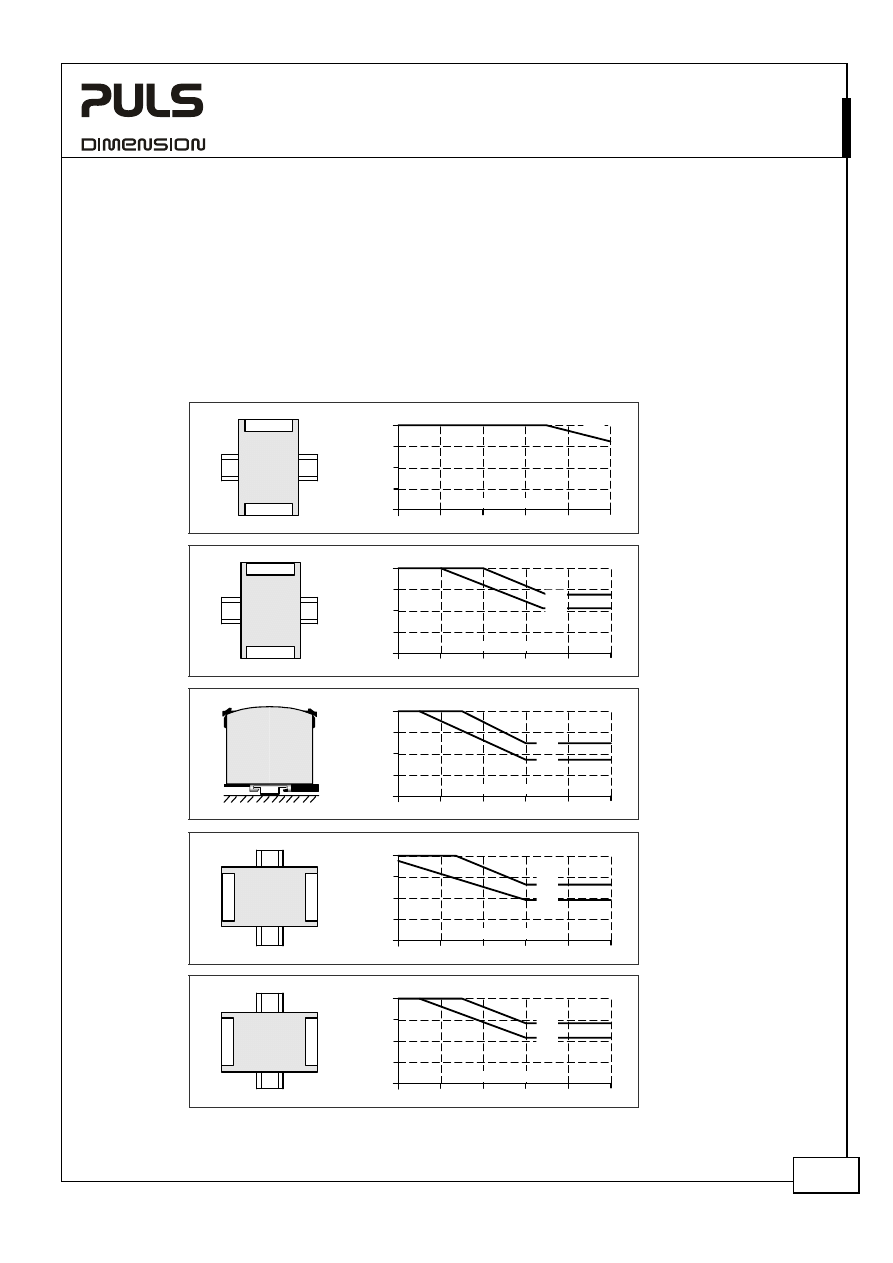
Mounting orientations other than input terminals on the bottom and output on the top require a reduction in
continuous output power or a limitation in the max. allowed ambient temperature. The amount of reduction
influences the lifetime expectancy of the power supply. Therefore, two different derating curves for continuous
operation can be found below:
Curve A1
Recommended output current.
Curve A2
Max allowed output current (results approx. in half the lifetime expectancy of A1).
Fig. 26-7
Mounting
Orientation A
Standard
Orientation
Power
Supply
OUTPUT
INPUT
Output Current
0
10
20
30
40
60°C
3
9
9
12A
50
A1
Ambient Temperature
Fig. 26-8
Mounting
Orientation B
(Upside down)
Pow
er
Suppl
y
OUTP
UT
INPU
T
Output Current
0
10
20
30
40
60°C
3
6
9
12A
50
A2
Ambient Temperature
A1
Fig. 26-9
Mounting
Orientation C
(Table-top
mounting)
Output Current
0
10
20
30
40
60°C
3
6
9
12A
50
Ambient Temperature
A1
A2
Fig. 26-10
Mounting
Orientation D
(Horizontal cw)
Po
w
er
S
uppl
y
OUT
P
UT
INP
U
T
Output Current
0
10
20
30
40
60°C
3
6
9
12A
50
Ambient Temperature
A1
A2
Fig. 26-11
Mounting
Orientation E
(Horizontal ccw)
Po
w
er
S
uppl
y
OUT
P
UT
INP
U
T
Output Current
0
10
20
30
40
60°C
3
6
9
12A
50
Ambient Temperature
A1
A2
Wyszukiwarka
Podobne podstrony:
Datasheet QS20 244
Datasheet CS10 481
Datasheet CS5 244
Datasheet CS10 241
Datasheet CS10 242
Datasheet CS10 243
Datasheet SL4 100
Datasheet QS10 241 C1
Datasheet YR2 DIODE
pdf datasheet 5 id 352824 Nieznany
244
Truskawkowe ślimaczki, 244 przepisy (naleśniki, ciasteczka, pączki, hrusty, racuchy, przepisy mączne
więcej podobnych podstron