AOL TIME WARNER, INC.
Asia
Ewa
Konrad
Michał
Presentation plan
The idea behind the merger
New Economy – America Online
Company history & Business model
Old Economy – Time Warner
Company history & Business model
The Merger
Antitrust concerns
Synergies & Possible benefits
Would the merger work?

Convergence of
the „old” & „new” economies?
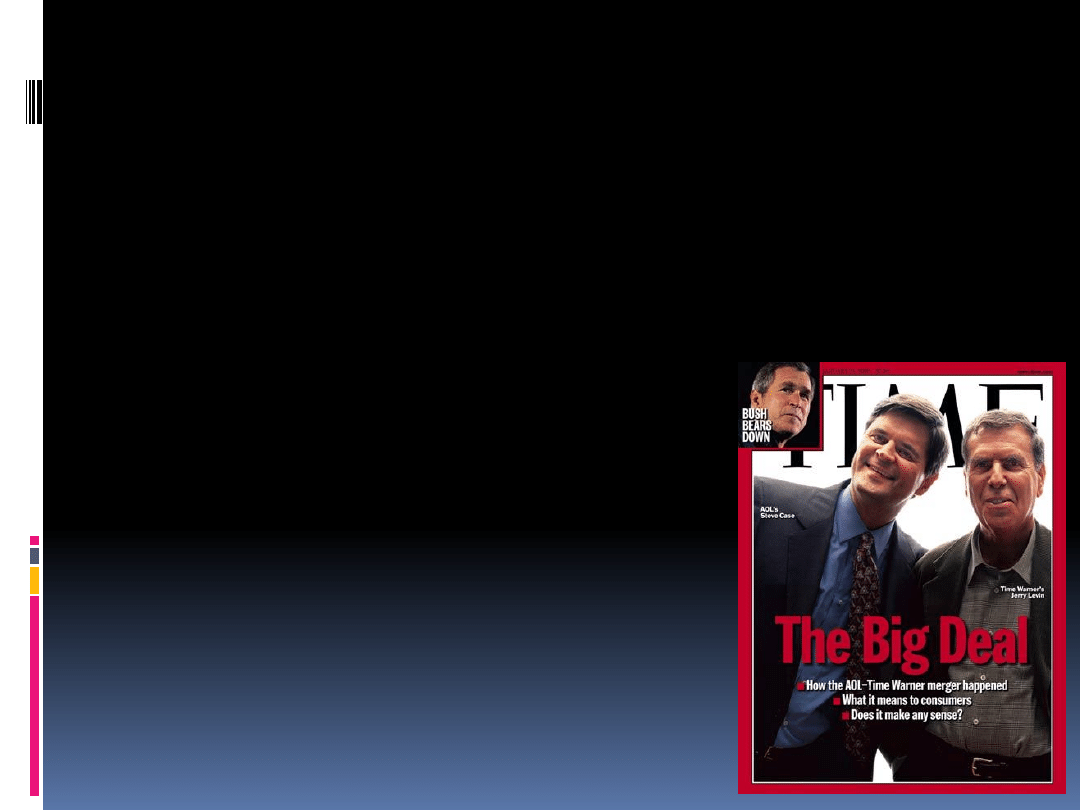
10.01.2000 – merger announcement by America
Online (AOL) and Time Warner
11.01.2000 – merger completion
Stock price:
AOL: $73,75 $72,63
Time Warner: $64,75 $92
All-stock combination worth $350 billion
Strategic merger of equals to create the world’s
first fully integrated media and communications
company for the Internet Century

Promise of multiple synergies…
Would you believe it?
Creation of
unparalleled resources
of creative and
journalistic talent,
technology assets,
expertise and
management
experience
Management
differences
Culture clashes
AOL adding $110
billion in „old economy
assets, risking slower
growth

We’re kicking off the new Internet Century with
a unique company with unparalleled assets
and unprecedented ability to accelerate the
next Internet revolution.
– Steve Case, Chairman, AOL Time Warner

New Economy:
America Online, Inc.
1985 – Quantum Computer Services co-founded
by Steve Case
1989 – AOL rebranding
1996 – falling stock, low member retention rates
Robert Pittman – the „white knight”
1999 – acquisition of 4 companies:
Netscape Communications Corporation (browser
software to replace Microsoft Internet Explorer)
MovieFone
2 Internet music companies (Spinner Networks &
Nullsoft)

Vision
Building a global medium as central to
people’s lives as the telephone or television
and even more valuable
Developing a mass market for interactive
services and content
Unique people & culture:
Fearless, always hungry, demanding the new
Intense work ethic, team effort, unification
Millionaires with modest salaries

Business Model
Flagship product – convenient and easy-to-use
package of online and interactive services
Doing the everyday things online instead of offline
More than 30 million users worldwide, daily volume of
194 million e-mails, 245 million stock quotes, 11 billion
Web URLs, 656 million instant messages
Accessible by high-speed or dial-up connections from
anywhere in the world
Various pricing plans

Hallmarks
Easy-to-use design
Intuitive navigation (keywords, Buddy List,
content organized in channels)
E-commerce: Partnerships with companies like
eBay („walled garden”, controlling customers),
Shopping Channel
Personalization (welcome screen with a personal
portfolio)
Interactive community (chat rooms, instant
messaging, bulletin boards, e-mail…)
AOL Anywhere (tv, telephone, wireless devices)

AOL in 2000
4 divisions:
Interactive Services Group
Interactive Properties Group
AOL International
Netscape Enterprise
$7.7 billion in consolidated revenues (that more than
doubled in two years)
More than 30 million subscribers worldwide
Main provider of Internet access in the United States
World’s leader in interactive services, Web brands,
Internet technologies and e-commerce services

Old Economy: Time Warner
Time Warner, Inc., founded as Time Inc. in
1922
Two mergers
1989 with Warner Communications
1996 with Turner Broadcasting Systems
World`s largest media and entertainment
company – grossed $27.3 billion in 1999

Company History
Merger with TBS added $17.5 billion in debt
to TW`s balance sheet
Goal of this merger: „(…)to create new
products for the digital age (…)”
Failed to produce envisioned synergies
TW – „series of sharp, thought, profit-
oriented companies”

Internet initiaitves
1994 – launch of Pathfinder website (free
email and search engine)
1997 – entertainment portal Go2 (never got
out of the planning stages)
1999 – second try – Entertaindom
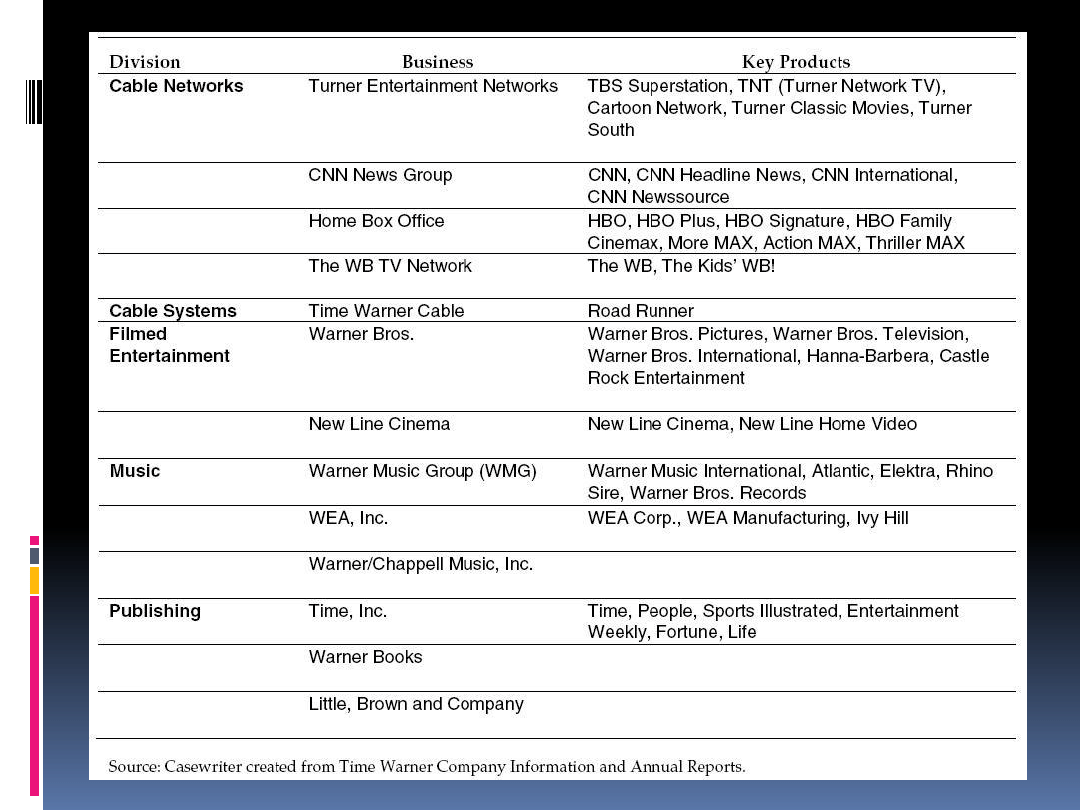

Cable Networks
Included CNN, TBS, TNT, HBO, Cartoon
Network and 50% interest in Comedy Central
HBO – most successful premium television
network in US
2000 – 35.7 million subscribers of HBO

Cable Systems
Time Warner Cable – second largest cable
operator – 6.5 million subscribers
1999 – significant increases in advertising
revenue
Since 1990 upgrading cable systems – more
channels, HD TV, video on demand, high-
speed internet, cable telephony
Filmed Entertainment
Warner Bros. and New Line Cinema composed the
Filmed Entertainment Divison at Time Warner
Time Warner had approximately 20 % of US box
office market
Matrix earned $450 million
Planned joint ventures: Harry Potter
and The Lord of the Rings

Music
Warner Music Group – diversified, vertically
integrated music company
WMG operated in 68 countries
18% – WMG`s market share in US
Introduced distribution via internet

Publishing
Highest revenue of the 25 top media
companies
More than 60 magazines, 268 million readers
Produced most popular magazines – Time,
People, Sports Illustrated
2000 – Time Inc. acquired Times Mirror
Magazines publishing 26 magazines
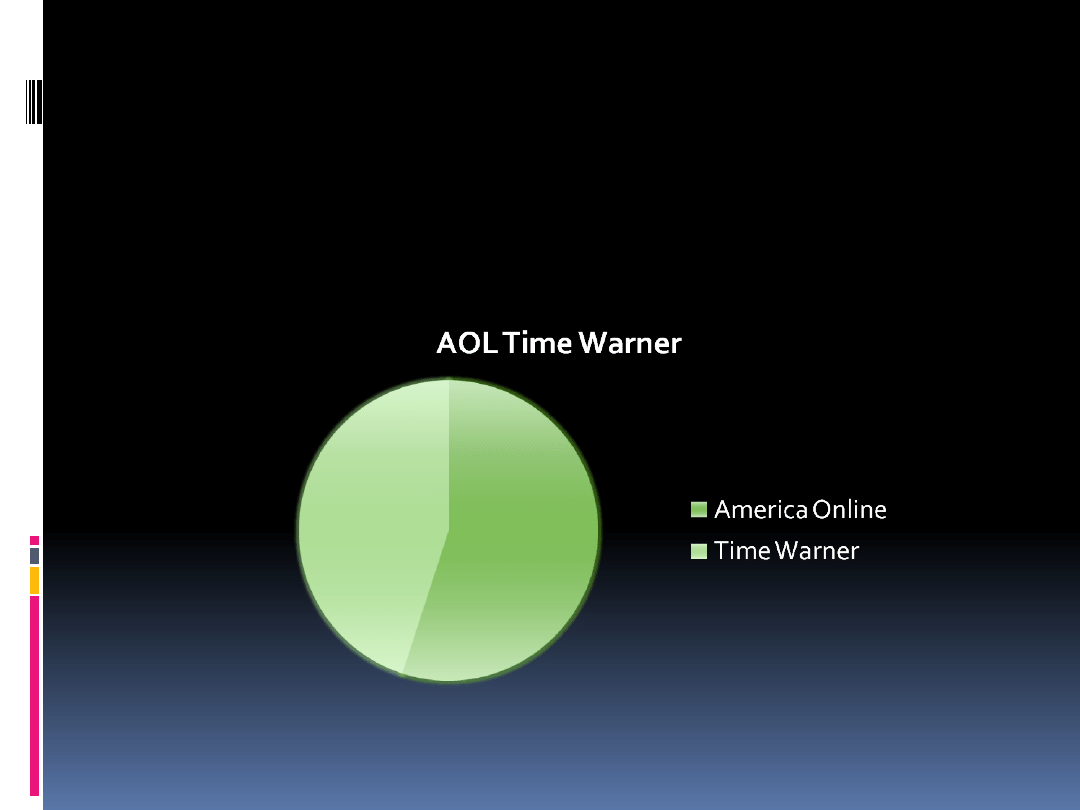
The Merger
Shareholders structure

The Merger
New trend?
Antitrust concerns
United States
Excessive size
Complaints filed to FCC and FTC
Europe
Time Warner and EMI Group PLC merger

Synergies: The Possible Benefits
Level 1
• Revenue enhancement
• Cost savings
Level 2
• Cable, Publishing, Music, Film
Level 3
• Future possibilities

Level 1 – Tactical Synergies
Revenue enhancement synergies = $400 million
Cost savings synergies = $600 million
Total = $1 billion
on
Synergies: The Possible Benefits

Level 2 – Strategic Opportunities
Synergies: The Possible Benefits
Cable
Publishing
Music
Film

Level 3 – Transformational
Future benefits
Synergies: The Possible Benefits
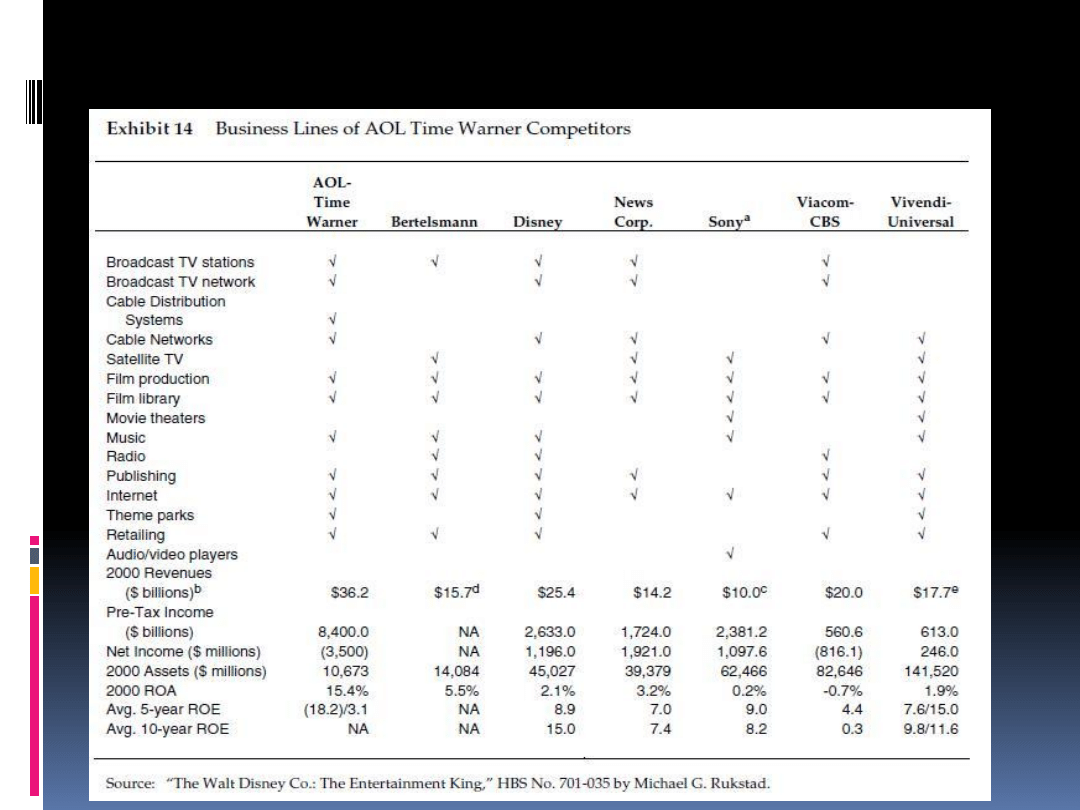
Would the Merger Work ?
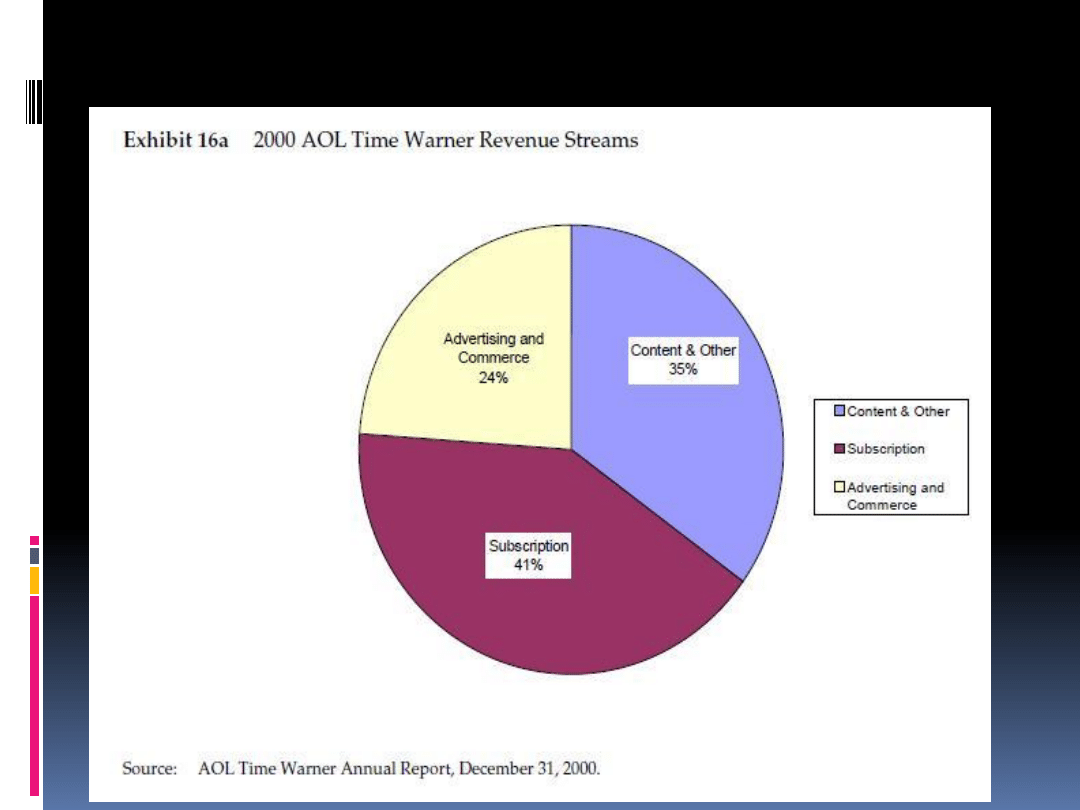
Would the Merger Work ?

How it really went ?
Short time for due diligence
Dotcom bubble -> AOL lower revenue from
advertising and commerce
Levin – Case conflict
Many expected synergies between AOL and
Time Warner never materialized
2003 – changed name back to Time Warner
2009 – AOL spin off from Time Warner

The end
Thank you for your attention
Asia
Ewa
Konrad
Michał
Wyszukiwarka
Podobne podstrony:
06 Half Time Beats
2002 06 Prime Time
Alan Dean Foster Spellsinger 06 The Time Of The Transferance
2007 06 One Time Pad czyli jednorazowa podkładka
Eleanor Cameron Mushroom Planet 06 Time and Mr Bass
Jon Scieszka Time Warp Trio 06 Tut, Tut
Rose Estes & Tom Wham Runesword 06 The Store of Time
2017 12 06 Człowiek Roku Time dla kobiet, które przerwały ciszę Do Rzeczy
06 The Easy Winners (a rag time two step)
MT st w 06
Kosci, kregoslup 28[1][1][1] 10 06 dla studentow
06 Kwestia potencjalności Aid 6191 ppt
06 Podstawy syntezy polimerówid 6357 ppt
06
06 Psych zaburz z somatoformiczne i dysocjacyjne
więcej podobnych podstron