
TS 6D – Engineering Applications of GNSS
Joël van Cranenbroeck
Core Wall Control Survey – The State of Art
7
th
FIG Regional Conference
Spatial Data Serving People: Land Governance and the Environment – Building the Capacity
Hanoi, Vietnam, 19-22 October 2009
1/19
Core Wall Control Survey - The State of Art
Joël van CRANENBROECK, Belgium
Doug HAYES, United Arab Emirates
Soang Hun OH, Kuwait
Mohammed HAIDER, United Arab Emirates
Key words: GNSS, TPS, precision inclinometer, core wall, high rise building, climbing
formwork
SUMMARY
There is today considerable interest in the construction of super high-rise and iconic
buildings. In addition to being very tall they can be quite slender and during the construction
there is a lot of movement of the building at upper levels due to wind loads, crane loads,
construction sequence and other factors.
It is essential that such straight “element” be constructed that, theoretically, moves around its
design centre point due to varying loads and if all conditions were neutral then the “element”
would stand exactly vertical. This ideal situation is rarely achieved due to differential raft
settlement, differential concrete shortening and construction tolerances.
The movement of the structure creates several problems for correct set out of control; at a
particular instant in time the surveyor need to know exactly how much the building is offset
from its design position and at the same time he must know the precise position at the
instrument location. Construction vibrations in the building and the building movement,
which makes it very difficult, if not impossible, further complicate this situation, to keep an
instrument set up level.
Leica Geosystems has developed a method using GNSS (GPS and GLONASS) observations
combined with high precision inclination sensors networked and Total Station to deliver
reliable and very precise coordinates in the design frame on the top of high rise buildings that
could also be applied to any other vertical structure like bridge pylons or dam walls.
The paper summarizes the state of the art and underlines the role and the contribution of Chief
Surveyors and Structural Engineers in charge of projects in Dubai, Kuwait and Abu Dhabi.
TS 6D – Engineering Applications of GNSS
Joël van Cranenbroeck
Core Wall Control Survey – The State of Art
7
th
FIG Regional Conference
Spatial Data Serving People: Land Governance and the Environment – Building the Capacity
Hanoi, Vietnam, 19-22 October 2009
2/19
Core Wall Control Survey - The State of Art
Joël van CRANENBROECK, Belgium
Doug HAYES, United Arab Emirates
SangHoon OH, Kuwait
Mohammed HAIDER, United Arab Emirates
1. INTRODUCTION
There is today considerable interest in the construction of super high-rise and iconic
buildings. In addition to being very tall they can be quite slender and during the construction
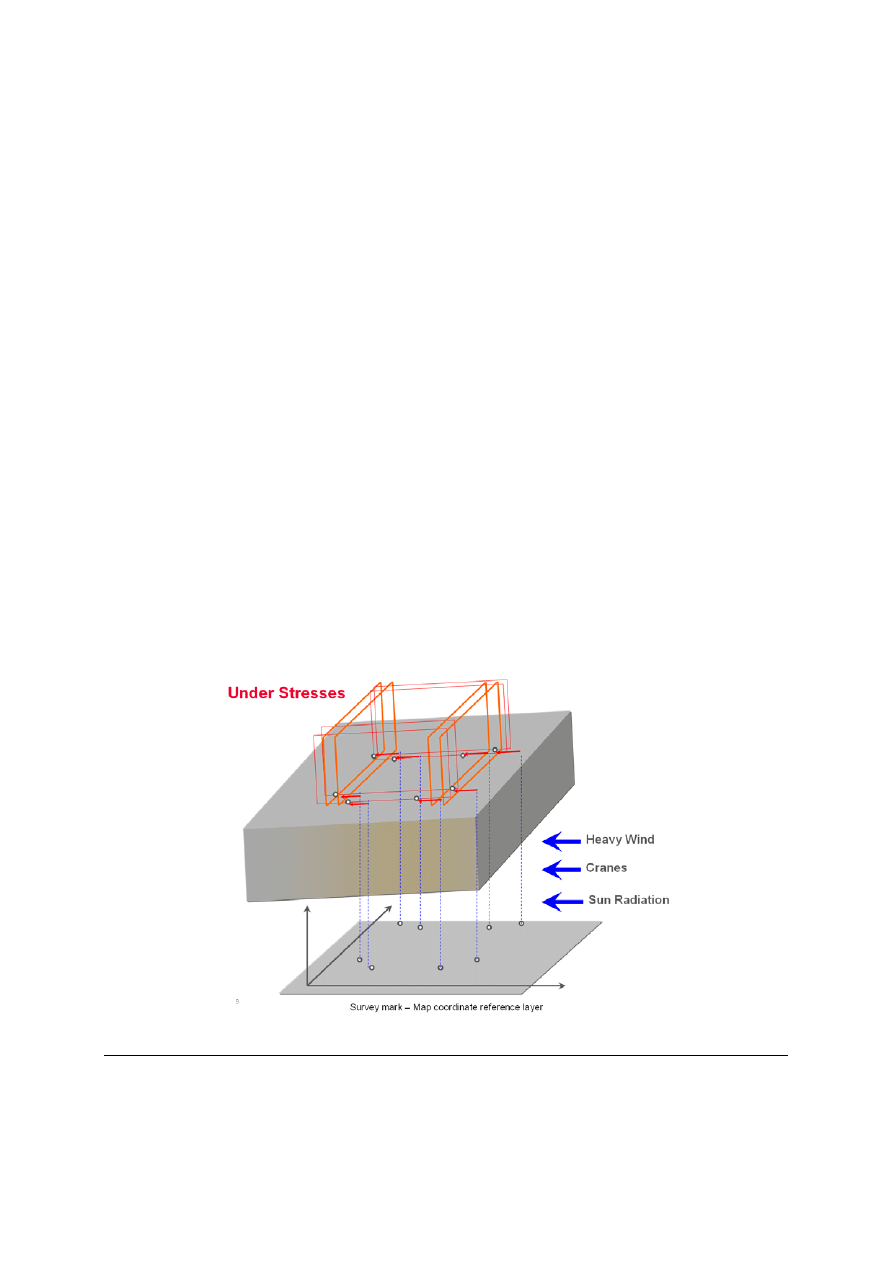
there is a lot of movement of the building at upper levels due to wind loads, crane loads,
construction sequence and other factors.
It is essential that such straight “element” be constructed that, theoretically, moves around its
design centre point due to varying loads and if all conditions were neutral then the “element”
would stand exactly vertical. This ideal situation is rarely achieved due to differential raft
settlement, differential concrete shortening and construction tolerances.
The movement of the structure creates several problems for correct set out of control; at a
particular instant in time the surveyor need to know exactly how much the building is offset
from its design position and at the same time he must know the precise position at the
instrument location. Construction vibrations in the building and the building movement,
which makes it very difficult, if not impossible, further complicate this situation, to keep an
instrument set up level.
Fig 1: schematic representation of building behavior under various stresses
TS 6D – Engineering Applications of GNSS
Joël van Cranenbroeck
Core Wall Control Survey – The State of Art
7
th
FIG Regional Conference
Spatial Data Serving People: Land Governance and the Environment – Building the Capacity
Hanoi, Vietnam, 19-22 October 2009
3/19
Leica Geosystems has developed a method using GNSS (GPS and GLONASS) observations
combined with high precision inclination sensors networked and Total Station to deliver
reliable and very precise coordinates in the design frame on the top of high rise buildings that
could also be applied to any other vertical structure like bridge pylons or dam walls.
1.1 Objective
The objective of the method is to deliver precise and reliable coordinates referred in the
design frame where the construction has been designed and projected that are not influenced
by building movements. Those coordinates are used to control the position of the climbing
formwork systems located at the top of any vertical structure like a tall building in
construction.
1.2 Concept
Leica Geosystems is proposing a combination of GNSS receivers, Total Station and very
precise inclination sensors networked along the main axis of the structure.
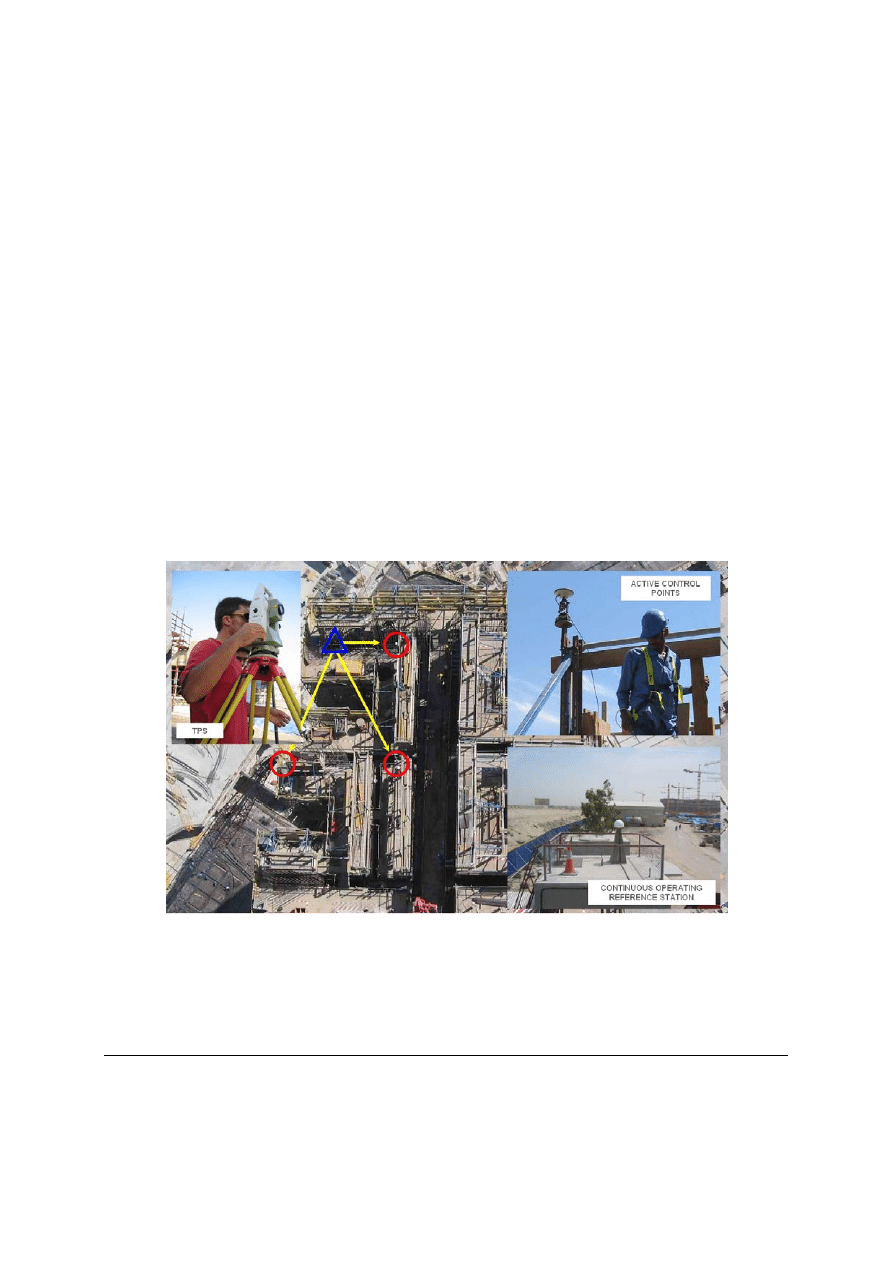
Three to four GNSS antennas collocated with 360° reflectors and a Total Station will be used
to determine the precise coordinates of control points that are established on the concrete for
each section of the formwork.
Fig 2: the TPS and GNSS components for coordinate’s determination
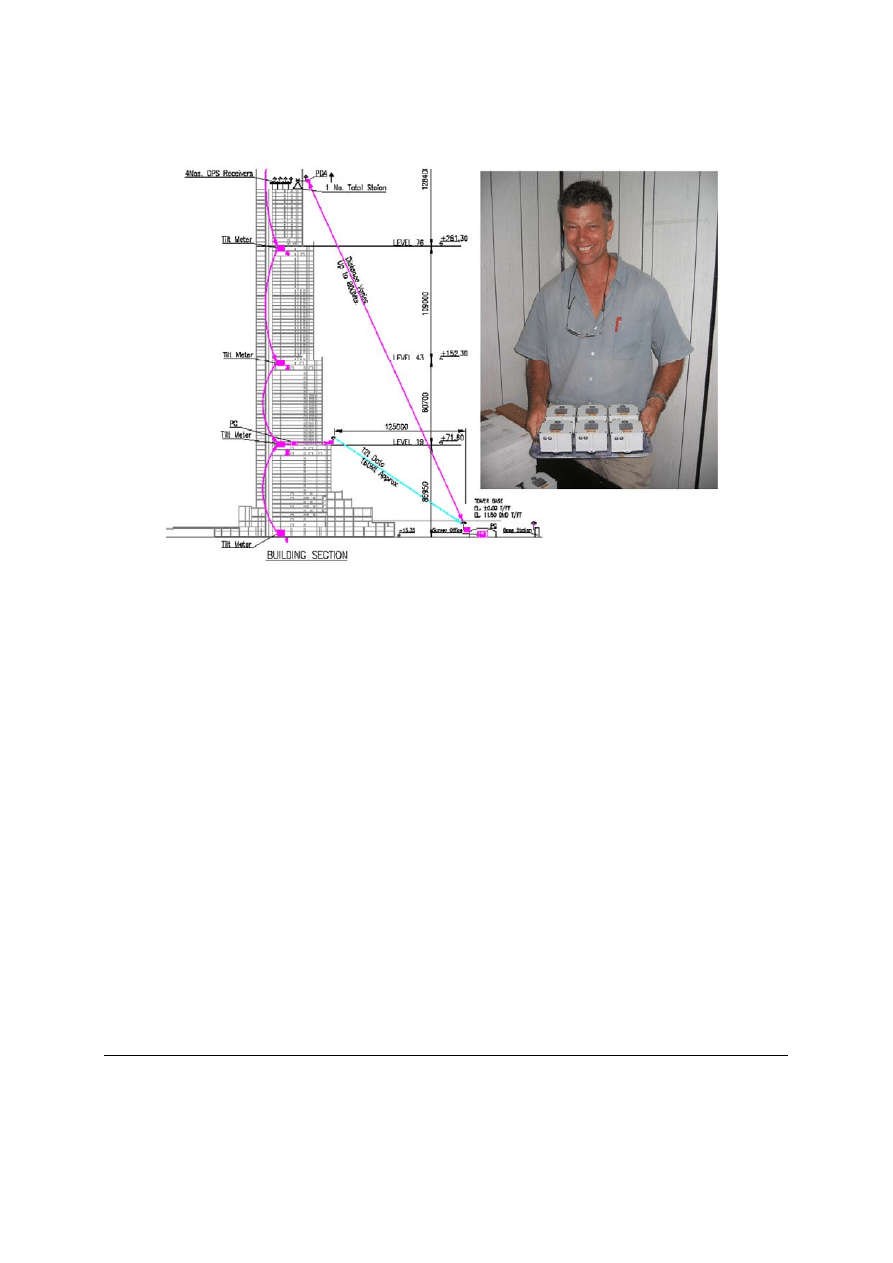
The inclination sensors will measure the exact amount in
Δx and Δy that the building is offset
from its vertical position and applied as corrections to the coordinates of the control points.
TS 6D – Engineering Applications of GNSS
Joël van Cranenbroeck
Core Wall Control Survey – The State of Art
7
th
FIG Regional Conference
Spatial Data Serving People: Land Governance and the Environment – Building the Capacity
Hanoi, Vietnam, 19-22 October 2009
4/19
The resulting corrected positions will ensure that the building is constructed as straight
element regardless of the movement of the building due to various sources of stresses.
Fig 3: example of designing a Leica NIVEL200 network by Doug Hayes in Dubai.
1.3 Procedure – Method Statement
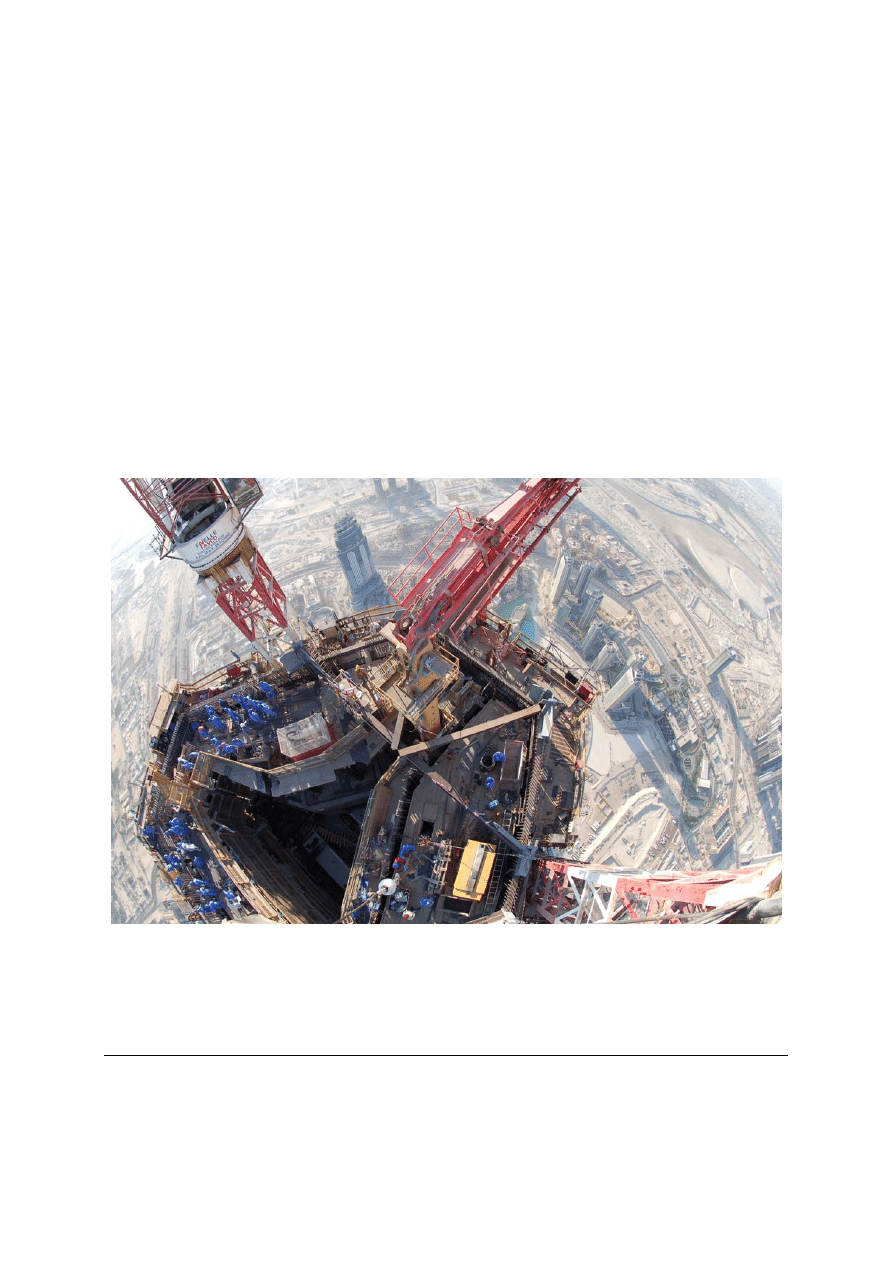
The core walls are being constructed in a sequence of several concrete pours. After each pour,
three to four GNSS antennas combined with a GNSS permanent reference station and a total
station will be set up.
The total station will observe the geometry of the GNSS antennas by measuring the angles
and distances to the 360° collocated reflectors and this information with the GNSS data will
be post-processed at the survey office or immediately on site in real time and the resulting
coordinates transferred to the total station to update its coordinates and orientation.
Inclinations sensors will be installed at ground level and about every given number level
above. The information from the inclinations sensors is logged at the survey office and used
to adapt the coordinates of the total station to the “design” coordinates system.
The total station then observes the control points (nails set in the top of the concrete) to derive
the corrections to be applied on the formwork structure. These coordinates are in relation to a
continuous line of the building as defined by the control lines and therefore when the points
are used to set the formwork for the next pour, the construction progresses as a straight
element regardless of building movement.
TS 6D – Engineering Applications of GNSS
Joël van Cranenbroeck
Core Wall Control Survey – The State of Art
7
th
FIG Regional Conference
Spatial Data Serving People: Land Governance and the Environment – Building the Capacity
Hanoi, Vietnam, 19-22 October 2009
5/19
1.4 Benefits
The real gain is that the surveyor is able to continue to set control – even when the building
has moved “off centre” – confident that he will construct a straight concrete structure.
With the inclinations sensors installed at every given number level and operating
continuously, he will also obtain precise information about the building movement.
The analysis will be able to isolate factors such as wind load, crane loads, raft slab
deformation and also relate movement to the construction sequence. This information will be
of great benefit in explaining to the client what is actually happening to the structure and if
there is a trend in any one direction it can be identified and an RFI submitted for a correction
based on reliable data obtained over a long period of time.
Another advantage is that the surveyor will be able to get precise positions at the top of the
formwork without the need to sight to external control marks, which will increasingly become
difficult to observe.
TS 6D – Engineering Applications of GNSS
Joël van Cranenbroeck
Core Wall Control Survey – The State of Art
7
th
FIG Regional Conference
Spatial Data Serving People: Land Governance and the Environment – Building the Capacity
Hanoi, Vietnam, 19-22 October 2009
6/19
The control surveys will be completed in a shorter space of time which improves productivity
and the instruments does not need to be levelled during the survey which is an important
consideration when the building is moving or there are vibrations.
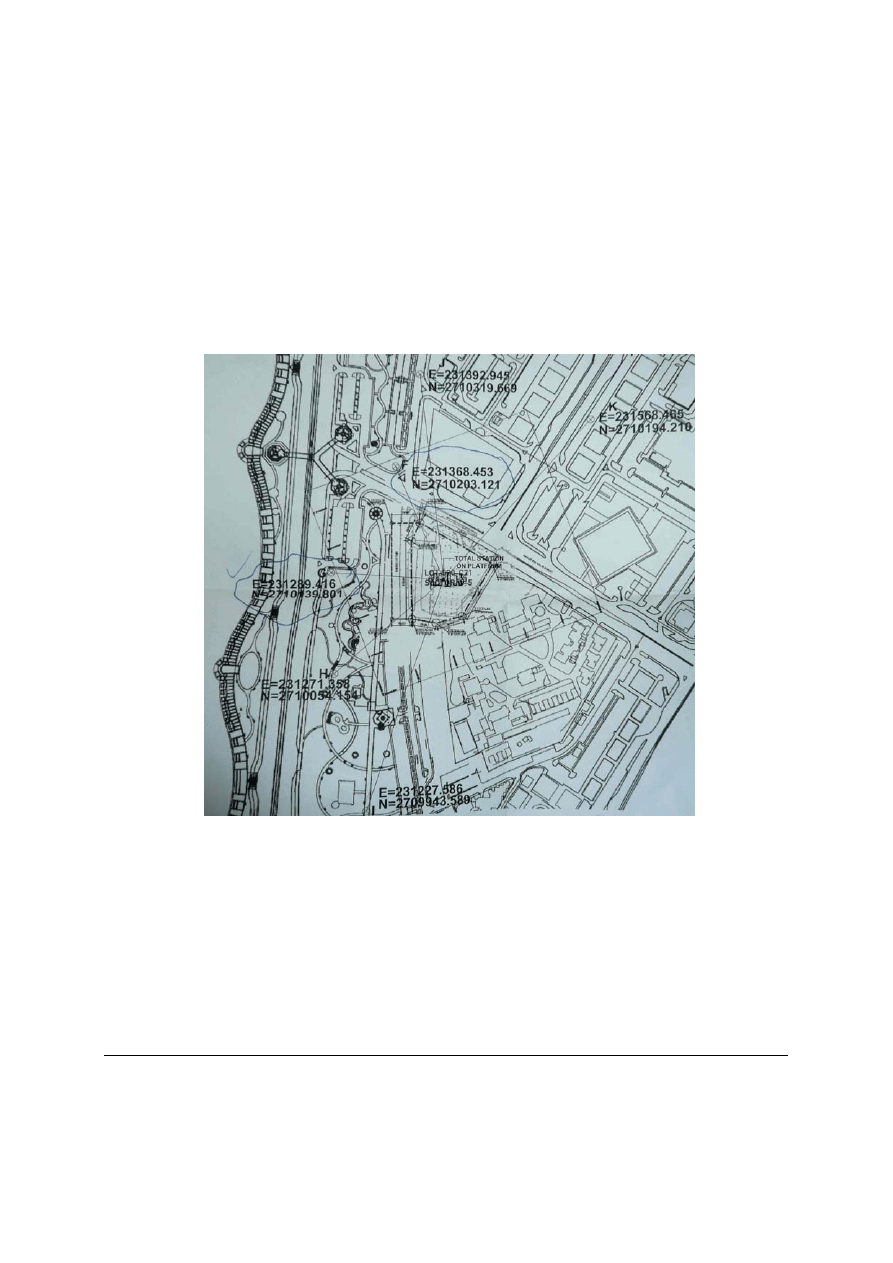
2. CONTROL GROUND SURVEY NETWORK
2.1 Definition and deployment
A network of ground control marks - that can be used to set-up a total station - around the
construction area must be established to ensure a proper coordinate frame where the design of
coordinates of the building will be referred to.
Fig 4: example of control ground survey network
The marks that materialized this network must be properly anchored on the ground. During all
the construction process those marks will be protected and re-surveyed regularly to ensure
that the coordinates derived from surveying operations are still referred to them.
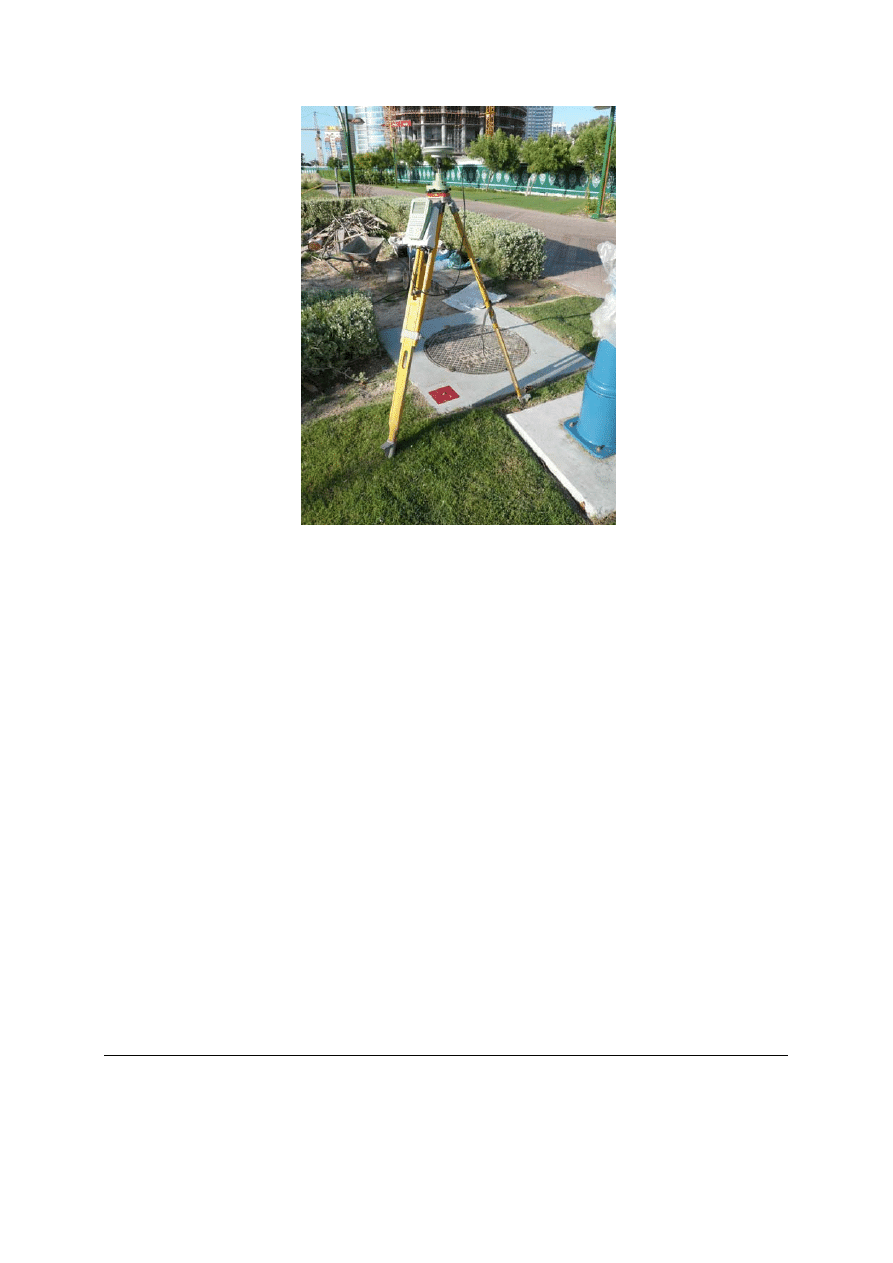
GNSS can be advantageously used to survey and monitor that network.
TS 6D – Engineering Applications of GNSS
Joël van Cranenbroeck
Core Wall Control Survey – The State of Art
7
th
FIG Regional Conference
Spatial Data Serving People: Land Governance and the Environment – Building the Capacity
Hanoi, Vietnam, 19-22 October 2009
7/19
Fig 5: control point re-surveyed by GNSS receiver
2.2 Coordinates Frame
The coordinates frame is an essential part of the surveying process, as it will be used as a
reference for every surveying operation.
The coordinates will be computed by using the directions and the distances measured with a
high-grade total station and levelled by using a digital levelling instrument with invar staffs.
All observations will be process by using least squares adjustment and the statistics derived
will be reported. Not only is the accuracy important but also the reliability of the observations
and the final results. Therefore attention must be paid on the design of the network to ensure
that any outliers could be detected and corrected if any.
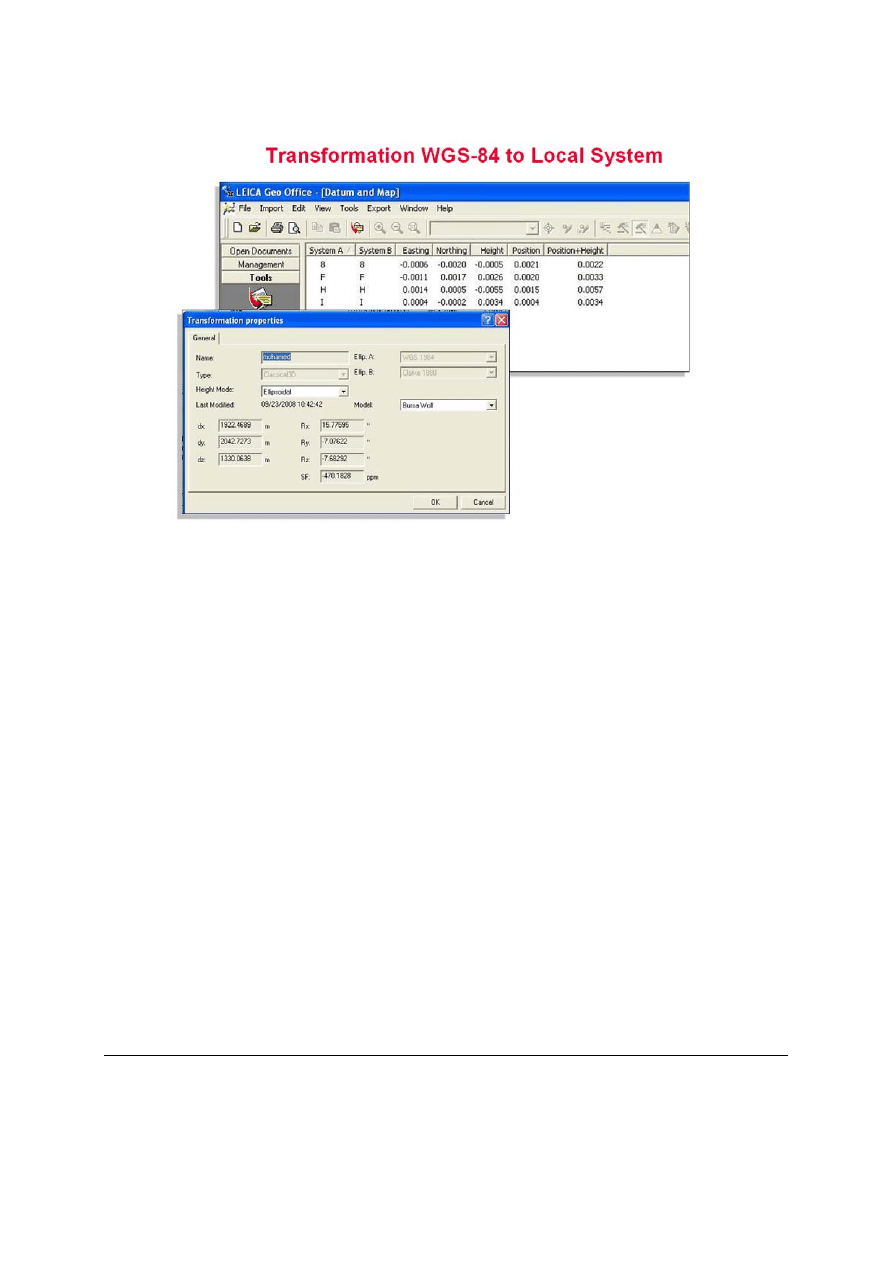
Because this coordinate frame will be used also to compute a 3D transformation to express the
GNSS coordinates (WGS) into the coordinate frame (local coordinate system), one must
ensure that the network will be extended at least the same radius than the total height of the
building. The reference level will be the one that is provided with by the geodetic control
points of the city for instance.
TS 6D – Engineering Applications of GNSS
Joël van Cranenbroeck
Core Wall Control Survey – The State of Art
7
th
FIG Regional Conference
Spatial Data Serving People: Land Governance and the Environment – Building the Capacity
Hanoi, Vietnam, 19-22 October 2009
8/19
Fig 6: Leica Geo Office – Datum and Map module
2.3 Densification on existing structures located in the neighbourhood
The ground control marks are used to set-up the total station and to propagate the coordinates
in the construction area as well as within the structure. For that reason and because of the
obstruction in the low level of the construction that could impact the use of GNSS (that needs
a line of sight from the GNSS antenna to the satellites) one advocate strongly the extension of
the coordinate’s marks network on buildings around the site if any.
High precision reflectors that will be measured by the total station will materialize that
extension of the ground coordinate marks. To determine the coordinates of those reflectors the
same principles described above will be applied. When the construction will rise above the
obstructions that could limit the use of GNSS, GNSS will be used and those marks will be
incorporated in the calculation of the total station orientation and coordinates.
2.4 GNSS and gravity vertical
It is well known that GNSS is referring to an ellipsoidal normal as reference to the Z
component. Therefore a transformation must be established to transform the results obtained
by GNSS in the same local coordinates reference frame. If this transformation is limited to a
single point the difference between the gravity vertical (that could be visualized by a plumb
line) and the ellipsoid normal (deflection of the vertical) will introduce a bias that will impact
the vertical alignment of the construction.

TS 6D – Engineering Applications of GNSS
Joël van Cranenbroeck
Core Wall Control Survey – The State of Art
7
th
FIG Regional Conference
Spatial Data Serving People: Land Governance and the Environment – Building the Capacity
Hanoi, Vietnam, 19-22 October 2009
9/19
The transformation that is needed for getting GNSS to provide coordinates and orientation for
the total station will be derived by using the coordinates of the reference frame and the
coordinates obtained for the same marks with GNSS.
Again this transformation must be verified over the time to ensure that GNSS transformed
results will match the gravity vertical as the precise inclinometers will detect the tilt variations
accordingly to the gravity. A control of the GNSS coordinates transformed into the
coordinates frame will be conducted at different stage of the construction. To handle that kind
of control a network of vertical and horizontal directions combined with distances measured
at different ground marks will be measured and combined with high precision levelling.
To summarize, GNSS, TPS and the precise inclinometers must all refer to the same reference
frame where the gravity vertical is just the most sensitive component as reference for the
building’s main axis.
3. COMPONENTS OF A CORE WALL SURVEY CONTROL SYSTEM
3.1 TPS - Automatic and Reflectorless Total Station
– The Total Station is one of the major components in that method as it will provide
- by measuring the horizontal and vertical directions and the slope distance - the
way to determine the coordinates of any mark or object in the structure.
– The Total Station must be calibrated regularly to ensure proper performances. The
calibration process aims to ensure that the errors that affect the mechanical axis
will be reduced. The Automatic Target Recognition system that provides a precise
aiming on the reflectors must also be calibrated accordingly to the factory
recommendations. The Electronic Distance Measurement system needs also to be
checked as well as the reflector constant.
– The surveyor has the responsibility to lead those calibration tasks to ensure that the
results will be unbiased.
– The Total Station has also the capacity to measure the distance on retro-tape
targets. Those targets will be intensively used and deployed during the operations
to augment the ground mark network at any stage of the construction inside and
outside the structure.
TS 6D – Engineering Applications of GNSS
Joël van Cranenbroeck
Core Wall Control Survey – The State of Art
7
th
FIG Regional Conference
Spatial Data Serving People: Land Governance and the Environment – Building the Capacity
Hanoi, Vietnam, 19-22 October 2009
10/19
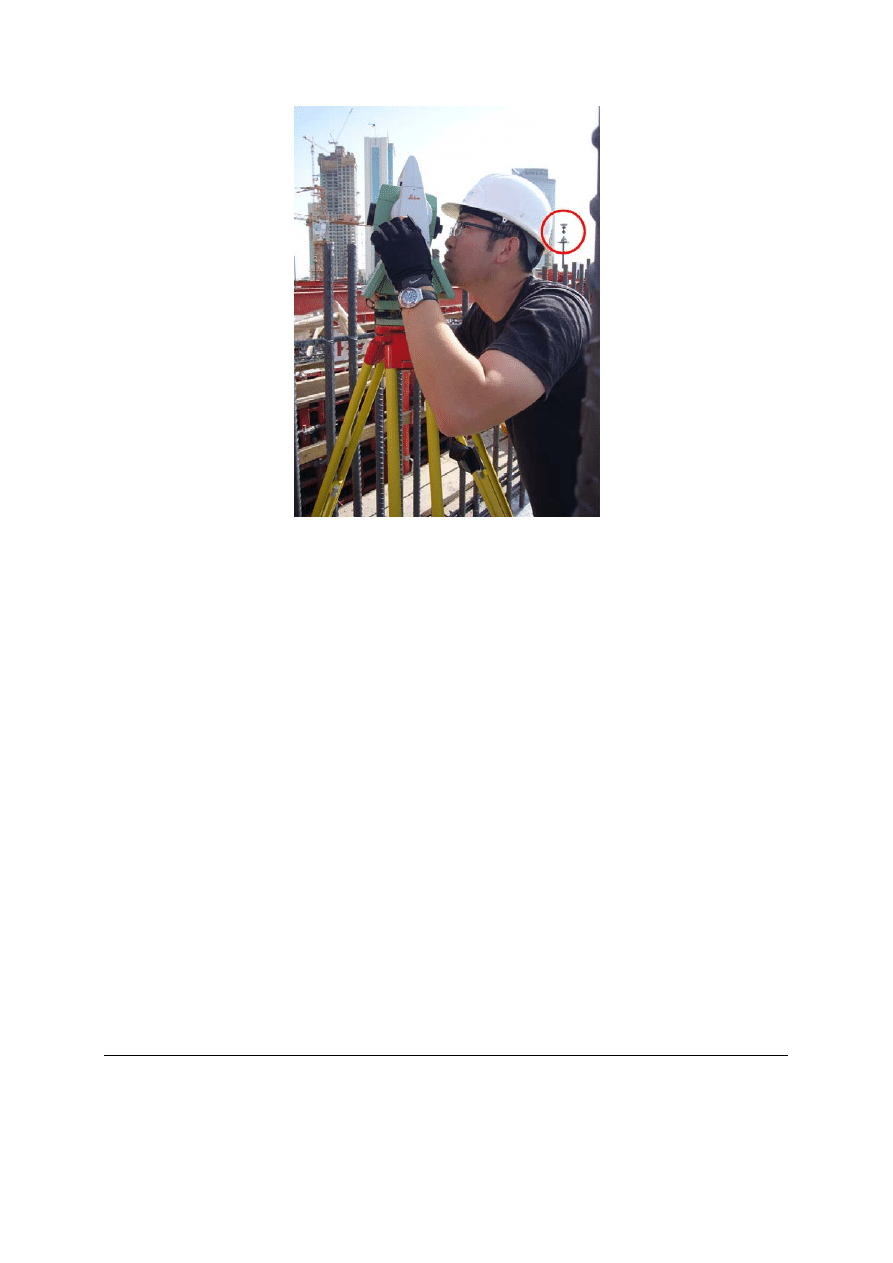
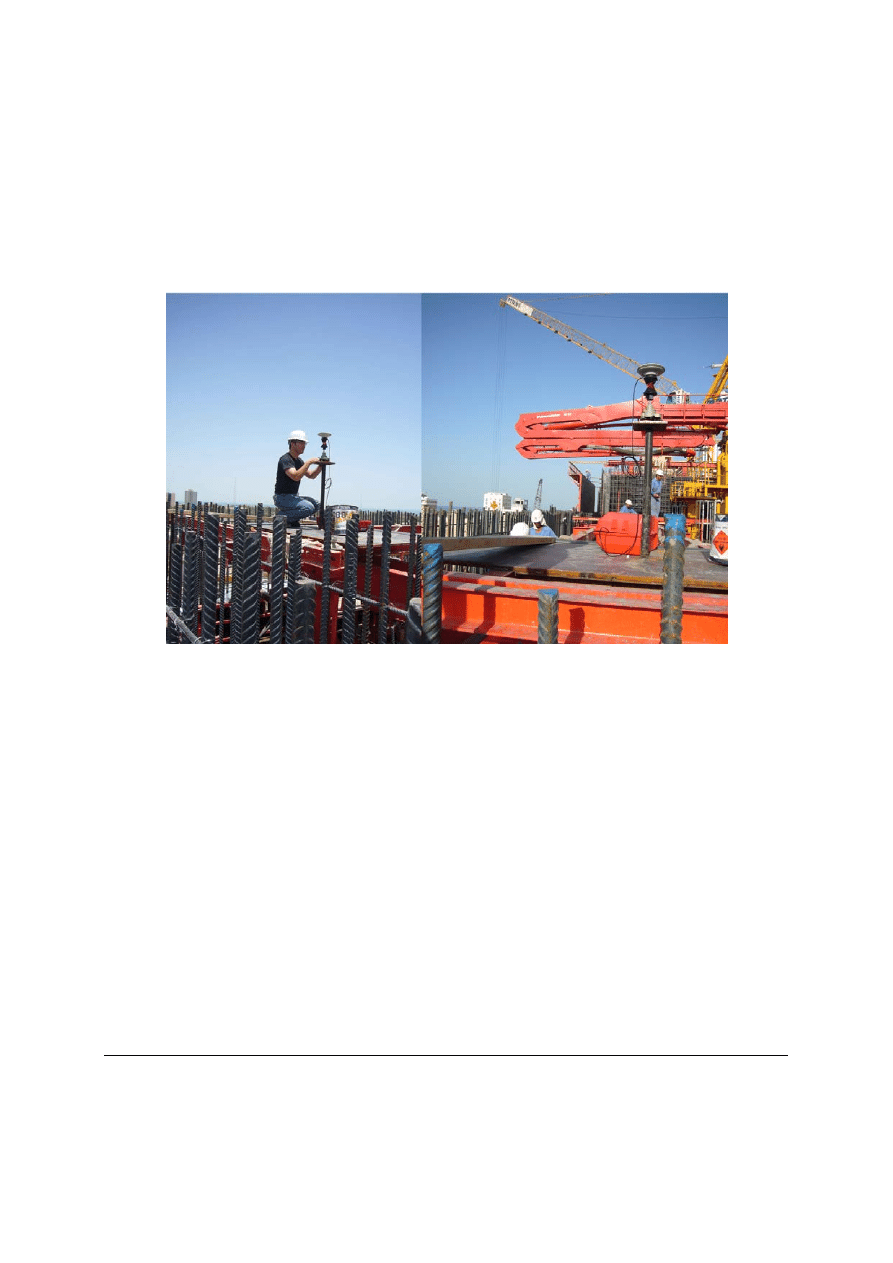
Fig 7: Soang Hoon in Kuwait operating a Leica TPS and measuring “Active Control Points”
3.2 GNSS
– GNSS will used to provide “active ground control marks” for setting up the TPS at
any stage of the construction. A 360° reflector is attached to the bottom of each GNSS
antenna to be aimed by the TPS.
– The GNSS antennas and receivers are tracking the signals of the GNSS satellite
constellation. A line of sight between the antenna’s and the satellites is mandatory.
– Obstructions can create reflection and diffraction in the signals. It’s the responsibility
of the surveyor to locate the GNSS antennas accordingly to that remark.
– Depending on the way the surveyor is acting to give instructions to put the formwork
on place one can consider a “Post-Processing” or a “Real-Time” based solution.
o
In the Post-Processing mode, the GNSS measurements will be logged before
and after the TPS operations to have sufficient data to be processed. The GNSS
post-processing software will handle the processing of the GNSS
measurements in “Kinematic on the Fly” or “mixed track” mode epoch-by-
epoch.
o
In the Real-Time mode, the GNSS measurements are processing in real time
aboard a PC laptop e.g. installed closely to the TPS station to deliver
immediately the coordinates of all the “Active Control Points”.
– Because GNSS can only derived precise coordinates in “differential mode” the
observations from a GNSS Reference Station will be used. Those observations are
time synchronised with those logged by the GNSS antennas used to provide “active
ground control marks” for the TPS. It’s a direct benefit of the GNSS.
TS 6D – Engineering Applications of GNSS
Joël van Cranenbroeck
Core Wall Control Survey – The State of Art
7
th
FIG Regional Conference
Spatial Data Serving People: Land Governance and the Environment – Building the Capacity
Hanoi, Vietnam, 19-22 October 2009
11/19
– The Continuous Operating Reference Station located preferably outside the building
area influences will produce the GNSS Reference Station observations. The data files
will be logged on files (post-processing) or the measurements will be streamed out
(real time).
– All the coordinates time series obtained will be screened and filtered to keep the
accuracy of GNSS results within few millimetres.
– The coordinates obtained will be transformed in the coordinates frame with the 3D
transformation derived by the procedure described in the previous section.
Fig 8: Soang Hoon setting up “Active Control Points” in Kuwait
3.3 Precise Inclinometer
– The precise inclinometers will be installed on the core wall along a vertical line
and measure the tilt variation of the building main axis. The inclinometer axis must
be aligned with the buildings’ coordinates system.
– A wall mounting will be fixed on the core wall and the ensemble will be protected
and secured by a cabinet.
– The inclinometers must be installed and overall levelled during period of time
where the building is unsolicited by external stresses to ensure that the initial
position is aligned to the gravity vertical.
– Two positions of the inclinometer measurements can be used as “calibration values
“to ensure that the tilts values are well referred to the building vertical main axis.
– The coordinates of the Total Station derived from the directions and distances
combined with the coordinates of GNSS will be updated with the information
delivered by the precise inclinometers.

TS 6D – Engineering Applications of GNSS
Joël van Cranenbroeck
Core Wall Control Survey – The State of Art
7
th
FIG Regional Conference
Spatial Data Serving People: Land Governance and the Environment – Building the Capacity
Hanoi, Vietnam, 19-22 October 2009
12/19
– Using vertical laser plummet beams passing through holes made on different levels
will control the tilt values delivered by the inclinometers as a way to calibrate
them. There are other possibilities based on a Total Station.
3.4 Additional remarks
– The Core Wall Control Survey System is a solution that fuses datasets from
different surveying components. Each component must be calibrated and set-up on
place accordingly factory recommendations.
– All components that are inter-acting will provide internal check.
– For instance the directions from the Total Station to the 360° reflectors collocated
with the GNSS antennas will be controlled with the distances - as we can derive
the coordinates of the TPS by using the directions only (resection). That’s the
reason the coordinates for the TPS are computed with a strict Least Square
Adjustment process.
– The GNSS receivers will log sufficient provision of measurement to have checked
and filtered results in the position domain. If some obstructions are blocking the
signals during the observations and if the signals from some satellites are reflected
or diffracted, a linear regression analysis will detect and mitigate the outliers.
– The inclination sensors’ tilts will be compared with the GNSS coordinates time
series.
– The 360° reflector collocated with the GNSS antenna forms the so-called “Active
Control Points”.
4. CORE WALL SURVEY CONTROL SYSTEM IN OPERATION
The Core Wall Control Survey System (CWCS) provides coordinates of form works in the
design coordinates frame. As the construction can move due to different effects on the
structure, the CWCS takes also into account the tilt offsets of the building main vertical axis.
When the surveyor needs to operate on the building structures’ top to provide control of the
formwork positions, he will check first the availability of the inclination sensors data and that
the GNSS permanent reference station is well operating. The various components of the
system are designing to operate continuously 24/7 but this is a good practice to check the
status of the various components. It’s of his responsibility to ensure that all components are in
operation during his intervention.
4.1 Setting up the Total Station
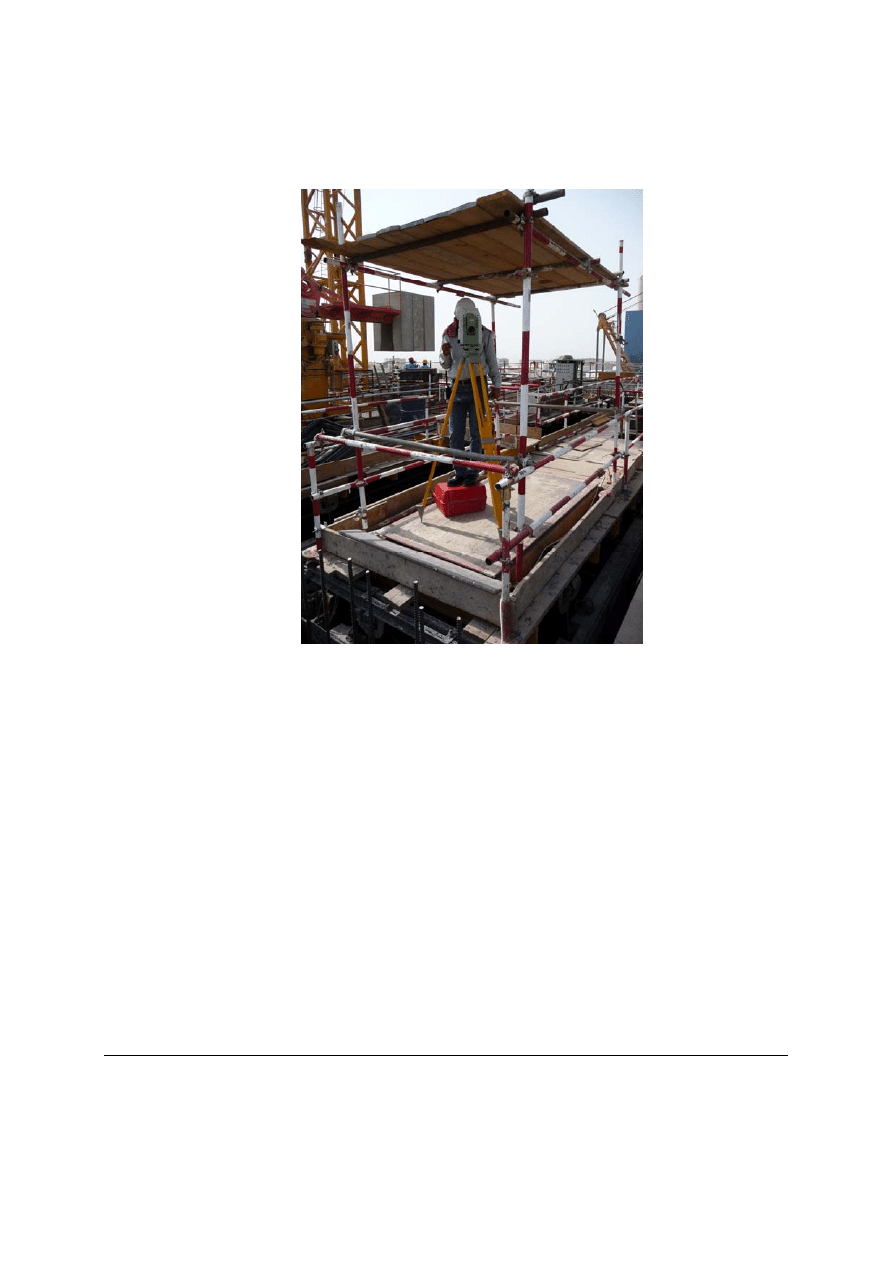
The surveyor will first have to set-up the TPS in a position where he will survey all the marks
on the formwork and also some other marks that can be used for other control points inside
the structure.
TS 6D – Engineering Applications of GNSS
Joël van Cranenbroeck
Core Wall Control Survey – The State of Art
7
th
FIG Regional Conference
Spatial Data Serving People: Land Governance and the Environment – Building the Capacity
Hanoi, Vietnam, 19-22 October 2009
13/19
– The tripod will be installed on a very stable place. During the operation the tripod as
well as the TPS will be protected against sun radiation. The station point will be
marked with a rivet and identified.
Fig 9: typical setup of a TPS on top of high-rise building in Kuwait
4.2 Setting up the GNSS antenna’s
The surveyor will then fix the different GNSS antennas around the TPS ensuring that a good
geometry to guarantee the precise determination of the orientation and coordinates of the TPS.
On the other hand the GNSS antennas will be placed in position with a direct line of sight to
GNSS satellites.
– When the antennas are installed and the receivers connected to them, the surveyor will
start logging (post-processing) or streaming (real-time) the measurements at 1Hz rate.
– The surveyor will check that all satellites in view are tracked and that the GDOP
(indicator of the geometry between the satellites and the antennas) are lower than 4.
– For that reason it’s still a good practice – even if today GPS and GLONASS
constellations provide enough satellites - to produce regularly a mission planning of
the satellites visibility.
– When all GNSS antennas & receivers are operating, the surveyor can start first to aim
all 360° reflectors collocated with the GNSS antennas and eventually the other
reflectors located on the existing buildings around the construction site. The operation
TS 6D – Engineering Applications of GNSS
Joël van Cranenbroeck
Core Wall Control Survey – The State of Art
7
th
FIG Regional Conference
Spatial Data Serving People: Land Governance and the Environment – Building the Capacity
Hanoi, Vietnam, 19-22 October 2009
14/19
will be handling in the two positions of the telescope to mitigate the instrumental
errors. The compensator of the Total Station would be switching off if too much
vibration occurs.
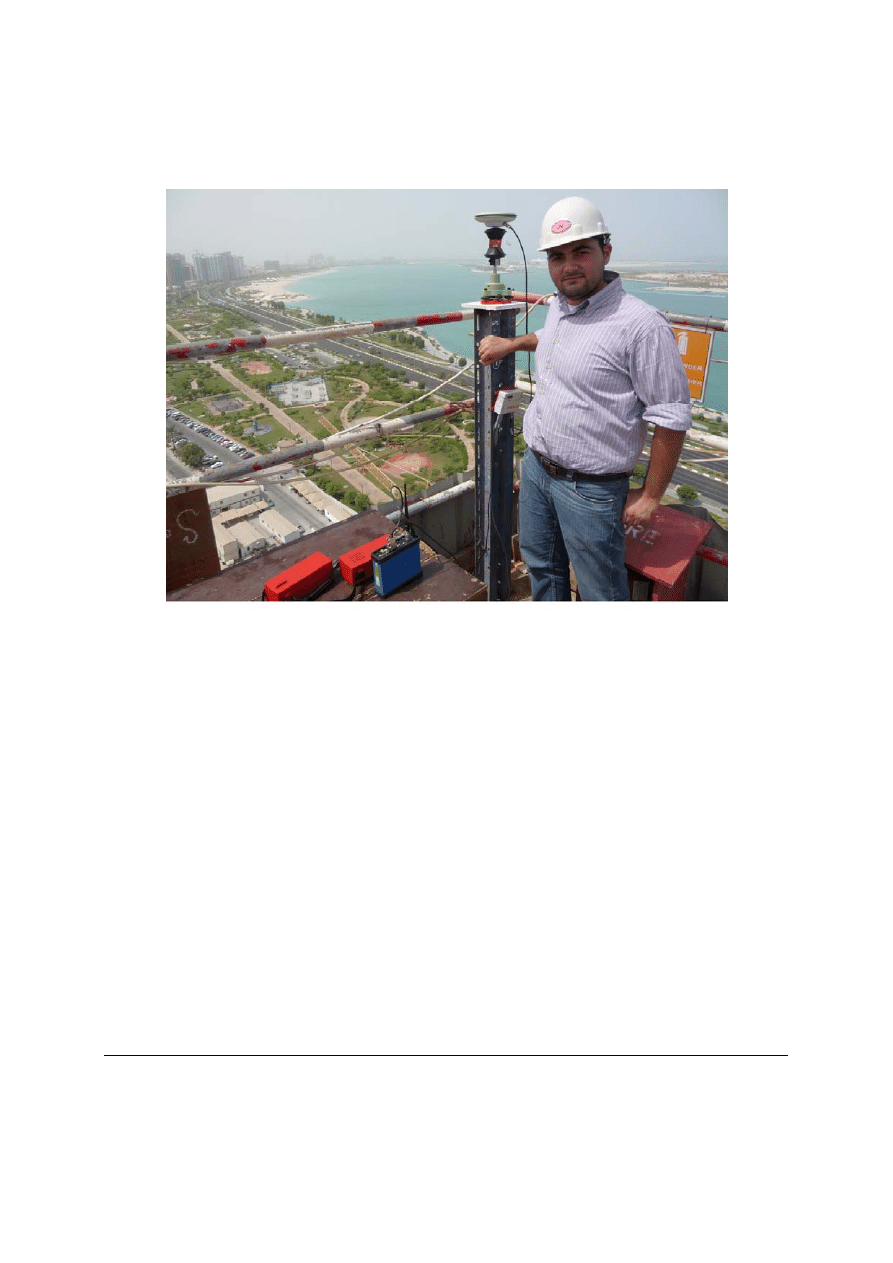
Fig 10: Mohammed Haider in Abu Dhabi with a real time “Active Control Point”
4.3 Surveying the Control Points on the formwork
When the first round of observation is made, the surveyor will survey the control points on the
formwork.
If the system operates in “real-time” mode the coordinates of the “Active Control Points” will
be introduced in the TPS to set-up it in the proper reference frame.

TS 6D – Engineering Applications of GNSS
Joël van Cranenbroeck
Core Wall Control Survey – The State of Art
7
th
FIG Regional Conference
Spatial Data Serving People: Land Governance and the Environment – Building the Capacity
Hanoi, Vietnam, 19-22 October 2009
15/19
Fig 11: Application software for real time operations
He can also survey other marks on the wall and inside the building to augment its network of
known marks. Those marks will be used when the surveyor will need to control and set-up
other elements inside the building.
4.4 Un-setting the GNSS antenna’s
Before unsetting the GNSS antennas, the surveyor again will measure a last round on the 360°
reflectors to have enough redundancy in the measurements and avoid or detect outliers.
Measurement outliers are generally due to wrong identification of target than from the
measurements themselves.
If the surveying operations last more than previously expected a third round of measurement
can be conducted. It’s important to understand that it’s far better to measure regularly the
“Active Control Points” than only the minimum. It’s again good practices from the surveying
state of art.
4.5 Office work if the system is operating in Post-Processing mode
– In the office, the surveyor will first download the GNSS data logged on the memory
cards and download the corresponding data files from the GNSS permanent reference
station.
– The surveyor will process the baselines from the GNSS permanent reference station to
all GNSS antennas used in the survey to derive the coordinates of the 360° reflectors.
– The “kinematic on the fly” or “mixed track” mode will provide coordinates for every
second of logging. Those coordinates will be screened and filtered by using regression
analysis to derive the coordinates of the 360° reflectors on the time of the Total
Station observations.A report will be generated and archived.
TS 6D – Engineering Applications of GNSS
Joël van Cranenbroeck
Core Wall Control Survey – The State of Art
7
th
FIG Regional Conference
Spatial Data Serving People: Land Governance and the Environment – Building the Capacity
Hanoi, Vietnam, 19-22 October 2009
16/19
– The Total Station data logged on the memory card will be downloaded by using a
survey processing software and combined with the coordinates of the 360° reflectors.
– A least square adjustment will determine the orientation and the coordinates of the
Total Station. A report will be generated and archived.
– The data of all inclination sensors will be analyzed for the same period of time or
extrapolated by a linear regression and the
δX and δY offset of the building main axis
will be used to adapt the Total Station coordinates.
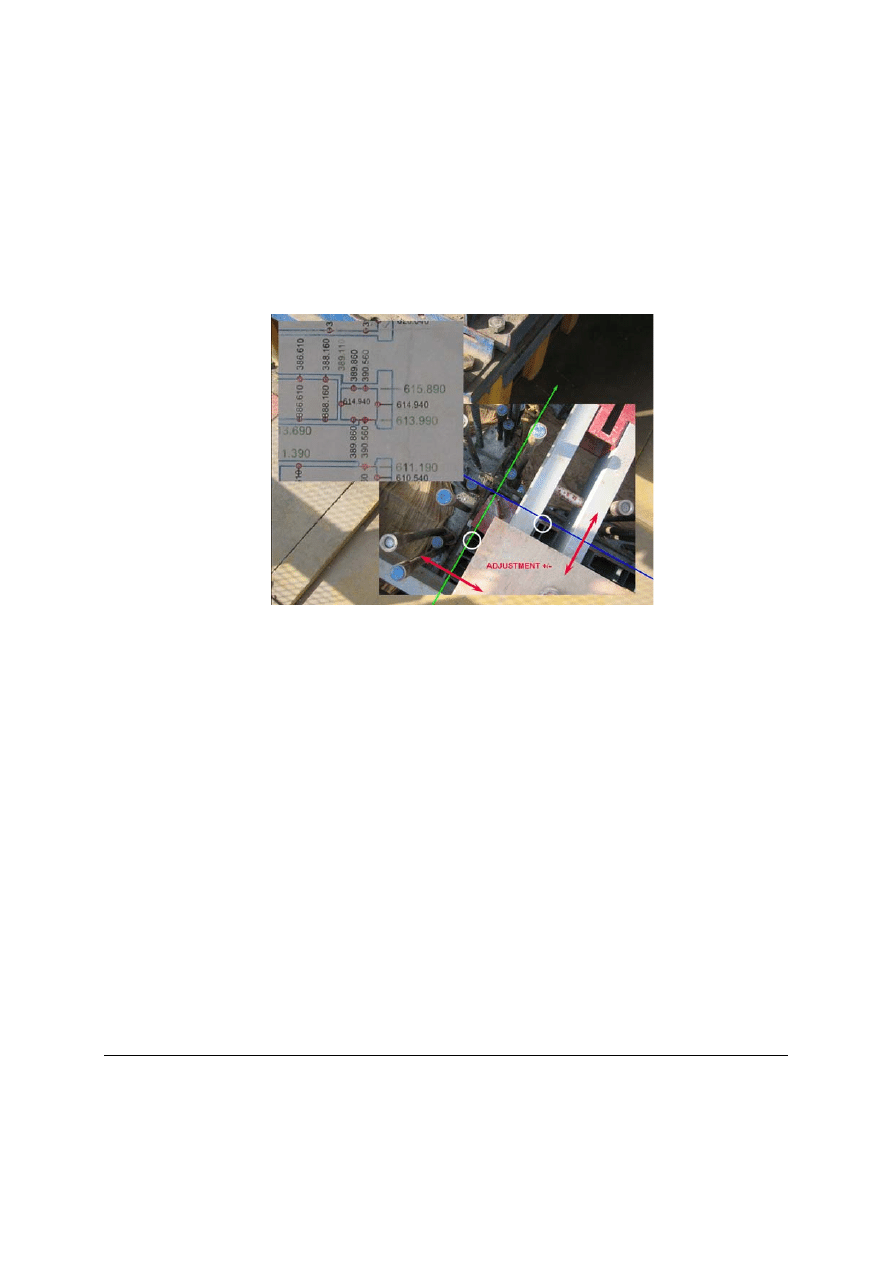
– Then the coordinates of all marks and formwork marks will be computed to deliver an
“as built” and drawings will be forwarded to the formwork operators.
Fig 12: example of formwork adjustment drawing
4.6 Formwork in position Post-Processing mode and Real-Time mode
With the data delivered by the surveyor, the operators will adjust the formwork at the right
place. The surveyor would have to repeat the whole sequence to check that the formwork has
been effectively adjusted to the design position. After his report the formwork will be said on
position.
Because of those operations (the one to deliver the offset of the formwork and the second to
check that the formwork is in its right position) it can be advantageous to keep the GNSS
antennas on place as well as the tripod or even the Total Station if secured. In the “real time”
mode all the data processing are lead on site.
5. CONSIDERATIONS
5.1 Core Wall Control Survey System
The Leica Core Wall Survey Control System allows the Surveyor to derive coordinates not
only for the formwork but also to any other point within the structure.
TS 6D – Engineering Applications of GNSS
Joël van Cranenbroeck
Core Wall Control Survey – The State of Art
7
th
FIG Regional Conference
Spatial Data Serving People: Land Governance and the Environment – Building the Capacity
Hanoi, Vietnam, 19-22 October 2009
17/19
Attention should then be paid to archive and maintain all the points that will be generated.
The better is to use a data base that will manage all the information’s.
Numerous other tasks will be conducted in the construction of a building and it should be
quoted that if the Core Wall Control Survey method is delivering effective coordinates, the
vertical component - that is a very sensible one due to e.g. column shortening adjustment
program - must be control by using conventional levelling procedure.
It’s however out of the scope of this document to deal with the levelling and adjustment
program.
5.2 Long term monitoring after construction
The precise inclination sensor network provides useful information over the time and 24/7
along the year. Other sensors data should be correlated with that inclination network to gain a
better understanding of the behaviour of the building. Wind speed and orientation sensors and
thermometers are often necessary components.
When the building construction ends, one may advocate the contractor to keep the inclination
network in operation in the building and to trade this installation with the owner for long term
monitoring.
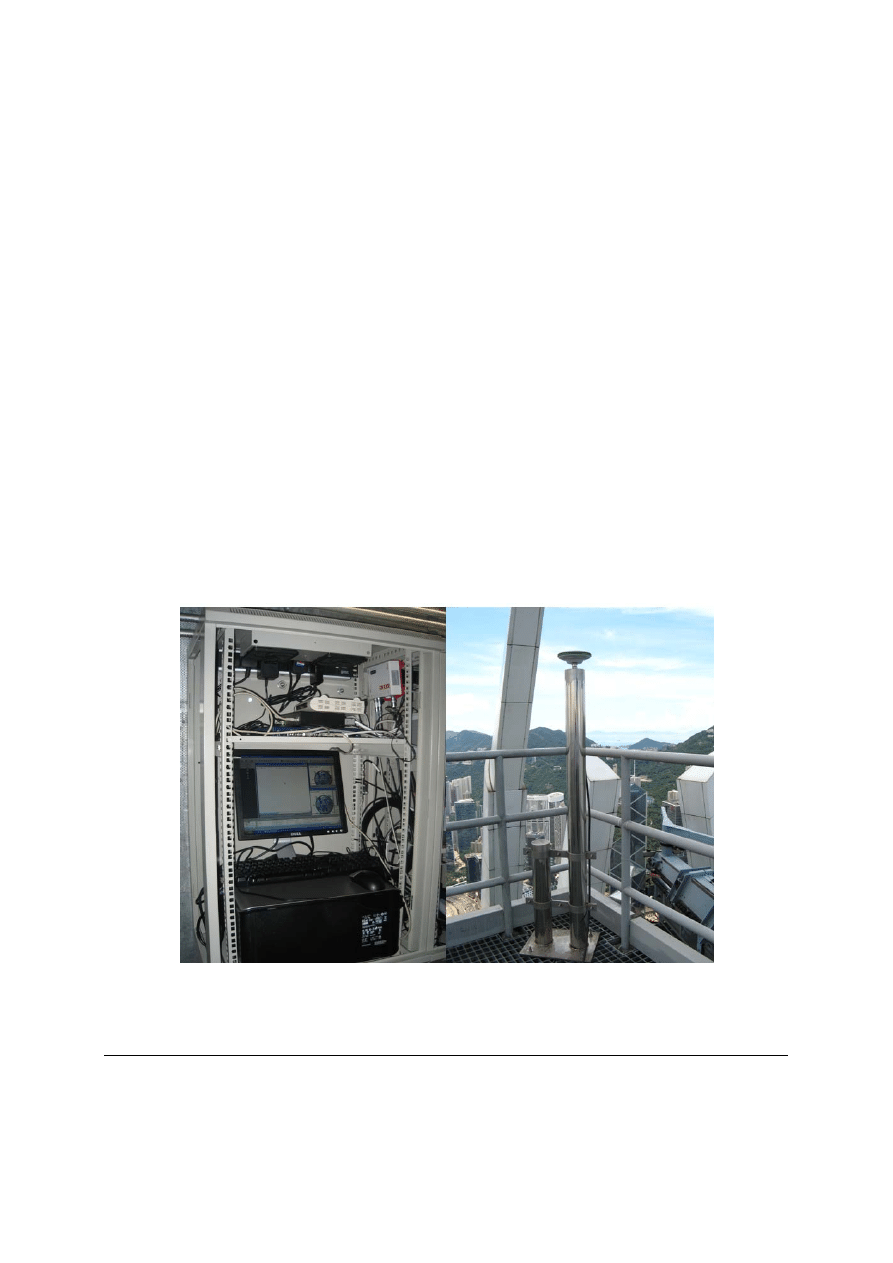
A GNSS antenna can also be kept running on the top to provide deflection information.
Fig 13: GNSS monitoring in the IFC2 tower in Hong Kong

TS 6D – Engineering Applications of GNSS
Joël van Cranenbroeck
Core Wall Control Survey – The State of Art
7
th
FIG Regional Conference
Spatial Data Serving People: Land Governance and the Environment – Building the Capacity
Hanoi, Vietnam, 19-22 October 2009
18/19
6. A TRIBUTE TO CHIEF SURVEYORS AND STRUCTURAL ENGINEERS
The Core Wall Control Survey System (CWCS) developed by Leica Geosystems has been
first imagined and proof tested then applied for the Burj Dubai tower construction in the
United Arab Emirates.
Doug Hayes as Chief surveyor has immediately acknowledged the merit of that proposal and
has contributed largely to the success of its implementation. We had numerous exchanges and
discussions during the construction and we have addressed issues that have not been
necessarily reported in that present paper. Without his passion and his outstanding surveying
skills we would never have succeeded.
A short time after the installation of the CWCS in Dubai we have been contacted in Kuwait
for the Al Hamra tower project. The contractor was requesting a similar system and overall a
professional surveyor that would be able to drive all the systems. Soang Hoon from South
Korea was willing to accept that challenge and became Chief Surveyor for the organisation.
Even if the system was similar to the one delivered for the Burj Dubai, he made the
necessarily adaptation and we learnt how tall buildings are different even if they shared on a
surveying point of view the same specifications.
A year after the installation in Kuwait, it was in Abu Dhabi for the Landmark tower that we
have been asked to provide a CWCS system. Again that case was slightly different and the
contractor marked a high interest of having the system tuned in real time mode. Mohammed
Haider, structural engineer for the contractor, hand over the system and right at the start was
an outstanding supporter.
We are actually working on several new projects and we shouldn’t miss the simple fact that
the first high rise building – The Empire State Building in the United States of America – has
been built in the deepest of the economical situation. Not a surprise that today we find the
same excitation from worldwide to build such iconic buildings. But this cannot hide the true
reason which is a search to rationalize the space in urban cities and to gather a large
population into super towers with all facilities available such apartments, shopping centres,
parking lots, bus, taxi and railway stations, offices, schools and distraction areas. We are at
the dawn of vertical cities. What has been a fiction in a recent past is now becoming a reality.
The Burj Dubai was the first to show the trend and can be considered as a proof case to
motivate urban planners to re-imagine our living space even with rotating towers and floating
structures …
In that paper we have tried to review the state of the art of an innovative surveying method to
support the construction of such outstanding vertical structure. The predominant role of the
surveyors and engineers in that process has contributed to mature our proposal. In the near
future we wouldn’t be surprised to address also request for semi or full automatic system.
After all it is only the first step of a long journey.

TS 6D – Engineering Applications of GNSS
Joël van Cranenbroeck
Core Wall Control Survey – The State of Art
7
th
FIG Regional Conference
Spatial Data Serving People: Land Governance and the Environment – Building the Capacity
Hanoi, Vietnam, 19-22 October 2009
19/19
REFERENCES
An international patent entitled “Surveying Procedure and System for a high-rise structure”
has been filled the 9
th
of January 2007 by Leica Geosystems AG to the World Intellectual
Property Organization – International Bureau and published the 19
th
of July 2007 with a
priority date set the 10
th
of January 2006.
The International Publication Number is WO 2007/080092 A1.
CONTACTS
Joël van Cranenbroeck, Business Development Manager
Leica Geosystems AG, Geomatics Division
Heinrich Wild Strasse
CH-9435 Heerbrugg
SWITZERLAND
Tel. +32 474 98 61 93
Fax + 32 81 41 26 02
Email: joel.vancranenbroeck@leica-geosystems.com
Web site:
www.leica-geosystems.com
Wyszukiwarka
Podobne podstrony:
Banks The State of the Art
the state of organizational social network research today
CONTROL AND THE MECHANICS OF START CHANGE AND STOP
writing task The state of psychology transcript
Cranenbroeck STATE OF ART IN STRUCTURAL GEODETIC MONITORING SOLUTIONS
Wall Street and the Rise of Hitler
(ebook english) Antony Sutton Wall Street and the Rise of Adolf Hitler (1976)
The State of the Art on Alyssum Marta Randall
Iain Banks Culture 03 The State of the Art
058 Doctor Who and the State of Decay
Dr Who Target 058 Dr Who and the State of Decay # Terrance Dicks
Dr Who Novelizations 058 The State of Decay Terrance Dicks
Antony Sutton Wall Street and The Rise of Hitler(1)
AGUIAR DE LUQUE, minorities and the state of regional autonomy in spain
THE STATE OF HUMAN RIGHTS IN EAST JERUSALEM 2009
NOTES ON THE STATE OF VIRGINIA tłumaczenie
Banks, Iain M Culture 03 The State of the Art 1 1
więcej podobnych podstron