
Valeriy Zhdanyuk, Doctor of Science, professor
Kharkiv National Automobile and Highway University, Ukraine
Oleksiy Govorucha, postgraduate student,
Kharkiv National Automobile and Highway University, Ukraine
Mikola Gnativ, engineer, Ukraine
Anatoliy Ivzhenko, engineer, Ukraine
REUSE OF MILLED ASPHALT CHIPS
FOR HIGHWAY CONSTRUCTION
Summary
Experimental research of physical and mechanical properties of cold concretes based
on milled asphalt concrete has been performed. The influence of compaction load on
properties of cold concretes on milled asphalt concrete has been elucidated. The influence of
binder type and content on freeze resistance of concrete on milled asphalt concrete has been
determined. The influence of binder type and content on bond strength between layers placed
by means of cold recycling and layers laid using hot asphalt concrete mixes has been
evaluated.

1. Introduction
Asphalt wearing courses are the most commonly used pavement layers of urban streets
and highways in Ukraine. Service life of highways asphalt wearing courses does not exceed 14
– 16 years, and it is much shorter for urban streets. Insufficient durability of asphalt wearing
courses is caused by many reasons (joint influence of traffic and climatic factors). In recent
years the technology of cold recycling of asphalt wearing courses has been spreading when
repairing and reconstructing pavements In Ukraine [1-3]. The technology of asphalt wearing
courses cold recycling can be implemented in-situ using recyclers or at traditional asphalt
plants.
The technique of both hot and cold in-place recycling of pavement layers is known to
allow [4-6]: reuse of old materials of existing pavements; provision of wearing course
homogeneity by both strength and geometrical parameters; reduction of waste material
volumes and materials mining in quarries, providing proper ecological benefits; provision of
possibility to renew some traffic lanes of a road with two and more lanes, indicating the most
frequent surface course deterioration under traffic loading; reduction of inconvenience caused
by operation of technological transport when performing traditional rehabilitation; reduction
of deterioration possibility of secondary roads local network taking into account reduction of
new materials transportation volumes; reduction of costs for worn wearing courses
rehabilitation; avoidance of necessity to elevate shoulders level and decrease opening under
overbridges; pavement recycling at simultaneous widening of existing roadway.
In Ukraine some road agencies are experienced in usage of recyclers WR 2500 and
WR 4200 (manufactured by WIRTGEN GROUP) for the implementation of technology of
cold in-place pavements recycling.
Today road millers for cold milling of wearing courses have found increasing
application in many road organizations. When performing rehabilitation of pavement surface
courses the technology of cold milling is often applied in order to level the surfaces on sites
with plastic deformations, or complete removal of layer with significant amount of
accumulated cracks. Cold milling of old asphalt surface courses or rough protective wearing
courses, laid by means of surface treatment, results in formation of asphalt chips. Milled
asphalt chips are traditionally used as a material for laying of base courses, shoulders pitching
and gutting of macadam base courses.
Research performed earlier has shown [7] that simultaneous application of cement and
bitumen emulsion at reclamation of old asphalt layers provides improved deformability of the
material and its less tendency to shrinkage in comparison with mixes bound with cement only.
The structure of asphalt concrete based on these mixes is characterized by two bond types:
coagulation and crystallization. The first bond type makes the material similar to asphalt
concrete, while the second type promotes formation of rather rigid spatial skeleton in it.
Compared to conventional asphalt concrete, the material is characterized by lower
temperature susceptibility of strength and improved shear resistance at high service
temperatures. However, the influence of compaction load on the parameters of physical and
mechanical properties of cold asphalt concretes on milled chips, corrosion resistance of such
asphalt concretes and adhesion to layers of hot asphalt mixes, which are laid as protective
layers, is less explored.
2. Materials and procedures
Milled asphalt chips obtained by milling of old asphalt wearing courses from fine-
aggregate mixes (type B) based on granite aggregates were taken for laboratory research.
Portland cement «ПЦ 400» and medium setting cationic road bitumen emulsion with 63 % of
bitumen «БНД 90/130» served as binders.

3. Results
Research results obtained indicate the influence of binder content and type on physical
and mechanical properties of asphalt concrete based on milled asphalt chips (Table 1). It is
apparent that asphalt concretes on cement are characterized by higher compression strength
and water resistance coefficients in comparison with asphalt concretes on composite binder.
The decrease of parameters of asphalt concretes strength and increase of short-term and long-
term water resistance coefficients is observed with the increase of bitumen emulsion content
in asphalt concretes.
Table 1 Physical and mechanical properties of asphalt concrete based on milled asphalt chips
Emulsion content, %
0
2
4
Cement content, %
Properties parameters
0
3
5
7
0
3
5
7
0
3
5
7
Water saturation, %
6.7
4.9
4.6
4.3
6.6
4.8
4.5
3.8 6.4
4.7
4.2 3.5
Swelling, %
0.4
0
0
0
0.4
0
0
0
0.3
0
0
0
Compression strength,
MPa, at:
0 ˚С
20 ˚С
50 ˚С
6.9
2.3
0.2
9.6
4.0
1.4
10.3
4.7
1.9
10.5
5.1
2.0
4.7
1.9
0.3
8.1
3.6
1.2
8.6
3.8
1.4
9.8
4.2
1.5
4.3
1.5
0.2
5.7
2.5
0.7
6.9
3.3
0.9
8.0
3.6
1.2
Water resistance
coefficient
0.61 0.82 0.83 0.83 0.49 0.81 0.82 0.86 0.46 0.83 0.85 0.85
Long-term water
resistance coefficient
0.40 0.80 0.81 0.82 0.34 0.76 0.78 0.81 0.34 0.75 0.77 0.82
The preparation of samples 70 mm in diameter and 70 mm high has been carried out
in order to elucidate the influence of compaction load value on physical and mechanical
properties of asphalt concretes. The preparation of samples from mixes on organic (bitumen
emulsion), hydraulic (cement) and composite (cement + bitumen emulsion) binders has been
performed under compaction load of 10, 20 and 30 MPa. The research results of physical and
mechanical properties of asphalt concretes under consideration are shown in Table 2. The data
analysis indicates that the increase of compaction load results in decrease of water saturation
parameter of asphalt concretes, increase of their average density, compression strength, short-
term and long-term water resistance coefficients. Asphalt concretes on hydraulic binder
(cement) exhibit higher long-term water resistance coefficients as compared to short-term
water resistance coefficients. The reason is incomplete cement hydration and its subsequent
slow behavior under long-term research.
The results of freeze resistance research has revealed (Table 3) that asphalt concretes
with high content of bitumen emulsion show higher resistance to varying freezing and
thawing. Asphalt concretes on cement are characterized by more sharp change of freeze
resistance coefficient within first 10 to 15 cycles as compared to asphalt concretes on
composite binders.
In order to protect pavement laid by means of cold recycling technique hot asphalt
mixes are traditionally used. Insufficient bonding strength between pavement layers is one of
the basic reasons of premature deterioration of multilayer pavements. The lack of adhesion
between layers can cause a 30 % decrease in service life of the structure.

It is recommended to use organic binders when applying tack coat to the wearing
course to be repairing. Organic binders, when applied on the surface, have low viscosity and
in course of contact formation between layers provide high adhesive and cohesive strength.
For experimental research of interlayer bond the surface of the samples from milled
asphalt chips was treated with a layer of tack coat and a layer of hot asphalt mix. Road
petroleum bitumen БНД 90/130 and rapid setting road bitumen emulsion were used as
adhesives. The binder content for tack coat varied from 0 to 0.6 kg/m
2
converted to bitumen.
The parameter of shearing strength, evaluated by means of tensile-testing machine, was
accepted as criterion of interlayer bond. Deformation rate of the samples comprised 3
mm/min.
Table 2 The influence of compaction load on physical and mechanical properties of
asphalt concrete
Binder type and content
4 % emulsion
5 % cement
4 % emulsion +
5 % cement
Compaction load, MPa
Properties parameters
10
20
30
10
20
30
10
20
30
Average density, kg/m
3
2131
2149
2152
2156
2213
2251
2143
2182
2205
Water saturation, %
8.6
8.3
7.8
11.3
8.9
7.3
8.1
6.0
5.1
Swelling, %
0.3
0.3
0.3
0
0
0
0
0
0
Compression strength,
MPa, at:
0 ˚С
20 ˚С
50 ˚С
6.0
2.1
0.2
6.2
2.4
0.3
6.5
2.4
0.3
8.2
4.0
1.5
10.4
5.0
1.8
10.5
4.9
1.8
7.7
3.2
1.0
8.2
3.4
1.1
8.3
3.6
1.2
Short-term water
resistance coefficient
0.49
0.50
0.51
0.75
0.78
0.86
0.76
0.80
0.82
Long-term water
resistance coefficient
0.36
0.41
0.42
0.85
0.86
0.90
0.83
0.86
0.89
Table 3 Freeze resistance coefficient of asphalt concrete based on milled asphalt chips
Number of freeze and thaw cycles
Binder type and content
5
10
20
30
50
5 % cement
0.89
0.83
0.79
0.77
0.74
5 % cement +
2 % bitumen emulsion
0.90
0.85
0.78
0.74
0.67
5 % cement +
4 % bitumen emulsion
0.96
0.92
0.87
0.83
0.77
The research of the effect of different binders content on parameter of interlayer bond
has revealed (Fig. 1 and 2) that content dependences of interlayer bond between conventional
asphalt concrete and asphalt concrete from cold mixes on milled chips pass through a
maximum. The maximum value of interlayer bond is typical for asphalt concrete on cement.
The increase of cationic bitumen emulsion content in composite binder results in decrease of
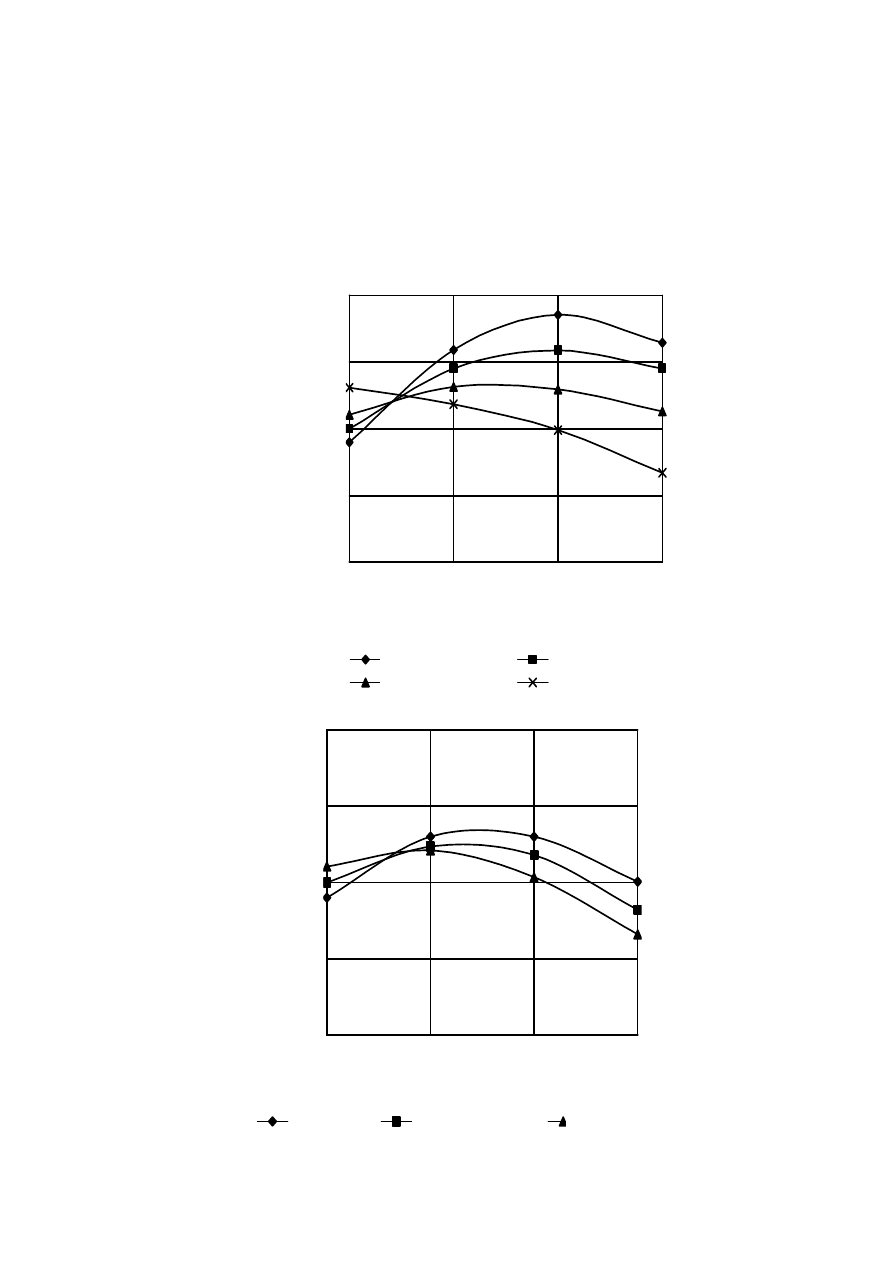
interlayer bond, and maximum of the dependence shifts to the side of lower content of organic
binder applied for tack coat. The regularity specified is peculiar to both bitumen and bitumen
emulsions used for tack coat. The highest values of interlayer bonding strength are observed
at 0.2 – 0.4 kg/m
2
of road petroleum bitumen and 0.35 – 0.7 kg/m
2
(0.2-0.4 kg/m
2
converted
to bitumen) of cationic bitumen emulsion. Bonding strength of the samples bonded with
bitumen emulsion averages about 12 % higher than that of samples bonded with bitumen. It
can be explained by better surface wetting with emulsion.
0,40
0,50
0,60
0,70
0,80
0
0,35
0,7
1,05
Emulsion content, kg/m
2
S
h
e
a
ri
n
g
s
tr
e
n
g
th
,
M
p
a
5%(Ц)
5%(Ц)+2%(Е)
5%(Ц)+4%(Е)
Асфальтобетон
Asphalt content
5%(C)+2%(E)
5%(C)
5%(C)+4%(E)
Fig. 1 Relationship between interlayer bonding strength and cationic bitumen emulsion content
0,40
0,50
0,60
0,70
0,80
0
0,2
0,4
0,6
Bitumen content, kg/m
2
S
h
ea
ri
n
g
s
tr
en
g
th
,
M
P
a
5%(Ц)
5%(Ц)+2%(Е)
5%(Ц)+4%(Е)
5%(C)
5%(C)+2%(E)
5%(C)+4%(E)
Fig. 2 Relationship between interlayer bonding strength and bitumen content
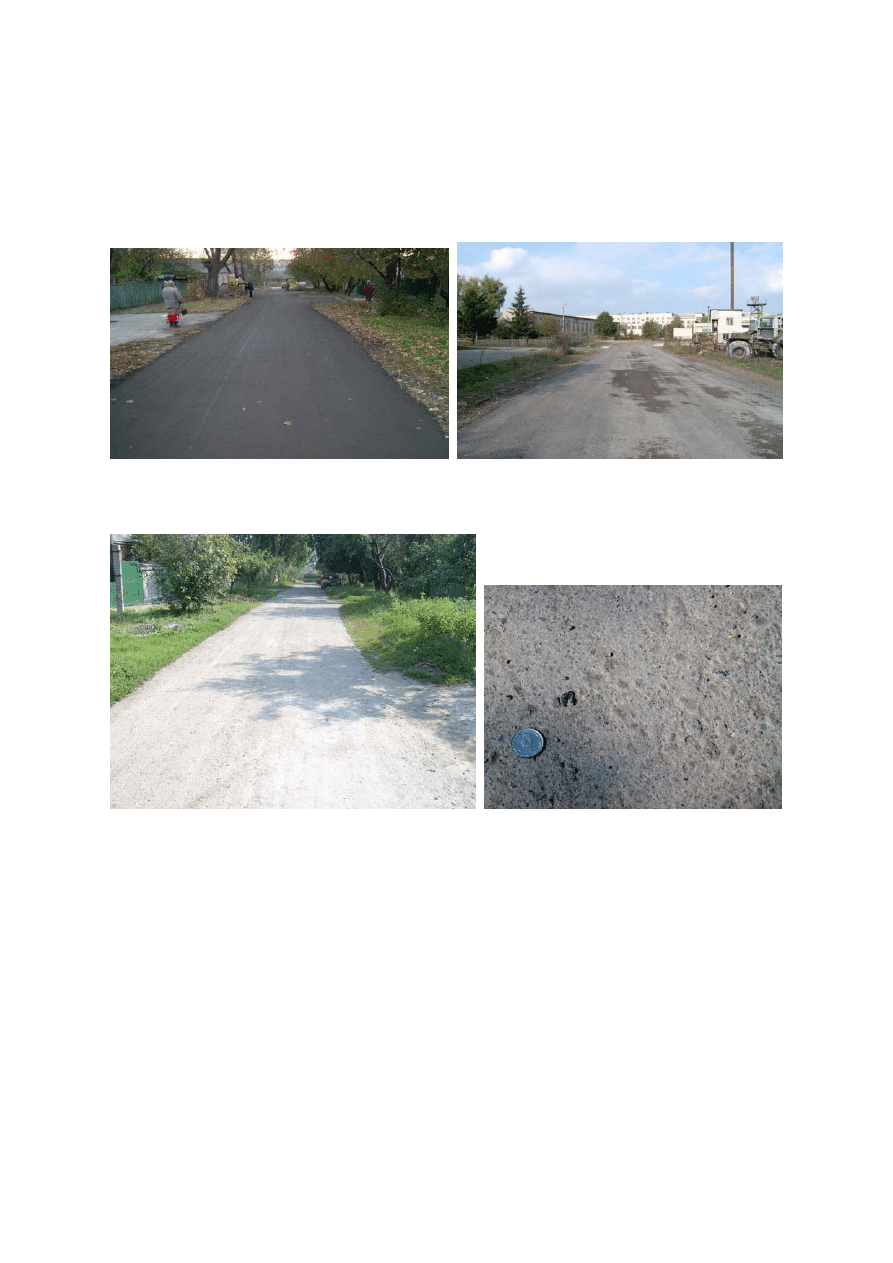
The outcome of the research carried out in 2003 – 2004 resulted in production of cold
mixes based on milled asphalt concrete, mineral and composite binder at asphalt plants, and
construction of experimental sites in Ternopil and Kharkiv region (Fig. 3-4). The experience
obtained makes it possible to recommend the specified material for use in road construction in
base courses and lower wearing courses on highways of all categories.
Fig. 3 General view of surface course from cold mixes based on milled asphalt concrete after
compaction (left image – composite binder, right image – cement)
Fig. 4 General view of surface course from cold mixes based on milled asphalt concrete on
composite binder after 8 months of service
4. Conclusions
Construction, reconstruction and rehabilitation of highway pavements takes much
costs for purchase of road-building materials and their delivery. In Ukraine granite aggregates
fall into the category of the most used materials. Taking into account the fact that some
regions of Ukraine lack natural resources of durable aggregates the implementation of
alternative technologies in road construction is promising for them. Scaling of asphalt
wearing courses and plastic deformations as ruts and buildups as well as cracks and other
damages and failures points to the fact that application of alternative technology of pavements
cold recycling is perspective. When implementing the technology of cold recycling of asphalt
wearing courses with distinctive plastic deformations it is efficient to use cement or
composite binder with low content of cationic bitumen emulsion as a binder. The technology
of pavements cold recycling can be implemented directly on site or at stationary and

transportable asphalt plants. It is recommended to lay rough protective layer by means of
surface treatment, slurry-seal mixes or hot asphalt mixes in order to increase corrosion
resistance of courses from such asphalt concrete. The level of durability of the whole
pavement structure is determined, first of all, by interlayer bond strength. Experimental
research has determined content of petroleum bitumen and cationic rapid setting bitumen
emulsion as binders for tack coat of pavement layers from cold reclaimed mixes before their
coverage with fine-aggregate hot asphalt mixes.
References
1. Жданюк В.К., Говоруха О.В., Гнатів М.Я., Іваниця Ю.П. Улаштування шарів
дорожнього одягу із застосуванням фрезерованого асфальтового дрібняку //
Автошляховик України.- 2003.- №2.- С.30-31.
2. Zhdanyuk V., Govorukha A., Gnativ N., Ivanitsa J. Execution pavement layers using
milled asphalt concrete // Transcom 2003 5-th European Conference in Transport and
Telecommunications, Section 7.- 2003.- p.37-40.
3. Жданюк В.К., Говоруха О.В., Гнатів М.Я., Іваниця Ю.П. Перспективи використання
холодних органогідравлічних сумішей на основі фрезерованого дрібняку //
Автошляховик України.- 2004.- №2.- С.37-38.
4. Corte J.-F. Cold in-place recycling with emulsion or foamed bitumen // Seminar on road
pavement recycling. - Warsaw, Poland.- 2002.
5. Sybilski D., Mechowski T. Czy stosowac w Polsce recykling na gorаco na drodze
nawierzchni bitumicznych? / Czesc 1: Badania odcinków nawierzchni / Czesc 2: Ocena
skutecznosci technologii // Drogownictwo.- №10 (51).- 1996.-s.298-304; №11 (51).-
1996.- s.320-324.
6. Бахрах Г.С. „Холодная” технология регенерации дорожных одежд.- Сб. научн.
трудов НПО РосдорНИИ.- 1994.- вып. 7.- С. 63-74.
7. Жданюк В.К., Володько В.П., Даценко В.М., Даценко О.В., Говоруха О.В.,
Думанский А.М. Холодні бітумомінеральні суміші для будівництва конструктивних
шарів дорожніх одягів // Автошляховик України.- 2005.- №5.- С.37-39.
Wyszukiwarka
Podobne podstrony:
zolotov, zhdanyuk, zhdanyuk
zhdanyuk, kijashko, gustelev
więcej podobnych podstron