
Journal of KONES Powertrain and Transport, Vol. 18, No. 3 2011
OVERSIZE CARGO TRANSPORT IN THE POLISH PART
OF SOUTH BALTIC REGION
Wiesáaw Galor
The Maritime University of Szczecin
Faculty of Navigation
Waly Chrobrego 1/2, 70-500 Szczecin, Poland
tel.: +48 91 4809 514, fax: +48 91 4809 375
e-mail: w.galor@am.szczecin.pl
Anna Galor
The Maritime University of Szczecin
Faculty of Economics and Transport Engineering
H. Poboznego Street 11, 70-507 Szczecin, Poland
tel.: +48 91 4809 640, fax: +48 91 4809 643
e-mail: a.galor@am.szczecin.pl
Abstract
The paper presents problems of oversize cargo (OC) carried by various modes of transport, relevant legal instruments
and problems that carriers face during the preparation and transport of extremely heavy and/or huge pieces of cargo
in Poland. The international program Oversize Baltic will be described. The program aims at the standardization of
procedures connected with the carriage of oversize cargo pieces in the South Baltic Region. The OV corridors in
Poland are presented. Oversize transport is indispensable for economic growth of every nation, but its organization varies
in each country of the South Baltic region. Oversize cargo is called a cargo that exceeds mean allowable parameters of
a vehicle in terms of dimensions, shape geometry or allowable loads on unit surface area. Unloading of a tank,
transport of wide oversize cargo, transport of equipment modules for the refinery industry by C. Hartwig – Katowice
S.A., unloading of 330 ton generator from the NORCA wagon by the Metalchem Serwis Ltd, transport of oversize
elements, operated by Best-Logistic Sp. z o.o., transport of a drilling rig, transport of a frigate USS Samuel B.
Roberts, potential sites of manufacturing and reception of oversize cargoes, transport infrastructure adjusted to OC
transport, Oversize Baltic Project, Infrastructural restrictions in each mode of transport, characteristics of OC
transport orderers, methodology of designating transport corridors are presented in the paper.
Keywords: oversize transport, oversize cargo, Oversize Baltic project, oversize transport corridors
1. Introduction
Along with the development of economy there are an increasing number of shipments that, due to
their size, weight or specific character of carriage, require individual solutions. Almost all major
investment projects require transport of equipment and their components bigger than the size of
trailers or containers. Non-standard cargoes create non-standard problems. Transport of such pieces is
of crucial importance for the development of industry, power engineering and improvement of
infrastructure. Oversize transport is indispensable for economic growth of every nation, but its
organization varies in each country of the South Baltic region. The establishment of joint strategy,
practices and the creation of new principles might enhance the economic competitiveness of the South
Baltic region. The carriage of oversize cargo is usually a very important link of each infrastructural
project, therefore it should be managed without redundant formalities, communication-based
misunderstanding or extra investments in infrastructure. A consistent system could make the Baltic
region more competitive in power engineering, industry and transport. This calls for an analysis of
W. Galor, A. Galor
possible transport routes, both existing ones and planned transport corridors [3].
The European Union policy, formulated by the Treaty establishing the European Community,
aims at enhancing its economic, social and territorial cohesion by increasing the level of such
cohesion in its regions [6]. An increase of the economic cohesion consists in reducing the differences
in the levels of economic development between rich and poor regions. Strengthening the social
cohesion requires that differences in the use of human potential across various areas are decreased,
while strengthening the territorial cohesion is achieved by eliminating the existing barriers of access
to less favoured peripheral regions by binding them more with regions of the Central Europe. The
territorial cohesion is measured by travelling time to a given area by air, road and rail [2].
2. Definition of oversize cargo
For each mode of transport oversize cargoes are those with parameters larger than standard
ones. This issue is due to the existing restrictions of both vehicle design parameters and the
transport infrastructure. For instance, one will not load a larger piece of cargo into an airplane than
its hold, as it simply will not get in, and one cannot load a 600-ton of goods onto a barge with
a 500-ton capacity because, even if the barge bottom has strength enough to withstand
compression forces and the cargo is ideally distributed, the vessel will sink. Similarly, a truck with
carrying 4-metre high object will not pass under a bridge having a 3.8 meter clearance. It can be
stated that in all the above cases the oversize determinants are either cargo dimensions or weight,
as well as available cargo space inside a vehicle and pressure exerted on a unit surface area. The
shape of a cargo piece is another important factor, as the geometry of an object carried may affect
static and dynamic stability. In road transport it is said that cargo is oversize when its dimensions
or weight exceed the maximum allowable parameters of a standard road vehicle or vehicle with
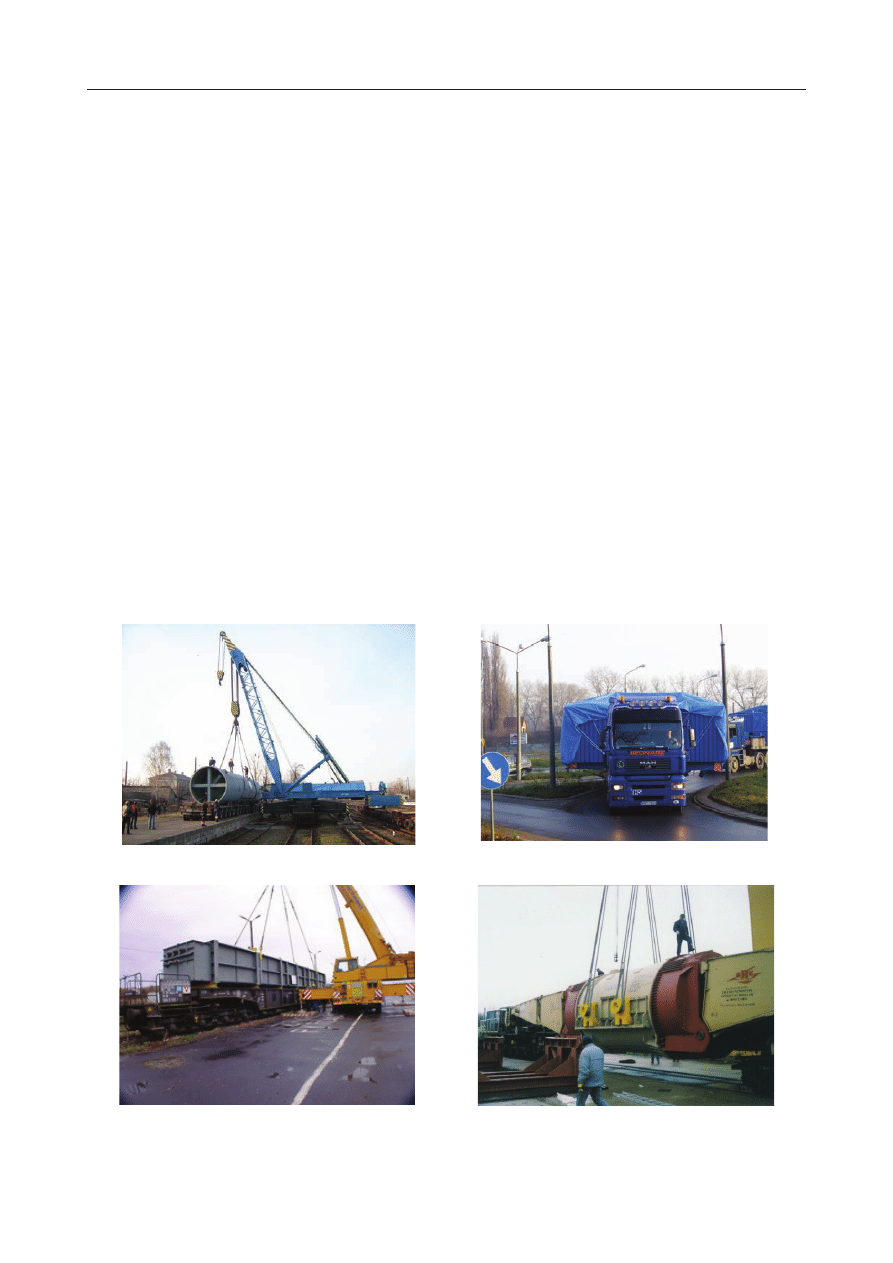
a trailer as well as axle loads of this vehicle (Fig. 1 and 2).
Fig. 1. Unloading of a tank [12]
Fig. 2. Transport of wide oversize cargo [12]
Fig. 3. Transport of equipment modules for the refinery
industry by C.Hartwig – Katowice S.A. [7]
Fig.4. Unloading of 330 ton generator from a NORCA
wagon by the Metalchem Serwis Ltd [8]
100
Oversize Cargo Transport in the Polish Part of South Baltic Region
In rail transport an oversize cargo is a shipment that cannot be carried without exceeding the
loading gauge of a wagon or/and exceeding allowable load on the wagon axle or on one running
metre of the rail. (Fig. 3 and 4).
In inland shipping an oversize cargo is one that protrudes beyond the vessel’s length or/and
width or which reaches up above the highest fixed element of the vessel (vertical clearance of
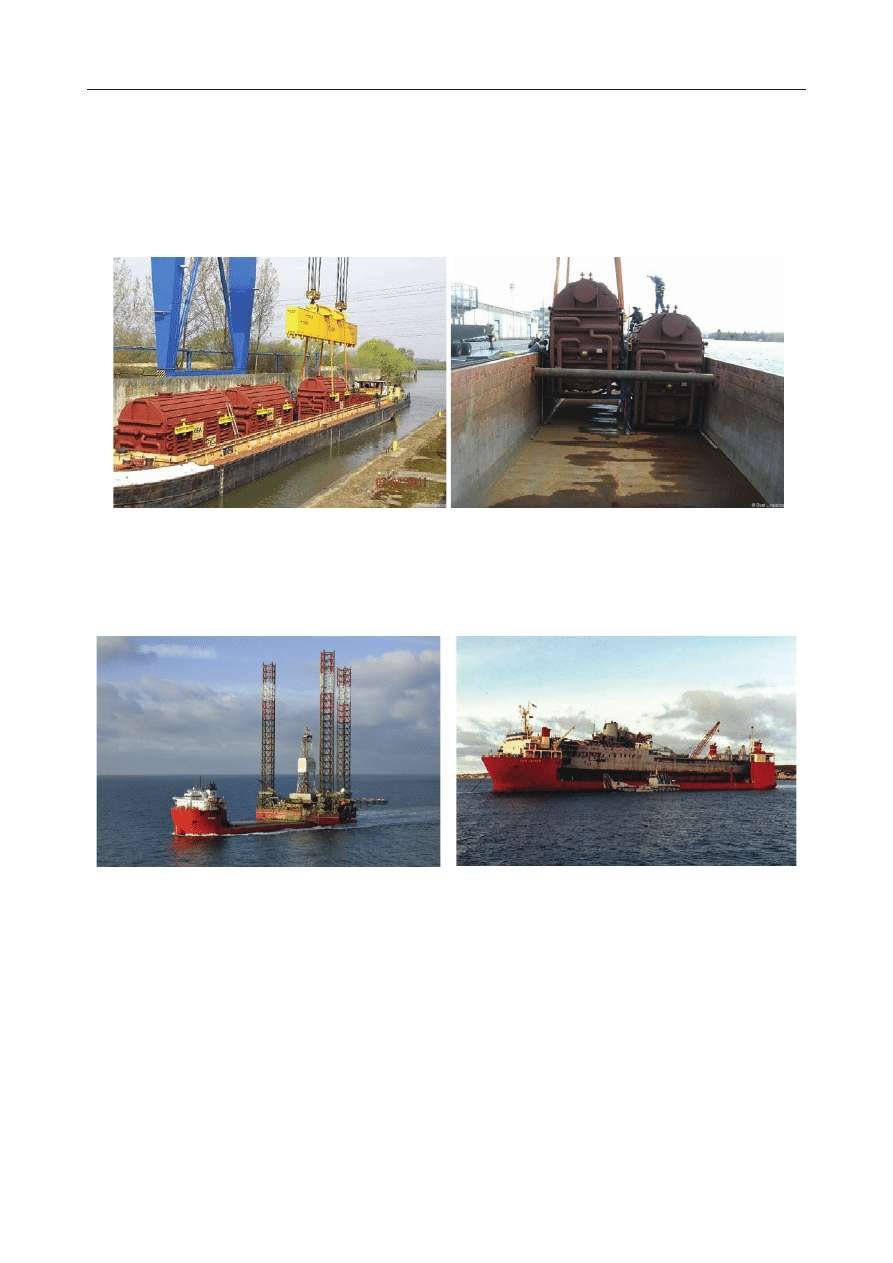
bridges, lock gates etc.), so that the helmsman has restricted vision (Fig. 5).
Fig. 5. Transport of oversize elements, operated by Best-Logistic Sp. z o.o. [5]
In sea transport oversize cargo items are sometimes a few hundred metres in length, weighing
from a few hundred to several thousand tons. Therefore, they are carried by dedicated ships.
Examples include drilling rigs, cranes, ships, yachts, turbines etc. (Fig. 6 and 7).
Fig.6. Transport of a drilling rig [9]
Fig.7. Transport of a frigate USS Samuel B. Roberts [4]
Taking all above into account, it seems that the most adequate definition for all modes of
transport can be formulated as follows:
“Oversize cargo is called a cargo that exceeds mean allowable parameters of a vehicle in terms of
dimensions, shape geometry or allowable loads on unit surface area”.
3. Oversize Baltic Project
One of the study under the South Baltic Project, approved for implementation in 2009, is
related with the transport of oversize cargo in the South Baltic region.
At present nearly each industrial investment requires transfer of various structural elements and
equipment, whose dimensions exceed standard size of transport vehicles (trucks, wagons etc.).
Cargo that needs special means of transport and lifting facilities to be moved is called oversize
101

W. Galor, A. Galor
cargo, although other terms are sometimes in use, such as outsized, bulky or non-standard cargo,
heavy lifts etc.
Some examples of oversize cargoes include elements of land and marine structures (sea
platforms, elements of tunnels, bridges or pipelines, power line pillars, turbines, etc.). These often
require precision and special conditions of the manufacturing process (including special tools). As
a result, structural elements are made in one place and have to be transported to their destination as
oversize items of cargo. The number of construction sites where these large elements are needed is
on the rise in Poland (e.g. LNG terminal in ĝwinoujĞcie) and Europe alike.
The transport of oversize cargo is indispensible to develop such sectors as industry, power
supply or infrastructure and, undoubtedly, makes up an important part in any major investment
project. It significantly affects the economic development of each country, where, however,
various regulations and solutions are in use [1].
Transport of this type is the last link of a long chain of specialized logistic operations. The
oversize transport operator has to make careful preparations, provide for proper equipment and
have experience in oversize cargo carriage. For the entire operation to be successful, the
appropriate route has to be selected along with the right vehicle, and the plan for loading and
securing each bulky or heavy item has to be drawn up [15]. Vehicles adjusted to carry oversize
cargo generally have the dimensions; load capacity, design and marking that differ from standard
vehicles. Cargo handling equipment has much higher lifting capacity than cranes or other
machines handling standard items.
Besides, to arrange a smooth movement of the oversize cargo carrying vehicle, one needs
special permits and other arrangements with transport infrastructure managers concerning the
route, and, naturally, cargo has to be insured. If the transport is international, the operator has to
satisfy the requirements of the region to be crossed, which sometimes is very difficult.
Each country in the South Baltic region has different procedures required to prepare the transport
of oversize cargo and to actually transfer such items from one point to another. These procedures
are sometimes very time-consuming and costly, due to the need to adjust the route to oversize
cargo and vehicle (e.g. a too small roundabout lying on the route of oversize transport has to be
dismantled, then restored) [1]. The development of a joint strategy, practices and creation of new
principles in this sector might increase the economic competitiveness of the South Baltic region.
In this connection, aimed at the improvement of the quality of oversize cargo handling in the
South Baltic region, the Oversize Baltic project is being implemented. Commenced in July 2009,
the project is scheduled to end in June 2011. The project, headed by the Klaipeda Science and
Technology Park, comprises partners from Poland, Germany, Lithuania and Sweden [10].
The main objectives of the Oversize Baltic project include:
1. development of an oversize cargo transport strategy, which will enhance the attractiveness of
the region,
2. creation of an information network that will raise the efficiency of oversize transport in the
South Baltic region (integration point where an appropriate permit will be obtained along with
information on route details),
3. creation of a database on available routes for oversize cargo transit, existing transport
infrastructure and obstacles, which will increase transport effectiveness,
4. enhancing the safety associated with the carriage of oversize pieces,
5. improvement of the co-operation in trade and infrastructure of the developing regions, which
will contribute to an increase in the competitiveness of the region on the global market of
transport services.
As a result of project implementation, five strategies are to be established for oversize transport:
four regional strategies for Germany, Poland, Lithuania and Sweden, and a joint strategy for the
entire South Baltic region. Besides, an Oversize Transport Information Network (OTIN) is to be
created. The network will provide information on carriage, maps of possible routes by various modes
of transport in the South Baltic region and will enable submitting an application for transport permit.
102

Oversize Cargo Transport in the Polish Part of South Baltic Region
The South Baltic Program covers both ‘new’ and ‘old’ EU member states, where substantial
disparities exist in the level of social and economic development. The aid provided under this
program focuses on two major priorities of co-operation:
Priority 1. Economic competitiveness.
Priority 2. Attractiveness and joint identity.
Priority 1 envisages support for projects aimed at developing enterprise, integration of higher
education and job markets, as well as regions transport accessibility.
Priority 2 comprises actions taken to support projects concerned with the environmental
protection of the Baltic Sea, saving energy and renewal energy, sustainable use of natural
resources and cultural heritage for the regional development, and initiatives of local communities.
Activities relating to transport accessibility include the preparation of feasibility studies of
undertakings aiming at the elimination of transport bottle necks within the South Baltic coastal
area. Additionally, there are plans to make joint efforts to improve the quality of transport links
and creating new ones. Besides, proposals are expected to provide solutions for increasing the
quality and life cycle of passenger transport means in the region [11].
4. Infrastructural restrictions in each mode of transport
Restrictions connected with the existing infrastructure have to be taken into account while
organizing the transport of oversize cargo. The fewest such restrictions exist in air and maritime
transport. In the latter case relevant restrictions may be those of port infra- and suprastructure.
Operators of bulky and heavy pieces have to take into account the use of specialized high lifting
capacity facilities, allowable load on the quay and sufficient depth along the berth, enabling ships
to moor. A sufficient depth of a port basin is needed for submersible ships to submerge to the
required depth (the ship submerges, the cargo such as a drilling platform is being towed over the
ship’s deck, the ship goes up, and the cargo is secured on deck).
In air transport the basic infrastructural restriction lies in the capability of the airport to handle
the cargo and the plane (e.g. runway length), as well as the transport links with the hinterland.
In inland waterway transport major restrictions result from the parameters of the navigable
routes and locks, air clearance under bridges, pipelines and other facilities crossing the waterway,
the width of bridge spans and the width of waterway channels. In this connection, regional
waterway authorities issue orders specifying vessels’ and push trains dimensions that are permitted
to navigate along particular waterway sections [1].
In rail transport restrictions refer to, first of all, the loading gauge and the building gauge, load
on one running meter of rail, [13], arcs of rail bends and transverse inclination of the rail track,
bridge and flyover load capacities, tunnel and other infrastructure facility size, sometimes the
varied transit speed. Additionally, the existing semaphores, signs, junctions, water towers, crossing
attendant’s house, railways stations and platforms, distances between platforms etc. have to be
taken into consideration as well.
Road transport faces the greatest number of various limitations connected with the carriage of
oversize cargo. Route planners have to take into account the width of transit roads, bend radiuses,
existing road signs and posts, height and width of clearances under bridges and flyovers, allowable
bridge load capacity, roundabouts, safety islands, allowable road surface load, electric and rail
tractions, road repairs in progress etc. Quite frequently the mentioned obstacles have to be
removed for the time of transit. This means dismantling of road signs or even roundabouts and
lifting overhead tractions. Even if the shortest route to the place of cargo destination is about 100
km, with all diversions it may take 300 km to carry one particularly bulky or long element. There
is a lack of immediately available information on the parameters of bridges and flyovers, and other
restrictions on each road. As a result of all such difficulties, the end recipient of the cargo pays
more and waits longer for the delivery [15].
103
W. Galor, A. Galor
5. Characteristics of OC transport orderers
Companies ordering oversize transport services include various firms, operators and
government institutions. However, it should be borne in mind that places where oversize cargo is
sent and received differ from the headquarters locations of the OC transport orderer or recipient.
Transport operations are usually carried out between the place of production and destination.
Under the Oversize Baltic program the area of Northern Poland was examined in view of OC
transport. Besides, the transport corridor linking Berlin and Moscow was reviewed on the grounds
that it is the main east-west link that has proper infrastructure capable of accommodating OC
transport [14].
The following factors were taken into consideration in determining places of production and
reception of oversize cargoes:
1. existing and planned wind farms,
2. special economic zones,
3. presently executed and planned investment projects.
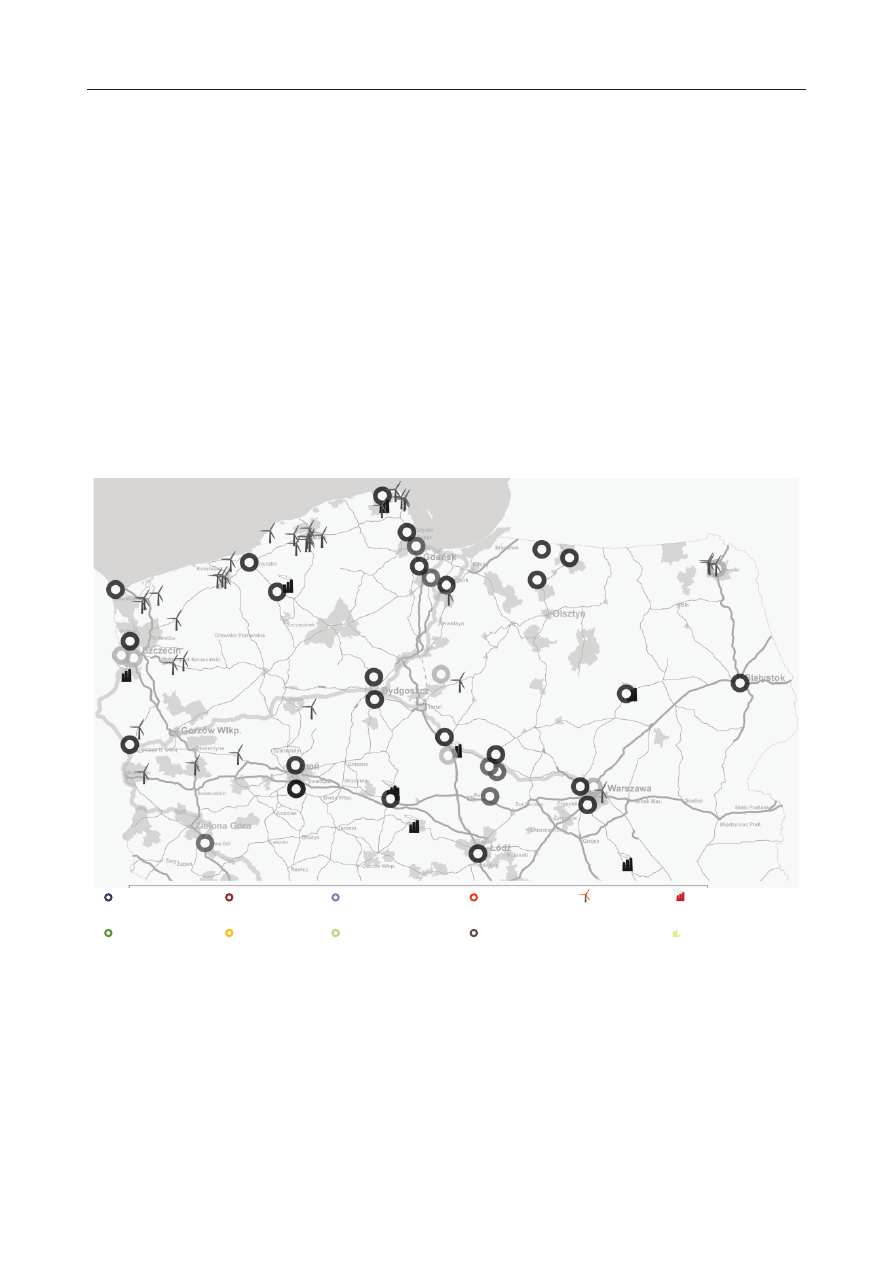
Example locations of currently executed and future investment projects, and OC manufacturing
sites are shown in Fig. 8.
Power stations
River ports
Power plants
Refineries
Wind
farms
Existing power
plants
River
shipyards
Machinery
production
Cranes and g
cranes product
antry
ion
Marine engines production
Special
economic zones
Fig. 8. Potential
facturing and reception of oversize cargoes
. Methodology of designating transport corridors
he ‘Strategy for oversize cargo transport for the South Baltic Region’, recommends
inc
sites of manu
6
T
reasing the share of maritime, river and rail carriage in oversize transport. For this reason the
infrastructure of all modes of transport has been taken into account in preparing the concept of
transport corridors. Besides, it has been assumed that corridors for OC transport should mainly
make use of the existing TEN-T – Trans-European Transport Network. However, it turned out that
104
Oversize Cargo Transport in the Polish Part of South Baltic Region
in the area under consideration, these corridors run only along the north-south direction. Therefore,
the examined area has been extended to include the Berlin-Moscow corridor [14].
The process of determining transport corridors began from collecting the maps with the
existing roads, rail tracks and inland waterways that are adjusted to accommodate oversize
transport, then the point infrastructure was mapped, e.g. sea and inland ports that may become
major reloading sites for OC carriage. Then the maps were supplemented with infrastructure to be
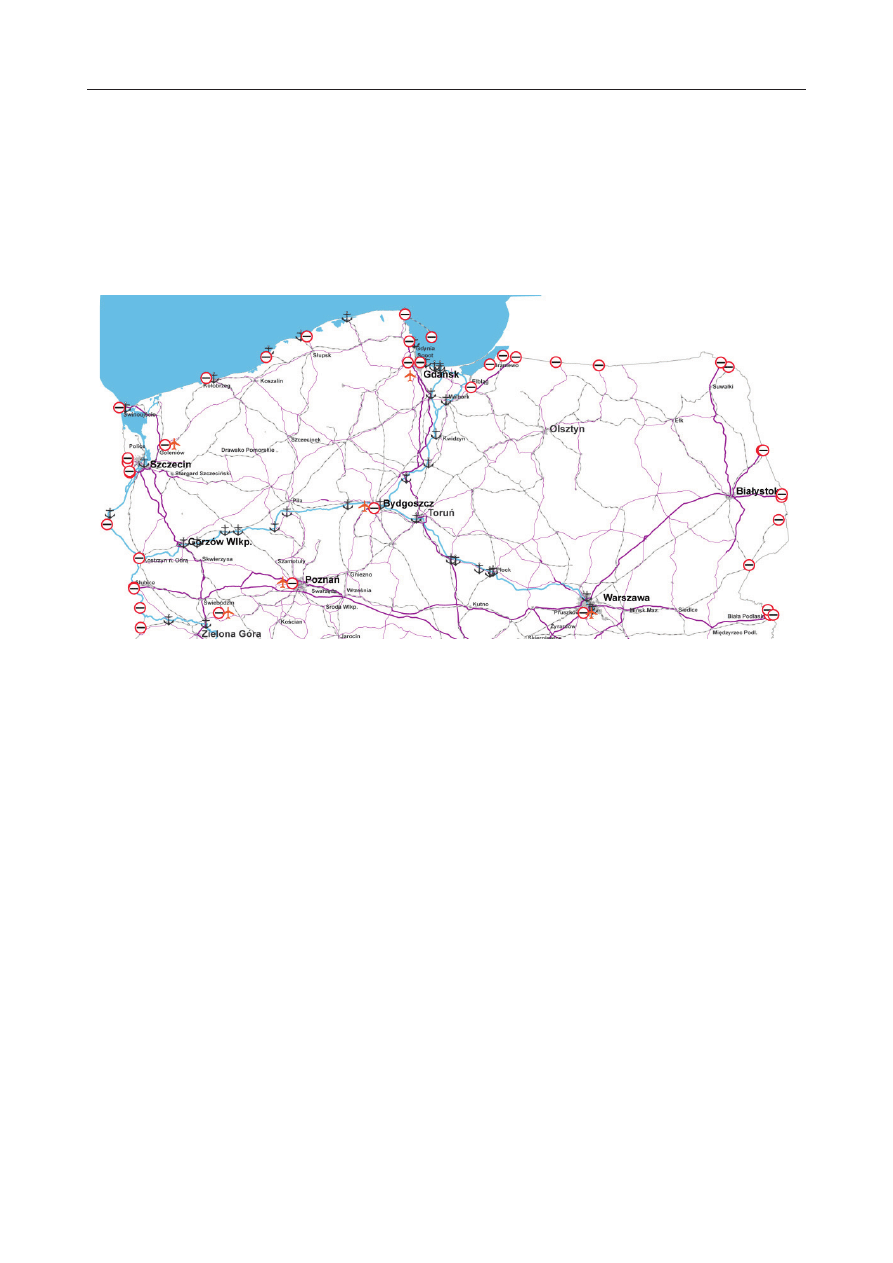
built or modernized till 2020 and which will be adequate for OC transport (Fig. 9). The next stage
was the mapping of potential points of sending and reception of oversize cargo [2].
Fig. 9. Transport infrastructure adjusted to OC transport
OC transport corridors were determined by taking into account places where oversize goods
are
. Conclusions
nalyses of transport corridors that might be selected for oversize cargo carriage indicated that
the
ransport are connected:
1.
nected with the
lems.
vement of oversize
manufactured, places in Northern Poland to which such goods may be sent, the road, rail and
waterway networks, potential points of transshipment to other modes of transport [12].
7
A
existing rail and road infrastructure is not fully adjusted to such operations. To create
conditions for the development of OC transport in the South Baltic Region, new investment and
modernization projects should account for this type of transport. When sufficient funds are
provided, the existing infrastructure should be adjusted to oversize cargo transit. Some works,
presently performed by OC carriers for temporary adjustment to let one or a few OC transits,
should result in permanent conversions facilitating future OC transport. All these investments
should concentrate along the designated transport corridors. Another very important aspect of OC
carriage intermodality is that permit-issuing bodies should enforce the use of waterways and
railways on carriers in order to relieve congested roads.
Besides the following problems with oversize cargo t
Each country within the Baltic Sea region has different procedures con
preparation of oversize cargo for transport, and the transport itself.
2. At present the transport of oversize cargo encounters numerous prob
3. Road transport, the most common form of transportation used for the mo
cargo (over 30 000 permits issued in 2008, over 24 000 in 2009), faces the largest number of
problems.
105

W. Galor, A. Galor
4. Information on existing obstacles or possible transit routes is not easily available.
cargo pieces
ove the quality of oversize cargo
eferences
] Galor, A., Galor, W., Problematyka krajowego transportu áadunków ponadnormatywnych
transportu
5.05.2011].
5.2011].
11].
.
Transportowa, 8.10.2008.
aátyku –
ttp://www.logistyka.net.pl [dostĊp:
5. No specific instructions or guidelines exist in reference to the correct securing of
on road vehicles in Poland, while in Germany, for instance, there are specific transport
standards of cargo securing and they are strictly enforced.
6. The Oversize Baltic project is underway, aimed to impr
handling in regions around the Baltic Sea. The project will result in a joint strategy and
practices and the creation of new principles, which may increase the economic competitiveness
of the Southern Baltic region.
R
[1
w aspekcie przewozów w regionie poáudniowego Baátyku, Logistyka, Nr 2, 2010.
[2] Galor,
A., Galor,
W., WiĞnicki, B., Koncepcja korytarzy transportowych dla
áadunków ponadnormatywnych w regionie poáudniowego Baátyku, Logistyka, Nr 8, 8 p., 2010.
[3] Galor, W., Galor, A., Transport áadunków ponadgabarytowych, XIII MiĊdzynarodowa
Konferencja Naukowa „Transcomp 2009”, Radom 2009.
[4] http://ukarmedforcescommentary.blogspot.com [dostĊp: 1
[5] http://www.best-logistics.com [dostĊp: 15.05.2011].
[6] http://www.funduszeeuropejskie.gov.pl [dostĊp: 15.0
[7] http://www.hartwig.katowice.pl [dostĊp: 15.05.2011].
[8] http://www.metalchemserwis.pl [dostĊp: 15.05.2011].
[9] http://www.offshoreenergytoday.com [dostĊp: 15.05.20
[10] http://www.transportoversize.eu [dostĊp: 15.05.2011].
[11] http://www.transportoversize.pl [dostĊp: 15.05.2011].
[12] Materiaáy firmy Bedmet Logistic Damian Bednarz sp.k
[13] Mincewicz, J., Trudne przewozy kolejowe, Polska Gazeta
[14] Strategia dla przewozu áadunków ponadnormatywnych w Regionie Poáudniowego B
Polska, Akademia Morska w Szczecinie, Szczecin 2010.
[15] Transport ponadgabarytowy – Schenkeroversized, h
15.05.2011].
106
Wyszukiwarka
Podobne podstrony:
httpwww bg utp edu plartpe32006pe32006117124 (1)
httpwww bg utp edu plartbtp2012010bezpieczef1stwo zc
httpwww bg utp edu plartbtp2022 Nieznany
httpwww bg utp edu plartbtp2032009klimiuk
httpwww bg utp edu plartdiagnos Nieznany (3)
httpwww bg utp edu plartdiagnos Nieznany
httpwww bg utp edu plartzn20uz1 Nieznany
httpwww bg utp edu plartbtp1 22012pozapb3acowe20formy20pobudzania20motywacji2
httpwww bg utp edu plartme22012mozdzonek
httpwww bg utp edu plartdiagnos Nieznany (2)
httpwww bg utp edu plartbtp2032009klimiuk
httpwww bg utp edu plartwybrane Nieznany
httpwww bg utp edu plartpe32006pe32006117124 (1)
httpwww bg utp edu plartbtp2012010bezpieczef1stwo zc
httpwww bg utp edu plartbtp2022 Nieznany
httpwww bg utp edu plartpe1 32010burchart
więcej podobnych podstron