
Tourism Scotland 2020
The future of our industry, in our hands
A strategy for leadership and growth


Recent years have seen Scotland’s tourism industry maintain
its position as a key contributor to the nation’s economy,
generating an annual visitor spend in excess of £4.5bn.
These same years however, have also seen visitor
expectations grow ever more sophisticated with a shift away
from individual tourism attractions towards more rounded
experiences, delivered to a consistently high quality at each
point of the customer journey.
The opportunity for Scotland, if we’re to accelerate growth
and get as close to our full potential as possible, is to up our
game collectively and turn our
nation’s many tourism assets
into quality, authentic visitor experiences
– inspiring our
industry strategy, Tourism Scotland 2020.


At a glance
Page
Foreword
Stephen Leckie,
2
Chair of the Tourism Leadership Group
& Scottish Tourism Alliance
Tourism Scotland 2020
Today’s industry
4
Tomorrow’s opportunity
6
Playing to our strengths
8
Priorities for action
12
Measuring our success
16
Our industry, in our hands
18

2
Foreword
“Tourism Scotland 2020 is a strategy for the industry, by the industry.
It’s the product of extensive consultation, led by the Tourism
Leadership Group (TLG), and it’s the means by which the Scottish
Tourism Alliance (STA) will lead the many different businesses and
stakeholders across the sector to deliver one common goal for 2020
and beyond. Making Scotland a destination of first choice for a
high quality, value for money and memorable customer
experience, delivered by skilled and passionate people.
“As strategies go it’s ambitious – just as we are – yet it’s realistic too,
based on the collective input of private and public sector; thorough
research into consumer trends, our tourism industry and international
tourism destinations; and careful analysis of the best available market
forecasts.
“Driven by the need to adapt to a changing industry and uncertain
economic climate, it provides a snapshot of where we currently stand,
the step changes we need to bring about in order to fully capitalise on
our assets, the potential financial rewards when we do and the
priorities for action.
“At the heart of the strategy is growth via quality, authentic visitor
experiences. In other words, highlighting those aspects of our assets
that are uniquely Scottish, be they contemporary Scotland or more
traditional, and delivering them to the highest possible standard at
each and every point of the customer journey.
“Leading delivery and providing a strong industry voice throughout will
be the STA. Equally critical however, is that each and every one of us
within the industry rallies round the strategy, embracing the common
agenda it sets out, giving it our full support and taking the initiative in
our own areas.
“Much has been done in recent years to make more of Scotland's
tourism assets at a local level through destination groups and with the
support of local authorities. We need to build on this as a collective,
sharing experiences and good practice more widely across
destinations.

3
“Completing the picture we need the support of Scottish Government
and public sector agencies too, aligning their tourism activities with
our industry strategy.
“Then, and only then, will we set ourselves on course to achieving our
vision for 2020 and beyond: Scotland
– a destination of first choice.
“Thank you to everyone who has given their time and energy so far to
help shape the strategy. I look forward to working with you all on the
detailed action plan that will follow on from it and the delivery of that
plan at business, local and national level.”
Stephen Leckie,
Chair of the Tourism Leadership Group
& Scottish Tourism Alliance

4
Today’s industry
Without doubt, tourism is one of Scotland’s key economic
contributors with overnight visitors generating in excess of £4.5bn
annually and day visitors contributing a further £6.2bn, giving a
total spend close to £11bn (2011 figures).
Not only that but tourism accounts for over 200,000 jobs
– many in rural
areas, helping less populous communities to prosper
– across 20,000
different tourism-related businesses, while also feeding into other sectors
such as food and drink, retail, transport and construction.
Scotland’s special appeal
Drill down further and the appeal of Scotland’s mainland and islands can be
largely attributed to four groups of assets.
Nature, heritage and activities
With dramatic landscapes and seascapes, a rich and colourful history,
and vibrant culture, Scotland serves as a truly unique backdrop for
holidays and short breaks, offering visitors a wealth of things to see
and do: golf, walking, wildlife-watching, adventure sports, visiting
castles and historical sites, to name just a few.
Destination towns and cities
Our destination towns such as St Andrews, Pitlochry and Oban, along
with our internationally-renowned cities including Edinburgh and
Glasgow, hold great appeal for leisure and business travellers alike,
whether as destinations in their own right or as bases from which to
explore our wider visitor offer.
Events and festivals
International attractions including the Edinburgh Festivals, high-profile
events such as the Commonwealth Games, Ryder Cup and Year of
Homecoming, or smaller, local initiatives like the Tiree Wave Classic
that help to extend the tourism season
– Scotland’s events and
festivals add to the uniqueness of the experiences on offer.
Business tourism
With our quality venues and facilities, a proven track record in staging
major conferences and exhibitions, not forgetting plenty to see and do
out of working hours, Scotland is a popular destination amongst
business tourists.

5
All of which contribute to our brand essence as being a
“dramatic, enduring
and human” destination.
It’s not just our tourism assets that set us apart but our people too, with the
renowned pride and friendliness of our nation earning us a reputation for
being a very welcoming destination. So far, so positive.
Where we could do better
Customer feedback tells us that there are also areas in which we could be
doing better. In particular, by addressing variations in quality when it comes to
accommodation, eating out, travelling to and around Scotland, and internet
and mobile phone coverage.
Each of these has an important role to play in shaping visitor impressions,
with
today’s travellers expecting a high level of service at each and every
turn. Yet in Scotland, we’re told, quality still varies from one provider to the
next. We need to act now and we need to act together
– the more of us that
do, the greater the likelihood of Scotland encouraging visitors to return again
in the future and recommend us to others.
That’s not the only area in which we need to up our game. Increasingly,
visitors are seeking more rounded experiences with a variety of things to see
and do. Our international research shows that competitor destinations have
been quick to respond, integrating their efforts across their respective
industries to offe
r experiences that are tailored to visitors’ personal interests.
Scotland, on the other hand, has still to react as a collective. We need to think
not just about what our own individual businesses can offer, but also the way
in which other attractions, activities and places to eat and drink might make
visitors’ stay all the more enjoyable – and be in a position to recommend local
providers who can be relied on to deliver.
Changing with the times
So what does this tell us as an industry? It tells us that there is much work to
be done if we are to meet visitor expectations of a consistently high level of
quality and customer service. It tells us that whilst we have in our favour
some fantastic tourism assets, we are not maximising our potential
– we are
focusing too intently on our individual businesses and products, and not
enough on customers’ overall experiences. And it tells us that we have to
work together more at business, local and national level to start shaping
Scotland’s many different assets into the authentic experiences that visitors
are seeking.

6
Tomorrow’s opportunity
Despite 2011 delivering an encouraging improvement on 2010 with
overnight visitors increasing by 9% and a similar increase in real
terms spend, longer term performance has been more modest.
In fact, if the long-term trend in overnight visitor spend witnessed since 1973
was to continue, we would see little or no real growth in the coming decade
–
a reflection of increasing costs, new competitor destinations and the fact that
Scotland is a mature tourism destination operating largely in well-established
markets such as Western Europe and North America.
Add to this the realisation that opportunities in emerging markets will naturally
take some time to produce notable results, along with the continuing
economic uncertainties facing our traditional markets, and the long-standing
picture
doesn’t look set to change any time soon. Unless that is, we as an
industry change.
Fresh focus, new goals
What is our potential for growth if we do change? Using forecasts by
internationally recognised experts Tourism Economics as the best available
indicator of our full potential, and official long-term tourism statistics as the
baseline, our ambition for the industry as a whole is to break from the status
quo and achieve an annual visitor spend of between £5.5bn and £6.5bn by
2020. This would generate an additional £1bn or more (at 2011 prices).
While this ambition does take into account the fact that different opportunities
and challenges exist for different parts of the tourism industry, it is not without
risk or uncertainty. But it does indicate just how much growth is possible
– if,
as we hope, the economic trend reverts to one of global growth and if we
collectively get right the factors that are within our control.
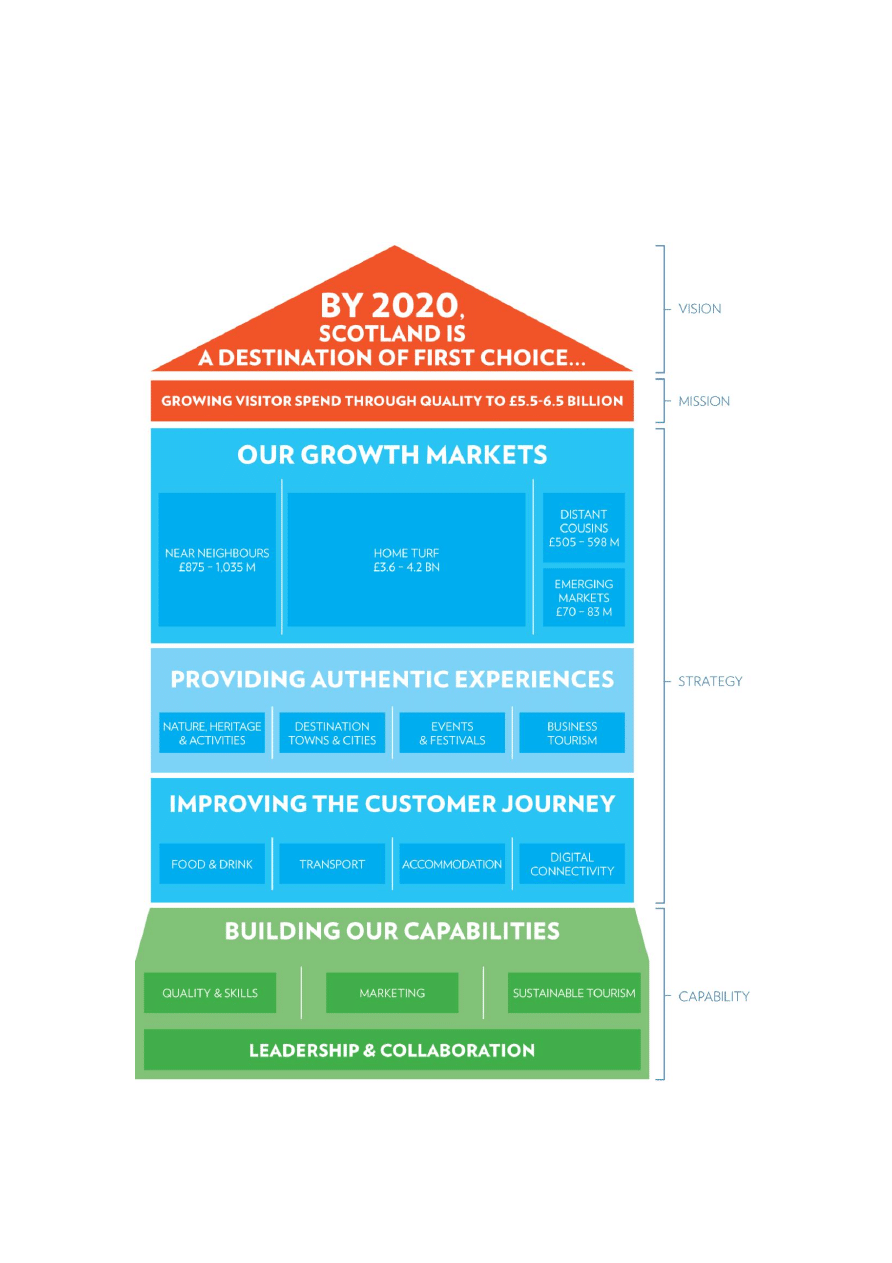
Our growth markets
So where does the greatest potential for growth exist? Forecasts indicate that
three main pillars will account for most of our visitor spend in 2020, just as
they do now:
Home turf: £3,127m in 2011, potential £3,586m
–£4,238m in 2020
England, Scotland, Northern Ireland, Wales
Near neighbours: £731m in 2011, potential £875m
–1,035m in 2020
Scandinavia, Germany, France, Spain, Ireland, Netherlands, Italy

7
Distant cousins: £414m in 2011, potential £505m
–£598m in 2020
USA, Australia, Canada
In addition to these main pillars of growth, we will also step up our efforts in
the emerging markets. Whilst growing strongly globally, they are unlikely to
deliver significant returns for Scottish tourism in the short to medium-term,
due in part to challenges posed by transport links and visa requirements:
Emerging markets: £33m in 2011, potential £70m
–83m in 2020
India, China, Russia, Brazil
Longer term however, their contribution to Scottish tourism does look set to
grow more markedly. If we want to be in a position to service and capitalise
fully on these and other emerging markets we need to act now by aligning our
tourism offer with what our market intelligence tells us about them.
A balanced portfolio
Combined, these markets add up to a balanced portfolio based on our
greatest growth potential but one that also gives us the flexibility to adjust our
plans in the event of any significant market changes.
Ambitious? Undoubtedly. Achievable? Yes, if we build our capabilities and if
we play to our collective strengths.

8
Playing to our strengths
Key to us achieving our growth ambitions will be turning Scotland’s
tourism assets into the more rounded, added value experiences
that today’s visitors want.
It’s a change in focus and approach that needs to happen at two levels: within
assets and across assets.
Developing our assets
Market analysis has identified that some assets offer significant potential for
growth. Indeed, many of our main tourism destinations now have in place
clear strategies for growth. For example, Edinburgh, Glasgow and their
surrounding areas already account for almost £1.8bn tourism revenue per
year and they have ambitions to grow this substantially.
In many of our rural destinations meanwhile, where tourism is often the
mainstay of the local economy, businesses and industry groups are also
working together to grow the value of tourism in their areas by making more
of assets such as walking and cycling, adventure tourism, food and drink, and
local history and culture.
Other assets identified as having real growth potential include:
Asset
Estimated value
Identified growth potential
Activities &
adventure
£759m
Extra £89m by 2015
Source: Adventure Tourism in Scotland 2010
Business
tourism
£817m
Being prepared
Source: International Passenger Survey 2006-10 and
UK Tourism Survey 2006-10
Cruise
£32m
Potential for 1.1m visitors by 2029
Source: Cruise Tourism in Scotland 2010
Golf
£220m
10%-53% over 10 years
Source: Scottish Golf Tourism Market Analysis 2009
Mountain
biking
£119m
Extra £36m by 2015
Source: Economic Value of Mountain Biking in Scotland 2009
Sailing
£101m
Extra £44m by 2020
Source: Sailing Tourism in Scotland 2010
Comparison should not be made between the estimated values and growth potentials for different assets
as research methodologies vary between studies.

9
What do we need to do to turn this potential into real profit? First and
foremost, we need to build local and national networks consisting of partners
who are equally committed to quality and customer service, identifying where
we can combine complementary products and services to offer visitors an
easier, more enjoyable experience.
We also need to develop assets in response to specific market opportunities.
For example:
Nature, heritage and activities
– embracing the opportunity
presented by Year of Natural Scotland to more widely promote all that
we have to offer: from wildlife-watching, hill-walking and sailing,
through country sports, farm stays and visiting castles, to adventure
sports and learning about our ancestors
Destination towns and cities
– more widely promoting the diversity
of things to see and do, contemporary and traditional, within our
destination towns and cities in order to extend their visitor seasons
Events and festivals
– developing further our reputation as a world-
leading events destination, building on our enviable position in the
sporting arena and our ability to host major cultural events such as the
Edinburgh Festivals and Celtic Connections
Business tourism
– maximising the return on investment delivered
via the new facilities being developed at the SECC and EICC by
showcasing Scotland’s proven track record in successfully staging
international conferences and events.
Turning assets into experiences
In tandem with developing specific assets we also need to collaborate across
assets in order to offer visitors a diverse range of authentic experiences. In
other words, experiences which are underpinned by elements unique to
Scotland, and therefore cannot be easily replicated by our competitors.
Consumer research shows that people want to feel that they have had an
authentic experience, taking in a wide range of things to see and do: from
gleaning an insight into a destination’s past to appreciating its contemporary
offer, interacting with its people and sampling its local produce.
We need to respond to this with a diverse range of experiences that bring
together the different touch points along the customer journey
–
accommodation, travel, activities, eating out
– and are underpinned by
authenticity, quality and a strong ethos of customer service.

10
Get it right and we will significantly increase the perceived value to the visitor
and offer them a greater incentive to visit, return and recommend us to
others, helping make Scotland a destination of first choice.
What’s more, doing the legwork on behalf of our visitors and making it easier
for them to use a wider range of tourism products and services once here will
also help boost takings and profits.
Building our capabilities
Playing to our strengths is one half of the step change required of us. In order
to develop quality, authentic tourism experiences that meet the needs and
wants of our markets, we must also build the capability of our businesses and
the industry as a whole in certain key areas:
Leadership and collaboration
Delivering our growth ambitions will rely on industry-wide collaboration
on a common agenda, with strong leadership at business, local and
national level
Quality and skills
All of us, as an industry, must commit to gaining and enhancing the
relevant skills, knowledge and customer-focused attitude required to
deliver consistently high quality experiences for all visitor profiles
Marketing
Utilising the market intelligence at our disposal we need to align our
tourism offer with visitor expectations, present
Scotland’s assets as
experiences and promote these experiences more consistently by
building on our overarching Scottish tourism brand
Sustainable tourism
With sustainable economic growth as our goal, we must seek to
maximise our operational efficiency and environmental performance,
minimise our impact on the local environment and connect with our
communities to deliver real benefits.
It is by building our capabilities in each of these four areas and by turning our
assets into experiences targeted at our growth markets that we will give
ourselves the best possible chance of achieving our ambitious growth
aspirations.
11

12
Priorities for action
Bringing about the necessary step changes in our industry will
require collective action based on shared goals, delivered at
business, local and national level.
Work has already begun on drawing up the detailed action plan that will
deliver our national strategy, Tourism Scotland 2020.
Building on the good work being done by local tourism groups, local
authorities and others, this action plan will provide a fresh challenge to all of
us in the industry, with the STA playing a central role in encouraging
businesses, destinations, sectors and other stakeholders to get involved.
The wider opportunity however, starts here t
oday. It starts with Scotland’s
tourism industry committing to work together on one common agenda:
turning our nation’s assets into authentic, value added visitor
experiences that appeal to our key growth markets.
Ambition into action
With this drive to turn assets into experiences as our priority, the action plan
for delivering Tourism Scotland 2020 will detail a number of specific steps we
must all take to build our capabilities, and in doing so make us better placed
to achieve our aspirations:
Knowing our markets
Focusing on our three main pillars for growth
– home turf, near
neighbours and distant cousins
– along with the longer-term
opportunities presented by the emerging markets, we will use the
market intelligence available to us to better understand visitor
motivations and expectations in each market. For example, we will
look at how we can respond to the demand for accessible tourism,
which contributed more than £325m in Scotland in 2009.
We will then shape our assets into tourism experiences accordingly,
detailing this in clear market plans.
That done, we’ll integrate our marketing efforts to promote our tourism
experiences in ways that are relevant to the target market and make
greater use of the Scottish tourism brand at business, local and
national level, reinforcing VisitScotland’s work promoting Scotland as
a destination.

13
We will also
tap into audiences’ increased usage of digital technology
such as apps, SMS, email and web to communicate with our
customers by their preferred means before, during and after their visit.
Managing the customer journey
Throughout, we will do whatever we can within our individual
businesses and beyond our businesses to provide a consistently high
quality of visitor experience at all points along the customer journey.
It’s about asking ourselves: ‘Which local products, places and services
could I proactively recommend to my customers to help make the
visitor experience more memorable?’ ‘What could I be doing to make
the experience more accessible
– and therefore, appealing – to all
visitor profiles?’ ‘And who could I partner to help make all of this
happen?’
It’s about making a firm commitment to quality and delivering on it,
whether that’s by acting on consumer feedback, participating in
industry quality schemes, investing in training and development,
attracting new talent to address skills or knowledge gaps, or leading
by example in terms of attitude and exemplary service.
It’s also about addressing fundamentals such as providing a
consistently good standard of accommodation regardless of location.
This includes investing in new and upgraded accommodation, and
developing the skills needed to make a convincing case for such
investment.
Likewise, we need to offer a consistently high quality of experience
when it comes to eating out, making greater use of local food and
drink produce.
Every business must play its part. Even those businesses with no
aspirations to grow their market share any f
urther. Because it’s only by
building local quality networks, putting our collective weight behind
those and developing people’s skills and knowledge that we will bring
about the step change necessary to improve visitor satisfaction. And
satisfied visitors can only be good news for any of us earning our
livelihoods from Scotland’s tourism industry.

14
Building sustainable tourism
In tandem with shaping a better quality visitor experience, we will also
be building a more sustainable industry. Because this is not a strategy
for growth at any cost, this is a strategy for sustainable growth
–
economic, environmental and social.
Our market-driven approach, with collaboration at its heart, will help
ensure long-term economic sustainability. Reinforcing this we will be
looking to, and learning from, examples such as M&S Plan A or the
Scotch Whisky
Industry’s Environmental Plan, and proactively seeking
out more efficient practices that benefit business, communities and
environment alike.
We will use our local provenance wherever possible, drawing on what
makes Scotland unique to create authentic, distinct tourism
experiences. Related to this we will think about ways to build
business, and with it our profit throughout the year
– not just during
peak season
– helping us achieve our full potential and our vision of
making Scotland a destination of first choice.
Strengthening leadership and collaboration
These are big step changes for our industry; changes that none of us
can bring about on our own. We need to work together more at
business, local and national level to maximise the potential of our rich
tourism assets, and we need strong leadership to help guide us and
support us along the way.
It starts with clear leadership within our own businesses:
understanding and
acting on market needs, promoting Scotland’s
tourism assets as authentic experiences rather than disparate
products, presenting a convincing case for investment, and playing
our part in delivering quality across all aspects of the customer
journey.
But it also needs a strong network of destination and local
partnerships working with sector organisations, local authorities and
others to share best practice and improve both the quality and
consistency of the overall visitor experience, while at the same time
delivering on local and national priorities.

15
Bringing it all together will be our industry leadership organisation
–
the Scottish Tourism Alliance
– which will lead the process of drawing
up a detailed action plan and co-ordinate its delivery, as well as
providing a common voice on key issues for the industry.
The STA will also work with sectors such as transport and finance,
along with others including the Scottish Government, to address the
barriers to growth that can’t be fixed by tourism alone. For example,
by helping to influence decisions that will:
Increase the number of direct air routes from our main growth
markets and enhance road, rail and ferry routes within
Scotland
Improve digital connectivity including free wi-fi hot spots in
cities, towns and visitor hubs
Open up access to investment
Reduce the burden of taxation such as VAT rates and Air
Passenger Duty, and other regulations that can put our
industry at a competitive disadvantage.
Better data
Helping us make informed decisions as we deliver the strategy will be
a drive to improve the accuracy, reach and relevance of the data
sources currently available to the industry, address any gaps in our
knowledge and ensure that up to date information gets where it’s
needed, when it’s needed.

16
Measuring our success
Overnight visitor spend and visitor satisfaction will be the key
measures by which we’ll gauge how well we are doing as an
industry.
Why these two measures specifically? Because they reflect the changes
we’re trying to bring about: increased spend in Scotland’s tourism industry
achieved by meeting and exceeding visitor expectations.
Overnight visitor spend
Overnight visitor spend has the added benefit of being consistently
measurable over time, enabling us to accurately gauge our progress towards
our ambition of generating an annual overnight visitor spend of between
£5.5bn and £6.5bn (in real terms at 2011 prices), equating to an additional
£1bn or more by 2020.
Visitor satisfaction
Visitor satisfaction will offer us crucial insights into whether we are delivering
the high quality, value for money, authentic
experiences that today’s visitors
seek. Therefore gathering and acting upon visitor satisfaction information
needs to be a major focus for the industry at all levels: national, destination
and business.
Across the sector we must put in place the mechanisms to ensure we are
able to gather information on a comprehensive and consistent basis in line
with the visitor experience and customer journey themes of our industry
strategy.
Adding to the picture
Helping to provide an even fuller picture still, we will also be tracking:
Overnight visitor numbers and length of stay
– we want to
encourage those holidaying to stay in Scotland for longer, while also
capitalising on the growing demand for short breaks
Average spend (per night and visitor)
– we want to encourage
visitors to spend more when with us by providing them with the types
of authentic experiences they want
Day visitor spend and numbers
– day visitors are a highly valuable
contributor to the sustainability of many tourism businesses.

17
Monitoring, reporting, acting
Our growth ambition is a dynamic indicator, and as such we will review
progress annually, tracking updated Tourism Economics forecasts, industry
performance data and progress against our action plan.
After three years, when we have a better idea of how the economic situation
is developing and have new actions underway with clearer indications of their
likely impact, we’ll carry out a more fundamental review.

18
Our industry, in our hands
That there is potential to grow our industry is without doubt. By
how much exactly depends on a number of factors, some of them
outwith our control. One of the single biggest requirements for
growth however, lies in our own hands
– working together as a
collective to a common agenda.
There are some great examples of this being done well already across the
industry. For example, a huge amount of progress has been made by strong
destination partnerships including the Edinburgh Tourism Action Group,
Cairngorms Business Partnership and St Andrews Partnership, along with
sector organisations such as Golf Tourism Scotland and the Scottish Country
Sports Tourism Group. Solid foundations are also in place for developing our
industry’s skill-set, thanks to the work of the Tourism Skills Group.
Tourism Scotland 2020 therefore, is not about starting completely from
scratch. But it is about doing more collaborative working
– much more –
something that the STA will lead, encourage and support throughout.
It’s about being clear on where our greatest growth opportunities lie, focusing
on what we must do to convert those opportunities, and wasting no time in
getting on and doing it.
It’s also about being responsive to change and adapting when necessary.
Because this is a strategy that will evolve in tune with what visitors want or in
response to wider economic conditions, in order to make the most of the
opportunities available to us.
So please, join the STA or make sure that you’re a member of a STA-
affiliated organisation in order to get involved and be kept fully informed of
progress against our action plan. And in the meantime, start thinking about
what you can do at business and local level.
The more of us that give the strategy our full support
, the sooner we’ll realise
our collective ambition for 2020 and beyond: Scotland
– a destination of
first choice for a high quality, value for money and memorable customer
experience, delivered by skilled and passionate people.
For further information or to get involved visit www.scottishtourismalliance.co.uk,
email mail@stalliance.co.uk or call 01786 459235.


Published June 2012
Wyszukiwarka
Podobne podstrony:
David L Robbins Endworld 24 New Orleans Run
Terry Davies, Sarah Cahill Environmental Implications of the Tourism Industry (2000)
24 Wykłady z Zarządzania Strategicznego
4-Tourism strategy summary, Turystyka, Turystyka uzdrowiskowa i odnowa biologiczna, Polityka i plano
A new control strategy for instantaneous voltage compensator using 3 phase PWM inverter
Analiza strategiczna PUDM (24 strony), Politechnika Częstochowska
Analiza strategiczna przedsiebiorstwa - komputery (24 stron)
strategia marketingowa firmy produkcja obuwia (24 strony) jqhtewkz7sk3gbu2oyuwmr2zjwavphutp4lysai
Strategia Bezpieczeństwa Narodowego RP 2007 new
Skrypt Studium Terapii Uzależnień, 24. Strategia pracy z osobami współuzaleĹĽnionymi, Strategia pr
Analiza strategiczna przedsiebiorstwa komputery (24 stron) 2
24 Strategia działania demonów(1)
China and the Jewish People Old Civilizations in a New Era Strategy Paper by Dr Shalom Salomon Wal
hobbit new zealand tourism
więcej podobnych podstron